
2026
2(86)
Judit Lopez-Besora*, Helena Coch**, Antonio Isalgue***
Adaptation and reuse of buildings:
how do traditional and contemporary buildings perform thermally
under real-world operating conditions?
DOI: 10.37190/arc260206
© by the Author/Authors. Licensee WUST.
Published in open access. CC BY-NC license.
Abstract
Promoting resilience in the built environment increasingly relies on the refurbishment and reuse of existing buildings to meet contemporary
performance and sustainability standards. Traditional buildings have character and strategic importance; however, they are often considered poorly
performing, though their inherent qualities can contribute to extending their lifespan. This study examines whether notable dierences exist between
traditional and contemporary construction systems in terms of thermal performance under real-world operating conditions. Continuous temperature
data were collected over a three-year period from two indoor spaces – one built using traditional techniques and the other employing contemporary
systems – both monitored under occupied and unoccupied conditions. The analysis included air temperature and radiant temperature of interior sur-
faces to evaluate the combined inuence of building characteristics and occupancy patterns. The ndings indicate that dierences between the two
construction systems are relatively minor, with occupancy exerting the dominant eect, bringing the thermal performance of both buildings closer
together. These results suggest that traditional architecture can achieve thermal performance comparable to that of modern constructions in Mediter-
ranean climate, highlighting its value as a resilient and sustainable component of the existing building stock through targeted building refurbishment.
Key words: traditional buildings, monitoring, thermal performance, radiant temperature, building refurbishment
Introduction
Traditional buildings in European countries constitute
a substantial portion of the existing building stock. The ex-
pansion of most cities and towns during the late 19
th
and
early 20
th
centuries resulted in an architectural legacy pre-
dominantly constructed using traditional techniques, prior
to the widespread adoption of more technologically ad-
vanced construction systems. This legacy is not conned to
major cities but is equally present in small towns and rural
areas, making traditional architecture both widespread and
territorially signicant.
From both cultural and environmental perspectives, tra
-
ditional buildings possess inherent values that merit pres-
ervation (Webb 2017; Galatioto, Ciulla and Ricciu 2017).
They stand as tangible evidence of historical construction
practices and are deeply intertwined with local cultural
identity (Akkurt et al. 2020; Mariani, Rosso and Ferrero
2018) oering a stark contrast to the homogenization and
placelessness often associated with the contemporary inter-
national style.
From an environmental standpoint, extending the lifes-
pan of existing buildings is a key strategy for reducing the
embodied energy associated with construction and lifecycle
processes. This can be achieved through regular mainte-
nance and context-sensitive updates, not only in traditional
structures but also across the broader stock of existing build-
ings. Additionally, the reuse of buildings contributes to the
revitalization of depopulated urban centres (Caro, Sen dra
2020), curbs land consumption linked to suburban sprawl,
and helps counteract territorial depopulation (Martín, Ma-
* ORCID: 0000-0002-8659-9346. Department of Archi tec tu ral
Tech nology, Uni ver si tat Politècnica de Catalunya (UPC), Spain, e-mail:
judit.lopez. besora@upc.edu
** ORCID: 0000-0001-9524-8057. Department of Architectu ral
Technology, Uni ver si tat Politècnica de Catalunya (UPC), Spain.
*** ORCID: 0000-0002-4354-5831. Physics Department, Univer-
si tat Poli tèc nica de Catalunya (UPC), Spain.
62 Judit Lopez-Besora, Helena Coch, Antonio Isalgue
zarrón and Cañas 2010). This latter aspect is essential for
promoting a more balanced and sustainable spatial distribu-
tion of population, thereby reducing the pressure on large
urban agglomerations.
Traditional architecture reects a symbiotic relationship
with climate and local environmental conditions. Building
dimensions, forms, and materials were historically adapted
to the availability of local resources and climatic needs. In
contrast, contemporary construction is increasingly shaped
by global market forces, prevailing trends, and standardized
regulations, especially those concerning thermal perfor-
mance. Traditional buildings are often perceived as thermal-
ly inecient, prompting owners to pursue major retrots or
even demolition (Ding 2013).
Policies often assume that traditional buildings are ther -
mal ly underperforming, directing subsidies toward HVAC
(Heating, Ventilation, Air Conditioning) replacement and
thermal insulation addition (Stéphan et al. 2014; de la Flor
et
al. 2021; Timur, Başaran and İpekoğlu 2022; Dervishi et
al.
2022). However, the thermal behaviour of traditional
buildings is more nuanced and cannot be fully captured by
simplied metrics. For instance, traditional buildings often
achieved insulation through thick, massive walls, unlike
modern buildings that rely on lightweight en velope sys-
tems with added insulation. These dierences aect the
buildings’ dynamic thermal behaviour, with implications
for thermal inertia, comfort, and energy use (Gagliano et al.
2014; Avendaño-Vera, Martinez-Soto and Marincioni 2020;
Stazi et al. 2014; 2015; Slee, Parkinson and Hyde 2013).
However, numerous studies have highlighted a persistent
discrepancy between predicted and actual energy perfor-
mance in buildings, both existing and newly constructed
(Sunnika-Blank, Galvin 2012; van den Brom, Meijer and
Vis scher 2019). This phenomenon, known as the Energy
Per formance Gap (EPG) (De Wilde 2014; Shi et al. 2019) is
frequently associated with two widely discussed eects in
the eld of energy policy: the prebound eect, which stems
from overestimating the energy demand of existing build-
ings based on the assumption of poor construction quality,
and the rebound eect, where high-performing buildings
consume more energy than expected due to user behaviour
and other real-life variables (Galvin 2014; Homann, Geiss-
ler
2017). Incorporating more realistic input data into ther-
mal simulations could help reduce this theoretical perfor-
mance gap and challenge assumptions about the relative
ineciency of traditional construction.
Most studies on the thermal performance of existing
buildings rely on either simulations or environmental mon-
itoring (Martín, Mazarrón and Cañas 2010; Callegaro et al.
2023). A common approach involves the use of software
such as DesignBuilder, built on the EnergyPlus simulation
engine, to develop calibrated digital models (Aste, Angelot-
ti and Buzzetti 2009). Accurate model calibration requires
assigning thermal properties (e.g., U-values, mass, air tight-
ness) to building components, often approximations in the
context of existing structures. These models are typically
created using environmental data collected over a specied
period and then used to test various retrotting scenarios
(Giuliani, Henze and Florita 2016; Mousa, Lang and Yousef
2017; Aste et al. 2015; Evola et al. 2017; di Perna et al. 2011;
Gagliano et al. 2016). However, variables such as solar shad
-
ing, ventilation, and internal loads are heavily inuenced
by occupant behaviour, which is dicult to replicate with
precision (Delzendeh et al. 2017; Ascione et al. 2020; Stazi,
Naspi 2019). Although standard occupancy schedules can
be used, real patterns are inherently variable. Additional-
ly, climatic data employed in simulations are derived from
statistical models that, while generally reliable, may not
capture the full variability of actual conditions. Therefore,
although simulations oer valuable insights into the com-
parative performance of dierent design strategies, their
reliability in predicting real-world thermal behaviour, par-
ticularly in traditional buildings, remains limited due to un-
certainties in input data (Malik, Bardhan and Banerji 2020).
Environmental monitoring serves both as a tool to cal-
ibrate simulations and as a means of empirical investiga-
tion, particularly in experimental setups such as test cells
or mock-ups (Lindberg, Binamu and Teikari 2004). These
studies often aim to compare the thermal behaviour of dif-
ferent materials and envelope congurations. Nonetheless,
they frequently omit the role of human occupants, whose in-
teractions with buildings are crucial to understanding actual
thermal performance.
Collecting data from real, inhabited spaces presents both
logistical and methodological challenges. Short-term mon-
itoring allows for greater control and observation of user
behaviour, whereas long-term monitoring introduces com-
plexity but provides more representative data regarding sea-
sonal patterns and occupant interaction. Despite these chal-
lenges, long-term monitoring in occupied buildings yields
valuable insights that are often missing from simulations
and lab-based studies.
In light of these complexities, a deeper understanding of
the thermal characteristics of both traditional and contem-
porary buildings is essential to inform eective and con-
text-sensitive interventions (Costa-Carrapiço et al. 2022;
Cal cerano, Cecchini and Martinelli 2017; Martínez-Molina
et al. 2016; Martín, Cañas and González 2004). To this end,
the present study oers a comparative analysis of two con-
struction typologies – traditional and contemporary – based
on long-term environmental monitoring. Conducted outside
a controlled laboratory setting, this empirical research cap-
tures the variability and complexity of real-life conditions in
Mediterranean climate. The methodology provides a more
accurate picture of building performance in use and contrib-
utes to rening the understanding of the Energy Performance
Gap. Ultimately, the ndings aim to support more informed
decision-making in both policy and practice for the sustain-
able management of the built environment.
Methodology
To assess and compare the thermal performance of two
building systems under real-life operating conditions, air
temperature and relative humidity were monitored in two
comparable spaces, one in a traditional building and the oth-
er in a contemporary structure. These indoor measurements
were complemented by outdoor meteorological data (air tem-
perature, relative humidity, and solar radiation), to contextu-
alize insight into the observed indoor thermal behaviour.
Adaptation and reuse of buildings 63
The monitoring campaign lasted three years, allowing
for a comprehensive and longitudinal assessment that ac-
counted for interannual climatic variability and ensured
a representative range of environmental conditions.
The collected data were analysed across four complemen-
tary levels:
– Annual trends. Annual datasets were examined to iden-
tify general temperature trends and assess the typical thermal
behaviour associated with each construction system. Specif-
ic timeframes were also selected for more detailed investiga-
tion. One such analysis focused on thermal amplitude, com-
paring a winter and a summer week in both buildings during
free-running operation and in the absence of occupancy. This
approach enabled an evaluation of the thermal response of
the envelope alone, isolating it from user behaviour and me-
chanical conditioning.
– Summer results. Occupant inuence was assessed by
comparing summer weeks with and without occupancy. This
comparison highlighted the role of user interaction, speci-
cally in terms of natural ventilation, solar shading strategies,
and internal heat gains, and revealed the resulting dierenc-
es in thermal performance between the two case studies.
– Thermal decay and winter heat loss. A winter week was
analysed to calculate and compare the theoretical and ob-
served time constants. These ndings were further supported
by steady-state heat loss calculations, providing additional
insight into the passive thermal performance of each enve-
lope system.
– Air and radiant temperature. Simultaneous measure-
ments of air and radiant temperatures were conducted over
a weekend in both summer and winter of 2023. The inclu-
sion of radiant temperature provided a more complete and
comprehensive understanding of indoor thermal conditions,
more accurately reecting the actual thermal sensation
experienced by occupants. This nal stage of analysis en-
hanced the comparative assessment of the two construction
systems by incorporating comfort-related parameters be-
yond air temperature alone.
Case study
The study was conducted in two adjacent houses located
in a small town within the coastal mountain range of Cata-
lonia, Spain (40°N17’N, 1°1’E). Despite being built a cen-
tury apart, the two dwellings are comparable in size, form
and orientation, making them suitable for a comparative
analysis of dierent construction systems. The town (Ca-
pafonts), situated at an altitude of 750 m above sea level,
has approximately 100 inhabitants. According to Köppen’s
climate classication, the area has a Mediterranean climate
with warm summers (Csb), characterized by an average
annual temperature of 13.3 °C and a seasonal amplitude of
17.9 °C between the coldest and the warmest periods. The
average daily temperature uctuation is 10 °C. Relative hu-
midity averages 70.3% annually, and total yearly precipita-
tion amounts to 525 mm/year, with spring and autumn being
the rainiest seasons.
The town is located atop a hill in the centre of a valley,
with its built fabric arranged concentrically along the slope.
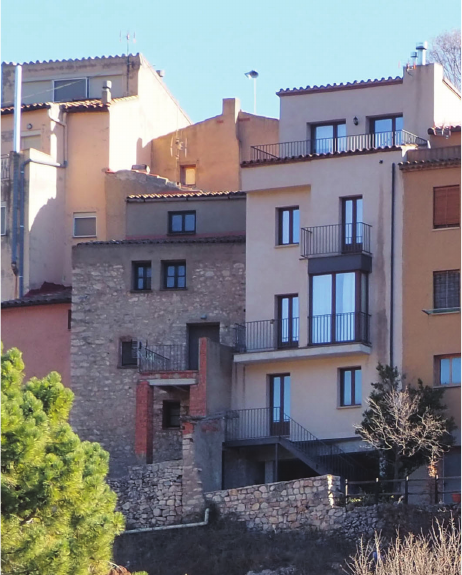
The two houses selected for the study are located at the
western edge of the town, with open views to the west and
facing the town to the east. They are attached to adjacent
buildings on their northern and southern façades. For clari-
ty, House 1 is the traditional dwelling situated on the north-
ern side, and House 2 is the contemporary dwelling on the
southern side (Fig. 1).
Access to both dwellings is through the east façade at street
level. Each house has three above-ground oors (ground,
rst, and second) and two semi-basement levels oriented
westward due to the sloped terrain. The ground oor of the
traditional house (House 1) comprises a lobby, a living room
with an open kitchen, and a staircase connecting all levels.
The contemporary house (House 2) has the same arrange-
ment but also features an additional bedroom and bathroom
on this level. Both dwellings open to balconies or terraces on
the west façade.
The rst oor in each dwelling contains three bedrooms
and one bathroom, with House 2 also incorporating a laun-
dry room. The second oor occupies a smaller footprint in
both cases, being set back from the west façade in the tra-
ditional house and from the east and west façades in the
contemporary.
On the rst semi-basement level the traditional house ac-
commodates two bedrooms, a bathroom and a storage area,
while the contemporary house is designed as a garage. The
second semi-basement level is smaller in area and is not
conditioned for occupancy in either dwelling.
The traditional house was constructed around the ear-
ly 20
th
century, although the exact date is unknown. It has
Fig. 1. West façade of the houses. At left, House 1; at right, House 2
(photo by J. Lopez-Besora)
Il. 1. Zachodnia fasada domów. Po lewej dom 1; po prawej dom 2
(fot. J. Lopez-Besora)

64 Judit Lopez-Besora, Helena Coch, Antonio Isalgue
undergone various renovations throughout its lifespan. Its
construction system is traditional with load-bearing stone
masonry walls approximately 60 cm thick, supporting one-
way structural slabs composed of wooden joists and ceram-
ic vaults. Exterior joinery consists of wooden frames with
single glazing and high air permeability, complemented by
internal shutters. The calculated U-values of the façade and
windows are 1.91 and 4.30 W/m
2
K, respectively (Table 1).
This typology is representative of vernacular construction
across the region and other areas with similar climatic and
geographic conditions. It remained prevalent until the emer-
gence of modern systems, such as brick load-bearing walls
with concrete slabs and, later, reinforced concrete structures.
The contemporary house, by contrast, was built in 2015
based on a technical design project. Its structural system
consists of reinforced concrete columns and one-way con-
crete slabs. The envelope comprises multilayer façades with
exterior and interior brickwork (14 cm and 7 cm thick, re-
spectively), a ventilated cavity, and 5 cm of thermal insula-
tion (expanded polystyrene). Openings consist of high-per-
formance windows with aluminium-clad exteriors and
wooden interiors, and double glazing; one of the windows
includes interior shutters. The U-values of the façade and
windows are 0.45 and 2.70 W/m
2
K, respectively.
Both dwellings are equipped with heating systems consisting
of oil-red boilers connected to aluminium radiators. Neither
house has mechanical cooling systems for the summer season.
The study was conducted in the living room of both
houses, which have nearly identical dimensions. The oor
areas measure 36.4 m
2
in House 1 and 34.5 m
2
in House 2,
while the corresponding volumes are 92.2 m
3
and 91.7 m
3
.
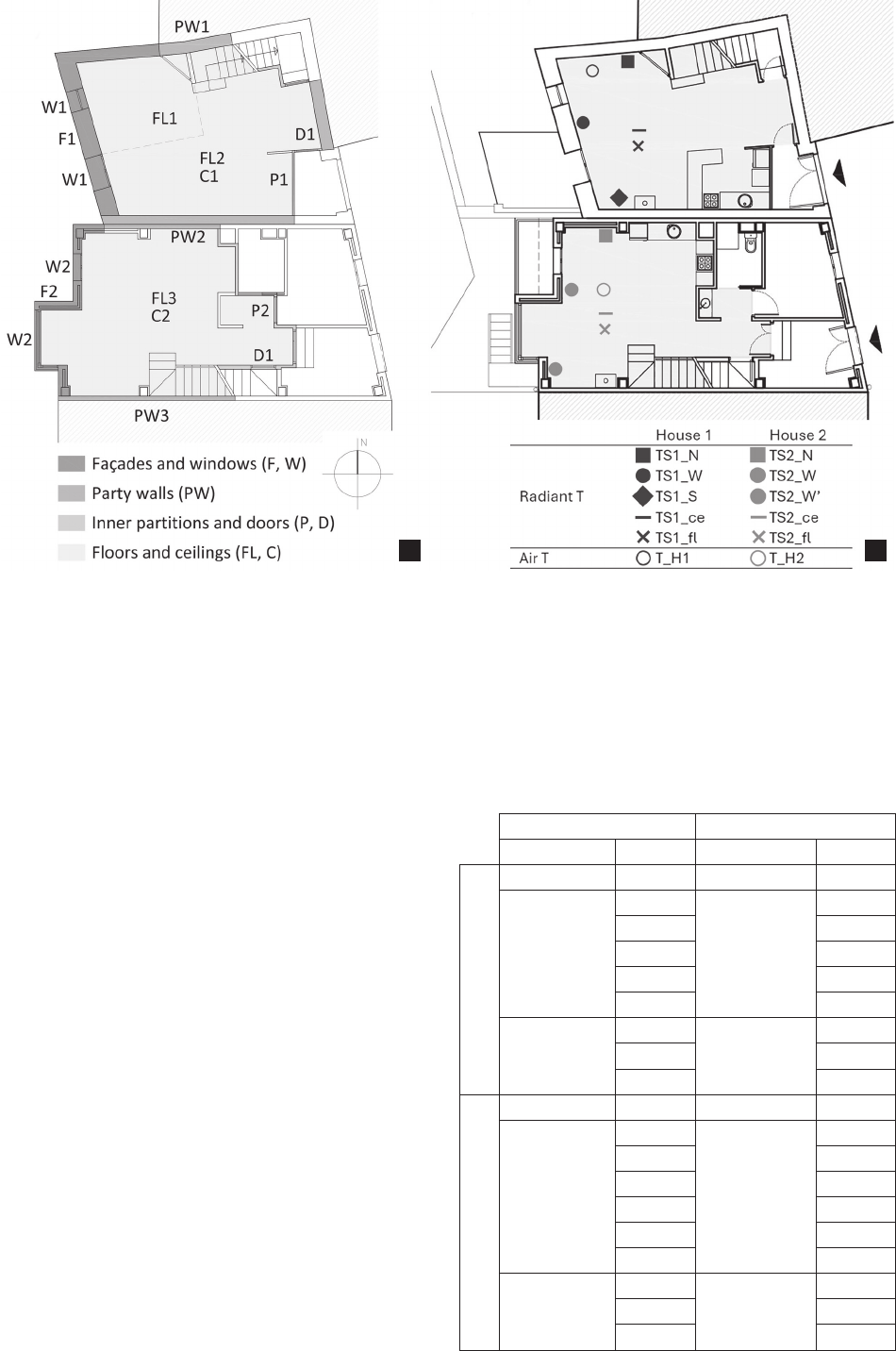
All surfaces, except for the west façade, are considered adi-
abatic. Table 1 and Figure 2 present a detailed breakdown of
the envelope elements of each monitored space. Each com-
ponent is coded (F for façades, W for windows, PW for par-
ty walls, P for partitions, D for doors, FL for oors and C for
ceilings), along with their area (S, in m
2
), U-value (W/m
2
K)
total mass (M, in kg) and eective mass (M′, in kg). The
total mass (M) refers to the full material thickness, while
the eective mass (M′) accounts for only half the thickness
for non-insulated elements, or the mass from the insulation
layer inward for insulated assemblies.
Methods
Air temperature and relative humidity were continuously
monitored in the living rooms of both houses over a three-
year period, from 27 September 2019 to 26 September 2022.
Data acquisition was uninterrupted except for brief pauses
required for battery replacement. Two TESTO 175H1 data
loggers were employed, one in each dwelling, placed in the
north-west corner of the living room (Fig. 2). Measurements
were recorded every 20 min starting on the hour. For clarity,
the air temperature in House 1 and House 2 is denoted as
T_H1 and T_H2, respectively.
In addition to the long-term monitoring, a short-term mea-
surement campaign was carried out in 2023 to capture both
air temperature and radiant temperature in the same rooms.
These measurements were conducted over two week end
pe-
riods, one in winter (10–12 February 2023) and one in sum-
mer (30 June–2 July 2023). The same TESTO data loggers
used in the long-term monitoring were deployed in identical
locations. Radiant temperature was recorded using a FLIR
TG267 thermal imaging camera. Air temperature and rela-
tive humidity were logged at 20-minute intervals.
Thermal images were captured at multiple times through-
out each weekend at predened and equivalent points in
both living rooms, including the oor, ceiling, west façade,
party wall, and the north wall of the traditional house. In the
winter campaign, thermal imaging was performed on Fri-
day upon arrival, immediately before activating the heating
system (Table 2).
Climate data (outdoor air temperature, relative humidity,
and solar radiation) were obtained from a weather station
located 40 m from the monitored houses (764 m altitude,
UTM coordinates E 334739, N 4573418). This station is
operated by Meteoprades (meteoprades.net), a non-prot
organization that collects meteorological data from sever-
al sites in the region. All meteorological variables were re-
corded in synchrony with the indoor monitoring intervals.
No behavioural guidelines were provided to the occu-
pants during the monitoring period; they were instructed
to go about their daily routines without modication. Both
houses are used intermittently, primarily on weekends and
during holidays. The traditional house is typically occupied
by 2 to 6 people, while the contemporary is occupied by
2 to 4. As both are second residences, occupancy may uc-
Code
*
S [m
2
]
U-value
[W/m
2
K]
M [kg] M′ [kg]
House 1
F1 10.5 1.91 13192 6596
W1 3.1 4.30 77 77
PW1 7.2 – 6057 3028
PW2 14.8 – 14322 12454
P1 11.2 – 558 279
D1 2.8 – – –
FL1 8.3 – 2543 1271
FL2 28.1 – 8605 1652
C1 36.4 – 11148 5574
TOTAL 122.4 – 56500 33581
House 2
F2 13.0 0.45 2493 849
W2 8.2 2.70 286 286
PW2 10.2 – 9830 1282
PW3 12.8 – 6438 1609
P2 14.2 – 926 463
D1 6.8 – – –
FL3 34.6 – 10585 5292
C2 34.6 – 10585 5292
TOTAL 134.4 – 41142 15075
Table 1. Constructive elements of House 1 and House 2,
and their physical characteristics (elaborated by J. Lopez-Besora)
Tabela 1. Elementy konstrukcyjne i detal architektoniczny
w domach 1 i 2 oraz ich specyfikacja (oprac. J. Lopez-Besora)
*
Key in the text and Figure 2.
Adaptation and reuse of buildings 65
Fig. 2. Floor plan: a) codes of constructive elements, b) location of the measurement points for air temperature and radiant temperature
(elaborated by J. Lopez-Besora)
Il. 2. Rzut: a) oznaczenia elementów konstrukcyjnych, b) lokalizacja punktów pomiarowych temperatury powietrza i temperatury promieniowania
(oprac. J. Lopez-Besora)
a b
House 1 House 2
Day Time Day Time
Winter
10/02/2023 22:20 10/02/2023 22:20
11/02/2023
01:20
11/02/2023
01:20
11:40
15:40 15:40
17:40
22:20 22:20
12/02/2023
10:00
12/02/202314:00 14:00
15:40 15:40
Summer
30/06/2023
21:40
30/06/2023
21:40
01/07/2023
00:40
01/07/2023
00:40
10:00 10:00
13:20 13:20
16:40 16:40
20:20 20:20
22:40
02/07/2023
10:40
02/07/2023
10:40
16:00 16:00
19:20 19:20
Table 2. Day and time of thermographic imaging for each house
(elaborated by J. Lopez-Besora)
Tabela 2. Dzień i czas obrazowania termograficznego dla każdego
z obiektów (oprac. J. Lopez-Besora)
tuate, especially during leisure periods or visits. The liv-
ing rooms in both houses feature an integrated open-plan
kitchen, which is regularly used when the dwellings are
occupied. It is important to note that the monitoring period
includes the nationwide lockdown imposed in Spain due to
the SARS-CoV-2 pandemic, which began in the third week
of March 2020 and lasted through the end of May 2020.
Results and discussion
Yearly thermal behaviour
The initial results present the complete dataset of indoor
air temperatures measurements from both houses, along with
the corresponding outdoor temperature data obtained from
the nearby weather station (https://dataverse.csuc.cat/data-
set.xhtml?persistentId=doi:10.34810/data1479). Figure 3
illustrates the temporal evolution of indoor and outdoor
temperatures over three annual periods, each spanning
from October to September, for the years 2019, 2020, 2021,
and 2022.
The dierence in mean annual indoor temperature be-
tween the two dwellings ranges from 0.68 °C to 2.07 °C, with
House 2 consistently registering higher average tempera-
tures than the traditional house. The largest temperature gap
was recorded during the 2021–2022 period, which also co-
incided with the highest average outdoor temperature across
the study duration. On average, the indoor temperature in
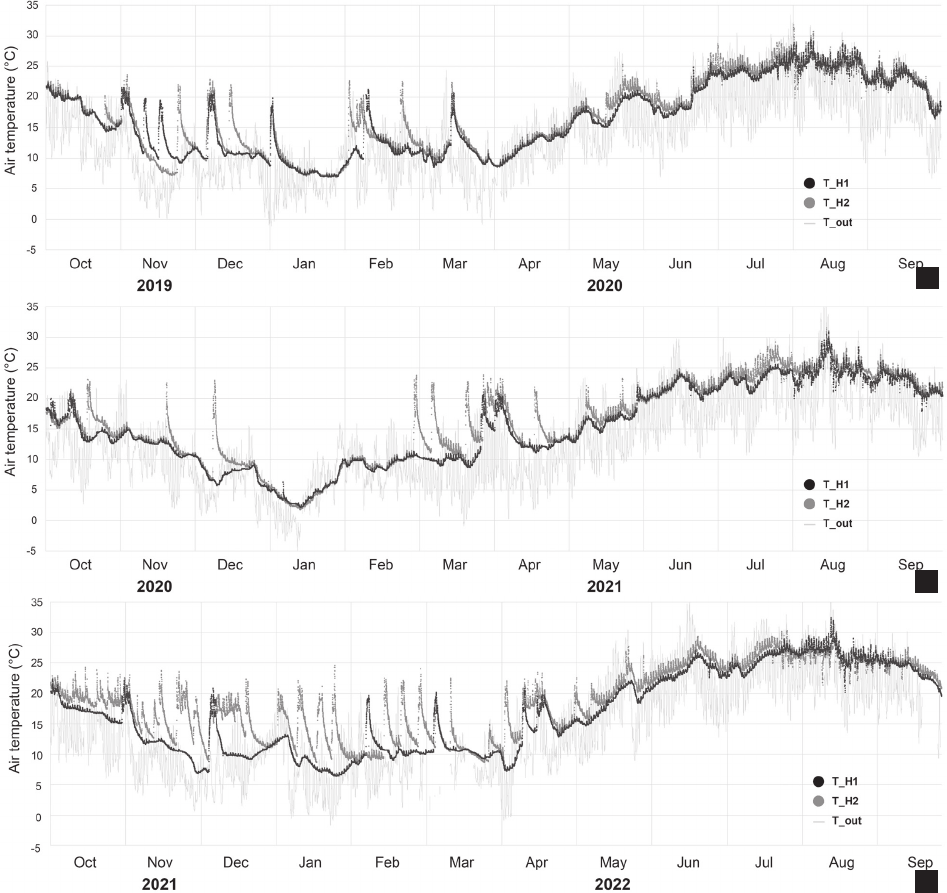
66 Judit Lopez-Besora, Helena Coch, Antonio Isalgue
House 1 exceeded the outdoor temperature by 2.35–2.94 °C,
while in the contemporary house the dierence was greater,
ranging from 3.62–4.42 °C. These measurements reect re-
al-life operating conditions, as both homes were occupied
for a comparable, though not identical, number of days.
The annual temperature curves in Figure 3 capture typical
occupancy rhythms, for instance, brief peaks during winter
weekends associated with heating system activation upon
arrival, and heightened temperature variability during the
summer, especially in August, corresponding to increased
household activity.
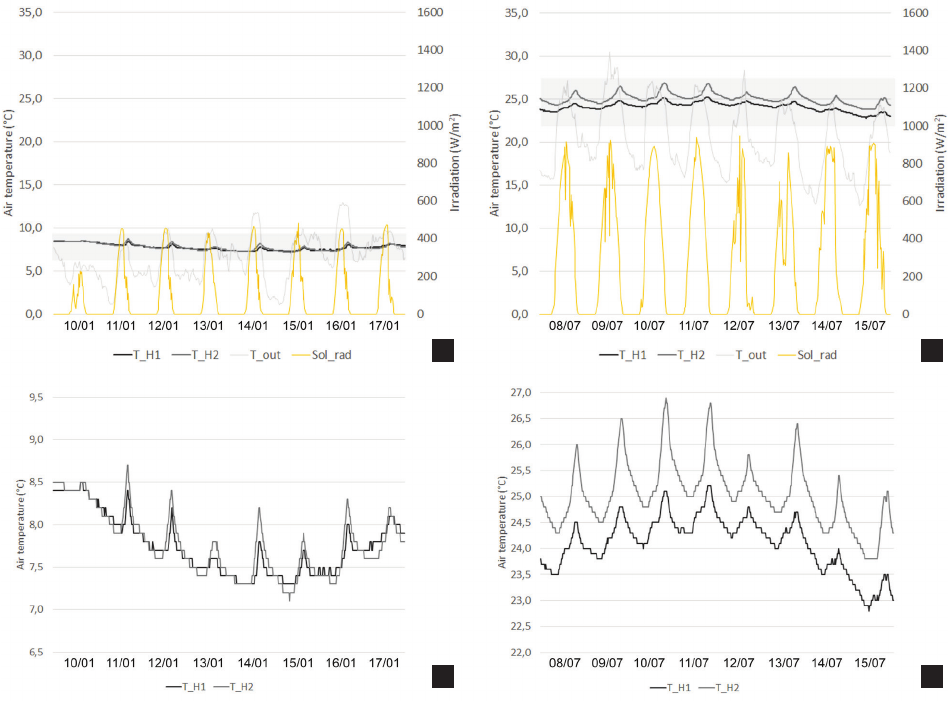
To explore this in greater detail, a focused analysis was
conducted on two one-week periods under free-running
conditions and in the absence of occupants: one in winter
and one in summer (Fig. 4). The winter week analysed spans
from 10 to 17 January 2020. During this period, both hous-
es exhibited similar thermal behaviour, with average indoor
temperatures of 7.75 °C in the traditional house, 7.78 °C in
the contemporary, and 6.48 °C outdoors. Daily thermal am-
plitude was below 1 ° C in the traditional house and slightly
above 1 °C in the contemporary one, indicating stable in-
door conditions in both dwellings under winter free-running
scenarios (Lopez-Besora et al. 2022).
In contrast, the summer week analysed, from 8 to 15 July
2020, revealed more signicant dierences. The average
indoor temperature in the traditional house was 24.10 °C,
while in the contemporary it reached 25.04 °C; both were
signicantly higher than the average outdoor temperature,
which was 20.41 °C. The daily peak temperatures were also
higher in the contemporary house than in the traditional,
Fig. 3. Yearly results of air temperature in House 1, House 2, and outdoor:
a) October 2019–September 2020, b) October 2020–September 2021, c) October 2021–September 2022
(elaborated by J. Lopez-Besora)
Il. 3. Temperatura powietrza w domu 1 i 2 oraz temperatura zewnętrzna w ciągu roku: a) październik 2019–wrzesień 2020,
b) październik 2020–wrzesień 2021, c) październik 2021–wrzesień 2022 (oprac. J. Lopez-Besora)
a
b
c
Adaptation and reuse of buildings 67
Summer results with and without occupants
The summer week in Figure 4 shows a regular thermal
pattern driven by outdoor temperature and solar radiation.
In contrast, the annual curves in Figure 3 become less dis-
tinct and begin to overlap from late July through August,
making it dicult to discern clear trends. This period coin-
cides with the summer holiday season when both dwellings
are regularly occupied.
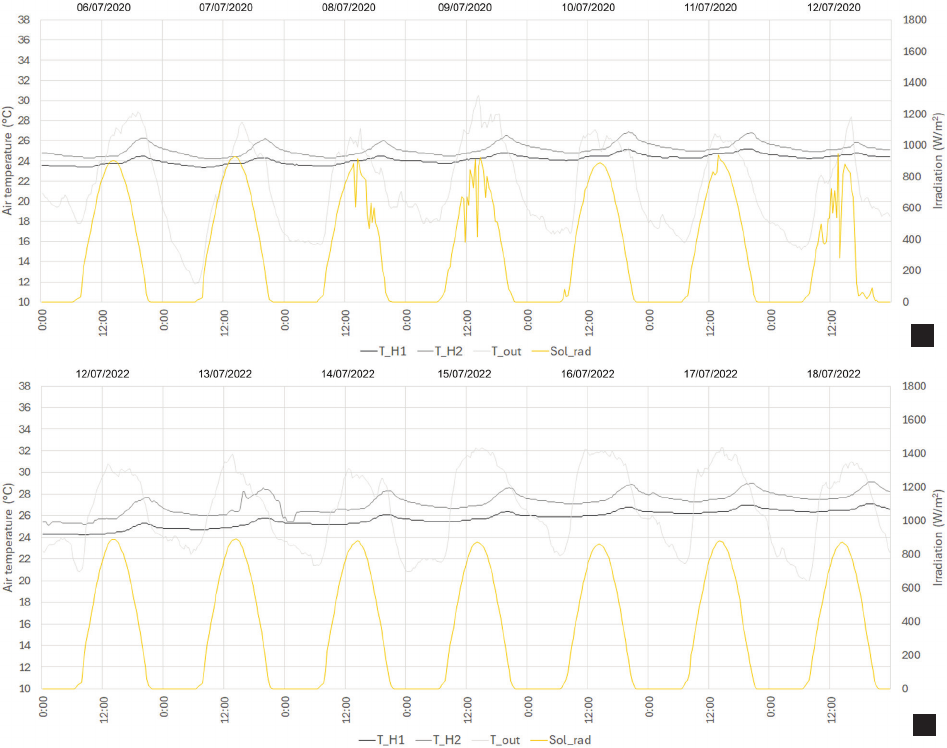
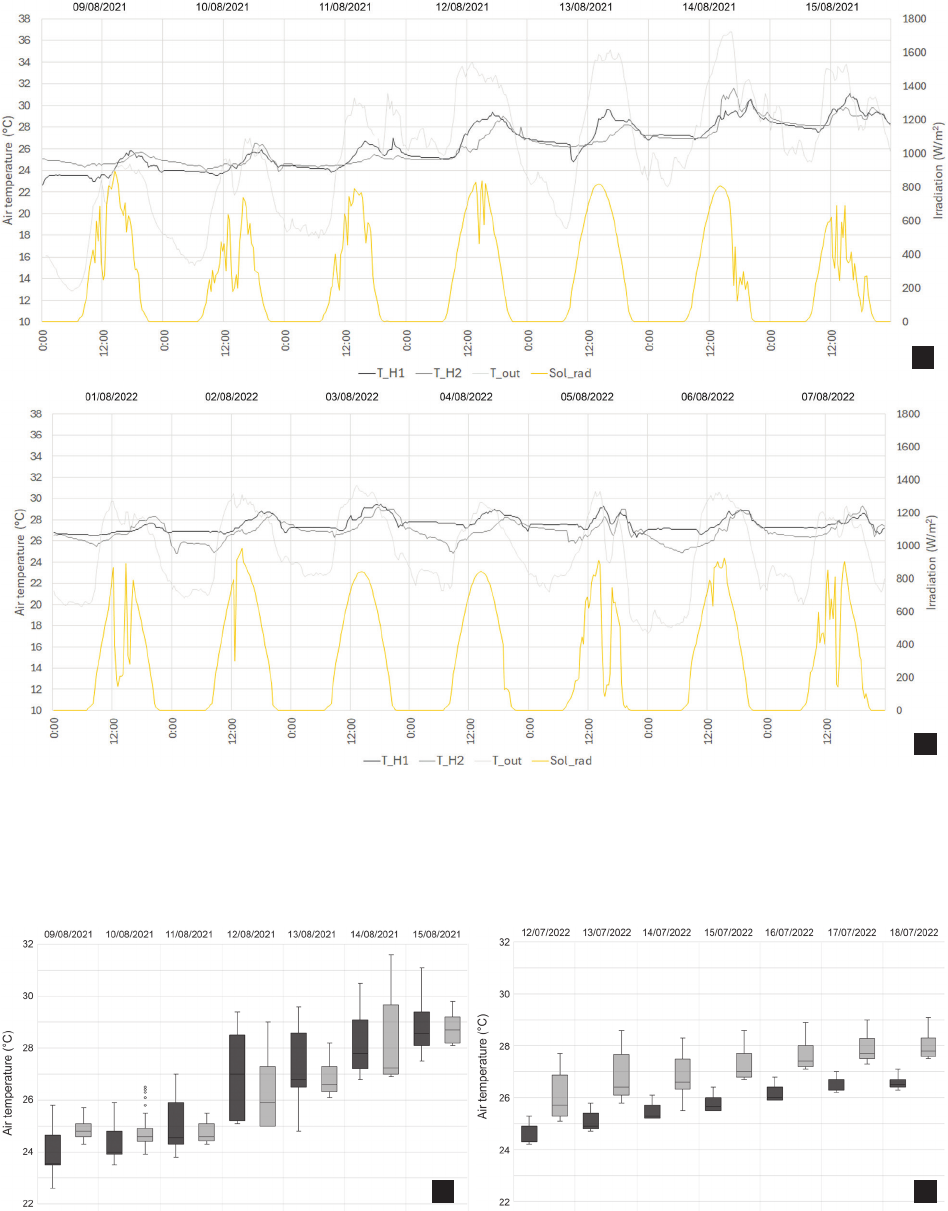
To assess thermal variability in this period, four repre-
sentative summer weeks were analysed: two unoccupied
(6–12 July 2020 and 12–18 July 2022), and two occupied
(9–15 August 2021 and 1–7 August 2022). The results are
shown in Figures 5 and 6.
During the unoccupied weeks (Fig. 5), the indoor tem-
perature proles remained consistent and showed predict-
able patterns, minimally inuenced by internal gains. In the
week of 6–12 July 2020, the contemporary house recorded
the highest average indoor temperature (25.1
°
C), exceeding
both the traditional (24.2
°
C) and the outdoor temperature
(21.3
°
C). A similar trend was observed during the week
of 12–18 July 2022, when the contemporary reached an
and this dierence was more pronounced than in the winter
analysis. These ndings suggest that the traditional house
is less responsive to solar radiation gains, particularly from
the west.
Moreover, the indoor air temperature in the traditional
house consistently remained lower than in the contempo-
rary throughout the summer week. On some days, the max-
imum temperature in the traditional house was even lower
than the minimum temperature recorded in the other, un-
derscoring the superior thermal buering capacity of the
traditional envelope.
These results highlight the greater sensitivity of the con-
temporary house to external climatic conditions and solar
heat gains, while the traditional house exhibits greater ther-
mal inertia and indoor temperature stability in both summer
and winter. It is important to note that these ndings corre-
spond to periods with no internal heat loads or user inter-
actions, thus oering a clearer view of the intrinsic thermal
performance of each construction system.
The following sections build upon this foundation by an-
alysing how occupancy and daily routines inuence indoor
thermal conditions, specically on summer and winter periods.
Fig. 4. Air temperature in House 1 (T_H1), House 2 (T_H2), outdoor air temperature (T_out), and solar radiation (Sol_rad): a) week of 10–17
January 2020, b) week of 8–15 July 2020, c) detail of T_H1 and T_H2 in the winter week, d) detail of T_H1 and T_H2 in the summer week
(elaborated by J. Lopez-Besora)
Il. 4. Temperatura powietrza w domu nr 1 (TH_1), domu nr 2 (TH_2), temperatura powietrza na zewnątrz (T_out) i promieniowanie słoneczne
(Sol_rad): a) 10–17 stycznia 2020, b) 8–17 lipca 2020, c) szczegółowy rozkład temperatury TH_1 i TH_2 w tygodniu zimowym,
d) szczegółowy rozkład temperatury TH_1 i TH_2 w tygodniu letnim (oprac. J. Lopez-Besora)
a b
c d
68 Judit Lopez-Besora, Helena Coch, Antonio Isalgue
average of 27.2
°C, while the traditional maintained a lower
average (25.7
°C) than the outdoor environment (26.6
°C). It
is noteworthy that the 2022 week experienced signicantly
higher solar radiation levels than the corresponding period in
2020, likely contributing to the overall temperature increase.
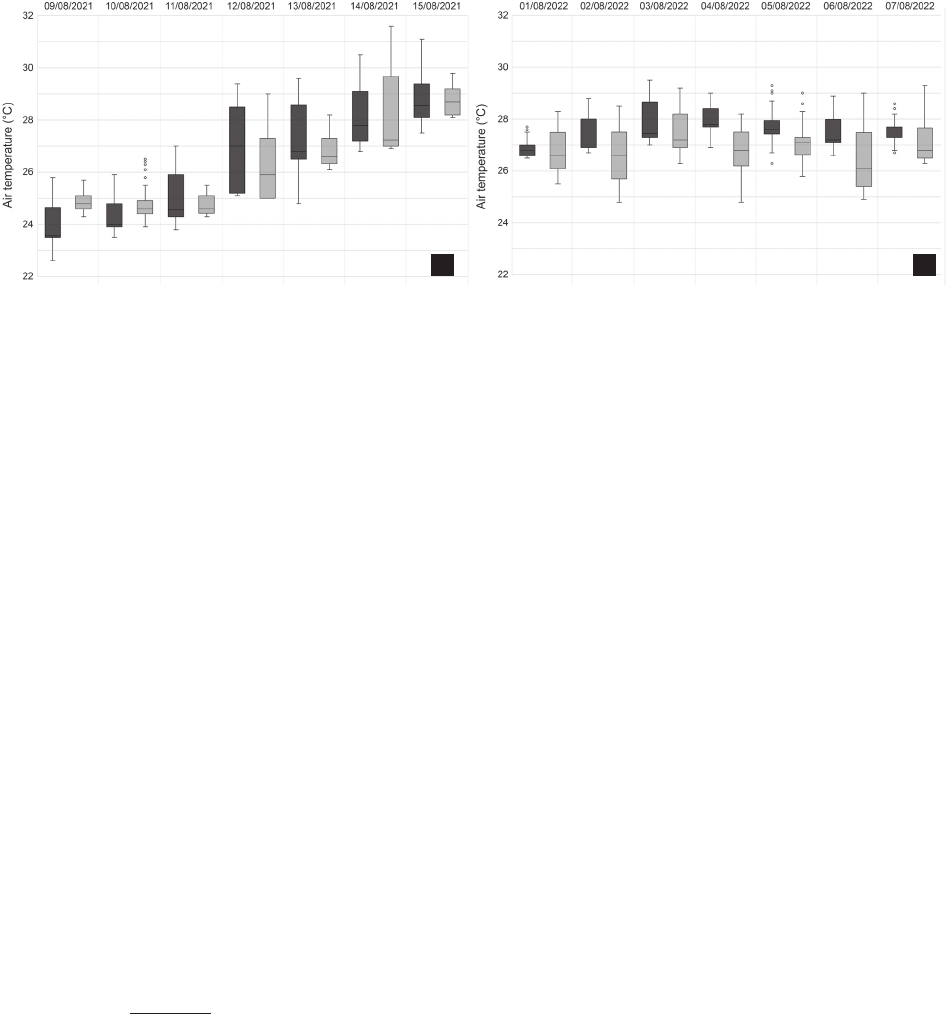
Figure 7 illustrates that during these unoccupied periods,
traditional house consistently exhibited a narrower tempera-
ture range (lower diurnal thermal amplitude) compared to
the contemporary one, which also maintained higher peak
temperatures throughout. This suggests that the traditional
building envelope provides greater thermal buering capac-
ity under passive conditions.
In contrast, the occupied weeks (Fig. 8), reveal marked
dierences in thermal behaviour. The temperature curves
become less regular due to the inuence of occupant ac
-
tivity. Since no behavioural protocols were imposed, users
were free to manage ventilation, shading, and cooking prac
-
tices according to their needs. During the week of 9–15 Au-
gust 2021, the average indoor temperature was identical in
both houses (26.4
°
C), slightly above the outdoor average of
25.5
°
C. However, during the week of August 2022, indoor
temperatures in both the traditional and the contemporary
houses exceeded the outdoor average by 2.2
°
C and 1.3
°
C,
respectively. Unlike in 2021, the 2022 period was character
-
ised by sustained high outdoor temperatures with minimal
daily variation, which contributed to heat accumulation,
particularly in the traditional, where dissipation appeared
less eective.
Figures 7 and 8 conrm that the regular thermal uc tua -
tion patterns observed during unoccupied weeks are dis-
rupted during occupancy Both houses exhibited increased
tem
perature variability, with wider ranges between ma xi-
mum and minimum values. The expansion of the interquar-
tile range (IQR) boxes also indicates greater dispersion in
the indoor thermal data, reecting the heterogeneity of occu-
pant-driven events.
These variations underscore the impact of occupant pre-
sence on thermal dynamics. For instance, in the contempo-
rary house, morning ventilation commonly produced a tem-
perature drop of approximately 1
°
C. In contrast, limited
early-morning activity was observed in the traditional during
the week of 1–7 August 2022, which diminished the eec-
tiveness of ventilation as a cooling strategy during that peri-
od. Around midday, occupancy and cooking activities in both
Fig. 5. Air temperature in House 1 (T_H1), House 2 (T_H2), outdoor air temperature (T_out), and solar radiation (Sol_rad), during two weeks
without occupancy: a) 6–12 July 2020, b) 12–18 July 2022 (elaborated by J. Lopez-Besora)
Il. 5. Temperatura powietrza w domu nr 1 (TH_1), domu nr 2 (TH_2), temperatura powietrza na zewnątrz (T_out) i promieniowanie słoneczne
(Sol_rad) w trakcie dwóch tygodni braku użytkowania domów przez mieszkańców: a) 6–12 lipca 2020, b) 12–18 lipca 2022 (oprac. J. Lopez-Besora)
b
a
Adaptation and reuse of buildings 69
houses caused temperature peaks exceeding 1 °C, relative to
adjacent periods. Although such uctuations were observed
in both dwellings, the traditional house tended to retain heat
for longer durations, indicating higher thermal inertia.
In summary, the summer data reveal that while both
houses are sensitive to internal gains during occupancy, the
traditional construction system exhibits greater thermal sta-
bility during unoccupied periods, and higher heat retention
Fig. 6. Air temperature in House 1 (T_H1), House 2 (T_H2), outdoor air temperature (T_out), and solar radiation (Sol_rad), during two weeks
with occupancy: a) 9–15 August 2021, b) 1–7 August 2022 (elaborated by J. Lopez-Besora)
Il. 6. Temperatura powietrza w domu nr 1 (TH_1), domu nr 2 (TH_2), temperatura powietrza na zewnątrz (T_out) i promieniowanie słoneczne (Sol_rad)
w trakcie dwóch tygodni użytkowania obiektów przez mieszkańców: a) 9–15 sierpnia 2021, b) 11–7 sierpnia 2022 (oprac J. Lopez-Besora)
Fig. 7. Daily maximum and minimum temperatures in House 1 (dark grey) and House 2 (light grey) for the summer weeks without occupancy:
a) 6–12 July 2020, b) 12–18 July 2022 (elaborated by J. Lopez-Besora)
Il. 7. Maksymalna i minimalna dzienna temperatura powietrza w domu nr 1 (ciemnoszary), domu nr 2 (jasnoszary) w trakcie tygodni letnich
bez użytkowników: a) 6–12 lipca 2020, b) 12–18 lipca 2022 (oprac. J. Lopez-Besora)
b
a
ba
70 Judit Lopez-Besora, Helena Coch, Antonio Isalgue
once internal gains are introduced. These ndings illustrate
the combined inuence of construction system and user be-
haviour on summer indoor thermal performance.
Winter results:
stationary heat loss and time constant
To evaluate and compare the thermal behaviour of both
dwellings in winter conditions, a twofold approach was
adopted: rst, we conducted theoretical calculations of sta-
tionary heat losses, and second, we validated these results
with empirical data from monitored winter periods.
• Stationary heat loss analysis
The heat loss through transmission and ventilation in
each living room was estimated under static, free-running
conditions, using the parameters outlined in Table 1. The
calculation of total heat losses followed Equation (1), while
the thermal time constant was derived using Equation (2).
Transm.loss = (U window
*
S window) + (U wall
*
S wall)
(1)
Vent.loss = Cp air
*
ρ air
*
V air
*
ach/3600
Total loss = Transm.loss + Vent.loss
Time constant = (2)
where:
Transm.loss – Transmission loss [W/K],
U window – U thermal transmittance [W/m
2
K],
S window – S surface [m
2
],
Vent.loss – Ventilation loss [W/K],
Cp air – Cp heat capacity [J/kg K],
ρ air – ρ density [kg/m
3
],
V air – V volume [m
3
],
ach – ach air changes per hour,
Total loss – total loss [W/K],
Time constant – time constant [h],
M′ – M′ eective mass [kg]
Transmission heat losses were obtained by multiplying
U-values with the surface areas of the building envelope
components. The results indicate a transmission heat loss
of 33.38 W/K for the traditional house and 27.99 W/K for
the contemporary one, which represents only a 19% higher
value for the traditional house despite its less thermally e-
cient construction system.
Ventilation heat losses were calculated based on assumed
air change rates. For House 2, we considered 0.7 ACH, in
accordance with the Spanish building code (RITE), whereas
for House 1, the inltration rate was doubled to 1.4 ACH
due to lower airtightness and older window systems. As-
suming an air density of 1.1 kg/m
3
(for 10
°C at 751 m alti-
tude) and a specic heat capacity of 1030 J/kg·K, the venti-
lation losses were 40.6 W/K for House 1 and 20.2 W/K for
House 2. In this case, the traditional house doubles the value
of the contemporary one.
Summing both components, the total heat loss amounts to
74.0 W/K in the traditional house and 48.2 W/K in the con-
temporary, implying that the traditional house exhibits approx-
imately 53% greater thermal losses. Notably, the ventila tion
component is the most critical contributor to this dierence.
A hypothetical retrot scenario (RI1) in which the win-
dows of the traditional house were replaced with those
from the contemporary would reduce transmission losses
to 28.42 W/K, and ventilation losses to 20.3 W/K, there-
by aligning total thermal losses (48.7 W/K) closely with
those of the contemporary house (Table 3). A more com-
prehensive intervention (RI2), involving both window re-
placement and external insulation to match the U-values of
the contemporary, would result in 44% lower heat loss than
in the contemporary house. Nevertheless, adding thermal
insulation may not be viable due to heritage conservation
constraints and limited interior space, in addition to hinder-
ing heat dissipation during the summer.
• Thermal mass and dynamic behaviour
Beyond steady-state conditions, thermal mass signi-
cantly inuences the dynamic thermal response of a build-
ing, particularly during unheated periods. Following occu-
pant departure, the decay in indoor temperature is governed
by the building’s eective thermal mass (M′), which, when
combined with heat loss values, denes the thermal time
constant (τ), a measure of the time required for indoor tem-
perature to stabilise in the absence of heat gains. The coe-
Fig. 8. Daily maximum and minimum temperatures in House 1 (dark grey) and House 2 (light grey) for the summer weeks with occupancy:
a) 9–15 August 2021, b) 1–7 August 2022 (elaborated by J. Lopez-Besora)
Il. 8. Maksymalna i minimalna dzienna temperatura powietrza w domu nr 1 (ciemnoszary), domu nr 2 (jasnoszary) w trakcie tygodni letnich
z użytkownikami: a) 9–15 sierpnia 2021, b) 1–7 sierpnia 2022 (oprac. J. Lopez-Besora)
ba
Total loss
M′
Adaptation and reuse of buildings 71
cient τ is calculated by dividing thermal mass by the thermal
loss coecient (Equation 2).
Using the eective thermal mass values from Table 1 and
a specic heat of 1000 J/kg·K, House 1 and House 2 present
33.6 MJ/K and 15.1 MJ/K, respectively. As such, the tradi-
tional house has more than double the thermal mass of the
contemporary one. Calculated time constants τ are 126.1 h
for House 1 and 87.0 h for House 2, indicating that the tra-
ditional house takes 39 hours more to stabilise, reecting
greater thermal inertia.
• Empirical validation
These theoretical results were then compared with mon-
itored data during a selected winter week (16–23 March
2020), which captures a full heating cycle: activation of
heat ing from Friday to Sunday (during occupancy), fol-
lowed by ve days of unheated operation after the occu-
pants’ departure on Sunday evening.
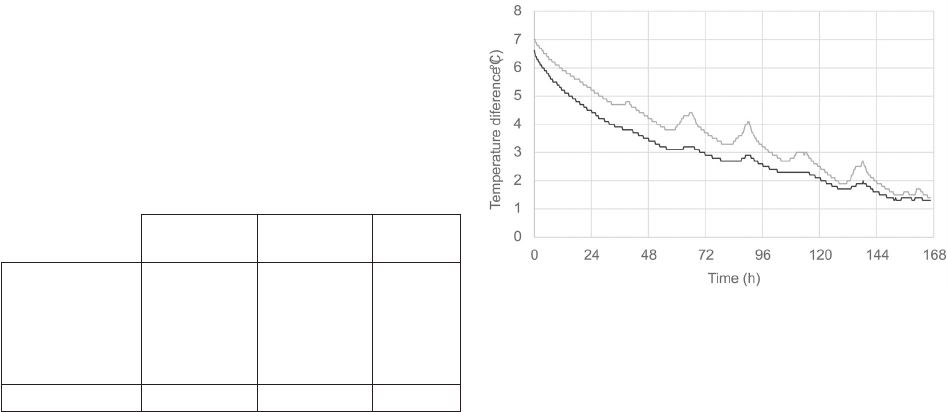
As shown in Figure 9, both houses exhibit a temperature
decay pattern after heating is turned o, with distinct be-
haviours. The contemporary house shows higher afternoon
temperature peaks due to greater exposure to solar gains,
while the traditional one maintains a more gradual and con-
sistent temperature decline, likely due to reduced glazing
and the presence of shutters.
To model this decay, we tted the indoor temperature
curves to an exponential decay function. The resulting
curves
displayed strong correlation, with R
2
values of 0.974
(House 1) and 0.965 (House 2). From these ts, we derived
empirical time constants of 115 h for House 1 and 116 h for
House 2. While the tted value for House 1 closely matches
the theoretical estimate (dierence of 11 h), House 2 exhib-
its a notable discrepancy of 29 h, potentially due to greater
exposure to solar radiation, which compensates for some
of the cooling and prolongs the eective decay (Marincic
1999; Isalgue et al. 1980).
Despite the fundamental dierences in construction, insu-
lation, exposure, and thermal mass, the overall cooling be-
haviour of both dwellings is remarkably similar in practice.
The traditional house’s higher mass and reduced exposure to
solar gains oset its inferior insulation and greater heat loss,
while the contemporary house benets from superior enve
-
lope performance but is more sensitive to external conditions.
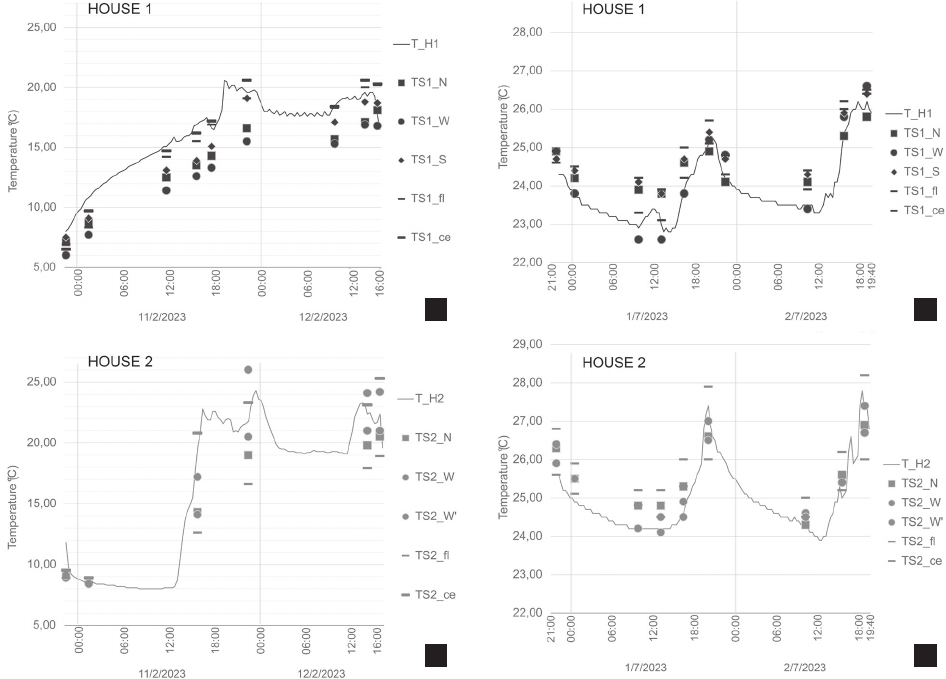
Summer and winter air
and radiant temperature
This phase of the study involved measuring and compar-
ing the air temperature and radiant temperature of the living
room interior surfaces during a winter weekend (10–12 Feb-
ruary 2023) and a summer weekend (30 June – 2 July 2023)
(Figs. 10–13) (Lopez-Besora, Isalgue and Coch 2024).
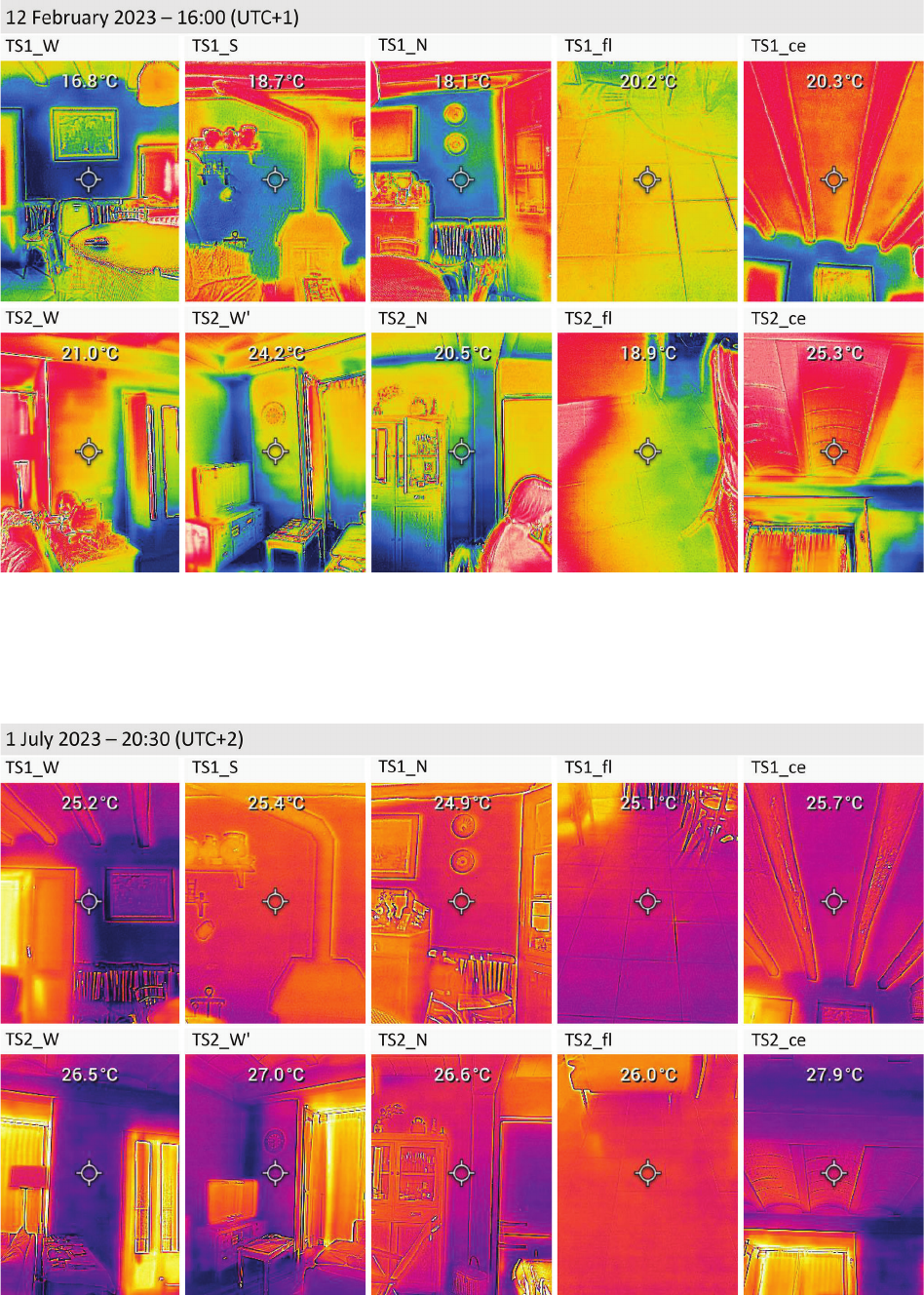
Winter measurements began on Friday evening and con-
cluded on Sunday afternoon (Figs. 10, 12). These measure-
ments were taken under real-use conditions, with occupants
present and the heating system in operation. Results indicate
that radiant temperatures in the traditional house remained
below the air temperature until Sunday. Thereafter, some
surfaces, particularly the ceiling and oor, exhibited slight-
ly higher radiant temperatures than the air. The lowest ra-
diant temperature values were consistently recorded on the
façade surfaces (TS1_W and TS1_N). In contrast, the con-
temporary house exhibited a more rapid thermal response.
Several surfaces reached radiant temperatures exceeding
the air temperature within just a few hours of activating the
heating. Notably, the façade in the contemporary showed
elevated radiant temperatures (TS2_W and TS2_W′) due to
direct solar radiation.
During the summer period, the air temperature in the tra-
ditional house remained approximately 1 °C lower than that
of the contemporary for most of the time (Figs. 11, 13). Ra-
diant temperatures closely tracked air temperatures in both
dwellings, although they were slightly higher, particularly
in the contemporary house. Compared to winter, the am-
plitude of radiant temperature uctuations was signicantly
reduced in both houses. As observed in winter, the ceiling
and oor tended to register the highest radiant temperatures.
Thermal sensation is inuenced by both air temperature
and radiant temperature. In summer, the convergence of these
two variables implies that air temperature largely governs
thermal perception. In winter, however (especially under in-
termittent occupancy) radiant temperature becomes a critical
Transm. loss
[W/K]
Vent. loss
[W/K]
Total loss
[W/K]
House 1 33.38 40.6 74.0
RI1 (window) 28.42 20.3 48.7
RI2
(window+thermal
insulation)
13.095 20.3 33.4
House 2 27.99 20.2 48.2
Table 3. Transmission, ventilation and total thermal losses in House 1
and House 2. In the case of House 1, two retrofit scenarios have been
considered:
RI1
corresponds to window replacement, and
RI2
corresponds to window replacement and addition of thermal insulation
(elaborated by J. Lopez-Besora)
Tabela 3. Przenikanie, wentylacja oraz całkowite straty ciepła
w domu nr 1 i domu nr 2. W przypadku domu nr 1 były rozważane
dwa scenariusze modernizacji:
RI1
– wymiana okien,
RI2
– wymiana okien z dodaną izolacją termiczną
(oprac. J. Lopez-Besora)
Fig. 9. Air temperature in House 1 and House 2 from 16 to 23 March 2020
(elaborated by J. Lopez-Besora)
Il. 9. Temperatura powietrza w domu 1 i domu 2 od 16 do 23 marca 2020
(oprac. J. Lopez-Besora)
72 Judit Lopez-Besora, Helena Coch, Antonio Isalgue
parameter. When comparing buildings with markedly dier-
ent thermal mass, radiant temperature plays a decisive role.
The traditional house, with its higher thermal mass, demon-
strates less favourable performance under winter conditions
but oers potential benets for thermal comfort in summer,
particularly during the early part of the season.
Conclusions
The reuse of traditional architecture plays a pivotal role
in enhancing urban resilience and preserving cultural heri-
tage. This study contributes to that goal by expanding the
understanding of thermal performance in traditional build-
ings compared to contemporary counterparts of similar mor -
phology in a specic climate. The methodology, based on
long-term in situ monitoring of occupied dwellings, pro-
vides valuable insights into real-life thermal dynamics under
typical use conditions.
In a context where existing buildings, particularly tradi-
tional ones, often face intensive retrotting or demolition due
to economic pressures, this research underscores the contin-
Fig. 10. Measurements of air temperature and radiant temperature
from 10 to 12 February 2023: a) House 1, b) House 2;
the codes for the measured points are listed in Figure 2
(elaborated by J. Lopez-Besora)
Il. 10. Pomiary temperatury powietrza i temperatury promieniowania
w okresie 10–12 lutego 2023: a) dom nr 1, b) dom nr 2,
opis oznaczeń zgodny z il. 2
(oprac. J. Lopez-Besora)
Fig. 11. Measurements of air temperature and radiant temperature
from 30 June to 2 July 2023: a) House 1, b) House 2;
the codes for the measured points are listed in Figure 2
(elaborated by J. Lopez-Besora)
Il. 11. Pomiary temperatury powietrza i temperatury promieniowania
w okresie 30 czerwca – 2 lipca 2023: a) dom nr 1, b) dom nr 2,
opis oznaczeń zgodny z il. 2
(oprac. J. Lopez-Besora)
ued relevance and functional viability of traditional archi-
tecture when addressed through well-founded, context-sen-
sitive interventions. The ndings support the idea, aligned
with theories such as the rebound and prebound eects, that
the thermal performance gap between traditional and con-
temporary buildings may be narrower than often assumed.
The climatic context is fundamental, as the climate under
study is a temperate one, in which conditions are favourable
for living for much of the year. Therefore, the potential for
architecture reuse in this specic case is a relevant factor.
Throughout the monitoring period, both houses exhibit-
ed remarkably similar annual average indoor temperatures.
However, under unoccupied conditions, the contemporary
house proved more sensitive to external climatic variations,
with sharper thermal uctuations. In contrast, the traditional
house demonstrated greater thermal stability, attributed to its
higher thermal mass. Under occupied conditions, both hous-
es were strongly inuenced by user behaviour, including
ventilation practices, internal heat gains, and solar shading.
In this context, the dierences between the two construc-
tion systems are less pronounced. These nding emphasize
b b
a a
Adaptation and reuse of buildings 73
Fig. 12. Thermal images with the radiant temperature in the specified points of House 1 and House 2. Data acquisition: 12 February 2023
(elaborated by J. Lopez-Besora)
Il. 12. Obrazy termiczne z temperaturą promieniowania w określonych punktach domu nr 1 i domu nr 2. Data badania: 12 lutego 2023
(oprac. J. Lopez-Besora)
Fig. 13. Thermal images with the radiant temperature in the specified points of House 1 and House 2. Data acquisition: 1 July 2023
(elaborated by J. Lopez-Besora)
Il. 13. Obrazy termiczne z temperaturą promieniowania w określonych punktach domu nr 1 i domu nr 2. Data badania: 1 lipca 2023
(oprac. J. Lopez-Besora)
74 Judit Lopez-Besora, Helena Coch, Antonio Isalgue
the decisive role of occupants in shaping thermal perfor-
mance in architecture, rearming that user behaviour is as
critical as construction quality in determining real-world
outcomes. In fact, the study reveals the character of both
buildings: holiday residences with a social function and
a strong mediterranean character, which shape their beha-
viour, as observed in the monitoring results.
Beyond user inuence, construction systems and building
typology also played a key role. Despite the contemporary
house having components with lower thermal transmit
tance
(U-values), the overall transmission heat losses were com-
parable between the two dwellings. The traditional house
c
ompensates for a less insulated envelope with smaller win-
dows and compact design, whereas the contemporary house,
with larger glazed areas and greater façade exposure, ex-
periences higher heat losses. This contrast embodies diver-
gent design philosophies and reveals the distinct aesthetic
character of each architectural approach: traditional archi-
tecture emphasizes thermal performance through mass and
compactness, while contemporary architecture often prio -
ritizes formal expression and spatial openness achieved
through the use of thermally ecient materials.
Ultimately, this study contributes to the scientic under-
standing of thermal behaviour in traditional buildings in
Me diterranean context and highlights the importance of re-
trot strategies that respect and leverage the intrinsic charac-
teristics of existing structures. Rather than applying standard
solutions, adaptive reuse should be guided by real-life data
and contextual sensitivity to ensure both energy perfor-
mance and building preservation.
References
Akkurt, Gülden Gökçen, Niccolò Aste, Julien Borderon, et al. “Dynamic
Thermal and Hygrometric Simulation of Historical Buildings: Critical
Factors and Possible Solutions.” Renewable and Sustainable Energy
Reviews 118 (2020). https://doi.org/10.1016/j.rser.2019.109509.
Ascione, Fabrizio, Nicola Bianco, Rosa F. De Masi, Margherita Mastel-
lone, Gerardo M. Mauro, and Giuseppe P. Vanoli. “The Role of the
Occupant Behaviour in Aecting the Feasibility of Energy Refurbish-
ment of Residential Buildings: Typical Eective Retrots Compro-
mised by Typical Wrong Habits.” Energy and Buildings 223 (2020).
https://doi.org/10.1016/j.enbuild.2020.110217.
Aste, Niccolò, Adriana Angelotti, and Michela Buzzetti. “The Inuence
of the External Walls Thermal Inertia on the Energy Performance of
Well Insulated Buildings.” Energy and Buildings 41, no. 11 (2009):
1181–87. https://doi.org/10.1016/j.enbuild.2009.06.005.
Aste, Niccolò, Fabrizio Leonforte, Massimiliano Manfren, and Manlio
Mazzon. “Thermal Inertia and Energy Eciency – Parametric Sim-
ulation Assessment on a Calibrated Case Study.” Applied Energy 145
(2015): 111–23. https://doi.org/10.1016/j.apenergy.2015.01.084.
Avendaño-Vera, Constanza, Aner Martinez-Soto, and Valentina Marin-
cioni. “Determination of Optimal Thermal Inertia of Building Ma-
terials for Housing in Dierent Chilean Climate Zones.” Renewable
and Sustainable Energy Reviews 131 (2020). https://doi.org/10.1016/
j.rser.2020.110031.
Calcerano, Filippo, Carlotta Cecchini, and Letizia Martinelli. “Numerical
Analysis of Passive Strategies for Energy Retrot of Existing Build-
ings in Mediterranean Climate: Thermal Mass and Natural Ventila-
tion Combination.” Sustainable Buildings 2 (2017): 4. https://doi.org/
10.1051/sbuild/2017003.
Callegaro, Nicola, Luca Endrizzi, Luca Zaniboni, and Rossano Albatici.
“Management of Indoor Thermal Conditions in Heavy and Lightweight
Buildings: An Experimental Comparison.” In Sustainability in Energy
and Buildings 2022, edited by J. Littlewood, R.J. Howlett and L.C.
Jain. Springer, 2023. https://doi.org/10.1007/978-981-19-8769-4_24.
Caro, Rosana, and Juan José Sendra. “Evaluation of Indoor Environment
and Energy Performance of Dwellings in Heritage Buildings. The
Case of Hot Summers in Historic Cities in Mediterranean Europe.”
Sustainable Cities and Society 52 (2020). https://doi.org/10.1016/
j.scs.2019.101798.
Costa-Carrapiço, Inês, Javier Neila González, Rokia Raslan, and Carmen
Sánchez-Guevara. “Understanding the Challenges of Determining
Thermal Comfort in Vernacular Dwellings: A Meta-Analysis.” Jour-
nal of Cultural Heritage 58 (2022): 57–73. https://doi.org/10.1016/j.
culher.2022.09.019.
de la Flor, Francisco José Sánchez, Enrique Ángel Rodríguez Jara, Álvaro
Ruiz Pardo, José Manuel Salmerón Lissén, and Maria Kolokotroni.
“Energy-Ecient Envelope Design for Apartment Blocks – Case
Study of a Residential Building in Spain.” Applied Sciences 11, no. 1
(2021): 433. https://doi.org/10.3390/app11010433.
De Wilde, Pieter. “The Gap Between Predicted and Measured Energy
Performance of Buildings: A Framework for Investigation.” Auto-
mation in Construction 41 (2014): 40–9. https://doi.org/10.1016/
j.autcon.2014.02.009.
Delzendeh, Elham, Song Wu, Angela Lee, and Ying Zhou. “The Impact
of Occupants’ Behaviours on Building Energy Analysis: A Research
Review.” Renewable and Sustainable Energy Reviews 80 (2017):
1061–71. https://doi.org/10.1016/j.rser.2017.05.264.
Dervishi, Sokol, Frida Pashako, Xhenisa Dushaj, and Ina Osmani Der-
vishi. “Energy Performance Optimization of Traditional Housing in
Mediterranean Climate.” Journal of Building Engineering 45 (2022):
103423. https://doi.org/10.1016/j.jobe.2021.103423.
Di Perna, Costanzo, Francesca Stazi, Casalena, A. Ursini, and Marco
D’Ora zio. “Inuence of the Internal Inertia of the Building Enve-
lope on Summertime Comfort in Buildings with High Internal Heat
Loads.” Energy and Buildings 43, no. 1 (2011): 200–6. https://doi.
org/10.1016/j.enbuild.2010.09.007.
Ding, Grace. “Demolish or Refurbish: Environmental Benets of Hous-
ing Conservation.” Construction Economics and Building 13, no. 2
(2013): 18–34. https://doi.org/10.5130/AJCEB.v13i2.3322.
Evola, Gianpiero, Luigi Marletta, Sukumar Natarajan, and Elisabettà Maria
Patanè. “Thermal Inertia of Heavyweight Traditional Buildings: Ex-
perimental Measurements and Simulated Scenarios.” Energy Procedia
133 (2017): 42–52. https://doi.org/10.1016/j.egypro.2017.09.369.
Gagliano, Antonio, Francesco Nocera, Francesco Patania, Antonella Mo s-
chella, Maurizio Detommaso, and Gianpiero Evola. “Synergic Eects
of Thermal Mass and Natural Ventilation on the Thermal Behaviour
of Traditional Massive Buildings.” International Journal of Sustain-
able Energy 35, no. 5 (2016): 411–28. https://doi.org/10.1080/14786
451.2014.910517.
Gagliano, Antonio, Francesco Patania, Francesco Nocera, and Carmelo
Sign o rello. “Assessment of the Dynamic Thermal Performance of
Massive Buildings.” Energy and Buildings 72 (2014): 361–70. https://
doi.org/10.1016/j.enbuild.2013.12.060.
Acknowledgements
This research was developed under the project PID2020-116036RB-I00,
funded by MICIU/AEI/10.13039/501100011033.
Adaptation and reuse of buildings 75
Galatioto, Alessandra, Giuseppina Ciulla, and Roberto Ricciu. “An Over-
view of Energy Retrot Actions Feasibility on Italian Historical
Buildings.” Energy 137 (2017): 991–1000. https://doi.org/10.1016/
j.energy.2016.12.103.
Galvin, Ray. “Making the ‘Rebound Eect’ More Useful for Performance
Evaluation of Thermal Retrots of Existing Homes: Dening the
‘Energy Savings Decit’ and the ‘Energy Performance Gap.’” Ener-
gy and Buildings 69 (2014): 515–24. https://doi.org/10.1016/j.en-
build.2013.11.004.
Giuliani, Marco, Gregor P. Henze, and Anthony R. Florita. “Modelling
and Calibration of a High-Mass Historic Building for Reducing the
Prebound Eect in Energy Assessment.” Energy and Buildings 116
(2016): 434–48. https://doi.org/10.1016/j.enbuild.2016.01.034.
Homann, Caroline, and Achim Geissler. “The Prebound-Eect in Detail:
Real Indoor Temperatures in Basements and Measured Versus Cal-
culated U-Values.” Energy Procedia 122 (2017): 32–7. https://doi.
org/10.1016/j.egypro.2017.07.301.
Isalgue, Antonio, Jordi Ortin, Vicenç Torra, and J. Viñals. “Heat Flux Calo-
rimeters: Dynamical Model by Localized Time Constants.” Anales de
Física 76 (1980): 192–6.
Lindberg, Ralf, Augustino Binamu, and M. Teikari. “Five-Year Data of
Measured Weather, Energy Consumption, and Time-Dependent Tem-
perature Variations Within Dierent Exterior Wall Structures.” Ener-
gy and Buildings 36, no. 6 (2004): 495–501. https://doi.org/10.1016/
j.enbuild.2003.12.009.
Lopez-Besora, Judit, Antonio Isalgue, and Helena Coch. “Adaptation and
Reuse of Buildings: The Role of Radiant Temperature Distribution
as a Resilience Factor.” In PLEA 2024: (Re)Thinking Resilience.
Proceedings of 37
th
PLEA Conference, Sustainable Architecture and
Urban Design, edited by Barbara Widera, Marta Rudnicka-Bogusz,
Jakub Onyszkiewicz and Agata Woźniczka. PLEA Conference Foun-
dation, 2024.
Lopez-Besora, Judit, Antonio Isalgue, Helena Coch, and Isabel Crespo.
“Inuence of Mass and Insulation in Building Retrotting.” In In-
ternational Conference on Passive and Low Energy Architecture.
“PLEA-STGO-2022 Will Cities Survive?” Book of Proceedings. Vol. 1.
Online sessions. PLEA, 2022.
Malik, Jeetika, Ronita Bardhan, and Pradipta Banerji. “Rethinking Indoor
Thermal Comfort in the Era of Rebound and Pre-Bound Eect for
the Developing World: A Systematic Review.” Indoor Air 30, no. 3
(2020): 377–95. https://doi.org/10.1111/ina.12664.
Mariani, Silvia, Federica Rosso, and Marco Ferrero. “Building in Historical
Areas: Identity Values and Energy Performance of Innovative Massive
Stone Envelopes with Reference to Traditional Building Solutions.”
Buildings 8, no. 2 (2018): 17. https://doi.org/10.3390/buildings8020017.
Marincic, Irene. Respuestas térmicas dinámicas en edicios: control tér
mi co a través de la climatización natural. PhD diss., Universitat Poli-
tècnica de Catalunya, 1999.
Martín Ocaña, Silvia, Ignacio Cañas Guerrero, and Ignacio González Re-
quena. “Thermographic Survey of Two Rural Buildings in Spain.” En-
ergy and Buildings 36, no. 6 (2004): 515–23. https://doi.org/10.1016/
j.enbuild.2003.12.012.
Martín, Silvia, Fernando R. Mazarrón, and Ignacio Cañas. “Study of Ther-
mal Environment Inside Rural Houses of Navapalos (Spain): The
Advantages of Reuse Buildings of High Thermal Inertia.” Construc-
tion and Building Materials 24, no. 5 (2010): 666–76. https://doi.
org/10.1016/j.conbuildmat.2009.11.002.
Martínez-Molina, Antonio, Isabel Tort-Ausina, Soolyeon Cho, and José-
Luis Vivancos. “Energy Eciency and Thermal Comfort in Hi sto-
ric Buildings: A Review.” Renewable and Sustainable Energy Reviews
61 (2016): 70–85. https://doi.org/10.1016/j.rser.2016.03.018.
Mousa, Wael A. Yousef, Werner Lang, and Waleed A. Yousef. “Simulations
and Quantitative Data Analytic Interpretations of Indoor-Outdoor
Temperatures in a High Thermal Mass Structure.” Journal of Build-
ing Engineering 12 (2017): 68–76. https://doi.org/10.1016/j.jobe.
2017.05.007.
Shi, Xing, Binghui Si, Jiangshan Zhao, et al. “Magnitude, Causes, and
Solutions of the Performance Gap of Buildings: A Review.” Sustain-
ability 11, no. 3 (2019): 937. https://doi.org/10.3390/su11030937.
Slee, Ben, Tom Parkinson, and Richard Hyde. “Can You Have Too Much
Thermal Mass? Is There a Point at Which Adding Additional Mass
to a Space Will Not Reduce the Internal Diurnal Temperature Range
During Summer Beyond Its Current Range?” In Cutting Edge: 47
th
International Conference of the Architectural Science Association, ed-
ited by Marc A. Schnabel. ANZAScA, 2013.
Stazi, Francesca, and Federica Naspi. Impact of Occupants’ Behaviour on
Zero-Energy Buildings. Springer, 2019. https://doi.org/10.1007/978-3-
319-71867-5.
Stazi, Francesca, Cecilia Bongli, Elisa Tomassoni, Costanzo Di Perna,
and Placido Munafò. “The Eect of High Thermal Insulation on High
Thermal Mass: Is the Dynamic Behaviour of Traditional Envelopes
in Mediterranean Climates Still Possible?” Energy and Buildings
88 (2015): 367–83. https://doi.org/10.1016/j.enbuild.2014.11.056.
Stazi, Francesca, Elisa Tomassoni, Cecilia Bongli, and Costanzo Di
Perna. “Energy, Comfort and Environmental Assessment of Dier-
ent Building Envelope Techniques in a Mediterranean Climate with
a Hot Dry Summer.” Applied Energy 134 (2014): 176–96. https://doi.
org/10.1016/j.apenergy.2014.08.023.
Stéphan, Emma, Richard Cantin, Antoine Caucheteux, Sihem Guernou-
ti, and Pierre Michel. “Experimental Assessment of Thermal Inertia
in Insulated and Non-Insulated Old Limestone Buildings.” Building
and Environment 80 (2014): 241–48. https://doi.org/10.1016/j.build-
env.2014.05.035.
Sunikka-Blank, Minna, and Ray Galvin. “Introducing the Prebound Eect:
The Gap Between Performance and Actual Energy Consumption.”
Building Research and Information 40, no. 3 (2012): 260–73. https://
doi.org/10.1080/09613218.2012.690952.
Timur, Barış Ali, Tahsin Başaran, and Başak İpekoğlu. “Thermal Retro-
tting for Sustainable Use of Traditional Dwellings in Mediterranean
Climate of Southwestern Anatolia.” Energy and Buildings 256 (2022):
111712. https://doi.org/10.1016/j.enbuild.2021.111712.
van den Brom, Paula, Arjen Meijer, and Henk Visscher. “Actual Energy
Saving Eects of Thermal Renovations in Dwellings – Longitudinal
Data Analysis Including Building and Occupant Characteristics.”
Energy and Buildings 182 (2019): 251–63. https://doi.org/10.1016/
j.enbuild.2018.10.025.
Webb, Amanda L. “Energy Retrots in Historic and Traditional Build-
ings: A Review of Problems and Methods.” Renewable and Sustain-
able Energy Reviews 77 (2017): 748–59. https://doi.org/10.1016/
j.rser.2017.01.145.
Streszczenie
Adaptacje i nowe funkcje użytkowe budynków:
jak tradycyjne i współczesne budynki zachowują współczynniki termiczne w warunkach rzeczywistych?
W przypadku zachowania odporności na zmiany klimatu w środowisku zurbanizowanym istotnym elementem jest znacząco zwiększający się
udział obiektów poddawanych adaptacjom i zmianom sposobów użytkowania w celu osiągnięcia współczesnych wymagań i standardów. Budyn-
ki tradycyjne mają odpowiednie znaczenie strategiczne i charakter, jednakże często nie odpowiadają współczesnym wymaganiom, chociaż ich
nieodłączne cechy mogą przyczynić się do przedłużenia ich okresu funkcjonowania. W przedstawionym badaniu zajęto się szczególnymi różnicami
pomiędzy tradycyjnymi i współczesnymi rozwiązaniami konstrukcyjno-architektonicznymi związanymi z termiką obiektu w bieżących, realnych
warunkach. Ciągłość badań temperatur została zebrana w ciągu trzech lat w dwóch wnętrzach budynków – jednego zbudowanego w tradycyjny
sposób, a drugiego zgodnie ze współczesnymi technikami budowlanymi – zarówno w okresach użytkowania, jak i braku tegoż i obejmowała badania
temperatur powietrza, promieniowania etc. Otrzymane rezultaty świadczą o tym, że różnice wynikające z systemów konstrukcyjnych są relatywnie
76 Judit Lopez-Besora, Helena Coch, Antonio Isalgue
małe, z użytkowaniem jako dominującym czynnikiem, z niemal ujednoliconym zachowaniem termicznym obu obiektów. Potwierdza to, że w klima-
cie śródziemnomorskim obiekty tradycyjnej architektury mogą osiągnąć wydajność cieplną porównywalną z wydajnością współczesnych konstruk-
cji, i podkreśla ich wartość jako elementu zachowującego zrównoważenie energetyczne.
Słowa kluczowe: budynki tradycyjne, monitoring, wydajność cieplna, temperatura promieniowania, modernizacja budynków