2010
Nr 2(28)
Situation of the Polish cinema in the 1960s
ism
2
[9] which, as we know, in the years 1948–1956 domi-
nated many areas of life, including architecture and lm.
2
Leopold Tyrmand (1920–1985) in his journal wrote about the
Socialist realism architecture: Communists believe that they are creating
the most wonderful epoch in human history and that this era must nd
its expression in huge architectural forms, full of monumentality and
pathos. (…). Of course – functionalism, which expresses material content
and denes exactly the usefulness of a given object for man, is devoid
of monumentality and pathos; therefore, it was considered as hostile,
destructive, killingly monotonous and inhumane. Theoreticians of the
Socialist realism architecture had to look for alliance in the past as the
presence did not conrm the legitimacy of their postulates and proved
these claims to be reactive and anti-artistic. Tyrmand L., Dziennik 1954,
Original Version, Publishing House Tentem, Warszawa 1995, p. 200.
Adam Nadolny*
Architectural remedy for love.
City and architecture in polish lms of the 1960s
Ewa Mizerska in the Film Quarterly in 1999 wrote:
‘From the very beginning, cinema is an art characteristic
of a great city – for many decades the majority of its view-
ers originated from those who, according to the Marxist
terminology, are dened as an industrial working class,
which meant poor people who could not afford a better
entertainment’
1
[5]. For Poland, the 1960s were the times
of getting back to normal after the period of Socialist real-
*
Poznań University of Technology, Faculty of Architecture, Departa-
ment of History of Architecture and Urban Planning.
1
Mizerska E., Janusowe oblicze lmowego miasta, Kwartalnik Fil-
mo wy, No. 28/1999, p. 39.
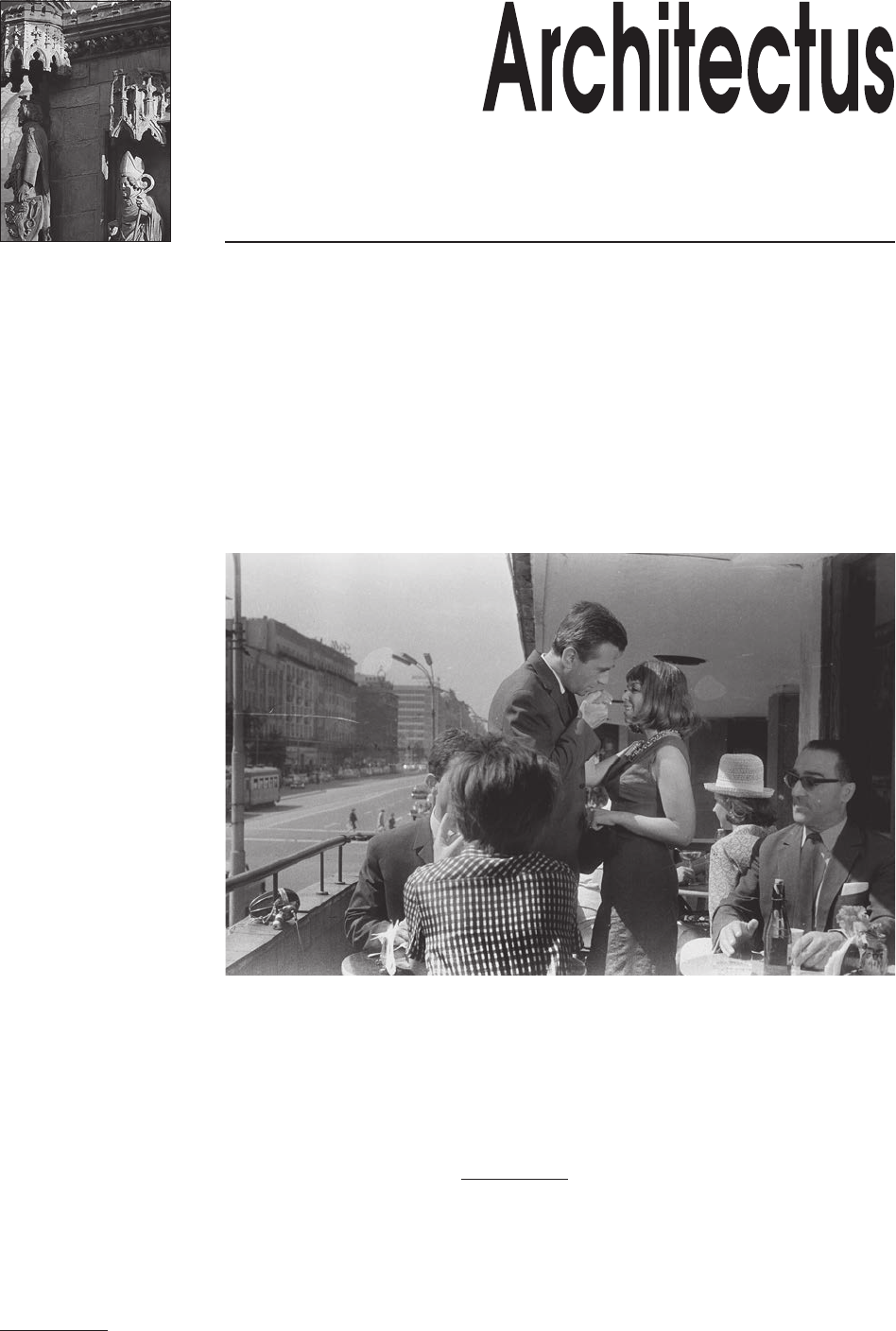
Fig. 1. Joanna – main character
of the lm Lekarstwo na milość
(Remedy for love) against
the background of the modern
architecture – the terrace of CDT.
Courtesy of The National Film
Stock Library, Warszawa,
Photo No. F-2306–171
140 Adam Nadolny
At this stage we would like to present the situation of the
Polish cinema and lm in the period which was called the
small stabilization
3
. After the year 1956 some democratic
changes were introduced in the country and this became
an impulse for creating broader schemes of lm activity,
where the lm was supposed to reect the reality as well
as describe and make a comment about the present times.
Unfortunately, this short period of freedom came to a swift
end. The existing system of censorship made it impossible
for the lm makers to tackle the subjects connected with
3
Name of this period in the most recent Polish history comes from the
play written by Tadeusz Różewicz Świadkowie, albo nasza mała stabilizacja
(1964). The play can be characterized as minimalism of requirements and
passivity of actions. Różewicz writes about historical and cultural situation
of the 1960s. The characters in the play do notice many imperfections of
the surrounding reality. However, they do not want to change it because
they are simply afraid to lose the acquired material values.
the current social and political situation. This contributed
to the production of numerous lm adaptations of national
literature canons and entertaining lms – lm comedies
4
.
ln the years 1961–1966, 119 lms were produced in Po-
land; as many as 24 out of this number were classed as
comedies
5
[1]. The lm title which is included in the title of
this article – Jan Batory’s 1966 production named Remedy
for love
6
– is an example of this genre.
4
Haltof M., Kino polskie, Publishing House Słowa/Obraz/Terytoria,
Gdańsk 2004, p. 135.
5
Haltof M., Kino polskie, Publishing House Słowa/Obraz/Terytoria,
Gdańsk 2004, p. 176.
6
The screenplay was based upon the book by Joanna Chmielewska
under the title Klin. Director: Jan Batory, screenplay by Joanna Chmie lew-
ska, Jan Batory, starring: main characters; Kalina Jędrusik (main character,
Joanna), Krystyna Sienkiewicz (Janka, Joanna’s friend), Wieńczysław
Gliński (Janusz, boss of money forgers’ gang), Andrzej Łapicki (captain
of Militia).
Modernistic architecture and the plot of the lm Remedy for love
The plot of the lm is not very complicated. Joanna,
an architect, lives a pretty boring life, shared between
work in the architects’ ofce and dates with her lover
[Janusz, boss of money forgers’ gang]. One day, when
she is trying to write an article about esthetics in interi-
ors, she answers an apparently insignicant call. Since
then things diverge from their ordinary course. We desire
to solve the mystery – who the mysterious Honorata is,
about whom the people who call Joanna keep asking.
The main character walks around the city (Warsaw, as it
is the case here) together with her friend Janka to nd
the solution and a remedy for unhappy love, which she
nds in the arms of a militia ofcer (Andrzej Łapicki).
Many times the lm story develops in the space of
a modern city, complemented with real life buildings.
From the historical viewpoint, many of them entered
the canon of the Polish architecture, like Central Depart-
ment Store CDT (1949–1952), perfect in the style, but
with terrible nishing, according to the Dziennik 1954
by Leopold Tyrmand
7
, Supersam (1952–1962) or East-
ern Wall (1958–1968) [9]. Modern architecture and the
city became a frequent motif used in Polish lms in the
1960s. Flat and simple building facades, wide perspec-
tives of modern housing estates became the mark of the
new times, the times so different from the previous era.
Modern architecture became an ideal background for the
creation of imaginary stories related to real life in a so-
cialist country. Krzysztof Kornacki wrote about the re-
7
Tyrmand L., Dziennik 1954, Original Version, Publishing House
Tentem, Warszawa 1995, p. 203.
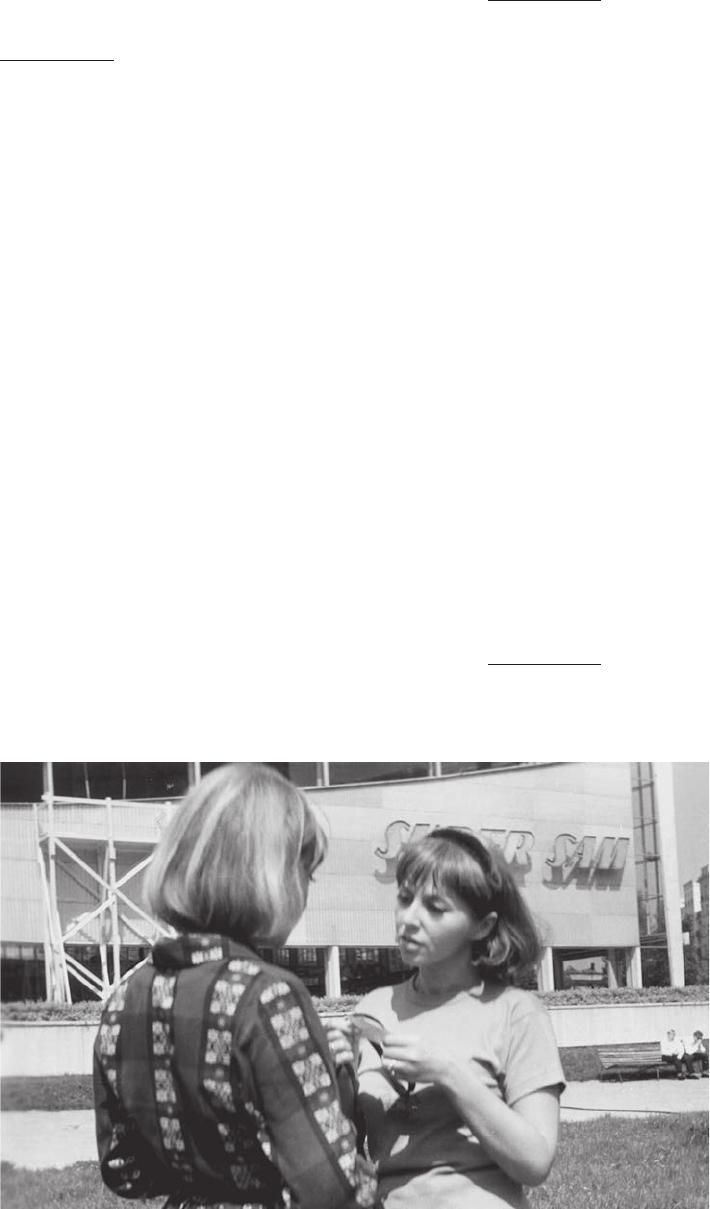
Fig. 2 Joanna and Janka in front
of the Supersam. Courtesy of
The National Film Stock Library,
Warszawa, Photo No. F-2306–279
Architectural remedy for love. City and architecture in polish lms of the 1960s 141
ality created in the Polish lm of the 1960s: the small
stabilization cinema created the image of a non-existing
country
8
[2].
Modern architecture in the lm Remedy for love
comprises the leading examples of the Polish modern-
ism. The rst building to be presented is Central Depart-
ment Store CDT designed by Zbigniew Ignatowicz and
Jerzy Romański. This building in its form corresponds
to famous examples of European trade architecture and
in the lm it is becoming the background of the meeting
of two main characters: Joanna and the Militia captain.
The café with a characteristic balcony hanging above the
street becomes a certain stage on which a performance is
acted: the performance involves the city life with all its
aspects, people moving and looking at one another, hav-
ing conversations with the sound of cups and plates on
the tables in the background. The trading part of the mass
of the CDT building protruding above the balcony com-
plements it naturally, at the same time framing the street
in a superb way. The minimalist architecture of the build-
ing is used as a background for the lm plot. The archi-
tectural form of the building is by no means dominant in
the lm, however, without its sublimeness and reticence
each performed scene would be deprived of its thrilling
sensuality.
The building of Supersam
9
(supermarket) in the lm
space plays the role of the main characters’ – Joanna and
Janka – meeting place. Its original architecture was used
in a few sequences of the lm, among others, the tele-
phone conversation of Janka and Joanna. It is also a point
from which they start the further search for solving the
8
Kornacki K., Bohater w przydeptanych kapciach, [w:] Człowiek
z ekranu. Z antropologii postaci filmowej, M. Jankun-Dopartowa,
M. Przylipiak (eds.), Kraków 1996, p. 77.
9
The building was designed by Maciej Krasiński; for the rst time
in Poland an innovative construction of a hanging roof was employed
here. The building was pulled down in December 2006 and replaced by
an ofce block designed by Stefan Kuryłowicz.
mystery. The futuristic structure with the characteristic
inscription SUPERSAM became a strongly recognized
motif shown in the lm. Undoubtedly, the fact that this
building forms the background of the lm was a sign of
respect towards modernistic architecture on the one hand
and it proved how important it was for the Warsaw in-
habitants’ awareness on the other. As I mentioned before,
modernistic architecture faithfully reected the spirit of
the 1960s. The modern form of the building, so different
from the Socialist realism lacelike motifs, wonderfully t
the existing iconosphere of the city. I my opinion, the Su-
persam architecture was supposed to conrm the thesis
about the openness of Poland and Polish architecture to
global tendencies. The director Jan Batory used the build-
ing as a modern counterpoint in the space of the city and
we can assume that the building’s architecture again, as
before, became a natural scenery where the lm’s charac-
ters have their adventures.
French director Jacques Tati (1907–1982) was quite
reserved towards modern architecture; in an interview
which he gave in 1958 he said: I do not like uniformity at
all (…) To be honest, today it is really difcult to tell the
difference between a food store and a pharmacy
10
[8]. Ta-
ti’s lms, especially the series of Mr. Hulot’s adventures
(Mr. Hulot’s Holidays 1953, or My Uncle 1958) presented
the image of modern architecture seen by the eyes of a per-
son who does not fully understand it. For him, it becomes
a series of misunderstandings and constant problems with
how to nd himself in its interiors. The Batory’s lm has
a stylistic concept which is different from the French one.
The modern architecture, which is the background of the
lm, is contrasted with the historical structure of the city
and the architecture of the past. Joanna’s at is situated
in an old tenement house, (however, her window over-
looks a modern housing estate) and the place where the
10
Penz F., Architektura w lmach Jacques’a Tati, Kwartalnik Fil mo-
wy, No. 28/1999, p. 113.
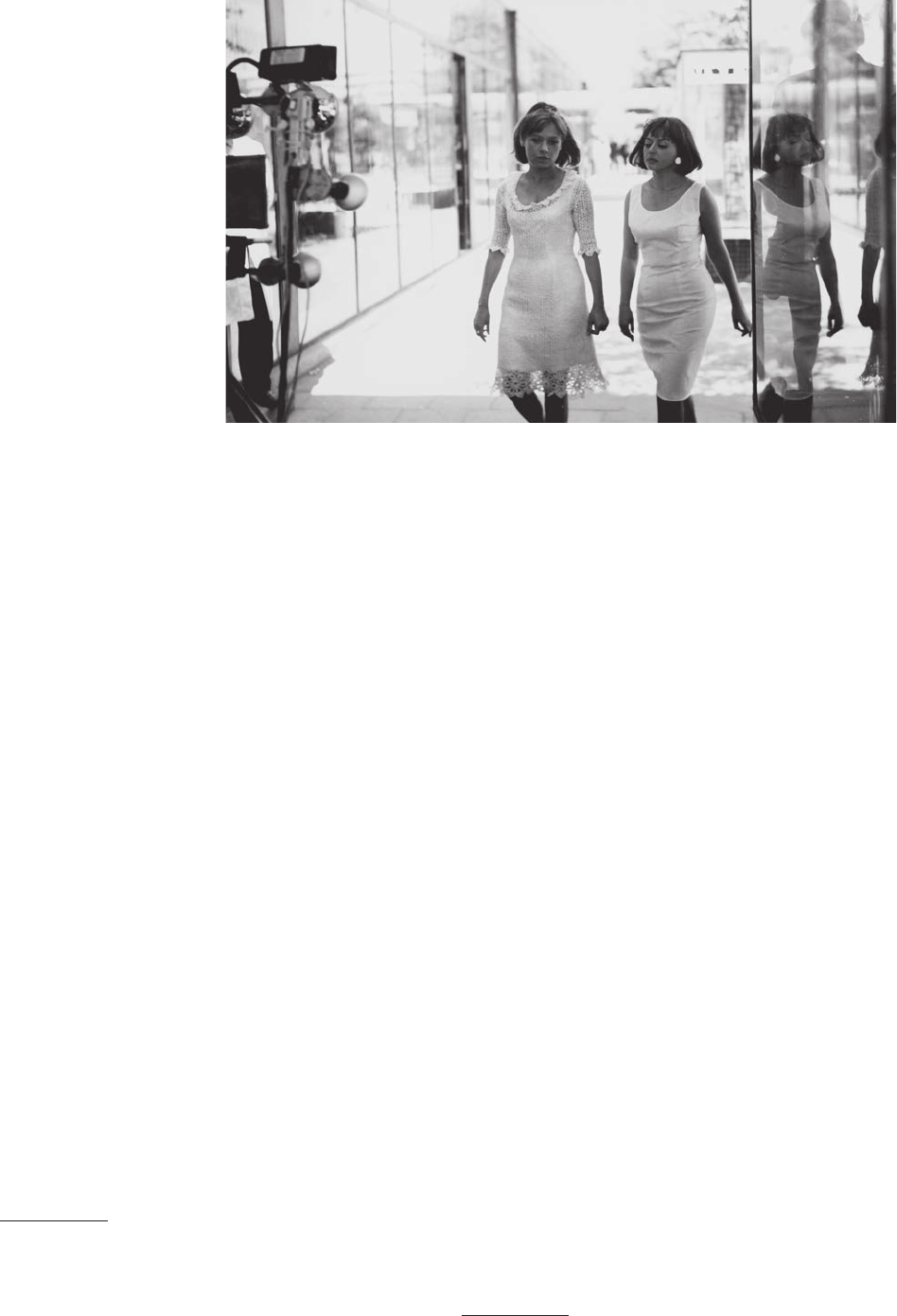
Fig. 3 Joanna and Janka while
walking in the passage Ściana
Wschodnia (Eastern Wall).
Courtesy of The National Film
Stock Library, Warszawa,
Photo No. F-2306–388
142 Adam Nadolny
forged banknotes are produced is located in a dingy base-
ment. These scenes which are set in the space of the city
are marked with an ‘invisible’ inscription: novelty, sun,
progress, modernism.
The real architecture of the ‘Eastern Wall’
11
buildings
became an illusory space where Joanna and Janka – the
main characters – are walking. Their gures are reected
in the shopping windows behind which numerous con-
sumer goods are housed. In this way, multiplication of
space shown by Jan Batory in this particular fragment,
reminds the viewer of motifs from Jacques Tati’s lms,
for example Mr. Hulot’s Holidays 1953, or My Uncle
1958, where glass and transparency were employed by
the director as a universally dened symbol of modern
times.
11
Authors: Zbigniew Karpiński, Jan Klewin, Andrzej Kaliszewski.
Modernity in the lm Remedy for love creates an il-
lusory image of architecture and the city on the one hand,
while on the other it equips the architecture with non-ma-
terial features. The main characters’ gures reected in
the shopping windows lose their material form for a mo-
ment. We could even say that in this way they assume
the form of modernistic caryatids who do not support
anything, but with their gures they carry the modern ar-
chitecture into a non-material space. To sum up this part
of my reections, I would like to quote the words of Fran-
cois Penz: Film as the registration (…) of vision consti-
tutes a mirror in which architects can see the reection of
buildings and the city. However, they may not like this re-
ection
12
[8].
12
Penz F., Architektura w lmach Jacques’a Tati, Kwartalnik Fil mo-
wy, No. 28/1999, p.115.
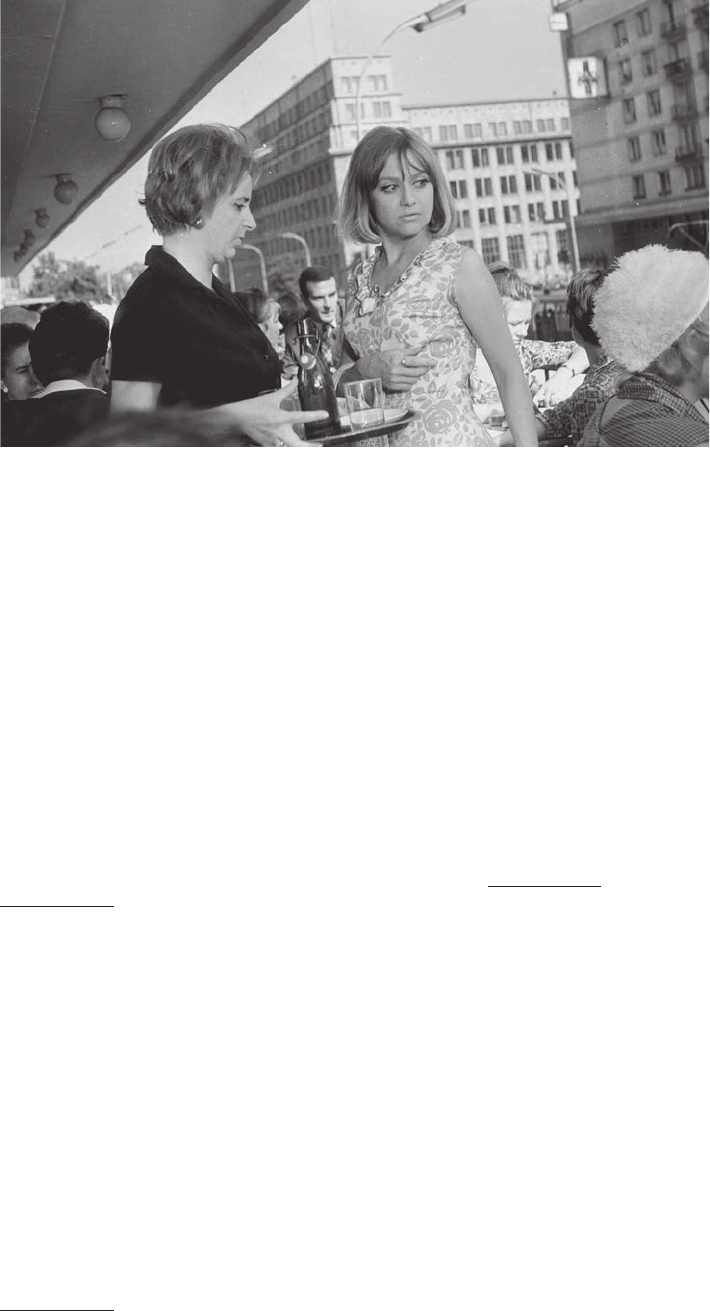
Fig. 4. Janka in the cafe on the
CDT terrace. In the background
the characteristic BGK building
designed in 1931 by Rudolf
Świerczyński. Courtesy of The
National Film Stock Library,
Warszawa, Photo No. F-2306–164
Modern city in the lm Remedy for love
In many lms made in the 1960s we can observe
the process of creating a non-existing image of the city
space
13
. It is a formally distorted image which is adapted
for the needs of the screenplay. The characters in those
lms move around against the scenery of real architecture,
yet its real context is usually neglected to a large extent.
The city in the lm Remedy for love can be divided into
two spaces: a modernistic or modern one in which good
lm characters are seen and an old one which is reserved
13
The 1920s were the times of fascination with the idea of the city in the
lm picture. It was then that such signicant lms were made as: Paris sleeps
by Rene Clair (1924), Metropolis by Fritz Lang (1926) or Berlin, symphony
of the great city (1927) by Walter Ruttmann. Each of those lms pictures the
city as an independent spatial unit which is ruled by its own rights and in
a sense uses the human genius to create its own power [6].
for the people whose dealings are not quite clear. The main
seat of the money forgers’ gang is situated in the basement
of a dilapidated tenement house, which is not a nice place,
rather dark and with no sunshine. On the other hand, the
good city is literally ooded with sunshine, with broad per-
spectives of the lm city and no traces of the past [except
for the scenes at the old town market place in Warsaw].
The context is dened in a way that has no connection with
the reality, the viewer gets the impression that the lm plot
develops in two parallel spatial layers: one spins the lm
story, the other is the space where urban interior and mod-
ern buildings are on the foreground.
Each of the chosen lm sequences presented in this arti-
cle uses the modern architecture and the city space in a dif-
ferent way for the purpose of showing or complementing
the story of the lm. Fictional stories which are set in the

Architectural remedy for love. City and architecture in polish lms of the 1960s 143
real space become a sort of a sign or symbol of a new spa-
tial reality of the Polish cities at the beginning of the 1960s.
A certain unreality and location of the plot of the lm in the
existing reality give the lm picture a new dimension.
From the viewpoint of an architectural researcher, it
seems really important to analyze the aforementioned
phenomenon while examining the reality in which ction
and certain unreality are part of the created spatial and
visual iconosphere of the city. To sum up these reec-
tions upon the city in the lm, I would like to quote the
words of Ewa Mizerska who dened the image of the city
in the lm in the following way: The cinema (…) could
present the city faithfully, almost scientically (due to its
photographic nature), (…). In this regard, a particularly
valuable technical means was montage, thanks to which
an artist was able to move instantly from the centre to the
suburbs, from the inside of the building onto the street,
from the roof of the skyscraper to the basement
14
[5]. City
14
Mizerska E., Janusowe oblicze lmowego miasta, Kwartalnik Fil-
mo wy, No. 28/1999, p. 39.
and architecture in the Polish lm of the 1960s became
determinants of progress and development. They provid-
ed opportunities to create the image of Poland as a coun-
try which is modern and lives up to the Western world.
The image of city and architecture recorded on the lm
tape can be interpreted as another stage in the discussion
on the phenomenon of memory in architecture. Building
museums, archives, historical research, caring about the
national heritage, including the lm heritage – all these
actions prove that we deal with the culture that does not
want to forget and cannot forget. Walter Benjamin said
that history and memory together mean a search for domi-
nant force. Memory is a fragment of the past which enters
the present times in a way that is uncontrolled and ex-
pressive and thanks to this an individual is able to sense
hegemony of history [6]. A lm picture became a record
of an epoch and at the same time provided a possibility
to commemorate architectural structures which are sig-
nicant for the Polish architecture history in their natu-
ral environment. This means the city, combined with hu-
man sensations, desires and expectations for a new bright
future.
References
[1] Haltof M., Kino polskie, Publishing House Słowa/Obraz/Terytoria,
Gdańsk 2004.
[2] Kornacki K., Bohater w przydeptanych kapciach, [in:] Człowiek
z ekranu. Z antropologii postaci lmowej, M. Jankun-Dopartowa,
M. Przylipiak (eds.), Kraków 1996.
[3] Kurz I., Twarze w tłumie. Wizerunki bohaterów wyobraźni zbiorowej
w kulturze polskiej 1955–1969, Świat Literacki, Warszawa 2005.
[4] Leśniakowska M., Architektura w Warszawie w latach 1945–1965,
Arkada Pracownia Historii Sztuki, Warsaw 2003.
[5] Mizerska E., Janusowe oblicze lmowego miasta, Kwartalnik Filmo-
wy, No. 28/1999.
[6] Nadolny A., Memory architecture. We may live without it, but we can’t
remember without it, Zeszyty Naukowe Politechniki Poznańskiej,
seria Architektura i Urbanistyka, Zeszyt 17/2009, Poznań 2009.
[7] Nadolny A., Miasto w lmie na przykładzie „Metropolis” Fritza Lan-
ga, Zeszyty Naukowe Politechniki Poznańskiej, seria Architektura
i Urbanistyka, Zeszyt 6/2006, Poznań 2006.
[8] Penz F., Architektura w lmach Jacques’a Tati, Kwartalnik Filmowy,
No. 28/1999.
[9] Tyrmand L., Dziennik 1954. Original Version, Publishing House
Tenten, Warszawa 1995.
Architektoniczne lekarstwo na miłość. Miasto i architektura w polskim lmie lat 60. XX wieku
Architektura i miasto modernistyczne stały się w latach 60. XX wieku
szeroko wykorzystywanym motywem w polskim lmie. Płaskie i oszczęd-
ne elewacje budynków, szerokie perspektywy nowoczesnych osiedli były
wyznacznikiem nowych czasów, tak odmiennych od przeszłości. Archi-
tektura modernistyczna stała się doskonałym tłem dla tworzenia kcji
w odniesieniu do realnego życia w kraju socjalistycznym. W wielu lmach
z tego okresu mamy do czynienia z tworzeniem nierzeczywistego obrazu
przestrzeni miasta. Jest to formalnie zniekształcony obraz dostosowywany
do potrzeb scenariusza. Bohaterowie obrazów lmowych poruszają się
w scenerii realnej architektury, ale z rzeczywistym kontekstem ma to
bardzo mało wspólnego. Zjawisko kontekstu jest deniowane w sposób
oderwany od rzeczywistości, odnosi się wrażenie, że fabuła lmu toczy się
w dwóch równoległych przestrzeniach: pierwsza z nich opowiada historię
poruszaną w lmie, druga jest przestrzenią, w której pierwszoplanową
rolę odrywają wnętrza urbanistyczne i nowoczesne budynki. W tytule
celowo umieściłem tytuł jednego z lmów z tego okresu Lekarstwo na
miłość (reż. Jan Batory, 1966). Fabuła lmu jest niezbyt skomplikowa-
na. Pani architekt o imieniu Joanna prowadzi nudne życie, które dzieli
między pracę w biurze architektonicznym a spotkania z kochankiem.
Pewnego dnia, kiedy próbuje napisać artykuł o estetyce we wnętrzach
mieszkalnych odbiera z pozoru nieważny telefon. Od tego momentu nic
nie jest tak jak było. Rozpoczyna się walka o rozwiązanie zagadki, kim
jest tajemnicza Honorata, o którą pytają ludzie dzwoniący do mieszkania
Joanny. Tytułowa Joanna wraz przyjaciółką przemierzają miasto (w tym
przypadku Warszawę) w poszukiwaniu rozwiązania zagadki. W wielu
miejscach akcja lmu toczy się w przestrzeni modernistycznego miasta,
którego dopełnieniem stają się rzeczywiste budynki, takie jak Supersam
czy CDT.
Key words: city, architecture, polish lms Słowa kluczowe: miasto, architektura, polskie lmy