2020
4(64)
DOI: 10.37190/arc200403
Architektura zobrazowana
Tematem poruszonym w artykule jest percepcja archi-
tektury przy udziale procesów sensorycznych ze szczegól-
nym uwzględnieniem denicji takich cech obiektów, jak
kolor, forma, wielkość, faktura, temperatura. Celem pro-
wadzonych badań było zwrócenie uwagi na istotną funkcję
zobrazowanych przestrzeni, odgrywających rolę komuni-
katu zawierającego się w kodzie językowym, w którym
duże znaczenie ma charakter modelowej przestrzeni. Zja-
wisko zwrotnych relacji, zachodzących podczas procesów
percepcji architektury, ma bezpośredni wpływ na jakość
generowanego obrazu autorskiego. Traktowany jako dzie-
ło sztuki dany obiekt architektoniczny determinuje formę
przedstawienia-zobrazowania (przestrzeń zobrazowana),
skutecznie kierując uwagę na walory, szczegóły, zjawiska
Katarzyna Słuchocka*
Architektoniczne notacje
Architectural notations
Imaged architecture
This article aims to present the perception of architec-
ture through sensory processes with particular emphasis
on denitions of features of architectural objects such as
colour, form, texture, and temperature. The purpose of
the research was to highlight the important function of
imaged space as a carrier of a meaningful message en-
coded in a eld-specic language based on the nature of
model space. The feedback generated from the perception
of architecture directly aects the quality of the image
a creator (architect) has framed. The form of presenta-
tion (imaging) of an architectural facility predetermines
its status as a work of art. As art, it shall eciently focus
our attention on values, details and phenomena inherent
in specic places. Only then can it support the commu-
nication of the message it carries and assure successful
reception. The transformation of autonomous thoughts
into purely artistic means of expression conrms the pur-
posefulness of cognitive methodology as it leaves an open
* ORCID: 0000-0002-0492-2761. Wydział Architektury Politech-
niki Poznańskiej / Faculty of Architecture, Poznan University of Techno-
logy, e-mail: katarzyna.sluchocka@put.poznan.pl
notujesz przestrzeń linią proporcji
kształtem nakreślasz cel
ubrany w przyszłość
komponujesz miejsce zdarzeń
kontekstem koloru
fakturą wrażliwości
by kiedyś
odczytać zapisaną
inspirację ciągu dalszego
notujesz przestrzeń
K. Słuchocka
noting down space with the lines of proportions
with shapes pursuing the goals
envisaging the attire of the future
you set the scene of events
with the contrasting colours,
sensitivity of texture
to be able
to come back to the recorded
conception and to get inspired to continue your work
you are the creator of architectural notations
K. Słuchocka
24 Katarzyna Słuchocka
przynależne ściśle do określonych miejsc, co wzmac-
nia siłę przekazu oraz odbioru konkretnej architektury.
Transformacja autonomicznych rozważań na wypowiedź
plastyczną skutecznie obrazuje celowość stosowania ko-
gnitywistycznej metodologii, oferując możliwość prowa-
dzenia autokorekt w trakcie procesów projektowych, rów-
nolegle wskazując współzależności pomiędzy dziedziną
nauk technicznych i sztuk plastycznych.
Metodologia prowadzonych badań opiera się na ob-
serwacji oraz analizie odręcznych zapisów rysunkowych
i malarskich w powiązaniu z heurystycznym sposobem
podejścia do zagadnienia. Zakłada, że wybór spostrze-
żeń według zastanych określonych warunków percepcji
i kształtowania architektury, odniesiony do autonomicz-
nych działań w sferze notacji plastycznych w powiązaniu
z zarysowanym celem, jakim jest optymalizacja procesów
kształtowania architektury, wskaże skuteczność zależno-
ści i związki zachodzące między danymi wstępnymi, kon-
struując ciąg logiczny implikujący zastosowanie omawia-
nych wytycznych. Zakres tematyczny, w który wpisuje się
podejmowana w materiale problematyka, dotyka wielo-
płaszczyznowo traktowane środowiska twórcze oraz ba-
dawcze, które przez pogłębianie świadomości, wrażliwo-
ści i rozwijanie wyobraźni stanowić mogą źródło nowych
powiązań wykraczających poza przyjęte normatywne roz-
wiązania. Ich implementacja w mechanizmy dydaktyczne
oraz projektowe poszerza obszary badawcze, przekłada-
jąc się na skuteczność holistycznej percepcji architektury.
Materiał badawczy wykorzystany w opracowaniu opiera
się na wybranych pozycjach naukowych, na autopsyjnych
doświadczeniach i studium przypadku.
Czym jest architektura?
Niejednokrotnie zadawane pytanie nie pozostaje bez
odpowiedzi. Bez trudu znajdziemy tysiące denicji archi-
tektury różniące się od siebie nasyceniem emocjonalnym,
fachowością użytych sformułowań, trafnością, zależnych
od tego, kto, kiedy i w jakim celu je konstruował. Inaczej
pojęcie to, jak i samą formę architektoniczną, postrzegał
będzie architekt, inaczej historyk, wreszcie inaczej tak
zwany szary człowiek. Językoznawcy termin architektura
eksplikowali od greckiego słowa architekton, oznaczają-
cego głównego budowniczego, socjologowie bazowali na
licznych określeniach traktujących architekturę jako narzę-
dzie polityczne, ekonomiczne, umożliwiające prowadze-
nie dialogu ogółu z jednostką. Popularna w XIX w. de-
nicja przedstawiała architekturę jako sztukę kształtowania
przestrzeni. Podobny opis widnieje w wielu encyklope-
diach oraz słownikach. Czy jest to po prostu […] sztuka
projektowania i kształtowania budowli? Dyscyplina nauki
i wiedzy organizująca i kształtująca wszelkie przestrzenie
w formach niezbędnych do zaspokojenia materialnych
i duchowych potrzeb człowieka? [1, s. 12]. Czy to złożo-
ność procesów projektowych związanych z pojęciem ar-
chitektura, oscylujących wokół tworzenia, w konsekwencji
oferowania człowiekowi dedykowanej danym funkcjom,
a co za tym idzie konkretnemu odbiorcy przestrzeni?
Zgłębiając zagadnienie, na architekturę można spojrzeć
także jak na sztukę ograniczania przestrzeni, wyznaczania
door for self-corrections to be made over the entire design
process. This testies to the existing correlations between
engineering and ne arts.
The research methods we adopted consist in the ob-
servations and the analyses of hand-made drawings and
paintings in view of the heuristic approach to architectural
design and its perception. This methodology assumes that
the selected observations – made in the specic conditions
of perception of architecture and its designing – transposed
upon autonomous artistic activities in ne arts in relation
to a dened goal (being the optimisation of architectural
output) will eciently dene the interdependencies and
correlations between the input data, and will thus, form
a logical continuum, which implies the compliance with
the guidelines discussed herein. The topic that encom-
passes the core issues of this paper concerns both design-
ers and researchers in many elds of their profession. The
aforementioned professionals, by deepening their social
awareness, sensitivity and developing imagination, can
create new interrelations that might outstand the presently
used standard solutions.
If we can successfully turn their works into relevant
teaching and designing mechanisms, we shall be able to
successfully safeguard the holistic perception of architec-
ture. The research material used herein refers to selected
scientic publications, author’s own experience and case
study.
What is architecture?
This frequently asked question does not remain unan-
swered. Searching for the answer, we will certainly be
ooded with thousands of denitions saturated with the
emotional or eld-specic terms, whose accuracy will
depend on their author, time and purpose. The term “ar-
chitecture” and the “architectural form” can denote dif-
ferent concepts for an architect, a historian and for an
ordinary layman. Linguists derive the term “architecture”
from a Greek word architekton, meaning a master builder,
whereas sociologists refer to numerous opinions viewing
architecture as a political and economic tool for a dialogue
between a community and an individual. The denition
popular in the 19
th
century presented architecture as the
art of shaping space. Many encyclopaedias and diction-
aries include similar entries on architecture. Is this just
the […] art of designing and modelling engineering facil-
ities? A discipline of science and knowledge that systema-
tises and models all types of spaces into forms necessary
for the satisfaction of the material and spiritual needs of
man? [own translation] [1, p. 12]. Or is this a complex
entangle of architecture-related design processes, under-
lying the act of creation, and in consequence rendering
space dedicated to certain functions to meet the needs of
particular groups of space users?
Trying to precisely grasp the idea of architecture, one
might also see it as the art of delimiting space, drawing the
borderlines between the internal and external space, be-
tween the private and public space, between the open and
closed space, in other words the art of separating or even
fragmenting. Or even an art of appropriation of space (on

Architektoniczne notacje / Architectural notations 25
granic między tym, co wewnętrzne i zewnętrzne, co pry-
watne i publiczne, co dostępne i niedostępne, sztukę wy-
dzielania, czy nawet porcjowania jej fragmentów. Może
i narzucania charakteru konkretnej przestrzeni, tej w mniej-
szej czy też większej skali, narzucania woli/idei tego, kto ją
kształtuje…
W swoim holistycznym zasięgu architektura wydaje
się niedeniowalna. Pewne jest także, że potrzeby emo-
cjonalne użytkownika są równie ważne jak pragmatyczne.
Zważywszy na interdyscyplinarność procesów projekto-
wych, w których architekt zobligowany jest do porusza-
nia się pomiędzy obszarami wiedzy z zakresu konstrukcji,
budownictwa, materiałoznawstwa, zyki, techniki wzno-
szenia obiektów i wielu innych, opierających się nierzad-
ko na narzędziach cyfrowych, niewątpliwie jest dziedzi-
ną nauki i techniki (materia ta stanowi również istotny
element w programach kształcenia dla studentów wydzia-
łów architektury na uczelniach wyższych). Niewątpliwie
jest także dziedziną sztuki. W starożytności celem sta-
wianym przed twórcami było takie działanie, aby odbiór
wizualny obiektów architektonicznych traał w poczucie
piękna, a każdy detal stanowił element estetyczny całej
kompozycji, opierając się na odczuciach osób, którym
były dedykowane.
Architekturę w prosty sposób przyrównać możemy do
rzeźby, będącej dyscypliną twórczości plastycznej, tyle
tylko że wyposażonej w istotną składową, w funkcję.
Znaczący krok w kształtowaniu się form i idei rzeźby no-
woczesnej, zbliżającej obie, nastąpił w 2. połowie XX w.,
kiedy to malarstwo, rzeźba i architektura w swoim swo-
bodnym przenikaniu się, wzbogacane udziałem nowych
technik obrazowania, np. lasera lub wideo (praktykowa-
nych wcześniej przez kubistów) coraz bardziej zacierały
granice pomiędzy sferą architektury i sztuki. Powszechną
praktyką było wychodzenie poza statyczną bryłę rzeźby
i czasoprzestrzenność, przybierającą postać environment,
jak w projekcie AXER/DÉSAXER Daniela Buren, pre-
zentowanym w Neapolu czy Excentrique (S), anektującej
Grand Palais w Paryżu
1
. Sztuka performatywna, kojarzą-
ca się tu z precyzyjną kreacją wnętrza architektonicznego,
budzi poczucie przynależności instalacji i wnętrza, jedno-
cząc architekturę z dziełem sztuki. Na podobnych zasa-
dach aranżuje wnętrza, tyle że w skali krajobrazu, Christo
Władimirow Jawaszew z żoną Jeanne-Claude Denat de
Guillebon. Rozpościera pomarańczową kurtynę w Kanio-
nie Kolorado (1972) czy zmienia wygląd zewnętrzny Re-
ichstagu w Berlinie, opakowując go 110 tysiącami metrów
kwadratowych białej tkaniny (1995). Projektant mody, ar-
tysta przestrzeni publicznej? Czyni z architektury obiekt
rzeźbiarski czy traktuje ją jak modelkę dla szaty, w którą
zostaje przyodziana? Gdy spojrzymy choćby na realiza-
cje Franka Gehry’ego, nasuwają się podobne skojarzenia.
Rzeźby w czystej postaci postrzegane w kontekście od-
bioru zewnętrznego form. Powiązanie sztuki projektowej
1
W 2015 r. francuski artysta, Daniel Buren, stworzył instalacje in
situ, ożywiającą atrium Muzeum Matki w Neapolu, poprzez zastosowa-
ne tae luster i duże płaszczyzny barwne, w drugim przypadku wyko-
rzystując kolorowe, dużych rozmiarów szklane okręgi, mocowane na
stalowych nogach w przestrzeniach Grand Palais w Paryżu w 2012 r.
a small or large scale) by subordinating it to the viewpoint
of its designer…
The holistic range of architecture seems to eective-
ly escape any attempts at capturing it within any deni-
tion framework. We all know that the emotional needs of
the users of architectural facilities are equally important
as their living needs. Accounting for the interdiscipli-
nary nature of design processes, which require an archi-
tect to refer to dierent areas of knowledge in the eld
of engineering, construction, materials science, physics,
construction technologies and many others, the elds of
which often involve the use of digital tools, we can arrive
at the conclusion that architecture is without doubt a part
of science and technology (this engineering part of archi-
tectural know-how is also an important component of the
study program developed for the students at the faculties
of architecture at universities). Without doubt, it is also
an artistic eld. In the Ancient times designers aspired
that the visual appearance of their architectural facilities
should evoke the feeling of beauty. Each detail was in-
cluded in the overall composition for aesthetic reasons
with the feelings of addressees in mind.
We can easily compare architecture to sculpture, a eld
of ne arts, yet, architecture will be a broader concept,
extended with an important component, namely: function.
A crucial step towards bringing the shaping of forms and
the ideas of modern sculpture closer together was made
in the 2
nd
half of the 20
th
century. Painting, sculpture and
architecture, furnished with new features by new imag-
ing technologies, e.g., laser or video (pioneered by cub-
ists), could freely penetrate into one another, thus blur-
ring the borderlines between the architectural and artistic
zones. Going beyond a static body of a sculpture and its
rigid time and space correlation was a common practice,
demonstrated through the so-called environment form as
in the project called AXER/DÉSAXER by Daniel Buren,
shown in Naples, or Excentrique (S), annexing Grand
Palais in Paris
1
. Performing arts, here associated with
the precision of the interior design of an architectural fa-
cility, evoke the feeling of adherence of the t-out and
the interior, which blends architecture with a work of art
into one whole. Similar interior design principles, though
in the scale of a landscape, were observed by Christo
Wladimirow Jawaschew and his wife, Jeanne-Claude De-
nat de Guillebon. He spreads an orange curtain in the Col-
orado Canyon (1972) or changes the external appearance
of the Reichstag in Berlin by wrapping it with 110,000
square meters of white fabric (1995). Was the author
a fashion designer or a public space performing artist? Did
he turn architecture into a work of sculpture or into a fash-
ion model dressed into a fashionable costume? Works
of Frank Gehry bring to mind similar associations. Pure
sculpture is perceived in the context of the external recep-
tion of forms. It is obvious that we can nd some common
1
In 2015, a French artist, Daniel Buren, specially conceived an in
situ installation for the Madre’s atrium in Naples by applying mirrors and
large coloured surfaces, the other installation mentioned was made with
the use of large, colourful glass circles supported with steel agpoles,
sequentially displayed in the large space of Grand Palais in Paris in 2012.
26 Katarzyna Słuchocka
ze sztuką czystą wydaje się oczywiste, jak w założeniach
realizowanych przez reprezentantów Bauhausu.
Idea wychowania przez sztukę aprobuje słuszność sto-
sowania metodologii, skupiając się na zdecydowanie szer-
szym traktowaniu samej architektury i bazowaniu na jed-
nocześnie pogłębiającej się wrażliwości oraz wyobraźni.
Wpływ na rozwój tej ostatniej ma aktywność na polu
plastycznym. Poprzez rysunek, malarstwo czy inne for-
my zapisu gracznego możemy ją rozwijać i modelować,
co z powodzeniem udowadnia M. Misiągiewicz w mono-
grai O prezentacji idei architektonicznej [2], L. Maluga
w monograi Autonomiczne rysunki architektoniczne [3]
czy N. Bingham, prezentując zbiór wybitnych, architek-
tonicznych zapisów plastycznych [4]. W zwięzły, obra-
zowy sposób przedstawia przykłady koegzystencji sfery
wrażliwości twórczej i projektowego zmysłu A. Bahamon
w opracowaniu Sketch: Houses, How Architects Conceive
residential Architecture [5]. Wieloaspektowa wrażliwość
na otaczającą nas rzeczywistość ukazana została w pozy-
cji Rysunek – zmysł architektury, skupiając uwagę na ze-
branych przez M. Orzechowskiego esejach dotyczących
architektury oraz autorskich, rysunkowych, malarskich,
gracznych zapisach przestrzeni [6].
Uaktywnienie tego ośrodka inspiracji skutkuje w my-
śleniu przestrzennym, lepszej percepcji otaczającej nas
rzeczywistości, uwrażliwia. Uważne patrzenie poszerza
horyzonty, otwiera nowe płaszczyzny, zwłaszcza twór-
cze i projektowe, płaszczyzny autorskich wyobrażonych
przestrzeni, usprawniając działania adeptów architektury
i tych czynnie już działających na rynku pracy. Stosowa-
ne w ramach zajęć ze studentami techniki sztuk plastycz-
nych stanowią podstawy rozwoju osobowości twórczej
przyszłych architektów. Reprezentowane przez różnorod-
ne wypowiedzi, zależne od etapu procedury projektowej,
spełniają swoje zadania wielostronnie.
Komunikat ↔ rysunek lustro ↔
autograf twórczy ↔ dokument ↔
źródło poznawcze
Fenomenem architektonicznych zapisów rysunkowych
jest ich unikatowy charakter, funkcja komunikatywna,
edukacyjna [3]. Podnoszą świadomość teorii i praktyki
zawodowej, wprowadzają jednocześnie pierwiastek świe-
żości, wynikający z indywidualnych cech autora. Klasy-
kując wykonane ręką architekta notacje graczne pod
względem rodzaju przypisanej im funkcji, możemy wy-
różnić co najmniej pięć kategorii.
Komunikat
Pierwsze szkice, zapisy myśli architekta, rozpoczynające
fazę projektową obiektu są przeobrażeniami idei w osta-
teczną formę architektury. Jako szybkie notatki, przybiera-
jące postać obrazu, pozwalają odbiorcy, którym jest poten-
cjalny klient, lepiej zrozumieć konkretyzowane myśli. Są
podstawą dialogu, rodzajem formalnego komunikatu. W tej
fazie kreacji bardzo często odbiorcą jest sam projektant.
Autorskie, graczne wypowiedzi w sposób multidyscy-
plinarny poddawane są komparacji z przechowywanymi
grounds that a design process and pure arts share, i.e., the
assumptions of the Bauhaus school of art implemented in
the works of its followers.
The idea of education through art approves the correct-
ness of applying the methodology, focusing on a much
broader approach to architecture itself and on the basis
of simultaneously deepening sensitivity and imagination.
Imagination can be developed through artistic activity.
Drawing, painting or any other forms of graphical rep-
resentations of the world around us underlie the imagina-
tion development and modelling, this position is held by
M. Misiągiewicz, in her monograph O prezentacji idei ar-
chitektonicznej [About the presentation of an architectural
idea] [2], by L. Maluga, in his monograph Autono micz-
ne rysunki architektoniczne [Autonomous architectural
draw ings] [3] or by N. Bingham in the collection of out-
stand ing architectural drawings of high artistic value [4].
A. Bahamon in a concise and illustrative manner presents
particular examples of coexistence of creative sensitivity
and design skills in his work Sketch: Houses, How Archi-
tects Conceive Residential Architecture [5]. Extensive sen-
sitivity to multifaceted aspects of the surrounding world
is in the focus of Rysunek – zmysł architektury [Drawing
– a sense of architecture], a set of essays on architecture
and the drawings, paintings and other graphical rep-
resentations of space, collected by M. Orzechowski [6].
Activation of sensitivity can inspire our spatial think-
ing and improve the perception of the surrounding reali-
ty; in other words it can sensitise us. Careful observation
can widen our horizons, open up new creative and design
perspectives or perspectives of imagined spaces. It can,
moreover, facilitate the work of architect trainees and ac-
tive professionals. The ne arts techniques the students
learn in accordance with their study program constitute
the foundations for their creative and personal develop-
ment in the architectural career. Expressed through a vari-
ety of means, irrespective of the design stage, these tech-
niques do meet multiple criteria of professional tasks.
Message ↔ drawing mirror ↔
identification mark ↔ document ↔
source of knowledge
The phenomenon of architectural drawing records is
their unique character as well as their communicative and
educational functions [3]. It increases the awareness of
both theoretical and practical professional issues, at the
same time introducing some fresh element originating
from individual traits of the creator. Classifying the hand-
made architectural drawings (graphical notations) by their
allocated function, we can distinguish at least ve func-
tional categories.
Message
The rst sketches, i.e. records of the architect’s thoughts
which start the design phase of a building, constitute the
transformation of the idea into the nal form of architec-
ture. Quick pictorial notes enable the addressee, a potential
client, to better understand the ideas captured in a physical
Architektoniczne notacje / Architectural notations 27
form. They underlie a specic kind of a dialogue between
the author and the viewer, where the author themselves is
often the viewer as well. The original output is multi-disci-
plinarily compared with short-term memory sensual infor-
mation on a given idea [7]. The set of previously adopted
signals describing the phenomenon being developed is
a kind of a buer stock of sensual, pictorial information,
including visual data from iconic memory, short-term
memory images and many traces of the long-term mem-
ory visual code. Cognitive attention in combination with
the selective function are close-coupled with motivation-
al tensity – in this case – related to the design task. The
process takes place in the individualisation area which
is responsible for past experiences and the ability to use
the privi leged signals that are relevant for the purposeful
action which is planned or being implemented. Increased
motivation for work translates into the work rate and qual-
ity of designed architecture.
Drawing mirror
A designer who is experienced and open to comments
can take advantage of the opportunity when the eect of
their work (conceptual sketch, schematic design) is con-
fronted with the idea. A “controlled opportunity” contrib-
utes to the increase in the aesthetic value of the work and
its higher quality, irrespectively of the industry sector the
work falls in. A handwritten note – quick sketch, initial
sketch, autonomous drawing – are terms that embrace the
merit of the issue. Thoughts swirling while working on
a given solid gure and space are the unrestrained energy
of the combination of guidelines, restrictions and one’s
own vision that are on a collision course with one an
other.
The synergy originating from experience, time compres-
sion and the resulting rate of the reaction of ongoing pro-
cesses are the mechanisms that cannot be handled by the
computer. Time lapsing from the moment an imaged rep-
resentation is coined in the brain, through data entry into
an electronic le, until the reaction triggered on the screen
of the data carrier is much longer than the time needed to
make a quick, hand-made note, reecting the results of the
mental process. Pressing ENTER takes denitely more
time than getting down on paper a note that pictures the
output of thinking. Moreover, it frequently happens that
due to the attention distraction caused with the ENTER
key and constant clicking on it, we tend to inhibit the orig-
inal, imagined vision. Detecting discrepancies between
the visualised shape of the form and the one noted down
on a paper drawing is related to increasing the pace of
work and, most of all, it accelerates achieving the desired
eect. Detecting errors is half of the success. Repetitive
acts (multiple verications of the drawings) turn into para-
behavioural activity saved in long-term memory as ele-
ments – keys for understanding and evaluation, resulting
in progressive action.
Identification mark
Following the adopted classication criteria, the archi-
tectural drawing, the immediate product of our thoughts,
w pamięci krótkotrwałej informacjami zmysłowymi danego
wyobrażenia [7]. Zbiór sygnałów opisujących aktualnie
opracowywane zjawisko jest swoistym buforem groma-
dzącym treści o charakterze obrazowym, także wizualne,
z pamięci ikonicznej, wyobrażenia z pamięci krótkotrwałej
oraz liczne ślady z kodu wizualnego znajdującego się w ma-
gazynie pamięci długotrwałej. Uwaga kognitywna w połą-
czeniu z funkcją selektywną sprzężona jest z napięciem
motywacyjnym, w tym przypadku – napięciem związanym
z zadaniem projektowym. Proces ten odbywa się w stree
zindywidualizowania, odpowiedzialnej za posiadane do-
świadczenia i umiejętności wykorzystania uprzywilejowa-
nych sygnałów, mających znaczenie dla planowanego lub
realizowanego celowego działania. Wzrost motywacji do
pracy przekłada się na tempo pracy oraz jakość projektowa-
nej architektury.
Rysunek lustro
Doświadczony, otwarty na uwagi projektant w mo-
mencie konfrontacji efektu pracy (szkic zalążkowy/ide-
owy) z wyobrażeniem potra konstruktywnie wykorzy-
stać przypadek. Kontrolowany przypadek ma wpływ na
zwiększenie walorów estetycznych dzieła, podwyższenie
jakości, niezależnie od dziedziny, do której zaliczamy wy-
konywaną pracę. Odręczna notatka (szybki szkic, szkic
zalążkowy, rysunek autonomiczny) to sformułowania
zamykające w sobie istotę problemu. Myśli kłębiące się
podczas pracy nad daną bryłą, przestrzenią to zasób nie-
pohamowanej energii splotu wytycznych projektowych,
ustaleń branżowych z własną wizją. Synergia mająca
źródło w doświadczeniu, kompresja czasowa oraz wyni-
kające z ich powiązania szybkie tempo reakcji zachodzą-
cych procesów są mechanizmami, których nie jest w sta-
nie poskromić komputer. Czas upływający od powstania
wyobrażenia, poprzez wprowadzenie w zapis elektro-
niczny, do pojawienia się reakcji na monitorze nośnika
elektronicznego jest nieporównywalnie dłuższy od czasu
wykonania szybkiej, odręcznej notatki, obrazującej efekt
myślenia. Ponadto, bardzo często, poprzez rozproszenie
uwagi na tzw. klawisz ENTER i związane z nim czynności
tracimy kontakt z pierwotną istotą wyobrażenia. Wykrycie
rozbieżności pomiędzy kształtem wizualizowanej formy
a przelanym na płaszczyznę rysunku zapisem łączy się ze
zwiększeniem tempa pracy i przyspiesza uzyskanie pożą-
danego efektu. Detekcja błędów stanowi połowę sukcesu.
Powtarzalność zachowań (wielokrotna werykacja zapi-
sów rysunkowych) powoduje przekształcenie się tychże
w czynności parabehawioralne, kodujące się w pamięci
długotrwałej jako elementy-klucze, służące poznaniu
i oce nie, w konsekwencji implikujące progres.
Autograf twórczy
Podążając dalej tropem klasykacji, możemy uznać ry-
sunek architektoniczny, natychmiastowy produkt naszej
myśli, za znak tożsamości twórczej, o czym świadczy spe-
cyka kreski, gestu, rodzaj użytego narzędzia. Rysunek
wstępny, szkic zalążkowy jest zobrazowaną ciągłością,
doskonałą pod względem wierności ideowej. Funkcjonuje
28 Katarzyna Słuchocka
jako autograf, od niechcenia stawiany na przypadkowo
uchwyconym fragmencie nośnika, jako autograf wrażli-
wości przestrzennej, a specyczne cechy powtarzające się
w zapisach rysunkowych, przypisywane do konkretnych
zbiorów prac, utożsamiane zostają z postacią autora. Na
tę środowiskową rozpoznawalność twórcy wpływa bu -
dowanie drabiny rozwoju osobistego, wspomagane nie-
ustannie pogłębiającą się wyobraźnią oraz dynamicznym
rozwojem myślenia abstrakcyjnego. Wciąż udoskonala-
na umiejętność reprezentowania otoczenia, o zmysłowej
genezie, poparta kontynuacją pracy celuje w swoistą au-
tonomiczność wypowiedzi artystycznej, skutkując wyjąt-
kowymi efektami, będącymi tzw. działalnością uboczną
architekta.
Dokument
Rysunki, szkice, obrazy stanowią równocześnie ogni-
wo wiążące często niezależne sfery obszarów motywa-
cyjnych oraz pól naukowych, także istotny dokument
w dynamicznym procesie kształtowania środowiska ze-
wnętrznego człowieka. Dowodzą interdyscyplinarności
specyki zawodu architekta, kreującego w sposób inży-
nierski konkretną przestrzeń, dodając do niej czy uzupeł-
niając kolejne elementy układanki w sposób świadomy,
z pełną odpowiedzialnością podjętych decyzji, wykorzy-
stując wszelkie walory kontekstu z zamierzeniami dobrej
kontynuacji dzieł podjętych przez budowniczych z lat
ubiegłych. Są materiałem reklamowym/wizytówką, po-
wstają w pracowniach, skrywane w szuadach, w tecz-
kach z pracami już archiwalnymi. Stanowią dopełnienie
wizji projektowych, penetrując zaułki wyobraźni, obrazu-
jąc kody myślenia twórczego. I te ledwo dotknięte ideą
w przelocie krzyżujących się dylematów decyzyjnych,
i te domknięte, gotowe od razu, by zaistnieć na ścianach
prestiżowych galerii to doskonałość daleka od iluzorycz-
nego przedstawiania rzeczywistości, pełna realizmu pro-
jekcji twórczej przypisywanej konkretnym elementom
składowym przestrzeni na bazie fundamentów dyscyplin
związanych z pracą architekta. Są przy tym inspirującym
przykładem popularyzacji sztuki, jaką jest architektura,
pretendując do miana niezależnych dokonań artystycz-
nych, bezwzględnie wymagających ochrony konserwa-
torskiej i uwzględniania w zasobach dorobku dziedzic-
twa kultury.
Źródło poznawcze
Traktowane przedmiotowo zbiory szkiców zalążko-
wych, szkiców-baz wyjściowych do zasadniczej fazy pro-
jektowej, rysunków konfrontacyjnych monochromatycz-
nych i z użyciem koloru to w przeważającej większości
gotowy materiał inicjujący, czyli koncepcja obrazu. Fa-
scynacje architekturą stanowią popularny temat podejmo-
wany w sztuce, lecz w przypadku jej interpretującej formy
mamy do czynienia z wielofunkcyjną rolą przekazu. Ar-
chitektura zobrazowana, komentarz na temat elewacji rzu-
tów, przekrojów konkretnych obiektów jest częścią proce-
su tworzenia oraz potwierdzeniem zależności pomiędzy
wartością struktury projektowej a wartością obrazu pla-
created with the use of a specic line, gesture or tool
can be considered a mark of creative identity. An initial
drawing or a conceptual sketch represent continuity in
a graphical form, characterised with perfect loyalty to the
idea and function as an autograph “negligently” signed on
some random piece of a medium, the autograph of spatial
sensitivity. Specic features repeatedly found in drawing
representations are attributed to the sets of works and
these identify the originator. This industry recognition of
the creator is fostered through a ladder of personal devel-
opment aided by continually ourishing imagination and
dynamically developing abstract thinking. The continu-
ously perfected ability of sensitive representation of the
environment, demonstrated in continuous work, aims to
produce autonomous artistic expressions that render the
exceptional “side eects” of design processes.
A document
Drawings, sketches and pictures represent a link that
connects independent motivational areas and scientic
elds; they, moreover, are important documents that cap-
ture the dynamics of the process of shaping human envi-
ronment. They prove the interdisciplinarity of the archi-
tectural profession that shapes space through engineering
solutions, which supplement or complement the urban
texture with subsequent elements of a puzzle, mindfully,
with full responsibility for the decisions taken, taking ad-
vantage of all the qualities of the context, meaning to con-
tinue well the job of the former “constructors”. They make
up specic advertising material created in the studios, hid-
den in drawers or briefcases with archive footage, comple-
menting the design visions, penetrating the cul-de-sacs of
imagination, depicting the codes of creative thinking, and
the ones uncompleted because of intersecting decision di-
lemmas and – the completed ones – ready to be hung on
the walls of prestigious galleries. They are the perfection
themselves that is far from the illusory portrayals of the
reality but oers a full range of realistic creative visions,
attributed to particular space components based on disci-
plines related to the architect’s work. They are, at the same
time, an inspiring example of popularisation of the art of
architecture, aspiring to be an independent artistic accom-
plishment, essentially requiring the conservator’s protec-
tion and inclusion in the national heritage resources.
Source of knowledge
Approached objectively, collections of conceptual
sketches, sketches used as the bases of the output data for
the basic design stage and monochromatic and colourful
idea confronting drawings largely represent ready-made
materials initiating the conception of a given image. Fasci-
nations with architecture make up a popular theme in arts,
however, should these works of art assume an interpreta-
tive form, we would be challenged with a multifunctional
role of the message. Imaged architecture, a commentary
on the elevation projections or cross-sections of particular
buildings, is an inherent part of the creative process and
a conrmation of interdependencies between the value of

Architektoniczne notacje / Architectural notations 29
stycznego. Intuicyjne mechanizmy synergii prowadzą nas
na płaszczyzny wyobraźni, psychologii oraz sztuki, gdzie
wspierane doświadczeniem zawodowym konstytuują się
w postać obiektu architektonicznego. Ten postrzegany
jako dzieło sztuki lub po prostu inspiracja, prowokująca
wypowiedź plastyczną, oferuje kolejne poziomy syste-
mów poznawczych. W interpretacji przestrzeni, poprzez
podejście emocjonalne i reakcję wywołaną obserwacją
oraz przeżyciem wynikającym z odbioru wrażeniowego,
odnajdziemy dualizm znaczeniowy. To przekłada się na
ukonstytuowanie zapisu dającego subiektywną, ale jed-
nak informację na temat obrazowanej rzeczywistości,
podlegającej ocenie w zakresie kompozycji, ekspresji,
kolorystyki, gestu. Zobrazowane projekcje pełnią funk-
cję translacji z języka projektowania, jak części zdania,
naprowadzają na hipotetyczny kierunek ciągu dalszego
zdarzeń i poddane zostają reinterpretacji.
Bardziej niż produkcja tak zwanych dzieł sztuki w ak-
tywności twórczej architektów interesujące jest to, w jaki
sposób sztuka obrazowania architektury może być plat-
formą do zrozumienia otaczającej rzeczywistości i jakie
mogą z tego płynąć korzyści. Przy tworzeniu artefaktu na
bazie artefaktów następuje implikacja kolejnych oraz rein-
terpretacja. W konsekwencji poszerzone zostaje spektrum
bodźców percepcji przestrzeni, równocześnie udostępnia-
jąc społeczeństwu temat do prowadzenia konstruktywnej
polemiki. Interpretacja, autorski zapis plastyczny zaobser-
wowanej formy technicznej, jest nośnikiem myśli inży-
nierskiej oraz impulsem do poszukiwań w obszarze indy-
widualizacji deniowania przestrzeni, podkreślając istotę
oddziaływania obrazem na wyobraźnię odbiorcy. Zwraca
uwagę na nieograniczone możliwości upowszechniania
idei architektonicznych, uaktywnia i prowokuje do dal-
szego dialogu, tworząc jednocześnie nową jakość. Nowa
jakość jest tu swoistym pośrednikiem, którego zadaniem
jest wprowadzenie odbiorcy w pożądany stan psychiczny,
z naciskiem na emocje, procesy poznawcze. Przenikanie
jakości architektonicznych do medium malarstwa, graki,
rysunku transmituje najistotniejsze przekazy treściowe na
grunt dwuwymiaru, poszerzając grono odbiorców inter-
pretujących architektoniczne struktury.
Percepcja przestrzeni architektonicznych oparta na
ocenie walorów kompozycyjnych oraz inuencji na od-
biór emocjonalny wraz z przenikaniem w sfery psychicz-
ne człowieka wygenerowała trzy wątki interpretacji,
przekładające się na charakter wypowiedzi malarskiej,
a odnoszące się do klasykacji przestrzeni na toksyczną,
transparentną i tożsamą.
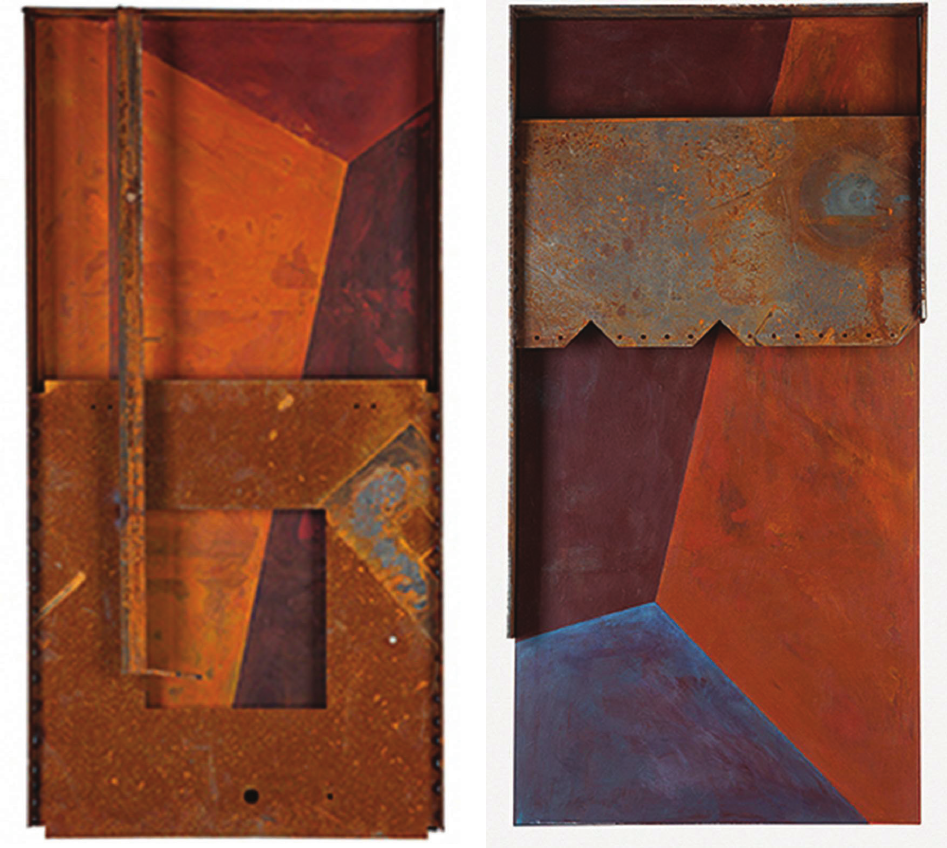
Życie (K. Słuchocka) i Wartość podwójna (K. Słuchoc-
ka)
2
są to prace mające w swym ideowym założeniu od-
niesienie do Muzeum Żydowskiego Daniela Libeskinda
w Berlinie (il. 1, 2). Surowa forma obiektu wykreowany-
mi przestrzeniami budzi głęboko poruszające człowieka
emocje, pobudza do reeksji, przywołuje wspomnienia,
2
Obrazy Życie oraz Wartość podwójna prezentowane były m.in.
na wystawach indywidualnych: Kontynuacja w Galerii u Jezuitów w Po-
znaniu (2015), Proces – malarstwo, Galeria odNOWA, ASP im W. Strze-
mińskiego w Łodzi (2015) oraz Konteksty w Galerii Sztuki Współcze-
snej Prol w Poznaniu (2016–2017).
a design and a work of ne arts. Intuitive mechanisms of
synergy will refer us to the imagination, psychology and
art. Only then, supported with professional experience,
can these mental processes assume a tangible form of an
architectural work, which, if perceived as an artefact or
a provocative inspiration for further artistic expressions,
can activate further and further cognitive mechanisms.
Interpreting space via the emotional approach, the obser-
vation triggered response and sensory feedback, we are
able to nd the dualism of meaning. This way, we create
a carrier of information, even if of subjective nature, about
the imaged reality, further assessed for its composition,
means of expression, colour scheme and gesture. Projec-
tions captured in images translate into the language of de-
signing and, like sentence parts, guide us towards further
development of the story, which will be next the subject of
many reinterpretations.
The artistic activity of architects is more focused on
how the art of pictorial representation of architecture can
become the common grounds for the understanding of the
reality around us and how we can all benet from it rather
than on the production of the so-called works of art itself.
Creating artefacts based on other artefacts implies innite
creative options and unlimited reinterpretations. This in-
volves the broadening of the range of stimuli of spatial
perception and furnishes the society with ideas for a con-
structive polemic. Interpretation, the artistic record of the
observed technical form by the author, becomes a carri-
er of the engineering thought and a trigger for searches
in the individualisation area for the denitions of space.
It underlies the signicance of the visual impact on the
imagination of the viewer. It, furthermore, highlights the
unlimited opportunities for the propagation of architectur-
al ideas and fosters continuation of a social dialogue by
creating new quality. This new quality serves as a specic
intermediary hired to put the viewer into the target mental
state (with the focus on the emotions and cognitive pro-
cesses). Permeance of the architectural quality into paint-
ings, graphics or drawings entails the transposition of
the key messages of the architectural facilities onto a 2D
plane, thus, engaging wider and wider circles of the pub-
lic into this innite chain of interpretations of the works
of architecture.
Perception of architectural space, based on the assess-
ment of composition and emotional impact, intertwined
with the metal processes has underlain three interpreta-
tive directions aecting the pictorial means of expression,
which correspond to the classication of space into trans-
parent, identiable and toxic.
Life (K. Słuchocka) and Twice the Value (K. Słuchoc-
ka)
2
are the conceptual references to the Jewish Museum,
designed by Daniel Libeskind in Berlin (Figs. 1, 2). The
created voids evoke deep feelings by their asceticism and
2
The paintings entitled Life and Twice the Value have among oth-
ers been displayed at individual exhibitions: Kontynuacja [Continuation]
in the Jesuit Gallery in Poznan (2015), Proces – malarstwo [Process
– painting], odNOWA Gallery, W. Strzemiński University of Fine Arts
in Lodz (2015) and Konteksty [Contexts] in Prol Modern Art Gallery
in Poznan (2016–2017).
30 Katarzyna Słuchocka
obrazy z tamtych lat. Wzrusza. Poprzez ascetyczność,
wystudiowaną ilość światła wpadającego w dokładnie
naznaczone przestrzenie architekt prowokuje bezpośred-
nie skojarzenia z miejscami, o których świat wolałby nie
pamiętać. Bez słów, bez fotograi, bez wyjaśnień staje-
my się uczestnikami symulacji sytuacyjnej. Perfekcja
projektowa. Architektura, jak wrażliwe naczynie dla ryt-
mu kroków po podłodze, dla skupienia […] [8, s. 12] nie
potrzebuje eksponatów, by opowiadać historię. Cytuje
czas. Tu czysta forma architektoniczna kreuje odczucie,
niesione ze sobą na długo. Libeskind zaprojektował per-
fekcyjnie przestrzenie toksyczne. Osiągnął zamierzony
cel implikowania głębokich, bolesnych doznań, po części
uświadamiających nam, co działo się za bramami obozów
koncentracyjnych. Malarski „aneks do…” kolorystyką
staje w opozycji do całości założenia muzeum. Szarość
betonu wyrażana w większości zgaszonymi czerwieniami
i rdzą metaforycznie formułuje wewnętrzny, zdławiony
provoke the visitors to reection, bring back the unsettling
memories and images from the past. The atmosphere is
very touching. The asceticism of form and limited amount
of daylight are the artistic means the architect uses to bring
to mind direct associations with places the world would
rather forget about. We become participants of a situa-
tional simulation deprived of any words, photographs or
explanations. Design perfection. Architecture like a sensi-
tive container for the rhythm of footsteps on the oor, for
the concentration […] [8, p. 12] needs no exhibits to spin
its story. It quotes the time. Here the pure form shapes the
feeling that lingers long in memory. Libeskind has per-
fectly created toxic spaces. He has aptly met the intended
purpose of implying deep, painful feelings, sharing the
secrets of what was going on behind the fences of concen-
tration camps with the visitors. The painted “annex to…”
stands in sharp contrast with its colours to the overall de-
sign assumption of the museum. Concrete grey texture is
Il. 1. K. Słuchocka, Życie
(akryl, stal, 130 × 60 cm, 2015)
Fig. 1. K. Słuchocka, Life
(acrylic, steel, 130 × 60 cm, 2015)
Il. 2. K. Słuchocka, Wartość podwójna
(akryl, stal, 130 × 60 cm, 2015)
Fig. 2. K. Słuchocka, Twice the Value
(acrylic, steel, 130 × 60 cm, 2015)

Architektoniczne notacje / Architectural notations 31
krzyk. Elementy stali, pokryte rdzą, pozyskane ze skupów
złomu, wyrwane zgniatarce, jeszcze tak niedawno funk-
cjonujące w okowach swego przeznaczenia, wkompono-
wane w obrazy, zyskują drugie życie, życie uratowane,
podarowane, odzyskane. Zagłada tysięcy istnień ludzkich,
wpisana w historię, łagodnieje w obrazach przedstawiają-
cych, a stworzenie warunków pobudzających wyobraźnię
jednocześnie ją aktywizuje, uzmysławiając głębię treści.
Procesualna koncepcja obrazów pozwalająca na artyku-
lację synergicznych skojarzeń pozostawia otwarte drogi
percepcji dla kolejnych reinterpretacji. Trafnie nazywany
przez angielskiego architekta Edwina Lutyensa plastycz-
ny rodzaj twórczości projektantów „listem otwartym” jest
przekazem, telegrafem wysyłanym do świata, przestrze-
gającym, by nie pozostawać obojętnym (za: [9]).
Transparentność to kolejny czynnik odnoszący się do
kodowanej funkcji i formy architektury, określający jej
jakość oraz charakter. Jak wspólny mianownik ma nazy-
wać obiekt, reprezentować jego przyjazny klimat, wyra-
żać emocje sprzężone z procesami poznawczymi w spo-
sób czytelny i jednoznaczny, jednocześnie zapraszając do
powrotu, do ponownego dialogu z treściami zawartymi
w przedstawieniach malarskich i przestrzeniach architek-
tonicznych. Mając do czynienia właśnie z takim obliczem
architektury, łatwiej o swobodę interpretacyjną. Architek-
tura staje się obrazem, a obraz czytany jest jak architek-
tura. Wyrażane w materii malarstwa odwołania do prze-
strzeni transparentnych, zapewniających użytkownikowi
optymalne warunki w wybranym przedziale czasowym,
poszarzają zakres czytelności założenia projektowego,
deniując ideę projektanta.
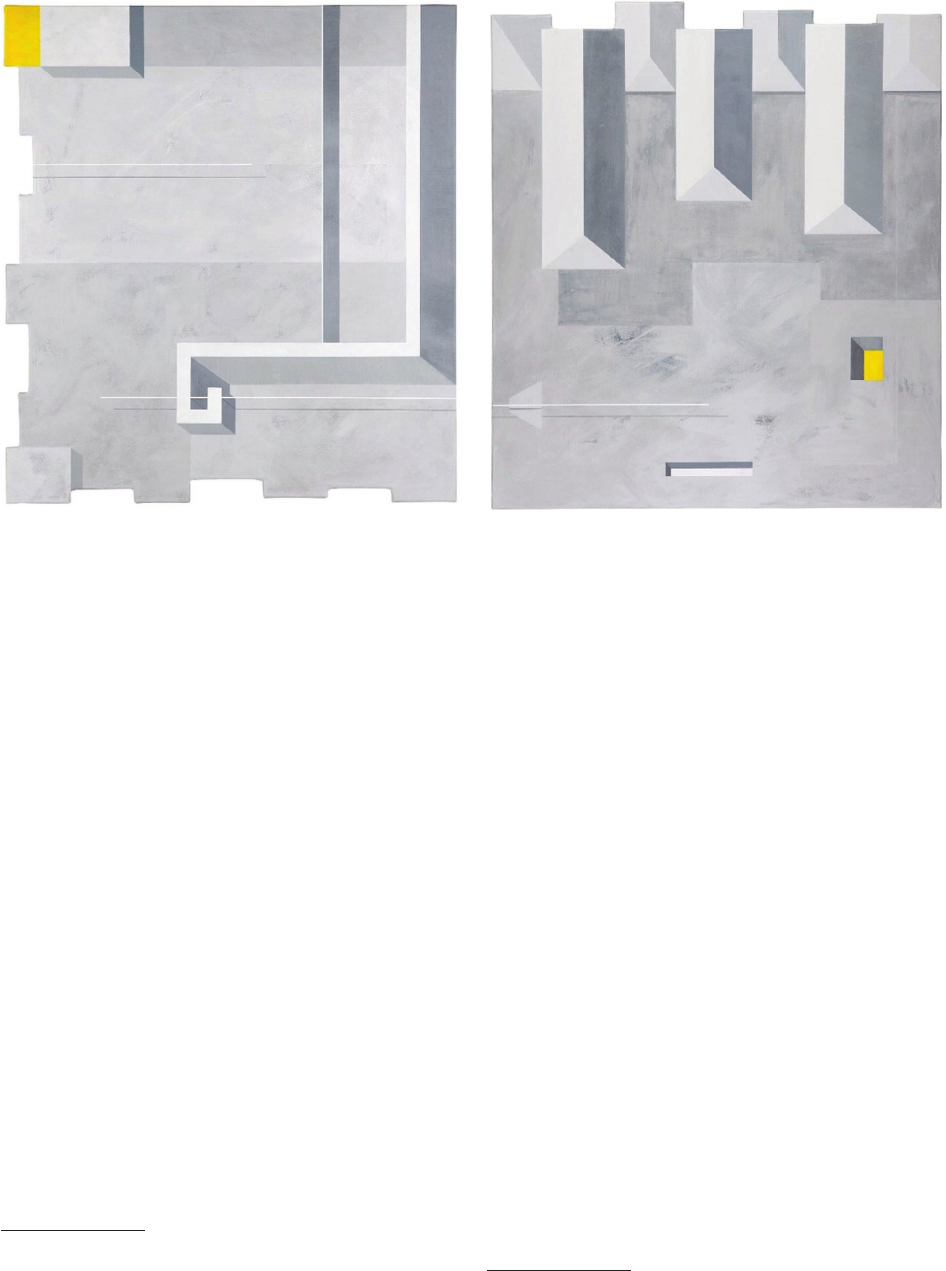
W przypadku zobrazowanej Filharmonii Szczecińskiej
(il. 3, 4)
3
symboliczne znaczenie odgrywa kolor, a jego
nasycenie generowane jest przez światłocień, silnie za-
znaczający się na elewacjach obiektu. Wybór stonowanej
szarości oznacza tło dla mieszających się grup użytkow-
ników, którzy jak regularne żółte plamy wyróżniają się,
stanowiąc dominantę, czyli najważniejszą składową prze-
strzeni. Rytm, powtarzalność, harmonia to komponen-
ty muzycznych utworów porządkujących i płaszczyznę
malarską. Charakterystyka funkcji oraz formy, komuni-
kowana akrylem na płótnie, łączy w sobie obszary mu-
zyki, architektury, sztuk plastycznych, czerpiąc inspiracje
z koncepcji oraz odbioru wrażeniowego.
Budzić pozytywne wrażenia, zapewniać spokój, bez-
pieczeństwo, oferować miejsce do nieskrępowanego roz -
woju, motywować to oprócz podstawowych wymogów
technicznych główne założenia projektowe. Gdy są speł-
nione, dają satysfakcję, albowiem projektowana prze-
strzeń ma być dla każdego przestrzenią wygodną, niena-
rzucającą się, satysfakcjonującą, jak w kolejnej odsłonie
zobrazowanych przestrzeni transparentnych.
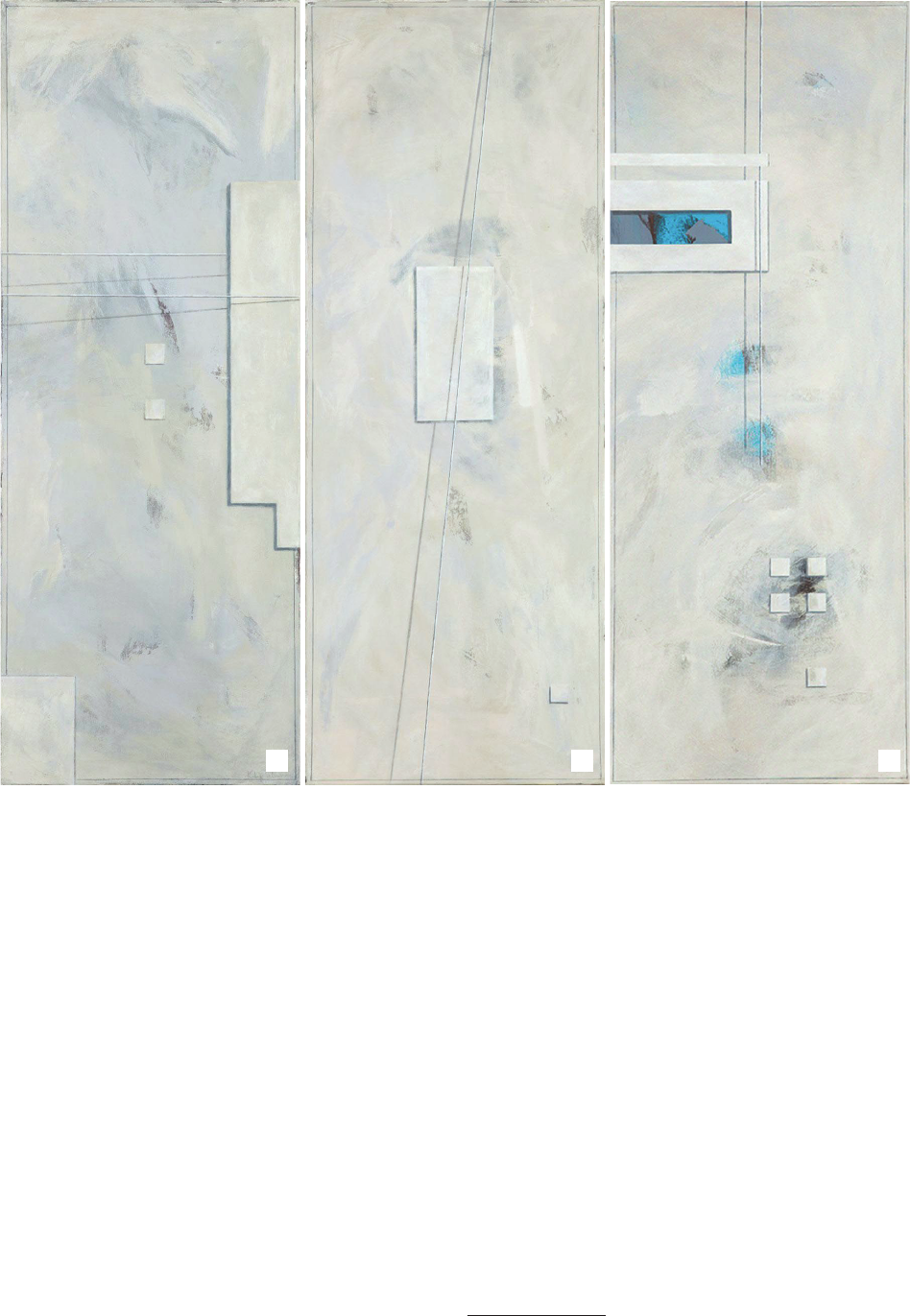
Rezerwat Archeologiczny Genius Loci w Poznaniu jest
próbą wprowadzenia odbiorcy w zamknięty ścianami mu-
zeum świat, przywołujący czasy końca średniowiecza
3
Obrazy Archidea Filharmonia Szczecińska Level +2, Level +5
prezentowane były m.in. na wystawie Zoom na Szczecin – punkty widze-
nia w przestrzeniach wystawienniczych Filharmonii Szczecińskiej im.
Mieczysława Karłowicza (2016).
mainly expressed through muted red or rust, becoming
a metaphor for an internal, mued scream. Rusted parts
of steel, reclaimed from metal scraps, saved from destruc-
tion by a crusher, that not so long ago still served their
purpose, are now composed within an image and enjoy
the second – rescued, gifted and regained – life. The imag-
es tend to mask the full picture of the mass murder atroc-
ities, documented in historical archives, however, in the
imagination stimulating environment, the visitors can ful-
ly sense the depth of the meaning carried. The conception
behind displaying the images to the audience alongside
the visiting route allows them to experience the synergy
of associations and leaves an open door for perception,
which is free to coin unlimited reinterpretations. Edwin
Lutyens – British architect – adequately denes this kind
of creative activity as an “open letter” (after: [9]) which is
a means of communication, a telex, sent to the world call-
ing everyone not to remain indierent.
Transparency is another factor that refers to the func-
tion and form of architecture, which in turn translate into
its quality and nature. It is supposed to serve as the com-
mon grounds for the users, to give a building its name, to
testify to its friendly atmosphere, to legibly and unambig-
uously express emotions coupled with cognitive processes
triggered. The users shall at the same time feel invited to
a further dialogue on contents contained in painted rep-
resentations and factual architectural spaces. Discovering
another face of architecture, we will feel encouraged to
freely interpret and reinterpret its image. Architecture
then becomes a painting and the painting is deciphered as
architecture. References to transparent places, expressed
in the form of a painting, assure the users with optimum
interpretative conditions in a given time interval. By this
the users can broaden the range of identied meanings of
a design assumption, thus, contributing to the conversion
of the designer’s idea into a denition framework.
The example of the presented picture of the Szczecin
Philharmonic [Filharmonia Szczecińska] (Figs. 3, 4)
3
un-
derlies the symbolic meaning of colour and its degree of
saturation produced with the chiaroscuro eect on the
building elevations. The selection of subdued shades of
greyness represents the background for the regular users,
depicted as distinctive yellow spots that dominate the en-
tire composition. In other words, they are the most im-
portant component of space. Rhythm, repeatability and
harmony are the components that organise the structure
of pieces of music and paintings. The form and function
characterised through an acrylic painting encompasses
a variety of elds – music, architecture, ne arts – in eect
of inspiration drawn from the original concept as well as
its sensory perception.
The main design assumption must go beyond just the
technical requirements to assure well-being, security and
safety of the user, to motivate the user and foster their
continuous development. Only if these criteria are met,
3
The paintings Archidea Filharmonia Szczecińska Level +2, Level +5
have among other been displayed at the exhibition entitled Zoom na
Szcze cin – punkty widzenia [Szczecin in focus – points of view] held in
Mieczysław Karłowicz Szczecin Philharmonic (2016).
32 Katarzyna Słuchocka
(il. 5a–c)
4
. Wertykalnie ukonstytuowane obrazy, powsta-
łe na gruncie przeprowadzonych analiz i studiów formy,
stawiają odbiorcę w pozycji obserwującego przestrzeń
„z dołu do góry”, podkreślając warstwowy układ stref
w budynku oraz budowę wału Mieszka I, któremu po-
święcony jest obiekt. Pozorna kumulacja planów prowa-
dzi w głąb, jak kondygnacje skrywające odkryte tajem-
nice historii. Prawda i wierność obrazu jest obecna nie
poprzez guratywne odwzorowanie, lecz wywołanymi
emocjami i poruszeniem myśli. Stymuluje też odbiorcę
w kierunku reakcji, utrzymując stałość układu kompo-
zycyjnego, gdzie pionowe płaszczyzny cięte powtarzają-
cymi się liniami, podkreślającymi złudzenie przestrzeni,
wprowadzają dodatkowy element ruchu, pozostawiając
zwiedzającego ze swoją autorską wersją reinterpretacji.
Podążając za tropem artystyczno-projektowej grama-
tyki, zatrzymać się możemy przy przestrzeniach tożsa-
mych (il. 6–8)
5
. To z nimi się identykujemy, jesteśmy ich
współtwórcami, choćby za pomocą realizowanych w pro-
jekcie sugestii czy nanoszonych zmian już „na czysto”.
W przestrzeniach wypełnionych autonomicznymi myśla-
mi, wspomnieniami, przeżyciami, własnym
wyposażeniem
4
Obrazy Wyznaczone, Pozornie, Dwoistość materii prezentowane
były m.in. na wystawach indywidualnych: Interpretacje – zapis malar-
ski, Muzeum Archeologiczne w Poznaniu – Rezerwat Archeologiczny
Genius loci (2013); Przestrzeń zobrazowana – malarstwo, Galeria Kierat
1, ZPAP Okręg Szczeciński, Szczecin (2015); Własny obszar przestrzeni
– malarstwo, Galeria Straż Pożarna w Kompleksie Sztygarka, Chorzów
(1015); Archiverticali – malarstwo, Studio Ziben, Berlin (2015).
5
Obrazy Kadr osobisty, To tam, W trakcie rozmowy prezentowane
były m.in. na indywidualnej wystawie Niezatapialni – Galeria Perlegal,
Skórzewo 2015.
can the users feel fully satised with the designed space,
which, as per the assumption shall be assessed by the
users as comfortable, non-dominating and pleasing. The
same applies to the transparent spaces represented in the
paintings named below.
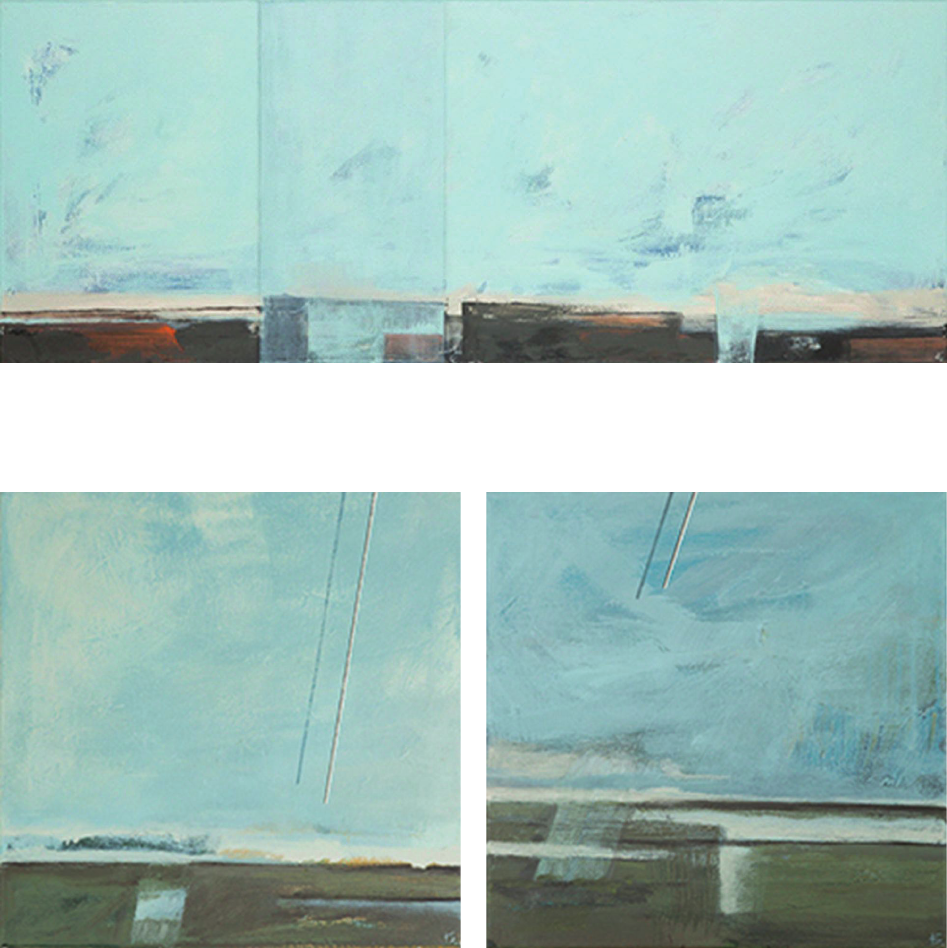
The Archaeological Reserve Genius Loci in Poznan
makes an attempt to introduce the visitors to a museum
world enclosed within the walls, which tries to recreate
the nal decades of the Middle Ages (Fig. 5a–c)
4
. Verti-
cally displayed images, made as a result of the analyses
and studies of form, place the viewer in an upside down
position, from which he/she looks at space from the “bot-
tom to top” order. This manner of the exhibition arrange-
ment is to highlight the layered system of the building
zones and the technique of construction of the embank-
ment made in the times of Duke Mieszko I, the subject
matter of the museum. The apparent accumulation of
planes leads the visitor further inside to discover the se-
crets of history sequentially revealed by every next oor.
The omnipresent truth of the images does not consist in
the gurative representation of the museum, but in the
emotions they evoke and thoughts they provoke. Observ-
ing the xed compositional layout of vertical planes cut
4
The paintings entitled Designated, Seemingly and Duality of Mat-
ter
have been displayed e.g. at individual exhibitions: Interpretacje – zapis
malarski [Interpretations – a painted record], The Archeological Muse um
in Poznan – the Archaeological Reserve Genius Loci (2013); Przestrzeń zo-
brazowana – malarstwo [Imaged space – painting], Kierat 1 Gallery, ZPAP
Szczecin Region, Szczecin (2015); Własny obszar prze strzeni – malarstwo
[Own area of space – painting], Fire Brigade Gallery in Sztygarek complex,
Chorzów (1015); Archiverticali – painting Ziben Studio, Berlin (2015).
Il. 3. K. Słuchocka, Archidea Filharmonia Szczecińska Level +2
(akryl, krosno sosnowe nieregularne, 108 × 98 cm, 2016)
Fig. 3. K. Słuchocka, Archidea Filharmonia Szczecińska Level +2
(acrylic, pine irregular loom, 108 × 98 cm, 2016)
Il. 4. K. Słuchocka, Archidea Filharmonia Szczecińska Level +5
(akryl, krosno sosnowe nieregularne, 108 × 98 cm, 2016)
Fig. 4. K. Słuchocka, Archidea Filharmonia Szczecińska Level +5
(acrylic, pine irregular loom, 108 × 98 cm, 2016)
Architektoniczne notacje / Architectural notations 33
użytkowym oraz ruchomymi elementami nasza aktywność
rozgrywa się między biologicznie zaprogramowanym in-
stynktem a wolnym wyborem. Osobiste, indywidualnie
zagospodarowane, w których bez względu na warunki ze-
wnętrzne dobrze się czujemy, własne przestrzenie.
Obrazy reprezentujące przestrzenie tożsame wynikają
z niejednorodnego ich charakteru, będąc zależnymi od
różnorodnych wątków budujących ich charakter i od-
zwierciedlających charakter osoby, której są przypisane.
Umożliwiają tym samym nieograniczoną liczbę komen-
tarzy, prowokując wzajemne oddziaływanie pomiędzy
architekturą i obrazem. Nasycone emocjonalnymi związ-
kami autonomiczne prace malarskie, rejestrujące tożsame
przestrzenie, to rodzaj pamiętnika przybierającego w cią-
gu wielu lat zapisywania odmienne barwy, dostrajane do
nastroju, wrażliwości, doświadczeń.
Komfort użytkownika budowany jest poprzez uszano-
wanie indywidualności potrzeb i znaczeń, a funkcjonal-
ność bazuje nie tylko na przesłankach mechanicznych,
ale także psychologicznych, próbując zaspokajać wymogi
emocjonalne.
o with repetitive lines, the images, further, stimulate the
visitor to respond to the created 3D impressions and the
element of implied dynamics. Around them, the visitor is
free to coin their own interpretations and reinterpretations.
Following the structural layout of the artistic and de-
sign grammar, we can now look at the identical spaces
(Figs. 6–8)
5
. These are the spaces we identify ourselves
with, we co-create, even if only by means of suggestions
or changes implemented into the nal design stage. Here,
in the spaces lled up with our own autonomous thoughts,
memories, experiences, utility t-out and other mova-
bles, we are somewhere in between our own biological
instincts and the freedom of choice. We own these spaces,
furnishing them with our personal and individual belong-
ings. Here we feel at home, irrespectively of how we per-
ceive their exterior.
5
The painting: A Personal Frame, This is where, During the con
versation have been displayed at the individual exhibition entitled Nie-
zatapialni [Unsinkable] – Perlegal Gallery, Skórzewo 2015.
ba c
Il. 5. K. Słuchocka: a) Wyznaczone, b) Pozornie, c) Dwoistość materii (akryl, 130 × 50 cm, 2014)
Fig. 5. K. Słuchocka: a) Designated, b) Seemingly, c) Duality of Matter (acrylic, 130 × 50 cm, 2014)
34 Katarzyna Słuchocka
Wnioski
Architektura, niezaprzeczalna składowa kultury czło-
wieka, wymaga odpowiednio ukształtowanego modułu
świadomości, do której rozwoju przyczynia się również
dorobek projektantów z puli notacji rysunkowych, malar-
skich i gracznych.
Jej percepcja, odbywająca się na wielu płaszczyznach
poznawczych, łączy w sobie różnorodne obszary badaw-
cze, jednocześnie poszerzając zasięg interdyscyplinarnej
współpracy. W procesie tym zobrazowana przestrzeń
egzystencjalna odgrywa rolę komunikatu, jest swoistym
rodzajem kodu językowego, w którym istotne znaczenie
ma charakter obrazowanej przestrzeni. Traktowany jako
dzieło sztuki obiekt architektoniczny warunkuje charakter
Paintings that represent identical spaces need to ac-
count for their non-homogeneous nature, depending on
a wide range of aspects and reecting the personality of
their owner. They may, thus, provoke an unlimited num-
ber of comments, establishing the grounds for the mutual
interactions between architecture and its image. Autono-
mous paintings, saturated with the emotional baggage of
their authors, record the identical spaces in a form that
resembles a diary of daily entries on colour shades, mood
swings, sensitivity variations and personal experience.
Comfort of the user is constituted through the respect
for their individual needs and manner of perception. The
foundations of functionality lay not only on mechanical
grounds but are supported with psychological assessments
assumed to positively meet the emotional needs.
Il. 6. K. Słuchocka, Kadr osobisty (akryl, 130 × 80 cm, 2015)
Fig. 6. K. Słuchocka, A Personal Frame (acrylic, 130 × 80 cm, 2015)
Il. 8. K. Słuchocka, W trakcie rozmowy (akryl, 40 × 40 cm, 2015)
Fig. 8. K. Słuchocka, During the conversation (acrylic, 40 × 40 cm, 2015)
Il. 7. K. Słuchocka, To tam (akryl, 40 × 40 cm, 2015)
Fig. 7. K. Słuchocka, This is where (acrylic, 40 × 40 cm, 2015)
Architektoniczne notacje / Architectural notations 35
wypowiedzi plastycznej, równolegle prowokując dalszą
aktywność interpretacyjną, a to pozwala informacjom
związanym z danymi przestrzeniami docierać do coraz
szerszych kręgów odbiorczych. Transformacja autono-
micznych rozważań na czystą wypowiedź plastyczną
(szkice ideowe, zalążkowe, odręczne wizualizacje czy
portrety architektury) potwierdza celowość stosowania
kognitywistycznej metodologii, wskazując na możliwość
prowadzenia autokorekt w trakcie złożonych procesów
projektowych, co może prowadzić do ich optymalizacji.
Obrazy architektury, będące świadectwem wysokiej ja-
kości warsztatu zawodowego, są także bogatym źródłem
wiedzy, często jedyną formą dokumentacji zrealizowa-
nych i niezrealizowanych projektów, plasując architektów
w czołówce światowego środowiska twórczego.
Wszelka działalność architektów odbywająca się w ob -
szarach sztuk plastycznych, niezależnie od praktyki pro-
jektowej, dowodzi interdyscyplinarności specyki za-
wodu architekta, a ich komunikatywne oraz edukacyjne
wartości powinny być w szczególny sposób eksponowa-
ne i chronione, podnosząc tym samym rangę w procesie
projek towym, jak i w zbiorach narodowego dziedzictwa
kultury.
Conclusions
Architecture is without doubt part of human culture and
as such requires a properly shaped awareness. This process
is also facilitated owing to the output left by designers in
the form of graphical notations, paintings and drawings.
The perception of architecture that is simultaneously
realised on many layers of cognition is a link for many
dierent research areas. It, thus, poses a chance for the
expansion of interdisciplinary cooperation. In this pro-
cess, the imaged living space plays the role of a carrier of
a message encoded in the specic language. To decode the
message, it is vital to understand the space portrayed. An
architectural facility, perceived as a work of art, predeter-
mines the means of artistic expression, provoking, at the
same time, our interpretative invention. Such activities of
the viewers eectively disseminate the information about
relevant spaces among wider and wider circles of the
audience. Transformation of autonomous thoughts into
purely artistic means of expression (conceptual sketches,
schematic designs, hand-made visualisations or architec-
tural portraits) conrms the purposefulness of cognitive
methodology as it leaves an open door for self-corrections
to be made over the entire period of a complex design pro-
cess. This safeguards the possibility of on-going optimisa-
tion. Images depicting architectural facilities not only tes-
tify to the quality of professional skills but also represent
a source of valuable knowledge and are sometimes the
only records of completed and non-completed projects.
They can popularise the works of respective architects,
increasing their rank in the professional environment.
All and any activities undertaken by architects in the
area of ne arts, alongside their professional practice,
demonstrate the interdisciplinary character of the pro-
fession and the communicative and educational values
of such activities should be in particular exposed and
protected. In other words, all the artistic works accompa-
nying the design process should be promoted to a higher
rank and archived in the national heritage collections.
Translated by
Barbara Marszałek
Bibliografia /References
[1] Szolginia W., Architektura i budownictwo. Ilustrowana encyklope-
dia dla wszystkich, Wydawnictwa Naukowo-Techniczne, Warszawa
1982.
[2] Misiągiewicz M., O prezentacji idei architektonicznej, Wydawnic-
two Politechniki Krakowskiej, Kraków 2003.
[3] Maluga L., Autonomiczne rysunki architektoniczne, Ocyna Wy-
dawnicza PWr, Wrocław 2006.
[4] Bingham N., Sto lat rysunku architektonicznego 1900–2000, Lau-
rence King Publishing, London 2013.
[5] Bahamon A., Sketch: Houses, How Architects Conceive residential
Architecture, LOFT Publications, Barcelona 2006.
[6] Orzechowski M., Rysunek – zmysł architektury, Wydawnictwo Blue
Bird, Warszawa 2014.
[7] Młodkowski J., Aktywność wizualna człowieka, Wydawnictwo Na-
ukowe PWN, Warszawa–Łódź 1998.
[8] Zumthor P., Myślenie architekturą, Karakter, Kraków 2010.
[9] Wilson P., British Architectural Drawing, Contemporary British Ar-
chitectural Drawing, London–Berlin 1993.
Artykuł wpisuje się w badania autora prowadzone na Wydziale Archi-
tektury Politechniki Poznańskiej w ramach projektu badawczego Obiekt
architektoniczny – dzieło sztuki [0113/SBAD/0041].
This article constitutes the studies of the author carried out at the Fa-
culty of Architecture at Poznan University of Technology within the fra-
mework of the research project entitled Architectural object – a work of
art [0113/SBAD/0041].
36 Katarzyna Słuchocka
Streszczenie
Artykuł podejmuje zagadnienia związane z percepcją architektury, z uwzględnieniem procesów sensorycznych, w głównej mierze służących do
wyodrębniania cech obiektów (kolor, forma, wielkość, faktura, temperatura itd.) a implikujących dialog poznawczy zachodzący pomiędzy odbior-
cą-użytkownikiem i przestrzenią. Uznawana za symbol podstaw oraz komfortu egzystencji przestrzeń egzystencjalna, w kontekście poznawczym,
jest elementarną składową większych w skali zespołów, które poszerzając zasięg oddziaływania, anektują w swoją strukturę poszczególne części, by
oscylować wokół najistotniejszych dla człowieka potrzeb i ich realizacji.
Celem prowadzonych badań jest zwrócenie uwagi na istotną funkcję zobrazowanych przestrzeni, odgrywających rolę komunikatu w kodzie języ-
kowym, w którym duże znaczenie ma charakter danej przestrzeni, zwrotnie przekładając się na jakość samego obrazu. Obiekt architektoniczny,
traktowany jako dzieło sztuki, warunkuje formę przedstawienia-zobrazowania, jednocześnie wzmacniając relacje pomiędzy odbiorcą a konkretną
przestrzenią lub jej fragmentem. Niezależnie od stopnia nasycenia związku emocjonalnego autora kreacji z kontekstem obraz przestrzeni (przestrzeń
zobrazowana) kieruje uwagę na walory, szczegóły, zjawiska przynależne ściśle do określonych miejsc. Współzależność działań plastycznych oraz
technicznego charakteru pracy architekta wzbogaca ofertę możliwości sposobu prowadzenia procesów projektowych, podkreślając wagę zależności
pomiędzy dziedziną nauk technicznych i sztuk plastycznych.
Słowa kluczowe: obrazowanie architektury, obiekt, dzieło sztuki
Abstract
The article presents the processes involved in the perception of architecture, including the sensory processes inherent in the dierentiation of features
of facilities (colour, form, size, texture, temperature, etc.) which imply a cognitive dialogue between space and its user. Existential space deemed as
a designator of basic living conditions and comfort assumes another meaning in the cognitive context, where it constitutes a basic component of larger
forms which expand by annexing individual components within its structure to address and meet the most vital needs of man.
The research aims to highlight the important function of space represented in images. Such images then play certain roles in our verbal commu-
nication, which is predetermined with the nature of the portrayed space, and as such translates into the quality of the picture/drawing/image itself.
An architectural facility perceived as a piece of art underlies the form of its representation/imaging and strengthens the relations between particular
space or a part thereof and its user. Irrespectively of the degree of emotional saturation existing between the designer and the context, the image of
space (space imaging) attracts the viewers’ attention to the qualities, details or phenomena closely correlated with particular places. The process
of transforming independent ideas of the author into the artistic expression eectively reveals the purposefulness of the application of the cognitive
approach which allows for self-corrections of the design processes. Such an approach simultaneously demonstrates correlations between engineering
and ne arts.
An image of an architectural facility can be a source of extensive information thereon and, in the form of design documentation, it can further, testify
to individual approaches of the globally renowned leaders in the eld and evidence the interdisciplinary nature of the profession of an architect.
Therefore, the communicative and educative values of such images need to be particularly exposed and protected. As such they should rank higher
both in the design process and collections of works classied as our national heritage.
The adopted research methods consist in the observations and the analysis of hand-made drawings and pictorials combined with the heuristic
approach to architectural designing. This methodology assumes that the selection of observations made in the specic conditions of perception of
architecture and its designing transposed upon autonomous artistic activities in ne arts in relation to a specic goal – being the optimisation
of
architectural output – will dene the eciency of interdependencies and correlations between the input data and, thus, will form a logical contin-
uum, which implies the compliance with the guidelines discussed herein.
Key words: architecture imaging, object, work of art