2010
Nr 2(28)
A huge while rectangle put on the easel and a huge
white rectangle on the drawing board – two planes cre-
ating a coordinate axis. What’s important for an art his-
torian is the points where y-axis and x-axis cross, cre-
ating a drawing, illustration of synergy of both media
of artistic expression. Vitruvius – lover of eurythmy,
symmetry, illusionistic painting and a module based
on human body as a pattern of good proportions – is the
person who symbolically combines these two areas of ex-
pression.
Vitruvius demands that artists only precisely imitate
reality and especially the illusions of spatial depth and
third dimension. There is one more aspect of the Vitruvian
lecture – a colorful tale of antiquity that actually could
be the basis of the scenario of a virtual game called “the
world of an architect” whose main characters would be
a hero-superman and an environmentalist, an incorrupt-
ible architect. a philosopher and a poet, an expert in paint-
ing and a constructor of “ballistas, scorpions and other
war machines” [7, pp. 16–17].
Ewa Łukaszewicz-Jędrzejewska*
Architecture in painting – in search of third dimension
Two white rectangles
Huge white rectangle put on the easel
In my teaching classes I have students of the Academy
of Art and Design, Faculty of Ceramics and Glass who
chose the specialization in restoration and reconstruction
of ceramics and glass. These are difcult studies which
require adequate knowledge of all strictly artistic sub-
jects obligatory for all students of the Academy such as
drawing, painting and sculpture as well as perfect ceramic
craftsmanship. This area of knowledge requires not only
knowledge of application of the techniques and technol-
ogy of ceramics and glass but also specialist knowledge
in the scope of chemistry, physics, and technical draw-
ing required in the designing process. The selected spe-
cialization – restoration and reconstruction of ceram-
ics and glass – requires knowledge of history of archi-
tecture, with special attention to the history of details
and architectural decorations, ability to recognize, date,
analyze, document, restore and stylize them. It requires
from the students almost “Vitruvian” inquisitiveness and
work discipline, which is often difcult to nd among
the temperamental students of the Academy of Art and
Design.
The course of studies teaches humbleness towards
material and technology. The simple basic ceramic forms
made on the wheel or built from rolls of clay gradually
introduce the students to the world of spatial geometry –
the third dimension. During classes on style recognition
the students begin their journey to the past and they learn
about the canon of divisions of entablature, composition
of friezes, discipline of architectural compositions em-
ployed in the Middle Ages and modern times as well as to
solve puzzles of eclectic decorations.
During the classes in conservation documentation,
which the students take at the same time, they deal with
the basic technical problems connected with the drawn
copies of details as well as terminological, stylistic and
typological problems. The students stand in front of ar-
tifacts without any basic description tools which would
enable them to understand their contexts and relations
with the history of architecture. The sensitive students
who developed a sense of form and acquired manual
skills as well as knowledge of compositions of architec-
*
Eugeniusz Geppert Academy of Art and Design in Wrocław.
284 Ewa Łukaszewicz-Jędrzejewska
tural details begin with micro-scale structures, studying
historicizing and eclectic furnaces where they see archi-
tectural details in most fantastic relations. However, due
to the fact that the students lack any specic knowledge
of art history – that subject is not included in the curricula
of public secondary schools – the knowledge they learn
in classes is often not connected with specic cultural
context.
Describing architecture
Since the 1950s cultural studies have been an interdis-
ciplinary eld of research dealing with relations between
artifacts, objects or phenomena within the scope of mate-
rial culture in its broad sense and its recipients. For an
art historian operating in that domain what is especially
interesting is the area of visual culture studies. It is a task
of a researcher dealing with the history of architecture to
look at an object in the whole context of aesthetic phe-
nomena accompanying that object and place it in the post-
modern discourse which is sometimes far from a positiv-
istic description [1, pp. 133–135]
1
.
The specic features of my classes with the students
require also research of the ability of an object of archi-
tecture to communicate with contemporary recipients
who mentally operate in two spheres – material world and
virtual world. In that relation an object of architecture be-
comes one more visual message searching for a way to
the consumer of the mass media culture. The reception of
such a message depends not only on the cultural founda-
tion of the recipients but also on the degree of their cur-
1
Positivism is a term describing a research method which relies exclu-
sively on facts, excluding their interpretation. In art history it is a method
of detailed description of a formal work of art, taking into account the
history of its creation, symbols, motifs and biography of the artist.
rent activity in culture. The students of the Academy of
Art and Design constitute a specic target group, meet-
ing at the same time the specic criteria of the author
(sender) of the visual message as well as exceptionally
critical and detached recipients. The educational content
dedicated to that group should then demonstrate features
that would distinguish it from the information noise and
the visual pulp of the mass media. In such a context the
way in which the visual information is read and absorbed
or rejected will depend on decisively subjective factors. In
extreme cases it will be an outright rejection of the didac-
tic proposal, manifested often by such claims as: We won’t
ever need it or We’ve already seen it.
Such attitudes – seen only too often – on the part of
the recipients practically discredit the traditional method
of a positivistic lecture on the history of architecture. In
the light of the multitude of biographical, historical and
topographical information in the area of art history which
is readily available to the Internet users, it does not seem
necessary to further create or copy the encyclopedic texts.
In contemporary didactics it is more important to ask
questions which would enable studies of contextual art
history and opening historical and artistic canon for works
which are present in the visual sphere is only tenuously or
which are absent in that sphere altogether.
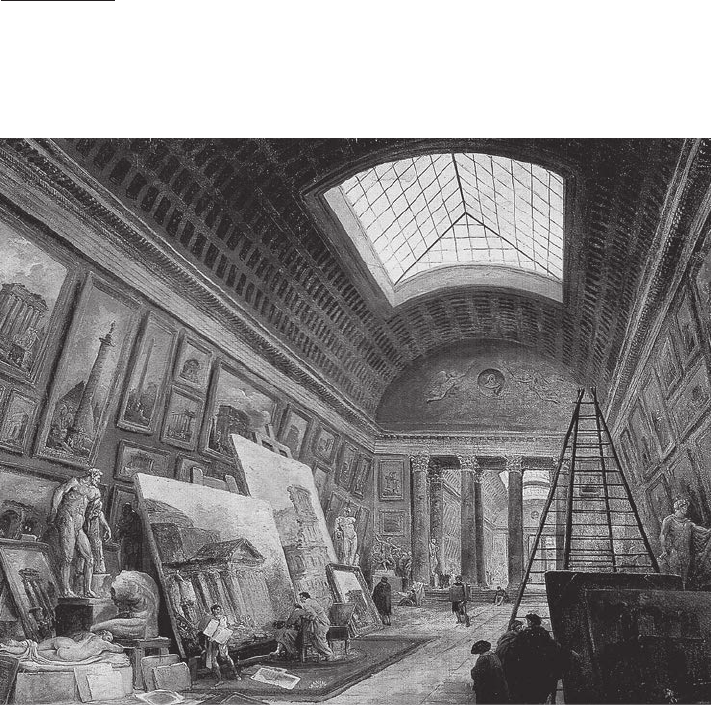
Fig. 1. Hubert Robert,
View of the Grand Gallery
of the Louvre, 1796
Architecture in painting – in search of third dimension 285
Condition 1
Determining the degree of satisfaction
I will go back to Roland Barthes’ statement: the pleas-
ure of the text lies not in pinning down meaning, but in
enjoying the free play of words – the gliding of signs – as
the reader catches provocative glimpses of meanings that
surface only to submerge again. I make an interpretation
of text in such a way as to introduce categories referring
to the process of viewing understood as one more visual
experience: the pleasure of the view is not the pleasure of
the text lies not in pinning down meaning, but in enjoying
the free play of visual associations – the gliding of details
– as the viewer catches provocative glimpses of details of
the described images that surface only to submerge again.
In practice this means that the selected image should have
the qualities stimulating the viewer to perceive it actively,
to analyze its cultural context, to discover its message; it
should demonstrate the features evidently distinguishing
it from the series of postcard-like “objects of architecture”
– slides used for decades in lectures on the history of ar-
chitecture. Only in this way can the rst condition be met
– “the pleasure of the view”.
Reading architecture
The theory of reader-response assumes that the sig-
nicance of text “occurs” as a result of reading and it does
not exist as an earlier imposed element of text [2]. Art
historians have adapted that theory to research visual art
where each cultural phenomenon which is subject of in-
terpretation is the “text”. Wolfgang Kemp, who created
the methodology of the aesthetic of reception, was critical
of the traditional techniques of transfer presenting works
of art as lonely beings with no contextual connections
and described them as ubiquitous, homeless, relocated [4,
pp. 180-196]. Introducing the term of “implied reader”,
Kemp also assumes the existence of a specic viewer with
specic visual experiences and he considers reading ar-
chitecture to be another visual experience. It corresponds
to the opinion of Roland Barthes who, while discussing
the practical applications of the reader-response theory,
states that the pleasure of the text lies not in pinning down
meaning, but in enjoying the free play of words – the glid-
ing of signs – as the reader catches provocative glimpses
of meanings that surface only to submerge again
2
. While
preparing the presentation material for classes in style rec-
ognition I used the reader-response theory. An image of
architecture in painting was the “text” and the student of
the Academy of Art and Design was the “implied reader”.
While selecting iconography I also tried to go beyond the
“historical and artistic canon”
3
.
2
Quote after D’Alleva A., Metody i teoria historii sztuki, Kraków
2008, p. 135.
3
This is what I call the artworks which are universally recognizable,
copied in various forms and at present in the social visual sphere as well
as in the media.
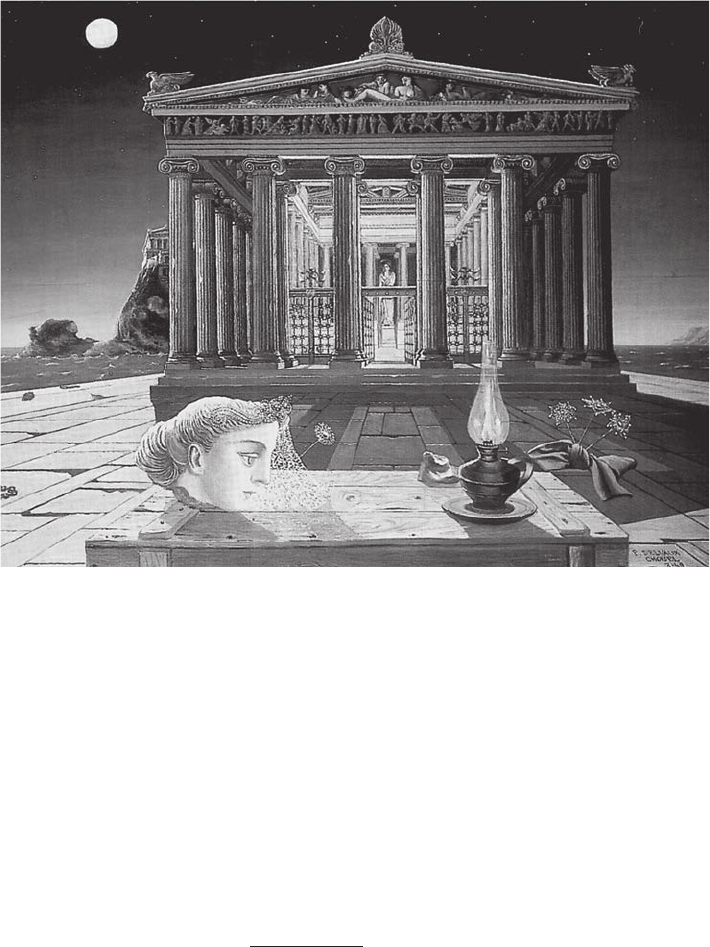
Fig. 2. Paul Delvaux,
Temple, 1949
Lecture structure
286 Ewa Łukaszewicz-Jędrzejewska
A good example of meeting that condition is the re-
action of the viewers when they are in contact with the
painting by Hubert Robert View of the Grand Gallery of
the Louvre (Fig. 1).
The basis of the discourse is the situation of “a painting
within a painting” with some narrative motifs – a study of
copies made by people in an interior. During the projec-
tion three levels of perception connected with the reader-
response process were observed. The rst one – compar-
ing the composition of the painting to framing a movie
shot, long perspective and closing up in a long shot. The
viewers felt “ushered into” an architectural interior of the
painting, the perspective of the gallery. The term virtual
gallery was used. It was the key moment before going into
the second level of perception, consisting in discovering
the disposition of the interior and the architectural decora-
tions of the Grand Gallery of the Louvre. In the conver-
sations about the painting, they recalled their trip to the
Louvre and the crowds of visitors everywhere blocking
the view. The objective of their trip was the paintings not
the architecture. The painting by Robert became a pretext
to discover the components of the architectural interior, to
search for details and elements of architectural decoration.
The next step was the attempts at reading the “paintings
within a painting” and recognizing the ancient buildings
presented in them. The classes were open, the attempts at
identifying the motifs were corrected by the teacher, and
the correctly identied and named details were incorpo-
rated into the dictionary. The third level of perception was
connected with the attempts at making a drawing copy
of the identied details and nding templates [5, 6, 7, 8].
The drawing exercises were connected with the subject
of style recognition and with specic requirements of the
conservation documentation – making a drawing copy on
the basis of iconographic presentation.
Condition 2
Competences of the “implied reader”
The second stage of learning the canon of ancient
architecture with the use of the reader-response method
was the analysis of the painting by Paul Delvaux, Temple
(Fig. 2).
That painting was selected because of the fascination
with the world of surrealists which is popular among my
students – so the competences of the readers – univer-
sally limited to one author – Salvador Dali. In this case
the “pleasure of the view” was connected with the ele-
ment of surprise and the anxiety to learn about the works
of a different artist. Additionally, the third condition was
met, namely opening of the historical and artistic canon
by introduction to the illustration material an artwork by
Paul Delvaux – a painter who is poorly represented in the
popular presentation of art.
During the conversation about the painting it was
important to read its symbols and identify the surre-
alistic dictionary as well as to notice the code applied
by Delvaux to make contact with the viewers. The key
moment was achieved in this way to get to the second
level of perception, consisting in discovering the prin-
ciples of construction of an ancient temple, disposition
of its interior and the components of architectural decora-
tions.
The third level of perception was connected with the
attempts at making a drawing copy of identied details
and nding templates, nding analogies and deviations
from the canon. The drawing exercises connected with
classes were by their topics connected with the subject
of “style recognition” and the requirements of the con-
servation documentation – making a drawing copy on the
basis of iconographic presentation as well as comparative
analysis of architectural details and elements.
Conclusions
The classes were conducted in a small group of six
students, so it was possible to concentrate, exchange in-
formation freely and talk with the lecturer as well as do
some exercises. Apart from the multimedia presentation
of a series of paintings, additional aids included the tem-
plates used by Alberti, Vignoli, Dolmetsch and Koch’s
tablets, ne art dictionaries and lexicons of iconography.
The basis of the didactic success is in this case individual
participation of the students, use of their sensitivity and
emotions. The reader-response theory, being an extreme-
ly subjective learning tool used in the analysis of an art-
work – artifact – object – requires such a commitment. In
the case of presented classes the theory becomes practice
which I called a visual-response.
References
[1] D’Alleva A., Metody i teorie historii sztuki, Kraków 2008.
[2] Barthes R., Przyjemność tekstu, przeł. A. Lewańska, Warszawa
1996.
[3] Hall S., Culture, Media, Language: Working Papers in Cultural Stud-
ies 1972–1979, London 1980.
[4] Kemp W., The Work of Art and its Beholder, [in:] The Subjects of Art
History: Historical Subjects in Contenporary Perspective, Cambridge
1998.
[5] Koch W., Style w architekturze, Warszawa 1996.
[6] Palladio A., Cztery księgi o architekturze, 1570, przeł. M. Rzepińska,
Warszawa 1958.
[7] Witruwiusz, o architekturze ksiąg dziesięć, przeł. K. Kumaniecki,
Warszawa 1999.
[8] Vignola J.B., Zasada pięciu porządków architektury, 1562, przeł.
K. Tymiński, Warszawa 1956.
Architecture in painting – in search of third dimension 287
Architektura w malarstwie – w poszukiwaniu trzeciego wymiaru
Tematem referatu jest metoda nauczania historii architektury, jaką
autorka prowadzi ze studentami Akademii Sztuk Pięknych we Wrocławiu,
którzy wybrali specjalność rekonstrukcja i restauracja ceramiki i szkła.
Studenci – artyści – są specyczną grupą docelową, która z trudem
przyjmuje tradycyjną formę wykładu, często wprost manifestując swój
brak zainteresowania zagadnieniami pozaartystycznymi. Założeniem
merytorycznym programu było wykorzystanie na zajęciach ze stylo-
znawstwa i dokumentacji konserwatorskiej zainteresowania studentów
historią malarstwa do prezentacji wątków ściśle związanych z wiedzą
o architekturze i dekoracji architektonicznej. Ideą programu było prak-
tyczne wykorzystanie w procesie dydaktycznym teorii reader-response
Rolanda Barthesa i metodologii estetyki recepcji Wolfganga Kempa. Bazą
ilustracyjną wykładu, prowadzonego z zachowaniem rytmu chronologicz-
nego, stał się zbiór obrazów pochodzących spoza kanonu historyczno-
artystycznego, w których przedstawiono wizerunki obiektów architektury
w różnych kontekstach. W wykładach-prezentacjach znalazły się dzieła,
w których detale i elementy architektoniczne oraz ich relacje przedsta-
wione zostały w sposób niemal wzornikowy. Znalazły się w nich obrazy
z obiektami architektury w tle – architektury realnej i utopijnej – które,
towarzysząc narracji sceny, stawały się dla studentów „tajemniczymi
obiektami w tle”, obiektami pobudzającymi ciekawość i chęć ich poznania.
W referacie przedstawiono teoretyczne podstawy metody oraz przykła-
dy realizacji dwóch spotkań – wykładów, połączonych z praktycznymi
ćwiczeniami.
Key words: architecture in painting Słowa kluczowe: architektura w malarstwie