
2026
3(87)
Monika Bogdanowska*, Miłosz Horodyski**
Authenticity of a monument in virtual historical reconstruction.
The case of Kijow Cinema in Krakow
DOI: 10.37190/arc260307
© by the Author/Authors. Licensee WUST.
Published in open access. CC BY-NC license.
Abstract
This article analyses the issue of authenticity in architectural heritage in the context of virtual historical reconstruction. The starting point was the
question of whether, and to what extent, a digital model of a building can convey selected aspects of material, intangible and contextual authenticity.
The discussion is based on a case study of the Kijow cinema in Krakow, whose original 1967 state was digitally reconstructed using laser scanning,
archival research and 3D modelling, and subsequently implemented in the Unreal Editor for the Fortnite environment. The authors combined an analysis
of conservation doctrines with reections on digital representation, experience of a place and the platform-based nature of the gaming environment.
They highlighted the dierence between a digital twin and a virtual historical reconstruction. They discussed the risks arising from the model operating
within a closed commercial environment. The conclusions drawn from this case study highlight the need for transparency in the reconstruction process,
documentation of interpretative decisions, and archiving data outside the game platform.
Key words: authenticity, architecture, virtual historical reconstruction, “Kijow” Cinema, Fortnite/UEFN, digital representation
Introduction
Modern digitisation techniques oer previously unat-
tainable precision in documenting heritage, together with
new ways of experiencing it. Yet can the key value of her-
itage – authenticity, which identies an object as real, gen-
uine and credible – be transferred to a virtual environment,
where a digital representation may gradually become de-
tached from the material original or even replace it in the
minds of some audiences? Some scholars have proposed
re cognising the authenticity of a virtual object through
ano ther of its attributes, namely credibility, provided that
it con veys both the tangible and intangible values of the
ori ginal. This recognition must, however, be accompanied
by a “credibility meter”; without one, the object may be
mis represented and lose its intrinsic function as a historical
do cu ment (Bentkowska-Kafel 2008).
The motivation for the study was the observation that,
in the age of cultural-heritage digitisation – particularly of
architecture – the concept of authenticity is changing. Re
-
constructions of historic buildings in virtual environments
reveal both the potential of digital mediation and the risk
of losing the “spirit of place”, as dened in the Quebec
Declaration (ICOMOS 2008). The London Charter (2009)
emphasises that the authenticity of a digital visualisation
depends not only on the reliability of the source data but
also on the transparency of the process by which those data
are transformed.
This article aims to analyse changes in the concept of
authenticity and the conditions under which it may be pre-
served in virtual historical reconstruction. The discussion
focuses on architecture, for which the perception of space,
context and spatial sequence, together with technological-
ly mediated experience, is central to reception (Rasmus-
sen 1999). The study encompasses changing denitions
of authenticity in heritage discourse, examples illustrating
major tendencies in the digital representation of historic
buildings, and a case study of Kijow Cinema in Krakow
– a listed building and one of Poland’s pioneering exam-
ples of transferring architectural heritage into the Fortnite/
*
ORCID:
0000-0003-2227-2093.
Faculty of Architecture, Cra -
cow University of Technology, Poland, e-mail: monika.bogdanowska@
pk.edu.pl
**
ORCID:
0009-0005-4659-6422. Higher School of Business – Na -
tional Louis University (WSB-NLU), Nowy Sącz, Poland.

72 Monika Bogdanowska, Miłosz Horodyski
UEFN (Unreal Editor for Fortnite) game environment. The
UEFN model is treated not as a digital twin in the engineer-
ing sense, but as a virtual historical reconstruction: an in-
terpretative digital model created within a specic platform
context. On this basis, the article examines the relationship
between documentation, reconstruction and the platform
environment.
Methods
The article presents a case study of Kijow Cinema in Kra-
kow, supplemented by an analysis of conservation doctrines
concerning authenticity and a selective comparative over-
view of practices in the digital representation of heritage.
The method is interdisciplinary: it combines a conservation
perspective, focused on the reliability of documentation, the
transparency of the reconstruction process and the relation-
ship between the representation and the original, with a me-
dia-studies perspective on digital representation, platfor-
misation, interaction and the model’s increasing narrative
autonomy. Given the scope of the topic, the literature review
is organised into two areas – conservation doctrine and me-
dia studies – which are discussed in separate sections.
The theoretical section analyses doctrinal documents and
scholarship on heritage authenticity, including the Venice
Charter (ICOMOS 1964), the Nara Document on Authen-
ticity (UNESCO 1994), the Quebec Declaration (ICOMOS
2008), the London Charter (2009) and the Seville Princi-
ples (ICOMOS 2017). The empirical section examines the
process of creating the virtual historical reconstruction of
Kijow Cinema, from laser scanning and archival research,
through modelling and optimisation, to implementation in
UEFN. The analysis is complemented by a phenomeno-
logical reection on the experience of place and an exam-
ination of the platform medium, within which the model
begins to function as an interpretative and narrative object.
Because the study concerns a single case, its conclusions
are analytical and interpretative rather than generalisable.
The authors do not seek to formulate a general theory of au-
thenticity in virtual environments, but to identify the condi-
tions, limitations and risks revealed by the case.
Research context:
authenticity in heritage conservation
Evolution of the concept
In conservation discourse – as most clearly reected in
the Venice Charter (ICOMOS 1964) – “authenticity” was
treated as a foundational concept: a fundamental value as-
sumed to be intuitively understood. In common usage, the
term denotes the quality of being real, genuine and credi-
ble. Accordingly, what is not real cannot be authentic
1
.
Western theory emphasised material authenticity, an em -
phasis that was dicult to reconcile with Eastern perspec-
tives grounded in other values, such as the continuity of
tra -
1
“Authenticity: the quality of being real or true” (Cambridge Dic-
tionary n.d.).
dition or craftsmanship (Tomaszewski 2012). The Nara Doc-
ument on Authenticity (UNESCO 1994) there fore broad -
ened
the concept to encompass intangible he ritage. Herb
Stovel (2008) described this evolution as a shift from an ab -
solute value to a relative, culturally conditioned concept.
The same approach is reected in the World He ritage Com -
mittee’s guidance: inscription on the World He ritage List
requires the demonstration of Outstanding Universal Value,
accompanied by an assessment of the property’s authenti-
city and integrity. Authenticity is assessed by examining
the credibility of attributes including form and design,
materials and substance, use and function, traditions and
techniques, location and setting, and spirit and feeling,
under stood as “sources of information” about the proper-
ty’s va lues (UNESCO 2003a).
Contemporary approaches to virtual heritage have been
shaped by three ideas: documentation, reconstruction and
accessibility. The Quebec Declaration (ICOMOS 2008)
iden tied digital technologies as tools capable of connect-
ing tangible and intangible heritage. In reconstruction, au-
thenticity began to be sought less in material fabric itself
than in a documentation process grounded in reliable sourc-
es, transparent procedures and the social function of access.
The safeguarding of intangible heritage, which is carried by
people, has brought the public interest to the fore ( UNESCO
2016). Yet making heritage accessible also entails its trans-
formation into a product, a process that may weaken – or
even falsify – the relationship between the representation,
the material original and its context (Smith 2006).
This situation calls for deeper reection on the nature
of authenticity, which can now be considered in three di-
mensions: material, intangible and contextual. The material
dimension concerns the authenticity of substance, form and
construction techniques – the aspects most closely associat-
ed in Western conservation tradition with the “original” and
its physical continuity. The intangible dimension concerns
cultural practices and social uses of an object: rituals, mem-
ories, narratives and experiences shared by a community,
through which a space becomes a place. The contextual
di mension encompasses the object’s relationships with its
urban, historical and symbolic surroundings, as well as the
conditions of its contemporary mediation, including modes
of presentation, interpretative frameworks and the logic of
the medium, such as a commercial platform. These factors
jointly shape the perceived “truthfulness” of heritage. The
remainder of the article adopts this triad as an analytical
framework for assessing which dimensions of authenticity
can be transferred to a virtual environment and which are
inevitably transformed.
Authenticity in digital reconstructions
The London Charter shifts the focus of the discussion of
authenticity from the physical monument to the process of
its digitisation (Denard 2012). The authenticity of a virtual
reconstruction can be considered on two levels: documen-
tation, meaning the delity and reliability of the historical
data used, and reconstruction, meaning the transparency
of the nal visualisation. The Charter emphasises that au-
thenticity in the digital domain depends on the reliability
Authenticity of a monument in virtual historical reconstruction. The case of Kijow Cinema in Krakow 73
and availability of the documentation on which a model is
based. This principle is one of the key points of reference
for the present analysis.
One attempt to redene authenticity in light of new tech-
nological possibilities is the concept of “digitised authen-
ticity”, based not on the originality of material fabric but
on the credibility of a digital representation (Zapłata 2016).
The creator of a digital model thus ceases to be a neutral
documentarian and becomes a co-author or interpreter of
heritage. The work involves not merely copying but a series
of decisions – from the selection of source data and model-
ling methods to the form of nal presentation – that shape
how the work is received.
The Seville Principles (ICOMOS 2017) set out guide-
lines for virtual reconstructions. They emphasise a funda-
mental rule of intellectual integrity: every element that is
hypothetical or constitutes a contemporary addition must
be visually distinguishable from elements supported by
rm evidence. Jesús Muñoz Morcillo et al. (2017) go fur-
ther by advocating the acceptance of a “plurality of authen-
ticities”. Because reconstructions are interpretative, multi-
ple scientically justied versions may exist; each may be
regarded as “authentic” within its own context, provided
that methodological transparency is maintained.
Embodied experience plays a key role in human percep-
tion, a central proposition of phenomenology (Merleau-Ponty
2001). Increasingly, however, reality is perceived not direct-
ly but through digital technologies, and these technologies
are not neutral: they mediate and transform how the world
is perceived (Ihde 2009). In virtual reconstructions, this
transformation often narrows perception to an incomplete
range of sensory experience (Asanowicz 2012). At the same
time, digital representations are modular, variable and open
to further transformation, which aects how they function
in platform environments (Manovich 2006). Information
tech nologies have advanced to the point at which virtual
ex periences can produce real physical responses, including
cy ber sickness (Stauert, Niebling and Latoschik 2020).
Comparative contexts
of digital heritage representation
The relationship between architecture, identity and dig-
ital space did not emerge only with contemporary gaming
platforms. An important earlier point of reference was the
Virtual Guggenheim Museum, developed by Asymptote
for the Guggenheim Foundation. The project was not a re-
construction of an existing historic building but an attempt
to create autonomous digital architecture for works of art
existing in an online environment. It already revealed a ten-
sion between the immaterial logic of digital space and the
habits and expectations of audiences shaped by physical
architecture (Guggenheim Going Virtual 2000).
Another form of digital heritage representation com-
prises documentary models and digital twins, whose pur-
pose is not primarily to create a narrative experience, but
to support monitoring, data integration, archiving and in-
formation management. In this approach, the digital model
remains closely subordinated to the material original and to
its present or historical condition (Niccolucci, Felicetti and
Hermon 2022). The digital preservation of Tuvalu’s heri-
tage in response to climate threats illustrates this approach:
the representation is intended to support memory, cultural
continuity and the state’s political visibility (Dev 2025).
Heritage interpretation raises a further problem: how
can the message carried by an object be conveyed faithful-
ly while also being made engaging for a specic audience?
This was the central challenge of the Glastonbury App,
designed to support visits to a medieval abbey: children had
to be entertained without compromising the sacred char-
acter of the site. The developers rejected treasure hunting,
Arthurian legend and magic as themes because they consid-
ered them a distortion of the spirit of place; magic was also
regarded as unacceptable on axiological grounds. Instead,
they adopted a narrative of pilgrimage, which referred di-
rectly to the site’s tradition and used a shared journey in
search of spirituality to connect past and present genera-
tions. The example shows how easily the historical truth
of a heritage site can be distorted when popular narratives
displace an interpretation of the site’s essential character
(Gilchrist et al. 2025).
At the opposite end of the interpretative spectrum from
documentation (science) and education lies commerciali-
sa tion. The Yuanyuzhou platform, for example, oers me-
taverse technologies – avatars, AIGC, 3D, digital twins – as
a digital framework for heritage tourism in Henan Province.
Exploring heritage through VR headsets makes the experi-
ence feel “real”. The platform gives users access not only
to extensive information about a site, but also to services
in the physical world, including purchases. It therefore ex-
emplies the movement from online to oine in meeting
users’ needs; avatar customisation, including physical fea-
tures and clothing, is only a minor addition. The application
demonstrates the scale on which technology can be used
to promote and commercialise heritage (He, Qin 2024).
Questions of a heritage site’s authenticity recede into the
background, though they do not disappear altogether. Vis-
iting a place always involves many kinds of experience:
encounters with other people, memories of the comfort of
a hotel room, shopping, local cuisine and more.
The case of Kijow Cinema lies between these models. It
is not a digital twin because it is not dynamically connected
to the physical building. Nor is it autonomous digital archi-
tecture created from scratch for the internet, or a tool for
commercialising the site. It is a documentation-based virtu-
al historical reconstruction that, once implemented in Fort-
nite/UEFN, acquires additional exploratory, interactive and
narrative dimensions. The resulting tension between docu-
mentation, interpretation and the model’s increasing auton-
omy within the platform is the central object of analysis.
In light of these examples, authenticity in digital environ-
ments requires careful qualication. Digital representations
can support heritage documentation, education and accessi-
bility, but their value depends on their relationship to source
evidence, the transparency of interpretative decisions and
the durability of data beyond the immediate presentation
environment. The developments in conservation doctrine
outlined above show that authenticity can no longer be re-
duced to an object’s material fabric. This does not mean that
materiality has lost its importance; rather, assessments must
74 Monika Bogdanowska, Miłosz Horodyski
also consider the reliability of documentation, the transpar-
ency of reconstruction and the relationship between a digital
representation and its original.
Kijow Cinema: between the material original
and the virtual reconstruction
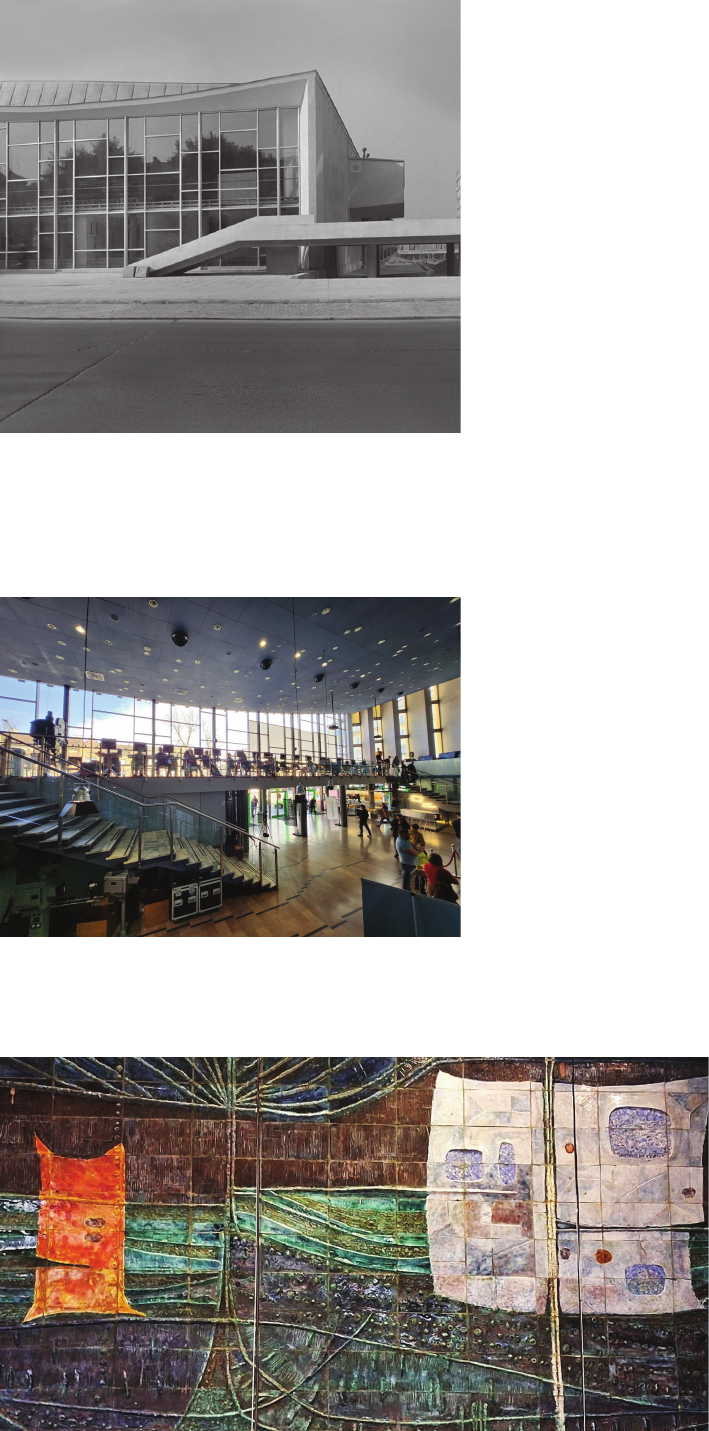
Kijow Cinema exemplies a project that moved beyond
the constraints of socialist functional modernism. Designed
by Witold Cęckiewicz in 1967 and conceived in close re-
lation to the Cracovia Hotel, the building was intended as
a space of prestige and an ideological demonstration of the
Polish People’s Republic (PRL) authorities’ openness to the
world (Fig. 1). Its architecture can be read as the symbol-
ic language of an era: a system of signs and a carrier of
cultural meanings in which form, function and social con-
text jointly create the meaning of place (Tuan 1977; Nor-
berg-Schulz 1980).
The form of Kijow Cinema – monumental yet light, ow-
ing to its glazed façade and column-free main auditorium
– communicated modernity and technological openness
unequivocally (Fig. 2). Its distinctive roof, conceived as
a “fth elevation” visible from the hotel rooms, was not
only an innovative engineering solution but also an aesthetic
accent in the spatial dialogue of the complex. A monumen-
tal ceramic wall composition by Krystyna Zgud-Strachoc-
ka became integral to the building’s symbolic dimension.
Created in the spirit of abstract modernism and inspired
by space exploration, it constituted an aesthetic rebellion
against socialist-modernist conventions and emphasised
the aspiration to modernity (Fig. 3). Over time, the building
underwent numerous alterations: the foyer was remodelled,
and the transparent glazing was replaced with tinted glass.
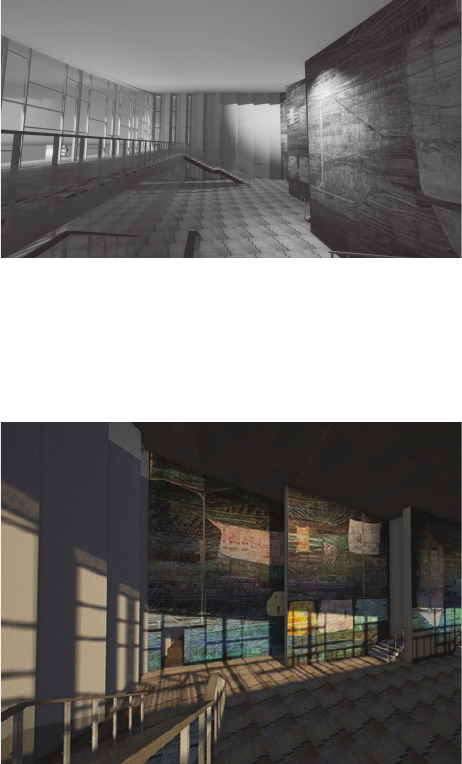
The research undertaken by a team led by Professor
Grzegorz Biliński of the Academy of Fine Arts in Krakow
aimed to recreate digitally the building’s original appear-
ance in 1967. In the context of the authenticity debate, this
was an attempt to restore not only the architectural form
but also the building’s original context and the way it was
experienced (Fig. 4).
The foundation of the virtual historical reconstruction
was the creation of as faithful a representation as possible
Fig. 1. Façade of Kijow Cinema in Krakow
(photo by W. Plewiński, 1967, courtesy of Kijow Cinema collection)
Il. 1. Fasada kina „Kijów” w Krakowie
(fot. W. Plewiński, 1967, źródło: ze zbiorów Kina „Kijów”)
Fig. 2. Vestibule of Kijow Cinema in Krakow (photo by M. Horodyski)
Il. 2. Westybul kina „Kijów” w Krakowie (fot. M. Horodyski)
Fig. 3. Kijow Cinema in Krakow
– detail of the Cosmos mosaic,
designed and executed by
K. Zgud-Strachocka, 1967
(photo by M. Bogdanowska)
Il. 3. Kino „Kijów” w Krakowie
– fragment mozaiki „Kosmos”
zaprojektowanej i wykonanej
przez K. Zgud-Strachocką, 1967
(fot. M. Bogdanowska)
Authenticity of a monument in virtual historical reconstruction. The case of Kijow Cinema in Krakow 75
of the building’s original appearance. The team carried out
a detailed laser scan of Kijow Cinema in its current form;
the building’s overall volume has not changed substantial-
ly. Over six days in May 2023, every part of the cinema was
systematically recorded with a Faro Focus S350 scanner.
The resulting high-density point cloud enabled the recon-
struction of details at high resolution. This precision made
it possible to capture even very small architectural features,
a prerequisite for discussing authenticity – understood here
as delity of representation – within conservation doctrine.
The next stage was archival research into Cęckiewicz’s
designs, Wojciech Plewiński’s photographs and details of
Zgud-Strachocka’s ceramic composition. These materials
provided the basis for transforming the raw point cloud into
an interactive model. The process was not purely technical;
it comprised a sequence of deliberate interpretative deci-
sions. Every optimisation involved a compromise between
geometric complexity and performance and could therefore
reduce the delity of the representation. First, the raw scan
data were cleaned and combined into a coherent whole in
Leica Cyclone and Autodesk ReCap. A 3D model was then
constructed in Autodesk 3ds Max from this digital record,
with realistic material textures applied while maintaining
high geometric precision. At this stage, the team had to de-
cide which elements required full delity, which could be
simplied and which had to be reconstructed hypothetical-
ly. The nal stage was to adapt the model for real-time op-
eration in UEFN. This involved simplifying the geometric
mesh, reducing the polygon count, and preparing variants at
dierent levels of detail (LOD), displayed according to the
user’s distance from the object. The Lumen lighting system
and ambient sound were used to improve spatial legibility
and strengthen the sense of presence. These measures were
necessary to ensure smooth performance in the Fortnite plat-
form environment, but they also required decisions about the
extent of simplication and therefore aected the preserva-
tion of the model’s geometric and material delity (Fig. 5).
The research concluded with qualitative analyses in-
tended to assess the credibility of the reconstruction from
the user’s perspective. VR workshops were organised for
a small group of experts and students. They examined phe-
nomenological dimensions of the experience, including im-
mersion and spatial perception. A complementary narrative
analysis assessed the model’s ability to convey the histor-
ical context and the “spirit of place” – the elusive quality
that determines whether a digital copy remains a credible
vehicle for the values associated with authenticity. The
conclusions were then situated within current theoretical
debates and the relevant scholarship.
Discussion
Digital twin versus virtual historical reconstruction
In conservation and technical literature, a digital twin
is a dynamic, continuously updated model connected to
a physical object in real time through sensor data (IoT). It
is used primarily in engineering and in managing the life
cycle of buildings or systems. A virtual historical recon-
struction, also described as an interpretative digital model,
is dierent: it is not supplied with current data but is built
from archival sources and historical materials. Its purpose
is not monitoring, but the reconstruction or interpretation
of an object. The Kijow Cinema model in UEFN belongs
to this second category. It is not a digital twin, but a one-
o, interpretative visualisation of the cinema’s 1967 state,
produced through a series of deliberate research and con
-
servation decisions. This distinction is essential both for
correctly assessing “digitised authenticity” and for trans-
parently communicating to users the scope and nature of
the interpretations introduced.
Technical authenticity
and phenomenological experience
The geometric precision of the Kijow Cinema model, de
-
mon strated by its high degree of correspondence with the scan
data, supports its documentary value and meets the criteria
Fig. 4. Digital reconstruction of the vestibule of Kijow Cinema
(source: Studio OkO, 2023)
Il. 4. Cyfrowa rekonstrukcja westybulu kina „Kijów”
(źródło: Studio OkO, 2023)
Fig. 5. Original transparent-glass façade restored
in the digital reconstruction. The façade was originally designed so
that the ceramic decoration would be visible from the street in daylight
(source: Studio OkO, 2023)
Il. 5. Przywrócona w ramach rekonstrukcji cyfrowej oryginalna fasada
z przezroczystego szkła, którą zaprojektowano tak, aby ceramiczna
dekoracja była widoczna od strony ulicy w świetle dziennym
(źródło: Studio OkO, 2023)
76 Monika Bogdanowska, Miłosz Horodyski
of credibility. The phenomenological dimension of authen-
ticity, however – the subjective, multisensory experience of
a place and its “aura” (Benjamin 2004) – remains largely
unrealised. Restricting the virtual experience to sight and
sound, without tactile, olfactory, or kinaesthetic feed back,
substantially reduces immersion because an authentic expe-
rience of virtual heritage requires engaging multiple senses.
Between space and place
Recognition of the existence and value of intangible he-
ritage – understood as practices, representations, expres-
sions and skills recreated by communities and passed from
generation to generation – has enriched the formal appre-
ciation of architecture with social and ritual dimensions
( UNESCO 2003b). An anonymous space becomes a mean-
ingful place through experience and emotional investment
(Relph 1976). Kijow Cinema became such a place through
events that created strong social and emotional bonds. It
was Poland’s rst widescreen cinema capable of projecting
lms from 70 mm prints. Its prestige was built rst by the
Short Film Festival and later by the Film Confrontations
series, which gave Polish audiences access to productions
not normally available and created a bridge to Western pop-
ular culture. The record attendance of more than 800,000
viewers for Gone with the Wind conrms the cinema’s ex-
ceptional status. Its embeddedness in urban life was also
expressed through “unocial” practices, such as the activ-
ities of ticket touts known as koniki, which rounded out its
social landscape. These relationships and micro-histories
constitute the city’s emotional geography and create a map
of attachment, or topophilia (Tuan 1977). In this way, the
cinema became encoded in Krakow’s collective memory as
a lieu de mémoire: a physical location saturated with sym-
bolic meanings that preserve and reinterpret the communi-
ty’s history (Nora 1984).
The identity of Kijow Cinema was not static. The po-
litical transformation of the 1990s and the emergence of
multiplexes forced a redenition of the building’s function.
The revitalisation carried out between 2005 and 2008 trans-
formed the single-screen cinema into a multifunctional cul-
tural centre. Interpreted through the concept of placemak-
ing, these changes show that place is a process continually
produced through social relations and practices (Lefebvre
1991). Despite these transformations, Kijow Cinema re-
tained symbolic continuity. Its sense of place, understood
as a deep bond between people and space, was sustained
and layered over time. This complex interaction between
iconic architecture, collective memory and dynamic cultur-
al practices constitutes, in terms of conservation doctrine,
the dimension of authenticity that cannot be transferred to
virtual space.
From documentary reconstruction
to a platform-based environment
In the case examined here, the digital model of Kijow
Ci nema moves from a documentary-interpretative function
towards an exploratory and ludic one. This does not amount
to a simple break with the original, but to a gradual dis-
tancing of the representation from its sources as the model
becomes subject to performance requirements, game rules
and the logic of the user’s narrative. The stages can be char-
acterised as follows:
1. The rst level is documentary representation: because
the 3D model is based on laser scans and archival materials,
it retains a strong relationship with the material object.
2. The second level is interpretative reconstruction: the
optimisation of geometry, the selection of textures and hy-
pothetical additions introduce design decisions that must be
documented explicitly.
3. The third level emerges after implementation in Fort-
nite/UEFN: the model becomes part of a task-oriented ex-
perience, and its reception depends on the platform’s rules,
the game scenario and users’ actions.
A virtual historical reconstruction is therefore no longer
a neutral carrier of data, but an interpretative process in
which every optimisation decision, texture choice and in-
teractive addition aects the degree of credibility retained.
A further issue is the closed nature of the Fortnite plat-
form. The model’s digital existence depends on the infra-
structure of a private corporation and carries no guarantee
of long-term archiving, while the logic of gamication re-
quires compromises in representational delity. Heritage
consequently becomes vulnerable to commodication and
to the loss of control over the long-term accessibility of
data. The discussion of authenticity in virtual environments
thus returns to the concepts of “digitised authenticity” and
a “plurality of authenticities”: a methodologically rigorous
and transparent reconstruction can serve as a valuable vehi-
cle for selected dimensions of authenticity, but only if it is
accompanied by open standards, interoperability and dura-
ble data storage outside the commercial platform.
Degrees of divergence
between digital representations
and the material original
The case study shows that, despite phenomenological limi -
tations, a methodologically rigorous and transparent re-
con struction can function as a valuable instrument of do-
cu mentation and interpretation – not as a substitute for
ma terial fabric, but as a digital model that facilitates under-
standing of the original. The virtual reconstruction of Kijow
Cinema results from interpretative decisions concerning the
selection of sources, modelling methods and optimisation
for the Fortnite environment, all of which aect geometric,
material and contextual delity.
Table 1 presents the degrees of divergence between the
digital representation and the material original. All digital
levels are representational and interpretative, but they dier
in their relationship to source documentation, the degree of
methodological control and their susceptibility to increas-
ing narrative autonomy within the platform environment.
Kijow Cinema as a modernist matrix
and digital reinterpretation
The architecture of Kijow Cinema functions as a exible
matrix for reinterpretation in both physical and digital en-

Authenticity of a monument in virtual historical reconstruction. The case of Kijow Cinema in Krakow 77
not reproduce the embodied, multisensory relationship
with the object and its actual social context.
The model developed for Fortnite/UEFN should be un-
derstood not as a digital twin, but as a documentation-based
interpretative digital model. Its value depends on the trans-
parency of its sources and modelling methods, the extent
of hypothetical reconstruction and the way the relationship
between model and original is communicated to users. Un-
derstood in this way, such models can function as docu-
ments, interpretative tools and – as Waldemar Aelt (2011)
proposes – “catalysts for cognitive curiosity” that lead us-
ers towards engagement with material heritage.
The case study also reveals the risks associated with op-
erating a reconstruction in a closed platform environment:
limited control over data longevity, the subordination of ex-
perience to the logic of gameplay and the possible weaken-
ing of the connection to the material original. Standards for
documenting and archiving virtual reconstructions should
therefore be developed on the basis of transparency, open
data formats and a clear distinction between source-based,
interpretative and ludic elements.
The conclusions are case-specic and do not purport to
establish a general theory of authenticity in virtual envi-
ronments. They may nevertheless provide a starting point
for further comparative research on the relationship be-
tween 3D documentation, digital reconstruction and plat-
form-based forms of experiencing heritage.
vironments. The Fortnite experience Epic Troubles in Kyiv
Cinema, created by Veles Productions, incorporates an in -
terpretative digital model of Kijow Cinema within a game -
play setting (Veles Production). The historic building’s
phy sical form is placed within a game scenario in which
archi tecture is not merely a backdrop, but an active space
for the user’s actions. This reinterpretation demonstrates
considerable potential for popularisation, but it also requires
the boundary between documentation, reconstruction and
the ludic layer to be communicated clearly.
Transferring a modernist icon into Fortnite/UEFN there-
fore reveals both the potential to reach new audiences and
the risk of commodication and of weakening the educa-
tional context when entertainment begins to dominate do-
cu mentation. This perspective underscores the need for
open data formats, principles of transparency and archiving
mechanisms capable of protecting heritage against loss or
appropriation within closed platform ecosystems.
Summary and conclusions
The analysis of Kijow Cinema shows that virtual his-
torical reconstruction can convey selected dimensions of
an architectural monument’s authenticity, particularly those
connected with geometry, form, documentation and educa-
tional interpretation. It cannot, however, replace material
authenticity or the full experience of place, because it does
Dimension/attribute Level I – material object
Level II – documentary
and interpretative reconstruction
Level III – ludic, platform-based
environment
Status
of representation
original material object
digital model based on documentation
and interpretation
model functioning as part
of a game or platform environment
Relationship
to the original
direct continuity
of material fabric and context
indirect relationship controlled
through sources, metadata
and modelling decisions
relationship weakened by the logic
of interaction, narrative
and gameplay
Main function
heritage preservation, use, memory
of place
documentation, education
and interpretation
exploration, task completion,
participation and entertainment
Type of experience multisensory, embodied, in situ visual-spatial and partially immersive
interactive, task-oriented
and governed by platform rules
Scope of interpretation
constrained by the physical fabric
of the object
high, but explicitly declared
and documentable
dominant; the model may acquire
narrative autonomy
Risk
degradation or loss
of material fabric
reconstruction error
or insufficient transparency
decontextualisation, commodification
and loss of reference to the original
Example:
Kijow Cinema
the 1967 building
and its social memory
a 3D model based on scans
and archival materials
Epic Troubles in Kyiv Cinema
in Fortnite/UEFN
Table 1. Degrees of divergence between the digital representation and the material original (elaborated by M. Horodyski)
Tabela 1. Stopnie oddalenia reprezentacji cyfrowej od materialnego oryginału (oprac. M. Horodyski)
Acknowledgements
The authors thank Professor Grzegorz Biliński for providing the laser-
scanning data for Kijow Cinema and for his methodological guidance.
78 Monika Bogdanowska, Miłosz Horodyski
References
Aelt, Waldemar. “Dziedzictwo transformowane: od autentycznych wra-
żeń do wirtualnej nudy.” In System ochrony zabytków w Polsce: ana-
liza, diagnoza, propozycje, edited by Bogusław Szmygin. Politechni-
ka Lubelska, Polski Komitet Narodowy ICOMOS, 2011.
Asanowicz, Aleksander. “Systemy rzeczywistości wirtualnej w architek-
turze.” Architecturae et Artibus 4, no. 4 (2012): 5–12.
Benjamin, Walter. “Dzieło sztuki w dobie reprodukcji technicznej.” Trans-
lated by Janusz Sikorski. In Walter Benjamin. Anioł historii: eseje,
szkice, fragmenty, edited by Hubert Orłowski. Wydawnictwo Poznań-
skie, 2004.
Bentkowska-Kafel, Anna. “Historyczna wiarygodność zabytku wirtualne-
go: uwagi na marginesie Karty Londyńskiej.” In Nowoczesne metody
gromadzenia i udostępniania wiedzy o zabytkach, edited by Agnieszka
Seidel-Grzesińska and Ksenia Stanicka-Brzezicka. Via Nova, 2008.
Cambridge Dictionary. Accessed September 23, 2026, at https://dictio-
nary.cambridge.org/dictionary/english/authenticity.
Denard, Hugh. “A New Introduction to the London Charter.” In Paradata
and Transparency in Virtual Heritage, edited by Anna Bentkowska-
Kafel, Drew Baker, and Hugh Denard. Ashgate, 2012.
Dev, Atul. “Life in a ‘sinking Nation’: Tuvalu’s Dreams of Dry Land.”
The Guardian, August 14, 2025. Accessed August 1, 2026, at https://
www.theguardian.com/news/2025/aug/14/how-to-leave-a-sinking-
nation-tuvalus-dreams-of-dry-land.
Gilchrist, Roberta, Janet Bell, Alex Book, et al. “Immersive sacred heri-
tage: enchantment through authenticity at Glastonbury Abbey.” Inter-
national Journal of Heritage Studies 31, no. 7 (2025): 857–77. https://
doi.org/10.1080/13527258.2025.2496888.
“Guggenheim Going Virtual.” Wired, June 9, 2000. Accessed August 1,
2026, at https://www.wired.com/2000/06/guggenheim-going-virtu-
al/.
He, Tong-Liang, and Feng Qin. “Exploring how the metaverse of cultu-
ral heritage (MCH) inuences users’ intentions to experience oine:
a two-stage SEM-ANN analysis.” Heritage Science 12 (2024): 1–18.
https://doi.org/10.1186/s40494-024-01315-0.
ICOMOS. International Charter for the Conservation and Restoration of
Monuments and Sites (The Venice Charter). 1964. Accessed August
3, 2026, at https://www.icomos.org/images/DOCUMENTS/Charters/
venice_e.pdf.
ICOMOS. Quebec Declaration on the Preservation of the Spirit of Place.
Adopted October 4, 2008. Accessed August 2, 2026, at https://whc.
unesco.org/uploads/activities/documents/activity-646-2.pdf.
ICOMOS. The Seville Principles: International Principles of Virtual
Archaeology. 2017. Accessed August 3, 2026, at https://icomos.es/
wp-content/uploads/2020/06/Seville-Principles-IN-ES-FR.pdf.
Ihde, Don. Postphenomenology and Technoscience: The Peking Universi-
ty Lectures. State University of New York Press, 2009.
Lefebvre, Henri. The Production of Space. Translated by Donald Nichol-
son-Smith. Blackwell, 1991.
London Charter. The London Charter for the Computer-Based Visualisa-
tion of Cultural Heritage. Version 2.1. Published February 7, 2009.
Accessed August 3, 2026, at https://londoncharter.org/.
Manovich, Lev. Język nowych mediów. Translated by Piotr Cypryański.
Wydawnictwa Akademickie i Profesjonalne, 2006.
Merleau-Ponty, Maurice. Fenomenologia percepcji. Translated by Małgo-
rzata Kowalska and Jacek Migasiński. Fundacja Aletheia, 2001.
Muñoz Morcillo, Jesús, Franziska Schaaf, Ralf H. Schneider, and Caroline
Y. Robertson-von Trotha. “Authenticity through VR-Based Documen-
tation of Cultural Heritage: A Theoretical Approach Based on Conser-
vation and Documentation Practices.” Virtual Archaeology Review 8,
no. 16 (2017): 35–43. https://doi.org/10.4995/var.2017.5932.
Niccolucci, Franco, Achille Felicetti, and Sorin Hermon. “Populating the
Data Space for Cultural Heritage with Heritage Digital Twins.” Data
7, no. 8 (2022): 105. https://doi.org/10.3390/data7080105.
Nora, Pierre, ed. Les Lieux de mémoire. Vol. 1: La République. Gallimard,
1984.
Norberg-Schulz, Christian. Genius Loci: Towards a Phenomenology of
Architecture. Rizzoli, 1980.
Rasmussen, Steen Eiler. Odczuwanie architektury. Translated by Barbara
Gadomska. Murator, 1999.
Relph, Edward. Place and Placelessness. Pion, 1976.
Smith, Laurajane. Uses of Heritage. Routledge, 2006. https://doi.org/
10.4324/9780203602263.
Stauert, Jan-Philipp, Florian Niebling, and Marc Erich Latoschik. “La-
tency and Cybersickness: Impact, Causes, and Measures. A Review.”
Frontiers in Virtual Reality 1 (2020): 582204. https://doi.org/10.3389/
frvir.2020.582204.
Stovel, Herb. “Origins and Inuence of the Nara Document on Authentici-
ty.” APT Bulletin: The Journal of Preservation Technology 39, no. 2–3
(2008): 9–17. Accessed August 3, 2026, at https://www.jstor.org/sta-
ble/25433946.
Tomaszewski, Andrzej. Ku nowej lozoi dziedzictwa. Selected and edited
by Ewa Święcka. Międzynarodowe Centrum Kultury, 2012.
Tuan, Yi-Fu. Space and Place: The Perspective of Experience. University
of Minnesota Press, 1977.
UNESCO. The Nara document on authenticity. 1994. Accessed Septem-
ber 23, 2026, at https://whc.unesco.org/document/116018.
UNESCO. Revised Operational Guidelines for the Implementation of the
World Heritage Convention. WHC-03/27.COM/10. 2003a. Accessed
August 3, 2026, at https://whc.unesco.org/en/documents/1412.
UNESCO. Convention for the Safeguarding of the Intangible Cultural
Heritage. 2003b. Accessed August 2, 2026, at https://ich.unesco.org/
en/convention.
UNESCO. Culture: Urban Future. Global Report on Culture for Sustain-
able Urban Development. 2016. Accessed August 1, 2026, at https://
unesdoc.unesco.org/ark:/48223/pf0000246291.
Veles Productions. “Epic Troubles in Kyiv Cinema.” Fortnite island 8569-
7309-0569. Accessed August 1, 2026, at https://www.fortnite.com/@
velesproductions/8569-7309-0569.
Zapłata, Rafał. “Autentyzm zabytkowej architektury i palimpsest w prze-
strzeni historycznej – nowe media a prezentacja dziedzictwa kul tu ro -
wego.” Architectus, no. 1(45) (2016): 97–114. https://doi.org/ 10.5277/
arc160109.
Streszczenie
Autentyzm zabytku architektury w wirtualnej rekonstrukcji historycznej. Studium przypadku kina „Kijów” w Krakowie
W artykule przedstawiono analizę problemu autentyzmu zabytku architektury w kontekście wirtualnej rekonstrukcji historycznej. Punktem wyjścia
było pytanie, czy i w jakim zakresie cyfrowy model obiektu może przenosić wybrane walory autentyzmu materialnego, niematerialnego i kontekstualne-
go. Rozważania oparto na studium przypadku kina „Kijów” w Krakowie, którego pierwotny stan z 1967 r. został zrekonstruowany cyfrowo na podstawie
skanowania laserowego, kwerendy archiwalnej i modelowania 3D, a następnie zaimplementowany w środowisku Unreal Editor for Fortnite. Autorzy
artykułu połączyli analizę doktryn konserwatorskich z reeksją nad cyfrową reprezentacją, doświadczeniem miejsca i platformowym charakterem
środowiska gry. Wskazano różnicę między cyfrowym bliźniakiem a wirtualną rekonstrukcją historyczną oraz omówiono ryzyko wynikające z funkcjo-
nowania modelu w zamkniętym środowisku komercyjnym. Wnioski mają charakter studium przypadku i wskazują na potrzebę transparentności procesu
rekonstrukcji, dokumentowania decyzji interpretacyjnych oraz archiwizacji danych poza platformą gry.
Słowa kluczowe: autentyzm, architektura, wirtualna rekonstrukcja historyczna, kino Kijów, Fortnite/UEFN, reprezentacja cyfrowa