
2025
4(84)
Marcelina Terelak*
The dynamics of demand for temporary accommodation
in crisis situations: strategies and insights
DOI: 10.37190/arc250412
Published in open access. CC BY NC ND license
Abstract
In the face of migration crises, cities encounter the challenge of providing shelter for victims of natural disasters and refugees, necessitating dynamic
and exible strategies in both housing provision and aid organisation. This article focuses on humanitarian architecture, encompassing transitional housing
solutions situated between emergency shelters and permanent accommodation. Using Wrocław as a case study, the paper examines the transformation of
existing infrastructure in response to the inux of displaced persons following the outbreak of war in Ukraine in 2022, with a particular emphasis on the
evolution of temporary housing solutions. The study explores successive stages of spatial organisation – from ad hoc interventions to institutionalised col-
lective accommodation facilities, originally intended as short-term solutions but still accommodating residents. The article discusses both local conditions
shaping the provision of shelter and the broader context of global migration crises.
The research is based on a literature review and semi-structured interviews conducted with representatives of non-governmental organisations and
municipal authorities to examine the dynamics of collective accommodation centres. Additionally, an analysis of numerical data illustrates the scale of
refugee arrivals and the shifting demand for housing space. A comparative assessment of dierent shelter organisation models allows for an evaluation
of Wrocław’s approach – dominated by collective accommodation centres – against solutions implemented in other countries. The review of various
strategies has prompted a reection on the potential for long-term use of such spaces and the necessity of designing them in alignment with the actual and
evolving needs of refugees.
The study underscores the importance for more precise identication of these needs, which would facilitate not only more eective planning of resi-
dential spaces but also better management and adaptation of these spaces in future crises.
Key words: refugees, migration crisis, temporary accommodation, humanitarian architecture, aid organisation
Introduction
In the face of migration crises, cities are challenged with
providing shelter for refugees, internally displaced persons
(IDPs), and economic and climate migrants. This situation
requires dynamic and exible strategies in both housing and
urban planning. Although migration is not the sole factor
shaping urban development, it plays a signicant role in this
process (Grab 2023). Contemporary migration generates
political debates and security concerns, inuences social
and economic processes, and serves as a point of interaction
between diverse cultures and identities (Czaja 2023).
Migration, both internal and external, aects various so-
cial and age groups, with a fundamental distinction between
voluntary and forced migration. According to the World Mi-
gration Report 2020, there were globally 281 million interna-
tional migrants, of whom 117 million were forcibly displaced
people. Those were: 35.4 million refugees, 5.4 million asy-
lum seekers, 5.2 million people in need of international pro-
tection and 71.4 million IDPs, including 62.5 million caused
by conicts and violence, and 8.7 million by natural disasters
(McAulie, Oucho 2024). On top of that, the World Bank re-
search foresees that by 2050 there might be additional 216
million internal migrants due to the climate change and envi-
ronmental impacts (Clement et al. 2021).
Earthquakes are among the most destructive natural disas-
ters. Japan experiences the highest number of earthquakes in
the world due to its location at the intersection of four tectonic
plates. Over the past ten years, a total of 10,111 earthquakes
* ORCID:
0000-0001-6752-1263. Faculty of Architecture, Wrocław
University of Science and Technology, Poland, e-mail: marcelina.terelak@
pwr.edu.pl

130
Marcelina Terelak
with a magnitude of four or higher have struck the Japanese
islands within a 300-kilometre radius, resulting in signicant
damage (Earthquakelist 2025). The largest earthquake in the
last 25 years occurred in 2011 in the Tohoku region, claiming
18,500 lives and destroying hundreds of thousands of build-
ings and infrastructure (NPA 2021).
A notable example is Italy, which has experienced three
major earthquakes in the past 25 years – in Abruzzo in 2009,
Emilia in 2012, and central Italy in 2016 and 2017. Each
of these events caused signicant material losses and forced
thousands of people to leave their homes. The 2009 earth-
quake in Abruzzo displaced over 67,000 people requiring
temporary accommodation, while in Emilia, around 16,000.
The 2016–2017 earthquake in central Italy left up to 31,000
people homeless (Di Bucci et al. 2023).
A signicant example of forced migration is that caused
by military operations, such as the conict in Syria that be-
gan in 2011, which led to large migration ows primarily to
Germany, Sweden, Italy, France, and Hungary. Currently,
the Russian invasion of Ukraine has triggered the largest
migration crisis in Europe since World War II, with nearly
one-third of Ukraine’s population seeking refuge in Euro-
pean Union (EU) member states. Between 24 February and
6 September 2022, 12.3 million people left Ukraine (Su -
bocz, Sternicka-Kowalska and Głuszak 2024). This migra-
tion is classied as forced, spontaneous, and temporary, driv-
en
by political and military circumstances (Demianchuk et
al. 2023).
The occurrence of disasters, whether natural or anthro-
pogenic in origin, results in immediate consequences for the
aected population. Primarily, these include casualties and
injuries, as well as individuals who have lost their homes
and require accommodation in temporary shelters (Di Bucci
et al. 2023). These incidents highlight the vast scale of dis-
placement caused by forced migration and underscore the
critical challenge of providing adequate temporary housing
as part of disaster management and recovery eorts.
The aim of this article is to examine the crisis triggered
by the inux of people and the associated humanitarian aid
systems from an architectural perspective. The assistance
provided will be analysed in a local context using the exam-
ple of Wrocław and compared with other temporary housing
strategies that have already been implemented worldwide.
Research questions
This study aims to explore the processes involved in pro-
viding temporary accommodation for individuals displaced
by crises. The following research questions have been posed
to guide this exploration:
1. What are the processes driving the evolution of the
number, structure and coordination of temporary accommo-
dation in Wrocław since 2022, according to municipality
and non-governmental organisations (NGOs) involved?
2. What are challenges and limitations in providing eec-
tive temporary accommodation?
3. What insights can be drawn from the experiences of
refugees in various contexts to improve the planning of fu-
ture temporary accommodation systems, ensuring exibili-
ty and resilience during crises?
The article highlights the crucial role of temporary re
si-
dential buildings or collective accommodation, oering spaces
for aected individuals to live and gradually return to daily
life (Cygańczuk, Roguski, and Tępiński 2022).
Methods
This study is descriptive and exploratory, based on a lite-
rature review and empirical data. The quantitative data was
collected by the municipality and shared for the purpose of
this research, including information from the crisis man-
agement department and other municipal research centres.
Additionally, as part of the empirical research, the author
conducted 12 in-depth interviews in person with representa-
tives of NGOs and city authorities
1
.
The qualitative study was based on the perspectives of
the interviewees. Data were collected through semi-struc-
tured interviews, which were recorded and subsequently
transcribed. The data were examined using content analy-
sis. The analysis employed meaning condensation, a meth-
od that involves reducing the meanings expressed in the in-
terviews into more concise formulations (Flick 2010). This
approach was complemented by narrative analysis, which
focuses on the stories told during the interviews, examining
their structure and plot. The analysis involved integrating
multiple stories shared by dierent participants into a sin-
gle, more condensed and coherent narrative (Kvale 2010).
Temporary accommodation
as a process
There is no universal approach to housing families after
a disaster, as each situation is unique. The way in which
fa milies and individuals build or acquire shelter depends on
the resources available and the actors involved in the emer-
g
ency response, recovery, and reconstruction processes.
Tem porary houses or transitional shelters serve as ac-
com modation following a disaster when other options are
unavailable, and aected families, facing housing crises, are
either unable or unwilling to return to their previous homes
and dwellings (Wagemann 2017).
It is suggested that shelter refers to a place of stay during
the immediate period following a disaster, which suspends
daily activities, while temporary housing is associated with
the return to household responsibilities and daily routines.
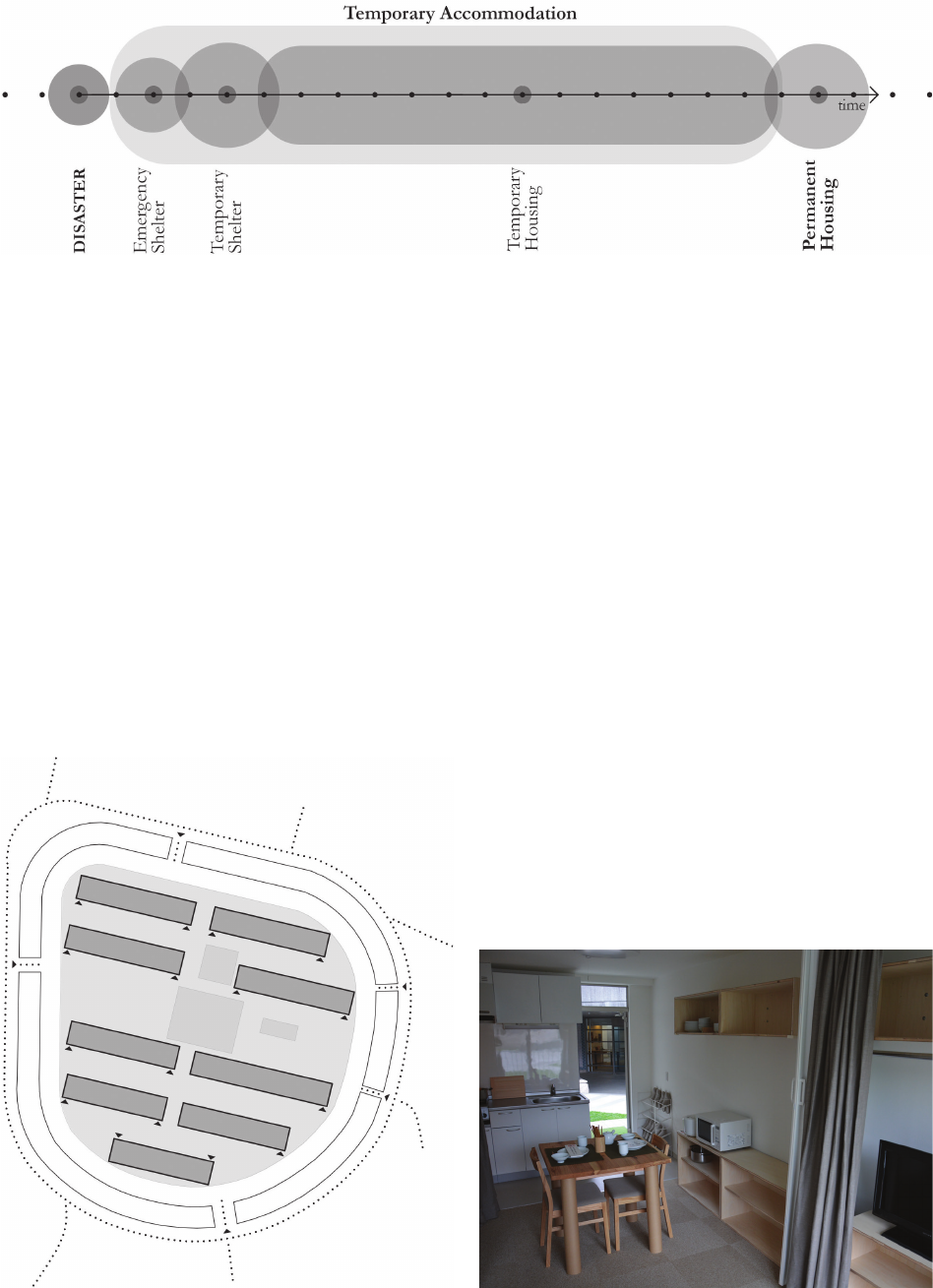
To avoid ambiguity regarding these terms, Quarantelli
(1995) proposed a division of the post-disaster housing pro-
cess into four fundamental stages: emergency shelter (for
a short period immediately after the disaster, for example,
up to 72 hours in a friend’s house or a public shelter), tem-
porary shelter (used for no more than a few weeks after the
disaster), temporary housing (a place where individuals
can stay, typically for 6 months to 3 years), and permanent
housing (Félix et al. 2015).
1
The interviews were conducted in Wrocław with individuals
managing relocation centres, coordinators of collective accommodation
facilities, leaders of humanitarian aid points, and representatives of the
municipal administration. They were coded in the order in which they
were conducted (e.g., I1, I2, etc.).
The dynamics of demand for temporary accommodation in crisis situations: strategies and insights
131
The article also references the term “temporary accom-
modation” (Fig. 1) which, according to Johnson (2002),
encompasses all forms of housing following the forced dis-
placement from a place of residence until the transition to
permanent housing.
Evolving strategies
in temporary accommodation
In response to growing forced migrations, various solu-
tions for temporary accommodation have been developed,
playing a key role in restoring stability. On 11 March 2011,
Japan experienced the largest recorded earthquake, the
Great East Japan Earthquake, with a magnitude of 9. This
Fig. 1. Temporary accommodation phases after disaster (elaborated by M. Terelak)
Il. 1. Etapy tymczasowego zakwaterowania po katastrofie (oprac. M. Terelak)
Fig. 2. Temporary container housing estate in the city of Onagawa,
located on a sports field
(elaborated by M. Terelak)
Il. 2. Tymczasowe osiedle kontenerowe w Onagawie
zlokalizowane na boisku (oprac. M. Terelak)
Fig. 3. The interior of a living space in a container housing module
used in Onagawa, built for an exhibition at Art Tower Mito in 2013
(photo by J. Łątka)
Il. 3. Wnętrze części dziennej w kontenerze mieszkalnym w Onagawie.
Eksponat na wystawie w Art Tower Mito, 2013 (fot. J. Łątka)
event caused a tsunami that devastated the eastern coast,
de stroying nearly 400,000 buildings and damaging anoth-
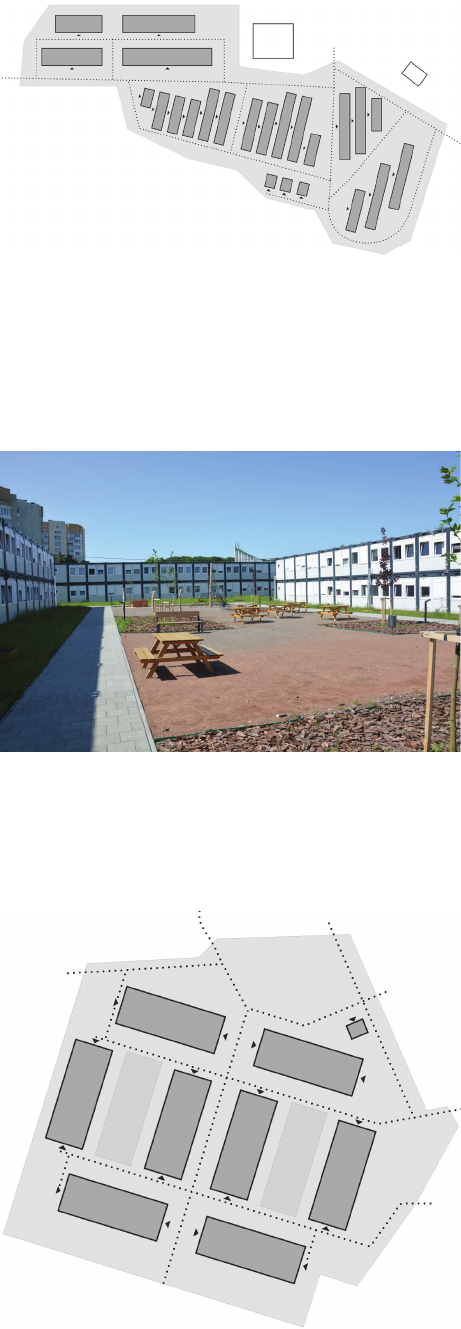
er 750,000. In the mountainous coastal city of Onagawa,
4,500 buildings were destroyed. Due to the uneven terrain,
the city lacked at land to build temporary housing. Archi-
tect Shigeru Ban proposed the construction of nine two- and
three-storey buildings made of shipping containers on the
baseball eld. The buildings were arranged in linear align-
ment to provide sucient access to light and air (Fig. 2).
The containers were stacked in a checkerboard pattern, cre-
ating a living area between them and a sleeping area with
a bathroom inside the prefabricated units (Ban et al. 2014).
The interior layout followed three module types – 19.8,
29.7 and 39.6 m
2
– designated for households of dierent
sizes and functionally divided into bedroom, bathroom and
living areas (Fig. 3). The units were equipped with basic
furnishings and designed to evoke a sense of home, with the
interior arrangement and furnishing supported by Voluntary
Architects’ Network (Yılmaz 2021). In addition to housing
for 189 families, a social centre and a learning space for
children were created between the buildings. The quality of
the ats meant that although the buildings were envisaged
132
Marcelina Terelak
as temporary, after the planned period of use, the residents
did not want to move out, remaining in the buildings for
eight instead of four years. The project set new standards for
the quality of living spaces for disaster victims.
Another example of a comprehensive temporary hous-
ing strategy was the response to the 2009 earthquake in
the Abruzzo region of Italy. The disaster left approximate-
ly 34,000 private homes damaged and uninhabitable, af-
fecting around 67,000 people (Di Bucci et al. 2023). The
initial phase of response to crisis involved setting up tent
camps to provide temporary shelter for those aected. By
autumn 2009, these camps were dismantled, and in the lat-
er stages of the crisis, the C.A.S.E. (Complessi Antisismici
Sostenibili ed Ecocompatibili) and M.A.P. (Moduli Abita-
tivi Provvisori) projects were implemented, oering long-
term and secure housing solutions (Di Bucci et al. 2023).
As part of the long-term reconstruction, permanent hous-
ing was planned under the C.A.S.E. project, while M.A.P.
provided transitional accommodation for approximately
6,000 people in units of varying sizes. The units were ar-
ranged in settlement layouts that were similarly repeated
across 57 earthquake-aected municipalities near the epi-
centre (Fig. 4). The modules ranged from 40 m
2
for one
person to 70 m
2
for up to six residents, catering to dierent
family needs (Bologna 2010). The process of providing
accommodation in the described region was implemented
rapidly yet lacked integration of new developments with
the existing urban fabric. The newly constructed buildings
were characterised by a disconnection from existing infra-
structure and services, limiting their functionality and ac-
cessibility for residents (Bologna 2010). Additionally, this
process created a sense of exclusion among individuals
who were unable to actively participate in the reconstruc-
tion planning in a way that addressed their specic needs
and expectations.
The full-scale invasion of Ukraine by the Russian Feder-
ation in February 2022 led to a rapid increase in the num-
ber of Ukrainian refugees and IDPs. The peak of internal
migration in May 2022 reached 8.7 million, with 600,000
registered IDPs in Lvivska Oblast between May and June
(Lozynskyy et al. 2023). Although this number has since
declined, many of the remaining IDPs are unable to return
to their homes. To accommodate these, several abandoned
hostels were modernised, new multi-family houses were
constructed, and modular towns were established. The use
of shipping containers as housing involved adapting prefab-
ricated units for living purposes (Pekarchuk 2023). One ex-
ample of such solution was for IDPs in the Sykhiv District
of southern Lviv (Fig. 5). The complex features a courtyard
layout, which creates semi-private areas for daily activities,
and playgrounds, enhancing supervision and care for chil-
dren within the complex (Fig. 6). The buildings consist of
two stories made up of 48 containers, equipped with wa-
ter and electricity. The residential units are the same and
consist of one double bed, built-in wardrobes and one bunk
bed. This makes the rooms tight and unsuitable for dierent
family sizes. This temporary housing complex can accom-
modate 1,408 IDPs and was constructed in a green area ad-
jacent to multifamily buildings that oer services such as
shops and cafes.
Fig. 4. Layout of a modular temporary housing settlement,
similarly repeated across municipalities in the Abruzzo region
around the earthquake’s epicentre (elaborated by M. Terelak)
Il. 4. Układ modułowego osiedla tymczasowego, powtarzany
w podobnej formie w gminach regionu Abruzji w pobliżu
epicentrum trzęsienia ziemi (oprac. M. Terelak)
Fig. 6. Temporary container housing estate in Lviv. The complex
is situated in the southern part of the city (elaborated by M. Terelak)
Il. 6. Tymczasowe osiedle kontenerowe we Lwowie.
Kompleks położony na południu miasta (oprac. M. Terelak)
Fig. 5. A view of the shared space between container buildings in Lviv
(photo by J. Łątka)
Il. 5. Widok na przestrzeń wspólną między zabudową kontenerową
we Lwowie (fot. J. Łątka)

The dynamics of demand for temporary accommodation in crisis situations: strategies and insights
133
Dynamic responses to refugee accommodation:
findings from Wrocław’s experience
United Nations High Commissioner for Refugees ( UNHCR)
data indicate that within just a few weeks, Poland became one
of the main receiving countries for refugees (Subocz, Sternic-
ka-Kowalska and Głuszak 2024). Between 24 February and
30 April 2022, over 3.3 million individuals crossed Poland’s
national border (SIP 2023). Over time, successive reports have
provided insights into the location of refugees, their needs,
challenges, and living conditions. By 31 March 2023, data
indicated that Poland was home to 997,737 Ukrainians, 81%
of whom resided in cities (GUS 2023). The highest concen-
tration of Ukrainians, exceeding 10% of Ukraine’s population
in Poland, was recorded in Warsaw. Signicant proportions
of those granted temporary protection were also reported in
Wrocław (4.5%) and Kraków (3.8%) (GUS 2023).
The rapid inux of refugees into Wrocław, with a pop-
ulation increase by 187,281
2
people by April 2022, placed
signicant pressure on the city’s housing infrastructure.
By that time, the Wrocław Metropolitan Area was home to
3
02,467 Ukrainians, driving a growing demand for both tem -
porary and permanent housing solutions to accommodate
the displaced population (UMP 2022). To understand how
or ganisations and municipal structures involved in refugee
assistance perceived the event, responded to it, adapted to
its consequences, and even reorganised various ongoing pro-
cesses, the study adopted a biographical perspective, drawing
on the interviews conducted for this purpose (Kvale 2010).
The analysis compares experiences and aims to develop
a framework for understanding how the refugee crisis has
been experienced in Wrocław. The following account pro-
vides a chronological perspective on the situation from the
onset of the crisis to the present. It focuses on housing condi-
tions and architectural aspects, as well as the stages of assis-
tance provided in response to the temporary housing crisis.
Before a structured system was developed to direct ref-
ugees to appropriate housing facilities, the initial response
relied on spontaneous and largely unregulated eorts by
Wrocław residents to host them in private homes. This sit-
uation posed signicant risks due to the lack of a system to
monitor the number, locations, and living conditions of indi-
viduals, as well as to register oers of assistance or maintain
contact with hosts, complicating emergency responses (I2).
In response to the crisis caused by the war in Ukraine, the
Polish government introduced the Act of 12 March 2022 on
assistance to Ukrainian citizens due to the armed conict in
their country. This document, alongside provisions for the
legalisation of the stay of Ukrainian citizens, also included
a nancial allowance for individuals providing accommo-
dation and meals to refugees. Under the regulations, these
individuals could apply for a daily payment of 40 PLN per
2
The data presented in the UMP report originate from various
sources, including advertisement displays viewed by unique mobile de-
vice users, which allow for the identication of parameters such as phone
language. Other data are drawn from external sources, including mobile
device usage indicators, operating system statistics, and information from
the PESEL registry on the number of identication numbers issued to
refugees from Ukraine who entered Poland after 24 February 2022.
person they were hosting. The allowance was granted for
a maximum of 120 days from the arrival of the Ukrainian
citizen in Poland. However, it was abolished after 30 June
2024, following an update to the Act. The amendment,
signed in June 2024, extended the legal stay of Ukrainian
citizens in Poland until 30 September 2025 (UDSC 2024).
After the Polish government responded, the city’s author-
ities were able to make alternative decisions regarding the
organisation of accommodation for refugees. The rst area
of intervention was the organisation of the main railway sta-
tion. As a result, the station was initially designated as the
central hub for providing information and coordinating the
relocation of refugees to various forms of collective accom-
modation (I5). Additionally, one of the key actions taken was
the repurposing of existing spaces at the station. However,
making changes there proved dicult, as existing regulations
created several obstacles that slowed the response, one of
which was ensuring free access to toilets. Converted support
facilities included the library, oering shelter for mothers
with children, and the Bureau of Artistic Exhibitions (BWA),
where artistic activities were redirected to create emergency
shelter (I5). To enhance privacy and comfort for those stay-
ing there, the Paper Partition System (PPS) was introduced.
This system, created from paper tubes, divides large spaces
into smaller units, each approximately 2 × 2 m, separated by
fabric (Ban et al. 2022). The project was initiated by Shigeru
Ban, in collaboration with architects, students and volunteers.
Approximately 2–3 weeks after the outbreak of the war
in Ukraine, the railway station fully operated as an infor-
mation and relocation point. The process for residents reg-
istering their willingness to accommodate refugees in their
homes became more organised, requiring the provision of
personal details. Refugees were also directed to other col-
lective accommodation spaces, which combined elements
of emergency shelter and temporary shelter. Available funds
allowed for renting hotel spaces and repurposing municipal
facilities like sports halls, schools, dormitories, and oces.
One example was a long-closed school, quickly renovated
and furnished with beds in classrooms. Relocation points,
oering shared sleeping spaces, were intended for short
stays of 24–72 hours or up to a week, giving refugees time
to rest, eat, and plan their next steps. However, no xed du-
ration of stay was established.
In the initial days and weeks following the outbreak of
the war, the primary challenge was the lack of coordinated
management of aid eorts. Respondents stated that commu-
nication between support centres mainly relied on personal
contacts, past humanitarian experience, and volunteer net-
works. To improve coordination and enable a more eective
response, ocials were assigned to maintain a continuous
presence at the railway station. However, insucient de-
cision-making at higher administrative levels hindered an
eective response to the rapidly changing situation.
And the key aspect was to establish contact with the ac-
commodation base in location X, in the town of XYZ, and to
have an understanding of its conditions (I5)
3
.
3
All respondent statements in the text are drawn from the qualita-
tive part of the study.
134
Marcelina Terelak
It was crucial to identify who had arrived in Wrocław and
their basic needs, such as family size and the presence of
individuals with disabilities, to ensure proper relocation to
suitable centres or other cities. However, due to time and lo-
gistical constraints, there was often no opportunity to prop-
erly assess these needs, leading to situations where people
with limited mobility were placed in facilities lacking es-
sential adaptations, such as accessible beds or lifts.
Respondents estimated that Wrocław had around 6–7 col-
lective accommodation sites with varying standards and fa-
cilities, none originally intended for living. A key challenge
for authorities was adjusting activity schedules, requiring
the cancellation or rescheduling of events like concerts, ex-
hibitions, and sports matches – leading to nancial losses
and contractual penalties. Interviewees noted that refugees
were initially directed to large facilities, like sports halls or
the airport, before being relocated within Wrocław or to oth-
er cities, often changing temporary residence at least twice.
The collective accommodation centres were equipped
with basic sleeping arrangements, such as folding camp
beds or mattresses, while coordinators were tasked with as-
sessing the overall conditions within these spaces. In some
build ings, due to poor technical condition, the oor couldn’t
support beds or furniture, so new residents were provided
only with mattresses. Over time, a decision was made to add
a chair to each sleeping space, allowing residents to store
their personal belongings. No other modications were
made to the living spaces throughout the centres’ use, wheth-
er they remained open for six months or three years. Only
in a few locations, where space allowed, shelves or lockable
cabinets were provided for additional storage. This arrange-
ment became the standard in most centres. There were no
clearly dened guidelines specifying the criteria a facility
had to meet to be converted into a collective accommoda-
tion centre. These eorts were carried out urgently, often
spontaneously and with the support of volunteers, enabling
the rapid adaptation or renovation of various buildings into
temporary shelters.
It was all meant to be temporary, just for a short while
[…], so from the very beginning, it was always a matter of
“just another three months, just another six months” (I12).
Despite initial assumptions framing the assistance as
“short-term” and “temporary”, data provided by the Crisis
Management Department indicate that between 1 March
2022 and 31 December 2024, a total of 709,515 person-days
of accommodation were provided in collective housing fa-
cilities in Wrocław. In the rst year following the outbreak
of the war, the number of person-days in collective accom-
modation centres reached 343,831, decreasing to 261,390
in 2023 and 104,294 in 2024. At present, two collective
housing facilities remain operational in Wrocław, providing
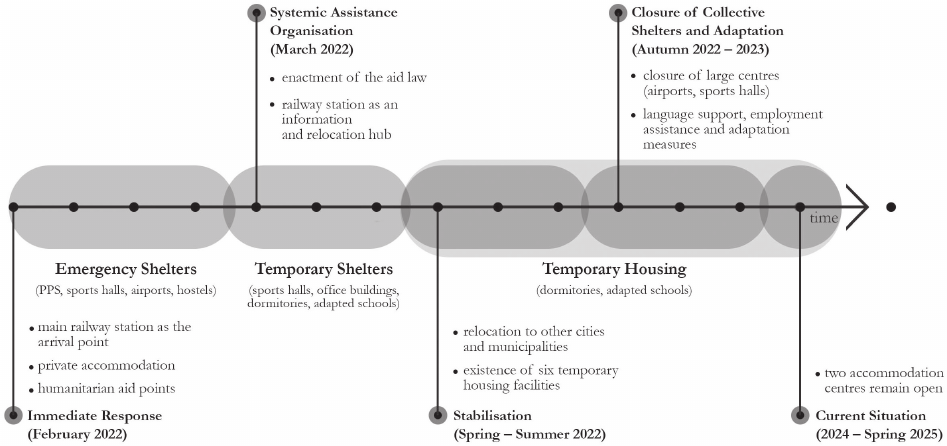
shelter for over 100 individuals. The timeline in Figure 7
il lustrates the main phases of collective accommodation in
Wrocław, highlighting the transition from emergency res-
ponse to the current phase of reduced shelter provision be-
tween 2022 and 2025.
Insights from the analysis
of Wrocław’s response
The perspectives of individuals directly involved in sup-
porting Ukrainian refugees have facilitated the reconstruc-
tion of a coherent picture of the assistance system. Inter-
views highlighted the early-stage spontaneity and lack of
eective coordination, which, combined with the absence of
a housing monitoring system, resulted in limited knowledge
about the living conditions of those accommodated in pri-
vate households. Similar challenges were identied in the
relocation process, where matching housing to the individ-
ual needs of refugees proved to be a signicant challenge.
As reported by a respondent involved in managing refugee
assistance eorts:
Fig. 7. The framework of refugee support in Wrocław (elaborated by M. Terelak)
Il. 7. Ścieżka wsparcia uchodźców we Wrocławiu (oprac. M. Terelak)

The dynamics of demand for temporary accommodation in crisis situations: strategies and insights
135
[…] there were no procedures, and I am not sure whether
any migration procedures for receiving migrants were ever
established across Poland. Everything was done based on
what we thought was right and what we felt needed to be
done (I1).
The city had established operational procedures; however, it
was not prepared for the scale of the refugee inux. As a result,
the support system was implemented gradually and continuous-
ly adjusted. In Wrocław some facilities were provided free of
charge by businesses, while others became available following
rapid renovations. However, no new forms of acco mmo dation,
such as temporary settlements, were developed (see Table 1).
Most of the repurposed spaces were in central areas of the city
or were well connected to the city centre, ensuring
convenient
Category Onagawa, Japan Abruzzo, Italy Lviv, Ukraine Wrocław, Poland
Reception organisation
Actions of central
government
expansion of the public
procurement system;
enabled local authorities
to implement alternative
housing projects
central management by
the Civil Defence Department;
special legislation;
full government control
over housing project
implementation
settlement organisation
led by local authorities
in cooperation
with foreign partners
(e.g., Poland)
40 PLN/day housing
allowance (Ustawa 2022);
in force until 30.06.2024;
supported local response
efforts
Actions
of local authorities
project approved by
Onagawa and prefectural
authorities after
negotiations;
site allocated within
a sports facility
limited influence of local
authorities on settlement
location and design; exclud-
ed from
the planning process
land allocation,
coordination of
construction and site
development; attention to
spatial quality
by local authorities
initial bottom-up response
– refugees hosted by residents;
then municipal coordination
of aid, use of train station,
halls and dormitories;
development of temporary
accommodation with NGOs
Role of volunteers
/ Community
involvement
project supported by
VAN (Voluntary
Architects’ Network);
interior design
and furnishing
no resident involvement in
planning; later grassroots
adaptations to meet
personal needs
grassroots resident
initiatives in organising
and improving shared
spaces
crucial in the initial phase;
support based on informal
networks, grassroots actions
by residents and local
volunteers
Proposed accommodation
Type and location
ISO containers arranged
in multi-storey layout on
a municipal sports field,
on elevated ground
outside the tsunami zone;
close to a hospital,
schools and green areas
MAP – prefabricated units
built in earthquake-affected
towns, near damaged
homes
container settlements
located on municipal
land, with access
to schools, shops
and public transport
accommodation in private
homes, sports halls,
dormitories, hostels
and municipal buildings;
locations dispersed
throughout the city
Standard
and furnishings
three module types
(19.8–39.6 m
2
); divided
into bedroom, bathroom
and living area; furnished
to create a homelike
atmosphere; shared spaces
and services provided
modules of 40–70 m
2
built to
“performance specifications”;
focus on transportability,
safety, material recoverability
and sustainability;
simplified combined
living–sleeping layout
regular layout; 13 m
2
modules for 4 people,
with 2 bunk beds, table,
chairs and cupboards;
shared kitchens and
sanitation facilities
varying standards
– from halls to flats and hostels;
basic furnishings
(bed + chair);
no control over allocation;
rooms often shared
Actual implementation
Degree
of adaptation
to user needs
private entrances;
furnished interiors with
a homelike feel; bright,
spacious modules; shared
spaces encouraging social
interaction
no shared spaces
or services;
spatial limitations;
grassroots adaptations
by residents (canopies,
fences, façades)
no accessibility features
for people with
disabilities;
shared sanitation
facilities located up to
60 m from housing units
unsuitable for long-term stay;
lack of privacy and
accessibility for people
with disabilities; limited
adaptability; furnishings
supplemented by residents
Duration of use
planned for 4 years;
actually used for around
8 years due to high quality
intended as temporary;
used for at least 7 years
after the disaster
still in use;
planned for 4 years;
some settlements closed
during winter due to lack
of weather adaptation
temporary accommodation;
some sites closed after
a few months;
two centres still operating
over 3 years after
the war began
Table 1. Comparison of refugee reception, housing solutions, and spatial arrangements in four case studies (Wrocław, Lviv, Abruzzo, Onagawa)
(elaborated by M. Terelak)
Tabela 1. Porównanie systemów przyjmowania uchodźców, rozwiązań mieszkaniowych i organizacji przestrzennej w czterech studiach przypadków
(Wrocław, Lwów, Abruzja, Onagawa) (oprac. M. Terelak)

136
Marcelina Terelak
access to services, work and other essential urban functions.
The favourable location of collective accommodation sites
made relocation to smaller towns or neighbouring municipal-
ities unattractive for many refugees. It was noted that indi-
viduals assigned for relocation refused to move after arriving
at their designated destination. As one interviewee noted:
[…] we only knew where they were going, but no one knew
what the conditions there were like (I12).
Accounts indicate that accommodation quality was basic,
resembling emergency shelter rather than temporary housing.
Furnishings were minimal, and no signicant improvements
were introduced over time to enhance privacy or living con-
ditions that would provide a greater sense of stability and
dignity. Without private space, residents stored belongings in
bags, impacting hygiene and contributing to sanitary issues.
In contrast, more attention was given to communal areas, es-
pecially for children, with many centres creating play areas,
small libraries, and TV rooms for social interaction.
[…] if we already have such a centre, it should not be
treated as one with the lowest standard, designed simply to
encourage people to move out as quickly as possible, be-
cause they will not do so. They do not want to move out,
despite the standard being what it is (I12).
Interviewees highlighted that the initial assumption of
“short-term accommodation” proved to be unrealistic in
practice, as some individuals remained in the centres for
years, becoming dependent on the assistance system. The
decision to close collective accommodation centres owned
by private entities, such as oces, was often driven by nan-
cial considerations. Another signicant factor was the inad-
equate technical condition of the buildings, which included
faulty installations, heating issues, leaking ceilings, and de-
teriorating walls. Some centres were also closed due to the
decreasing number of individuals requiring assistance. This
mainly applied to initial relocation points, like sports halls
or airports, used during the early stages of the crisis. These
Category Area Recommendations
Management and level
of responsibility
central government
continuous financial and legal support for host municipalities and households,
fast-track decision-making, simplified procedures,
predefined maximum duration of use,
integration of temporary housing into housing and urban planning policy
local authorities
pre-identified emergency locations in local development plans,
resource map (e.g., halls, hotels, schools),
ongoing cooperation with NGOs; joint activation procedures
volunteers / community
support with adaptation,
integration activities (language, education, community initiatives),
filling gaps in basic supplies during the initial phase
Spatial organisation
basic furnishings
minimum: bed, storage space, table, chairs,
access to private or semi-private bathroom,
shared spaces (e.g., kitchens, common rooms), access to Wi-Fi
division of space
possibility to ensure privacy,
zoning: private, semi-private and shared areas,
additional elements
simple options for personalisation
(curtains, shelves, decorations, space for personal belongings)
Table 2. Proposed recommendations for management and spatial organisation in future crisis situations (elaborated by M. Terelak)
Tabela 2. Proponowane rekomendacje dotyczące zarządzania i organizacji przestrzeni w sytuacjach kryzysowych (oprac. M. Terelak)
ndings situate the Wrocław case within a broader compar-
ative perspective, alongside previously discussed examples
from Lviv, Abruzzo and Onagawa. Table 1 oers an over-
view of refugee reception models, housing typologies, and
spatial arrangements in response to displacement.
Discussion
In both Italy and Wrocław, shelter provision for dis-
placed people is marked by a chaotic approach and lack of
long-term planning. Meanwhile, Onagawa’s container set-
tlement set a new standard for temporary housing, reden-
ing accommodation for IDPs. In contrast, the conditions in
Wrocław’s collective accommodation centres raised ques-
tions about their adequacy for people who had ed war. The
location of temporary accommodation played a signicant
role. In Italy, the absence of communal spaces, markets, and
services contrasted with the more thoughtful integration of
amenities in Onagawa and Lviv. In Wrocław, many respon-
dents noted that refugees were reluctant to relocate from
the city centre, where services were easily accessible. Giv-
en these challenges, the bottom-up approach that emerged
due to the lack of organised support raises the question of
whether a more structured framework could have ensured
a more coordinated response. In some cases, participatory
design approaches involving refugees have led to more con-
text-sensitive and socially sustainable housing solutions.
Existing research highlights that involving future residents
in planning and decision-making can result in more appro-
priate and widely accepted spatial arrangements (Albadra et
al. 2021). In the light of these observations, Table 2 outlines
key recommendations aimed at strengthening the planning
and coordination of temporary accommodation eorts. The
suggestions are grouped according to levels of responsibili-
ty and spatial aspects concerning the organisation, usability
and quality of the living environment.
The dynamics of demand for temporary accommodation in crisis situations: strategies and insights
137
Conclusions
The analysis identied solutions and methodologies for
temporary accommodation, highlighting areas for improve-
ment based on interviews and examples from Ukraine,
Ja pan, and Italy. A key issue was the lack of centralised
co or dination, which led to inconsistent relocation and accom-
modation strategies. Establishing clear guidelines would im-
prove eciency, ensure a more predictable response and
help people transition to more permanent housing. Another
pressing issue was the inadequate standard of living, particu-
larly the lack of privacy and essential furnishings, which can
be addressed by analysing the spatial needs of those aected.
Conducting qualitative research with refugees would pro-
vide valuable insights, helping ensure that housing solutions
Acknowledgements
The work was supported by the project Minigrants for doctoral students of
the Wrocław University of Science and Technology.
References
Albadra, Dima, Zainab Elamin, Kehinde Adeyeye, Eleni Polychronaki,
David A. Coley, Jennifer Holley, and Andrew Copping.. “Participato-
ry Design in Refugee Camps: Comparison of Dierent Methods and
Visualization Tools.” Building Research and Information 49, no. 2
(2021): 248–64. https://doi.org/10.1080/09613218.2020.1740578.
Ban, Shigeru, Jerzy F. Łątka, Hubert Trammer, Yasunori Harano, Artur
Jörgen, Daria Pawłosik, and Weronika Abramczyk. “Aid Architec-
ture. Implementation of the Paper Partition System and Styrofoam
Housing System in the Context of the War in Ukraine.” Środowisko
Mieszkaniowe 41, no. 1 (2022): 27–38. https://doi.org/10.4467/2543
8700sm.22.028.17151.
Ban, Shigeru, Naomi Pollock, Michael Kimmelman, and Claude Bruder-
lein. Shigeru Ban: Humanitarian Architecture, edited by Mary Chris-
tian. Aspen Art Press 2014.
Bologna, Roberto. “Planning and Designing Post Disaster Transitional
Housing: The Case of the Abruzzo (Italy) Earthquake.” In CIB World
Building Congress 2010, Salford, UK, May 11–13, 2010. CIB Publi-
cation, 2010.
Clement, Viviane, Kanta Kumari Rigaud, Alex de Sherbinin, et al.
“Grounds well Part 2: Acting on Internal Climate Migration.” World
Bank, 2021. https://hdl.handle.net/10986/36248.
Cygańczuk, Krzysztof, Jacek Roguski, and Jarosław Tępiński. “Temporary
Accommodation Facilities for People Aected by an Emergency or
Humanitarian Disaster.” Safety and Fire Technology 59, no. 1 (2022):
42–57. https://doi.org/10.12845/sft.59.1.2022.2.
Czaja, Jan. “Migracje jako problem globalny. Aspekty polityczno-prawne,
społeczne i kulturowe.” In Migracje i uchodźstwo ludności: trendy,
problemy, wyzwania, edited by Paulina Szymczyk and Iwona Domina.
Wydawnictwo Naukowe Tygiel, 2023.
Demianchuk, Maryna, Alina Burliai, Oleksandr Burliai, and Natalia Maslii.
“Fale migrantów wojennych w krajach Unii Europejskiej w związku
z wybuchem wojny w Ukrainie.” In Migracje i uchodźstwo ludności:
trendy, problemy, wyzwania, edited by Paulina Szymczyk and Iwona
Domina, Wydawnictwo Naukowe Tygiel, 2023.
Di Bucci, Daniela, Fabio Del Missier, Mauro Dolce, et al. “Life Satis-
faction during Temporary Housing after an Earthquake: Comparing
Three Cases in Italy.” International Journal of Disaster Risk Reduc-
tion 91 (2023): 103697. https://doi.org/10.1016/j.ijdrr.2023.103697.
Earthquakelist. “Japan Earthquake Report.” Accessed March 31, 2025, at
https://earthquakelist.org/japan/#latest-earthquakes-mag-6-distance-
smart/.
Félix, Daniel, Daniel Monteiro, Jorge M. Branco, Roberto Bologna, and
Artur Feio. “The Role of Temporary Accommodation Buildings for
Post-Disaster Housing Reconstruction.” Journal of Housing and the
Built Environment 30, no. 4 (2015): 683–99. https://doi.org/10.1007/
s10901-014-9431-4.
Flick, Uwe. Projektowanie badania jakościowego. Translated by Paweł
Tomanek. Wydawnictwo Naukowe PWN, 2010.
Grab, Jadwiga. “The Impact of Migration and Refugee Movements on the
Architecture and Urban Planning of Cities.” In Migracje i uchodźstwo
ludności: trendy, problemy, wyzwania, edited by Paulina Szymczyk
and Iwona Domina, Wydawnictwo Naukowe Tygiel, 2023.
GUS [Główny Urząd Statystyczny]. “Mieszkańcy Ukrainy objęci ochroną
czasową.” Published December 20, 2023. Accessed March 31, 2025, at
https://stat.gov.pl/obszary-tematyczne/ludnosc/migracje-zagra niczne-
ludnosci/mieszkancy-ukrainy-objeci-ochrona-czasowa,19,1.html.
Johnson, Cassidy. “What’s the Big Deal about Temporary Housing? Plan-
ning Considerations for Temporary Accommodation after Disasters:
Example of the 1999 Turkish Earthquakes.” In Proceedings of the
TIEMS Disaster Management Conference, Waterloo, Canada, 2002.
Kvale, Steinar. Prowadzenie wywiadów. Translated by Agata Dziuban.
Wydawnictwo Naukowe PWN, 2010.
Lozynskyy, Roman, Viktoriya Pantyley, Andriy Zubyk, and Hanna Sma-
liychuk. “The Eects of Internal Displacement on the Host Border
Regions (Case Study of the Lviv Region of Ukraine).” Europa XXI 45,
(2023): 39–57. https://doi.org/10.7163/Eu21.2023.45.4.
McAulie, Marie, and Linda A. Oucho, eds. World Migration Report 2024.
International Organization for Migration (IOM). International Orga-
nization for Migration, 2024.
NPA [National Police Agency of Japan]. “Police Countermeasures and
Damage Situation Associated with 2011 Tohoku District – o the Pa-
cic Ocean Earthquake.” Accessed March 31, 2025, at https://www.
npa.go.jp/news/other/earthquake2011/pdf/higaijokyo_e.pdf.
Pekarchuk, Oksana. “Container Settlements Built in Ukraine and Western
Europe in 2022. Analysis and Design Recommendations.” Architectus
74, no. 2 (2023): 105–14. https://doi.org/10.37190/arc230211.
Quarantelli, Enrico L. “Patterns of Sheltering and Housing in US Disas-
ters.” Disaster Prevention and Management 4, no. 3 (1995): 43–53.
https://doi.org/10.1108/09653569510088069.
SIP [Stowarzyszenie Interwencji Prawnej]. “Opcje dla obywateli państw
trze
cich (innych niż Ukraina) przebywających w Polsce na 15-dnio -
wym zezwoleniu.” Accessed March 31, 2025, at https://ukraina.
meet both practical and emotional needs. Additionally, clear
criteria should be established for identifying locations that
can be converted into temporary accommodation centres.
The location of these centres emerged as a signicant factor,
as demonstrated by the contrast between Italy and Onagawa
or Lviv. Temporary accommodation can be implemented in
underused spaces such as parks or sports elds, temporarily
integrating them into the urban fabric. In Wrocław, refugees’
reluctance to relocate from the city centre highlights the
need for a clearer system that outlines potential destinations
and services. These insights underscore the importance of
a strategic approach to temporary accommodation, integrat-
ing crisis planning with long-term housing policies to ensure
adaptability and resilience in future crises.
138
Marcelina Terelak
Streszczenie
Dynamika zapotrzebowania na przestrzeń w sytuacjach kryzysowych: strategie na przykładzie Wrocławia
W obliczu kryzysów migracyjnych miasta stają przed wyzwaniem organizacji schronienia dla oar katastrof naturalnych i uchodźców, co wyma-
ga dynamicznych i elastycznych strategii zarówno w zakresie przestrzeni mieszkaniowej, jak i organizacji pomocy. Tematem artykułu jest architek-
tura pomocowa, obejmująca rozwiązania przejściowe pomiędzy schronieniem natychmiastowym a stałym zakwaterowaniem. Na przykładzie Wro-
cławia przeanalizowano proces przekształcania miejskiej infrastruktury w odpowiedzi na napływ ludności po wybuchu wojny w Ukrainie w 2022 r.,
koncentrując się na ewolucji rozwiązań tymczasowego zakwaterowania. Omówiono kolejne etapy organizacji przestrzeni – od spontanicznych
działań po instytucjonalne miejsca zbiorowego zakwaterowania, pierwotnie planowane jako krótkoterminowe, lecz nadal funkcjonujące. W artykule
przedstawiono zarówno lokalne uwarunkowania organizacji schronienia, jak i szerszy kontekst globalnych kryzysów migracyjnych.
Przeprowadzone badania opierają się na przeglądzie literatury przedmiotu oraz częściowo ustrukturyzowanych wywiadach z przedstawicielami
organizacji pozarządowych i władz miejskich. Wywiady te miały na celu zrozumienie dynamiki funkcjonowania ośrodków zbiorowego zakwatero-
wania. Dodatkowo, analiza danych liczbowych z Wrocławia ukazała skalę napływu uchodźców i wynikające z tego zmiany w zapotrzebowaniu na
przestrzeń mieszkalną. Zestawienie różnych modeli organizacji schronienia pozwala na porównanie podejścia zastosowanego we Wrocławiu, gdzie
dominowały ośrodki zbiorowego zakwaterowania, z rozwiązaniami stosowanymi w innych krajach.
Przegląd różnych strategii skłonił do reeksji nad potencjałem długoterminowego wykorzystania takich przestrzeni oraz koniecznością ich pro-
jektowania w zgodzie z rzeczywistymi, zmieniającymi się potrzebami uchodźców. Podkreślono potrzebę lepszej identykacji tych potrzeb, która
umożliwiłoby nie tylko bardziej efektywne projektowanie przestrzeni, ale także skuteczniejsze zarządzanie i dostosowywanie do przyszłych kryzysów.
Słowa kluczowe: uchodźcy, kryzys migracyjny, tymczasowe zakwaterowanie, architektura pomocowa, organizacja pomocy
in terwencja
prawna.pl/mozliwe-sciezki-dzialania-dla-obywateli- panstw-
trzecich- innych
-niz- ukraina-przebywajacych-w-polsce-na-15-
dniowym-zezwoleniu/.
Subocz, Elżbieta, Magdalena Sternicka-Kowalska, and Bartłomiej Głuszak.
“Life Situation of War Refugees from Ukraine. Research in Warm-
ian-Mazurian Voivodeship.” Polityka Społeczna 601, no. 5–6 (2024):
30–8. https://doi.org/10.5604/01.3001.0054.6496.
UDSC [Urząd do Spraw Cudzoziemców]. “Nowelizacja Ustawy o pomocy
obywatelom ukrainy w związku z koniktem zbrojnym na terytorium
tego państwa.” Published June 25, 2024. Accessed March 31,
2025,
at https:// www.gov.pl/web/udsc/nowelizacja-ustawy-o-po mo cy- oby-
wa telom-ukrainy-w- zwiazku-z-koniktem-zbrojnym-na-tery to rium-
tego-panstwa2/.
UMP [Unia Metropolii Polskich]. “Miejska gościnność: wielki wzrost,
wyz wania i szanse.” Published April 26, 2022. Accessed March 31,
2025, at https://metropolie.pl/artykul/miejska-goscinnosc-wielki-
wzrost- wyzwania-i-szanse-raport-o-uchodzcach-z-ukrainy-w-naj-
wiekszych-polskich-miastach/.
“Ustawa z dnia 12 marca 2022 r. o pomocy obywatelom Ukrainy
w związku z koniktem zbrojnym na terytorium tego państwa.”
Dz.U. 2022, poz. 583. Published March 12, 2022. Accessed March
31, 2025, at https://isap.sejm.gov.pl/isap.nsf/DocDetails.xsp?id =-
WDU 20220000583.
Wagemann, Elizabeth. “Need for Adaptation Transformation of Temporary
Houses.” Disasters 41, no. 4 (2017): 828–51. https://doi.org/10.1111/
disa.12228/full.
Yılmaz, Zelal. “Emergency Architecture: Van and Onagawa Example.”
Proceedings of the International Conference of Contemporary Aairs
in Architecture and Urbanism 4, no. 1 (2021): 648–58. https://doi.
org/10.38027/ICCAUA2021311N7.