
2020
2(62)
DOI: 10.37190/arc200203
Introduction
The importance of the El Fuerte de Samaipata site and
the history of the investigations of this emblematic place
have been the subject of numerous works. These works
include a synopsis published a few years ago by Albert
Meyers in a compendium edited by him in collaboration
with Isabel Combès [1]. With the background of this site
being so important and well-known to the public, in this
text I will limit myself to summarising the facts, which
have been analysed in detail by my predecessors, and
complementing these with some relatively unknown data,
but of importance for the main theme of this publication:
the sacred rock of Samaipata and its petroglyphs.
Description of the site
Samaipata, or more precisely El Fuerte de Samaipata, is
a pre-Hispanic archaeological site of approximately 40 ha.
It is located in Bolivia, on the eastern slopes of the Andes,
on the top of a hill that rises above the valley of the Piray, at
an altitude between approximately 1890 and 1920 m above
sea level. Its geographical coordinates are Lat. 18°10′42″S,
Long. 63°49′10″W. In administrative terms, it belongs to
the department of Santa Cruz, province of Florida, muni-
cipality of Samaipata. It consists of two parts:
– A natural rock with (approximate) dimensions of 250
× 60 m, covered with a complicated system of petroglyphs
representing animals, various geometric shapes, canals, and
water tanks, as well as carved-out niches or entire rooms.
Mariusz Ziółkowski*
El Fuerte de Samaipata in the light of current research
El Fuerte de Samaipata w świetle aktualnego stanu badań
–
An architectural complex located on the south side
of the rock, which served as the Incan ceremonial and ad-
ministrative centre. It is composed of about 50 buildings
typical of Incan provincial architecture, including what are
known as kancha, that is, sets of rectangular buildings dis-
tributed around a quadrangular courtyard or patio. Among
the buildings, a kallanka (a huge stone building), 78 m long
and 16 m wide, stands out for its size. This kallanka was
used for residential purposes (sometimes also ceremonial)
and was capable of accommodating numerous groups of
temporary workers (mit’ayuq), soldiers, or pilgrims [2]–[5].
In spite of its present Incan appearance, the Samaipata
site is multicultural, and its origins date back to around
1000 AD, the probable date of the beginning of the crea-
tion of the petroglyphs in the rock mentioned above [1].
Its current appearance is the eect of at least 1000 years of
activity of the successive cultures that occupied the place
in pre-Hispanic times, during the Colony, and even today,
but also of the deterioration and modications of both an-
thropic and natural origin, phenomena that accelerated in
the previous century.
In the pre-Hispanic period (and after this), the rock
played the role of wak’a, or sacred place, and its prestige
among the local population was undoubtedly one of the
main reasons (although not the only one) for the Incas to
build an administrative and ceremonial centre here, af-
ter incorporating these areas into the Tawantinsuyu (Inca
Empire), probably in the mid-15
th
century AD. Due to its
artistic and historical importance, in 1998, the site was in-
scribed on the UNESCO World Heritage List
1
.
1
Cf. A. Meyers, El Fuerte de Samaipata in context. Introduction,
in this issue of “Architectus”.
* ORCID: 0000-0003-4137-0799. Centre for Andean Studies of the
University of Warsaw in Cusco (Peru), e-mail: mziolkowski@uw.edu.pl

12 Mariusz Ziółkowski
Summary of research history
Samaipata (initially Sabaypata) appears in the histori-
cal sources of the Probanza of the grandsons of the Con-
querors document written in 1569, in which the conquests
of the Inca ruler Tupac Inca Yupanqui and his brothers
in clashes with the Chiriguanos are recounted
2
. However,
the most detailed historical document about the history
of Samaipata at the time of the Inca Empire is True Re-
lationship, written by Father Diego Felipe de Alcaya(ga)
between December 1635 and March 1636. This was based
on an earlier account, written probably between 1573 and
1582, which was authored by Martín Sánchez de Alcaya-
ga, the supposed father of Father Diego
3
.
According to Father Diego’s document, Samaipata (or
Sabaypata) was an important Inca administrative and reli-
gious centre, which suered a devastating invasion from the
Chiriguanos shortly before the arrival of the Spaniards in the
Tawantinsuyu
4
. Apparently reconquered by the Incas (al-
though the document cited is not very clear about it), the site
would have been rebuilt but quickly abandoned because of
the advance of the Spaniards [7], [2, p. 48], [1, pp. 12, 13].
The archaeological data collected mainly by the Ger-
man project, the Samaipata Archaeological Research Pro -
ject (Proyecto Arqueológico en Samaipata, PIAS) in the
1990s conrm the reliability of historical references re-
garding the successive destruction of the site and its re-
construction. Historical stories or legends also refer to
treasures supposedly hidden by the Incas, a topic that re-
mains part of dierent stories and the oral tradition until
today [1, pp. 12, 13].
Leaving aside the somewhat legendary component of
the site, it is clear that Samaipata occupied a key strategic
position for the protection of the Tahuantinsuyu against
2
Y asi salieron a Pocona y hiçieron muchas fortaleças en el mesmo
Pocona y en Sabaypata quees en los chiriguanas y en Cuzcotuiro y pusso
en todas fortale[ça]s muchos yndios de diuerssaspartes para guardasen
la dha fortaleça y frontera a donde dexo muchos yndios orexones y al
pressente estan poblados sus hijos y desçendientes en las dhas orta-
le[ça]s y fronteras [6, p. 226].
3
A critical study of this document with the comprehensive publi-
cation of the palaeographed text has been conducted by Albert Meyers
and Isabel Combès. These scholars concluded that Don Martín’s original
document has been altered by successive remodelling, through which
references to dierent events after 1582 were introduced [1].
4
The document provides interesting chronological information
regarding the possible date of the occupation of Samaipata by the Chi-
riguanos. When referring to the entry of the Spaniards through the Río de
la Plata and the foundation of the city of Asunción (15
th
August, 1537),
there is a reference to information provided by the Guaraní regarding the
sacking of Samaypata and the death of the Inca commanders (kings):
[…] le dieron notiçia con façilidad de la Riqueça que poseyan los yndios
parientes suyos en los llanos que la hauian descubierto los dos yngas
que mataron que ya lo sauian ellos en su tierra y por las lunas que con-
taron pareçio hauer onçe años que mataron a estos dos yngas [1, p. 25].
If the aforementioned Guaraní calculation “by moons” was correct,
it would mean that the Chiriguano invasion took place in ca. 1525–1526.
This date coincides with the chronicle of Rui Diaz de Guzman, accord-
ing to which an invasion of the Inca territory by the Guaraní, an event
in which a Portuguese, Alejo García participated, took place precisely
in 1526. However, after a thorough critical study of this document, Nor-
denskiöld advanced this invasion to 1522 [7].
rampant incursions of the Guaraní. Due to these defensive
qualities, the Spanish administration also promoted the
construction of a fort in this place, most likely in the time
of Viceroy Toledo, between 1574 and 1575. This provides
the origin of the current name of the site – “El Fuerte”.
However, at the beginning of the 17
th
century, the defen-
sive value of the site was no longer so important since the
“Chiriguano Border” had been established further east. In
addition, after the foundation between 1615 and 1617 of
the settlement of Samaipata (at the time, the capital of the
municipality), about 8 km from “El Fuerte”, the latter lost
importance and was gradually abandoned [1]. Despite this
abandonment, the tradition regarding the glorious past of
the site remained in force not only in the oral tradition of
the inhabitants of the place, but in the geographical pub-
lications of the time, which undoubtedly urged travellers
to visit the place
5
.
The rst of the itinerant scientists about whom we
have
somewhat detailed information was a Czech-German
scholar
Thaddeus (Tadeás) Haenke, who, after a short
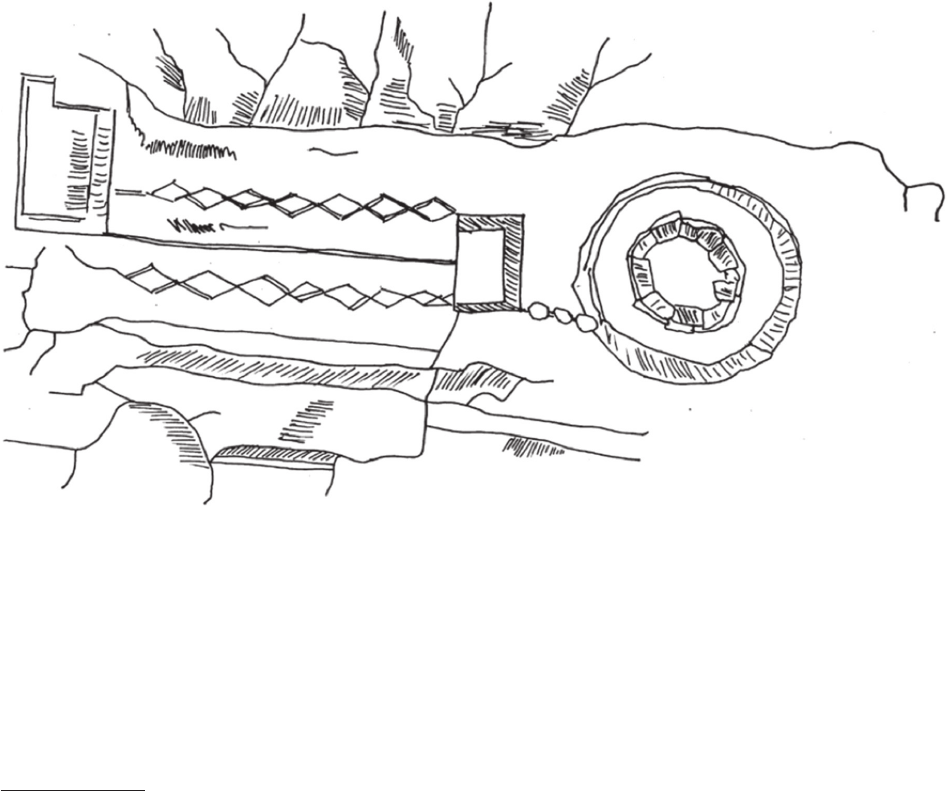
visit to Samaipata in 1795, drew a schematic drawing of
the rock and its petroglyphs (Fig. 1). Unfortunately, after
Haenke’s unexpected death in 1817
6
, most of his notes
and plans, including his information on Samaipata, re-
mained unpublished [11], [12].
An important event for studying the history of this site
was the visit (of only one day – 24
th
November, 1832)
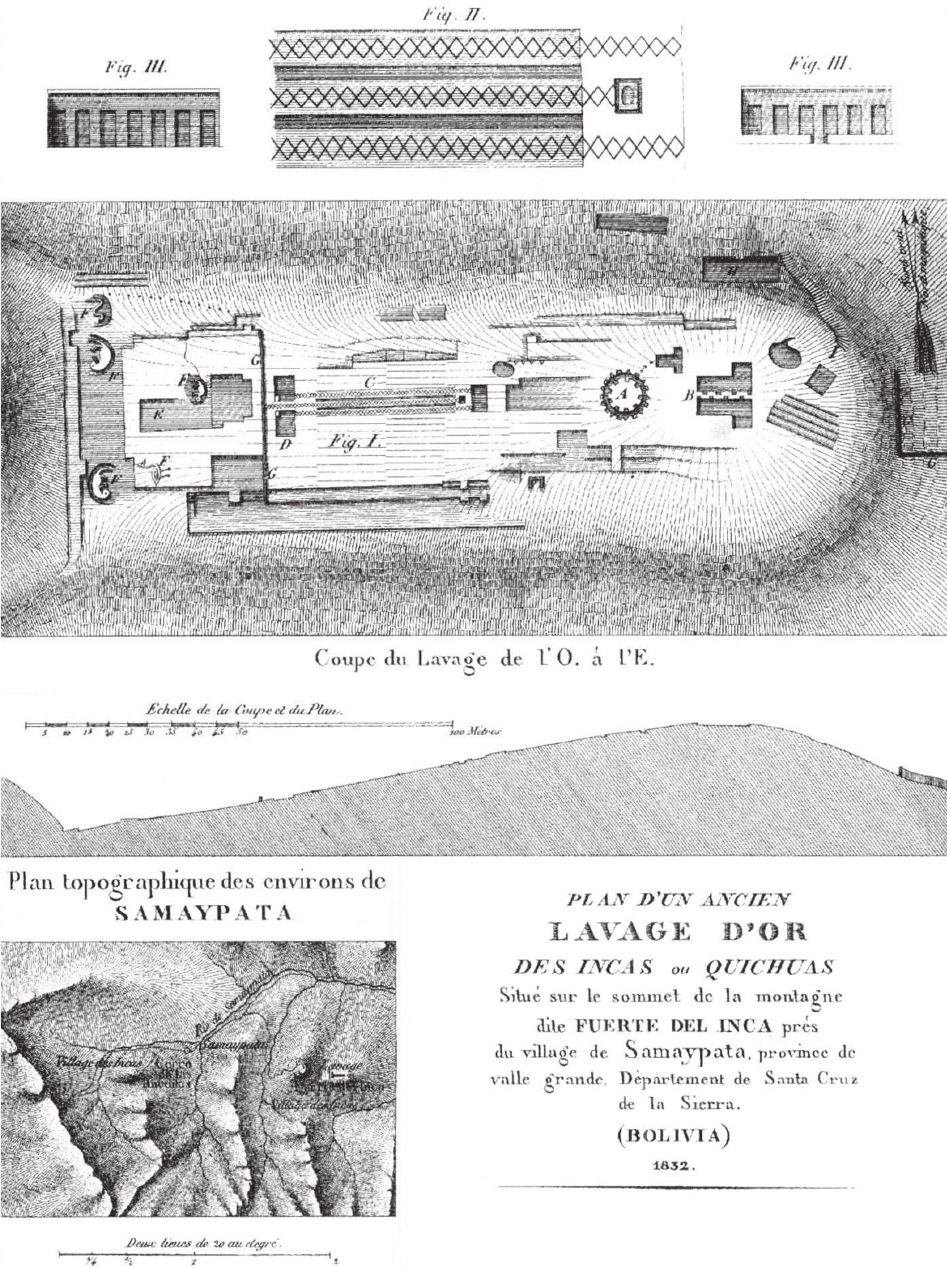
of the French naturalist Alcide d’Orbigny, who prepared
a more detailed but still incomplete plan of the rock and
the carved representations. D’Orbigny’s plan presents
some petroglyphs, including a rhea, that are now practi-
cally unrecognisable (Fig. 2)
7
.
D’Orbigny interpreted a set of elements carved in the
rock as a gold-washing plant [13, pp. 1464–1466]. However,
this interpretation had no rm basis and has been, rightly,
rejected [14], [15]. In light of certain data collected 85 years
after d’Orbigny’s visit, it is possible that this curious iden-
tication as a “gold-washing plant” had a local origin
8
.
5
As an example, let us mention a geographical dictionary from
the end of the 18
th
century: Samaipata, Pueblo grande y de numerosa
Población en la Provincia y Gobierno de Santa Cruz de la Sierra en el
Perú, tiene mas de 600 almas todos Españoles, y á una legua de distan-
cia en un cerro alto en que se ve un edicio maltratado de tiempo con
vestigios de palacio que llaman del Inca y dicen que hay escondido allí
un gran tesoro desde la gentilidad de los Indios [8, p. 486].
6
Haenke was accidentally poisoned by his maid, who served a tox-
ic potion instead of a medicament. There is some confusion in the litera-
ture regarding the date of his death: 1816 or 1817 [9, p. 23], [10, pp. 5, 22].
7
The French scholar was apparently the rst one to propose an as-
tronomical–calendrical interpretation of some of the petroglyphs, a topic
much discussed until today: En lo que se reere a1 aspecto alegórico,
relacionado con la religión, quizis podría verse en el estanque A, situ-
ado en el punto mis alto del conjunto, la representación del sol, cuyos
rayos serian las excavaciones triangulares del contorno. Dentro de esta
hipótesis, seria licito creer también que las medias lunas F F de la parte
baja representarian los primeros y los últimos cuartos de la luna, andan-
do de este a oeste. En cuanto a la serpiente F, a1 ave y a1 otro animal a1
borde del estanque E, tenian tal vez un valor simbólico dicil de explicar
hoy (D’Orbigny 1945 [1844]: 1466 – compare with Fig. 2).
8
In 1917, a North American traveller, Harry A. Franck, after his visit
to Samaipata, published the following information, which, although brief,
oers relatively little known data about the rock. This interesting testimony
El Fuerte de Samaipata in the light of current research / El Fuerte de Samaipata w świetle aktualnego stanu badań 13
D’Orbigny’s plan is accompanied by a description that is
presented below in an approximate English translation: The
sculpted set is composed, at its eastern end, by the founda-
tions of a great wall (C C) and other stores or homes. From
that point, you climb a gentle slope of thirty meters to the top.
In this interval, there are four steps carved in the rock, and
is reproduced in length below: Some two hours beyond Samaipata, 3000
feet or more above the road, up the range on the right, stands what the na-
tives of the region call “El Fuerte”. Here, in a splendid strategic position,
covering the at top of an entire hill, were and still are extensive terraces
and the mostly fallen remains of what must have been important buildings,
now overgrown with brush, though there are few or no real trees. Scattered
about this cold and barren plateau, some 10,000 feet above sea-level, are
many carved seats, similar to those of Cusco and its vicinity, and gures
cut in sandstone, among which jaguars, ostriches, and other fauna of the
Andes can still be distinguished, though many are time- and weather-worn
beyond identication. Practical miners who have visited the spot report the
existence of ore-washing apparatus of hewn stone. According to tradition,
the Incas had here their easternmost stronghold, built by Yupanqui, the
emperor who aspired to conquer the hated huarani, the breechless tribes
of the tropical lowlands. At present, “El Fuerte” is utterly uninhabited.
For many years, one aged Indian lived here, long reputed to be more than
a century old. The people of the region called him “the Inca”, and cred-
ited him with supernatural powers and untold wealth. The usual rumors
of hidden gold and jewels, and of subterranean passages from temple to
treasure-house, hover about the place. So far as is known, the site has never
been visited, or at least explored, by archeologists, to whom it might bring
rewards not inferior to those of Machu Picchu [16, pp. 537, 538].
If in the second decade of the 20
th
century, the miners interpreted
the elements carved in the rock as an ore-washing plant, it could hardly
be a memory associated with d’Orbigny’s visit in 1832; more like a local
tradition still in force that the French scientist would have known and
resumed in his time. There is also interesting information about the “old
Indian” who had lived near the rock. This information has a parallel in
the story of “Timothy and the Elder” collected by Erland Nordenskiöld
[7]. Also of interest are Franck’s references to the representations of
animals (felines, ostriches), still visible at that time, despite the advanced
deterioration of the rock.
to the north, two ponds (l). One is square, six meters long,
and another oval, seven metres, certainly destined to serve
as reservoirs for water (see the section below the plan). At
the highest point, there are two oblong ponds (B), twelve
meters long and separated by a part in which four chairs
on each side were carved, whose destiny was perhaps to
serve as a seat for the workers engaged in washing in those
ponds. A little further down is another circular pond (.4),
eleven meters in diameter, around which eighteen seats are
carved equally in the rock. A conduit connects this pond
with another placed on the northern slope. Going down the
slope and along the middle, under pond A, is a second ob-
long pond, excavated in the slope and whose length is six-
teen meters: under this one, there is a third, oblique, much
smaller, and a fourth pond, oval, in the north. From this last
cross-sectional pond, pond C, six meters wide by forty long,
a little concave, can be seen on the midline of the slope, in
which there are three ditches in the shape of a rhombus,
which is the supposed washing plant; they should serve
to collect the gold nuggets (g. II). Under these rhomboid
ditches, there are two last D ponds, beyond which a wall
extends. Undoubtedly, there nished the installation of the
ore-washing plant. On the other side of the wall, and below,
pond E is still seen on a very even platform, twenty-seven
meters long and twelve meters wide. On this platform, near
the pond, is the gure of an animal carved in relief, and on
the other side a large bird, drawn only in hollow. Below,
in two crescent-shaped pits (F F), whose convexity is in-
verse, two large animals are visible, and on the northern
side, a snake, evenly sculpted in relief in a semilunar cavity
beyond two huge stepped terraces that end the whole west.
So far, I have spoken only of the convex part that occu-
pies the top of the hill: I want to say only two words about
the two parallel slopes, to the north and south of each side
of the eminence. To the north and the eastern extremity,
Fig. 1. Plan of the rock of Samaipata by Thaddeus Haenke in 1795 [1, p. 25, Fig. 4]
14 Mariusz Ziółkowski
there are three wide stepped terraces and some kinds of
moats (H of the plane and g. III the prole) where there
is a reserved entrance, and the rest, carved in the rock,
shows concealed doors. On the slope, you can see four
of these pits and several large stepped terraces, some of
which must have been used as stairs and the others for
other uses. To the south, you can see many more grand
stepped terraces and wide and long pits [13, p. 1465].
Fig. 2. Plan of the rock of Samaipata created by Alcide d’Orbigny on 24
th
November, 1832 [13]
El Fuerte de Samaipata in the light of current research / El Fuerte de Samaipata w świetle aktualnego stanu badań 15
It is interesting to note that in the middle of the 19
th
cen-
tury, Samaipata’s chronological position was already as-
sociated with Tiwanaku and a pre-Inca period, despite the
prevailing historical information about its Inca aliation
[17, p. 27].
The chronological considerations about the pre-Inca
origin of advanced pre-Columbian cultures (among those,
the Samaipata builders) were intimately associated with
the popular theories at that time, which were related to the
supposed existence of two “racial” components of the in-
digenous population: a “superior” and an “inferior” race.
These speculations rested in craniological studies, which
were promoted by physical anthropologists including Paul
Broca [18]. Apparently, a specimen (skull), likely from
excavations in El Fuerte de Samaipata, was collected by
the Italian Medical-Surgical Commission that was present
in Bolivia between 1875 and 1877, and served as “evi-
dence” for those speculations [19, p. 182].
A signicant advance in the research and interpretation
of the rock at Samaipata occurred in the 1
st
half of the 20
th
century. This was the work of the Swedish scholar Erland
Nordenskiöld [20], [21], [7] and the self-taught researcher
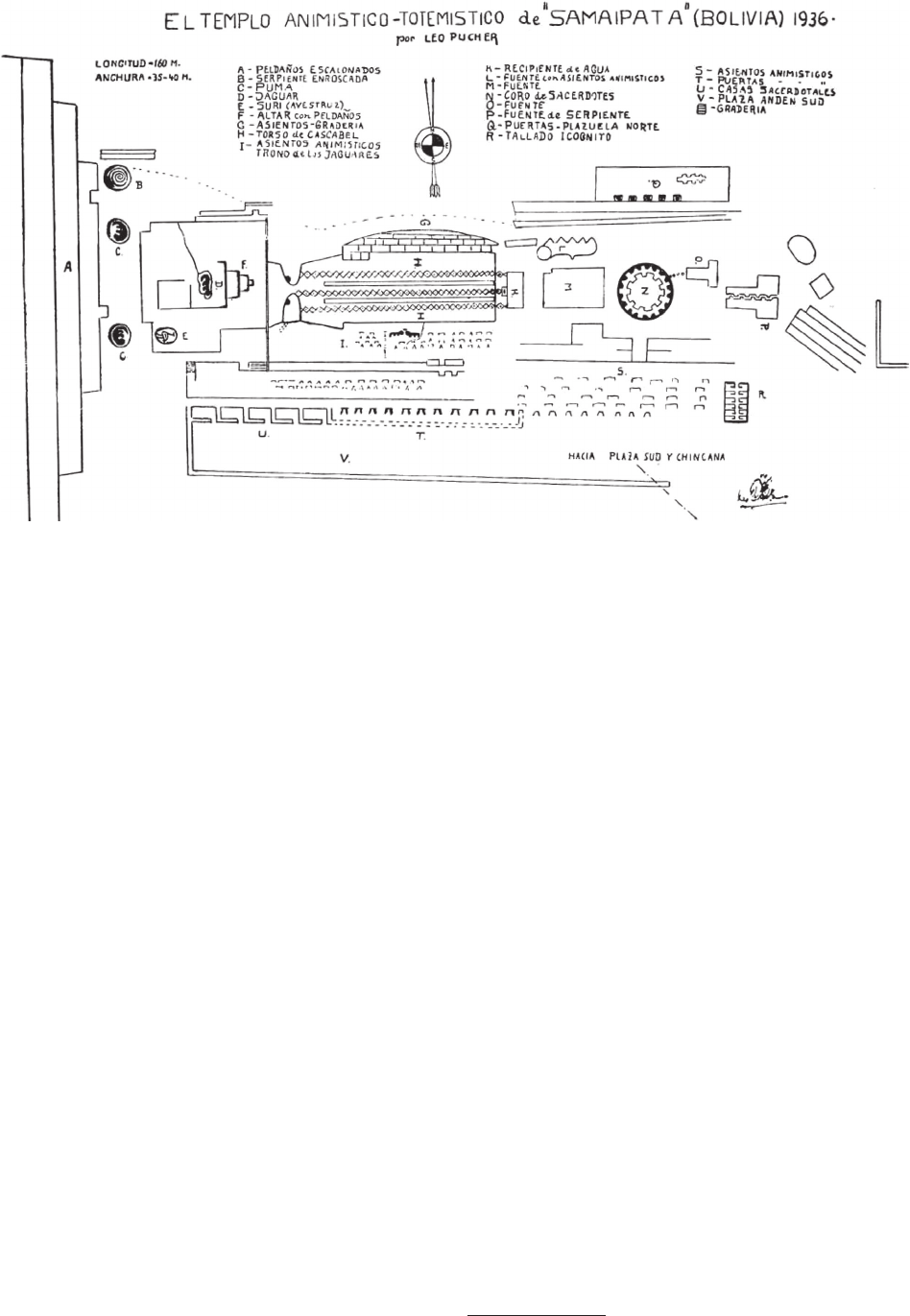
Leo Pucher, an Austrian emigrant in Bolivia [14]. The lat-
ter supported the thesis on the pre-Inca origin of some of
the representations carved into the rock, an interpretation
that proved to be correct. Pucher’s activity was supported
by the Archaeological Society of Bolivia, created in 1930
by Arthur Posnansky. However, the truth is that the type of
archaeology promoted by this society (very select – only
twelve members) raised several doubts not so much in
terms of the eldwork methodology, but more the theo-
retical and interpretative aspects. This is why the some-
what derogatory qualication of “fantastic” and “ mythical”
archaeology is often attributed to this society [22]. For
this reason, and also because of the historical moment in-
which it was published, Pucher’s work on Samaipata [14]
did not have a signicant distribution or impact outside
Bolivia, while the credit of having begun scientic sensu
stricto studies in Samaipata is attributed to Nordenskiöld.
The truth is that the main contribution of the Swedish
scholar was to contextualise the foundation of Samaipata
within the framework of the expansion of the Tawantin-
suyu in the direction of the plains of the east and the con-
secutive clashes with the Chiriguanos [21]
9
. However,
Nordenskiöld devoted relatively little time and attention to
eldwork on the site itself. Despite this, he had the honour
of publishing some photos that showed the state of preser-
vation of the site in 1908 when he visited it [20], [7], [1].
In the 1950s, the long-lasting involvement of German
scholars in research on Samaipata began. The well-known
German archaeologist Hermann Trimborn (University of
Bonn) visited Samaipata in 1955 and 1960 as part of an
archaeological survey in the east of Bolivia. He published
a very detailed description of the site, which also sum-
marised the previous studies, and a simplied plan of the
structures combined with a topographic survey carried out
by his assistant Hansjürgen Müller-Beck [24]. This plan
is not of sucient resolution for the study of petroglyphs,
but Trimborn also used in his publication the little-known
plan drawn by Pucher (Fig. 3). Other works, but of lim-
ited scope, were conducted in the following years: “On
9
In a recent study, Sonia Alconini again addresses this issue, men-
tioning the importance of Samaipata among other Inca facilities in this
territory [23, p. 28].
Fig. 3. The plan of the rock of Samaipata by Leo Pucher in 1936 [14, sec.], [24]

16 Mariusz Ziółkowski
a study trip to Samaipata from June 1 to 7, 1964, the Bo-
livian-German Günter Holzmann (1968) made some small
excavations in what we call platform 2, nding remains of
buildings and ceramics” [1, p. 15].
Investigations of Samaipata and particularly of the rock
have not been limited to the activity of foreign expeditions.
The work of Bolivian scholars has expanded signicantly
with the establishment of the Samaipata Archaeological
Research Centre (CIAS) in early 1974 by the Bolivian
government (and under the initiative of Carlos Ponce San-
ginés). Since then, this centre coordinates the research ac-
tivities and maintenance of the site: The rst systematic
excavations were carried out by Peruvian archaeologist
Felix Tapia Pineda in that same year, in a residential area
south of the rock, today known as sector 2 [25].
In 1979, Oswaldo Rivera Sundt made an interpretative
publication about Samaipata, which represents so far the
most complete and detailed vision of the site [26].
Since then, the resident archaeologist and director of
CIAS, Omar Claure Callaú, makes continuous eorts not
only in terms of the conservation of the monument but
also to attract the interest of scientists to do deep research
into the site and region [1, p. 16].
The site is also still the subject of interest of dierent
scientic publications. Among these, a text by Giancarlo
Ligabue stands out for the excellence of the photos taken
on the site [27]
10
.
Following Trimborn’s studies, in 1992, the German
researchers from the Department of Ancient American
Studies of the University of Bonn and the Commission
for Archaeology of Non-European Cultures (Kommission
für Archäologie Außereuropäischer Kulturen, KAAK; part
of the German Archaeological Institute) initiated PIAS,
headed by Albert Meyers of the University of Bonn. The
research within the framework of this German-Bolivian
project focused mainly on the part of the site connected
to the ceremonial and administration centre of the Incas,
located at the south of the rock.
For the subject of the present study, a survey conducted
in 1994 by the German technicians of the University of
Bonn is particularly important. The result of this survey
10
Photographic documentation of the rock done for the prepara-
tion of the aforementioned article is in the archives of the Fondazione
Giancarlo Ligabue in Venice, Italy.
was a detailed plan of the rock and its petroglyphs. It is
necessary to emphasise the fact that this plan, produced
using “high-tech” equipment for the time, was the rst one
so precise
11
and has been surpassed only by what we have
presented in this volume. However, we must remember
that our plan in this work was produced using advanced
3D laser scanning technology, unavailable in the 1990s.
In 2015, Albert Meyers and Isabel Combès published
a collective work in Santa Cruz, Bolivia [28] that con-
tains a summary of the work of PIAS completed in 2001.
Among the texts of great importance that are presented in
this volume, there is a detailed description of the petro-
glyphs, which serves as a commentary to the above-men-
tioned topographic plan.
Finally, it is necessary to mention the work related to
the conservation and protection of the site and in particu-
lar the rock: geologically, it is a type of sedimentary sand-
stone with a siliceous, porous, extremely soft, and friable
matrix [29]. Carved in such a soft and delicate material,
petroglyphs deteriorate due to environmental factors such
as rainfall, insolation, wind erosion, the harmful impact
of lichens whose dierent species grow on the surface of
the rock, as well as anthropic factors. Among the latter,
the most notable are the inscriptions, drawings, and other
forms of expression carved profusely by visitors before the
installation of CIAS and a control and monitoring system
of the tourist ow. Among the studies that addressed the
issue of conservation and protection, the most relevant are
those conducted in recent years by Sonia Avilés [29]–[32].
A brief summary of the main contributions to the stud-
ies of Samaipata by dierent scholars, both Bolivians and
foreigners, with corresponding bibliographical referenc-
es, has been published by Richard Alcazar de la Fuente,
a researcher who for over 13 years was in charge of CIAS
[33]. Currently, the archaeological and conservation works
on the El Fuerte de Samaipata site are coordinated by
CIAS, which depends on the Autonomous Government of
the Department of Santa Cruz and on the authorities of
the municipality of Samaipata, who work under the su-
pervision of the Department of Heritage of the Ministry of
Cultures and Tourism of Bolivia.
11
Cf. A. Meyers, El Fuerte de Samaipata in context. Introduction,
p. 7, Fig. 1 in this issue of “Architectus”.
References /Bibliografia
[1] Combès I., Meyers A., El Fuerte de Samaipata en contexto: Estu-
dios históricos, Biblioteca del Museo de Historia Universidad Autó -
noma Gabriel René Moreno, Santa Cruz de la Sierra 2018.
[2] Meyers A., Trabajos Arqueológicos en Samaipata, Departamento
de Santa Cruz. Primera Temporada 1992, “Boletin SIARB” 1993,
No. 7, 48–58.
[3] Meyers A., Las Campańas Arqueológicas en Samaipata, 1994–96.
Segundo Informe de Trabajo, “Boletín SIARB” 1998, No. 12,
59–86.
[4] Meyers A., Reexiones acerca de la periodización de la cultura Inka:
Perspectivas desde Samaipata, Oriente de Bolivia, [in:] C. Diez
Marín (ed.), Actas del XII Congreso Nacional de Arqueología Andi-
na, La Plata 1999, T. 1, Universidad Nacional de La Plata, La Plata
1999, 239–251.
[5] Meyers A., Incas, Españoles y el Paytiti: la perspectiva desde el
“Fuerte de Sabaypata”, Oriente de Bolivia, [in:] L. Laurencich Mi-
nelli (ed.), Atti del Convegnio Internazionale Nuove Prospettive negli
Studi Andini Firenze 2005, Società italiana di antropologia e etno -
logia, Serie Archivio per L’Antropologia e la Etnologia, Vol. 135,
Firenze 2006, 167–181.
[6] Rowe J.H., Probanza de los incas nietos de conquistadores, “Histor-
ica” 1985, Vol. 9, No. 2, 196–245.
El Fuerte de Samaipata in the light of current research / El Fuerte de Samaipata w świetle aktualnego stanu badań 17
[7] Nordenskiöld E., Indianer und Weisse in Nordostbolivien, Stuttgart
1922, https://archive.org/details/indianerundweiss00nord/page/
n9/mode/2up?q+=Samaipata [accessed: 14.07.2019].
[8]
Alcedo A., Diccionario geográco-histórico de las Indias Occidentales
ó América: es á saber, de los reynos del Perú, Nueva España, Tierra
Firme, Chile, y Nuevo reyno de Granada…, Vol. 4, Madrid 1786.
[9] Beidleman R.G., California’s Frontier Naturalists, University of
California Press, Berkeley–Los Angeles–London 2006.
[10] Haubelt J., Polisensky J., Prirodovedec Tadeás Haenke a pocatky
Ceského novodobého Zajmu o Latinskou Ameriku, “Acta Universi-
tatis Carolinae. Historia Universitatis Carolinae Pragensis” 1965,
Vol. 6, No. 2, 5–46.
[11] Ponce Sanginés C., Tadeo Haenke y su viaje a Samaipata en 1795,
Centro de Investigaciones Arqueológicas, La Paz 1974.
[12] Ovando-Sanz G., Tadeo Haenke, su obra en los Andes y la selva,
boliviana, “Biblioteca IV Centenario”, Editorial, La Paz 1974.
[13] D’Orbigny A., Viaje a la América Meridional, Editorial Futuro,
Buenos Aires 1945.
[14] Pucher L., Ensayo sobre el arte prehistórico de Samaypata, “Re-
vista de la Universidad de San Francisco Xavier”, Universidad
Mayor de San Francisco Xavier Sucre, Sucre 1945, 17–61.
[15]
Ponce Sanginés C., Alcides d’Orbigny y su viaje a Samaipata en 1832,
[in:] R.D. Arze Aguirre (dir.), El naturalista francés, Alcide Dessaline
d’Orbigny en la visión de los bolivianos, Institut Français d’Études
Andines, Plural editores, Lima–La Paz 2002 [1975], 307–315.
[16] Franck H.A., Vagabonding down the Andes: being the narrative of
a journey, chiey afoot, from Panama to Buenos Aires, Grosset &
Dunlap, Garden City, NY, 1917.
[17] Maury M.F., The Amazon, and the Atlantic Slopes of South Amer-
ica. A series of letters published in the National intelligencer and
Union newspapers, under the signature of “Inca”, F. Taylor, Wash-
ington 1853.
[18] Broca P., Sur des crânes et des objets d’industrie provenant des
fouilles de M. Ber à Tiahuanaco (Pérou), “Bulletins de la Société
d’anthropologie de Paris” 1878, Ser 3, T. 1, 230–235.
[19] Podgorny I., Coleccionistas de arena. La Comisión médico-quirúr-
gica italiana en el Altiplano boliviano (1875–1877), “Antípoda”
2010, No. 2, 165–188.
[20] Nordenskiöld E., Meine Reise in Bolivien 1908–1909, [in:] Globu
Illustrierte Zeitschrift für Länder- und Völkerkundes, F. Vieweg
und Sohn, Braunsweig 1910, 213–219.
[21] Nordenskiöld E., The Guarani Invasion of the Inca Empire in the
Sixteenth Century: An Historical Indian Migration, “Geographical
Review” 1917, Vol. 4, No. 2, 103–121.
[22] Browman D.L., La Sociedad Arqueológica de Bolivia y su inuen-
cia en el desarrollo de la práctica arqueológica en Bolivia, “Ar-
queobolivia” 2007, No. 4, 29–54.
[23] Alconini Mujica S., Southeast Inka Frontiers: Boundaries and In-
teractions, University Press of Florida, Gainesville 2016.
[24] Trimborn H., Der skulptierte Berg von Samaipata, “Archäologi-
sche Studien in den Kordilleren Boliviens”, Bd. 3, “Baessler Ar-
chiv, Beiträge zur Völkerkunde” 1967, NF 5, 130–169.
[25] Tapia Pineda F., Excavaciones arqueologicas en el sector habita-
cional de el Fuerte de Samaipata, “Arqueologia Boliviana” 1984,
No. 1, 49–62.
[26] Boero Rojo H., Rivera O., El Fuerte preincaico de Samaipata, Edi-
torial Los Amigos del Libro, La Paz y Cochabamba 1979.
[27] Ligabue G., The Samaipata Fort, “Ligabue Magazine” 1992, Anno
11, No. 21, 60–69.
[28] Marulanda R., La roca esculpida del Fuerte de Samaipata: elemen-
tos de discusión para un enfoque interpretativo, [in:] A. Meyers,
I. Combès (comp.), El Fuerte de Samaipata. Estudios arqueológi-
cos, Biblioteca del Museo de Historia, Universidad Autónoma Ga-
briel René Moreno, Santa Cruz de la Sierra 2015, 34–51.
[29] Avilés S., La conservación de la Roca Sagrada de Samaipata, [in:]
A. Meyers, I. Combès (comp.), El Fuerte de Samaipata. Estudios
arqueológicos, Biblioteca del Museo de Historia, Universidad Autó-
noma Gabriel René Moreno, Santa Cruz de la Sierra 2015, 151–170.
[30] Avilés S., Consolidazione della Roccia scolpita di Samaipata, Bo-
livia-Sudamerica/Consolidación de la Roca esculpida de Samai-
pata, Bolivia-Sudamerica, Tesis de Master per Operatori Museali
con competenze storiche, lologiche e storico-religiose nei secoli
IV–XV. Dipartimento di Storie e Metodi per la Conservazione dei
Beni Culturali. Alma Mater Studiorum Università di Bologna, Ra-
venna, (Italia) 2001–2002, www.stonewatch.de/media/download/
sc%2004.pdf [accessed: 18.07.2019].
[31] Avilés S., Aspetti sulla conservazione della Roccia Scolpita di Sa-
maipata, Bolivia-Sudamerica, Tesis de Corso di Perfezionamento
sui materiali ceramici, lapidei e musivi per i beni culturali. Alma
Mater Studiorum Università di Bologna, Italia 2002.
[32] Avilés S., Diagnostico di conservazione del Tempio della Roc-
cia Scolpita di Samaipata, Santa Cruz-Bolivia, [in:] S. Avilés,
L. Bengtsson, E. Bre’, G. Ganzaroli (eds.), Progetto di Conservazi-
one del Tempio della Roccia Scolpita Di Samaipata, Univeristá di
Bologna, Italia, Santa Cruz, Bolivia 2014.
[33] Alcazar de la Fuente R., El Sitio Ceremonial y Administrativo de
El Fuerte de Samaipata, “Boletín Tesape Arandu” 2015, Año 4,
No. 21, 2–9.
Acknowledgements /Podziękowania
The presented work is part of the research sponsored by the grant giv-
en to the Wrocław University of Science and Technology by the Polish
National Science Centre (grant No. 2014/15/B/HS2/01108). Additio -
nally, the municipality of Samaipata, represented by Mayor Falvio Ló-
pes Escalera, contributed to this research by providing the accommo-
dation during the eldwork in June and July 2016, as well as in July
2017. The Ministry of Culture and Tourism of Bolivia kindly granted
all necessary permits (UDAM No. 014/2016; UDAM No 060/2017).
The research is conducted in close cooperation with the Centre of
Pre-Columbian Studies of the University of Warsaw in Cusco. Spe-
cialists from other universities and research centres are also joining
the project.
Abstract
Samaipata, or more precisely El Fuerte de Samaipata, is a pre-Hispanic archaeological site of approximately 40 ha located in Bolivia, on the eastern
slopes of the Andes. Due to its artistic and historical importance, the site was inscribed on the UNESCO World Heritage List in 1998.
The importance of El Fuerte de Samaipata and the history of the investigations of this emblematic place have been the subject of numerous works.
This text summarises the main stages of the studies of the site, particularly of the rock, from the rst information in Colonial sources of the 16
th
century to the most current research carried out by Bolivian and foreign scholars. Special emphasis is given to the documentation and preservation
programs of the petroglyphs, which are deteriorating due to environmental and anthropic factors.
Key words: Samaipata, Bolivia, rock art, Andean archaeology, UNESCO World Heritage List
Streszczenie
Samaipata, a ściślej El Fuerte de Samaipata, to przedhiszpańskie stanowisko archeologiczne o powierzchni około 40 ha, położone w Boliwii na
wschodnich zboczach Andów. W 1998 r. miejsce to ze względu na swoje znaczenie artystyczne i historyczne zostało wpisane na Listę Światowego
Dziedzictwa UNESCO.
18 Mariusz Ziółkowski
Znaczenie El Fuerte de Samaipata i historia badań tego wyjątkowego zespołu były już przedmiotem licznych studiów. Ten tekst podsumowuje wyniki
głównych etapów prac na tym stanowisku, zwłaszcza te dotyczące samej skały, od pierwszych informacji w źródłach kolonialnych z XVI w. poczyna-
jąc, po najbardziej aktualne opracowania boliwijskich i zagranicznych badaczy. Szczególny nacisk kładzie się na dokumentację i programy ochrony
petroglifów, których stan zachowania pogarsza się z powodu czynników środowiskowych i antropogenicznych.
Słowa kluczowe: Samaipata, Boliwia, sztuka naskalna, archeologia andyjska, Lista Światowego Dziedzictwa UNESCO