
2020
2(62)
DOI: 10.37190/arc200202
Samaipata, a little Machu Picchu
and a small Cusco in Bolivia
The name “El Fuerte de Samaipata”, the ocial title
with which this mysterious archaeological and historical
site in eastern Bolivia was inscribed on the UNESCO
World Heritage List a little more than twenty years ago,
is in some sense misleading, as the fortication aspect
of the site is not particularly characteristic, at least when
considering its prehistoric origin(s). UNESCO’s brief de-
scription on its ocial website
mentions the strategic im-
portance of this site for the Inca as it was located on the
eastern slopes of the Andes and formed “a bulwark against
the incursions of the warlike Chiriguanos of the Chaco re-
gion in the 1520s”. However, the reuse of the Inca site for
military purposes by the Spaniards during the wars under
Viceroy Toledo and later seems to be the reason for its lat-
er name of “El Fuerte”. Regardless of its name, the prin-
cipal reason for the inscription of this site on the World
Heritage List is its huge sculptured rock, which is classi-
ed as “a unique testimony to pre-Hispanic traditions and
beliefs, and has no parallel anywhere in the Americas”.
In the early nineties of the last century, when we were
prospecting the area and uncovered the structures in the
small valley adjacent to the monumental carved rock
known among the local people and in the sparse literature
as “El Fuerte de Samaipata”, we soon became aware of
the uniqueness of this site
1
. It is unique not only in the
* Department of Anthropology of the Americas, University of Bonn
(Germany), e-mail: a.meyers@uni-bonn.de
1
The Samaipata Archeological Research Project (Proyecto Arqueo -
lógico en Samaipata, PIAS) of the University of Bonn included ve eld
campaigns in Samaipata during the years of 1992 to 1996 under the
Albert Meyers*
El Fuerte de Samaipata in context. Introduction
El Fuerte de Samaipata w szerszym kontekście. Wprowadzenie
Bolivian context of cultural patrimony, but also in a much
broader geographical and cultural sense. In our rst enthu-
siasm, we started talking about a little Machu Picchu, and
I still think we did not exaggerate.
Firstly, let me recall the archaeological situation in Bo-
livia at that time. At a supercial level, the only archaeo-
logical site known by people not considered as insiders
was Tiwanaku (Tiahuanaco), the mysterious megalithic
site surrounding the famous Gateway of the Sun situated
on the Altiplano close to Lake Titicaca. Tiwanaku culture
was considered the uniting prehistoric national culture,
whose cultural remains were dispersed around most of the
national territory except the Chaco and part of the Amazo-
nian regions. Ironically, Carlos Ponce Sanginés, who could
be called a national(ist) archaeologist and who dominated
Bolivian understanding of their prehistoric origin, already
early in the 1970s recognised the importance of Samai-
pata, as he was promoting it as a national monument. As
he told me in 1974, when I had the opportunity to work
on a museum collection in La Paz, the site “belonged”
to the Mollo culture, a culture dened by their ceramics
and architecture and associated with the spectacular ruins
of Iskanwaya that dominate the mountain slopes east of
Lake Titicaca, and whose remains are distributed along
the eastern border of the Andes practically from southern
Peru to the Yungas of Cochabamba. As an outcome of this
Andean-centric or Tiwanaku-centric view, he lled the
local museum of the town of Samaipata with “foreign”
pieces of Tiwanaku culture. It must be stated that during
direction of the author. These were supported by the German Research
Foundation (Deutsche Forschungsgemeinschaft) and other institutions
whose contribution is kindly acknowledged.

6 Albert Meyers
our excavations, among the thousands of shards found,
curiously we found not a single piece belonging to the
classic Tiwanaku culture, or at least none that displayed
the characteristic painted decoration of that culture.
Secondly, at that time, the common understanding of
the eastern border of the Inca realm was that only a slight
part of it reached the Amazonian or Chaco lowlands, and
that this had occurred nearer to the end of the Inca Empire.
Due to this, nobody would have thought that there was
a little Machu Picchu so far to the east. Although early
travellers like d’Orbigny in the thirties of the 19
th
centu-
ry and Nordenskiöld at the beginning of the 20
th
century
described Samaipata as an Inca gold-washing place or the
last Inca fortress to the east against the belligerent Guaraní
people, the carved rock itself was considered as pre-Inca
style in the scientic literature [1], [2]. On the other hand,
Hermann Trimborn underlined the Incan character of Sa-
maipata. However, his detailed description dating from
the sixties of the last century was translated into Spanish
too late and thus has been scarcely considered by local
scholars [3].
Thirdly, the comparison with Machu Picchu was a sort
of cry for help: help for nancial support for the most ur-
gent measurements – the planimetry of the rock and the
whole archaeological complex – and the excavation of the
main structures. The results of this excavation could be
perhaps summarised in the following short way: although
there is clear evidence of pre-Inca cultural manifestations
in the form of ceramics, remains of habitations beneath
the Inca buildings at the gran plaza, and perhaps a con-
siderable amount of the rock carvings, the whole rock has
to be viewed in correlation with the adjacent architectural
remains and the landscaping and seen as a complete unit.
There are two phases recognisable in the architecture
and landscaping of the site. In the rst phase, smaller hous-
es were built on the slope to the south of the rock. Then, the
whole landscape south of the rock and the valley ground
were remodelled and structured with one large platform
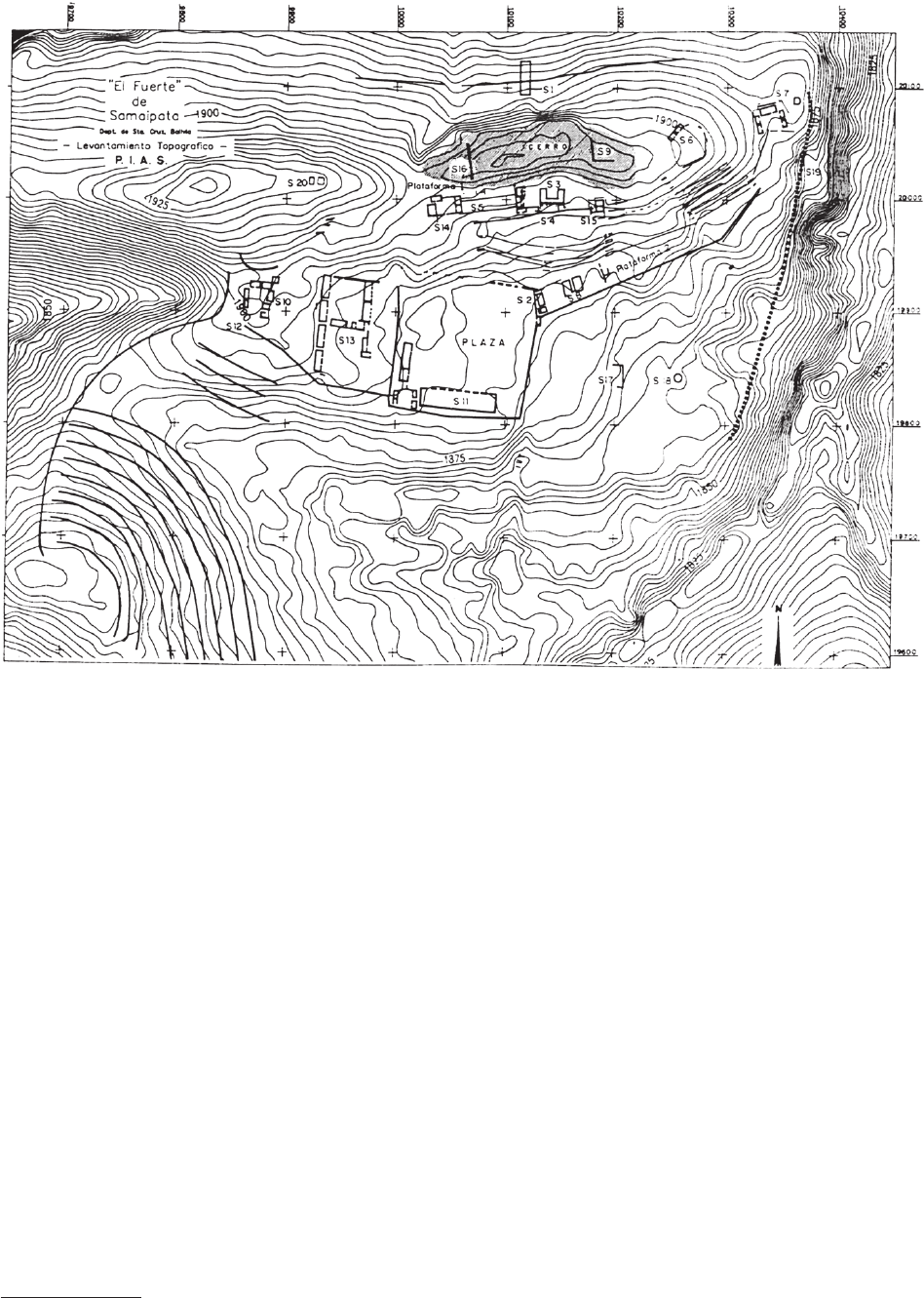
adjacent to the rock, several terraces, and nally a gran
plaza of 100 × 100 m (appr.) bordered by medium-sized
stone buildings 30–40 m long, and huge stone buildings,
kallanka, nearly 70 m long (Fig. 1). This is the same kind
of structure for “new Cuscos” as described for other Inca
sites in the province [4, p. 53]. Samaipata only lacks a sac-
rice stone or altar (ushnu) in the centre of the plaza
2
– but
what more spectacular ushnu could be imagined than the
carved rock? It was during this phase in the history of
Samaipata that the southern part of the whole rock was
cut vertically and provided with lots of niches of human
shape, which formed the northern longitudinal walls of
the large temple buildings whose foundation walls on the
opposite side were documented during the excavations.
Let us now take a short look at the UNESCO descrip-
tion of Machu Picchu: Embedded within a dramatic land-
scape at the meeting point between the Peruvian Andes
2
It is possible that a stone sculpture or altar in front of the kallanka
similar to that of the other large Bolivian Inca centre of Inkallacta near
Cochabamba existed, but it may have been removed later when the area
was used as an agricultural eld.
and the Amazon Basin, the Historic Sanctuary of Machu
Picchu is among the greatest artistic, architectural and
land use achievements anywhere and the most signicant
tangible legacy of the Inca civilization [5]. Concededly, the
landscape of Samaipata is not as dramatic as that of Machu
Picchu, but the special and surpassing characteristic of it is
its position as an Inca town located at the meeting point of
three macro-regions: additionally to the Andes and Ama-
zon, the Chaco – a unique and distinctive environment.
As generations of botanists, zoologists, and ecologists in
general have explained, this special arrangement at the so-
called codo de los Andes (“Elbow of the Andes”) is famous
for its combination of dierent ecological characteristics.
This has been conrmed by the ndings of a group of
botanists and zoologists whom we invited to the site be-
fore clearing it of vegetation [6]. Additionally, in a recent
ethnohistoric study, Samaipata has been characterised as
a centre of trade routes for stone and metal products from
the highlands to the lowlands [7]
3
. The notion of a macro-
regional meeting point is also reected in the ceramic
material that points to regional styles of the mesothermic
Andean valleys (Mojocoya, Presto Puno, Yampará, etc.)
as well of the Amazonian and Chaco lowland wares (at-
tributed to Arawak and Guaraní-speaking people).
To consider all these elements in terms of a chrono-
logical framework, especially as most of the material
that has been excavated is undiagnostic and a lot of oth-
er material was removed during habitation activities es-
pecially during the last horizons, is still a challenge and
requires future research. However, stratigraphically, there
is a clear pre-Inca cultural manifestation best document-
ed in the gran plaza [8, pp. 122–123, Fig. 101]. This is
superimposed by a double horizon of Incan settlement,
which in almost all habitation contexts is interrupted by
the presence of coarse ware ceramics of lowland origin,
and above all, the presence of Spanish colonial activity in
the form of a typical colonial house (casa de patio) dating
from the 2
nd
half of the 16
th
century and abandoned at
the latest during the founding of the town of Samaipata
around 1618. Inca culture at Samaipata, as I have argued
repeatedly, was certainly present for longer than suggest-
ed so far. This has been conrmed by recent research in
the neighbouring areas of the south-eastern Bolivian An-
des as well as in Chile and Argentina
4
.
3
The same, by the way, could be supposed for Machu Picchu, but
until now, it seems that the ethnohistoric interpretation of it being a sum-
mer residence, a sort of Castel Gandolfo, for the Inca King Pachacuti
distracts from consideration any pre-Inca history as well as other as-
pects, for example that it may have been a port of trade for Andean and
Amazonian people.
4
Sonia Alconini, a Bolivian archaeologist teaching in the US, with
considerable research experience in the region, also speaks of a dou-
ble-phase presence of the Inca culture at the fortress of Cuzcotuyo, in
the Cordillera de los Chiriguanos, south of Samaipata, with the rst
phase dating from 1400 to 1480 and the second from 1480 to 1536 [9,
pp. 137–139]. The almost-hundred early dates for Inca sites in Chile and
Argentina published in the last thirty years are currently under debate
due to obvious methodological reasons, but at least one conclusion of
this situation seems to be reasonable: the historical and mythical dynasty
of Inca rulers and the chronological treatment and interpretation of the
archaeological context of Inca sites are considered separately [10].
El Fuerte de Samaipata in context. Introduction / El Fuerte de Samaipata w szerszym kontekście. Wprowadzenie 7
The sculptured rock in a broader context
Let us return to the comparison with Machu Picchu,
where we also have rock carvings, but not the gigantic en-
semble of dierent elements or the dimensions of the rock
present at Samaipata. This has no parallel in the Ameri-
cas, as indicated in the UNESCO list, and perhaps even
no global parallel. Of course, many examples of huge rock
carvings can be enumerated, including ones from India,
Cambodia, South Africa, the well-known town of Petra
(Jordan), another Heritage Site, and the long list of what
are generally understood as “rock art” dispersed all over
the globe. However, as this point, it is useful to distin-
guish painting from carving; the former being much more
common than the latter. Rock painting is very common
and comparatively well studied in the Americas, in-
cluding Bolivia
5
, but examples of rock sculpture of the
dimensions at Samaipata are rare. Malinalco in Central
Mexico, with its rock-cut temples and chambers with
5
The Bolivian Rock Art Research Society (Sociedad de Investi-
gación del Arte Rupestre de Bolivia), who are also engaged in the pres-
ervation of rock sites and in whose journal we published our rst exca-
vation reports, show great commitment to the study of rock painting in
Bolivia.
wall niches is a spectacular exception. Perhaps the fact
that this megalithic mountain sanctuary belonged to the
Aztec state could make it a point of comparison with Sa-
maipata, where the Inca state, far away towards the east-
ern lowlands, manifested the power and strength of its
sun cult.
As for a general understanding and comparison, it
seems interesting to look at the Iberian Peninsula where,
especially in the western part, there are archaeological
sites, sometimes called fortresses, but mostly multi-com-
ponential habitation sites with rooms, altars, niches, etc.
carved in rock. Generally, they are subsumed under the
somewhat diuse Celtiberian culture of the pre-Roman
European Iron Age with strong religious and astronomical
aspects. Heuristically, in my opinion, comparing the Inca
rock-carving complex with these elements of Celtic cul-
ture is useful as both cultures were illiterate, and for their
interpretation, especially religious interpretation, we need
to rely on “foreign” descriptions, i.e., Roman or Spanish
narratives. In both cases, because of the absence of preco-
lonial “emic” literal documents (not even for the names
of the gods or the kings), our understanding is deeply in-
uenced by the (mis)interpretations of the victors of these
cultures. Therefore, the tendency in recent Celtic studies
is to separate the archaeological material, including the
Fig. 1. Samaipata, general plan with excavation sectors, 1992–1996.
Created by Peter Pahlen and Cornelius Ulbert © PIAS
(Samaipata Archeological Research Project [Proyecto Arqueológico en Samaipata],
Institute of Archaeology and Cultural Anthropology, Department of Ancient American
Studies of the University of Bonn)

8 Albert Meyers
art, from its analysis in order to create a more emic vision,
and in another step compare the results of analysis to his-
toric or historical and mythical sources
6
. This procedure
could also be fruitfully applied to Incan studies. Another
tendency, used worldwide, is to interpret these rock-sculp-
tured sites in terms of cultural astronomy, for which Sa-
maipata is also an outstanding example.
On a regional, Andean, level, we can nd many ele-
ments in the Inca realm that are useful for comparison.
These are found particularly in the Cusco region and have
been determined in recent studies to be of Incan geomet-
ric style: rock-cut benches, basins, staircases, channels of
dierent forms, etc. The uniqueness of Samaipata in this
aspect is that it has an accumulation of practically all these
elements in one place, whereas they appear isolated else-
where. The multiplicity of niches is well known from the
Inca heartland, but in Samaipata we have, for example,
a high number of cut seats forming a gallery, which were
intended to form a public theatre. In sum, considering the
clear superposition of some of the carvings at strategic
points at the east and the west end of the rock with classic
Inca niched stone walls, there seems to be a clash of two
religious systems: one perhaps pan-Andean, more gener-
ally oriented to the earth (telluric) and the xed unmova-
ble rocks, and the other an expression of a standardised,
“transportable” state cult. However, certainly, there are
elements of more cosmologies that have to be identied
by considering especially the other macro-regions – the
Chaco and the Amazon.
The need for protection for the sculptured rock
Ironically, in relation to the mentioned reservations
about written sources on pre-Hispanic events, we have
a chronicle that provides some valuable information
about Samaipata in Inca times. Although it dates from
the 17
th
century, the author, a priest named Diego Felipe
de Alcaya(ga), got his information as early as from the
times of Paullu Inca, one of the half-brothers of the last
pre-Hispanic Sapa Inca, and the information was provided
by Alcaya’s father, one of the founders of Ancient Santa
Cruz de la Sierra (in 1561). Alcaya’s chronicle indicates
that Samaipata had been an asiento real (king seat) that
was destroyed by the lowland Chiriguanos before the
Inca recovered it again. This information is reected in
the excavation results. The main purpose of the chronicle
is, however, to declare and prove that there is no more
gold at Samaipata as it was transported by the last gov-
ernor to the jungle “where it will be hidden until the end
of the world”. As conrmation of this, Alcaya indicates
that Father Miguel de Corella, dean of the province of
Santa Cruz, went with people to the rock at Samaipata to
look for gold, but did not nd any
7
. This is just one part
6
Although there is a bulk of critical literature on the Celtiberian
culture, it might be more lucid and pleasant to refer to the mystication
of Asterix and the Gauls as described in a short interview with a French
archaeologist and conservator [11].
7
This treasure hunt that was “legitimated” as extirpation of idola-
try must have happened between 1626 and 1628 according to biograph-
of the long history of vandalism of the site in post-His-
panic times. It starts with the conquistadors, escorted
by their indigenous auxiliary troops for several decades
after the conquest, who reused the Inca houses as habi-
tations and as building material, as well as damaged the
rock and caused other destruction during that time. An-
thropogenic damage reduced in the seventies of the last
century, when most of the territory that had been declared
national patrimony was fenced o, and any tourist visi-
tors trespassing onto the area in the 1990s were impeded
or prohibited.
It must be recognised that the person mostly respon-
sible for these and other protective measures was Prof.
Omar Claure Callaú, long-time director of the local mu-
seum and archaeological centre. He is now retired from
his position as departmental archaeologist of Santa Cruz,
but lives in Samaipata and is still engaged and interested
in any protective initiative and continues to be a source
of information for the many experiments that have been
conducted in the last fty years to try to stop the deterio-
ration of the rock. It was also due to his initiative that the
Samaipata Archeological Research Project (Proyecto Ar-
queológico en Samaipata, PIAS) started, which included
not only investigation of the planimetry of the rock using
the latest technology (a total station) and the excavation
of the surrounding archaeological site, but also protective
measures in correlation with national (conservation of un-
covered building structures) and international (Venice and
other charters) norms.
As is well known, the rock in the Samaipata region is
principally soft sandstone, which suers much under the
changing weather conditions of this exposed transitional
region. Therefore, during our eld campaigns that lasted
a few months, we were able to observe the dramatic dete-
rioration of some of the structures – for example, sever-
al niches on the southern side of the rock fell down. The
various initiatives and projects that we proposed during
our campaigns and afterwards to preserve the rock were
never implemented, even after the inscription of the site
on the World Heritage List. A single example might be
sucient in this context. As the environmental conditions
are the principle element in the process of erosion, one
of our proposals was to install a weather monitoring sta-
tion near the rock in order to have a solid statistical basis
for future measurements of protection. However, this was
never done.
Finally, I want to refer again to the example of Machu
Picchu, which has known problems of protection that are
repeatedly addressed in UNESCO meetings and decla-
rations (although it is not included on the List of World
Heritage in Danger). Samaipata also needs these sorts
of updates in order to nd a way to protect this site. As
archaeological resource management in Bolivia has to
struggle with the conicting elds of national, regional,
and local pretentions in relation to the cultural patrimo-
ny, it is desirable that the World Heritage Centre takes the
ical information [12], which also includes more information about the
historical context of Samaipata and a reproduction of Alcaya’s chronicle.
El Fuerte de Samaipata in context. Introduction / El Fuerte de Samaipata w szerszym kontekście. Wprowadzenie 9
References /Bibliografia
[1] Pucher L., Ensayo sobre el arte prehistórico de Samaypata, “Revista
de la Universidad de San Francisco Xavier”, Universidad Mayor de
San Francisco Xavier Sucre, Sucre 1945, 17–61.
[2] Boero Rojo H., Oswaldo Rivera Sundt A., El Fuerte preincaico de
Samaipata, Ed. Los Amigos del Libro, La Paz 1979.
[3] Trimborn H., Der skulptierte Berg von Samaipata, “Archäologische
Studien in den Kordilleren Boliviens”, Bd. 3, “Baessler Archiv, Bei-
träge zur Völkerkunde” 1967, NF 5, 130–169.
[4] Farrington I., The Concept of Cusco, “Tawantinsuyu” 1998, No. 5,
53–59.
[5]
https://whc.unesco.org/en/list/274/ [accessed: 10.07.2019].
[6]
Ibisch P., Rojas P., de la Barra N. et al., Un “lugar de encuentro”. Flora
de la zona arqueoló gica “El Fuerte”, Samaipata (Provincia Florida,
Dpto. Santa Cruz, Bolivia), “Ecología en Bolivia” 1996, No. 28, 1–28.
[7] Combès I., Planchas, brazaletes y hachuelas: las rutas prehispáni-
cas del metal andino desde el Guapay hasta el Pantanal, “Revista
Andina” 2008, No. 47, 53–82.
[8] Szykulski J., Investigaciones en los Sectores 1 y 2, [in:] A. Mey-
ers, I. Combès (comp.), El Fuerte de Samaipata. Estudios arque-
ológicos, Biblioteca del Museo de Historia Universidad Autónoma
Gabriel René Moreno, Santa Cruz de la Sierra 2015, 116–132.
[9] Alconini S., La expansión guaraní en el sur de Bolivia: Cuzcotuyo
en perspectiva, [in:] S. Alconini, C. Jaimes (eds.), En el Corazón de
América del Sur 3: Arqueología de las Tierras Bajas de Boli via y
zo-
nas limítrofes, Biblioteca del Museo de Historia Universidad Autó-
noma Gabriel René Moreno, Santa Cruz de la Sierra 2015, 129–154.
[10] Meyers A., Dos mundos diferentes: Incas históricos e Incas ar-
queológicos, “Tambo. Boletín de Arqueología” 2019, No. 4, 153– 199.
[11] Olivier L., Que reste-t-il du mythe gaulois?, [in:] F. Malrain,
M. Poux (dir.), Qui étaient les Gaulois?, Martinière, Universcience,
Paris 2011, 173–189.
[12] Combès I., Meyers A., El Fuerte de Samaipata en contexto: Es-
tudios históricos, Biblioteca del Museo de Historia Universidad
Autónoma Gabriel René Moreno, Santa Cruz de la Sierra 2018.
Acknowledgements /Podziękowania
The presented work is part of the research sponsored by the grant giv-
en to the Wrocław University of Science and Technology by the Polish
National Science Centre (grant No. 2014/15/B/HS2/01108). Additio-
nally, the municipality of Samaipata, represented by Mayor Falvio Ló-
pes Escalera, contributed to this research by providing the accommo-
dation during the eldwork in June and July 2016, as well as in July
2017. The Ministry of Culture and Tourism of Bolivia kindly granted
all necessary permits (UDAM No. 014/2016; UDAM No. 060/2017).
The research was conducted in close cooperation with the Centre of
Pre-Columbian Studies of the University of Warsaw in Cusco. Spe-
cialists from many other universities and research centres also joined
the project.
Abstract
This article oers an introduction to the El Fuerte de Samaipata site as a unique example of pre-Hispanic cultural heritage in Bolivia, and discusses the
importance of current research for the conservation and preservation of the site. The rock carvings and the actual rock on the site have to be viewed
in correlation with the adjacent architectural remains and the landscaping and seen as a complete unit. A summary of current knowledge concerning
the site is presented, and it shows that the scale of the rock art at Samaipata has no parallel in the Americas, as specied in the description of the site
on the UNESCO World Heritage List. The site has been compared to some sites in Bolivia and Peru in terms of the problems facing the protection of
heritage monuments. The new approach guided by the Polish mission for research on the architecture and rock art of the site is well justied by the
methods and methodology used for its comprehensive documentation.
Key words: cultural heritage, rock art, Samaipata, Tiwanaku, Machu Picchu, Bolivia, Peru
Streszczenie
Artykuł jest tekstem wprowadzającym do przedstawienia stanowiska El Fuerte de Samaipata jako wyjątkowego przykładu dziedzictwa latynoskiego
w Boliwii i omawia znaczenie bieżących badań dla zachowania tego miejsca. Zarówno ryty naskalne, jak i samą skałę należy postrzegać łącznie i roz-
patrywać w powiązaniu z pobliskimi reliktami architektonicznymi i całym krajobrazem. Zaprezentowano stan obecnej wiedzy na temat tego miejsca
i jednocześnie podkreślono, jak podsumowano to we wpisie Samaipata na Listę Światowego Dziedzictwa UNESCO, że skala i waga tych przykładów
sztuki naskalnej nie ma swojego odpowiednika w obu Amerykach. W artykule porównano Samaipata z niektórymi przykładami w Boliwii i Peru pod
względem problemów związanych z ochroną zabytków. Nowe podejście wykreowane przez polską misję badań nad architekturą i sztuką naskalną
Samaipata jest dobrze uzasadnione metodami i metodologią zastosowaną do jego kompleksowej dokumentacji.
Słowa kluczowe: dziedzictwo kulturowe, sztuka naskalna, Samaipata, Tiwanaku, Machu Picchu, Boliwia, Peru
initiative in that eld before it is too late. A new plan for
the rock is provided by the Polish mission for research on
the architecture and rock art of the site and is based on
the application of the latest technical instruments as well
as the other outcomes of the project presented in this vol-
ume. This plan can be considered an excellent and highly
welcomed precondition for the ambitious but necessary
initiative of protecting Samaipata.
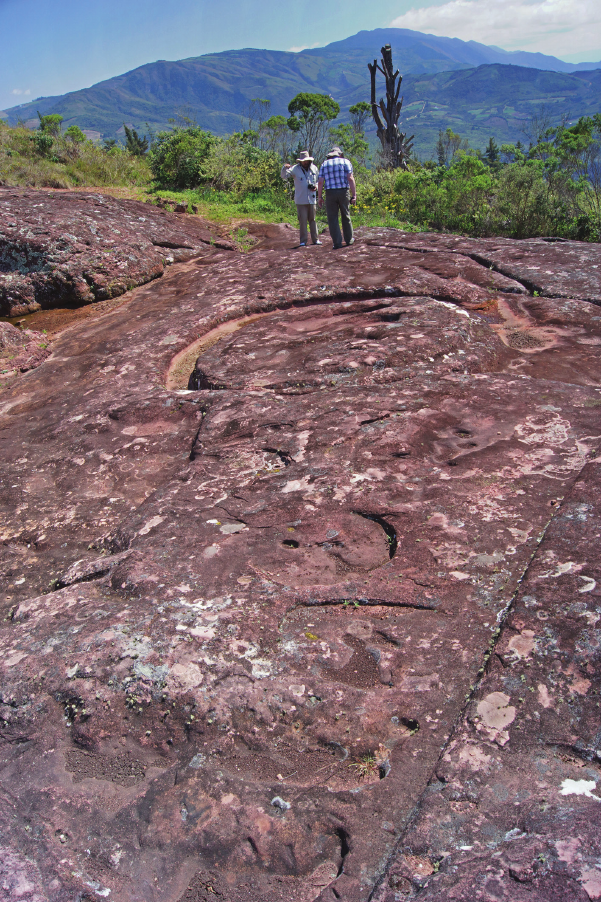
Research team members
analyzing petroglyphs
(photo by J. Kościuk)
Członkowie zespołu badawczego
podczas analizy petroglifów
(fot. J. Kościuk)