
2025
4(84)
Anna Tejszerska*
Gothic church of Saint Lawrence in Gniezno:
interwar expansion according to the plans
of Lucjan Michałowski
and contemporary continuation of the project
DOI: 10.37190/arc250404
Published in open access. CC BY NC ND license
Abstract
The article is devoted to the history of transformations of the Gothic church of St Lawrence in Gniezno. Particular emphasis was given to the
church’s extension carried out in the 1930s following the design by Poznań architect Lucjan Michałowski (1883–1943). The research was based on
historical studies, archival documentation of two versions of the design (1924 and 1935), cost estimates, explanatory notes to the design, and related
correspondence. In order to reconstruct the building’s state before the extension an analysis was carried out of historical studies, plans presenting the
earlier concept of the temple’s enlargement undertaken at the turn of the 19
th
and 20
th
centuries, and photographic documentation from that period.
Use was also made of the documentation made available to the author concerning the ongoing renovation of the church in which the unnished
pre-war elements of Michałowski’s interior design are now being completed. An on-site inspection was conducted to check which parts of the com-
prehensive design, including the church’s furnishings, were actually implemented. Additionally, the paper includes fragments of writings explaining
the ideas that guided the architect in developing his concept. The project under discussion is presented in the context of contemporary debates on the
conservation and transformation of historic buildings.
Key words: Lucjan Michałowski, interwar architecture, church expansion, Gniezno, church of Saint Lawrence
Introduction
In the history of architecture, the expansion of historic
religious buildings was a common phenomenon, allowing
at least some of the original structures to survive. In the
Second Polish Republic, signicant population growth, and
thus an increase in the number of parishioners, forced deci-
sions to be made either to build new churches or to expand
existing ones. At the same time, a backlog was cleared that
had arisen due to the diculty of obtaining the necessary
permits during the period of partitions (Kumor 1980, 665,
666; Jabłoński 2002, 7–28; Tejszerska 2019, 30). The ex-
pansion of historic churches became the focus of conser-
vation debates and discussions among architectural theo-
rists and active designers. Attempts were made to give this
practice the right direction, to dene at least general rules
of conduct in line with the emerging conservation doctrine
(Cybichowski 1928; Szyszko-Bohusz 1912/1913; Tomko
-
wicz 1901, 59; 1912; Muczkowski 1912, 21; Dettlo 2006).
The article is devoted to the interwar extension of the
Gothic church of St Lawrence in Gniezno, designed by
Poznań architect Lucjan Michałowski (1883–1943). The
rst was obtaining access to the project documentation com
-
piled by Lucjan Michałowski, together with fragments of
correspondence related to this investment
1
. The second is
the ongoing restoration of the church, with plans to com-
plete the unrealised parts of the pre-war design.
1
At this point, the author would like to express her sincere grat-
itude to Mr Piotr Michałowski for sharing materials preserved in his
family archive. Unless otherwise stated, all excerpts from Lucjan Mi-
chałowski’s writings quoted in this article come from the private collec-
tion of Piotr Michałowski (le no. 6).
* ORCID:
0000-0001-7872-4496. Faculty of Architecture, Bialy-
stok University of Technology, Poland, e-mail: anna.tejszerska@pb.edu.pl

38 Anna Tejszerska
The author’s aim was to collect, verify, systematise and
share the fullest possible range of information concerning
the history of St Lawrence’s Church, with particular em-
phasis on the changes proposed and implemented as part of
the reconstruction carried out by Michałowski, and to pres-
ent the issue in the light of the conservation debates taking
place at the time.
The research was based on archival materials – project
documentation (drawings, cost estimates, etc.)
2
, correspon-
dence, as well as old diocesan schematics helpful in recon-
structing unexplored pages of the church’s history. The in
situ research enabled a comparative analysis of the design
drawings with their implementation, both in terms of archi-
tectural form and the temple’s furnishings. The work was
greatly aided by information and materials obtained from
the local heritage conservationist and the architect responsi-
ble for the ongoing renovation of the object.
State of research
The Church of St Lawrence – one of the oldest churches
located around the medieval stronghold of the rst Polish
capital – is mentioned in the Liber beneciorum by Bishop
Jan Łaski (1456–1531), published four hundred years later in
a study by Father Jan Korytkowski (de Lasco 1880, 11–13)
3
and in Brevis descriptio (Korytkowski 1888, 33, 34),
which
presents basic information about the Catholic churches of
the diocese according to the state of knowledge at the time.
Equally important is the four-volume catalogue of monu-
ments published during the period of partition and compiled
by Julius Kohte (1861–1945), which covers the province of
Poznań at that time. In addition to brief descriptions of the
form and history of the church, it also includes drawings of
its oor plans (Kohte 1897, 129). Subsequent studies on indi-
vidual churches of the metropolis relied heavily on the afore-
mentioned works and often replicated the information they
contain. This is also the case with St Lawrence’s Church.
Individual references to the building appear in publications
cited in the article concerning broader issues, including the
history of architecture in the region (Maluśkiewicz 2008;
Tomala 2007). The beginnings of the temple’s history are
described in the article by Michał Muraszko (2013). A con-
cise presentation of the building and its history, extending
into the 20
th
century, is provided in the Katalog zabytków
sztuki w Polsce [Catalogue of Art Monuments in Poland]
(Ruszczyńska, Sławska 1963, 68). The matter of the church’s
enlargement in the interwar period, which is the main topic
of the present study, is mentioned in a single sentence.
History of the church building
The Church of St Lawrence is one of the oldest churches
in the rst capital of Poland. In the early Middle Ages, in
the area of present-day Gniezno, apart from the cathedral
2
The photographs and scans of design drawings included in this
article were taken by the author of this article.
3
The author of the 16
th
-century Liber beneciorum is Primate Jan
Łaski, but what is most important in this work are the extensive comments
that Korytkowski added to the reprint of the manuscript published in 1880.
located in the outer bailey and St George’s Church within
the castle walls, both built in the 10
th
century, there were
four churches serving the faithful living in the settlements
surrounding the castle. These were: Church of the Holy
Cross in the northern settlement on Lake Bielidło (also
called Lake Świętokrzyskie) (see in more detail: Murasz-
ko 2012), the church of St Peter in Piotrów (Zajezierze),
situated to the west of the stronghold, St Michael’s Church
located by the road leading to Kruszwica and the Church of
St Lawrence, belonging to the trading site located in the
south. The temples situated around the stronghold also in -
cluded the Church of St John the Baptist, built outside the
settlement area (Skwierczyński 1996, 9, 10). All these tem-
ples were built between the 11
th
and mid-13
th
centuries.
Their exact dating is often uncertain or dicult to determine.
Korytkowski’s schematism states that the ancient church
of St Lawrence was supposedly founded by the courtiers
of Bolesław Chrobry
4
. This dating can also be based on
information contained in a footnote to the reprint of Liber
beneciorum, stating that […] According to oral tradition,
this church was built and endowed by the courtiers of King
Bolesław Śmiały (de Lasco 1880, 11). Both versions come
from publications by the same author
5
. Does this suggest
that 19
th
-century tradition preserved two versions of the
events, or rather that Korytkowski, in one of his publica-
tions, confused the ruler’s epithet? It is dicult to determine
with certainty whether either version corresponds to histor-
ical reality. Some sources repeat it, other authors question
it (cf. Muraszko 2013, 29). In the diocesan schematism of
Father Stanisław Kozierowski, it can be read that the church
[…] was founded and endowed by the owners of Ludziska
(the Symon family, descendants of Degnon of Oćwieka?)
in the 1
st
half of the 13
th
century (1934, 49). The rst reli-
able source referring to the church dates back to 1255, when
Prince Bolesław the Pious issued a foundation charter for the
town of Kłecko (de Lasco 1880, 11; Korytkowski 1888, 33)
6
.
Father Korytkowski states that the church, originally wood-
en,
was probably rebuilt and erected in brick in the 16
th
cen-
tury (1888, 33). It is well known that in mid-1331, during
the Teutonic Knights’ invasion, the church and the suburb
to which it belonged were set on re and completely de-
stroyed (Galewski
7
1929, 43). The construction of the brick
temple is therefore most likely a more or less direct result
of this fact. Originally, it was a single-nave building with
a massive western tower located on the northern side of
the body, covered with a low tented roof. The unplastered
brick walls of the western elevation and the tower, built in
Polish bond, testify to the church’s medieval origins, as do
the north-western buttresses at the junction of the nave and
the tower, which serve to reinforce the structure. Three tall,
clearly visible window openings in the façade, crowned with
4
Eccl. S. Laurentii M. mur. antiqua, quae ab aulicis Boleslai Chro-
bry, Regis Polon., extructa et dotata esse dicitur (Korytkowski 1888, 33).
5
The quoted fragment comes not from the original Liber benecio-
rum, but from Korytkowski’s footnote.
6
It records the tithe belonging to the church from Kraiewo, one of
the town’s four districts (Muraszko 2013, 27).
7
In the cited edition of the guide, although it is only a supplement-
ed reprint of Józef Galewski’s 1924 publication, the author’s name is
not given.
Gothic St Lawrence Church in Gniezno and its interwar expansion 39
that the church was renovated […] in recent years thanks
to the eorts of parish priest Father [Stanisław] Kubski
(1876–1942)
9
, who held this position between 1910 and
1917 (Galewski 1929, 43, 44). Thus, the expansion that be-
gan at the end of the 19
th
century continued for the next
twenty years, until 1917, when the enlarged church was
consecrated by the then suragan bishop of Gniezno, Wil-
helm Kloske (1852–1925) (cf. Rocznik 1929, 56).
When the expansion of the church began in 1893, the
parish of St Lawrence had 3,423 members (Elenchus 1892,
15), while in 1924 it had 8,000 (Elenchus 1924, 19). Such
a substantial increase in the number of parishioners meant
that only seven years after the consecration, a decision was
made to expand the church once again. The plans were
commissioned from Lucjan Michałowski, a Poznań-based
architect educated in Munich (1907).
Lucjan Michałowski – artist profile
Lucjan Michałowski gained professional experience under
various mentors, including Raimund Jeblinger (1853–1937)
during a one-year postgraduate internship (1907–1908)
at the
Archiepiscopal Building Department in Freiburg, which un-
doubtedly inuenced the architect’s later work, dominated
9
Blessed of the Catholic Church, martyr, murdered in the Hart-
heim concentration camp.
a semicircular arch and now bricked up, bear witness to the
alterations made to the temple.
The church was desecrated and devastated by Napoleon’s
soldiers during their campaign against Moscow in 1812, and
was then used as a granary. On 2 February 1817, follow-
ing restoration work, it was returned to its religious pur
pose
(de Lasco 1880, 11; Korytkowski 1888, 33, Ruszczyńska,
Sławska 1963, 68). In the 19
th
century – from 1896 onwards
– it was signicantly expanded (Ruszczyńska, Sławska 1963,
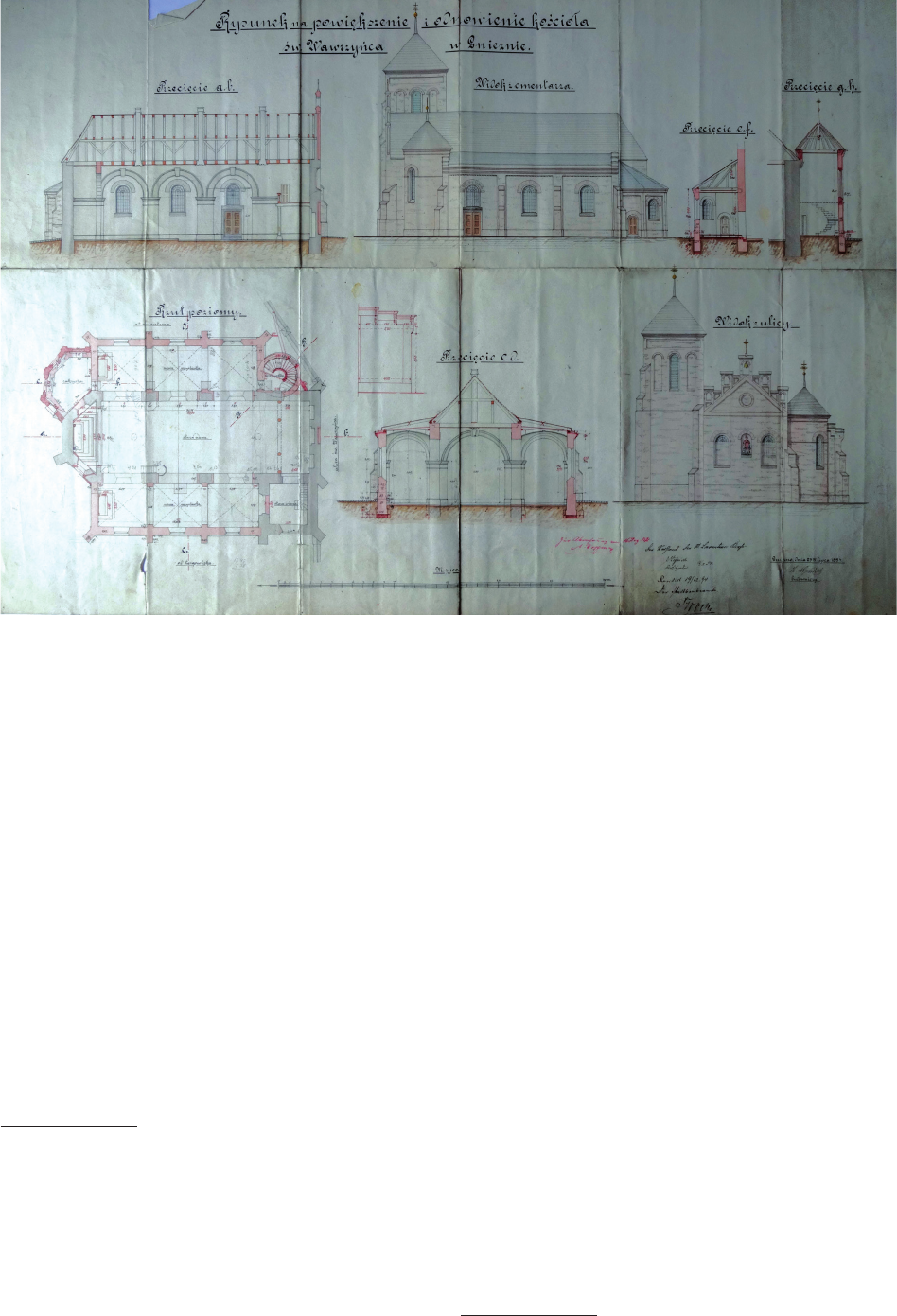
68) according to a blueprint dated 1894 (Fig. 1). The
build-
ing then gained three-bay, cross-vaulted side aisles in a hall
layout, a low, round tower with stairs on the south side, and
a sacristy adjacent to the chancel and the side aisle from the
south-east. The central window opening in the façade was
partially bricked up. There were also plans to transform its
gable
8
. A guidebook to Gniezno from the late
1920s states
8
The Baroque-style gable visible in photographs taken before the
reconstruction carried out in the 1930s does not correspond to the Gothic
form presented in the 1894 design. It can be assumed that either the re -
construction which started at the end of the 19
th
century did not go ac-
cording to plan, or that in later years certain changes were made which
were not recorded in the sources, which seems less likely. In the 1840s,
the church still had a simple brick triangular gable, as can be seen in an
illustration from that period (Pasiciel 1989, 167). Therefore, it seems un-
likely that the Neo-Baroque gable was erected before the reconstruction
at the end of the 19
th
century, and the design of the gable developed in
1894 (clearly marked as a new element in the cross-section) was intend-
ed to regothicise the building, which was not carried out.
Fig. 1. Design for the extension of St Lawrence Church in Gniezno, 1894 (source: private collection of P. Michałowski, photo by A. Tejszerska)
Il. 1. Projekt powiększenia kościoła pw. św. Wawrzyńca w Gnieźnie, 1894 (źródło: zbiory prywatne P. Michałowskiego, fot. A. Tejszerska)
40 Anna Tejszerska
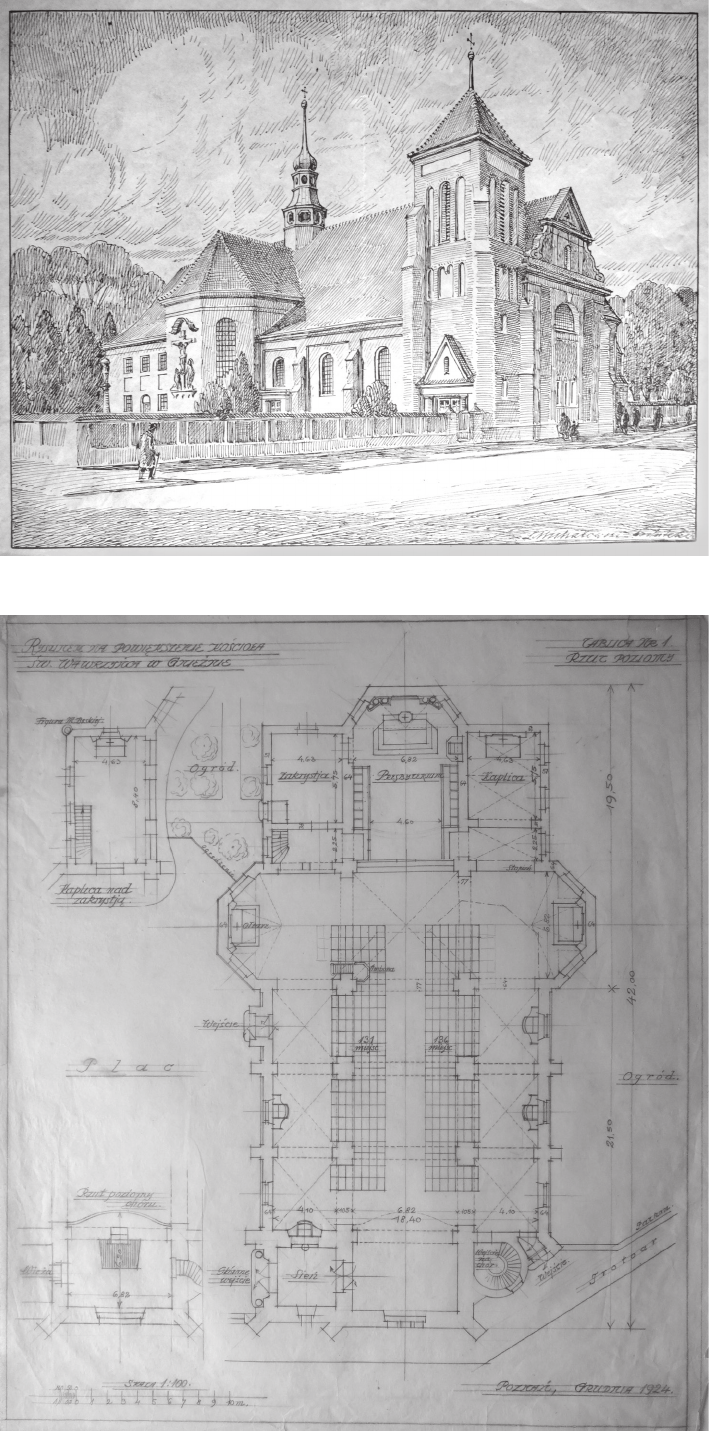
Fig. 2. Design for the extension
of St Lawrence Church
in Gniezno (sketch), 1924
(source: private collection
of P. Michałowski,
photo by A. Tejszerska)
Il. 2. Projekt powiększenia
kościoła pw. św. Wawrzyńca
w Gnieźnie (szkic), 1924
(źródło: zbiory prywatne
P. Michałowskiego,
fot. A. Tejszerska)
Fig. 3. Design for the extension
of St Lawrence Church
in Gniezno (plan), 1924
(source: private collection of
P. Michałowski,
photo by A. Tejszerska)
Il. 3. Projekt powiększenia
kościoła pw. św. Wawrzyńca
w Gnieźnie (rzut), 1924
(źródło: zbiory prywatne
P. Michałowskiego,
fot. A. Tejszerska)
Gothic St Lawrence Church in Gniezno and its interwar expansion 41
by objects of a religious purpose. Upon his return to Poznań,
he spent several years as an assistant to Stanisław Borecki
(1855–1924) before becoming fully independent. It can be
assumed that this collaboration introduced the then novice
architect to the path of national romanticism, to which he
remained faithful throughout his
career. In addition to ar-
chitectural structures, Michałowski designed numerous el-
ements of church furnishings. He
was also an art collector,
draughtsman and painter. The architect was known to the
clergy of Gniezno for his design
work carried out since 1915
for St Michael’s Church and the parish church of the Holy
Trinity (since 1916), as well as for his designs for numer-
ous tombstones in St Peter’s Cemetery.
He also completed
a small commission in the form of a roadside cross design
near St Lawrence’s Church (1915)
10
.
At the time of the project’s implementation (1935–1936)
Michałowski already had almost thirty years of design expe-
rience,
mainly in the eld of sacred architecture. His achie-
vements included designs for the construction or extension
of churches in Rogów (1932–1934), Domachowo
(1928–
1931)
11
, and Ludziska (1932–1935), while at the same
time
working on the reconstruction of the church
in Brześć nad
Gopłem (1935–1936). They are all part of the Neo-Baroque
“national style” trend, characteristic of the period when
these designs were created (cf. Stefański 2000).
Throughout
the decade from 1929 to 1939, Michałowski carried out pro-
jects to enlarge and furnish the church in Kłecko. This pro-
ject is most closely related to St Lawrence’s Church due to
the medieval origins of the Kłecko temple and, as in the case
of the previously mentioned buildings, due to the Neo-Ba-
roque form of the added sections, which is maintained in the
national romanticism spirit.
Extension of the church in the interwar period
The project to enlarge St Lawrence’s Church in Gniez-
no was developed by Michałowski in two stages. The rst
architectural plans were drawn up in 1924 (Figs. 2, 3). Cor-
respondence concerning the development of the concept
also dates from this period. The slightly modied version
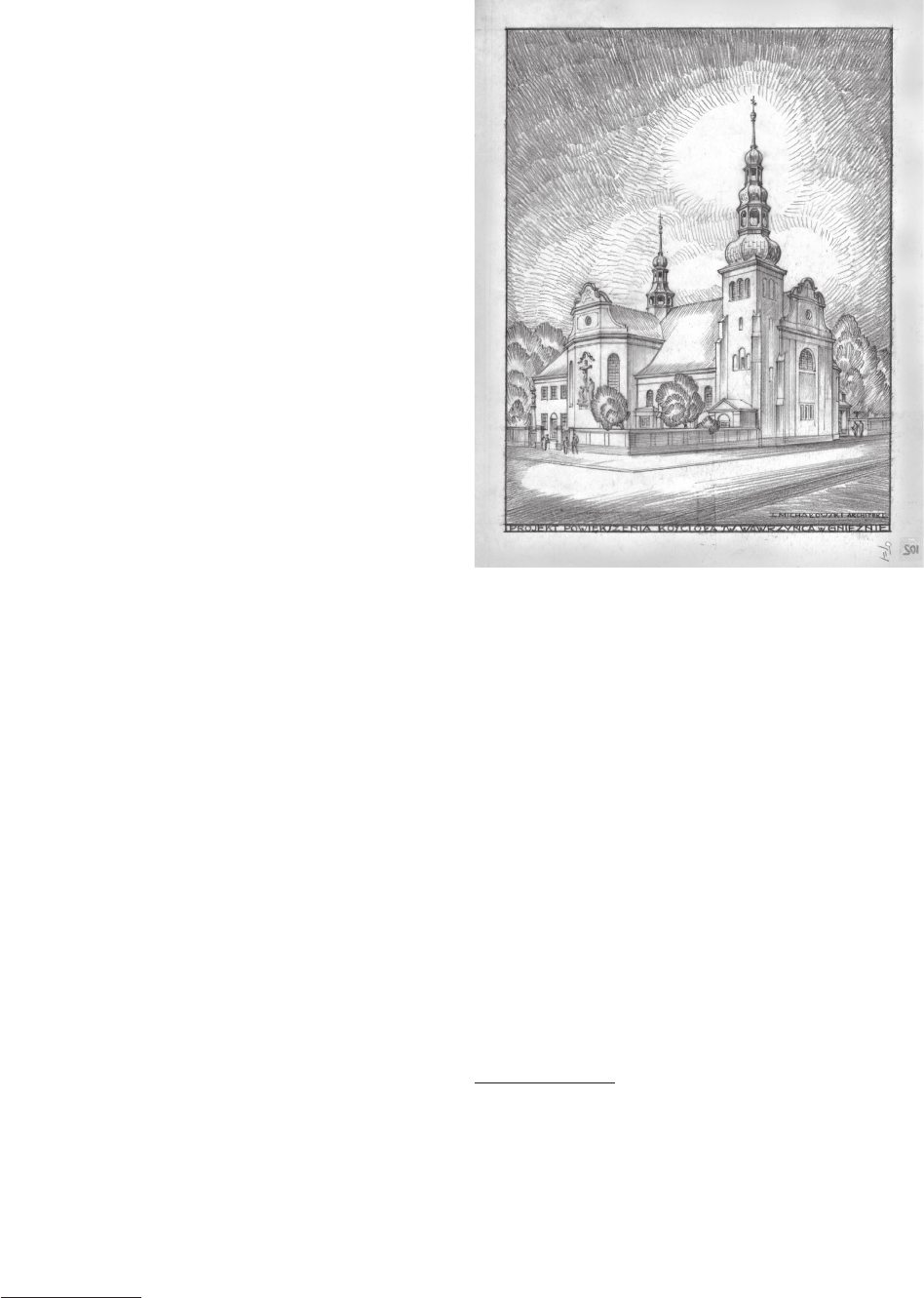
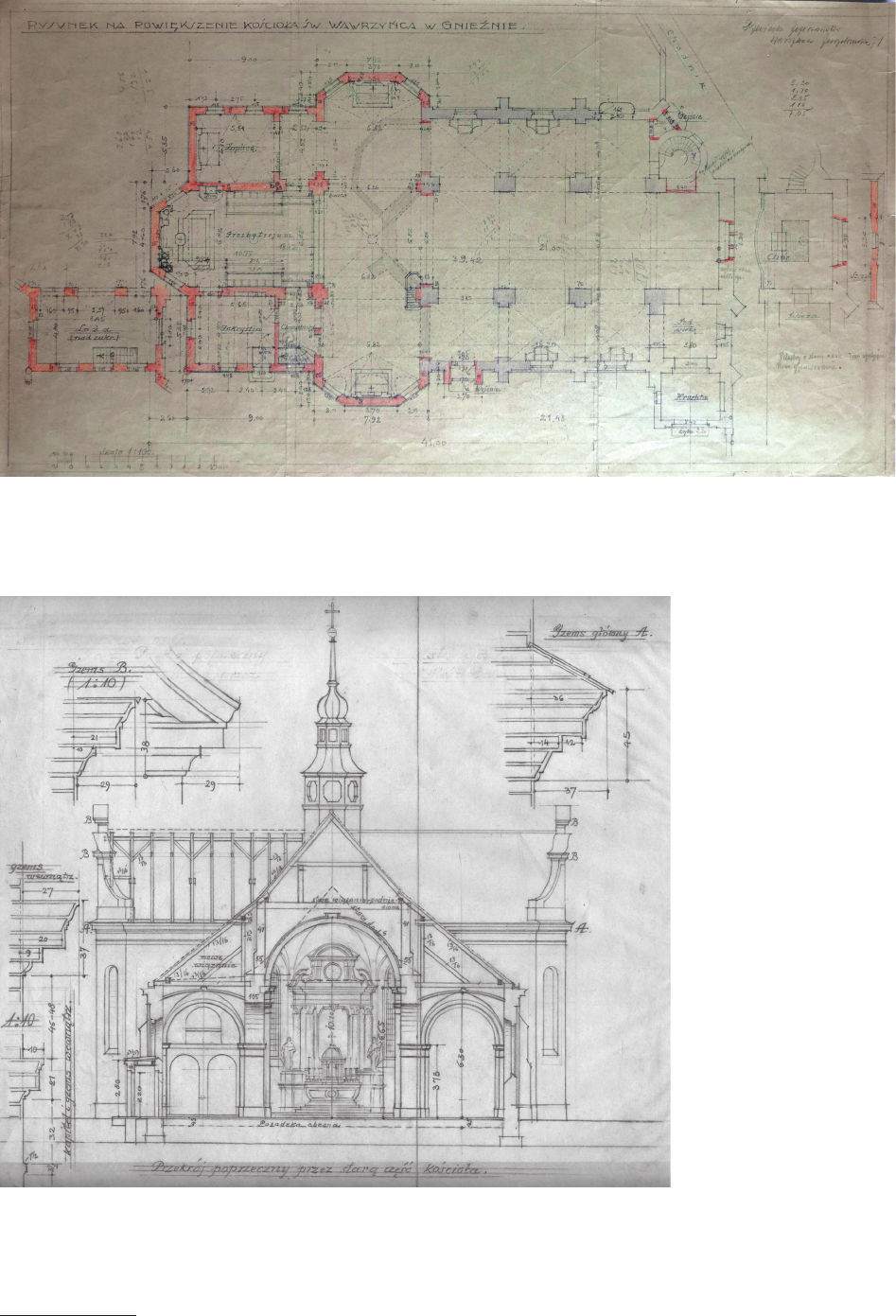
that was ultimately implemented (Figs. 4, 5) was created
a decade later. Correspondence concerning the details of the
project dates back to 1935. In March, the architect provided
the parish with a complete set of cost estimates for masonry,
carpentry, roong and tinsmithing works, as well as a list of
timber and other materials. The design plans were approved
by the provincial authorities in May 1935
12
. An unrealised
detailed design to raise the tower and change its spire to
a Baroque style dates back to 1936. That same year, draw-
ings of the interior furnishings were created.
The project to enlarge St Lawrence’s Church involved
extending the oriented temple towards the east and add-
ing a transept, which increased the oor space from 290
to 580 m
2
and made it possible to accommodate 1,500
10
Piotr Michałowski’s collection includes dated design drawings
of altars and other furnishings from the churches mentioned above.
11
A more detailed discussion is presented in Tejszerska (2023).
12
Letters from L. Michałowski to the parish priest dated 25 March
1935 and 21 May 1935.
Fig. 4. Design for the extension of St Lawrence Church
in Gniezno (sketch), 1935
(source: private collection of P. Michałowski, photo by A. Tejszerska)
Il. 4. Projekt powiększenia kościoła pw. św. Wawrzyńca
w Gnieźnie (szkic), 1935
(źródło: zbiory prywatne P. Michałowskiego, fot. A. Tejszerska)
people
13
. The design also included interesting functional
solutions for the interior. During the extension, the eastern
wall of the chancel and the sacristy, added at the turn of
the 19
th
and 20
th
centuries, were demolished. A new chan-
cel was built, anked on both sides by the sacristy and the
chapel. A transept with three-sided gable ends was erected.
The oor in the old part of the church was raised, so were
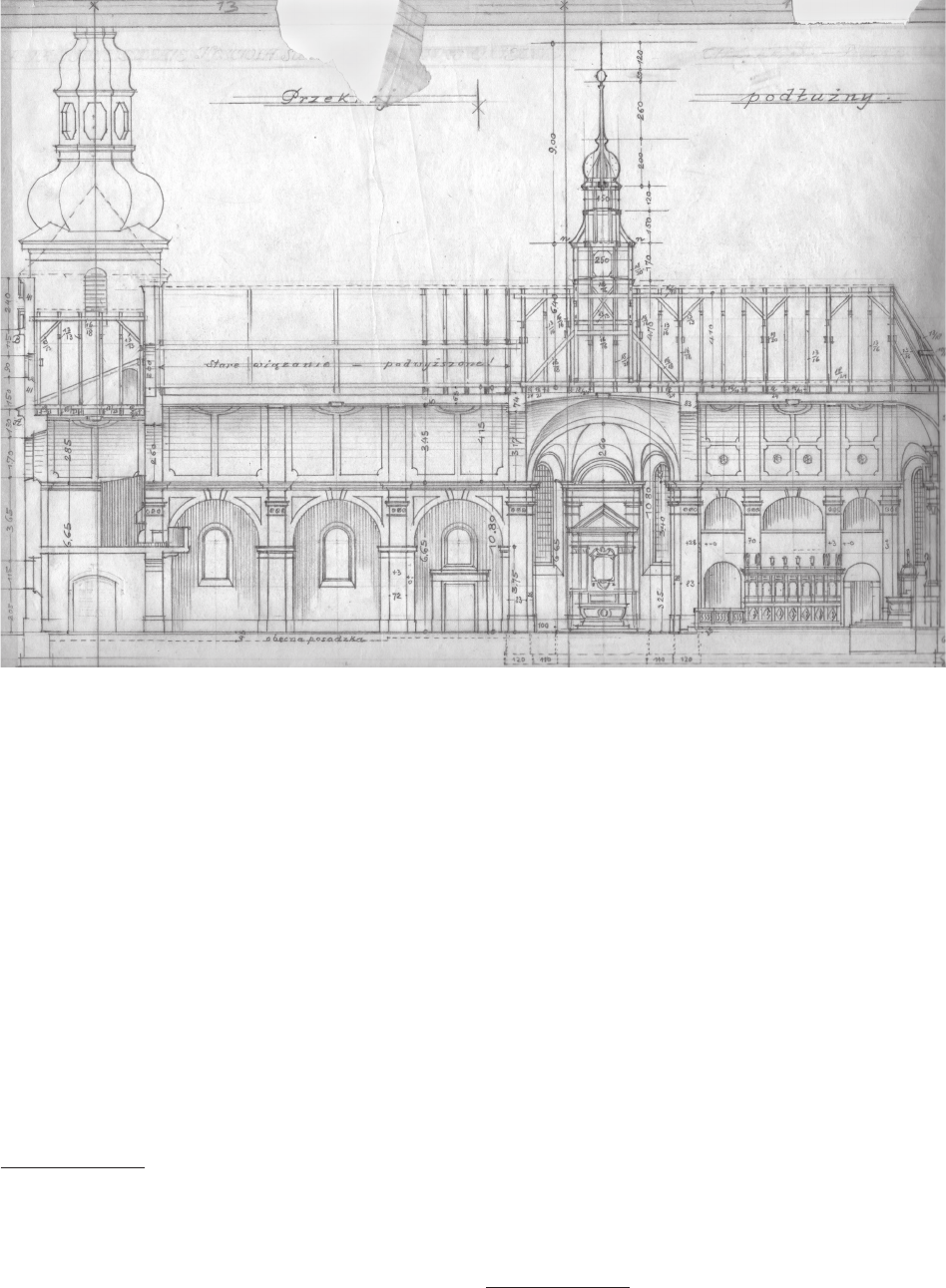
the walls of the nave (Fig. 6), and a barrel vault decorated with
a simple Neo-Renaissance metalwork motif based on a Ra bitz
mesh and a new raised roof were installed
14
(Fig. 7). A con-
siderably higher Neo-Baroque gable was added to the west-
ern façade, while a vestibule was built in front of the north -
ern side entrance
15
. A Mahra air heating system was used.
13
300 seats and 1,190 standing places. Information based on manu-
scripts entitled: Explanation of the design and Calculation of seats and
entrances.
14
A type of articial vault popular at the beginning of the 20
th
cen-
tury, based on a proled metal mesh suspended from the ceiling (for
further details see: Pająk 2009).
15
There are some doubts as to when the north-western porch, con-
sidered to be part of the extension from the turn of the 19
th
and 20
th
centuries or from 1936, was built. In the 1924 design, the main entrance
(under the tower) is not preceded by a porch. In the 1935 plans, however,
the porch appears as an existing element. Michałowski devoted an entire
design board (1935) to the shallow vestibule added to the side aisle in
front of the side entrance. If the porch had been his work, he would
certainly have done the same. It can therefore be assumed that either it
was indeed built at the end of the 19
th
century, even though it was not
included in the plans, and Michałowski, when creating the rst concept
42 Anna Tejszerska
Fig. 6. Design for the extension
of St Lawrence Church ain
Gniezno (section), 1935
(source: private collection
of P. Michałowski,
photo by A. Tejszerska)
Il. 6. Projekt powiększenia
kościoła pw. św. Wawrzyńca
w Gnieźnie (przekrój), 1935
(źródło: zbiory prywatne
P. Michałowskiego,
fot. A. Tejszerska)
In a letter dated 26 August 1936, Father Józef Chilomer
(1885–1942; parish priest of St Lawrence’s Parish from
of the transformations, based his work on an incorrect, unveried oor
plan, or it was built between 1924 and 1936.
1923 to 1942) informed the architect that the extended
church had been inspected by the building police, mention-
ing at the same time that […] it looks wonderful, everyone is
delighted, and the Bishop said that we will have a beautiful
and homely church.
Fig. 5. Design for the extension of St Lawrence Church in Gniezno (plan), 1935 (source: private collection of P. Michałowski, photo by A. Tejszerska)
Il. 5. Projekt powiększenia kościoła pw. św. Wawrzyńca w Gnieźnie (rzut), 1935 (źródło: zbiory prywatne P. Michałowskiego, fot. A. Tejszerska)
Gothic St Lawrence Church in Gniezno and its interwar expansion 43
Architectural form
The expanded church of Gothic origin, signicantly
chang ed its architectural shape. Preserved relics include the
unplastered brick tower and the lower part of the façade with
bricked-up window recesses
16
. Above them, in the raised
wall of the façade, at the level of the former gable, a large
thermal window was installed, letting [as the author wrote in
the project description] a beam of light into the main nave
of the church. A signicant trace of the past visible from the
street are two buttresses located in the corner of the tower
and in the north-western corner of the nave
17
.
16
Before Michałowski’s renovation, the side openings were glazed,
while the central one – a narrower recess, partially walled up – served
as
a niche for the statue of St Lawrence.
17
Absence of the south-western buttress. In the drawings from 1924,
the western elevation is anked on both sides by corner Gothic buttress-
es. In the 1935 design, however, the southern buttress does not appear on
any of the sheets, including the site plan, where the other buttresses are
clearly marked. It is possible that in developing the 1924 concept, Mi-
chałowski relied on unveried plans from 1894, on which both buttresses
are indicated. On one copy of the 1894 design the southern buttress is
crossed out by hand (Fig. 3). A plausible, though undocumented, hypoth-
esis is that it was dismantled during the alterations initiated in 1896, as
its position conicted with the tower added at that time. It is unlikely that
Fig. 7. Design for the extension of St Lawrence Church in Gniezno (longitudinal section), 1935
(source: private collection of P. Michałowski, photo by A. Tejszerska)
Il. 7. Projekt powiększenia kościoła pw. św. Wawrzyńca w Gnieźnie (przekrój podłużny), 1935
(źródło: zbiory prywatne P. Michałowskiego, fot. A. Tejszerska)
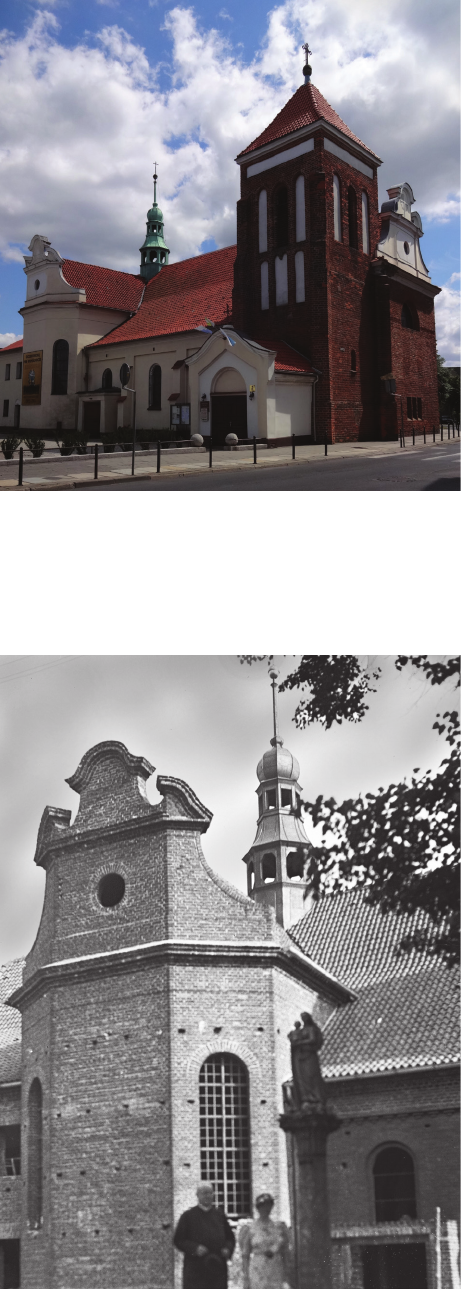
Unplastered elements of the object reveal Polish (Gothic)
bond. In accordance with Michałowski’s recommendation,
the rest of the church’s external walls, constructed as part
of the last two expansions, was plastered (Fig. 8)
18
. The ex-
tensions were given a modernised Baroque outline, typical
of the nal phase in the formation of the Polish “National
Style”. In the local context of the Gniezno citiscape, this
measure aligned the church with a whole series of sacred
structures rooted in the Middle Ages and more or less clad
in a Baroque style. Raising of the nave gave the interi-
or a sense of spaciousness and, in its external perception,
a sense of monumentality. A new Neo-Baroque gable of the
façade served as a compositional link between the historical
and extended parts thus ensuring a sense of cohesion with
the form given to the gable walls of the transept (Fig. 9).
Concern for the compositional unity of the extended objects
is a distinctive trait of Michałowski’s projects.
such work would have been carried out during the 1936 remodeling of
the western façade without being recorded on any of the plans.
18
A drawing of the church made in the 1840s by Kajetan W. Kieli-
siński, accompanied by a brief description of the materials, indicates that
until the church’s enlargement the entire façade, the tower, and the but-
tresses remained in brick, while the side walls were plastered (Pasiciel
1989, 166, 167, g. 137, 138).
44 Anna Tejszerska
The harmonious integration between the newly added
and the existing parts of the building was also one of the key
general requirements in the enlargement of churches. In his
l
ecture dedicated to the extension of historical churches,
Stefan Cybichowski, while warning against striving for
stylistic homogeneity, stressed that […] the main empha-
sis should be placed on ensuring complete harmony and
balance between the old structure and the newly added one
(Cybichowski 1928, 21). Michałowski likewise endeav-
oured to keep this balance in the 1924 project, maintained
largely in the medieval spirit, with minor Neo-Baroque ad-
ditions (the gable and the ridge turret).
Attention to compositional unity also inuenced the
de cision to raise the tower in the 1935 design. During the
works on both versions of the project (1924 i 1935), Mi-
chałowski approached it with particular attentiveness stem-
ming from the recognition of the tower’s historical signif-
icance. In the letter dated 4 November 1924, he wrote: In
sketching, constant attention had to be paid to the tower,
ensuring that it did not come into direct contact with the
tall roof of the nave or its gable, as it would otherwise lose
its prominence. In the Explanatory Note to the 1924 design
he likewise emphasized: The walls of the present church re-
main untouched. […] The ridge of the main roof is kept at
the same height as the cornice of the old tower, which is to
be preserved unchanged […]. Beside the tower, on the street
side, a new gable considerably higher than the existing one
[…] yet not so high as to diminish the tower’s signicance
and proportions.
In his concept of 1935, Michałowski decided to raise the
tower and crown it with a Neo-Baroque dome stylistically
integrated with the new gables of the façade and the tran-
sept. Its elevation to a height of 36 m, through the raising
of the belfry storey, was intended to prevent a disruption
of the proportions between it and the heightened nave, and
appeared – as stated in the letter from 27 February 1935
– necessary to harmonize the whole project. The alteration
of the tower, however, was never carried out.
Such an interference with the medieval structure hardly
accords with contemporary conservation principles, yet for
centuries historical buildings were altered to suit the needs
and tastes of their users (Misiorowski 2001, 272). The inter-
war period, by contrast, was a time of gradual abandonment
of Eugène Viollet-le-Duc’s purist ideas, of ongoing doctrinal
disputes among conservators, and of a shift toward a non-re-
strictive, individualized approach to monuments – particu-
larly those that continued to serve their intended function.
The contemporary position of conservation science,
[as Stanisław Tomkowicz argued], may be summed up in
a short phrase: the principal rule is – as few theoretical,
absolute rules of procedure as possible […] in practice,
everything depends on prudence, sound judgment, and
compromises (1912, 22, 23). No principle can be applied
absolutely in the practice of human works; if anything, the
restoration of historic buildings, with their centuries-long
histories and still in active use today, must consist of a hun-
dred compromises (Tomkowicz 1901, 59). Adolf Szysz ko-
Bohusz, in turn, asserted that every building must above all
correspond to its practical purpose; and if it is to continue
fullling that purpose – if it is not to become a mere mu-
Fig. 9. St Lawrence Church in Gniezno, north transept gable wall,
in the photograph: Father Chilomer and the architect’s wife
(source: private collection of P. Michałowski, photo by L. Michałowski)
Il. 9. Kościół pw. św. Wawrzyńca, ściana szczytowa transeptu
północnego, na fotografii ks. Chilomer i żona architekta
(źródło: zbiory prywatne P. Michałowskiego, fot. L. Michałowski)
Fig. 8. St Lawrence Church in Gniezno, north-west view
(photo by A. Tejszerska, 2024)
Il. 8. Kościół pw. św. Wawrzyńca w Gnieźnie,
widok od strony północno-zachodniej (fot. A. Tejszerska, 2024)

Gothic St Lawrence Church in Gniezno and its interwar expansion 45
seum relic – it must, in many cases, undergo successive
alterations, extensions, and additions (1912/1913, 6). In
the case of enlargement […], of utility buildings requir-
ing expansion, the modern additions should be executed in
such a way as to harmonize artistically with the old struc-
ture – yet without obscuring the distinction between the
new and the old (Muczkowski 1912, 21).
The above instructions were implemented in many proj-
ects. In a broad survey of interwar undertakings, Paweł
Dettlo observed that, indeed, one of the most common
solutions employed in the enlargement of historic church-
es was to stylistically dierentiate the new parts from the
old (2006, 372). For Gothic churches, it was nearly standard
practice to design the extensions in a Baroque idiom (eg.
Kazanice, Jeżewo, Wojnicz). Dettlo also emphasizes that
the choice of architectural style may have been inuenced
by the widespread perception of Baroque as a “Polish”
style, particularly in the territories of the former Prussian
partition (Dettlo 2006, 374). The expansion of St Law-
rence’s Church in Gniezno thus ts into a broader formal
and ideological context
19
.
Michałowski valued the historical signicance of the
monument and submitted his design proposals for consul-
tation with the appropriate conservation authorities. After
preparing the full set of design drawings, in a letter of 10
December 1924 he informed the parish priest of Gniezno:
[…] Yesterday I conferred with the Provincial Conserva-
tor, Dr Pajzderski
20
; he has no objections and accepts the
project, with only one request – that the main entrance to
the tower be simplied. With regard to the planned raising
of the tower, a year before the detailed design was drawn
up – on 27 February 1935 – the architect wrote: […] the
inclusion [of the tower superstructure] is now necessary in
order to secure the conservator’s approval. In the available
sources, there is no information as to why the project to
raise the tower was abandoned. Perhaps the general objec-
tive of conservation was given precedence over the idea
of stylistic coherence and compositional proportionality,
in order to […] preserve monuments in a state as little al-
tered as possible, in the most authentic condition
21
(Tom-
kowicz 1912, 23). Perhaps to Gniezno came the echoes of
the debate that arose around the words of Father Zygmunt
Baranowski […] For historical reasons, one may preserve
a mixture of styles; yet in the name of what slogans are
Baroque additions imposed today upon Gothic churches?
Is it only the Baroque that is granted the right to exist in
our country? Is pure Gothic truly so intolerable that it
must be curtailed and supplemented with Baroque forms?
(1930, 6). It is also possible that other, e.g., nancial, rea-
sons led to the abandonment of the project. Later dating of
the detailed project of the tower and its spire (1936) and
the omission of the works associated with it from the cost
estimate from 1935 indicate that these plans were supposed
19
It is worth mentioning here that its “baroquication” (introduced in
the form of a new gable) began before the extension in the 1930s (cf. fn. 7).
20
Nikodem Pajzderski (1882–1940) heritage conservator of the
Poznań (from 1919) and Pomerania (from 1923) voivodships.
21
Although, as Ewa Łużyniecka (2013, 43) observes, the unambig-
uous denition of authenticity remains problematic to this day.
to be carried out at a later stage. Given that Michałowski
intended to consult with the conservation ocer regarding
the project with the preliminarily sketched elevated tower
in 1935, and developed detailed solutions toward the end
of 1936, it is dicult to imagine that he did not receive
the conservator’s approval. Moreover, all the boards of the
project approved by the regional authorities in 1935, fea-
turing the tower (view, cross-section, elevations), present
it in its elevated form. It is, therefore, plausible that it was
precisely economic reasons that prevented the project from
being carried out before the outbreak of the World War II
22
.
Michałowski approached church design in a comprehen-
sive manner. That is, apart from the architectural cencept,
he prepared drawings of multiple elements of the church
furnishing. The letter of 25 November 1937 concerning,
nota bene, the request for the payment of the architect’s fee,
contains an enumeration of all the design works he executed
for the parish. Besides the projects of the church expansion
and the unrealized elevation of the tower the works also in-
cluded: altar in the upper chapel, the main altar, altar for the
Chapel of the Sacred Heart of Jesus, side altar in the tran-
sept, confessional, choir stalls, galleries, throne, the sacristy
doorframe, and pews. Furthermore, the rectory, designed in
the manor-house style, along with the garden, and the fence
surrounding the church and the square.
A considerate number of the objects mentioned above
was produced before the war, albeit not in the full scope.
Currently, a hundred years after the rst version of the proj-
ect was created, Michałowski’s plans are being implement-
ed as part of the renovation of the church.
An unusually interesting functional solution proposed
by Michałowski was the creation of a baptismal chapel lo-
cated in the corner between the chancel and the left side-
nave, linked to both of the aforementioned spaces by open
arcades. During the service, the priest could approach the
baptismal font directly from the chancel, while the candi-
dates for baptism would come up from the nave. Presently
the arcades are bricked up and the space intended for the un-
realized chapel is taken up by a utility room (Fig. 10). Plans
have been drawn up to open the arcades and implement Mi-
chałowski’s concept.
Another unconventional solution proposed by Micha-
łow ski was the arrangement of the area above the baptys-
mal chapel. It was designed as a gallery, open through ar-
cades to the presbytery and the nave, intended to function
as an additional chapel. A two-sided altar was designed for
it, facing the nave on one side and the chapel’s interior on
the other. The altar was created and placed in the previosuly
designated location. The architectural detail, however, was
not executed – namely the metal balustrade securing the
arcades of the gallery, nor the balustrade along the stairs
leading to the chapel, whose course, moreover, was giv-
en a slightly dierent alignment than that foreseen in the
design. At present, the elements of architectural detail are
to be carried out in accordance with the design based on
Michałowski’s concept. It is also planned to complete the
22
A few years earlier – in 1930 – Michałowski developed a design
for adding a Neo-Baroque tower to the Gothic body of the church in
Kłecko, and this concept was realized.
46 Anna Tejszerska
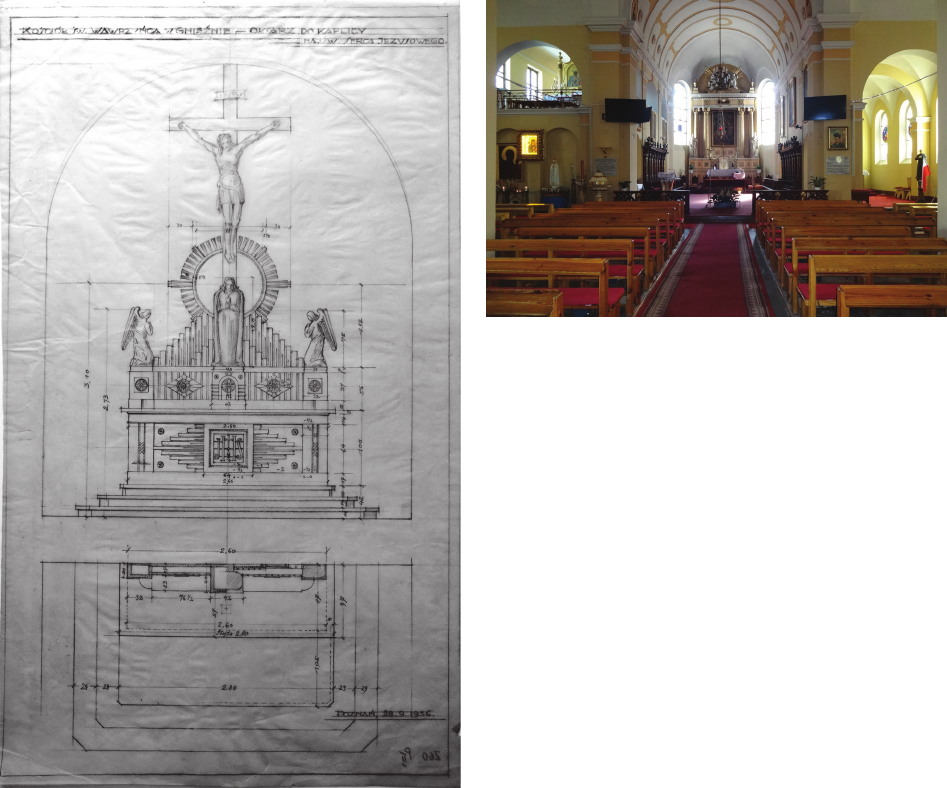
partially executed altar in the Chapel of the Sacred Heart of
Jesus (Fig. 11). As part of the renovation, the original co-
lour scheme of the walls is also to be restored. In the church
interior, exploratory stratigraphic probes – point-based and,
in some areas, strip-based – were conducted to determine
the original painted decoration.
Fig. 11. St Lawrence Church in Gniezno, interior, current state
(photo by A. Tejszerska, 2024)
Il. 11. Kościół pw. św. Wawrzyńca, wnętrze, stan obecny
(fot. A. Tejszerska, 2024)
Acknowledgements
The author wishes to express her sincere gratitude to Piotr Michałow-
ski – architect Lucjan Michałowski’s grandson – for kindly providing the
materials and all the information that greatly supported this research;
to Bartłomiej Klepiński, the architect of the church restoration project;
to Dariusz Pustelnik, the architect overseeing the implementation of the
project and coordinating the restoration works; and to Father Franciszek
Jabłoński, parish priest of St Lawrence Church for their generous assis
-
tance and support.
The research was carried out at the Bialystok University of Technolo-
gy as part of research project No. WZ/WA-IA/2/2023 nanced by a grant
from the Minister of Education and Science.
Fig. 10. Design for the Altar of the Sacred Heart of Jesus, 1936
(source: private collection of P. Michałowski,
photo by A. Tejszerska)
Il. 10. Projekt ołtarza Najświętszego Serca Pana Jezusa, 1936
(źródło: zbiory prywatne P. Michałowskiego,
fot. A. Tejszerska)
Conclusion
Comparative studies and analyses of archival documents
conducted within the research helped to substantially recon-
struct the history of transformations of the Gniezno church.
Nevertheless, some research gaps and unanswered questions
still remain. The study of the architect’s writings, mainly
his letters and explanatory notes to the project, allowed for
an understanding of the Michałowski’s fundamental idea,
which, following the advice of contemporary theorists, was
aimed at attaining compositional unity in the extension of
the temple. The Neo-Baroque form of the additions, typi-
cal of the author’s projects and harmonized with the slightly
transformed historic part, became a characteristic element of
Gniezno’s cultural landscape. Moreover, it also bears wit-
ness to methods of dealing with the historic structure. Be-
sides providing the expected functional space, the church’s
extension supervised by Michałowski added monumentality
to the body of the temple and shaped its contemporary char-
acter, typical for the interwar-period churches erected in the
so-called “national style”. The ongoing attempt to realize the
unnished elements of the project, if successfully complet-
ed, will make it possible to fully achieve the visual and func-
tional integrity of the interior as originally intended by the
architect. The realization of the nal stage of reconstruction
envisaged by Michałowski, namely the raising of the tower,
is impossible under the present conservation doctrine, which
diverges from that applied in the interwar period.
Translated by
Katarzyna Bednarska-Adamowicz
Gothic St Lawrence Church in Gniezno and its interwar expansion 47
Streszczenie
Gotycki kościół pw. św. Wawrzyńca w Gnieźnie
– międzywojenna rozbudowa według planów Lucjana Michałowskiego i współczesna kontynuacja realizacji projektu
Artykuł poświęcony jest historii przekształceń gotyckiego kościoła pw. św. Wawrzyńca w Gnieźnie, ze szczególnym uwzględnieniem rozbudowy
realizowanej w latach 30. XX w. według projektu poznańskiego architekta Lucjana Michałowskiego (1883–1943). Badania prowadzone były w opar-
ciu o historyczne opracowania, archiwalną dokumentację dwu wersji projektu z 1924 i 1935 r., kosztorysy, objaśnienia do projektu i związaną z nim
korespondencję. W celu odtworzenia stanu sprzed rozbudowy przeanalizowano opracowania historyczne, plansze prezentujące wcześniejszą koncepcję
powiększenia świątyni realizowaną na przełomie XIX i XX w. oraz materiał fotograczny z tamtego okresu. Wykorzystano także udostępnioną autorce
dokumentację prowadzonej obecnie renowacji kościoła, w której ramach kontynuowana jest realizacja niewykonanych przed wojną elementów projek-
tu Michałowskiego w zakresie aranżacji wnętrza. W celu werykacji, które elementy kompleksowego projektu, obejmującego również wyposażenie
kościoła, zostały zrealizowane, przeprowadzono wizję in situ. W artykule zaprezentowano też fragmenty pism wyjaśniające idee przyświecające archi-
tektowi podczas tworzenia koncepcji. Tytułową realizację przedstawiono na tle współczesnych jej dyskusji dotyczących konserwacji i przekształceń
obiektów zabytkowych.
Słowa kluczowe: Lucjan Michałowski, architektura międzywojenna, rozbudowa kościoła, Gniezno, kościół św. Wawrzyńca
References
Baranowski, Zygmunt. “Róża do kożucha czyli barok do gotyku.” Wia-
domości dla Duchowieństwa, no. 1 (1930): 4–9.
Cybichowski, Stefan. “Konserwacja zabytków kościelnych oraz przebu-
dowa i budowa kościołów. Cz. 2.” Orędownik Kościelny dla Die-
cezji Chełmińskiej, no. 2 (1928): 20–3.
Dettlo, Paweł. Odbudowa i restauracja zabytków architektury w Pol-
sce w latach 1918–1930. Teoria i praktyka. Towarzystwo Autorów
i Wydawców Prac Naukowych “Universitas”, 2006.
Elenchus Omnium Ecclesiarum et Universi Cleri Archidioecesis Gnesn-
ensis pro Anno Domini 1893. J.B. Lange, 1892.
Elenchus Omnium Ecclesiarum et Universi Cleri Archidioecesium Gnes-
nen sis et Posnaniensis pro Anno Domini 1924. Zjednoczenie Mło-
dzieży Polskiej, 1924.
[Galewski, Józef]. Ilustrowany przewodnik po Gnieźnie i okolicy. Księ-
garnia W. Lebiedzińskiej, 1929.
Jabłoński, Krzysztof Antoni. Budownictwo kościelne 1795–1939 na
terenie archidiecezji białostockiej. Wydawnictwo Politechniki Bia-
łostockiej, 2002.
Kohte, Julius. Verzeichnis der Kunstdenkmaler der Provinz Posen IV.
Verlag von Julius Springer, 1897.
Korytkowski, Joanne [Jan]. Brevis descriptio historico-geographica eccle-
siarum archidioecesis Gnesnensis et Posnaniensis. J.B. Lange, 1888.
Kozierowski, Stanisław D. Szematyzm historyczny ustrojów parafjal-
nych dzisiejszej archidiecezji gnieźnieńskiej. [self-published], 1934.
Kumor, Bolesław. Ustrój i organizacja Kościoła polskiego w okresie nie-
woli narodowej 1772–1918. Polskie Towarzystwo Teologiczne, 1980.
de Lasco, Joannis. Liber beneciorum. Edited by J. Korytkowski. Vol. 1.
J.B. Lange, 1880.
Łużyniecka, Ewa. “Autentyzm a XIX-wieczna odbudowa katedry w An -
goulême.” Architectus 36, no. 4 (2013): 43–51. https://doi.org/ 10.5277/
arc130404.
Maluśkiewicz, Piotr. Gotyckie kościoły w Wielkopolsce. Wydawnictwo
Wo
jewódzkiej Biblioteki Publicznej i Centrum Animacji Kultury,
2008.
Misiorowski, Andrzej. “Kontynuacja – aspekt oceny prawidłowości za-
mierzeń architektonicznych w zabytkowych układach przestrzen-
nych.” Ochrona Zabytków, no. 3 (2001): 272–75.
Muczkowski, Józef. “Stan dzisiejszy nauki o konserwacyi zabytków.”
In Pamiętnik Pierwszego Zjazdu Miłośników Ojczystych Zabytków
w Krakowie w dniach 3 i 4 lipca 1911 roku. Grono Konserwatorów
Galicyi Zachodniej, 1912.
Muraszko, Michał. “Początki kościoła pod wezwaniem Krzyża Świętego
w Gnieźnie.” Studia Europaea Gnesnensia, no. 6 (2012): 231–39.
Muraszko, Michał. “Początki kościoła pod wezwaniem św. Wawrzyńca
w Gnieźnie.” Nasza Przeszłość. Studia z dziejów Kościoła i kultury
ka tolickiej w Polsce 120 (2013): 25–30.
Pająk, Zbigniew. “Stan zachowania sklepień ‘Rabitza’ w wybranych obiek -
tach zabytkowych.” Wiadomości Konserwatorskie, no. 26 (2009):
574–83.
Pasiciel, Stanisław. Gniezno: widoki miasta 1505–1939. PWN, 1989.
Rocznik Archidiecezyj Gnieźnieńskiej i Poznańskiej 1929. Kancelaria
Pry masa Polski, 1929.
Ruszczyńska, Teresa, Aniela Sławska, ed. Katalog zabytków sztuki w Pols-
ce. T. 5: Województwo poznańskie. Z. 3: Powiat gnieźnieński. In sty tut
Sztuki PAN, 1963.
Skwierczyński, Krzysztof. “Custodia civitatis. Sakralny system ochro-
ny miasta w Polsce wcześniejszego średniowiecza na przykładzie
siedzib biskupich.” Kwartalnik Historyczny 103, nr 3 (1996): 3–51.
Stefański, Krzysztof. Polska architektura sakralna w poszukiwaniu stylu
narodowego. Wydawnictwo Politechniki Łódzkiej, 2000.
Szyszko-Bohusz, Adolf. “Stosunek sztuki nowoczesnej do konserwacyi
zabytków.” Rocznik Architektoniczny. Prace uczni prof. Szyszko-Bo-
husza w szkole politechnicznej lwowskiej, no. 1 (1912/1913): 5–12.
Tejszerska, Anna. Styl narodowy w architekturze sakralnej Polski Odro-
dzonej (1918–1939). Wydawnictwo KUL, 2019.
Tejszerska, Anna. “Remodeling of the Church in Domachowo to the De-
sign of Lucjan Michałowski as an Example of Interwar-Period Con-
servation Measures.” Wiadomości Konserwatorskie, nr 74 (2023):
36–50. https://doi.org/10.48234/WK74REMODELING.
Tomala, Janusz. Murowana architektura romańska i gotycka w Wielko-
polsce. T. 1: Architektura sakralna. Wydawnictwo Edytor Sławomir
Woźniak, 2007.
Tomkowicz, Stanisław. Katedra na Wawelu i jej obecna restauracya.
Spółka Wydawnicza Polska, 1901.
Tomkowicz, Stanisław. “Stosunek muzeów sztuki do konserwacyi za-
bytków.” In Pamiętnik Pierwszego Zjazdu Miłośników Ojczystych
Za bytków w Krakowie w dniach 3 i 4 lipca 1911 roku. Grono Kon-
ser watorów Galicyi Zachodniej, 1912.