
Hilversum is a town with a population of 85 thousand
people and now it is the 35
th
biggest town in Holland. It is
located circa 30 kilometres south-east of Amsterdam with
which it has connections by railway, road and canal net-
work. Historic origins of the town date back to the Bronze
(UDDVWKH¿UVWGRFXPHQWHGWUDFHVRIFXOWXUHÀRXULVKLQJLQ
these areas come from that period. Its further development
was connected with gaining the independence status in
PHGLDHYDOWLPHVLQ7KH¿UVWSHULRGRIWXUEXOHQWGH-
velopment of the city took place in the 17
th
century when
thanks to a network of canal connections with Amsterdam
textile industry expanded there. The city owes its another
period of development to the expansion of railways in the
19
th
century when rich people from Amsterdam started to
settle down in villas surrounded by woods, thus forming
the city’s present character and its spatial shape.
At present Hilversum is mainly known as the Dutch
capital of the radio and TV industry. It became the location
of seats, studios and archives of several stations, national
and commercial ones, what is worth emphasising, in a way
that does not interfere with the identity of the town and its
special villa character. It was made possible due to situat-
ing the buildings connected with radio and TV technology
in a park area in the northern part of the city. The build-
ings erected with respecting the existing townscape were
EOHQGHGLQ ZLWK QDWXUDO WRSRJUDSK\DQG ÀRUD RI WKHWHU-
rain. Thanks to the size limitations and the respect towards
the environment so characteristic of Dutch architecture as
well as the use of sustainable solutions in designing, even
the large-sized structures were successfully given the char-
acter referring to the 19
th
-century city tissue.
Patrycja Haupt*
Hilversum – green interior of the media
City of the media
*
Faculty of Architecture, Cracow University of Technology.
Pop culture and sustainable designing
Buildings situated in the area of the Media Park as a
comprehensive complex have become a part of the pan-
orama of city which surrounds it. Nevertheless, each of
them retains its own unique character which is visible in
the structural shape, façade design as well as the way of in-
teracting with the surroundings, according to James Wines
who once said: ‘potential variations of green architecture
DUH LQ¿QLWH >@¶> S @(DFK EXLOGLQJ FRQVWLWXWHV DQ
individual response of a designer to the problem of com-
bining features characteristic of the media stylistics of the
pop culture era in one structure with simultaneous atten-
tion to harmony with surroundings that is typical of con-
temporary trends of sustainable designing. Architecture
created in accordance with such assumptions is an attempt
to form a spatial sign – icon for a company represented
in this way with simultaneous blending with the terrain,
thus co-creating the townscape of contemporary Hilver-
sum. Relations with the surroundings are explicitly visible
in each of the park buildings; nonetheless, it is interpreted
LQDVSHFL¿FPDQQHUFKDUDFWHULVWLFRIDJLYHQVWUXFWXUHDQG
its designer. The relation architecture – nature is realised
through blending the building in with the terrain topogra-
phy, using the roof panels as a continuation of the public
space, transparency and permeating with the surroundings
as well as introducing elements of nature into interiors
– internal gardens.
2012
No. 2(32)
DOI: 10.5277/arc120213
82 Patrycja Haupt
The building of RVU
1
VWDWLRQZDVRQHRIWKH¿UVWZKLFK
was constructed during the extension of the Media Park.
The structure, which was realised in the years 1994–1997,
became a reference to the subsequent realisations in this
DUHD>@7KHSODFHVHOHFWHGIRUWKHFRQVWUXFWLRQRIWKHVHDW
of RVU station, according to the original land-use planning
document, was intended to be an undeveloped ecological
corridor introduced between two intensively urbanised
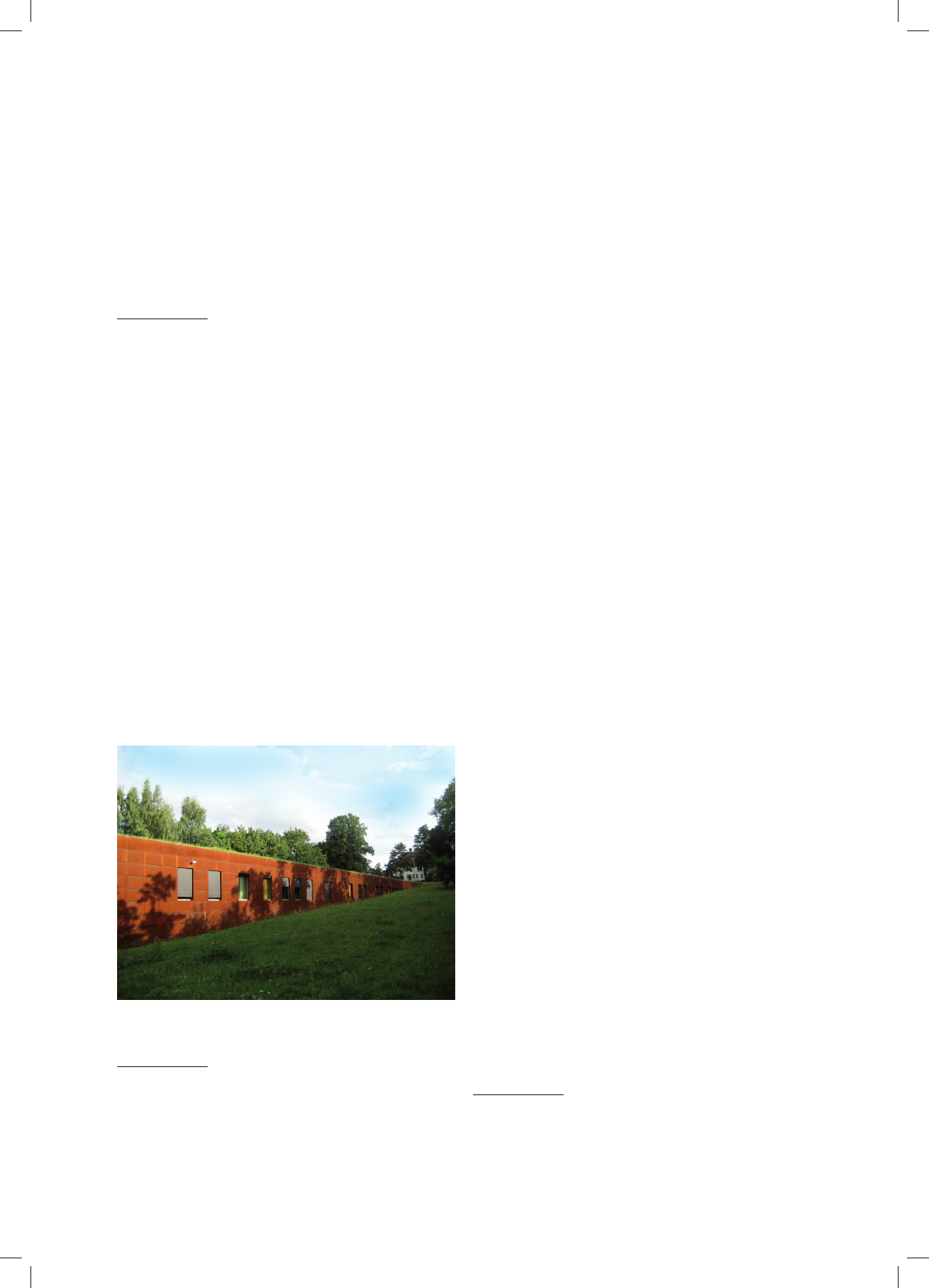
districts of Hilversum. However, the authors of the design
– architects from MVRDV group – presented their vision
of a building blended in with the natural inclination of
the terrain, combined with the landscape and introducing
nature into the urban tissue. In this way, the assumptions
RIWKHSODQZHUHVDWLV¿HGE\WKHXQLTXHFKDUDFWHURIWKH
green roof covering the entire area of the building. At the
same time, this area constitutes a continuation of the pub-
lic space and serves as a viewing point for the area of the
Media Park and from the side of the street it does not re-
veal the cubature hidden underneath. From the side of the
green areas, the existence of the building is disclosed by
the façade which was suspended above the ground on the
network of slender steel posts. This arrangement makes
the building look ‘wrapped up’ by the green area from un-
derneath, from above and from side façades and thus it
seems to be penetrated by the surroundings (Fig. 1).
)LJ598VWDWLRQJUXRS095'9+LOYHUVXP±6RXUFH>@
,O6LHG]LEDUDGLD598095'9+LOYHUVXP±ħUyGáR>@
Blending with the terrain
2
VPRO – Vrijzinnig Protestantse Radio Omroep (Liberal Protestant
Radio Station) – started its activities in Holland in 1926 as a religious
radio. In the 1950s and 1960s the religious character of this station was
changed into a secular, social and liberal character and the station began
to broadcast television programmes. At present its programmes are con-
sidered to be mostly connected with culture. Similarly to all the public
media in Holland, it has no permanent channel.
,QWHUPLQJOLQJWUDQVSDUHQF\UHÀHFWLRQ
The principle of architecture intermingling with the
landscape – or permeating the landscape – was also used
in the project of another building designed in Hilversum by
the MVRDV group – Villa VPRO
2
IURP>@$ORQJ
with the seat of RVU station, this building constitutes a
W\SHRIDVSHFL¿FJDWHWRWKHSDUN7KLVWLPHWKHVWUXFWXUH
was composed of several combined forms which, similarly
to the historical development of this district, were situated
among the green areas. The effect of permeating with the
landscape was achieved due to the employment of trans-
parent, glassed façades. Surrounding nature permeates in-
side, can be observed from there and it constitutes a back-
ground for the transparent building. The building, similarly
to RVU, blends with the terrain using its natural land form.
Slabs of ferroconcrete ceilings that cut into the building on
various heights crossing the façades constitute multi-layer
connections with levels of its grassy foundation. The solu-
WLRQWKDWZDVXVHGKHUHFRQVLVWHGLQWKHHIIHFWRIÀRDWLQJ
above the ground, as it was in the case of the RVU seat ar-
rangement. However, here it was realized by curving and
HOHYDWLQJWKHFHLOLQJRIWKHVHFRQGÀRRURYHUJURXQGWKXV
IUHHLQJWKH VSDFHEHWZHHQWKHÀRRUVRIWKHEXLOGLQJDQG
at the same time augmenting its lightness. This allowed
for making this part of the building completely translucent
E\SHUPLWWLQJWKHODQGVFDSHWRWRWDOO\¿OWHULQLWVLQWHULRUV
Also in this case the building was covered by a green roof,
which makes its volume blend in with the surroundings
and constitute their continuation (Fig. 3).
Another building of the Media Park is Beeld en Geluid
Instituut (the Netherlands’ Institute for Sound and Vision)
3
(Fig. 2, 3) designed by the studio Neutelings Riedijk Ar-
chitects in 2003. The buildings discussed above constituted
a continuation of the park as they were located at the meet-
ing point of the green areas and the exclusive historical
UHVLGHQWLDOGLVWULFW,WZDVUHÀHFWHGLQWKHLUVLPSOHIRUPLQ
harmony with the surroundings. The Institute, which is an
archive of the Dutch television achievements, was situated
in the corner of the development quarter on the outskirts
of the park. From the south it ends the line of halls of an
LQGXVWULDO FKDUDFWHU XVHG IRU ¿OP SURGXFWLRQ SXUSRVHV
1
RVU – Radio Volks Universiteit (Folk University Radio) – the old-
est Dutch radio station existing under this name in the years 1931–2010.
This station, established in 1930 by the Dutch Association of Folk Uni-
versities, was given a license in 1931 and in 1932 it was transformed into
a public media. In 1983 RVU also appeared on TV with some educational
programmes broadcast by station Nederland 2, and later Nederland 3.
Now, starting from 2010 RV is a part of NTR group (the name comes
IURP WKH ¿UVW OHWWHUVRI WKHEURDGFDVWHUV 1367HOHDF DQG 598 7KH
mission of RVU remains unchanged since its beginnings – broadcast-
ing informative and educational programmes as well as improving social
relations.
3
Beeld en Geluid Instituut (Netherland Institute for Sound and
Vision) – it is one of the biggest European audio-visual archives. The
building contains about 800 thousand hours of materials coming from the
Dutch radio and television programmes, which constitutes over 80% of
the national heritage in this domain.
Hilversum – green interior of the media 83
whereas from the east it borders on the main thoroughfare
leading to the central part of the town. Due to this loca-
tion the building – from the side of the park – has the fea-
tures which were observed earlier in the case of RVU and
VPRO stations such as transparency and blending with the
surroundings, whereas in the part which is closer to the
intensively urbanized zone the building has a totally dif-
ferent appearance. Its cubic form, namely, a cube which is
half-hidden in the terrain, is covered by three glass panels
on three sides with a colourful inscription. They consti-
WXWHHOHPHQWVRIDWZRFRDWFOLPDWLFIDoDGH>@WKHSXUSRVH
of which was to introduce a sustainable character into the
realisation. At the same time, this way of arranging the
façade contributed to the artistic expression of the building
which is associated with a colourful stylistics of the media
message. The wall situated on the side of green areas was
shaped differently. It was glazed and it opens to the frag-
ment of reconstructed natural landscape with a water res-
ervoir. Thanks to this solution, which is augmented due to
WKHJUDGXDOO\ORZHUHGÀRRURIWKHDXGLWRULXP]RQHQDWXUH
VHHPVWR¿OWHULQWKHEXLOGLQJKDOOWKXVFRQVWLWXWLQJDQHOH-
PHQWRILWVLQWHULRUVSDWLDOFRPSRVLWLRQ>@
Fig. 3. Institute for Sound and Vision, Neutelings Riedijk Architects,
Hilversum, 2003 (photo by P. Haupt, 2011)
Il. 3. Institute for Sound and Vision, Neutelings Riedijk Architects,
Hilversum, 2003 (fot. P. Haupt, 2011)
Fig. 4. Media Headquarters, Ector Hoogstad Architecten,
+LOYHUVXP6RXUFH>@
Il. 4. Media Headquarters, Ector Hoogstad Architecten,
+LOYHUVXPħUyGáR>@
Green interior of the media
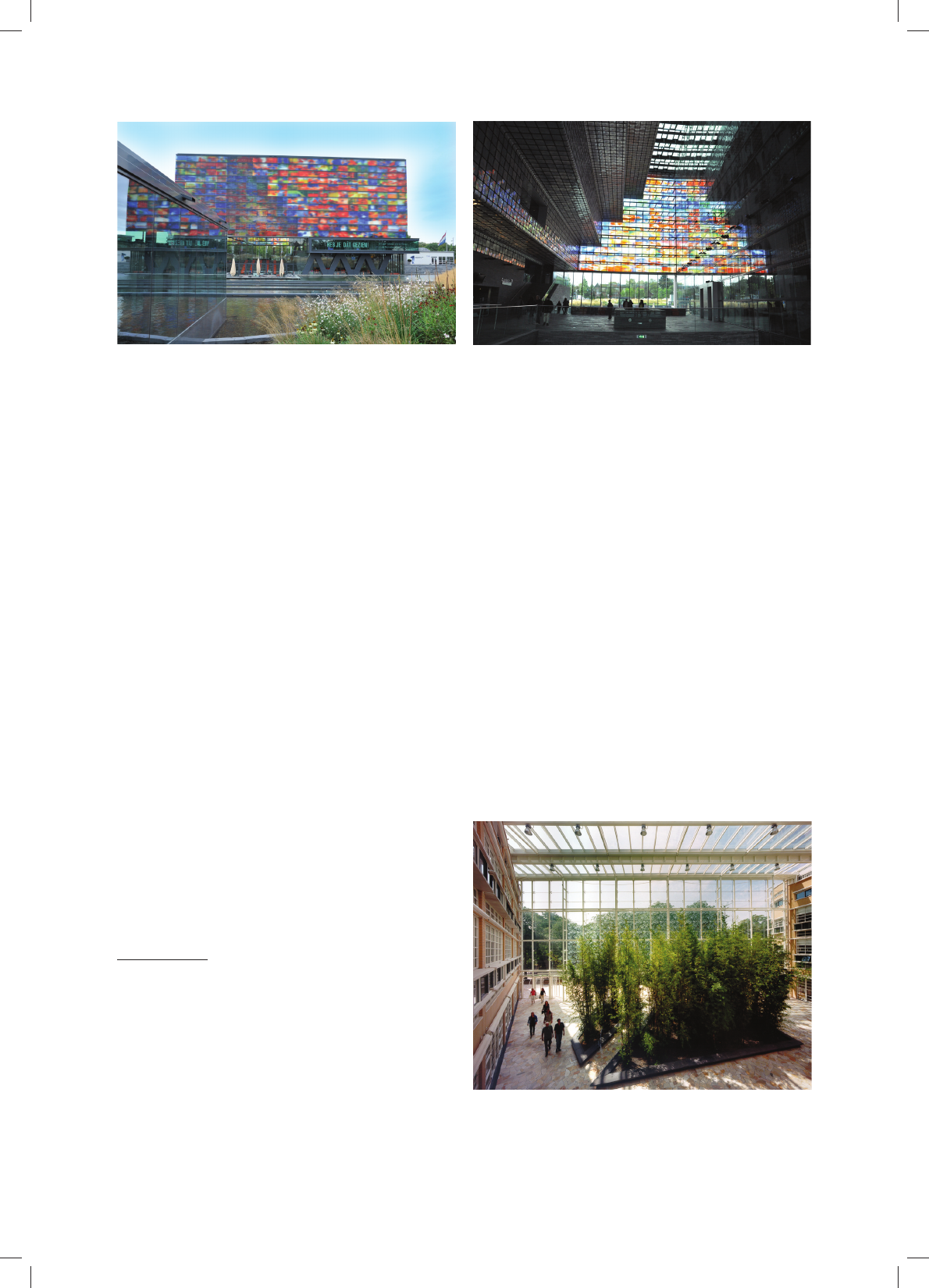
The building of Media Headquarters designed by team
Ector Hoogstad Architecten, as the previous ones, serves
the media – television stations AVRO
4
, KRO
5
and NCRV
6
being with harmony with the surroundings of Hilversum.
The building erected in 2000, according to its designer,
constitutes an attempt to blend in a large volume structure
ZLWKWKHVXEXUEDQSDUNDQGYLOOD]RQHRI+LOYHUVXP>@
About 35 thousand square metres of the building’s usable
area constitute a segmented four-storey structure divided
by inner courtyards. Each of them opens to the park area
by means of the glass façade and in this way the landscape
¿OWHUVLQVLGHWKHEXLOGLQJ$GGLWLRQDOO\HDFKDWULXPKDVLWV
own inner garden designed by the group of WEST 8 land-
VFDSHDUFKLWHFWV,QWKHJHRPHWULFDOFUDFNVRIWKHÀRRUKLJK
bamboo trees were planted with tunnel passages through
WKHP±FRV\VSRWVRIWKHLQWHULRURIWKHEXLOGLQJ¿OOHGZLWK
its users. They constitute a continuation of nature that per-
4
AVRO – Algemene Vereniging Radio Omroep (General Radio
Broadcasting Association) – public association of stations, mainly radio
stations. Within the framework of this organisation the Dutch stations
such as Radio 1, Radio 2, 3 FM and Radio 5 broadcast their programmes.
The association also deals with producing over 20 serial television pro-
grammes.
5
KRO – Katholieke Radio Omroep (Catholic Radio Station) – it is
a public station which started broadcasting on 23
rd
April 1925. At pre-
sent, it broadcasts mainly television programmes of a religious character
propagating the image of the Catholic Church in Holland.
6
NCRV – Nederlandse Christelijke Radio Vereniging (Dutch Chris-
tian Radio Association) – at present, since 1951 this public organisation
mainly has dealt with producing and broadcasting television programmes
which are shown on channels Nederland 1 and Nederland 2 for the gen-
eral audience.
Fig. 2. Institute for Sound and Vision, Neutelings Riedijk Architects,
Hilversum, 2003 (photo by P. Haupt, 2011)
Il. 2. Institute for Sound and Vision, Neutelings Riedijk Architects,
Hilversum, 2003 (fot. P. Haupt, 2011)

84 Patrycja Haupt
meates inside and also form parts of the system improving
the quality of air in the entire building. The interior com-
positional effect turned out to be so attractive aesthetically
that some of the programmes are broadcast from the green
courtyard interiors and the work of reporters can be ob-
VHUYHGIURPWKH¿UVWÀRRUJDOOHU\)LJ
Summary and conclusions
Analysing the spatial development of the Media Park
in Hilversum, we can notice that sustainable solutions
have been used there since the 1990s. The land-use plan-
ning document that introduced an ecological corridor into
the town centre was respected by the subsequent investors
and designers acting in this area. We can conclude that the
philosophy of sustainable development is present at each
VWDJHRIDQLQYHVWPHQW±GHVLJQLQJEXLOGLQJDQGXVLQJ>@
Thanks to this manner of thinking, it turns out that pro-
ecological architecture and town planning are suitable for
each domain of life, even the one that is associated with
mass culture so much as the media. When we look at reali-
sations of the buildings associated with the radio industry,
we can observe that introducing sustainable solutions in
arranging buildings and urban interiors does not limit the
designers, but it enriches their projects. Due to interacting
with nature, architecture acquires a new aesthetic dimen-
sion. In the process, also the public space achieves a new
expression because it is treated by users as a friendly place
which is suitable for social contacts. The example of Hil-
versum also shows that, when pursuing a new character of
architecture, it is possible to achieve an attractive modern
spatial form simultaneously preserving the identity of the
place with the image of the town, its development and its
green areas.
Translated by
%RJXVáDZ6HWNRZLF]
References
>@ %DUDQRZVNL$/RNDOQRĞüZUyZQRZDĪHQLXPLHMVNLHJRĞURGRZLVND
PLHV]NDQLRZHJRÄĝURGRZLVNR0LHV]NDQLRZH±+RXVLQJ(QYLURQ-
ment”, 1R.UDNyZ
>@ 2XURXVVRII1 Heaven, Hell and Purgatory, “New York Times”,
26.05.2007.
>@ :LQHV - $UFKLWHFW¶V 6WDWHPHQW, “Architecture and Urbanism”,
1990, No 12.
>@ KWWSZZZDUFKLWHFWXUHQHZVSOXVFRPSURMHFWVDFFHVV
2012).
>@ KWWSZZZHFWRUKRRJVWDGFRPHQSURMHFWVGXWFKEURDGFDVWLQJ
company-headquarters-hilversum (access: 25.04.2012).
>@ KWWSZZZPYUGYQOSURMHFWVYLOODYSURDFFHVV
>@ KWWSVWDWLFSDQRUDPLRFRPSKRWRVRULJLQDOMSJ DFFHVV
25.04.2012).
+LOYHUVXP±]LHORQHZQĊWU]HPHGLyZ
+LOYHUVXP ]QDQH MHVW JáyZQLH MDNR KROHQGHUVND VWROLFD SU]HP\VáX
radiofonicznego i telewizyjnego. Zlokalizowano tam siedziby, studia
RUD] DUFKLZD NLONXQDVWX VWDFML ± SDĔVWZRZ\FK LNRPHUF\MQ\FK DFR
ZDUWR SRGNUHĞOLü ZVSRVyE QLH QDUXV]DMąF\ WRĪVDPRĞFL PLDVWD RUD]
MHJR V]F]HJyOQHJR ZLOORZHJR FKDUDNWHUX 6WDáR VLĊ WR PRĪOLZH G]LĊNL
XV\WXRZDQLX EXG\QNyZ SRZLą]DQ\FK ]WHFKQLNą UDGLRZRWHOHZL]\MQą
QD WHUHQLH RFKDUDNWHU]H SDUNRZ\P Z\]QDF]RQ\P ZSyáQRFQHM F]ĊĞFL
PLDVWD%XGRZOHSRZVWDáHZSRV]DQRZDQLXLVWQLHMąFHJRNUDMREUD]XZSL-
VDQR ZQDWXUDOQą WRSRJUD¿Ċ LURĞOLQQRĞü WHUHQX ']LĊNL RJUDQLF]HQLRP
JDEDU\WRZ\PDWDNĪHZáDĞFLZHPXGODZVSyáF]HVQHMDUFKLWHNWXU\KROHQ-
GHUVNLHMSRV]DQRZDQLXĞURGRZLVNDG]LĊNLVWRVRZDQLXUR]ZLą]DĔ]UyZ-
QRZDĪRQ\FKZSURMHNWRZDQLXXGDáRVLĊQDGDüQDZHWGXĪ\PRELHNWRP
NXEDWXURZ\P FKDUDNWHU QDZLą]XMąF\ GR ;,;ZLHF]QHM WNDQNL PLDVWD
%XG\QNLQDWHUHQLH3DUNX0HGLyZMDNR]HVSyáVWDQRZLąFDáRĞüZSLVX-
MąFąVLĊZSHM]DĪRWDF]DMąFHJRMHPLDVWD1LHPQLHMMHGQDNNDĪG\]QLFK
SUH]HQWXMHVZyMZáDVQ\XQLNDOQ\FKDUDNWHUZLGRF]Q\ZNV]WDáFLHEU\á\
NRPSR]\FML HOHZDFML DWDNĪH VSRVREX LQWHUDNFML ]RWRF]HQLHP .DĪGD
]EXGRZOLVWDQRZLLQG\ZLGXDOQąRGSRZLHGĨWZyUF\QDSUREOHPSRáąF]H-
QLDZMHGQHMVWUXNWXU]HFHFKFKDUDNWHU\VW\F]Q\FKGODVW\OLVW\NLPHGLyZ
HU\SRSNXOWXU\SU]\UyZQRF]HVQ\P]DFKRZDQLXKDUPRQLL]RWRF]HQLHP
ZáDĞFLZHMGODZVSyáF]HVQ\FKWUHQGyZSURMHNWRZDQLD]UyZQRZDĪRQHJR
$UFKLWHNWXUD SRZVWDáD ]JRGQLH ]WDNLPL ]DáRĪHQLDPL MHVW SUyEą VWZR-
U]HQLD]QDNXSU]HVWU]HQQHJR±LNRQ\GODUHSUH]HQWRZDQHMZWHQVSRVyE
¿UP\UyZQRF]HĞQLHZVSyáJUDMąF]WHUHQHPZVSyáWZRU]ąFPLHMVNLNUD-
MREUD]ZVSyáF]HVQHJR +LOYHUVXP3RZLą]DQLH ]RWRF]HQLHPRGF]XZDO-
QH MHVW ZNDĪG\P ]EXG\QNyZ 3DUNX QLHPQLHM MHGQDN LQWHUSUHWRZDQH
MHVWRQRZVZRLVW\FKDUDNWHU\VW\F]Q\GODGDQHJRRELHNWXLMHJRWZyUF\
VSRVyE5HODFMD DUFKLWHNWXUD±QDWXUDUHDOL]RZDQD MHVW SRSU]H]ZSLVDQLH
EXG\QNX ZWRSRJUD¿Ċ WHUHQX Z\NRU]\VWDQLH SáDV]F]\]Q GDFKX MDNR
NRQW\QXDFMLSU]HVWU]HQLSXEOLF]QHMWUDQVSDUHQWQRĞüLSU]HQLNDQLH]RWR-
F]HQLHPDWDNĪHSRSU]H]ZSURZDG]HQLHGRZQĊWU]HOHPHQWyZSU]\URG\
±RJURGyZZHZQĊWU]Q\FK
Key words: architecture of media, city park, sustainable architecture,
sustainable interior
6áRZDNOXF]RZHDUFKLWHNWXUDPHGLyZSDUNPLHMVNLDUFKLWHNWXUD]UyZ
QRZDĪRQD]UyZQRZDĪRQHZQĊWU]H