
2010
Nr 2(28)
Faculty of Architecture at Warsaw University was
founded in 1915 as one of the four units of the newly es-
tablished university. The Organisation Committee’s task
was to outline the rules of functioning, including the prin-
ciples of University educational program. The Committee
members were architects and engineers who graduated
from different European schools, universities of technol-
ogy and academies and had various scientic and estheti-
cal experiences.
Nowadays, we aim at organising a new university
which is supposed to centre and shape our efforts; we aim
at connecting creative activity at the deepest sources –
architectural, painting and sculpture art; our goal is to
revive old traditions, to maintain and develop the artistic
tradition on the Polish land in order to compete with the
Western Europe art with dignity like in the previous cen-
turies.
The purpose of the program, which we present here,
is to educate architects at the highest level and range –
wide artistic culture and serious professional knowledge
constitute guiding principles in form of a general study
schedule as well as particular subjects
1
.
Faculty of Architecture schedule was formed on the
basis of the assumption that the architect’s profession is
characterised by the need to associate and use the knowl-
edge which comprises many different disciplines under-
stood as elds of study. A lot of attention was paid to the
connections existing between architecture and painting,
sculpture and pattern-designing. In the group of scientic
subjects which included, among other things, mathemat-
ics, mechanics, building trade, constructions, installa-
tions and cost estimates, technical basics of designing
were also taught. The schedule was complemented by
practical information as regards architect’s profession-
*
Warsaw University of Technology, Faculty of Architecture.
1
A fragment of the rst schedule preamble of Warsaw University of
Technology, Faculty of Architecture, Warszawa 1915.
al duties. Plenty of time was also devoted to the issues
of history of art and history of architecture as well as
teaching urban planning in the historical and contempo-
rary context
2
[19].
The rst plan of studies comprised 4 140 hours of
didactic classes carried out within four years. Over 35%
(1 500 hours) constituted design classes. Historical sub-
jects comprised nearly 20% of time (810 hours), while
scientic subjects like building and construction – over
25% (1 080 hours). Almost 15% (600 hours) constituted
drawing, graphics and sculpture classes
3
.
For comparison purposes, in the study schedule for
the academic year 2008/2009 (for master’s and engineer’s
degree inclusively) realised for six years (4 + 2 years re-
spectively), the number of hours is 3 905. Design subjects
comprise nearly 39% of time (1 520 hours), historical –
circa 11% (450 hours), scientic building and construc-
tion – almost 17% (665 hours), drawing – less than 5%
(180 hours).
The schedule outlined in 1915 was nally shaped till
the academic year 1920/1921 without any bigger changes
4
[15]. Within this time, all planned didactic units started to
function:
– Departments: Urban Designing, Monumental De-
signing, Village Designing, Ancient Architecture, History
of Architecture, History of Art, Polish Architecture, Town
Building, Building Industry, Freehand Drawing;
2
‘Wydział Architektury na Politechnice w Warszawie. Program,
War szawa 1915.
3
The analyses of study schedules at Faculty of Architecture of
Warsaw University of Technology made on the basis of the informa-
tion contained in the university documents were worked out by the
author and used in the doctoral thesis: ‘The Method of Recording
and Accessing Historical Knowledge on the Example of Faculty of
Architecture of Warsaw University of Technology’, Warsaw 2010, pp.
255–270.
4
‘Program Politechniki Warszawskiej na rok naukowy 1920/21,
Warszawa 1920, pp. 85–86.
Karolina Tulkowska*
Individualism and background architecture.
Education dilemmas in the days of breakthrough

210 Karolina Tulkowska
– Institutes: Polish Architecture, History of Ancient
Architecture, Renaissance Architecture.
Program sources of Faculty of Architecture of Warsaw
University of Technology can be found in Polish and for-
eign schools educating future professors of architecture
– these schools functioned in Europe in the 19th century
and at the beginning of the 20th century.
The beginnings of architectural education in Poland
go back to the 17
th
century. At that time the rst Polish
Department of Geodesy at Cracow Academy was opened
5
[15], which – according to the foundation act – was sup-
posed to teach, among other things, military construction.
In 1632 at the same Academy, Department of Geometry
and Fortication was opened, the schedule of which in-
cluded the studies on Vitruvius ‘Architecture’
6
[20]. In the
18th century, some elements of architectural education can
be found in Engineering and Military schools schedules.
However, graduating from those schools did not mean the
right to practise the profession.
More or less until the middle of the 19
th
century, the
majority of architects in Europe studied in the master
systems and did not study at universities. A fundamental
way to gain experience and uency in the profession was
practice. At the end of the 18
th
century and at the begin-
ning of the 19
th
century, non-compulsory professional
examinations were introduced in many countries, which
were mainly taken by persons who applied for clerk
posts.
In the same period, rst universities with technological
sections were opened. In 1794 École Polytechnique was
endowed – a Parisian elite technical school. The method
of education in this type of schools was initially based on
a free choice from the courses comprising issues from dif-
ferent branches of technology. Around the middle of the
19th century, faculties with specic proles and examina-
tions during the course of studies were introduced in the
organisational structure of the university as well as the
obligation to present a master thesis
7
[2].
An important event for the development of architec-
tural education in Poland was foundation of Crown Engi-
neers Corps School in Warsaw in 1789. At the same time,
Lithuanian Engineers Corps School was open in Vilnius.
Architectural education was introduced in both schools.
In 1826 the Preparation School to the Institute of Tech-
nology
8
[1] was opened in Warsaw with the Department
of Civil Engineering which, among other things, educated
students in the scope of architecture and geodesy
9
[12].
The school, which was supposed to be transformed into
a university of technology, was closed after the outbreak
5
Suchodolski B., Historia nauki polskiej, Wrocław 1974, Vol. 6, pp.
658–660.
6
Zarębska T., Początki polskiego piśmiennictwa urbanistycznego,
Warszawa 1975, p. 404.
7
Anderson R.D., European Universities from the Enlightenment to
1914, Oxford 2004.
8
150 lat Politechniki Warszawskiej: kalendarium, Warszawa 1976,
pp. 2–3.
9
Ogolny programmat kursów wykładać się mających w Szkole Przy-
gotowawczej do Instytutu Politechnicznego w roku szkolnym 1830/1831,
Warszawa 1831.
of the November Uprising. As a result of reprisals which
took place after the uprising, Warsaw University and Fac-
ulty of Sciences and Fine Arts were closed in 1831. In
1844 School of Fine Arts continued teaching students in
the range of artistic education
10
[7]. After the school had
been suspended (1863) and then closed (1866), education
in the range of architecture on the level secondary school
took place in Warsaw.
In 1898 Warsaw Tsar Nicholas Institute of Technol-
ogy was created
11
[9]. Among three faculties of the newly
opened university Faculty of Engineering and Construc-
tion started its activity, at which architecture constituted
one of two specializations achieved on the level of a di-
ploma. All the classes were run in the Russian language.
After the University of Technology had been closed in
1905, in the years 1907–1910 The Society of Scientic
Courses developed its activity in Warsaw, which organ-
ized, among other things, construction courses at the ma-
jor of architecture.
In 1915, after tsar’s authorities had withdrawn from
Poland and the Germans had entered Poland, The Soci-
ety of Higher Scientic Courses and The Association of
Technicians made attempts to open Polish University and
University of Technology in Warsaw
12
[8]. Initially, the
major of architecture was planned to be opened as part of
Faculty of Engineering and Construction, however, due
to the efforts made by Warsaw Architects Club a separate
‘Architectural Faculty’ was nally opened.
In the Organisation Commission there were the fol-
lowing persons: Mikołaj Tołwiński (the chairman), Ru-
dolf Świerczyński (the secretary), Józef Dziekoński,
Czesław Domaniewski, Jan Heurich, Karol Jankowski,
Juliusz Kłos, Kazimierze Skórewicz, Tadeusz Tołwiński,
and Jarosław Wojciechowski. The architects Zygmunt
Kamiński and Apoloniusz Nieniewski as well as the en-
gineers connected with other Faculties of University of
Technology such as Henryk Czopowski, Wacław Pasz-
kowski and Ignacy Radziszewski also contributed to the
preparation of schedules
13
[14, 19].
We can assume that a diversity of experiences gath-
ered by the members of the Commission signicantly
inuenced the interdisciplinary and open character of
the Faculty. Starting from education which they got in
schools with technical proles (Faculties of Architecture
at Universities of Technology in Vienna, Karlsruhe and
Darmstadt; Faculties of Construction of Higher Technical
School in Dresden and University of Technology in Riga;
Faculty of Engineering and Construction of Tsar Nicholas
II Warsaw Institute of Technology; Institute of Civil En-
gineers in Petersburg; II Corps Cadets in Petersburg) as
well as with artistic proles (Tsar’s Academy of Fine Arts
10
Jakimowicz I., Ryszkiewicz A., Szkoła Sztuk Pięknych w Warszawie
1844–1866, [in:] Rocznik Warszawski 1963, Vol. IV.
11
Kolbiński K., Politechnika Warszawska 1915–1965, Warszawa
1965, p. 22.
12
Kazimierski J., Nauka i szkolnictwo wyższe w Warszawie, War-
szawa 1987, pp. 401–409; 150 lat wyższego szkolnictwa technicznego
w Warszawie 1826–1976, Warszawa 1980.
13
Wydział Architektury…, op. cit.

Individualism and background architecture. Education dilemmas in the days of breakthrough 211
in Petersburg; School of Fine Arts in Warsaw; School of
Fine Arts in Cracow; Higher School of Painting, Sculp-
ture and Construction in Moscow) through rst design
attempts to the development of one’s own characteristic
style.
The formula of education, which was accepted at the
moment of creation of the School and developed during
the rst years of its activity, dened a specic prole of
Warsaw Faculty determined by consistent coexistence of
technical, artistic and historical disciplines. The plan of
the program enabled the student to choose to some extent
an individual way of education often based on coopera-
tion with a chosen professor.
A boom in philosophical thought and new tendencies
in art preceded by a rapid development of industry consti-
tuted the background for architectural activity at the be-
ginning of the 20
th
century. The more and more common
usage of new construction materials as well as the arising
need for functional architecture resulted in changes in un-
derstanding the essence of building creative activity and
the role of the architect.
A desire to leave the 19
th
-century historicism appeared
in architecture. The last decade of the 19
th
century brought
the origin of a new expressive style – secession. Moder-
nity in architecture was represented at that time by realisa-
tions of Chicago School in the United States and designs
by Perret and Garnier in Europe.
In 1907 in Berlin, Deutscher Werkbund was created
– the association organised by a group of artists and in-
dustrialists, which aimed at creating conditions for the
development of industrial production of high quality
based on valuable craftsmanship
14
[11]. The architectural
creative activity was characterised by purity of functional
solutions and simplicity of the form. The rst exhibition,
which presented realisations corresponding to the accept-
ed assumptions, was opened in Cologne in 1914.
In general, the character of European architecture
around the year 1915 was featured by fondness for his-
toricism, in particular, in the scope of average creative
activity. Representatives of the younger and progressive
generation of designers tried to leave traditional thinking
about art by heading towards rationalism.
Enlivening of artistic and intellectual activity, which
was restrained by the events of World War I, came back
after 1918 and was intensied by the development of in-
dustry and technological progress generated by military
needs. Rational thinking about architecture, whose sourc-
es were already embedded in the creative activity of the
19
th
century, was developed in the atmosphere conducive
to logical understanding and effective working. Dynamic
development of industry and building industry was ac-
companied by initiatives from the borderline of art and
technology.
In 1919 in Weimar, Staatliche Bauhaus was opened –
the school whose prole was determined by the respect
for craftsmanship, the awareness of unity of architecture,
14
Maciuika J.V., Before the Bauhaus: architecture, politics, and the
German state 1890–1920, Vol. 2, Cambridge 2005.
sculpture and painting as well as the conviction that the
best source of creative imagination is perfection of the
technique
15
[5, 6].
In 1917 T. van Doesburg established De Stijl group
which played a signicant role in the development of the
modern architectural thought
16
[13]. In this group there
were painters, sculptors and architects who created ac-
cording to neo-plasticism principles (geometric abstrac-
tion). This group introduced functional and constructivist
tendencies into architecture. It also contributed to the de-
velopment of the rational thought, the example of which
constitute Kiefhoek residential complexes in Amsterdam
(J. J. P. Oud) or cheap districts in Hilversum (W. M. Du-
dok)
17
[18]. The year 1914 brought ve principles of mod-
ern architecture formulated by Le Corbusier: detached
supports, free plan, walls independent on the construc-
tion, facades with wide (streaked) windows, and at roofs
with gardens. The innovative concept of understanding
architecture introduced new methods of building the form
which made the architectural composition independent of
the construction
18
[10].
In 1926 ‘Praesens’ group was established in Poland. It
was created by, among other, artists connected with Fac-
ulty of Architecture of Warsaw University of Technology:
Helena and Szymon Syrkus, Bohdan Lachert and Józef
Szanajca. The program of the group referred to function-
alism and constructivism and assumed synthetic unity
of all ne arts. Members of the group realized many de-
signs in which specic colours and forms were subject to
functional purposes. They actively took part in the works
of the International Congress of Modern Architecture
19
[3, 4].
In this atmosphere, architectural creative activity de-
veloped in Warsaw, which comprised both completions
of the existing city buildings and designs of new housing
development. By using new areas, among other things,
on the right side of the Vistula River or in Żoliborz it was
possible to build urban complexes, which are nowadays
commonly perceived as unique. While walking down the
streets of this district we have the impression that this
architecture – although often quite different as regards
style, form and scale – perfectly blends in with the exist-
ing structure and gives the space an unexpectedly uniform
character.
Building a new bridge on the extension of Aleje Jer-
ozolimskie in the years 1905–1913
20
contributed to the
opening of the new investment areas on the right side of
the Vistula.
15
Gropius W., Scope of total architecture, Ann Arbour 1962; Walter
Gropius The new architecture and the Bauhaus, Boston 1965.
16
Padovan R., Towards universality: Le Corbusier, Mies and De Stijl,
New York 2002.
17
White M., De Stijl and Dutch modernism, Manchester 2003.
18
Le Corbusier, Toward an Architecture, Los Angeles 2007.
19
Baranowicz Z., Polska awangarda artystyczna 1918–1939, War-
szawa 1979.
20
The bridge was opened to public in January 1914. In August 1915
it was blown up by Russians like other Warsaw crossings. It was burnt
after several months since its emergency repair. Reconstruction started in
1921 and lasted till 1927; in the meantime one road was opened (1925).
212 Karolina Tulkowska
The rst development plans of Saska Kępa appeared
already in about 1900. After the building works of the
bridge started, architects came back to the concept of
district plotting and in 1911 the municipal council pub-
lished the sketch of the regulatory scheme in which the
realization of villa housing development was planned
and the location of Skaryszewski Park was indicated. Ac-
cording to earlier assumptions, the arrangement of streets
was shaped in the radiant system with the central square
situated at the exit of the bridge. These plans were car-
ried out almost 20 years later. Numerous reasons and
conditions inuenced the spatial arrangement and char-
acter of Saska Kępa. A particular climate of the place,
which is today more appreciated than ever before, was
shaped, among other things, by architecture reecting
wide creative possibilities of architects working in this
area.
Walking along Saska Kępa, we can see not only exam-
ples of historicizing buildings but also buildings designed
in the spirit of functionalism up to elegant, classicising
modernism
21
.
The rst signicant investment in this area was the
so called Kolonia Łaskiego which was located in the re-
gion of the following streets: Katowicka, Obrońców and
Dąbrowiecka. The development complex was built in the
historicizing stylistics although with the usage of a mod-
ern gravel-concrete technology. Many structures, which
were built in the 1920s and 1930s, referred to tradition-
al forms and details. This also refers to the building at
Obrońców Street 33, the project of which is attributed to
Józef Vogtman – a graduate from Faculty of Architecture
21
Classication introduced by K. Koszewski in the study: Koncepcja
architektoniczno-historycznej bazy wiedzy na przykładzie Saskiej Kępy
w Warszawie.
of Warsaw University of Technology in 1933
22
[17]. This
structure was built quite late, i.e. in about 1936 and its
realization at that time shows the architects’ everlasting
devotion to historical inspirations.
At the end of the 1920s, the rst buildings represent-
ing architectural avant-garde were built on Saska Kępa.
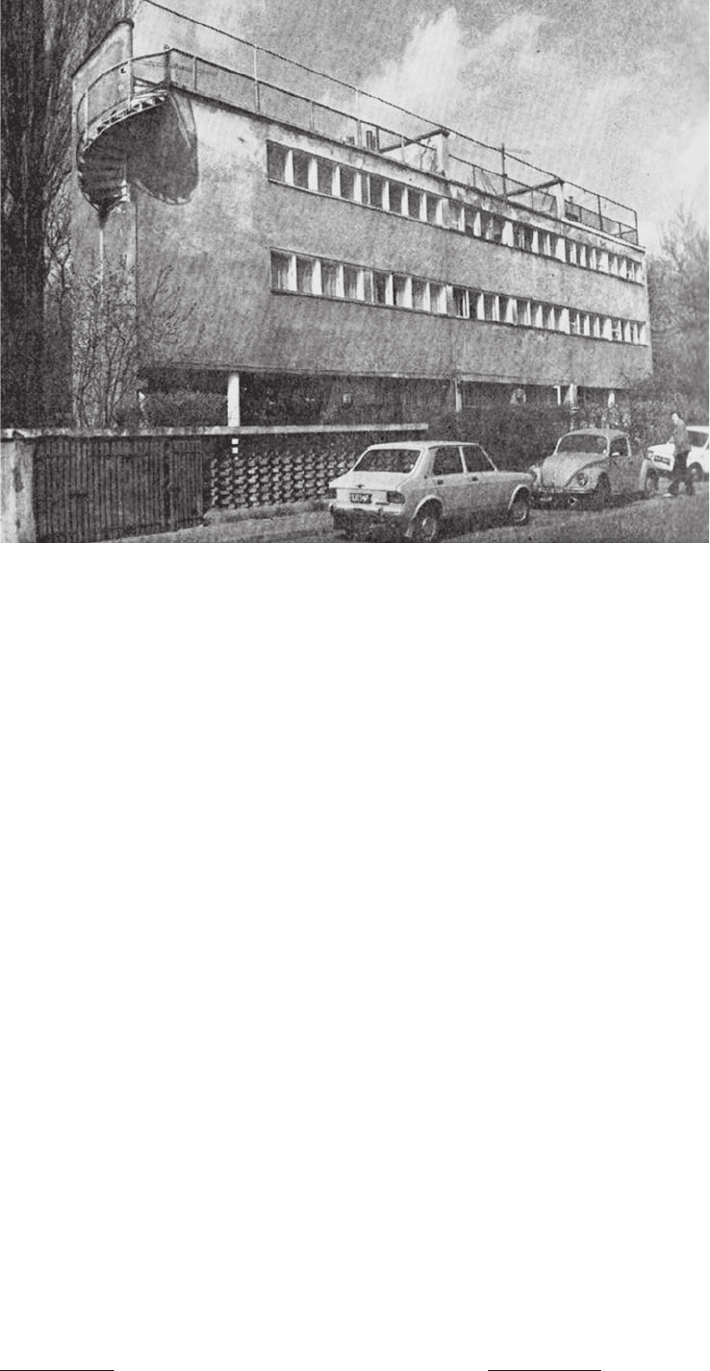
Among them, there is a building at Katowicka Street
9/11/11a, which was built as a three-family terraced house
(it included the house and the study of Bohdan Lachert at
number 9, the house of Z. Lechowska (No. 11) and the
house of M. Ostrowska (No. 11a)). The project strictly re-
ferred to ve principles of modern architecture of Le Cor-
busier. The architects Bohdan Lachert and Józef Szanajca
were the authors. Both of them graduated from Faculty
of Architecture at Warsaw University of Technology and
they defended their diploma in 1926 and 1927 respec-
tively. Bohdan Lachert worked as a didactic instructor; he
was a deputy of the professor in the Department of Indus-
trial and Economic Designing (1945–48); he obtained the
title of associate professor in 1948.
At the same time, i.e. in the years 1928–1929, the ar-
chitects realised – unfortunately not existing
23
any longer
– the Villa of Antoni and Olimpia Szyller located at Wał
Miedzeszyński 756. It was an outstanding example of ex-
treme functionalism with the form consisting of rectangu-
lar elements of diverse heights.
In the 1930s the development of Saska Kępa was sys-
tematically extended by buildings which belonged to the
modern architecture trend.
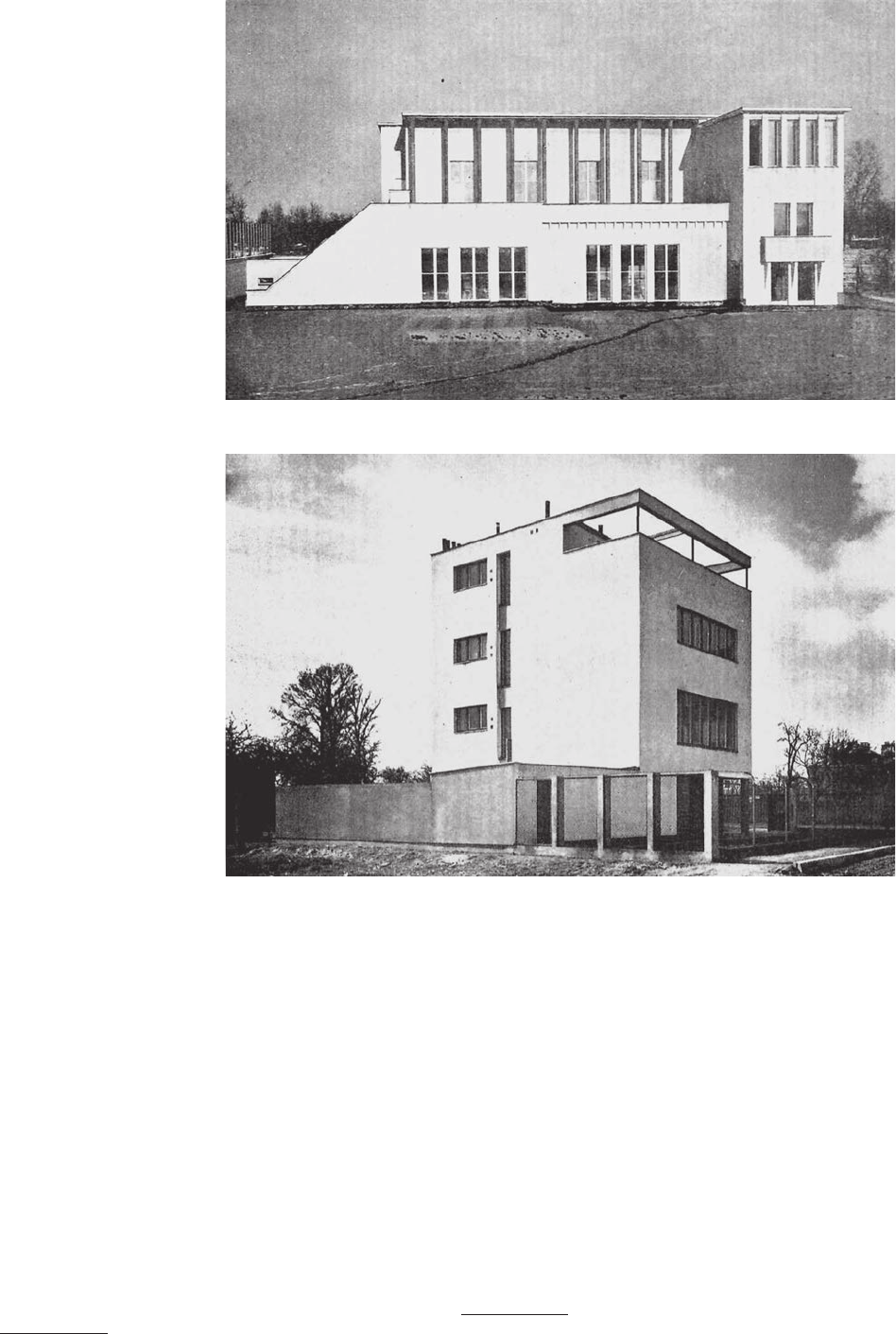
A good example can be the Villa of Andrzej Zaleski
designed by Bohdan Pniewski in 1930. It is characterised
22
Warszawska Szkoła Architektury 1915–1965, Warszawa 1967,
p. 295.
23
Destroyed gradually since 1945 and pulled down in 2002.
Fig. 1. Bohdan Lachert,
Józef Szanajca, The Building
at Katowicka Street in Warsaw
Individualism and background architecture. Education dilemmas in the days of breakthrough 213
by the structure consisting of simple forms of different
heights and facades deprived of details and shaped by
means of large planes of smooth walls. It is located in
a way which makes it possible to observe the composi-
tion from the most convenient places and directions.
According to the author’s description: ‘Forms of the
building were designed in such a way that there were
no short cuts from Miedzeszyński Wał’
24
[21]. Bohdan
Pniewski graduated from Faculty of Architecture at War-
saw University of Technology in 1922 and later he was
connected with this Faculty due to his didactic activity.
After the war he received the title of associate profes-
sor (1945) and then professor (1946). In different peri-
ods of his work at the Faculty, he managed the following
departments: Department of Designing and Architec-
tural Composition, Institute of Theory and Architectural
24
Architektura i Budownictwo, No. 8/1932, p. 240.
Criticism and Department of Public Utility Edices De-
signing
25
[17].
The house of Jadwiga Dobrzyńska and Zygmunt
Łoboda located at Estońska Street 6, which was designed
and realised in the years 1932–1933, is considered to be
an outstanding example of rational architecture. The form
of the building dened by the uncomplicated rectangular
mass referred to Le Corbusier creative activity follow-
ing his principles: a free plan, terrace on the roof, free
façade, streaked windows and a building on pillars. Jad-
wiga Dobrzyńska graduated from Faculty of Architecture
in 1922, while Zygmunt Łoboda in 1927
26
[17].
The villa at Obrońców Street 10, which was designed
by the architects Piotr Kwiek and Lucjan Korngold in the
years about 1934–1936, constitutes an example of luxuri-
25
Warszawska Szkoła Architektury..., op. cit., pp. 248–249.
26
Ibidem, pp. 274, 284.
Fig. 2. Bohdan Pniewski,
The House at Miedzeszyński
Wał in Warsaw. Source:
Architecture and Construction,
No. 8/1932, p. 237
Fig. 3. Jadwiga Dobrzyńska,
Zygmunt Łoboda, The House
at Estońska Street in Warsaw.
Source: Architecture and
Construction, No. 4/1934, p. 114

214 Karolina Tulkowska
ous functionalism. It was the building with diverse facades
arranged according to the principles of geometric abstrac-
tion. Lucjan Korngold graduated from Faculty of Archi-
tecture in 1921 and Piotr Kwiek in 1927
27
. These several
examples of prominent architectural works designed by
the graduates of Faculty of Architecture in the area of Sas-
ka Kępa can constitute the proof that strongly individual-
ised architecture can successfully intermingle with neutral
urban context and in this way enrich the space with charac-
teristic elements and jointly create genius loci [17].
It is worth emphasising the fact that the above men-
tioned architects studied at Faculty of Architecture at War-
saw University of Technology shortly after the University
was set up. Many students started their education before
the year 1920. However, it seems impossible to determine
a simple rule which would show the relation between the
date of submitting the diploma and the nature of further
creative activity. It also seems interesting that a probable
author of the presented most conservative works is the last
graduate of the School (Józef Vogtman, diploma in 1933).
Nowadays, if we look around Warsaw in search for
a contemporary equivalent of the housing estate of Saska
27
Ibidem, pp. 281–282.
Kępa quality, it is difcult to nd examples of organised
plotting on this scale at all. Perhaps, modern norms of the
investment market are not favourable for a reasonable
planning policy.
Against this background, the Town Wilanów seems
to be a particular example whose realisation has last-
ed for several years on the so called territories of Pola
Wilanowskie in the south of Warsaw. The housing estate
is designed on the basis of the local plans worked out by
the authors selected through urban competitions, which is
something really unique. Of course, the range and charac-
ter of the design signicantly differs from the above men-
tioned pre-war realisations. It refers to the scale and to
the intensity of the development as well as to the planned
functional structure which – apart from multi-family
residential buildings – includes trade, service and ofce
zones. The central element of the arrangement plan is
Świątynia Opatrzności Bożej (National Temple of Divine
Providence) – currently under construction.
It seems that in the perspective of several years, we will
have an opportunity to see whether the ambitious plans of
a private investor turn out to be effective. Will we be able
to sum up a walk around the Town Wilanów as satisfying
not only because of the quality of the public spaces but
also due to the character of the local architecture?
References
[1] 150 lat wyższego szkolnictwa technicznego w Warszawie. 1826–1976,
materiały z sesji naukowej 13–14 grudnia 1979.
[2] Anderson D.R., European Universities from the Enlightenment to
1914, Oxford 2004.
[3] Baranowicz Z., Polska awangarda artystyczna 1918–1939,
Warszawa 1979.
[4] Chrościcki J., Rottermund A., Atlas architektury Warszawy,
Warszawa 1977.
[5] Gropius W., Scope of total architecture, Ann Arbour 1962.
[6] Gropius W., The new architecture and the Bauhaus, Boston 1965.
[7] Jakimowicz I., Ryszkiewicz A., Szkoła Sztuk Pięknych w Warszawie
1844–1866, [in:]: Rocznik Warszawski 1963, t. IV.
[8] Kazimierski J., Nauka i szkolnictwo wyższe w Warszawie, Warszawa
1987.
[9] Kolbiński K., Politechnika Warszawska 1915–1965, Warszawa
1965.
[10] Le Corbusier, Toward an Architecture, Los Angeles 2007.
[11] Maciuika J.V., Before the Bauhaus: architecture, politics, and the
German state 1890–1920, Vol. 2, Cambridge 2005.
[12] Ogolny programmat kursów wykładać się mających w Szkole
Przygotowawczej do Instytutu Politechnicznego w roku szkolnym
1830/1831, Warszawa 1831.
[13] Padovan R., Towards universality: Le Corbusier, Mies and De Stijl,
Nowy Jork 2002.
[14] Piłatowicz J., Profesorowie Politechniki Warszawskiej w dwudzies-
toleciu międzywojennym, Warszawa 1999.
[15] Program Politechniki Warszawskiej na rok naukowy 1920/21,
Warszawa 1920.
[16] Suchodolski B., Historia nauki polskiej, Wrocław 1974.
[17] Warszawska Szkoła Architektury 1915–1965, Warszawa 1967.
[18] White M., De Stijl and Dutch modernism, Manchester 2003.
[19] Wydział Architektury na Politechnice w Warszawie. Program,
Warszawa 1915.
[20] Zarębska T., Początki polskiego piśmiennictwa urbanistycznego,
Warszawa 1975.
[21] Architektura i Budownictwo, 1926–1935.
Indywidualizm i architektura tła.
Dylematy edukacji w dobie przełomu
Współczesna kultura zbudowała przekonanie o konieczności po-
nadnormatywnej ekspresji.
Wyścig ikon generuje krótkotrwałe zainteresowanie i różnorodne
skutki w czasie. Teledyskowa lista przebojów znika w cotygodniowej
reinkarnacji. Miasto krzyczących fasad trwa.
Kiedy w roku 1915 członkowie Komisji Organizacyjnej tworzyli
podstawy programowe Wydziału Architektury Politechniki Warszawskiej
kontekst działań architektów odzwierciedlał ponad stuletnią destrukcję
państwowości.
Różnorodność upodobań i rodowodów upoważniała do przewidy-
wania niespójnych, kompilacyjnych efektów. Spotkali się m.in.: Józef
Pius Dziekoński, Rudolf Świerczyński, Karol Jankowski wywodzący się
z różnych europejskich szkół, politechnik i akademii sztuk pięknych.
Mimo to warszawska spuścizna dwudziestolecia tworzy spójny ob-
raz o ponadprzeciętnej jakości. Szkoła wykształciła „architektów klasy
średniej”, którzy tworzyli znakomitą architekturę tła: gmachy publiczne,
budynki socjalne, mieszkalne. O czym przekonuje spacer po warszawskiej
Saskiej Kępie, czy Żoliborzu.
Jakiej chcemy dziś architektury? Czy przez absorpcję ikonicznych
modeli zdołamy uporządkować krajobraz miast zniszczony przesz pół-
wieczne niedoinwestowanie i totalitaryzm? A może znów, bardziej niż
wirtuozów potrzeba nam mistrzów drugiego planu?
Key words: background architecture, individualism, education Słowa kluczowe: architektura tła, indywidualizm, edukacja