
2026
3(87)
Austensean Stanislaus Lumunon*
The Church of the Sacred Heart of Jesus in Tomohon:
A design proposal for new liturgical adaptations to the presbytery
DOI: 10.37190/arc260304
© by the Author/Authors. Licensee WUST.
Published in open access. CC BY-NC license.
Abstract
Post-conciliar liturgical reforms following the Second Vatican Council (1962–1965) prompted widespread spatial transformations in Catholic places
of worship, ranging from minimal reconguration to the demolition of historically signicant furnishings. Conformity with ocial Church documents,
particularly the General Instruction of the Roman Missal (GIRM), which explicitly mandates the preservation of artistically valuable furnishings, var-
ied considerably across regional. Dutch East Indies-era Catholic churches in Indonesia remain almost entirely absent from the international scholarly
literature on post-conciliar liturgical adaptation, despite their acute vulnerability to excessive intervention in the absence of established conservation
frameworks.
This article examines the Sacred Heart of Jesus Church in Tomohon, North Sulawesi, a neo-Gothic Dutch East Indies heritage building constructed
by Jesuit missionaries in 1903, whose presbytery underwent radical post-conciliar adaptation resulting in the demolition of all three pre-conciliar wooden
altars in direct contravention of the GIRM Articles 289 and 303. Employing a case study design, the study integrates eld survey, historical photographic
archive analysis, and normative assessment against the GIRM provisions. A minimum-intervention design proposal is developed, introducing a new
versus populum altar in formal harmony with the existing interior while reconstructing the three lost altars from surviving physical fragments and archi-
val documentation. A methodological distinction is maintained between source-based reconstruction, in which lost elements are directly derivable from
physical and archival evidence, and interpretative reconstruction, in which analogy with contemporary typological precedents is necessary.
The study demonstrates that post-conciliar liturgical imperatives and the conservation of Indies heritage furnishings are reconcilable within a coher-
ent minimum-intervention framework, and contributes a replicable methodology for the assessment of liturgical adaptations of Dutch East Indies-era
Catholic churches across the Indonesian archipelago and the broader Southeast Asian region.
Key words: liturgical adaptation, presbytery, Dutch Indies architecture, Church of the Sacred Heart of Jesus, Tomohon
Introduction
The Church of the Sacred Heart of Jesus in Tomohon,
North Sulawesi, Indonesia is a Dutch Indies heritage ec -
cle siastical building completed in 1903 and still in active
liturgical use. Like many Catholic places of worship built
before the Second Vatican Council (1962–1965), this
church underwent signicant interior transformations in the
decades following the Council, particularly within its pres -
bytery. The removal of its three neo-Gothic wooden altars,
comprising the main altar and two side altars dedicated to
the Virgin Mary and St. Joseph, represents a case of liturgi-
cal adaptation that exceeded the limits recommended by of-
cial Church documents. Neither Sacrosanctum Concilium
nor the General Instruction of the Roman Missal (GIRM)
provides support such an intervention, resulting in an ir-
reversible loss of heritage of considerable historical and
artistic value.
The call for liturgical reform issued by the Second Vat-
ican Council was grounded in the broader liturgical move-
ment that had been developing since the late 19
th
century in
France. Pioneering works such as Romano Guardini’s The
Spirit of the Liturgy (1998) and Dom Lambert Beauduin’s
reform writings had already begun reshaping theological
and architectural thinking about sacred space decades be-
fore the Council convened (Keere, Plevoet and Goyvaerts
2020). The Council’s Constitution on the Sacred Liturgy,
Sacrosanctum Concilium (Second Vatican Council 1963),
* ORCID: 0009-0006-0888-5925. Faculty of Architecture, Wro-
cław University of Science and Technology, Poland, e-mail: austensean.
lumunon@pwr.edu.pl
38 Austensean Stanislaus Lumunon
and the subsequent document Inter Oecumenici set out
principles to guide, rather than mandate, the recongura-
tion of liturgical spaces, emphasising the active and con-
scious participation of the faithful (Consilium of the Sa-
cred… 1964). Nevertheless, as scholars including Michael
A. Skaggs (2015, 1–23) and Denis R. McNamara (2009)
have documented, the implementation of these reforms in
existing churches was frequently characterised by misinter-
pretation, resulting in interventions that far exceeded what
the conciliar documents prescribed.
Post-conciliar adaptations encompassed a wide spectrum
of interventions. As Jitka Jonová (2017, 193–206) and Ur-
sula De Jong and Flavia Marcello (2019, 156–171) have
demonstrated, the nature and extent of these changes var-
ied signicantly across dierent regions, parishes, and his-
torical contexts, ranging from minimal recongurations to
radical demolitions. The existing literature, including com-
parative European and American studies, identies at least
three models: minimal, moderate, and radical adaptation
(Kieckhefer 2004). The case of the Sacred Heart of Jesus
Church in Tomohon represents an example of the latter, in
which the presbytery was fundamentally redesigned and
all three pre-conciliar altars, including their decorative ele-
ments, were dismantled.
The objective of this study is threefold. First, it analy-
ses the liturgical adaptation interventions undertaken in the
presbytery of the Sacred Heart of Jesus Church, examin-
ing their extent and conformity with ocial Church docu-
ments, particularly the GIRM, which represents the current,
denitive, and governing legislation for the Ordinary Form
of the Roman Rite (Congregation for Divine Worship…
2003). Second, it documents and reconstructs the remain-
ing fragments of the three pre-conciliar altars through ar-
chival research and eld survey. Third, it proposes a design
concept for a minimal-intervention liturgical adaptation
that integrates post-conciliar liturgical requirements with
the preservation and reconstruction of the church’s histor
-
ic interior, in support of the parish’s objective of obtaining
formal cultural heritage status from the municipality. This
study makes an original contribution in two respects: it pro-
vides the rst scholarly examination of the liturgical history
and interior transformation of this specic historic church,
and it presents a design methodology applicable to compa-
rable Dutch East Indies-era Catholic churches in Indonesia
that face similar challenges arising from liturgical reform
and heritage conservation.
Church history
The Sacred Heart of Jesus Church, also known as Gereja
Besi (which means “Iron Church” in English) is located in
Tomohon, a highland city on the island of Sulawesi, Indo-
nesia, approximately 25 km south of Manado, the provin-
cial capital of North Sulawesi. The church was inaugurated
on 28 September 1903 (Noor 2017) and constitutes one of
the most signicant examples of Dutch Indies ecclesiastical
architecture in eastern Indonesia. Its construction in iron
materials imported directly from the Netherlands reects
the technological and aesthetic ambitions of the Dutch Jes-
uit mission during the late Dutch East Indies period.
The Catholic presence in the Minahasa region has a his-
tory extending over four centuries. The rst Catholic mis-
sionaries, from Portugal and Spain, arrived in the area in
1563; however, they were subsequently expelled by the
Dutch Protestants in the 1650s. The return of Catholic mis-
sionaries to the Dutch East Indies in the early 19
th
century,
primarily members of the Society of Jesus, marked the re-
sumption of evangelisation in the region following Catho-
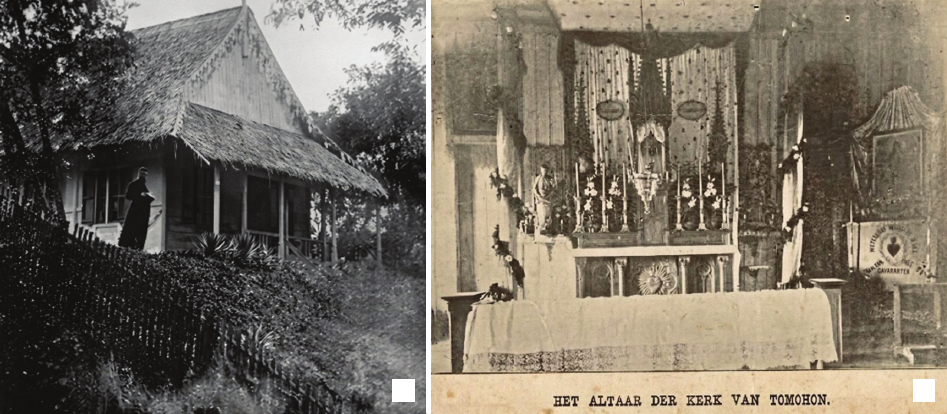
Fig. 1. The first Catholic church in Tomohon: a) a Jesuit missionary standing in front of the church (source: Berichten uit Nederlandsch… 1900;
image quality enhanced using AI-based sharpening), b) the high altar (image reproduced from Berichten uit Nederlandsch… 1900;
image quality enhanced using AI-based sharpening)
Il. 1. Pierwszy kościół katolicki w Tomohon: a) misjonarz jezuicki przed elewacją frontową kościoła (źródło: Berichten uit Nederlandsch… 1900;
jakość obrazu została podniesiona za pomocą modelu AI), b) ołtarz główny (źródło: Berichten uit Nederlandsch… 1900;
jakość obrazu została podniesiona za pomocą modelu AI)
a b
The Church of the Sacred Heart of Jesus in Tomohon: A design proposal for new liturgical adaptations to the presbytery 39
lic Emancipation in the Netherlands and its colonies. As
documented by Karel Steenbrink, Catholic missionary ac-
tivity in this period represented the beginning of a renewed
phase of expansion, with early centres of Catholic presence
located in regions such as Minahasa and the eastern islands
(Steenbrink 2003). The Jesuit missionaries arrived in Mi-
nahasa in 1868, baptising the indigenous population, who
were either Pagan or Protestant (Palar, Tim 2003).
The rst permanent Catholic presence in Tomohon was
established in 1875–1876, when Father Joan van Meurs,
S.J., arrived with the purpose of spreading Catholicism and
acquired a plot of land on which the rst Catholic church
in the city would later be built. This initial structure was
a modest wooden building with a thatched roof, completed
on 27 May 1891 (Fig. 1) (Palar, Tim 2003; Wullur 2020). In
1883, an additional plot of land was acquired to the right of
the rst church, where a second Catholic church was sub-
sequently erected in 1902.
The decision to construct a permanent new church build-
ing was made by Father Petrus Antonius Wintjes, S.J., in
response to the rapid growth of the Catholic population
in Tomohon since the rst baptism on 26 December 1875
(Keu s kupan Manado n.d.), which had reached nearly 2,000
parishioners. The new church was built on the land acquired
in 1883 (Wullur 2020), with the assistance of Brother An-
tonius van Leeuwenberg, S.J. The edice was completed
in 1903, and during the Dutch East Indies period, it was
known in Dutch as De rooms-katholieke kerk te Tomohon
or De Heilig Hartkerk te Tomohon. It is now a landmark of
the Tomohon’s urban landscape and a representative exam-
ple of the architectural legacy of Jesuit mission in North
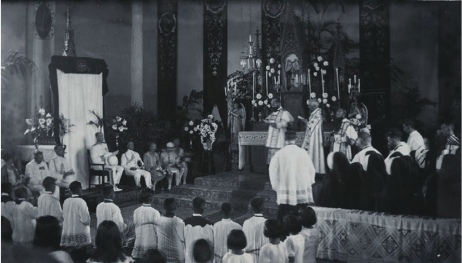
Sulawesi (Fig. 2).
The history of the church’s interior is central to this study.
The presbytery originally featured a main altar transferred
from the rst church in 1903, supplemented several years
later by two side altars dedicated to the Virgin Mary and
St. Joseph, positioned on the left and right sides of the pres-
bytery, respectively. The building sustained severe struc-
tural damage in an earthquake on 14 May 1932 (Muskens
1974) necessitating major repairs and renovations. The
most consequential transformation of the interior, how -
ever, occurred during and after the Second Vatican Council
(1962–1965), when all three altars were removed, and the
liturgical furnishings, decorations and the presbytery were
redesigned. These changes are the subject of this study.
Liturgical adaptation
The concept of liturgical adaptation in the Roman
Catholic Church refers to the set of structural and spatial
modications undertaken within existing places of worship
in response to the liturgical reforms mandated by the Sec-
ond Vatican Council. However, it is important to recognise
that the impetus for liturgical reform signicantly predates
the Council itself. The liturgical movement, emerging in
the late 19
th
century under gures such as Dom Prosper
Guéranger and subsequently advanced by Guardini (1998)
(Reid 2014), had already begun to reshape the theological
and architectural understanding of sacred space, emphasis-
ing the communal and participatory character of worship.
Guardini argued that the liturgy is not merely an individu
-
al devotional act but a corporate expression of the Church,
writing that […] the liturgy is the Church’s public worship…
in which the faithful are not spectators but participants
(Guardini 1998, 66). This early theological articulation of
active participation laid an intellectual and spiritual foun-
dation for the later reforms of the 20
th
century and for the
spatial reconguration of churches that accompanied them.
The Council’s Constitution on the Sacred Liturgy, Sac-
rosanctum Concilium (1963), articulated the foundational
principles of reform, including the active participation of
the faithful, the use of vernacular languages, and the simpli-
cation of the rites (Second Vatican Council 1963). These
principles were operationalised through the subsequent in-
struction Inter Oecumenici (1964), which provided specic
guidance on the spatial arrangement of the liturgy, includ-
ing the positioning of the altar so that the celebrating priest
could face the people (versus populum) (Consilium of the
Sacred… 1964). The General Instruction of the Roman
Missal (GIRM) subsequently consolidated these guidelines,
addressing in detail the placement and form of the altar,
ambo, celebrant’s chair, and other liturgical furnishings
(Congregation for Divine Worship… 2003). Cardinal Jo-
seph Ratzinger, later Pope Benedict XVI, further empha-
sised that the spatial orientation of the liturgy possesses
profound theological signicance, arguing that the common
direction of the priest and the faithful expresses the escha-
tological dimension of worship, since […] turning toward
the East means going to meet the coming Christ (Ratzinger
2000, 69, 70). This perspective reinforces the interpretation
that liturgical reconguration should preserve theological
symbolism rather than be driven solely by functional or aes-
thetic considerations.
Crucially, neither Sacrosanctum Concilium (1963) nor
subsequent documents mandated the wholesale destruction
of existing altars or furnishings. Article 303 of the GIRM
explicitly provides that where an existing altar cannot be
moved without compromising its artistic value, a new xed
altar should be erected for liturgical celebrations, while
Fig. 2. The interior of the second church in Tomohon from the Dutch
East Indies period, prior to the Second Vatican Council
(photo by an unknown author; source: Leiden University Libraries,
KITLV 11280, 1927)
Il. 2. Wnętrze drugiego kościoła w Tomohon z okresu Holenderskich
Indii Wschodnich, przed Soborem Watykańskim II
(autor fotografii nieznany; źródło: Leiden University Libraries,
KITLV 11280, 1927)
40 Austensean Stanislaus Lumunon
the original altar is preserved (Congregation for Divine
Worship… 2003). Despite this, the implementation of the
post-conciliar reforms in many existing churches, particu-
larly during the 1960s and 1970s, was frequently charac-
terised by interventions that exceeded these prescriptions.
As Jonová (2017) has documented, heritage artworks and
furnishings were removed, sold, or destroyed across multi-
ple European contexts in the decades following the Coun-
cil. Similarly, De Jong and Marcello (2019) have observed
comparable patterns of excessive adaptation in Australian
Catholic churches, where original liturgical furnishings
were discarded rather than integrated into the reformed li-
turgical space.
The spatial focus of these adaptations in pre-conciliar
churches was primarily the presbytery, particularly the area
surrounding the main altar. The side or minor altars also
became targets if their location was close to the new altar
versus populum (Keere, Plevoet and Goyvaerts 2020). Key
interventions typically included: the introduction of a new
altar versus populum; the installation of a xed ambo; the
reconguration of the celebrant’s chair; and the removal
of architectural elements demarcating the sanctuary from
the nave, such as the altar rail and rood screen. The alter-
ation or demolition of the existing altars, including side or
minor altars (votive altars) dedicated to specic saints or
devotional practices, was also widespread, though not uni-
versally so. Scholars including Skaggs (2015) and McNa-
mara (2009) have identied three broadly distinguishable
models of post-conciliar adaptation: minimal intervention
(preserving existing furnishings while adding new liturgi-
cal elements); moderate adaptation (selective recongura-
tion); and radical transformation (demolition and complete
redesign of the presbytery). The case of the Sacred Heart of
Jesus Church in Tomohon, as analysed in this study, corre-
sponds to the third category.
Beyond the European context, the implementation of
post-conciliar liturgical reforms in colonial and post-co-
lonial religious buildings in Southeast Asia presents par-
ticular challenges, as these structures combine the architec-
tural heritage of the colonising culture with the devotional
and cultural specicities of the local Catholic community
(Phan 2005). The Sacred Heart of Jesus Church in Tomo-
hon represents such a case: a Dutch Indies church, built in
neo-Gothic style, which underwent radical post-conciliar
adaptation in a regional context without established conser-
vation frameworks or specialist oversight. Research specif-
ically addressing this category of buildings remains limit-
ed, reinforcing the scholarly relevance of the present study.
State of research
Academic research specically addressing the Sacred
Heart of Jesus Church in Tomohon is extremely limited.
The earliest scholarly work identied is Alberta Mantiri’s
thesis (Mantiri, Warouw and Waani 2021), which examines
the building within the context of Dutch Indies architectur-
al heritage in the Tomohon area and assesses its potential
for cultural heritage designation. The study focuses pri-
marily on the exterior architectural style and urban context
and does not address the interior liturgical history or the
post-conciliar transformations of the presbytery. The au
-
thor’s two studies on the same case study have examined
dierent but complementary aspects of the church’s archi-
tectural character. The rst focused on the adaptation of the
historic building to the tropical highland climate (Lumu-
non, Pasla and Prijadi 2025), while the second, published
in 2026, examined its Neo-Gothic architectural elements
through a variable-based comparative analysis against es-
tablished Dutch and European references (Lumunon, Gosal
and Hasanah 2026). No previous study has examined the
history of the church’s altars, their removal, or the process
and consequences of liturgical adaptation within this spe-
cic building. Therefore, the present study responds to an
identiable research gap by examining the spatial and li-
turgical transformation of a Dutch Indies church within its
historical and cultural context.
In parallel, a substantial body of scholarship has emerged,
primarily in European contexts, addressing the challenge of
reconciling post-conciliar liturgical requirements with the
conservation of historically signicant church interiors.
Among the most notable contributions are the design and
research studies by Giovanni Carbonara for the Basilica di
Santa Maria in Domnica, Rome (Englen 2003), and Calo-
gero Bellanca’s research and design proposal for the Chie-
sa di San Nicola dei Lorenesi, Rome (Bellanca, Muratore
2009). Both studies exemplify an approach of minimal li-
turgical intervention by introducing required elements such
as the altar versus populum and the ambo without altering
or removing the existing historical furnishings. Daniela
Concas (2005) has additionally examined guidelines for
liturgical adaptation in spaces for Eucharistic celebration
in Italian churches, providing a methodological framework
for balancing conservation with liturgical functionality.
These European case studies demonstrate the viability
of a minimum-intervention approach and provide method-
ological precedents for the present study. However, they
operate within well-established European conservation
frameworks, notably the Italian legislative framework for
the protection of cultural heritage in churches, and address
buildings of a dierent historical periods and architectural
characters, ranging from Early Christian Roman basilicas
to Baroque churches. These buildings dier signicantly
from the Dutch East Indies neo-Gothic church examined
here. No comparable study has been conducted for Dutch
Indies-era Catholic churches in Indonesia, where the in-
tersection of Dutch Jesuit mission heritage, post-conciliar
reform, and emerging local heritage conservation frame-
works creates a distinct set of challenges.
Literature specically addressing the conservation and
re construction of liturgical furnishings in scenarios where
the original furnishings have been removed and only frag-
mentary physical evidence remains is particularly scarce.
Bellanca’s methodological works (Bellanca, Muratore
2009;
Bellanca 2011) provide relevant frameworks for ap-
proaching the restoration of historic ecclesiastical interiors.
However, the scholarly literature does not yet adequately
address scenarios such as the one in Tomohon where the
original furnishings have been removed and only fragmen-
tary physical evidence remains, necessitating a combined
archival and physical reconstruction approach.
The Church of the Sacred Heart of Jesus in Tomohon: A design proposal for new liturgical adaptations to the presbytery 41
The review of the existing literature reveals a clear re-
search gap: no study has addressed the post-conciliar li-
turgical adaptation of the Sacred Heart of Jesus Church in
Tomohon, nor has any study proposed a design solution for
the restoration and reconstruction of its presbytery. More
broadly, scholarly attention to post-conciliar liturgical ad-
aptation in the Dutch East Indies-era Catholic churches in
Indonesia and Southeast Asia is virtually absent from the
both national and international literature. The present study
aims to address this gap by combining historical documen-
tation, eld survey, archival research, and design method-
ology to produce both a scholarly analysis of the adaptation
process and a concrete design proposal for minimum-in-
tervention liturgical adaptation and heritage conservation.
Methods
This study adopts a qualitative, case study research de-
sign, combining historical documentation, eld survey,
archival analysis, and design methodology (Groat, Wang
2002; Yin 2009). The Sacred Heart of Jesus Church in To-
mohon is selected as the subject of this case study on the
basis of three criteria that render it a relevant and distinctive
example within the broader phenomenon of post-concili-
ar liturgical adaptation in Dutch Indies heritage buildings.
First, the church represents one of the earliest and most ar-
chitecturally signicant examples of Dutch Indies ecclesi-
astical construction in eastern Indonesia, with its iron struc-
ture imported directly from the Netherlands constituting an
exceptional material heritage. Second, the post-conciliar
adaptation interventions in its presbytery were particularly
radical in scope. They resulted in the complete removal of
all three pre-conciliar altars and thus constitute an extreme
instance of the type of excessive intervention document-
ed in the scholarly literature (Skaggs 2015; Jonová 2017).
Third, the survival of two physical fragments from the
original altars, together with archival photographic records,
creates a specic condition in which partial reconstruction
is methodologically feasible, distinguishing this case from
those in which all physical evidence has been lost.
The research was conducted between early July and late
September 2025 and proceeded in four sequential phases.
The rst phase consisted of a comprehensive review of
the existing literature, incorporating historical narratives,
ecclesiastical records, and published scholarly studies ad-
dressing post-conciliar liturgical adaptation, Dutch East In-
dies architecture in Indonesia, particularly church architec-
ture, and conservation methodologies for historic religious
interiors. This review provided the theoretical and compar-
ative framework for the subsequent phases of our research.
The second phase comprised a systematic eld survey
of the church building, conducted mostly in August 2025.
The survey involved a detailed inspection and photographic
documentation of the current state of the presbytery and its
furnishings. Particular attention was devoted to the two sur-
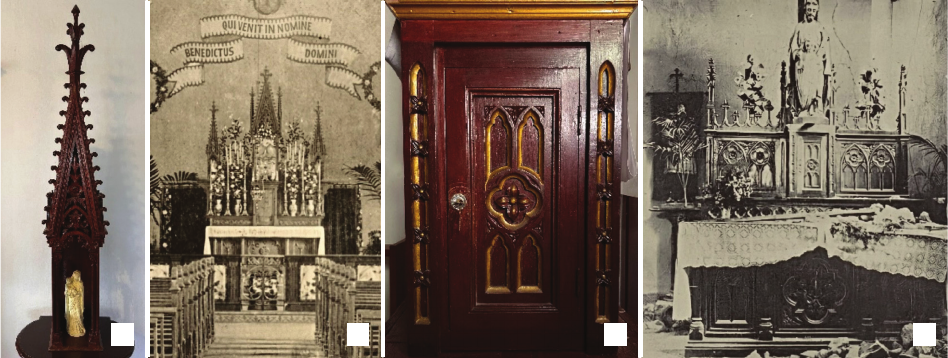
viving altar fragments: a neo-Gothic pinnacle from the main
altar and a tabernacle from one of the side altars (Figs. 3, 4).
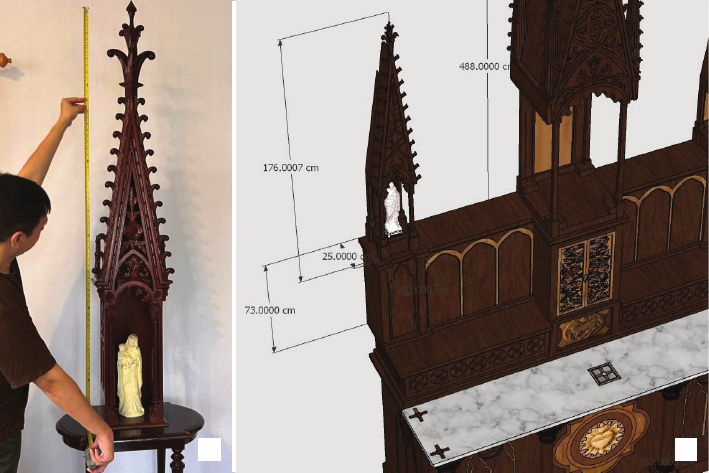
These fragments were measured, drawn and recorded us-
ing computer-aided design (CAD) techniques to produce
scaled, dimensionally accurate documentation of the re-
maining physical evidence and to facilitate the reconstruc-
tion of the lost altar components.
The third phase involved the systematic analysis of his-
torical photographic archives. Images from the Konink-
lijk Instituut voor Taal-, Land- en Volkenkunde (KITLV),
Collectie Nederland, and the parish archive, spanning the
Fig. 3. Remaining fragments and historical documentation of the main and side altars:
a) a pinnacle from the former High Altar (photo by A. Lumunon), b) an overall view showing the loss of the High Altar
(source: photograph from the parish archive, image enhanced for clarity using AI-based sharpening), c) a tabernacle component from one of
the side altars, either the Altar of the Virgin Mary or the Altar of St. Joseph (photo by A. Lumunon), d) the Altar of St. Joseph
following the 1933 earthquake (source: photograph from the parish archive, image enhanced for clarity using AI-based sharpening)
Il. 3. Zachowany fragment i fotograficzna dokumentacja historyczna ołtarza głównego i ołtarzy bocznych:
a) pinakiel z dawnego ołtarza głównego (fot. A. Lumunon), b) widok ogólny pokazujący utracony ołtarz główny
(źródło: fotografia z archiwum parafii, jakość obrazu została podniesiona za pomocą modelu AI), c) tabernakulum z jednego z bocznych ołtarzy
albo ołtarza Najświętszej Marii Panny lub ołtarza św. Józefa (fot. A. Lumunon), d) ołtarz św. Józefa po trzęsieniu ziemi w 1933 r.
(źródło: fotografia z archiwum parafii, jakość obrazu została podniesiona za pomocą modelu AI)
a b c d
42 Austensean Stanislaus Lumunon
period from 1903 to 1935, were examined to reconstruct
the original conguration of the presbytery interior, includ-
ing the position, form, and decorative programme of the
three pre-conciliar altars. A comparison of historical and
current conditions enabled a detailed analysis of the nature
and extent of the post-conciliar adaptations.
The fourth phase consisted of the development of a de-
sign proposal for a minimum-intervention liturgical adap-
tation of the presbytery, drawing on the physical evidence,
archival documentation, and the normative framework
established by the GIRM (Congregation for Divine Wor-
ship… 2003) as the ocial and primary source and other
relevant church documents.
A methodological distinction of particular importance in
this study is that between source-based reconstruction and
interpretative reconstruction. Where the physical form of
a lost element can be directly derived from surviving frag-
ments and unambiguous archival photographs, the recon-
struction is classied as source-based. Where the available
evidence is insucient for direct derivation, as is the case
for the ornamental and decorative details of the three altars,
for which no high-resolution archival photographs have
been identied, the reconstruction is classied as interpre-
tative, drawing on analogous neo-Gothic altar designs from
the same period of Dutch neo-Gothic tradition. All recon-
structed elements are explicitly identied as either source-
based or interpretative throughout the design proposal. This
distinction is considered essential to the intellectual hones-
ty of the study and constitutes a deliberate methodological
safeguard against conating established historical evidence
with hypothetical interpretation. Remaing fragments were
manually measured using basic instruments and utilized as
reference units for the reconstruction of missing compo-
nents (Jokilehto 1999).
The study acknowledges several limitations. The ab-
sence of photographic documentation of the presbytery
interior immediately before and after the post-conciliar in-
terventions (1962–1965) means that the precise sequence
and chronology of the alterations cannot be fully estab-
lished. Furthermore, the limited number of surviving phys-
ical fragments constrains the extent to which source-based
reconstruction is achievable and renders several aspects
of the altar reconstruction inherently hypothetical. These
limitations are addressed in the design proposal through an
explicit dierentiation of source-based and interpretative
reconstruction, as well as through recommendations for
further archival research.
Architectural form and building interior details
This analysis provides a description of the architectural
features and interior arrangement of the Sacred Heart of Je-
sus Church in Tomohon, thereby establishing the physical
context for the subsequent examination of liturgical adapta-
tions. The analysis addresses both the exterior architectur-
al form of the building and the organisation of its interior
spaces, with particular attention to the presbytery as the
primary locus of liturgical adaptation. The Church of the
Sacred Heart of Jesus is an exemplar of neo-Gothic ecclesi-
astical architecture as interpreted through the lens of Dutch
Indies construction practices. Its most distinctive feature is
its structural system of prefabricated iron components, im-
ported from the Netherlands, which accounts for its popu-
lar designation as the Gereja Besi (Iron Church). The main
façade is dominated by a bell tower surmounted by a spire,
giving the building the vertical emphasis characteristic of
the neo-Gothic tradition (Fig. 5). The lower portion of the
façade features a primary entrance portal anked by Gothic
lancet windows and a narrow rosette window above. The
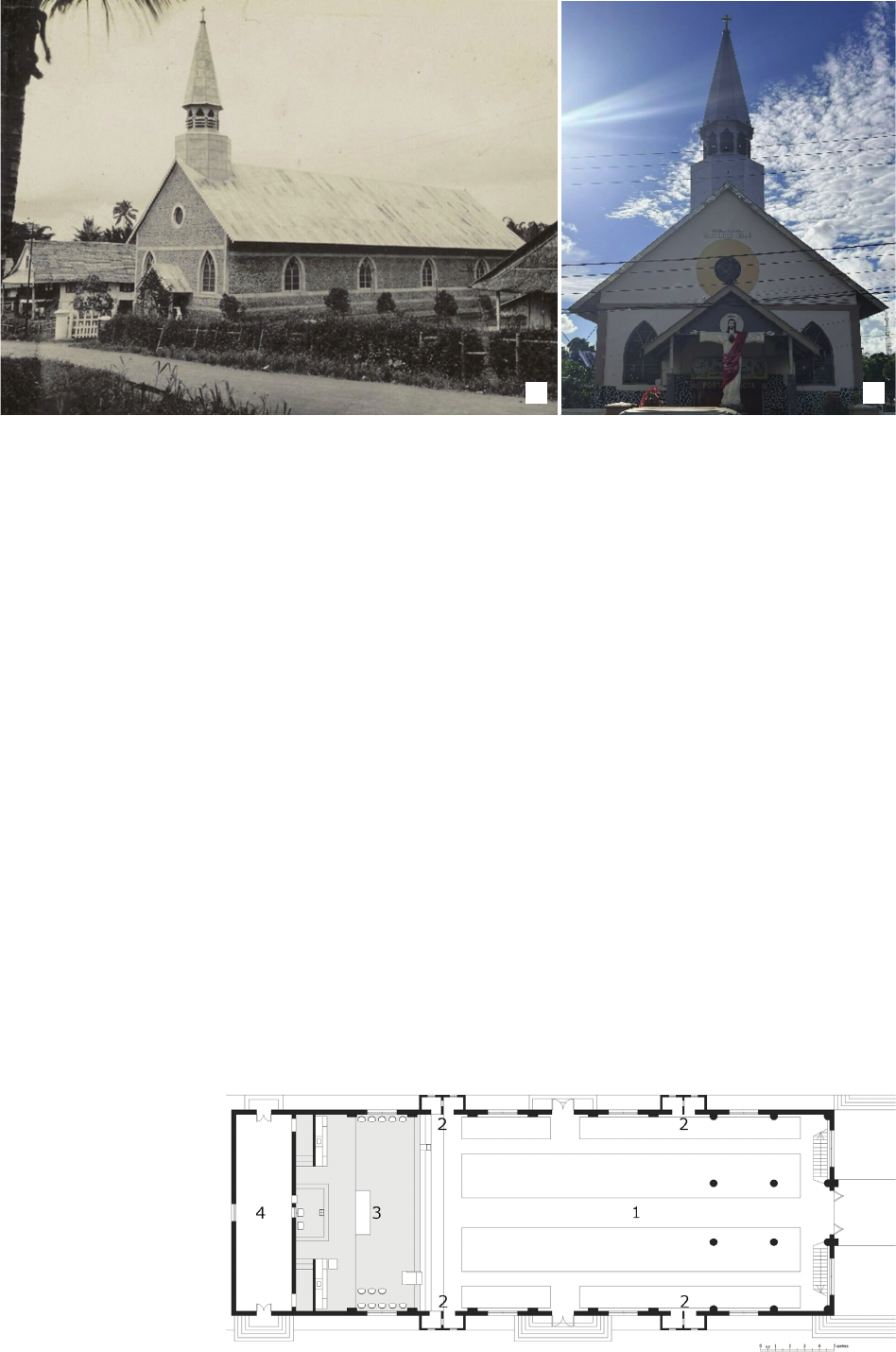
church measures 45 × 14 m in plan (Keuskupan Manado
n.d.). The scale of this church is considered to be quite large
in comparison to typical Dutch Indies mission churches of
the same period.
The lateral elevations of the nave are articulated by four
pairs of Gothic windows with simple stained glass featur-
ing Christian symbols above. These windows are designed
a b
Fig. 4. Reconstruction process
for one of the altars:
a) documentation of the surviving
fragment and measurements
taken by the author,
b) the reconstructed main altar
with dimensional specifications
(elaborated by A. Lumunon)
Il. 4. Proces rekonstrukcji
jednego z ołtarzy:
a) dokumentacja zachowanego
fragmentu i pomiary
przeprowadzone przez autora,
b) rekonstrukcja głównego ołtarza
z wymiarowaniem
(oprac. A. Lumunon)
The Church of the Sacred Heart of Jesus in Tomohon: A design proposal for new liturgical adaptations to the presbytery 43
to be opened using a rope mechanism to facilitate natural
ventilation and ensure eective air circulation in the humid
tropical environments of the Tomohon plateau (Lumunon,
Betteng 2013). Two windows of the same Gothic typology,
slightly larger in proportion, are also present on the front
elevation (Fig. 5).
The interior is organised on a longitudinal plan compris-
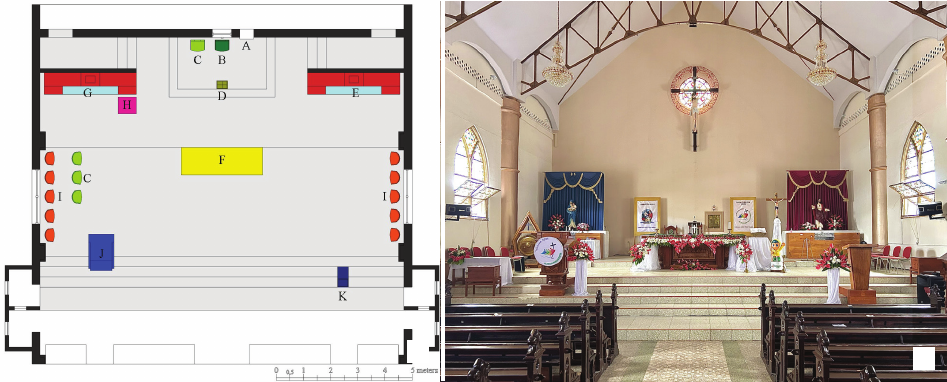
ing four principal zones (Fig. 6): the nave (1), two con-
fessionals on the left and right of the nave (2), the presby-
tery (3), and the sacristy (4). The confessionals were added
later, either following the earthquake of 1932 or after the
Second World War (Fig. 7). A tribune with dual staircas-
es, originally constructed as a temporary wooden structure,
was rebuilt in permanent form in 1993 and occupies the
rear of the nave above the church’s main entrance.
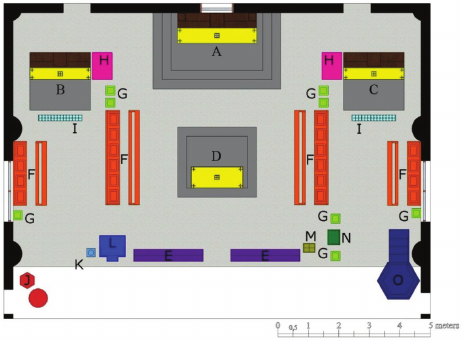
As recorded in the August 2025 survey (Fig. 6, no. 3),
currently contains a single altar versus populum (facing
the congregation), one xed ambo for scripture readings,
and one movable lectern for announcements (Fig. 8). The
server chairs or seats for the ministers is distributed on the
left and right sides of the presbytery. A statue of the Virgin
Mary is positioned on the left and a statue of the Sacred
Heart of Jesus on the right, behind which access doors lead
to the sacristy. Two chairs for the celebrant and co-cele-
brant are positioned centrally at the rear of the presbytery,
with the tabernacle situated to the right of the axial centre-
line, deviating from the building’s central axis. The sacris-
ty is equipped with two access doors and a single Gothic
window centred on the rear wall (Fig. 6, no. 4). The upper
section of the rear wall of the presbytery features a cross
and a narrow rosette window that is an identical twin of the
one on the front façade.
The presbytery is shown in its pre-conciliar congura-
tion. The original interior arrangement of the presbytery,
as documented in archival photographs from 1903–1935
(Figs. 3, 7), was substantially dierent from its current
state. The main altar originally installed in the rst church
(1891) (Fig. 1) was transferred to the present building upon
its completion in 1903. The ad orientem altar was posi-
tioned at the western end of the presbytery, xed against
the rear wall in the manner characteristic of pre-conciliar
Tridentine practice. This altar was constructed in a neo-
a b
Fig. 5. The Church of the Sacred Heart of Jesus in Tomohon: a) a photograph of the church in 1926 (source: Collectie Nederland,
TM-ALB-2090-174, 1926), b) the façade of the church in 2025 (photo by A. Lumunon)
Il. 5. Kościół pw. Najświętszego Serca Jezusa w Tomohon: a) fotografia kościoła z 1926 r. (źródło: Collectie Nederland, TM-ALB-2090-174, 1926),
b) fasada kościoła w 2025 r. (fot. A. Lumunon)
Fig. 6. Floor plan of the Church
of the Sacred Heart of Jesus:
1 – nave, 2 – confessional,
3 – presbytery (grey), 4 – sacristy
(drawing by A. Lumunon)
Il. 6. Rzut parteru kościoła
pw. Najświętszego Serca Jezusa
1 – nawa, 2 – konfesjonał,
3 – prezbiterium (kolor szary),
4 – zakrystia
(rys. A. Lumunon)

44 Austensean Stanislaus Lumunon
Gothic wooden style, featuring a pinnacle or spire ornament
(a fragment of which survives, Figs. 3, 4). Some years af-
ter the inauguration, two side altars (altare laterale) in the
similar neo-Gothic style were added to the left and right of
the presbytery, dedicated to the Virgin Mary and St. Joseph,
respectively. A tabernacle from one of these side altars also
survives as a physical fragment (Fig. 3). The presbytery was
separated from the nave by an altar rail and a level of oor.
A pulpit was positioned on the right, while a statue of the
Sacred Heart of Jesus was positioned on the left. This spatial
arrangement was standard in pre-conciliar Catholic church
interiors prior to the liturgical reforms of the Second Vati-
can Council’s. The subsequent radical transformation of this
interior conguration during and after the Second Vatican
Council, including the removal of all three altars, the altar
rail, and the pulpit, constitutes the central subject of this
study’s analytical and design components.
Concept of liturgical adaptation design
The design concept for the proposed liturgical adapta-
tion of the Sacred Heart of Jesus Church in Tomohon is
grounded in three normative sources: the GIRM (Congre-
gation for Divine Worship… 2003), the conservation prin-
ciple of minimum intervention, and the methodological
distinction between source-based and interpretative recon-
struction introduced in the preceding chapter. This section
rst presents the normative framework derived from o-
cial Church documents, then applies this framework analyt-
ically to assess the existing condition of the presbytery and
to justify the design decisions proposed.
The General Instruction of the Roman Missal establish-
es specic requirements regarding the placement, material,
and form of the principal liturgical furnishings within the
presbytery. These requirements are summarised in Table 1,
which provides the basis for evaluating both the existing
post-conciliar arrangement at Tomohon and the proposed
design intervention.
Of particular importance for the present study are two
articles of the GIRM that address the treatment of histor-
ically signicant existing furnishings. Article 289 arms
the Church’s commitment to preserving works of art and
artistic treasures from past centuries, insofar as their con-
servation is compatible with the requirements of liturgical
reform (Congregation for Divine Worship… 2003). Article
303, quoted in Table 2, directly addresses the situation of
an existing altar whose repositioning would cause artistic
damage, providing a normative basis for retaining the orig-
inal main altar while introducing a new versus populum al-
tar (Congregation for Divine Worship… 2003).
The application of this normative framework to the ex-
isting post-conciliar condition of the presbytery at the Sa-
cred Heart of Jesus Church reveals a signicant departure
from the provisions of the GIRM articles 289 and 303. The
three original neo-Gothic wooden altars, comprising the
main altar and the two side altars dedicated to the Virgin
Mary and St. Joseph. They possessed considerable artis-
tic and historical value as examples of Dutch Indies Jesuit
Fig. 7. Interior of the Church of the Sacred Heart of Jesus in Tomohon,
view of the presbytery and High Altar
(source: historical photograph from the parish archive)
Il. 7. Wnętrze kościoła pw. Najświętszego Serca Jezusa w Tomohon,
widok na prezbiterium i ołtarz główny
(źródło: fotografia historyczna ze zbiorów parafii)
Liturgical element Material Position/Location Form
Altar
natural stone or other worthy, solid,
well-crafted material
fixed; visible to the congregation
permanent
(integrated with floor; immovable)
Ambo
suitable and adapted
to the environment of the church
fixed; not movable permanent rather than portable
Chair of main celebrant/priest dignified and simple
facing the people;
within the presbytery
dignified but not resembling
a throne or cathedra
Co-celebrant chairs
simpler than the main
celebrant’s chair
in or near the presbytery simple
Deacon/minister/altar server simpler than the co-celebrant’s
near the presbytery; if a deacon is
present, next to the main celebrant
simple
Table 1. Liturgical furnishings according to the General Instruction of the Roman Missal
(Congregation for Divine Worship… 2003)
Tabela 1. Wyposażenie wnętrz zgodne z Ogólnym wprowadzeniem do Mszału Rzymskiego
(Congregation for Divine Worship… 2003)

The Church of the Sacred Heart of Jesus in Tomohon: A design proposal for new liturgical adaptations to the presbytery 45
craftsmanship and as original furnishings of a building now
approaching 125 years of age. Their wholesale removal,
rather than their retention alongside a new versus populum
altar as the GIRM 303 prescribes, constitutes an interven-
tion that exceeds the scope of legitimate liturgical adapta-
tion and has resulted in an irreversible loss of heritage.
Table 3 compares the existing liturgical elements in the
presbytery of the Church of the Sacred Heart of Jesus in To-
mohon with the relevant provisions of the General Instruc-
tion of the Roman Missal, identifying their current level
of compliance. It also presents the corresponding design
responses (Figs. 9, 10), including the retention, relocation,
Table 2. The General Instruction of the Roman Missal provisions for existing altars of artistic value
(Congregation for Divine Worship… 2003)
Tabela 2. Zasady z Ogólnego wprowadzenia do Mszału Rzymskiego odnoszące się do istniejących ołtarzy o wartości artystycznej
(Congregation for Divine Worship… 2003)
GIRM 289
In fact, just as she (The church) is intent on preserving works of art and artistic treasures handed down from past centuries,
insofar as necessary
GIRM 303
In already existing churches, when the old altar is so positioned that it makes the people’s participation difficult but cannot be
moved without damage to artistic value, another fixed altar, skilfully made and properly dedicated, should be erected,
and the sacred rites celebrated on it alone
Element GIRM provision
Existing condition
at Tomohon
Assessment Design response
Main altar
preserve if of artistic
value (GIRM 289,
303); introduce new
versus populum altar
if necessary
original neo-Gothic
main altar removed;
replaced with a plain
modern altar
non-compliant with
GIRM 289 & 303
The original main altar is to be reconstructed on
the basis of surviving fragments and archival
evidence; the restored altar will function as an altar
for Eucharistic adoration and will make possible
the celebration of the old rite (vetus ordo)
(see Figs. 9, 10). A new, harmoniously integrated
versus populum altar (Altar D; see Figs. 9, 10)
is to be introduced.
Side altars
(Mary & Joseph)
preserve works of
artistic value
(GIRM 289)
both side altars
removed; replaced
with a special place for
the statues (Mary and
Sacred Heart of Jesus)
non-compliant
with GIRM 289
The reconstruction of both side altars (Altars B and C;
see Figs. 9, 10), based on surviving fragments and
archival documentation, is proposed so that the
restored structures may serve as shrines for devotional
prayer and for the celebration of votive Masses.
Ambo
fixed, visible,
adapted to interior
a fixed ambo is present
for the liturgical
proclamation of the
Word of God
compliant
with GIRM 309
The element will be retained and aesthetically
harmonised with the reconstructed interior, and the
traditional pulpit on the right side will be restored for
use solely for preaching or the homily (see Figs. 9, 10).
Celebrant’s chair
dignified but
not resembling
a cathedra;
facing the people
two chairs positioned
centrally at the rear;
adequate in form
compliant
with GIRM 310;
however,
the position is next to
the tabernacle
The chair will be repositioned closer to the boundary
between the presbytery and the nave, to the right side
of the versus populum altar, and new chairs
harmoniously designed in accordance with the neo-
Gothic interior are proposed (see Figs. 9, 10).
Chair
(co-celebrant,
deacon
and altar server)
simpler than
the main celebrant’s
located on the left
and right sides
compliant
with GIRM 310–311
The existing position is to be retained, and a new
choir-style seating arrangement is proposed to
subdivide the presbytery into two distinct areas: one
designated exclusively for the celebration of the Mass
and the other for devotional activities (see Figs. 9, 10).
Altar rail
not prescribed by
GIRM; its removal
is permitted but
not required
removed
non-compliant
with GIRM 295
A similar style of altar rail is to be reintroduced as
an element of spatial demarcation between the nave
and the presbytery, in keeping with the historical
character of the interior (see Figs. 9, 10).
Statue of Sacred
Heart of Jesus
emphasizes that
images should be
displayed to lead
the faithful toward
the mysteries of faith
being celebrated
relocate in the
ex-places of the side
altar of St. Joseph
compliant with
GIRM 318, but
resulting
in the loss
of devotion to
the original altar
of St. Joseph
The Sacred Heart of Jesus statue is to be returned to
its original position on the left side of the sanctuary,
in a location directly opposite the restored pulpit
(see Figs. 9, 10).
Table 3. Assessment of existing presbytery adaptation and proposed design responses according to GIRM (elaborated by A. Lumunon)
Tabela 3. Ocena istniejącej adaptacji prezbiterium do rozwiązań posoborowych i propozycje zmian (oprac. A. Lumunon)
46 Austensean Stanislaus Lumunon
removal, or reconstruction of liturgical elements to improve
GIRM compliance while maintaining the historical and
neo-Gothic character of the interior.
Design principles and reconstruction methodology
The design proposal is governed by four principles that
re spond to the specic conditions of this case. The rst prin -
ciple is minimum intervention: certain furnishings, such
as the current ambo from the existing post-conciliar ar-
rangement, are retained. A new versus populum altar is in-
cor porated into the presbytery as the principal liturgical el-
ement, replacing the existing versus populum altar, whose
dimensions and stylistic character directly conict with the
proposed design. The second principle is material and sty-
listic coherence: all new and reconstructed elements are de-
signed in harmony with a neo-Gothic style consistent with
the existing architectural character of the building, ensuring
visual and historical continuity within the presbytery interior.
The third principle is the distinction between source-
based and interpretative reconstruction: elements for which
direct physical evidence or unambiguous archival docu-
mentation exists, such as the general form and scale of the
altars, derived from surviving fragments and old archival
photographs, are reconstructed on a source-based basis.
Elements for which the available evidence is insucient,
particularly the ornamental and decorative details of the al-
tars, are reconstructed on an interpretative basis, drawing on
analogous neo-Gothic altar designs from the same period
and the same Dutch Jesuit missionary tradition. All interpre-
tatively reconstructed elements are clearly identied as such
in the design documentation.
The fourth principle is liturgical functionality: the pro-
posed design accommodates the full range of liturgical
celebrations prescribed by the post-conciliar rite, including
the celebration of the Mass ad orientem or according to the
old rite (vetus ordo) at the reconstructed main altar, votive
Masses at the side altars, Eucharistic adoration at the re-
constructed main altar, and the participation of ministers,
choir, and congregation as dened by the General Instruc-
tion of the Roman Missal. These four principles together
constitute the methodological basis for the design proposal
presented in the following section.
The design proposal for liturgical adaptation
The design proposal for the liturgical adaptation of the
presbytery of the Sacred Heart of Jesus Church in Tomo-
hon is developed in accordance with the normative frame-
work established by the GIRM (Congregation for Divine
Worship… 2003) and the four design principles: mini-
mum intervention, stylistic coherence, distinction between
source-based and interpretative reconstruction, and liturgi-
cal functionality as outlined or articulated in the preceding
section. The proposal addresses ve categories of interven-
tion: the reconstruction and repositioning of altars; the re-
introduction of spatial demarcation elements; the arrange-
ment of ministerial furnishings; the integration of surviving
and stored liturgical objects; and the visual modelling for
accommodation of the full liturgical calendar, including or-
dinary celebrations, solemnities, and Eucharistic adoration.
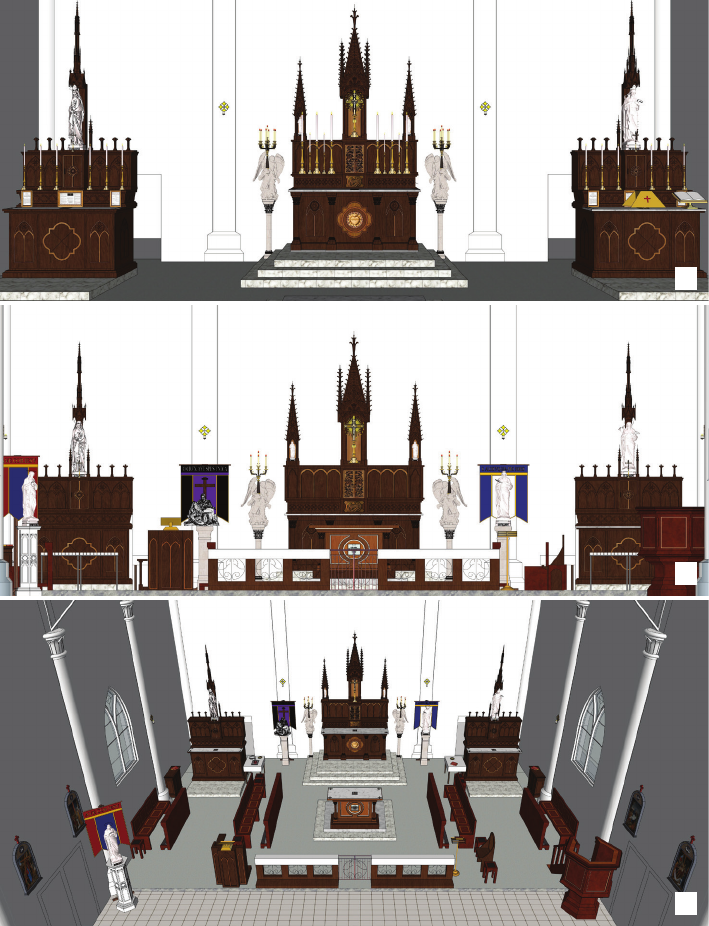
Altar arrangement (Altars A, B, C, and D)
The proposed arrangement introduces four distinct altar
positions within the presbytery (Fig. 9), each with a spe-
cic liturgical function, based on the reconstruction of the
pre-conciliar conguration as documented in archival pho-
a
b
Fig. 8. The presbytery of the Church of the Sacred Heart of Jesus in Tomohon: a) current floor plan: A – Tabernacle, B – celebrant’s chair,
C – deacon’s or concelebran’s chair, D – celebrant’s lectern, E – Statue of Sacred Heart of Jesus, F – main altar, G – Statue of Virgin Mary,
H – credence table, I – ministers’ seats, J – ambo, K – lectern for announcement, b) photographic documentation of the presbytery in 2025
(elaborated by A. Lumunon)
Il. 8. Prezbiterium kościoła Najświętszego Serca Pana Jezusa w Tomohon: a) aktualny rzut kondygnacji: A – tabernakulum,
B – krzesło celebransa, C – krzesło diakona lub koncelebransa, D – mównica celebransa, E – statua Najświętszego Serca Pana Jezusa,
F – ołtarz główny, G – statua Marii Panny, H – kredencja, I – krzesła ministrantów, J – ambona, K – pulpit do czytania ogłoszeń,
b) dokumentacja fotograficzna prezbiterium w 2025 r. (oprac. A. Lumunon)
The Church of the Sacred Heart of Jesus in Tomohon: A design proposal for new liturgical adaptations to the presbytery 47
tographs from 1903–1935 (Figs. 3, 7) and on the normative
provisions of the GIRM 289 and 303 (Congregation for Di-
vine Worship… 2003).
Altar A (reconstructed Main Altar) corresponds to the
original main altar of the church, positioned ad orientem
at the rear of the presbytery against the rear wall, as in the
pre-conciliar conguration. Its general form and approx-
imate scale are derived from two sources: the surviving
neo-Gothic pinnacle fragment (Figs. 3, 4) and archival
pho tographic records from the KITLV collection and the
parish archive (Fig. 7). On this basis, the reconstruction of
its overall silhouette, structural organisation, and principal
de corative vocabulary, including the surviving neo-Goth-
ic pointed arch, pinnacle, and tabernacle, is classied as
source-based reconstruction. The ornamental details of the
carved elements, for which no suciently high-resolution
archival photographs have been identied, are classied
as interpretative reconstruction, informed by the surviving
fragments of both main and minor altars. In accordance
with the GIRM 303 (Congregation for Divine Worship…
2003), the reconstructed Altar A is not designated as the
primary altar for the regular celebration of the Eucharist;
it is instead assigned to the celebration of Eucharistic ad-
oration and the reservation of the Blessed Sacrament, with
the tabernacle restored to its original position on the axis
of this altar. There is a possibility for pre-reform celebra-
tions to accommodate the preservation of the old rite (vetus
ordo) form. This arrangement resolves the current o-axis
positioning of the tabernacle, which deviates from both his-
torical precedent and liturgical propriety based on the spirit
of tradition.
Altars B and C correspond to the two pre-conciliar
side altars dedicated to the Virgin Mary (left, Altar B) and
St. Jo seph (right, Altar C), positioned in the lateral recesses
of the presbytery on either side of the main altar. The sur-
viving tabernacle fragment from one of these altars (Fig. 3)
provides direct physical evidence of the typological char-
acter of these furnishings from their scale, material, and
decorative programme and constitutes the primary source
for their source-based reconstruction. As with Altar A, the
decorative details not directly recoverable from surviving
evidence are treated as interpretative reconstruction. In
liturgical terms, Altars B and C are designated as votive
altars, available for the celebration of private Masses on
the feast days of the Virgin Mary and St. Joseph, and for
devotional use by the faithful. Their reconstruction restores
the traditional three-altar arrangement of the pre-conciliar
presbytery, which was a dening feature of the spatial char-
acter of the original interior.
Altar D is a newly designed altar versus populum, po-
sitioned at the forward edge of the presbytery to serve and
designated as the primary altar for ordinary form or reg-
ular Eucharistic celebrations, in full compliance with the
post-conciliar requirements of the GIRM (Congregation for
Divine Worship… 2003). As a new element introduced into
a historic interior, its design is governed by the principle
of stylistic coherence with the existing neo-Gothic envi-
ronment. It adopts the formal vocabulary of the Romanitas
tradition, incorporating simple geometric patterns with the
existing architectural elements found in some of the great
historical basilicas of Christendom, while remaining clear
-
ly distinguishable as a contemporary addition rather than
a reproduction of the pre-conciliar altars (Fig. 10). This
approach reects the methodological position, established
in scholarship on conservation of liturgical interiors (Bel-
lanca, Muratore 2009; Bellanca 2011), according to which
new interventions in historic buildings should be harmo-
nious with, yet clearly distinguishable from the existing
historic fabric. The author deliberately avoids the use of
modern and contemporary styles to prevent visual and con-
textual discord with the surrounding environment and to
align the intervention with the current movement advocat-
ing a return to tradition and identity.
Conclusions
This study set out to examine the post-conciliar litur-
gical adaptation of the presbytery of the Sacred Heart of
Jesus Church in Tomohon, Indonesia, to assess the extent
to which those interventions conformed to the provisions
of ocial Church documents, and to propose a design for
a minimum-intervention liturgical adaptation that address-
es the dual imperatives of liturgical functionality and herit-
age conservation. The analysis and design work presented
in this article lead to the following conclusions.
First, the post-conciliar liturgical adaptation undertaken
at the Sacred Heart of Jesus Church constitutes a case of
radical transformation that substantially exceeded the limits
established by the General Instruction of the Roman Missal.
Fig. 9. Details of the proposed liturgical adaptation of the Church of
the Sacred Heart of Jesus in Tomohon: A – reconstructed Main Altar,
B – Altar of the Virgin Mary, C – Altar of St. Joseph, D – proposed
new High Altar, E – altar rails, F – choir, G – ministers’ seats,
H – credence table, I – devotional candles, J – statue of the Sacred
Heart of Jesus, K – Paschal candle, L – ambo, M – celebrant’s lectern,
N – celebrant’s chair, O – pulpit (elaborated by A. Lumunon)
Il. 9. Proponowane zmiany związane z adaptacją kościoła
pw. Najświętszego Serca Jezusa w Tomohon: A – zrekonstruowany
ołtarz główny, B – ołtarz Najświętszej Marii Panny,
C – ołtarz św. Józefa, D – projektowany nowy ołtarz główny,
E – balustrady ołtarzy, F – chór, G – siedziska duchownych,
H – kredencja, I – miejsca na świece, kandelabry,
J – posąg Najświętszego Serca Jezusowego,
K – świece paschalne, L – ambona, M – lektorium celebransa,
N – krzesło celebransa, O – lektorium-pulpit (oprac. A. Lumunon)
48 Austensean Stanislaus Lumunon
The removal of three neo-Gothic wooden altars was under-
taken. These comprised the main altar and two side altars,
dedicated to the Virgin Mary and St. Joseph. The imple-
mentation of liturgical adaptions constitutes a direct con-
travention of the General Instruction for the Roman Missal,
articles 289 and 303. These articles explicitly mandate the
preservation of furnishings of artistic value and the reten-
tion of existing altars, where their removal would result in
irreversible damage. In regard to the artistic quality and
historical signicance of these furnishings as products of
the Dutch Jesuit missionary in the Dutch East Indies, their
demolition or removal constitutes an irreversible loss of
heritage of considerable religious and cultural importance.
Second, the proposed design demonstrates that the im-
peratives of post-conciliar liturgical reform and the conser-
vation of historical furnishings are not mutually exclusive.
The introduction of a new versus populum altar (Altar D),
designed in the tradition of Romanitas, and incorporating
simple geometric patterns harmonious with the existing in-
terior, in combination with the reconstruction of the three
pre-conciliar altars (Altars A, B, C) and the reintroduction
of the altar rail, pulpit and choir seating for participants oth-
er than the celebrant, fulls the relevant requirements of the
GIRM, while simultaneously restoring the spatial and aes-
thetic coherence of the historic interior associated with the
Dutch Jesuit mission heritage. This conclusion aligns with
the ndings of comparable studies in the European context
and extends their methodological framework to the specic
conditions of a post-colonial church in Southeast Asia, par-
ticularly in Indonesia.
Third, the methodological distinction between source-
based reconstruction, in which the form of a lost element
can be directly derived from surviving physical fragments
and archival documentation, and interpretative reconstruc-
tion, in which the available evidence is insucient for direct
derivation and recourse to analogous typologies is there-
fore necessary, is proposed as a necessary and transferable
tool
for design research in comparable contexts. Its consist-
Fig. 10. Design proposal for
new liturgical adaptations to
the presbytery of the Church
of the Sacred Heart of Jesus
in Tomohon:
a) the three reconstructed altars,
b) front views of the presbytery,
c) the presbytery with its
proposed liturgical furnishings
(elaborated by A. Lumunon)
Il. 10. Projekt adaptacji
prezebiterium kościoła
pw. Najświętszego Serca
Jezusowego w Tomohon:
a) trzy zrekonstruowane ołtarze,
b) widok na prezbiterium,
c) prezbiterium z proponowanym
wyposażeniem liturgicznym
(oprac. A. Lumunon)
a
b
c
The Church of the Sacred Heart of Jesus in Tomohon: A design proposal for new liturgical adaptations to the presbytery 49
References
Bellanca, Calogero, and Oliva Muratore, eds. Una didattica per il restauro
II: Esperienze a San Luigi dei Francesi e San Nicola dei Lorenesi.
Alinea Editrice, 2009.
Bellanca, Calogero, ed. Methodical Approach to the Restoration of Histor-
ic Architecture. Alinea Editrice, 2011.
Berichten uit Nederlandsch Oost-Indië voor de leden van den Sint-Claver-
bond. T.C.B. ten Hagen, 1900.
Concas, Daniela. Vademecum per la conservazione e il restauro dell’ar-
chitettura religiosa di culto cattolico. PhD diss., Università degli Stu-
di La Sapienza, 2005.
Congregation for Divine Worship and the Discipline of the Sacraments.
General Instruction of the Roman Missal. USCCB Publishing,
2003.
Consilium of the Sacred Congregation of Rites. “Inter Oecumenici: In-
struction on Implementing Liturgical Norms.” Published September
26, 1964. Accessed April 21, 2026, at https://adoremus.org/1964/09/
inter-oecumenici/.
de Jong, Ursula, and Flavia Marcello. “Stewardship and Renewal of Ca -
tholic Places of Worship in Australia.” Actas de Arquitectura Reli-
giosa Contemporánea 6 (2019): 156–71. https://doi.org/10.17979/
aarc.2019.6.0.6236.
Englen, Alia, ed. Caelius I: Santa Maria in Domnica, San Tommaso in
Formis e il Clivus Scauri. “L’Erma” di Bretschneider, 2003.
Groat, Linda N., and David Wang. Architectural Research Methods. John
Wiley and Sons, 2002.
Guardini, Romano. The Spirit of the Liturgy. Translated by Ada Lane.
Crossroad Publishing, 1998.
Jonová, Jitka. “Heritage Preservation and Sacred Art after the Second Vat
-
ican Council.” AUC Theologica 7, no. 1 (2017): 193–206. https://doi.
org/10.14712/23363398.2017.9.
Jokilehto, Jukka. A History of Architectural Conservation. Butterworth-
Heinemann, 1999.
Keere, Nikolaas Vande, Bie Plevoets, and Samuel Goyvaerts. “ ‘Donde
sea que unos pocos se reúnan’: El Movimiento Litúrgico y el Vati-
cano II como fuente para la transformación arquitectónica de las
igle sias en el contexto de la reutilización.” Actas de Arquitectura Re-
li giosa Contemporánea 7 (2020): 40–51. https://doi.org/10.17979/
aarc.2020.7.0.6289.
Keuskupan Manado. “Sejarah – Keuskupan Manado.” Published n.d. Ac-
cessed September 3, 2025. https://keuskupanmanado.or.id/sejarah/.
Kieckhefer, Richard. Theology in Stone: Church Architecture from Byzan-
tium to Berkeley. Oxford University Press, 2004.
ent application in this study is intended to ensure intellectu-
al transparency and to prevent the conation of established
historical evidence with hypothetical interpretation.
The study is subject to several limitations that must be
acknowledged. The absence or lack of photographic doc-
umentation of the presbytery interior immediately before
and after the post-conciliar interventions (1962–1965)
means that the precise sequence and chronology of the al-
terations cannot be fully established. The paucity of surviv-
ing physical fragments, specically two fragments of altar
pieces from the three altars, means that a signicant pro-
portion of the reconstruction, particularly the ornamental
and decorative details of all three altars, is interpretative in
nature and must therefore be regarded as a working hypoth-
esis rather than a denitive historical reconstruction. These
limitations do not invalidate the design proposal, but rather
dene its epistemic boundaries and indicate directions for
future research.
Summary
This article presents a research and design study on the
post-conciliar liturgical adaptation of the Sacred Heart of Je-
sus Church in Tomohon, North Sulawesi, Indonesia, a 1903
neo-Gothic iron ecclesiastical building erected by the Dutch
Jesuit mission, combining historical documentation, archi-
val analysis, eld survey, and design methodology.
The demolition of three neo-Gothic altars and the whole-
sale redesign of the presbytery were not mandated by the
conciliar documents and contradicted the explicit provisions
of the GIRM. This nding extends the well-documented
European pattern of excessive post-conciliar intervention
to Dutch East Indies-era churches in Indonesia, a context
that has hitherto received little or no scholarly attention and
demonstrates that post-conciliar liturgical requirements and
the conservation of historical furnishings can be reconciled
through the GIRM based normative assessment combined
with a minimum-intervention design approach.
The study could not determine whether the intervention at
Tomohon was an isolated case or representative of a broader
regional pattern, as no comparative data are available. The
precise original conguration of the three altars could not
be fully established due to the absence, across all archives
consulted, of photographic documentation from the period
1955–1975 (before and after the Second Vatican Council),
rendering the reconstruction necessarily dependent in part
on typological inference.
Three directions for future research are proposed: sys-
tematic archival investigation targeting photographic do-
cu mentation of the presbytery from ca. 1955–1975 with
the aim of strengthening the evidentiary basis for the al-
tar re construction; a comparative study of post-conciliar
litur gical adaptation across Dutch East Indies-era Catholic
churches in Indonesia as a prerequisite for any generalisa-
tion of the present ndings; and a dedicated study of Dutch
Catholic ecclesiastical furniture-making traditions of the
late 19
th
and early 20
th
centuries to advance the interpreta-
tive reconstruction of the altar details.
Acknowledgments
I would like to thank R.D. Rafael Hendrico Mario Tanod, parish priest
of the Sacred Heart of Jesus, priest of the Diocese of Manado, for grant-
ing permission to access the photograph archives and conduct the sur-
vey. I would also like to thank the Koninklijk Instituut voor Taal, Land-
en Volkenkunde (KITLV) and Collectie Nederland: Musea, Monumenten
en Archeologie for granting access to a collection of historical photo-
graphs of the Dutch East Indies, particularly those held in the open access
collections of the Catholic Church in Tomohon. I would also like to ac-
knowledge the nancial support provided by the Institute for Research and
Community Services, Universitas Sam Ratulangi, Manado.
50 Austensean Stanislaus Lumunon
Streszczenie
Kościół pod wezwaniem Najświętszego Serca Jezusa w Tomohon:
propozycja projektu adaptacji prezbiterium związanych z nowymi wymogami liturgii
Reformy liturgiczne po Soborze Watykańskim II (1962–1965) spowodowały powszechne przekształcenia przestrzenne w katolickich miejscach kul-
tu – od minimalnych zmian we wnętrzach po usunięcie historycznie cennych elementów wyposażenia. Zgodność tych działań z ocjalnymi dokumenta-
mi Kościoła, w szczególności z Ogólnym wprowadzeniem do Mszału Rzymskiego (OWMR), które wprost nakazywało zachowanie wartościowego pod
względem artystycznym wyposażenia, była bardzo zróżnicowana w zależności od kontekstu regionalnego. Katolickie kościoły z epoki Indii Holender-
skich w Indonezji pozostają niemal całkowicie nieobecne w międzynarodowej literaturze naukowej dotyczącej posoborowych adaptacji liturgicznych,
pomimo ich skrajnej podatności na nadmierne ingerencje w obliczu braku skodykowanych działań konserwatorskich.
Tematem artykułu jest kościół Najświętszego Serca Pana Jezusa w Tomohon (Celebes Północny) – neogotycki obiekt dziedzictwa kulturowego
z czasów Indii Holenderskich, wzniesiony przez misjonarzy jezuickich w 1903 r. Prezbiterium tej świątyni poddano radykalnej posoborowej adaptacji,
która doprowadziła do demontażu wszystkich trzech przedsoborowych drewnianych ołtarzy, co stanowiło bezpośrednie naruszenie artykułów OWMR
289 i 303. W badaniach związanych ze studium przypadku oparto się na danych z inwentaryzacji terenowej, analizie archiwów fotogracznych oraz
ocenie normatywnej pod kątem przepisów OWMR. Opracowano projekt konserwatorski oparty na zasadzie minimalnej interwencji, wprowadzający
nowy ołtarz versus populum (skierowany ku ludowi) w formalnej harmonii z istniejącym wnętrzem, przy jednoczesnej rekonstrukcji trzech utraconych
ołtarzy na podstawie zachowanych fragmentów materialnych oraz dokumentacji archiwalnej. W pracy utrzymano metodologiczne rozróżnienie po-
między rekonstrukcją opartą na źródłach (gdzie utracone elementy wynikają bezpośrednio z dowodów materialnych i archiwalnych) a rekonstrukcją
interpretacyjną (w której przypadku niezbędne jest zastosowanie analogii do współczesnych precedensów typologicznych).
Dowiedziono, że posoborowe wytyczne dotyczące liturgii oraz ochrona wyposażenia dziedzictwa Indii Holenderskich są możliwe do pogodzenia
w ramach spójnej koncepcji minimalnej interwencji, a także zaproponowano możliwą do szerszego zastosowania metodologię oceny adaptacji liturgicz-
nych kościołów katolickich z epoki Indii Holenderskich w archipelagu indonezyjskim i szerszym regionie Azji Południowo-Wschodniej.
Słowa kluczowe: adaptacje do zmian liturgii, prezbiterium, holenderska architektura kolonialna, kościół pw. Najświętszego Serca Jezusa, Tomohon
Leiden University Libraries. “Gouverneur-generaal A.C.D. de Grae
(links) wordt ontvangen in de rooms-katholieke kerk te Tomohon, ten
zuiden van Manado.” KITLV 11280, 1927. Digitalised 2006. Accessed
Septemebr 3, 2026, at http://hdl.handle.net/1887.1/item:907709.
Lumunon, Austensean Stanislaus, and Luther Betteng. “Implementasi
Arsitektur Gothik pada Bangunan di Daerah Tropis Lembab.” Media
Matrasain 10, no. 2 (2013): 38–51. https://doi.org/10.35793/matras
-
ain.v10i2.4112.
Lumunon, Austensean Stanislaus, Vincent Dwight John Pasla, and Ryo
Kurniawan Prijadi. “Adaptasi Bangunan Bersejarah dari Era Hindia
Belanda di Iklim Tropis Dataran Tinggi: Studi Kasus Gereja Katolik
Hati Kudus Yesus di Tomohon.” Gorontalo Journal of Infrastruc-
ture and Science Engineering 8, no. 2 (2025): 50–62. https://doi.
org/10.32662/gojise.v8i2.4659.
Lumunon, Austensean Stanislaus, Priscilla Nelvy Gosal, and Risty
Uswatun Hasanah. “Analisis Komparatif Elemen Arsitektur Neo-Go-
tik pada Gereja Katolik Hati Kudus Yesus Tomohon: Kajian Visual
Berbasis Variabel terhadap Bangunan Era Hindia Belanda.” Media
Matrasain 23, no. 1 (2026): 91–109. https://doi.org/10.35793/matra-
sain.v23i1.66635.
Mantiri, Alberta, Fela Warouw, and Judy O. Waani. “Arsitektur Kolonial
Belanda Menuju Kawasan Cagar Budaya di Kota Tomohon.” Frak-
tal: Jurnal Arsitektur, Kota dan Sains 6, no. 1 (2021): 1–10. https://
doi.org/10.35793/fraktal.v6i1.35792.
McNamara, Denis R. Catholic Church Architecture and the Spirit of the
Liturgy. Hillenbrand Books, 2009.
Muskens, Martinus P. M. Sejarah Gereja Katolik Indonesia. 2 vol. Bagian
Dokumentasi-Penerangan Kantor Waligereja Indonesia, 1974.
Noor, Ryo. “‘Gereja Besi’ Tomohon, Gereja Tertua yang Sudah Lewati
Masa Seabad.” Tribun Manado, February 26, 2017. Accessed Sep-
tember 1, 2025, at https://manado.tribunnews.com/2017/02/26/gere-
ja-besi-tomohon-gereja-tertua-yang-sudah-lewati-masa-seabad.
Palar, Hendrikus Benedictus, and Tim. Bangkitnya Kembali Umat Kato-
lik Tomohon (Sejarah Kristianisasi Minahasa). Paroki Hati Kudus
Yesus, 2003.
Phan, Peter. “Christianity in Indochina.” In The Cambridge History of
Christianity. Vol. 8. World Christianities c. 1815–c. 1914, edited by
Brian Stanley and Sheridan Gilley. Cambridge University Press, 2005.
Ratzinger, Joseph, Cardinal. The Spirit of the Liturgy. Ignatius Press, 2000.
Reid, Alcuin. “Elements of the New Liturgical Movement.” Published No-
vember 13, 2014. Accessed April 20, 2026, at https://www.academia.
edu/9282429/Elements_of_the_New_Liturgical_Movement.
Second Vatican Council. Sacrosanctum Concilium: Constitution on the Sacred
Liturgy. Published December 4, 1963. Accessed September 14, 2025, at
https://www.vatican.va/archive/hist_councils/ii_vatican_council/docu-
ments/vat-ii_const_19631204_sacrosanctum-concilium_en.html.
Skaggs, Michael A. “The Council as Shibboleth: The Rhetoric of Authen-
ticity and Liturgical Space after Vatican II.” U.S. Catholic Historian
33, no. 2 (2015): 1–23. https://doi.org/10.1353/cht.2015.0014.
Steenbrink, Karel A. Catholics in Indonesia, 1808–1942: A Documented
History. Vol. 1: A Modest Recovery, 1808–1903. KITLV Press, 2003.
Wullur, Frangky. “Seperti Ini Wujud Altar Gereja Katolik Pertama di To -
mohon.” Published February 19, 2020. Accessed September 1, 2025,
at https://beritamanado.com/seperti-ini-wujud-altar-gereja-katolik-per-
tama-di-tomohon/.
Yin, Robert K. Case Study Research: Design and Methods. Sage, 2009.