
2021
2(66)
DOI: 10.37190/arc210211
Andrzej Jarczewski*
Yes is more comics as an architectural manifesto
* ORCID: 0000-0002-2527-9453. Faculty of Architecture, Wrocław
University of Science and Technology, e-mail: andrzej.jarczewski@pwr.
edu.pl
Introduction
In the last half-century, a new form of graphic promo-
tion and documentation of architects’ design creativity has
appeared. It is a comic book that has so far been associat-
ed primarily with mass culture.
The development of civilization is associated with
changes of an evolutionary or revolutionary nature. In each
case, the initiators of changes look for supporters to put
them into practice. To this end, they use various means of
persuasion: they convince with arguments, bribe, impose
by force. The creators of various elds of art, including
architecture, can only publish or exhibit their visions,
declarations or arguments, and the “packaging” in which
they do it, they try to adapt to their contemporary times. In
the case of visual arts, these are mainly paintings – draw-
ings, sketches, computer visualizations, animations, etc.
The black and white text itself no longer reaches a wider
audience to the extent that it guarantees full communica-
tion. In the era when we are moving away from verbal
communication towards pictorial, visual [1, p. 205], the
image has become the basic medium of communication,
a transmitter and a source of information. The visual pres-
entation of an idea by the creator has the best chance of
nding an audience. The question arises as to how wide
the transmission range we expect, how we will dene the
goals, and which means and methods we can apply and
are ready to use to achieve these goals. By indicating the
visual form as the most eective means of communica-
tion, we choose art tools, painting, graphics, multidimen-
sional graphics, infographics, all created with the use of
digital or analog methods. A comic book is also a visual
form of artistic creation and the message of content in the
form of images. Comic strip, as one of the youngest arts, is
still developing, which makes it dicult to fully dene it.
A common feature that takes into account its various de-
nitions is the narrative nature of images, their deliberate
sequence serving to convey information and / or evoke an
aesthetic reaction of the recipient [2, p. 9]. Architects have
always used the processes of visualizing design ideas and
communicating with the environment using artistic means
taken from the eld of ne arts. At rst, simple drawings,
gradually more and more rened, with time even became
independent artistic forms. The comic also found its place
in the architect’s workshop as a tool that opens up new
possibilities for professional communication. The comic
book by Danish architect Bjarke Ingels conrms the at-
tractive and eective role of this form of graphic narrative
in architectural theory and practice. Filling it with creative
declarations, presenting his views on the method of creat-
ing architecture, methods of its creation and pointing to its
goals, he built an innovative form of an architectural man-
ifesto
1
. Undoubtedly, a desire to stand out, as well as nd
a new recipient for his own theses, indicated this medium.
The aim of the article is to present comics as a new form
of presenting architectural ideas and to demonstrate its
communication capabilities. Using the example of Bjar ke
Ingels’ archicomic, the ways of the visual method of com-
munication, the means of transmitting ideas and narrative
tracks showing the creative and functional goals of the de-
signer will be presented. By distinguishing the indivi dual
features of the comic, the functionality of each of them
will be shown for the exploration of the architectural de-
sign and to facilitate its reception. The research to date that
looks for a relationship between comics and architecture
1
Manifesto (Latin manifesto – I present to the public) is a declara-
tion of the creative group; a published program or theoretical publication
setting out the main goals of a movement, a form of public announce-
ment, a credo, and one of the varieties of contemporary art. In conceptual
art – the announcement of an idea in the form of art [3].

106 Andrzej Jarczewski
is best described by Mélanie van der Hoorn in her exten-
sively illustrated publication Bricks & Balloons [4].
Comic book language
Although comic book in its form is a young eld of art,
there are opinions pointing to comics as one of the oldest
forms of artistic expression which developed in parallel
with painting [3]. Cave painting conveyed the message
of content using sequences of images. The comic book
denition, though still debated, is expressed as a ctional,
narrative sequence of images. Hence, a few rock drawings
depicting prehistoric hunting, creating sequential narrative
elds, can be called a comic book. Similar suggestions are
made for Egyptian paintings in temples and tombs, reliefs
on the Roman Trajan or medieval illumination painting.
The comic book in its present form was created in the
19
th
century. At that time, stories composed of linked se-
quences of images appeared in the press and in book edi-
tions. The series of pictures linked with time continuity,
supplemented by text, created new relationships between
the written word and the picture. Comics have become
a new communication medium using its own communi-
cation techniques. To convey the information, comic book
authors combined images, signs, written words into a nar-
rative sequence. The characteristic features of this artistic
medium have become a specic graphic expression – giv-
ing a new meaning to written signs, their dierentiation
in size, color, and cut. The record of dialogues, descrip-
tions, comments has been entered in limited elds of
various shapes. The boundaries of these elds are lines,
dashed lines, sometimes the eld itself is highlighted in
color. These elds, commonly known as “balloons” or
“clouds”, mark the paths of narrative streams by varying
the graphic form and shape used. The very writing of the
texts also acquired its own form. The words are written
in a font that looks like handwriting. Like the shape of
“balloons” it becomes another expression of expression.
The font is bold, slanted, but also distorted, exaggerated
and mixed with graphic signs to emphasize the dramatic
change. The fragmentary nature of the narrative has also
become an important characteristic of the comic. This fea-
ture requires the reader to complete the story, referring to
his imagination and forcing the content to be completed
between the frames [2, p. 65].
Pioneering works of the “Archigram” group
Architectural manifestos were presented in various
forms. The architects’ arguments on aesthetics and art,
function and form, economy and development as a result of
their deliberate and well-founded decisions were commu-
nicated through the publication of texts. The best known
are The Arts and Crafts of the Machine by Frank Lloyd
Wright in 1901, Towards a New Architecture (Le Corbu-
sier, 1965), The Death and Life of Great American Cities
(Jane Jacobs, 1961), Complexity and Contradictions in
Architecture (Robert Venturi, 1966) and Operating Man-
ual for Spaceship Earth (Buckminster Fuller, 1968). Oth-
er architects, known for their lectures on contemporary
architecture, are also worth mentioning. The authors of
their own manifestos were Mies van der Rohe, Phi lip John-
son, Louis Kahn, Paolo Soleri, Rob Krier, Renzo Piano
with Richard Rogers, Aldo Rossi, Daniel Libes kind, Rem
Koolhaas, Coop Himmelblau, Tadao Ando and many oth-
ers. The content of these declarations was published as
short forms, a few sentences in an interview, one page
or a poster in architectural magazines and periodicals, or
in extensive book editions. As a result, they could only
nd their way to a group of determined researchers of the
philosophy of architecture. The language of this message
encapsulated the sender and the recipient, ignoring the
actual users of architecture. Constructing the denition
of the future of shaping space was done by means of the
language of “higher art”.
In the 1960s, a group of architects called “Archigram”
published their thoughts on the future of architecture in the
form of an illustrated magazine. Over time, these visua -
lizations of ideas not only began to use the language of
comics, but also became comic books themselves. One of
the group’s architects, Warren Chalk, was fascinated by
Americana
2
, especially those artifacts related to the cul-
tural heritage of the United States, which were the quin-
tessence of the American way of life, which also trans-
lated into an interest in comics. Inspired by the works of
Jack Kirby, Carmine Infantine and other artists drawing
science-ction stories, he drew his own story Space probe
– a cosmic comic book, in which dialogues were not only
a verbal transmission of the action, but also his own decla-
rations about the future of cities and, indirectly, of the city
itself and architecture. Skillfully using meaning-creating
possibilities, the so-called balloons and clouds, he creat-
ed individual narrative tracks. Their dierent shapes were
visua lizations of various acts of communication (speaking)
or thinking. A special shape dierent from those common-
ly used in comics, similar in appearance to descriptions
on architectural project boards, also distinguished by a dif-
ferent font, contained architectural thoughts and declara-
tions. Ron Herron, Warren Chalk and Peter Cook declared,
in this unprecedented and intentionally irritating way for
other architects, Here’s what’s going to happen and what
it should look like [5]. This publication appeared in the
fourth issue of the Amazing Archigram series edited by
Peter Cook. The publishing formula of this issue resem-
bled a comic book known from the American market. On
the cover of the twenty-page notebook, which appeared in
1964, there was the gure of a space traveler ying over
the city, shooting at it, and the sound was expressed by the
exploding word ZOOM. The title “Zoom” referred to the
assembly speed appropriate to small, pre-fabricated molds
and spacecraft. The lettering style of the title “Amazing
Archigram 4”, just like the whole layout, composition, was
2
Americana – a term associated with nostalgia for the idealized
small town life in America, popularly referred to as “the good old days”.
Around it, there is a strong current of valuable collectibles and memo-
rabilia such as old advertisements, records, toys, instruments, old car
license plates and retro clothing. Americana is a remarkable cultural
phenomenon inspiring artists who want to express and explore what is
typically American.

Yes is more comics as an architectural manifesto 107
inspired by the already existing publication entitled “Mys-
tery in space” number 86. The next volumes of Amazing
Archigram contained the group’s subsequent architectural
declarations – Walking City or Plug in City. This comic
book became one of the rst architectural manifestos to
use this form and language of visual communication.
A comic declaration of architectural evolution
45 years later, in 2009, a young Danish architect named
Bjarke Ingels
3
published an architectural comic entitled
Yes is more, which in the title contains a note – Yes is
more an archicomic on architectural evolution [4]. It is
therefore not a revolutionary work as intended. However,
the verbal message, the editorial form and, above all, the
visual side allow us to perceive the publication as revolu-
tionary. The addressee of the publication is no longer only
other architects with whom the author could argue about
his views, relying on quotes from his own manifesto. The
shape and formula of the comic show the desire to reach
a much wider audience. In the title Ingels includes the slo-
gan of the idea of evolutionary architecture “Yes is more”,
which is also the title of the book-archicomics. Already on
its rst pages, the concept of utopian pragmatism appears,
as well as a description of the source of this idea and an
indication of its directions. Ingels’ idea of pragmatic uto-
pian architecture aims to create socially, environmentally
and economically perfect places. Ingels proposes an idea
that is the opposite of a conict by combining into unity
many conicting interests accompanying an architectur-
al creation – “the Gordian knot of new ideas” [6]. At the
same time, it avoids unwanted compromise or even choice
of sides. In the following chapters, he presents methods
of achieving these goals, based on his own projects. He
describes them in a comic book language, using methods
and graphic structures characteristic of this genre, experi-
menting with the formula, adapting the technical elements
of an architectural design to it, often simplifying them to
the level of a newspaper comic book. Ingels recognizes
that the ability to communicate ideas is an important skill
for architects. The necessity to involve not only the entire
creative team, but also clients, politicians and city o-
cials, requires a key that decodes the technical language,
not only to visually reproduce the project, but also to make
the idea accompanying the creation process and its goal
clearer. Ingels admits that he became an architect some-
what by accident, starting his studies only to better draw
his comics, and in particular the scenery of the events that
were to take place in them. Therefore becoming one of
the most popular Danish architects, he decided to use the
3
Bjarke Ingels was born in 1974 in Copenhagen. He studied ar-
chitecture in Copenhagen and then in Barcelona. He did his rst appren-
ticeship at Rem Koolhas’ oce in Rotterdam. From 2001 to 2005 he
was active in the PLOT company. In 2004 he won the Golden Lion at
the Venice Architecture Biennale. It was the rst of many international
awards. In 2006 he founded his own studio – Bjarke Ingels Group (BIG).
BIG designs in Denmark and the United States and to this day has over
20 implementations also in Korea, the Arab Emirates, China and Swe-
den. In 2009, Ingels co-founded the industrial design group KiBiSi, and
in 2014 the research laboratory BIG IDEAS Lab.
language of comics, considering it a particularly commu-
nicative medium. The graphic formula of the comic and
the narrative itself are to help in understanding the archi-
tecture of the BIG studio. This communication experi-
ment is a reection of its extroverted nature. He himself
is compared more to pop stars than to icons of contempo-
rary architecture such as Herzog or Zaha Hadid, and the
studio itself to the computer company Apple [5]. In this
comic book, the architect is the narrator and superhero,
and his projects, stages of creation, and inspirations are
adventures full of puzzles asked by investors, politicians
and the environment, the solution to which is a challenge
lling the individual chapters.
The premiere of the publication was accompanied by an
exhibition lasting three months (February 21 to May 31,
2009) at the Danish Architecture Center. The comic book
boards were decorated with twisting black walls, between
which architectural models were placed. The most in-
teresting and surprising ones are also presented. Among
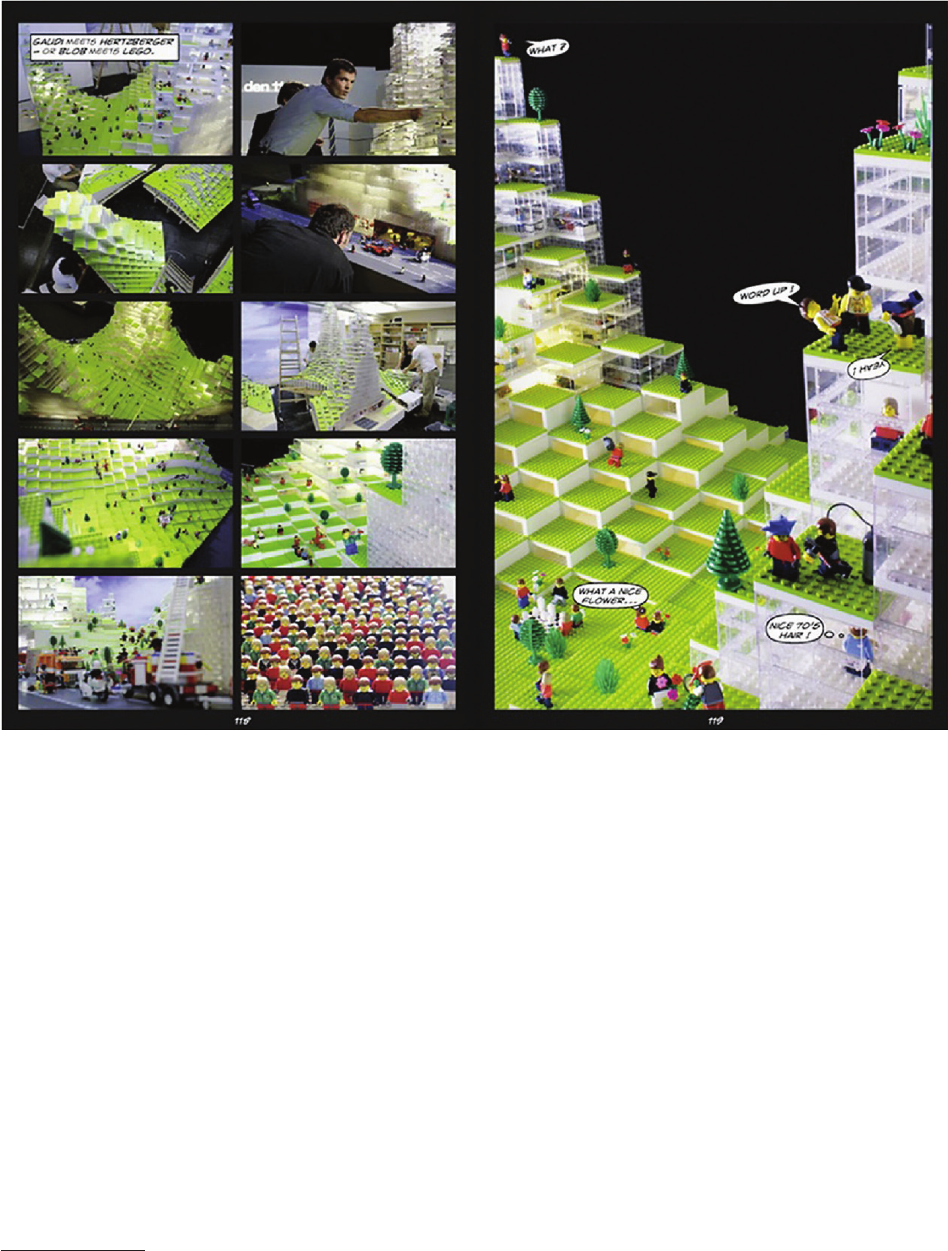
them, a model of the Lego Towers project, made of Lego
bricks, another unconventional procedure arousing the in-
terest of non-professional recipients (Fig. 1). The exhibi-
tion was also presented in France, the United States and
Germany.
The structure of the archicomic Yes is more
The comic consists of 35 chapters preceded by an in-
troduction and an additional chapter that opens the narra-
tive. At the end there is an iconographic explanation of the
idea of architectural evolution, an index of BIG projects,
a photo gallery from the exhibition and a short interview
with the author.
Before the introduction, 6 panels were placed. The
four panels are creative manifestos of famous architects.
Successive gures are presented in chronological order
in order to emphasize the development of architectural
thought. The rst is Mies van der Rohe with the words
“Less is more”, followed by Robert Charles Venturi “Less
is bore”, Philip Johnson – “I’m a whore”, Rem Koolhas
– “More and more, more is more”. As last but one comes
a fragment from the speech of the only non-architect, US
President Barack Obama, with his optimistic election cry
“Yes we can”. The location of this gure suggests that af-
ter many architectural declarations, it is time for a change,
non-conict and seeking unity. After this accent, the au-
thor Bjarke Ingels himself utters the slogan of his idea of
evolutionary architecture “Yes is more”. The architect’s
own statement is complemented by the message of the
manifesto, creating the author’s views as antagonistic to
the aforementioned architects.
The graphic novel opens with the shortest chapter. The
genesis of this artistic project is described on four pages.
It shows the background of the events that we will get
to know on the following pages. There are also present-
ed people who will be hidden until the end of the story,
and form one coherent creative organism standing behind
each new challenge for the protagonist. The short history
of the meeting with the client is a case study, the seed from
which the whole idea of the manifesto and the formula of
108 Andrzej Jarczewski
its announcement grew
4
. This episode revealed the neces-
sity of transmitting energy pulsating in the background of
emerging projects, recording migrating ideas and growing
structures taking shape of this architectural evolution. The
necessity to show how the idea crystallizes, even though
it is based on often wasted eort or even “fossils of past
evolution”, was revealed.
Economic, political, cultural and geographical contexts
are the basis for each of the discussed projects. Based on
the interpretation of these conditions, Ingels formulates
the designer’s own goals – “what if design could be the
opposite of politics?” In descriptions of 35 architectural
and economic ideas, contexts constitute an important refe-
rence for analyzes, […] they testify to the tedious design
4
One of the clients, whose meeting and tour of the studio ended
with the traditional delivery of information materials, including a multi-
media presentation, asked for the materials presented to him during his
visit. When it turned out that these were the same materials, he shared
his reection on the dierence in the perception of the architect’s work
– on the one hand, he saw dead drawings, and on the other hand, during
his visit to the studio, he felt the energy reviving the idea, derived from
the accompanying process of creating small stories or even jokes [6,
pp. 24–27].
approach used by BIG, which has proved to be a success
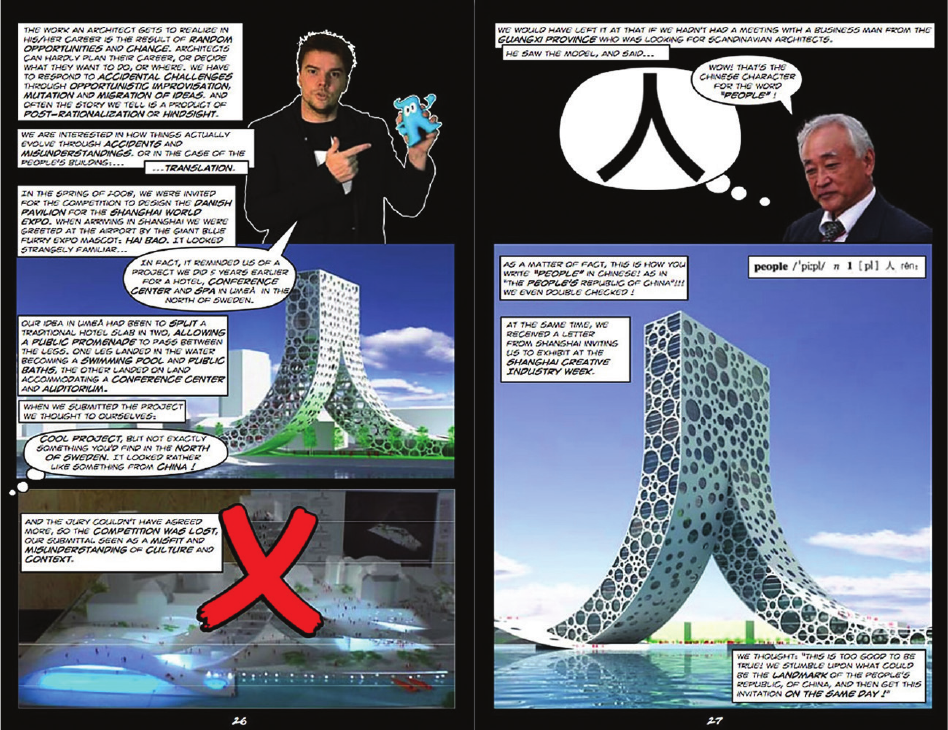
in recent years [7]. The cultural context is the inspiration
for the competition project in Shanghai, which is the con-
tent of the rst chapter (Fig. 2).
The following chapters visualize the development of
the concept of further projects and implementation of the
BIG oce. The investment locations are mainly the areas
of Denmark. We also get to know projects located in Azer-
baijan, Iran, Greece and Iceland. The following pages
show how the unique demands of terrain, the geography
of the cultural, economic and social context have been
dealt with. The search for spatial concepts that best reect
the possibi lity of combining investors’ requirements, the
creativity of architects and their worldview based on the
ideology presented in this comic are the narrative motive
of its content.
Yes is more can also be seen as a design oce directory.
The presentation of so many projects evokes such associa-
tions, however, the message, the means of communication
used, the presentation of individual and unconventional
methods, means, processes, and therefore a specic ap-
proach to the concept of architecture, indicate that this
comic is a manifesto not only architectural, but also cul-
tural. In the comic book Yes is more, the BIG studio pre-
Fig. 1. Bjarke Ingels Group, Yes is more, Taschen, Köln 2010
Il. 1. Bjarke Ingels Group, Yes is more, Taschen, Kolonia 2010
Yes is more comics as an architectural manifesto 109
continuum do they make us aware of how the creative
process develops, despite the changing stimuli each time.
In each of the chapters, in order to emphasize the change
in the dynamics of the action, dierent sizes of the frames
that make up the page are used. Large horizontal areas
indicate a slowdown in work. This is clearly visible in
the moments of searching for solutions, sometimes even
wrong. Vertical, narrower, and sometimes even irregular,
they build the tension accompanying the upcoming break-
through or announcing the creators’ success. A similar
role is played by the visual forms of “speech bubbles”,
whether they are dialogical or lled with comments to the
illustrations. Calm, regular rectangles suggest a technical
description of the project, they describe the content of the
frame with balance. “Balloons” or words without frames
drawn in a bold, clear font, sometimes multicolored, em-
phasize the emotions accompanying the project work or
heated discussion over the chosen direction.
Ingels’ narrative methods
Ingels uses all the available graphic comic language
tools. In his work, we can see the modeling of canoni-
cal methods of narration. The rst pages of the comic
sents the process of designers’ response to various require-
ments, introduces the rules of conducting investments and
transcribes highly specialized social knowledge, creating
specic solutions through artistic processes [8].
Form versus narration
The chosen form of presenting the manifesto is con-
sistently followed throughout the book. From the very
beginning, we have no doubts that we are dealing with
a comic book. Pages divided into frames lled with imag-
es, supplemented with various forms of dialogue or com-
menting speech bubbles are what we commonly consider
to be comics. The images that ll the frames are photos,
drawings, sketches or reproductions. Arranged in the or-
der of passing time linearly, they present successive sto-
ries while creating a narrative. Each story is a chapter that
captures the next phase in the development of the compa-
ny and Ingels as its chief architect. These phases create
a certain rhythm that accompanies all architects. A rhythm
that we can dene colloquially “from order to order”. But
we can observe these phases independently. Each of them
is a description of working on a dierent project, not re-
lated to the rest. However, only when arranged in a time
Fig. 2. Bjarke Ingels Group, Yes is more, Taschen, Köln 2010
Il. 2. Bjarke Ingels Group, Yes is more, Taschen, Kolonia 2010

110 Andrzej Jarczewski
come to the nal shape, the base for the target project.
A parallel thread is the analysis of economic conditions
and their impact on functions in the space of the object.
Like other analyses, each new topic becomes an impulse
for change and is guided by a separate graphic line, dif-
fering in the size of the frame, drawing details, graphic
technique, color tone
5
.
Regardless of the other “threads”, the author also pre-
sents a line of media comments in a graphically distinc-
tive form. In literary books, including comics, comments
are reduced to explanatory notes after the * asterisk at
the bottom of the page. Ingels recognized that comments
were also contextual elements inuencing the action and
gave them a full-edged graphic line. Finely divided into
Mondrian-like areas, the pages are lled with scans from
newspapers, journals, opinion weeklies and magazines
popularly known as “tabloids” instead of pure colors. He
does not refer to quoting opinions about his projects, but
only quotes their images. In this way, he inserts the pub-
lic discourse into the comic book’s narrative, creating
another narrative line – commenting on the action like
a Greek Chorus. For the rst time in a comic, this kind of
public projection appeared in Frank Miller’s comic book
The Dark Knight Returns in 1986
6
. Ingels admits that it
is one of his favorite comics [10], and he used the format
of shots from meetings in a television studio to present
the most controversial idea for Danish citizens – to trans-
port the national symbol of Denmark, i.e., the sculpture of
the “Little Mermaid”
7
to China. In Yes is more newspaper
headlines are also presented, some of them even marked
with picture runes, emphasizing their ashy nature of
speech, in the language of comic art, usually helping to
visualize intense states and emotions [11].
In order to take advantage of the possibilities oered
by the comic, Ingels graphically emphasizes breakthrough
moments in the creative process. They become the core
of the action, which stimulates the natural curiosity of the
readers. An important aspect of this form of communi-
cation is its aesthetic value. The text in the comic itself
would be 120 pages long. In the present reality of a visual
culture dominated by social media, the audience would
be next to negligible compared to the one that reacted to
the comic. This is undoubtedly the inuence of the cho-
sen medium, which in this case conrms the principle of
5
A similar method of presenting the creative process based on
impulses unblocking the narrative was also used by Bernard Tschumi
in his 1981 manifesto The Manhattan Transcripts [9]. In this study, the
Swiss architect presented in one line, in square elds, photos or draw-
ings visualizing a stage, movement, context. In subsequent lines, they
changed into architectural graphics, and then urban graphics. Tschumi
thus presented his vision of thinking about creation, grading the scale
– from micro to macro.
6
In Frank Miller’s comic book, comments were placed in comic
book frames in a shape resembling TV screens of the time. They were
spoken by the presenters of opinion-forming and entertainment televi-
sion stations, which suggested an open discussion.
7
The nearly 100-year-old sculpture of “The Little Mermaid” from
Hans Christian Andersen’s fairy tales was brought to the EXPO exhibi-
tion in Shanghai, China, and the entire architectural space was subordi-
nated to it, placing it on the water in the center of the Danish pavilion in
the shape of two superimposed rings [6, p. 44].
introduce the reader not only to its content, but also to
the form in which it will be presented. Against the back-
ground of a two-page black and white photo, the creators
use a few words written in a conventional “speech bub-
ble” sign to express their creative declarations. In the se-
mantics of comics, “a balloon” with a sharp protrusion
pointing to the speaker’s face means “a spoken statement”
[8], which means that they are not author’s interpretations
of their thoughts. Additionally, the panels are “equipped”
with a black frame with a short text explaining when the
quote was made and describing the meaning and context
in which it was spoken.
The comic book style chosen by Ingels is to facilitate
the reception of messages received by the architect from
the outside. Communications, which include all inspira-
tions, investor guidelines and all others that become the
source of the creative process. The need to focus on sim-
plifying the message to the formula of images and texts in
frames also forced the author to condense the information.
He did this using intelligible language, though not neces-
sarily simple. Large illustrations showing the visualiza-
tion of the object indicate the subject of the story. Small-
er frames are lled with analytical charts, iconographic
background, showing direct transcription from the mor-
phology of the language or close-ups on details. The pages
are enriched with images of the narrator and other partic-
ipants of the narrative, expressing themselves in the form
of characteristic “speech bubbles”. The content is provid-
ed in the form of text in rectangular frames. The state-
ments are placed in balloons in the shape of a balloon with
a “tail” directed at the speaker. Inner reections, not spo-
ken aloud, are also lled with balloons, but these are ovals
of various sizes owing out of the gure’s head. Large
graphic signs, covering almost the entire picture – crosses,
exclamation marks, arrows, onomatopoeias, as well as the
selection of fonts lling the text balloons, also come from
the workshop of a comic book artist rather than an engi-
neering studio. The narrative diagram created in this way
is a kind of template on which the subsequent “graphic
novels” included in the comic are built.
The structure of the pages, the division, is not repeata-
ble, but the visual components representing the indicated
scope of content, consistently implemented, create spe-
cic segments of encoded information. These segments
could be dened as equally coexisting narrative threads.
These narratives are linear, sometimes several on one
page, showing the multidirectional process of creating an
architectural work. There are segments that are a collec-
tion of location, contextual, historical, social and econom-
ic information.
The narrative line showing the sequence of creating the
body of the building, the investment, are blocks consisting
of small graphics, often appearing without frames, only
on a black base background. Low detail drawings take
turns to show the spatial transformation of the original
idea. Each frame of this narrative demonstrates the devel-
opment of the project, e.g., of the mass itself. In the rst
gures there are attempts to directly visualize the needs,
guidelines or their interpretation. Next, the original char-
acter is subject to metamorphoses. On the last ones we
Yes is more comics as an architectural manifesto 111
Canadian media expert Marshall McLuhan “the medium
is the message itself” [12].
A visual manifesto
Bjarke Ingels submitted his architectural manifesto us-
ing an innovative presentation path. Created slogans of sus-
tainable hedonistic development, vertical suburbs or utopi-
an pragmatism, verbalized solely with the use of black and
white text would become another set of statements.
Ingels
paraphrases Darwin by saying that the species most capa-
ble of adapting to change will survive. He visualizes his
thoughts in an innovative way. Black typographic char-
acters (letters that build words) are a supplement that ex-
plains the actual ow of ideas. The multi-layered sequenc-
es of drawings create a visual narrative of the ma nifesto.
Pictures replace words. The architect’s image debates with
the images of clients, recipients, politicians, and users.
Declarations on social processes, ecology, and aesthet-
ics are visualized in narrative and stylistically arranged
streams of photos, drawings, graphics and charts. In this
ma nifesto, instead of underscores and bolds, exag gerated,
multi-colored, often deformed icons, signs, and runes, typi -
cal of comics, were used. Sustainable declarations linking
the evolutionary thoughts of naturalist Charles Darwin and
the creative powers of philosopher Friedrich Nietzsche
are made against the backdrop of an explosion of frames,
skillfully mitigating the information noise accompanying
contemporary societies. Ingels skillfully lays out Darwin’s
adaptation to change in a formula that is adapted to the
present day. In view of the enormous nancial and turnout
successes of comic book adaptations, this formula of the
manifesto seems to be a method of presentation that oers
the broadest range of reception, not only of the idea, but
also of the architecture itself.
Summary
Architectural manifestos are undergoing their regres-
sion. The infographic published by ARCADE Magazine in
the fall of 2014 documents the most important architectural
manifestos of the last century (since 1904 to be more pre-
cise). Thirty modern ideas were noted in it from 1900 to
1960, more than eighty in the years 1960–2010. In 2014,
there were only two. Presenting creative manifestos ceased
to be a path to artistic innovation. In 1965 Walter Gropius
wrote: The Past was broken, which allows us to imagine
a new aspect of architecture corresponding to the technical
civilization of the era in which we live; the morphology of
still styles has been destroyed… [13, p. 9]. Currently, such
strong declarations do not exist. This raises questions not
only about the future of architecture. It shows how few ar
-
chitects are currently ready to express their willingness to
change through verbal declarations. However, nding new
means of visual communication can break this trend. Inter-
disciplinarity and the permeation of art disciplines have ac-
companied architecture from its beginnings. The medium
of comics indicates the possibility of introducing narrative
into the transmission of ideas, as well as into the architec-
tural space itself. The interest in comics by contemporary
designers should be associated with the eectiveness of
this means of professional communication at various stag-
es of designing and promoting the idea. The wide range
of transmission of ideas and content through this medium
allows for attractive and diverse artistic forms adapted to
traditional analog forms of publication and digital media.
Bjarke Ingels creates a new formula of an architectural
manifesto. It does not call for a new revolution, but it does
follow a specic template for such a declaration. He iden-
ties antagonists, makes statements and declares how he
will implement them. His archicomic, using the language
of narration, points to evolution as a path to a new one.
Imaging with comics in the era of modern media enables
the architect to combine images and verbal messages into
a suggestive whole. Its graphic forms combine the tradi-
tional art workshop of an architect, the artistic quality of
the message with the latest technologies for processing
and disseminating information.
Unlike static graphics of single drawings or computer
animations, comics allow the reader or viewer to adjust the
pace of exploring the content to their needs, knowledge
and sensitivity. The eectiveness of this form of commu-
nication can be perceived in the fact of abandoning the
hermetic formula of project documentation and adapting it
to visual forms occurring in mass culture. Such a presenta-
tion of the manifesto of architectural ideas gives the op-
portunity to go beyond the narrow circle of the profession-
al environment and to interest a wider audience in them.
It is an important culture-shaping mission of the designer
– increasing the spatial culture and social awareness of the
role of architects and architecture in the society.
Translated by
Andrzej Jarczewski
References
[1] Łosiewicz M., Rola obrazu w komunikacji społecznej, [in:] A. Ob-
ręb ska (red.), Komunikacja wizualna w przestrzeni społecznej, Pri-
mum Verbum, Łódź 2009, 205–212.
[2] McCloud S., Zrozumieć komiks, Kultura Gniewu, Warszawa 2021.
[3] Olinkiewicz E., Radzymińska K., Styś H., Słownik encyklopedyczny
– Język polski, Europa, Wrocław 1999.
[4] Van Der Hoorn M., Bricks & Balloons, 010 Publishers, Rotter dam
2012.
[5] Olóriz C., Lus Arana K., Amazing Archigram interview sir Peter
Cook, “Mas Context” 2013, No 20, 48–61.
[6] Bjarke Ingels Group, Yes is more, Taschen, Köln 2010.
[7] Parker I., High Rise. A bold Danish architect charms his way to the
top, „The New Yorker” 2012, September 10, https://www.newyor-
ker. com/magazine/2012/09/10/high-rise [accessed: 12.01.2020].
[8] Hofmeiste S., Bjarke Ingels explains the world the way we like it,
STYLEPARK 2010, https://www.stylepark.com/en/news/bjarkeingels-
explains-the-world-the-way-we-like-it [accessed: 5.10.2020].
112 Andrzej Jarczewski
Abstract
Yes is more comics as an architectural manifesto
The aim of the article was to present a comic book as a new medium of communicating the architectural manifesto and to highlight the trans-
mission possibilities that this genre of art brings to architects. The subject of our study was the archicomic Yes is more created by Bjarke Ingels, the
founder of the Danish architectural rm BIG. The visual and narrative means used by the author, which are characteristic of the language of comics,
have been analyzed. A study was conducted on what linguistic and graphic forms the author used to take advantage of the popularity of the medium
chosen by him. In a declaration so important for every author, which is a creative manifesto, the choice of the medium of communication also
becomes an artistic declaration. During the research, the case of the architectural manifesto of the British design group Archigram was investigated,
which rst published it as a comic book.
The article describes how Bjarke Ingels, in his archicomic, gave his thoughts on the architect’s methods of operation, how to create architecture,
and how this architecture should exist and function. The 400-page long graphic novel used the divisions, narrative lines and visual eects character-
istic of a comic book. The author, appearing here as a comic book hero, uses images illustrating the methods of designing architecture and the eects
of this work.
The conclusions of the study are in line with Ingels’ actual achievements. Referring to the phenomenon that the comic has now become in the
form of a manifesto gives measurable marketing eects, conrming the eectiveness of the medium used. Yes is more is the most cited example of
an architectural comic today.
Key words: architecture, comics, manifesto, Bjarke Ingels
Streszczenie
Komiks Yes is more jako manifest architektoniczny
Celem artykułu było ukazanie komiksu jako nowej formy przekazu manifestu architektonicznego i naświetlenie możliwości transmisyjnej, jaką
niesie ten gatunek sztuki dla projektantów architektury. Przedmiotem pracy był archikomiks Yes is more stworzony przez Bjarke Ingelsa – założyciela
duńskiego biura architektonicznego BIG. Przeanalizowane zostały zastosowane przez Inglesa środki wizualne i narracyjne charakterystyczne dla
komiksu. Przeprowadzono badanie, jakimi formami językowymi i gracznymi się posłużył, by wykorzystać popularność wybranego przez siebie
medium. W tak ważnej dla każdego autora deklaracji, jaką jest manifest twórczy, wybór nośnika przekazu staje się również deklaracją artystyczną.
W artykule opisano, jak Bjarke Ingels w archikomiksie przekazał swoje przemyślenia na temat metod działania architekta, sposobu tworzenia
architektury oraz jak ta architektura powinna istnieć i funkcjonować. Stworzona 400-stronicowa nowela graczna wykorzystała charakterystyczne
dla komiksu podziały, tory narracyjne i efekty plastyczne. Autor, występując tu jako komiksowy bohater, używa obrazów ilustrujących metody
projektowania architektury i efekty tej pracy. W trakcie analiz zbadano też przypadek manifestu architektonicznego brytyjskiej grupy projektowej
Archigram, która jako pierwsza opublikowała go w postaci komiksu.
Wnioski z badania pokrywają się z rzeczywistymi osiągnięciami Ingelsa. Odwołanie się formą manifestu do fenomenu, jakim obecnie stał się
komiks, daje wymierne efekty marketingowe, potwierdzające skuteczność zastosowanego środka przekazu. Yes is more to obecnie najczęściej przy-
taczany przykład komiksu architektonicznego.
Słowa kluczowe: architektura, komiks, manifest, Bjarke Ingels
[9] Tschumi B., The Manhattan Transcripts, Academy Editions, Lon-
don 1994.
[10] Klaustoon’s Blog, https://klaustoon.wordpress.com/2011/09/26/yes-
is-more-or-less-zoomzzzzrrttthudblaam-%e2%80%93-me-not-
full-text/ September 26, 2011 [accessed: 5.03.2020].
[11] Birek W., Komiks, [w:] G. Gazda (red.), Słownik rodzajów i ga tun
ków literackich, Wydawnictwo Naukowe PWN, Warszawa 2012, 479.
[12] McLuhan M., The Gutenberg Galaxy: The Making of Typographic
Man, University of Toronto Press, Toronto 1962.
[13] Gropius W., The new architecture an the Bauhaus, MIT Press,
Cambridge, MA, 1965.