2025
4(84)
Tomasz Omieciński*
The issue of the designer’s description of the appearance
of their architectural work
DOI: 10.37190/arc250411
Published in open access. CC BY NC ND license
Abstract
The aim of the article is to highlight the features that distinguish scientic texts from texts written by architects. The research is interpretative in nature
and uses the method of logical argumentation with the use of analogy. The examples described are situations when: an architect may not understand his
architectural work; an architect may lack the necessary theoretical knowledge; an architect may deliberately use argumentation in a dishonest way; an
architect may wrongly evaluate the creative process.
Being sensitised to these elements and the ability to critically approach architects’ statements can be applied to academic activities when working with
architects’ texts.
Key words: explicite aesthetics, theory and practice, project description, authorship, text criticism
Introduction
The appearance of a building may seem to be an arbitrary
matter, resulting from the subjective preferences of the ar-
chitect. Nevertheless, it is what appeals to the general public
quickly and strongly. One instantly and eortlessly forms an
opinion of a building simply based on its appearance. Be-
cause of that, in order to win the favor of residents and poten-
tial decision-makers, the visual aspect of the future building
is presented as attractive and appropriate. Photos or drawings
are used for this purpose, yet statements by architects, high-
lighting advantages and explaining the reasons for imperfec-
tions, are also very important. Contemporary designers often
give interviews and publish texts in which they explain formal
assumptions. What is interesting is the manner in which the
architects use words to talk about the designed forms. Why
and how do they argue for something that remains a matter of
individual taste for certain persons? How do they describe the
appearance of their projects? How do they outline the prin-
ciples of their aesthetics? In publications aimed at potential
audiences of the buildings, they place great importance on
explaining the inspiration for the building’s form, describing
the relationship with the context and the ideas according to
which they create their works. Their statements, due to their
personal relationship and non-scientic purpose, are of a dif
-
ferent nature than the texts of scientists, and involve a number
of diculties, yet they are not completely devoid of scientif-
ic value for researchers dealing with architectural aesthetics.
This article illustrates that matter with concrete examples.
Description of own research
Aim of the study
The article describes some recurring phenomena, and its
goal is to name the problems (there are four of them emerg-
ing from the literature on the subject) burdening the author’s
descriptions of the appearance – and only the appearance
– of the architecture, and then to broaden our understanding
of their nature in order to improve our work process with
them. This skill will nd application in academic activities
when analyzing texts, such as assessing the inuence of the
architect’s personality on the text or evaluating the objectiv-
ity of the text.
* ORCID:
0000-0002-9333-0783. Faculty of Civil Engineering, Ar-
chitecture and Environmental Engineering, Lodz University of Technolo-
gy, Poland, e-mail: tomasz.omiecinski@p.lodz.pl
120 Tomasz Omieciński
Research method and techniques
The research described is interpretive in its nature. I make
the epistemological assumption that knowledge is the result
of the interaction between intuition and reason; intuition acts
as a tool of initial discernment based on the researcher’s ex-
perience. The study was carried out by the method of logical
argumentation using analogies between the visual arts (gen-
eral approach) and architecture (special case).
The problems associated with descriptions of artworks
from their creators have already been described. The arti-
cle presents the search for them in architectural activities
(architecture and urban planning are treated as artistic activ-
ities herein). General theorems are illustrated with precise
architectural examples that verify the correctness of the in-
tuitive phase. In this way, it was demonstrated that the listed
problematic situations do occur in architecture. The ndings
have an academic focus.
The research used literature from the elds of art and
architecture. The rst group consists of works by aesthe-
ticians, dealing with the problems of the texts of artworks’
authors – Maria Gołaszewska (1967; 1984; 1986) and Ste-
fan Morawski (1973; 2007). The second group consists of
scholarly articles introducing the statements of architects by
Lech Niemojewski (1934) and Andrzej Klimek (2022).
Texts by creators vs. scientific papers
Among publications concerning architecture, one can dis-
tinguish between texts written by academics (especially his-
torians), critics and architects themselves; sometimes the au-
thors may belong to several of these groups. Texts written by
architects seem to be the least reliable from a scientic point
of view, although their presence is nothing new. Authors who
had already written about their own works include Theodoros
– who wrote about the Heraion of Samos, Chersiphron and
Metagenes – about the Artemision of Ephesus, Iktinos and
Karpion – about the Parthenon, Pytheos and Satyros – about
the Mausoleum at Halicarnassus (Tatarkiewicz 1962, 317).
Many later well-established architects described the aesthet-
ic design principles that guided them, including Adolf Loos
(Haus am Michaelerplatz in Wien from 1911 [Polish: Mój
dom przy Michaelerplatz, 2013]) Le Corbusier (Vers une ar-
chitecture from 1923 [Polish: W stronę architektury, 2012]),
and also more contemporary ones – including Patrik Schu-
ma cher (The Autopoiesis of Architecture 2011 and 2012).
Even if their texts describe only their personal approach to
design, they conscientiously try to nd a scientic basis for
the instinctively perceived truths and principles of the visu-
al aspect of architecture. Loos argues that the placement of
his building’s windows reects function – the purpose of the
housing units and the number of rooms (2013, 160, 161),
Le Corbusier cites the use of the straight line as a necessity
brought about by the economics of the modern construction
site (2012, 262, 263), and Schumacher argues for an undu-
lating parametric architecture, showing curvilinear forms as
a natural result of the evolution of shapes and how they adjust
to each other (2012, 619). Considerations of form and critical
analysis of art and perception in order to establish general
laws – how space aects our sight – allow to treat designers’
books as design textbooks. The fact
that they are written by
the creators themselves, however, has implications that aca-
demic works do not.
Art manifestos constitute another expression form for art-
ists, after books. They are no longer as fashionable as they
used to be; nowadays, the short literary forms created by
architects often take the form of an interview or an author’s
description explaining the reasons for their decisions. They
also do not require the credo to be supported by sound argu-
ments, therefore – in my opinion – they do not cause confu-
sion when expertly analyzing scientic texts. Furthermore,
they often focus on social, technological and engineering
aspects rather than aesthetics (although Friedensreich Hun-
dertwasser and Pierre Restany’s Mouldiness Manifesto
Against Rationalism in Architecture, 1958/1959/1964 can
be mentioned here), which is what this article is about.
Relationship of theory and practice
Appearance is an aspect that is dicult to describe in
words. Even ancient terms such as “harmony” and “pro-
portion” have frameworks rather than rigid denitions. De-
scription is combined with the experience of feeling, there-
fore it is reasonable that not only scientists, but also artists
are considered competent in this domain. Morawski treats
artists’ statements about the appearance of plastic works as
full-edged sources of knowledge about art, pointing out
that […] aesthetics aiming at the scientic rationalization
of aesthetic aspirations, assumed a limine and unquestiona-
ble, is forced to rely on all levels […] of the rationalization
process – from average tastes through artists’ manifestos to
philosophers’ statements (1973, 29). Contrary to the compli-
cated theory associated with the concept of beauty, practice
has been excellent in dealing with it. Determining the rules
of how to bring beauty into existence, on the other hand,
borders on the impossible. It is therefore worth exploring
the texts of those for whom practice is the starting point for
consideration. Meaning: those who often create in a similar
way to how the rest of the people perceive art – intuitively.
In Historia estetyki [History of Aesthetics], Władysław
Tatarkiewicz distinguishes between explicite aesthetics
(treat ises, theories, artists’ declarations) and implicite aes-
thetics (artistic practice, fashion, customs of the era) (1962,
12, 13). He justies this, writing that there is often a clear
rift in these elds in history. Wassily Kandinsky even clar-
ies the direction of the inuence of practice on theory and
it is a ow from practice toward theory (1969, 261). Albert
Gleizes and Jean Metzinger echo Kandinsky in diagnosis
that reection on art cannot develop as rapidly as creative
abilities (1969, 104). All three mentioned analyzed the lat-
est trends emerging in art at the time – Kandinsky chalked
up the principles of abstractionism, Gleizes and Metzinger
– cubism. However, the priority of practice over theory is
not unanimously recognized, as exemplied by a number of
conceptual art artists. Conceptualism is an activity in which,
by denition, the idea, and not the work, is the most im-
portant thing. Such work, however, is far from architecture,
very much growing out of utilitarian motives. The architect
devises not only how the building will look and what it will
convey as a work of art, but also its functionality and design.
The issue of the designer’s description of the appearance of their architectural work 121
The message of an architectural work – its artistic side
– is combined with the practical dimension of the building.
According to American pragmatism as interpreted by John
Dewey, values do not come from some absolute world ex-
ternal to man, but are discovered by the individual in the
world. They are not imposed from above, but achieved em-
pirically. They are part of man and grow out of his needs.
Dewey calls them a permanent phenomenon of human life
and does not recognize the possibility of deriving them from
non-experimental sources (Dziemidok 2014, 41). The art of
construction, the intended result of which is the commis-
sioning of a physical object, should refer to empirics as of-
ten as possible. Developing theory without juxtaposing it
with the realities of the real world, without listening to what
practitioners have to say, can bring undesirable discord be-
tween the two. It is necessary to make such a confrontation,
even if artists’ statements do not reach scientic status in
many elds.
The role of the creator’s statement
in the reception of an architectural work
One of the questions that arises when dealing with the
text of an architect describing his building concerns the ba-
sic purpose of his statement. Is guidance necessary to under-
stand or fully experience the work? Or are they needed to
notice its beauty? Some do not comment on their work, con-
sidering it sucient and the only possible voice articulating
their intention. Paul Gauguin disliked explaining his works
and stigmatized his colleagues when they explained theirs.
Many works from other art elds are received more con-
sciously than architecture. People go to see a collection of
paintings by a particular artist whose biography they know,
or to an exhibition of a period in painting whose tenets they
are familiar with. Between the work and the viewer, there is
often the person of the creator, who inuences the reception
process. In the case of architecture, the person of the creator
most often remains unknown to the audience. Buildings,
unlike literature or painting, are rarely signed with a name.
The work must defend itself. It is received in passing, with-
out focus. The ubiquity of architecture and its nature do not
allow their users to explore the pedigree of each building.
Some defend the assumption that knowledge of the art-
ist’s thoughts is essential for a complete and “proper” re-
ception of the work. Maria Anna Potocka expresses an ad-
ditional objection in such a situation regarding the proper
experience of contact with art: A work detached from the
artist is an “abandoned entity” that requires theoretical le -
gitimacy. Art detached from the artist loses its justication
and closes the way to its essence, whose only clue is the
relationship between the work and the artist. This road re-
quires rebuilding (2007, 58). Therefore, Theodor Adorno
believes that the truth hidden in a work of art can remain
forever forgotten, and without philosophical reection – ne-
ver undiscovered (Potocka 2007, 58, 59).
The position presented in the foregoing paragraph refers
to the idea of the work of art as an egoistic creation, not
created with the viewer in mind, as a completely individual
record of the artist’s thoughts. In my opinion, this is incom-
patible with architectural art, which puts the viewer (user)
at the center. The need to respect them is already apparent at
the stage of presenting the concept. In this phase, words car-
ry an exceptionally high weight. Numerous architects, who
must curry favor with residents and decision-makers (who
depend on residents), have mastered the ability to persuade
eectively. A large part of their arguments are aimed at the
community at large, so they may not be very expressive
– they are based on emotions, not facts, as they are meant
to spread a vision of the future, not the status quo. Archi-
tects can use emotion-based persuasion techniques for this
purpose: the principle of reciprocity (asking for a deviation
from conditions argued by balancing this with other benets
of the project), social proof of rightness (citing analogous
projects in other cities; noticeable in the case of iconic ar-
chitecture), moral persuasion (touching on ecological and
safety aspects). These techniques do not have to be used
fraudulently. Unfortunately, such statements are sometimes
duplicated later and can uncontrollably make their way into
industry speeches and beyond (a learned speech, but also
participation in a public consultation → a citation in the
industry press without marking the citation → a scientif-
ic article about the building). Texts by architects published
in layman sources are intended to deepen the architectural
awareness of citizens, popularize currents in architecture or
present a public building in an accessible way, among other
things. Texts aimed at industry insiders, on the other hand,
should be as reliable and objective as possible and advance
architecture and urban planning.
Problems related to architects’ texts
about their works
Presented below are four problematic situations that can
occur in a text written by a creator. The order of the sub-
sections is based on a pattern that follows from the detail to
the whole: work on the project, that is, the as yet unnished
minor elements of the project → interpretation of the idea of
the nished project → architectural thought beyond a single
building (concerning the architect, trend, style, philosophy).
Subsection 4 is the only one that deals with the potential
dishonesty of the writer.
1. The architect may misjudge the impact of the process
on the work.
One of the problems of authorial descriptions is the case
when the artist gives a lot of facts about the process of cre-
ating the work when evaluating it. Reproducing the course
of the creative process can be subject to many errors. The
order of the phases, or even the very choice of experiences
and thoughts that contributed to the execution of the proj-
ect may be disturbed (Gołaszewska 1986, 176, 177). A per-
sonal attitude to the work can distort its fair judgment: the
architect’s memory is clearly imprinted by the long hours
spent on bringing the idea to its nal form, meanwhile, the
inconvenience associated with it does not translate into the
reception of the work. The author may wrongly exaggerate
the importance of dicult moments in the creative process,
belittling those that came to him, as it were, on their own
(Gołaszewska 1986, 189). The role of rejected ideas in de-
veloping a mature, albeit dierent, form may also remain
underestimated (Gołaszewska 1986, 179).
122 Tomasz Omieciński
In the description of the Plato Contemporary Art Gallery
project, the architectural rm KWK Promes writes extensively
the following, which can be found on their website: Original-
ly, the plaza around the building was to be concrete. However,
subsequent reports of climate change and environmental ca-
tastrophe made us decide to react and change the project. In-
stead of concrete, we used natural water-permeable paving,
and introduced a lot of greenery, ower meadows and natu-
ral retention. Currently, despite the ongoing construction, we
are also working to increase greenery to the building’s roofs
with extensive vegetation in the shade of distressed brick on
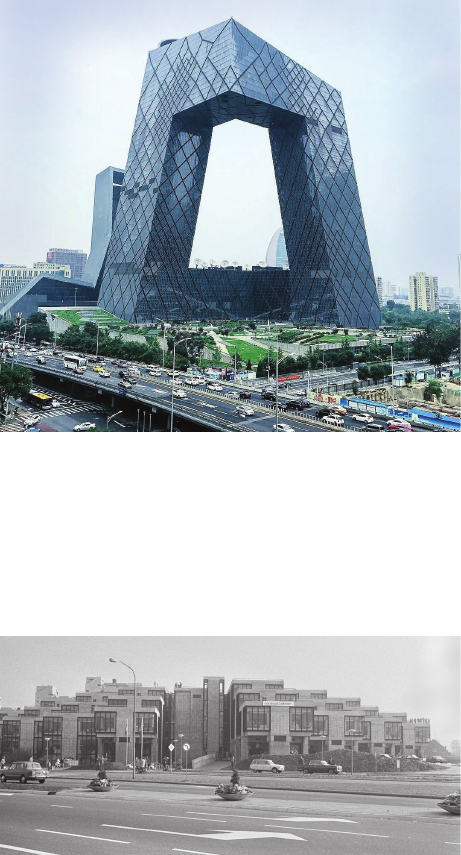
Fig. 1. CCTV building designed by Rem Koolhaas, Beijing, 2012
(photo by Colin Charles, CC BY-NC-ND 2.0, source: flickr.com/
photos/byte/35966604971, accessed December 3, 2024)
Il. 1. Budynek CCTV zaprojektowany przez Rema Koolhaasa, Pekin,
2012 (fot. Colin Charles, CC BY-NC-ND 2.0, źródło: flickr.com/
photos/byte/35966604971, dostęp 3.12.2024)
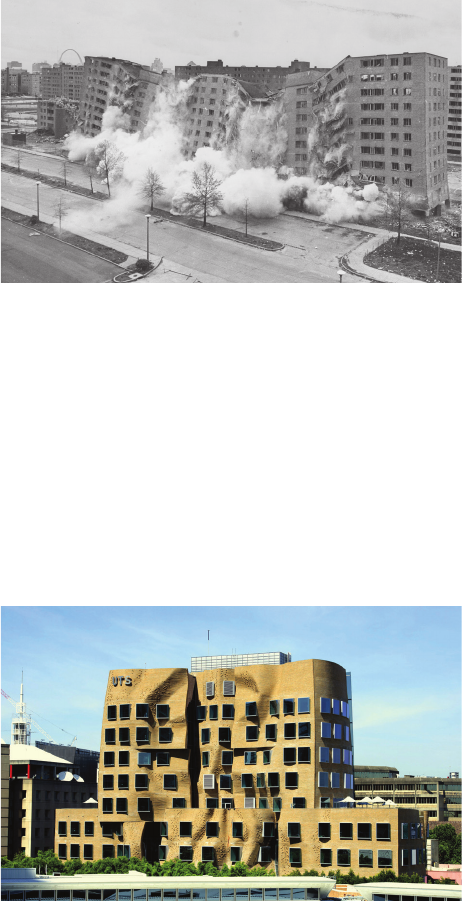
Fig. 2. Centraal Beheer building designed by Herman Hertzberger
(Apeldoorn, 1972). According to the designer – democratic answer
to the modernistic monolithicity. For Jencks – modernism in different
guise (photo by Punt, W. / Anefo, Nationaal Archief, CC0,
source: http://hdl.handle.net/10648/abfb5e10-d0b4-102d-bcf8-
003048976d84, accessed November 24, 2025)
Il. 2. Budynek Centraal Beheer projektu Hermana Hertzbergera
(Apeldoorn, 1972). Według projektanta – demokratyczna odpowiedź
na monolityczność modernizmu. Według Jencksa – modernizm w innej
szacie (fot. Punt, W. / Anefo, Nationaal Archief, CC0,
źródło: http://hdl.handle.net/10648/abfb5e10-d0b4-102d-bcf8-
003048976d84, dostęp 24.11.2025)
the façade. We believe that it is now necessary to ght for
every square meter of greenery in the city (KWK Promes,
slide 8). The description of the unrealized concrete version
may indicate a strong attachment to it, a sense of the need to
mention it in the author’s commentary. Justifying water per-
meability by taking care of rational water circulation seems
sucient. The last two sentences are another indication that
the KWK Promes rm considers it important to report on the
course of its work.
Overinterpretation of the design process itself and a per-
sonal attitude can aect an architect’s statement. A similar
selection of facts according to their signicance should be
carried out by the critic – instead of the artist’s experiences,
their creative abilities should be examined. To understand
a work of art and admire it, it is not necessary to know the
history of its creation or the life of its creator.
2. An architect may not understand their own work.
The situation in which one interacts with a work without
description or explanation does not necessarily impair its
reception at all. Authors are not always good interpreters of
their works. Gołaszewska believes that this is often seen at
author meetings, where the artist learns new things about
the work or hears an apt take on things only felt by them-
selves (1967, 37, 38). In another place, the researcher notes
that the artistic level of a work of art and the abilities of its
author can be incommensurable: […] the creative possibil-
ities [of the artist] are more extensive than those realized in
this one creation, and at the same time, what is realized in
the work often surpasses their intentions, arouses surprise
in themselves (Gołaszewska 1986, 181).
A similar situation can occur in architecture. Sometimes
a critic can see a positive aspect of a building that the de-
signer was not aware of. Charles Jencks – a critic and also
a juror of the competition to select the design of the new
headquarters of Chinese television – compared the CCTV
building in Beijing, designed by Rem Koolhaas (Fig. 1) to,
signicant for this country, the symbol of the moon gate
(Deyan Sudjic points out the friendly relationship between
Jencks and Koolhaas [2015, 145–147]). In this case, the crit-
ic’s ability to connect seemingly distant things highlighted
a feature of the building that the architect himself probably
did not plan. The symbolic dimension, understood by the
Chinese, was not Koolhaas’ intention, however, at the stage
of presenting the project it had already become visible, it
was part of the work.
Not understanding one’s own work does not always
mean not realizing its positives. According to Jencks, archi-
tect Herman Hertzberger with the Centraal Beheer building
(Fig. 2) sought answers to the monolithic nature of modern-
ist oce buildings. The designer said he was creating dem-
ocratically, designing architecture for the people (Jencks
1988, 32, 33). Jencks denies this in a remark that the design
leaves no room for dierent preferences (e.g., those of tradi-
tionalists), and despite a step in the right direction, it is still
an architecture of repetitive modules devoid of character.
The appearance of this construction project is also subordi-
nated to one distinct aesthetic. The modernist program was
simply dressed in a dierent garment here. The thing that
constituted a paradigm shift for the architect was merely
a new quality within the paradigm according to the critic.
The issue of the designer’s description of the appearance of their architectural work 123
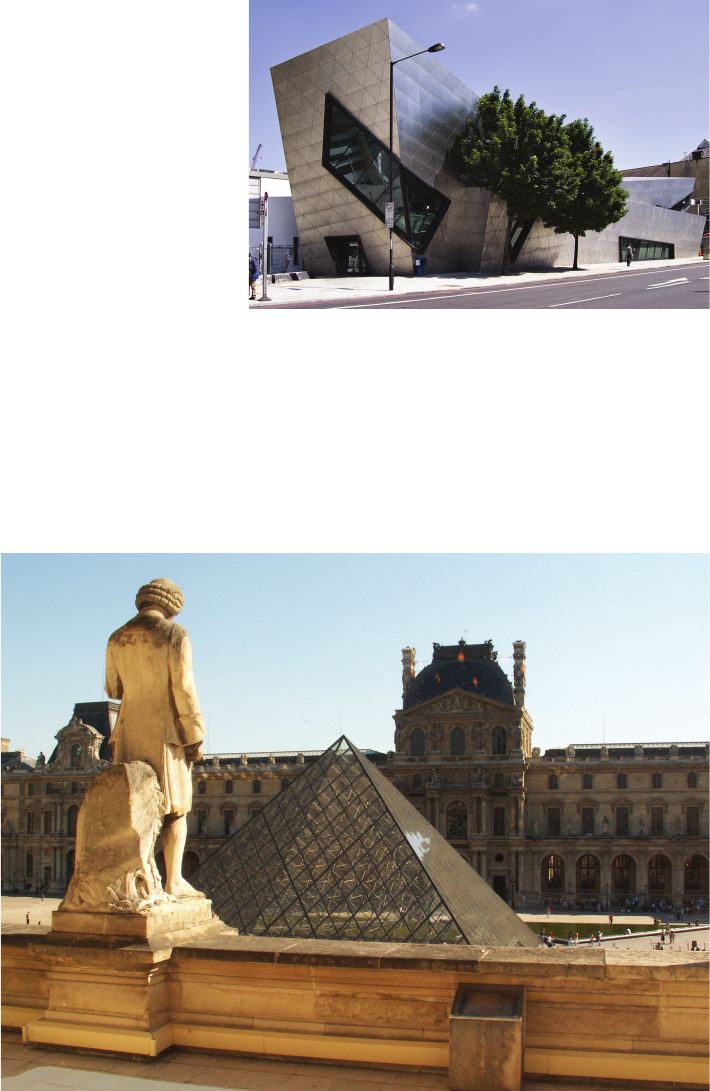
Simone Brott believes that another misunderstanding ap-
pears in the description of the Dr. Chau Chak Wing Build-
ing in Sydney by its designer, Frank Gehry, as humanized
modernism (Brott 2012, 57, 58). The “crumpled” façade
is meant to make modernist architecture more human, ac-
cording to the architect. Even to the layman, the warped,
crooked walls – which look as if they were created by a hos-
tile force that crushed the smooth plane – do not create the
impression of humanizing, giving dignity, increasing the
humanistic aspect of the architecture. In addition: in this
image, Brott nds a clear reference to the photograph of the
demolition of the Pruitt-Igoe complex, which is well-known
to architects: the Sydney building looks like Pruitt-Igoe fro-
zen in the middle of the demolition process (Figs. 3, 4).
Modernism is thus petried in the image of its symbolic de-
mise. The architect does not seem to consciously refer to the
media space that accompanies architecture, which is more
visible to the critic or a scholar.
Today, buildings exist not only in material reality, but
also (sometimes even more strongly) in imaginary space.
Photographic reproductions, video recordings, even notes
are now almost an integral part of architecture analysis.
Whenever it occupies the public’s attention, so many times
its presentation techniques gain relevance. Such an example
is provided precisely by the symbolic end of modernism,
as the demolition of Pruitt-Igoe has been dened as such.
Thus, if Gehry did not notice the similarity described here,
then his building “spoke” in a discussion outside the design-
er’s intent.
3. The architect may not always know the theory.
The problem of interpretation can extend to a sphere
broader than the individual creator. Artists can misinter-
pret their own actions and create theories that, upon deeper
analysis, bear the mark of a mistake. Stanisław Ignacy Wit-
kiewicz draws attention to such examples and, in his style,
waspily criticizes them: It would seem that the confessions
of a very sincere artist, and at the same time: one capable of
self-analysis, could shed some light on the process. Howev-
er, judging by the works and comparing the statements of the
artists, one comes to a complete hopelessness in this matter.
Often as a result of inaccurate analysis, a great number of
subconscious processes of duration, that is, changes in the
background of mixed quality, as well as due to the intellectu-
al under-education of artists, their declarations can be very
misleading. […] And how many artists there are who have
false theories of their work, which then become the cause of
monstrous schools of mindless imitators of them, who, not
being able to experience the analogous evolution process of
a given artist and the process of purely individual creation
itself, […] helping themselves with theories begotten by the
often sick and degenerate, as in these days [1919], brains
of such artists, who no longer have the strength for theo-
retical thinking. How many artists there are and have been
who did not know what they were creating, having no con-
ceptual form to describe […] (1969, 189, 190). Witkiewicz
blames the unconsciously inconsistent theories on the in-
sucient knowledge of artists. Władysław Strzemiński, in
his book Teoria widzenia [Theory of Seeing], accuses the
weak Impressionists of being unable to understand why the
outstanding painters of the movement painted the way they
Fig. 3. Demolition of Pruitt-Igoe housing complex on March 16, 1972.
Simone Brott notices the similarity in the form of the Dr Chau Chak Wing
building to the moment captured in this photo (photo by U.S. Department
of Housing and Urban Development, public domain, via Wikimedia
Commons, source: commons.wikimedia.org/wiki/File:Pruitt-igoe_col-
lapse-series.jpg, accessed November 24, 2025, cropped by T. Omieciński)
Il. 3. Wyburzenie kompleksu mieszkaniowego Pruitt-Igoe 16 marca 1972.
Simone Brott dostrzega podobieństwo formy budynku Dr Chau Chak
Wing do momentu z tego ujęcia (fot. U.S. Department of Housing and
Urban Development, domena publiczna, za Wikimedia Commons, źródło:
commons.wikimedia.org/wiki/File:Pruitt-igoe_collapse-series.jpg, dostęp
24.11.2025, przycięcie fot. T. Omieciński)
Fig. 4. Dr Chau Chak Wing Building designed by Frank Gehry
(Sydney, 2015). Instead of the human side of architecture
declared by the author, Simone Brott sees the resemblance
to the moment of demolition of the Priut-Igoe
(photo by Brickworks Building Products, CC BY-SA 2.0,
source: https://tiny.pl/0y5kgd0x, accessed December 3, 2024)
Il. 4. Budynek Dr Chau Chak Wing zaprojektowany przez Franka
Gehry’ego (Sydney, 2015). Zamiast deklarowanego przez autora
ludzkiego oblicza architektury, Simone Brott widzi podobieństwo
do momentu detonacji budynku Pruit-Igoe
(fot. Brickworks Building Products, CC BY-SA 2.0,
źródło: https://tiny.pl/0y5kgd0x, dostęp 3.12.2024)
did (2016, 242, 279), which ultimately led to degeneration
in the eld of form. The irrational nature of creating and
nding new relationships does not allow theorizing it. As
Cicero said: issues of beauty are easier to comprehend than
to explain later (Tatarkiewicz 1962, 245).
Benedetto Croce believes that the artist, taking on the role
of critic, becomes a completely new character (Morawski
2007, 16). Unfortunately, not all creators are predisposed
to this new role. No matter how interesting their judgments
124 Tomasz Omieciński
about their own work may be, the critic has a broader per-
spective and knowledge of parallel currents, and sees cor-
relations between art and other areas of human life. It is not
the artist who explains his work, but vice versa – we can
understand the artist through the work (Morawski 2007,
127). As Tatarkiewicz writes, for the artist, styles […] are
a necessity, because they correspond to the way of looking,
imagining, thinking of their time and environment. They
are mostly unaware of them; the critic, especially the histo-
rian, is more aware of them than the artist (1982, 204–206).
Hence, it is usually the critics who can more accurately de-
scribe the inuences and causes of a particular work.
An example from the world of architecture is the descrip-
tion of the deconstructivism trend created by Mark Wigley
and Philip Johnson. The Deconstructivist Architecture ex-
hibition at the Museum of Modern Art in 1988, which they
curated, featured the works of seven architecture studios or
architects. Similar in aesthetics, they were brought together
under one banner – deconstructivist architecture. The artists
themselves had operated without awareness of the existence
of such a community until then, and most of them, despite
following similar intellectual paths in places, rejected the
common designation of “deconstructivists” (McLeod 1989,
43, 44). To this day, Peter Eisenman maintains that decon-
structivism in architecture, as described on the occasion of
this exhibition, did not exist, and that some of the major
assumptions of Wigley’s reasoning are wrong (Eisenman
2022). After more than 30 years have passed, it must be
acknowledged that architectural criticism has adopted Wig-
ley’s outlook – the term “architectural deconstructivism”
and the selection of its representatives are widely recog-
nized and understood according to the 1988 exhibition cat-
alog. The division between “deconstructivism” and “decon-
structionism” emphasized by Eisenman, which stems from
philosophical assumptions, does not seem to be as strong
a demarcation as the aesthetics of buildings.
Not only are the sources of architecture’s aesthetics eval-
uated dierently by critics and architects, but also its social
eects. Norman Foster believed that an architect must be
an optimist. In a speech he gave after receiving the Pritzker
Prize, he said his oce had always tried to ask the right
questions with insatiable curiosity and believed in social
context – that buildings are created by people and their
needs (Foster 1999, 1, 2), both material and spiritual. He
devoted the last paragraph to the responsibilities and chal-
lenges faced by architects. Jencks, however, considers high-
tech architecture as performed by Foster, seen as an end
in itself, to be nihilistic, while stressing that the architect
himself do not recognize this (Jencks 1994, 261). The ar-
mation of technique for its own sake leads to emptiness and
meaninglessness. Jencks claims the architecture profession
as a whole seems to have missed this. Increasing warnings
about the dangers caused by the impact of technological de-
vices on society show that it was probably Jencks, a critic
with a broader view of civilization, who was able to make
a more accurate simulation of the future.
Correctly understanding one’s actions can also be disas-
trous for an artist. According to Gołaszewska, structuring
reality binds us: later, it is not we who use our thoughts,
but they subjugate our lives (1984, 23). The same may be
true of the analytical texts of authors who, from the mo-
ment they announce their credo, refuse to deny it. Francis
Edward Sparshott believes that if artists describe their own
mannerism, they themselves risk over-intellectualizing their
artistic activity (Morawski 1973, 18). In order not to betray
their own “manifesto”, the architect can adapt the solutions
they create intuitively under a previously written doctrine.
This situation can result from a new look at the work when
it is completed (Gołaszewska 1986, 181). When it does not
require work from the artist, it becomes a dierent object
than before – a work that is, as it were, alien, further from
personal involvement.
For the creator, becoming aware of the creative processes
can be downright harmful. It is mainly the work that ex-
presses the artist’s views, but, as Potocka vividly described
it, […] it is a witness […] most often outlandish and, in
addition, very imprecise in his testimony (2007, 157). What
problem for the researcher arises from this? Well, just as
an artist adapts a work to earlier guidelines, they can bend
later guidelines to them. Content written after one text gains
popularity can be rebuilt along its lines. However, such sit-
uations are very dicult to detect.
4. An architect can use argumentation in a dishonest way.
It is an exceptional situation when an architect does not
act decently. Their argument is deliberately disingenuous be-
cause it increases the chances of success. Such a description
is no longer a professional explanation and turns into persua-
sion using manipulation. In each of the examples cited be-
low, without being sure of the creator’s bad intentions, only
the creator’s opinion was confronted with that of the critic.
In the modern world, as market mechanisms take over
increasingly more areas of life, art has also become a large-
scale stock market. Like any commodity for sale, it has re-
ceived extremely eective advertising. Myths are growing
around works of art to change the perception of the object
– from mediocre to a masterpiece of genius. Michael Bald-
win even says that modern art is more a result of the dis-
course on it than the creation of its artists, whom he harshly
calls vulgar (Cottington 2017, 69). Therefore, it is natural
that artists try to raise the price of their works with their own
image and statements.
Such a phenomenon also occurs in the case of architec-
ture – an art that requires winning the favor of a wealthy
investor to get a project built. Many architects’ explanations
of their concepts are closer to persuasion than translation.
They are trying to convince an alleged thought process,
which is very questionable upon further reection. Tom
Dyck ho accuses Daniel Libeskind of making his state-
ments about architecture seem like random thoughts pasted
together post factum (Dyckho 2018, 324). The architect ex-
plained the Graduation School building in London (Fig. 5)
as inspired by the constellation Orion, which appeared to
him above the plot of land intended for the building, but he
also said bluntly that he did not want to make a big deal out
of it (Dyckho 2018, 324). Hearing about this correlation
prompts the thought of an absurd “logic” by which one tries
to put incompatible elements of reality together – instead of
intellectual satisfaction, a sense of interacting with some-
thing original, something that is obvious but required the
intervention of a genius to make it appear to us. It is worth
The issue of the designer’s description of the appearance of their architectural work 125
remembering, however, that the train of thought of eccentric
people is sometimes unique.
Jencks, on the other hand, alleges that I.M. Pei, when
ad vertising his design for a glass pyramid in front of the
Louvre as transparent, knew full well that this was not what
the glass would look like (Jencks 1990, 187). The critic is
convinced that the architect must have been aware of how
the two sloping planes of glass, supported by a dense frame,
will not allow the eyes to enjoy the view of the historical
part of the palace establishment located behind the designed
pyramid (Fig. 6). Jencks might not have been so critical of
the misguided predictions about the new material, but glass
has been around for so long that someone who deals with
the material must be aware of the falseness of the argument
about its complete transparency. Convincing of the “invis-
ibility” of a glass building is similar to the opposite com-
mand of the perfect reection in a glass façade of the view
from the opposite direction. Such suggestions may indicate
an attempt to complete a building in an architecturally valu-
able setting by invoking respect for the context – which is
not really planned at all.
From the beginning, modern materials have been used by
architects in a less than honest way. Leading modernists of
the early 20
th
century designed buildings from a then-new
material: concrete. Finances did not allow for their realiza-
tion, so the buildings were eventually built of brick, which
was later covered with plaster to achieve a uniform, smooth
surface imitating concrete. This was done by Erich Men-
delsohn with the Einstein Tower in Potsdam, and Jacobus
Johannes Pieter Oud with the Kiefhoek Housing Estate in
Rotterdam, among others. In this way, they completed their
visions without major changes or compromises of the visual
side. However, this contradicts their stated rule of “direct-
ness” of architecture with the use of new materials (Hitch-
cock 1932, 93; Charciarek 2020, 104, 105). Some modernist
Fig. 5. Graduation School Building designed by Daniel Libeskind
(London, 2003). The designer points to the constellation of Orion as the
inspiration for the building (photo by Artur Salisz, CC BY-NC 2.0,
source: https://tiny.pl/9m1j6b8y, accessed December 3, 2024)
Il. 5. Budynek Graduation School zaprojektowany przez Daniela
Libeskinda (Londyn, 2003). Autor za inspirację do jego zaprojektowania
podaje gwiazdozbiór Oriona (fot. Artur Salisz, CC BY-NC 2.0,
źródło: https://tiny.pl/9m1j6b8y, dostęp 3.12.2024)
Fig. 6. The glass pyramid
– the new entrance to the Louvre
designed by I.M. Pei
(Paris, 1989). Jencks believes
that the architect must have been
aware of the opacity
of glass in that design
(photo by T. Omieciński, 2006)
Il. 6. Szklana piramida nowego
wejścia do Luwru zaprojektowana
przez I.M. Peia (Paryż, 1989).
Jencks uważa, że projektant
musiał zdawać sobie sprawę
z nieprzezierności szkła
w tej sytuacji
(fot. T. Omieciński, 2006)
designers may have overestimated the possibilities of the
construction process in the reality in which they had to cre-
ate, and perhaps that is why they allowed themselves con-
cessions in the area hidden from the eyes of users.
Conclusions
Bohdan Dziemidok writes that […] artistic norms are
extrapolations of implicit aesthetics contained in works that
have achieved success and recognition by experts and au-
diences in a particular culture and era (2012, 28, 29). Ac-
cording to the philosopher, aesthetic norms eventually yield
126 Tomasz Omieciński
to artistic norms. New artworks are nally breaking through
the barrier of incompatibility with the old way of thinking
about aesthetics. People open up to it, begin to analyze it,
understand it, eventually accept it. In this sequence, there
must be someone who starts to analyze it, and before that,
someone suggesting material for analysis. It can be harsh
and factual, but it can also have one of the aws described
in the article. Therefore, the listed shortcomings of the au-
thor’s descriptions of buildings should be made clear to re-
searchers, and they should analyze and review the merits of
such texts. When a particular aesthetic becomes popular, it
is useful to know the reason behind it.
Potential directions for further research
Academics interested in analyzing the author texts of ar-
chitects can expand on this topic. In my opinion, promising
and interesting directions could include:
1. Describing the relationship between the way of writ-
ing and the progressive popularity of the architect. As archi-
tects consciously recognize their rise in popularity, are they
beginning to write about their architecture dierently? Are
they more adventurous or even more reserved?
2. Analysis of the statements of architects in the current
times of transition from the culture of writing to post-writing
culture. Does new media, using audio and video techniques,
have an impact on forms of human expression? In the be-
ginnings of direct experience transfer culture (augmented
reality), does the architect communicate their ideas dier-
ently, more directly (in the sense: without the mediation
of words)? Is architecture in virtual reality a better way to
present a project? Are thoughts communicated in this way
more eectively protected from the inuence of the media
vehicle: words?
3. An in-depth study of the writing activities of specic
recognized names from the world of architecture.
Summary
A large part of the texts read by architecture students are
those written by architects. Nevertheless, these works are
not peer-reviewed for their scientic quality. A student fac-
ing the task of reading a book by a building designer in
an architectural course at a university may suspect that it
is equivalent in this respect to an article from a scientic
journal on the Ministry’s list of ranked journals. A person
reading a lot is bound to notice the dissimilarity between Le
Corbusier’s approach and that of Peter Zumthor, and begin
to approach them more critically the
mselves. Nevertheless,
their workshop should be constantly improved. Skillful use
of texts outside the scientic circuit should be a prerequi-
site for reading them. They constitute valuable sources that
can uncover aspects of an architectural work that are un-
available by any other means (including the course of the
creative process, rejected versions of the design, previously
unpublished accounts of the collaboration of those involved
in the creation of the project). In order for anyone preparing
to become an architect to confront the designer’s text, archi-
tectural colleges at the second level of study can introduce
mandatory work with them in seminar classes into their pro-
grams. Such lessons could boil down to discussing them,
with the need for cultural argumentation based on evidence
in case of disagreement with the content.
Being aware of the potential dangers of reading archi-
tects’ texts, the bibliography can be expanded to include
a very important group of readings. Awareness of the com-
plex interrelationships and dissimilarities of such sources
will allow one to work reliably with this, nowadays very
common, source of information. In architecture, as one of
the arts, not everything can be clearly described in words,
and limiting oneself to this way of conveying content would
impoverish it in terms of the humanities. I would like to
conclude with the words of Lech Niemojewski (1934, 113):
Corbusier, even when he is wrong, is more interesting than
many, many others who, like an exemplary cashier, are nev-
er wrong, who forget, or do not know, that the qualities of
a cashier are good, are very valuable, but… in the banking
window, while the dimension of value in the eld of art – is
a mute chimera!
Translated by
Bartłomiej Matulewicz
References
Brott, Simone. “Modernity’s Opiate, Or, The Crisis of Iconic Architec-
ture.” Log, no. 26 (2012): 49–59. Accessed November 16, 2024, at
https://www.jstor.org/stable/41765759?read-now=1&seq=11#page_
scan_tab_contents.
Charciarek, Marcin. Relations Between the Idea and Matter in Con-
crete Architecture. Wydawnictwo Politechniki Krakowskiej, 2020.
Accessed October 1, 2022, at https://repozytorium.biblos.pk.edu.
pl/redo/resources/43865/le/resourceFiles/CharciarekM_Relation-
shipBetween.pdf.
Cottington, David. Sztuka nowoczesna. Translated by Jarosław Pawłow-
ski. Wydawnictwo Uniwersytetu Łódzkiego, 2017.
Dyckho, Tom. Epoka spektaklu. Perypetie architektury i miasta XXI
wie ku. Translated by Agnieszka Rasmus-Zgorzelska. Karakter, 2018.
Dziemidok, Bohdan. Amerykańska aksjologia i estetyka XX wieku. Wy-
brane koncepcje. Wydawnictwo Akademickie Sedno, Szkoła Wyższa
Psychologii Społecznej, 2014.
Dziemidok, Bohdan. Główne kontrowersje estetyki współczesnej. Wy-
dawnictwo Naukowe PWN, 2012.
Eisenman, Peter. “Deconstructivism ‘killed o postmodernism’ says Peter
Eisenman.” Interview by Tom Ravenscroft. Dezeen, 10 May 2022.
Accessed September 5, 2022, at https://www.dezeen.com/2022/05/10/
deconstructivism-killed-o-postmodernism-says-peter-eisenman/.
Foster, Norman. “Norman Foster. 1999 Laureate. Ceremony Acceptance
Speech.” The Hyatt Foundation / The Pritzker Architecture Prize,
1999. Accessed October 8, 2022, at https://www.pritzkerprize.com/
sites/default/les/inline-les/1999_Acceptance%20Speech.pdf.
Gleizes, Albert, and Jean Metzinger. “O kubizmie (1912).” In Artyści o sztu
ce, edited by Elżbieta Grabska, and Hanna Morawska. PWN, 1969.
Gołaszewska, Maria. Estetyka rzeczywistości. Instytut Wydawniczy PAX,
1984.
Gołaszewska, Maria. Odbiorca sztuki jako krytyk. Wydawnictwo Lite-
rackie, 1967.
The issue of the designer’s description of the appearance of their architectural work 127
Streszczenie
Problematyka odautorskiego opisu wyglądu dzieła architektonicznego
W artykule zwrócono uwagę na cechy odróżniające teksty naukowe od tekstów pisanych przez architektów. W badaniach natury interpretacyjnej
posłużono się metodą logicznej argumentacji z użyciem analogii. Opisano przypadki, kiedy: architekt może nie rozumieć swojego dzieła; architekt może
nie mieć niezbędnej wiedzy teoretycznej; architekt może świadomie używać argumentacji w sposób nieuczciwy; architekt może błędnie oceniać proces
twórczy.
Uczulenie na te elementy i umiejętność krytycznego podejścia do wypowiedzi architektów mogą znaleźć zastosowanie w działalności akademickiej
podczas pracy z tekstami architektów.
Słowa kluczowe: estetyka explicite, teoria a praktyka, opis projektu, autorstwo, krytyka tekstu
Gołaszewska, Maria. “Typologia osobowości twórczych.” In Maria Goła-
szewska. Zarys estetyki. Problematyka, metody, teorie. PWN, 1986.
Hitchcock, Henry Russell Jr. “J.J.P. OUD.” In Modern Architecture. In-
ternational exhibition, New York, Feb. 10 to March 23, 1932. Muse-
um of Modern Art, 1932. Accessed October 1, 2022, at https://www.
moma.org/documents/moma_catalogue_2044_300061855.pdf.
Hundertwasser, Friedensreich, and Restany, Pierre, Mouldiness Manifes-
to Against Rationalism in Architecture, 1958/1959/1964. Accessed
November 13, 2025, at https://www.hundertwasser.at/english/texts/
philo_verschimmelungsmanifest.php.
Jencks, Charles. Architecture Today. Academy Editions, 1988.
Jencks, Charles. The New Moderns. From Late to Neo-Modernism. Acad-
emy Editions, 1990.
Jencks, Charles. “The reason I laugh or: The topsy-turvydom of post-mod-
ern architectural ethics: a conversation with Charles Jencks.” Inter-
view by Ole Bouman. In The Invisible in Architecture, edited by Ole
Bouman, and Roemer van Toorn. Academy Editions, Ernst and Sohn,
1994. Accessed August 30, 2025, at https://www.olebouman.agen-
cy/_les/ugd/cd116f_ef910f6fb3194c6a9a4ba0b1d7fa8108.pdf.
Kandinsky, Wassily. “Język form i kolorów (1912).” In Artyści o sztuce,
edited by Elżbieta Grabska, and Hanna Morawska. PWN, 1969.
Klimek, Andrzej. Starchitekci i starchitektura. Wydawnictwo Politechni-
ki Łódzkiej, 2022.
KWK Promes. “Galeria sztuki współczesnej Plato.” Accessed Septem-
ber 9, 2022, at https://www.kwkpromes.pl/galeria-sztuki-wspol czes-
nej- plato/16788.
Le Corbusier. W stronę architektury. Translated by Tomasz Swoboda.
Fundacja Centrum Architektury, 2012.
Loos, Adolf. “Mój dom przy Michaelerplatz.” In Adolf Loos. Ornament
i zbrodnia. Eseje wybrane. Translated by Agnieszka Stępnikows-
ka-Berns. Fundacja Centrum Architektury, 2013.
McLeod, Mary. “Architecture and Politics in the Reagan Era: from Post -
modernism to Deconstructivism.” Assemblage, no. 8 (1989): 22–59.
Accessed October 21, 2022, at https://www.jstor.org/stable/ 3171013 -
?seq=23#metadata_info_tab_contents.
Morawski, Stefan. O przedmiocie i metodzie estetyki. Książka i Wiedza, 1973.
Morawski, Stefan. Wybór pism estetycznych. Universitas, 2007.
Niemojewski, Lech. “Corbusier jako pisarz.” Architektura i Budownic-
two 10, nr 4 (1934): 112–3. Accessed November 14, 2024, at https://
bcpw.bg.pw.edu.pl/Content/1435/PDF/04arbud34_nr_4.pdf.
Potocka, Maria Anna. Estetyka kontra sztuka. Kompromitacja założeń arty-
stycznych w konfrontacji ze sztuką nowoczesną. Fundacja Aletheia, 2007.
Schumacher, Patrik. The Autopoiesis of Architecture. A New Framework
for Architecture. John Wiley and Sons, 2011.
Schumacher, Patrik. The Autopoiesis of Architecture. Vol. 2: A New Agen-
da for Architecture. John Wiley and Sons, 2012.
Strzemiński, Władysław. Teoria widzenia. Muzeum Sztuki w Łodzi, 2016.
Sudjic, Deyan. Kompleks gmachu. Architektura władzy. Translated by
Agnieszka Rasmus-Zgorzelska. Centrum Architektury, 2015.
Tatarkiewicz, Władysław. Dzieje sześciu pojęć. Sztuka, piękno, forma,
twór czość, odtwórczość, przeżycie estetyczne. PWN, 1982.
Tatarkiewicz, Władysław. Historia estetyki. Vol. 1. Estetyka starożytna.
Ossolineum, 1962.
Witkiewicz, Stanisław Ignacy. “Nowe formy w malarstwie i wynikające
stąd nieporozumienia (1919).” In Artyści o sztuce, edited by Elżbieta
Grabska, and Hanna Morawska. PWN, 1969.