2020
4(64)
DOI: 10.37190/arc200412
Wprowadzenie.
Świat idei i materii
w twórczości architektonicznej
Przedmiotem artykułu jest funkcja rysunku struktural-
nego w twórczości architektonicznej jako metody obrazo-
wania przestrzeni zgodnie z prawami widzenia i perspek-
tywy malarskiej oraz jego rola w kształceniu studentów
architektury.
Zasadniczą częścią wykonywania zawodu architekta
jest wykorzystanie komunikacji wizualnej umożliwiają-
cej nadanie idei projektowej materialnego zapisu w po-
staci rysunków, które mogą mieć bardzo różne wyrazy
graczne i stopnie precyzji. Rozwój metod rysunkowego
przedstawiania architektury od najdawniejszych przykła-
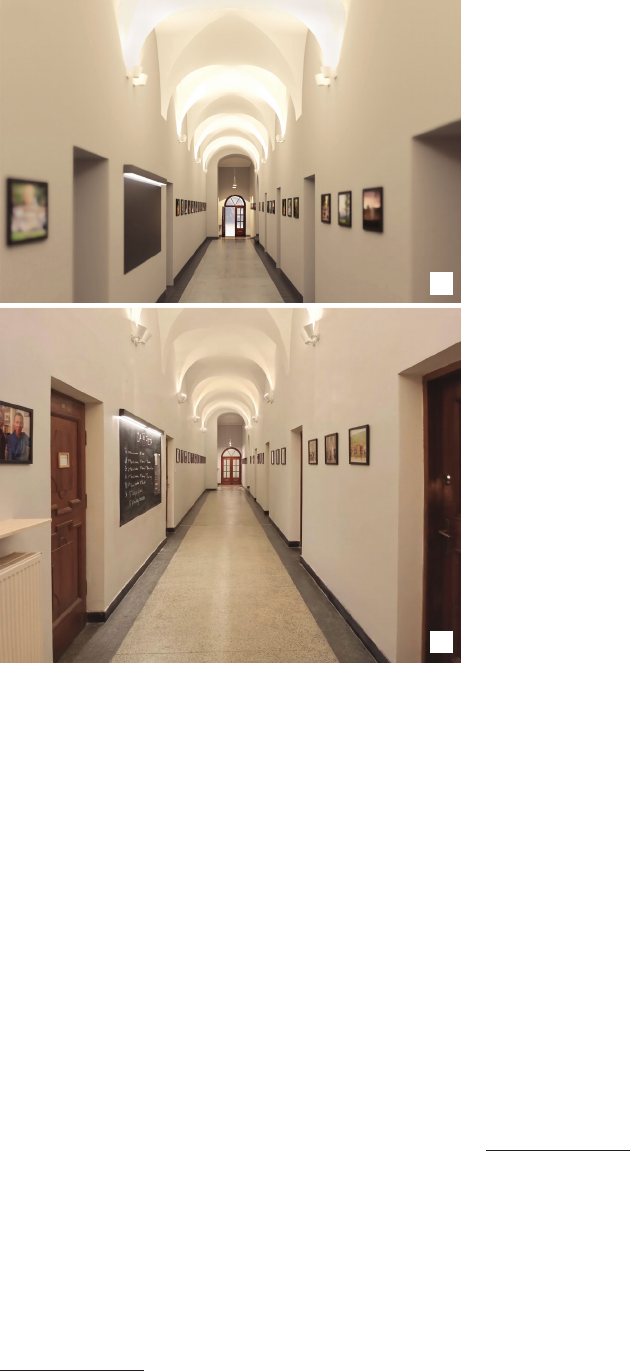
dów do dzisiejszego zapisu elektronicznego (il. 1) stanowi
ciekawą historię relacji idei wobec kształtowania materii.
Na miano sztuki, zgodnie z platońską koncepcją, zasłu-
guje dzieło, które prowadzi nas do prawdy. Świat, który
odbieramy za pomocą zmysłów, Platon określa jako od-
bicie świata idei i prawdy. Potępia on zatem malarstwo
naśladowcze, ponieważ nie prowadzi ono do poznania
prawdy, a jedynie kopiuje zmysłowe doznania, które już
Michał Suffczyński*
Rysunek strukturalny w obrazowaniu przestrzeni i edukacji
architektonicznej na Wydziale Architektury Politechniki Warszawskiej
wobec tradycji École des Beaux Arts i Bauhausu
Structural drawing in the representation of space and architectural
education at the Faculty of Architecture of Warsaw University
of Technology in relation to the tradition
of the École des Beaux Arts and the Bauhaus University
Introduction.
The ideal and material world
in architectural works
The article discusses the function of structural drawing
in architectural works as a method of picturing space ac-
cording to the optics and aerial perspective as well as its
role in the education of architecture students.
The essential part of the profession of an architect is
the use of visual communication that enables a design
idea to get a material record in the form of drawings,
which can be represented dierently and have varying
levels of precision. Since the appearance of oldest ex-
amples until today’s electronic record (Fig. 1), the de-
velopment of methods of representing architecture by
drawings has been an interesting history of the relations
of ideas in relation to the formation of matter. According
to the Platonic conception, a work of art which leads us
to truth deserves to be called art. The world we perceive
with our senses is dened by Plato as a reection of the
world of ideas and truth. Therefore, he condemns the
imitative painting because it does not lead to the truth
but only copies sensory experiences, which are already
copies of ideas themselves [1]. Thus, a painter recreates
appearances. Art should perform a cognitive function. In
this sense, architectural sketches which precede the reali-
zation of an actual object, unless they are a copy, deserve
* ORCID: 0000-0001-7734-1610. Wydział Architektury Politech-
niki Warszawskiej / Faculty of Architecture, Warsaw University of Tech-
nology, e-mail: michalsuczynski@gmail.com
146 Michał Suczyński
same w sobie są kopią idei [1]. Malarz jest więc odtwórcą
pozorów. Sztuka zaś powinna pełnić funkcję poznawczą.
W tym rozumieniu szkice architektoniczne poprzedzające
rzeczywisty obiekt, o ile nie są kopią, zasługują na miano
sztuki. Ciekawym spostrzeżeniem jest to, iż dużo wspól-
nego z tą teorią ma abstrakcjonizm oraz podejście do na-
uczania w szkole Bauhausu, mimo że przedstawiciele tego
nurtu nie czerpali bezpośrednio z lozoi Platona. Maria
Misiągiewicz przywołuje zdeniowanie przez Stanleya
Allena roli rysunku […] jako znaku wskazującego to co
nieobecne, […] ponieważ sam w sobie w pełni charakte-
ryzuje budowanie tu i teraz i jako taki jest immanentny
dla projektowania [2, s. 14]. Według autorki architekt jest
pierwszym obserwatorem własnych rysunków umożli-
wiających mu ocenę i rozwój idei projektowej
1
. Kendra
1
Konkretyzacja zamysłu projektowego przez rysunek jest według
autorki najistotniejszą cechą procesu tworzenia architektury [2, s. 14,
15].
the name of art. It is worth noticing that abstractionism as
well as the approach to teaching represented by the Bau-
haus have a lot in common with this theory, even though
representatives of this trend did not directly draw from
Plato’s philosophy. Maria Misiągiewicz refers to Stanley
Allen’s denition of drawing […] as a sign which indi-
cates what is absent […] because it fully characterizes
the way of building here and now and as such is immanent
for a design process [2, p. 14]. She believes that an archi-
tect is the rst observer of his own drawings which ena-
ble him to evaluate and develop the design idea
1
. Kendra
Schank Smith quotes Ernst Gombrich’s opinion on the
magical function of the rst drawings ever made, (e.g.,
on rocks) and their similarity to building seats protecting
people against the power of nature and its spirits
2
. When
writing about the specics of architectural drawing in re-
lation to other types of artistic pictures, Leszek Maluga
notices that architectural drawing is assigned to the pro-
fession of an architect because it is a material trace of the
process of designing space. […] It means that drawing
plays an auxiliary role in this process. However, it is also
a base material document at the stage of coming up with
an idea and then implementing it in a real space. […] The
cited denition, however, requires elaboration and more
detailed discussion due to the variety of creative situa-
tions in which graphic records as well as the richness of
forms and artistic means used by architects
3
[4, p. 17].
According to Frank Gehry, an architect is searching for
a building by doing his drawings and he compares this
eort to the act of carving
4
(after: [2]). Roman Ingarden
believes that an architectural work is created only when
a project is materially realized [5, p. 124]. Also from his
opinion Misiągiewicz draws a conclusion on […] the
rationale behind a drawing-project as an indispensable
element in the process which takes place between com-
ing up with an idea and its implementation. A project is
the documentation of an actual work of an architect. Ex-
pressing thoughts by a drawing is a creative act. After all,
only in this way is it possible to achieve the design goal.
This purpose is based on the relationship between think-
ing and the visual perception, the correlation for which
Władysław Strzemiński argues in his theory of vision
5
[2, p. 18]. Olgierd Czerner made an important division
into two areas of the architectural creation by noticing
dierences between architectural drawings (those which
are expressions of ideas as well as those made for the
1
According to the author, the most essential feature in the process
of creating architecture is the representation of a concept by a drawing
[2, pp. 14, 15].
2
The art. historian E. H. Gombrich when discussing the origins of
art. writes that humans assembled structures to shelter themselves from
elements of nature such as rain, as well as from the spirits that controlled
the natural environment [3, p. 6].
3
The author believes that architectural drawing is […] a material
trace in the space design process [4, p. 16].
4
The author also says that a drawing is “a stage on the way to con-
struction”. Raimund Abraham, on the other hand, expressed a conviction
that architectural drawings have an autonomous value even when they
do not lead to the construction of a building (after: [2, p. 54]).
5
Cf. [6].
Il. 1. Adaptacja fragmentu krużganka klasztoru dominikanów
przy ul. Freta 10 w Warszawie na przestrzeń duszpasterską
(proj. T. Szenajch, M. Rygier, A. Chrząstowski-Wachtel):
a) wizualizacja komputerowa (program SketchUp Pro+VRAY,
autor: T. Szenajch, 2019),
b) zdjęcie powykonawcze projektu (fot. T. Szenajch, 2020)
Fig. 1. Adaptation of a fragment of the cloister for pastoral space
in the Dominican Friars’ monastery at Freta Street in Warsaw
(project and realization: T. Szenajch, Eng. M. Rygier,
Eng. A. Chrząstowski-Wachtel):
a) Computer visualization (SketchUp Pro+VRAY, author: T. Szenajch, 2019),
b) as-built picture (by T. Szenajch, 2020)
b
a
Rysunek strukturalny w obrazowaniu przestrzeni / Structural drawing in the representation of space 147
Schank Smith przytacza opinię Ernsta Gombricha o ma-
gicznej funkcji pierwszych rysunków (np. naskalnych)
i w tym znaczeniu ich podobieństwie z budowaniem sie-
dzib chroniących przed siłami natury i jej duchowością
2
.
Leszek Maluga, pisząc o specyce rysunku architekto-
nicznego wobec innych typów obrazów plastycznych,
dostrzega, że […] rysunek architektoniczny jest przypi-
sany do zawodu architekta, ponieważ stanowi materialny
ślad procesu projektowania przestrzeni. […] Oznacza to,
że rysunek spełnia rolę pomocniczą w ogólnym proce-
sie kształtowania przestrzeni. Jest jednak podstawowym
materialnym dokumentem w fazie powstawania zapisu
projektowego, a następnie realizacji zamysłu twórczego
w rzeczywistej przestrzeni. […] Przytoczona denicja
wymaga jednak rozwinięcia i dokładniejszego omówie-
nia ze względu na różnorodność sytuacji twórczych,
w których powstają zapisy graczne oraz bogactwo form
i środków plastycznych stosowanych przez architektów
3
[4, s. 17]. Frank Gehry wyraża przekonanie o poszuki-
waniu projektowanego budynku przez rysunek, porów-
nując ten wysiłek do aktu rzeźbienia
4
(za: [2]). Według
Romana Ingardena dzieło architektury powstaje dopiero
wówczas, gdy dochodzi do materialnej realizacji projek-
tu [5, s. 124]. Jednocześnie z jego opinii Misiągiewicz
wnioskuje o […] zasadności rysunku-projektu jako nie-
zbędnego pośrednika na drodze: idea dzieła i jej reali-
zacja. Projekt dokumentuje rzeczywistą twórczość archi-
tekta. Wyrażanie myśli poprzez rysunek staje się aktem
twórczym. Wszak tylko w ten sposób możliwy jest do
osiągnięcia cel projektowania, wspierający się na rela-
cji myślenia i postrzegania wzrokowego, zależności, ja-
kiej sens dowodzi Władysław Strzemiński w swojej teorii
widzenia
5
[2, s. 18]. Ważnego podziału na dwa obszary
twórczości dokonał Olgierd Czerner, zauważając różni-
ce między rysunkami architektonicznymi (projektowymi
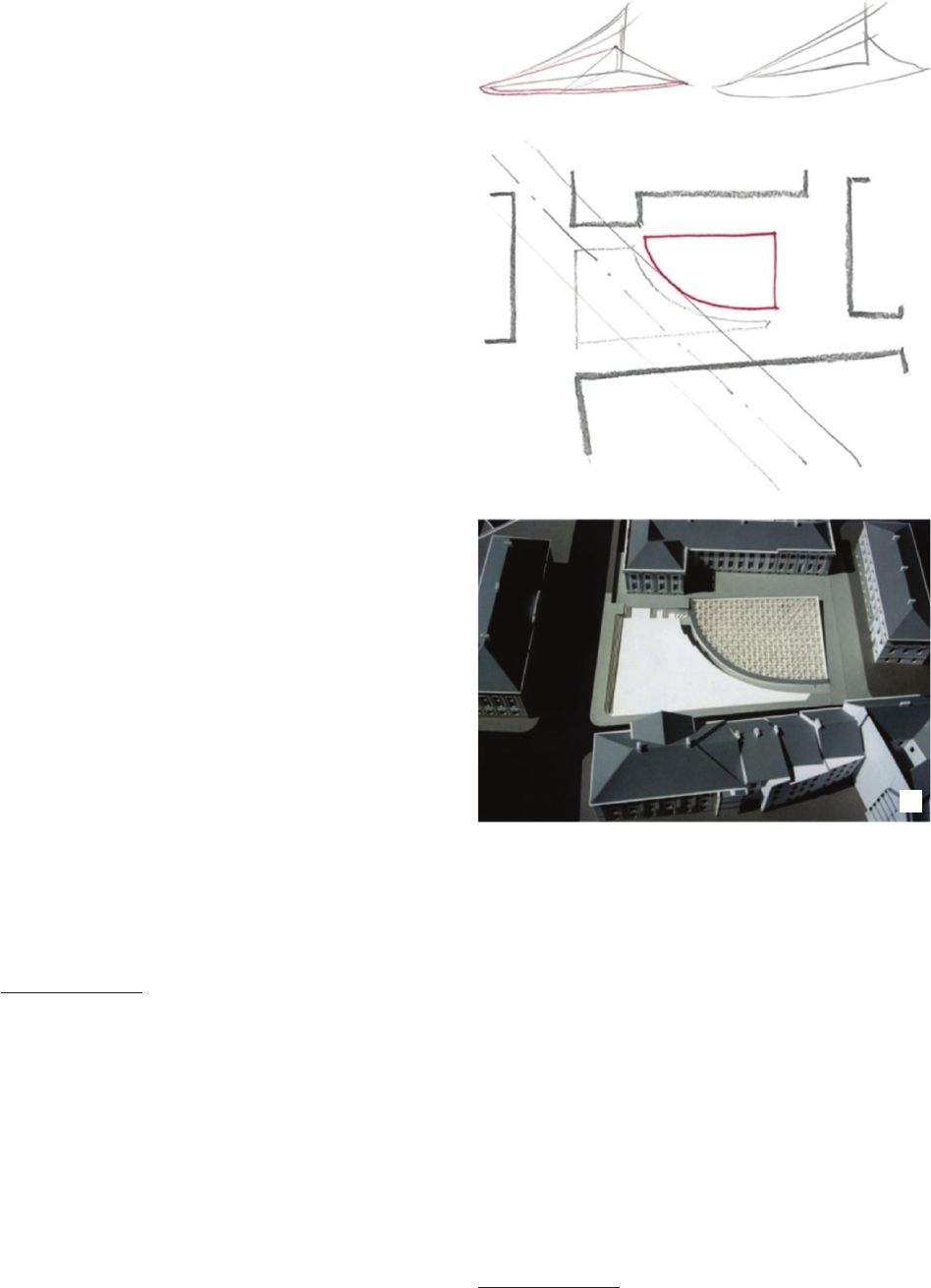
do realizacji obiektu oraz wyrażającymi idee) (il. 2) i ry-
sunkami architektury (ukazującymi obiekty istniejące)
6
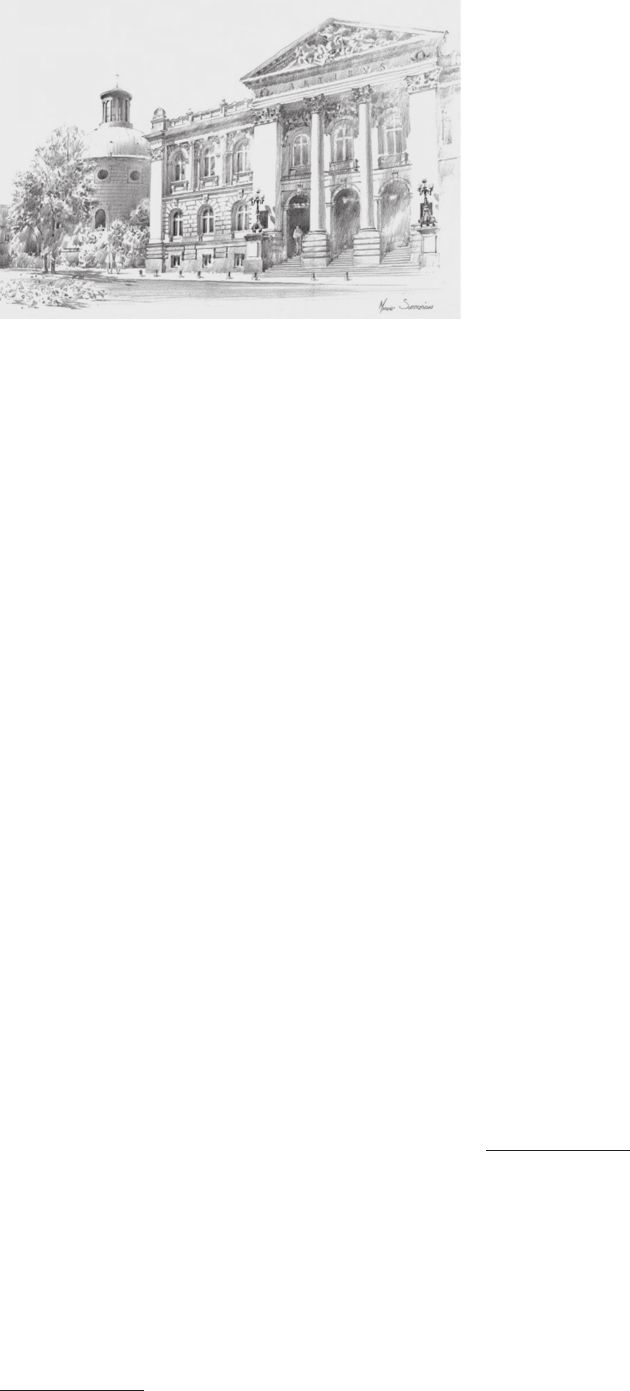
(za: [2]) (il. 3).
Podobną opinię Robina Evansa przytacza Leszek Malu-
ga: Rysunek w architekturze nie jest wykonywany w następ-
stwie rzeczywistości, lecz poprzedza konstruowanie jej
7
2
Historyk sztuki E.H. Gombrich, rozważając źródła sztuki, pisze,
że ludzie tworzyli schronienia, by chronić się przed wpływami natury
takimi jak deszcz, ale też przed duchami sił przyrody (tłum. M. Su-
czyński) [3, s. 6].
3
Autor wyraża przekonanie, że rysunek architektoniczny […] sta-
nowi materialny ślad procesu projektowania przestrzeni [4, s. 17].
4
Zaznacza też, że rysunek jest „etapem na drodze do realnego
budowania”. Z kolei Raimund Abraham przyznaje rysunkom architek-
tonicznym autonomiczną wartość nawet wtedy, gdy nie prowadzą do
realizacji budynku (za: [2, s. 54]).
5
Por. [6].
6
Misiągiewicz pisze, że rysunki studialne pozbawione szansy
na bezpośrednią materialną realizację obiektu oraz fantazje architek-
toniczne mogą jednak stanowić „element procedury projektowania”.
Przywołuje też dokonany przez Federica Zuccaro podział na rysunki
„wewnętrzne” (związane z twórczym myśleniem i poszukiwaniem roz-
wiązania wyzwania projektowego) oraz „zewnętrzne” (adresowane na
budowę w celu realizacji projektu) [2, s. 262].
7
Autor zauważa, że […] myśl Evansa odnosi się do zasadniczej
funkcji rysunku architektonicznego w procesie projektowania [4, s. 19].
Fantazje i utopie architektoniczne nie mieszczą się wprost w takim
realization of objects) (Fig. 2) and drawings which show
existing objects
6
(after: [2]) (Fig. 3).
The design idea is to shape the form of the gallery
in such a way, so as to preserve the views of the exist-
ing frontages around the parcel in the historical area of
the Old Town, and to take into account the spatial and
constructional determinants of the W-Z Route’s tunnel.
6
Misiągiewicz writes that studies which will not be later used
for the realization of an object as well as architectural fantasies can be
“a part of a design procedure”. She also makes a reference to the division
made by F. Zuccaro into: “internal” drawings (associated with creative
thinking and searching for a solution to a design task) and “external”
drawings (intended to be used at a construction site) [2, p. 262].
Il. 2. Projekt Galerii Sztuki Współczesnej w Warszawie:
a) szkice wstępne, b) ideogram, c) zdjęcie materialnej makiety
(autor: M. Suffczyński, projekt dyplomowy, promotor: dr A. Miklaszewski,
Wydział Architektury PW, 1996, ołówek, cienkopis, 20 × 15 cm)
Fig. 2. Project of the Contemporary Art Gallery in Warsaw:
a) initial sketches, b) ideogram, and c) a photograph of a material model
(for the diploma of the M. Suffczyński,
supervisor: PhD Andrzej Miklaszewski, Faculty of Architecture
of the WUT, 1996, pencil, fineliner, 20 × 15 cm)
b
a
c
148 Michał Suczyński
[4, s. 19]. Mirosław Orzechowski w autorskim denio-
waniu rysunku architektonicznego przygląda się […] jego
funkcji skupionej na opisywaniu zjawisk przestrzennych
dotyczących rzeczywistości, tej zastanej, ale i tej plano-
wanej. […] Znalazłbym miejsce zarówno dla odwzorowań
realistycznych, jak i abstrakcji, oraz wszystkiego co jest
pomiędzy. Klucz dla klasykacji i denicji rysunku archi-
tektonicznego stanowiłby zawsze cel powstawania rysun-
ku [7, s. 17].
Rysunek strukturalny
w komunikacji wizualnej
W rozmowach ze studentami podczas zajęć w Zakła-
dzie Dziedzictwa Architektonicznego i Sztuki PW zwra-
camy uwagę na analityczną funkcję zapisów gracznych.
Ciekawe w tym aspekcie może okazać się odniesienie
do odmiennej estetyki proponowanej w kształceniu ar-
chitektów w tradycji École des Beaux Arts oraz środo-
wiska Bauhausu, o których będzie mowa w dalszej części
artykułu. Obecnie używamy technik zapisu elektronicz-
nego, wzbogacając możliwości przekazu wizualnego po-
zosta jącego podstawowym obszarem komunikacji w ar -
chitekturze.
Rysunek strukturalny trzeba charakteryzować na tle
pojęcia rysunku jako wyzwolonej w czasach renesansu
dziedziny twórczości. Warto zaznaczyć, że mówimy tu
o sztuce europejskiej, bogate dziedzictwo w tym zakresie
innych obszarów świata, zwłaszcza Azji, nie jest przed-
miotem tego opracowania.
ujęciu, ale mogą pełnić funkcje pomocnicze jako inspiracje w poszuki-
waniu nowych form i organizowania przestrzeni.
Saving the visual message aims at highlighting the most
important features of the designed form.
A similar opinion by Robin Evans is cited by Leszek
Maluga: An architectural drawing does not follow reali-
ty but precedes the process of constructing it
7
[4, p. 19].
In his own description of architectural drawing Mirosław
Orzechowski considers […] its function focused on de-
picting spatial reality phenomena, the reality which al-
ready exists and the one which is planned at a particular
moment. […] There is a place for realistic representations
as well as for abstractions and for everything in between.
A key to classifying and making a denition of architectur-
al drawing would always be the aim of drawing [7, p. 17].
Structural drawing in visual communication
When talking with our students at the Academic Unit
of Architectural Heritage and Art at Warsaw University
of Technology (WUT), we pay attention to the analytic
function of the graphic recording. What is interesting in
this aspect and will be discussed below is the reference to
a dierent type of aesthetics, which in the process of edu-
cating architects is proposed by the tradition of the École
des Beaux-Arts and the tradition of the Bauhaus. Nowa-
days, we use techniques of electronic recording enriching
the possibilities of visual messages, which remains the
basic area of communication in architecture.
Structural drawing should not be characterized other-
wise than taking into account the concept of drawing as
a separate eld of art, which was liberated during the Re-
naissance. At this point, it should be emphasized that here
we are dealing with European arts. The abundant heritage
of other parts of the world, Asia in particular, is not the
subject of this paper.
The most essential form of visual communication in
a drawing is the line that represents a symbolic meeting of
surfaces with various lighting, textures and colors. In Pol-
ish, the very etymology of the word meaning “drawing”
(pl: rysunek) is derived from the word meaning “trace”
(pl: ślad) or “scratch” (pl: rysa). It can also be observed in
other languages, for instance in German – Risse Machen
8
.
Ryszard Natusiewicz notices that the power of human im-
agination and abstract thinking makes it possible to oper-
ate with a line which is in fact a border between visually
variable areas
9
. This aspect is also pointed out by Ewa M.
Górska who emphasizes the brevity and abstractness
7
The author notices that […] Evan’s thought refers to the funda-
mental function of architectural drawing in a design process. Fantasies
and architectural utopia do not t directly into this approach, but they
can perform auxiliary functions as inspirations for nding new forms
and organization of space [4, p. 19].
8
In Polish, the etymology of the word rysunek (Eng. “drawing”)
is associated with the noun rysa (Eng. “crack”) and the verb ryć (Eng.
“carve”). Professor Dąbrowski refers to the sources of the word rysunek
in Latin and other European languages (Greek, Italian, French, English,
Russian, German) [8, p. 286].
9
The freehand drawing method is used at most of the faculties of
architecture at Polish universities. Drawing is a basic workshop skill in
this profession. Professor Natusiewicz’s great achievements in the edu-
cation of students are worth mentioning here [9, p. 9].
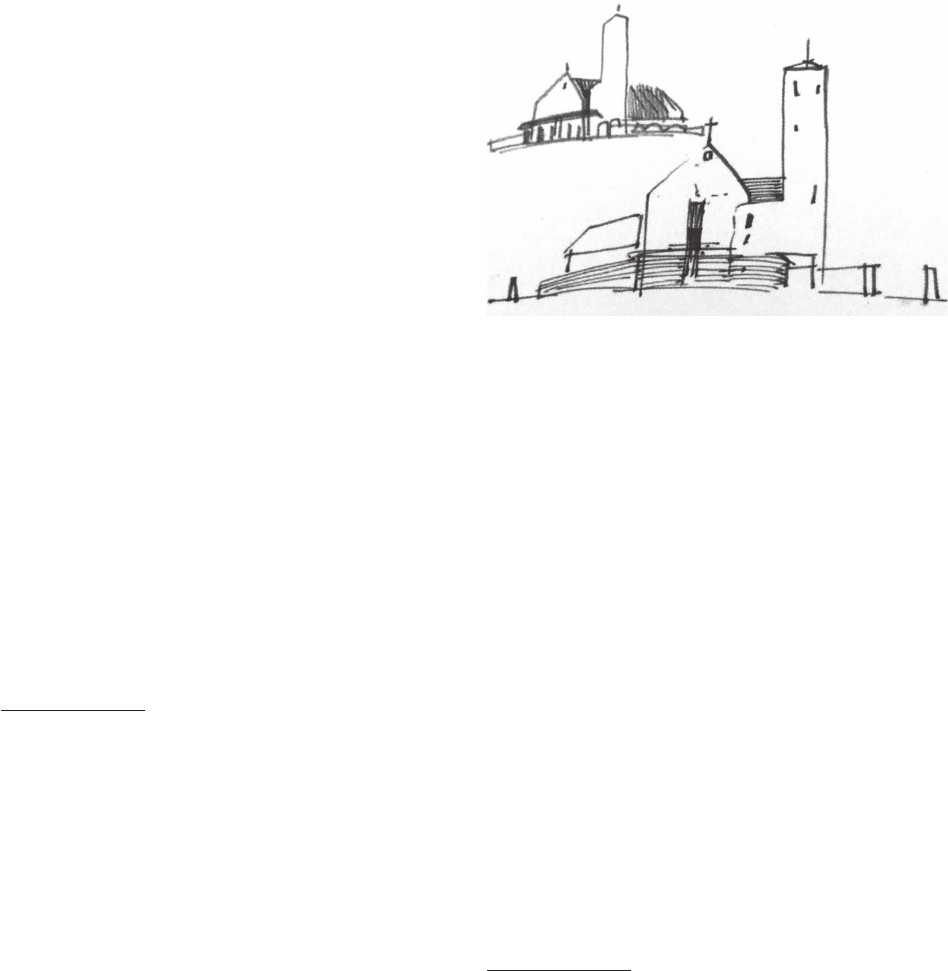
Il. 3. Przykład realistycznego obrazowania
z bezpośredniej obserwacji.
Budynki kościoła ewangelicko-augsburskiego pw. św. Trójcy
(proj. B. Zug)
i Galerii Zachęta (proj. S. Szyller)
(rys. M. Suffczyński, ołówek, 40 × 30 cm)
Fig. 3. An example of realistic observational drawing.
The buildings of the The Holy Trinity Evangelical Church
of the Augsburg Confession (arch. B. Zug)
and the Zachęta National Gallery of Art (arch. S. Szyller)
(drawn by M. Suffczyński, pencil, 40 × 30 cm)
Rysunek strukturalny w obrazowaniu przestrzeni / Structural drawing in the representation of space 149
of the message
10
(Fig. 4). This great value of a graphic
syn thesis in contemporary visual communication is also
highlighted by Jacek Krenz. While writing about graphic
signs in architecture, Professor assigns ideograms a great
function in revealing a design idea
11
(Fig. 5). This synthe-
sis is always preceded by the phases of observation and
analysis
12
. Workshop renement is a crucial skill but only
in the proportion as it is intended for the thinking process.
An interesting thought was expressed by Adam Suiński:
[Drawing] is an informative language which does not suc-
cumb to the magic of words.. Nulla dies sine linea. Since
the 4
th
century BC these words of Apelles have been re-
minding the need for a constant improvement of skills in
drawing of lines in a smooth manner, as well as the clarity
of spots, sublime beauty of the composition, lightness of
touching the paper
13
[7, p. 19].
When we draw from nature we deal with the shaping
of a visual object, which arises in the process of psycho-
physical eort of a drawing person
14
, while architectural
10
E.M. Górska makes a reference to K. Teissig who wrote about an
ability to bring out particular aspects and depicti them, which is visually
expressed by drawing (K. Teissig, Techniki rysunku, Warszawa 1983).
This is fundamentally dierent from realistic painting based on the use
of colors, the areas of which meet directly in the picture, without the line
being visible [10, p. 122].
11
Krenz says: […] ideogram is a concise, conceptual guide in the
process of creating architectural space. It is a goal stated in the simplest
way and a signpost. When we consider the reception, ideogram can fa-
cilitate recognition and interpretation of the idea contained in architec-
tural work. An ideogram also plays the role of a catalyst which enables
an idea to transform into a material [11, p. 54].
12
What is particularly signicant is the author’s conviction about
giving students some freedom in searching for means of graphic expression
to express characteristic features of a depicted subject. This approach in the
process of artistic education makes it possible to discover personal sensitiv-
ity and achieve interesting, often unexpected depiction eects [11, p. 11].
13
What draws attention here are the reections of the author upon
the concept of space: With our senses we blend in with the beauty of na-
ture. We can see shapes, feel atmospheres expressed by light, color, heat,
sound, smell, touch, transparency and air movement [7, p. 19].
14
Professor Bartel’s contribution to literature and knowledge about
perspective drawing is enormous. This is evidenced by his two-volume
Najistotniejszą formą przekazu wizualnego rysunku
jest obecność linii stanowiącej symboliczne spotkanie
płaszczyzn o różnym oświetleniu, fakturach lub kolorze.
Już sama etymologia słowa czerpie ze słów oznaczających
ślad, rysa, również w językach obcych (np. niemieckie
pojęcie risse machen)
8
. Ryszard Natusiewicz zauważa, że
siła ludzkiej wyobraźni i myślenia abstrakcyjnego umoż-
liwia operowanie linią będącą w rzeczywistości granicą
między zmiennymi wizualnie obszarami
9
. Na ten aspekt
zwraca też uwagę Ewa M. Górska, podkreślając skróto-
wość i abstrakcyjność przekazu
10
(il. 4). Jacek Krenz,
pisząc o znakach gracznych w architekturze, wydoby-
wa tę cenną wartość syntezy gracznej we współczesnej
komunikacji wizualnej, przyznając ideogramom ważną
funkcję ogniskowania idei projektowej
11
(il. 5). Synteza
taka zawsze jest poprzedzona fazami obserwacji i anali-
zy
12
. Sprawność warsztatowa jest ważną umiejętnością,
ale tylko w takiej proporcji, w jakiej ma służyć proceso-
wi myślenia. Ciekawą reeksję wyraża Adam Suiński:
[Rysunek] to język informujący bez ulegania magii słów.
Nulla dies sine linea. Te słowa Apellesa od IV wieku p.n.e.
przypominają o konieczności stałego doskonalenia umie-
jętności płynnego prowadzenia linii, wyrazistości plam,
wysublimowanej urody kompozycji, lekkości dotykania
papieru
13
[7, s. 19].
Przy rysowaniu z natury mamy do czynienia z kształto-
waniem przedmiotu wzrokowego powstającego w procesie
psychozycznego wysiłku u rysującego
14
, w projektowaniu
8
Etymologia słowa rysunek związana jest w języku polskim z rze-
czownikiem rysa i czasownikiem ryć. Henryk Dąbrowski odwołuje
się do źródeł słowa rysunek w łacinie i innych językach europejskich
(greckim, włoskim, francuskim, angielskim, rosyjskim, niemieckim) [8,
s. 286].
9
Metoda rysunku odręcznego w kształceniu architektów jest obec-
na na większości wydziałów architektury polskich uczelni. Operowanie
kreską stanowi podstawową umiejętność warsztatową w wykonywaniu
zawodu. Należy tu wspomnieć ogromne zasługi prof. Natusiewicza
w edukacji studentów i popularyzacji wiedzy o architekturze i metodach
obrazowania [9, s. 9].
10
Górska powołuje się na Karela Teissiga piszącego o zdolności do
abstrahowania w sztukach plastycznych, czego wizualnym wyrazem jest
operowanie kreską (K. Teissig, Techniki rysunku, Warszawa 1983). Za-
sadniczo różni się to od realistycznego malarstwa opartego na wykorzy-
staniu barw, których obszary spotykają się w obrazie bezpośrednio, bez
uwidocznienia kreski wyznaczającej granice tych obszarów [10, s. 122].
11
W swojej pracy Krenz formułuje to następująco: Na płaszczyź-
nie projektowej ideogram jest lapidarnym, pojęciowym przewodnikiem
w procesie tworzenia przestrzeni architektonicznej. Jest najprościej
wyrażonym celem i drogowskazem. Na poziomie odbioru ułatwia od-
czytanie i interpretację idei zawartej w dziele architektonicznym. Ideo-
gram pełni rolę katalizatora umożliwiającego przekucie idei w tworzywo
[11, s. 54].
12
Szczególnie wartościowe jest przekonanie autora o pozostawia-
niu studentom pewnej swobody w poszukiwaniu środków wyrazu gra-
cznego dla oddania charakterystycznych cech obrazowanego tematu.
Takie podejście w procesie edukacji artystycznej umożliwia odkrywanie
osobistej wrażliwości i osiąganie ciekawych, często niespodziewanych
efektów obrazowania [11, s. 11].
13
Ciekawe są reeksje autora dotyczące postrzegania przestrzeni:
Zmysłami wtapiamy się w naturalność przyrody. Widzimy kształty, czu-
jemy nastroje wyrażane przez światło: barwę, ciepło, dźwięk, zapach,
dotyk, przejrzystość i ruch powietrza [7, s. 19].
14
Wkład prof. Bartla w piśmiennictwo i gromadzenie stanu wie-
dzy o rysunku perspektywicznym jest ogromny. Świadczy o tym jego
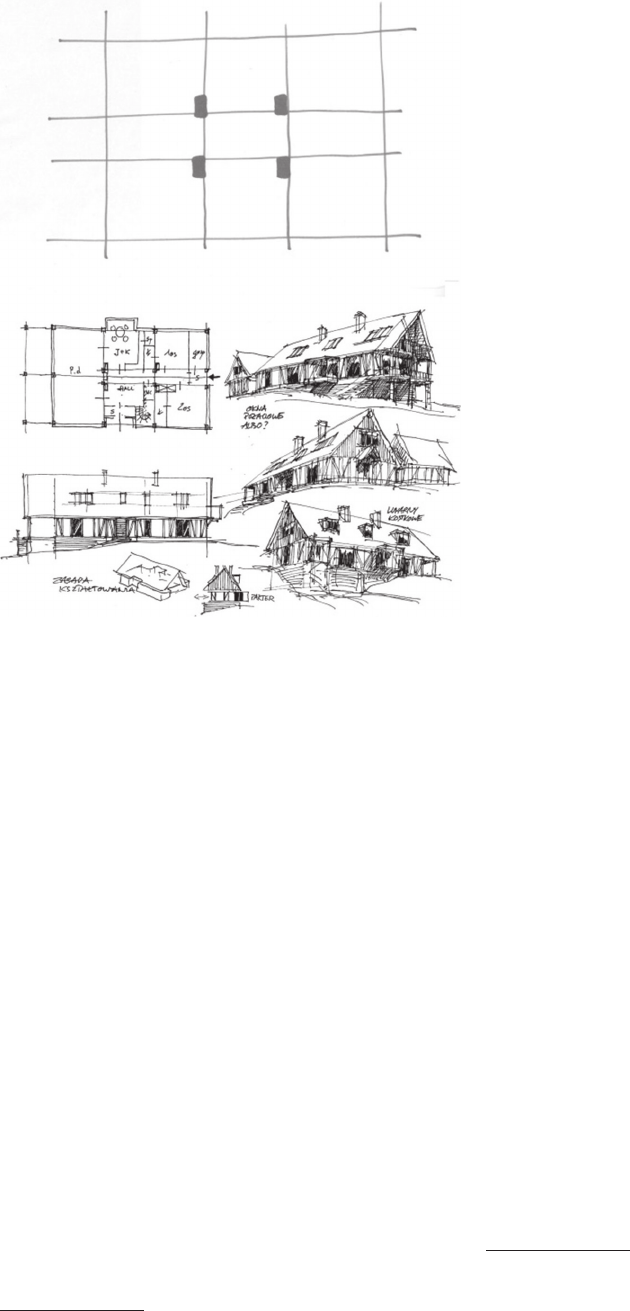
Il. 4. Szkic wstępny widoku do projektu kościoła w Białymstoku
(autor: A. Sufliński, tusz i ołówek na papierze, 11 × 14 cm)
Fig. 4. An initial sketch for the project of a church in Białystok
(author: A. Sufliński, ink and pencil on a paper, 11 × 14 cm)
150 Michał Suczyński
design is featured by a sequence of interactive reactions
between views evolving on the surface of an image and
the search for solutions by a designer.
The denition of structural drawing is not connected
with the trend of structuralism in painting, which focuses
on a deeply textured picture surface that sometimes can
even resemble a relief. Instead, it is related to the very
notion of structure, the essence of which is the spatial rela-
tionship of its particular parts and its visual aspect. When
we look at crystals through a microscope we can notice
their parallelepiped character and sometimes also their re-
semblance to geometric gures as well as to architectural
objects. Some natural forms occurring in nature can like-
wise inspire to coming up with structures built by humans,
sometimes also on an urban scale.
At the Faculty of Architecture WUT, in his PhD thesis,
Władysław Fuchs presented his authorial characteristics
of structural drawing by depicting its crucial features rep-
resented by this academy and reected in their education-
al methods as well as in their perception of the concept of
space. A similar understanding of the function of draw-
ing appeared already in the Renaissance in Leonardo da
Vinci’s works, which were analyzed by researchers in the
aspect of the “skeletal” way of presenting spatial relation-
ships of solids
15
. An analysis of structures that organize
a space of a depicted object and their graphic visibility
are the essence of this method (Fig. 6). At this point, it
should be noted here that the degree and clarity of this
visibility always depend on the purposes for which the im-
age is created. The connection of the graphic intensity of
showing the inner edges with the message of a drawing is
one of the determinants that distinguish a structural draw-
ing from the broad and traditional concept of drawing as
a liberated eld of art. It also makes it possible to shape
a view in an interesting and visually attractive way, so as
to show more than we can see during direct observation.
It is also an invaluable skill in creating imaginary, non-ex-
istent forms on a at surface.
Hence, it has a signicant role in design. I am convinced
that even initial sketches which begin a design process and
an architectural illustration as its nal step are realizations
of structural drawing as long as their author rightly recog-
nizes internal structures of a subject matter (Fig. 7). In this
sense the axonometric drawings of the Bauhaus are good
examples of structural thinking, even though they do not
present internal structures of an object, but rather its idea
and objective proportions of bodies without an illusion of
perspective or chiaroscuro eects. Axonometry is more
related to an unbiased representation of an object than
a perspective intended for the observer. The aesthetics of
contemporary structural drawings sometimes resemble
dissertation devoted to the painting perspective, written in the years of
his creative activity at the Lviv Polytechnic before the outbreak of World
War II. His own term “visual object”, which was very well dened in the
dissertation, nowadays is one of the base concepts raised during discus-
sions on the freehand drawing [12, p. 223].
15
Kemp applies the term “skeletal drawing” to the overall pre-
sentation of the structures of a depicted object. In the Warsaw School
of Drawing we speak of the notion of “structural drawing”, which has
a close meaning and was proposed by Fuchs [13, p. 62].
architektonicznym występuje raczej sekwencja interak-
tywnych reakcji między kształtującymi się na powierzch-
ni obrazu widokami a poszukiwaniem rozwiązań przez
projektanta.
Deniowanie rysunku strukturalnego nie jest związane
z nurtem strukturalizmu w malarstwie, polegającym na
głęboko fakturowym, czasami wręcz reliefowym kształto-
waniu powierzchni obrazu. Wiąże się z samym pojęciem
struktury, której istotą jest przestrzenna relacja poszcze-
gólnych jej części, oraz z jej wymiarem wizualnym. Gdy
widzimy pod mikroskopem kryształy, zauważamy od razu
ich równoległościenny charakter i niekiedy podobieństwo
do brył geometrycznych oraz obiektów architektonicz-
nych. Również naturalne formy występujące w przyro-
dzie stanowić mogą inspirację dla kształtowania struktur
budowanych przez człowieka, niekiedy również w skali
urbanistycznej.
dwutomowa dysertacja poświęcona perspektywie malarskiej napisa-
na w latach jego twórczej aktywności na Politechnice Lwowskiej po-
przedzających wybuch II wojny światowej. Jego autorskie określenie
„przedmiotu wzrokowego”, świetnie zdeniowane, stanowi współcze-
śnie jedno z podstawowych pojęć rozważań dotyczących rysunku od-
ręcznego [12, s. 223].
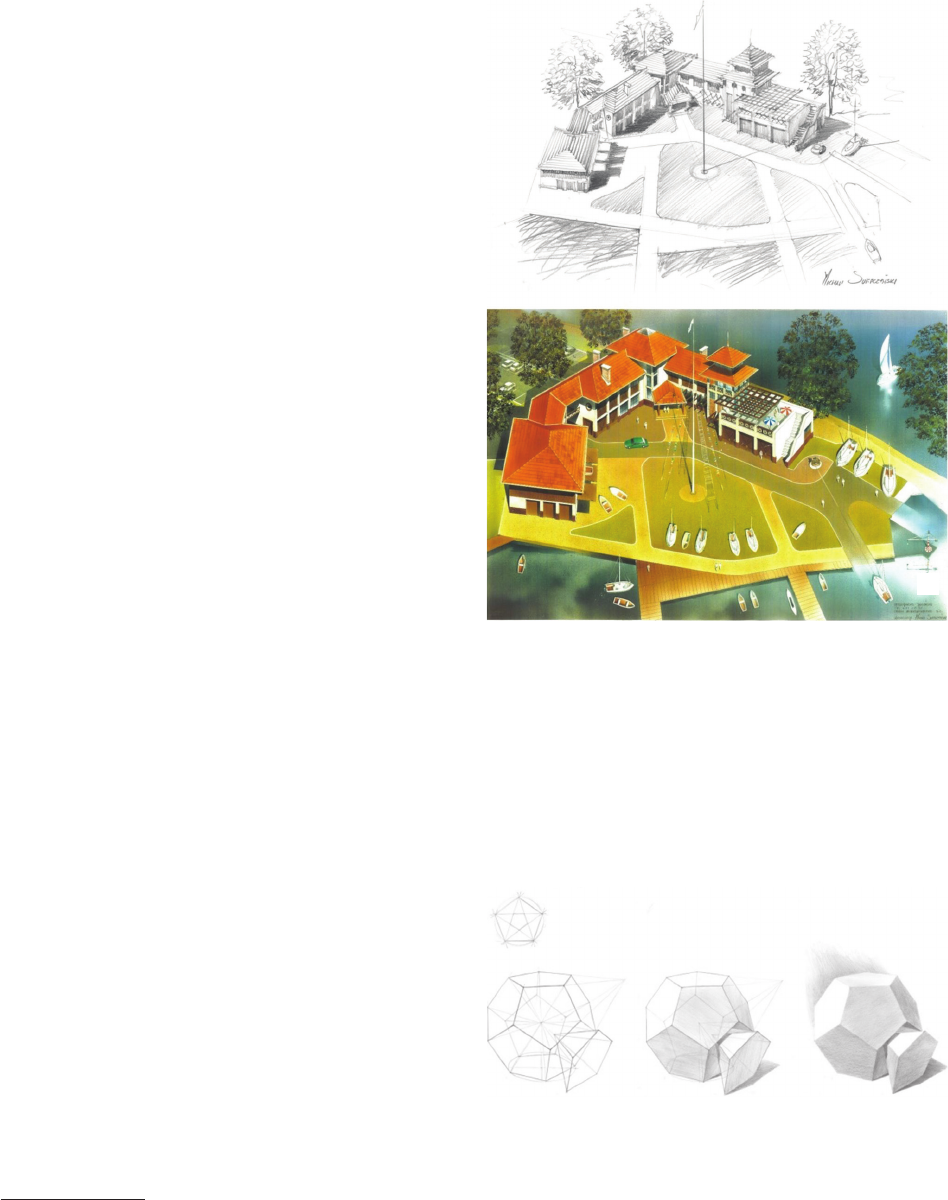
Il. 5. Ideogram i szkice w perspektywie wykonane w procesie
projektowania zespołu zabudowy rezydencjonalnej w Pluskach
(gm. Stawiguda) dla Rezydencji Warmińskich w latach 2017–2018
(proj. M. Orzechowski, J. Klos, rys. M. Orzechowski)
Fig. 5. An ideogram and perspective sketches made during the process
of designing buildings for Warmiński’s residence in Pluski
(gmina Stawiguda) in the years 2017–2018
(designers: M. Orzechowski, J. Kłos, drawn by M. Orzechowski)
Rysunek strukturalny w obrazowaniu przestrzeni / Structural drawing in the representation of space 151
Autorską charakterystykę rysunku strukturalnego wy -
łożył w swojej pracy doktorskiej na Wydziale Architek-
tury PW Władysław Fuchs, opisując jego zasadnicze
cechy obecne w metodach kształcenia i myśleniu o prze-
strzeni w środowisku tej szkoły. Podobne rozumienie
funkcji rysunku pojawiło się już w renesansie w pracach
Leo narda da Vinci, które badacze analizowali w aspek-
cie „ szkieletowego” sposobu prezentacji zależności prze -
strzennych brył
15
. Istota tej metody polega więc na ana-
lizie struktur organizujących przestrzeń obrazowanego
przedmiotu oraz ich graczne uwidocznienie (il. 6). Trze-
ba tu zaznaczyć, że stopień i czytelność tego uwidocz-
nienia zależą zawsze od celów, w jakich obraz powsta-
je. To powiązanie intensywności gracznej ukazywania
wewnętrznych krawędzi z zawartością informacyjną ry-
sunku stanowi jeden z wyznaczników odróżniających
rysunek strukturalny od szeroko i tradycyjnie rozumia-
nego rysunku jako wyzwolonej dziedziny twórczości
artystycznej. Pozwala też na ciekawe i atrakcyjne wizu-
alnie kształtowanie widoku ukazującego więcej, niż mo-
żemy zobaczyć w bezpośredniej obserwacji przedmio-
tu. Jest również bezcenną umiejętnością w kreowaniu
na płaskim podłożu obrazu wyobrażonych nieistnieją-
cych form.
Z tego wynika jego ważna funkcja w projektowaniu.
Wyrażam tu przekonanie, że nawet luźne szkice rozpo-
czynające proces projektowy oraz nalizująca go ilustra-
cja architektoniczna są przejawami rysowania struktural-
nego, o ile towarzyszy im myślowe rozpoznanie przez
ich autora struktur wewnętrznych opracowanego tematu
(il. 7). W tym sensie aksonometryczne rysunki środowi-
ska Bauhausu stanowią czystą egzemplikację myślenia
strukturalnego, mimo że nie prezentują struktur we-
wnętrznych obiektu, a raczej jego ideę i obiektywne pro-
porcje brył pozbawione złudzeń perspektywicznych lub
efektów światłocieniowych. Aksonometria jest bardziej
związana z obiektywnym przedstawianiem obiektu niż
dedykowana jego obserwatorowi perspektywa. Estety-
ka współczesnych rysunków strukturalnych przypomina
niekiedy, ze względu na ukazywanie wszystkich krawę-
dzi obrazowanych tematów, prace rosyjskich konstruk-
tywistów, ale różni ją od nich większy stopień nezji
w operowaniu kreską i połączenie z subtelnym światło-
cieniem.
Warszawska Szkoła Architektury
wobec tradycji École des Beaux-Arts
i Bauhausu
Źródeł nowożytnej edukacji architektonicznej w Euro-
pie upatrywać można w XVII-wiecznych akademiach ry-
sunku stanowiącego kanwę dla malarstwa i rzeźby oraz
w konkursach fundowanych przez m.in. papieża Klemen-
sa XI i Antoniego Canovę. Od Ich uczestników oczeki-
wano rozwiązania w precyzyjnym rysunku zagadnień
15
Martin Kemp stosuje określenie „rysunku szkieletowego” wo-
bec całościowej prezentacji struktur obrazowanego obiektu, w Warszaw-
skiej Szkole Rysunku mówimy o bliskim w znaczeniu i zaproponowa-
nym przez Fuchsa pojęciu „rysunku strukturalnego” [13, s. 62].
Il. 6. Dwunastościan foremny:
a) rysunek krawędziowy, b) rysunek krawędziowo-światłocieniowy,
c) obrazowany powierzchniowo
(rys. M. Suffczyński, kredka, 30 × 40 cm)
Fig. 6. Symmetrical dodecahedron:
a) skeletal drawing, b) skeletal drawing with chiaroscuro,
c) surface drawing
(drawn by M. Suffczyński, crayon, 30 × 40 cm)
Il. 7. Marina na Cyplu Czerniakowskim w Warszawie:
a) monochromatyczny szkic (rys. M. Suffczyński, ołówek, 30 × 20 cm),
b) ilustracja (rys. M. Suffczyński, aerograf, akryl, 80 × 60 cm)
(proj. A. Orzechowski, K. Jabłoński)
Fig. 7. A marina at Cypel Czerniakowski in Warsaw:
a) monochromatic sketch (drawn by M. Suffczyński, pencil, 30 × 20 cm),
b) illustration of the concept
(drawn by M. Suffczyński, airbrush, acrylic, 80 × 60 cm)
(authors of the project: A. Orzechowski, K. Jabłoński)
ba c
b
a
the works of Russian constructivists due to showing all
the edges of the depicted subjects. What makes them dis-
tinctive is the enhanced nesse in operating the line and
the combination with subtle chiaroscuro.

152 Michał Suczyński
Warsaw School of Architecture
in the face of the tradition of the Beaux-Arts
and the Bauhaus
Sources of the contemporary architectural education in
Europe trace back to the academies of drawing from the 17
th
century as well as in contests organized by, inter alia, Pope
Clement XI and Antonio Canova. Participants had to make
precise drawings and thereby solve design issues concern-
ing a form of an elevation or an architectural object in ur-
ban space. The educational program of the Académie Roy-
ale d’Architecture, which was founded in Paris, combined
geometry, perspective, and military constructions with the
knowledge on art. The crucial factor in the admission pro-
cess was drawing skill. After limiting its activity in 1793,
the Academy was reactivated and merged into the Académie
des Beaux-Arts together with the Académie de Peinture et
de Sculpture and the Académie de Musique in 1816. The
traditions of the Académie d’Architecture were upheld
and spread by the architecture department of the École des
Beaux-Arts. At that time drawing was a basic workshop skill
in recording successive stages of the building design process.
The changes brought about by the industrial revolution
and technological development resulted in the separation
of architects from technical problems and social process-
es. The role of architects was to some extent taken over
by constructors. One of the attempts to solve this problem
was the foundation of a new type of art university – the
Bauhaus by Walter Gropius in 1919. The school aimed at
combining the craftsmanship and artistic skills, but above
all in seeking new esthetics which would be in line with
the new industrialized reality.
Neil Bingham describes the Bauhaus school as “exper-
imental” and acknowledges its enormous inuence on the
ways of representing forms and educating architects. Due
to Bingham opinion new and simple graphic means of
describing the buildings express objection to neoclassical
precise drawings commonly present in other architectural
schools
16
[15, p. 6]. What he means here is a considerable
impact that the Parisian École Beaux-Arts made on these
traditional educational methods. The aforementioned
denition of the Bauhaus as an “experimental” school re-
fers not only to the formal means of presenting ideas, but
above all to a thought experiment. A drawing is only a tool
and has a minor function in relation to the idea it presents.
What the Bauhaus school strived to attain was to stimu-
late thinking process and to create new forms. This was
intended to raise an objection to copying the old styles.
The drawing itself had to nourish imagination. Drawing,
painting and sculpture had an inuence on each other –
they were no longer forms of showing a future architec-
tural work. Drawing and painting were inspirations that
16
The short history of the Bauhaus school between 1919 and 1933
in the Western world resulted in the spread of an ascetic graphic message
which was based on axonometric views and simplied in relation to an
academic tradition. Paradoxically, the closure of the school by the Nazi
regime, then World War II and consequently the emigration of many au-
thors and students of the School resulted in the promotion of its esthetics
and educational methods, especially in North America [15].
projektowych polegających na kształtowaniu elewacji lub
obiektu architektonicznego w przestrzeni miejskiej.
Za-
łożona w Paryżu Académie Royale d’Architecture łą czyła
w programie kształcenia znajomość geometrii, per spektywy
i konstrukcji militarnych z wiedzą o sztuce, a warunkiem
rozpoczęcia studiów przez kandydata była umiejętność ry-
sowania. Po ograniczeniu działalności w 1793 r.
Akademia
została reaktywowana i połączona w 1816 r. w Académie
des Beaux-Arts razem z Académie de Peinture et de Sculp-
ture i Académie de Musique. Tradycje Académie d’Archi-
tecture zostały utrzymane i rozpowszechnione przez dział
architektury École des Beaux-Arts. Rysunek był wówczas
podstawową umiejętnością warsztatową w zapisie kolej-
nych etapów procesu projektowania budynku.
Zmiany, jakie przyniosła rewolucja przemysłowa i roz-
wój w dziedzinie techniki, spowodowały, że architekt
został oderwany od problemów technicznych oraz pro-
cesów społecznych, a rolę architekta w pewnym sensie
przejął konstruktor [14]. Jedną z prób rozwiązania tego
problemu było w 1919 r. założenie przez Waltera Gropiu-
sa uczelni artystycznej nowego typu – Bauhausu. Główną
ideą szkoły było połączenie umiejętności rzemieślniczych
i artystycznych, ale przede wszystkim poszukiwanie no-
wej estetyki zgodnej z nową zindustrializowaną rzeczy-
wistością.
Neil Bingham określa szkołę Bauhausu jako „ekspe-
rymentalną” i przyznaje jej ogromny wpływ na sposo-
by obrazowania form i kształcenia architektów. Pisze
on, że […] nowe i uproszczone metody przedstawiania
budynków […] ukazują sprzeciw wobec drobiazgowych
rysunków neoklasycznych, które powszechnie powsta-
wały w innych szkołach architektonicznych [15, s. 6]
16
.
Ma on, jak rozumiem, na myśli silny wpływ na te tra-
dycyjne metody kształcenia środowiska paryskiej École
des Beaux-Arts. Wspomniane określenie Bauhausu jako
szkoły „eksperymentalnej” odnosi się nie tylko do for-
malnych środków przedstawienia idei, ale przede wszyst-
kim do eksperymentu myślowego. Rysunek jest jedynie
narzędziem i pełni funkcję drugorzędną względem idei,
jaką prezentuje. Celem w nauczaniu Bauhausu było po-
budzenie do myślenia i tworzenia nowych form. Był to
sprzeciw wobec
kopiowania minionych stylów, a rysu-
nek sam w sobie miał stanowić pożywkę dla wyobraź-
ni. Rysunek, malarstwo i rzeźba wzajemnie na siebie
oddziaływały – nie były już tylko formą odwzorowania
przyszłego dzieła architektury. Rysunek i malarstwo in-
spirowały i dawały zaczątek nowej architekturze. Malar-
stwo i technika wyprzedziły architekturę. To w pracow-
ni malarzy znajdziemy fascynację odkryciami techniki
i dziełami konstruktorów. Architekci podążali za tymi
zmianami, adaptując nowe wyrazy przekazu wizualnego
do
prezentacji swoich projektów. Przyczyną tego był
16
Krótkie dzieje funkcjonowania szkoły Bauhausu w latach 1919–
1933 spowodowały rozprzestrzenienie w zachodnim świecie uproszczo-
nego wobec akademickiej tradycji ascetycznego przekazu gracznego
opartego na widokach aksonometrycznych. Paradoksalnie zamknięcie
szkoły przez nazistowski reżim i II wojna światowa spowodowały, że emi-
gracyjne losy wielu autorów i studentów szkoły zaowocowały promocją
jej estetyki i metod kształcenia, zwłaszcza w Ameryce Północnej [15].

Rysunek strukturalny w obrazowaniu przestrzeni / Structural drawing in the representation of space 153
initiated new architecture. The development of painting
and technology overtook architecture. A painter’s atelier
is a place in which we can see the fascination with tech-
nological discoveries and constructor’s works. Architects
followed these changes by adapting new ways of visual
expression to present their projects. The reason for this was
the rapid technological development. Thus, at the begin-
ning of the 20
th
cen tury the painter’s atelier became the
architect’s workshop.
One of the obligatory textbooks in this school was Wassi-
ly Kandinsky’s book Point and Line to Plane. It shows the
author’s search for foundations for the new esthetic theory
initiated by the Impressionists who abandoned the academ-
ic approach in painting. The goal of academic drawing and
painting was to render visual objects accurately. Howev-
er, the scientic and technological development in the 19
th
and 20
th
centuries made people realize that what they saw
did not necessarily had to be the absolute truth. Kandin-
sky examined the notion of drawing and was looking for
a new “grammar” of the composition by comparing it to
a musical piece. He was also looking for basic tensions be-
tween a point, a line and a surface [16]. This approach can
be perceived in relation to Platonic idealism. However, it
should be emphasized that it was empiricism that played
an equally signicant role in the Bauhaus, if not even more
signicant. In this school, prior to theoretical classes, cru-
cial were the workshops and practices on construction
sites. According to Gropius, who denied intellectual aca-
demic training, theoretical knowledge and the work done
only on a drawing board resulted in “a lack of experience
in eldwork and workshop” [17, p. 75]. The craftsman had
to become an artist and the artist a craftsman. For this rea-
son, the workshops were led by two teachers – a master
craftsman and an artist. We need to bear in mind that the
inuence of an esthetic inspiration created in this art school
was surprisingly notable when we consider the relatively
short period of its existence (from 1919 to 1933). In the
projects of the Bauhaus and the Russian followers of new
art (an artistic group Unovis, which was represented by, in-
ter alia, El Lissi tzky), the focus is on a graphically clear,
sometimes even abstract way of presenting an architectural
idea without a context of surroundings. Joanna Pętkows-
ka-Hankel said that […] the curriculum of the Bauhaus was
based upon transformation of reality, an intuitive opera-
tion, working with colors, forms and textures and graphic
experiments
17
[7, p. 67]. Lech Kłosiewicz was convinced
that […] the relation of a building to its surrounding is es-
sential. This conviction was and presumably remains to this
day […] distinctive for the Faculty of Architecture WUT
in terms of the education of architects [19, p. 268]. When
writing about the educational methods of this academy he
made a reference to practical classes conducted by Mari-
an Sulikowski at the History of Art and Architecture De-
partment, under scientic supervision of Piotr Biegański.
The classes started with measurements of forms existing
17
Johannes Itten also writes about the importance of intuition in
experimenting with color and shaping of colorful compositions. He be-
lieves that the laws of color are given by the nature and can be discov-
ered by man in the process of careful observation [18].
gwałtowny rozwój technologiczny. Właśnie dlatego na
początku XX w. atelier malarza stało się laboratorium
architekta.
Jednym z obowiązkowych podręczników w tej szko-
le była praca Wassilego Kandinskiego pt. Punkt i linia
a płaszczyzna. Przyczynek do analizy elementów malar-
skich. Autor poszukuje w niej podwalin nowej teorii es-
tetycznej, którą zapoczątkowali impresjoniści, zrywając
z podejściem akademickim w malarstwie. W rysunku czy
malarstwie akademickim celem było możliwie wierne
odwzorowanie tego, co widzimy. Jednak rozwój techni-
ki i nauki w XIX i XX w. sprawił, że ludzie dostrzegli,
iż to, co widzimy, to nie musi być prawda ostateczna.
Kandinsky rozkłada rysunek na części pierwsze i szu-
ka nowej „gramatyki” kompozycji, przyrównując ją do
utworu muzycznego, poszukuje podstawowych napięć
między punktem, linią a płaszczyzną [16]. Można w tym
podejściu upatrywać związków z idealizmem platoń-
skim. Należy jednak podkreślić, że w szkole Bauhausu
równie ważną rolę, o ile nie ważniejszą, pełnił empiryzm.
W szkole tej przed wprowadzeniem zajęć teoretycznych
kluczowe były warsztaty oraz praktyki na placu budowy.
Według Gropiusa, negującego intelektualne szkolenie
akademickie, wiedza teoretyczna, deska kreślarska skut-
kowała […] zerowym doświadczeniem w pracy w terenie
i warsztacie [17, s. 75]. Rzemieślnik miał stać się artystą,
a artysta rzemieślnikiem. Z tego też powodu warsztaty
prowadziło dwóch dydaktyków – mistrz rzemiosła oraz
artysta. Trzeba pamiętać, że inspiracja estetyką kształto-
waną na tej uczelni była zaskakująco silna w aspekcie
jej relatywnie krótkiego trwania (w latach 1919–1933).
W projektach Bauhausu i rosyjskich zwolenników nowej
sztuki (grupa artystyczna Unovis, której przedstawicie-
lem był m.in. El Lissitzky) zwraca uwagę skupienie się
na wyrazistym gracznie, czasem nawet abstrakcyjnym
sposobie prezentacji idei architektonicznej z pominię-
ciem kontekstu otoczenia. Joanna Pętkowska-Hankel za -
uważa: Program nauczania rysunku w Bauhausie opie-
rał się na przekształcaniu widzianej rzeczywistości,
działaniu intuicyjnym, pracy z kolorem, formą i tekstu-
rą czy też gracznym eksperymencie [7, s. 67]
17
. Lech
Kłosiewicz wyrażał przekonanie, że […] relacja budy-
nek–otoczenie ma znaczenie zasadnicze. To przekonanie
było, i zapewne pozostało do dziś, […] charakterystyczne
dla koncepcji kształcenia architektów na Wydziale Ar-
chitektury Politechniki Warszawskiej [19, s. 268]. Pisząc
o metodach kształcenia tej uczelni, wspominał ćwicze-
nia prowadzone przez Mariana Sulikowskiego w Kate-
drze Historii Architektury i Sztuki pod opieką naukową
Piotra Biegańskiego. Ćwiczenia rozpoczynały pomiary
form istniejących w naturze: tralki balustrady w Pałacu
Wilanowskim, na grobka na Powązkach. Uzasadnieniem
tych zadań był bezpośredni kontakt z miejscem, ma te -
riałem, formą […]. Kolejnym ćwiczeniem było studium
form architektury klasycznej, które trzeba było wykreślić,
17
Również Johannes Itten pisze o znaczeniu intuicji w ekspery-
mentowaniu z kolorem i kształtowaniu barwnych kompozycji. Wyraża
przekonanie, że prawa barw są dane przez naturę i mogą być odkrywane
przez człowieka w procesie uważnej obserwacji [18].

154 Michał Suczyński
in nature: a headstone in Powązki Cemetery, balusters of
a railing in Wilanów Palace. By doing such exercises stu-
dents had a direct contact with a place, a material and
a form, […]. The next practice concerned a study of forms
of the classical architecture. Students had to draw them,
show their space, structure and composition, study their
chiaroscuro, proportions, scale and above all comprehend
them
18
[19, p. 268]. The Warsaw academy treats drawing
as a tool for space exploration, which makes it possible to
recognize geometric
relations in space and the atmosphere
of a place. The central projection method allows you to as-
sess the appearance of the designed objects in the context
of their surroundings. This is how Marek Leon Suzin
dened perspective and understood its function when he
wrote about “our spatial impressions which are closest to
a real picture”
19
[20, p. 59]. The Warsaw School of Draw-
ing takes into account this manner of depicting space by
combining it with the personal perception of the world of
its artists and current co-authors. Stefan Tworkowski and
Jerzy Sołtan recommended to their students that the pro-
cess of searching for solutions to a design task in a given
area should be recognized by drawing based on insightful
observation
20
. When new forms are proposed, even if they
are later intended to be created in contrast to its existing
surroundings, they should not be considered without a rec-
ognition of the existing space with all its cultural values.
A similar opinion about architecture which complements
landscape is described quite poetically by Peter Zumthor
noticing deep union of the forms of the buildings with
their surrounding space [21, p. 17]. Also, Marian Fikus
wrote about getting familiar with a site and about the im-
portance of drawing in searching for a designed form
21
.
In his review of my doctoral thesis on drawing in depict-
ing architecture, he noted that […] it will be useful for
architects, who would express their ideas by drawing. All
students work on computers, but the process of creating
and specifying of ideas always has to be based on free-
hand drawings
22
[23, p. 1]. Sketches are done quickly and
intuitively, which makes it possible to present an idea in
many optional sequences.
18
Professor Kłosiewicz adds: These time-consuming exercises
were later abandoned, which was presumably a detriment of the integ-
rity of the studies [19, p. 268]. The eld exercises combined building
of a drawing workshop with the recognition of a spatial and cultural
context.
19
The beginnings of understanding and describing the rules of the
central projection are connected with the work of the early Renaissance
masters. The well-known woodcut by Albrecht Dürer which shows the
transmission of beams of vision through the background of an image
does not yet take into account the binocular eld of the human per-
ception and perceives the eye of an observer as one geometric point
[20, p. 59].
20
The statement by Professor Tworkowski can be a proof for the
signicance of an insightful observation of an area: I kindly ask you to
study the case and then we will talk about the proposed design solutions
(after: [19, p. 268]).
21
The act of drawing in a design process leads to a lowering of
the level of abstraction, further sketches lead to answers to ever more
detailed questions but they also reveal new issues to solve [22, p. 140].
22
A review of doctoral thesis: Rysunek strukturalny w prezentacji
przestrzeni architektonicznej at the Faculty of Architecture WUT, pre-
pared under the supervision of L. Kłosiewicz [23, p. 1].
pokazać ich przestrzenność i strukturę, kompozycję,
przestudiować światłocień i proporcje, skalę, a ponad
wszystko zrozumieć zawartą w nich logikę [19, s. 268]
18
.
Środowisko warszawskiej uczelni traktuje rysunek jako
narzędzie badania przestrzeni pozwalające na rozpozna-
nie jej relacji geometrycznych i nastroju miejsc. Meto-
da rzutowania środkowego umożliwia ocenę wyglądu
projektowanych obiektów w kontekście otoczenia. Tak
deniował perspektywę i tak jej funkcję rozumiał Ma-
rek Leon Suzin, pisząc o […]
najbardziej zbliżonym do
rzeczywistego obrazu doznawanych przez nas wrażeń
przestrzennych
19
[20, s. 59]. Warszawska Szkoła Ry-
sunku uwzględnia taki sposób obrazowania, łącząc go
z osobistym postrzeganiem świata przez jej twórców
i obecnie kształtujących ją autorów. Stefan Tworkowski
i Jerzy Sołtan zalecali swoim uczniom, aby proces poszu-
kiwania rozwiązań zadania projektowego na danym ob-
szarze rozpoznawali rysowaniem opartym na wnikliwej
obserwacji
20
. Rozpoznanie istniejącej przestrzeni z jej
wartościami kulturowymi powinno zawsze towarzyszyć
proponowaniu nowych form, nawet jeżeli będą kształ-
towane w opozycji do zastanego otoczenia. Podobną
opinię o architekturze dopełniającej krajobraz dość po-
etycko opisuje Peter Zumthor, zauważając głeboki zwią-
zek form budynków z otoczeniem [21, s. 17]. Również
Marian Fikus pisał o poznawaniu miejsca projektowa-
nia z autopsji oraz o znaczeniu rysowania w poszuki-
waniu projektowanej formy
21
. W swojej recenzji mojej
rozprawy doktorskiej poświęconej rysunkowi w obra-
zowaniu architektury zaznaczył, iż Będzie [ona] służyć
architektom, wyrażającym myśl poprzez rysowanie.
Wszyscy studenci pracują na komputerach, ale proces
powstawania i konkretyzowania idei na wszystkich latach
musi być podbudowany rysunkiem odręcznym [23, s. 1]
22
.
Szkice są szybkie i bardzo intuicyjne, co pozwala na za-
prezentowanie pomysłu w wielu opcjonalnych sekwen-
cjach.
Obecny program nauczania rysunku na warszawskim
Wydziale Architektury wyrasta z ponadstuletniego dorob-
ku twórczości nauczycieli akademickich i doświadczeń
18
Kłosiewicz dodaje, iż: Te czasochłonne ćwiczenia później zarzu-
cono, chyba ze szkodą dla rzetelności studiów [19, s. 268]. Ćwiczenia
terenowe w swojej istocie łączyły budowanie warsztatu rysunkowego
z rozpoznaniem kontekstu przestrzennego i kulturowego.
19
Początki rozumienia i opisania reguł rzutowania środkowego
związane są z twórczością mistrzów wczesnego renesansu. Znany drze-
woryt Albrechta Dürera ukazujący przenikanie przez tło obrazu wiązki
promieni widzenia nie uwzględnia jeszcze binokularnego pola ludzkie-
go postrzegania, traktując wzrok obserwatora jako jeden geometryczny
punkt [20, s. 59].
20
O znaczeniu rozpoznania miejsca projektowania świadczyć
może cytowana wypowiedź w trakcie korekt dla studentów prof. Stefana
Tworkowskiego: Bardzo proszę opracować sytuację, a potem będziemy
mówić o proponowanych rozwiązaniach projektowych (za: [19, s. 268]).
21
Akt rysowania w procesie projektowym prowadzi do obniżenia
poziomu abstrakcji, kolejne szkice prowadzą do odpowiedzi na coraz
bardziej szczegółowe pytania, ale też wyłaniają nowe zagadnienia do
rozwiązania [22, s. 140].
22
Recenzja pracy doktorskiej Rysunek strukturalny w prezentacji
przestrzeni architektonicznej obronionej w 2008 r. na Wydziale Archi-
tektury Politechniki Warszawskiej pod kierunkiem L. Kłosiewicza [23,
s. 1].
Rysunek strukturalny w obrazowaniu przestrzeni / Structural drawing in the representation of space 155
The roots of the current curriculum of teaching drawing
at the Warsaw Faculty of Architecture WUT originate from
over a hundred years of work by academic teachers and the
heritage of artistic education. The basic principles shaping
contemporary education of visual arts at our school were
represented by one of its outstanding creators and teachers
– Henryk Dąbrowski. He attached particular importance
to drawing on location, which allows us to see the mutual
relations between landscape and architecture. In this pro-
cess there is a sequence of psychophysical activity, which
consists of careful observation, memorization of an object,
and then transferring the view to a picture’s surface with
the use of graphic and painting tools. Its signicance lies
not only in arousing of students’ sensibility as creators but
also in building their cultural awareness by dealing with
objects that are important for the architectural heritage in
urban and natural spaces. Worth quoting here are the words
of Gropius about gaining knowledge through direct experi-
ence. He emphasized the value of good education shaping
creative attitude and resulting from combination of acade-
mic knowledge with personal experience [17, p. 69].
Summary
Currently, the curriculum for drawing oered in the rst
and second year of studies at the Faculty of Architecture
in Warsaw is largely based on the heritage of the École des
Beaux-Arts and certain elements of the Bauhaus, taking
into account the current changes in the forms of visual
communication and the balance of hours devoted to the
subject. What is typical for the Bauhaus philosophy is al-
lowing for a greater role of the students’ intuitive search
for the authorial creation of visual artifacts, compared to
the second half of the 20
th
century. At the same time, the
maintenance of the realistic imagery technique derived
from the heritage of the École des Beaux-Arts is a dis-
tinctive feature of the Warsaw School of Drawing. In over
a hundred years of its existence, the school has educated
many architects and world-famous illustrators as well as
graphic designers. Among its graduates are Jerzy Stajuda,
Rafał Olbiński and Janusz Kapusta. This combination of
engineering and artistic education, very unique in today’s
world, and still present in the environment of the Warsaw
Faculty of Architecture has a great value. The structural
drawing described above is a worthful method of analysis,
presentation of forms, and visualization of imagined ob-
jects. The value of drawing from nature and imagination
lies in the development of understanding of the principles
that organize material objects, and their connection to
cultural heritage. A visual and a physical contact with an
artifact that is created on the image surface enables inter-
action in design processes.
Since the school was founded by Zygmunt Kamiński,
it has naturally experienced many generational changes
and therefore also created dierences in the methods of
drawing among the authors who established the school.
However, it has maintained its multi-generational identity.
An essential component of this identity is the considera-
tion of a drawing as an expression of beauty and a means
of conveying information. In the era of electronic media,
edukacji artystycznej. Podstawowe założenia kształtu-
jące dzisiejsze nauczanie sztuk plastycznych w naszej
szkole charakteryzował jeden z jej wybitnych twórców
i dydaktyków Henryk Dąbrowski. Przykładał on szcze-
gólną wagę do rysowania podczas obecności w plenerze
pozwalającej na dostrzeganie wzajemnych relacji pejza-
żu i architektury. W tym procesie dochodzi do sekwen-
cji psychozycznej aktywności polegającej na wnikliwej
obserwacji, zapamiętaniu widzianego obiektu i następnie
przenoszeniu widoku na podłoże obrazu przy użyciu na-
rzędzi gracznych i malarskich. Ma to znaczenie nie tyl-
ko dla rozbudzania wrażliwości twórczej studentów, ale
też buduje ich świadomość kulturową przez obcowanie
z ważnymi dla dziedzictwa architektonicznego obiektami
w przestrzeniach miejskich i naturalnych. Warto przy-
toczyć w tym miejscu myśl Gropiusa traktującą o zdo-
bywaniu wiedzy poprzez bezpośrednie doświadczenie.
Zwracał on uwagę na znaczenie solidnego wykształcenia
modelującego twórcze podejście i wynikającego z łącze-
nia wiedzy akademickiej z własnymi doświadczeniami
[17, s. 69].
Podsumowanie
Obecnie program nauczania rysunku proponowany na
pierwszym i drugim roku studiów na warszawskim Wy-
dziale Architektury czerpie w dużej mierze z dorobku
École des Beaux-Arts i pewnych elementów Bauhausu,
uwzględniając obecne zmiany zachodzące w formach ko-
munikacji wizualnej i bilansie godzin przeznaczonych na
ćwiczenia z przedmiotu. Bliskie lozoi Bauhausu jest
dopuszczenie większej w porównaniu z latami 2. poło-
wy XX w. roli intuicyjnych poszukiwań przez studentów
autorskiego kształtowania wizualnych artefaktów. Jedno-
cześnie utrzymanie warsztatu realistycznego obrazowania
wywodzącego się z dziedzictwa École des Beaux-Arts jest
znakiem rozpoznawczym Warszawskiej Szkoły Rysunku.
W ponad stu latach swojego funkcjonowania wykształciła
ona wielu twórców architektury, ale też światowej sławy
rysowników i projektantów gracznych, jej absolwentami
są m.in. Jerzy Stajuda, Rafał Olbiński, Janusz Kapusta. To
rzadko spotykane w dzisiejszym świecie, a wciąż obec-
ne w środowisku warszawskiego Wydziału Architektury
połączenie kształcenia inżynierskiego i artystycznego
stanowi ogromną wartość. Scharakteryzowany powyżej
rysunek strukturalny jest cenną metodą analizy i prezen-
tacji form oraz wizualizacji obiektów wyobrażonych.
Wartość rysowania z natury i z wyobraźni polega na wy-
kształceniu rozumienia zasad organizujących materialne
obiekty i powiązania ich z dziedzictwem kulturowym.
Wzrokowy i odczuwalny zycznie poprzez narzędzie
kontakt z powstającym na powierzchni obrazu wizual-
nym artefaktem umożliwia interakcję w procesach pro-
jektowania.
Szkoła od czasu jej założenia przez Zygmunta Kamiń-
skiego przeszła długą drogę pokoleniowych przemian
i związanych z tym różnic sposobów rysowania kształtu-
jących ją autorów. Zachowała jednak tożsamość wynika-
jącą z kontynuacji i sztafety pokoleń. Istotnym komponen-
tem tej tożsamości jest traktowanie rysunku jako wyrazu
156 Michał Suczyński
piękna i nośnika informacji. W epoce mediów elektronicz-
nych odręczne zapisy graczne zmieniły w dużym stopniu
swoją funkcję w wykonywaniu zawodu architekta, ale za-
chowały ogromne znaczenie w procesach edukacji.
Bibliografia /References
[1] Żak D., Teoria malarstwa abstrakcyjnego a Platońska koncepcja
sztuki, [w:] A. Kozerska (red.), Podstawy edukacji. Zrównowa-
żony rozwój, t. 9, Wydawnictwo im. Stanisława Podobińskiego
Akademii im. Jana Długosza w Częstochowie, Częstochowa 2016,
225–237.
[2] Misiągiewicz M., O prezentacji idei architektonicznej, Politechni-
ka Krakowska, Monograa 291, Kraków 2003.
[3] Schank Smith K., Architects’ Drawings. A Selection of Sketches by
World Famous Architects Through History, Architectural Press, El-
sevier, London 2005.
[4] Maluga L., Autonomiczne rysunki architektoniczne, Ocyna Wy-
dawnicza PWr, Wrocław 2006.
[5] Ingarden R., O dziele architektury, [w:] R. Ingarden, Studia z este-
tyki, t. 2, PWN, Warszawa 1958, 115–160.
[6] Strzemiński W., Teoria widzenia, Wydawnictwo Literackie, Kra-
ków 1974.
[7]
Balcerzak J., Orzechowski M., Pętkowska-Hankel J., Suczyński M.,
Suiński A., Trzupek T., Rysunek architektoniczny w praktyce,
czyli jak patrzeć ze zrozumieniem, PWN, Warszawa 2019.
[8] Dąbrowski H., Architektura i krajobraz z lotu ptaka, „Kwartalnik
Architektury i Urbanistyki” 2002, t. 47, z. 3, 285–289.
[9] Natusiewicz R., Rysunek architekta, Wydawnictwo PWr, Wrocław
1992.
[10] Górska E.M., Studium postaci w technikach monochromatycznych,
[w:] B. Siomkajło (red.), Rysunek i malarstwo: problemy podsta-
wowe, wybrane zagadnienia, Ocyna Wydawnicza PWr, Wrocław
2001, 119–147.
[11] Krenz J., Architektura znaczeń, Wydawnictwo PG, Gdańsk 1997.
[12] Bartel K., Perspektywa malarska, t. 2, PWN, Warszawa 1958.
[13] Kemp M., The Science of Art. Optical themes in western art from Bru-
nelleschi to Seurat, Yale University Press, New Haven–London 1990.
[14] Trzeciak P., Przygody architektury XX wieku, Nasza Księgarnia,
Warszawa 1974.
[15] Bingham N., 100 lat rysunku architektonicznego 1900–2000, Lau-
rence King Publishing, London 2013.
[16] Kandyński W., Punkt i linia a płaszczyzna. Przyczynek do analizy
elementów malarskich, Wydawnictwo Ocyna, Łódź 2019.
[17] Gropius W., Pełnia architektury, Karakter, Kraków 2014.
[18] Itten J., Sztuka barwy, Wydawnictwo d2d.pl, Kraków 2015.
[19] Kłosiewicz L., Architektura w XX w. – modernizm, postmodernizm,
„Kwartalnik Architektury i Urbanistyki” 2002, t. 47, z. 3, 265–284.
[20] Suzin L.M., Perspektywa wykresowa dla architektów, Arkady,
Warszawa 1974.
[21] Zumthor P., Myślenie architekturą, Karakter, Kraków 2010.
[22] Fikus M., Cechy procesu projektowego w działalności twórczej i rea-
li zacyjnej, powiązanie praktyki realizacyjnej z teorią i dydaktyką,
Wydawnictwo PP, Poznań 1991.
[23]
Fikus M., Recenzja pracy doktorskiej pt. Rysunek strukturalny w pre
-
zentacji przestrzeni architektonicznej autorstwa Michała Su czyń-
skiego, Warszawa 2008 [mpis: WA PW].
Streszczenie
Przedmiotem artykułu jest funkcja rysunku strukturalnego w twórczości architektonicznej jako metody obrazowania przestrzeni zgodnie z prawami
widzenia i perspektywy malarskiej oraz jego rola w kształceniu architektów. Deniowanie rysunku strukturalnego odwołuje się do rozmieszczenia
materialnych elementów w przestrzeni oraz ich wizualnego przedstawiania. Celem opracowania jest zapis doświadczeń edukacyjnych Warszaw-
skiej Szkoły Rysunku w środowisku Wydziału Architektury Politechniki Warszawskiej wobec tradycji nauczania École des Beaux-Arts i Bauhausu.
Przedstawiono metody gracznej prezentacji form architektonicznych istniejących i projektowanych. Analiza porównawcza sposobów wizualizacji
w XX-wiecznym procesie ich kształtowania i przemian uwzględnia zarówno zewnętrzny aspekt obrazowanych obiektów, jak i ich zależności prze-
strzenne. Wynikające z niej wnioski dotyczą wpływu dziedzictwa edukacji École des Beaux-Arts i Bauhausu na metody ukazywania przestrzeni
przez absolwentów Wydziału Architektury Politechniki Warszawskiej oraz różnic charakteryzujących wyżej wymienione uczelnie.
Słowa kluczowe: rysunek strukturalny, Warszawska Szkoła Rysunku, Bauhaus, École des Beaux-Arts
Abstract
This article discusses the function of structural drawing in architectural works as a method of depicting space according to the laws of vision and
perspective, as well as about its role in the education of architects. The denition of structural drawing refers to the arrangement of material elements
in space and their visual representation. The paper presents the educational experience of the Warsaw School of Drawing in the environment of the
Faculty of Architecture of the Warsaw University of Technology in relation to the teaching tradition at the École des Beaux-Arts and the Bauhaus.
It also shows methods of graphic representation of existing as well as designed architectural forms. The comparative analysis of the methods of
depiction in the formation and transformation processes from the 20
th
century takes into account both the external aspect of depicted objects and
also their spatial relations. The resulting conclusions concern the impact of the educational heritage of the École des Beaux-Arts and Bauhaus on the
methods of presenting space by graduates of the Faculty of Architecture of the Warsaw University of Technology and the dierences characterizing
the above-mentioned universities.
Key words: structural drawing, Warsaw School of Drawing, Bauhaus, École des Beaux-Arts
handwritten graphic records changed their function in
practicing the profession of an architect to a large extent,
but they remained highly signicant in educational pro-
cesses.
Translated by
Joanna Wójcik