
2026
2(86)
Jan Feliks Tomczyk*
A sacred monument of the family.
Unusual architectural sculpture of the Church of Our Lady of Sorrows
in Nowa (Bolesławiec Municipality)
DOI: 10.37190/arc260202
© by the Author/Authors. Licensee WUST.
Published in open access. CC BY-NC license.
Abstract
The church of Our Lady of Sorrows in Nowa stands out among other medieval rural churches of the former Duchy of Świdnica and Jawor due to
the richness of its stone architectural sculpture, both in terms of quantity and ideological content. Considering the scale of the building, the lavishness
of this decoration is remarkable. An even more distinctive feature is the exceptionally strong emphasis placed on the role of the founders, expressed
through the prominent display of their coats of arms. Despite this, the ensemble has received only cursory attention in previous publications.
I sought to ll this gap by undertaking an in-depth analysis of this decoration and addressing the question of the reasons for its uniqueness. To
this end, I conducted a literature review and eld research, drawing conclusions through stylistic, comparative, iconographic and heraldic analyses,
as well as through the examination of mason’s marks and the chronology of motifs.
Research has conrmed the uniqueness of this sculptural ensemble against the backdrop of medieval rural ecclesiastical architecture in the region.
Particularly unique is the strong family-oriented ideological programme, expressed through extensive heraldry. I have proposed the period between
1406 and 1423 as the date of the church’s construction, and I have identied Nickel Hocke and his wife, Hedwig of Borsnitz, as its probable founders.
I have explained the uniqueness of the church’s decoration by reference to the Hocke family’s economic status and ambitions, the planned function
of the church as a family necropolis, and the preservation of the ensemble resulting from the absence of major later reconstructions. I have also chal-
lenged the prevailing view that the Hocke family permanently lost their patronage of the church in 1423, as well as most of the workshop aliations
previously suggested; the latter issue requires further research.
Key words: Hocke (family), Borschnitz (family), Redern (family), Gothic architectural sculpture, the church in Nowa (Bolesławiec Municipality)
Introduction
The rst unquestionable mention of Nowa (Bolesławiec
Municipality) is found in the Liber Fundationis Episcopatus
Vratislaviensis, a source most likely compiled around 1305
(Markgraf, Schulte 1889, D 206). From the 14
th
century un-
til 1740, the village was continuously part of the Duchy of
Świdnica and Jawor. The church in Nowa was built in the
rst quarter of the 15
th
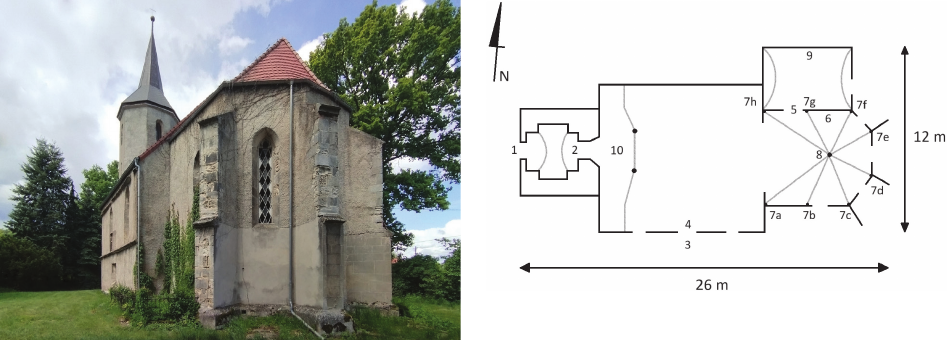
century (Fig. 1). It is located in the
centre of the village and is surrounded by a cemetery en-
closed by a ring of walls. The church is oriented. It consists
of a rectangular nave, a chancel attached to the east and
enclosed by a three-sided, buttressed apse, a square-shaped
tower attached to the nave on the west (with the narthex
on the ground oor), and a rectangular sacristy adjacent
to the choir on the north. The church is 26 m long, 12 m
wide, and the height of its tower to the crowning cornice
is approximately 18 m. Gray-yellow sandstone (probably
sourced from local deposits) was used in its construction,
both in the form of quarried stone and regular blocks of
various sizes. A large complex of stone architectural sculp
-
ture from the time of the church’s construction has been
preserved within the sanctuary (Fig. 2). Five portals con-
nect the church to the exterior and to the various parts of
the building. All passages, with the exception of two, are
adorned with more or less elaborate sculptural decoration.
Additionally, a heraldic panel is located above the southern
portal. The chancel is covered by an eight-part ribbed vault,
* ORCID: 0000-0001-5715-2505. Faculty of Historical and Pe da-
go gi cal Sciences, University of Wrocław, Poland, e-mail: jan.tomczyk@
uwr.edu.pl
16 Jan Feliks Tomczyk
with ribs converging at a relief boss and resting on eight
gural corbels. The sacrament house is located on the north
wall of the chancel. This extraordinary richness of the stone
architectural sculpture – both in terms of its quantity and
its symbolic signicance – sets the church in Nowa apart
from other medieval rural churches in the former Duchy
of Świdnica and Jawor. Given the size and character of the
building, the lavishness of this decoration is particularly
striking. An even more signicant distinguishing feature is
the exceptionally strong emphasis on the role of the found-
ers through their numerous coats of arms (including full
heraldic achievement with supporters) and the depiction of
a knightly couple as worshippers of the Crucied Christ in
the tympanum of the portal leading to the nave – this pro-
gram has no parallel among the medieval churches of this
scale and status that have survived to this day in the area
of the former Duchy of Świdnica and Jawor. Despite this,
in previous publications, the architectural sculpture of the
church in Nowa has not received the attention it deserves
and has been mentioned only briey. I set out to ll this gap
by analyzing this stonework decoration in the context of its
style, workshop connections, the history of the village and
the church, its symbolic content, its ideological signicance
and the motivations of its founders. I also sought to answer
the question of what makes the stone sculptural decoration
of the church in Nowa so unique. The eld research and
literature review that I conducted yielded many new nd-
ings in the areas mentioned above and also allowed me to
formulate proposals for future research and conservation.
State of research
The oldest known description of the church in Nowa is
contained in a report on a bishop’s visitation dated May 28,
1666; however, it is very supercial regarding the church’s
decoration (Jungnitz 1902, 341). In works from the second
half of the 19
th
century, various dates for the build ing’s
construction were proposed; stonemason’s marks observed
on the church’s details were identied and linked to other
buildings; coats of arms were described; and the identica
-
tion of the church’s founders was proposed, along with the
rst (though very brief, incomplete, and often erroneous)
information about the iconography of the sculptural rep-
resentations (Wernicke 1876, 116, 117; 1877b, 163, pl. 3;
1886, 454, 455; Lutsch 1891, 495, 539, 572, 573). In the
second half of the 20
th
century and the early years of the
21
st
century, encyclopedic and regional guide publications
featured brief descriptions of the church, based largely on
earlier literature (e.g., Brzezicki et al. 2006, 602, 603).
Among these, the catalog section of the monumental publi-
cation Architektura gotycka w Polsce [Gothic architecture
in Poland] deserves special mention, as it was likely the
rst to recognize the uniqueness of the church in Nowa,
including it as one of only ve rural churches from Silesia
listed in this study (Stulin, Włodarek 1995, 164). In their
works from the rst two decades of the 21
st
century, Dag-
mara Adamska (2005, 138, 202) and Romuald Kaczmarek
(2023, 89, 90) indicated the heraldic decoration in Nowa
as an exceptionally vivid example of the construction of
a family iconosphere and the emphasis placed on the pa-
tronage of the church by its knightly founders. To date, the
most comprehensive account of the church in Nowa has
been provided by Anna Skowron in her master’s thesis sub-
Fig. 1. Church in Nowa. View from the southeast
(photo by J.F. Tomczyk)
Il. 1. Kościół w Nowej. Widok od południowego wschodu
(fot. J.F. Tomczyk)
Fig. 2. The schematic arrangement of architectural sculptures
in the church in Nowa: 1 – the outer western portal, 2 – the inner
western portal, 3 – the southern portal, 4 – the heraldic panel,
5 – the portal of the sacristy, 6 – the sacrament house, 7 – the corbels
(a – with bust of probably a youth, b – with bust of a calm bearded man,
c – with bust of a maiden, d – with bust of a man with a book,
e – with bust of a man with a scroll, f – with bust of a woman in a kru-
seler, g – with bust of an irate bearded man, h – with bust of probably
a woman in a headscarf), 8 – the boss, 9 – the piscina, 10 – the portal
on the second storey of the church tower (elaborated by J.F. Tomczyk
on the basis of “Kościół katolicki filialny p.w. Matki Bożej Bol.
Karta Ewidencyjna…”)
Il. 2. Schemat rozmieszczenia elementów rzeźby architektonicznej
w kościele w Nowej: 1 – zewnętrzny portal zachodni, 2 – wewnętrzny
portal zachodni, 3 – portal południowy, 4 – tablica heraldyczna,
5 – portal zakrystii, 6 – sakrarium, 7 – wsporniki (a – z popiersiem
prawdopodobnie młodzieńca, b – z popiersiem spokojnego brodatego
mężczyzny, c – z popiersiem panny, d – z popiersiem mężczyzny
z księgą, e – z popiersiem mężczyzny ze zwojem, f – z popiersiem
kobiety w kruzelerze, g – z popiersiem wzburzonego brodatego
mężczyzny, h – z popiersiem prawdopodobnie kobiety w chuście),
8 – zwornik, 9 – piscyna, 10 – portal na drugiej kondygnacji wieży
(oprac. J.F. Tomczyk na podstawie „Kościół katolicki filialny
p.w. Matki Bożej Bol. Karta Ewidencyjna…”)
A sacred monument of the family. Unusual architectural sculpture of the Church of Our Lady of Sorrows in Nowa 17
mitted to the Institute of Art History at the University of
Wrocław (Skowron 2010). Regarding the heraldic decora-
tion, the date of the church’s construction, and its potential
founders, she essentially repeated the conclusions reached
by earlier researchers. She was, however, the rst to pro-
vide a broader description of the sculptural decoration of
the church’s chancel, reecting on its ideological program
and analogies, as well as workshop aspects, though she did
not reach any more concrete conclusions.
Methods
I conducted eld research at the church in Nowa in
May 2025. During this work, I assessed the current con-
dition of the objects under study and prepared photograph-
ic and measurement documentation. To draw conclusions
from these observations, I employed stylistic, comparative,
iconographic, and heraldic analyses, as well as an analysis
of stonemason’s marks and the chronology of motifs. From
January to June 2025, I conducted a literature review, during
which I reviewed previous studies on the church in Nowa,
the broader scholarly literature on the subject, relevant sup-
plementary publications, as well as published source ma-
terials and conservation documentation. The preparation of
the article was also informed by my broader knowledge
of the prevalence of particular iconographic motifs, types of
representations, or ideological programs, which I gained
through my studies on medieval architectural stone sculp-
ture in the Duchy of Świdnica and Jawor conducted since
September 2024 in connection with my doctoral thesis.
Description and analysis
of the architectural sculpture
Portals
• The outer western portal
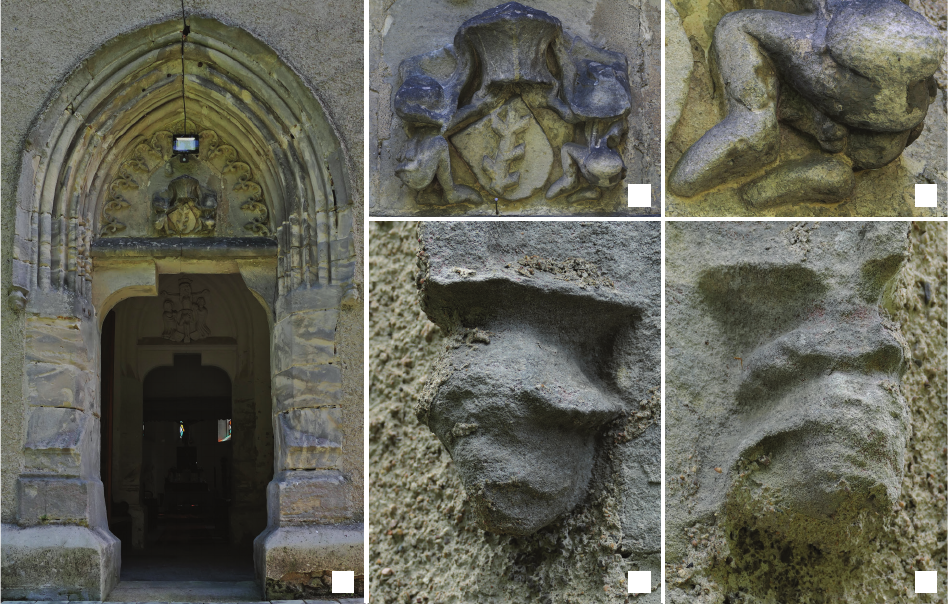
The main portal (Fig. 3), leading from the west to the
narthex on the ground oor of the tower, is 4.6 m high and
2.7 m wide. Its decoration is concentrated in the upper sec-
tion. The outer band of the richly proled archivolts is sup-
ported by two corbels in the form of human heads, topped
with pyramidal imposts. Their poor state of preservation
does not allow for a more detailed analysis, but the right
one likely depicts a mature man (as indicated by the mus-
tache), while the left one depicts a woman or a young man
(due to the wreath or torse covering the head). In the tympa-
num eld, bordered on the inside by a bordure of connected
eur-de-lis, the Hocke family coat of arms is depicted in its
full heraldic achievement – with a crest (now almost com-
pletely destroyed), a frog-mouth helm, mantling, and an-
thropomorphic supporters (deprived of their heads at least
since the turn of the 1880s and 1890s – see Wernicke 1886,
454; Lutsch 1891, 572). The gures of the supporters wear
skimpy attires and are naked from the waist down. The g-
ure on the left heraldic side clearly depicts male genitalia,
Fig. 3. The outer western portal of the church in Nowa: a) full view, b) the coat of arms on the tympanum,
c) genitals of the left heraldic supporter, d) the left corbel, e) the right corbel (photo by J.F. Tomczyk)
Il. 3. Zewnętrzny portal zachodni kościoła w Nowej: a) całość, b) herb w tympanonie,
c) genitalia postaci lewego (heraldycznie) trzymacza, d) lewy wspornik, e) prawy wspornik (fot. J.F. Tomczyk)
a
b
d
c
e
18 Jan Feliks Tomczyk
known documents of any connections between the Hertels
and Nowa (while numerous connections with the Hocke
family do exist), but also by a tombstone from the second
half of the 15
th
century belonging to perhaps the most prom-
inent medieval representative of the Hocke family – Georg
Hocke from Tomaszów Bolesławiecki, Bishop of Trent
from 1446 to 1465 (Jungnitz 1910, 25–28), currently locat-
ed in the early Christian undergrounds of St. Vigilius Cathe-
dral in that city. The coat of arms of his family is depicted
on it in the version present in Nowa
1
.
• The inner western portal
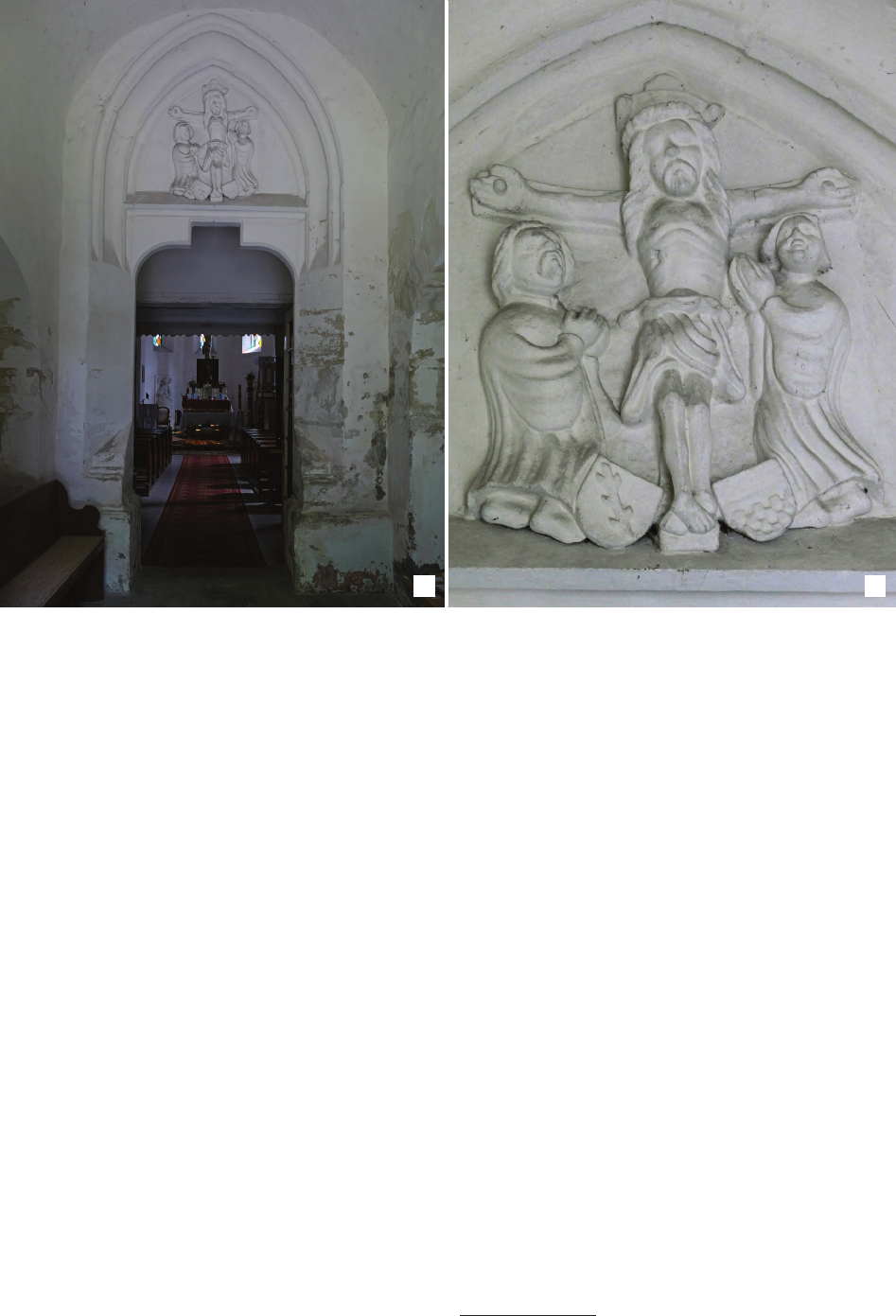
The portal leading from the narthex to the nave (Fig. 4) is
4 m high and 1.8 m wide. Its tympanum features a depiction
of the Crucied Christ, adored by a kneeling man from the
Hocke family and a woman from the Borsnitz family. Giv-
en the location and manner of their depiction, this couple
should be considered the founders of the church. As in the
case of the Hocke coat of arms described above, the typical
variant of the Borsnitz coat of arms was not used in Nowa.
On the family’s seals from that period, the checkerboard oc-
cupies the entire eld of the shield (Wójcik 2018, 180–185),
whereas here the shield is divided by a band, and the check-
erboard lls only the lower part of the eld, while the upper
1
See photo by Niccolò Caranti, 2016. Accessed June 1, 2026.
https://commons.wikimedia.org/w/index.php?curid=51755905.
featuring an erect penis and testicles. A horn on a strap and
a large pouch hangs over on its back. This way of depict-
ing a heraldic supporter is unique among medieval Silesian
sculpture. In the previous literature, the phallic motif in the
church in Nowa has not been noted. Male genitalia may be
interpreted here in the context of the attributes of the family
– they symbolize its strength, fertility, and creative energy.
The apotropaic dimension may also be signicant – phallic
representations were used in the Middle Ages as amulets
to ward o evil forces (Kopaliński 2012, 85, 86). The horn
and the pouch are also linked to the symbolism of the gen-
italia, serving as references to abundance and wealth (Ko-
paliński 2012, 360, 362). The depiction of the hunting horn
can additionally be interpreted as an attempt to emphasize
the family’s status, as hunting was then an elite pastime of
the knighthood. The gure of the supporter on the heraldic
right does not have a similarly dened gender (perhaps it
could be identied by the head, which has not survived to
this day), while the object suspended on its back is dicult
to identify.
Both here and in the other depictions in the church, the
charge on the shield in the Hocke family coat of arms is
consistently shown as a cut o tree stump with ve spurs.
Meanwhile, in roll of arms and literature, the Hocke fam-
ily’s charge is a tree stump with six spurs, while the one
with ve belongs to the Hertel family (Appuhn 1989, pl.
55, 64; Sękowski 2003, 152). Certainly, however, the Hocke
used both variants, as evidenced not only by the absence in
a b
Fig. 4. The inner western portal of the church in Nowa: a) fullview, b) depiction on the tympanum (photo by J.F. Tomczyk)
Il. 4. Wewnętrzny portal zachodni kościoła w Nowej: a) całość, b) przedstawienie na tympanonie (fot. J.F. Tomczyk)
A sacred monument of the family. Unusual architectural sculpture of the Church of Our Lady of Sorrows in Nowa 19
part contains no gures. The Bindemann family, present on
the Silesian-Lusatian border since the 15
th
century, had such
a coat of arms (Sękowski 2002, 198). However, the known
sources provide no evidence of a connection between this
coat of arms and Nowa. At the same time, the documented
marriage of Nickel Hocke and Jadwiga of Borsnitz during
the period in which the church was built lends credence to
the claim that this is, in fact, the Borsnitz coat of arms, albeit
used, like the Hocke coat of arms, in a variant that is less
familiar today. Aside from heraldry, the main feature iden-
tifying the gure on the left as a man is his mustache. The
couple wears long, nearly identical robes, tighter at the top
and looser at the bottom. Skowron regarded their owing,
somewhat shapeless form as evidence of the stonemason’s
lack of skill (Skowron 2010, 27). Indeed, these sculptures
are not of particularly high artistic quality; however the
workshop responsible for them was capable of dierenti-
ating the gures’ attire, as is best evidenced by the corbels
in the chancel. The depiction of the founders was too im-
portant an element of the church’s sculptural decoration for
its patrons (who were themselves being commemorated) to
have allowed the use of random clothing. The form of the
robes and the fact that the man from the Hocke family was
depicted in such an attire, rather than, for example, in armor,
must have had their justication. In my opinion, the answer
lies in the meaning of the entire depiction. This couple is
shown primarily as worshippers of the Crucied Christ,
who is the source of Salvation. The robes in which they are
clothed may therefore be regarded as the wedding garment
mentioned in the parable contained in the Gospel of Mat-
thew (Pismo Święte… 1980, Mt 22:1–14). An analogy in
this regard is provided by the tombstone of Jan of Czernina
from around 1425, located in the Church of St. Stanislaus
the Bishop in Rydzyna (Kalinowski 1989, 381, 384, 394,
398, 399, 407). Given that the gures depicted in these gar-
ments are shown adoring the crucix, the robes can also be
seen as a symbol of the robes washed white in the blood of
the Lamb from the Book of Revelation (Makarewicz 2007,
197, note 199). The depiction on the tympanum of the portal
in Nowa thus served as a form of commemoration of the
church’s founders both during their lifetimes and after their
deaths, and their adoration of the Crucied Christ thereby
acquires an eternal character and a salvic dimension.
• The portal of the sacristy
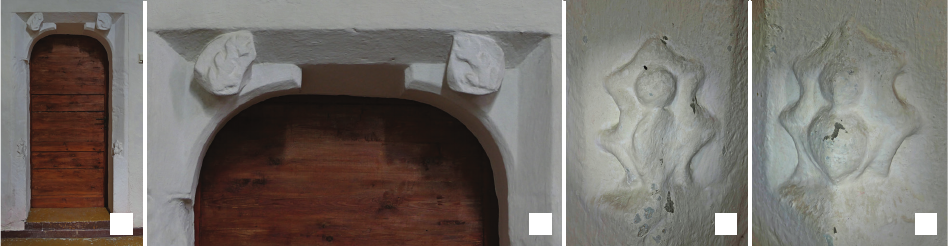
The most modestly sculpturally decorated portal in the
church in Nowa is the one leading from the chancel to the
sacristy, set into the north wall of the chancel (Fig. 5). It
is 2.2 m high and 1.2 m wide. Two coats of arms of the
Hocke family are placed in its corner segments, while styl-
ized leaves, probably oak, are depicted at about one-third
of the jamb’s height, where the chamfering begins. Given
the symbolism of this tree, associated with divinity, glory,
strength, and durability (Kobielus 2006, 52–55), their use
can be explained both by their placement in the chancel and
by their co-occurrence with heraldic decoration, as a further
emphasis on the positive traits characterizing the family.
The decoration of the chancel vault
All eight corbels supporting the vault of the chancel
(measuring on average 0.5 × 0.4 m) and its boss (with a di-
ameter of approx. 0.4 m) are decorated with gurative rep-
resentations – in the rst case in the form of busts, and in the
second as the head (Fig. 6). The depictions on the corbels
vary in terms of the gures’ gender, age, and marital status,
and these distinctions are conveyed through facial features,
attire, and attributes. The corbel in the southwest corner of
the chancel probably depicts a young man. This is indicated
by the gure being shown in rather masculine attire, while
simultaneously having a wreath adorning his head. The next
corbel (facing east) on the south wall, depicts a calm, beard-
ed man, likely a giant – this is indicated by the head’s larger
size relative to the other sculptures, suggesting the gure’s
superhuman stature. The next corbel, located in the southern
corner of the chancel apse, depict a maiden holding a wreath
or torse in her hands. Her marital status is indicated by her
long, loose hair and the presence of a wreath or torse on her
head. Two corbels located on the east wall of the chancel
apse depict two mature, bearded men dressed in buttoned
robes. The gure on the south side holds an open book in
his hands, while the one on the north side holds an unrolled
scroll. Another corbel, located in the northern corner of the
chancel apse, depicts a married woman, as indicated by
the presence of a headscarf. Her head is adorned with a kru-
seler – a type of veil popular from the mid-14
th
to the mid-
15
th
century, worn by ladies from knightly and burgher’s
Fig. 5. The portal of the sacristy of the church in Nowa: a) full view, b) the coat of arms on the corner segments of the portal,
c) plant ornament on the left jamb, d) plant ornament on the right jamb (photo by J.F. Tomczyk)
Il. 5. Portal zakrystii kościoła w Nowej: a) całość, b) herby na przyłuczach, c) detal roślinny lewego ościeża, d) detal roślinny prawego ościeża
(fot. J.F. Tomczyk)
a b c d
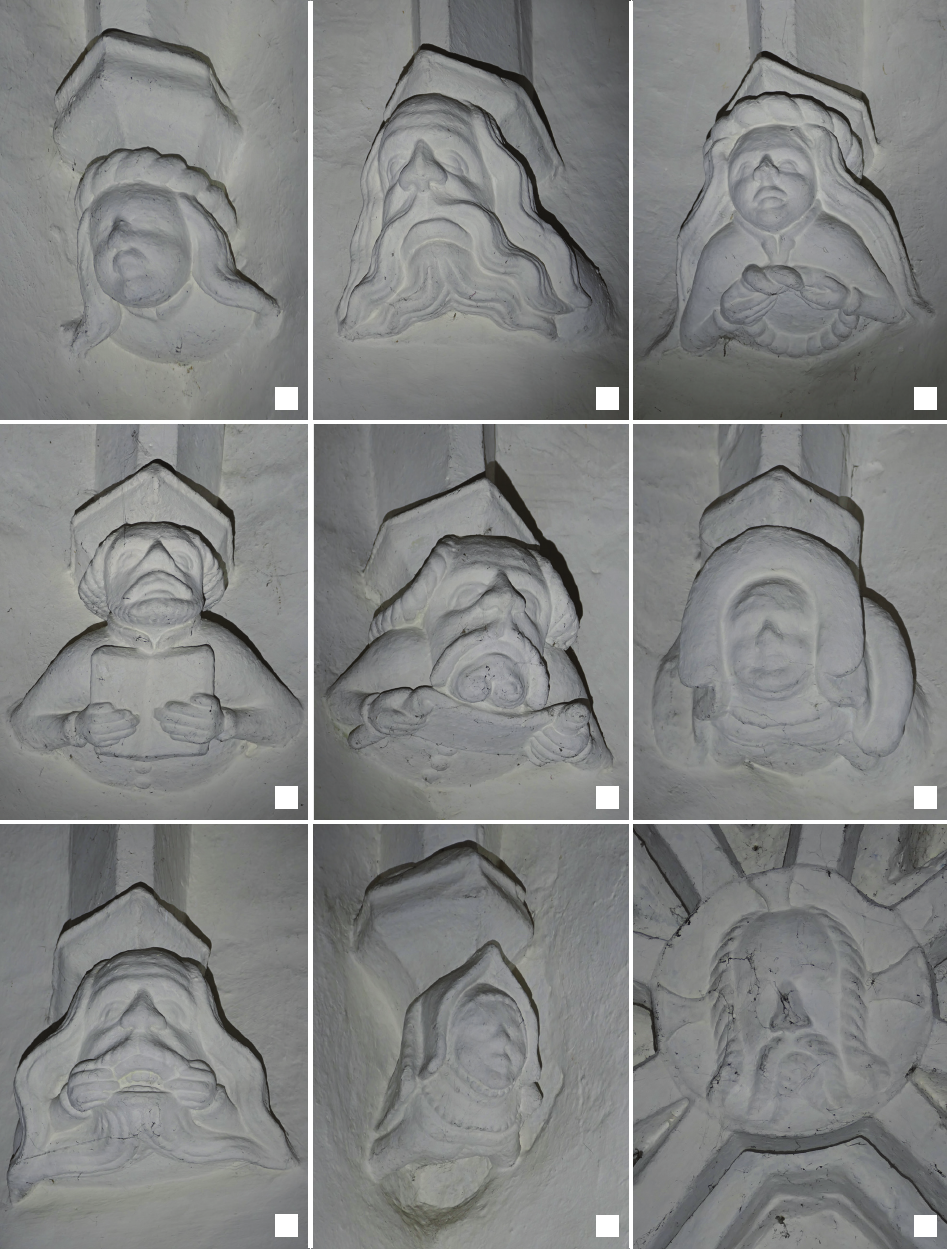
20 Jan Feliks Tomczyk
Fig. 6. Architectural sculpture on the vault of the chancel of the church in Nowa: a) the corbel with bust of probably a youth,
b) the corbel with bust of a calm bearded man, c) the corbel with bust of a maiden, d) the corbel with bust of a man with a book,
e) the corbel with bust of a man with a scroll, f) the corbel with bust of a woman in a kruseler, g) the corbel with bust of an irate bearded man,
h) the corbel with bust of probably a woman in a headscarf, i) the boss (photo by J.F. Tomczyk)
Il. 6. Rzeźba architektoniczna na sklepieniu prezbiterium kościoła w Nowej: a) wspornik z popiersiem prawdopodobnie młodzieńca,
b) wspornik z popiersiem spokojnego brodatego mężczyzny, c) wspornik z popiersiem panny, d) wspornik z popiersiem mężczyzny z księgą,
e) wspornik z popiersiem mężczyzny ze zwojem, f) wspornik z popiersiem kobiety w kruzelerze, g) wspornik z popiersiem wzburzonego
brodatego mężczyzny, h) wspornik z popiersiem prawdopodobnie kobiety w chuście, i) zwornik (fot. J.F. Tomczyk)
a
d
g
b
e
h
c
f
i

A sacred monument of the family. Unusual architectural sculpture of the Church of Our Lady of Sorrows in Nowa 21
the stylistic features of the gural representations, the shape
of the shields, and the type of helmet and border, it can
be concluded that the panel was created around the same
time as the rest of the church. This work was most likely
commissioned by a couple one generation younger than the
church’s founders – a woman from the Hocke family (on the
dista side Borsnitz) and her husband from the Redern fam-
ily. There is no information in known documents
about the
connections between the Rederns and the Hocke of Nowa at
that time, although sources indicate that earlier, in the 1360s,
1380s, and 1390s, there were contacts between these fami-
lies (Wernicke 1886, 452; Jurek 2000, 226, no. 1184, 261
,
no. 1418; 2004, 7, no. 19).
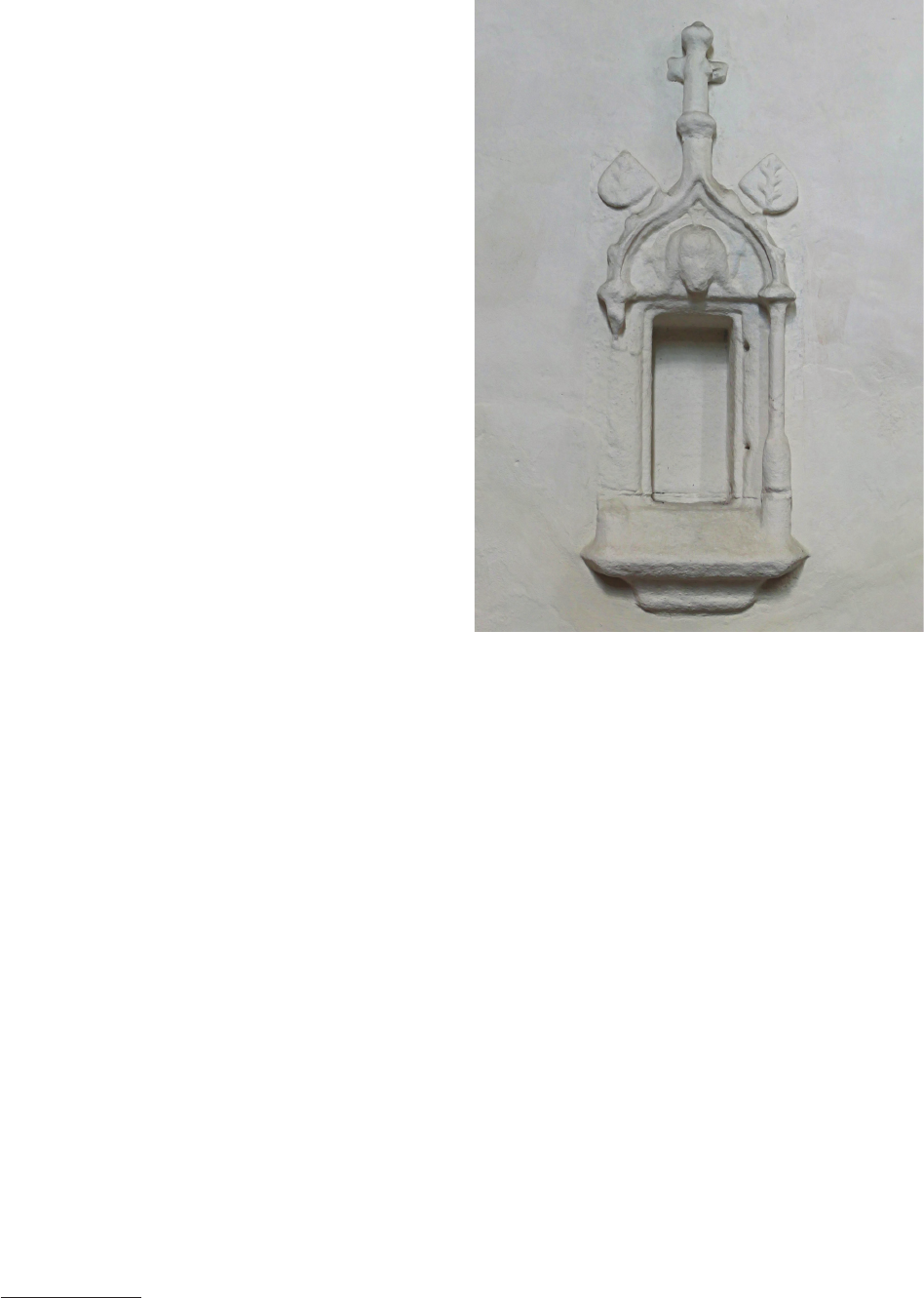
• The sacrament house
A wall-mounted sacrament house is located on the north
wall of the chancel (Fig. 8). In terms of form, it consists
of a niche with an architecturally shaped frame. It is 1.7 m
high, 0.6 m wide, and the depth of the niche itself is 0.25 m.
In the eld of the wimperg, originally supported by two
small columns, a relief head of Christ in a cruciform halo
is depicted, while on either side of the euron crowing the
whole are two shields with the Hocke family coat of arms.
The placement of heraldic depictions on an object used to
store the consecrated Host can be seen as the founders’ de-
sire to emphasize their role as guardians and defenders of
the church – after all, stone tabernacles secured with a grille
(as was originally the case here as well) were intended to
protect the Blessed Sacrament. Additionally, the duplica-
tion of the coat of arms, present both here and on the por-
tal leading to the sacristy, may have had a purely aesthetic
purpose, serving to maintain symmetry, or it may also have
been a sign of the participation of a larger number of repre-
sentatives of the Hocke family in the church’s foundation
– however, at this stage of research, this cannot be proven
3
.
The time of creation and the founders
of the decoration
In previous studies, the church in Nowa has been dated to
various periods – the 14
th
, 15
th
, and 16
th
centuries (e.g., Wer-
nicke 1886, 455; Adamska 2005, 138; Bartnik et al. 2005,
256). Any other period than the turn of the 14
th
and 15
th
cen turies and the rst half of the 15
th
century is contradict-
ed by an analysis of the building’s architecture, including
the sculptural details decorating it. The kruseler on the head
of the woman on the corbel in the northeast corner of the
chancel apse (Fig. 6f) takes the form of a semicircular roll
with several rows of frills owing down onto the shoulders,
present in Silesian art from at least the 1370s through the
1430s
4
. The combination of a mustache with a clean-shaven
3
I omit the portals on the south side of the church and on the sec-
ond oor of the tower, as well as the piscina in the sacristy, because they
lack sculptural decoration.
4
For example, on the seal of Duchess Agnes of Habsburg on a do-
cu ment from 1370 approving the sale of the estate in Jeżów Sudec ki (Do -
kument księżnej…, APWr, department Jelenia Góra) and on the tomb -
stone of Princess Elizabeth of Hohenzollern and her husband Louis II of
Legnica from ca. 1435 in the Cathedral of Sts. Peter and Paul the Apostles
in Legnica (Czechowicz 2003, 128).
families (Gutkowska-Rychlewska 1968, 161, 162; Moskal
2008, 105). Adjacent to this depiction on the west side is
a second corbel depicting a monstrous bearded man, this
time irate, and opening his mouth with his hands and baring
his teeth. The last corbel probably depicts a woman wearing
a headscarf and a shawl on her head
2
. The keystone shows
the head of Christ in a cruciform halo.
The ideological program of the chancel vault is likely
not uniform, but all the gures can be linked to the image
of Christ on the boss. Given their attributes, age, and loca-
tion within the chancel vault – and thus closest to the altar
– the men holding a scroll and a book may be, respective-
ly, a prophet and an apostle – the former announcing the
coming of the Messiah, the latter attesting to His presence
(e.g., as an Evangelist). It is possible that their attributes
originally bore writings. In the context of the distinctly he-
raldic decoration of the rest of the church, it is possible that
the four gures, diering in age and headgear, symbolize
a cross-section of the knightly class subject to God. In turn,
the two monstrous bearded gures may be a reference to
the tamed and untamed forces of nature (analogous to the
so-called wild men, as Wiese 1927, 154, identied them;
see also Kopaliński 2012, 277, 278 on the symbolism of
giants, and Bernheimer 1952 on the motif of the wild man
in the Middle Ages), especially since the gure with the ag-
gressive facial expression was placed on the northern side,
often associated in the Middle Ages with threats and evil.
The rest of the church’s sculptural decoration
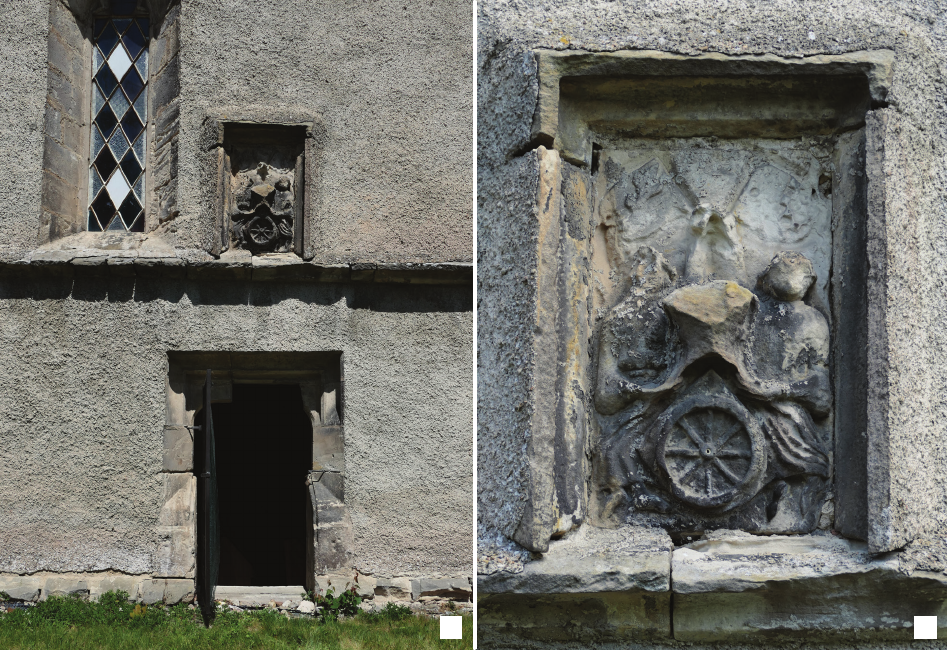
• The heraldic panel
Above the south entrance to the church is a heraldic
panel (Fig. 7), which has received only brief mention in
previous publications, where authors merely listed the
coats of arms depicted on it (sometimes incorrectly – see
Lutsch 1891, 572). It is 1.3 m high and 1 m wide. The pan-
el features a relief depicting the full heraldic achievement
of the Redern family coat of arms, complete with a crest,
a frog-mouth helmet, mantling, and anthropomorphic sup-
porters. The supporters hide one pair of hands in the man-
tling, while the other pair holds two smaller coats of arms
– Hocke on the right and Borsnitz on the left, facing each
other in a heraldic courtesy. Unlike those on the tympanum
of the outer western portal, the gures of the supporters are
fully clothed – wearing owing robes. The robe of the g-
ure on the right is additionally tied with a cord. Based on
2
Interpreting this bust as male seems less likely, though it cannot
be entirely ruled out. The headgear depicted here resembles a kettle hat,
a type of helmet that was particularly popular from the 13
th
to the 15
th
century (for more on this, see Gosk 2022). If this gure were to be iden-
tied as a knight, then the form with serrated edges surrounding his face
and neck would likely be mail, and the entire armor would resemble that
present in the Passion panels in the Grudziądz Polyptych. The male iden-
tication of the gure is also supported by the pairing of this sculpture
with what is likely a depiction of a young man in the southwest corner,
analogous to the evident pairs of a married woman and a maiden, a man
with a scroll and a man with a book, and an irate bearded man and a calm
bearded man on the remaining corbels. However, this thesis is contra-
dicted by the probable outline of a bosom, more clearly visible from the
bottom of the depiction, as well as the shape on the gure’s back, which
is unlikely to be a shield due to its too big curvature.
22 Jan Feliks Tomczyk
and the marital status of some of them and the family ali-
ations of their possible wives remain unknown.
Based on the document mentioned above and another
one from two years later that also mentions Nickel (Wer-
nicke 1886, 454), Adamska concluded that the church in
Nowa was built between 1406 and 1408 (Adamska 2005,
138). However, these sources do not mention a possible
church in the village. Nevertheless, the rst document may
be helpful in establishing the lower limit for the church’s
construction date. A life estate (Leibgedinge) is a form of -
nancial security for a wife in the event of widowhood, typ-
ically included in a marriage contract. Therefore, assuming
the most likely scenario that Nickel and Hedwig are depict-
ed on the tympanum of the inner western portal, the church
in Nowa could not have been built before 1406. In turn,
the upper date limit for the church’s construction, is a doc-
ument dated March 23, 1423 (Wernicke 1884, 98), which,
as the earliest known archival record, notes the presence
of a church ef in the village, thus proving the existence of
a sacred building there.
The issue of the workshop
In the analysis of the sculptural decoration of the church
in Nowa, another important issue is the workshop responsi-
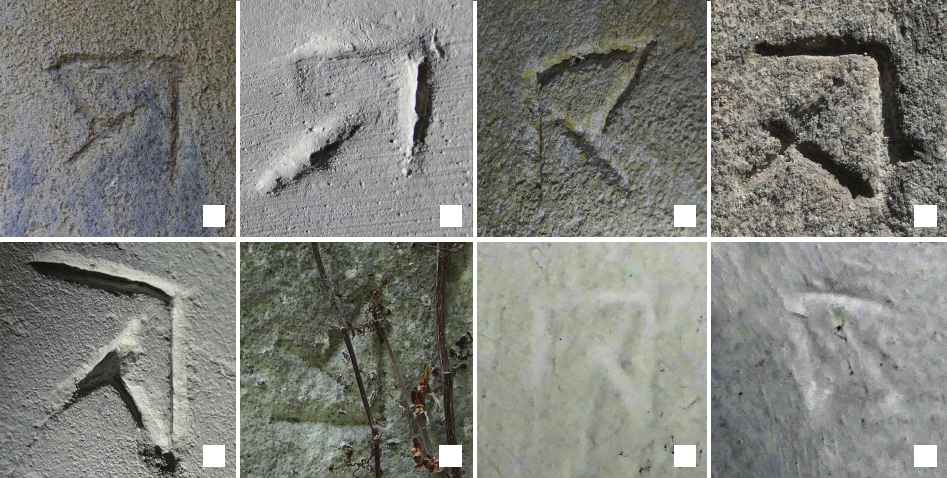
ble for its creation. Numerous mason’s marks can be found
both on the church’s elevations and inside the building
(Fig. 9). I identied them on the western portals (one on
Fig. 7. The church in Nowa: a) the southern portal, b) the heraldic panel above it (photo by J.F. Tomczyk)
Il. 7. Kościół w Nowej: a) portal południowy, b) tablica heraldyczna nad nim (fot. J.F. Tomczyk)
chin, seen on face of the kneeling man in the tympanum
of the inner western portal in Nowa (Fig. 4b), appears, for
example, in the case of Jan of Czernina on his aforemen-
tioned tombstone from around 1425 in the Church of St.
Stanislaus the Bishop in Rydzyna (Kalinowski 1989, 383).
In turn, the shape of the heraldic shields used in the decora-
tion is analogous to the designs of the shields of these coats
of arms on the seals of the families that used them in the rst
and second decades of the 15
th
century (see Wójcik 2018,
183–185, 630, 631), whereas on older seals dating from
1400 and earlier, the shields generally have a slightly point-
ed lower edge (see Wójcik 2018, 172–183, 317–319, 630).
Above all, however, the only known medieval document
mentioning a married couple consisting of a husband from
the Hocke family and a wife from the Borsnitz family dates
to the rst decade of the 15
th
century, specically 12 Janu-
ary 1406. In this document, Nickel Hocke granted his wife,
Hedwig of Borsnitz, a life estate (Leibgedinge), consist-
ing of the revenues from Tomaszów Bolesławiecki (Jurek
2007, 409, no. 1590). Given the match between the style
of the church and the date of the document, as well as the
family aliations of the individuals mentioned therein, the
attribution of the church’s foundation in Nowa to Nickel
Hocke and Hedwiga of Borsnitz, as found in the previous
literature, appears to be the most likely option. However, it
should not be forgotten that documents from the last quar-
ter of the 14
th
century in this part of Silesia mention more
than ten of the Hocke family members (Jurek 1996, 318),
a b
A sacred monument of the family. Unusual architectural sculpture of the Church of Our Lady of Sorrows in Nowa 23
each), on the southern portal (two), on the niche of the pi-
scina in the sacristy (one), and on the jambs of the southern
and southeastern chancel windows (two on the former – one
on the exterior face and one on the interior face – and one on
the interior of the latter). Some of them have not been doc-
umented in the existing literature. At the same time, I was
unable to locate some of the marks mentioned by Ewald
Wernicke and Hans Lutsch in their late 19
th
century publica-
tions (Wernicke 1877b, 163, pl. 3; Lutsch 1891, 572). It still
remains unclear whether this is due to their being hidden
under layers of whitewash or because of an error on the part
of these authors. Additionally, all the marks I have found
share the same form – an L-shape with a T-shaped extension
curving inward; in one instance (on the southern portal),
a cross was used instead of the T, though it is barely visi-
ble (Fig. 9d). Meanwhile, Wernicke listed as many as seven
types of mason’s marks on the church. On the one hand,
based on the locations and forms he provided, I believe that
at least some of them were mistakenly duplicated, essen-
tially being a single mark. On the other hand, it is hard to
ima gine that only one or two stonemasons worked on the
con struction of a church so rich in architectural sculpture. In
ad dition, I found several possible mason’s marks, which can-
not be identied with certainty due to their poor condition.
Symbols analogous to the marks used in Nowa are known
from Grodziec Castle and several parish churches: in Świd-
nica, Lwówek Śląski, Rząsiny, and Płóczki Górne – they had
been already documented there by Wernicke and Lutsch,
with the latter author regarding their presence as evidence of
workshop connections between these churches, a view lat-
er echoed by Adamska (Wernicke 1877a, 143, 1877b, pl. 1,
160, pl. 3; Lutsch 1891, 539, 572; Adamska 2005, 267).
Apart from the parish church in Świdnica (which requires
further research in this regard), it cannot be the case that the
same stonemason worked on the construction sites of the
above-mentioned buildings as in Nowa, since all of them
– or the parts marked with this sign – date from approxi-
mately eighty to one hundred years later than the church
in Nowa
5
. How, then, can this similarity in the form of the
mark be explained? The mark may have been passed down
to the son or grandson of a stonemason working in Nowa
(we know that such cases occurred, for example, in Lwówek
– see Białek 2007, 46), or it may have belonged to a person
completely unrelated to him, with the similarity resulting
from its assignment within a much later lodge originating
from a dierent artistic region, without any awareness of its
earlier use by another stonemason.
Judging by the low artistic quality of the sculptures in
Nowa, the workshop that produced them was likely one of
many small studios operating in the rst quarter of the 15
th
century in the Silesian region, inuenced by local traditions
and artistic trends from neighbouring regions, of which Bo-
hemia was the most signicant for the Duchy of Świdnica
and Jawor at the time for political and economic reasons.
5
Another good example is – previously unknown in the literature
– an analogous mark to the ones located in Nowa, found on the vaults of
two rooms in the east wing of the Franciscan monastery in Lwówek Śląs-
ki. A stylistic analysis of the decoration on these vaults clearly indicates
that they were created several decades later.
However, at this stage of the research, it is dicult to draw
broader conclusions about the creators of the church decora-
tions in Nowa. Further analysis of the stylistic features and
stonemason’s marks of other buildings constructed during
the same period in the region – which I am conducting as
part of my doctoral thesis – may prove helpful in this regard.
The church in Nowa as a sacred monument
of the family
Many features of architecture of the church in Nowa
– its relatively complex form and the articulation of its ele -
vations, used materials and techniques, and above all, the
extraordinary abundance of architectural sculpture, testify
to the founders’ intention to create an outstanding, even
elite, church, incorporating motifs borrowed from large ur-
ban churches, scaled down in size but not in diversity.
Full heraldic achievements are rarely found in well-
known examples of architectural sculpture commissioned
by medieval knights in Silesia. It is also a rarity that a foun-
dation tympanum depicting the lay patrons who commis-
sioned the church’s construction appeared in a small rural
church – such an element is typically associated with the
iconography of rulers, as exemplied by the tympanums in
the Collegiate Church of the Holy Cross in Wrocław and
in the castle chapel dedicated to St. Hedwig in Lubin. The
above features, along with the almost ostentatious use of
Fig. 8. The sacrament house in the chancel of the church in Nowa
(photo by J.F. Tomczyk)
Il. 8. Sakrarium w prezbiterium kościoła w Nowej (fot. J.F. Tomczyk)
24 Jan Feliks Tomczyk
coats of arms on numerous elements of the church’s sculp-
tural decoration, point to an exceptionally strong desire to
emphasize the role and social standing of the founders. This
reects the late medieval tendency of feudal lords to treat
a church serving the entire local community as their own
family church, a phenomenon that is expressed here in an
exceptionally emphatic manner (Adamska 2005, 138, 184,
201–204; Kaczmarek 2023, 89, 90). Another signicant
impetus for the creation of this decoration was the desire
for commemoration. This interpretation is reinforced by the
presence of a crypt beneath the chancel (no longer in use by
the 17
th
century – see Jungnitz 1902, 341), which attests to
plans to turn the church in Nowa into a family necropolis.
Among the reasons for the creation of such spectacular
decoration in a rural church, the status of the Hocke family
at the time appears to have been a key factor. During the pe-
riod when the church in Nowa was built, the Hocke family
was among the more auent knightly families in the Duchy
of Świdnica and Jawor (Adamska 2005, 216). This is indi-
cated by the numerous donations they made to the Church
at the turn of the 14
th
and 15
th
centuries (Adamska 2005,
113, 154, 155, 216, 311, 313, 318, 329 – specic examples
of endowments are provided there). Given the general im-
poverishment of the Silesian knighthood at that time, only
families of higher economic status could aord such activ-
ities (Adamska 2005, 216, 217). The signicant position of
the Hocke family is also indicated by the important roles
held by its representatives – e.g., Konrad and Henryk, active
in the second half of the 13
th
century at the courts of the
Dukes of Legnica and Wrocław (e.g., Wernicke 1886, 450),
and above all the aforementioned Georg from Tomaszów
Bolesławiecki, Bishop of Trent, and his brother Happi, Mar-
shal to Duke Sigismund of Tyrol (Jungnitz 1910, 25).
Previous studies have assumed that the Hocke fami-
ly sold their estate in Nowa in 1423 and never again held
property there (most recently Skowron 2010, 12, 56, 64;
Adamska, Dulęba 2015, 142). Indeed, according to a doc-
ument dated March 23, 1423, Peter Hocke sold everything
he owned in Nowa (including the church ef) to the knights
Petsche and Jeschke Schellendorf (e.g., Neuling 1885, 408;
Wernicke 1886, 454). However, this does not imply that
other members of the Hocke family could not continue to
hold property in Nowa, nor that Peter or another family
member did not later repurchase this estate, but no docu-
ment attesting to such a transaction is known. Although the
Hocke family no longer appear in connection with Nowa in
the archival records known today, and for the next hundred
or so years the Schellendorfs were listed as the owners of
the local estates (e.g., Wernicke 1884, 121, 144, 145, 204),
a certain piece of the church’s former furnishings in Nowa
contradicts the thesis that the Hockes’ ties to this village
denitively ended in 1423. As late as the end of the 19
th
century, a heavily damaged late-Gothic triptych was locat-
ed in the church in Nowa; in the 1930s it formed part of the
collection of the Archdiocesan Museum in Wrocław, and
after 1945 was transferred to the storage facilities of the
National Museum in Warsaw, where it remains to this day
(e.g., Wernicke 1876, 116, 117; Ziomecka 1976, 99). Given
the dimensions of the retable, the limited interior space of
the church in Nowa and its layout, it can be considered
the
a
e
c
g
b
f
d
h
Fig. 9. Mason’s marks on the church in Nowa: a) on the left corner segment of the outer western portal, b) on the left jamb of the inner western portal,
c) on the leftcorner segment of the southern portal, d) on the right jamb of the southern portal, e) on the niche of the piscina,
f) on the outer jamb of the southern window of the chancel, g) on the inner jamb of the southern window of the chancel,
h) on the inner jamb of the southern window of the presbytery apse (photo by J.F. Tomczyk)
Il. 9. Znaki kamieniarskie z kościoła w Nowej: a) na lewym przyłuczu zewnętrznego portalu zachodniego, b) na lewym ościeżu wewnętrznego
portalu zachodniego, c) na lewym przyłuczu portalu południowego, d) na prawym ościeżu portalu południowego, e) na wnęce piscyny,
f) na zewnętrznym ościeżu południowego okna prezbiterium, g) na wewnętrznym ościeżu południowego okna prezbiterium,
h) na wewnętrznym ościeżu południowego okna absydy prezbiterium (fot. J.F. Tomczyk)

A sacred monument of the family. Unusual architectural sculpture of the Church of Our Lady of Sorrows in Nowa 25
former main altarpiece of this church. The triptych is dated
to the 1470s–1480s (Ziomecka 1976, 99, 100). On the re-
verse sides of its wings were painted (described as damaged
as early as the 19
th
century and now partially lost) images
of two saints (St. Nicholas on the right, an unknown saint
on the left), as well as a depiction, divided between the two
wings, of a kneeling knight bearing the Hocke coat of arms,
the inscription “Cunrad Hocke”, and the invocation “Sancte
Nicolae ora pro me!” (e.g., Wernicke 1876, 116, 117; 1886,
455; Lutsch 1891, 573; Ziomecka 1976, 99)
6
.
This triptych
should therefore be regarded as a donation by a member of
the Hocke family and direct evidence that the family’s ties
to Nowa did not end in 1423.
In the centuries that followed, the state of neglect in which
the church had already found itself by the 17
th
century para-
doxically helped preserve its sculptural decorations (Skow-
ron 2010, 14). Until the 20
th
century, the only known repairs
were those that did not substantially interfere with its archi-
tecture; in the case of stone decorative elements, these were
limited to whitewashing them as part of interior refurbish-
ment and eorts to combat moisture (e.g., Lutsch 1891, 573;
Pater 1982, 140; Bartnik et al. 2005, 256). On the other hand,
this is precisely what led to the loss of the full legibility of
the depictions, and in the case of exposed exterior details
– their signicant and irreversible damage due to weathering.
6
An interesting point, given the likely founders of the church in
Nowa – namely Nickel Hocke and Hedwig of Borsnitz – is the fact that
Cunrad directed his prayers to St. Nicholas rather than to his own name-
sake patron saint. It is possible that this was an expression of respect
for the church’s founder and evidence of the prayers still being oered
here for his soul, though one must also bear in mind the great popularity
of this saint in the Middle Ages as well as other possible reasons, now
unknown, for singling out this particular gure.
Summary and recommendations
The analysis presented in this article has conrmed the
uniqueness of the architectural sculptural complex of the
church in Nowa within the context of medieval rural re-
ligious architecture in the Duchy of Świdnica and Jawor.
Particularly unique is the distinctly family-oriented ideo-
logical program, which makes extensive use of heraldry.
I have proposed the period between 1406 and 1423 as
the date of the church’s construction, and I have consid-
ered Nickel Hocke and his wife Hedwig of Borsnitz as its
likely founders. I attributed the uniqueness of the church’s
sculptural decoration to the ambitions of the Hocke family
(which at the time was among the wealthiest and most in-
uential in the duchy) and the church’s intended function
as a family necropolis, and its completeness to the absence
of signicant later alterations to the building. I called into
question the previously held view that the Hocke family
permanently lost patronage over the church in 1423, as well
as most of the workshop connections suggested in the past.
From a scholarly perspective, the most important priorities
include further exploration of technical aspects and the
search for direct and indirect sources of inspiration for this
decoration. From a conservation perspective, it is crucial to
protect the exterior details from further destructive eects
of rainwater, and in the case of the architectural sculpture
inside the church, it is necessary to remove the layers of
overpainting, which would allow for a more complete as-
sessment of its stylistic characteristics and perhaps lead to
the discovery of traces of the original polychromy. In this
way, the measures undertaken by conservation specialists
will contribute to a better understanding and preservation
of this sacred monument of the region’s historic noble fam-
ilies for future generations.
Acknowledgements
I would like to thank Romuald Kaczmarek, Associate Professor at the Uni-
versity of Wrocław, for his expert guidance, and Bogdan Klinkowski, parish
priest of St. Michael the Archangel Parish in Włodzice Wielkie, for allowing
me to conduct a thorough exploration of the church in Nowa. I would also
like to thank the kind residents of Nowa, Kraszowice, and Ocice, who pro-
vided me with transportation during my eld research and showed a keen
interest in the local cultural heritage – I hope this article will serve as an op-
portunity for you to further expand your knowledge of your small homeland.
References
Adamska, Dagmara. Fundacje dewocyjne rycerstwa księstwa świdnicko-
jaworskiego w średniowieczu. Wydawnictwo Historyczne, 2005.
Adamska, Dagmara, and Przemysław Dulęba. “Średniowieczny tłok pie-
czętny Lutolda von Hacke – znalezisko spod Bierzyna, pow. strzeliń-
ski.” Śląski Kwartalnik Historyczny Sobótka 70, no. 3 (2015): 133–43.
Appuhn, Horst, ed. Johannes Siebmachers Wappenbuch. Harenberg, 1989.
Bartnik, Krystyna, Anna Cudnowska, Ewa Kica, et al. Prace konserwa-
torskie na terenie województwa dolnośląskiego w latach 1979–1999.
Wojewódzki Urząd Ochrony Zabytków we Wrocławiu, 2005.
Bernheimer, Richard. Wild men in the Middle Ages. A study in art, senti-
ment and demonology. Harvard University Press, 1952.
Białek, Stefan. “Znaki kamieniarskie na budowlach lwóweckich od połowy
XV do połowy XVI wieku.” Rocznik Jeleniogórski 39 (2007): 37–60.
Brzezicki, Sławomir, Grzegorz Grajewski, Christine Nielsen, et al., eds.
Zabytki sztuki w Polsce. Śląsk. Krajowy Ośrodek Badań i Dokumen-
tacji Zabytków, 2006.
Czechowicz, Bogusław. Nagrobki późnogotyckie na Śląsku. Wydawnic
-
two Uniwersytetu Wrocławskiego, 2003.
Dokument księżnej Agnieszki potwierdzający sprzedaż folwarku w Jeżowie
Sudeckim (Grunow) 18 października 1370 roku. Manuscript in Ar-
chiwum Państwowe, Wrocław, department Jelenia Góra. Akta miasta
Jeleniej Góry, Dokumenty, shelfmark no. 18. Accessed May 17, 2026,
at https://jbc.jelenia-gora.pl/dlibra/publication/705/edition/970/con-
tent?ref=L2NvbGxlY3Rpb25kZXNjcmlwdGlvbi84NQ.
Gosk, Daniel. Średniowieczne kapaliny z ziem polskich na tle europej-
skim. Muzeum Zamkowe w Malborku, 2022.
Gutkowska-Rychlewska, Maria. Historia ubiorów. Zakład Narodowy im.
Ossolińskich – Wydawnictwo, 1968.
Jungnitz, Josef, ed. Visitationsberichte der Diözese Breslau. Vol. 1: Archi-
diakonat Breslau. G.P. Aderholz Buchhandlung, 1902.
Jungnitz, Josef. “Ein Schlesier auf dem Bischofsstuhle von Trient.” Schle-
sische Geschichtsblätter 2 (1910): 25–8.
26 Jan Feliks Tomczyk
Streszczenie
Sakralny pomnik rodu. Niezwykła rzeźba architektoniczna kościoła pw. Matki Bożej Bolesnej w Nowej (gm. Bolesławiec)
Kościół pw. Matki Bożej Bolesnej w Nowej wyróżnia się na tle średniowiecznych świątyń wiejskich z obszaru dawnego księstwa świdnicko-jawor-
skiego bogactwem kamiennej rzeźby architektonicznej, zarówno pod względem jej ilości, jak i wymowy ideowej. Uwzględniając skalę obiektu, zwraca
uwagę wystawność tej dekoracji. Jej jeszcze istotniejszą cechą jest wyjątkowo silne zaakcentowanie roli fundatorów, poprzez ich licznie umieszczone
herby. Mimo to w dotychczasowych publikacjach zespół ten był jedynie lakonicznie wspominany.
Moim celem było zapełnienie owej luki poprzez poddanie tej dekoracji analizie oraz odpowiedź na pytanie o przyczyny wyjątkowości tego wystro-
ju. W tym celu przeprowadziłem kwerendę literaturową oraz badania terenowe, z których wyciągnąłem wnioski, posługując się analizą styloznawczą,
metodą porównawczą, ikonograczną i heraldyczną, analizą znaków kamieniarskich oraz chronologią motywów.
Wyniki badań potwierdzają unikatowość zespołu rzeźby architektonicznej kościoła w Nowej na tle średniowiecznej wiejskiej architektury sakral-
nej w regionie. Niezwykły jest zwłaszcza wybitnie rodowy program ideowy, posługujący się rozbudowaną heraldyką. Jako czas powstania kościoła
zaproponowałem okres między 1406 a 1423 r., zaś za jego prawdopodobnych fundatorów uznałem Nickela Hocke i jego żonę Hedwigę z Borsnitzów.
Wyjątkowość wystroju rzeźbiarskiego świątyni uzasadniłem statusem ekonomicznym oraz ambicjami rodu Hocke i planowaną funkcją kościoła jako
nekropolii rodowej, a jego kompletność brakiem późniejszych większych przebudów. Podważyłem dotychczasowy pogląd o trwałej utracie przez ród
Hocke patronatu nad świątynią od 1423 r., a także większość sygnalizowanych w przeszłości powiązań warsztatowych – druga z tych kwestii wymaga
dalszych badań.
Słowa kluczowe: Hocke (ród), Borschnitz (ród), Redern (ród), gotycka rzeźba architektoniczna, kościół w Nowej (gm. Bolesławiec)
Jurek, Tomasz, ed. Landbuch księstw świdnickiego i jaworskiego. Vol. 1:
1366–1376. PTPN, 2004.
Jurek, Tomasz, ed. Landbuch księstw świdnickiego i jaworskiego. Vol. 2:
1385–1395. PTPN, 2000.
Jurek, Tomasz, ed. Landbuch księstw świdnickiego i jaworskiego. Vol. 3:
1396–1407. PTPN, 2007.
Jurek, Tomasz. Obce rycerstwo na Śląsku do połowy XIV wieku. PTPN, 1996.
Kaczmarek, Romuald. “Znaki właścicieli, fundatorów i wykonawców
w przestrzeni społecznej miast śląskich w średniowieczu i we wcze-
snej nowożytności.” Rocznik Polskiego Towarzystwa Heraldycznego.
Seria Nowa 22 (2023): 85–101.
Kalinowski, Lech. “Płyta nagrobkowa Jana z Czerniny w Rydzynie. Za-
gadnienie interpretacji.” In Speculum artis. Treści dzieła sztuki śre-
dniowiecza i renesansu, edited by Lech Kalinowski. Państwowe Wy-
dawnictwo Naukowe, 1989.
Kobielus, Stanisław, SAC. Florarium christianum. Symbolika roślin – chrześ-
cijańska starożytność i średniowiecze. Tyniec Wydawnictwo Be ne dyk-
tynów, 2006.
Kopaliński, Władysław. Słownik symboli. Ocyna Wydawnicza Rytm, 2012.
“Kościół katolicki lialny p.w. Matki Bożej Bol. Karta Ewidencyjna
Zabytków Architektury i Budownictwa” [no date – veried in Sep-
tember 1967]. Manuscript in Archiwum DWKZ in Jelenia Góra.
Accessed May 17, 2026, at https://zabytek.pl/pl/obiekty/g-230956/
dokumenty/PL.1.9.ZIPOZ.NID_N_02_EN.158991/1.
Lutsch, Hans. Verzeichnis der Kunstdenkmäler der Provinz Schlesien.
Vol. 3: Die Kunstdenkmäler des Reg.-Bezirks Liegnitz. Wilhelm Got-
tlieb Korn Verlag, 1891.
Makarewicz, Agnieszka. “Eschatologiczna interpretacja Nowego Testa-
mentu w tekstach Godziny czytań Liturgii godzin okresu wielka-
nocnego.” PhD diss., Papieski Wydział Teologiczny we Wrocławiu,
2007. https://www.dbc.wroc.pl/Content/2006/Makarewicz.pdf.
Markgraf, Hermann, and Johann Wilhelm Schulte, ed. Codex Diplomati-
cus Silesiae. Vol. 14: Liber Fundationis Episcopatus Vratislaviensis.
Josef Max & Comp, 1889.
Moskal, Katarzyna. “Średniowieczna gliniana gurka kobiety z dzbanem
w zbiorach Muzeum Historycznego Miasta Krakowa.” Krzysztofory.
Zeszyty Naukowe Muzeum Historycznego Miasta Krakowa 26 (2008):
103–10.
Neuling, Hermann. “Schlesiens ältere Kirchen und kirchliche Stiftun-
gen.” Zeitschrift des Vereins für Geschichte und Alterthum Schlesiens
19 (1885): 406–9.
Pater, Józef. Katalog ruchomych zabytków sztuki sakralnej w archidiecezji
wrocławskiej. Vol. 2: Województwo wałbrzyskie, województwo jele-
niogórskie, województwo opolskie, województwo leszczyńskie. Kuria
Arcybiskupia Wrocławska, 1982.
Pismo Święte Starego i Nowego Testamentu w przekładzie z języków
oryginalnych, edited by Kazimierz Dynarski SAC, Augustyn Jan-
kowski OSB, Lech Stachowiak, Kazimierz Romaniuk. Pallottinum,
1980.
Sękowski, Roman. Herbarz szlachty śląskiej. Informator genealogiczno-
heraldyczny. Vol. 1: A–C. Videograf II, Fundacja Zamek Chudów,
2002.
Sękowski, Roman. Herbarz szlachty śląskiej. Informator genealogiczno-
heraldyczny. Vol. 3: H–K. Videograf II, Fundacja Zamek Chudów,
2003.
Skowron, Anna. “Kościół pw. Matki Boskiej Bolesnej w Nowej – mono-
graa zabytku.” MA thesis, Uniwersytet Wrocławski, 2010.
Stulin, Stanisław, and Andrzej Włodarek. “Nowa.” In Architektura gotyc-
ka w Polsce, edited by Marian Arszyński, Teresa Mroczko. Vol. 2:
Katalog zabytków, edited by Andrzej Włodarek. Instytut Sztuki PAN,
1995.
Wernicke, Ewald. “Schlesische Steinmetzzeichen. Ein Beitrag zur hei-
mathlichen Baugeschichte.” Schlesiens Vorzeit in Bild und Schrift 3,
no. 33 (1877a): 136–43.
Wernicke, Ewald. “Schlesische Steinmetzzeichen. Ein Beitrag zur hei-
mathlichen Baugeschichte (Fortsetzung).” Schlesiens Vorzeit in Bild
und Schrift 3, no. 34 (1877b): 153–68.
Wernicke, Ewald. “Urkundliche Beiträge zur Geschichte der Adelsfami-
lien in den ehemals vereinigten Kreisen Bunzlau-Löwenberg.” Vier-
teljahrsschrift für Heraldik, Sphragistik und Genealogie 14 (1886):
411–567.
Wernicke, Ewald. “Zur Kunsttopographie von Schlesien.” Schlesiens Vor-
zeit in Bild und Schrift 3, no. 32 (1876): 114–9.
Wernicke, Ewald. Chronik der Stadt Bunzlau von den Altesten Zeiten bis
zur Gegenwart. G. Kreuschmer, 1884.
Wiese, Erich. “Die Plastik.” In Die Kunst in Schlesien, edited by August
Grisebach, Günther Grundmann, Franz Landsberger, et al. Deutscher
Kunstverlag, 1927.
Wójcik, Marek L. Pieczęcie rycerstwa śląskiego w dobie przedhusyckiej.
Vol. 1–2. Księgarnia Akademicka, Uniwersytet Wrocławski, 2018.
Ziomecka, Anna. “Śląskie retabula szafowe w drugiej połowie XV i na
początku XVI wieku.” Roczniki Sztuki Śląskiej 10 (1976): 7–146.