2021
1(65)
DOI: 10.37190/arc210111
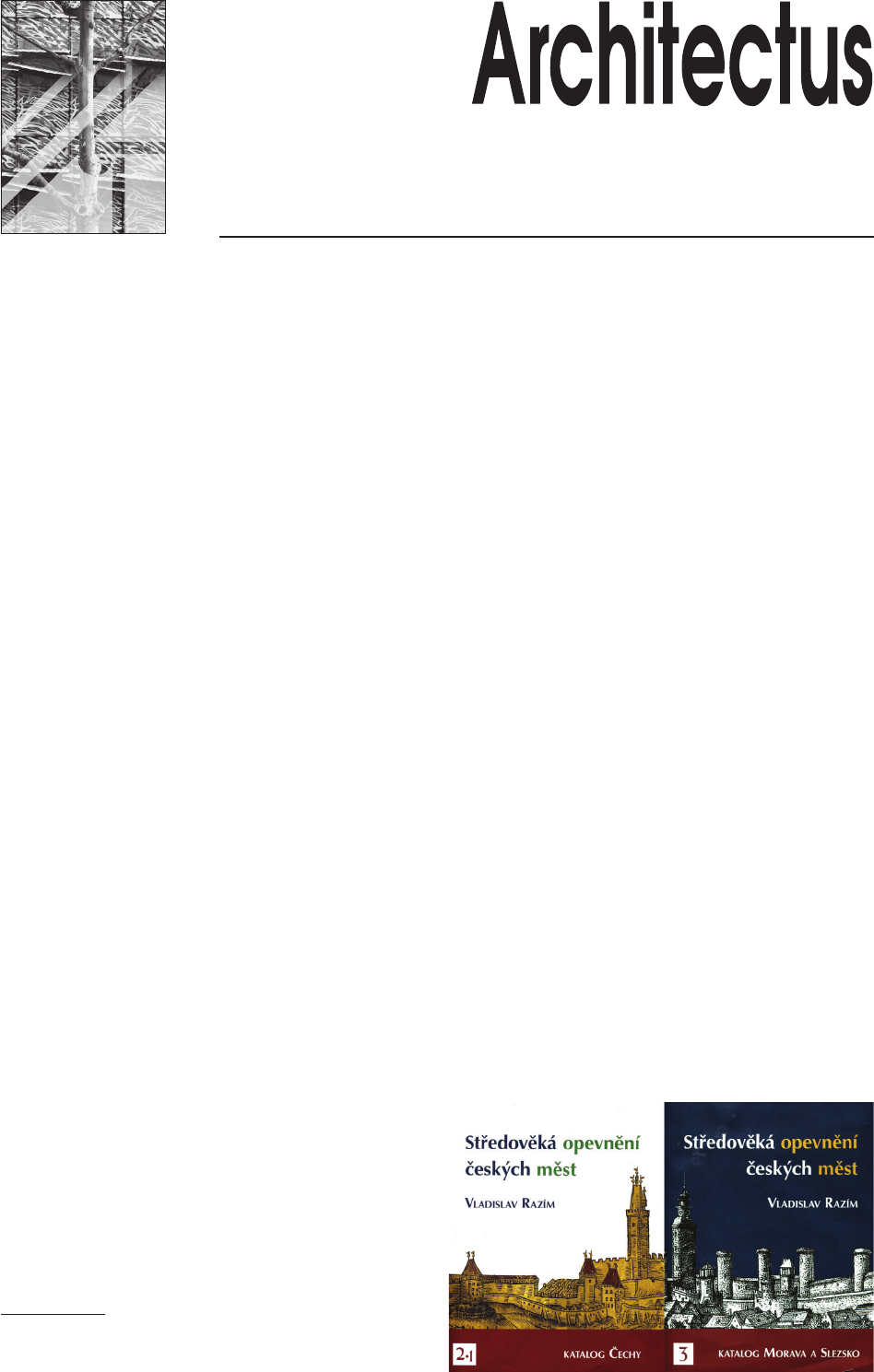
The monumental catalog of medieval fortications of
cities and towns from the present-day Czech Republic
terrain, which is the subject of this study (Středovӗká
opevnӗni českých mӗst [Medieval fortications of Czech
towns]), has been published in parts in Prague under the
auspices of the Národní Památkový Ústav (NPU) [Na-
tional Institute for Monument Protection] since 2019. This
catalog was conceived as a work consisting of three com-
plementary parts. The rst part, still being edited, will be
a synthesis of issues related to the architecture of defen-
sive walls, towers and town gates, in their defensive func-
tion, changes in form, and in the European context. The so
far published parts – the second and the third – appeared
in 2020 and 2019, respectively, i.e., in reverse order, and
contain – part two: catalog of town fortications from the
area of historical Bohemia (vol. 1 – cities beginning from
B to O; vol. 2 – from P to Ż), and the third part: catalog
of town fortications from the area of historical Moravia
and the Czech part of Silesia (in one volume). In total, the
defensive districts of 172 towns from the Czech Republic
and 88 towns from Silesia and Moravia were cataloged.
These are the cities with preserved, at least partially, walls
and defensive devices, but also the cities where gates are
visible today only, because during the Middle Ages they
were not fully fortied or the old defensive walls were
demolished in the 19
th
and 20
th
centuries. The cities such
as royal town Most, which ceased to exist in the 1970s,
are also discussed although they completely disappeared.
We learn about the latter on the basis of written sources,
cadastral maps and iconography, as well as the results of
archaeological research. Whilst the list of the former can
be considered complete, in the latter case, we are deal-
ing with a selection of city fortications which illustrate
a broader important research problem, useful in the syn-
thetic volume being prepared.
Małgorzata Chorowska*
Medieval fortifications of Czech towns
Review
* ORCID: 0000-0002-5073-4382. Faculty of Architecture, Wro-
cław University of Science and Technology, e-mail: malgorzata.chorowska
@pwr.edu.pl
Vladislav Razím, Středovӗká opevnӗni českých mӗst.
Díl 2–3, Národní Památkový Ústav, Praha 2019–2020

96 Review
The author of the catalog is Vladislav Razím PhD,
a Czech historian, conservator and editor of the most im-
portant scientic journals in the eld of protection and
research of monuments
1
and the author of a number of
articles and monographs on fortied districts of towns
and castles such as Křivoklát and Křivoklátska Land [1],
early Gothic Vizmburk [2], castles Hasištejn, Pürglitz,
Jagd, Wald and Zbořený Kostelec [3]–[5]. The author is,
above all, a well-known and respected eld researcher of
medieval architecture, in particular defensive architecture
[6], [7], to which he devoted 40 years of his professional
work at the Národní Památkový Ústav, in the Územní od-
borné pracoviště středních Čech [Specialist Local Work-
shop of Central Bohemia]. One of the goals of publishing
the volumes in question in such a monumental form was
a desire to compensate for the disproportion between the
research eort and the length of time necessary to read
the entirety of construction transformations in defensive
structures in the eld and all the accompanying cognitive
contexts, and the short length of records usually devoted
to reporting the obtained results.
The large volume and richness of illustrations of indi-
vidual catalog entries enabled a complete and substantive
presentation of the contents provided. Their structure, on
the other hand, was subordinated to the needs of the future
synthetic rst part of the discussed work.
The rst subchapter of each entry contains a brief de-
scription of the history of cities up to the 1
st
third or the
1
st
half of the 16
th
century inclusive. The author placed
spe cial emphasis on the political and defensive context,
looking for grounds for dating the beginnings of the con-
struction of fortied districts and gates in the particular
cities, as well as their further changes and extensions. The
same purpose was also served by quoting source texts re-
ferring to privileges granted to cities or excerpts from city
registers.
The second subchapter of each entry presents the urban
characteristics of cities with particular emphasis on their
topography, geomorphology and course of routes as a de-
terminant of decisions about the shape of the city walls
as well as the location of main gates and towers in them.
The third subchapter brought a full description of the
city fortications with descriptions of individual buildings
from the material, workshop, aesthetic and, of course, de-
fensive side. Each time it began with an analysis of all
1
Such as “Zprávy památkové péče”, “Průzkumy památek”, „Pa-
mátky středních Čech”, “Svorník”, “Castellologica Bohemica”.
relevant written sources and literature. Subsequently,
successive “layers” of the research, i.e. an architectural,
historical and stylistic, as well as spatial context, were car-
ried out by the author according to the methodology and
standards consistently developed in the Czech Republic
since the last decades of the 20
th
century, in the course of
dealing with the numerous preserved monuments of me-
dieval, modern, and contemporary construction [8]–[12].
It will not be exaggerated to say that it is the most perfect
methodology among those currently used in Europe, in
terms of logic, detail, and consistency in dealing with the
monument [13, pp. 12–14]. As the research progressed,
this argument was enriched with data from the analyses
of representatives of related specialties – archaeologists,
dendro-chronologists, art historians, etc. Thus, all clas-
sical methods of conducting historical and architectural
research were used, and the so-called modern methods,
such as LIDAR aerial scanning or building digital models
of objects using photos taken from a drone, were omitted.
Perhaps at this point, it is worth posing a question whether
the latter methods really do not contribute anything impor-
tant to the cognitive base and can be completely ignored
without the risk of losing any important information. It
should be emphasized, however, that the nal eect of the
author’s work resulted in the fundamental ndings relat-
ing to individual defense works, which will be summa-
rized in the interpretative rst part of the work which is
currently being developed.
As the author points out, the importance of the city de-
fensive walls in the Middle Ages had a double dimension
– practical and symbolic. The former was important in
times of unrest and wars because it provided inhabitants
with a sense of security. The other dimension was visi-
ble in the massiveness of the “toothed” defensive walls,
the number and height of towers, the power of city gates
and the depth of moats. Fortications of “cities within the
walls” through their lofty form created the most charac-
teristic image of a medieval city viewed from the outside
by merchants, wanderers and potential enemies. This im-
age, although distorted as a result of the destruction and
changes over the centuries, is also attractive to us, i.e. spe-
cialists, researchers, and enthusiasts of architecture of the
past centuries. Vladislav Razím’s work brings it back and
ts perfectly into the list of monumental Czech mono-
graphs devoted to such architectural phenomena as castles
[14], folk architecture [15], or diamond vaults [16].
Translated by
Bogusław Setkowicz
References
[1] Premyslovske Krivoklatsko. 900 let hradu Krivoklatu, V. Razím
(ed.), NPÚ, Praha 2010.
[2] Razím V., Vizmburk. Raně gotický hrad a jeho proměny, “Průzkumy
Památek” 2012, R. 19.
[3] Razím V., K stavebnímu vývoji a významu hradu Hasištejna, “Průz-
kumy Památek” 2014, R. 21, nr 1, 39–74.
[4] Razím V., Burg Pürglitz und ihr Jagdforst, [in:] J. Fajt, M. Hörsch,
V. Razím (Hrs.), Křivoklát – Pürglitz, Jagd – Wald – Herrscher-
repräsentation, Studia Jagiellonica Lipsiensia, Bd. 17, Thorbecke,
Ostldern 2014, 143–207.
[5] Razím V., Hrad Zbořený Kostelec jako obranná stavba doby polipan-
ské a poděbradské, “Průzkumy Památek” 2016, R. 23, nr 1, 73–102.
Review 97
[6] Razím V., Výtvarné a symbolické prvky středověkých fortikačních
staveb, [in:] A. Mudra, M. Ottová (ed.), Trans montes, Podoby stře-
dověkého umění v severozápadních Čechách, Filozocká fakulta
Univerzity Karlovy, Praha 2014, 108–127.
[7] Razím V., Řeč středověké fortikační architektury – terminologie
a její souvislosti, NPÚ, Územní odborné pracoviště středních Čech,
Praha 2018.
[8] Bláha J., Jesenský V., Macek P. et al., Operativní průz kum a do-
kumentace historických staveb, “Odborné a metodické publikace”,
t. 31, NPÚ, Praha 2005.
[9] Beránek J., Macek P., Pařizková-Čevonová J. et al., Metodika
stveb nӗhistorického průzkumu, “Odborné a metodické publikace”,
t. 70, NPÚ, Praha 2015.
[10] Vaclavik F.R., Průzkum, dokumentace a inwentarizace architek-
tonických prvků, “Odborné a metodické publikace”, t. 47, NPÚ,
Praha 2014.
[11] Veselý J., Mӗřická dokumentace historických staveb pro průzkum
v památkové péči, “Odborné a metodické publikace”, t. 49, NPÚ,
Praha 2014.
[12] Zkoumání historických staveb, P. Macek, V. Razím (ed.), NPÚ,
Praha 2011.
[13] Kwaśniewski A., Po co badać – jak badać. Uwagi o metodyce
współczesnych badań historyczno-architektonicznych i o ich stoso-
waniu przy adaptacji obiektów zabytkowych, “Architectus” 2019,
nr 1(57), 3–20, doi: 10.5277/arc190101.
[14] Menclová D., České hrady, t. 1, 2, Odeon, Praha 1976.
[15] Mencl V., Lidová architektura v Československu, Academia, Praha
1980.
[16] Radova M., Radovy O., Kniha o slípkových klenbách, Jalna, Praha
1998.
Abstract
Medieval fortifications of Czech towns
The review contains the discussion on the monumental catalog of medieval fortications of cities and towns in the present-day Czech Republic
by Vladislav Razím. The catalog has been published in parts by Národní Památkový Ústav in Prague since 2019. So far, parts two and three were
published, which are devoted respectively to: part 2, in two volumes – to cities from the historic territory of Bohemia and Moravia, and part 3 – to the
Czech part of Silesia. The rst part – interpretative, will be a synthesis of the issues of urban medieval defensive architecture. Noteworthy are both the
volume of the work, which includes a total of 260 catalog entries, as well as the capacity and length of the texts of individual entries, richly illustrated
with the material from historical and architectural research – inventory, iconographic, and photographic. What is most important is the methodology
of the research conducted, which was consistently applied in all of the developed defense objects, guaranteeing an in-depth recognition of their ori-
gins, architectural changes, functions, and spatial context. Summing up, it can be said that the literature on medieval Czech defense architecture has
been enriched with an exceptionally valuable position.
Key words: town fortications, Middle Ages, Czech Republic, Moravia, Bohemian Silesia
Streszczenie
Średniowieczne obwarowania miast czeskich
W recenzji omówiono monumentalny katalog obwarowań średniowiecznych miast i miasteczek z terenu obecnej Republiki Czeskiej, autorstwa
Vladislava Razíma, wydawany od 2019 r. przez Národní Památkový Ústav w Pradze. Dotychczas ukazały się część druga i trzecia, poświęcone
odpowiednio: część 2, w dwóch tomach – miastom z terenu historycznych Czech i Moraw, a część 3 – czeskiej części Śląska. Pierwsza część
– interpretacyjna – będzie stanowić syntezę zagadnień miejskiej średniowiecznej architektury obronnej. Na uwagę zasługują zarówno objętość pra-
cy obejmującej w sumie 260 haseł katalogowych, jak i pojemność oraz długość tekstów poszczególnych haseł, bogato zilustrowanych materiałem
pochodzącym z badań historyczno-architektonicznych – inwentaryzacyjnym, ikonogracznym i fotogracznym. To, co najważniejsze, to metodyka
przeprowadzonych badań, konsekwentnie zastosowana we wszystkich opracowywanych obiektach obronnych, dająca gwarancję dogłębnego rozpo-
znania ich metryki, przemian architektonicznych, funkcji i kontekstu przestrzennego. Podsumowując, można powiedzieć, że literatura poświęcona
średniowiecznej architekturze obronnej Czech została wzbogacona o wyjątkowo cenną pozycję.
Słowa kluczowe: obwarowania miast, średniowiecze, Czechy, Morawy, czeski Śląsk
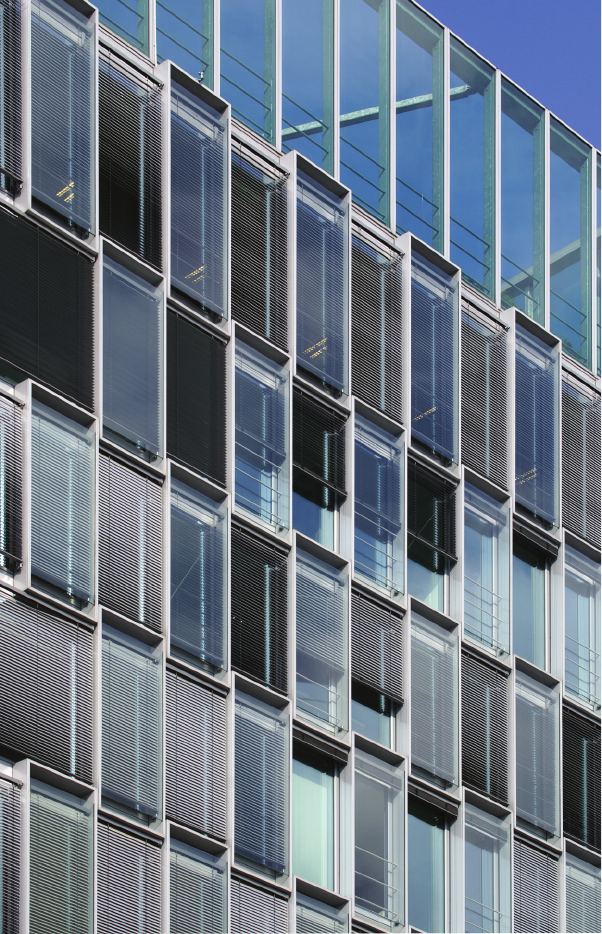
Office Building Kap am Südkai, Cologne
(arch. KSP Engel und Zimmermann,
Architekten, photo by M. Brzezicki)
Biurowiec Kap am Südkai, Kolonia
(arch. KSP Engel und Zimmermann,
Architekten, fot. M. Brzezicki)