
2015
2(42)
DOI: 10.5277/arc150206
Maria Zwierz*
Willa projektu Rudolfa Fränkla w Smolcu pod Wrocławiem
The villa designed by Rudolf Fränkel, in Smolec near Wrocław
Wrocławska architektura okresu międzywojennego od
dwóch dekad cieszy się dużym zainteresowaniem bada-
czy i mimo że powstało wiele artykułów oraz monogra-
fi cz nych jej opracowań [1]–[7], to okazuje się, że może
nas jeszcze niejednym ciekawym obiektem zaskoczyć.
Takim interesującym, moim zdaniem, a do tej pory
w polskiej literaturze zupełnie nieznanym budynkiem
jest willa (il. 1) położona na południowo-zachodnich ob-
rzeżach Wrocławia – w niewielkiej miejscowości Smo-
lec, miejscu intensywnej obecnie zabudowy miesz ka -
nio wej. Co ciekawsze, ta powstała w latach 1931–1932
pier wotnie komfortowa willa prezentuje koncepcję tzw.
bu do wania organicznego (organhaftes Bauen), nurtu bar -
dziej elitarnego niż „styl międzynarodowy”, którego re -
prezentantami byli architekci Le Corbusier, Mies van der
Rohe czy Walter Gropius. Podstawy programowe bu do-
wania organicznego sformułowane w 1925 r. przez Hu -
gona Häringa
1
w eseju Wege zur Form, opublikowa nym
w pre stiżowym czasopiśmie „Die Form” [9, s. 3–5],
były
alter natywą dla „stylu międzynarodowego”. Kieru jąc się
or ganicznym porządkiem przyrody, Häring przyj mo wał,
że podczas projektowania od wnętrza ku zewnęt rzu kra-
jobrazem staje się także przestrzeń wewnętrzna do mu,
któ ra z jednej strony musi sprostać wymaganiom fun kcjo-
nalnym, z drugiej strony powinna być powiązana z uk -
ła dem terenu i najbliższym otoczeniem pro jek to wa nego
budynku oraz roztaczającymi się widokami i przy rodą.
Powstające według tej zasady zazwyczaj luksusowe domy
* Muzeum Architektury we Wrocławiu/Museum of Architecture,
Wrocław.
1
O poglądach Häringa na temat architektury organicznej bardziej
szczegółowo pisała Jadwiga Urbanik [8].
Inter-war architecture of Wrocław and its surroundings
has been enjoying great interest among researchers for
two decades and in spite of the fact that numerous articles
and monographic studies on this topic were written [1]–
[7], it turns out that it can still surprise us with some of its
objects.
One of such interesting (in my opinion) buildings, and
so far in the Polish literature a totally unknown one is
a villa (Fig. 1) situated on the south-western outskirts of
Wrocław, in a small village called Smolec which is now an
intensely developing residential area. More interestingly,
this originally luxurious villa erected in the years 1931–
1932 presents the concept of the so called organic con-
struction (organhaftes Bauen), a trend that is more elitist
than an “international style” whose representatives were
architects such as Le Corbusier, Mies van der Rohe or
Walter Gropius. The program bases for organic con struc -
tio
n were formulated in 1925 by Hugon Häring
1
in his
essay Wege zur Form published in the prestigious pe rio-
dical “Die Form” [9, pp. 3–5], and they were the alter native
for an “international style”. In accordance with an organic
natural order, Häring assumed that during the designing
process from the interior towards the exterior the house
internal space also becomes a sort of landscape which on
the one hand must meet functional requirements, while
on the other hand it ought to be connected with the lie
of the land and the immediate surroundings of a designed
building as well as with unfolding views and nature. The
usually luxurious houses erected according to this principle
1
A more detailed account of Häring’s views on organic architecture
can be found in works by Jadwiga Urbanik [8].

56 Maria Zwierz
były za każdym razem niepowtarzalne i ściśle powiązane
z miejscem lokalizacji. Jak największy dostęp świeżego
powietrza oraz światła dziennego i słońca do wnętrz sta -
rano się zapewnić dzięki dużym oknom, tarasom oraz
mniejszym lub większym partiom przeszklonych ele-
wacji, często w kształcie fragmentów walca.
We Wrocławiu architektami, którzy kierowali się po-
dobnymi zasadami przy projektowaniu, byli Hans Scha -
roun, Heinrich Lauterbach, Moritz Hadda, a także Lud wig
Moshamer. W 1929 r. zaprezentowali oni tego typu domy
na wrocławskiej wystawie Werkbundu WuWA [4, s. 432–
476]. Scharoun i Hadda nieco wcześniej, na wy stawie
GUGALI w Legnicy (1927), pokazali dom wzor cowy dla
średniozamożnej czteroosobowej rodziny, o „elastycznym
rzucie”, z obszernymi tarasami i dużymi ok nami w pokoju
dziennym [10, s. 293–296]
2
.
Jednakże willa w Smolcu nie została zaprojektowana
przez żadnego z nich. Właściciel tej dużej posesji i two -
rzonego nieopodal gospodarstwa ogrodniczego ze szkół-
ką drzew – Robert Stern – zwrócił się po projekt do
ber lińskiego architekta Rudolfa Fränkla
3
, który już wów -
czas
miał na swoim koncie kilka cieszących się du żym
uznaniem przedsięwzięć [12, s. 72]. Mimo mło de go
wieku (Fränkel nie przekroczył wówczas 30 lat) uda ło
mu się już zrealizować w Berlinie projekt osied la miesz-
kaniowego Atlantic
4
(1924–1928) z 500 miesz ka niami
o zróżnicowanej wielkości, z niezwykle ko loro wymi
ele wacjami (partery fi oletowe, górne piętra jasno zielo -
ne, balkony żółte, a opaski drzwiowe i okienne szare),
osiedle z 400 mieszkaniami i garażami przy parku miej-
skim Schöneberg (1930–1932), osiedle jedno- i dwu -
ro dzinnych domów w dzielnicy Frohnau (1927–1930),
do my przy Bellermannstrasse nr 72–78 (1927), a także
kil ka jedno- i dwurodzinnych domów m.in. przy Warne -
münder Strasse nr 28a i b (na styku dzielnic Wil
mers dorf
i Schmargendorf) [12, s. 72]. Najbardziej jed nak spe-
ktakularne było kino „Lichtburg” (oddane w 1929 r.)
na
wspomnianym osiedlu Atlantic: z pasażem mieszczą cym
kompleks restauracji, eleganckich skle pów oraz miejsc
spotkań i rekreacji. Wykonane nocą fo togra fi e ki na, z mo-
c no podświetloną neonami bryłą, za miesz czone
zostały
w kilku specjalistycznych czaso pis mach [13, s. 1226],
[14,
s. 336–341]. W pobliżu Ber lina, w wy po czynkowej miej -
s cowości Bad Saarow, nad ma lowniczo położonym je-
ziorem Scharmützelsee, w la tach 1926–1928 według pro -
jektu Fränkla powstał kom fortowy dom weekendowy dla
reżysera fi lmowego Ga briela Leviego i jego żony. O du -
żej intensywności prac prowadzonych wówczas przez
Fränkla świadczy także i to, że już na początku swo jej
kariery został on członkiem Związku Niemieckich Ar chi -
tektów (Bund Deutscher Architekten, BDA), a w 1926 r.
Werkbundu [11, s. 17].
2
Fotografia domu wzorcowego Scharouna została opublikowana
w artykule G. Allingera [10], ilustracji domu Haddy do tej pory nie
udało się odszukać.
3
W 2009 r. ukazała się, jak do tej pory jedyna, monografia na
temat życia i twórczości architektonicznej Fränkla [11].
4
W latach 2001–2005, podczas renowacji tego osiedla, elewacjom
tylko w części przywrócono dawną kolorystykę.
were each time unique and closely linked to their location.
The largest possible supply of fresh air as well as daylight
and sunlight into the interiors was to be ensured by means
of big windows, terraces and smaller or bigger parts of
glazed elevations, often in the form of cylinder fragments.
Some of Wrocław architects who applied such rules
when designing were Hans Scharoun, Heinrich Lau-
terbach, Moritz Hadda, and also Ludwig Moshamer. In
1929 they presented some houses designed in this way at
the Wrocław exhibition Werkbund WuWA [4, pp. 432–
476]. Somewhat earlier Scharoun and Hadda at the ex-
hibition GUGALI in Legnica (1927) showed a model
house for a middle class family of four, on a “fl exible
plan”, with large terraces and big windows in the living
room [10, pp. 293–296]
2
.
However, the villa in Smolec was not designed by
any of them. The owner of this large property and a fruit
farm with a tree nursery that was being started nearby –
Robert Stern – asked Berlin architect Rudolf Fränkel
3
to prepare a design; already at that time he had been the
author of several successful projects [12, p. 72]. In spite
of his young age (Fränkel was not even thirty then), he
had managed to carry out a design of residential estate
Atlantic
4
(1924–1928) with 500 various size fl ats with
unusually colourful elevations (violet ground fl oor,
light green upper fl oors, yellow balconies and grey door
and window casing), another estate with 400 fl ats and
garages near the city park Schöneberg (1930–1932), an
estate of single- and two-family houses in the district
of Frohnau (1927–1930), houses in Bellermannstrasse,
numbers 72–78 (1927) as well as several single- and
two-family houses e.g. in Warnemünder Strasse, numbers
28a and b (on the border of districts of Wilmersdorf
and Schmargendorf) [12, p. 72]. The most spectacular,
however, of his works was “Lichtburg” cinema (opened in
1929) in the aforementioned estate of Atlantic, equipped
with a passage that housed a complex of restaurants, ele-
gant shops, meeting places and recreational areas. Night
pho tographs of the cinema, featuring a strongly neon-
high lighted structure, were placed in some specialist pe-
riodicals [13, p. 1226], [14, pp. 336–341]. According to
a design by Fränkel in the years 1926–1928 near Berlin
in a spa town called Bad Saarow by the picturesquely lo-
cated lake Scharmützelsee a luxurious weekend house for
a fi lm director called Ga briel Levy and his wife was built.
Fränkel’s intensive professional life at that time is also
evidenced by the fact that already at the beginning of his
career he became a member of the Association of German
Architects (Bund Deutscher Architekten, BDA), and in
1926 also a member of Werk bund [11, p. 17].
What was the reason then why a gardener from Smolec
near Wrocław decided to start cooperation with a rising
2
A photograph of Scharoun’s model house was published in an
article by G. Allinger [10]; no illustration of Hadda’s house could be
traced so far.
3
In 2009 the only existing monograph on Fränkel’s life and
architectural creativity was published [11].
4
In years 2001–2005, during renovation works at this estate, the
elevations’ former colours were only partly restored.

Willa projektu R. Fränkla w Smolcu /The villa designed by R. Fränkel in Smolec 57
Jakie zatem okoliczności zaistniały i co skłoniło o -
grod nika z podwrocławskiego Smolca do współpracy ze
wscho dzącą gwiazdą berlińskiej architektury? Wydaje
się, że oprócz zamożności samego zleceniodawcy zna -
czenie mogły mieć względy towarzyskie, być może ro-
dzin ne powiązania, choć na obecnym etapie badań trudno
to z całą odpowiedzialnością stwierdzić.
Rudolf Fränkel urodził się w 1901 r. w Nysie, gdzie
jego ojciec inżynier nadzorował budowę linii kole jo wej
łączącej Gliwice z Piekarami Śląskimi [11, s. 12–16].
Wkrótce, w 1904 r., rodzina przeniosła się do Ber lina,
a ojciec Louis objął intratną posadę rządowego bu dow-
niczego (Regierungsbaumeister). Rudolf wraz z sios tra-
mi rósł w dostatku, a rodzina, kilkukrotnie zmie niając
miejsce zamieszkania, ostatecznie w 1912 r. zajęła duży
dom z ogrodem w willowej dzielnicy Berlina – Niko-
lassee. Przyszły architekt studiował w Technische Hoch-
schule w Charlottenburgu, w latach 1922–1924 przebywał
w Monachium w pracowni Richarda Riemerschmida.
Odbył też grand tour do Włoch, Francji, Holandii i Bel gii.
W 1924 r. dzięki pomocy swojego teścia, znanego i wy-
bitnego lekarza berlińskiego Fritza Siegfrieda Tarra scha,
w samym centrum Berlina przy Kaiserallee ot worzył swo-
je biuro architektoniczne. Jak wspomniałam, do 1931 r.,
a więc czasu rozpoczęcia budowy willi w Smolcu, otrzy-
mywał on intratne zlecenia, nie tylko na luksusowe wil-
le, ale i na mieszkania osiedlowe o zróż nicowanym
standardzie. Wykonał również projekty nie wielkich do -
mów reprezentujących tzw. minimum so cjalne: weeken -
dowy dom „Robinson” eksponowany na wy stawie „Das
Wochenende” w Charlottenburgu w 1927 r., dom seg -
mentowy umożliwiający jego rozbudowę (w Ora nien -
bur gu), pawilon mający pomieścić przedszkole typu
Mon tessori w Wannsee (Berlin-Zehlendorf) oraz osta -
tecz nie niezrealizowane trzy projekty domu wiej skie go
[11, s. 100–101, 103–104, 112]. Świetnie roz wija ją ca się
ka riera została przerwana w 1933 r., kiedy Fränkel do -
wie dział się, od architekta Hitlera Alberta Speera, że „nie
będzie miejsca dla żydowskich architek tów w Niem-
czech” [11, s. 132–133, przyp. 18]. Latem tego sa me go
roku w dramatycznych okolicznościach (żo na archi tekta
nie była poinformowana o przestrodze i groź bie) ca
ła
rodzina opuściła Berlin pociągiem, udając się na wa -
ka cje do Rumunii, by już nigdy więcej nie od wie dzić
Niemiec i ich stolicy. W Rumunii Fränkel podjął dzia-
łalność architektoniczno-projektową, jednak nie czu jąc
się bezpiecznie, w 1938 r. przeniósł się wraz z żoną do
Londynu, w czym pomogła mu mieszkająca tam jego
siostra. Wielka Brytania niestety nie była wówczas miejs-
cem, gdzie zasady projektowania Neues Bauen znaj do-
wałyby uznanie i grono odbiorców, dlatego w 1950 r.
Fränkel udał się do Stanów Zjednoczonych i podjął dzia-
łalność dydaktyczną na Miami University (planowanie
miast). Fränkel zmarł 23 kwietnia 1974 r. Jego żona Ewa
utrzymywała jeszcze kontakt z jego studentami i w 1984 r.
spuściznę po swoim mężu przekazała do Canadian Centre
for Architecture w Montrealu [11, s. 24].
Nieco mniej informacji zachowało się o Sternach, choć
z całą pewnością – podobnie jak Fränklowie – była to
zamożna i utytułowana rodzina o żydowskich korzeniach,
star of Berlin architecture? It seems that, apart from the
client’s wealth, some social considerations or perhaps
family connections could play their role here, however,
at the present stage of research it is hard to determine this
with full responsibility.
Rudolf Fränkel was born in 1901 in Nysa, where
his father supervised the construction of a railway line
connecting Gliwice with Piekary Śląskie [11, pp. 12–16].
Soon in 1904 his family moved to Berlin and his father
Louis took a lucrative post of a governmental builder
(Regierungsbaumeister). Rudolf along with his sisters
grew up in affl uence and his family, having changed their
residence a few times, fi nally in 1912 moved into a big
house in a residential area of Berlin – Nikolassee. The
future architect studied in the Technische Hochschule in
Charlottenburg, while in the years 1922–1924 he stayed
in Munich in Richard Riemerschmid’s studio. He also
took a grand tour to Italy, France, Holland and Belgium.
In 1924 with the help of his father-in-law Fritz Siegfried
Tarrasch, a remarkable Berlin physician, he opened his
architectural offi ce in the very centre of Berlin in Kaiser-
allee. As I already mentioned, till 1931, i.e. the time of
starting the construction of the villa in Smolec, he kept
receiving lucrative orders not only for luxurious villas
but also fl ats in housing estates of varied standards. He
also carried out designs of small houses representing
the so called social minimum, e.g. weekend house “Ro-
binson” exhibited at “Das Wochenende” exhibition in
Char lottenburg in 1927, a segment house enabling its ex-
tension (in Oranienburg), a pavilion which was to house
a Montessori kindergarten in Wannsee (Berlin-Zehlen-
dorf) and fi nally unaccomplished three rural house de-
signs [11, pp. 100–101, 103–104, 112]. His excellently
developing career was interrupted in 1933 when he learned
from Adolf Hitler’s architect Albert Speer that “there shall
be no place for Jewish architects in Germany” [11, pp.
132–133, ft. 18]. In the summer of that year in dramatic
circumstances (the architect’s wife was not informed
about the warning and threat) the whole family left Berlin
on a train heading for a summer holiday in Romania and
never returned to Germany and its capital city. Fränkel took
architectural and designing activity in Romania, however,
not feeling safe enough, in 1938 along with his wife he
moved to London, taking advantage of his sister’s help
who lived there. Unfortunately, Great Britain at that time
was not a place where Neues Bauen designing principles
were appreciated or popular, so in 1950 Fränkel went to
the United States of America where he started teaching
activity at the Miami University (urban planning). Fränkel
died on 23 April 1974. His wife Eve kept in touch with his
students for some time and in 1984 she donated the legacy
of her husband to the Canadian Centre for Architecture in
Montreal [11, p. 24].
As for Stern family, there is not much information
available, although we do know that, similarly to Fränkel,
it was a wealthy and titled family of Jewish origins, which
at the beginning of the 20
th
century assimilated with
the German culture and customs fi rmly growing into it.
Unfortunately, we do not have exact dates from Robert
Stern’s life [15, p. 892], the owner of the villa in Smolec.

58 Maria Zwierz
która na początku XX w. zasymilowała się i mocno wrosła
w niemiecką kulturę i obyczajowość. Niestety nie są zna-
ne dokładne daty z życia Roberta Sterna [15, s. 892], czyli
właściciela willi w Smolcu. Wiadomo, że od 1895 r. był
on pracownikiem gospodarstwa Reinholda Benhscha
w Brochowie pod Wrocławiem [16, s. 898], które istniało
już od 1869 r., a jego twórca był cenionym i zasłużonym
ogrodnikiem. Widocznie współpraca układała się dobrze,
skoro w 1906 r. Stern stał się właścicielem gospodarstwa,
które specjalizowało się w uprawie drzew i krzewów
owocowych, drzew do wysadzania alei, różnego rodzaju
pnączy, winorośli, a także róż i gladioli. Firma brała
udział w wystawach ogrodniczych, uzyskując medale
i wyróżnienia, a przy okazji w ten sposób reklamując
znajdujące się w jej ofercie rośliny. Po przejęciu świetnie
prosperującej fi rmy Stern, w latach 1907–1908, wzniósł
na Brochowie, przy obecnej ul. Semaforowej 9 (daw ny
nr 16), okazałą, malowniczą willę, która zachowała się do
dziś. O aspiracjach Sterna świadczy także przy na leżność
do organizacji i stowarzyszeń: od 1895 r. spra wo wał funk-
cję skarbnika Związku Ogrodników Wroc ław skich,
na leżał
do Prowincjalnego Zrzeszenia Śląs kie go Związku Og -
rodników, a także – podobnie jak jego poprzednik Rein-
hold Benhsch – brał udział w wy stawach ogrodniczych.
W 1900 r. na wystawie w Gli wicach pokazał piękne oka zy
roślin iglastych, w 1927 r. na wystawę GUGALI w Leg-
nicy przygotował większy pokaz roślin stosowanych
w ogrodach przydomowych: ogród różany, formy krze-
wiaste oraz ogród warzywny [15, s. 892]. W środku tego
ogrodu stał wspomniany dom wzorcowy Hansa Scharouna,
wykonany przez fi rmę budowlaną Christoph u. Unmack
z miejscowości Nie sky na Łużycach
5
. Na wrocławskiej
wystawie WuWA w 1929 r. Stern zaprezentował natomiast
jeden z ogrodów specjalnych
6
.
Około 1930 r. doszło do podzielenia ogrodnictwa
w Brochowie na trzy części [17, s. 429]. Budynki miesz-
kalne i zarządu fi rmy przejął Otton Raumbaum, zachodni
frag ment posesji – Konrad Raumbaum, natomiast obszar
północny (obecny pl. Indyjski i północny fragment dział-
ki przy ul. Koreańskiej) przeznaczono pod zabudo wę
mieszkaniową. To zapewne na sprzedaży tej ostatniej
częś ci wzbogacił się Stern na tyle, że stać go było na prze-
nie sienie ogrodnictwa do podwrocławskiego Smolca i na
sfi nansowanie budowy nowej siedziby rodziny.
Choć nie są znane wszystkie rysunki projektowe
domu Sterna, to szczęśliwie widoki zarówno wnętrz, jak
i elewacji zachowały się na dobrej jakości zdjęciach fo-
tografa Maxa Krajewskiego
7
, z którym Fränkel stale
współpracował, reklamując i dokumentując w prasie spe-
cjalistycznej swoje kolejne zrealizowane budowle. Wiele
tych zdjęć, często nocnych z podświetlonymi budynkami
(np. oprócz kina „Lichtburg” również taras domu Sterna
5
Te ciekawe informacje o działalności wystawienniczej Sterna zna-
lazłam w przewodniku po wystawie GUGALI w Legnicy [10, s. 296].
6
Udział Sterna w prestiżowej wystawie WuWA świadczy o wy -
sokiej randze tego ogrodnika.
7
Wprawdzie w podpisach do zdjęć nie ma informacji, że ich auto-
rem jest Krajewski, ale z monografii na temat życia i twórczości archi-
tekta taki wniosek można wyciągnąć [11, s. 17].
It is known that starting from 1895 he was a worker on
Reinhold Benhsch’s farm in Brochów near Wrocław [16,
p. 898], which existed since 1869 and was established by
the gardener who was respected and meritorious. Their
coope ration must have been good since in 1906 Stern
became the owner of the farm specializing in cultivation
of fruit trees and shrubs, avenue trees, various creepers,
vines as well as roses and gladiolas. The fi rm also took
part in horticultural exhibitions, winning medals and
awards and in this way advertised the plants that it offered.
After Stern took over this thriving business, in the years
1907–1908 in Brochów at 9 Senatorska Street (formerly
house number 16) he built a magnifi cent and picturesque
villa that has survived until today. Stern’s aspirations are
also exemplifi ed by his membership in organizations and
associations, namely from 1895 he held the position of
treasurer of the Union of Wrocław Gardeners, he belonged
to the Provincial Silesian Association of Gardeners’ Union
and – similarly to his predecessor Benhsch – participated
in horticultural exhibitions. In 1900 at an exhibition in
Gliwi ce he showed some beautiful specimens of coniferous
plants and in 1927 for the GUGALI exhibition in Legni -
ca he prepared a major demonstration of plants used in
home gardens: rose garden, shrub forms and vegetable
garden [15, p. 892]. The central part of this garden featured
the aforementioned Scharoun’s model house built by con-
struction company Christoph u. Unmack from a town
called Niesky in Lusatia
5
. At Wrocław exhibition WuWA
in 1929 Stern presented one of his special gardens
6
.
In circa 1930 the garden farm in Brochów was di-
vided into three parts [17, p. 429]. The residential and
fi rm management buildings were taken over by Otton
Raumbaum, the western part of the property by Konrad
Raumbaum, while the northern area (at present Indyjski
Square and the northern fragment of the plot in Koreańska
Street) was allocated for housing development. It was
certainly thanks to the successful sale of the latter part
that Stern earned so much that he could afford to move his
gardening business to Smolec and fi nance the construction
of a new house for his family.
Although we do not have all the design drawings of
Stern’s house, fortunately there are views of both interiors
and elevations preserved on good quality photos taken
by photographer Max Krajewski
7
, with whom Fränkel
cooperated on a permanent basis, advertising and do-
cumenting his subsequent accomplished buildings in the
specialist press. Many of these photographs, often taken
in the night with illuminated buildings (e.g. apart from
“Lichtburg” cinema, also the terrace of Stern’s house in
Smolec), were published in such prestigious periodicals
as “Wasmuths Monatshefte für Baukunst”, “Baumwelt”,
“Das Schöne Heim”, “Die Baugilde”, “Deutsche Bau zeit-
5
I found this interesting information on Stern’s exhibition activity
in a guide on GUGALI exhibition in Legnica [10, p. 296].
6
Stern’s participation in the prestigious exhibition WuWA proves
his high rank as a gardener.
7
Although in the photo captions there is no information that their
author is Krajewski, we can draw this conclusion from the architect’s
monograph [11, p. 17].
Willa projektu R. Fränkla w Smolcu /The villa designed by R. Fränkel in Smolec 59
w Smolcu), ukazało się w tak renomowanych czasopis-
mach jak „Wasmuths Monatshefte für Baukunst”, „Baum -
welt”, „Das Schöne Heim”, „Die Baugilde”, „Deu tsche
Bau zeitung”, również angielskojęzycznych: „Ar chitects’
Jour nal” oraz „Architectural Forum”.
Fotografi e willi Sterna w Smolcu z czasu tuż po jej
oddaniu do użytku i zamieszkaniu, a więc z około 1932/
1933 ukazały się w artykule Fritza Hellwaga Haus St. bei
Breslau, erbaut von Architekt Rudolf Fränkel, Ber lin [18,
s. 225–229] oraz w drugim, krótszym tekście nieznane-
go autora zatytułowanym: Landhaus auf einem Gut bei
Bre slau. Architekt: Rudolf Fränkel, Berlin [19, s. 67–71].
Oprócz wspomnianych zdjęć willi, w obu ar tykułach za-
miesz czono również plan sytuacyjny po siadłości oraz
rzu ty parteru i piętra z rozpisaną funkcją po szczególnych
po mieszczeń.
Posiadłość Sterna usytuowana została na skraju nie-
wielkiej miejscowości, jaką był i nadal pozostaje Smo lec.
Prywatna droga wysadzana drzewami wiodła do szkół-
ki drzew otoczonej zabudowaniami
8
mieszczącymi biura,
garaże, magazyny oraz pokoje dla personelu pomocni-
czego (po północnej stronie szosy) i do willi nad stawem
(po stronie południowej). Odseparowanie od domu
Sternów zarówno gospodarstwa ogrodniczego, jak i pokoi
dla służby spowodowane było tym, że właściciel trakto-
wał willę jako miejsce kameralnego odpoczynku, służą-
ce także rozkoszowaniu się otaczającą przyrodą, stawem
oraz dalekimi widokami. Równinność terenu narzuciła
architektowi pomysł horyzontalnego ukształtowania pro -
stopadłościennej i dwukondygnacyjnej bryły willi. Do -
dat kowo jeszcze skontrastował on obie dłuższe ele-
wa cje domu. Ta od strony ulicy (il. 1b) została płasko
8
Nie jest znany projektant tej części majątku Sterna. W Archiwum
Państwowym we Wrocławiu, Regencja Wrocławska, Zarząd Katastralny
Rejencji Wrocławskiej, sygn. 1568, s. 125–135, zachowały się jedynie
plany sytuacyjne zabudowań oraz przekrój z lat 1930–1933. Wynika
z nich, że budynek był niepodpiwniczony, dwukondygnacyjny, przy kry-
ty dachem dwuspadowym. W 1940 r. gospodarstwo ogrodnicze przejął
kupiec Max Reder (por. akta jak wyżej, s. 117–122). Pani Grażynie
Brodzie bardzo dziękuję za pomoc w odszukaniu tych dokumentów.
ung”, or in the English language magazines: “Archi tects’
Journal” as well as “Architectural Forum”.
Photographs of Stern’s villa in Smolec taken just after
it was opened for use and dwelt in, i.e. around the years
1932/1933 were published in an article by Fritz Hell -
wag Haus St. bei Breslau, erbaut von Architekt Rudolf
Frän kel, Berlin [18, p. 225–229] and in another shorter
text written by an unknown author with the title: Landhaus
auf einem Gut bei Breslau. Architekt: Rudolf Fränkel, Ber-
lin [19, pp. 67–71]. Apart from the aforementioned photos
of the villa, both of these articles also featured a site plan
of the property and projections of the ground fl oor and
the fi rst fl oor along with a list of functions of the particu-
lar rooms.
Stern’s property was situated on the edge of a small
village called Smolec; it still remains small nowadays.
A tree-lined private road led to a tree nursery surrounded
by buildings which housed offi ces, garages, warehouses
and support staff rooms (on the northern side of the road)
and to the villa by the lake (on the southern side). The
fact of separating Stern’s house from the garden farm and
rooms for servants was caused by the owner’s intention to
treat the villa as a place of quiet recreation and savouring
surrounding nature, the pond and distant views. Flatness
of the land gave the architect the idea of the horizontal
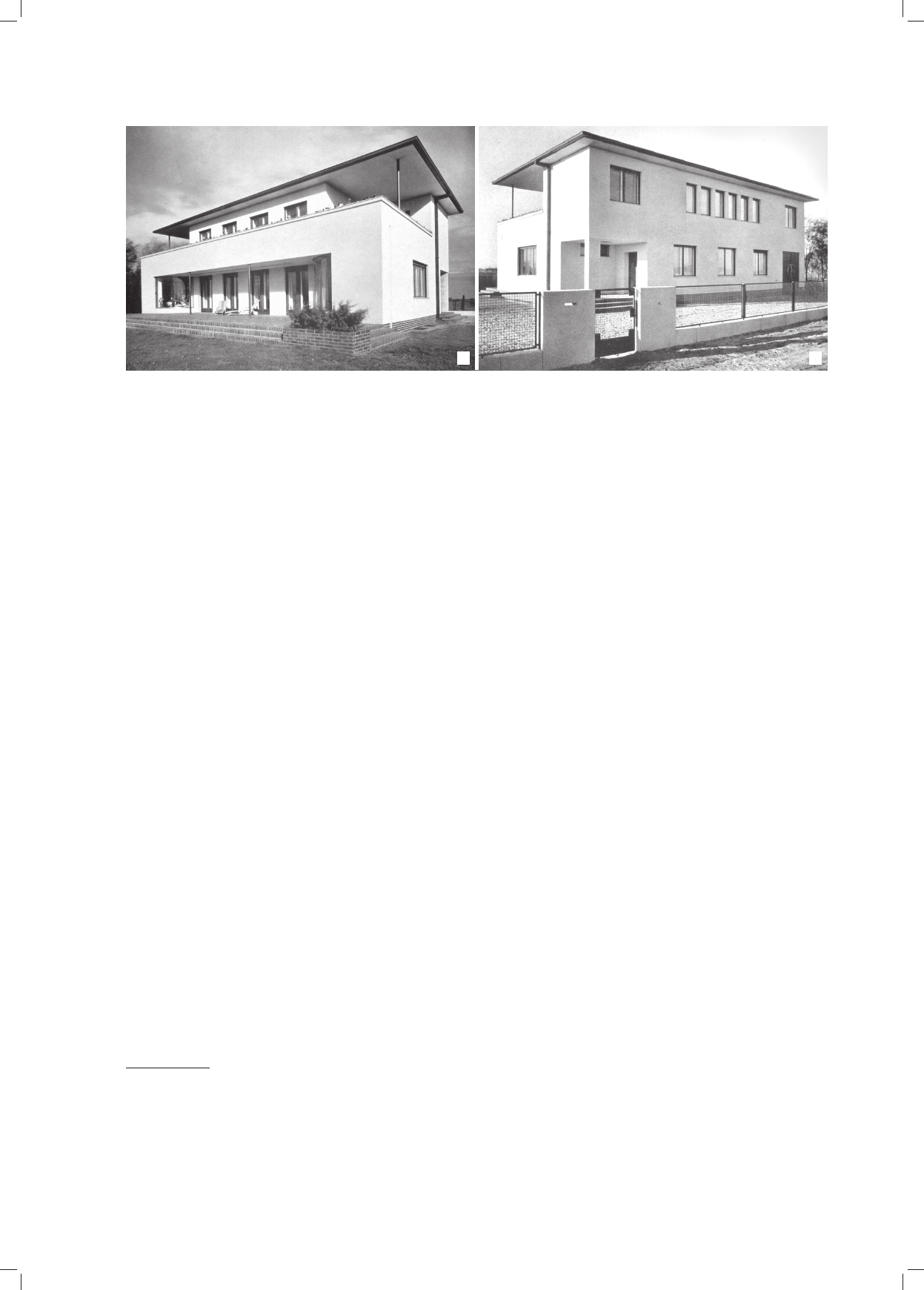
shaping of the rectangular and two-storey villa structure.
Additionally, he contrasted the two longer elevations
of the house. The one on the side of the street (Fig. 1b)
was shaped fl at with six rectangular interlocked small
windows on the fi rst fl oor, on the ground fl oor in one
corner an outdoor porch was located preceded by three
stairway steps leading to the villa, while on the other
side there was a massive wooden garage door. In contrast
to the simple but not monotonous street elevation, the
southern elevation, on the side of the pond, was heavily
sculpted. The ground fl oor was accented by a niche with
a terrace (type of loggia) and four two-wing wholly
glazed doors leading straight from the dining room to the
terrace. In both corners this niche was closed by windows
shaped in the form of cylinder fragments, encircled by
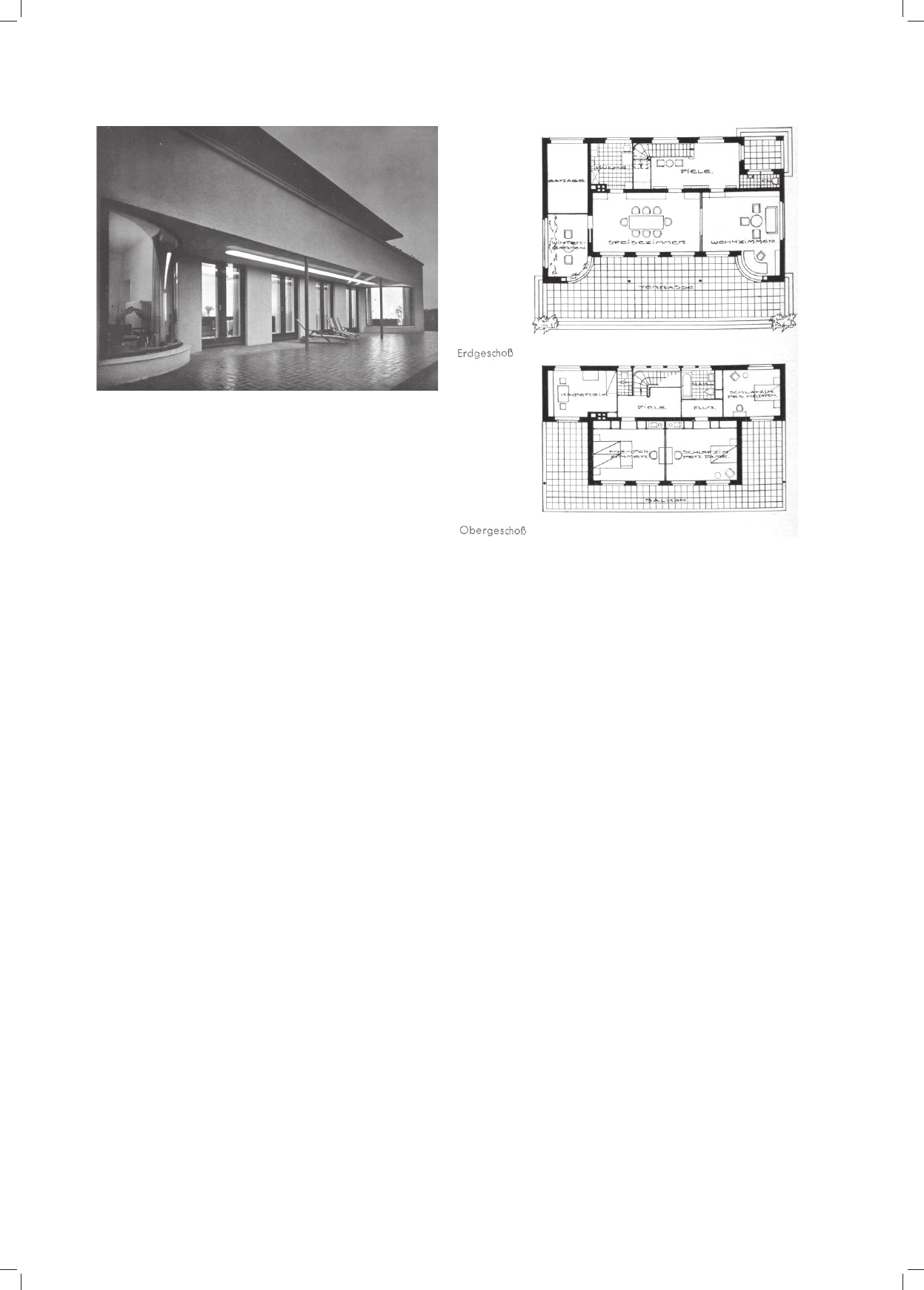
elegant brass frames. Originally, above the ground fl oor
Il. 1. Rudolf Fränkel, willa Sterna: a – widok od stawu, b – widok od ulicy [18, s. 225, 226]
Fig. 1. Rudolf Fränkel, Stern’s villa: a – view from the lake, b – view from the road [18, pp. 225, 226];
a
b
60 Maria Zwierz
ukształtowana, z sześcioma prostokątnymi, zblokowanymi
okienkami na piętrze, na parterze w jednym narożniku
umieszczono odkryty ganek poprzedzony trzema stop-
nia mi schodów, wiodący do willi, z drugiej strony ma-
syw ne, drewniane drzwi garażu. W przeciwieństwie do
prostej, ale nie monotonnej elewacji od strony ulicy ele -
wa cja południowa, od strony stawu, została mocno roz -
rzeź bio na. Parter akcentowała wnęka z tarasem (ro dzaj
loggii) i z czterema dwuskrzydłowymi, w całości prze-
szklonymi drzwiami prowadzącymi wprost z jadalni na
taras. W obu narożnikach ową wnękę zamykały okna
w kształcie fragmentu walca, ujęte w eleganckie mosiężne
ramy. Pierwotnie nad tarasem parteru znajdowała się
duża podłużna lampa, która umożliwiała przesiadywanie
w tym miejscu wieczorną porą i dodatkowo rozświetlała
bryłę willi (il. 2). Na piętrze domu drugi taras okalał
kon dygnację z trzech stron, co spowodowało cofnięcie
obu jej narożników w stosunku do frontu parteru. Płas-
ki dach, wsparty po bokach na dwóch metalowych, cien-
kich kolumienkach (podobne umieszczono w części cen -
tral nej tarasu na parterze), sprawiał wrażenie, że nie mal
uno si się w górę. Ta wysmakowana południowa ele wa cja,
przywodząca na myśl harmonijną palladiańską kom po-
zycję, ukształtowana została w taki sposób, by za pew nić
mieszkańcom domu miejsce do spokojnej kon tem placji
stawu i dalekich widoków, a jednocześnie umoż liwia -
ła wyjście z każdego z pokoi na taras i świeże po wiet-
rze, zarówno w kondygnacji parteru, jak i piętra (il. 3).
Temu celowi służył też odpowiednio pomy ślany przez
architekta układ wnętrz, w którym pokoje usze re gowano
obok siebie, a korytarz z klatką schodową, ła zienkę
i kuchnię ulokowano w trakcie tylnym, od stro ny ulicy.
Poprzez narożnikowy ganek wchodziło się do prze-
stronnego korytarza, z którego drzwi prowadziły do po -
koju dziennego, z wydzielonym miejscem do pracy dla
pana domu (w tej częś
ci było też jedno z dwóch efek-
townych zaokrąglonych okien). Środkową część parteru
zajmowała wspomniana jadalnia (il. 4) z bezpośrednim
wyjściem na taras. Z jej boku znajdowała się oranżeria
z kolekcją kaktusów (il. 5), którą opiekowała się pani
terrace there was a large longitudinal lamp which gave
an opportunity to spend time there in the evening and
moreover illuminated the whole villa (Fig. 2). On the
fi rst fl oor another terrace encircled the storey from three
sides, which resulted in the withdrawal of both its cor-
ners with respect to the ground fl oor facade. A fl at
roof, on the sides supported by two small thin metal
columns (similar ones were located in the central part of
the terrace on the ground fl oor) gave the impression that
it almost rose up. This sophisticated southern elevation,
bringing to mind a harmonious Palladian composition,
was shaped in a way that provided the villa’s residents
with a place for peaceful contemplation of the pond and
distant views and at the same time made it possible to exit
each room to the terrace to enjoy fresh air both on the
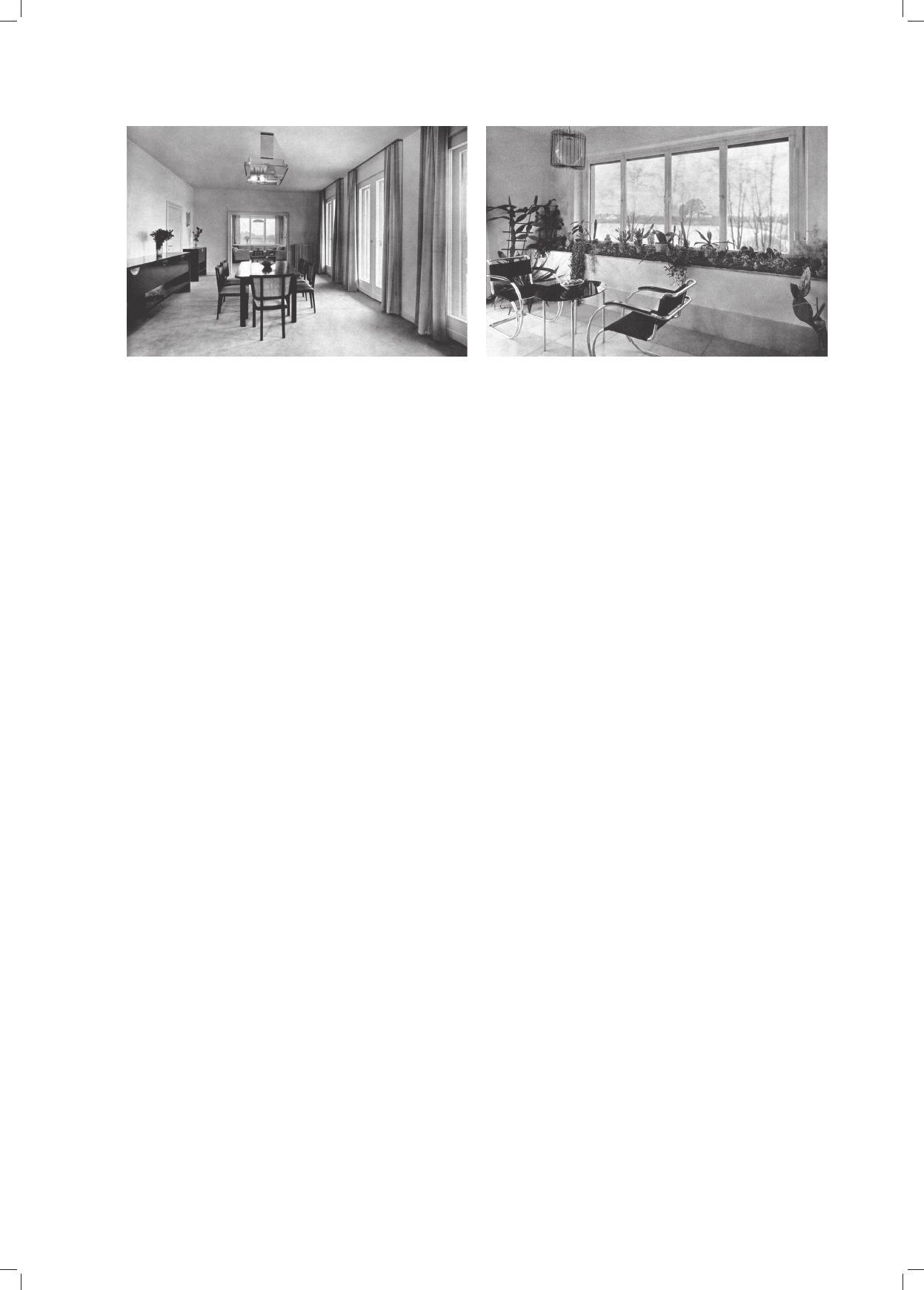
ground and on the fi rst fl oor (Fig. 3). This purpose was
also served by the interior layout, appropriately conceived
by the architect, where the rooms were located next to one
another, while the hall with the staircase, the bathroom
and the kitchen were situated in the rear tract from the
side of the street.
Through a corner porch the residents entered the
spacious hall from which a door led to a living room
with a designated working area for the host (this part also
housed one of the two impressive rounded windows).
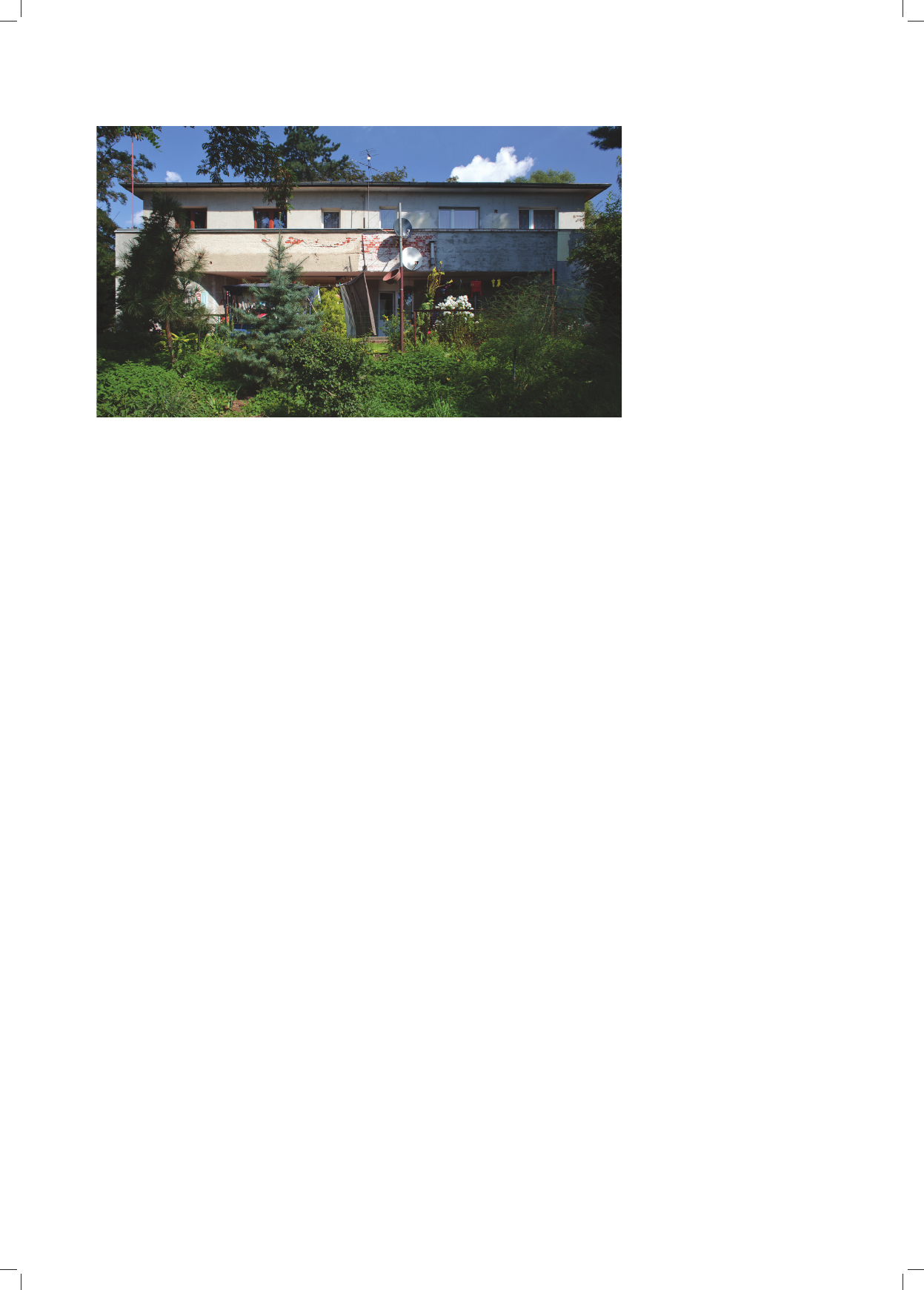
The aforementioned dining room (Fig. 4) with a direct
exit to the terrace was in the central part of the ground
fl oor. An orangery with a cacti collection (Fig. 5) was at
its side. The lady of the house looked after the collection.
A wide, quadripartite window occupying almost the entire
Il. 2. R. Fränkel, willa Sterna, taras nocą [18, s. 227]
Fig. 2. R. Fränkel, Stern’s villa, the tarrace by night [18, p. 227]
Il. 3. R. Fränkel, willa Sterna, rzut parteru i piętra
[18, s. 226]
Fig. 3. R. Fränkel, Stern’s villa, plans of the downstairs and upstairs
[18, p. 226]
Willa projektu R. Fränkla w Smolcu /The villa designed by R. Fränkel in Smolec 61
domu. Szerokie, czterodzielne okno zajmujące nie mal
całą ścianę zachodnią oraz drugie zaokrąglone, w kształ -
cie fragmentu walca, dostosowane zostały do po trzeb po -
łudniowoamerykańskiej roślinności, wy ma ga jącej ciepła
i du że go nasłonecznienia. Do północno-za chod nie go na -
roż nika willi mieszczącego garaż przy le gała kuch nia po -
łączona z pokojem jadalnym. Natomiast na pięt rze znaj-
dowały się cztery pokoje: pokój dla dziec ka, dla goś ci oraz
pokoje pana i pani domu połączone wspól ną łazienką.
Na podkreślenie zasługuje wielka staranność w do bo -
rze kolorystyki, widoczna zarówno we wnętrzu, jak i na
zewnątrz willi. Elewacje pokryte zostały jas no be żo wym
gruboziarnistym tynkiem o urozmaiconej fak
tu rze i skon-
trastowane z brązowymi obramieniami okien,
rynien oraz
krawędzi dachu. Podobnie jak w in nych swo ich realiza -
cjach (m.in. w mieszkaniach na berlińskim osied lu
Schöne berg) w domu Sterna Fränkel za dbał o od po wied-
nią i przemyś la ną aranżację wnętrz. Tak pi sał o tym autor
artykułu o willi, Fritz Hellwag, któ ry naj prawdopodob -
niej oglą d a ł tę rezydencję: [...] po miesz cze nia są z wiel-
kim gustem i powściągliwością za pro jektowane, wszyst kie
ściany ut rzy mane są w żółtej to nacji. Meble są wykonane
z drewna palisandrowego. Jed no cześ nie w piaskowym
ko lorze we lurowe pokrycie pod ło gi dobrze zharmonizo-
wa ne z ca łoś c i ą [18, s. 227]. Meble do willi Sterna za-
pro jektowała fi rma J. Loeben steina z Mühlhausen [18,
s. 229]. Tuż po 1933 r. zamurowano narożny, pierwotnie
odkryty ganek, wstawiając ścianki, okno i drzwi iden-
tyczne z tymi, które były już wcześniej w korytarzu domu.
Willa Sterna z podwrocławskiego Smolca uznawana
jest za jedną z najlepszych realizacji architektonicznych
Ru dolfa Fränkla. Opinię taką wyraża nie tylko autorka
ni niejsze go artykułu, ale również prof. Gerardo Brown-
-Man rique z Miami University in Oxford (Ohio) [11,
s. 45–47, 111–112] oraz prof. Kenneth Frampton [za: 11,
s. 9 wpro wadzenie] z Columbia University, który nawet
stwier dził, że Fränkel już nigdy więcej nie zaprojekto wał
bu do wli o podobnie znakomitych proporcjach i artys tycz-
nym uk ształtowaniu, przywołującym palladiań ską kom -
pozycję.
western wall and another rounded window in the shape of
a cylinder fragment were adjusted for the needs of South
American plants requiring suffi cient heat and insolation.
The kitchen connected with the dining room adjoined the
north-west corner of the villa that also housed the garage.
On the fi rst fl oor there were four rooms, i.e. a child room,
a guest room and bedrooms of the master and lady of the
house connected by a common bathroom.
An aspect worth emphasizing is the great care taken in
the selection of colours, which is visible both in the interior
and in the external parts of the villa. The elevations were
covered with a light beige coarse plaster of diverse texture
and contrasted with brown frames of windows, gutters
and the roof edge. Similarly to his other realisations (e.g.
in the fl ats in Berlin estate of Schöneberg), in Stern’s
house Fränkel took care of adequate and well-thought
interior design. This is what Hellwag wrote, the author
of the article about the villa, who most probably visited
this residence: [...] rooms are designed with great taste
and restraint, all the walls are kept in yellow tones. The
furniture is made of rosewood. At the same time the sand-
coloured velour cover of the fl oor is well harmonized with
the whole [18, p. 227]. The furniture for Stern’s villa was
designed by a fi rm of J. Loebenstein from Mühlhausen
[18, p. 229]. Just after 1933 the originally outdoor corner
porch was bricked up and additions were made in the form
of walls, a window and a door identical with those that
had previously been in the hall of the house.
Stern’s villa from Smolec near Wrocław is recognized to
be one of the best architectural works designed by Rudolf
Fränkel. Apart from the author of this article, this opinion
is also expressed by Professor Gerardo Brown-Manrique
from Miami University in Oxford (Ohio) [11, pp. 45–47,
111–112] as well as Professor Kenneth Frampton [in:
11, p. 9 introduction] from Columbia University, who
even stated that Fränkel never again designed a building
of similarly excellent proportions and artistic shape,
resembling a Palladian composition.
In the reconstructed and now neglected villa (Fig. 6)
– in which internal divisions and window joinery were
Il. 4. R. Fränkel, willa Sterna, jadalnia
[18, s. 229]
Fig. 4. R. Fränkel, Stern’s villa, the dining-room
[18, p. 229]
Il. 5. R. Fränkel, willa Sterna, ogród zimowy z kolekcją kaktusów
[18, s. 229]
Fig. 5. R. Fränkel, Stern’s villa, the winter garden with cactus collec-
tion [18, p. 229]
62 Maria Zwierz
W przebudowanej i obecnie zaniedbanej willi (il. 6)
– w której zmieniono podziały wewnętrzne i stolarkę
okienną, zamurowano wyokrąglone okna dolnego tara-
su, użytkowanej przez kilka rodzin – trudno dopatrzyć
się daw nego artyzmu. Jednak archiwalne zdjęcia oraz
frag mentarycznie zachowana stolarka drzwiowa, klatka
scho dowa dają wyobrażenie o harmonii tej wtopionej
w krajobraz, prostej i funkcjonalnej willi, której forma
ar chi tektoniczna została idealnie dostosowana do stylu
życia jej mieszkańców.
changed, the lower terrace rounded windows bricked up
and which is occupied by several families now – it is hard
to discern the former artistry. However, archival photos
and the preserved door joinery and staircase give an idea
of harmony of this simple functional villa that blends in
with the countryside and whose architectural form was
ideally adapted to the lifestyle of its inhabitants.
Translated by
Bogusław Setkowicz
Bibliografia /References
[1] Ilkosz J., Störtkuhl B. (red.), Hans Poelizg we Wrocławiu. Archi-
tektura i sztuka 1900–1916, Muzeum Architektury we Wroc ławiu,
Wrocław 2000.
[2] Ilkosz J., Hala Stulecia i tereny Wystawowe we Wrocławiu – dzieło
Maksa Berga, Muzeum Architektury we Wrocławiu, Wrocław 2005.
[3] Dobesz J.L., Wrocławska architektura spod znaku swastyki na tle
budownictwa III Rzeszy, Ofi cyna Wydawnicza PWr, Wrocław 1999.
[4] Urbanik J., WuWA 1929–2009. Wrocławska wystawa Werkbundu,
Muzeum Architektury we Wrocławiu, Wrocław 2009.
[5] Kononowicz W., Wrocław. Kierunki rozwoju urbanistycznego w ok -
resie międzywojennym, Ofi cyna Wydawnicza PWr, Wrocław 1997.
[6] Ilkosz J. (red.), Heinrich Lauterbach. Architekt wrocławskiego
modernizmu, Muzeum Architektury we Wrocławiu, Wrocław 2013.
[7] Ilkosz J. (red.), Ernst May, Muzeum Architektury we Wrocławiu,
Wrocław 2012.
[8] Urbanik J., Luksusowe domy jednorodzinne – dwa oblicza funkcjo-
nalizmu okresu międzywojennego, [w:] R. Nakonieczny, J. Wojtas-
-Swo szowska (red.), Oblicza modernizmu w architekturze, Wy-
daw nictwo Śląsk, Katowice 2013, 175–184.
[9] Häring H., Wege zur Form, „Die Form” 1925, H. 1, 3–5.
[10] Allinger G., Deutsche Gartenbau- und Schlesische Gewerbe-Aus stell -
ung in Liegnitz 1927, „Ostdeutsche Bau-Zeitung” 1927, Nr. 49, 293–296.
[11] Brown-Manrique G., Rudolf Fränkel und Neues Bauen. Work in
Ger many, Romania und the United Kingdom, Ernst Wasmuth Ver-
lag, Tübingen–Berlin 2009.
[12] [b.a.], Doppelwohnhaus in Berlin, „Monatshefte für Baukunst und
Städtebau” 1933, Nr. 17, 72.
[13] „Bauwelt”, 18 września 1930, 1226.
[14] „Building”, listopad 1948, 336–341.
[15] Bandurska Z., Stern Robert, [w:] I. Bińkowska, R. Szopińska
(red.), Leksykon zieleni Wrocławia, Via Nova, Wrocław 2013, 892.
[16] Bandurska Z., Ogrodnicze gospodarstwo Reinholda Benhscha, [w:]
I. Bińkowska, E. Szopińska (red.), Leksykon zieleni Wrocławia,
Via Nova, Wrocław 2013, 898.
[17] Gaglik P., Ogrodnicze gospodarstwo Reinholda Behnscha, [w:]
I. Bińkowska, E. Szopińska (red.), Leksykon zieleni Wrocławia,
Via Nova, Wrocław 2013, 429.
[18] Hellwag F., Haus St. bei Breslau, erbaut von Architekt Rudolf
Fränkel, Berlin, „Die Kunst. Monatshefte für freie und Angewandte
Kunst” 1933, Bd. 68, H. 10, 225–229.
[19] [b.a.], Landhaus auf einem Gut bei Breslau. Architekt: Rudolf
Fränkel, Berlin, „Monatshefte für Baukunst und Städtebau” 1933,
17, 67–71.
Streszczenie
Ta dotąd zupełnie nieznana w polskiej literaturze willa powstała w latach 1931–1932. Reprezentuje koncepcję budowania organicznego,
sformułowaną w 1925 r. przez Hugona Häringa. Projekt wykonał Rudolf Fränkel będący wówczas wschodzącą gwiazdą berlińskiej architektury,
autor kilku luksusowych willi, ale przede wszystkim berlińskich osiedli mieszkaniowych, m.in. osiedla Atlantic z pięciuset mieszkaniami, zapleczem
rekreacyjnym i kinem „Lichtburg”. Jego znakomicie zapowiadająca się kariera architektoniczna została jednak w 1933 r., ze względu na żydowskie
pochodzenie, w dramatycznych okolicznościach przerwana.
Il. 6. Willa Sterna w Smolcu
pod Wrocławiem
(fot. B. Bednorz, 2011)
Fig. 6. Stern’s villa in Smolec
(photo by B. Bednorz, 2011)

Willa projektu R. Fränkla w Smolcu /The villa designed by R. Fränkel in Smolec 63
Zleceniodawcą podwrocławskiej willi był Robert Stern, ogrodnik o wyrobionym guście artystycznym i dużych aspiracjach, który w Brochowie
(obecnie dzielnica Wrocławia) prowadził ogrodnictwo, uczestniczył w wystawach ogrodniczych, zbierając doświadczenie i nagrody. Około
1930 r. swoje przedsiębiorstwo przeniósł na obrzeża Smolca, a nad stawem, na dużej posesji wzniósł willę. Villa rustica o znakomitych, niemalże
palladiańskich proporcjach i luksusowych, indywidualnie aranżowanych wnętrzach została zaprojektowana od wnętrza na zewnątrz, jej pomiesz-
czenia powiązano z ukształtowaniem terenu i roztaczającym się z dwóch tarasów szerokim widokiem na staw i zieloną okolicę. Bardzo dobrej
jakości zdjęcia willi wykonane przez fotografa Maxa Krajewskiego, stale współpracującego z architektem, zamieszczone w ówczesnej fachowej
prasie dają wyobrażenie o jej pierwotnym kształcie i komforcie, dostosowanym do oczekiwań właścicieli. Dom, choć bardzo przebudowany,
nadal jest zamieszkany. Artykuł przedstawia wszystkie dostę
pne informacje o kształcie i detalach architektonicznych willi, jej projektancie oraz
pierwszych właścicielach.
Słowa kluczowe: willa, projekt, Rudolf Fränkel, budowanie organiczne, Robert Stern
Abstract
This, to date completely unknown in Polish literature, villa was built in 1931–1932, representing the concept of organic building (organhaftes Bauen),
formulated in 1925 by Hugo Häring. The design was created by an architect, being then a rising star of the Berlin architecture, the designer of several
luxury villas, but above all Berlin housing estates, including the Atlantic estate with fi ve hundred apartments, leisure facilities and the “Lichtburg”
cinema. The very promising architectural career of Fränkl was interrupted in dramatic circumstances in 1933 due to his Jewish ancestors.
Fränkl’s employer and the villa’s owner was Robert Stern, a horticulturist with refi ned taste and high artistic aspirations, who in Brochów (now
a quarter of Wrocław) ran a horticulture enterprise and who participated in horticultural exhibitions collecting both experience and awards. Around
1930 he moved his company to the outskirts of Smolec and at the pond, within a large estate he built the villa, designed by Fränkl. This villa rustica
with excellent, almost Palladian, proportions and luxurious, individually decorated interiors was designed from the inside to the outside, its spaces
were linked with the landscape and a panoramic view of the pond and the nature from two large terraces. Photographs of very good quality taken
by the photographer Max Krajewski constantly cooperating with the architect, published in the contemporary architecture magazines give an idea
of its original shape and comfort, adapted to the expectations of the owners. The house, although strongly rebuilt, still exists. The article presents all
available information about the shape and architectural details of the villa, its designer and oryginal owners.
Key words: villa, design, Rudolf Fränkel, organic building, Robert Stern
„Autokarykatura” z dedykacji
w książce Śmierć nadeszła nocą
autorstwa Janusza L. Dobesza
Satiric self-portrait from an inscription
in the book Death came at night
by Janusz L. Dobesz