
2018
2(54)
DOI: 10.5277/arc180207
Barbara Siomkajło*, Dorota Łuczewska*
Wstęp do modelowania przestrzeni
– łączenie podstaw teorii kompozycji z pracą z tworzywem
na Wydziale Architektury Politechniki Wrocławskiej
Introduction to space modelling
– combining the basics of composition theory with work on material
at the Faculty of Architecture
of Wrocław University of Science and Technology
Wstęp
– kompozycja przestrzenna jako cel dydaktyczny
Jednym z podstawowych problemów pojawiających
się w procesie kształcenia plastycznego przyszłych archi-
tektów jest uświadomienie studentom istotnego znaczenia
pojęcia „kompozycja” jako terminu elementarnego dla
wszelkiej działalności plastycznej, w tym projektowania
architektury. Jak wia domo, i według teoretyków, i w po w-
szechnym odbiorze określenie „kompozycja” oznacza
z jednej strony zaprojektowane/zrealizowane
dzieło, a z dru-
giej – sposób powiązania ze sobą elementów formalnych
dzieła tak, by tworzyły zgodną z intencją twórcy jednolitą
całość wizualną uzyskaną świadomie dzięki zastosowa-
niu wielu zabiegów kompozycyjnych [1]–[5].
Oczywiste jest również, że w czasie realizacji procesu
kształcenia plastycznego studentów architektury niezbęd-
ne jest wprowadzenie i zaznajomienie ich z powyżej
wspom nianym problemem tak, aby potrafili samodzielnie
wykorzystywać zdobytą wiedzę i opanowane umiejętno-
ści przy wykonywaniu zadań projektowych w dalszym toku
studiów, a następnie w trakcie pracy zawodowej. Duże zna-
czenie mają więc działania dydaktyczne polega
jące na
Introduction
– spatial composition as a didactic purpose
One of the fundamental problems appearing in the pro-
cess of visual arts education of future architects is to make
students realise the importance of the term “composition”
as the term sine qua non of all artistic activities, including
design of architecture. As we know, and according to the-
oreticians as well as in the widespread perception, the
term “composition” means on the one hand a composed/
realised work, and on the other, a method of connecting
formal elements of a work to create a unified visual whole
obtained consciously due to the use of many compositio nal
treatments, according to the author’s intention [1]–[5].
It is also obvious that during the implementation of the
process of visual arts education of students of architec-
ture, it is necessary to introduce and familiarise them with
the above-mentioned problem so that they can indepen-
dently use the acquired knowledge and learned skills while
performing project tasks in the further course of studies
and then during their professional work. Therefore, didac-
tic activities consisting in combining various artistic dis-
ciplines within one task – in theory and in practice – are
of great importance already during the first year of stud-
ies. They allow students to learn more about the issues
related to the composition. They also describe issues
related to space modelling in a flat conceptualisation and
* Wydział Architektury Politechniki Wrocławskiej/Faculty of Ar-
chi tecture, Wrocław University of Science and Technology.

72 Barbara Siomkajło, Dorota Łuczewska
łączeniu w jednym zadaniu różnych dziedzin plastycz-
nych – w teorii i praktyce – już na I roku studiów. Po -
zwalają one studentom na szersze poznanie problematyki
związanej z kompozycją. Przybliżają także zagadnienia
dotyczące modelowania przestrzeni w ujęciach płaskich
oraz w trzech wymiarach przy wykorzystaniu konkret-
nych materiałów. Istotną rolę odgrywa w tym procesie
rysunek jako medium łączące wszystkie fazy roz wią-
zywania zadania, od wstępnych szkiców po wizualizację
koncepcji.
Niniejsze rozważania poświęcone są właśnie omówie-
niu takiego elementu cyklu kształcenia kompozycyjno-
-plastycznego, który ściśle wiąże teorię z praktyką twór-
czą oraz angażuje różne media.
Kształcenie plastyczne
na Wydziale Architektury PWr
Od wielu lat na Wydziale Architektury Politechniki
Wro cławskiej (WA PWr) w Zakładzie Rysunku, Malarstwa
i Rzeźby prowadzone są zajęcia, których celem jest rozwój
możliwości twórczych studentów. Wybrane tematy i za -
dania kursowe służą wspomaganiu wyobraźni, dostarcza-
niu informacji potrzebnych do samodzielnego rozwiązy-
wania problemów plastycznych, a także uczeniu sposobów
przedstawiania idei projektowych. Jak wynika z do świad-
czeń, zagadnienia, które przy rozwiązywaniu określonego
problemu projektowego łączą ze sobą jed no cześnie różne
dziedziny plastyczne, są znacznie bardziej pomocne w przy-
swajaniu przez studentów potrzebnej wiedzy i umie jęt-
ności.
Uruchamiają i angażują różne poziomy aktywności
i percepcji, co znacząco wspomaga procesy umysło we
związane z twórczością [6]. Są także bardziej atrakcyjne
dla uczestników kursów. Zakres tematyki i technik pla-
stycznych stosowanych w trakcie omawianych zajęć dy -
dak tycznych obejmuje tradycyjne dziedziny sztuki, tj. ry su-
nek
, malarstwo i rzeźbę, różnego rodzaju ich kombinacje
oraz inne media poszerzające znacznie warsztat przy-
szłych projektantów.
W ramach programu kursów kształcenia plastycznego
studentów WA PWr już na I roku w semestrze zimowym
i letnim – w ramach bloków kształcenia plastycznego 1 i 2
– wprowadzone zostały zadania pararzeźbiarskie
1
. Ich
celem jest zapoznanie studiujących z problematyką mode-
lowania przestrzeni, a jednocześnie zaznajomienie z eta-
pami procesu projektowania. Poprzedzają one realizowa-
ne na II roku regularne zajęcia rzeźbiarskie, na których
podstawowym wykorzystywanym materiałem jest glina
(12 tematów w roku akademickim).
1
W latach 1998–2000 na kierunku ochrona zabytków (WA PWr) po
raz pierwszy – pod kierunkiem L. Malugi oraz P. Jaszczuka i K. Skwa ry
– wprowadzone zostały tematy łączące działania na płaszczyźnie z mo -
delowaniem przestrzeni. Zebrane doświadczenia posłużyły do wpisania
tej grupy tematycznej do projektu programu zajęć w ramach bloków
kompozycyjno-plastycznych, których realizację rozpoczęto od roku
2008. Opis oraz ilustracje różnego rodzaju rysunkowych i malarskich
zadań kompozycyjnych wykonywanych w ramach zajęć kursowych WA
PWr w latach 1995–2005 znaleźć można także w rozdziale „Kompozycja
– pomiędzy rygorem zasad a swobodą interpretacji” autorstwa B. Siom-
kajło w: [7, s. 53–118].
in three dimensions with the use of specific materials. In
this process an important role is performed by drawing as
a medium connecting all phases of solving the task, i.e.
from making preliminary sketches to visualising a concept.
These considerations are devoted to discussing such an
element of the compositional and artistic education cycle
which closely connects theory with creative practice and
engages various media.
Visual arts education
at the Faculty of Architecture
of Wrocław University of Science and Technology
Classes which are aimed at developing creative possi-
bilities of students have been conducted at the Faculty of
Architecture of Wrocław University of Science and Te ch-
nology (WA PWr) at the Department of Drawing, Paint ing
and Sculpture for many years. Selected topics and course
tasks are used to support imagination, provide informa-
tion necessary for independent solving of artistic prob-
lems as well as to teach methods to message/communi-
cate design ideas. As experience shows, the issues that in
the solving of a specific project problem combine simul-
taneously the various arts, are much more helpful in ac-
quiring the necessary knowledge and skills by the stu-
dents. They start and engage different levels of activity
and perception, which significantly supports mental pro-
cesses related to creativity [6]. They are also more attrac-
tive for participants of the course. The scope of the issues
and visual arts techniques which are used during the di-
dactic classes includes traditional fields of art, i.e. draw-
ing, painting, and sculpture as well as various combina-
tions of them and other media which significantly extend
the workshop of future designers.
Within the framework of the program of artistic educa-
tion courses at WA PWr, para-sculptural tasks as part of
the classes in visual arts education 1 and 2 were intro-
duced already at the first year in winter and summer se-
mesters
1
. They are aimed at familiarizing students with
the issues of space modelling and at the same time famil-
iarizing them with the stages of the design process. They
precede regular sculptural classes which are carried out
during the second year and during which clay is used as
the basic material (12 topics within one academic year).
These preliminary sculpture exercises were introduced
to the program of visual arts education courses in 2008. In
general, three meetings are held during the semester
2
.
1
In the years 1998–2000, topics combining activities on the plane
with space modelling under the supervision of L. Maluga, P. Jaszczuk
and K. Skwara were introduced for the first time at the faculty of his-
toric preservation (WA PWr). The collected experiences served to
include this thematic group into the draft curriculum as part of composi-
tion and visual arts classes, the implementation of which began in 2008.
A description and illustrations of various drawing and painting compo-
sitional tasks which were performed as part of WA PWr coursework in
the years 1995–2005 can also be found in chapter “Composition – between
the rigor of principles and the freedom of interpretation” by B. Siom kajło
in: [7, pp. 53–118].
2
The discussed classes follow the earlier implementation of
themes drawn from nature, considered as basic/preparing and enabling

Wstęp do modelowania przestrzeni /Introduction to space modelling 73
Te wstępne ćwiczenia z zakresu rzeźby zostały wpro-
wadzone do programu kursów kształcenia plastyczne -
go w roku 2008. Na ogół odbywają się trzy spotkania
w semestrze
2
. W trakcie tych zajęć studenci zapoznają się
z rodzajem elementarnego projektowania prostych obiek-
tów z materiałów nieco mniej trwałych, ale bardziej
dostępnych i niewymagających szczególnych warunków
warsztatowych, np. kartonu, listewek, sznurków.
Omawiane modelowanie przestrzeni polega na stoso-
waniu wielu nieskomplikowanych zabiegów przy jedno-
czesnym łączeniu rysunku i pracy z makietą. Wybrana
tematyka stanowi rodzaj treningu wyobraźni przestrzen-
nej i jest czymś zupełnie nowym dla większości uczestni-
ków zajęć. Realizacja tych prostych zadań wydaje się
istotna i celowa ze względu na:
–
wprowadzanie w proces nauczania i wykorzysty wa nie
podstaw wiedzy o problematyce dotyczącej kompozycji,
o jej cechach, uwarunkowaniach, zasadach czy kryteriach,
– zapoznawanie z konstrukcją związaną z cechami
określonego tworzywa i technologią wykonania,
– naukę umiejętności swobodnego naprzemiennego
łączenia pracy/zapisu na płaszczyźnie z modelowaniem
w przestrzeni – umiejętności podstawowej dla architekta.
Teoria kompozycji
Z pojęciami kompozycja/komponowanie studenci
mają do czynienia od początku kursu, ale nie zawsze w spo-
sób dla nich oczywisty i świadomy. W przypadku tematu
– elementarne formowanie/modelowanie – taka wiedza
jest wręcz wymagana. Toteż zapoznają się z jej podstawa-
mi w teorii i praktyce
3
. Niezmiernie ważne jest pokazanie
studiującym, że świadome konstruowanie kompozycji
wymaga znajomości wielu zasad, zależności, kryteriów
czy tendencji, które są z kolei związane z procesem per-
cepcji. Proponowany temat łączy w sobie elementy, które
pozwalają im zaznajomić się z tymi zagadnieniami w spo-
sób praktyczny i teoretyczny. Studenci mogą zapoznawać
się z procesem komponowania poprzez organizowanie/
rozmieszczanie różnorodnych części składowych (bądź
usuwanie elementów zbędnych), aby utworzyć większe
zespoły/całości – od stanu bliskiego chaosowi do stanu
maksymalnego uporządkowania – przy zastosowaniu róż-
nego rodzaju zasad organizujących. Odkrywają, że kom-
pozycja architektoniczna posługuje się przede wszystkim
bryłą w przestrzeni, z czego wynika wzajemna relacja
tych dwóch jakości, a ich zetknięcie na zasadzie pozy-
tyw–negatyw, puste–pełne jest źródłem licznych proble-
mów zarówno natury filozoficzno-teoretycznej, jak i prak-
tycznej. Zadania dydaktyczne, w których celem jest
2
Omawiane zajęcia następują po wcześniejszym zrealizowaniu
tematów rysowanych z natury, uznawanych za podstawowe/przygoto-
wujące i umożliwiające rozwiązywanie zadań bardziej złożonych. Do
nich należą przede wszystkim: ustawiane układy z brył geometrycznych
rysowane w perspektywie i martwe natury, którym towarzyszą ujęcia
płaskie (rzuty, widoki, przekroje) oraz ujęcia aksonometryczne.
3
Tematyka omawianych zajęć może się zazębiać z tematyką zadań
dydaktycznych projektowania początkowego, co wydaje się korzystne
dla rozwoju świadomości twórczej uczestników obu kursów.
During these classes, students become familiar with the
type of elementary design of simple objects from materi-
als that are less durable but more accessible and do not
require special workshop conditions, e.g. cardboard, slats
or strings.
The discussed space modelling consists in the use of
many uncomplicated treatments while combining draw-
ing and work with the mock-up. A selected subject is
a kind of spatial imagination training and is something
completely new to most of the participants of the course.
The implementation of these simple tasks seems to be sig-
nificant and purposeful due to the following aspects:
– introduction into the teaching process and the use of
basics of knowledge about issues concerning composi-
tion, its features, conditions, principles or criteria,
– familiarisation with the structure related to the char-
acteristics of a particular material and a technology of
performance,
– learning the skills to freely alternately combine work/
record on the plane with modelling in space – the basic
skill for the architect.
Theory of composition
Students deal with the concepts of composition/com-
posing from the very beginning of the course, but it is not
always done in a way that is obvious and conscious. In the
case of this subject, i.e. elementary forming/modelling,
this kind of knowledge is indispensable. Therefore, they
become familiar with its basics in theory and practice
3
. It
is extremely important to show the students that con-
scious construction of the composition requires the know-
ledge of many principles, dependencies, criteria or trends,
which in turn are connected with the process of percep-
tion. The proposed topic combines elements that allow
students to become familiar with these issues in a practical
and theoretical manner. Students can get acquainted with
the process of composing by organizing/arranging various
components (or removing unnecessary elements) to create
larger complexes/wholes – from the state close to chaos to
the state of maximum order – using different kinds of or-
ganising principles. They discover that the architectural
composition primarily uses a body in space, which results
in a mutual relationship between these two qualities, and
their contact on the positive-negative, empty-full basis is
the source of numerous problems of both philosophical
and theoretical as well as practical nature. Didactic tasks,
in which the aim is to shape compositional arrange-
ments in space and on the plane, are therefore the basis for
practical mastery and understanding of concepts related to
traits, determinants and rules governing the creation and
perception of compositions [3], [7]. They make it possi ble
to solve more complex tasks. These include, first of all: set layouts of
geometric shapes drawn in perspective and still life, accompanied by flat
images (projections, views, sections) and axonometric views.
3
Subjects of the discussed classes may be interconnected with the
topic of didactic tasks of the initial design, which seems to be beneficial
for the development of creative awareness of the participants of both
courses.

74 Barbara Siomkajło, Dorota Łuczewska
kształ towanie układów kompozycyjnych w przestrzeni i na
płaszczyźnie, stanowią zatem podstawę praktycznego
opanowania i rozumienia pojęć związanych z cechami,
wyznacznikami i prawidłami rządzącymi tworzeniem
i percepcją kompozycji [3], [7]. Pozwalają one na rozwi-
janie świadomości plastycznej przyszłego projektanta
i swobodne wykorzystywanie w komponowaniu takich
pojęć jak prostota i złożoność, zamkniętość i otwartość,
dynamizm i statyczność, swoboda i rygor, podobieństwo
i kon trast. Umożliwiają posługiwanie się pojęciami: harmo-
nia, równowaga, kulminacja, dominanta, akcent, spoistość,
czy telność, rytm, symetria, forma mocna i słaba, miejsce
ważne, związek między całością a częścią [1]–[3], [5].
Tworzywo i technologia
Tworzywo ma określone cechy wytrzymałościowe ze
względu na swoją wewnętrzną strukturę, kruchość, ela-
styczność, spoistość, fakturę powierzchni. Decydują one
o jego przydatności do zastosowania w rozwiązaniach
konstrukcyjnych. Studenci nie mają świadomości takich
ograniczeń i często próby realizacji wstępnie wymyślo-
nych rozwiązań kończą się niepowodzeniem. Dopiero
testowanie pomysłów w skali 1:1 na próbnych elemen-
tach daje wyobrażenie o tym, czy coś jest wykonalne w pier-
wotnie wybranym materiale, i często zmusza autora do
zmiany decyzji – co do pomysłu lub materiału. Do świad-
czanie cech tworzywa dotyczy także sposobu po stę po-
wania z nim tak, aby uzyskać oczekiwany efekt wizualny
również ze względu na jakość wykonania zaprojektowa-
nego obiektu.
Dokumentacja idei
Przy realizacji omawianego tematu duży nacisk kła-
dzie się na kształcenie umiejętności sprawnego i popraw-
nego ryso wania/szkicowania pierwotnych pomysłów,
a na stępnie sprawdzanie ich w trzech wymiarach, na prób-
nych makietach. Pomysł roboczo zrealizowany w prze-
strzeni
pozwala studentom ocenić jego trafność z punktu
widzenia wartości plastycznej/estetycznej i konstrukcyj-
nej – umożliwia także dalszą pracę w kierunku uzyskania
zadowalającego efektu. Omawiany proces powstawania
kolejnych przybliżeń rysunkowych i kolejnych próbek
w formie makiety, aż do ostatecznej wersji modelowane-
go obiektu jest niezwykle cennym etapem w kształceniu
i w projektowaniu – jest myśleniem za pomocą rysowa-
nia
4
– symbolicznym odwzorowaniem trójwymiarowej
rzeczywistości powstałej w wyobraźni autora. Rysunek
pełni także funkcję dokumentacyjną, pozwala studentom
zapisać i w czytelny sposób zakomunikować w formie
4
W klasycznym ujęciu wywodzącym się z renesansu rysunek –
disegno – spełniał funkcję medium. Jego szczególna jakość wynikała ze
zmiany relacji między twórcą i dziełem: Disegno to nie to, co artysta
od twarza, lecz to, co tworzy [8, s. 38], co oznaczało z jednej strony
zreali zowany wizerunek rzeczywistości, a z drugiej wewnętrzną mental-
ną formę koncepcji dzieła. Odnaleźć w tym można elementy traktowa-
nia rysunku i malarstwa jako narzędzi poznawania oraz pierwotnego
zapisu idei formy – źródła formy.
to develop artistic awareness of the future designer and
a free use of such concepts as simplici ty and com plexity,
closure and openness, dynamism and stativity, freedom
and rigor, similarity and contrast in composing. They en-
able students to use the following con cepts: harmony, bal-
ance, culmination, dominant, accent, cohesion, readabili-
ty, rhythm, symmetry, strong and weak form, important
place, relationship between the whole and part [1]–[3], [5].
Material and technology
The material has specific endurance characteristics due
to its internal structure, fragility, elasticity, cohesion, and
surface texture. They determine its suitability for use in
structural solutions. Students are not aware of such limita-
tions and often attempts to implement pre-invented solu-
tions are unsuccessful. Only testing ideas on a scale of 1:1
on sample elements gives an idea of whether something is
possible to be made in the original material, and often
forces the author to change the decision as to the idea or
material. Experiencing features of the material also ap-
plies to the method of handling it so as to obtain the ex-
pected visual effect also due to the quality of performance
of the object that is designed.
Documentation of the idea
During the implementation of the discussed topic, great
emphasis is put on training the skills of efficient and correct
drawing/sketching of original ideas, and then check ing
them in three dimensions on sample mock-ups. The idea,
which was implemented in space, allows students to as-
sess its accuracy from the point of view of the artistic/
/aesthetic and structural value and it also enables them to
further work towards obtaining a satisfactory result. The
discussed process of creating next drawing approxima-
tions and subsequent samples in the form of a mock-up to
the final version of the modelled object is an extremely
valuable stage in education and design – it is thinking by
means of drawing
4
– a symbolic representation of the
three-dimensional reality which is created in the imagina-
tion of the author. The drawing also has a documentary
function because it allows students to record and clearly
present the final effect of their works in a contractual
(views, projections) and a realistic form (perspective). The
final stage of the task is a drawing visualisation – present-
ing the designed object in a selected real en viron mentwhere
it is supposed to perform a specific function. It is there-
fore necessary to determine characteristics of the context,
the scale of the object and the position of the observation
point. However, the purpose of visualisation is first of all
4
In the classical approach, which is derived from the Renaissance,
drawing – disegno – performed the role of a medium. Its particular qual-
ity resulted from a change in the relationship between the creator and the
work: Disegno is not what the artist reproduces, but what s/he creates [8,
p. 38], which meant on the one hand the realised image of the reality and
on the other the inner mental form of the concept of the work. It is pos-
sible to find elements of treating drawing and painting as tools of learning
and the original record of the idea of the form – the source of the form.

Wstęp do modelowania przestrzeni /Introduction to space modelling 75
umownej (widoki, rzuty) i realistycznej (perspektywa)
końcowy efekt ich pracy. Ostatnim etapem zadania jest
rysunkowa wizualizacja – przedstawienie zaprojektowa-
nego obiektu w wybranym realnym otoczeniu, gdzie peł-
nić ma określoną funkcję. Konieczne jest zatem ustalenie
cech kontekstu, skali obiektu i pozycji punktu obserwa-
cji. Jednak celem przygotowania wizualizacji jest przede
wszystkim opanowanie umiejętności komunikatywnego,
atrakcyjnego prezentowania własnej pracy jako końcowe-
go rezultatu procesu projektowania.
Kompozycja w praktyce dydaktycznej
Metodologia
Zagadnienia, z jakimi zapoznawani są studenci, wystę-
pują w kilku wariantach tematów pararzeźbiarskich. Co
roku uzgadniana jest ich kolejność i wybór wprowadza-
nych wariantów. Możliwe jest także ich modyfikowanie
na równoległych zajęciach, w ramach testowania skutecz-
ności w osiąganiu zamierzonych celów dydaktycznych.
Tematy obejmują działania związane z kształtowaniem
prostych form takich jak płyty, ściany, prostopadłościany
– w myśl wcześniej sformułowanych warunków i według
podanych przez prowadzących kryteriów. Zajęcia są na
ogół realizowane zgodnie z ustalonym porządkiem:
– wykonywanie wstępnych rysunków/szkiców pomy-
słów oraz sprawdzanie przydatności projektowanych ele-
mentów do wykonania założonej formy docelowej –
próbne cięcia, zginanie, łączenie, małe makiety robocze,
– dalsze precyzowanie pomysłu (np. w postaci małych
makiet roboczych) i realizacja końcowej wersji modelu,
–
przygotowanie rysunkowej dokumentacji projektowa-
nej formy w postaci zestawu ujęć płaskich (widoków, rzu-
tów, przekrojów) i przestrzennych (perspektywy lub akso-
nometrii) – najczęściej zadawanej jako praca domowa,
– narysowanie wizualizacji tematu – umiejscowienie
zaprojektowanego obiektu/formy plastycznej w konkret-
nym otoczeniu zurbanizowanym (czasem wnętrzu).
Proponowane zadania, wprowadzając uczestników
zajęć w problematykę dotyczącą pojęcia „kompozycja”,
jednocześnie stopniowo pogłębiają zakres zdobywanej
wiedzy, ponieważ różnią się nieco ze względu na poziom
trudności/komplikacji. Przy omawianiu na zajęciach każ-
dego z zadań przedstawiane są wymagania i kryteria,
które powinien spełniać projektowany obiekt, oraz zasa-
dy, według jakich można go kształtować, aby uzyskać
interesujący efekt plastyczny. Jednocześnie zwraca się
uwagę na różnorodność źródeł inspiracji i kierunków
możliwych poszukiwań.
Przykłady zadań kompozycyjnych
A. Płyta
Jednym z prostszych zadań proponowanych studentom
jest rozwiązywanie kompozycji na płycie (il. 1). Polega
ono na uzyskaniu na poziomej powierzchni kwadratu (naj-
częściej o wymiarach 50 × 50 cm) efektu reliefu dzięki
nacinaniu i odginaniu ku górze wyciętych elemen tów, bez
usuwania żadnego z nich. Niezbędne jest w tym przypadku
to master the skills to present one’s own work in a com-
municative and attractive way as a final result of the de-
sign process.
Composition in didactic practice
Methodology
The issues students are familiarised with are available
in several variants of para-sculptural topics. Each year
their order and the selection of variants introduced are
agreed. It is also possible to modify them in parallel class-
es within the framework of testing effectiveness in achiev-
ing the intended didactic goals. Topics include actions
which are connected with shaping simple forms such as
boards, walls, cuboids – in accordance with the previ-
ously formulated conditions and according to the criteria
given by the leaders. Classes are generally implemented
in accordance with the established order:
– making preliminary drawings/sketches of ideas and
checking the usefulness of the elements designed to per-
form the assumed target form – trial cutting, bending,
joining, small working mock-ups,
– further clarification of the idea (e.g. in the form of
small working mock-ups) and implementation of the final
version of the model,
– preparation of drawing documentation of the form
designed in the form of a set of flat (views, projections,
cross-sections) and spatial (perspective or axonometry)
conceptualisations – students are most often told to do
this as their homework,
– drawing a visualisation of the topic – locating the
object/artistic form designed in a specific urbanised envi-
ronment (sometimes in the interior).
The proposed tasks, which introduce participants of
classes to the issues related to the concept of “composi-
tion”, at the same time gradually deepen the scope of the
acquired knowledge because they slightly differ due to
the level of difficulty/complexity. While discussing each
task during the classes, the requirements and criteria are
presented which the designed object should meet as well
as the principles according to which it can be shaped to
obtain an interesting visual effect. At the same time, atten-
tion is paid to the diversity of sources of inspiration and
the directions of possible searches.
Examples of composition tasks
A. Board
One of the simpler tasks which are proposed to stu-
dents is performing compositions on the board (Fig. 1). It
consists in obtaining a relief effect on the horizontal sur-
face of a square (usually 50 × 50 cm) thanks to notching
and bending up the cut off elements without removing
any of them. In this case it is necessary to familiarise the
participants of the classes with the basic information
about composition, which will allow them to choose
a variant of performance from among an infinite num-
ber of possible solutions. The decisions refer to the selec-
tion of the compositional scheme (fixed layouts of the
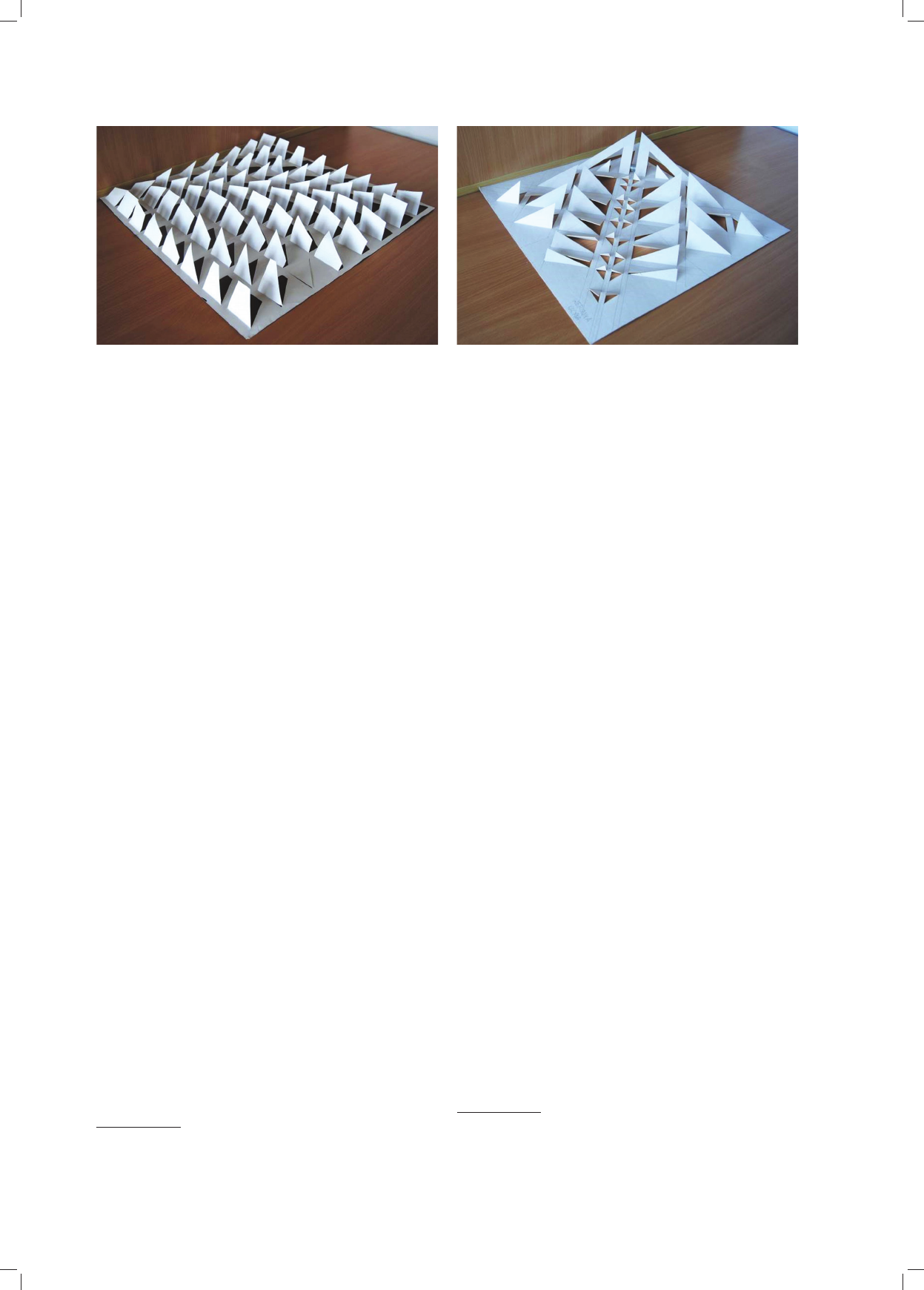
76 Barbara Siomkajło, Dorota Łuczewska
zapoznanie uczestników zajęć z podstawowymi informa-
cjami o kompozycji, które pozwolą im na wybór wariantu
postępowania wobec nieskończonej ilości możliwych roz-
wiązań. Decyzje dotyczą wyboru schematu kom po zy-
cyjnego (stałego układu elementów kompozycji) spośród
takich jak układ otwarty lub zamknięty, dynamiczny lub
statyczny, symetryczny lub asymetryczny, cen tralny lub
zdecentralizowany, diagonalny lub prostokreślny, z domi-
nantą lub bez niej, na osi, osiach lub bezosiowy. Następny
krok to wybór kształtu i proporcji wy ci na nych elementów,
z których budowana jest po wierz ch nia płyty, oraz sposobu
ich odginania. Dzięki takim zabiegom studenci uzyskują
zarówno prawie płaskie, zróżnicowane tylko kierunkami
nacięć kompozycje, jak i wyniesione ku górze zrytmizo-
wane formy, jednolicie ukształtowane mo nostruktury
i układy zdynamizowane z centralną strefą
oraz wiele
innych
5
. Jednym z wariantów tego zadania jest uformowa-
nie płyty w sposób sugerujący układ urbanistyczny (il. 2).
Na tym etapie studiujący poznają cechy kompozycji,
w której pojawiają się symbolicznie ukształtowane obiek-
ty architektoniczne o zróżnicowanej wielkości, strefy
większych i mniejszych przestrzeni – puste lub wypełnio-
ne – oraz ciągi komunikacyjne. Studenci, mimo braku
doświadczenia w posługiwaniu się tak rozległą dziedziną,
jaką jest wiedza na temat kompozycji, i działając in -
tuicyjnie, uzyskują czasami interesujące efekty plastyczne.
B. Ściana (dwie płyty)
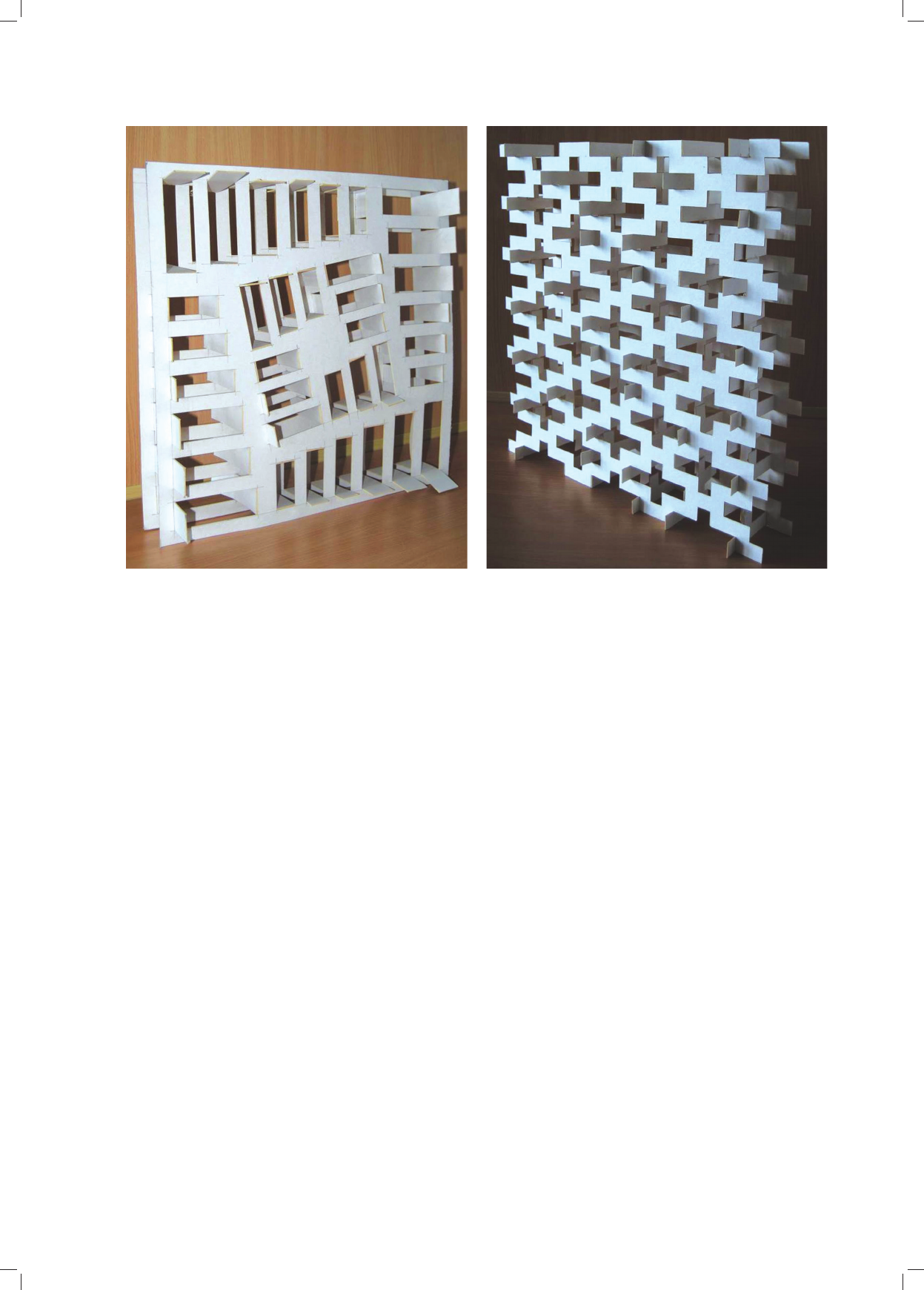
Bardziej skomplikowanym zadaniem jest opracowa-
nie kompozycji ściany – ażurowego obiektu o wymiarach
50 × 50 × 5–12 cm. Jej konstruowanie polega na zesta -
wieniu i połączeniu dwóch kartonowych kwadratów za
5
Wybrane do tekstu ilustracje są w stanie tylko zasygnalizować
omawianą problematykę wobec liczby i rodzajów/odmian pomysłów
roz wiązań kompozycyjnych zastosowanych w pracach studentów (ar chi-
wum Zakładu Rysunku, Malarstwa i Rzeźby WA PWr).
composition elements) including an open or closed lay-
out, dynamic or static, symmetrical or asymmetric, cen-
tral or decentralised, diagonal or straight, with or without
a dominant, on the axis, on the axes or without them. The
next step is to choose the shape and proportions of the
cut-out elements from which the surface of the board is
built and then the method of bending them. Thanks to
such treatments, students obtain both almost flat composi-
tions which are differentiated only by the directions of
incisions as well as upwardly rhythmised forms, uniform-
ly shaped mono-structures and the layouts which are dy-
namized with the central zone as well as many more
5
. One
of the variants of this task is to form a board in a manner
suggesting an urban layout (Fig. 2). At this stage, students
learn about the features of the composition in which sym-
bolically shaped architectural objects of various sizes,
zones of larger and smaller spaces – empty or filled as
well as communication routes appear. Students, despite
the lack of experience in using such a vast field, which is
the knowledge about composition, and acting intuitively,
sometimes obtain interesting visual artistic effects.
B. Wall (two boards)
A more complicated task is to develop a wall composi-
tion – an openwork object 50 × 50 × 5–12 cm. Its con-
struction consists in the juxtaposition and connection of
two cardboard squares by means of elements which were
previously cut out from them, bent and fixed on opposite
sides (Figs 3, 4). The openwork construction realized in
this way should be stable, which is caused by the appro-
priately selected quality of the cardboard as well as the
5
The illustrations, which were chosen for the text, are only able to
signal the discussed problem in relation to the number and types/variet-
ies of ideas for compositional solutions which were applied in the works
made by students (Archives of the Department of Drawing, Painting and
Sculpture of WA PWr).
Il. 1. Płyta – przykład uformowania powierzchni
za pomocą płaskiego reliefu, stopniowa zmiana zakończenia górnej
krawędzi podstawowego elementu pozwoliła uzyskać efekt ruchu
(autor: I. Łyszkiewicz)
Fig. 1. Board – an example of surface formation using a flat relief,
a gradual change of the end of the upper edge of the basic element
allowed us to obtain the effect of movement
(author: I. Łyszkiewicz)
Il. 2. Płyta – zastosowanie diagonalnej osi i zróżnicowanych
wysokości odginanych elementów aż po kulminację na jej zakończeniu
wprowadza zdynamizowanie układu i kojarzy się z rozwiązaniami
urbanistycznymi (autor: W. Kacyna)
Fig. 2. Board – application of a diagonal axis and varied heights of
bending elements up to the culmination of its completion introduces
dynamism of the system and is associated with urban solutions
(author: W. Kacyna)
Wstęp do modelowania przestrzeni /Introduction to space modelling 77
po mocą
elementów uprzednio z nich wyciętych, odgiętych
i zamocowanych po przeciwległych stronach (il. 3, 4).
Zrealizowana
w ten sposób ażurowa konstrukcja powinna
być stabilna, czemu służy odpowiednio dobrana jakość
kartonu oraz rodzaj, kształt, liczba i wymiary połączeń.
Problemy związane z tworzywem i konstrukcją są równie
istotne jak zagadnienia kompozycyjne. Solidne powiąza-
nie obu części ścianki wymaga właściwego ukształtowa-
nia elementów łączących, a ich forma i rozmiar decydują
o jakości efektu plastycznego ażuru. Z tego powodu kon-
cepcja zgodności formy i funkcji znajduje tutaj odzwier-
ciedlenie, chociaż dopuszcza się sytuacje, w których tylko
część połączeń ma charakter konstrukcyjny, pozostałe zaś
stanowią rodzaj spójnego z całością dekoracyjnego uzu-
pełnienia. Dużą wartość dydaktyczną ma spostrzeżenie,
że rodzaj i sposób rozmieszczenia nacinanych elementów
na obu płytach pozwala ukształtować interesujące i całko-
wicie odmienne efekty przestrzenne. Na ostateczną war-
tość plastyczną projektowanej ścianki istotny wpływ ma
proporcja pomiędzy powierzchnią pustą – wycięć/otwo-
rów – a pełną powierzchnią pozostawioną z obu jej stron.
C. Bryła (sześcian, prostopadłościan, wieża)
Inne zadanie kompozycyjne z zakresu modelowania
przestrzeni dotyczy brył – punktem wyjścia są na ogół
type, shape, number, and dimensions of connections.
Problems related to the material and structure are as im-
portant as the compositional issues. A solid connection
between the two parts of the wall requires proper shaping
of the connecting elements and their form and size deter-
mine the quality of the plastic openwork effect. Therefore,
the concept of compatibility of the form and function is
reflected here, although some situations in which only
some of the connections are of a constructional nature are
permissible, while others are a kind of decorative comple-
ment which is coherent with the whole. A great didactic
value is the observation that the type and method of dis-
tribution of the cut-out elements on both boards makes it
possible to shape interesting and completely different spa-
tial effects. The final artistic value of the wall designed is
significantly influenced by the proportion between the
empty surface – cut-outs/openings – and the full surface
which is left on both of its sides.
C. Solid (cube, cuboid, tower)
Another compositional task within the framework of
space modelling concerns solids – the starting point are
usually the simplest forms, that is a rectangular or a cube.
The aim of the students’ work is to shape the solid by cut-
ting out and rejecting parts so as to obtain an interesting
Il. 3. Ścianka – kompozycja zamknięta ze strefą centralną,
ażur uzyskany dzięki wycięciom i odgięciom prostokątów
o zróżnicowanej długości, interesujący efekt obróconej części środkowej
(autor: M. Kiela)
Fig. 3. Wall – closed composition with the central zone,
the openwork was obtained thanks to notches and bends of rectangles
of varied lengths, interesting effect of the rotated central part
(author: M. Kiela)
Il. 4. Ścianka – kompozycja otwarta jednorodna,
zrównoważona proporcja powierzchni wyciętych i pozostawionych,
wycięte brzegi sprawiają wrażenie większej lekkości
(autor: W. Lebiedowska)
Fig. 4. Wall – open homogeneous composition,
balanced proportion of surfaces cut out and left,
the cut edges give the impression of greater lightness
(author: W. Lebiedowska)
78 Barbara Siomkajło, Dorota Łuczewska
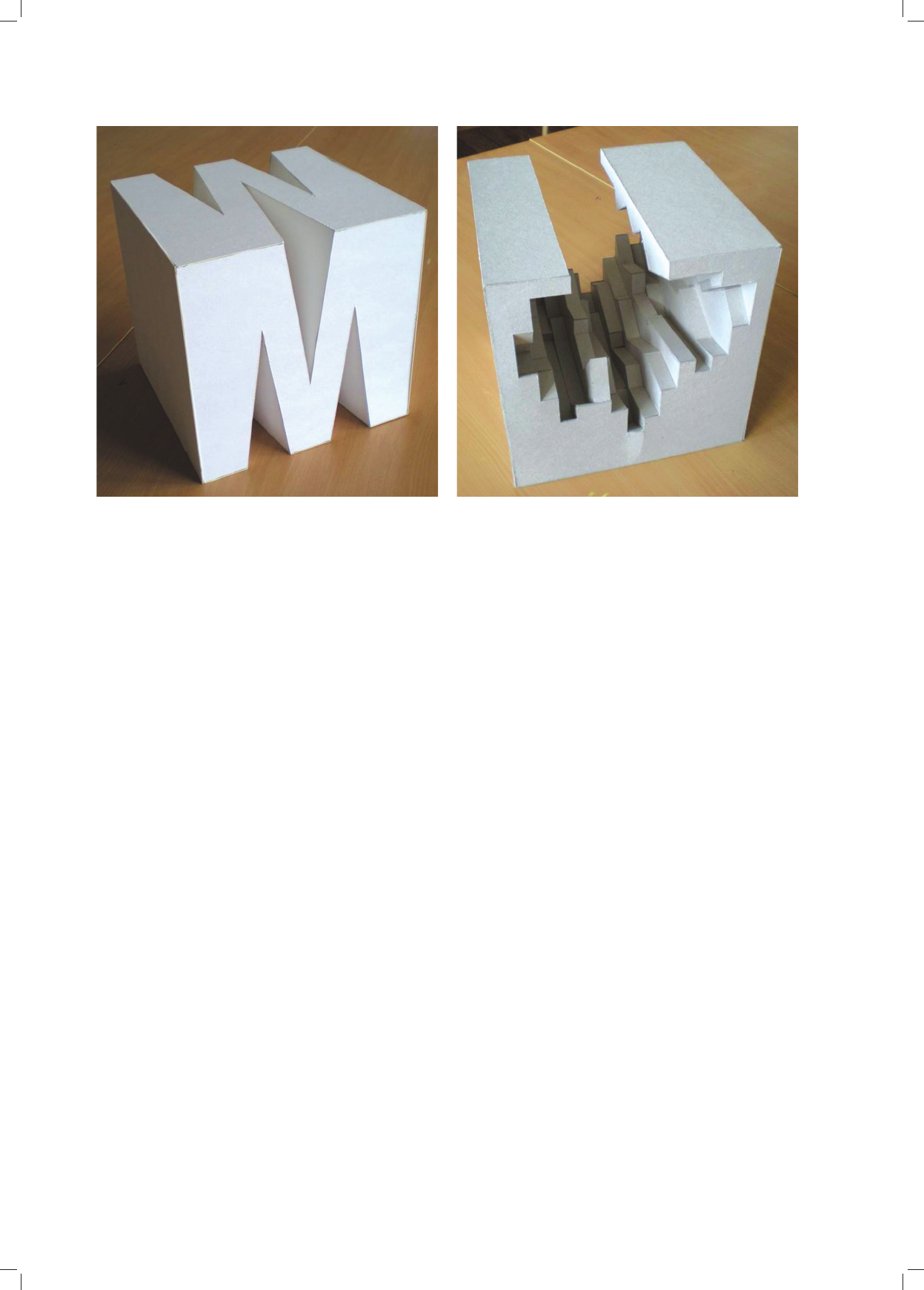
najprostsze formy, czyli prostopadłościan lub sześcian.
Celem pracy studentów jest kształtowanie bryły za pomo-
cą wycinania z niej i odrzucania części tak, aby otrzymać
interesujący obiekt, zachowując jednocześnie czytelność
jej pierwotnego kształtu. Zakłada się końcowe wymiary
projektowanego modelu z kartonu, dla sześcianu – kra-
wędź 25–30 cm (il. 5, 6), prostopadłościanu – podstawa
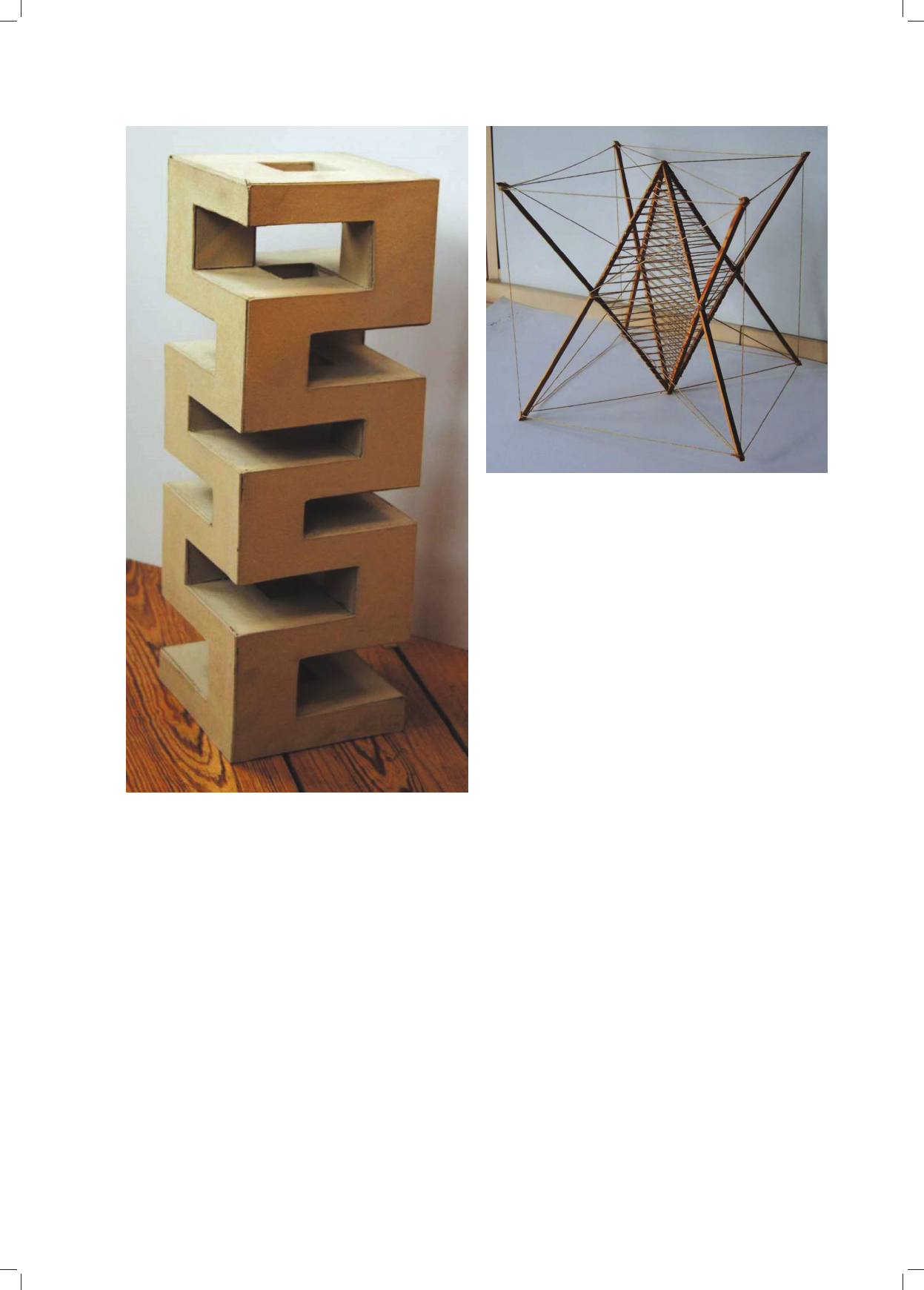
około 15 × 15 cm, wysokość 50 cm (il. 7). Większość
uczestników zajęć zazwyczaj rozpoczyna szkicowanie
pomysłu od wycinania ze swojej bryłki identycznych sze-
ścianików (standardowa kostka Rubika) – po pewnym
czasie udaje się jednak przekonać ich do zmiany sposobu
myślenia. Wycinane formy zyskują zróżnicowane wymia-
ry lub kształty (sugerowane są proste cięcia płaszczyzna-
mi, krzywizny nie sprawdzają się w kartonie), wzrasta
świadomość możliwości, jakie tworzy zmiana miejsca
wy cięcia. Omawiane zadanie bardziej niż poprzednie po z-
wala studentom dostrzec zagadnienia przestrzenne. Sześ -
cienna rzeźba jest oglądana z wielu stron, a obracanie jej
ujawnia inne możliwości i zróżnicowane efekty wizualne.
Istotne jest zwrócenie uwagi na potrzebę uzyskania efek-
tu spójnej całości, co niejednokrotnie sprawia sporą trud-
ność. Decyzje projektowe muszą dotyczyć wielu elemen-
tów – wykonywane prace uwzględniają różnorodne,
często skrajne kryteria i tendencje. Część z nich jest roz-
drobnioną układanką, inne są bliskie formowania w duchu
minimal artu lub dzięki skojarzeniom stają się przestrzen-
nym znakiem. Wycinanie może być płytkie i dotyczyć tylko
powierzchni bryły, ale może prowadzić także do uzys
ka nia
object, while maintaining the readability of its original
shape. The final dimensions of the model designed of
cardboard are assumed, i.e. for the cube – the edge
25–30 cm (Figs 5, 6), cuboid – the base is about 15 × 15 cm,
the height is 50 cm (Fig. 7). Most of the participants of the
classes usually start sketching the idea from cutting out
identical solid cubes from their own solids (standard Ru-
bik’s cube) – after some time, however, it is possible to
convince them to change their way of thinking. The cut-
out forms gain different dimensions or shapes (simple
planar cuts are suggested, curves do not work well in the
cardboard), the awareness of possibilities that are pro-
vided by changing the place of cutting increases. The task
discussed more than the previous ones allows students to
see spatial issues. A cubic sculpture is viewed from many
sides and turning it reveals other possibilities and diversi-
fied visual effects. It is important to pay attention to the
need to achieve the effect of a coherent whole, which
often makes a lot of trouble. Design decisions must con-
cern many elements, i.e. the works carried out take into
account various often extreme criteria and trends. Some
of them are fragmented puzzles, others are close to form-
ing in the spirit of minimal art or thanks to associations
they become a spatial sign. The cutting-out may be shal-
low and refer only to the surface of the solid, but it may
also lead to obtaining the effect of a hollow shell. The
im pression of dynamism is achieved not only through
slants, but also through the illusion of a rotational motion
thanks to the appropriately located straight cutting-outs.
Il. 5. Sześcian – przykład formowania bryły-znaku
przy użyciu skośnych cięć przez całą wysokość obiektu,
spójna całościowa kompozycja
(autor: A. Skrobała)
Fig. 5. Cube – an example of forming a solid-sign
using oblique cut-outs along the entire height of the object,
a coherent overall composition
(author: A. Skrobała)
Il. 6. Sześcian – kompozycja jednokierunkowo wydrążona
z rozcięciem na jednej ze ścian, skontrastowana gładka powierzchnia
ścian zewnętrznych z dynamicznie potraktowanym wnętrzem otworu
(autor: R. Pylypchuk)
Fig. 6. Cube – a one-way hollow composition with a cut on one of
the walls, a contrasted smooth surface of external walls
with a dynamically treated interior of the hole
(author: R. Pylypchuk)
Wstęp do modelowania przestrzeni /Introduction to space modelling 79
Models of objects of a tower/pole character can be shaped
– in line with the vertical visual determinant of the object
– by means of vertical cut-outs, but the designed exam-
ples show a tendency of upward pursuit which is obtained
also due to different methods.
The application of materials other than cardboard also
requires familiarisation with their properties. Interesting
compositions can be shaped from strips of wood which
are joined by means of strings (Fig. 8). The target open-
work form may have the shape of, for example, a cube
(which allows the first-year students to more control the
process of reaching the intended effect), but the materials
applied make it possible to use many miscellaneous forms.
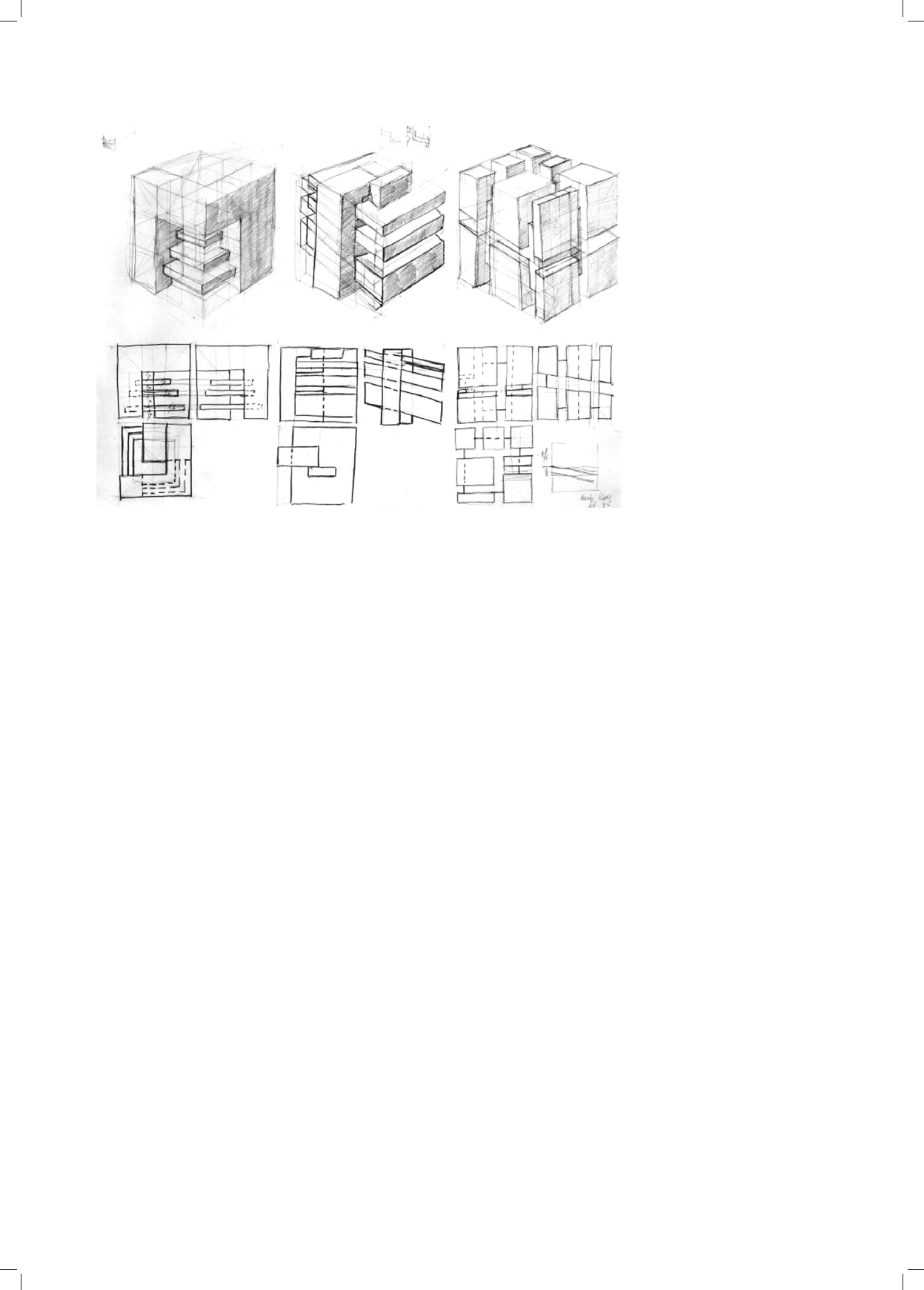
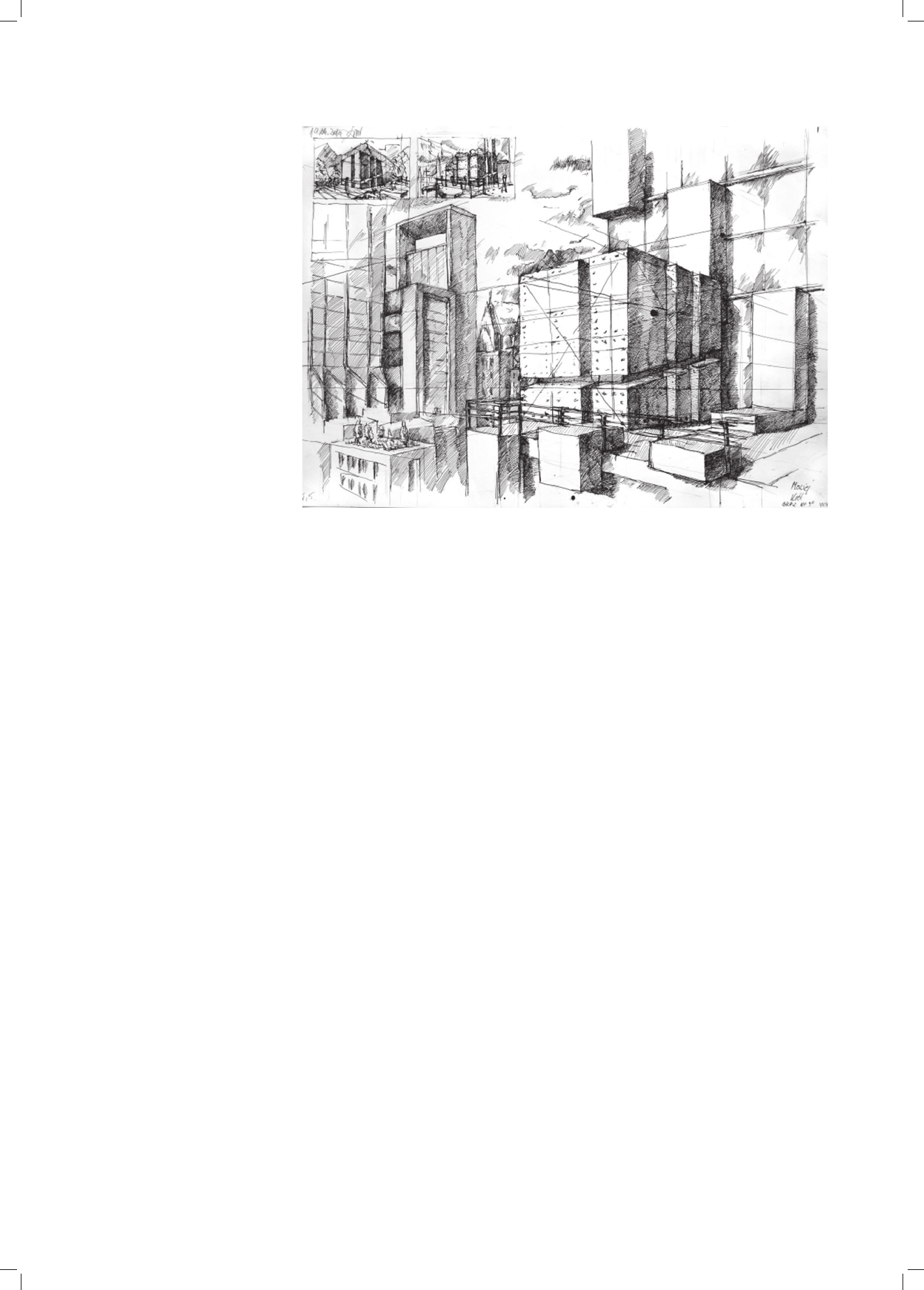
All of the above-discussed activities in space are always
accompanied by a drawing (evaluated independently of
the final model/mock-up), i.e. in the form of initial work-
shop sketches of an idea as the documenta tion of a de-
signed model and concept visualisation, that is, locating
the object in the reality chosen by the author (Figs 9, 10).
The drawing thus constitutes a kind of binder or frame of
a complex of actions in all phases of the modelling/design
process. It is worth noticing here that the whole process
of realisation of this kind of task is basically the intro -
duction of students into the nature and secrets of architec-
ture design.
Summary
The works which were created during the classes rep-
resent a different artistic level, but they are undoubtedly
an important creative experience for future architects.
Some of the works duplicate the schemes which were
efektu wydrążonej skorupy. Wrażenie zdynamizowania
osiągane jest nie tylko poprzez skosy, ale również przez
iluzję ruchu obrotowego, dzięki odpowiednio umiejsco-
wionym prostym wycięciom. Modele obiektów o charak-
terze wieży/słupa mogą być kształtowane – zgodnie z pio-
nowym wyznacznikiem wizualnym obiektu – pionowymi
wycięciami, ale projektowane przykłady pokazują ten-
dencję dążenia w górę uzyskaną również za pomocą róż-
nych metod.
Stosowanie innych niż karton materiałów wymaga
także zapoznania się z ich właściwościami. Interesujące
kompozycje dają się kształtować z listewek łączonych
sznurkami (il. 8). Docelowa ażurowa forma może mieć
kształt np. sześcianu (co pozwala studentom na I roku
Il. 8. Forma sześcienna – zbudowana z listewek i sznurków,
interesująco ukształtowany sznurkowy rdzeń kompozycji
(autor: A. Malarska)
Fig. 8. Cubic form – made of wooden strips and strings,
an interestingly shaped string core of the composition
(author: A. Malarska)
Il. 7. Prostopadłościan/wieża – w kompozycji wykorzystano poziome
podziały i wycięcia ścian, uzyskując wrażenie ruchu ku górze
(autor: B. Kołodziej)
Fig. 7. Rectangular/tower – horizontal divisions and cut-outs of the walls
were used in the composition, giving the impression of moving upwards
(author: B. Kołodziej)
80 Barbara Siomkajło, Dorota Łuczewska
seen in the examples presented earlier or known from
various sources. However, many works have an authentic
unique expression. Reaching the final solution, which
was preceded by trials and corrections, creates an oppor-
tunity to stimulate creativity of students. As a result, link-
ing the issues of the theory of composition with their
practical application in didactics equips young artists with
intellectual and artistic experience as well as with effec-
tive tools and methods of creative work.
Thanks to the themes and tasks that connect various
artistic fields, the process of educating students of archi-
tecture is enriched with the possibility of wider familiari-
sation with the issues of composition – from flat concep-
tualisations to a model and the improvement of drawing
skills – from synthetic sketching and precise documenta-
tion to visualising objects in a specific reality. An impor-
tant feature of these activities is the necessity to solve an
idea at the same time in the form of a drawing and a mock-
up, which allows students to master such an important
mental skill for the architect as moving freely between 2D
and 3D, but most of all to stimulate their imagination. The
knowledge and skills acquired can be used when realising
the next themes within the framework of the course of
visual arts education. The experience which is gained dur-
ing the implementation of this type of tasks can also be
helpful in solving design problems in other subjects of the
curriculum at the Faculty of Architecture.
What seems to be important in the implementation of
these tasks, is to familiarise young people with the stages
and regularities of the design process at the beginning of
their experience in architecture while ignoring the addic-
tive and limiting usage of digital techniques, and to do
this on the basis of their own mental and manual activity.
Translated by
Bogusław Setkowicz
bardziej kontrolować proces dochodzenia do zamierzone-
go efektu), ale użyte tworzywa pozwalają na wykorzy-
stywanie
wielu różnorodnych form. Wszystkim omawia-
nym działaniom w przestrzeni towarzyszy zawsze rysunek
(oceniany niezależnie od końcowego modelu/makiety):
w formie wstępnych szkiców warsztatowych pomysłu,
jako dokumentacja zaprojektowanego modelu i wizuali-
zacja koncepcji, czyli umiejscowienie obiektu w wybra-
nej przez autora rzeczywistości (il. 9, 10). Rysunek stano-
wi tym sa mym rodzaj spoiwa czy też szkieletu kompleksu
działań we wszystkich fazach procesu modelowania/
projekto wa nia. Warto przy tym zaznaczyć, że cały proces
rea li zowa nia tego rodzaju zadania jest w zasadzie wpro-
wadzeniem stu dentów w charakter i tajniki projektowania
architektury
.
Podsumowanie
Powstałe podczas zajęć prace reprezentują różny po -
ziom artystyczny, ale są bez wątpienia ważnym do świad-
czeniem twórczym dla przyszłych architektów. Część
prac powiela schematy podpatrzone w prezentowanych
wcześniej przykładach lub znane z różnych źródeł. Wiele
jednak prac ma autentyczny autorski wyraz. Do chodzenie
do ostatecznego rozwiązania poprzedzone próbami
i korektami stwarza możliwość pobudzenia kreatywności
studentów. W efekcie powiązanie zagadnień teorii kom -
pozycji z praktycznym ich zastosowaniem w dy dakty ce
wyposaża młodych twórców w intelektualne i artystycz ne
doświad czenie oraz w efektywne narzędzia i metody
pracy twórczej.
Dzięki tematom i zadaniom, które łączą różne dzie dzi-
ny plastyczne, proces kształcenia studentów architektury
zostaje wzbogacony o możliwość szerszego zapoznawa-
nia się z problematyką kompozycji – od ujęć płaskich po
model, oraz doskonalenia warsztatu rysunkowego – od
Il. 9. Rysunek warsztatowy –
wstępne pomysły ukształtowania
bryły sześcianu
(autor: M. Król)
Fig. 9. Workshop drawing –
preliminary ideas for
shaping a cube solid
(author: M. Król)
Wstęp do modelowania przestrzeni /Introduction to space modelling 81
syntetycznych ujęć szkicowych, precyzyjną dokumen ta-
cję, po wizualizację obiektów w określonej rzeczy wis toś ci.
Istotną cechą tych działań jest konieczność rozwiązy -
wania pomysłu jednocześnie w formie rysunku i ma kiety,
co pozwala na opanowanie tak ważnej dla architekta zdol-
ności jak swobodne poruszanie się pomiędzy 2D i 3D, ale
przede wszystkim na uruchamianie wyobraźni. Zdobytą
wiedzę i umiejętności można wykorzystywać przy następ-
nych tematach w ramach kursu kształcenia plastycznego.
Doświadczenia uzyskane przy realizacji tego rodzaju
zadań mogą być również pomocne w rozwią zywaniu
zagadnień projektowych z zakresu innych przedmiotów
programu nauczania na wydziale architektury.
Istotne przy realizacji tych zadań wydaje się także
zaznajamianie młodych ludzi na początku ich doświad-
czeń dotyczących architektury z etapami i prawidło-
wościami procesu projektowania przy pominięciu coraz
częściej uzależniającego i ograniczającego udziału tech-
nik cyfrowych – w oparciu o własną aktywność umysło-
wą i manualną.
Il. 10. Wizualizacja –
zaprojektowany obiekt
w konkretnej przestrzeni miejskiej
(autor: M. Król)
Fig. 10. Visualisation –
a designed object
in a specific urban space
(author: M. Król)
Bibliografia /References
[1] Arnheim R., Sztuka i percepcja wzrokowa, Wydawnictwa Artystycz-
ne i Filmowe, Warszawa 1978.
[2] Gombrich E.H., Zmysł porządku, o psychologii sztuki dekoracyjnej,
Uni versitas, Kraków 2009.
[3] Kompozycja na styku architektury i sztuk plastycznych, L. Maluga
(red.), cz. 1, Raporty Zakładu Rysunku, Malarstwa i Rzeźby PWr,
SPR W1 H/2016/S-013, Wrocław 2016.
[4] Słownik terminów plastycznych, Wiedza Powszechna, Warszawa
1999.
[5] Żórawski J., O budowie formy architektonicznej, Arkady, Warszawa
1973.
[6] Nęcka E., Psychologia twórczości, GWP, Gdańsk 2002.
[7] Rysunek i malarstwo – problemy podstawowe, wybrane zagadnie-
nia, B. Siomkajło (red.), Oficyna Wydawnicza PWr, Wrocław 2001.
[8] Tatarkiewicz W., Historia estetyki, t. 3: Estetyka nowożytna, PWN,
Warszawa 1985.
Streszczenie
W procesie kształcenia studentów architektury jednym z podstawowych problemów jest uświadomienie im znaczenia pojęcia kompozycja – jako
podstawowego dla wszelkiej twórczości plastycznej, a zwłaszcza dla projektowania architektury. Praca niniejsza prezentuje element tego procesu
kształcenia, który ściśle wiąże teorię z praktyką twórczą przy wykorzystaniu różnych mediów, w celu przygotowania kompozycji przestrzennej.
Służą temu odpowiednio dobrane zadania, które wprowadzono w ramach kursów bloku kompozycyjno-plastycznego na Wydziale Architektury
Politechniki Wrocławskiej, już na pierwszym poziomie nauczania. W opracowaniu omówiono grupę prostych zadań i sposobów ich realizacji ze
względu na wprowadzanie elementów teorii kompozycji (jej cech, zależności, zasad), zastosowane tworzywo i technologię wykonania oraz rodzaje
dokumentacji idei projektowej. W artykule zawarto także opis metodologii realizacji kolejnych etapów tych zadań oraz dokumentację fotograficzną
z opisem wybranych przykładów prac studenckich (płyty, ściany, bryły). Realizacja tej grupy zadań dydaktycznych umożliwia jednoczesne weryfi-
kowanie związków pomiędzy projektowaną formą, jej konstrukcją i cechami materiału, pozwala także na koordynowanie procesów projektowania
równolegle – w zapisie płaskim (rysunek na wszystkich etapach) i w realnej przestrzeni. Są one tym samym istotnym elementem warsztatu plastycz-
nego przyszłych architektów.
Słowa kluczowe: kompozycja, modelowanie, edukacja

82 Barbara Siomkajło, Dorota Łuczewska
Abstract
In the educational process of architecture students one of the essential problems is to make them aware of the importance of the concept composition
– as a basic one for all artistic activity, especially for the architectural designing. This paper presents an element of this educational process which
closely connects the theory with creative practice using different media, in order to realize the three-dimensional composition. Adequately chosen
educational tasks, which have been introduced within the confines of composition-artistic block courses at the Faculty of Architecture of Wrocław
University of Science and Technology at the primary level, are very helpful. In the paper a group of simple tasks and ways of their realization for
the sake of introducing some elements of composition theory (its features, relationships, rules), used materials and technology of execution as well
as some kinds of designing idea documentation is described. This paper also contains the report on the realization methodology of the next steps of
these tasks and also described photos of chosen students’ work examples (plates, walls, solids). Realization of this group of educational tasks makes
it possible to verify connections between the designed form, its construction and characteristics of material, it also allows to co-ordinate designing
processes simultaneously – in two-dimensional notation (drawing, at all stages) and during modelling in real space. And so they are an important
element of the future architects art technique.
Key words: composition, modeling, education