2010
Nr 2(28)
The medieval Lviv, located in the crossroads of trade
routes, was open to the inuence of the new traditions. The
Renaissance period comes to the city, lying in the ruins
of destructive re of 1527. Gothic Lviv suddenly passes
away in the past, and the Renaissance in its bright under-
standing of this word comes to the city. New forms were
brought to the architecture of Lviv by Italian craftsmen,
educated in the Renaissance traditions of their country.
These are mostly the natives of northern Italian regions.
Ordinary artisans-architects have quickly assimilated in
the new conditions, being affected by the local traditions.
Those among them who were non-ordinary personalities
left their inimitable monuments of Renaissance architec-
ture to us. Buildings, constructed at that period, attract us
by harmony of shapes and by renement of stone carv-
ings. Sculptural décor, which acquires expressive exem-
plariness and which is vested a certain symbolic and phil-
osophical content during the Renaissance epoch, plays
a special rоle in the formation of a peculiar architectural
image of the buildings.
The present article is dedicated to revealing a sym-
bolic and philosophical meaning of sculptural décor on
the façades of Lviv Renaissance houses on the example
of Scholtz-Wolfowitz tenement stone No. 23 in Market
Square in Lviv.
It should be noted there was late Renaissance, which
came to Lviv. Its chronological frames for the monuments
of Lviv may be conventionally limited by the second half
of the 16
th
century and one third of the 17
th
century [1,
p. 43]. Arriving at the local ground, this style is affected
by certain autochthonous inuences. The distinguished
order system of the Italian Renaissance is often combined
with the traditions of the local national culture. The en-
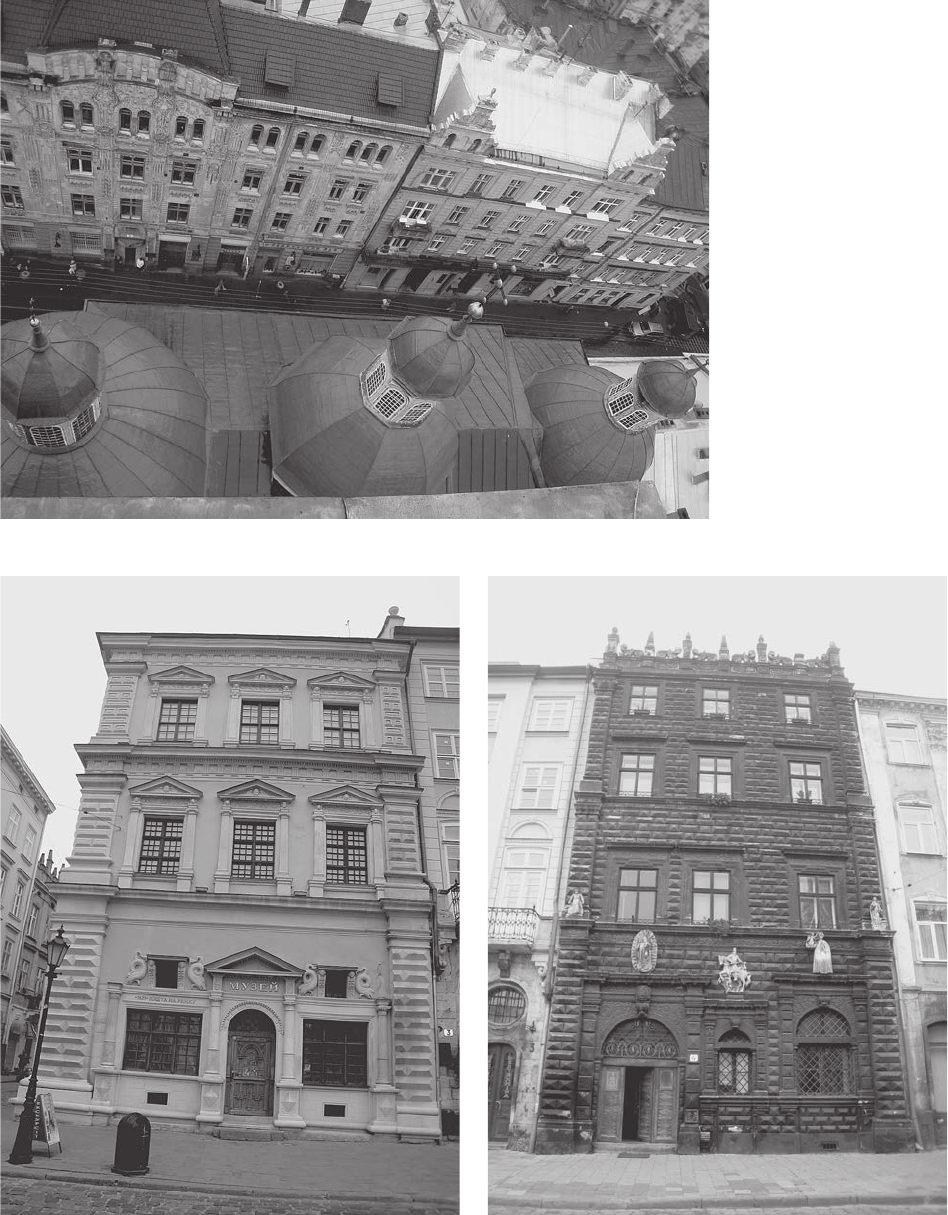
semble of Assumption Church is a bright example of such
a combination (Fig. 1). Pavlo Rymlyanyn (Paolo Domini-
ci Romanus), a well-known creator of numerous Lviv
monuments of Renaissance, combines the west basilica
plan with the local architectural traditions in this monu-
ment. He puts three cupolas, the most signicant element
of Ukrainian sacral architecture, on the longitudinal axis
of the building (Fig. 2). This technique was obviously ap-
Oleksandra Kulynska*
Sculptural décor of façades of Lviv tenement houses
of the Renaissance period (on the example of Scholtz-Wolfowitz
tenement house No. 23 in Market Square in the city of Lviv)
*
Ukrainian Specialized Research Institute.
Fig. 1. Façade of Assumption Church
38 Oleksandra Kulynska
plied in order to please the customer, because the church
was built at the expense of the Assumption Brotherhood
of the Ukrainian community of the city. Such inuences
can be traced not only at the level of architect’s creative
design, but in the process of performance of decorative
works as well. Local craftsmen have obviously perceived
classical shapes of order patterns, brought from the West,
in their own way, they often performed them not quite
exactly, in their own manner, or added traditional national
motives, which used to be more clear for them. Such de-
tails can be seen among the wealth of stone carvings on
the façades of the Assumption Church and the Chapel of
Fig. 3. Bandinelli Palace, Market Square No. 2
Fig. 2. Cupolas
of Assumption Church
Fig. 4. Black house, Market Square No. 4
Sculptural décor of façades of Lviv tenement houses of the Renaissance period... 39
Three Saints from the same ensemble. Thus, the reliefs of
saints on the church frieze are carved in the style of the
eastern icons, and the branches of viburnum, being the na-
tional symbol of the Ukrainians which can be seen in the
oral ornaments. Many other sacral structures are built at
that period apart from the Assumption Church, Church of
the Bernardine (project by Bernardine architect Avelides,
architects Pavlo Rymlyanyn, Amvrosiy Prykhylnyy,
Andriy Bemer from Wroclaw), Church of Poor Clares
(Pavlo Rymlyanyn (?), Benedictine Church and Monas-
tery (Pavlo Rymlyanyn), hospital and Church of Lazarus
(Pavlo Rymlyanyn, Amvrosiy Prykhylnyy), Boim Chapel
(Andriy Bemer) and Campiano Chapel (Pavlo Rymly-
anyn?), near the Latin Cathedral, are among them. In the
composition of the said structures the inuences of the
national traditions are not so evident, because they were
built mainly for monastic communities, which came from
the west.
Besides sacral buildings, many residential houses were
constructed in the city, ruined by the re. If the develop-
ment of Market Square along with the City Hall structure
had not changed after the rst third of the 17
th
century,
today we would see one more integral ensemble of the
Renaissance architecture. Residential houses, however,
are exposed to greater changes than sacral ones due to
frequent reconstructions and adjustments, connected with
change of residents and a new vogue of decoration of the
interiors or façades. Among numerous Renaissance hous-
es, built in the medieval city at the end of the 16
th
– be-
ginning of the 17
th
centuries, only several houses in Mar-
ket Square have survived without any essential changes,
which marks the traits of the style. Their façades attract
us by their composition perfection and craftsmanship of
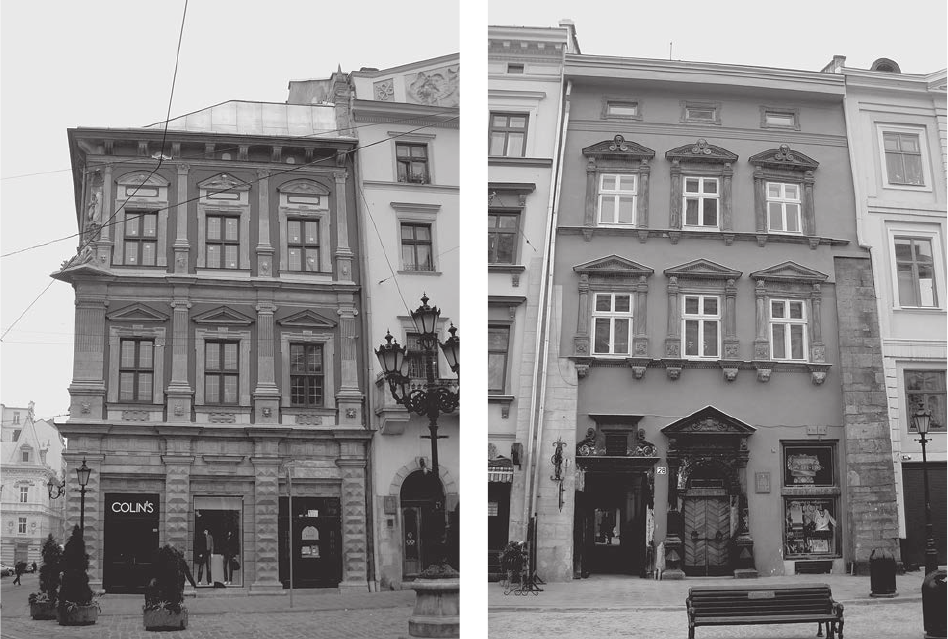
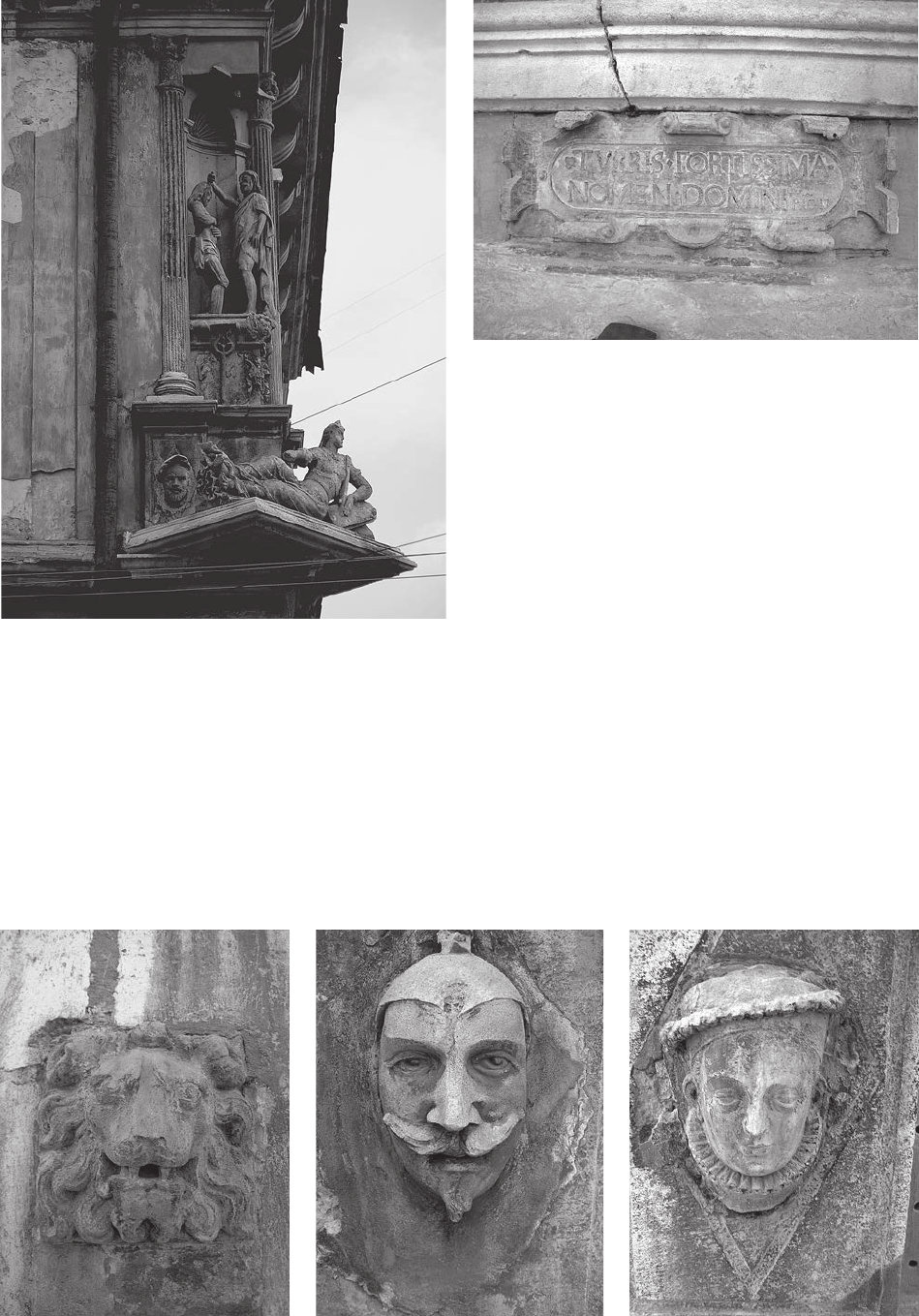
décor performance. These are house No. 2, known as Band-
inelli palace (Fig. 3) and the Black house (No. 4) (Fig. 4) on
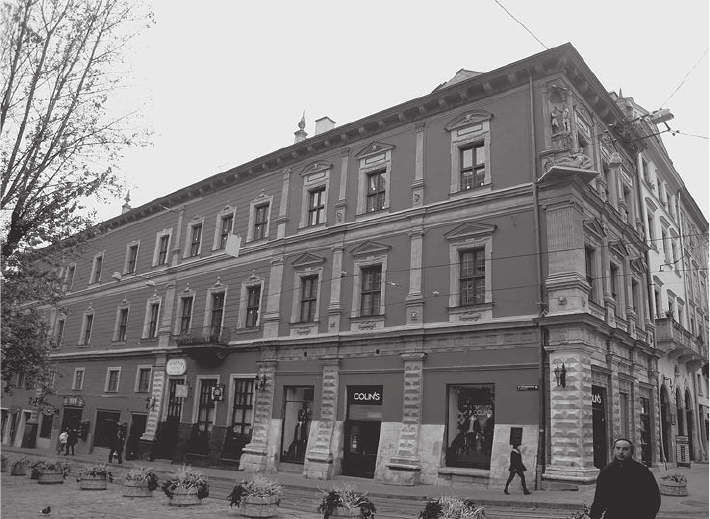
the east side of the square. Scholtz - Wolfowitz house (No.
23) (Fig. 5) and Hepner house (No. 28), (Fig. 6) located
on the west side. Façade of the house No. 14, faced with
rusticated stone, which architects were Pavlo Rymlyanyn
and Pavlo Shchaslyvyy [2, s. 32], working on the order of
Venetian Consul Antonio Massari, is distinguished among
the buildings on the southern side. The façade, however,
has been reconstructed several times, and there are only
rusticated stones and the sculpture of a winged lion above
the main entrance, which tell us about its original charac-
ter. The remaining houses were either built in a later time
period, or reconstructed in a manner which reminds us of
only some elements of the style.
From the point of view of composition, the façades
of all the houses are interpreted differently, though they
belong to one style. The Black house and house No. 14
are entirely faced with rusticated stone, door portals and
window frames distinguishing between them. Façades
of the houses No. 2 and No. 28 have a pronounced hori-
zontal division of the façade and well-developed window
frames, which are ended by pediments. In the composi-
tional decoration of the house No. 23, horizontal division,
traditional for the Renaissance style, is supplemented by
an order system with application of pillars of the Ionic and
the Corinthian orders.
Fig. 5. Scholtz-Wolfowitz house, Market Square No. 23
Fig. 6. Hepner house, Market Square No. 28
40 Oleksandra Kulynska
With this free interpretation of antique order in com-
positional solution of the façades, the Renaissance build-
ings of Lviv still have some common traits, expressed in
a wealth of stone carving, decoration with stone sculpture
and subjection of sculptural décor to a greater or lesser
extent to a certain philosophical idea. If in the Assump-
tion Church we see the effect of cultural and national tra-
ditions upon the style, than the worldview and aesthetic
taste of an owner have a greater inuence on the character
of residential houses.
Market Square façade of Scholtz-Wolfowitz house
(No. 23) is the most interesting from this point of view.
The house has a construction of the pit and attic, lost as
a result of numerous reconstructions, but the decoration at
the level of the second and the third oors survived almost
unchanged. The façade impresses by a great wealth of
sculptural décor and the craftsmanship of its performance.
In order to understand better the philosophical idea of pat-
tern of the façade, one should know something about the
house owner, because it was he, who, being an educated
and creative person of the Renaissance day, determined
this image of the house.
Scholtz-Wolfowitz is known to be the native of Sile-
sia. In the second half of the 16
th
century he comes to
Lviv, then gets married with a daughter of Lviv patrician
Melchior Gase. The bride gets as a dowry an angular
house in Market Square, which side façade faces the Latin
Cathdral. In 1570 Jan Scholtz-Wolfowitz buys the entire
Fig. 7. Scholtz-Wolfowitz house.
Aedicula which sculptural group “Baptism”
Fig. 8. Scholtz-Wolfowitz house.
Cartouche under the second oor windows
Fig. 9. Scholtz-Wolfowitz house.
Mascaron of lion in the second oor
pilasters’ pedestals
Fig. 10. Scholtz-Wolfowitz house.
Sculptural portrait in the right corner
of the aedicule
Fig. 11. Scholtz-Wolfowitz house.
Portrait of a young lady in the third oor
pilasters’ pedestals
Sculptural décor of façades of Lviv tenement houses of the Renaissance period... 41
house, located on the partsel, and commences its recon-
struction and decoration of the façades, which has lasted
until his death in 1605. Jan Zaremba, student of Herman
Van Gute, sculptor of Dutch origin, for whom the Scholtz-
-Wolfowitz family was the patron of arts, is considered to
be the author of sculptural Renaissance décor. The histori-
cal sources testify that after the craftsman’s death (1596)
there were no more orders for sculptural studio on part
of Jan Scholtz-Wolfowitz. In 1595 the Scholtz-Wolfowitz
family was granted baronage title de Wolfowitz from the
emperor Rudolf ІІ [3]. After this event, the owners, proba-
bly, could afford to decorate the façades of the house with
sculptural portaits of their family representatives.
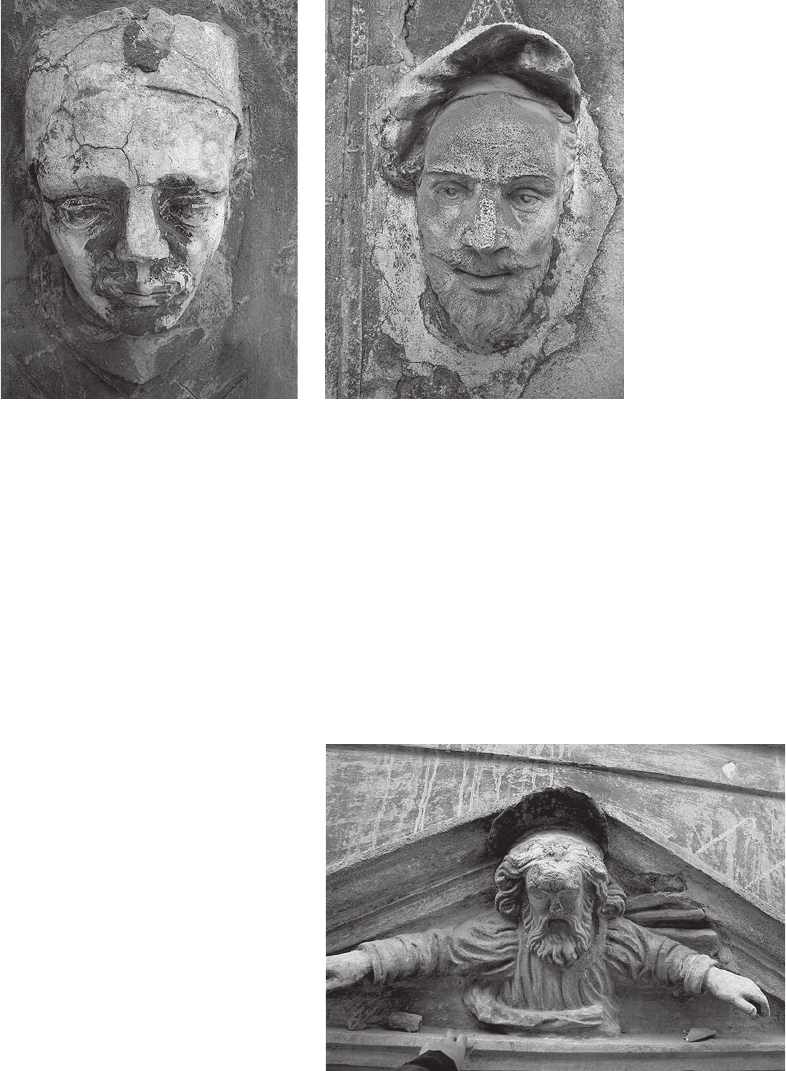
Aedicula, arranged on the third oor level, is a sculp-
tural dominant. (Fig. 7) Sculptural group ”Baptism” is
placed in its niche. Such subjects of sculptural composi-
tion are not accidental, because the house owner’s name
was Jan (Johann). Therefore, it is natural, that the plot of
the most signicant event in his patron’s life is chosen
by the owner to decorate his house corner. The base with
Jesus and John standing is decorated on one side by the
Gase family coat of arms and on the other – by the Scholtz-
-Wolfowitz family coat of arms. Underneath, on the base
ledge, there is a reclining statue of a woman with the at-
tributes of Belief. The sculptural group is well perceived
from both, the Market Square and Halytska Street, which
once led from Halytska gateway to the city. The house
owner makes it clear with the help of the sculptural décor,
that his family has a strong protection, and he conrms his
belief in the patronage of his patron. The entire sculptural
décor of the façade is subjected to a certain philosophical
meaning. (It should be dened more precisely that here
we speak of the façade from the market square side be-
cause in the 16–17
th
centuries the house was not decorated
from the Cathedral square.)
On the level of the second oor, under the windows,
cartouches are built into the masonry of the walls with
inscriptions carved in the stone in Latin: “THE NAME
OF THE LORD IS A STRONG TOWER” (Proverbs,
18) (Fig. 8); “WHOEVER TRUSTS IN THE LORD IS
KEPT SAFE” (Proverbs, 29); “A WISE MAN FEARS
THE LORD AND SHUNS EVIL”, (Proverbs, 14) [4,
pp. 53–57]. Stern lions near the cartouches look menac-
ingly onto the square from the pilasters’ pedestals (Fig.
9). Such decor symbolically protects tenants of the house
from evil intentions and actions from outside.
Fig. 12. Scholtz-Wolfowitz house.
Portrait of a young man in the third oor
pilasters’ pedestals
Fig. 13. Scholtz-Wolfowitz house.
Young man in a beret in the left corner
of the aedicule
Fig. 14. Scholtz-Wolfowitz house. Sculpture of God the Father
on the pediments above outermost windows of the third oor
On the level of the third oor mascarons are mounted
to the pilasters’ pedestals. The sculptural portraits impress
with the depth of representation of character of each g-
ure, perfect execution and detailed nishing of details
of the garments. A portrait of Lviv patrician, probably
Melchior Gase, is placed on the aedicule pedestal on the
right from the family coat of arms (Fig. 10) and further on
a portrait of a young lady (Fig. 11), probably his daughter,
spouse of Jan Scholz-Wolfowitz. Next portrait – a portrait
of a young man; it is, probably, one of the representatives
of the patrician family (Fig. 12). The outermost portrait
42 Oleksandra Kulynska
mask was lost due to the leaking drainpipe and restored,
evidently, in 1890; it has not preserved its characteristic
portrait features. Of some interest is the mask placed in
the left corner of the aedicule (Fig. 13). This is a perfect
portrait of a young man in a beret. Is it not the owner of
the house himself (?), an educated, vigorous and creative
man. On pediments above outermost windows of the third
oor there are high reliefs of the angels, half-length sculp-
ture of God the Father (Fig. 14) who stretches arms over
the façade as if protecting and blessing all residents of the
house and, probably, those who walks in the square by the
façade. There are two more mascarons placed high above
under the eaves. They take up the eld on the right and
left of the console on the corner of the house. These are
faces of a man and a woman that have no portrait features.
What do they symbolize, almost indistinguishable at such
height, those masks ? May be just a man and a woman, yin
and yang, the two fundamental energies of the universe
from which life on earth begins… The frozen in stone
façade tells us in the language of symbols expressed in
sculpture that residents of this house are merited people
who live by the Lord’s laws, who can defend themselves
from envy and encroachment of outside world and rest in
the Lord’s mercy. Unfortunately, the Scholz-Wolfowitz’s
house has lost completely the initial pattern of the ground
oor, the entrance to the house, whose decoration was of
a considerable importance in forming philosophical and
aesthetic image of the house, has not been preserved ei-
ther. To form the idea of the characteristic features of dec-
oration of the ground oors of buildings of this period it
shall be necessary to examine other buildings in the mar-
ket square. Only the Black house (1588–1589) has com-
pletely retained its character, while the rest of the façades
have only fragments of the initial pattern; these are pre-
dominantly the entrance stone portals. The doors and the
windows of the Black house have lavishly decorated with
stone carving portals. Cartouche with the owner’s coat of
arms is afxed above the entrance arch and further above
there is the sculpture of Virgin Mary with the Child Jesus,
above the windows and corbels of the pilasters of the rst
oor there are sculptures of the patron saints. The façade
acquired its sculptural decor in 1675–1677, but it does not
spoil its general character.
The central portal of the house No. 28 is decorated
with gures of angels that embrace the entrance arch with
their wings with the pediment above it supported by lions-
mascarons. The gure of the winged lion with an opened
book – the symbol of Venice – is placed above the stone
portal of the house No. 14 that belonged to the Venetian
consul and merchant Antonio Massari.
These examples show that the decor of Renaissance
façades on the level of the rst oor often carried direct
information about the house owner, his social status or
origin. The portals were ornately decorated and the decor
combined symbols of earthly and heavenly protection.
Proceeding from the analysis carried out, a certain
pattern emerges after which the decor is located on the
façade of Scholz-Wolfowitz’s house:
1 – (ground oor level) lost. It could symbolize wealth
of the owner, combine symbols of earthly and heavenly
protection.
2 – (second oor level) – decor shows attitude of the
house owner to earthly life, symbolizes his self-reliance.
3 – (third oor level) – decor symbolizes hopes of the
house owner for the Lord’s protection of himself and his
family.
It should be noted that such a pattern is not established
or mandatory as the sculptural decor, similarly to the rest of
adornment, is formed freely on every façade observing gen-
eral style features and a certain philosophical idea only.
Façade of the house is of interest also because of the
fact that it underwent substantial restoration works in the
Fig. 15. Scholtz-Wolfowitz house.
Façade on the Cathedral Square
Sculptural décor of façades of Lviv tenement houses of the Renaissance period... 43
end of the 19
th
century. David Schwarzwald bought the
house in 1888 and immediately began its reconstruction.
A row of shop windows in the ground oor with the mez-
zanine over some of the rst oor rooms appeared and
reconstruction works were carried out on the outbuilding.
Two balconies on the second oor level from the Cathe-
dral square side were added as well. The pushing owner
wanted to dismantle the aedicule with the sculptures and
offered it to the city. But, instead, he was forced to re-
store the façade on the Market square side preserving its
authentic decor, while the façade on the Cathedral square
side received stucco molding of braces and pilasters simi-
lar to those on the Market square side (Fig. 15) on the
decision of the city council and the conservatives lodge
commission. To preserve the character of the façade, lion-
mascarons were attached to the molded bases of pilasters
of the second oor, but their material and the manner
of execution differed from their analogs on the Market
square side. These are molded masks cast in molds. The
cartouches under the windows also differ, for they are
molded too and not as delicately as the rest. The letters of
the text are embedded in the convex surface, while letters
of the front façade cartouches are embossed. The inscrip-
tions are different, and although these are also proverbs,
there is no reference to the source in the lower right cor-
ner. To avoid repetition of the inscriptions on the main
façade, they were borrowed from the house No. 28 whose
façade was also decorated with aphorisms. Also interest-
ing is the extension of the portrait row located on the pi-
lasters’ pedestals on the level of the third oor. The mas-
carons there are also molded pieces. One face is a copy of
the alabaster portrait located on the same façade under the
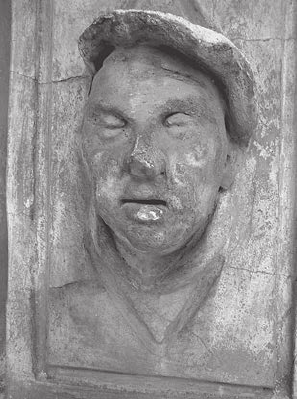
aedicule. The other face (Fig. 16) is of interest because it
has evident portrait features but does not look like any of
the other existing mascarons and by its features the face
of the person differs considerably from the other portraits
of members of the patrician family. It is possible that re-
storers of the 19
th
century made a portrait of one of their
colleagues, for Lviv has never been short of people with
a good sense of humor. Some molded pediments wit an-
gels are located under the windows.
Returning to the main façade, it should be noted that
this is the only market place building where aside from
such traditional material for the stone decor as limestone
alabaster is used as well [6]. The cartouches with proverbs
and portrait mascarons are made of alabaster. The entire
stone decor of the façade was painted as it was the custom
of that time [7]. Even now one can discern remnants of
polychromy on the limestone gures with a naked eye.
Unfortunately, the sculpture had not been restored at
the time of the façade restoration. The sculptural compo-
sition “Epiphany” that is the connoting and architectural
accentuation of the façade, lost a part of Jesus’ leg and
has a look that does not decorate the restored façade. The
reclining gure of “Faith” located under the pediment is
open to snow and rain and has already lost its once rened
features. Now it reminds of a chunk of stone of an inde-
nite shape washed by the rain and is out of tune with the
façade. Comparing the present day state of the sculpture
with its photograph in the book by V.S. Wujcyk “State
historical-architectural preserve in Lviv”, published in
1991, it is easy to understand, that because of the irrevers-
ible processes it will soon become impossible to restore it.
The delicate alabaster portraits that stayed on the façade
for over 400 years and are in a dangerous state, continue
to be ruined by the adverse atmospheric elements. The
problem lies not only in methods of their restoration. The
question arises whether it is necessary to let the originals
stay on the façade. Portraits of such delicate workman-
ship should give aesthetic delight to the museum visitors.
Nobody can see their ne features on the level of the third
oor of the façade. It will probably be absolutely justied
to install on the façade their nely made copies and dis-
play the originals in the museum after their restoration.
The Renaissance period left for us in inheritance the
monuments whose façades are valuable not only for their
artistic decor, but lled with philosophical content which
gives us an opportunity to understand better the epoch,
its world outlook, cultural and moral values. Opening of
this stratum of national cultural heritage requires further
detailed studies and well-balanced steps for their restora-
tion and preservation.
Fig. 16. Scholtz-Wolfowitz house.
Sculptural portrait in the façade
on the Cathedral Square
References
[1] Вуйцик В., Зодчий Павло Римлянин, Володимир Вуйцик. Вибрані
праці до 70-річчя з дня народження. Вісник інституту „Укрзахід-
проектреставрація”, № 14, Львів, 2004.
[2] Вуйцик В., Державний історико-архітектурний заповідник у
Львові, Видання друге доповнене, Каменяр, Львів, 1991.
[3] Сьомочкін І., Сорокаліт Х., Пам’ятка архітектури ХVІ–XІХ ст.
Кам’яниця Шольц-Вольфовичів. Історична записка, Інститут
„Укрзахідпроектреставрація”, Львів, 2008.
[4] Содомора А., Домбровський М., Кісь А., Аnno Domini. Року
Божого. Латинські написи Львова, Піраміда, Львів, 2008.
44 Oleksandra Kulynska
[5] Пам’ятка архітектури ХVІ–XІХ ст. Кам’яниця Шольц-
Вольфовичів, Хіміко-технологічні дослідження та техноло-
гічна схема реставрації скульптур. – К.: Державний науково-
технологічний центр консервації та реставрації пам’яток
ДНТЦ, КОНРЕСТ, 2008.
[6] Пам’ятка архітектури ХVІ–XIХ ст. Кам’яниця Шольц-
Вольфовичів. Комплексні наукові дослідження: Зондажі, карто-
грами втрат та кольорового вирішення фасадів, узагальнення
матеріалів досліджень, Інститут „Укрзахідпроектреставрація”,
Львів, 2008.
Wystrój rzeźbiarski fasad lwowskich kamienic doby renesansu
(na przykładzie kamienicy Szolc-Wolfowiczów – Rynek 23 we Lwowie)
Warunki rozwoju średniowiecznego Lwowa sprzyjały poszerzeniu tra-
dycji Renesansu w jego kulturze i w budownictwie. Na klasyczne formy
i metody, przyniesione przez włoskich architektów, wpływ wywarły
miejscowe tradycje. Wskutek tego architektura Lwowa doby odrodzenia
nabyła specycznych cech. Dla wystroju architektonicznego fasad cha-
rakterystyczna stała się dość swobodna interpretacja reguł klasycznych,
a także nasycenie delikatną rzeźbą i stosowanie polichromii. Jednak
szczególnie ciekawe jest traktowanie wystroju rzeźbiarskiego, stosowa-
nie którego często było podporządkowane nie tyko funkcji estetycznej,
lecz także idei symbolicznej, oraz nabierało treści lozocznej. Wystrój
plastyczny stał się ilustracyjny i często charakteryzował światopogląd wła-
ściciela kamienicy. Rzeźbiarze wyróżniający się wysokim mistrzostwem
i kulturą wykonania byli często zatrudniani przez znanych projektantów.
Wystrój rzeźbiarski fasad stał się wartością architektoniczną, artystyczną
i historyczną i wymaga obecnie szczególnego podejścia do jego badania
i ochrony.
Key words: Lviv, tenement houses, renaissance period Słowa kluczowe: Lwów, kamienice, renesans