2018
2(54)
DOI: 10.5277/arc180208
Hubert Bujak*
Znaczenie medium w sztuce i architekturze
The importance of medium in art and architecture
Wprowadzenie
Artykuł jest próbą usystematyzowania wiedzy zdobytej
na styku niezależnej pracy artystycznej w obszarze rzeź-
by oraz malarstwa z działalnością pedagogiczną w pra-
cowni rzeźby w Zakładzie Rysunku, Malarstwa i Rzeźby
na Wydziale Architektury Politechniki Wrocławskiej (WA
PWr), a dotyczącej wpływu medium na proces twórczy.
Znajdują się tu również teoretyczne rozważania dotyczą-
ce zagadnień związanych z aktywnością artystyczną oraz
jakości wypływających z odpowiedniego nastawienia do
materii dzieła sztuki. Zebrane poglądy oraz myśli pocho-
dzące od autorów działających na polu sztuk wizualnych,
architektury, lozoi oraz literatury wespół z przekona-
niami wypływającymi bezpośrednio z naukowo-dydak-
tycznego doświadczenia mają wiele punktów wspólnych,
wśród których wyróżnia się czynnik materialny dzieła
sztuki oraz sam stosunek artysty do materii, do medium,
w którym pracuje. W sposób szkicowy została tu przy-
wołana historia wytworzenia się idei medium na gruncie
sztuki XX w. Są tu również przedstawione interpretacje
oraz konsekwencje płynące z przemian jej pojmowania.
Jednym z założeń artykułu jest wykazanie, że poniższe
przykłady myśli teoretycznej dotyczące zjawiska me dium
można poprzeć niezależną praktyką artystyczną oraz
efektami procesu twórczego zawierającego się w pracy dy -
daktycznej. W tym kontekście zostały przywołane przy-
kłady konkretnych rozwiązań formalnych zrealizo wanych
podczas zajęć z rzeźby ze studentami II roku WA PWr
Introduction
The article is an attempt to systematize the knowl-
edge which was acquired on the border of independent
artistic work in the eld of sculpture and painting with
pedagogical activity in the sculpture studio at the De-
partment of Drawing, Painting and Sculpture at the Fac-
ulty of Architecture of Wrocław University of Science
and Technology (WA PWr) regarding the inuence of
medium on the creative process. It also includes theoret-
ical considerations which are connected with the issues
related to artistic activity and the qualities stemming
from a right attitude to the matter of a work of art. The
views and thoughts collected which come from authors
working in the eld of visual arts, architecture, philoso-
phy and literature, together with the beliefs resulting di-
rectly from the scientic and didactic experience, have
many common points among which a material factor of
a work of art is distinguished as well as the artist’s at-
titude to matter and to the medium in which s/he works.
The history of creating the idea of medium on the basis
of the 20
th
-century art was mentioned here as an outline.
Interpretations are also presented here as well as conse-
quences resulting from transformations of understanding
its history.
One of the assumptions of the article is to show that the
examples of theoretical thought regarding the phenom-
enon of medium can be supported by independent artistic
practice as well as by the effects of the creative process
which is included in the didactic work. In this context,
examples of specic formal solutions which were im-
plemented during the classes in sculpture with students
of the second year of WA PWr were presented as well as
* Wydział Architektury Politechniki Wrocławskiej/Faculty of Ar-
chi tecture, Wrocław University of Science and Technology.

84 Hubert Bujak
oraz przykłady prac powstałych w ramach własnych dzia-
łań artystycznych.
Kolejnym poruszonym tu zagadnieniem jest koniecz-
ność podkreślenia znaczenia, jakie dla praktyki artystycz-
nej i dydaktycznej ma myśl teoretyczna oraz zjawisko
przejawiania się tych samych idei w różnych dziedzinach
twórczości. Celem opracowania jest również zaznaczenie
wagi procesu twórczego, wskazanie jego cech najistot-
niejszych oraz określenie jego uniwersalnego charakteru
przejawiającego się na wielu polach działalności arty-
stycznej człowieka.
Proces twórczy
Jednym z efektów łączenia własnych doświadczeń ar-
tystycznych z obowiązkiem przekazywania wiedzy na te-
mat podstawowych problemów plastycznych jest podkre-
ślenie i uwypuklenie znaczenia twórczości w kształceniu
młodych architektów czy adeptów sztuki.
Nie ulega wątpliwości, że dla przyszłych architektów
duże znaczenie ma szeroko pojęty warsztat plastyczny,
czyli umiejętność budowania kompozycji przestrzennych
i kolorystycznych, określania ich charakteru, dynamiki,
kontrastu, lekkości, wprowadzania kontekstów oraz wie-
le innych elementów pracy artystycznej, które są często
podporządkowane idei, stojącej u podstaw procesu twór-
czego, a także samej naturalnej potrzebie działania i wy-
rażania się na polu sztuki.
Zjawisko twórczości jest ogólnoludzkie, pojawia się
w każdej naszej aktywności, a sztuka jest tą działalnością,
która wykorzystuje je w pełni, bez względu na to, czy bę-
dzie to rzeźba, malarstwo czy architektura. Bezpośrednie
zapoznawanie się od strony praktycznej z procesem two-
rzenia jest bardzo istotne, ponieważ przyswajając sobie
pewne jego mechanizmy na polu takich dziedzin jak rzeź-
ba czy malarstwo, jesteśmy w stanie przetransponować
te doświadczenia na każdą inną działalność obejmującą
rozwiązywanie problemów naukowych, projektowanie
itp. Dotyczy to bezpośrednio takich aspektów działalnoś-
ci ar tystycznej jak myślenie transgresyjne, otwartość na
przypadek i umiejętność jego wykorzystania, ponadto
umie jętność syntezowania, „odciążania” czy też usuwania
niepotrzebnego balastu znaczeń i form, a jednocześnie
otwartość na pojawiające się w trakcie pracy idee, twórcze
rozwiązywanie problemów technicznych itp. Istotnym czyn-
nikiem w tych wszystkich procesach jest me dium, czyli
tworzywo, albo inaczej mówiąc, materia dzieła sztuki.
Deniując w uproszczeniu twórczość plastyczną jako
proces poszukiwania form odpowiadających określonym
treściom, czy wręcz proces poszukiwania formy i treści
w określonym tworzywie, należałoby zarówno we wła-
snej praktyce artystycznej, jak i działalności pedagogicz-
nej nadawać znaczenie temu poszukiwaniu jako czynni-
kowi istotnemu, bo będącemu często swoistym spiritus
movens dzieła, które ma powstać. Chodziłoby tu przede
wszystkim o potrzebę wyrażenia określonych treści oraz
o samo wywołanie takiej potrzeby i jej zrozumienie.
Wszystkie problemy kompozycyjno-plastyczne, z któ-
rymi studenci architektury mają do czynienia w czasie za
jęć
z rzeźby, są niejako wynikiem tego procesu i jego składo
wą.
examples of works which were created as part of their
own artistic activities.
Another issue which is raised here is the necessity to
underline the importance of the theoretical thought for the
artistic and didactic practice as well as the phenomenon
of manifesting the same ideas in various elds of crea-
tive activity. The aim of the study is also to emphasise the
importance of the creative process, to indicate its most es-
sential features and to dene its universal character which
is manifested in many elds of artistic activity of a human
being.
The creative process
One of the effects of combining one’s own artistic ex-
periences with the obligation to spread the knowledge of
fundamental artistic problems is to emphasize and high-
light the signicance of creative activity in educating
young architects or adepts of art.
There is no doubt that for future architects the broadly
understood artistic workshop is of great importance, i.e.
the ability to make spatial and colourful compositions, to
de termine their character, dynamics, contrast, lightness,
to introduce contexts and many other elements of artistic
work, which are often subordinated to the idea being the
fundamentals of the creative process as well as to show
their natural need to act and express yourself in the eld
of art.
The phenomenon of creative activity is universal. It
appears in each of our activities and art is just this activ-
ity that uses it fully, regardless of whether it is sculpture,
painting or architecture. Direct familiarising with the pro-
cess of creation from the practical side is very signicant
because by assimilating some of its mechanisms in the
elds of art such as sculpture or painting, we are able to
transpose these experiences into any other activity which
is connected with solving scientic problems, designing,
etc. This is directly related to such aspects of artistic ac-
tivity as transgression thinking, openness to chance and
the ability to use it. Moreover, the ability to synthesize,
to “relieve” or to remove unnecessary ballast of mean-
ings and forms, and at the same time to be open to the
ideas appearing during work, to creative solving technical
problems, etc. An important factor in all these processes
is the medium, or the material, or in other words, matter
of a work of art.
Dening briey artistic creativity as a process of search-
ing for forms corresponding to specic contents, or even
the process of searching for form and content in a specic
material, the importance should be given to this search as
an essential factor in one’s own artistic practice as well as
in didactic activity, as it is often a kind of spiritus movens
of a work which is supposed to be created. It would be
primarily about the need to express specic contents and
just to cause such a need as well as to understand it.
All the compositional and artistic problems which stu-
dents of architecture have to deal with during the sculp-
ture classes are in a way the result of this process and its
component. These problems are solved more willingly
when the artistic goal is clearer and more dened and

Znaczenie medium w sztuce i architekturze /The importance of medium in art and architecture 85
Problemy te są rozwiązywane tym chętniej, im wyraźniej-
szy i bardziej określony staje się cel artystyczny odkryty
w czasie bezpośredniej pracy z tworzywem i zawierający
się w szeroko pojętej ekspresji.
Pojęcie medium w sztuce
Z procesem twórczym wiąże się nieuchronnie pojęcie
medium rozumiane jako materia albo tworzywo. Samo
pojęcie medium w odniesieniu do sztuki jest dość szero-
kie i wieloznaczne, jednak warto wyróżnić tylko dwa jego
znaczenia podstawowe, z których jedno traktować będzie
medium jako jedną z dziedzin artystycznych, np. rzeźbę,
malarstwo, rysunek, taniec, a drugie – po prostu tworzy-
wo, z jakim pracuje artysta. I właśnie ten drugi sens nale-
ży krótko omówić. Można nadmienić, że wieloznaczność
określenia sprawia, że użycie słowa medium w odniesie-
niu do tworzywa jest bardziej elastyczne i nadaje pojęciu
tworzywa czy materiałowi większą swobodę i autonomię.
Jednym z najbardziej intrygujących problemów w sze-
roko rozumianej twórczości jest związek artystycznych
poszukiwań z elementem dla nich nieodłącznym, miano-
wicie medium, oraz to, jak te poszukiwania określają sto-
sunek artysty do materii będącej dla niego często czymś
więcej niż tylko surowcem wykorzystywanym do reali-
zacji swoich koncepcji. Istnieje pogląd, że jeśli dzieło ar-
tystyczne ma w pełni wyrażać się poprzez swoją formę,
to powinno ono powstawać przy głębokiej znajomości
i bezpośrednim doświadczeniu materii, będącej tą częścią
rzeczywistości, nad którą artysta powinien zapanować
oraz umiejętnie ją przekształcić, i że medium jest jednym
z ważniejszych czynników działających pozytywnie jako
katalizator dla procesu tworzenia.
Wydaje się, że wiele świadomych odpowiedzi albo też
pytań czy artystycznych komentarzy do tej kwestii dała
sztuka XX-wieczna oraz sztuka współczesna.
Powrót do źródeł twórczości
Warto zaznaczyć, że powrót do materii w sztuce XX w.,
będący otwarciem na niezmierzone bogactwo form i moż-
liwości estetycznych w rzeźbie, malarstwie czy architek-
turze, miał swój początek w odkryciu wartości dzieł sztu-
ki prymitywnej, które zgodnie z duchem czasu zaczęły
sobie torować drogę jako źródło inspiracji dla awangardy
z początku minionego stulecia. Natychmiast dostrzeżo-
no w nich potencjał ekspresyjny oparty na odpowiednim
wykorzystaniu tworzywa, na jego symbolice i religijnych
konotacjach. Można przy tej okazji założyć, że działa-
jąca w tych dziełach surowość zawarta w materii, a także
wstrzemięźliwość artysty w pracy z tworzywem sym bo-
lizuje pokorę w stosunku do świata, do przyrody z jej pra -
wami i w ten sposób przedstawia pogląd dotyczący umiejs -
cowienia
człowieka w rzeczywistości.
Jednym ze skutków przemian, jakie spowodowało za-
interesowanie sztuką prymitywną w XX w., było nowe
podejście do materii dzieła sztuki, do tworzywa, z którym
pracuje artysta. Henri Matisse wyraził spostrzeżenie, że
rzeźba prymitywna odnosiła się w pierwszej kolejności
do materiału, z jakiego była wykonywana, w odróżnieniu
which is discovered during direct work with the material
and contained in the broadly understood expression.
The concept of medium in art
The concept of medium understood as matter or mate-
rial is inevitably connected with the creative process. The
very concept of medium in relation to art is quite broad
and ambiguous. However, it is worth distinguishing only
two of its fundamental meanings, one of which will mean
the medium as one of artistic elds such as sculpture,
painting, drawing, dancing and the other – just the mate-
rial the artist works with. And just this other sense should
be discussed briey. It can be mentioned that the ambi-
guity of the term results in the use of the word medium
in relation to the material is more exible and gives the
con cept of material or the material itself greater freedom
and autonomy.
One of the most intriguing problems in the broadly un -
derstood creative activity is the relationship of artistic ex-
ploration with an inherent element, namely the medium,
and how these searches determine the artists’ attitude to
matter which often means more than just the raw mate-
rial that is used to realise the artistic concepts. There is
an opinion saying that if an artistic work is to be fully
expressed through its form, then it should be created with
a deep knowledge and direct experience of matter, which
is this part of reality that the artist should control and skil-
fully transform, and that the medium is one of the most
important factors acting positively as a catalyst for the
creation process.
It seems that a lot of conscious answers and questions
or artistic comments on this issue have been given by the
20
th
-century art and modern art.
Return to the sources of creativity
It is worth noticing that the return to matter in the 20
th
-
century art, which was the openness to immeasurable
wealth of forms and aesthetic possibilities in sculpture,
painting or architecture, originated in the discovery of the
value of primitive art works which in the spirit of time be-
gan to pave the way as a source of inspiration for the avant-
garde at the beginning of the last century. The expressive
potential which was based on the appropriate use of the
material, on its symbolism and religious connotations was
immediately noticed. In this situation, it can be assumed
that the severity working in these works and contained in
matter as well as the abstinence of the artist in working
with the material symbolizes humility in relation to the
world, to nature along with its laws and in this way it pre-
sents a view regarding the placement of man in reality.
One of the effects of the changes, which resulted in
the interest in primitive art in the 20
th
century, was a new
approach to the matter of a work of art and to the material
the artist works with. Henri Matisse expressed his obser-
vation that primitive sculpture referred in the rst place to
the material from which it was performed, in contrast to
European art which was rooted in the perfect reections
of gures, muscles, etc. [after: 1, p. 956].

86 Hubert Bujak
od sztuki europejskiej zakorzenionej w wiernym przed-
stawianiu postaci, mięśni itd. [za: 1, s. 956].
Charakter materii okazał się również bardzo istot-
nym czynnikiem w malarstwie. O strukturze podobra-
zia i jego metazycznym wpływie na proces twórczy
pisał Paweł Florenski
1
w eseju Ikonostas: Właściwości
powierzchni drzemią, póki jest ona obnażona, budzą się
na tomiast dzięki nałożeniu na nią farby. […] Wszystkie
wła ściwości powierzchni obrazu, a więc to, czy jest twar-
da, czy miękka, sprężysta czy wiotka, gładka czy szorstka,
wchłaniająca farbę czy nie przyjmująca jej, niejako zwie-
lokrotnione, wzmocnione, przekazywane są fakturze ob
razu [3, s. 160].
Mimo że esej Florenskiego dotyczył ściśle „sztuki iko-
ny”, opisywana przez niego „metazyka powierzchni”
ma charakter uniwersalny i towarzyszy twórczości ar-
tystycznej począwszy od sztuki prehistorycznej. Jednak
to przede wszystkim artyści współcześni dostrzegli zna-
czenie tego czynnika w procesie twórczym i świadomie
rezygnowali z tradycyjnych technik malarskich, ekspery-
mentując między innymi właśnie z podłożem. Malowano
na surowych deskach, na skórach, metalowych płytach
itp., dochodząc dzięki temu do zaskakujących rezulta-
tów. Francis Bacon
2
przyznał, że niezwykle indywidualny
charakter swoich prac zawdzięcza między innymi temu,
że raz przypadkiem zdarzyło mu się malować na nieza-
gruntowanym płótnie i przy użyciu nietypowych narzędzi
malarskich. Z kolei Jean-Charles Blais
3
malował na zdra-
panych aszach reklamowych, co również pomogło mu
stworzyć bardzo osobisty i charakterystyczny styl. Do-
świadczenia sztuki współczesnej wskazują jednoznacznie
na wagę wyboru tworzywa czy techniki dla oryginalności
danego twórcy, a przykłady można by tu mnożyć w nie-
skończoność.
Wynalezienie przez artystę własnej techniki sprawi
przede wszystkim, że jego twórczość nie będzie skażona
obcymi wzorami. Szczególnie w obecnych czasach orygi-
nalność techniki pracy jest istotnym warunkiem do stwo-
rzenia indywidualnego stylu.
Struktura materii
Znaczenie struktury
4
materii ujawnia swoje estetyczne
oddziaływanie w związku z formami nieprzypadkowymi,
ukształtowanymi niejako „od środka”, dzięki siłom i ce-
chom wewnętrznym. Struktury określane są na przykład
przez właściwości danej materii i mogą być wyrazem na-
turalnych porządków i procesów.
Dziedziną sztuki, w której medium przejawia się
w pełni, jest oczywiście architektura. Im bardziej jest ona
1
Paweł Aleksandrowicz Florenski (ur. 21.01.1882 w Jewłachu,
zm. 8.12.1937 w Leningradzie) – rosyjski duchowny i teolog pra wo-
sławny, filozof, esteta, biolog, fizyk, elektrotechnik, chemik, matematyk,
wynalazca, poliglota i poeta [2].
2
Francis Bacon (ur. 28.10.1909, zm. 28.04.1992) – brytyjski m a-
larz urodzony w Irlandii, samouk [4, s. 42].
3
Jean-Charles Blais (ur. 1956 w Nantes), malarz francuski [4, s. 71].
4
Struktura (łac. structura) – układ i wzajemne relacje elementów
stanowiących całość; budowa, ustrój; całość zbudowana w pewien spo-
sób z poszczególnych określonych elementów; zespół [5, s. 706].
The character of matter also turned out to be a very im-
portant factor in painting. Pavel Florensky
1
wrote about
the structure of the canvas and its metaphysical inuence
on the creative process in his essay Ikonostas: The prop-
erties of the surface lie dormant while it is bare, but they
wake up by applying paint on it. [...] All the properties
of the surface of the picture, i.e. whether it is hard, soft,
elastic or accid, smooth or rough, absorbing paint or not
accepting it, somehow multiplied, reinforced, are trans-
ferred to the texture of the picture [3, p. 160].
Although Florensky’s essay referred strictly to the “art
of icon”, the “metaphysics of the surface” he describes
is of a universal nature and has been accompanying ar-
tistic creative activity since the times of prehistoric art.
However, it was rst of all modern artists who noticed
the importance of this factor in the creative process and
deliberately resigned from traditional painting techniques,
experimenting, among other things, with the basis. Art-
ists painted on raw boards, on leather, metal plates, etc.,
which resulted in obtaining surprising effects. Francis Ba-
con
2
admitted that he obtained the extremely individual
character of his works due to, inter alia, the fact that once
accidentally he happened to paint on uncoated canvas
and using unusual painting tools. However, Jean-Charles
Blais
3
painted on scratched advertising posters, which
also helped him create a very personal and distinguish-
ing style. Experiences of modern art clearly indicate the
importance of the choice of material or technique for the
uniqueness of a given artist and examples could be multi-
plied here indenitely.
Finding the artist’s own technique will rst of all result
in the fact that his/her creative activity will not be tainted
with someone else’s patterns. Especially nowadays the
uniqueness of the working technique is a signicant con-
dition for creating an individual style.
Structure of matter
The importance of the structure
4
of matter reveals its
aesthetic inuence in relation to non-random forms which
are shaped somehow “from the inside” thanks to powers
and internal features. Structures are dened, for example,
by properties of a given matter and can be an expression
of natural orders and processes.
A eld of art in which the medium is fully manifested
is of course architecture. The more minimalistic it is in
the sense of depriving it of ornaments, the more clearly it
affects the visual effects of material, strength and physi-
cal factors. Some works of art of modern architecture
1
Pavel Aleksandrovicz Florensky (born on January 21, 1882 in Yev -
lakh, died on December 8, 1937 in Leningrad) – a Russian priest and the
Orthodox theologian, philosopher, aesthete, biologist, physicist, elec tro-
technician, chemist, mathematician, inventor, polyglot and poet [2].
2
Francis Bacon (born on October 28, 1909, died on April 28, 1992)
– a self-taught British painter born in Ireland [4, p. 42].
3
Jean-Charles Blais (born in Nantes in 1956), a French painter [4, p. 71].
4
Structure (in Latin: structura). The layout and mutual relations of
elements which constitute the whole; construction, system; the whole
which is built in a certain way from particular specific elements; com-
plex [5, p. 706].

Znaczenie medium w sztuce i architekturze /The importance of medium in art and architecture 87
minimalistyczna w sensie pozbawienia ozdób, tym wy-
raźniej zaznacza się w niej wizualne działanie czynników
materiałowych, wytrzymałościowych i zycznych. Nie-
które dzieła architektury współczesnej były projektowa-
ne z myślą o najprostszej formie uwzględniającej jedynie
wyżej wymienione czynniki. Proces ten był najczęściej
zresztą naturalny, dyktowany nowymi technologiami oraz
warunkami ekonomicznymi. Wraz z pojawieniem się no-
wych materiałów budowlanych, takich jak żelbet, nowe
rodzaje stali, zmienił się na przykład zupełnie kształt kon-
strukcji mostów. Ich konstrukcje stały się lekkie zycznie
i optycznie [6, s. 254]. Jak twierdził Frank Lloyd Wright,
Każdy nowy materiał oznacza nową formę i wykorzysta
nie zgodnie z jego naturą [za: 7, s. 129]. Pojawiło się
prze ko nanie, że konstrukcja musi uwzględniać właściwo-
ści i wytrzymałość danych materiałów, co pozwoliłoby na
od krycie nowych form w architekturze.
W XX w. artyści reprezentujący nowe kierunki i nurty
podjęli się twórczego wysiłku, aby wyeksponować suro-
wy byt, materię oraz żywioły, wśród których żyjemy. Do
tych kierunków można zaliczyć sztukę ziemi (Land Art)
oraz powstały we Włoszech nurt Arte Povera. Artyści
związani z tym ruchem tworzyli formy rzeźbiarskie, które
zwracały uwagę na niezwykłość powszechnej w naszym
życiu materii, na różnorodność tworzyw i ich oddziały-
wanie na nasze zmysły, niekoniecznie tylko na zmysł
wzroku. Używali materiałów niepoddawanych obróbce
(płyty z kutego ołowiu, tkaniny, szkło, glina itp.). Kon-
frontując widza z prostymi formami czy konstrukcjami,
zachęcali go do czysto zmysłowej percepcji brył materii
oraz zawartej w niej energii i napięć [4, s. 30].
W bezpośredniej pracy z tworzywem kryje się również
pewnego rodzaju rytualność mająca bardzo często religij-
ne konotacje. Jeden z największych twórców awangardo-
wej rzeźby XX w. Constantin Brâncuși
5
poświęcił całe
swoje artystyczne życie dla kilku tematów, szukając dla
nich doskonałego ucieleśnienia za pomocą formy i two-
rzywa. Zawarł w swoich dziełach pęd ku dematerializacji,
przekraczaniu granic widzialnego świata za pomocą pra-
cy mającej w sobie coś niezaprzeczalnie transcendentne-
go. Jego przykład pokazuje, że praca z tworzywem może
odzwierciedlać lozoczny i duchowy stosunek do świa-
ta. Nierzadko widać w niej pokorę i metazyczne odczu-
wanie rzeczywistości.
Zajęcia z rzeźby
Jednym z ważniejszych problemów plastycznych, ja-
kie pojawiają się w czasie zajęć rzeźbiarskich, jest odkry-
wanie przez studentów możliwości zawartych w tworzy-
wie, mogących stać się w pewnym momencie nośnikami
określonych idei oraz źródłem inspiracji dla zbudowania
oryginalnej wypowiedzi artystycznej. W praktyce oka-
zuje się, że jest to warunek konieczny ostatecznego po-
wodzenia danej realizacji, co skłania do założenia, że nie
można w pełni twórczo wykorzystywać danego medium
5
Constantin Brâncuși (ur. 1876 w Pestisani Gorj, zm. 1957 w Pa -
ry żu) – rzeźbiarz francuski pochodzenia rumuńskiego. Jeden z najwybit-
niejszych twórców sztuki współczesnej [4, s. 84].
were designed with the simplest form in mind taking
into account the above-mentioned factors only. In fact,
this process was most often natural and forced by new
technologies as well as by economic conditions. With the
appearance of new building materials such as reinforced
concrete and new types of steel, the shape of the bridge
structures, for example, changed completely. Their struc-
tures became physically and optically light [6, p. 254].
According to Frank Lloyd Wright, each new material
means a new form and use in accordance with its nature
[after: 7, p. 129]. There was a conviction that the structure
must take into account the properties and strength of the
given materials, which would make it possible to discover
new forms in architecture.
In the 20
th
century, the artists who represented new
trends and concepts undertook a creative effort to expose
the crude existence, matter and elements among which we
live. Land Art and Arte Povera trend which was created
in Italy belong to these trends. Artists who are associated
with this movement created sculptural forms which were
appealing due to the uniqueness of matter common in our
life, due to the diversity of materials and their inuence
on our senses, not necessarily just on the sense of vision.
They used untreated materials (wrought lead plates, fab-
rics, glass, clay, etc.). Confronting viewers with simple
forms or structures, they encouraged them to the purely
sensual perception of solids of matter as well as the en-
ergy and tensions contained in it [4, p. 30].
In direct work with the material there is also a certain
kind of ritual which very often has religious connotations.
One of the greatest artists of the 20
th
century avant-garde
sculpture Constantin Brâncuși
5
devoted his entire artis-
tic life to several themes, seeking a perfect embodiment
for them by means of the form and material. In his works
he included a drive to dematerialise, to cross the borders
of the visible world by means of a work that has some-
thing undeniably transcendent. His example shows that
working with a material can reect a philosophical and
spiritual attitude to the world. Humility and metaphysical
experiencing the reality can be often noticed in it.
Classes in sculpture
One of the most important artistic problems that appear
during classes in sculpture is the discovery of possibilities
by students, which are contained in the material and may
become at some point carriers of specic ideas as well
as a source of inspiration for creating an original artistic
expression. In practice, it turns out that it is a necessary
condition for the nal success of a given implementation,
which leads to the assumption that a given medium can-
not be fully used in a creative way without considering
and working on its character and properties, even if the
subject of a given work deviates with its main content
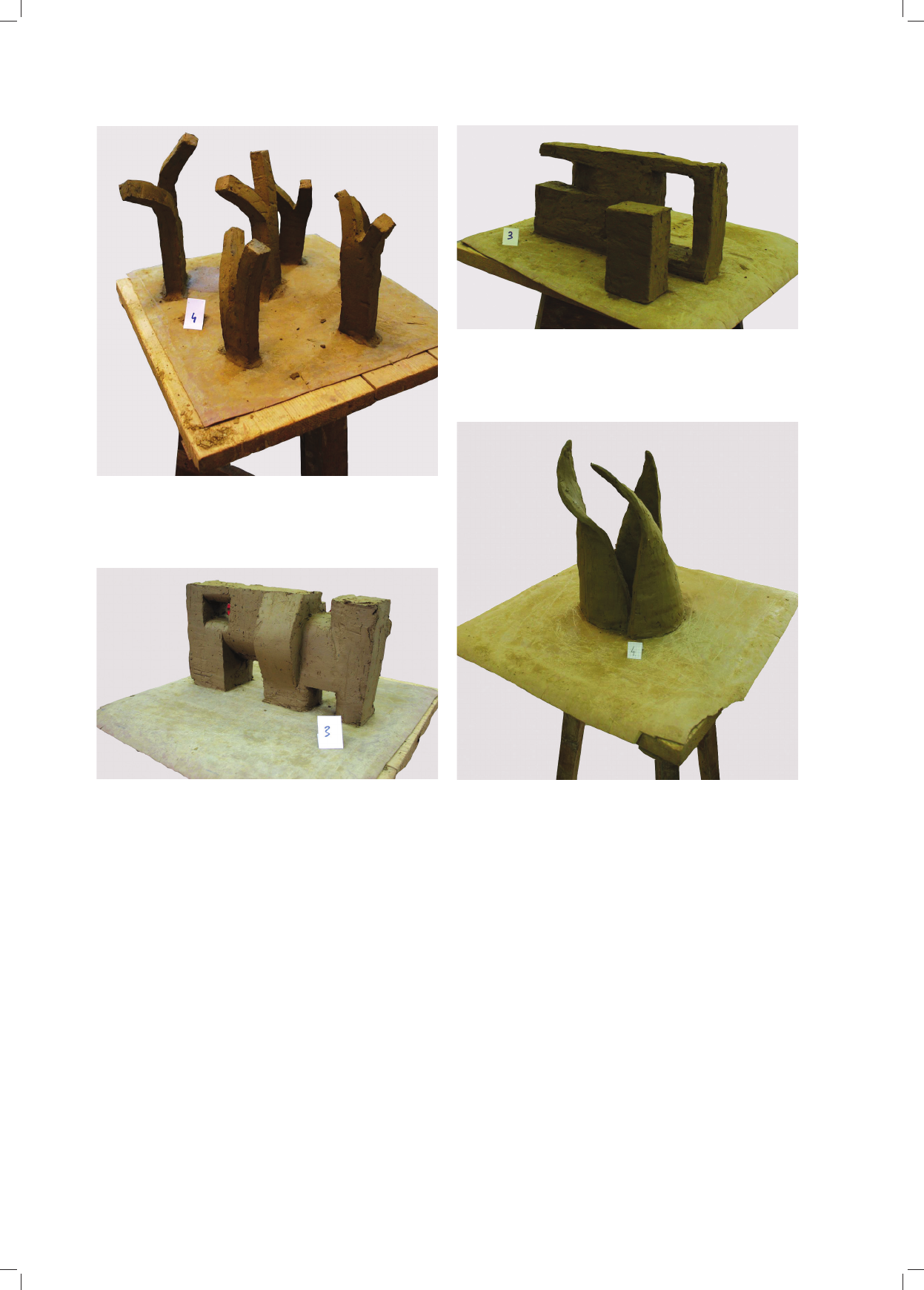
from the discussed meaning. This is illustrated by exam-
ples of student works (Figs 1–4).
5
Constantin Brâncuși (born in Pestisani Gorj in 1876, died in Paris
in 1957). A French sculptor of the Romanian origin. One of the most
remarkable creators of modern art [4, p. 84].
88 Hubert Bujak
bez uwzględnienia i przepracowania jego charakteru
i właściwości, nawet jeśli temat danej pracy odbiega swo-
ją główną treścią od omawianego znaczenia. Ilustrują to
przykłady prac studenckich (il. 1–4).
Są to realizacje w pełni wykorzystujące i ukazujące
cechy materiału, jakim jest glina, jej: miękkość, ciężar,
podatność na deformację i walory konstrukcyjne, a także
wpływ używanych narzędzi. Zdarza się również, że osta-
teczny efekt takiej pracy jest podporządkowany ujemnym
cechom danej materii, które przy odpowiednim potrakto-
waniu mogą stać się czynnikiem działającym pozytyw-
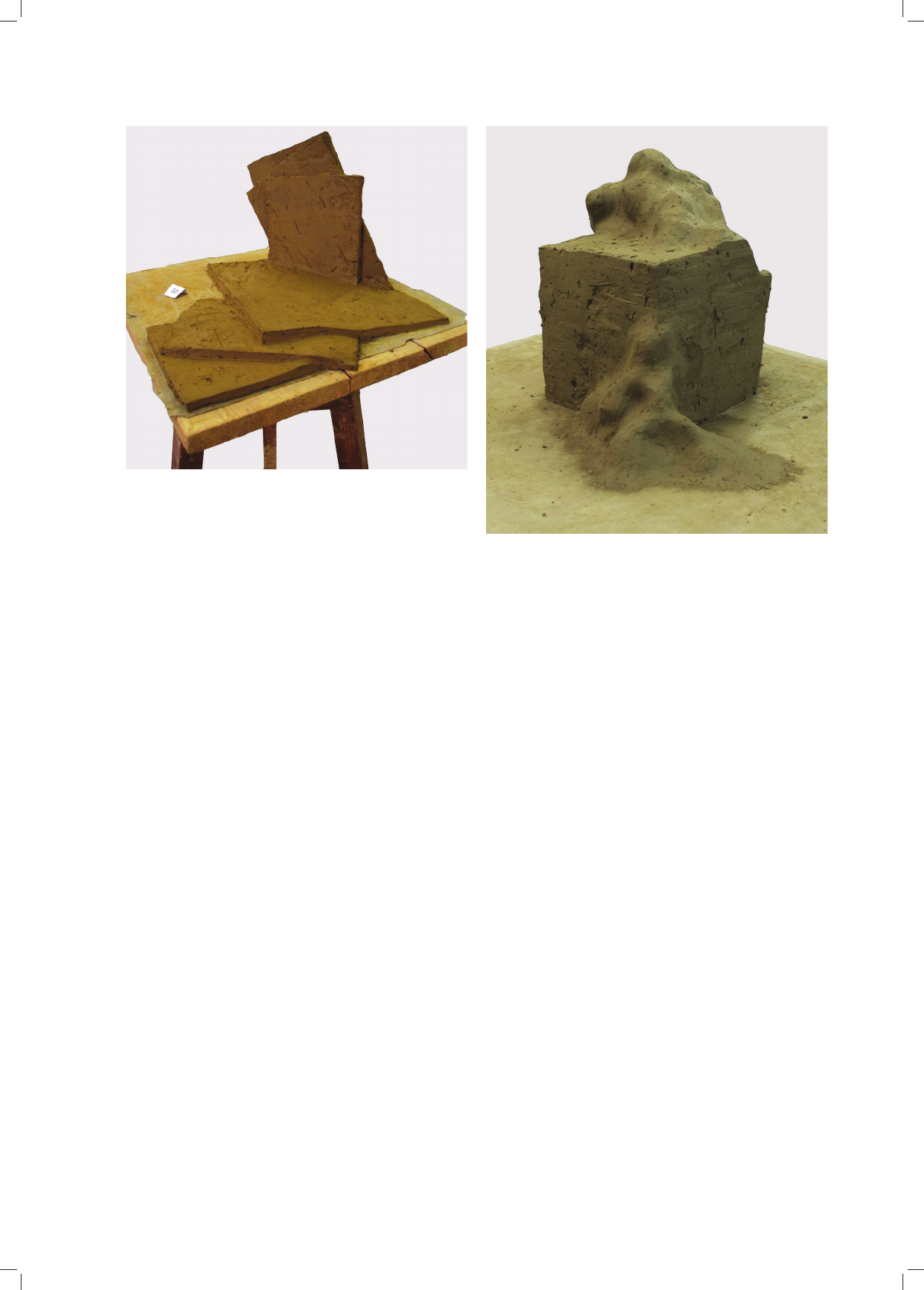
nie. Świadczy o tym przykład pracy Pion–poziom (il. 5),
w której miękkość gliny ukazana za pomocą lekko powy-
ginanych form geometrycznych buduje subtelną dynami-
kę kompozycji.
Kolejnym czynnikiem działającym odkrywczo w bez-
pośredniej pracy z określonym medium jest przypadek,
który pozwala niespodziewanie ujawnić właściwości
These are realizations that fully exploit and demon-
strate characteristics of the material which is clay, i.e. its
softness, weight, susceptibility to deformation and struc-
tural values as well as the inuence of the tools used. It
also happens that the nal effect of such a work is sub-
ordinated to negative features of a given matter, which
with appropriate treatment can become a factor acting in
a positive way. This is illustrated by the example of the
work Vertical and horizontal (Fig. 5), in which the soft-
ness of clay shown by slightly deformed geometric forms
creates subtle dynamics of the composition.
Another factor acting creatively in the direct work with
a particular medium is the case which makes it possible
to unexpectedly reveal the properties of a given matter.
The artist must be vigilant and should learn some kind of
openness to inspirations coming from the outside.
In this kind of search for the “truth of the material”,
it is also important to act in a destructive way to some
Il. 1. Natalia Czepułkowska, Rytm, glina, 2015 (fot. H. Bujak)
Fig. 1. Natalia Czepułkowska, The rythm, clay, 2015 (photo by H. Bujak)
Il. 2. Weronika Dams, Ażur, glina, 2017 (fot. H. Bujak)
Fig. 2. Weronika Dams, Openwork, clay, 2017 (photo by H. Bujak)
Il. 3. Jakub Gajda, Ażur, glina, 2016 (fot. H. Bujak)
Fig. 3. Jakub Gajda, Openwork, clay, 2016 (photo by H. Bujak)
Il. 4. Sylwia Haciuk, Trzy bryły, glina, 2017 (fot. H. Bujak)
Fig. 4. Sylwia Haciuk, The three solids, clay, 2017 (photo by H. Bujak)
Znaczenie medium w sztuce i architekturze /The importance of medium in art and architecture 89
danej materii. Twórca musi być czujny i powinien na-
uczyć się pewnego rodzaju otwartości na inspiracje pły-
nące z zewnątrz.
W takim poszukiwaniu „prawdy materiału” ważne jest
również działanie do pewnego stopnia destrukcyjne, mo-
gące być punktem wyjścia do budowania opartego na na-
turalnych właściwościach tworzywa, wykorzystującego
znajomość jego wewnętrznej struktury, wytrzymałości,
cech takich jak twardość, miękkość itd.
Posługując się najbardziej podstawowym i uniwer-
salnym tworzywem w rzeźbie, jakim jest glina, studenci
opracowują zadany temat, używając form geometrycz-
nych albo organicznych, dostosowanych do możliwości
konstrukcyjnych i wizualnych danego tworzywa. To zde-
rzenie wstępnego założenia czy ogólnej koncepcji z kon-
kretnym materiałem skłania siłą rzeczy do pewnych kom-
promisów i przekształceń formalnych, których rezultat
jest często zaskakujący dla samego autora i niejednokrot-
nie warunkuje ostateczne powodzenie (il. 6).
Realizacje według z góry zamierzonego planu czy we-
dług określonego projektu, który nie bierze pod uwagę
możliwości danego medium, są często nieudane i mają
charakter odtwórczy, co wskazuje na znaczenie bezpo-
średniej pracy projektowej w oparciu o dany materiał.
Istotnymi w procesie dydaktycznym związanym z pra-
cą twórczą okazują się wszelkie ograniczenia materia-
łowe, technologiczne, czasowe i tematyczne. Realizacja
na „zamówienie” może i zazwyczaj charakteryzuje się
większymi wartościami artystycznymi niż ta powsta-
ła bez żadnych zewnętrznych ograniczeń i wymogów.
Doświadczenie pokazuje, że inspiracja pojawia się tam,
gdzie indywidualność wyraża się w zetknięciu ze sztyw-
nymi regułami, a medium w postaci określonego materia-
łu jest jedną z takich barier. Zadane tematy rzeźbiarskie
extent, which can be a starting point for building based
on natural properties of the material and using the knowl-
edge of its internal structure, strength, and features such
as hardness or softness, etc.
Using the most fundamental and universal material in
sculpture, which is clay, students prepare a given topic us-
ing geometric or organic forms which are adapted to the
construction and visual possibilities of a given material.
This clash of the initial assumption or the general concept
with a specic material necessarily implies some compro-
mises and formal transformations, the outcome of which
is often surprising for the author himself and often deter-
mines the nal success (Fig. 6).
Realisations according to a pre-planned scheme or ac-
cording to a specic project that does not take into ac-
count possibilities of a given medium are often unsuc-
cessful and have a reproductive character, which indicates
the importance of the direct project work based on a given
material.
All material, technological, temporal and thematic lim-
itations turn out to be important in the didactic process
which is connected with creative work. The realization
that is made “to order” can and usually is characterised
by greater artistic values than the work which is created
without any external restrictions and requirements. Expe-
rience shows that inspiration appears where individual-
ity is expressed when facing rigid rules and the medium
in the form of a specic material is one of such barriers.
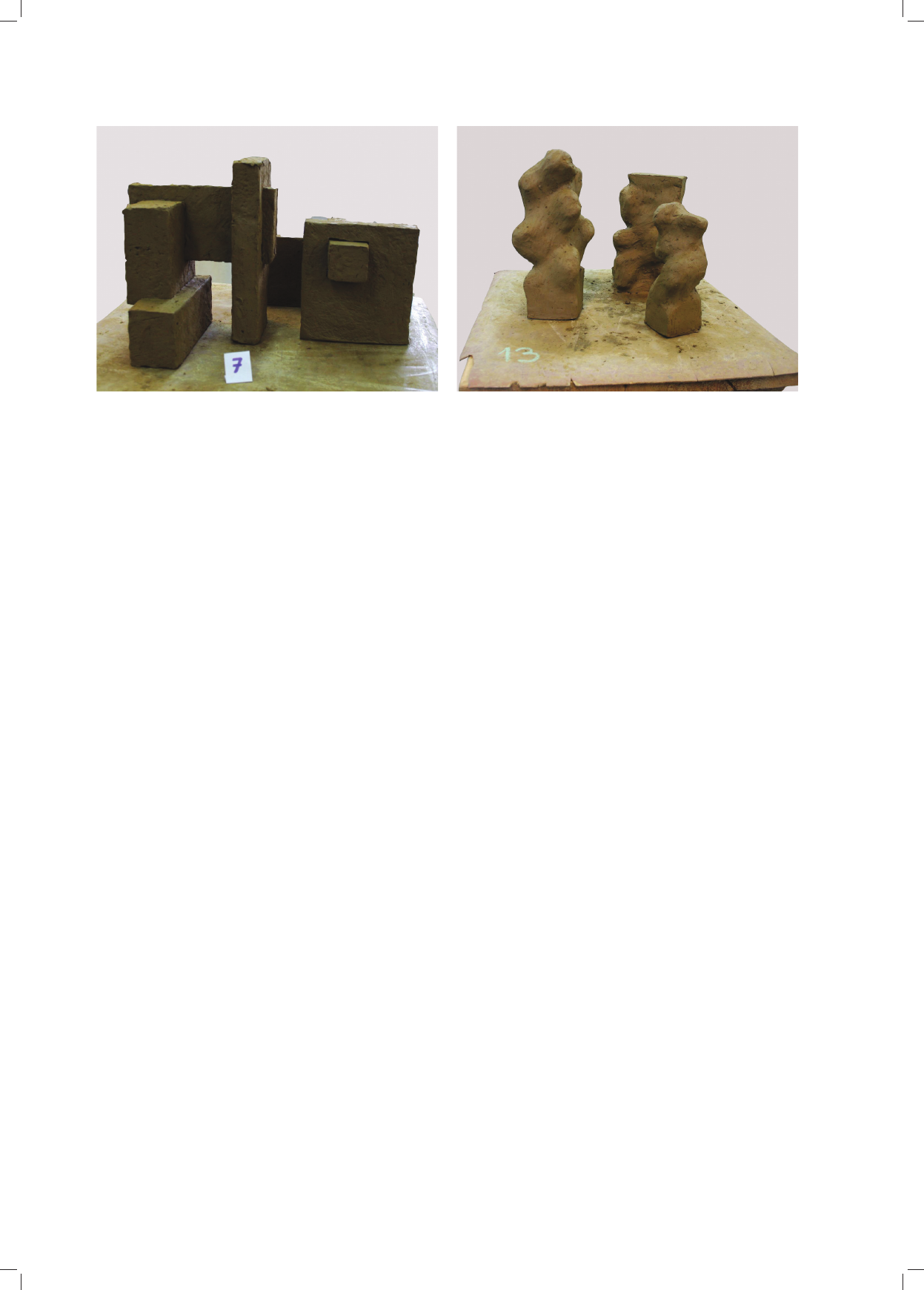
Sculpture topics to be performed such as Contrast, Open-
work, and Vertical and horizontal are a pretext for a com-
pletely autonomous expression, which often exceeds the
thematic requirements (Figs 7, 8).
Il. 5. Karolina Radna, Pion–poziom, glina, 2015
(fot. H. Bujak)
Fig. 5. Karolina Radna, Vertical and horizontal, clay, 2015
(photo by H. Bujak)
Il. 6. Joanna Paterska, Kontrast, glina, 2016 (fot. H. Bujak)
Fig. 6. Joanna Paterska, Contrast, clay, 2016 (photo by H. Bujak)
90 Hubert Bujak
takie jak np. Kontrast, Ażur, Pion–poziom są pretekstem
do wypowiedzi całkowicie autonomicznej, często prze-
kraczającej wymogi tematyczne (il. 7, 8).
Medium w procesie tworzenia
Praktycznie w każdym działaniu twórczym ściśle
związanym z tworzywem pojawia się wątek współdziała-
nia artysty i materii, odkrywania wewnętrznych struktur,
co wynika z procesu poznawania, czy nawet utożsamia-
nia się na pewnym poziomie twórcy z medium, z którym
pracuje. Materia zyczna podlega określonym prawom,
więc człowiek, który z nią pracuje, powinien te prawa
odkrywać i w jakimś stopniu im się poddawać. Nawią-
zuje to do poglądu, o którym pisał Władysław Tatarkie-
wicz w Dziejach sześciu pojęć, że dla starożytnych […]
artysta był odkrywcą, nie wynalazcą […]. To pojmowa-
nie sztuki opierało się na założeniu, że natura jest do-
skonała, więc człowiek w swoim działaniu powinien się
do niej upodobniać, a ponieważ ona podlega prawom, to
człowiek winien odkrywać jej prawa i im się poddawać
[8, s. 295].
Odkrywanie właściwości danej materii jest wstępem
do zainicjowania procesu twórczego. Dzieje się to na
wiele różnych sposobów, na przykład przywiązanie do
jednego materiału czy nawet hermetyczne zamknięcie
się na jednym tworzywie może prowadzić do naprawdę
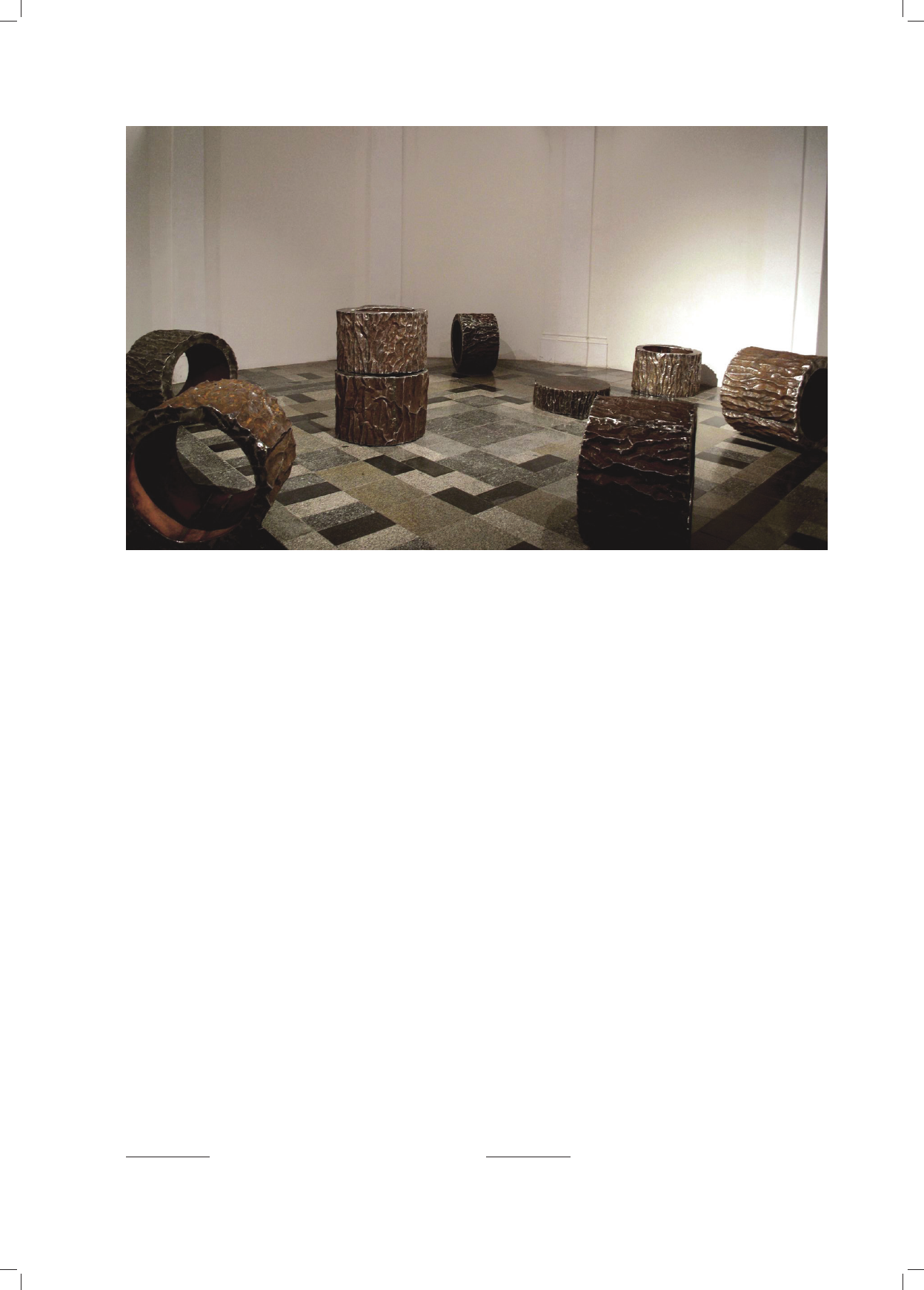
niecodziennych rozwiązań, jak w wypadku pracy Poszu-
kiwanie struktury (il. 9), gdzie w trakcie obróbki blacha
stalowa ujawniła podobieństwo do kory starego drzewa.
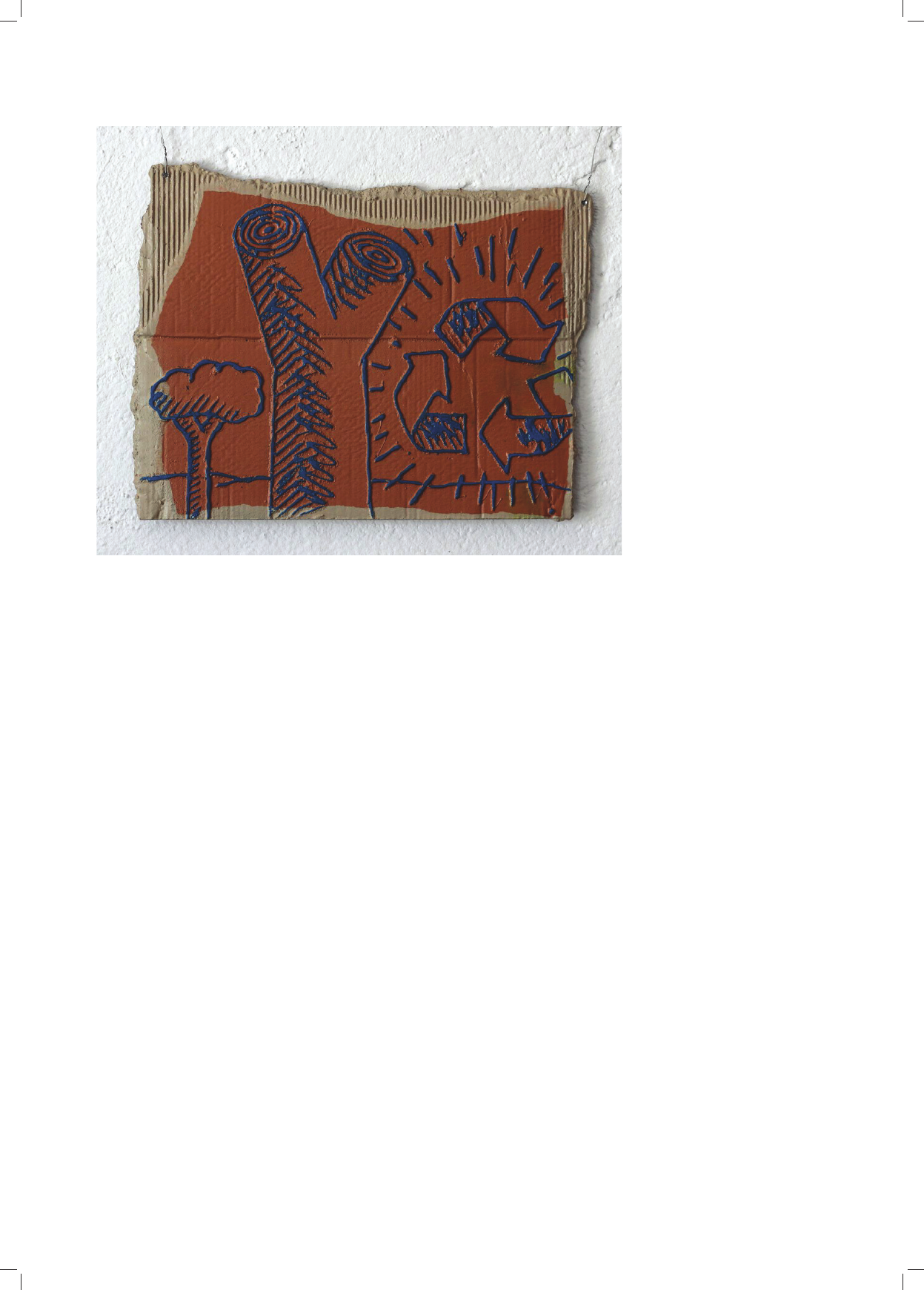
Jednocześnie próbowanie swoich sił w materiałach zu-
pełnie obcych nabiera często cech wyprawy w nieznane,
gdzie artysta musi zmobilizować całość swoich sił twór-
czych, aby przejąć nad materią kontrolę i wyrazić swoją
osobowość, jednocześnie nie ulegając jej zbytnio i nie
poddając się jej często negatywnemu artystycznie oddzia-
ływaniu (il. 10). Te dwie postawy są w sztuce bardzo wy-
raźne i ich połączenie w obrębie twórczości tego samego
artysty może dać naprawdę dobre rezultaty.
Medium in the process of creation
Practically, in every creative activity which is strictly
connected with the material there is an element of cooper-
ation between the artist and matter, the discovery of inter-
nal structures, which results from the process of learning
or even identifying on a certain level the artist with the
medium he works with. Physical matter is subject to spec-
ied laws, so a human being who works with it should
discover these laws and surrender to them to some extent.
This refers to the idea Władysław Tatarkiewicz wrote
about in Dzieje sześciu pojęć (Acts of Six Concepts), that
for the ancients [...] the artist was an explorer, not an in-
ventor [...]. This understanding of art was based on the
assumption that nature is perfect, so that man in his ac-
tions should become similar to it and because it is subject
to laws, it is man who should discover its rights and be
subject to them [8, p. 295].
Discovering the properties of a given matter constitutes
an introduction to the initiation of the creative process.
This happens in many different ways, for example, the at-
tachment to one material or even a hermetic closure on
one material can lead to truly unusual solutions, as in the
case of the work The searching for the structure (Fig. 9),
where during processing the steel sheet revealed similar-
ity to the bark of an old tree.
At the same time, trying one’s hand at completely new
materials frequently takes on the characteristics of a jour-
ney into the unknown, where the artist must mobilize all
of his creative forces to take control over matter and ex-
press his personality, concurrently without succumbing to
it too much and not giving in to its often artistically nega-
tive inuence (Fig. 10). These two attitudes are very clear
in art and their combination within the creative activity of
the same artist can give really good results.
In this kind of work, it is important to constantly re-
fresh one’s own attitude to it and to test creative forces at
the fundamental level, which in practice may result in the
discovery of new, unique forms and contents.
Il. 7. Katarzyna Nocoń, Pion–poziom, glina, 2015 (fot. H. Bujak)
Fig. 7. Katarzyna Nocoń, Vertical and horizontal, clay, 2015
(photo by H. Bujak)
Il. 8. Valeria Samsonik, Trzy bryły, glina, 2016 (fot. H. Bujak)
Fig. 8. Valeria Samsonik, The three solids, clay, 2016
(photo by H. Bujak)
Znaczenie medium w sztuce i architekturze /The importance of medium in art and architecture 91
Creative activity which is understood as an exponent
of universal truth or which seeks and presents the spirit of
time, something that cannot be fully dened, what is not
yet verbalized and consists only of “sections” showing
this reality “being formed”, must consist in the concept of
art reaching to the sources where the artist acts somehow
like a “medium”, a revealing spirit and in the way where
the appropriate and open attitude of the artist to the mate-
rial serves this concept of art.
Witold Gombrowicz wrote: But the fact is that the
artist does not think if thinking is understood as elabo-
ration of the chain of ideas. Thought arises in contact
with matter which he shapes as something auxiliary, as
a requirement of this precisely shaped matter, the require-
ment of a newly born shape: the task is to make the work
possible, to make it able to live [9, p. 31]. It is a thought
which is associated with the existential philosophy and
whose development on the basis of aesthetics was pre-
sented by Luigi Pareysón
6
in his concept of “formativ-
ity”. He wrote: Thus, matter must be necessarily physical
matter, which means that forming in art means forming
some matter. In the work the body identies with the
spirit, physicality and spirituality are the same thing. To
create a work of art means to do a physical, material ob-
ject, which results from the fact that there is no art that
would not be realized by adopting some physical matter
like sounds, colours, stones or the human body itself, as
6
Luigi Pareysón (born on February 4, 1918 in Piasco, died on Sep tem-
ber 18, 1991) – an Italian philosopher, a representative of herme neutics [10].
Istotne w takiej pracy jest ciągłe odświeżanie własnego
do niej stosunku i sprawdzian sił twórczych na podstawo-
wym poziomie, co w praktyce skutkować może odkrywa-
niem nowych, oryginalnych form i treści.
Twórczość pojmowana jako wyrazicielka prawd uni-
wersalnych czy poszukująca i ukazująca ducha czasu,
coś, czego nie da się do końca sprecyzować, co jeszcze
nie jest zwerbalizowane i składa się tylko z „wycinków”
ukazujących tę rzeczywistość „tworzącą się”, musi pole-
gać na koncepcji sztuki sięgającej do źródeł, gdzie artysta
działa poniekąd jak „medium”, duch ujawniający i gdzie
odpowiedni, otwarty stosunek artysty do tworzywa służy
takiej koncepcji sztuki.
Witold Gombrowicz pisał w Testamencie: Ale artysta
właściwie nie myśli, jeśli przez myślenie rozumiemy ela-
borację łańcucha pojęć. Myśl rodzi mu się w zetknięciu
z materią, którą kształtuje, jako coś pomocniczego, jako
wymóg tej właśnie kształtowanej materii, wymóg rodzą-
cego się kształtu: idzie o to, by dzieło udało się, zdolne
było do życia [9, s. 31]. Jest to myśl wiążąca się z lozo-
ą egzystencjalną, której rozwinięcie na gruncie estetyki
przedstawił Luigi Pareysón
6
w swojej koncepcji „forma-
tywności”. Pisał on: Materia zaś, to koniecznie materia
zyczna, co oznacza, że w sztuce formować znaczy for-
mować jakąś materię. W dziele ciało identykuje się z du-
chem, zyczność i duchowość są tym samym. Robić dzieło
sztuki, to znaczy robić zyczny, materialny przedmiot, co
6
Luigi Pareysón (ur. 4.02.1918 w Piasco, zm. 18.09.1991) – wło s ki
filozof, przedstawiciel hermeneutyki [10].
Il. 9. Hubert Bujak, Poszukiwanie struktury, stal repusowana, 2010 (fot. H. Bujak)
Fig. 9. Hubert Bujak, The searching for the structure, hammered steel, 2010 (photo by H. Bujak)
92 Hubert Bujak
zresztą wynika z faktu, że nie ma sztuki, która nie realizo-
wałaby się poprzez zaadoptowanie jakiejś materii zycz
nej, jak dźwięki, kolory, kamienie, czy samo ciało człowie-
ka, jak w mimice oraz tańcu [11, s. 20] i dalej: Artysta
studiuje i zgłębia materię po to, by poznawać jej zacho-
wanie i reakcje, interpretuje ją po to, by móc nad nią
panować i kształtować. Szuka w niej ukrytych, niespoty-
kanych wcześniej możliwości, które mógłby wykorzy
stać;
bada sposoby manipulowania nią, wyniesione z tradycji po
to, aby je przełamać i odnaleźć nowe i oryginalne, a w mo-
mencie gdy obciążenie materii przez tradycję jest zbyt duże,
to może jej nadać świeżą i prawdziwą wartość przez zanie-
chanie jakiegokolwiek badania i zgłębiania [11, s. 216].
Zakończenie
Nie ulega wątpliwości, że „warsztat”, biegłość i opa-
nowanie jakiejś techniki są podstawowymi czynnikami
artystycznego rozwoju, dzięki którym twórca uzysku-
je poczucie pewności siebie i może przekraczać granice
swoich możliwości technologicznych, artystycznych itd.
Niemniej znaczenie „warsztatu” jest istotne również wte-
dy, gdy jest on pozostawiony przez artystę niejako „na
boku”, gdy nie ingeruje bezwzględnie w proces twórczy
i gdy pozostawia miejsce dla eksperymentu, ryzyka i nie-
pewności powodzenia. Wydaje się, że najważniejszy jest
moment, w którym to, co powstaje, nabiera charakteru
odkrywczego i jest nowością dla swojego autora.
Istotne w tak pojętej idei twórczości jest właśnie od-
powiednie nastawienie do medium, z którym się pracu-
je. Artysta, któremu zależy na oryginalności, powinien
uwzględniać
wartości, jakie niesie ze sobą dane tworzywo,
i wykorzystać je tak, aby uzyskać maksimum wyrazu.
in facial expressions and dance [11, p. 20] and further:
The artist studies and explores matter in order to learn
about its behaviour and reactions, interprets it in order to
control and shape it; He looks for hidden, unprecedented
possibilities that he would be able to use; he explores the
ways of manipulating it, taken from tradition in order to
break it and nd new and unique, and when the burden
of matter by tradition is too large, he can give it a fresh
and true value by giving up any research and exploration
[11, p. 216].
Summary
There is no doubt that the style, prociency and mas-
tering of some techniques are the fundamental factors of
the artistic development, thanks to which the artist gains
a sense of self-condence and is able to exceed the limits
of his technological, artistic and other abilities. Neverthe-
less, the meaning of “style” is also important when it is
somehow “put away” by the artist and when it does not
interfere ruthlessly in the creative process as well as when
it leaves room for experiment, risk and uncertainty of suc-
cess. It seems that the most important moment is the one
in which something that is created acquires a revealing
character and becomes a novelty for its author.
The right attitude towards the medium the artist works
with is essential in the concept of creative activity under-
stood in this way. An artist who cares about uniqueness
should take into account the values of a given material
and use it in such a way so as to obtain the maximum
expression. Matter is a necessary factor in the creative
work also due to the fact that it allows the artist to break
away from certain images or superstitions and introduces
Il. 10. Hubert Bujak,
Recycling,
aluminium (odlew), 2016
(fot. H. Bujak)
Fig. 10. Hubert Bujak,
Recycling,
cast aluminium, 2016
(photo by H. Bujak)

Znaczenie medium w sztuce i architekturze /The importance of medium in art and architecture 93
Materia jest czynnikiem koniecznym w pracy twórczej
również z tego względu, że pozwala oderwać się arty-
ście od pewnych wyobrażeń czy przesądów i wprowadza
myśl oraz postrzeganie na nowe tory, mocniej związane
ze światem realnym, a mogące tym bardziej wyrażać oso-
biste treści autora.
Zajęcia z rzeźby, w których nacisk położony jest na za-
gadnienia związane z medium, stanowią również przy-
gotowanie do konfrontacji z wymogami projektowania
architektonicznego, gdzie oprócz czynników materiało-
wych należy uwzględnić i w sposób twórczy rozwiązać
wiele innych problemów.
Zrozumienie zasad i praw działających w procesie
tworzenia powinno odbywać się na drodze praktycznego
kontaktu z dziedzinami, w których to działanie przebiega
w sposób oczywisty i bezpośredni, tak jak w przypadku
rzeźby czy malarstwa. To z kolei powinno odbywać się
przy teoretycznej znajomości idei związanych z różnymi
poglądami na twórczość, między innymi takimi, które
wskazują na zagadnienia dotyczące medium.
Zajęcia takie jak rzeźba, malarstwo czy rysunek stwa-
rzają wyjątkowo dobrą okazję do poruszania na wielu
płaszczyznach problemów dotyczących formy oraz treści
dzieła, uniwersalnych w odniesieniu do wszystkich dzie-
dzin twórczości.
Wpływ medium na proces twórczy jest jednym z ele-
mentów wspólnych dla dziedzin sztuki jak rzeźba, archi-
tektura, malarstwo i inne. Zrozumienie tych zależności
i świadomość współistnienia różnych dziedzin są koniecz-
ne dla rozwoju każdego artysty czy projektanta. Przykład
szkoły Bauhausu jest w tym przypadku sztandarowy,
a założenia jego twórców nie straciły na aktualności.
Idee, których można się doszukać np. w rzeźbie albo
w malarstwie, mogą być z powodzeniem przeniesione
i wykorzystane w innej działalności twórczej: architek-
turze, literaturze, lozoi, muzyce i odwrotnie. Ta moż-
liwość jest wykorzystywana tym chętniej, że inspiracje
są nawet lepiej „przyswajalne” przez artystę, jeśli pocho-
dzą z innego obszaru niż własny. Należy również dodać,
że praktyczna umiejętność swobodnego poruszania się
i tworzenia w obszarach innych dziedzin artystycznych
gwarantuje rozwój i oryginalność twórcy.
the thought as well as perception onto new tracks which
are connected with the real world more strongly and
which can better express the author’s personal contents.
The classes in sculpture, during which an emphasis is
put on issues related to the medium, constitute also prepa-
ration for confrontation with the requirements of archi-
tectural design, where, apart from material factors, many
other problems should be taken into consideration and
creatively resolved.
Understanding the principles and laws acting in the
creation process should take place through practical con-
tact with the elds in which this action proceeds in an ob-
vious and direct way, as in the case of sculpture or paint-
ing. This, in turn, should take place along with theoretical
knowledge of ideas which are connected with different
views on creative activity, including those that point to
the issues concerning the medium.
Classes such as sculpture, painting and drawing cre-
ate an exceptionally good opportunity to discuss prob-
lems concerning the form and content of a work in many
spheres, which are universal in relation to all elds of
creative activity.
The inuence of medium on the creative process is
one of the common elements in the elds of art such as
sculpture, architecture, painting and others. Understand-
ing these relationships and the awareness of the coexist-
ence of various elds are necessary for the development
of any artist or designer. The Bauhaus school is a agship
example in this case and the assumptions of its founders
still have not become out-of-date.
Ideas that are found, for example, in sculpture or in
painting, can be successfully transferred and used in other
creative activities such as architecture, literature, philoso-
phy, music and vice versa. This possibility is used more
willingly because inspirations are even better “absorbed”
by artists if they come from an area that is different than
their own one. It should also be added that the practical
ability to move freely and create in other artistic areas
guarantees the development and uniqueness of an artist.
Translated by
Bogusław Setkowicz
Bibliografia /References
[1] Hohl R., Permanence and avantgarde, [w:] G. Duby, J.-L. Daval
(ed.), Sculpture, from antiquity to the present day, Taschen, Köln
2013, 949–972.
[2] https://pl.wikipedia.org/wiki/Pawieł_Fłorienski [accessed:
29.10.2017].
[3] Florenski P., Ikonostas i inne szkice, PAX, Warszawa 1997.
[4] Duruzoi G., Słownik sztuki XX wieku, Arkady, Warszawa 1998.
[5] Słownik wyrazów obcych, PWN, Warszawa 1980.
[6] Ingarden R., Wykłady i dyskusje z estetyki, PWN, Warszawa 1985.
[7] Weston R., 100 idei, które zmieniły architekturę, Top Mark Centre,
Londyn 2011.
[8] Tatarkiewicz W., Dzieje sześciu pojęć, PWN, Warszawa 2005.
[9] Gombrowicz W., Testament, Res Publica, Warszawa 1990.
[10]
https://pl.wikipedia.org/wiki/Luigi_Pareyson [accessed: 30.10.2017].
[11] Pareyson L., Estetyka. Teoria formatywności, Universitas, Kraków
2009.
Streszczenie
W artykule w sposób subiektywny i syntetyczny przedstawiono kilka kluczowych problemów związanych z pojęciem twórczości w odniesieniu
do medium rozumianego jako tworzywo oraz materia dzieła sztuki. Zawarto tu reeksje oraz wnioski zdobyte na styku działalności dydaktycznej
na Wydziale Architektury Politechniki Wrocławskiej z niezależną działalnością artystyczną na polu malarstwa oraz rzeźby. Podstawowym
założeniem i celem artykułu jest podkreślenie czynnika materialnego w twórczości oraz wykazanie w tym kontekście dużego znaczenia samej

94 Hubert Bujak
twórczości jako procesu mającego cechy uniwersalne dla działalności związanej z projektowaniem. W kontekście omawianych zjawisk zostały
przytoczone fragmenty myśli estetycznej, ukazano wybrane zjawiska z obszaru historii sztuki oraz konkretne przykłady prac własnych i studenckich
realizowanych na zajęciach z rzeźby na Wydziale Architektury PWr.
Słowa kluczowe: medium, tworzywo, twórczość, rzeźba
Abstract
The article in a subjective and at the same time synthetic way presents a point of view on several key problems related to the concept of creativity
in relation to the medium understood as a material and the matter of a work of art. It contains the reections and conclusions gained thanks to the
combination of didactic activity at the Faculty of Architecture Wrocław University of Science and Technology with the independent artistic activity
in the eld of painting and sculpture. The basic assumption and purpose of the article is to emphasize the material factor in the artistic work and
to demonstrate the great importance of the creativity as a process that has universal features for activities related to design. In the context of the
discussed problems, fragments of aesthetic thought, selected phenomena in the area of art history and specic examples of own works as well as
student works created during the sculpture classes at the Faculty of Architecture are quoted here.
Key words: medium, material, creativity, sculpture