
2010
Nr 2(28)
In contemporary Japanese culture, gardens are a form
of art which combines nature and human creation. The
Japanese garden presents nature formed with the human
hand. This way it is both an element of nature and archi-
tecture as well as art.
Contemporary art and architecture are dominated by
functionalism and simplicity where excessive decoration
and ornamentation are avoided. Similar trends appear in
gardens globally. A lot of old rules are questioned and in
many cases nature is rejected. Japanese designers also ex-
periment by creating inventive compositions but the basic
difference is that they still draw from their native tradition
of garden design.
The oldest tradition assumes that the garden repre-
sents nature which for centuries has been considered holy
in Japan. Such understanding of nature is connected with
indigenous Shinto religion which provides that each natu-
ral phenomenon is interpreted as a manifestation of dei-
ties. Japanese kami deities dwell in places which display
natural beauty such as mountains, trees, waterfalls, rocks.
They were the places of contact for man where people
could worship deities and pray to them for grace. These
natural sacred surroundings, enclosure and pebbles be-
came the origin of the garden.
In the 18th century, Zen Buddhism was brought to Ja-
pan from China and it exerted great impact on numerous
aspects of Japanese culture such tea drinking ceremony,
garden design, calligraphy, suibokuga painting, ceramics
or theater. This unique culture developed under the inu-
ence of Zen and it deeply penetrated into the aesthetic per-
ception of the Japanese who love simplicity, naturalness
and subtlety. The Japanese now also live in connection
with traditional culture which is highly signicant to life
and spirituality of these people.
Zen monks created contemplative ishidateso [1, p.
11] gardens which literary means “a priests who raises
stones”. These gardens were the answer to the simplicity
and austerity which are the attributes of a Zen monk life.
The austere atmosphere created by stone compositions
seems proper for ascetic places where Zen is practiced.
Through their simplicity and limited elements which
could distract the viewers, the gardens provoked medita-
tion and contemplation. They demonstrated a scarcity of
means of expression and at the same time philosophical
profundity. This simplicity was coupled with color mod-
eration and the use of natural colors and materials. With
the use of rocks and gravel as well as few slow-growth
evergreen shrubs, Zen monks created dry landscape gar-
dens, karesansui. By reducing nature to its most basic
level, removing from it everything that could be removed
and restoring it to its most fundamental dimension, they
displayed its essence. These almost unchanging gardens
seem to be frozen in time. Zen monks rejected passing
phenomena and worthless appearances. Thus the gardens
which they created present universe in its most condensed
form. Rocks which do not change are such an imperish-
able element – at least in the scale of human life. Rocks
in Japanese gardens play a very important role which is
unheard of in the West. The Japanese believe that stones,
like plants and animals, have spiritual life. Single rocks
can be the main element of the Japanese garden and es-
pecially colors, texture and shape of each of them provide
the whole landscape with specic qualities.
The inuence of Zen is visible not only in the selec-
tion of materials but also in the composition of karesansui
gardens. It is very important to compose free space with
space occupied by rocks and shrubs. In traditional Japa-
nese painting, an unoccupied space, which in the Western
culture has negative connotations and is considered emp-
tiness, constitutes the basic part of the composition and its
artistic signicance is great. It is an artist’s task not to say
everything and some room is left for the viewer’s imagi-
nation to interpret the rest. The most important message
should be suggested, delicately signaled and in no case
should it be communicated directly. Emptiness expresses
perfection, the absolute, true substance of all things and it
is the essence of the teachings of Zen. Similarly, in kare-
Małgorzata Wołodźko*
Garden architecture in contemporary Japanese culture
*
Wyższa Szkoła Zarządzaniem Środowiska w Tucholi.
234 Małgorzata Wołodźko
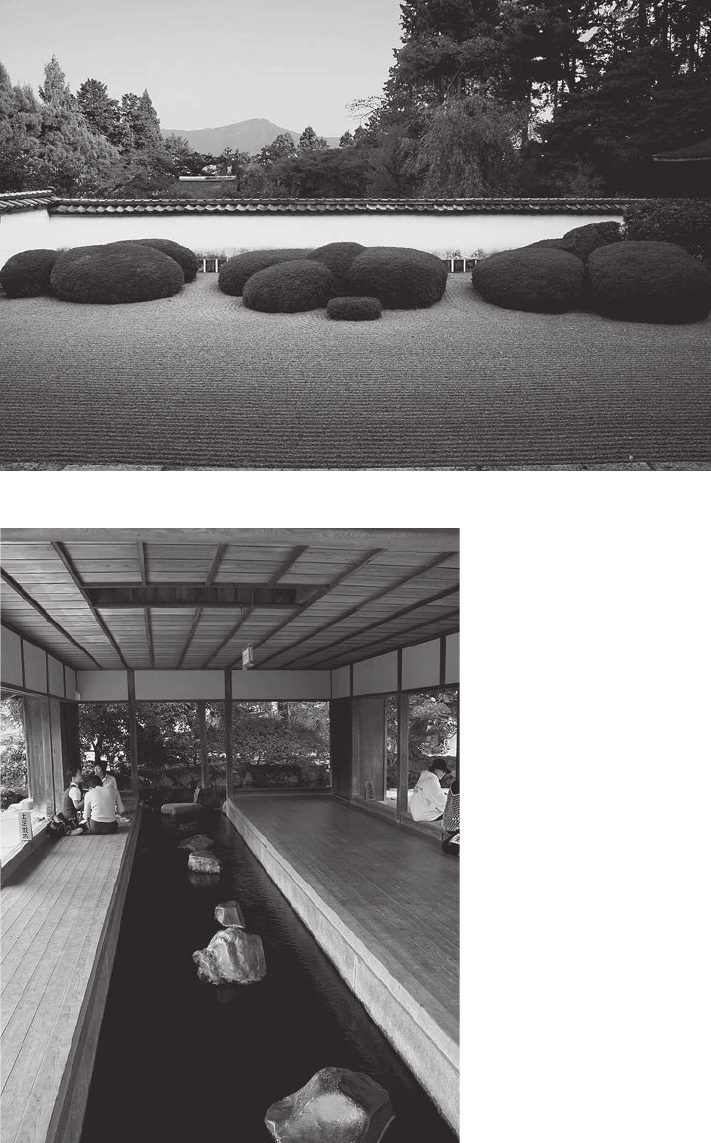
sansui gardens there are large spaces of light gravel and
trees and rocks contrast with that light space which sur-
rounds them. These gardens were not meant to be used
for strolls; they were meant only to be looked at from the
building as a landscape (Fig. 1).
Harmony achieved by asymmetry is another charac-
teristic feature of the Japanese garden, originating from
observation of nature. The Japanese aesthetics deliberate-
ly and consistently rejects symmetry, building harmony of
the whole on asymmetric location of the rocks in the gar-
den. Rocks and trees can be used individually but usually
they are arranged asymmetrically in groups of 3, 5 or 7.
The principles of breaking symmetry in order to achieve
harmony with nature were applied not only in the ar-
rangement of rocks but they also govern the relations be-
tween the groups and their relations to the pathway or the
building. The natural harmony, as seen in nature, is also
achieved by arranging different, often opposite, elements
of form and color in the garden. Contrasting arrangement
of shrubs, ferns, clumps of grass and moss brings out the
beauty of the rocks and constitute an element combining
the rocks with the surroundings.
The contemporary gardens, created under the inu-
ence of Zen, are also designed to express simplicity and
nature in its purest form without plants or water. Like
sculptures, karesansui gardens can be seen as abstract
and three-dimensional monochromatic landscapes. With
different modications, what always applies is the prin-
ciple of great moderation and simplicity in selecting ele-
ments and well as in their arrangement, resulting in very
sophisticated garden designs. The rocks which are used
very often in the contemporary Japanese gardens have
new shapes and they are specially cut; sometimes they are
replaced with irregular “blocks” made of glass imitating
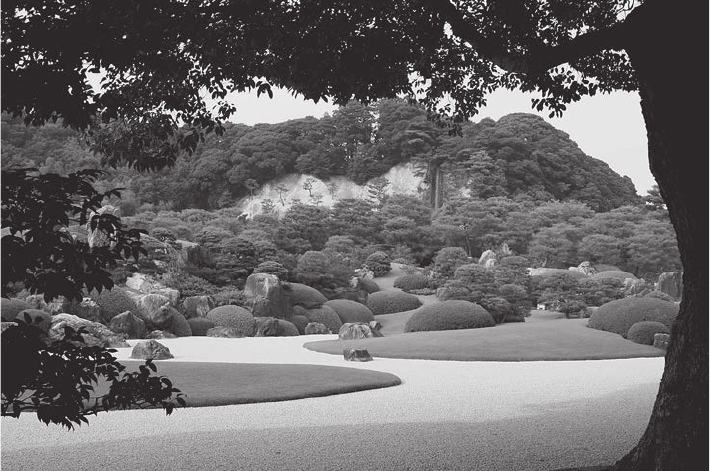
rocks; sometimes, combined with water, they create space
integrating the interior of the house with its surroundings
(Fig. 2).
Other well developed garden design techniques in-
clude beauty spots and compositions inuencing the per-
ception of the garden by the viewer. Such effects can be
achieved by directing the viewers’ eyes, revealing parts
and not the whole view or by revealing the same view
from different places. The partial blocking of the viewing
eld provides some room for imagination and enables the
control of the view. The fragmentary and episodic nature
Fig. 1. In this karesansui garden,
the stones are replaced
with clipped azaleas and camellia
shrubs. There are three groups
with three, ve, and seven plants.
The shakkei technique
of a borrowed distant view is
of Mt. Hiei
Fig. 2. In the traditional karesansui garden, water is represented
in a symbolic way by gravel. In this garden, stones standing
in the shallow water integrate the garden with the building
Garden architecture in contemporary Japanese culture 235
as well as the lack of unity in art is connected with delib-
erate rejection of symmetry as well as a predilection for
naturalness. These qualities are expressed in gardens by
focusing on a single element as well as in their simplic-
ity and limiting the number of the elements of the garden
to the necessary ones. This has its origin in Zen philoso-
phy which is deeply rooted in Japan, based primarily on
intuitive acquisition of knowledge and perception of the
world as well as avoiding logic and minimizing the role of
intellect in artistic creation. According to this philosophy
universe is not constructed logically, and a fragment is as
important as the whole, which is in line with a Buddhist
saying “ichi soku issai soku ichi” meaning “the one is
none other than the many, and the many is none other than
the one” [4]. In a traditional Japanese home, the sliding
shōji doors or straw sudare screens or blinds which are
used as curtains carve out some outside space – garden or
scenery – and compose a graphic view resembling a paint-
ing seen from inside of the house. The view of the garden
is blocked with the use of groups of plants and bamboo
fences. Under no circumstances should the garden space
be directly revealed. Adequate vegetation can make the
garden look bigger than it really is, which is especially
convenient in small gardens. Planting trees by a pond with
swooping branches which provide glimpses of the view
behind them or a plum tree branch in the foreground be-
hind which there is a whole landscape and the space is just
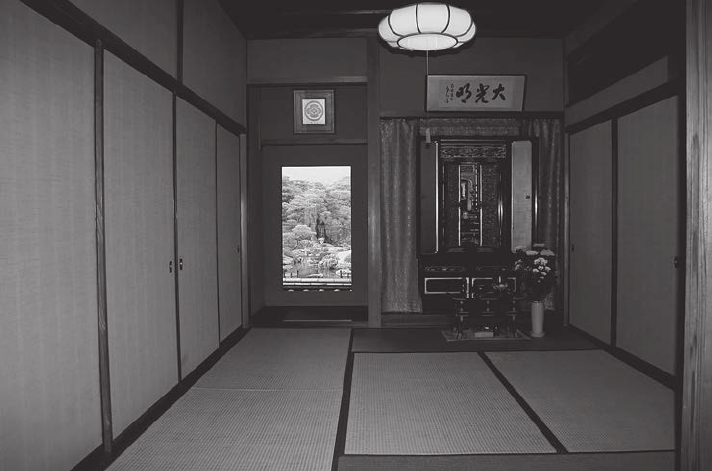
suggested and make is look bigger. Similarly, the details
are only delicately signaled instead and the viewers can
let their imagination run free and image more (Fig. 3).
Tea ceremony is another element that shaped the Japa-
nese patterns. The aesthetics developed on the basis of
tea ceremony exerted great inuence on garden art, ar-
chitecture and interior decoration of tea pavilions, the art
of ower arrangement, applied utensils, costumes and the
behavior of the participants. Since there is a close con-
nection between the symbolism of tea and Zen philoso-
phy, the metaphor of emptiness plays an important role
in tea ceremony. According to the esoteric Zen mysticism
emptiness is the essence of things and that is why in tea
ceremony what is not there it is more important than what
is in it. The same criteria apply to the pavilion where what
is important is empty space is limited by the roof and the
walls and not the roof and the walls themselves.
The brewing and drinking tea has become a religious
ritual still in China, however, in Japan it extended its di-
mension to include the totally secular domain in order to
ultimately develop the aesthetic patterns which still are
visible today in many aesthetic and spatial solutions as
well as in applied materials. Tea ceremony fully devel-
oped in the 16th century when Sen no Rikyū was the tea
master; he is considered precursor of formal rules of tea
drinking and strict regulations for each activity, includ-
ing the kind of tea bowls used and ower arrangement
as well as the tea house interior decoration. The rules of
tea ceremony developed by him have been applied with
slight changes until today. The characteristic features of
that style included primarily the following: moderation,
rejection of splendor and ostentation as well as elimina-
tion of everything that can district attention and cause un-
rest of the spirit. Rikyū wanted to create surroundings that
would demonstrate the frailty and the eeting character
of the surrounding world. He wanted to wake the world
of soul by applying simplicity. The elements of his phi-
losophy, especially those regarding the development of
the “framework” for a broader context of the surround-
ings, still can be seen in the contemporary development
of urban space.
The style of tea pavilions was reected also in the ar-
chitectural mainstream. Architecture is the expression of
the typical Japanese way of perception of space as being
continuous, exible, horizontal and combining the ele-
ments of the world of nature and man. For the Japanese
space, which is in the West perceived as emptiness lim-
ited only by walls and roof, is considered real beauty of
the room and a valuable element of composition. The real
Fig. 3. The tree trunk
and branches in the foreground
catch a glimpse of the distant
view. Space in the garden thus
appears to be bigger than it
really is. When garden borders
are not visible, focusing on
a part enables the viewer
to imagine the whole
236 Małgorzata Wołodźko
beauty can be shown in artistic work by simplicity and
delicate suggestion of color, form or texture. The charac-
teristic features of traditional homes include almost empty
interior, simplicity, harmoniousness and beauty of few de-
tails. The mind and ingeniousness of the viewer should
complement the image which is visible only for a short
moment. The external emptiness is internally rich. Empti-
ness – which is erroneously identied with nothingness
– is a treasure chest full of innite possibilities. This idea
is the “essence” of the Japanese home and garden. The
most important thing is the space designed with basis ele-
ments – it is the “pure” function. Contemporary buildings
and gardens are designed in Japan according to the above
assumptions and their value is demonstrated not in their
rich ornaments but in the sophisticated details made of
traditional materials or in compliance with the traditional
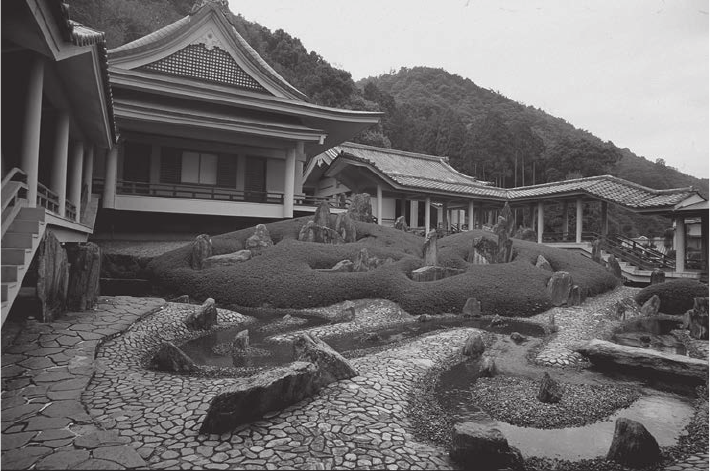
spatial form (Fig. 4).
The traditional Japanese home is integrated with its
garden which, regardless of its size, is important, inte-
gral part of the home. In the Japanese home with simple
structure, almost all walls, both external and internal, are
sliding and they can be temporarily disassembled, which
makes the home look totally integrated with nature. After
sliding the walls to the sides the whole view of the garden
appears; one of the garden’s sides adjoins the building and
the other ones are is enclosed by a wall constituting the
frame of the design. As a result the home’s interior and
the garden, which is outside, are spatially connected with
each other to provide integral whole. Looking outside
from such a home’s interior, the wooden poles of the light
timber structure are the frame, which with the trees, stone
lanterns, mossy rocks and the mountains glimmering in
the distance, create a great picture that looks as if it was
painted by an unparalleled artist.
The contemporary architectural solutions of this type
that involve combining space used by the residents with
garden are typical primarily of residential buildings or
generally accessible public spaces. The problem is high-
density housing and no private space. Nowadays, when
the living spaces are very limited, apart from shōji doors
which help to integrate the home with its garden, vegeta-
tion is introduced inside the home. The sense of presence
of nature inside the home is achieved e.g. by a growing
tree which changes during its growth. In the spring buds
appear; in the summer leave provide a lot of shade and
when the fall comes they turn red. The tree was planted in
such a place so that it could be seen from the places which
are used most often at home in a small rectangular area
enclosed by the walls. Sliding the walls open provides the
view and light and it makes the division between interior
and exterior indistinct and provides a sense of freedom
and open space.
One of the most effective techniques is shakkei –
a technique of “borrowed scenery” where a fragment of
a distant landscape is incorporated into the garden com-
position. Frequently, the garden design makes use of the
natural surroundings e.g. a forest or hills which provide
a sense of additional space and prospects. These solutions
are also applied in contemporary designs such as Matsuo
Taisha in Kyoto. The central element of the composition
in the garden – large hill with clipped azaleas – repro-
duces the shape of Mt. Matsuo, behind the temple. At the
same time the shape of the hill resembles a tortoise which
in Japan is the symbol of a long life. Rock arrangements,
located all over the garden, strongly contrast with nicely
clipped karikomi shrubs on the hill. The repetition of the
shape of the mountain and the use of karikomi as a back-
drop for a meandering stream makes this garden unique
and special (Fig. 5).
The contemporary Japanese designers create a new
kind of scenery. In an inventive way, they design space
by combining, in accordance with their taste, elements se-
lected from nature. They face new issues connected with
contemporary life and specic conditions of urban life.
Even if in their designs they use new materials in a totally
new way, they still draw inspiration most often from the
Fig. 4. In the traditional
Japanese room there may be
a tokonoma alcove with
a ower arrangement
and/or hanging scroll painting.
In this room, the scroll
is imaginatively replaced
with an actual view, a cropped
fragment of the garden
Garden architecture in contemporary Japanese culture 237
rich Japanese repertoire of traditional techniques. As a re-
sult the gardens are still close to their roots.
Experimenting with new materials and a new way of
their arrangement provides new perspectives in the design
of Japanese gardens. One of them is the use of cut stones
– a radical departure from the old tradition of application
of stones which can only be found in nature; sharp edges
and chisel marks on the stones reveal a different kind of
beauty. Another, is the application in the garden of gravel
of a different color and a plane raked to produce innova-
tive patterns. The contemporary designers also found an
application for glass, iron, stainless steel, tiles and even
carbon ber, stimulating imagination of the viewers so
that they could create their own image of the garden.
Inhabitants of the city who suffer from stress connect-
ed with work and lack of space can easily lose their iden-
tity and strong connection with nature. In its ideal form,
the contemporary Japanese garden should be a spiritual
place designed in line with the sophisticated aesthetics
which evokes and celebrates nature as space that includes
nature helps to relieve stress and soothe the mind. In order
to achieve this, various techniques are applied, including
rock Zen gardens or focus on one element (e.g. a tree) and
less restricted forms of arrangement of plants – still they
all draw from thousands of years of tradition. This kind
of expression, involving a combination of traditional and
contemporary solutions, sets new directions in the design
of Japanese gardens.
Fig. 5. The shape of Mt. Matsuo
behind the shrine is „borrowed”
into the garden by a reproduced
hill with clipped karikomi shrubs.
The banks of the meandering
stream are covered with at,
bluish rocks and its shallow
bottom is covered
with small pebbles
References
[1] Freman M., Rico Nosé M., Masuno S., The Modern Japanese Garden,
Toppan Printing Company Limited, 2002.
[2] Kubiak Ho-Chi B., Estetyka i sztuka japońska. Wybrane zagadnienia,
Universitas, Kraków 2009.
[3] Suzuki D., Zen i kultura japońska, Wydawnictwo Uniwersytetu
Jagiellońskiego, 2009.
[4] Wołodźko M., Ogrody w Kioto – studium historyczne, rozprawa
doktorska, materiały własne, niepublikowane, Wydział Architektury
Politechniki Warszawskiej, 2009.
Architektura ogrodów w kulturze współczesnej Japonii
W kulturze współczesnej Japonii nie można pominąć ogrodów jako
formy sztuki, w której natura i dzieło ludzkich rąk łączą się ze sobą.
Artystyczna wartość „japońskich ogrodów” jest powszechnie uznawana
na całym świecie i miała znaczący wpływ na rozwój współczesnych
ogrodów na Zachodzie.
Sztuka tworzenia i idee japońskich ogrodów przekazywane są
z pokolenia na pokolenie, chociaż przez pewien czas uważane były za
mało nowoczesne i starano się je zastąpić wzorcami zachodniej kultu-
ry masowej. Pomimo to nadal kultywuje się tradycyjne umiejętności
tworzenia ogrodów i traktowanie krajobrazu jako wnętrza użytkowego.
Wielu czołowych projektantów coraz częściej eksperymentuje z zasto-
sowanymi materiałami, formą i stylem projektowanych przez siebie
ogrodów. Zmianie ulega wygląd współczesnej przestrzeni miejskiej.
Pojawiają się rozwiązania wykorzystujące tradycyjne elementy kultury
i sztuki, wkomponowane w nowoczesne, niekiedy wręcz futurystyczne
rozwiązania architektoniczne.
Key words: Japan, garden architecture Słowa kluczowe: Japonia, architektura ogrodów