
2025
4(84)
Aleksander Piwek*, Michał Kwasek**
History of the crypt in the Eastern wing
of the post-Cistercian monastery in Krzeszów
DOI: 10.37190/arc250401
Published in open access. CC BY NC ND license
Abstract
The article presents the results of architectural research concerning the identied underground spaces of the Krzeszów monastic complex.
The subject of the research is the crypt located in the northern part of the eastern wing of the former Cistercian monastic complex, which has not
yet been suciently explored. The developed crypt in the eastern wing of the monastery holds the greatest signicance for understanding the histo-
ry of the monastery’s construction. Based on the traces found in the crypt, several stages and phases were identied, spanning from the 14
th
to the
21
st
century. The rst of these refers to the time when a medieval chapter house and sacristy were constructed at the ground level of the crypt. During
the construction of the new church, the eastern part of the crypt, which has been preserved, was built with a circular staircase (around 1730). Over
the next few years, structural, functional, and communication changes were introduced in these underground spaces. The last of these (around 1738)
involved the creation of the western part of the current crypt and its connection to the transept crypt. The construction of this additional space was
necessary to integrate it with the neighboring interiors, creating a unied complex accessible from the outside.
Keywords: Cistercians, monastery, crypt, architectural survey, Krzeszów
Introduction
The monastery in Krzeszów, erected during the Middle
Ages and subsequently modied in the Baroque style, con-
stitutes a noteworthy component of the extant monastic com-
plex. This phenomenon can be attributed to the architectural
design of the church, which comprises both above-ground
structures and subterranean crypts. A recent programme of
architectural research, undertaken in the aforementioned
spaces, has been expanded to encompass the crypts situated
beneath the transept of the church. This initiative has yield-
ed a comprehensive overview of the construction phases of
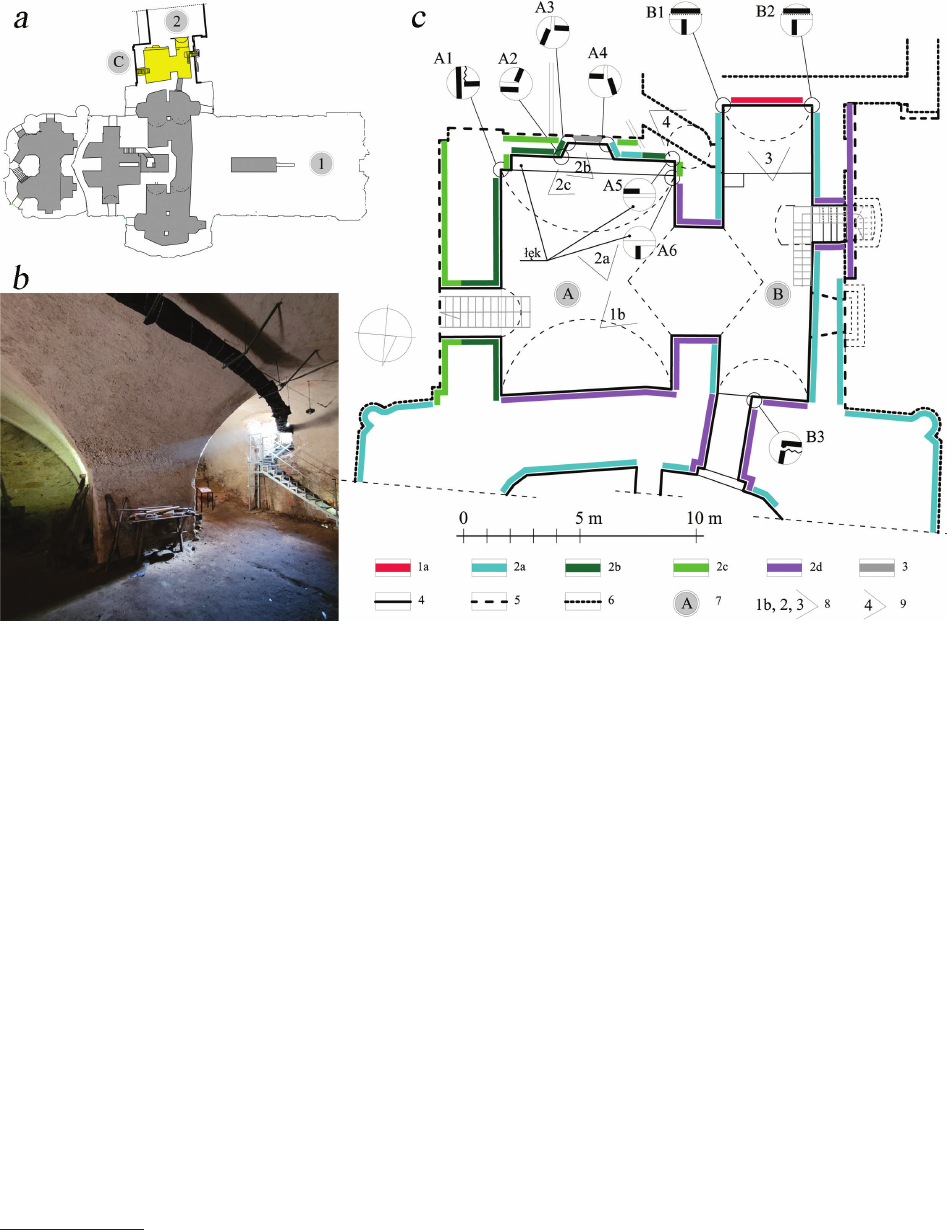
these crypts. In the crypt of the eastern wing (Fig. 1a, b), in
contrast to any other interior in Krzeszów, numerous trans-
formations from the Middle Ages to the 21
st
century were
identied. The site is situated beneath the present sacristy
and the adjacent corridor on the western side. The traces
found there relate only to a minor extent to the medieval
period, but they proved to be important for identifying the
stages and phases of construction in this place. The prepon
-
derance of the information obtained was from the Baroque
period, during which a signicant number of previously un-
known transformations took place. This phenomenon was
not only related to changes within the monastery itself, but
above all to the construction of a new, imposing monastery
church.
Current state of research
The majority of studies written on the Krzeszów Ab-
bey focus on the history of the construction of the monas-
tery church, including its exterior and interior decorative
elements. The crypt of the eastern wing of the monastery
is a subject on which there is very little literature, given
that it was inaccessible for a considerable length of time.
The layout of the crypt was published in 1984 in connec-
* ORCID:
0000-0001-9487-5091. Wydział Architektury Politech-
niki Gdańskiej (Faculty of Architecture, Gdańsk University of Technolo-
gy), e-mail: aleksander.piwek@pg.edu.pl
** ORCID:
0000-0002-3485-7219. Wydział Architektury Politech-
niki Gdańskiej (Faculty of Architecture, Gdańsk University of Techno lo-
gy), e-mail: michal.kwasek@pg.edu.pl
4 Aleksander Piwek, Michał Kwasek
tion with the inventory of the entire
1
church
2
. Prior to the
designation of the site as a visitor attraction in 2018 and
the initiation of the research project entitled “The Abbey
in Krzeszów. Architecture and natural and landscape con-
text” (2023)
3
, the architecture of the site was not a subject
that could be investigated. The study of all the research
results, published two years later, included an article con-
taining preliminary ndings on the history of the crypt (Pi-
wek, Kwasek, Dembicki in print). The results of the study
demonstrated the presence of functional connections, pre-
dominantly in relation to the subterranean transept of the
church. Furthermore, the study yielded insights into the
temporal framework of the construction, and the decorative
1
The marked stages of construction do not include changes in the
interiors of individual walls. In order to present the sequence of con-
struction steps in wall openings and window openings, the markings
refer only to the actions taken.
2
The inventory was conducted by a team comprising S. Wojdon,
A. Żydkowski, E. Ratajczak and J. Michalak. The documentation is
stored in the collections of the eld branch of the National Heritage In-
stitute in Wrocław, dating from 1984.
3
It was organized by the Faculty of Architecture of the Wrocław
University of Technology under the supervision of Prof. Ewa Łużyniecka.
elements employed during the architectural development.
It was determined that the crypt beneath the monastery is
not homogeneous. The easternmost part of the structure,
located beneath the sacristy, is believed to date back to ap-
proximately 1730, while the western part, connected to the
former by a wide passage, is estimated to have been con-
structed around 1738. A more detailed analysis of the crypt
revealed further information about the history of its con-
struction. It was not possible to provide full conrmation
of this information during the excavations. Consequently,
some of the data presented is still pending conrmation
through further research.
The historical context of the crypt is enriched by the in-
formation provided regarding the monastery (Dziurla 1974,
17–21, 29–38; Kutzner 1997, 138–139; Łużyniecka 1998,
110–111, 113–116, 118–120, 128–129; Łużyniecka 2002,
161). Its history encompasses several signicant develop-
ments, including those that occurred in the Middle Ages
(partially preserved), the Baroque period (during which the
sacristy was constructed, and the east wing underwent sub-
stantial reconstruction, along with the addition of the south
wing and the space between it and the east wing), and the
19
th
century (the demolition of the eastern wing) (Dziurla
Fig. 1. Monastery crypt: a) location (1 – church with crypts, 2 – fragment of the eastern wing of the monastery, c – crypt under investigation – yellow),
b) interior view towards the south-west, c) chronological stratification with marked nodes and photographed locations.
Markings: 1a – 1
st
half of the 14
th
century, 2a–2d – approx. 1730–approx. 1738, 3 – 19
th
–21
st
century,
4 – visible course of basement walls, 5 – invisible course of walls below ground level, 6 – ground floor walls, 7 – parts of cellars,
8 – photographs at cellar level, 9 – photograph at ground floor level, A1–A6, B1–B3 – research nodes
1
(own work)
Il. 1. Krypta klasztorna: a) lokalizacja (1 – kościół z kryptami, 2 – fragment wschodniego skrzydła klasztoru, c – badana krypta – kolor żółty),
b) widok wnętrza w kierunku południowo-zachodnim, c) rozwarstwienie chronologiczne z zaznaczeniem węzłów i miejsc fotografowanych.
Oznaczenia: 1a – 1. poł. XIV w., 2a–2d – ok. 1730–ok. 1738, 3 – XIX–XXI w., 4 – widoczny przebieg ścian piwnic,
5 – niewidoczny przebieg ścian poniżej poziomu terenu, 6 – ściany parteru, 7 – części piwnic, 8 – fotografie na poziomie piwnic,
9 – fotografia na poziomie parteru, A1–A6, B1–B3 –węzły badawcze (oprac. własne)

History of the crypt in the Eastern wing of the post-Cistercian monastery in Krzeszów 5
1962). With regard to the eastern wing of the monastery, it
has been established that the part connected with the sacristy
was constructed in conjunction with the extant church, while
the rest of it, including the medieval interior, was rebuilt and
extended between 1662 and 1666 (Dziurla 1962, 15, 73).
The present article draws upon the ndings of architec-
tural research conducted at the turn of the 20
th
and 21
st
cen-
turies, which have proved to be of great utility. The probable
layout of the medieval monastery was described by Ewa
Łużyniecka (1995, 143–149). In 2011, the same author pre-
sented a hypothetical division of the monastery into individ-
ual interiors (2011, 450). Furthermore, she interpreted the
ndings in the eastern wing, on its western façade and inside
the former refectory, as well as changes in the architecture.
In addition, she identied several medieval interiors, includ-
ing a vestibule, a rectangular staircase, a fraterni ty room,
and what appeared to be fragments of a chapter house. In
a subsequent publication, in cooperation with Mo ni ka Dąb -
kow ska (
Łużyniecka, Dąbkowska 2018, 344, 351), she dis-
tin guished several stages in the construction of the eastern
wing (in order from the north): the sacristy with a cor
ridor
– circa 1730, rooms with a refectory – 14
th
century to the 4
th
quarter of the 18
th
century, and the southern part of
the for-
mer wing (connecting to the southern wing). This publica-
tion also comprises descriptions of conservation work that
was carried out in the cloister buildings in the aftermath of
World War II. The work carried out in the monastery be-
tween 1969 and 1984 was previously presented by Woj -
ciech Kapałczyński (Kapałczyński 1997, 369–370).
Two engravings from the iconographic material relating
to, among other things, the eastern wing of the monastery
(and thus partly to the crypt) proved to be signicant. The
rst illustration is a depiction of the abbey as drawn by Mi-
chael L. Willmann in 1678. This illustration employs an ax-
onometric projection technique to showcase the state of the
abbey following its initial Baroque modications. Adjacent
to the three-story wing, cloisters remain visible, extending
to the south nave of the church. The second engraving is
a plan for the reconstruction of the monastery by J.G. Feller
from around 1770. The current sacristy, situated next to the
transept, features a circular staircase on its south wall. The
corridor adjacent to the sacristy does not have a cloister on
the west side, as observed in other buildings of the cloister.
Research findings
Methodology
The research was conducted using qualitative methods.
A comprehensive architectural inventory of the subterranean
environment was conducted, and a thorough analysis of the
relevant sources was undertaken. Excavations were conduct-
ed wherever feasible, yielding signicant insights into the
structural alterations that had ocurred within the crypt.
Results of research on the monastery crypt
In the interests of clarity and concision, the description
of the crypt has been distilled to encompass the elements
that proved most instrumental in deciphering the history of
its construction
4
. These have been combined with an ex-
planation of its original purpose, determined on the basis
of visual inspection and architectural research. The results
obtained, which were conrmed through excavations, were
marked on the plan with the addition of a symbol (Fig. 1c:
A1–6, B1–3).
The vaulted monastery crypt, which comprises four lu-
nettes, is divided into two sections: the eastern part A, which
is larger, and the western part B, which is smaller. These
spaces are connected by a wide passageway, and the smaller
one is additionally connected to the crypt under the transept.
The usable level is dened as hardened ground, located at
a depth of 4.36 metres below ground level at the western en-
trance to the crypt
5
. The southern walls of both sections of
the crypt provide the most substantial body of information.
Part A of the crypt
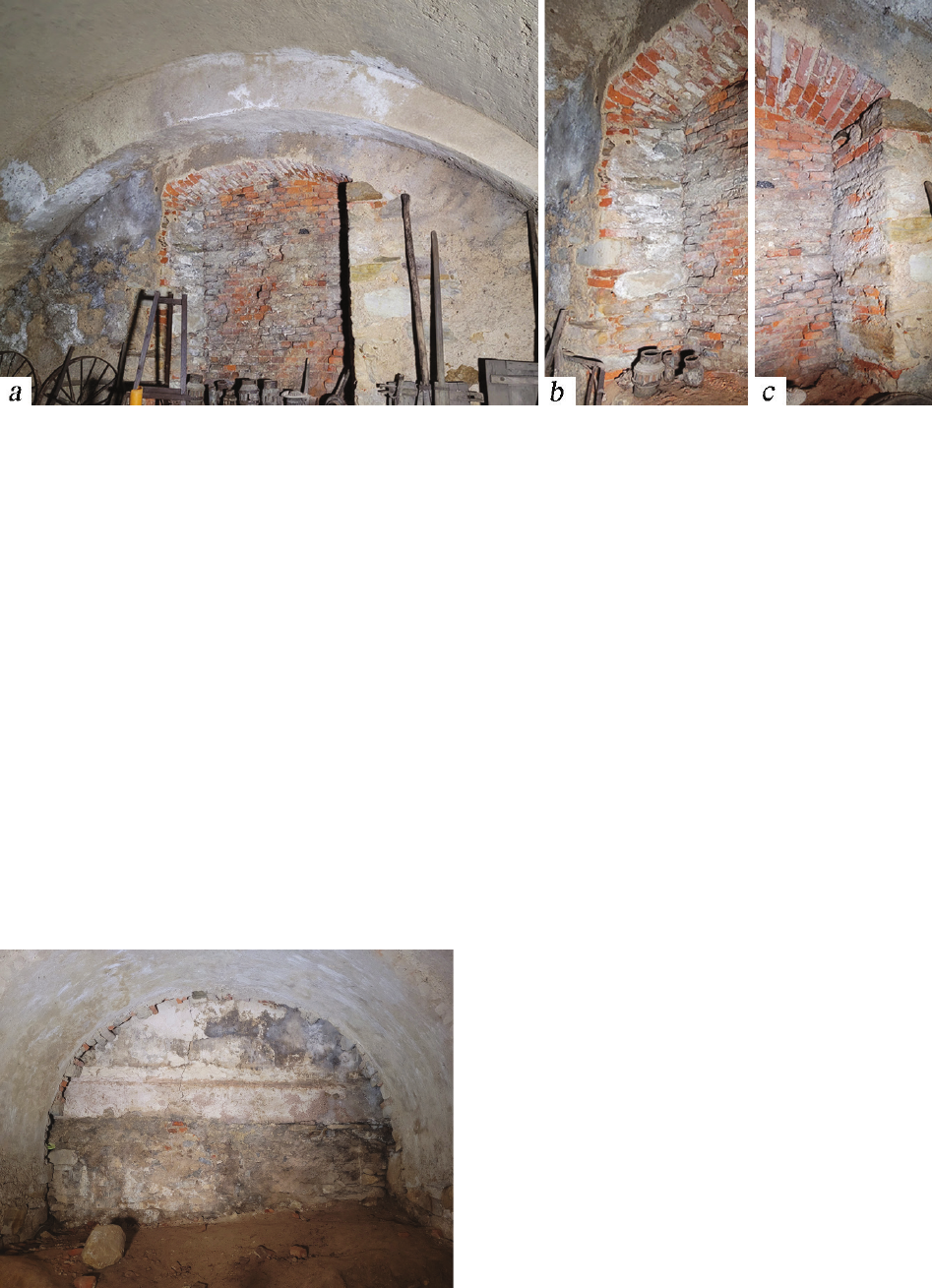
he stone and brick south wall in part A of the crypt fea-
tures a recess in the middle (Figs. 1c, 2a), the rear wall of
which is composed of bricks measuring 14.5–15.0 × 6.3 cm.
The height of 10 layers of bricks (and joints) laid with
their headers is 80.5 cm. The side walls are inscribed with
a glyph, and the upper structure comprises a segmental arch
that is integrated into the wall, resulting in the visibility of
only one side (the wall arch). Since the background of the
recess is not connected to its side walls (Fig. 1c: A3, A4), it
can be hypothesised that it should be considered as a brick-
ing up of a previously existing wide passage. Two distinct
categories of material can be identied in the eastern wall of
the recess: a layer of bricks (with a width of approximately
15–20 cm) and rows of stones situated behind it (see Fig-
ure 2b). This phenomenon can be attributed to the construc-
tion of the wall in two distinct phases. The stone segment
can be regarded as a remnant of an earlier stage, while the
brick element represents a subsequent addition. The western
wall of the recess contains worked stone blocks, indicating
the remains of an older, narrower passage (Fig. 2c).
Adjacent to the wall under examination is another arch,
measuring approximately 60 cm in width and 65 cm in depth.
However, its course is not parallel to that of the wall arch,
a discrepancy that is probably attributable to the dierent
times of their construction. This arch is undoubtedly later
than the wall arch. The subject begins approximately 40 cm
in front of the eastern wall and is aligned ush with the op-
posing wall. As demonstrated in Figure 1c: A1, the junction
between the eastern wall of the crypt and the protruding arch
is of particular interest. Analysis indicates that this junction
is likely secondary to the visible face of the wall. This hy-
pothesis can be substantiated by the almost vertical attach-
ment of the arch to the eastern wall, which results in a width
of only approximately 40 cm at ground level. Conversely,
the alignment of the arch with the western wall suggests that
4
The contemporary condition of the northern crypt has been de-
lineated in exhaustive detail in the Monograa Zespoł Krzeszowickiego
(in print), consequently, a proportion of the data has been excluded from
this article.
5
Within the article, the reference level (±0.00) was adopted for all
levels described.
6 Aleksander Piwek, Michał Kwasek
part B of the crypt, where an excavation could be (Fig. 1c:
B3). In the eastern wall, metal steps constructed in the 21
st
century have been inserted into a slanted opening, there-
by providing access to ground level. From the interior of
the crypt, the upper parts of its walls have preserved faces,
while the rest show traces of chiseling. Furthermore, the
bottom surface of the opening contains irregularly shaped
faults resembling steps. The structure is surmounted by a lu-
nette, which is a fragment of the barrel vault of part A of the
crypt. The ndings suggest that there was a high window in
this location, which was subsequently deepened to its cur-
rent form, thereby allowing access from the crypt. External-
ly, the opening still retains the form of a historic window
with stonework, similar to the nearby windows illuminating
the transept crypt.
Part B of the crypt
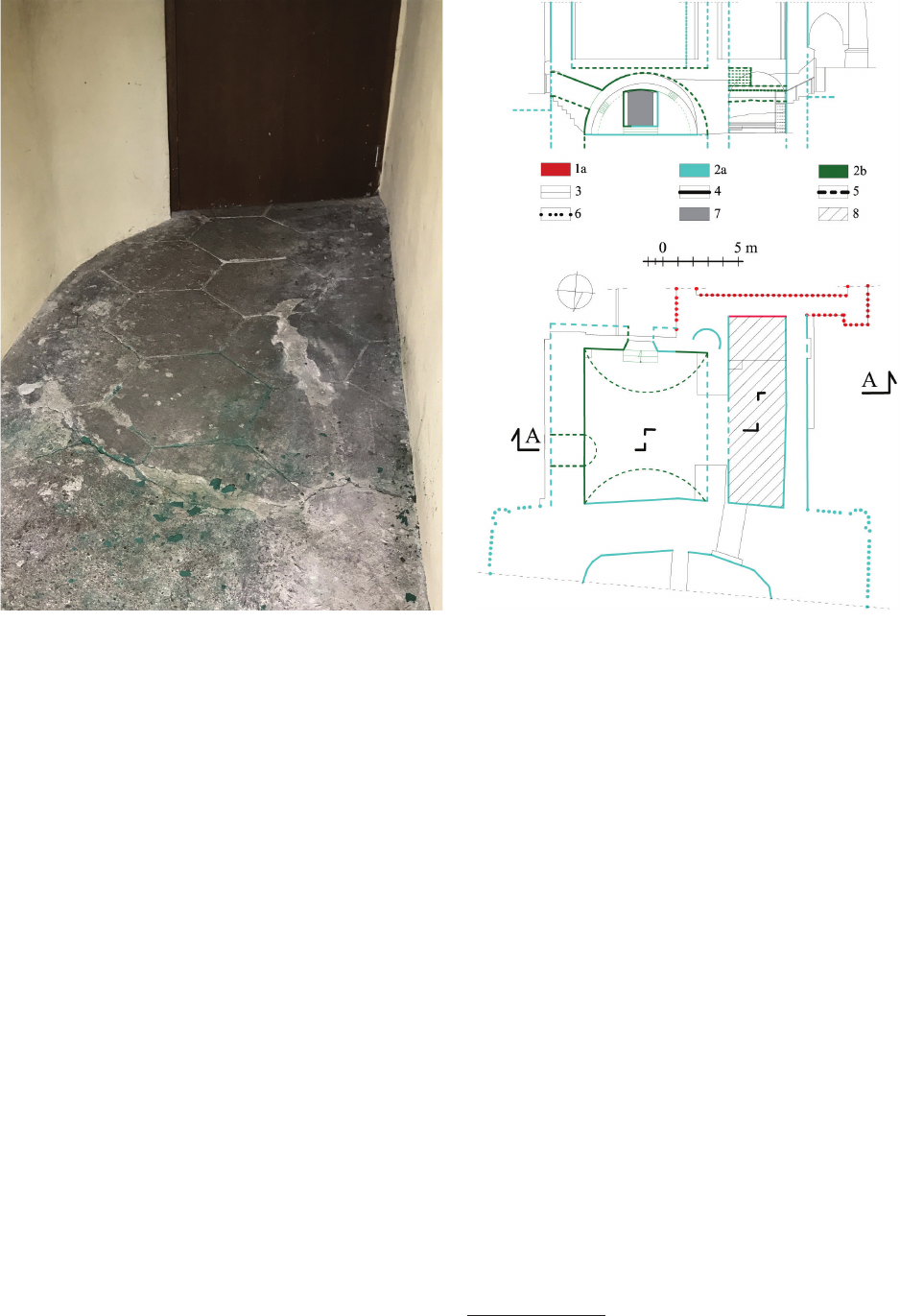
The upper half of the south wall surface consists of white -
washed lime plaster, while the lower half (built of stones and
a few bricks) consists of roughcast with fragments of plas-
ter (Fig. 3). This distinction can be attributed to the dier-
ing purposes of the two types of use. The lower part of the
structure was originally part of the wall foundation, and was
later incorporated into the usable interior of the basement.
In contrast, the upper part was part of the wall that formed
the usable
ground oor room from the beginning, extending
northwards (towards the church). The plaster in the upper
part exhibits several layers of whitewash, suggesting that
the interior, which has not been preserved, was in use for
a considerable duration. Furthermore, three levels are still
visible on their surfaces – traces of previously laid oors.
The lowest of these (–1.97 m), corresponding to the incep-
tion of the eastern wing’s construction, traverses approxi-
mately halfway up the observable portion of the wall, the
second is situated approximately 50 cm above it, and the
it is embedded within it (Fig. 1c: A5, A6). The aforemen-
tioned statement suggests that the western wall is composed
of two layers; the younger part is situated on the interior side
of part A of the crypt. The thickening of the wall was a result
of the repair of the vault and the reconstruction of the above-
ground part of the monastery wing.
The surfaces of the remaining walls do not demonstrate
any indications of reconstruction. The northern wall, as in-
dicated by its course, repeats the form given to the southern
wall of the transept of the present church. Consequently, it
can be deduced that the structure in discussion could only
have been erected subsequent to the construction of the
church. It is reasonable to hypothesise that the thickness of
the structure is slightly thickened just like the north wall in
Fig. 2. South wall of part A of the crypt with two arches (wall and added) and a bricked-up exit to the monastery grounds, 2023:
a) general view, b) eastern glyph, c) western glyph (photo by A. Piwek)
Il. 2. Ściana południowa części A krypty z dwoma łękami (ściennym i dostawionym) oraz zamurowanym wyjściem na teren przyklasztorny, 2023:
a) widok ogólny, b) glif wschodni, c) glif zachodni (fot. A. Piwek)
Fig. 3. South wall of part B of the crypt containing plasterwork
from the medieval period and three different floor levels, 2023
(photo by A. Piwek)
Il. 3. Ściana południowa części B krypty zawierająca tynki z okresu
średniowiecza oraz trzy różne poziomy posadzek, 2023 (fot. A. Piwek)
History of the crypt in the Eastern wing of the post-Cistercian monastery in Krzeszów 7
third (marked with a pencil) is positioned around 70 cm.
An examination of the 290-centimetre segment of the wall
revealed that the ground along this section slopes at a con-
siderable angle. The structure’s perimeter is delineated by
a transverse wall measuring 46 cm in height, constructed
from ve layers of bricks with dimensions 29,0–29,3–29,5
× 15,0 × 7,0 cm, laid alternately in a row of headers and
a row of strethers. Between the wall and the eastern wall
of the room, there is a masonry structure measuring 88 cm
in width, 58 cm in depth, and 18.5 cm in height (consid-
ered a step). This structure consists of four layers of similar
bricks, with the second and fourth layers (counting from the
top) being half the height of the other layers. The ground
level is much more leveled from the low wall with the step.
It is evident that the low partition serves to protect the south
wall and its foundations from losing stability. Such con-
cerns must have arisen because, with the deepening of the
northern part adjacent to the wall (the nal phase of chang-
es made during the Baroque period), previously invisible
parts (medieval foundations) were exposed. It was therefore
imperative to expose only the minimum of the building
structure when creating the underground passages under
the corridor, even at the cost of excluding part of the newly
built basement from current use. Moreover, the construction
of the wall impeded the ground from slipping into the area
designated for the newly created passageway between the
crypts. The construction of the wall (and the steps) is related
to the construction of part B of the crypt.
In the western wall of this part of the crypt, there is
a passage leading to the current ground level. Access to
the premises is facilitated by a metal stairs, which were in-
stalled in the 21
st
century. A ight of stairs and a landing,
leveled to the bottom edge of the opening (–2.37 m), are
attached to the inner wall. Furthermore, the stairs traverse
the thickness of the wall, with multiple steps extending be-
yond its exterior, into a stone well. Historically, the open-
ing functioned as a window, providing illumination to the
interior of the crypt. From the outside, its edge was encir-
cled by stonework, akin to other windows in the monastery.
In order to facilitate access to the interior of the crypt, the
opening in the wall was slightly enlarged by chiseling due
to the 21
st
-century purpose of the former window. In the
eastern part of the north wall, a passage to the transept crypt
is located. In its western frame, an excavation (Fig. 1c: B3)
revealed two types of material: the top layer, approx. 15–
20 cm thick, made of bricks measuring 14.5–15.0 × 6.0 cm
(the height of 10 layers of bricks with mortar is 71.5 cm),
and a row of stones located behind it. It should be assumed
that the rst mentioned was created later – after the passage
was carved out.
Interpretations
The construction traces found in the examined crypt al-
low for the determination of the stages and phases of its
creation, as well as the purpose of the changes made. In the
context of the monastery’s history and the evolution of the
church, these elements can be traced back to the period in
which the work was undertaken. Due to the fact that the in-
terior walls were covered in cement during the construction
phase, not all of the results obtained from the excavations
could be conrmed. Consequently, some of the results are
awaiting verication in further research. In consideration of
the extant ndings pertaining to the northern part of the east
wing, it can be concluded that its construction was executed
in multiple stages.
Stage 1
The rst stage pertains to the spaces outside the current
crypt (Fig. 4). To the north of the southern wall of part B of
the crypt, there was a room enclosed by the continuations
of the extant longitudinal walls of the eastern wing of the
monastery. According to Willmann’s drawing from around
1678, depicting a Gothic Cistercian church with the rst Ba-
roque modications, the southern part of the transept may
have been situated in a location analogous to that occupied
by a comparable part constructed during the Baroque period.
It is reasonable to hypothesise that a sacristy was located ad-
jacent to the transept, in which case its southern wall would
also have formed the boundary of the interior, which has
not been preserved. The aforementioned conditions, in con-
junction with the sequence of functions in the eastern wing,
suggest the possibility that the interiors above the examined
crypt may have served as a sacristy and a chapter house.
The rst interior remains unidentied. Some details have
already been established regarding the second one. The low-
est oor level identied, at –1.97 m, is likely to be associat-
ed with it (Figs. 3, 4), suggesting that its initial construction
may have commenced at approximately 2/3 of the current
crypt’s height. The chapter house on the south side ended
at the location of the current south wall of section B of the
crypt. A cloister adjoined its west wall.
The date of construction of these parts of the monastery
remains uncertain. It probably dates back to the rst half of
the 14
th
century. The construction of the eastern wing was
to be completed in 1454 (Łużyniecka 2002, 161). As evi-
denced by the preserved traces, the oor level of the chapter
house was raised twice (stage 1, phases b and c). The rst
time this happened was around 1427, immediately after the
devastation of the monastery and church by the Hussites
(1420–1426), thereby enabling the interior to be utilised
provisionally. The second alteration must have occurred
prior to 1454, when repairs to all the damage caused earlier
were completed in the monastery (Kutzner 1997, 134) and
the nal adjustments could be made.
Stage 2
This stage is distinguished by a series of reconstructions
of the crypt. The period under discussion may be divided
into four phases, spanning from approximately 1730 to ap -
proximately 1738. They refer to the reconstruction of the mo -
nastery, which was also substantially inuenced by chang-
es
made within the church. The rst transformations of the
crypt of the eastern wing are associated with the construction
of the church, or at very least its transept.
The rst phase (2a–c. 1730) entailed the demolition of
the northern segment of the east wing, thereby creating ad-
ditional space for the construction of the Baroque transept

8 Aleksander Piwek, Michał Kwasek
of the church, whose form diered signicantly from the
medieval layout
6
. Between the newly constructed transept
and the preserved part of the east wing, only two interiors
were planned on the ground oor. While maintaining pro-
portionality with the width of the sacristy and the passage-
way, they were displaced in an eastward direction (Fig. 4).
The rst of these was constrained by a newly constructed
section of the south wall. The construction of a subterranean
level beneath the sacristy was planned. The structure was
overhung by a ceiling, and it was hypothesised that it was
illuminated from the east by a single window. Access to the
crypt was provided by a narrow passage in the south wall
and a round staircase built into the south-west corner, which
also functioned as a connection to the individual oors of
the monastery. The dimensions and positioning of the cor-
ner pass-through are known, inter among other things, from
the monastery plan drawn by J.G. Feller circa 1770. The
location has been specically identied on the basis of pre-
served traces in the oor of the corridor on the ground oor
(connecting the interior of the eastern wing with the pavil-
ion added from the east) and is visible in the distortion of
its wall (Figs. 1c, 5). A space that was both inaccessible and
6
The northern part of the cloister was demolished, with its function
being transferred to the corridor without a basement, which was being
constructed at that time.
partially lled was created between the western wall of the
basement and the foundations of the corridor wall.
The second phase (2b) involved the introduction of fur-
ther signicant changes (Fig. 6). These were a consequence
of the construction of a new Baroque church. The com-
mencement of construction work on the church necessitated
the temporary closure of the presbytery crypt. The function
of the crypt was temporarily assumed by the basement un-
der the sacristy (now part A of the crypt). The interior was
adapted by widening the existing entrance towards the east.
The resultant cavities in the wall face were lled with bricks
on this side. The construction work on the wide passageway
may have instilled apprehensions regarding structural integ-
rity. In order to circumvent this issue, a substantial arch was
constructed within the designated wall, with the central por-
tion subsequently becoming the element closing the wide
passageway from above (Figs. 2, 5 ). The construction works
entailed the removal of access to the circular staircase in the
basement. One of the benecial outcomes – unless it was
another reason for the bricking up – was the separation of
the residential and burial functions. The interior was vaulted
with a longitudinal barrel vault, and illuminated by a small
window in the eastern wall. The brick covering thickened
the existing eastern wall. This was also used to reinforce
it, which, as subsequent modications demonstrated, was
not the nal construction measure of this nature, presum-
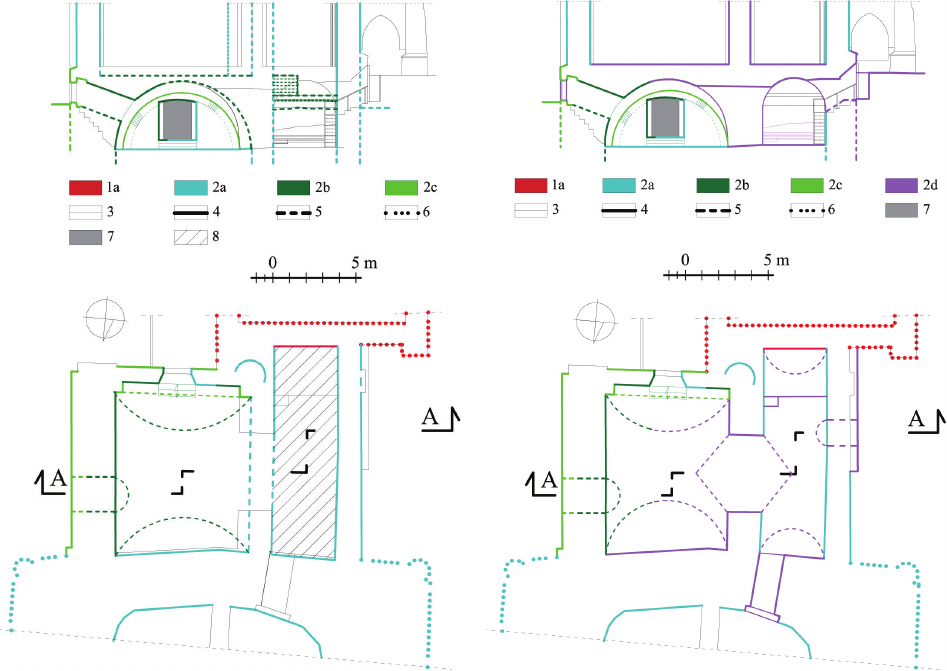
Fig. 4. Reconstruction of the plan and cross-section through the northern part of the eastern wing of stages 1 and 2 of phase a.
Legend: 1a – 1
st
half of the 14
th
century, 1b – approx. 1427, 1c – ca. 1454, 2a – ca. 1730, 3 – current state, 4 – visible course of basement walls,
5 – invisible course of walls below ground level, 6 – ground floor walls, 7 – passageway, 8 – part without basement
(elaborated by A. Piwek, M. Kwasek)
Il. 4. Rekonstrukcja planu i przekroju poprzecznego przez część północną skrzydła wschodniego etapów 1 i 2 fazy a.
Oznaczenia: 1a – 1. poł. XIV w., 1b – ok. 1427 r., 1c – ok. 1454 r., 2a – ok. 1730 r., 3 – stan obecny, 4 – widoczny przebieg ścian piwnic,
5 – niewidoczny przebieg ścian poniżej poziomu terenu, 6 – ściany parteru, 7 – przejście, 8 – część niepodpiwniczona (oprac. A. Piwek, M. Kwasek)
History of the crypt in the Eastern wing of the post-Cistercian monastery in Krzeszów 9
ably due to its suboptimal location. Comparable work was
not required on the western wall, as it was an internal wall
and did not exhibit such structural issues. Furthermore, it
had been partially lled in. The above work was probably
completed around 1731.
In phase three (2c), the southern wall of the basement
underwent a process of thinning on the outer surface, while
an internal arch was introduced to ensure stability (Fig. 7).
In the upper levels, this approach enabled the construction
of an additional section of wall on the arch, thereby increas-
ing its thickness beyond that of the basement levels. This
resulted in the wall achieving the requisite thickness, equiv-
alent to that of the earlier phases. It is indisputable that this
measure was implemented for structural reasons. This phase
of the construction of the monastery crypt was completed
around 1735.
Phase four (2d) witnessed substantial transformations,
primarily attributable to the obstruction of the pre-existing
passageway from the presbytery crypt to the transept, thus
necessitating the improvisation of an alternative means of
communication (Piwek, Kwasek, Dembicki, in print). The
most eective solution was determined to be the creation
of an access passage through the southern wall of the tran-
sept crypt, utilising the previously constructed exit in base-
Fig. 6. Reconstruction of the plan and cross-section
through the monastery crypt of stage 2 of phase b.
Markings: 1a – 1
st
half of the 14
th
century, 2a – approx. 1730,
2b – approx. 1731, 3 – current state,
4 – visible course of basement walls,
5 – invisible course of walls below ground level, 6 – ground floor walls,
7
– passageway, 8 – part without basement
(elaborated by A. Piwek, M. Kwasek)
Il. 6. Rekonstrukcja planu i przekroju poprzecznego
przez kryptę
klasztorną etapu 2 fazy b.
Oznaczenia: 1a – 1. poł. XIV w., 2a – ok. 1730 r., 2
b – ok. 1731 r.,
3 – stan obecny, 4 – widoczny przebieg ścian piwnic,
5 – niewidoczny przebieg ścian poniżej poziomu terenu,
6 – ściany parteru, 7 – przejście, 8 – część niepodpiwniczona
(oprac. A. Piwek, M. Kwasek)
Fig. 5. Outline of the semicircular staircase (also marked by
the curvature of the south wall) in the passageway of the eastern wing
of the monastery leading to the added pavilion, 2023
(photo by M. Kwasek)
Il. 5. Zarys półkolistej klatki schodowej (zaznaczonej także krzywizną
ściany południowej) w przejściu wschodniego skrzydła klasztornego
wiodącym do dostawionego pawilonu, 2023 (fot. M. Kwasek)
ment A to the external area of the monastery (Fig. 8). Of the
two passages of this crypt that reach the transverse wall of
the transept, only the western one was suitable for creating
a passage, as it was the only one from which it was possi-
ble to freely access every underground part. However, the
implementation of this plan necessitated the construction of
a basement beneath the corridor. The soil was removed in
such a manner that a passageway could be created
7
, which
was established in the narrowest part, i.e., as close as possi-
ble to the axis of the convex transept. Consequently, the con-
struction eorts were primarily concentrated on the north-
ern sector of the basement, while the southern sector was
only partially cleared and secured with a low wall. In addi-
tion, a section of the eastern wall of part B of the crypt had
7
Therefore, the level of the newly created interior by the transept
wall was aligned with that of basement A, while the level by the south
wall, due to its unusability, was approximately 80 cm higher.
10 Aleksander Piwek, Michał Kwasek
to be removed. Consequently, the newly created space was
integrated with the pre-existing spaces (under the sacristy
and transept) to form a unied complex. However, this un-
dertaking necessitated the demolition of a section of the
barrel vault that extended to this wall in part A of the crypt.
The repair of the ceiling was utilised to increase the thick-
ness of the wall by approximately 90 cm. Such a signicant
increase in the cross-section of the wall separating the two
basements seems to have had a more important meaning.
At ground oor level, the construction of a wall shifted to
the east was now possible, thus widening the corridor at the
expense of the sacristy. In the basement, the northern walls
of the two-part crypt, which were under construction at the
time, were given further additions. However, due to their
transverse course, they were only about 15–20 cm thick (in
part B of the crypt this is certain – Fig. 1c: B3). he western
wall located beneath the corridor was presumably fortied
in a similar method from the exterior. The second part of
the crypt was also vaulted, and the space was illuminated
by a window that had been cut into the western wall. The
external stone frame was located in the thickened part of
the wall. The construction of a new entrance to the transept
crypt, involving structural modication to parts A and B of
the existing crypt, occurred circa 1738.
Stage 3
It is associated with changes that proved necessary as
a result of historical events. The rst of these may have
been the dissolution of the monastery by the King of Prussia
in 1810. The transition of the abbey church to a parochial
church resulted in the crypt’s obsolescence, a development
that likely inuenced the decision to construct a brick wall
enclosing its entrance within the south wall of section A of
Fig. 7. Reconstruction of the plan and cross-section
through the monastery crypt of stage 2 of phase c.
Markings: 1a – 1
st
half of the 14
th
century, 2a – approx. 1730,
2b – approx. 1731, 2c – approx. 1735, 3 – current state,
4 – visible course of basement walls, 5 – invisible course of walls
below ground level, 6 – ground floor walls, 7 – passageway,
8 – part without basement (elaborated by A. Piwek, M. Kwasek)
Il. 7. Rekonstrukcja planu i przekroju poprzecznego
przez kryptę klasztorną etapu 2 fazy c.
Oznaczenia: 1a – 1. poł. XIV w., 2a – ok. 1730 r., 2b – ok. 1731 r.,
2c – ok. 1735 r., 3 – stan obecny, 4 – widoczny przebieg ścian piwnic,
5 – niewidoczny przebieg ścian poniżej poziomu terenu,
6 – ściany parteru, 7 – przejście, 8 – część niepodpiwniczona
(oprac. A. Piwek, M. Kwasek)
Fig. 8. Reconstruction of the plan and cross-section
through the monastery crypt of stage 2 of phase d.
Markings: 1a – 1
st
half of the 14
th
century, 2a – approx. 1730,
2b – approx. 1731, 2c – ca. 1735, 2d – ca. 1738, 3 – current state,
4 – visible course of basement walls,
5 – invisible course of walls below ground level, 6 – ground floor walls,
7 – passageway (elaborated by A. Piwek, M. Kwasek)
Il. 8. Rekonstrukcja planu i przekroju poprzecznego
przez kryptę klasztorną etapu 2 fazy d.
Oznaczenia: 1a – 1. poł. XIV w., 2a – ok. 1730 r., 2b – ok. 1731 r.,
2c – ok. 1735 r., 2d – ok. 1738 r., 3 – stan obecny,
4 – widoczny przebieg ścian piwnic, 5 – niewidoczny przebieg ścian
poniżej poziomu terenu, 6 – ściany parteru, 7 – przejście
(oprac. A. Piwek, M. Kwasek)
History of the crypt in the Eastern wing of the post-Cistercian monastery in Krzeszów 11
the monastery crypt. Following the arrival of the Benedic-
tines in Krzeszów in 1919, the entrance to the transept crypt
was most likely restored through the utilisation of a window
opening in the eastern wall, which was part of the same sec-
tion of the former monastery underground. Without altering
its perimeter, the portion of the wall situated beneath the
window was dismantled, thereby creating steps. The most
recent alterations, which included the installation of metal
staircases, were undertaken in 2018, coinciding with the de-
cision to open the transept crypt to visitors.
Summary
The research revealed medieval remains in the northern
part of the eastern wing, which are likely to belong to the
chapter house. The initial Baroque transformations were
precipitated by functional metamorphoses within the mon-
astery wing and the erection of a new church. The oldest
section of the crypt was the chamber situated beneath the
extant sacristy. Following the reconstruction of the presby-
tery and transept crypts, it became necessary to enlarge the
crypt under investigation with a new room located below
the previously unbasemented corridor. This provided access
to the reconstructed transept crypt. Structural considerations
were a contributing factor in the reconstruction and thick-
ening of the walls, with the aim of installing vaults in the
eastern room of the crypt (A). Several modications were
also implemented in the 21st century within the connes of
the monastery wing, with the primary objectives of enhanc-
ing visitor accessibility and bolstering the security measures
in place.
Concerns have been raised regarding the dating of the
construction of the sacristy and the crypt beneath it. These
concerns have prompted a re-examination of a version of
the construction slightly dierent from the one presented.
The initial Baroque transformations of the Krzeszów com-
plex were executed prior to 1678, concurrent with the exe-
cution of the modications depicted in Willmann’s illustra-
tion. The implementation of these changes permitted the
construction of the sacristy and the reconstruction of the
crypt in question at that time, i.e., much earlier than present-
ed in this article – before the construction of the transept of
the present church. The argument in favour of this proposal
appears to be the aesthetically and architecturally unjusti-
ed location of the axis of the monastery wing windows
at the point where they intersect with the church (the rst
row of monastery windows from the north). Furthermore,
its proximity to the transept is such that its wall partially
obscures the window band, which is an unusual occurrence
in Baroque design.
In this version, the alterations to the presented history
pertain to the second stage, which would be subject to a sig-
nicantly extended duration. The initial two phases of this
stage would occur during the period of medieval church
existence. Initially, the construction of a new sacristy may
have been undertaken in front of the eastern wing of the me-
dieval monastery (circa 1678). In the subterranean level of
the structure, there was a cellar that functioned as a storage
space for items associated with the monastery garden. Sub-
sequent transformations would lead to the creation of a crypt
with a widened entrance and the installation of vaults (be-
tween approximately 1680 and approximately 1728). It is
con ceivable that it could temporarily assume the role of the
bu rial function, even prior to the construction of the crypts
of the Baroque church. Consequently, the demolition of the
cloister would have been necessary. During the construction
of the transept of the new church, the only changes made to
the crypts were the reconstruction and thickening of the east-
ern and southern walls of crypt A (around 1730). The western
side of the crypt was enlarged at some point around 1738.
Undoubtedly, the presented research will require conti-
nuation and further interpretation. It should determine to
what extent the second version is realistic.
Translated by
Michał Kwasek
References
Dziurla, Henryk. Krzeszów. Zakład Narodowy im. Ossolińskich, 1974.
Dziurla, Henryk. “Studium historyczno-architektoniczne zabytkowego ze-
społu w Krzeszowie.” Maszynopis, Regionalny Ośrodek Dokumenta-
cji Zabytków we Wrocławiu, 1962.
Kapałaczyński, Wojciech. “Prace remontowo-konserwatorskie w okresie
powojennym.” In Krzeszów uświęcony łaską, edited by Henryk Dziur-
la i Kazimierz Bobowski, 360–375. Wydawnictwo Uniwersytetu Wro-
cławskiego, 1997.
Kutzner, Marian. “Średniowieczna architektura klasztoru cysterskiego w Krze -
szowie.” In Krzeszów uświęcony łaską, edited by Henryk Dziur la
i Kazimierz Bobowski, 132–140. Wydawnictwo Uniwersytetu Wroc-
ław skiego, 1997.
Łużyniecka, Ewa. Architektura klasztorów cysterskich. Filie lubiąskie i inne
cenobia śląskie = The Architecture of Cisterian Monasteries. Daughter
Houses of Lubiąż and Other Silesian cenobia. Translated by Marzena
Łuczkiewicz. Ocyna Wydawnicza Politechniki Wrocławskiej, 2002.
Łużyniecka, Ewa. Architektura klasztorów cysterskich na Śląsku. Patria
Polonorum – Księgarnia Św. Wojciecha, 1998.
Łużyniecka, Ewa. Architektura średniowiecznych klasztorów cysterskich
liacji lubiąskiej. Ocyna Wydawnicza Politechniki Wrocławskiej,
1995. https://doi.org/10.52204/np.1995.83.411-428.
Łużyniecka, Ewa. “Średniowieczny klasztor cysterski w Krzeszowie na
podstawie ostatnich badań architektonicznych.” Czasopismo Tech-
niczne 108, Z. 23, 7-A (2011): 441–460.
Łużyniecka, Ewa, and Monika Dąbkowska. “Prace konserwatorskie i bada-
nia architektoniczne klauzury dawnego opactwa cysterskiego w Krze-
szowie po drugiej wojnie światowej.” Saeculum Christianum. Pismo
historyczno-społeczne 25 (2018): 341–357. https://doi.org/10.21697/
sc.2018.25.26.
Piwek, Aleksander, Kwasek, Michał, Dembicki, Szymon. “Krypty w ze-
spole klasztornym.” In Monograa zespołu krzeszowskiego (in print).
12 Aleksander Piwek, Michał Kwasek
Streszczenie
Dzieje krypty w skrzydle wschodnim klasztoru pocysterskiego w Krzeszowie
W artykule przedstawiono wyniki badań architektonicznych dotyczących rozpoznanych podziemi krzeszowskiego zespołu zakonnego.
Przedmiotem badań jest krypta znajdująca się w północnej części skrzydła wschodniego należącego do dawnego cysterskiego założenia klasztornego,
który dotąd nie został dostatecznie rozpoznany. Krypta ta ma spośród wszystkich największe znaczenie dla poznania historii budowy klasztoru. Na pod-
stawie znajdujących się w niej śladów ustalono kilka etapów i faz obejmujących okres między XIV a XXI w. Pierwszy etap odnosi się do czasu, kiedy
w miejscu krypty wzniesiono na poziomie parteru pomieszczenia, które mogły być średniowiecznymi kapitularzem oraz zakrystią. W czasie budowy
nowego kościoła wymurowano część wschodnią zachowanej dotąd krypty z okrągłą klatką schodową (ok. 1730 r.). W ciągu kilku następnych lat wprowa-
dzano w niej zmiany budowlane, funkcjonalne i komunikacyjne. Ostatnia z nich (ok. 1738 r.) łączyła się z powstaniem zachodniej części obecnej krypty
i powiązaniem jej z kryptą transeptową. Jej budowa była konieczna, aby stworzyć w podziemiach jeden zespół dostępny z zewnątrz.
Słowa kluczowe: cystersi, klasztor, badania architektoniczne, krypta, Krzeszów