
2026
3(87)
Karol Pieter*
Between memory and oblivion.
A comparison of methods of transforming post-mining areas
based on selected post-industrial regions in Germany and England
DOI: 10.37190/arc260306
© by the Author/Authors. Licensee WUST.
Published in open access. CC BY-NC license.
Abstract
This article addresses the issue of the regeneration of post-mining areas in the context of contemporary strategies for the revitalisation of post-in-
dustrial areas. The starting point is the assumption that post-mining areas represent not only a spatial and environmental challenge, but also a signicant
vehicle for cultural and social heritage. The aim of the article is to assess whether regions with seemingly similar characteristics – in terms of the scale
of industrialisation, spatial structure and historical signicance – have developed similar models for the transformation of post-mining areas, which may
also constitute an element of regional identity.
The research was based on a comparative analysis of the regeneration processes of former hard coal mining areas in two European post-industrial
regions: the Ruhr Area in Germany and the regions of West and South Yorkshire in England. The time frame covers the period from the late 1980s to the
present day, with particular emphasis on initiatives implemented after 1990. The analysis examined trends in spatial transformation, methods of adapting
post-mining infrastructure and descriptions of new functions.
The research ndings indicate a marked diversity in approaches to the regeneration of post-mining areas across the regions analysed. Despite similar
initial conditions, the strategies adopted dier both in terms of development forms and in the ways in which mining heritage is interpreted. The analysis
conrmed that there is no universal model for the transformation of post-mining areas and that eective regeneration requires a bespoke approach in each
case, taking into account the local historical, social and spatial context.
Key words: industrial heritage, the Ruhr region, Yorkshire, regeneration, heritage policy
Introduction
European regions that were once major centres of the
mining industry have, since the mid-20
th
century, under-
gone intensive processes of transformation at several levels
and to varying degrees. The unprotability of mines and
erce competition from mining companies in other parts
of the world triggered the decline of the mining industry in
Western Europe.
In Germany, the crisis in hard coal mining began in the
late 1950s. The largest mining region, the Ruhr, underwent
major changes. As recently as 1958, coal production stood
at almost 150 million tonnes per year. The sharpest decline
in production – by more than half – was recorded by 1968.
Consequently, the restructuring company Ruhrkohle AG
(RAG) was established to assist with the transition and pre
-
vent rising unemployment (Oei, Brauers and Herpich 2020,
963–979). This marked the beginning of major changes in
the German mining sector. Mines were gradually closed,
while programmes were introduced to prevent unemploy-
ment and support the retraining of workers. This process
was accelerated by the crisis of the 1970s, the challeng-
es associated with German reunication in the 1990s, and
subsequent European Union regulations in the 21
st
century.
The last mines in the Ruhr region were closed in 2018 (Oei,
Brauers and Herpich 2020, 963–979).
The second half of the 1950s also marked the beginning
of a decline in coal production in the United Kingdom. Pro-
duction fell from over 220 million tonnes a year to around
150
million tonnes a year within a dozen or so years (Ritchie
2019). West and South Yorkshire were major coal-min-
*
ORCID:
0009-0009-4058-3515. Faculty of Architecture, The Si le-
sian University of Technology, Poland, e-mail: karol.pieter@polsl.pl

62
Karol Pieter
ing regions. The decline of the mining industry brought
with it numerous problems and challenges. In 1993, the
gross domestic product (GDP) of West Yorkshire was 7
percentage points below the European Union average at
the time, while for South Yorkshire it was almost 20 per-
centage points lower (Parry 1996, 124). The last coal mine
in England – Kellington Colliery – closed in 2015.
The scale of the transformations in these regions was im-
mense, which had a negative impact on public sentiment and
created tensions. Strikes broke out, particularly in England.
The economic situation deteriorated, unemployment rose
rapidly, and, as a result, the number of social problems also
increased. The unfavourable situation was exacerbated by
the closure of other industrial facilities closely linked to the
mines, such as steelworks, coking plants and power stations
(Waddington 2023, 432–464). In an attempt to mitigate the
negative eects of the transition, the authorities sought to
implement revitalisation programmes, many of which are
still ongoing today. Now, after years of experience, it is
clear that these measures have yielded mixed results.
The rst comprehensive attempts to mitigate the eects
of industrial transition were undertaken in the Ruhr region
in 1968. At that time, a course of action was set out aimed
at transforming the region, with a focus on improving res-
idents’ quality of life, enhancing transport and developing
the education system. For example, a very large-scale rege-
ne ration programme with a strong environmental focus was
the Internationale Bauausstellung Emscher Park, imple-
mented between 1989 and 1999.
In England, comprehensive regeneration programmes
be gan to be implemented in the 1990s. Government-funded
organisations were established for this purpose, in cluding
the Coalelds Regeneration Trust. In 1990, the En vi ron-
men tal Protection Act was enacted, imposing a duty on lo-
cal authorities to identify and remediate contami nated land
(Burke et al. 2015, 321–331).
However, the regeneration of post-industrial areas in
Eng land involved not only spatial, environmental and eco -
nomic interventions, but also issues relating to the local
community. This was of particular signicance in the case
of mining areas, where the history of these places and the
way they functioned had shaped the identity of their in-
ha bitants over a very long period. Indeed, one of several
key criteria for regeneration is the social sphere (Gasidło
et al. 2010, 233–245). This includes a sense of attachment
to the region’s heritage, traditions and history, which can
inuence the methods of transformation chosen and their
outcomes. The spatial as pect of these transformations is
equally important. The sites of closed mines have become
problematic in terms of how they should be redeveloped.
A large number of buildings, many of them listed, as well
as roads, railway lines, undeveloped land and sites covered
with waste, much of it hazardous, are among the main ele-
ments remaining from hard coal mining operations. These
elements are signicant in the context of identity, as dened
through the prism of residents’ attachment to the post-min-
ing heritage and the associated landscapes (Opania 2012).
The methods used to transform these areas may dier be-
tween regions, even where the areas themselves appear to
be similar in many respects.
This article focuses on regeneration, including the rec-
lamation and restoration of post-industrial sites and struc-
tures in post-mining areas, as well as the related issue of
preserving post-industrial mining heritage. The research
covers the period from the late 1980s to the present day. It
forms part of a wider study analysing trends in urban poli-
cymaking in the context of the transformation and creation
of sustainable neighbourhoods in post-industrial cities with
a polycentric structure.
Representative mining centres in Germany and England
– countries that pioneered Europe’s industrial development
– were selected for the study. In Germany, the main mining
area under investigation was the Ruhr region. In England,
the study focused on the two regions of West and South
Yorkshire, which together form a larger area in which the
boundaries between individual mining centres are often
blurred (Table 1). Both regions are characterised by a poly-
centric struc ture – an amorphous spatial arrangement re-
sulting from industrial development and the distribution of
hard coal deposits. Each has a long history of development
associated with this industrial sector.
The aim of this study was to attempt to determine wheth-
er two seemingly similar post-industrial regions, both with
a rich history of hard coal mining, are characterised by sim-
ilar policies for the regeneration of post-mining areas.
Given the size of these regions, South and West Yorkshire
account for around 75 per cent of the population and 81 per
cent of the area of the Ruhr region. Individual regions in
England could not be compared with a single German re-
gion, which further justies grouping them together in this
comparison.
State of research
An analysis of the current state of research indicates that
the literature on this subject is dominated by an approach
that involves a general comparison of the transformation
processes of post-industrial areas in Europe, without clear-
ly distinguishing post-mining areas – either at regional or
national level. This perspective is adopted, among others,
by Marta Chmielewska (Chmielewska 2015, 133–145) and
Table 1. Summary of figures relating to the centres under comparison
in the mining regions of Germany and England (elaborated by K. Pieter,
based on Referat Bildung… 2021; Office for National Statistics n.d.)
Tabela 1. Zestawienie danych liczbowych dotyczących porównywanych
ośrodków w regionach górniczych Niemiec i Anglii (oprac. K. Pieter,
na podstawie Referat Bildung… 2021; Office for National Statistics n.d.)
Region name
Population
[mln]
Area
[km
2
]
Population density
[persons/km
2
]
Ruhr
metropolitan area
(Germany)
~ 5.1 ~ 4439
~ 2100 in the central zone
(value varies depending
on the definition)
West Yorkshire ~ 2.4 ~ 2029 ~ 1182
South Yorkshire ~ 1.4 ~ 1552 ~ 902
West Yorkshire +
South Yorkshire
~ 3.8 ~ 3581 ~ 1061
Between memory and oblivion – selected post-mining regions in Germany and England
63
by Kean Birch, Danny MacKinnon and Andrew Cumbers
(Birch, MacKinnon and Cumbers 2010, 35–53).
In contrast, in-depth studies most often narrow the scope
of their analysis to a single region. Examples include Jay
Emery’s monograph (Emery 2020, 38), which focuses on
community identity in former mining settlements, and Szy-
mon Opania’s work, which provides a comprehensive dis-
cussion of issues relating to post-mining areas in Upper Si -
lesia (Opania 2012).
Studies directly focused on comparing the Ruhr region
with South and West Yorkshire, as presented by Chas Crit-
cher, Dave Parry and Dave Waddington, have largely be-
come outdated today, as they fail to take into account sig ni-
cant spatial changes that have occurred in subsequent years
(Crit cher, Parry and Waddington 1999). Conversely, the au-
thors of more recent studies on these regions do not un der-
take a direct comparison, focusing instead on other Eu ro pean
industrial areas. An example is the article by Ma ciej Soł ty-
sik and Ka ta rzy na Mazur (Sołtysik, Mazur 2022, 45–49).
The ndings cited above point to a clear research gap in
the current comparative analysis of the processes of land
transformation following former hard coal mining in the re-
gions under study.
Methods
The research was carried out between October and De-
cember 2025 (including eldwork between November and
December 2024) and covered selected areas in two large
post-industrial regions of Europe: in Germany (the Ruhr)
and in England (West and South Yorkshire). The key crite-
rion for selecting the sites was the presence of regeneration
initiatives carried out from 1990 to the end of 2025, which
enabled an analysis of transformation processes over a lon-
ger time horizon.
The analysis was conducted at two spatial scales: re-
gional and local. At the regional scale, covering cities and
metropolitan areas, a review of the relevant literature and
planning documentation was carried out, alongside expert
and community interviews, which enabled the identica-
tion of specic sites for further analysis. At the local level –
concerning neighbourhoods, housing estates and industrial
areas – an in-depth review of the literature and empirical
research, in cluding on-site observations, was carried out.
Particular atten tion was paid to post-mining areas, which
are strategically important for urban development, enabling
a precise assessment of their functional and spatial trans-
formations.
The research was based on three types of data: measur-
able data, qualitative data from on-site observations, and
data obtained from community interviews. The measurable
data included indicators such as site area, the number of
struc tures and project completion dates, as well as other
quan titative indicators. The qualitative data concerned the
con dition of the built environment, spatial functions and
pre served elements of the industrial landscape, while com-
munity interviews enabled an analysis of public percep-
tions of the transformations, local experiences and views
on changes in the urban landscape, and they also helped to
narrow down the search for the sites under study.
The analysis also took into account the historical context
of the sites under study, including their original industrial
function, the duration of their operation and the course of
the regeneration activities. Particular emphasis was placed
on the chronology of the transformation – from the com-
mencement of regeneration activities to the attainment of
the current spatial form.
The selection of case studies for the research was based
on three criteria. The rst was the aforementioned period
of the regeneration programme, covering the years 1990–
2025. The second criterion concerned the size of the area
being redeveloped, which was classied into three groups:
up to 30 hectares (ha) (Group A), up to 100 ha (Group B)
and over 100 ha (Group C). The nal criterion was the na-
ture of the site – former industrial areas were selected for
analysis, where the buildings remained intact until the clo-
sure of the mine or industrial plant.
For each region (the Ruhr Area and West/South York-
shire), three example sites were identied and described in
the form of site proles covering:
– the area of the site undergoing regeneration,
– the duration of the regeneration activities,
– post-transformation functions,
– the current spatial form and ownership of the site,
– the number of preserved buildings and infrastructure
elements.
At the conclusion of the research, a comparison was made
of the sites within each group, which enabled the iden tication
of trends and dierences in the approach to the regeneration of
post-mining areas in both regions.
The regeneration of mines
in the Ruhr region of Germany
The Osterfeld Mine in Oberhausen
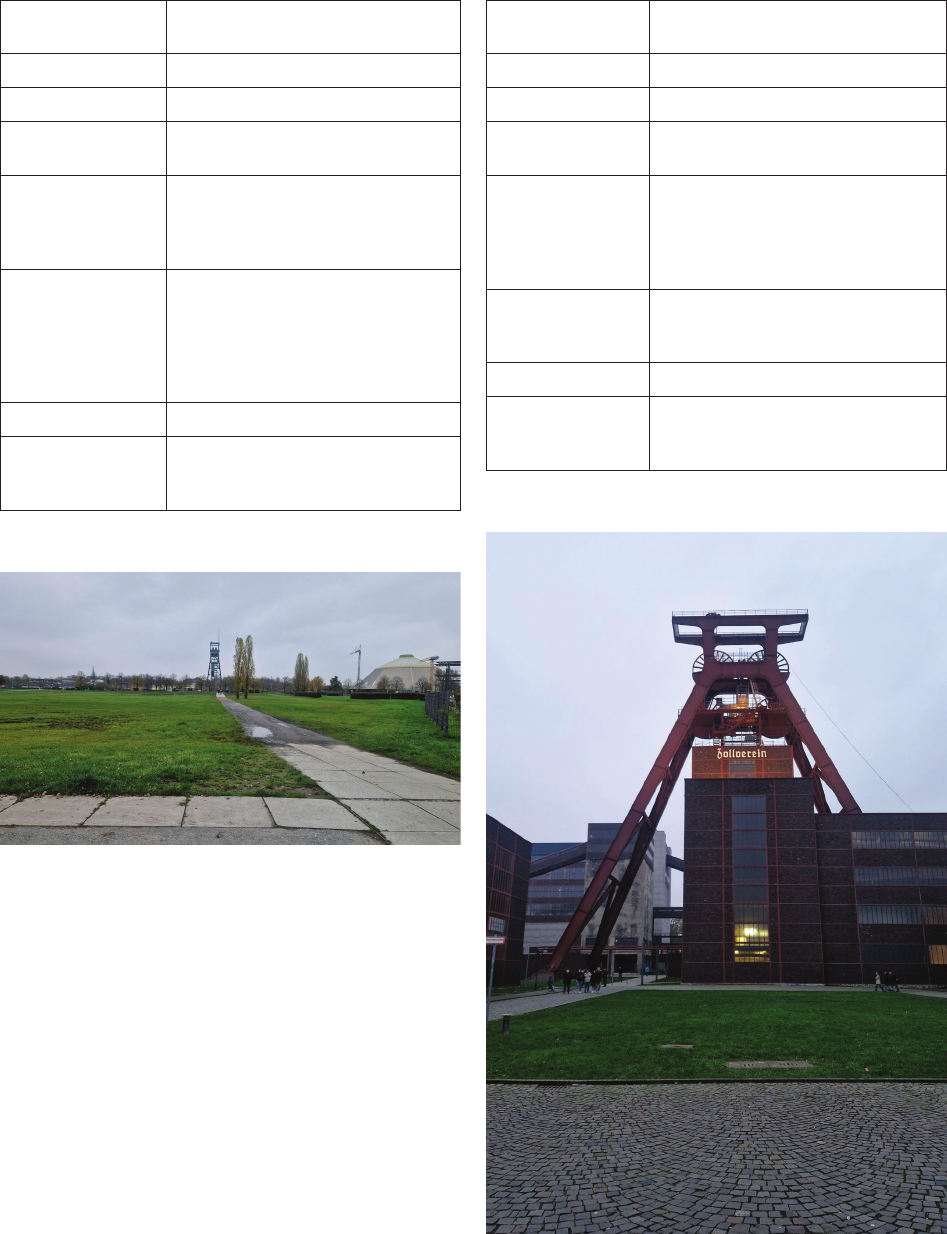
The former Osterfeld mine and coking plant is classi ed
as Group A. The site ceased operations in 1988 (Em scher-
genossenschaft 2021), and in the 1990s work began on its
conversion into OLGA Park in Oberhausen (Table 2). The
project was carried out as part of the preparations for the
1999 Landesgartenschau exhibition (Oberhausen Tourismus
n.d.; Stadt Oberhausen n.d.) and involved the conversion
of post-industrial sites into a landscape park. During this
process, selected elements of technical he ritage were pre-
served, such as the administrative and social building for
mining sta (Steigerhaus), the headframe (För der turm) and
the gatehouse (Pförtnerhaus). These elements, integrated
into the park’s layout, serve as spatial landmarks and phys-
ical testimonies to the region’s industrial history (Fig. 1).
The process of revitalising browneld sites, as exempli-
ed by OLGA Park in Oberhausen, illustrates the regener-
ation of a former hard coal mine site, including the conver-
sion of some of the existing buildings to new recreational,
commercial and residential uses.
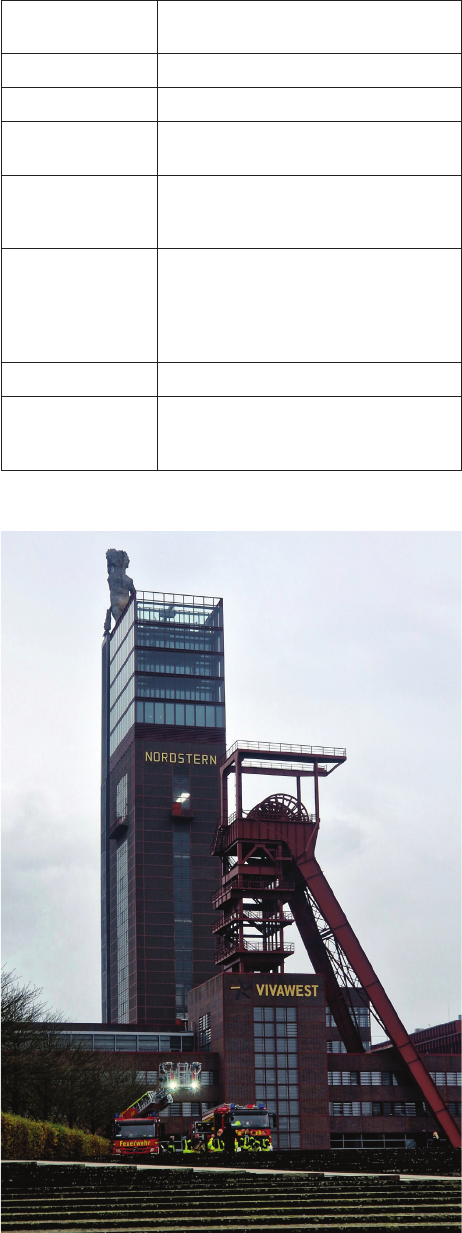
The Zollverein Coal Mine in Essen
The Zeche Zollverein industrial complex in Essen is clas-
sied as Group B in terms of area. It is one of the most
64
Karol Pieter
Fig. 1. Redeveloped Osterfeld mine in Oberhausen, Germany
(photo by K. Pieter)
Il. 1. Przekształcona kopalnia Osterfeld, Oberhausen, Niemcy
(fot. K. Pieter)
Fig. 2. Redeveloped Zollverein mine in Essen, Germany
(photo by K. Pieter)
Il. 2. Przekształcona kopalnia Zollverein, Essen, Niemcy
(fot. K. Pieter)
Table 2. Site profile for the Osterfeld mine
(elaborated by K. Pieter based on Oberhausen Tourismus n.d.)
Tabela 2. Karta obiektu dla kopalni Osterfeld
(oprac. K. Pieter na podstawie Oberhausen Tourismus n.d.)
Table 3. Site profile for the Zollverein Colliery (elaborated by
K. Pieter based on Stiftung Zollverein n.d.; Stadtplan Ruhr n.d.)
Tabela 3. Karta obiektu dla kopalni Zollverein (oprac. K. Pieter
na podstawie Stiftung Zollverein n.d.; Stadtplan Ruhr n.d.)
Example
Zeche Osterfeld
Olga Park, Oberhausen, Germany
Year of closure 1998
Transformation period 1992 – ongoing (as of the end of 2025)
Area undergoing
transformation
26 ha
Functions after
transformation
– recreational park (dominant function)
– offices
– housing
– event venue
Spatial form
A distinctive shaft structure serving as
a landmark visible from a considerable
distance; mixed residential development
– single-storey detached houses,
several-storey multi-family buildings;
a park layout structured along two axes
Ownership, capital Predominantly public and private
Preserved buildings
Headframe (mine shaft) with historic
ancillary buildings (2 buildings);
coal blending facility
representative examples of comprehensive regeneration
and adaptation of post-mining sites on a European scale
(Table 3). The hard coal mine, which operated from 1847
to 1986 and employed over 8,000 workers at the height of
its development, was a vital economic pillar of the Ruhr re-
gion. The transformation process began immediately after
mining operations ceased and involved systematic chang-
es both in the mining area and within the coking works
(Stiftung Zollverein n.d.) (Fig. 2).
The conservation strategy adopted for this area was based
on preserving the integrity of the physical structure, includ-
ing such architectural landmarks as the Tower of Shaft XII,
the engine house buildings and the coking plant chimneys.
The site’s international cultural signicance and the success
Example
Zeche Zollverein
Essen, Germany
Year of closure 1986
Transformation period 1990–2019
Area undergoing
transformation
approx. 55 ha
(excluding the coking plant site)
Functions after
transformation
– museum (primary function),
– shops,
– offices,
– park,
– event venue
Spatial form
preserved layout of the former mine
with its distinctive hoist shaft
as the dominant feature
Ownership, capital public
Preserved buildings
96 buildings (including the coking plant),
including shaft towers, coking batteries,
a coal washing plant and a coal sorting plant
Between memory and oblivion – selected post-mining regions in Germany and England
65
of the adaptation measures undertaken were recognised in
2001 when the complex was inscribed on the UNESCO
World Heritage List. These measures enabled the imple-
mentation of a model for assigning new and diversied
socio-economic functions to historic industrial buildings.
Cultural and design institutions housed in the former in-
dustrial facilities have taken centre stage in the functional
structure of the revitalised complex. The Zeche Zollverein
Foundation, established by an institutional consortium com-
prising the city of Essen, the federal state of North Rhine-
Westphalia and the Regional Association of the Ruhr (RVR),
was responsible for coordinating and managing the regener-
ation process.
The Nordstern Colliery in Gelsenkirchen
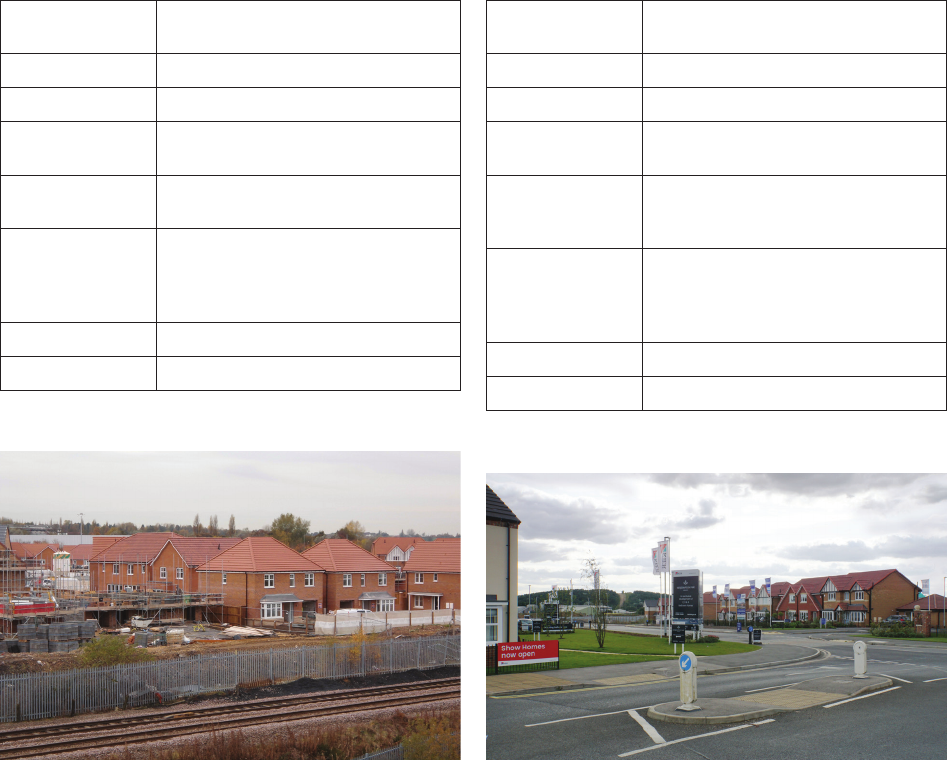
The site of the former Nordstern hard coal mine is clas-
sied as Group C. The mine operated until 1993. It became
one of the sites where the IBA Emscherpark programme
was implemented between 1989 and 1999 (Table 4). The
site is situated alongside the Rhein-Herne Canal and the
River Emscher. As part of the site’s regeneration in 1991,
an area of 4,000 m
2
was set aside for the BUGA horticultur-
al exhibition (Stadt Gelsenkirchen 2017). The site opened
in 1997, and over one million visitors attended the exhibi-
tion within 170 days (Stadt Gelsenkirchen n.d.). Two city
districts were also linked, enabling the creation of a net-
work of footpaths and cycle routes forming part of a com-
prehensive plan for the entire metropolitan area (Fig. 3).
In the years that followed, further measures were under-
taken to improve the quality of the natural environment,
including those aimed at the renaturalisation of the River
Emscher. The park was expanded to include further attrac-
tions, the historic mine shaft was restored, and commercial
premises were created in the former industrial buildings.
In addition, new commercial buildings were constructed in
the area. These changes also contributed to the gentrica-
tion of the historic workers’ housing estate located near the
central part of the mine site.
Revitalisation of mines
in West and South Yorkshire, England
The Prince of Wales Mine
in Pontefract, West Yorkshire
Due to its surface area, this mine was classied as
Group A (Table 5). The mine commenced operations in
the 1870s and was closed in 2002 due to geological prob-
lems preventing the further extraction of the remaining coal
seams. Following the cessation of mining operations, the
mine site, covering a total area of approximately 47 ha, was
designated for regeneration. This process began in 2013
(Pedley 2025).
The site in question has been divided into two main
zones: the area of the former mine (pit yard), covering
18.2 ha and designated for residential development, and
the remaining areas designated for commercial develop-
ment in the form of a logistics centre. The mine spoil tip
has also been reclaimed (Fig. 4).
Fig. 3. Redeveloped Nordstern mine in Gelsenkirchen, Germany
(photo by K. Pieter)
Il. 3. Przekształcona kopalnia Nordstern, Gelsenkirchen, Niemcy
(fot. K. Pieter)
Table 4. Site profile for the Nordstern mine (elaborated by K. Pieter
based on Stadt Gelsenkirchen n.d.; Stadtplan Ruhr n.d.)
Tabela 4. Karta obiektu dla kopalni Nordstern (oprac. K. Pieter
na podstawie Stadt Gelsenkirchen n.d.; Stadtplan Ruhr n.d.)
Example
Zeche Nordstern
Nordstern Park, Gelsenkirchen
Year of closure 1993
Transformation period 1991 – ongoing (as of the end of 2025)
Area undergoing
transformation
~100 ha
Functions after
transformation
– offices (dominant function)
– park
– event venue
Spatial form
A mine shaft serving as a spatial landmark;
an extensive park area along the Emscher
River and canal; a distinctive landmark
element in the form of a bridge connecting
the areas on opposite banks of the river
Ownership, capital predominantly public and private
Preserved buildings
7, including a coal bunker and blending facility,
2 headframes, and workshop
and administrative buildings
66
Karol Pieter
The Harworth Colliery in Harworth
This colliery was classied as Group B. Coal mining
began there in the 1920s, and the site was closed in 2006.
Following the cessation of mining operations, the site, cov-
ering an area of approximately 70 ha, was earmarked for
regeneration (Table 6). In 2011, planning permission was
granted for the development of the site, including residen-
tial and commercial buildings as well as public spaces.
The regeneration process began in 2013, when work com-
menced on the construction of terraced housing estates
(NHBC 2024) (Fig. 5).
The site of the former mine required comprehensive
reclamation work, including the removal of industrial in-
frastructure and soil decontamination. Work was also car-
ried out to remove two deep mine shafts and to remediate
the site of the former coking plant (WYG Environment
Planning Transport 2020).
The Ogreave Colliery in Waverley, Rotherham
This is a Group C colliery. It closed in 2002, but regen-
eration programmes had already begun to be implemented
here in the mid-1990s (Table 7). The area has undergone
a transformation, becoming primarily a residential neigh-
bourhood. The regeneration processes are being carried out
in phases by the Harworth Group across an area of approx-
imately 300 ha (NHBC 2024) (Fig. 6).
By 2025, over 1,800 ats had been completed (Harworth
Group n.d.) along with a primary school, while plans envis-
age the construction of over 3,800 ats in total (We Are
Waverley n.d.).
Fig. 4. Redeveloped Prince of Wales Colliery, Pontefract, England
(photo by Derek Dye, source: www.geograph.org.uk/p/5652321,
CC-BY-SA/2.0; accessed: September 5, 2026)
Il. 4. Przekształcona kopalnia Prince of Wales, Pontefract, Anglia
(fot. Derek Dye, źródło: www.geograph.org.uk/p/5652321,
CC-BY-SA/2.0; data dostępu: 5 września 2026)
Fig. 5. Redeveloped Harworth colliery, Bircotes, England
(photo by Bill Boaden, source: www.geograph.org.uk/p/6268157,
CC-BY-SA/2.0; accessed: September 5, 2026)
Il. 5. Przekształcona kopalnia Harworth, Bircotes, Anglia
(fot. Bill Boaden, źródło: www.geograph.org.uk/p/6268157,
CC-BY-SA/2.0; data dostępu: 5 września 2026)
Table 5. Site profile for the Prince of Wales Mine
(elaborated by K. Pieter based on Pedley 2025)
Tabela 5. Karta obiektu dla kopalni Prince of Wales
(oprac. K. Pieter na podstawie Pedley 2025)
Table 6. Site profile for the Harworth mine (elaborated by K. Pieter
based on WYG Environment Planning Transport 2020)
Tabela 6. Karta obiektu dla kopalni Harworth (oprac. K. Pieter
na podstawie WYG Environment Planning Transport 2020)
Example
Prince of Wales Colliery
Pontefract, West Yorkshire, England
Year of closure 2002
Transformation period 2013 – ongoing (as of the end of 2025)
Area undergoing
transformation
18.2 ha (47 ha including subsequent phases)
Functions after
transformation
– housing (dominant function)
– recreational areas
Spatial form
low-rise terraced housing, lack of clearly
defined communal areas; the spatial form of
a logistics centre characteristic of warehouse
facilities, together with road infrastructure
Ownership, capital private
Preserved buildings none
Example
Harworth Colliery
Simpson Park, Bircotes, Doncaster, Anglia
Year of closure 2006
Transformation period 2011 – ongoing (as of the end of 2025)
Area undergoing
transformation
43.28 ha
Functions after
transformation
– housing (predominant use)
– recreational areas
– shops
Spatial form
low-rise terraced housing, communal areas
in the form of squares in front of retail spaces,
a main axis serving as a landmark, recreational
space comprising a park and a pond
Ownership, capital private
Preserved buildings none

Between memory and oblivion – selected post-mining regions in Germany and England
67
Conclusions
Comparing the above examples, two distinct trends can
be observed in the way post-mining areas are being trans-
formed – each characteristic of one of the two regions
(Table 8). The rst of these, observed in the Ruhr region,
focuses on the reuse of existing structures and a regenera-
tion approach characterised by a greater emphasis on con-
servation, preservation of the existing landscape and the
development of tourism potential. This is supported by
numerous institutions and substantial nancial contribu-
tions from central government and local authorities. Co-
operation between the various stakeholders has enabled the
regeneration of selected post-mining areas and the success-
ful creation of valuable landmarks on the region’s industrial
heritage map.
The second trend, typical of the English regions under
discussion, is not characterised by a focus on the protec-
tion and preservation of the tangible heritage of the min-
ing industry. In South and West Yorkshire, few traces of
the former mines remain today. The main outcomes of the
redevelopment are residential properties and logistics cen-
tres. Extensive marketing campaigns are being carried out
to facilitate the rapid sale of properties and maximise prof-
its, with no reference to the region’s heritage or industrial
history of hard coal mining in the region. An example of
this is a document setting out guidelines for development
on the site of the former Hartworth Colliery (Simpson Park
n.d.), in which no mention is made of the site’s historical
function. Furthermore, relatively few museums have been
established as part of the regeneration of former English
hard coal mines.
During discussions with experts and community inter-
views, the English interviewees highlighted important histo-
rical aspects. Attempts at restructuring led by the then Prime
Minister, Margaret Thatcher, resulted in mass redundancies
and protests.
Demonstrations were often suppressed quite
brutally. This may have contributed to a lack of trust in the
authorities and a reluctance within the mining community
to confront its dicult past. Furthermore, private entities
focused on generating prots from the sale and trading of
property are very active in England. This is demonstrated
by the ndings of the research – all the examples analysed
are being redeveloped with the involvement of private
Fig. 6. Redeveloped Ogreave colliery, Rotherham, England
(photo by John Jennings, source: www.geograph.org.uk/p/3046908,
CC-BY-SA/2.0; accessed: September 5, 2026)
Il. 6. Przekształcona kopalnia Ogreave. Rotherham, Anglia
(fot. John Jennings, źródło: www.geograph.org.uk/p/3046908,
CC-BY-SA/2.0; data dostępu: 5 września 2026)
Table 7. Site profile for the Ogreave mine
(elaborated by K. Pieter based on Harworth Group n.d.)
Tabela 7. Karta obiektu dla kopalni Ogreave
(oprac. K. Pieter na podstawie Harworth Group n.d.)
Example
Ogreave Colliery
Rotherham, Waverley, England
Year of closure 2002
Transformation period 1995 – ongoing (as of the end of 2025)
Area undergoing
transformation
~300 ha
Functions after
transformation
– housing (predominant use)
– recreational areas
– schools
– shops
– small businesses
– warehouse and logistics park
Spatial form
low-rise terraced housing, low-rise
multi-family housing, a small pedestrian-only
high street, recreational areas in the form of
a park, the spatial layout of the logistics
centre characteristic of warehouse facilities,
together with road infrastructure
Ownership, capital private
Preserved buildings none
Name of the colliery Region Main use of the redeveloped site
Have the existing structures
been preserved?
Developer
Zeche Osterfeld Ruhr area recreation yes public
Zeche Zollverein Ruhr area museum yes public
Zeche Nordstern Ruhr area offices yes public
Prince of Wales Colliery West Yorkshire residential areas no private
Harworth Coliery South Yorkshire residential areas no private
Ogreave Colliery West Yorkshire residential areas no private
Table 8. Summary table of site profiles for comparable post-mining areas (elaborated by K. Pieter)
Tabela 8. Podsumowanie kart obiektów porównywanych terenów poprzemysłowych (oprac. K. Pieter)
68
Karol Pieter
References
Birch, Kean, Danny MacKinnon, and Andrew Cumbers. “Old Industrial
Regions in Europe: A Comparative Assessment of Economic Perfor-
mance.” Regional Studies 44, no. 1 (2010): 35–53. https://doi.org/
10.1080/00343400802195147.
Burke, Helen, Edward Hough, David John Robert Morgan, Leanne Hu-
ghes,
and David J.D. Lawrence. “Approaches to Inform Redevelop-
ment of Browneld Sites: An Example from the Leeds Area of the
West Yorkshire Coaleld, UK.” Land Use Policy 47 (2015): 321–31.
https://doi.org/10.1016/j.landusepol.2015.04.018.
Chmielewska, Marta. “Conservation of Post-Industrial Cultural Heritage
in Europe in Local and Global Context. Industrial Heritage and Re-
gional Identity.” In Geographical-political Aspects of the Transbor-
der Conservation of Natural and Cultural Heritage, edited by Kry-
stian Hener. University of Łódź, Silesian Institute in Opole, Silesian
Institute Society, 2015.
Critcher, Chas, David Parry, and Dave Waddington. “Regulation, Restruc-
turing and Regeneration in Coalelds: Three European Cases.” In The
Global Economy, National States and the Regulation of Labour, edi-
ted by Paul K. Edwards, Tony Elger. Routledge, 1999.
Emery, Jay. “After Coal: Aective-Temporal Processes of Belonging
and Alienation in the Deindustrializing Nottinghamshire Coaleld,
UK.” Frontiers in Sociology 5 (2020): 38. https://doi.org/10.3389/
fsoc.2020.00038.
Emschergenossenschaft (EGLV). “Oberhausen-OLGA Park.” Published
May 20, 2021. Accessed May 4, 2026, at https://www.eglv.de/em-
scher-lippe/stadt-und-regionalentwicklung/gemeinsam-emscher-lip-
pe/faszination-transformation/leuchtturmprojekte/oberhausen-olga
-park/.
Gasidło, Krzysztof, Elżbieta Błeszyńska-Koclęga, Marek Janik, and Szy-
mon Opania. “Rewitalizacja i rewaloryzacja urbanistyczna w pro-
gramie studiów na Wydziale Architektury Politechniki Śląskiej.” Za-
rządzanie Publiczne. Zeszyty Naukowe Instytutu Spraw Publicznych
Uniwersytetu Jagiellońskiego, no. 1/2 (2010): 233–45.
Harworth Group. “Residential Development.” Published n.d. Accessed
December 29, 2025, at https://harworthgroup.com/residential/.
NHBC. “Simpson Park Case Study.” Published 2024. Accessed December
29, 2025, at https://www.nhbc.co.uk/insights-and-media/case-studies/
simpson-park.
Oberhausen Tourismus. “OLGA Park.” Published n.d. Accessed Decem-
ber 29, 2025, at https://www.oberhausen-tourismus.de/en/poi/olga
-park/.
Oce for National Statistics. “Local indicators for Yorkshire and The
Hum ber.” Published n.d. Accessed December 29, 2025, at https://
www.ons.gov.uk/visualisations/areas/E12000003/.
Oei, Pao-Yu, Hanna Brauers, and Philipp Herpich. “Lessons from Germa-
ny’s Hard Coal Mining Phase-Out: Policies and Transition from 1950
to 2018.” Climate Policy 20, no. 8 (2020): 963–79. https://doi.org/10.
1080/14693062.2019.1688636.
Opania, Szymon. Tożsamość a wizerunek obszarów poprzemysłowych. Przy
kład Aglomeracji Górnośląskiej. Wydawnictwo Politechniki Śląs kiej,
2012.
Parry, David J. “Regenerating Local Economies: A Comparative Analysis
of Three UK Coal Areas.” MPhil diss., Sheeld Hallam University,
1996. ProQuest (10700836).
Pedley, Andrew. “Restoration Shows How to Redevelop UK Industrial
Legacy.” Land Journal. Published January 16, 2025. Accessed De-
cember 29, 2025, at https://ww3.rics.org/uk/en/journals/land-journal/
prince-of-wales-colliery-remediated.html.
Referat Bildung und Soziales Team Regionale Statistik und Umfragen. Re-
gionalverband Ruhr. “Metropolie Ruhr. Die Region in Zahlen.” Pub-
lished August, 2021. Accessed December 29, 2025, at https://www.
rvr.ruhr/leadmin/user_upload/01_RVR_Home/03_Daten_Digitales/
Regionalstatistik/03_Publikationen/2021-08_Metropole_Ruhr_Die_
Region_in_Zahlen.pdf#:~:text=Die%20Metropole%20Ruhr%20
%E2%80%93%20das%20sind%20rund,besie%2D%20delten%20
Ballungsr%C3%A4ume%20mitten%20im%20Herzen%20Europas.
capital. The policies adopted by the UK government may
also have inuenced the objectives of the redevelopment
projects. In 1998, a national target was introduced stipulat-
ing that 60 per cent of new housing developments should
be built on browneld sites, i.e., areas previously used for
industrial production in the context of industrial sites.
This does not mean that the examples cited above repre-
sent the only model for the redevelopment of former hard
coal mining sites in Germany and England. In these regions,
there are also sites that have been redeveloped in other ways,
although these are in the minority. Examples include the
articially created lake Phoenix See on the site of the for-
mer Phoenix-Ost steelworks in Dortmund and the National
Coal Mining Museum for England in Overton, Wakeeld.
The comparative perspective employed in the research
enables the identication of both the common challenges as-
sociated with the decline of the mining industry and the di-
versity of solutions developed in selected regions of Europe.
Summary
The research carried out indicates that the history and
identity of post-mining areas are neither homogeneous nor
universal, and cannot be directly applied in dierent re-
gional contexts. Both the course of industrialisation and the
social dimension of mining operations, as well as the pro-
cess of their phasing out, have shaped distinct narratives of
place and forms of local identity. When devising strategies
for the transformation of post-mining areas, it is essential to
consider their tangible and intangible heritage on a case-by-
case basis, taking into account the specic characteristics of
each region. At the same time, however, the need to restore
the degraded environment and reintegrate these areas into
social and spatial life is universal, regardless of location.
The research ndings presented here have made it pos-
sible to expand existing knowledge by comparing the ways
in which former hard coal mining sites have been redevel-
oped in two regions that had not previously been compared.
A clear dierence was also demonstrated in the treatment of
mining heritage and history depending on the specic region.
However, it was not possible to determine the impact of
the failure to preserve post-industrial sites and the methods
of regeneration on the process of shaping residents’ identity
and awareness of the history of the regions in question, as
this is a long-term process.
Two directions for future research can therefore be iden-
tied as particularly signicant for the continuation of re-
search on this topic. The rst concerns the need for further
research into the social perception of industrial heritage in
dierent cultural contexts of post-industrial areas. The sec-
ond involves an analysis of urban policy and the role of
non-governmental organisations in heritage conservation
processes, particularly in the context of preserving local
identity and raising residents’ awareness of their heritage.
Between memory and oblivion – selected post-mining regions in Germany and England
69
Streszczenie
Między pamięcią a zapomnieniem.
Porównanie sposobów przekształceń terenów pogórniczych
na podstawie wybranych poprzemysłowych regionów Niemiec i Anglii
W artykule podjęto problematykę przekształceń terenów pogórniczych w kontekście współczesnych strategii rewitalizacji, obszarów poprzemysło-
wych. Punktem wyjścia jest założenie, że tereny poeksploatacyjne stanowią nie tylko wyzwanie przestrzenne i środowiskowe, lecz także istotny nośnik
dziedzictwa kulturowego i społecznego. Celem artykułu jest ocena, czy regiony o pozornie podobnych uwarunkowaniach – pod względem skali indu-
strializacji, struktury przestrzennej i znaczenia historycznego – wykształciły zbliżone modele transformacji terenów pogórniczych, które mogą również
stanowić element tożsamości regionalnej.
Badania oparto na analizie porównawczej procesów rewitalizacji dawnych terenów wydobycia węgla kamiennego w dwóch europejskich regionach
poprzemysłowych: Zagłębiu Ruhry w Niemczech oraz regionach West i South Yorkshire w Anglii. Zakres czasowy obejmuje okres od końca lat osiem-
dziesiątych XX w. do współczesności, ze szczególnym uwzględnieniem działań realizowanych po 1990 r. Analizie poddano kierunki przekształceń
przestrzennych, sposoby adaptacji infrastruktury pogórniczej oraz opis nowych funkcji.
Wyniki badań wskazują na wyraźne zróżnicowanie sposobów podejścia do rewitalizacji terenów pogórniczych w analizowanych regionach. Pomimo
podobnych uwarunkowań wyjściowych, przyjęte strategie różnią się zarówno w zakresie form zagospodarowania, jak i sposobów interpretacji dziedzic-
twa górniczego. Dzięki analizie potwierdzono, że nie istnieje uniwersalny model przekształceń terenów pogórniczych, a skuteczna rewitalizacja wymaga
każdorazowo indywidualnego programu, uwzględniającego lokalny kontekst historyczny, społeczny i przestrzenny.
Słowa kluczowe: dziedzictwo przemysłowe, Zagłębie Ruhry, Yorkshire, rewitalizacja, polityka w zakresie dziedzictwa
Ritchie, Hannah. “The Death of UK Coal in Five Charts.” Our World in
Data. Published January, 2019. Updated 2025. Accessed from an ar
-
chived version August 21, 2026, at https://archive.ourworldindata.
org/20260821-163232/death-uk-coal.html.
Simpson Park. “Simpson Park, one of Bassetlaw’s newest communities.”
Published n.d. Accessed December 29, 2025. https://www.simpsonpark.
co.uk/.
Sołtysik, Maciej, and Katarzyna Mazur. “Przekształcenia terenów poprze-
mysłowych na przykładzie Metropolii Ruhry i Górnośląsko-Zagłę-
biowskiej Metropolii.” Builder 302, no. 9 (2022): 45–9. https://doi.
org/10.5604/01.3001.0015.9543.
Stadt Gelsenkirchen. “Die BUGA 1997. Ein Landschaftspark entsteht.”
Published n.d. Accessed December 29, 2025, at https://www.gelsen-
kirchen.de/de/freizeit/ausuege_und_sehenswuerdigkeiten/nordster-
npark/buga_1997/index.aspx.
Stadt Gelsenkirchen. “Der Nordsternpark: Freizeit, Erholung, Kultur und
Arbeiten im Landschaftspark am Wasser.” Published 2017. Accessed
December 29, 2025. https://www.gelsenkirchen.de/de/freizeit/ausu-
ege_und_sehenswuerdigkeiten/nordsternpark/_doc/ge_nordsternpark_
brosch_internet_auage2.pdf.
Stadt Oberhausen. “Wandern & Spazieren. OLGA Park.” Published n.d.
Accessed December 29, 2025, at https://www.oberhausen.de/de/
index/tourismus-freizeit/freizeit-und-erholung/wandern-spazieren/
olga-park.php.
Stadtplan Ruhr. “Stadtplan.” Geoportal Ruhr. Published n.d. Accessed Au-
gust 24, 2026, at https://stadtplan.geoportal.ruhr/.
Stiftung Zollverein. “Zollverein UNESCO World Heritage Site Data,
Facts and Figures.” Published n.d. Accessed December 29, 2025,
at https://www.zollverein.de/app/uploads/2026/02/260110_Basic_
Press_Release_Data_Facts_Figures.pdf.
Waddington, Lee. “Rethinking Camaraderie as Emotional Practices:
De in du strialisation and Deskilling in South Yorkshire Coalelds,
1980s–2000s.” Contemporary British History 37, no. 3 (2023): 432–64.
https://doi.org/10.1080/13619462.2023.2226070.
We Are Waverley. “About Harworth.” Published n.d. Accessed December
29, 2025, at https://www.wearewaverley.com/about-harworth/.
WYG Environment Planning Transport. “Simpson Park (Former Harworth
Colliery) Remediation Strategy.” Published January, 2020. Accessed
December 29, 2025, at https://docs.planning.org.uk/20210222/171/
QO2CMUCSMJR00/aavuq6owbgq9v534.pdf.