
2025
4(84)
Franciszek Hackemer*
The issue of structural failures
at St Elizabeth’s Church in Wrocław
in the light of architectural surveys
DOI: 10.37190/arc250402
Published in open access. CC BY NC ND license
Abstract
The article discusses unusual solutions of the Gothic structural system used in St Elizabeth’s Church in Wrocław and their potential inuence on the di-
sasters that took place in its nave. The paper presents the results of stratigraphic surveys of the church walls, which show that its nave collapsed for the rst
time most likely during construction. Later, this part of the parish church suered similar disasters twice more. The author’s goal was to determine the
reasons for these disasters (especially the least understood one – the rst), identify their connection with the unusual placement of the ying buttresses,
and nd the reasons for using such a solution. The author also presented examples of similar load-bearing systems in buildings in Silesia, Alsace, Upper
Rhineland, Baden-Württemberg, Bavaria, and the Czech Republic. Ultimately, study determined that the cause of the disasters was a change in the spatial
design of the church from a hall or pseudo-basilica to a basilica with a very high clerestorium after its foundations had already been laid. The unusual
location of the ying buttresses proved to be eective to a certain extent, although it had practically no analogies among the buildings from the areas
previously considered as a source of inspiration for the Wrocław parish church. The previously postulated workshop connections with Czech churches
were rejected. The reason for using this complicated construction system was assumed to be the desire to erect a nave of exceptional height, inspired by
specic architectural structures from the Lake Constance and Rhine regions, mainly monasteries.
Key words: ying buttress, vaults, gothic architecture, St Elisabeth Church, Wrocław
Introduction
Located in the north-western corner of Wrocław’s Mar-
ket Square, St Elizabeth’s Church has served as a parish
church for centuries. Its main structure was built (in its
present form) in the 14
th
century. One of the unique fea-
tures of its architecture is the use of an unusual structural
system in which low-set ying buttresses do not balance the
thrust of the nave vaults. This solution shapes the character
of the parish church’s architecture. The result is the majestic
height of the nave, relatively low side aisles, and the expo-
sure of plain walls between the arcades and the windows
of the main nave, while maintaining the synthetic, closed
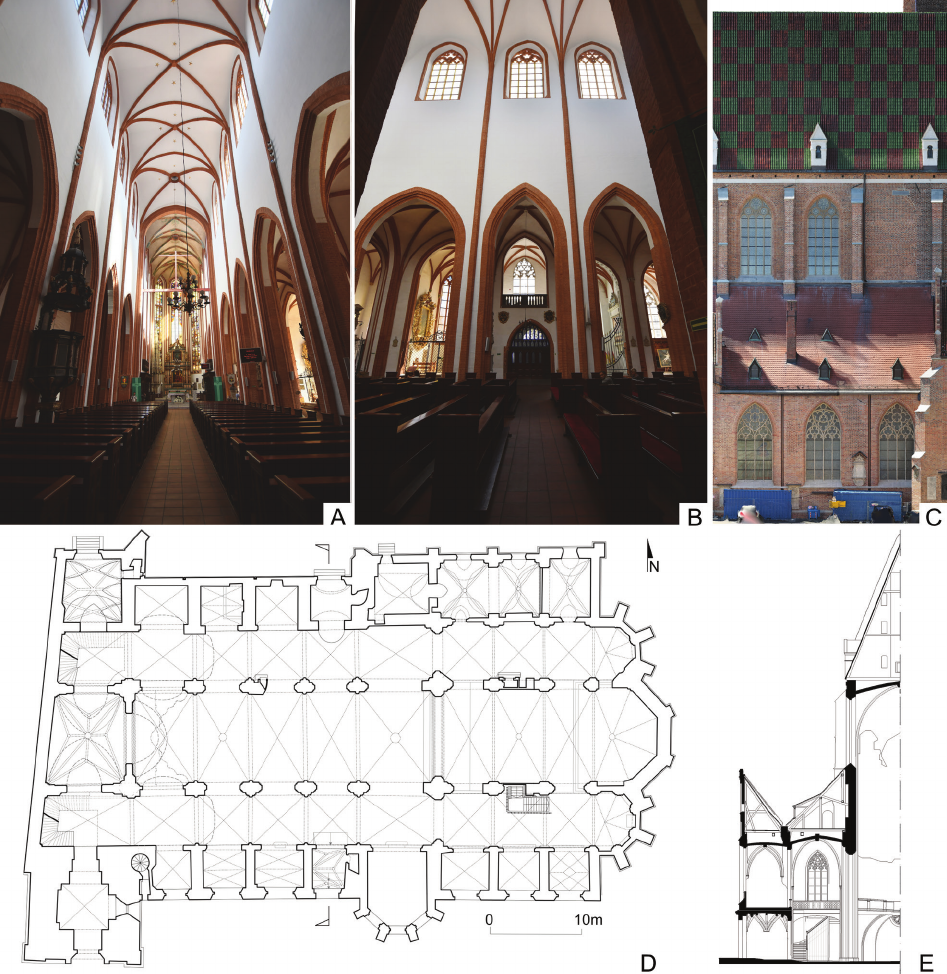
character of the external structure (Fig. 1). The high walls of
the nave are deviated from the vertical (at the height of the
vault support in bay 3 by approx. 14 cm), which indicates
a certain imperfection in the structure.
The research presented in this paper is part of a broader
eort spanning from 2021 to 2025, culminating in a mono
-
graphic study of the history of Wrocław’s parish church ar-
chitecture
1
. It has provided a more complete understanding
of the church’s design and the issues that led to three struc-
tural failures in the building. This contributed to studies on
load-bearing solutions in the church. The author’s primary
goal was to explain the causes of successive structural disas-
ters (especially the rst one), relate them to the problematic
solution of the ying buttresses, and search for justication
and analogies for such an unusual solution.
1
This monographic study is the author’s doctoral dissertation, pre-
pared under the supervision of Prof. Ewa Łużyniecka.
* ORCID: 0000-0003-1966-4926. Faculty of Architecture, Wro-
cław University of Science and Technology, Poland, e-mail: franciszek.
hackemer@pwr.edu.pl
14
Franciszek Hackemer
State of research
The structural system of St Elizabeth’s Church was the
subject of interest of Werner Güttel. The author included his
extensive description in the work of Ludwig Burgemeister
and Günther Grundmann. The cited researcher drew at-
ten tion to the very low point of embedment of the ying
buttresses. On this basis, he suggested that the original de-
sign of the nave was to be much lower. He interpreted the
niches in the wall above the arcades, visible in the attics
of the side aisles, as planned window openings. Güttel also
believed that the nave of the church was younger than the
chancel. Furthermore, he suggested that the sixth bay of
the nave collapsed even before the disaster of 1649, known
from written records (Güttel 1933, 74, 80). Hans Tintelnot
(Tin telnot 1951, 90–94) disagreed with the view that the
nave had been raised at a later date, as did Jakub Adam-
ski (Adam ski 2017, 397). Supporters of this thesis includ
-
ed Czesław Lasota and Jerzy Rozpędowski (Lasota, Roz-
pędowski 1980, 64) and Marian Kutzner, who believed that
the walls of the nave were raised to their full height after
the completion of the chancel (Kutzner 1996, 28). Stanisław
Fig. 1. St Elizabeth’s Church in Wrocław: A – view of the interior of the main nave towards the east, B – fifth bay from the west of the nave,
arcade (south), C – second, third, and fourth bays from the west in the north elevation (orthophotograph generated from a photogrammetric model),
D – plan, E – cross-section through the fifth bay from the west (photo and elaborated by F. Hackemer)
Il. 1. Kościół św. Elżbiety we Wrocławiu: A – widok wnętrza nawy głównej w kierunku wschodnim, B – przęsło piąte od zachodu nawy głównej,
ściana arkadowa (południowa), C – przęsła drugie, trzecie i czwarte od zachodu w elewacji północnej (ortofotografia wygenerowana z modelu
fotogrametrycznego), D – rzut, E – przekrój przez piąte przęsło od zachodu (fot. i oprac. F. Hackemer)

The issue of structural failures at St Elizabeth’s Church in Wrocław in the light of architectural surveys
15
Stulin, citing examples of many churches, mostly monastic,
noted that hiding the ying buttresses under the roofs may
have originated in Upper Rhine or Burgundy (Stulin 1982,
86). The majority of post-war researchers of the church did
not address the issue of structural solutions or treated them
very briey. They were more interested in the issue of the
order in which parts of the temple were built and, above all,
its stylistic analogies (Adamski 2014a, 395–411, 448–454;
Kutzner 1996, 19–52; Stulin 1982, 81–89). Little attention
was paid to the structural system itself.
Stulin postulated Upper Rhine, Alsatian, and southern
Ger man roots for the architectural style of St Elizabeth’s
Church, citing many examples of analogous solutions for
almost all elements of the building (Stulin 1982, 81–89).
Kutz ner linked the Wrocław parish church with the Cister-
cian church in Zlatá Koruna. This researcher even suggest-
ed that both buildings were erected by the same workshop
(Kutz ner 1996, 32, 33). Adamski, on the other hand, wrote
ex tensively about the style of the nave, agreeing with Stulin
on this matter and expanding on the concept of the Rhen-
ish stylistic origins of the nave (Adamski 2017, 402–410).
However, he agreed with Kutzner on the Czech origin of the
polygonal responds.
Methods
The research presented in this article is part of a broader
eort at St Elizabeth’s Church. It primarily involved the use
of stratigraphic analysis of the walls structure. Digital tools
were used to support the research, including photographic
documentation (including UAV), digital photogrammetry,
LiDAR scanning, and 3D modeling.
Based on 1691 photographs, a textured mesh model of
the exterior of the church was prepared using Agisoft Me-
tashape Pro. It served as the basis for CAD inventory draw-
ings and allowed for an in-depth analysis of the object. Cru-
cial parts of the church interior were scanned. The entire
building (including the interior) was inventoried in draw-
ings of the facades, oor plans, and cross-sections.
In the next step, an attempt was made to search for objects
that were analogous in terms of their structural solutions.
Churches from Germany, eastern France, the Czech Repub-
lic, and Silesia, built around the same time as St Elizabeth’s
Parish Church, were taken into consideration. The selection
focused primarily on buildings identied by researchers
on the basis of similar details and other features, located
in geographical regions considered crucial for the style of
the Wrocław church. Measurements and visual inspections
of elements belonging to the structural systems were car-
ried out in the selected buildings. 3D scans of crucial parts
were made, along with photographic and drawing documen-
tation. Their comparison allowed for the establishment of
connections with St Elizabeth’s Parish Church in terms of
structural solutions. The work was nanced by a minigrant
project for doctoral students at the Wrocław University of
Science and Technology
2
.
2
Project: “A aw in art or a trend worth the risk? The search for
the origins of the unusual structural design of St Elizabeth’s Church in
Wrocław” nr 50SD/0018/24.
Results
The structural design of the church
In order to compare the structure of St Elizabeth’s Church
with similar buildings, one must rst recognize its shape
and attempt to determine what inuenced its formation. The
church is a three-nave basilica with 11 bays. It is character-
ized by a very large dierence in height between the side
aisles and the main nave. From the oor level (original) to
the keystones, the height is 14.5 and 31 m, subsequently.
All aisles have rib vaults. The horizontal composition of the
force with which they press against the walls of the church
is taken over by buttresses and ying buttresses. The letter
were hidden under the roofs of the side aisles. This forced
them to be embedded low in the wall, which would have
been standard if it were not for the exceptional height of
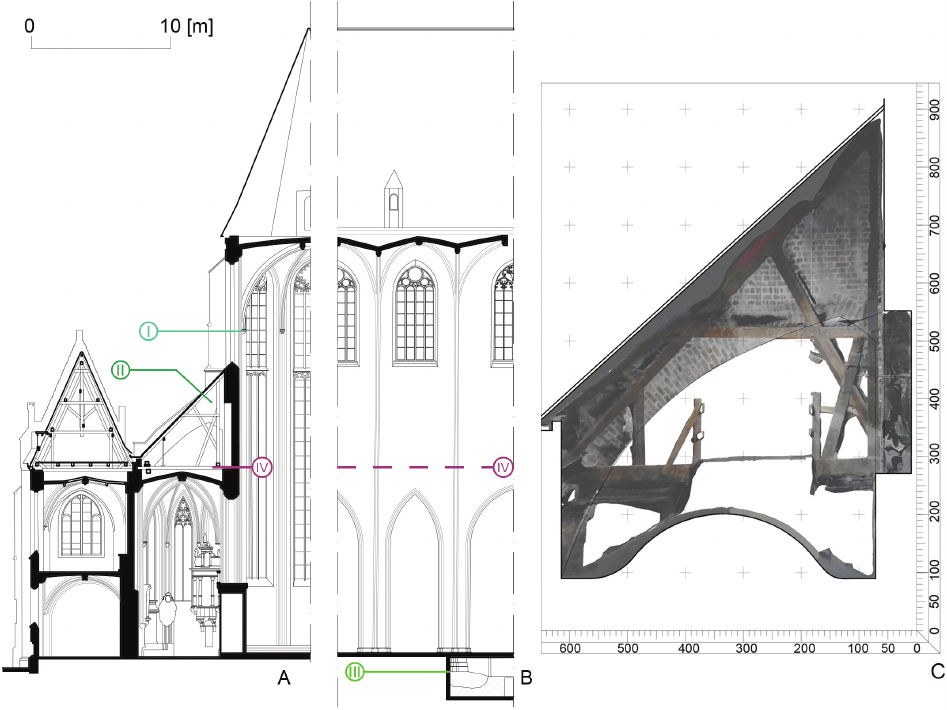
the clerestory. The wall of the nave above the roofs of the
side aisles is 9.90 m high. Its windows have sills just above
the edge of the roof and are approximately 7.00 m high. As
a result, the point of support for the vault is signicantly
(4.50 m) higher than the ying buttress that is supposed to
balance its thrust (Fig. 2). The ineectiveness of this solu-
tion is obvious. The eect of the unbalanced thrust forces
is the outward spreading of the walls, visible to the naked
eye. This problem prompted 19
th
-century conservators to
install a system of wooden anchors in the attic of the nave to
connect the walls to the roof truss. It is not entirely certain
whether this project was implemented, although a sketch of
this solution (APW no. 167) and some traces in the wall that
could testify to this have been made. The buttresses of the
church have varied shapes. Some of them are quarter-circu-
lar (south side: bays 4/5, 7–10 from the west; north side: bay
1/2 from the west), while others are pointed.
Buttresses adjacent to the arcade walls rise on the ying
buttresses. To some extent, they help balance the thrust forces.
As they do not continue below the arches, this is known as the
Gniezno system. Its use and connections with other build-
ings in Poland will be discussed in the section on analogies.
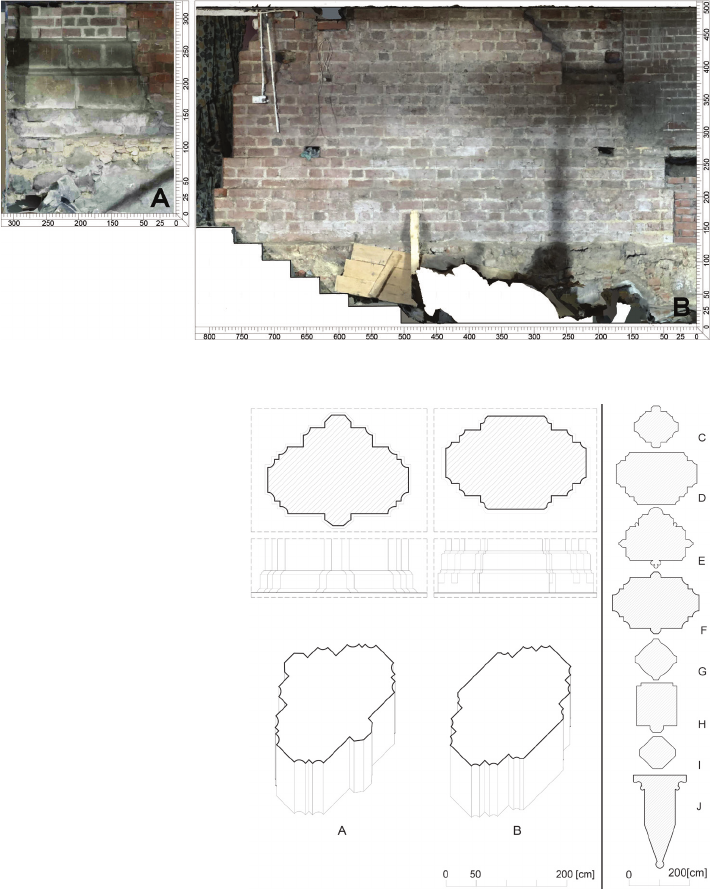
The foundations of St Elizabeth’s church are partially
visible in the church crypt (Fig 3). These include the foun-
dations of the fth pillar from the west on the north side of
the nave and large sections of the strip and isolated footings
supporting the arcades of the chancel. The foundations of the
nave dier signicantly from those of the chancel. They were
created by lling a narrow excavation with erratic stones
mixed with ceramic debric and light, yellowish lime mortar
(Fig. 3A). The lower parts of the chancel foundation were
also constructed in this way. However, brick isolated foot-
ings for the pillars were erected on the strip created in this
way (Fig. 3B). They are made of bricks measuring 25.5–27
× 11–13 × 8–9 cm in a emish bond. It is therefore clear that
the design of the church’s foundation was changed during
construction. It is worth noting here that at the same time,
a decision was made to raise the usable level of the chan-
cel by about 1.3 m above that designated for the nave. The
nave originally had a oor level of approximately 118.80 m
above sea level, while the chancel was 120.10 m above sea
level. The isolated footings of its pillars were covered with
a thick layer of sand (Lasota, Piekalski 1996, 17, 18).
16
Franciszek Hackemer
ply (quarter-circular) proled pilaster strips. In contrast,
there are no responds in the chancel. Instead, the pillars are
anked on both sides by pilaster strips, and the vaults rest on
corbels at their apex (Fig. 4).
Although the details of St Elizabeth’s Church were usu-
ally considered separately for the nave and the chancel, the
overall architectural character remained consistent for both
parts. The layout, proportions of the naves, consistency of
the structure, and the general design of the construction
system all contribute to a very uniform building. However,
Güttel noticed a stratigraphic division between the sanc-
tuary and the nave about 40 cm west of the chancel arch.
This junction of walls does indeed exist. In addition, the
researchers described the shape of the ying buttress arches
as one of the distinguishing features – quarter-circular in the
chancel and pointed in the nave (Güttel 1933, 74). This is
quite surprising, as this division is now completely illegible.
As already mentioned, quarter-circular arches are found in
both parts of the building. The alteration of these parts of
the church in the years after 1933, when the researchers’
The nave of the church was probably originally designed
as a hall church or, less likely, a pseudo-basilica or even
a basilica with a small clerestory. This is evidenced by trac-
es in the western bay of the church – capitals on the front
wall. This issue has been discussed in more detail by earlier
researchers of the church (Stulin 1982, 81–84; Kozaczew-
ska-Golasz 2015, 232; Adamski 2014a, 313–315). It is not
directly related to the topic of the paper, which focuses on
the ultimately realized structure. However, it seems that the
foundations are a common element of the unrealized and
realized nave. Most likely, they were built, at least in large
part, during the construction of the building according to the
original design. Regardless of the reconstruction of the spa-
tial layout of the originally planned nave, there is no doubt
that its foundations were adapted to a much smaller load.
The pillars of the church generally have a consistent plan,
which diers between the chancel and the nave only in terms
of vertical articulation. In both cases, the arcades are ne-
gatively proled in identical way. The responds of the nave
are half octagonal, on the side aisles superimposed on sim-
Fig. 2. Cross-sections of St Elizabeth’s Church in Wrocław: A – transverse (eastward through the eighth bay from the west),
B – longitudinal in the northward direction, C – flying buttress between the seventh and eighth bays from the west on the north side.
I – main nave vault corbel, II – flying buttress, III – original floor level (nave), IV – probable height of the walls established as part of the hall
concept (orthophotography generated from a photogrammetric model; compiled by F. Hackemer)
Il. 2. Przekroje kościoła św. Elżbiety we Wrocławiu: A – poprzeczny (w kierunku wschodnim przez przęsło ósme od zachodu),
B – podłużny w kierunku północnym, C – łuk oporowy między przęsłami siódmym i ósmym od zachodu po stronie północnej.
I – wspornik sklepienia nawy głównej, II – łuk oporowy, III – pierwotny poziom posadzki (korpus), IV – prawdopodobna wysokość przegród
arkadowych założona w ramach koncepcji halowej (ortofotografia wygenerowana z modelu fotogrametrycznego; oprac. F. Hackemer)
The issue of structural failures at St Elizabeth’s Church in Wrocław in the light of architectural surveys
17
study was published, would have been documented, and the
face of the wall shows no signs of any secondary changes.
Therefore, this should be considered a mistake.
Structural failures
The rst structural failure that left traces occurred most
likely during the construction of the church. This is evi-
denced primarily by the junctions of the walls in the fth
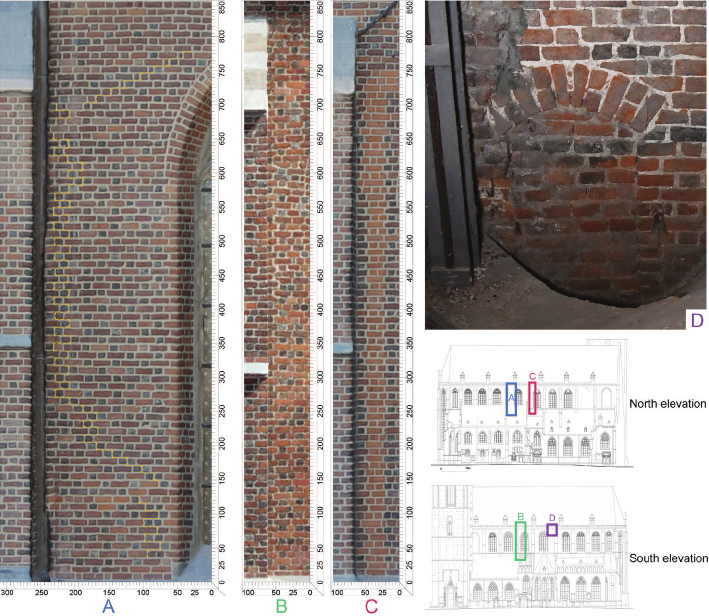
and sixth bays from the west. On the south wall of the nave,
a secondary lling of a previously existing gap in the wall
is visible from the outside. It runs vertically on the right
side of the fth buttress of the nave from the west (Fig. 5).
This junction proves that further sections of the wall were
added from the east to the existing wall of the fourth bay.
This addition reached approximately the line of the chancel
arch. This edge is marked primarily by the arch of the for-
mer entrance to the staircase, which existed until the 19
th
century in the sixth bay. It is accessible in the attic of the
main nave, above the vaults (Fig. 5). It was built along with
the wall in which it is located, but its eastern part rests on
a chiselled, previously existing brickwork. This seam is also
visible from the outside, above the mentioned arch and the
nearby buttress. In the exterior wall of the south nave, in the
attic, the seam between the walls can also be seen in the fth
and sixth bays.
On the north side, however, it is more dicult to nd
signs of the disaster. On the exterior of the main nave wall,
in the sixth bay from the west, there is a characteristic trace
of double brick headers. At the bottom, it runs from west
to east, vertically in the middle, and then returns westward
at the height of the window arch (Fig. 5). Double headers
occur quite often in the walls of the church. Their sequences
can be observed in places where two walls built in dierent
time meet. This is the case, for example, at the bottom of the
junction between the tower and the south aisle. The western
edge of the addition, which may have existed in the fth
bay, is now dicult to determine. This part of the church
was destroyed in a later disaster (1649) and rebuilt, which
may have obscured the traces. However, in the eastern part
of the fth bay, a vertical strip of machine-made bricks mea-
suring approximately 27 × 13 × 8.5 cm is visible in the wall,
which is the result of conservation treatments in the second
half of the 20
th
century (Il. 5). Perhaps originally there was
a wall seam in this place, which was rebuilt due to its poor
condition.
Another element reveals a secondary addition to the space
between the fourth and seventh bays from the west. It is
a massive arch in the thickness of the southern main nave
Fig. 3. Foundations of the pillars
of St Elizabeth’s Church
in Wrocław: A – nave,
B – chancel (orthophotos
generated on the basis of
a photogrammetric model;
elaborated by F. Hackemer)
Il. 3. Fundamenty filarów
kościoła św. Elżbiety we
Wrocławiu: A – korpus,
B – prezbiterium (ortofotografie
wygenerowane na podstawie
modelu fotogrametrycznego;
oprac. F. Hackemer)
Fig. 4. Pillars of St Elizabeth’s Church in Wrocław, plan, side view
of the plinth, and axonometric view of the shaft: A – nave,
B – chancel. Plans of pillars of formally similar churches:
C – Cistercian church in Złota Korona, D – Cistercian church in Lubiąż,
E – Our Lady before Tyn church in Prague, F – parish church
of St Peter and Paul in Legnica, G – St Maurice church in Soultz,
H – Dominican church in České Budějovice,
I – Cistercian church in Kaisheim, J – Cistercian church in Salem (body)
(compiled by F. Hackemer)
Il. 4. Filary kościoła św. Elżbiety we Wrocławiu, rzut, widok cokołu
i widok aksonometryczny trzonu: A – korpus, B – prezbiterium. Rzuty
filarów kościołów zbliżonych formalnie: C – cysterski w Zlatej Korunie,
D – cysterski w Lubiążu, E – Matki Bożej przed Tynem,
F – fara św. Piotra i Pawła w Legnicy, G – św. Maurycego w Soultz,
H – Dominikanów w Czeskich Budziejowicach, I – Cysterski
w Kaisheim, J – cysterski w Salem (korpus) (oprac. F. Hackemer)
18
Franciszek Hackemer
Fig. 5. Visible seams of the walls
of the nave in bays five and six
on orthophotos from
the photogrammetric model:
A – north wall, bay 6,
B – south wall, bay 6,
C – north wall, bay 5,
D – arch of the former staircase
opening in the south wall of
the nave (from the interior,
main nave attic)
(elaborated by F. Hackemer)
Il. 5. Widoczne styki murów
korpusu w przęśle piątym
i szóstym na ortofotografiach
z modelu fotogrametrycznego:
A – ściana północna, przęsło 6,
B – ściana południowa, przęsło 6,
C – ściana północna, przęsło 5,
D – łęk otworu dawnej klatki
schodowej w ścianie południowej
nawy głównej (od wnętrza,
strych nawy)
(oprac. F. Hackemer)
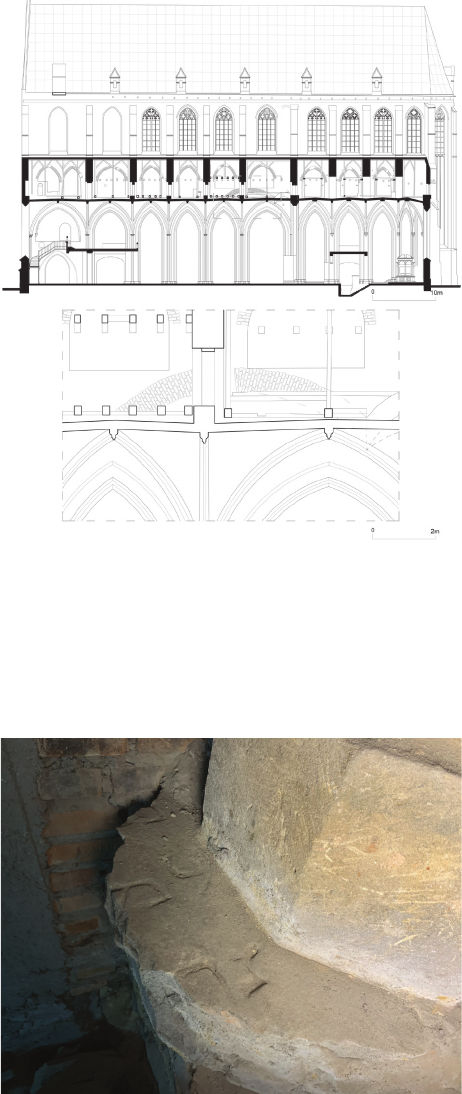
wall above the arcades. It was stretched between the fourth
and sixth pillars from the west (Fig. 6). It is clearly visible in
the attic of the south nave. It was built simultaneously with
the wall in which it is embedded, as evidenced by the lack
of traces of chiselling. This can only be explained by the
assumption that at the time of its construction, both pillars
that it connects already existed.
Traces in the church walls prove that the sixth bay and
part of the fth bay were built later than the adjacent parts
of the church on both sides. The assumption that this is the
result of the planned sequence of works is dicult to de-
fend. It seems relatively unlikely that most of the nave and
the entire chancel were erected to their full height, leaving
a free space between them. This part of the church most
likely collapsed and was rebuilt.
It is not easy to determine the exact time of the disaster.
Dating the construction of the nave and chancel of the church
has posed diculties for researchers and is quite broad. De-
termining the approximate time of their construction was
part of the research on the stratigraphy of the church and
will be presented in the author’s doctoral dissertation. How-
ever, some information should be mentioned. The rebuilt
walls were made in the emish bond from bricks measuring
25.5–27 × 12–13 × 8.5–9.5 cm on beige-colored lime mor-
tar, with visible lumps of calcium. These materials and tech-
nique are very similar to those used in the chancel and nave
of the church. The pattern of the seams in the northern wall
of the main nave, which can be seen from exterior, is quite
irregular (Fig. 5) and can probably be considered a direct
trace of the collapse. In contrast, in the south wall, the seam
is exactly vertical (Fig. 5). Therefore, it does not repeat the
line of the rupture. It should be assumed that at the time of
the disaster, the southern wall of the main nave had not yet
reached its full height. The vertical seams are remnants of
its construction within the fth and sixth bays with some
delay. The builders continued work on the adjacent bays,
bricking up the window area while rebuilding the damaged
parts. The collapse of the fth and sixth bays, which were
under construction at the time, most likely took place when
the northern wall of the main nave was already completed,
while the southern was still being raised by a clerestory.
The matzeva used as a oor slab under the base of the
fth pillar from the west on the north (Figs. 3, 7) is of par-
ticular interest. It is worth mentioning the year 1345, when
John of Bohemia abolished the 30-year-old inviolability
of the Jewish cemetery, allowing the use of tombstones in
the construction of the city’s fortications. These slabs ap-
peared in many buildings in Wrocław from that period (Wo-
dziń ski 1996, 197, 198). The matzeva under the pillar of
the nave could date from after 1345. This cannot be known
for certain, but it seems very likely. It is dicult to imagine
that after the collapse of two bays of the nave, the pillar was
de molished down to the oor slab and then rebuilt without
strengthening the foundations. It can rather be assumed that
the lower parts of these supports were built around 1345.
The disaster must therefore have occurred later. It should
also be remembered that at the time of the collapse of the
nave bays, the chancel had already been raised at least to
the level of the window sills.
The cause of the disaster can be attributed to the poor
foundation of the pillars. This is evidenced primarily by the
arch in the southern wall of the main nave, which relieves
the load on the pillar below it. The builders must have been
aware that the collapse of two bays of the nave was caused
The issue of structural failures at St Elizabeth’s Church in Wrocław in the light of architectural surveys
19
by excessive load on the supports. The foundations of the
nave (at least in large part) were most likely built as part of
the initially planned hall or pseudo-basilica structure. They
were designed to bear much smaller loads than those re-
sulting from the construction of the enormous height of the
nave (Fig. 2 IV). After the modication of the design, the
load on the foundations more than doubled. The collapse
of the church was caused by the insucient load-bearing
capacity of the foundations, not by the low setting of the
ying buttresses.
Another disaster that took place in St Elizabeth’s church
was the collapse of large sections of the nave and north aisle
on August 10–15, 1649 (Luchs 1860, 6). In 1627, the walls
of this part of the church were additionally burdened with
organs, which was considered to be the cause of the disaster.
Three northern pillars collapsed, along with the wall above
them and the vaults built on it (Güttel 1933, 80). Recon-
struction began immediately. Records from 1649 show pay-
ments to stonemasons, as well as fees for beer and food for
bricklayers and carpenters (Bimler 1936, 73). The names
of the masters leading the work are known: Hans Hentsch,
Friedrich Wol, and David Roch. On August 23, Joachim
Wolgang, the builder of the Legnica fortress, arrived in
Wrocław to inspect the church. The work was completed in
1653 (Güttel 1933, 82).
In 1856–1857, the interior was renovated under the su-
pervision of building counselor von Roux. Unfortunately,
this work caused another disaster. After removing the plaster
from the southern wall of the main nave, cracks were discov-
ered. It was decided that repairs were necessary, and wooden
supports were erected to secure the arcades. After removing
one of the pillars (the second from the west), the two adja-
cent pillars (the third and fourth from the west) collapsed,
bringing down the vaults of the south aisle. Reconstruction
work began again immediately. The nave of the church was
put into use as early as 1858 (Güttel 1933, 85, 86).
Analogous buildings
The structural systems of the analogous buildings cited
by previous researchers of St Elizabeth’s Church are not en-
tirely uniform. Of course, all of them are basilicas, but they
dier in the presence and location of ying buttresses.
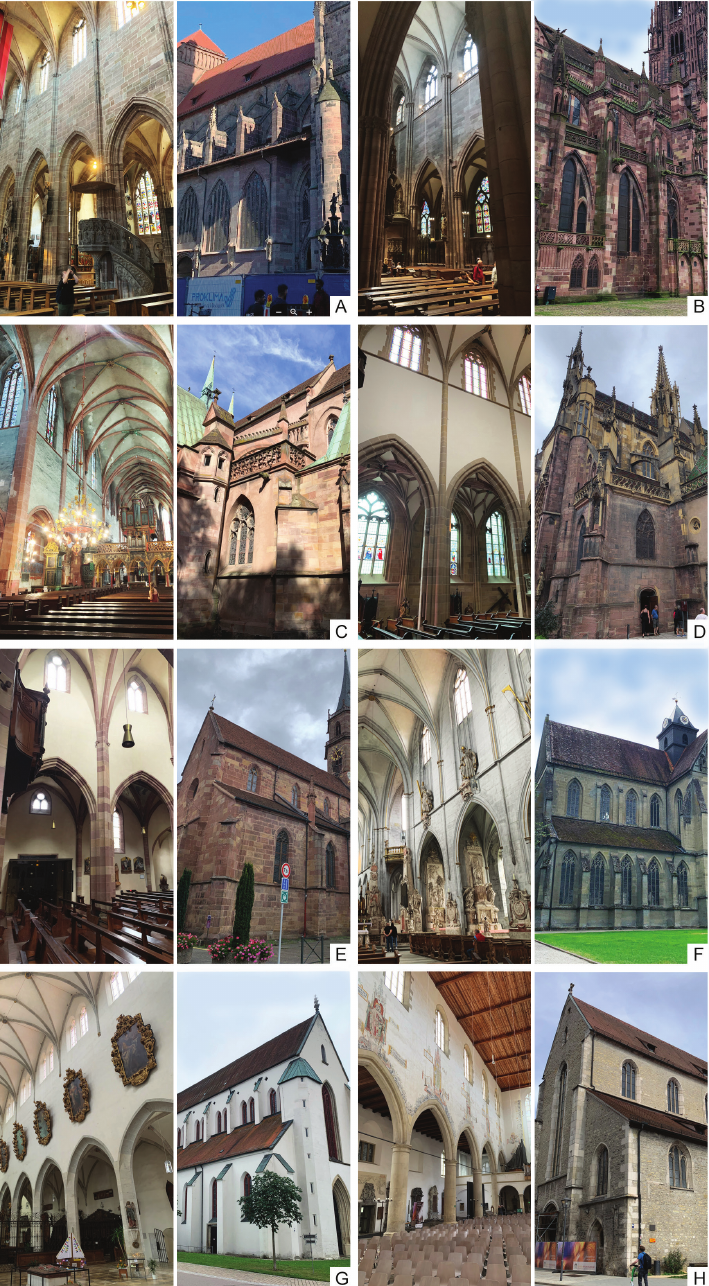
One of the most important characteristics of St Elizabeth
church external shape is location of the ying buttresses un-
der the roofs of the side aisles. This solution, or even aban -
donment of their use, was quite common in Germany and
France (Cistercian churches in Lahr, Kaisheim, and Salem,
the parish church in Soultz, Dominican and Franciscan
churches in Regensburg). The principles of shaping the ar-
ticulation of walls in interiors can also be linked to temples
with this solution. This refers primarily to leaving a plain
wall between the window sills and the arcading (St Pierre-
le-Jeune in Strasbourg, St Lawrence in Nuremberg, the pa-
rish church in Soultz, Thann and Nabburg, the Cistercian
churches in Lahr and Kaisheim, the Franciscan and Domin-
ican churches in Regensburg, St Martin’s in Colmar, and the
collegiate church in Freising). Some of these buildings also
feature a similar method of proling the arcades and articu-
lating the walls (Fig. 8). In terms of the overall appearance
and proportions of the interior, as well as to some extent the
details, there are numerous similarities between the parish
church in Wrocław and many buildings in the Upper Rhine,
Baden-Württemberg, and Bavaria. The monastery churches
of Kaisheim, Salem, and Regensburg stand out in this re
-
spect, as apart from certain internal similarities, they have
structures shaped in a synthetic, restrained manner. This is
more reminiscent of Silesian buildings than the fragmented
Fig. 6. The structrural arch in the southern arcade wall
on the cross-section through the south nave and a detail of the arch
(elaborated by F. Hackemer)
Il. 6. Łęk oporowy w południowej ścianie arkadowej
na przekroju przez nawę południową oraz detal łęku
(oprac. F. Hackemer)
Fig. 7. Fraction of a matzeva used as a floor slab under the fifth pillar
from the west in the north aisle (elaborated by F. Hackemer)
Il. 7. Fragment macewy użytej jako płyta posadzkowa
pod piątym od zachodu filarem nawy północnej (oprac. F. Hackemer)
20
Franciszek Hackemer
forms known from churches with other functions. Examples
include the churches of St Lawrence in Nuremberg, the ca-
thedral in Freiburg im Breisgau (originally a parish church),
St Martin in Colmar, and St Theobald in Thann (Fig. 8).
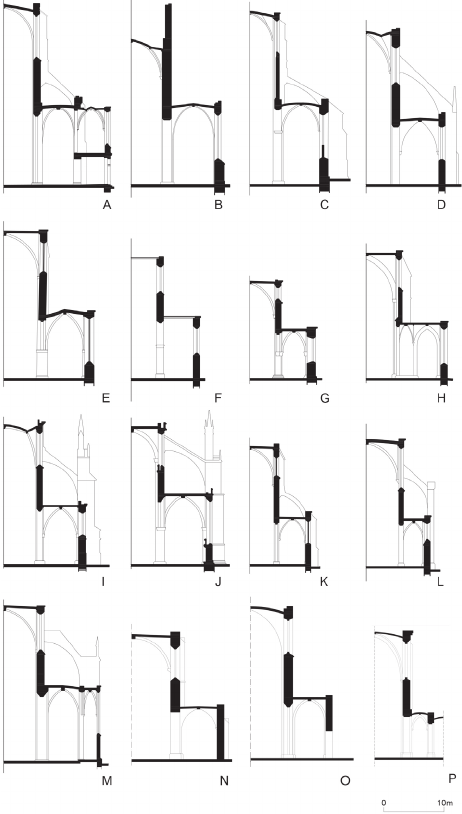
Most of the monastery churches mentioned here have
a conventional design (Fig. 9). Although usually hidden, the
ying buttresses are at the correct height thanks to the lower
clerestories. Sometimes (the nave in Salem), a system of
Fig. 8. Views of main nave
walls, external buttresses and
flying buttresses of churches
in Germany and France bearing
stylistic similarities to
St Elizabeth’s Church in Wrocław:
A – St Lawrence church in Nuremberg,
B – Freiburg Minster,
C – St Pierre-le-Jeune church
in Strasbourg,
D – St Theobald church in Thann,
E – St Maurice church in Soultz,
F – Cistercian church in Salem,
G – Cistercian church in Kaisheim,
H – Franciscan church in Regensburg
(photos by F. Hackemer)
Il. 8. Widoki ścian arkadowych
i zewnętrznego systemu przypór
i łuków oporowych kościołów
Niemiec i Francji noszących cechy
stylowego podobieństwa do fary
św. Elżbiety we Wrocławiu:
A – św. Wawrzyńca w Norymberdze,
B – katedralnego we Fryburgu
Bryzgowijskim,
C – St Pierre-le-Jeune w Strasburgu,
D – św. Teobalda w Thann,
E – św. Maurycego w Soultz,
F – cysterski w Salem,
G – cysterski w Kaisheim,
H – franciszkański w Ratyzbonie
(fot. F. Hackemer)
The issue of structural failures at St Elizabeth’s Church in Wrocław in the light of architectural surveys
21
extending the buttresses by adding them to the pillars of the
nave so that they reached the oor was used. Such solu-
tions were missing in the Dominican church in Regensburg,
which led to visible (more so than in St Elizabeth’s church)
deviations from the vertical. However, this is a much small-
er building. In contrast, in the Franciscan church in the same
city, no vaults were built at all, and the majestic basilica was
covered with ceilings. The tendency of monastery build-
ers to hide the ying buttresses naturally forced the use of
buttresses at the pillars or the reduction of the dierence in
height between the nave and the aisles and the overall scale,
or the abandonment of vaults.
Apart from southern German and eastern French buildings,
Czech churches were another source of inspiration mention-
ed in the literature. Undoubtedly, the proling of the pillars
in Zlatá Koruna, the design of the arcades in České Budě-
jovice, and the half octagonal responds in both buildings
bring to mind the temple in Wrocław. Kutzner considered
the churches in Zlatá Koruna and Wrocław to be the work
of a single workshop. Other researchers had dierent views
(Stulin 1982, 82–89; Adamski 2017, 402–410). Re sistance
to such a direct connection between the buildings seems en-
tirely justied. The proling of the pillars and the half oc-
tagonal responds may indeed give the impression of very
similar architecture, but it should be noted that the way in
which the loads are transferred from the vaults is com pletely
dierent. There are currently no ying buttresses in Zlatá
Koruna, but in the older, northern parts of the nave (the rst
three bays), they were probably located above the roof of the
aisle. They were only abandoned during the reconstruction
after the destruction of the temple (Mareš, Sedláček 1918,
203; Libal 2001, 576). It is dicult to nd any craftsman-
ship connections between the two buildings. The Cistercian
church is made of stone, which means that the method of
its construction clearly diers from that used in the brick
archi tecture of Silesia. In St Elizabeth’s parish church, a very
high level of masonry can be seen from the earliest stages of
its
construction. Cleanly laid junctions, a regular bonds, and
very
skillfully developed corners testify to the high level of
crafts manship at work there. Experienced bricklayers worked
there, which does not conrm the workshop connections be-
tween the two buildings. Similarly, the method of bricklaying
in the few brick sections (e.g., buttresses in the attics) of the
Dominican church in České Budějovice seems very distant
from the skilled bricklaying of St Elizabeth’s church.
Among Czech churches, a certain similarity can be seen
in the case of the Church of Our Lady before Týn in Prague,
whose overall spatial layout, scale and proportions are most
reminiscent of the architecture of Silesian parish churches
(Fig. 10). However, it is most likely younger than the church
of St Elizabeth (Čevonová Pařízková 2021, 31–39; Prix
2006), so as such it rather became part of a common trend
together with it. Inspiration from Silesian churches cannot
be ruled out either.
It is also worth mentioning the temples of northern Po-
land, where the so-called Gniezno system was used – the
cathedral in Gniezno, as well as the Cistercian temples in
Oliwa, Koronowo, Pelplin, and St James’s Church in Toruń
(Za chwatowicz 1934–1935, 187). However, all these tem-
ples have correctly balanced vaulting forces. Additional
parts based on ying buttresses provide further support for
the already correctly designed structure, unlike in St Eliza-
beth’s church. It is also worth noting here that Adamski re
-
cently argued convincingly that the architecture of Gniezno
Fig. 9. Sketches of structural systems on cross-sections of the churches
discussed: A – St Elizabeth’s church in Wrocław, B – St Stanislaus and
Wenceslaus church in Świdnica, C – St Nicholas’ church in Brzeg,
D – St Peter and Paul’s church in Strzegom (nave), E – Dominican
church in Regensburg, F – Franciscan church in Regensburg,
G – Cistercian church in Lahr, H – Cistercianchurch in Salem,
I – St Theobald church in Thann, J – Cathedral in Freiburg im Breisgau,
K – Cistercian church in Kaisheim, L – St Pierre-le-Jeune church
in Strasbourg, M – St Lawrence church in Nuremberg,
N – Dominican church in České Budějovice, O – Cistercian church
in Zlatá Koruna, P – Cistercian church in Lubiąż
(compiled by F. Hackemer)
Il. 9. Szkice systemów konstrukcyjnych na przekrojach poprzecznych
omawianych kościołów: A – św. Elżbiety we Wrocławiu,
B – św. Stanisława i Wacława w Świdnicy, C – św. Mikołaja w Brzegu,
D – św. Piotra i Pawła w Strzegomiu (korpus), E – dominikańskiego
w Ratyzbonie, F – franciszkańskiego w Ratyzbonie, G – cysterskiego
w Lahr, H – cysterskiego w Salem, I – św. Teobalda w Thann,
J – katedralnego we Fryburgu Bryzgowijskim, K – cysterskiego
w Kaisheim, L – St Pierre-le-Jeune w Strasburgu, M – św. Wawrzyńca
w Norymberdze, N – dominikańskiego w Czeskich Budziejowicach,
O – cysterskiego w Zlatej Korunie, P – cysterskiego w Lubiążu
(oprac. F. Hackemer)

22
Franciszek Hackemer
Cathedral has Silesian origins. The Gniezno system itself
was used not only in St Elizabeth’s Parish Church, but also
in Brzeg, at the Dominican monastery in Wrocław, and in
Głogów (Adamski 2014b, 161, 162). It therefore seems
that considering the aforementioned buildings in northern
Poland as the origin of the solutions used in the Wrocław
church is unjustied.
Extending the clerestory so high that the existing ying
buttresses do not balance the pressure of the vault is com-
pletely unusual. This should come as no surprise, given its
ineectiveness. Nevertheless, it was repeated in Silesia.
We refer here to the parish churches in Brzeg and Świdnica
(Fig. 9). In these buildings, the point of embedment of the
buttresses is vertically distant from the point of pressure of
the vaults (in Brzeg by approximately 6 m). What is parti-
cularly interesting is that in the 16
th
century, the original
vaults in the church in Świdnica collapsed as a result of
a re and were rebuilt much lower, creating a kind of fake,
blind clerestory (Pilch 1978, 266, 267). The reason for this
decision by the builders is unknown, but perhaps they were
aware of the danger posed by the previous solution.
Cross-sections of the churches in Brzeg and Wrocław
reveal similar proportions and structural design principles
(Fig. 9). However, the church dedicated to St Nicholas dif-
fers signicantly in terms of detail, with particular emphasis
on octagonal pillars without proling, which is why it was
rarely mentioned in the context of its Wrocław counterpart.
Nevertheless, it seems that the similarity in the design of the
external structure as a synthetic form of a basilica without
visible ying buttresses, together with the very high clere-
story, indicate at least some inspiration from the Wrocław
parish church. This is possible because the construction of
Fig. 10. Views of arcades, external buttresses and flying buttresses of Czech churches, bearing stylistic similarities to St Elizabeth’s Church
in Wrocław: A – Cistercian church in Zlatá Koruna, B – Dominican church in České Budějovice, C – Franciscan church in Jindřichův Hradec,
D – Our Lady before Týn church in Prague (photo by F. Hackemer)
Il. 10. Widoki ścian arkadowych i zewnętrznego systemu przypór i łuków oporowych kościołów czeskich, noszących cechy stylowego
podobieństwa do fary św. Elżbiety we Wrocławiu: A – cysterskiego w Zlatej Korunie, B – dominikańskiego w Czeskich Budziejowicach,
C – franciszkańskiego w Jindřichův Hradec, D – Marii Panny przed Tynem w Pradze (fot. F. Hackemer)
The issue of structural failures at St Elizabeth’s Church in Wrocław in the light of architectural surveys
23
the temple in Brzeg began when St Elizabeth’s Church was
almost completed, and continued into the 15
th
century (Kutz -
ner 1980, 82).
A detail very similar to the forms known from St Eliza-
beth’s parish church was used in the church of St Peter and
Paul in Legnica. We are talking about a comparable form
of the plinth with half octagonal pilasters and arcade pro-
ling. As a result, the parish church in Legnica seems to
be the closest Silesian analogy to the building in Wrocław,
despite the striking dierence in the proportions of the inte-
rior. However, this discrepancy results from a change in the
design at a late stage of construction. This could have tak-
en place after 1341 (Adamski 2017, 495), perhaps around
1360–1378 (Stulin 1982, 90). Thus, it could have occurred
after the collapse of part of the nave of St Elizabeth’s parish
church. This event must have had an impact on other build-
ings in Silesia. It is possible that the structural failure of the
Wrocław church inuenced the change in construction plans
in Legnica. Under this assumption, the Legnica nave would
have been designed as an almost exact copy of the nave of
St Elizabeth’s Church, but after a revision of the concept, it
was limited to the form known today. Due to the very uncer-
tain dating of both events, this assumption must remain in
the realm of speculation, but it is worth considering.
Conclusions
The research revealed that most of the foundations of the
nave were built during the implementation of the hall de-
sign. The weak rubble trench foundation, which was intend-
ed to bear the load of much lower walls, was not suitable for
the partitions that were actually built. This was the cause of
the rst (and most likely the next two) disasters at St Eliza-
beth’s Church. This is conrmed by the absence of any such
incidents in the chancel, whose structure is essentially a rep-
etition of the solutions used in the nave, with the exception
of the reinforcement of the foundations.
The direct workshop connections with the church in Zlatá
Koruna postulated by Kutzner are not conrmed by the ma-
sonry and structural system of either building. It would be
more appropriate to agree with Stulin and Adamski that
these churches belong to a group of buildings inspired by
the achievements of workshops from the Lake Constance
and Rhineland regions. However, it seems that Kutzner’s
ge neral observation regarding the “monastic” character of
the architecture of the Wrocław parish church is justied to
some extent. Churches whose external structures are syn-
thesized, compact basilicas with hidden (or no) ying but-
tresses are mostly monastic buildings. Their inuence on
St Elizabeth’s Church led Kutzner to conclude that the aim
of the Wrocław patriciate was to erect a temple that stood
in opposition to the aristocratic traditions of gothic cathe-
dral architecture. According to the researcher, the inspira-
tion from Cistercian architecture was primarily due to the
characteristic spirituality of the bourgeoisie (Kutzner 1975,
64–68; 1996, 50–52). The question of the validity of such
a far-reaching statement cannot be resolved solely through
the architectural research presented here.
The assumption made by Güttel, according to which the
nave was initially supposed to be lower, is not conrmed by
the masonry. There is no doubt that the pointed niches in the
arcade walls in the attics of the side aisles are a structural
element and not the remains of windows. Their purpose is
to reduce the weight of the wall by reducing its thickness
in areas of lesser structural importance. Perhaps the build-
ers did indeed originally plan to extend the window area
slightly lower. This is a quite plausible explanation for the
dierence in the height of the starting points of the vaults
and the ying buttresses. However, we have no evidence to
conrm this.
The unusual design of St Elizabeth’s Church structure
was most likely not a mistake, but rather an attempt to
achieve a specic expression of external and internal archi-
tectural form. This, in turn, was probably a reection of the
architecture emanating from centers, especially monaster-
ies, on Lake Constance and the Rhine, although obviously
adapted to local conditions and possibilities. The inuence
of monastic buildings from these regions (probably through
the mediation of the less distant temples of Regensburg or
Lubiąż) should be attributed to the concealment of the ying
buttresses under the roofs and the overall synthetization of
the structure. At the same time, the builders of the Wrocław
temple sought to achieve a majestic height for the nave,
which led to a rather dangerous but ultimately stable solu-
tion. Interestingly, it was adopted in Silesia in the churches
in Brzeg, Świdnica, Legnica (partially) and Strzegom.
The analyses conducted concerned the buildings most
frequently mentioned in the literature and those located in
their regions. In further research on St Elizabeth’s Church,
other buildings erected around 1300 in Central and Western
Europe should be subjected to similar analyses, with partic-
ular emphasis on the Baltic temples of Hanseatic cities. It is
also necessary to conduct in-depth research on the architec-
ture and construction of other 14
th
-century Silesian parish
churches, with particular emphasis on the church in Legni-
ca. Its comprehensive stratigraphy would allow for verica-
tion of the concept suggested here regarding the modica-
tion of the design after the disaster at St Elizabeth’s Church.
References
Archiwum Państwowe we Wrocławiu [APW], Paraa św. Elżbiety we
Wrocławiu, “Renovation der Kirchen, Denkmäler, Kapellen”, sygn.
167.
Adamski, Jakub. Gotycka architektura sakralna na Śląsku w latach 1200–
1420. Towarzystwo Naukowe Societas Vistulana, 2017.
Adamski, Jakub. “Między Strasburgiem a Wrocławiem. O genezie artyku-
lacji elewacji wewnętrznych śląskich bazylik XIV wieku.” In Procesy
przemian w sztuce średniowiecznej. Przełom – regres – innowacja –
tradycja. Studia z historii sztuki, edited by Rafał Eysymontt and Ro
-
muald Kaczmarek. brak wydawcy, 2014a.
Adamski, Jakub. “Śląska geneza gotyckiej katedry gnieźnieńskiej.” Rocz-
nik Historii Sztuki 39 (2014b): 157–75.
Bimler, Kurt. Quellen Zur Schlesischen Kunstgeschichte. Heft 1. Kommis-
sionsverlag Maruschke & Berendt, 1936.
24
Franciszek Hackemer
Čevonová Pařízková, Jana. Týnský Kostel a architektura poděbradské doby.
Univerzita Palckého, 2021.
Güttel, Wener. “Die Elisabethkirche” W Die Kunstdenkmäler Der Pro vinz
Niederschlesien. Tl. 2. red. Ludwig Burgemeister, Günther Grund -
mann, 73–154. Breslau: Wilhelm Gottlieb Korn Verlag, 1933.
Kozaczewska-Golasz, Hanna. Halowe kościoły z XIII wieku na Śla̢sku. O-
cyna Wydawnicza PWr, 2015.
Kutzner, Marian. “Kościoły bazylikowe w miastach śląskich XIV wieku.”
In Sztuka i ideologia XIV wieku: Materialy Sympozjum Komitetu Nauk
o Sztuce Polskiej Akademii Nauk Warszawa, 29 i 30 Listopada 1973 r.
[Kunst Und Ideologie Des 14. Jahrhunderts], edited by Piotr Skubi-
szew ski. PWN, 1975.
Kutzner, Marian. “Technika i organizacja budowy gotyckich kościołów miej-
skich na Śląsku na przykładzie realizacji kościoła św. Mikołaja w Brze-
gu.” Acta Universitatis Nicolai Copernici. Nauki Humanistyczno-Spo-
łeczne. Zabytkoznawstwo i Konserwatorstwo 9, no. 112 (1980), 75–125.
Kutzner, Marian. “Kościół św. Elżbiety we Wrocławiu na tle śląskiej szko-
ły architektonicznej XIV w.” In Z dziejów wielkomiejskiej fary: wro-
cławski kościół Św. Elżbiety w świetle historii i zabytków sztuki, edited
by Mieczysław Zlat. Wydawnictwo UWr, 1996.
Lasota, Czesław, and Jerzy Piekalski. “Kościół św. Elżbiety we Wrocławiu
w świetle badań archeologicznych.” In Z dziejów wielkomiejskiej fary:
wrocławski kościół św. Elżbiety w świetle historii i zabytków sztuki,
edited by Mieczysław Zlat.Wydawnictwo UWr, 1996.
Lasota, Czesław, and Jerzy Rozpędowski. “Pierwotny kościół paralany
św. Wawrzyńca i św. Elżbiety we Wrocławiu”. Prace Naukowe Insty-
tutu Historii Architektury, Sztuki i Techniki Politechniki Wrocławskiej,
nr 13 (1980): 61–6.
Libal, Dobroslav. Katalog gotické architektury v České Republice do husit
-
ských válek. Unicornis, 2001.
Luchs, Hermann. Die Denkmäler der St. Elisabeth-Kirche zu Breslau: mit
einem lithographirten Grundriss der Kirche. Ferdinand Hirt’s Königl.
Universitäts-Buchhandlung, 1860.
Łużyniecka, Ewa. “The Use of 2D Vector Studies as an Architectural
Research Stage in the Era of Digital Spatial Models.” Architectus 71,
no. 3 (2022): 79–86. https://doi.org/10.37190/arc220308.
Mareš, František, and Jan Sedláček. Soupis památek historických a umě lec-
kých v politickém okrese krumlovském. Archaeologická kommisse pri
Ceské akademii císare Frantiska Josefa, 1918.
Pilch, Józef. Zabytki architektury Dolnego Śląska. Zakład Narodowy im.
Ossolińskich – Wydawnictwo, 1978.
Prix, Dalibor. “Związki śląsko-czeskie w architekturze średniowiecznej
w okresie panowania Luksemburgów.” In Śląsk. Perła w Koronie Czes -
kiej. Trzy okresy świetności w relacjach artystycznych Śląska i Czech,
edited by Mateusz Kapustka, Jan Klipa, Andrzej Kozieł, Piotr Osz cza-
nowski, Vit Vlnas. Narodni Galerie, 2007.
Stulin, Stanisław. Kierunki kształtowania się stylu regionalnego architek-
tury sakralnej na Śląsku 1320–1370.PhD diss., Politechnika Wrocław-
ska, 1982.
Tintelnot, Hans. Die Mittelalterliche Baukunst Schlesiens. Holzner-Verlag,
1951.
Wodziński, Marcin. Hebrajskie inskrypcje na Śląsku XIII–XVIII wieku. To-
warzystwo Przyjaciół Polonistyki Wrocławskiej, 1996.
Zachwatowicz, Jan. “Katedra gnieźnieńska. Gotycki system konstrukcyj-
ny.” Biuletyn Historii Sztuki i Kultury, nr 3 (1934–1935): 180–195.
Streszczenie
Problematyka katastrof budowlanych kościoła św. Elżbiety we Wrocławiu w świetle badań architektonicznych
Tematem artykułu są nietypowe rozwiązania gotyckiego systemu konstrukcji zastosowane w kościele św. Elżbiety we Wrocławiu i ich potencjalny
wpływ na katastrofy, jakie miały miejsce w jego korpusie. W pracy przedstawiono wyniki badań stratygracznych murów kościoła, dzięki którym wy-
kazano, że jego korpus zawalił się po raz pierwszy najpewniej jeszcze podczas budowy. W późniejszym czasie ta część fary ulegała podobnym katastro-
fom jeszcze dwukrotnie. Celem autora było ustalenie powodów tych katastrof (zwłaszcza najsłabiej rozpoznanej – pierwszej), określenie ich związków
z nietypowym umieszczeniem łuków oporowych oraz odnalezienie przyczyn zastosowania takiego rozwiązania. Przedstawił też przykłady analogicznych
rozwiązań systemów przenoszenia obciążeń wśród obiektów Śląska, Alzacji, Górnej Nadrenii, Badenii-Wirtembergii, Bawarii oraz Czech. Ostatecznie
ustalił, że przyczynę katastrof stanowiła zmiana koncepcji przestrzennej kościoła z halowej czy pseudobazylikowej na bazylikową o bardzo wysokiej stre-
e okiennej już po wykonaniu jego fundamentów. Nietypowe położenie łuków oporowych okazało się do pewnego stopnia skuteczne, choć praktycznie
pozbawione analogii wśród obiektów z terenów rozważanych dotychczas jako źródło inspiracji dla fary wrocławskiej. Wykluczono postulowane wcze-
śniej związki warsztatowe z kościołami czeskimi. Za przyczynę użycia kłopotliwego systemu konstrukcyjnego przyjęto chęć wzniesienia nawy o wyjąt-
kowej wysokości przy jednoczesnej inspiracji konkretnymi obiektami architektury znad Jeziora Bodeńskiego i Renu, głównie o funkcjach klasztornych.
Słowa kluczowe: łuki oporowe, sklepienia, architektura gotycka, kościół św. Elżbiety, Wrocław