
2010
Nr 2(28)
The Central Museum of Textiles has been on the cul-
tural map of Łódź since 1950s and it constitutes an exam-
ple of a museum institution which is in constant progress
and still enriches its offer. CMW (Polish acronym of the
name) is an exceptional institution – not without reason
it was created in the greatest Polish centre of the textile
industry called ‘Polish Manchester’, and in this way it
emphasizes the specic character of Łódź by document-
ing its industrial tradition, with time becoming a distinc-
tive feature of the city. Also the location of the museum is
symbolic – it is housed in the town’s oldest, attractively
located factory consisting of many departments whose
architecture is so extraordinary that it is nowadays con-
sidered as one of the most beautiful examples of the in-
dustrial architecture in Poland.
As a public institution, the Central Museum of Textiles
plays many important roles and fulls various tasks, has
cognitive functions adapted to changing requirements and
expectations and it encourages visitors to enjoy its rich
program in many dimensions. Each visitor may choose
their own sightseeing path by focusing attention on build-
ings, their construction, architecture, details… A visitor
can admire the size and space of old factory halls, can
look at machines and try to understand how they func-
tioned and can learn about history and development of
the textile industry. Finally, visitors can admire fabrics,
fashion and works of art; also, in the near future it will
be possible to enjoy the virtual world of technology and
art… All this can be found in that one exceptional place
on famous Piotrkowska Street.
The rst important element is the very place – location
of the museum, factory buildings and the adjoining, de-
signed by us, wooden architecture open-air museum. Due
to their unique character, these structures in themselves
became almost museum exhibits in the developing city
tissue. The fact that these buildings were revitalized and
they are now housing cultural institutions contributed to
the protection of the original factory buildings and typical
wooden residential buildings, which are so important in
the history of the industrial city. Thus, the museum was
turned into the symbol of great respect for the continuity
of local urban and architectural tradition, which can be
felt by visitors who analyze in detail the particular struc-
tures.
Another cognitive element is the method of adapting
interiors and their adjustment to the new requirements.
Wandering around halls, oors and buildings, visitors
have a unique opportunity to see the typical 19
th
century
factory interiors – their construction, overall dimensions
and characteristic space, they can witness the subsequent
phases of the textile factory development, imagine what
old workplaces looked like and thanks to the presentation
of textile industry tools and equipment, they even have
the chance to observe the production process. By docu-
menting the textile industry development, the museum
became the guardian of memory about the industrial rev-
olution times, about the era of formation of Łódź and its
factories and it is also the witness of history, thought and
technology development and the witness of human labour
as well…
The enormous factory halls also perform another role
– they constitute the place where various contemporary
and historic objects of art are exhibited and presented. In
this way, the museum combines the industrial tradition of
the city with modern times, while the exhibitions held in
the museum provide the visitors with a chance to admire
an exhibit, work of art, effect of artist’s thoughts and ac-
tivities. The museum is proud to have one of the great-
est collections of industrial and metric fabrics as well as
printed, harness and Jacquard ones, it has numerous ready
patterns, and it archives projects, sketches, technical
drawings and photographs of fabrics. The collections are
an excellent source of knowledge about textile technolo-
Teresa Mromlińska*, Anita Luniak*
Modernization and development
of the Central Museum of Textiles in Łódź
*
Grupa 33_03, Wrocław.
134 Teresa Mromlińska, Anita Luniak
gies, current changes in pattern designing of fabric and
the process of formation of trends and fashions. The most
prestigious periodic exhibition to be held in the CMW is
the International Fabric Triennale, which has been organ-
ized since 1972 and it is the oldest and greatest interna-
tional exhibition of this type that promotes a unique fabric
and ‘the art of the yarn’ in a broader context. The museum
designated the area of seven thousand square meters in to-
tal for the exhibition purposes and there have been almost
one thousand exhibitions organized since the museum
was established…
The exhibitions organized in the museum give the
visitors a chance to see the exhibits, while in the design
of the modernized boiler room we suggest a new way of
presentation and a different interior organization. The
main purpose of the adaptation of the building is to cre-
ate an original space and a modern structure based on the
21
st
-century technology which is addressed to a new re-
cipient.
Apart from its statutory activity, the CMW also con-
stitutes an attractive ‘active’ public space, resilient cen-
tre, adapted to various creative and cultural activities. It
hosts numerous events and periodic presentations – start-
ing from the graduation banquet of Academy of Art stu-
dents, fashion shows such as Fashion Week, Comics and
Games Festival and nally symposia, workshops and con-
certs.
It has taken many years to introduce these changes
and create the present state of the CMW… This institu-
tion developed gradually but consequently and thus it was
turned into a signicant institution and the centre of great
importance to the Polish culture.
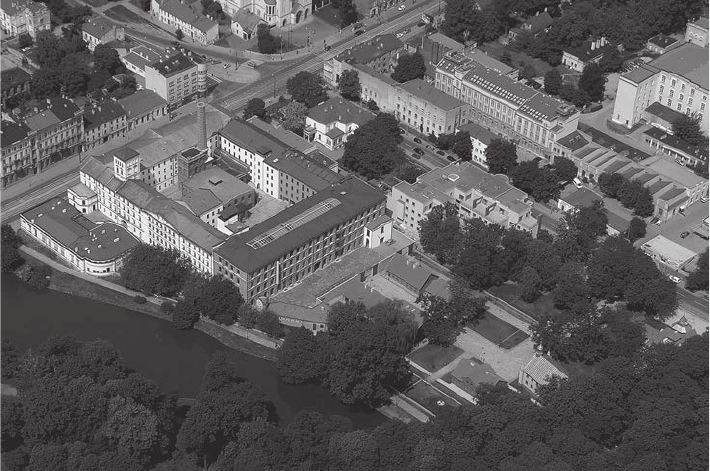
The history of factory buildings, which are now part
of the CMW, was started in 1828 when Ludwik Geyer
arrived there from Saxony to occupy the attractive areas
situated on Piotrkowska Street, the main road of the de-
veloping city, on the corner of Górny Rynek next to the
picturesque pond created on the Jasień River. In the years
1835–1837 the rst monumental factory building was
constructed on the scale never seen before; this building
was the seat of a spinning mill, weaving mill and printing
house. The structure was based on the English solutions; it
was given 26-axis white plastered classicist façade, which
was not typical of factory construction and it contributed
to its name: ‘White Factory’, which expression is in use
until today.
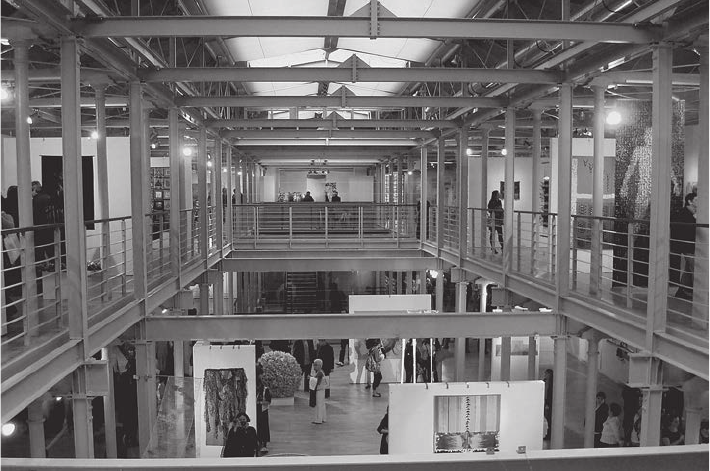
In 1838 the boiler room was built along with the north-
ern wing and ten years later the southern wing – a four-
storey spinning mill situated by the pond on the Jasień
River and nally in 1886 the eastern wing was built of
bricks, which signicantly differed from the others. In the
meantime, the buildings were complemented by addition-
al extensions and elements thanks to which an original
complex of various buildings was created, equipped with
water and dust towers situated around romantic, irregu-
lar and cobwebbed yard. Through such evolution, a dense
quadrilateral building complex was formed – so untypical
as for a textile plant and unusual for the Łódź city tissue,
making the factory similar to a fortress. The Geyer’s fac-
tory is a unique place also for other reasons: in the factory
boiler room the rst steam machine in Łódź was installed;
in was here that the rst smokestack in town was built,
which is part of Piotrkowska Street scenery until today;
nally, in 1907 the factory bathhouse was erected – this is
one of the rst buildings of this type in Łódź and the only
one preserved until now.
After the Second World War and the nationalization,
the former Ludwik Geyer factory was used by the Cotton
Industry Works ‘Eskimo’ until 1990; in the end this plant
was declared bankrupt, which took place in 2002.
The idea of establishing a museum of textiles ap-
peared already in 1946. In 1952 at the Museum of Art, the
Weaving Department was created which after 1955 got its
own seat and in 1960 the independent Museum of Weav-
ing History was created; in 1975 the name was nally
changed into the Central Museum of Textiles.
Fig. 1. The Central Museum
of Textiles and Open-air Museum
of Łódź Wooden Architecture.
Photo by Wiesław Stępień
Modernization and development of the Central Museum of Textiles in Łódź 135
In the oldest buildings of the spinning mill and Gey-
er weaving factory a new city institution was created in
the 1950s – the Weaving Department of the Museum of
Art. The location of the cultural institution on the terri-
tory of the unique factory complex, which had unusual
historical and artistic values, was symbolic and gave an
opportunity for favourable functioning and perspective
development of the museum. Reconstruction of build-
ings in the early post-war years resulted in the fact that
the museum in a way became a pioneer in adapting in-
dustrial structures for exhibition functions – the process
of rebuilding the western wing was probably the rst in
Poland and doubtless one of the rst post-industrial ar-
chitecture reconstructions for museum purposes in the
world.
The CMW gradually took over the next buildings –
in the western and southern production buildings with
wooden structures, huge and spacious exhibition halls
were arranged successively, while in the southern building
– technical rooms, workshops of textile preservation and
conference rooms. The buildings were connected and the
transport between particular storeys and functional places
was provided. The rst reconstruction and building works
started in the oldest western wing already in 1958 but
they were limited to the adaptation of big production halls
for the needs of the museum exhibitions; thanks to this
reconstruction, the most valuable building structure was
preserved and the old ‘gloomy’ appearance of authentic
halls with low storeys and a dense system of wooden sup-
ports was maintained in one-room interiors. In the years
1962–1964, according to the project of Professor H. Ja-
worowski, the northern building was rebuilt; in the years
1972–1975 in the northern corner of the western building
a new entrance with a hall and open staircase was created
and in 1981 works in the boiler room started; in the years
1989–1992 the southern wing was reconstructed.
After the liquidation of ‘Eskimo’ Factory in 2002, the
CMW received the last element of buildings – a devas-
tated eastern wing which was not used for 12 years and
whose revitalization was supposed to be an opportunity
to integrate and modernize the whole complex of post-
factory museum buildings.
In March 2002 the authorities invited tenders to pre-
pare an architectural concept of the eastern wing adapta-
tion and land development. On winning the rst prize, we
made projects which included rebuilding of the eastern
wing along with the modernization of adjacent parts of
the buildings, adaptation of the old factory bathhouse, and
arrangement of the inner yard according to the project of
Open-air Museum of Łódź Wooden Architecture as well
as land development of the museum surroundings. The
realization of our projects from 2002 brought about a di-
versity of the program & space offer and museum exhibi-
tion; at the same time, it became an example of a different
approach to revitalization of industrial buildings. Revital-
ization of the eastern wing and bathhouse constitutes an
example of creative rebuilding of structures subordinated
to the exposition of the industrial character of interiors;
a planned conversion of the boiler room into the multi-
media museum is the example of making use of interiors
deprived of original elements in order to introduce new
functions and stylistics, while the open-air museum is the
result of relocation which constitutes a method of wooden
structures protection which are endangered in the city
space development.
The basic purpose of the museum modernization was
the improvement of the functional system of the complex,
enrichment of its program offer and nally integration
of buildings with the surroundings, which we managed
to obtain by means of exposing the eastern wing to the
rst-rate role as well as the representative and entrance
function. The change in the entrance location resulted in
the change of the urban arrangement and functional re-
organization of the whole museum; in this way, it gained
a representative entrance zone and not existing earlier
yard at the side of the city park, which was enriched
Fig. 2. Open-air Museum
of Łódź Wooden Architecture
136 Teresa Mromlińska, Anita Luniak
with the Open-air Museum. Thanks to the new space or-
ganization, the open-air museum became an integral part
of the museum – the rst ‘exhibit’ which a visitor can
admire.
At the turn of the 1950s, Krystyna Kondratiukowa –
the founder and rst director of the museum – wanted to
create the open-air museum of city wooden architecture in
the part of the nearby park. This idea was made concrete
in the 1970s, however, its realization took place at the be-
ginning of the next century…
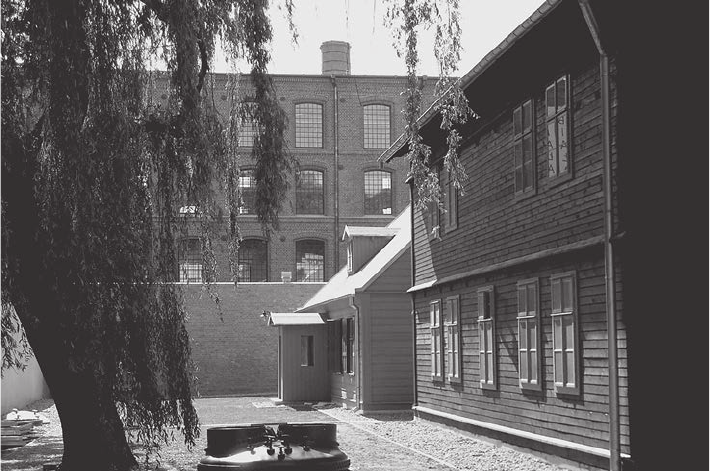
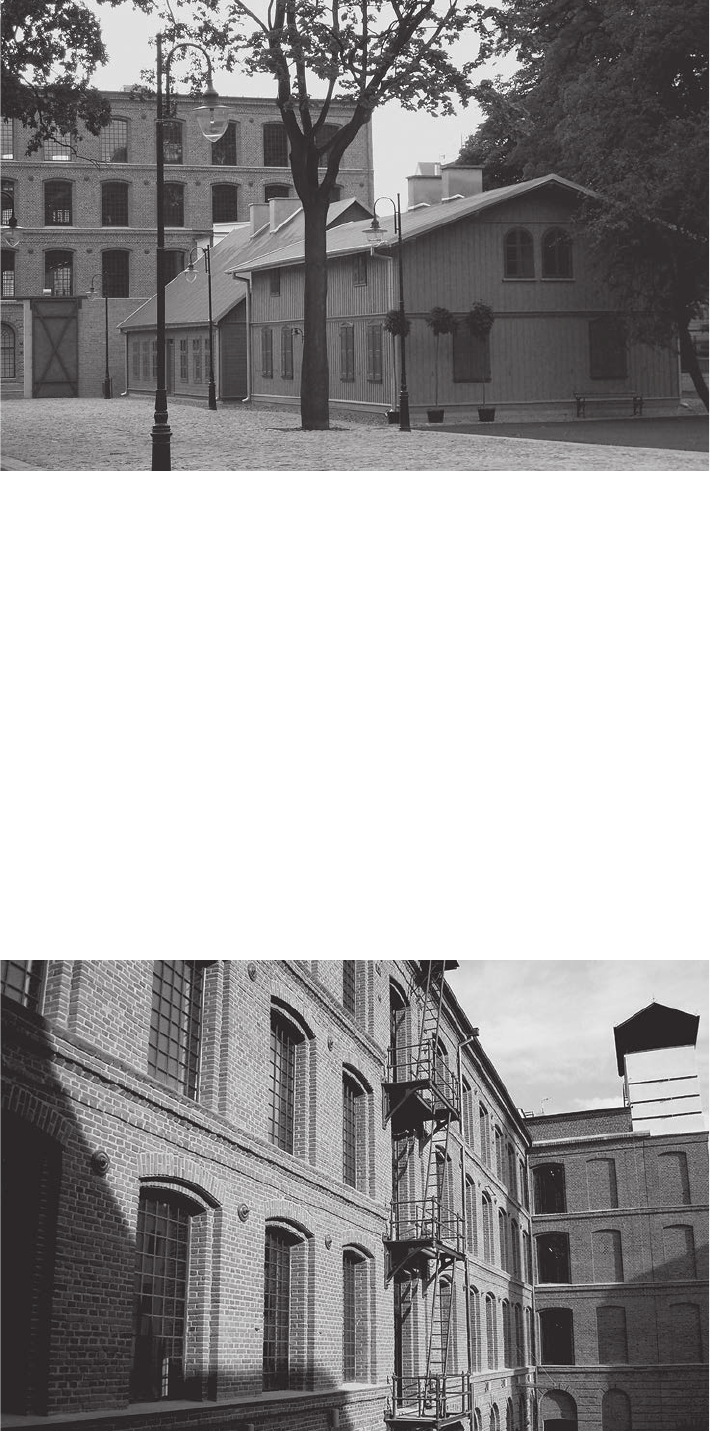
The imperative idea of creating the open-air museum
was protection and preservation of the 19
th
-century typical
wooden houses and sacral buildings which were becoming
rarer and rarer in Łódź agglomeration. In the open-air mu-
seum there were eight various historical buildings translo-
cated from Łódź and the surroundings: ve living quarters
for weavers and clothiers (19
th
century), a summer villa
(beginnings of the 20
th
century), a church (former Protes-
tant church) and a tram stop (beginnings of the 20
th
cen-
tury). This complex, which was created by us, constitutes
the rst in Poland open-air museum of urban architecture.
Wooden buildings were dismantled, restored and then put
together again on the territory of the open-air museum;
the original appearance and facades colours as well as
the arrangement of rooms were restored (which dispelled
a myth that the 19
th
-century Łódź was grey and dirty).
The objects in the open-air museum are not only exhibits
but they are adapted to full different functions; they cre-
ate a space which is live and attractive for the visitors.
St. Andrew Bobola Church was consecrated once again
and wedding ceremonies already take place there. The
complement of the open-air museum development con-
Fig. 3. Open-air Museum
of Łódź Wooden Architecture
Fig. 4. Eastern building
and dust tower from the side
of the inner yard direction
Modernization and development of the Central Museum of Textiles in Łódź 137
stitutes a revitalized former big factory bath house where
a museum coffee shop is supposed to be situated; the area
was enriched with the exhibition of historical technical
devices and elements of small architecture creating in this
way picturesque places which became photographic loca-
tions willingly visited by people.
The space composition of the open-air museum refer-
ring to historical urban structures of Łódź is based on the
rectangular net which additionally arranges the space and
emphasizes a newly created entrance zone. The element
which organizes the space arrangement is the longitu-
dinal axis of the museum buildings on which particular
elements of the urban structure were placed – the inner
yard with the boiler room, museum buildings, entrance
square with the old bathhouse and the complex of historic
wooden buildings of the open-air museum situated along
the so called ‘Łódź Street’.
According to our project, in the eastern wing which
adjoins the cast-iron yard there is a representative entrance
hall whose favourable location ensures a convenient en-
trance to the exhibition spaces of the southern and western
wing as well as to the conference rooms and a technical
equipment room which are situated in the northern build-
ing. Thanks to this rebuilding, it is now possible to use
all the buildings situated around the inner yard; walking
through particular rooms it is possible to observe the yard
from different perspectives.
The main goal of rebuilding the eastern wing was to
maintain the industrial character of the building according
to its original purpose; therefore, the imperative aim was
to make an impression as if the rooms were one-space
and open interiors of the old production halls. Intensica-
tion of this impression results from the en suite arrange-
ment of rooms and application of transparent and neutral
glass divisions which allow the visitors to see particular
rooms; visitors who walk on the open staircase hung in
the atrium, can observe the interiors from new perspec-
tives. Thanks to these new spaces it was possible to make
a spectacular exhibition of fabrics of great sizes, which
was earlier difcult to make.
Adaptation of the boiler room shall complete the revi-
talization of ‘White Factory’ buildings complex and enrich
the exhibition space as well as ensure additional transport
inside the complex. There will be a hidden surprise in
the brick boiler room – the external cover shall include
rooms and objects which will form the protection for illu-
sions and a peculiar theatre hidden in the inner labyrinth
spaces. A visitor is supposed to become a participant of
spectacles which are created from virtual ‘articial’ real-
ity, performances generated on the basis of arranged light
scenes and interactive projections. The hero of spectacles
shall be the textile industry – its history, development,
buildings and factories, equipment and machines as well
as the product, effects of their work and man’s activities
– thread, weft, fabric and nally a work of art… A specta-
tor will be able to learn about all these things thanks to
the multi-media presentations, computer programs, logic
games; he will be able to familiarize himself with the
CMW collections and see the work of huge production
devices.
The most satisfying for us is the fact that the eastern
wing received the title ‘The Best Interior of the Year 2008’
and the adaptation of the museum and the open-air mu-
seum got a honorable mention of Polish Union of Urban-
ists in 2009 and a special prize of Polish Urbanists Asso-
ciation in Łódź in the category of ‘Newly created public
space’.
Thanks to the revitalization, which has been carried
out in recent years, the museum became an important
place not only because of the unique collections docu-
menting the history of the textile industry or collections
of art, but it also became an attractive public space where
concerts, shows and ceremonies important for the city are
organized. The new space created new perspectives and
we do hope that the Central Museum of Textiles will be
developing in future…
Fig. 5. Two-storey exhibition hall
in the eastern wing;
Triennial of Fabric 2010
138 Teresa Mromlińska, Anita Luniak
Przebudowa i rozwój Centralnego Muzeum Włókiennictwa w Łodzi
Centralne Muzeum Włókiennictwa, mieszczące się w zabudowaniach
tzw. Białej Fabryki Ludwika Geyera w Łodzi, stanowi przykład stale
rozwijającej się i wzbogacającej swa ofertę jednostki muzealnej. Muzeum
dokumentuje rozwój przemysłu włókienniczego, eksponuje elementy hi-
storycznego wyposażenia technicznego oraz promuje sztukę współczesną
związaną z tkaniną unikatową, łącząc w ten sposób industrialną tradycję
miasta ze współczesnością.
W artykule zaprezentowano projekty autorskie z lat 2002–2010,
dotyczące rewitalizacji Centralnego Muzeum Włókiennictwa, dzięki
którym zostały zmodernizowane dziewiętnastowieczne zabudowania,
zaadaptowana d. łaźnia zakładowa oraz powstał Skansen Łódzkiej
Drewnianej Architektury Miejskiej. Nadrzędnym celem przekształceń
było poszerzenie roli muzeum jako miejsca kontaktu z kulturą, sztuką
i zabytkami, miejsca inicjującego różnorodną działalność, stworzenie
interesującej wieloelementowej przestrzeni publicznej oraz wykreowanie
nowych relacji między muzeum a otoczeniem.
Key words: Łódź, museum design Słowa kluczowe: Łódź, projekt muzeum