2010
Nr 2(28)
According to anthropology we perceive culture as
a reality transformed by man – as a result of civilizational
achievements – changed physically, and through symbolic
representation – modeling opinions, notions and feelings.
The world is completely lled with culture which is
presents directly or indirectly in all potential locations.
The sensory perceptions and their psychological effects
have numerous interpretations. Where is the border be-
tween nature and culture?
The technological development which changes per-
ception – the borders of art (architecture) cease to be de-
nitive. The discussion shifts from clear distinctions (is/
is not) to relative gradation (is to what extent) or even
– to parametric simulations (is in what conditions, what
determines that).
William Mitchell’s essay titled Antitectonics: The
Poetics of Virtuality
1
[4] can be considered a manifesto
of new culture. The author describes the context of cre-
atice activities by establishing barriers which architecture
crosses while absorbing achievements of the informatiza-
tion era. He demonstrates the contacts between old and
new meanings, scopes and forms of human activity. He
undermines the sense of continuing the deliberations on
the basis of the tectonic architecture advocated by Ken-
neth Frampton
2
[1].
The key terms taken from Semper’s (1951) descrip-
tion of a building such as earthwork, interior, framework
or detail
3
[6] – which dened the traditional tectonic in-
terpretation become useless in the virtual environment.
Mitchell claims that the „traditional” theory stubbornly
sticks to schemes which are inadequate for the matter
*
Warsaw University of Technology, Faculty of Architecture, Com-
puter Aided Architecture Design, Division of Architecture Design.
1
W.J. Mitchell, Antitectonics: The Poetics of Virtuality, [in:] The
Virtual Dimension: Architecture, Representation, and Crash Culture,
J. Beckmann (ed.), New York 1998, p. 205.
2
K. Frampton, Studies in Tectonic Culture, Cambridge 1995,
p. 12.
3
G. Semper, The Four Elements of Architecture and Other Writings,
New York 1951, p. 40.
which is described. He notes that virtual space carries
Miesa van de Rohe’s less is more to a provocatively ano-
rexic extreme.
The antitectonic debate begins with the presentation
of the controversy regarding the scope of space avail-
able for creation. The author undermines the conviction
of the physical character of architectural structures. The
interpretation through understanding of the relationships
between the elements which bear and which are borne,
gravitational logic of the building and proportions were
enough to develop the basis of ancient theories. The pos-
tulates of durability and utility are easy to accept when
the only way to execute ideas is to create a building of
wood or stone. Due to computers the sensations can be
perceived in a new, exible visualization environment
whose features require the theory to be remodeled.
The author accuses Frampton of division between
a strict physical interpretation and virtuality of explana-
tions. The architectural reality described in the essay IS
virtual in a genetic sense. It comprises both forming ex-
periments and workshop procedures as well as fully func-
tional spatial environments.
The technological development of the media alters the
sense of artistic creation. The notion of becoming known
abruptly becomes relevant covering not only physical sub-
stance but information effects of human activities as well.
Mitchell stresses that the digital representation is not for
architecture a matter of choice by a natural consequence
of popular use of CAD. Each project which is prepared
with the use of computers is executed in a virtual environ-
ment. This fact can be ignored or utilized. Basically – as
an inexpensive testing eld which, with the application of
proper equipment, simulates the conditions of use. More
generally – as an individual area of expression.
An architectural work gains in the electronic represen-
tation an aspect of ‘performance’. Depending on applied
means – what is generated is the signals transferred to
specic senses or complex simulations, including oat-
ing VR visualizations which can evoke sensations similar
to natural and automatically generated prototypes. Due to
Jan Słyk*
Antitectonics – architecture for information society
192 Jan Słyk
the functionalities of digital media the record of an archi-
tectural idea is more and more like music score. The com-
position of space, like a composition ofmusic, records the
limits of freedom marked by the author. Electronic crea-
tion provides for multiplication of representations and
generates space for interpretation. As a result of provid-
ing access to spatial perception simulation tools even the
buildings which have not been existing for years in the
real world gain new realizations by extension or parallel.
CAD-CAM technologies transfer the problem of dig-
ital creation to the real scale. Mitchell sees the le-to-
factory architecture as the culmination of the electroni-
zation process. A monitor image, printout, prototype and
building – create a hierarchy corresponding, on the one
hand, to the complication of equipment, and on the other
hand, to the skills of perception of complex environments.
The growth of possibilities of creating results from the
relationship between two coupled trends: the standards of
space description offered by editors are much more ef-
cient than the technologies of production of materials.
The fact that it is easy to form, deform, divide and join
complex objects on the computer screen stimulates the
appetite of authors as well as effort of CAM technology.
Furthermore, the procedures available to the numerically
controlled machines become the basis for software devel-
opment. Through mutual interaction – a new myriad of
procedural ‘archetypes’ develops. The language of archi-
tectural representation absorbs the structures taken from
the world of machines.
Apart from technical and functional consequences,
the informatization of architecture causes effects regard-
ing the non-usability sphere. The symbolic representa-
tion, which is the basic feature of cultural identity, gains
through the computer a totally new context. Mitchell de-
scribes by listing the features of a façade and interface.
The morphology of an architectural object is traditionally
a closed artifact. The variation of physical features and
evoked sensations, which is possible as a result of the in-
teraction of such factors as lighting and aging, provides
a very narrow predictable range of states. After crossing
the threshold of interactivity or at least reactivity we face
the solutions bringing a building closer to the function-
ality which is typical of an information transmitter. The
information capacity of a surface/cubature represented
digitally depends only on the author’s decision. The sat-
uration of space with sensors creates conditions for the
development of changeability and makes a building re-
act in real time to the users’ actions. They extend the real
architecture and provides for dynamic transformation of
the exterior/symbols. A building can change its ‘façades’
performing arbitrary instructions (of the author) or react
in the way coded in the sequence of interactions.
The antitectonic conception is a deliberate exaggera-
tion. The virtual debate between Mitchell and Frampton
does not need to be assessed as being right or wrong. What
is striking, however, is the pertinence of observations re-
garding changes which occurred in the domain of space
development after computers became universally popular.
The information revolution rst of all affected the
design tools. The invention of CAD resulted in the di-
chotomy of representation mentioned in the essay. The
traditional architectural graphics (plans, cross sections,
elevations) is the domain of professionals, whereas the
computer models create the basis of universal perception
of a work before development. On the one hand, this is
because of photorealism and, on the other hand, applica-
tion of dynamic techniques of presentation.
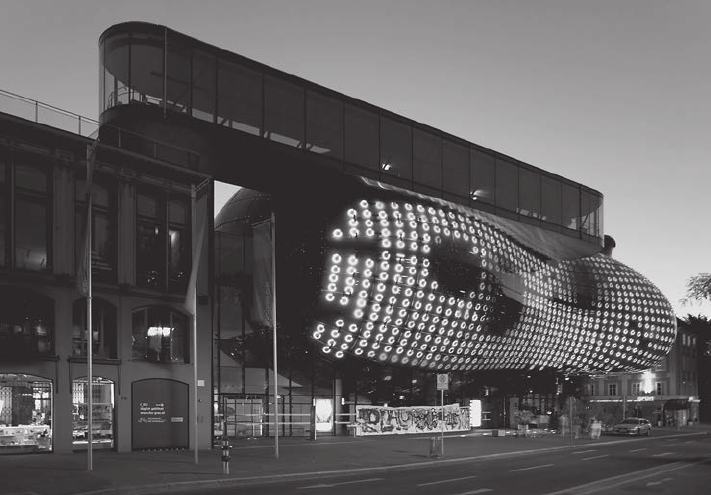
The building of Kunsthaus in Graz designed by Peter
Cook and Colin Fournier and its media façade designed
by Realities:United architects is one of the rst examples
of deliberate use of digital representation of architectural
ideas. A virtual model of its surrounding, which was used
to verify the external form of the museum, was developed
already at the conception stage, creating the basis of the
Fig. 1. Kunsthaus Graz,
designed by Peter Cook,
Colin Fournier.
Media façade designed
by Realities:United.
Photo by author
Antitectonics – architecture for information society 193
application which constituted a virtual perception plat-
form to be further developed in the following year. A user
connected with the Internet moves around Graz with the
use of a marker on the map. Software reacts dynamically
displaying an image of the building from a specic point.
The broad scope of functionality enables the users not only
to ‘go around’ the museum but also to admire the pano-
ramic view – for instance from the top of Schlossberg.
The functionality of the virtual observation window is not
limited to the geometric representation. After download-
ing the video in an appropriate format, the media façade
displays animation in the way which is analogous to live
exposition in the city. Due to the digital representation –
the message of architecture coupled with visual art is per-
ceived by the viewers in a non-material form.
Apart from the creation stage the digital extensions
can regard construction and use. The information infra-
structure enables the buildings to react to changing condi-
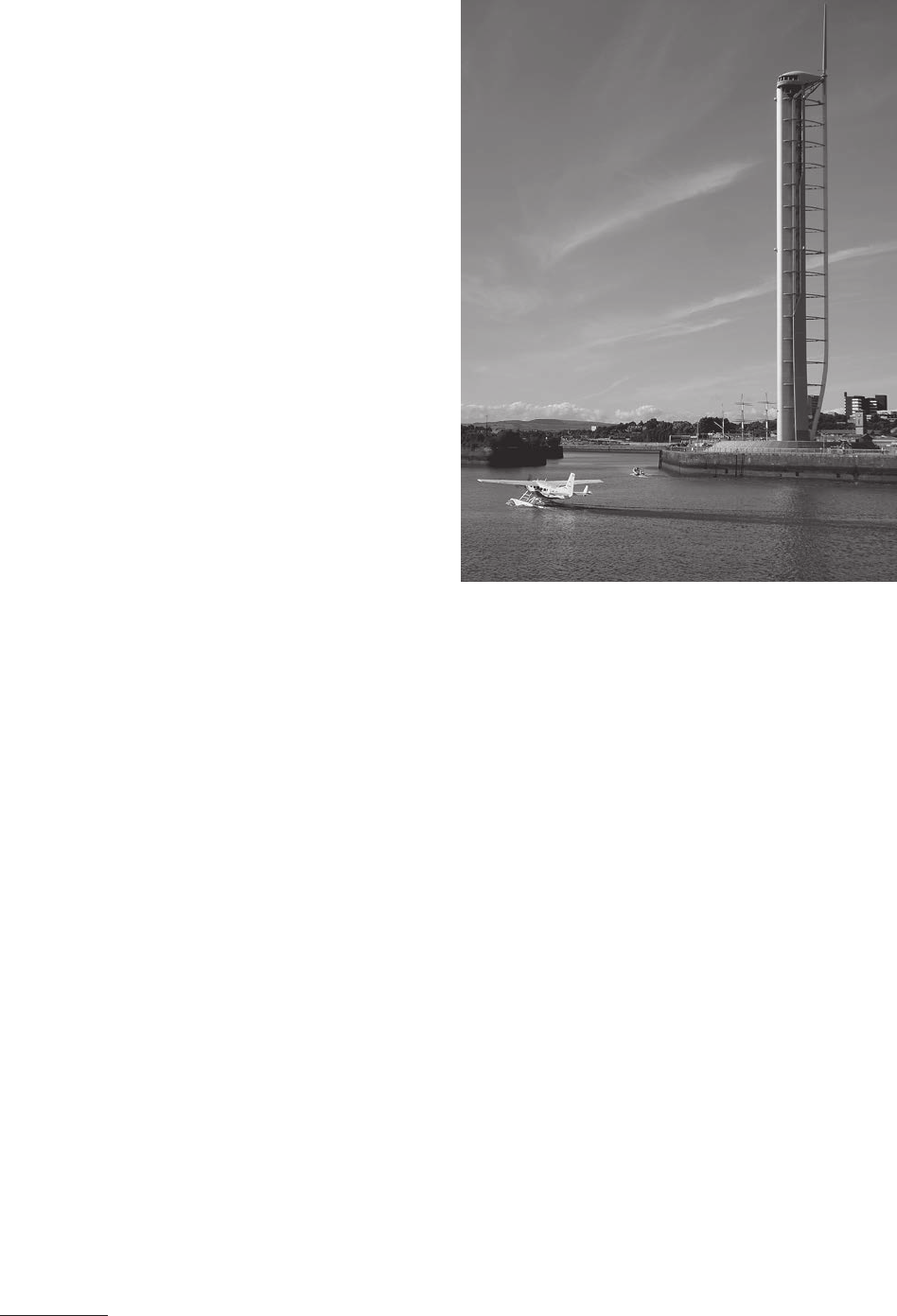
tions. Glasgow Tower designed by Richard Horden which
was built in 2001 in Glasgow Science Center realizes this
scenario by changing the relations to its surrounding. The
form of the structure results from optimization achieved
by minimizing the resistance to air. The shape and the lo-
cation as well as the dimensions of its elements are the
result of the compromise between esthetic preferences
of the author and the results of computer simulation. The
originality of the solution regards the assumption that the
exposure to side forces remains constant. A network of
sensors measure the wind force and software anticipates
the changes of weather conditions. As the digitally con-
trolled engines work continuously this over 130 meters
tall structure can rotate and assume the best position to-
wards the wind in real time which assures the best static
and dynamic conditions for operation of its elements.
The next step towards digitalization brings architec-
ture to the state in which the exterior of a work resembles
the morphology of a live organism. The introduction of
sophisticated actuators to the system and the complication
of scenarios included in the software enable not only the
movement of the equipment elements but also changing
the shape and dimensions of buildings.
MuscleBody built by HyperBody under supervision
of Kas Oosterhuis is a ‘home’ reacting to the activities
of its users’ or the players – as the author prefers to call
them
4
[5]. The external skeleton is composed of 26 ex-
ible FESTO actuators stretching the membrane made of
Lycra bers. The sensors xed inside transmit signals
regarding the presence and movements to the computer
that controls the pressure in the ‘muscle’ construction. In
effect – the form of shelter changes as the users’ activities
change. This is accompanied by modulation of transpar-
ency of the walls (stretched surface becomes more trans-
parent) and by sound coming from the loudspeakers xed
in the structure.
It is difcult in the light of classical denitions to iden-
tify the scenarios of virtual reality with works of architec-
4
K. Oosterhuis, Swarm Architecture II, [in:] Verb Natures, Barcelona
2006, p. 188.
ture. It is, however, worth noting that apart from the form
of materialization they do not differ much from traditional
works. Both the techniques of modeling and the reception
conditions remain unchanged. What is more – the cyber-
space creation often is the domain of architects educated
to perform in real world.
The analysis of the design of the New York Stock Ex-
change building and the virtual Guggenheim Museum de-
signed by Asymptote leads to the realization how far the
limits of spatial correspondence can be stretched. Separate-
ly we perceive the interiors and exteriors, zoning and the
proportions of rooms as in the real world. The social func-
tions of the interiors remain unchanged though thanks to the
simulated presence we contact the users located thousands
of kilometers away. Interestingly, the authors abandon the
‘gravitational’ requirements of navigation so that the shift
between reality and virtual reality is unnoticeable.
The changes in saturation of space with information
are signicant. The traditional means of coding – form,
detail, icon, relief – gain multiple representations. The
Stock Exchange building changes its decor depending on
the securities market uctuations. The museum adjusts its
interior to selected forms of exhibitions.
Has computerization changed architecture in compli-
ance with antitectonic model? The development of space
as traditionally the most durable form of symbolic repre-
sentation follows the trail marked earlier by other branch-
es of art. The analogies in the cultural context prove use-
ful not only in respect of background description but also
expected directions of growth.
Fig. 2. Glasgow Tower – in Glasgow Science Center,
designed by Richard Horden. Photo by J. Woźniak
194 Jan Słyk
Lev Manovich [3] lists ve criteria dening the new
media in the sphere of contemporary artistic activity
5
.
1. Numerical representation provides new media ob-
jects with a mathematical denition and a possibility of
manipulation in algorithmic processes.
2. Modularity enables their analysis by hierarchical
disintegration – from basic of pieces information (bits)
all the way to complex structures that comply with the
principles of logic.
3. Automation, which is the result of application of
digital tools, affects the development of new techniques
of creation, including a new interpretation of intention-
ality.
5
L. Manovich, Język nowych mediów, Warszawa 2006, p. 91.
4. Variability distinguishes groups of representations
or scenarios included in objects of art that are evoked in
the reception process.
5. Transcoding – so far available to a limited extent
(e.g. music transcription) regards all new media objects;
enables the translation of transfer at the fundamental level
and transformation into any form of artistic expression.
Manovich’s principles ideally correspond to Mitchell’s
essay. The use of the term “new media” in space develop-
ment activities enables the interpretation of architectural
works in the context of cultural changes which take place
as a result of information revolution. The works which are
created in CAD environment uzyskują digital representa-
tion. The modular structure of data enables the creation
of databases and knowledgebases regarding a building as
well as integration of specialist information in a coherent
environment (BIM). Automation, variability and trans-
coding dene the contemporary architectural concepts
even better than works of visual arts and music which
constitute the basis of Manovich’s thought. The projects
executed by the synthesis of effectiveness are called by
Branco Koralevich [2] performative projects
6
– those
which best perform assigned assumptions. The automatic
processes of simulations regarding geometry, static work
and dynamics of ows result in solutions which are the
synthesis of author’s intentions and parametrization in
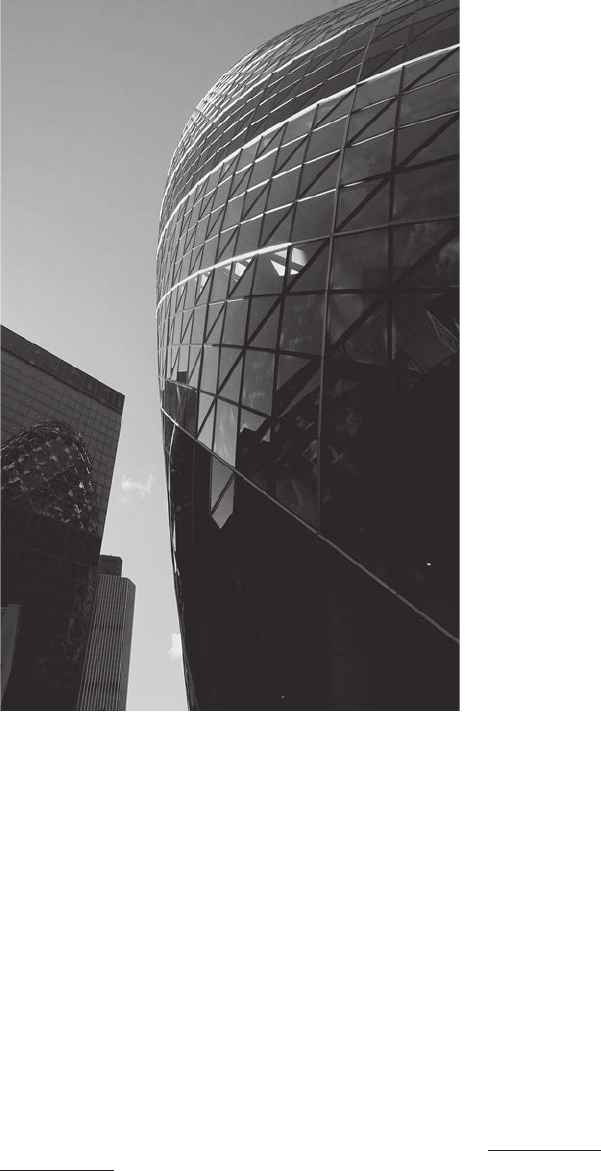
compliance with specic criteria – such as Swiss RE in
London designed by Foster. Due to the mobility of their
elements and digital control the buildings are perceived
not as single representations but as numerous variations
of form, which is especially well illustrated in Kas Oost-
erhuis’s muscle installations. Transcoding symbolism
becomes not only easier as the data are digital but rst
of all more evocative and precise. The BMW pavilion
from 2001 designed by Bernhard Franken documents
that the process of transfer of the information pattern be-
tween such remote areas as dynamics of a vehicle move-
ment and a building form can result in a unique spatial
pattern.
Due to the analogy which I see between the Manov-
ich’s theory and contemporary architectural designs one
can assume the position close to that expressed in Mitch-
ell’s antitectonic manifesto. Even if architecture in its core
remained the same, because of information technology it
is expressed in a completely new language. The language
of new media.
6
B. Koralevic A. Malkavi, Performative Architecture. Beyond
Instrumentality, New York 2005, p. 8.
Fig. 3. ReSwissofce building, designed by Norman Foster.
Photo by author
References
[1] Frampton K., Studies in Tectonic Culture, Cambridge 1995.
[2] Koralevic B. Malkavi A., Performative Architecture. Beyond Instru-
mentality, New York 2005.
[3] Manovich L., Język nowych mediów, Warszawa 2006.
[4] Mitchell W.J., Antitectonics: The Poetics of Virtuality, [in:] The
Virtual Dimension: Architecture, Representation, and Crash Culture,
J. Beckmann (ed.), New York 1998.
[5] Oosterhuis K., Swarm Architecture II, [in:] Verb Natures; Barcelona
2006.
[6] Semper G., The Four Elements of Architecture and Other Writings,
New York 1951.
Antitectonics – architecture for information society 195
Antytektonika – architektura społeczeństwa informacyjnego
Esej Antytektonika: poezja wirtualnosci Mitchella (1998) tworzy
podwaliny nowej teorii. Podważa sens kontynuacji rozważań na gruncie
tektoniki architektonicznej promowanej przez Kennetha Framptona
(2007). Kluczowe pojęcia opisu budowli zaczerpnięte z wywodu Sem-
pera (1951), takie jak: fundament, wnętrze, struktura, detal, tracą rację
bytu w niegrawitacyjnym środowisku. Jak zauważa Mitchell: „Less is
more Miesa van de Rohe wyostrza się w wirtualnej rzeczywistości do
anorektycznego ekstremum”. Antytektoniczny wywód operuje zestawami
antonimów: materialność – wirtualność, realizacja – zaprogramowanie,
rzemiosło – CAD/CAM, lokalność – globalność, fasada – interfejs,
tektonika – elektronika.
Coraz silniej głoszony jest obecnie pogląd odrywający nowe zjawiska
w architekturze od tradycji dwudziestowiecznej. Autor poddaje reeksji
relacje teorii zmiany paradygmatu i wybranych projektów współczesnych
budowli. Chciałby dociec, czy między dziewiętnastowieczną tektonika
i antytektoniką przyszłości odnaleźć można wątek ciągłości.
Dla lepszego wyjaśnienia zagadnień wpływu technologii informacyj-
nej na kształtowanie przestrzeni dokonano zestawienia myśli Mitchella
z pracami Lwa Manovicha. Kryteria, które służą opisaniu nowych mediów
– głównie w obrębie sztuk plastycznych i muzyki – wydają się adekwatne
dla interpretacji architektonicznej. Zmiany w technice i języku wyrażania,
niezależnie od rodzaju działalności artystycznej, zawierają pierwiastki
wspólne. Koncepcja Manovicha deniująca pięć obszarów wyróżnia-
jących sztukę tworzoną przy użyciu komputerów wydaje się dobrym
narzędziem do interpretacji architektury antytektonicznej.
Key words: antitectonics Słowa kluczowe: antytektonika