
2026
2(86)
Małgorzata Neumann*, Adriana Krupa**
Architectural standards of public kindergartens in Warsaw
and supportive design for children’s development
DOI: 10.37190/arc260208
© by the Author/Authors. Licensee WUST.
Published in open access. CC BY-NC license.
Abstract
The kindergarten classroom is a fundamental setting in every child’s life. It plays a vital role in their emotional, social, and cognitive development.
Although numerous theoretical studies emphasise the importance of space in early childhood education, there is still a lack of in-depth research ex-
amining the role of high-quality learning environments in contemporary preschool education.
The authors’ objective was to assess the quality of contemporary kindergarten classrooms in Warsaw based on parameters recognised by research
as benecial to children’s development and well-being. In the rst stage of the study, they carried out a detailed eld literature review to identify
fteen relevant characteristics of qualitative space. The second stage involved a study of ten nursery classrooms in newly built state-run nurseries in
Warsaw. This part resulted in an assessment of the degree to which theoretical principles had been implemented in the examined facilities, where an
average of 5.7 out of 15 indicators were met. The analysis carried out can be regarded as a rst step towards identifying design gaps and outlining
potential directions for systemic changes that may be relevant to design practice on a national scale.
Key words: kindergarten architecture, design for children, educational environment, early childhood education
Introduction
The environment and space in which children spend
most of their time are of fundamental importance to their
emotional, social, and cognitive development. The kinder-
garten classroom is therefore a fundamental setting in every
child’s life (Acer et al. 2016). Despite numerous theoretical
studies on the role of space in early childhood education,
there remains a lack of in-depth research on the actual qual-
ity of contemporary kindergartens in Poland. Questions
therefore arise as to the extent to which the recommenda-
tions contained in the academic literature are reected in
specic design solutions, which recommended spatial char-
acteristics are being incorporated into the design of newly
built kindergartens, and which continue to be overlooked.
In seeking answers to these questions, research was
conducted aimed at assessing the quality of contemporary
kindergarten classrooms. This research represents an at
-
tempt to link theoretical knowledge with analysis of real
kindergarten spaces. It began with a wide-ranging review
of the subject literature, encompassing a search of sources
available on academic platforms and online repositories.
This stage aimed to identify the key spatial parameters in-
uencing children’s development. The second phase of the
research involved an analysis of ten newly built public kin-
dergartens in Warsaw against the established criteria. The
ndings may be regarded as a rst step towards identifying
design gaps and outlining directions for potential systemic
changes that may be relevant to design practice.
State of research
The importance of thoughtful spatial design for children
was emphasised by pioneers of educational methods such
as Heinz Werner, Jean Piaget, Johann Heinrich Pestalozzi,
and Maria Montessori at the beginning of the 20
th
century.
However, the ndings and observations of practitioners did
*
ORCID:
0009-0006-3766-1816. Faculty of Architecture, War-
saw University of Technology, Poland, e-mail: malgorzata.neumann.
dokt@pw.edu.pl
**
ORCID:
0009-0000-9178-7002. Faculty of Architecture, War-
saw University of Technology, Poland.
92 Małgorzata Neumann, Adriana Krupa
not receive empirical validation until the 1980s. It was then
that the rst studies emerged conrming that the physical
environment inuences children’s emotional, social, and
cognitive development (Moore 1986). This thesis has been
conrmed on numerous subsequent occasions. As Helen
Knauf has observed, the physical environment is today
widely described as the “third teacher”, and the architec-
ture of space is an important element of education (2019).
The younger the child, the stronger the connection between
motor and cognitive development. The role played by the
surrounding environment, as well as the opportunities and
challenges it contains, is crucial in early childhood educa-
tion (Berris, Miller 2011).
Many researchers emphasise the importance of appropri-
ate organisation of the kindergarten classroom for the op timal
development of the children who occupy it. An ap propriately
designed space can support young users at in di vidual stages
of development and help them to reach their full potential
(Acer et al. 2016). For example, when activity corners are
clearly delineated and well dened, children engage more
readily and independently without adult assistance (Moore
1986). A key element of the kindergarten classroom is the
appropriate spatial division into zones, which should include
areas for play, learning, relaxation, and undened (or exi-
ble) open space (Brown, Burger 1984).
Among the most important parameters of the kindergar-
ten classroom is the ratio of classroom area to the number
of occupants. On average, this should be no less than 3 m
2
per child (Acer et al. 2016). Equally important is adequate
daylighting of the interior. The literature highlights the ad-
vantages of natural lighting, which has a positive eect
on
children’s mood and behaviour, as well as its limited bac -
tericidal
eect (Terczyńska 2021). Another signicant pa -
ra meter is the visual connection of the interior with out-
door greenery through low-set windows and direct access
to a garden (Schutte, Torquati and Beattie 2017). Research
ndings also indicate that introducing plants, solid wood
elements, and soft materials such as cushions, poues, or
mattresses into the classroom has a benecial eect on the
wellbeing of its occupants (Hanták, Končeková 2023; Mo-
hidin, Ismail and Ramli 2015).
The development of the Childcare Physical En viron-
ment Rating Scale (CPERS) by Gary T. Moore and Takemi
Sugiyama represented an important step in the assessment
of educational space quality (2007). This scale enabled the
assessment and comparison of facilities in terms of their en-
vironmental and spatial qualities – aspects that were prac -
tically absent from other quality assessment tools available
at the time. Building on the CPERS scale, the Visual En-
vironment Analysis was developed, which involves the
detailed mapping of kindergarten interiors in their existing
state and the analysis of their spatial characteristics in order
to identify ways in which these spaces could function more
eectively (Knauf 2019).
Some researchers have proposed systematising a list of
characteristics and parameters considered most important
for children’s development and behaviour. Konstantina
Rentzou identied such factors as: school size, number of
children per square metre, spatial organisation (zoning),
furniture and equipment, availability of spaces for individ-
ual work, ceiling height, colours, and noise levels (2014). In
Poland, Ewa Terczyńska developed a classication of fac-
tors inuencing the character of a place, including: inti ma-
cy and sense of security, ease of movement and orien ta tion
in the surroundings, quality of lighting, acoustic qua lity,
climatic quality, aesthetic impressions, spatial arran gement,
and the manner of spatial dierentiation (2021).
Methods
Selected spatial parameters
On the basis of the literature review, a checklist of archi-
tectural parameters was compiled to serve as a framework
for assessing kindergarten classrooms. The review identied
15 spatial parameters that appeared most frequently in the
analysed sources or were supported by compelling empir-
ical evidence. For greater clarity, these were grouped into
three thematic categories: architecture, equipment, and inte-
rior design. For each selected parameter, specic assessment
criteria were dened on the basis of the literature reviewed.
Legal context
Prior to assessing kindergarten classroom spaces against
the listed parameters (Table 1), a review was also conducted
of the applicable legal and technical regulations governing
preschool establishments in Poland. These requirements
derive from the Building Law Act (Ustawa… 1994), the
Re gulation on Technical Conditions (Rozporządzenie…
2002), the Regulation on the Conditions for Operating Kin-
dergartens (Rozporządzenie… 2017), sanitary regulations
(Rozporządzenie… 1997), and re protection regulations
(Rozporządzenie… 2010). Additionally, in May 2021, the
Capital City of Warsaw issued a set of design standards and
tools for the shaping of functional, exible, pro-ecological,
and inclusive school and kindergarten architecture, entitled
“Szkoła dobrze zaprojektowana” [Well-Designed School]
(Zarządzenie... 2021). This document serves as a source of
knowledge on the expectations of local authorities regard-
ing newly established facilities and was used as a reference
point in the analysis. It should be noted, however, that giv-
en the construction timeline of the selected buildings, it
may be assumed that all of them were designed prior to the
publication of the guide.
Field research process
The eld research focused on public kindergartens built
in the last decade and located in Warsaw. The capital, owing
to its intensive recent investment in educational infrastruc-
ture, provided a suciently large and stimulating research
context, not least because of the relatively high quality of
its public architecture. The ten-year period was adopted as
the boundary enabling the capture of contemporary design
approaches. Sample selection was exploratory in nature
and was constrained by the availability of facilities for
which consent to conduct research was obtained from dis-
trict oces and the management of individual kindergar-
ten establishments. During the period under consideration,

Architectural standards of public kindergartens in Warsaw and supportive design for children’s development 93
Parameters Description Source To determine Research process
ARCHITECTURE
Density
Density, i.e., the number
of children, has a significant
impact on their group behaviour.
Excessive density leads to more
frequent aggressive
and destructive behaviour.
Moore (1986);
Şahin, Dostoğlu
(2016)
What is the number
of children and teachers?
What is the room area?
What is the ratio
of children to floor area?
1. Environmental survey
2. Measuring the classroom
3. Determining the ratio
of children per m
2
Zoning
Zoning enhances the quality and
complexity of play, extends
engagement time, and strengthens
concentration and interest.
It comprises: a play zone,
a learning zone, a relaxation zone,
an intimate space,
and an undefined (open) space.
Brown, Burger
(1984);
Rentzou (2014)
Can zones be
distinguished and which
ones? What part of the
space remains undefined?
1. Identifying zones, taking basic
measurements and photographs
2. Marking zones on the floor plan
3. Determining the number of zones
Spatial layout
Children are more inclined
to engage in various activities
in an open space
that provides good visibility
of individual activity corners.
Significant visual barriers
limit opportunities for collaborative
play and hinder spontaneous
interaction.
Legendre (1999);
Moore (2002)
How are individual zones
delineated?
Are they open, semi-open,
or closed?
Are there significant
visual barriers?
1. Checking whether the zoning
criterion is met; if so:
2. Determining whether individual
zones are open, partially open,
or closed to the undefined
(open) space
3. Identifying visual barriers
4. Marking on the floor plan
5. Preparing a photographic
inventory
Natural
daylighting
The benefits of natural lighting
should be maximised,
as it has a positive effect on mood,
behaviour, and concentration,
and has a bactericidal effect.
It is desirable for daylight to enter
from more than one direction
to avoid strong contrasts.
Sanoff (1995);
Terczyńska (2021)
What is the ratio
of window area to floor
area, and what is
the distance from
the window to the furthest
point in the room?
1. Calculating window area
2. Checking the distance from
windows to opposite walls
Variable
ceiling height
Changes in ceiling height make
children experience
the space as more welcoming
and conducive to cooperation,
naturally encouraging them
to engage more frequently
in collaborative activities
and cooperative play.
Read, Sugawara
and Brandt (1999)
Is there a difference
in ceiling heights?
If so, what is the height
difference
and over what area?
1. Measuring ceiling heights
and their areas
Functional
and visual
connection
between
interior
and exterior
A functional and visual connection
between the classroom
and the outdoor space promotes
children’s motor development,
supports brain activity, and ensures
better oxygenation. Large glazed
surfaces, low-set windows,
and direct access to a terrace,
garden, or playground make
the outdoor zone an extension
of the classroom.
Moore (2002)
Is there a view from
inside the classroom
to an outdoor
play/learning area?
What design treatments
were used to strengthen
the interior–exterior
relationship?
1. Photographic inventory
2. Determining whether there is
a view from inside to an outdoor
play/learning area
3. Determining whether
and what design treatments
were used to strengthen
the interior–exterior relationship
Table 1. Summary of spatial parameters conducive to the development and proper functioning of children
(elaborated by M. Neumann, A. Krupa)
Tabela 1. Zestawienie parametrów przestrzennych sprzyjających rozwojowi i prawidłowemu funkcjonowaniu dzieci
(oprac. M. Neumann, A. Krupa)

94 Małgorzata Neumann, Adriana Krupa
Parameters Description Source To determine Research process
EQUIPMENT
Multi-
functional
equipment
Children’s sensory and creative
development can be supported
through the flexible shaping
of the educational space,
adapted to their
individual capabilities.
Mobile and multi-functional
equipment promotes
the creation of an environment
that stimulates imagination
and activity.
Şahin, Dostoğlu
(2016)
Is there equipment with
variable functions?
In what way can
it be changed?
Is it used in accordance
with its intended purpose?
1. Photographic inventory
2. Marking on the floor plan
3. Determining how these elements
can change
4. Asking the caregiver whether they
are used in a positive way
Equipment
supporting
motor
development
Access to equipment
supporting gross motor
development – both indoors
and outdoors – encourages
children to be more
physically active.
This favours the importance
of physical fitness
and strengthening their
sense of agency.
Maxwell (1996)
Are there items
of equipment
in the classroom
that support motor
development, e.g.,
for climbing
or pulling up?
How and whether children
use them?
1. Identifying equipment
supporting motor development
2. Marking on the floor plan
3. Photographic inventory
4. Asking the caregiver whether
they are used in a positive way
Presence of
soft elements
The use of materials
and furnishings
such as carpets, cushions,
and upholstered seating
in the kindergarten classroom
increases the comfort
of the space, improves
acoustics, and promotes a sense
of safety and cosiness.
Mohidin, Ismail
and Ramli (2015)
Are there soft elements
such as carpets, sofas,
pouffes, or cushions?
If so, what kind?
1. Photographic inventory
2. Marking on the floor plan
Presence
of wooden
elements
Introducing solid wood
furnishings and detailing
to the classroom
– with which children have
visual, tactile, and olfactory
contact – has a beneficial
effect on their emotional
and physiological wellbeing,
and supports the creation
of an inclusive environment
for all children, regardless
of their abilities
and limitations.
Hanták,
Končeková (2023)
Are there solid wood
elements?
If so, what kind?
1. Photographic inventory
2. Marking on the floor plan
Table 1 cont. Summary of spatial parameters conducive to the development and proper functioning of children
(elaborated by M. Neumann, A. Krupa)
Tabela 1 cd. Zestawienie parametrów przestrzennych sprzyjających rozwojowi i prawidłowemu funkcjonowaniu dzieci
(oprac. M. Neumann, A. Krupa)

Architectural standards of public kindergartens in Warsaw and supportive design for children’s development 95
Parameters Description Source To determine Research process
INTERIOR DESIGN
Access to
greenery
The opportunity for children
to have daily contact with
the natural environment,
such as a garden,
a playground with vegetation,
or green areas
in the immediate vicinity
of the kindergarten, supports
concentration, self-regulation
processes, and attentional
recovery.
Schutte, Torquati
and Beattie
(2017);
Faber Taylor,
Butts-Wilmsmeyer
(2020)
Is there a view of
greenery from the
kindergarten classroom?
What plants are present
in the classroom?
How can access
to greenery be rated on
a scale from 0 to 5?
1. Photographic inventory
2. Determining whether there
is a view of greenery from inside
3. Inventory of indoor plants
– marked on the floor plan
4. Rating access to greenery on
a Likert scale
Layout
flexibility
The ability to transform space,
furnishings, and materials
by moving or combining
them promotes children’s
experience of environmental
variability, stimulates imagination,
supports creative thinking,
and encourages the development
of new solutions and approaches.
Rentzou (2014);
Şahin, Dostoğlu
(2016)
Do the classroom
furnishings consist
of permanently fixed
elements or movable
furniture?
What is the degree
of layout flexibility on
a scale from 0 to 5?
1. Photographic inventory
2. Marking elements
(fixed/movable) on the floor plan
3. Determining the degree
of spatial flexibility
4. Asking whether, how,
and how often the space
is rearranged
Spatial
definition
Clear delineation of activity zones
promotes more frequent,
more positive social interactions
among children, based on
cooperation rather than competition
or aggression.
Moore (1986)
How can the kindergarten
classroom be rated
in terms of spatial
definition on a scale
from 0 to 5?
1. Photographic inventory
2. Rating the degree of spatial
definition on a Likert scale
Attractiveness,
cosiness and
“home-like”
atmosphere
The classroom space should be
attractive, evoking in the child
a sense of security and associations
with something familiar
and welcoming.
Rentzou (2014)
How can the kindergarten
classroom be rated
in terms of attractiveness,
cosiness,
and a “home-like”
atmosphere on a scale
from 0 to 5?
1. Photographic inventory
2. Rating attractiveness, cosiness,
and „home-like” atmosphere on
a Likert scale
Balanced
colour palette
The colour palette in
the kindergarten classroom
should be balanced – an excess
of white and monochromatic
shades may cause tension,
while an overabundance of
colour leads to sensory
overstimulation. As a base, warm
natural skin or sand tones
are recommended, supplemented
by considered colour accents
that organise and enliven the space.
Gaines, Curry
(2011)
What colours/shades
appear in the classroom
on walls, floors, and
ceilings? How can
the degree of colour
palette balance be rated on
a scale from 0 to 5?
1. Photographic inventory
2. Preparing a colour scheme
for the classroom
3. Rating the balance of the colour
palette on a Likert scale
21
capital-city kindergartens were built and commissioned,
but the nal research sample comprised 10 facilities lo-
cated in the districts of: Włochy, Żoliborz, Wola, Wawer,
Targówek, Praga-Północ, and Wilanów
1
.
1
Kindergartens nos: 183, 424, 426, 427, 432, 433, 437, 440, 443,
and 446.
In each of the studied kindergartens, designated BT01
through BT10, an on-site inspection was carried out in-
volving observation, photographic inventory, and mea-
surements of a typical classroom for that kindergarten, as
indicated by the management. Kindergarten classrooms ex-
hibit a high degree of repetition – they have similar spatial
layouts, interior character, and equipment within a single
building – so selecting a place for research was not a prob-
96 Małgorzata Neumann, Adriana Krupa
lem for the sta. The research was conducted by one team
member performing the tasks described in the “Research
Process” column (Table 1). An additional element of the
research was a supplementary interview conducted with the
management or teachers in order to specify certain infor-
mation in detail, e.g., the availability of soft elements or the
number of children in a group.
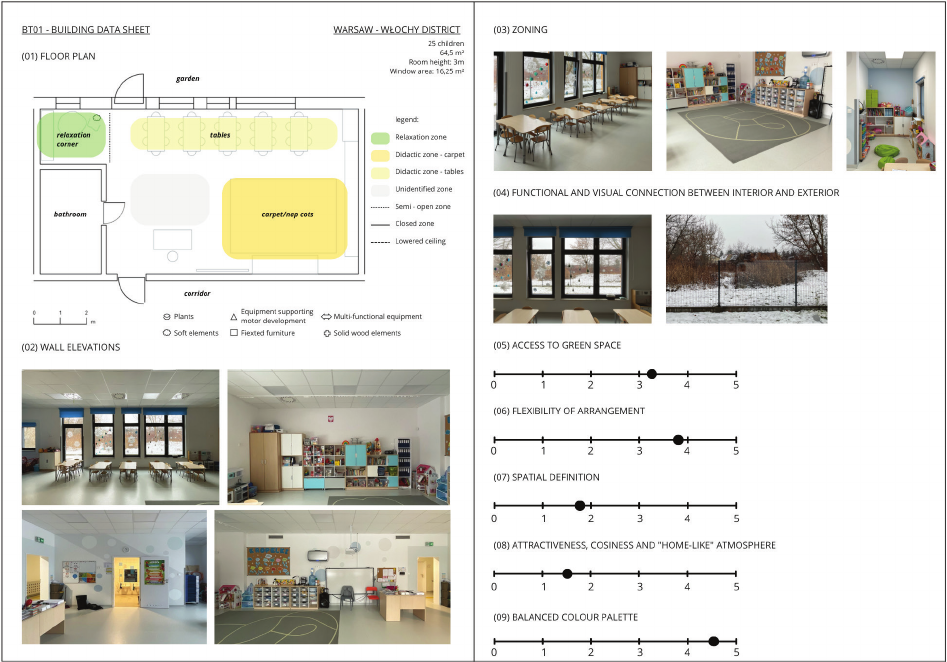
On the basis of the collected materials, building data
sheets were prepared (Fig. 1), comprising oor plans, pho-
tographic documentation, and an assessment of selected pa-
rameters. In the case of features that are dicult to subject
to dichotomous assessment, a ve-point Likert scale was
used, based on the subjective perception of the research-
er. Values of 0 and 5 points corresponded to two extreme
levels of criterion fullment. For example, for the parame-
ter “attractiveness, cosiness, and ‘home-like’ atmosphere”,
a score of 0 indicates the absence of elements such as soft
furnishings, plants, decorations, or children’s artwork, re-
sulting in a neutral, unfamiliar character of the space. Inter-
mediate values (2–3 points) indicate the presence of at least
two of the listed elements, while a score of 5 corresponds
to their clear diversity and accumulation, conducive to the
creation of a home-like atmosphere.
The building data sheets provide a concise characterisa-
tion of each of the analysed preschool classrooms, being at
the same time a base for assessing the degree of fullment
of individual criteria in the parameter summary (Table 1).
They were prepared by one of the researchers and subse-
quently formed the basis for discussion and the formulation
of a joint nal assessment of each parameter by both au-
thors. The compilation was designed with the assumption
that the analysis would be conducted by persons with ar-
chitectural training and design experience, since some pa-
rameters required expert assessment. Both researchers are
competent in this eld, with ve and ten years of profes-
sional practice respectively. Furthermore, the preparation of
building data sheets was an attempt to ensure transparency
and to enable scrutiny of the basis for decisions made and
assessments given.
Limitations
The empirical research conducted was primarily explor-
atory in character and may be regarded as a rst step to-
wards broader analyses of the quality of contemporary kin-
dergartens in Poland. This gives rise to several limitations.
The rst is reliance on the opinions of only two experts,
which introduces an element of subjectivity and personal
perception on the part of the researchers, despite an attempt
to apply standardised assessment criteria. The second is the
uncontrolled selection of the research sample, which was
based on availability – i.e., consents obtained – rather than
a precise selection procedure. Furthermore, none of the
studied kindergartens were designed after the publication
Fig. 1. Building data sheet – template (elaborated by M. Neumann, A. Krupa)
Il. 1. Wzór karty obiektu (oprac. M. Neumann, A. Krupa)
Architectural standards of public kindergartens in Warsaw and supportive design for children’s development 97
semi-open zone the ceiling was lowered by approximate-
ly 80 cm, probably in order to conceal technical installa-
tions rather than as a deliberate design choice. Despite this,
the area naturally functions as a zone with a somewhat dis-
tinct character. It was also noted that all analysed rooms
have a ceiling height of at least 3 m, which exceeds the sta -
tutory minimum of 2.5 m and appears appropriate to the
room size.
Functional and visual connection between interior and
exterior – the great majority of classrooms aord a view of
a green garden or terrace (all except BT09). The interiors
were designed to emphasise the connection with the sur-
roundings – most commonly through low-set windows or
direct access to a patio.
2. Equipment parameters.
Multi-functional equipment – no elements with an adap-
table function were identied in any of the analysed class-
rooms. These do not constitute a standard feature of kinder-
garten equipment, which may be attributable both to their
limited availability and to management preferences for
readily available, certied furniture with a clearly dened
function.
Equipment supporting motor development – no perma-
nent equipment for motor development was found in the
analysed classrooms. In one case, such items were stored
in a storeroom; in the others, they were located in separate
multi-purpose rooms. This approach is consistent with the
traditional model of preschool education, in which physical
activity takes place at designated times and places, and the
presence of physically engaging elements in classrooms
might disrupt the daily routine.
Presence of soft elements – the presence of such ele-
ments in the classrooms is limited and amounts to a carpet
and, at most, a few cushions or poues. Their impact on
sensory experience is negligible, particularly as some are
made available only occasionally, for example at children’s
request. Only in three classrooms (BT06, BT07, BT09) was
a permanent area with a sofa or nap cot identied, enabling
them to be considered as meeting the criterion for the pres-
ence of soft elements in a measure capable of inuencing
children’s perception and behaviour.
Presence of wooden elements – the level of criterion ful-
lment is very low. Elements made of natural wood were
found in only one classroom (BT06), in the form of ply-
wood chairs. In the remaining spaces, laminate furniture
imitating wood predominates, along with ooring or panels
featuring a wood-grain pattern, which – owing to their dif-
ferent texture, manner of reecting light, and thermal con-
ductivity – are not classied as wooden materials. The lim-
ited presence of wooden elements is probably attributable
to their higher cost and the limited availability and variety
of such items in the market oering intended for education-
al establishments.
3. Interior design parameters.
Access to greenery – eight out of ten analysed kinder-
gartens meet the criterion for access to greenery, primarily
through a visual or direct connection with a garden (BT01,
BT02, BT03, BT06, BT07, BT08, BT09, BT10). This ap-
plies also to facilities in dense urban developments. Potted
plants inside kindergarten classrooms have a lesser eect.
of “Szkoła dobrze zaprojektowana” (Zarządzenie... 2021),
meaning that this analysis does not account for the inu-
ence of that guide on spatial quality.
The identication of these shortcomings provides a good
starting point for further research. In future analyses, it
would be advisable to expand the qualitative component
– in particular to include in-depth interviews with teaching
sta and users – as well as to involve a greater number of
experts and to extend the research sample in terms of con-
struction period and location.
Results
The results of the analysis of building data sheets are
presented in Table 2, in which fullment of a given crite-
rion by individual classrooms is indicated by a plus sign.
Despite the limitations mentioned above, the data obtained
allow for the identication of dominant design tendencies,
showing which architectural aspects are systematically tak-
en into account in the design process and which are margin-
alised. The degree of fullment of the adopted criteria for
individual kindergartens ranges between 3 and 10 out of 15
parameters, with an average of 5.7.
The assessment of individual items is presented in the
form of bullet points below.
1. Architecture parameters.
Density – in eight out of ten analysed classrooms, the
maximum permissible group size of 25 children was re-
corded. Only three classrooms meet the standard of 3 m
2
per child recommended in the literature (BT03, BT04,
BT10). The remaining facilities mostly correspond to the
minimum indicator of 2.5 m
2
recommended for new de-
velopments, while two classrooms have an indicator of
2.35 m
2
. Given the considerable oor area of the class-
rooms (an average of 67.8 m
2
), it may be concluded that the
problem lies not in insucient oor area but in group size.
Zoning – the functional layout of classrooms in all ana-
lysed kindergartens is similar, consisting of three basic
zones: a didactic zone (with tables), a didactic-play zone
(carpet), and an area of indeterminate purpose between
them. In three of the ten classrooms, a relaxation zone was
additionally identied, enabling these spaces to meet the
adopted criterion (BT04, BT06, BT07).
Spatial layout – the majority of classrooms are char-
acterised by an open, rectangular plan without delineated
semi-open zones. Exceptions include: a classroom with an
irregular shape (BT04) and a classroom with a delineated
relaxation zone (BT06).
Natural daylighting – in the majority of analysed kinder-
garten classrooms, the ratio of window area to room area
is higher than the required 1:5. At the same time, only two
classrooms (BT01, BT04) met the criterion for the maxi-
mum distance to the opposite wall (< 7 m). In many cas-
es, a single large window was placed on the shorter wall,
which limits the depth of daylight penetration and leads
to a requirement for constant use of articial lighting. The
key problem proves to be the uneven distribution of natural
light in the classroom space.
Variable ceiling height – variation in ceiling height
was recorded in only one classroom (BT04), where in the

98 Małgorzata Neumann, Adriana Krupa
Parameters / building data sheet
Criterion
requirements
BT01 BT02 BT03 BT04 BT05 BT06 BT07 BT08 BT09 BT10
ARCHITECTURE
Density
classroom area > 3 m
2
per child
2.58
(–)
2.80
(–)
3.03
(+)
3.30
(+)
2.35
(–)
2.66
(–)
2.74
(–)
2.35
(–)
2.86
(–)
3.13
(+)
Zoning
at least 4 different zones
present
(–) (–) (–) (+) (–) (+) (+) (–) (–) (–)
Spatial layout
open or semi-open activity
zones without significant
visual barriers
(–) (–) (–) (+) (–) (+) (–) (–) (–) (–)
Natural daylighting
window-to-floor ratio ≥ 1:5
and furthest point from window
≤ 7 m
1:4.6
distance from
the window:
6.23 m
(+)
1:2.6
distance from
the window:
7.32 m
(–)
1:4.7
distance from
the window:
8.02 m
(–)
1:4.3
distance from
the window:
6.2 m
(+)
1:4.4
distance from
the window:
9.62 m
(–)
1:4.1
distance from
the window:
8.7 m
(–)
1:4.6
distance from
the window:
9.6 m
(–)
1:5.6
distance from
the window:
8.7 m
(–)
1:5.3
distance from
the window:
6.5 m
(–)
1:6.7
distance from
the window:
7.8 m
(–)
Variable ceiling height
ceiling height difference ≥ 80 cm
over an area ≥ 2 m
2
(–) (–) (–) (+) (–) (–) (–) (–) (–) (–)
Functional and visual
connection between
interior and exterior
view of a play/learning area
from the classroom;
one of the following design
treatment procedures
implemented: large glazing,
low sill, or direct outdoor
access
(+) (+) (+) (+) (+) (+) (+) (+) (–) (+)
EQUIPMENT
Multi-functional
equipment
at least one item of adaptable
equipment with a positive
assessment by the caregiver
(–) (–) (–) (–) (–) (–) (–) (–) (–) (–)
Equipment supporting
motor development
at least one item supporting
motor development with
a positive assessment of
the caregiver
(–) (–) (–) (–) (–) (–) (–) (–) (–) (–)
Presence of soft elements
soft elements present to
a degree that may influence
children (own assessment)
(–) (–) (–) (–) (–) (+) (+) (–) (+) (–)
Presence of wooden
elements
solid wood elements present to
a degree that may influence
children (own assessment)
(–) (–) (–) (–) (–) (+) (–) (–) (–) (–)
Table 2. Degree of compliance with parameters by the surveyed kindergartens (elaborated by M. Neumann, A. Krupa)
Tabela 2. Stopień spełnienia wybranych parametrów przestrzennych przez badane przedszkola (oprac. M. Neumann, A. Krupa)

Architectural standards of public kindergartens in Warsaw and supportive design for children’s development 99
Parameters / building data sheet
Criterion
requirements
BT01 BT02 BT03 BT04 BT05 BT06 BT07 BT08 BT09 BT10
INTERIOR DESIGN
Access to greenery
score in the upper half
of Likert scale
(≥ 2.5 pts)
3.25
(+)
3.5
(+)
3
(+)
1.5
(–)
2
(–)
3
(+)
3
(+)
3
(+)
2.5
(+)
2.5
(+)
Layout flexibility
score in the upper half
of Likert scale
(≥ 2.5 pts)
3.75
(+)
4
(+)
3
(+)
2.5
(+)
2.5
(+)
275
(+)
2.75
(+)
2.5
(+)
2.5
(+)
2.5
(+)
Spatial definition
score in the upper half
of Likert scale
(≥ 2.5 pts)
1.75
(–)
2
(–)
2
(–)
3
(+)
1.5
(–)
3
(+)
2.5
(+)
1.5
(–)
1.5
(–)
1.5
(–)
Attractiveness, cosiness
and “home-like”
atmosphere
score in the upper half of
Likert scale
(≥ 2.5 pts)
1.5
(–)
2.5
(+)
1.5
(–)
3
(+)
1.5
(–)
3.25
(+)
2.25
(–)
1.5
(–)
2
(–)
1.5
(–)
Balanced colour palette
score in the upper half
of Likert scale
(≥ 2.5 pts)
4.5
(+)
3.25
(+)
3.75
(+)
3.25
(+)
3
(+)
4.25
(+)
2.75
(+)
3.5
(+)
2.25
(+)
3.5
(+)
Number of criteria met
5/15 5/15 5/15 10/15 3/15 10/15 7/15 4/15 3/15 5/15
In some facilities, they are entirely absent (BT01, BT06,
BT08, BT10) or present as a single plant (BT05).
Layout exibility – Likert scale scores fall within the
range of 2.5–4 points, indicating fullment of the exibility
criterion in all analysed classrooms. Some teachers declare
periodic modications to the functional layout in order to
optimise and diversify the conduct of classes. It is worth
noting, however, that changes to the functional layout are
introduced exclusively by sta, whereas the literature holds
that active participation by children in adapting the space
should be possible.
Spatial denition – in the analysed classrooms, spatial
zoning is based primarily on the arrangement of furniture
and a carpet, with the infrequent use of typical dividing
elements such as curtains, shelving, or mobile partitions
– as recommended, inter alia, in the “Szkoła dobrze zapro-
jektowana” guide (Zarządzenie… 2021). Zones are also
not delineated by changes in colour or nish. Only three
kindergarten classrooms exceed the threshold value of 2.5
points on the Likert scale (BT04, BT06, BT07).
Attractiveness, cosiness and “home-like” atmosphere – the
adopted criterion was met in only three of the ten ana lysed
classrooms (BT02, BT04, BT06). The maximum score
achieved (3.25 points) indicates a generally low level of
realisation. In many cases, the interiors give the impression
of oce-like spaces, an eect reinforced by the presence of
suspended exposed grid ceilings with uorescent lighting.
Elements that build a domestic atmosphere, such as potted
plants or decorations, appear sporadically.
Balanced colour palette – the colour schemes of the an-
alysed kindergarten classrooms are generally muted, kept
in greys or pastels. Vivid colour accents appear typically on
one – at most two – surfaces and are balanced by a neutral
background; for example, the intensity of the oor colour is
softened by a grey carpet, light-coloured walls, ceiling, and
furniture in wood tones. An exception is classroom BT09,
which showed a lack of colour coherence between the fur-
niture, the carpet, and the wall decorations. In the remain-
ing kindergartens, parameter scores fall within the range
of 2.25 to 4.5 points, indicating a moderately high level of
criterion fullment.
Identification of gaps
and good practices
In the analysis of fullment of individual criteria, the
poorest performance relates to the equipping of the spaces.
The absence of multi-functional elements and equipment
supporting motor development may be a consequence of
the traditional model of preschool education, in which such
activity is conned to designated spaces such as gymna-
siums. In day-to-day practice, sta therefore do not per-
ceive a need for these elements to be present directly in the
kindergarten classrooms. Analysis of the materials used, on
the other hand, reveals a marked decit in natural elements
– particularly conspicuous is the absence of wooden oor-
ing or furniture. Surfaces made of synthetic materials pre-
dominate – and this applies to both hard elements and soft
elements such as poues, which are frequently covered in
impermeable, synthetic fabrics with an unpleasant texture.

100 Małgorzata Neumann, Adriana Krupa
The result is a general lack of material and tactile diversity.
The limited number of clearly dened relaxation areas may
be directly related to the low ratings of qualities such as at-
tractiveness, cosiness, and a homelike atmosphere. Despite
the presence of new furniture and a coherent, balanced co-
lour scheme, the overall aesthetic eect is sometimes rem-
iniscent of oce spaces. This impression is heightened by
the presence of uorescent lighting and standard suspended
exposed grid ceilings, which further weaken the sense of
cosiness and individual character of the interior.
In spatial terms, the analysed classrooms display a high
degree of similarity. They have been designed according to
a repeating scheme: rectangular in plan, with an equal ceil-
ing height and a similar functional layout. The space has
not been clearly divided into zones – beyond what results
from the arrangement of furniture – and this limits the pos-
sibilities for varied perception and use of the interior. There
is also a lack of more subtle means of organising space,
such as changes in colour scheme, materials, or sectional
ceiling lowering.
Signicant deciencies were also noted in the design of
natural daylighting, despite its important direct eect on
the wellbeing of users and its indirect eect on many other
assessed parameters – from the perception of spaciousness,
through the shaping of the functional layout, to the percep-
tion of the interior’s colour scheme and the relationship
with nature outdoors. Some of the studied kindergarten
classrooms, though designed in compliance with applicable
law
2
, do not provide optimal lighting conditions for chil-
dren. The provision for a minimum window-to-room area
ratio of 1:8 seems insucient for kindergarten classroom
space. There is also a lack of standards addressing uniform,
multidirectional daylighting and the appropriate orientation
of windows in relation to the cardinal directions.
Although the analysis conducted reveals primarily sig-
nicant deciencies, examples of good practice are also
discernible, as are areas to which designers and decision-
makers have paid appropriate attention. One positive aspect
is the provision of visual and functional contact with the
surrounding greenery, achieved through the use of low-set
windows and direct access to a patio – a solution found in
almost all studied classrooms located on the ground oor.
Although actual use of these exits depends on the internal
regulations of individual facilities, the very possibility of
their use represents a valuable potential. Another favour-
ably assessed aspect is the exibility of the spatial layout.
Thanks to their dimensions, the classrooms enable a variety
of organisational arrangements, aording the possibility of
adaptation to changing needs. Although the current number
of children – most commonly the maximum of 25 – may
be considered high, in the context of the ongoing demo-
graphic decline, it is anticipated that these spaces will in fu-
ture be better suited to smaller groups, which will translate
into more comfortable conditions for use. Also worthy of
note is the selection of interior colour schemes. The use of
subdued tones creates a calm, neutral background that does
2
Current regulations specify a minimum window-to-room area ra-
tio of 1:8 and a required insolation period of at least 3 hours on equinox
days, between 08:00 and 16:00 (§ 57 i § 60, Rozporządzenie… 2002).
not compete with children’s activity, while at the same time
promoting concentration and a sense of aesthetic order.
Conclusions
On the basis of the research conducted, it may be stated
that newly built kindergartens in Warsaw are characterised
by a similar, though relatively low, level of fullment of the
selected spatial parameters. Kindergarten classrooms dis-
play a high degree of homogeneity – they have comparable
potential but also recurring limitations, which result from
the design, material, and layout solutions adopted.
The few dierences between individual classrooms
emerge
primarily in the manner of their spatial congura-
tion. Geometry and daylighting have a considerable eect
on the comfort of use and the atmosphere inside. The more
varied the shape of the classroom, the greater its potential
for creating distinct and functional zones. In the few cases
where the rectangular oor plan was abandoned, the space
was more clearly dened, which facilitated the organisation
of children’s activities. The niches that arise are naturally
adapted as relaxation zones or reading corners. Dierences
in ceiling height play a similar role. This subtle architec-
tural intervention supports the intuitive allocation of func-
tions to specic areas within the interior. The location of
windows and the positioning of adjacent terraces are also
of signicance – they aect not only access to daylight but
also the manner of arranging the walls on the interior side,
and thus the exibility of classroom use.
The economic factor has a primary inuence on deci-
sions regarding the nishing and equipping of kindergarten
classrooms, and is clearly discernible in many of the studied
projects. Within a constrained budget, there is little room
for unconventional solutions, and practical considerations
tend to take precedence over how a material is perceived by
children. A case in point is the widespread use of linoleum,
which is characterised by its low cost and lack of main-
tenance requirements. Wooden ooring is no longer used,
although experience from kindergartens of the 1960s – in
which parquet ooring was commonly used – shows that
despite the passage of time and intensive use, this materi-
al retains its durability and unique character. Moreover, it
contributes to the creation of a warm, domestic atmosphere
in the interior. A similar signicance may be attributed to
the use of high-quality wooden and upholstered furniture,
which would additionally serve to organise and zone the
space. The incorporation of even one prominent nishing
feature made from natural materials, such as built-in furni-
ture, wall cladding, or timber ooring, can enhance the vi-
sual character of an interior while substantially improving
the quality of the user experience.
The quality of designed natural daylighting in kindergar-
ten classrooms appears to be an urgent concern. In many
existing projects, these solutions give rise to serious mis-
givings, clearly indicating the need for more ambitious
le gal regulations guaranteeing children appropriate condi-
tions for daily functioning and development. These regula-
tions should above all specify a greater minimum share of
glazed surfaces relative to oor area (e.g., in a ratio of 1:4)
and require even distribution of windows so that natural

Architectural standards of public kindergartens in Warsaw and supportive design for children’s development 101
light can reach the entire classroom
3
. These requirements
would also need to be supplemented by an obligation to use
eective solar shading systems and to design appropriate
– ideally intelligent – articial lighting that would work in
harmony with daylight. Similar regulations are needed re-
garding room height. The minimum value specied by cur-
rent regulations – 2.5 m – seems insucient in relation to
the typical area of kindergarten classrooms. Fortunately, in
practice, designers and investors often demonstrate greater
spatial sensitivity and appropriately adjust interior height to
their scale and function.
Summary and recommendations
The kindergarten classroom is a spatial unit of unusual
scale and character. Although formally classied as a sin-
gle room, its size – up to 80 m
2
– and multi-functionality
indicate the need for a more complex design approach than
it is the case for other rooms of simpler function. The anal-
ysis conducted once again underlines the need for a more
conscious and careful creation of kindergarten spaces by
designers, investors, and kindergarten management. It is
3
Interestingly, highly precise and high-quality guidelines similar
to those proposed here appeared in a pre-war document on the arrange-
ment of kindergartens (Mączeński 1935).
worth noting, however, that most of the identied issues are
systemic in nature and could be mitigated through amend-
ments to, or greater specication of, building regulations.
Key actions appear to be needed in three areas: more varied
spatial conguration, conscious selection of materials, and
ensuring high-quality environmental conditions, particular-
ly with respect to natural daylighting.
In the face of the challenges of contemporary early
child hood education and the developmental needs of the
youngest users, an approach is advocated that integrates
functional, aesthetic, and emotional aspects in the design
as inseparable elements of a well-planned space. Broad-
er research encompassing a greater number of projects is
necessary, enriched by a qualitative component and the in-
volvement of a larger and more varied group of experts.
A valuable continuation of the current research would be an
analysis of more recently built kindergartens designed us-
ing the objectives from the “Szkoła dobrze zaprojektowa-
na” guide (Zarządzenie… 2021). The conclusions drawn
from a comparison of the inuence of such publications on
the quality of kindergarten spaces could contribute to the
formulation of specic guidelines for systemic changes.
Translated by
Magdalena Śmieja
Acknowledgements
This article was written as part of the “Experimental Research Project”
course at the Doctoral School at the Faculty of Architecture of the Warsaw
University of Technology.
References
Acer, Dilek, Gözen Göksu, Zehra Saadet Fırat, Hatice Kefeli, and Büşra
Aslan. “Eects of a Redesigned Classroom on Play Behaviour among
Preschool Children.” Early Child Development and Care 186, no. 12
(2016): 1907–25. https://doi.org/10.1080/03004430.2015.1136999.
Berris, Rebecca, and Evonne Miller. “How Design of the Physical En-
vironment Impacts on Early Learning: Educators’ and Parents’ Per-
spectives.” Australasian Journal of Early Childhood 36, no. 4 (2011):
102–10. https://doi.org/10.1177/183693911103600414.
Brown, James G., and Charles Burger. “Playground Designs and Pre-
school Children’s Behaviors.” Environment and Behavior 16, no. 5
(1984): 599–626. https://doi.org/10.1177/0013916584165004.
Faber Taylor, Andrea, and Currie Butts-Wilmsmeyer. “Self-Regulation
Gains in Kindergarten Related to Frequency of Green Schoolyard
Use.” Journal of Environmental Psychology 70, no. 2 (2020): 1–29.
https://doi.org/10.1016/j.jenvp.2020.101440.
Gaines, Kristi S., and Zane D. Curry. “The Inclusive Classroom: The
Eects of Color on Learning and Behavior.” Journal of Family and
Consumer Sciences Education 29, no. 1 (2011): 46–57.
Hanták, Jakub, and Danica Končeková. “Positive Eects of Wood in
Vorarlberg’s (Austria) Timber Kindergartens.” Architecture Papers of
the Faculty of Architecture and Design STU 28, no. 3 (2023): 36–49.
https://doi.org/10.2478/alfa-2023-0018.
Knauf, Helen. “Visual Environmental Scale: Analysing the Early Child-
hood Education Environment.” Early Childhood Education Journal
47 (2019): 43–51. https://doi.org/10.1007/s10643-018-0914-x.
Legendre, Alain. “Interindividual Relationships in Groups of Young
Children and Susceptibility to an Environmental Constraint.” En-
viron ment and Behavior 31, no. 4 (1999): 541–57. https://doi.org/
10.1177/00139169921972191.
Maxwell, Lorraine E. “Multiple Eects of Home and Day Care Crowd-
ing.” Environment and Behavior 28, no. 4 (1996): 494–511. https://
doi.org/10.1177/0013916596284004.
Mączeński, Zdzisław, ed. Przedszkola. Teren – urządzenia terenowe – bu -
dynek i jego wykonanie – urządzenia pomieszczeń. Ministerstwo Wyz -
nań Religijnych i Oświecenia Publicznego, 1935.
Mohidin, Hazrina Haja Bava, Alice Sabrina Ismail, and Hidayati Binti
Ramli. “Eectiveness of Kindergarten Design in Malaysia.” Proce-
dia Social and Behavioral Sciences 202 (2015): 47–57. https://doi.
org/10.1016/j.sbspro.2015.08.207.
Moore, Gary. “Design Environments for Young Children: Empirical Find-
ings and Implications for Planning and Design.” In Children and
Young People’s Environments: Keynote Addresses and Selected Pa-
pers from the Children’s Issues Centre Fourth Child & Family Poli-
cy Conference, 28–30 June 2001, edited by Megan Gollop and Jaleh
McCormack. Children’s Issues Centre, 2002.
Moore, Gary. “Eects of Spatial Denition of Behaviour Settings on
Children’s Behavior: A Quasi-Experimental Field Study.” Journal
of Environmental Psychology 6, no. 3 (1986): 205–31. https://doi.
org/10.1016/S0272-4944(86)80023-8.
Moore, Gary, and Takemi Sugiyama. “The Children’s Physical Environ-
ment Rating Scale (CPERS): Reliability and Validity for Assessing
the Physical Environment of Early Childhood Educational Facilities.”
Children, Youth and Environments 17, no. 4 (2007): 24–53. https://
doi.org/10.1353/cye.2007.0023.
102 Małgorzata Neumann, Adriana Krupa
Streszczenie
Standardy architektoniczne przedszkoli publicznych w Warszawie a projektowanie wspierające rozwój dzieci
Środowisko i przestrzeń, w których dzieci spędzają większość czasu, odgrywają kluczową rolę w ich rozwoju emocjonalnym, społecznym i poznaw-
czym. Chociaż autorzy licznych opracowań teoretycznych podkreślają znaczenie przestrzeni w edukacji wczesnoszkolnej, nadal brakuje dogłębnych
badań dotyczących rzeczywistej jakości architektury współczesnych przedszkoli w Polsce.
Celem autorek artykułu była ocena jakości przestrzeni współczesnych sal przedszkolnych w Warszawie w oparciu o parametry uznane przez badaczy
za sprzyjające rozwojowi i dobremu samopoczuciu dzieci. W pierwszym etapie pracy przeprowadziły one szczegółowy przegląd literatury przedmiotu
w celu zidentykowania piętnastu cech jakościowych przestrzeni. Drugi etap to badania dziesięciu sal przedszkolnych w nowo wybudowanych przed-
szkolach publicznych w Warszawie. Rezultatem opisanych prac była ocena stopnia implementacji założeń teoretycznych w badanych obiektach, gdzie
średnio zostało spełnionych 5,7 na 15 parametrów. Przeprowadzone badania można traktować jako pierwszy krok w kierunku identykacji luk projek-
towych oraz zarysowania kierunków potencjalnych zmian systemowych, które mogą mieć znaczenie dla praktyki projektowej w skali całego kraju.
Słowa kluczowe: architektura przedszkolna, projektowanie dla dzieci, środowisko edukacyjne, edukacja wczesnoszkolna
Rentzou, Konstantina. “The Quality of the Physical Environment in Pri
-
vate and Public Infant/Toddler and Preschool Greek Day-Care Pro-
grammes.” Early Child Development and Care 184, no. 12 (2014):
1861–83. https://doi.org/10.1080/03004430.2014.891991.
Read, Marilyn A., Alan I. Sugawara, and Jeanette A. Brandt. “Impact of
Space and Color in the Physical Environment on Preschool Children’s
Cooperative Behavior.” Environment and Behavior 31, no. 3 (1999):
413–28. https://doi.org/10.1177/00139169921972173.
“Rozporządzenie Ministra Edukacji Narodowej z dnia 25 sierpnia 2017 r.
w sprawie sposobu prowadzenia przez publiczne przedszkola, szkoły
i placówki dokumentacji przebiegu nauczania, działalności wycho-
wawczej i opiekuńczej oraz rodzajów tej dokumentacji.” Dz.U. 2017,
poz. 1646. Accessed June 5, 2026, at https://isap.sejm.gov.pl/isap.nsf/
DocDetails.xsp?id=WDU20170001646.
“Rozporządzenie Ministra Infrastruktury z dnia 12 kwietnia 2002 r.
w sprawie warunków technicznych, jakim powinny odpowiadać bu-
dynki i ich usytuowanie.” Dz.U. 2002 nr 75, poz. 690 ze zm. Ac-
cessed June 5, 2026, at https://isap.sejm.gov.pl/isap.nsf/DocDetails.
xsp?id=WDU20220001225.
“Rozporządzenie Ministra Pracy i Polityki Socjalnej z dnia 26 września
1997 r. w sprawie ogólnych przepisów bezpieczeństwa i higieny pra-
cy.” Dz.U. 1997 nr 129, poz. 844. Accessed June 5, 2026, at https://
isap.sejm.gov.pl/isap.nsf/DocDetails.xsp?id=WDU19971290844.
“Rozporządzenie Ministra Spraw Wewnętrznych i Administracji z dnia
7 czerwca 2010 r. w sprawie ochrony przeciwpożarowej budyn-
ków, innych obiektów budowlanych i terenów.” Dz.U. 2010 nr 109,
poz. 719 ze zm. Accessed June 5, 2026, at https://isap.sejm.gov.pl/
isap.nsf/DocDetails.xsp?id=WDU20230000822.
Şahin, B. Ece, and Neslihan Dostoğlu. “Changeable Designs in Preschool
Education Environments: Supporting Sensory Development and
Creativity.” European Journal of Education Studies 2, no. 8 (2016):
84–108. https://doi.org/10.5281/ZENODO.163788.
Sano, Henry. Creating Environments for Young Children. School of De-
sign, North Carolina State University, 1995.
Schutte, Anne R., Julia C. Torquati, and Heidi L. Beattie. “Impact of
Urban Nature on Executive Functioning in Early and Middle Child-
hood.” Environment and Behavior 49, no. 1 (2017): 3–30. https://doi.
org/10.1177/0013916515603095.
Terczyńska, Ewa. “Współczesne przedszkole – aranżacja dziecięcego śro-
dowiska przestrzennego.” Builder 287, no. 6 (2021): 38–41. https://
doi.org/10.5604/01.3001.0014.8831.
“Ustawa z dnia 7 lipca 1994 r. Prawo budowlane.” Dz.U. 1994 nr 89,
poz. 414. Accessed June 5, 2026, at https://isap.sejm.gov.pl/isap.nsf/
DocDetails.xsp?id=wdu19940890414.
“Zarządzenie nr 645/2021 Prezydenta m.st. Warszawy z dnia 4 maja
2021 r. w sprawie wprowadzenia w m.st. Warszawa standardów
architektonicznych i funkcjonalnych dla szkół podstawowych i ze-
społów szkolno-przedszkolnych.” Załącznik nr 1. Accessed June 5,
2026, at https://bip.warszawa.pl/web/prezydent/-/zarzadzenie-nr-
645-2021-z-2021-05-04-924614.