
2026
2(86)
Yuriy Kryvoruchko*
Architecture of new cathedrals in Ukraine
DOI: 10.37190/arc260205
© by the Author/Authors. Licensee WUST.
Published in open access. CC BY-NC license.
Abstract
The subject of this article is the contemporary cathedrals of Ukraine as an expression of the continuity of the autochthonous tradition of sacred archi-
tecture, as a space for revealing the archetypes of the Ukrainian Christian church, and as the most representative phenomenon of contemporary Ukrainian
sacred architecture. Cathedrals are regarded as a space of dialogue between tradition and modernity, in which the reinterpretation of historical heritage,
the formation of new architectural images, and the actualisation of the spiritual and cultural archetypes of the Ukrainian nation take place.
The aim of the study was to identify the principal archetypes of Ukrainian church architecture and to examine the ways in which they are interpreted
and realised in the architecture of new cathedrals in Ukraine. Particular attention is devoted to the historical continuity of the sacred tradition, the rela-
tionship between pre-Christian and Christian worldviews, as well as to the search for a contemporary architectural language capable of expressing the
spiritual essence of the church in the context of the modern world.
The research employs the historical-genetic method, the hermeneutic method, comparative-typological analysis, the architectural-compositional
method, as well as cultural and phenomenological interpretations of sacred space.
The analysis covers the principal stages in the development of Ukrainian sacred architecture – from the pre-Christian cultural strata and the period
of Kyivan Rus’ to the Ukrainian Baroque and the National Style of the late 19
th
and early 20
th
centuries. On this basis, three fundamental archetypes
of Ukrainian church architecture have been identied: the Princely tradition, the Ukrainian (Cossack, Mazepa) Baroque, and the National Style of the
modern era.
The study demonstrates that the contemporary architecture of Ukrainian cathedrals is developing in several directions: through the creative reinter-
pretation of historical archetypes, the search for new forms of expressing the sacred, and reference to universal, interreligious images and primordial
forms of the sacred. It has been established that the principal challenge of contemporary sacred architecture is not the reproduction of historical styles
but rather a profound understanding of tradition and the creation of an authentic contemporary type of Ukrainian church that responds to the spiritual and
cultural needs of contemporary society. The architecture of new cathedrals is perceived as a unique laboratory for the search for a new Ukrainian sacred
architecture capable of integrating theological tradition, national identity, and contemporary architectural culture. The study demonstrates that the sacred
dimension of architecture is revealed through the architectural image of the church and the architect’s personal creative revelation. This dimension is
capable of transcending confessional boundaries and fostering a deeper understanding of the unity of the Christian tradition.
Key words: architecture, Ukraine, innovations, archetype, tradition
Introduction
Brief statement of the research problem
– thematic, temporal, and territorial scope
The architectural phenomenon of new cathedrals in Uk -
raine reveals several essential dimensions of the dis course
on contemporary Ukrainian ecclesiastical and, more broad-
ly, sacred architecture.
First, cathedrals constitute the most complete embodi-
ment of current tendencies in church architecture. On the
one hand, they remain grounded in the tradition of eccle-
sias tical design; on the other, they are characterised by
a search for new imagery and novel spatial interpretations
of traditional sacred values.
Second, cathedrals themselves serve as a continuation
of Ukraine’s centuries-old ecclesiastical tradition, ex press -
ing within contemporary architectural practice the auto ch-
thonous dimension of the national heritage of Ukrainian
ar chitecture.
Third, the architecture of new cathedrals often represents
the nest achievements of present-day sacred design. Owing
* ORCID:
0000-0003-1352-1924. Faculty of Architecture and De -
sign, Lviv Polytechnic National University, Ukraine; Faculty of Archi -
tecture, Politechnika Białostocka, Poland, e-mail: yurikryv@gmail.com
50 Yuriy Kryvoruchko
to the particular signicance of cathedrals, their plann ing and
construction usually attract greater attention, with projects
frequently determined through architectural com petitions.
This process provides the opportunity to se lect the most ac-
complished solutions from a wide range of proposals.
Fourth, cathedrals are erected by the faithful across a spec -
trum of confessions and denominations – Orthodox, Greek
Catholic, Roman Catholic, various Protestant traditions, as
well as communities of other religions. Accordingly, in this
article the term church architecture is applied when refer-
ring to Orthodox and Greek Catholic cathedrals, whereas
the broader category of sacred architecture is employed in
reference to religious buildings of other traditions (Judaism,
Islam, Protestantism, and others).
Rationale for addressing the topic,
research aim, hypothesis
In order to situate the contemporary Ukrainian context,
it is necessary to trace, at least in brief, the historical evo-
lution of this tradition. Its roots reach back not only to the
period of Kyivan Rus’ and the Baptism of 988, but also to
the early centuries of Christianity, when church building
ourished in the territories of the northern Black Sea region
and Crimea. Equally signicant for the spiritual identity
of Ukrainians is the pre-Christian era, whose foundations
extend to the Trypillian culture. This renowned Neolithic
and Eneolithic civilization, which thrived between approx-
imately 7000 and 2750 BCE across present-day Ukraine,
Moldova, and Romania, achieved a remarkably advanced
level of de ve lopment and exerted a lasting inuence on
Ukrainian cul tu ral identity.
Without such a deep historical perspective, it is im pos-
sible to grasp the fundamental archetypes of church ar chi tec-
ture, which continue to nd expression in the con tem porary
cathedral. The architecture of Ukrainian cathedrals thus pro-
vides an opportunity not only to demonstrate the richness
of present-day ecclesiastical design but also to il luminate its
genealogy, origins, and archetypes, which un der pin the spa-
tial composition of the modern Ukrainian sacred edi ce. The
following discussion is devoted to this purpose.
The aim of the article is a comprehensive interpretation
of the architecture of new cathedrals in Ukraine as a spatial
manifestation of an autochthonous tradition and, at the same
time, as a eld for the formation of a contemporary identi-
ty of Ukrainian sacred architecture. Achieving this goal re-
quires reconstructing the continuity of Ukrainian church ar-
chitecture through the example of cathedral churches – from
historical archetypes to contemporary realizations – while
outlining the autochthonous character of Ukraine’s sacred
architecture through geographical, cultural, form-generat-
ing, and worldview-related factors. These factors constitute
the basis for the formation of the principal archetypal im-
age-spatial systems that emerged during key periods of state
formation (the princely era, Cossack Baroque, and the na-
tional style of the late 19
th
and early 20
th
centuries), whose
transformations can be traced in contemporary church ar-
chitecture.
An analysis of the problem of identity in Ukrainian church
architecture, considered within the context of the historical
fate of Ukrainian lands and the inuence of diverse politi-
cal
and cultural environments over time, makes it possible
to sys tematize current trends in church con struction in Uk-
raine. These include both tradition-oriented approaches
(based on historical styles) and in no vative directions (fo-
cused on the search for universal sacred forms). New ca-
the drals
play an important role in synthesizing tradition,
theology, and contemporary architectural practice.
The central hypothesis of this research is that Ukrainian
modes of perceiving and interpreting the world reveal a con-
tinuity across time. From pre-Christian beliefs, through
the adoption and reinterpretation of Christian archetypes
drawn from early medieval Byzantine and Moravian tradi-
tions, Ukrainians have developed their own autochthonous
worldview and spatial archetypes of eccle sias tical architec-
ture. These archetypes nd their realization and reection
in the cathedrals of contemporary Ukraine.
The article therefore presents the current state of re-
search on Ukrainian church architecture, introduces the
au thor’s own studies on the genesis and development of ec-
cle siastical archetypes from the Christianization of Kyivan
Rus’ to the present, and formulates results, con clu sions,
and a synthesis of broader investigations, em pha sizing their
scho larly novelty.
State of research
In recent decades, the study of church architecture, and
more broadly sacred architecture in Ukraine, has en com-
passed a wide spectrum of issues, particularly those aspects
of Ukrainian Orthodox and Greek Catholic churches that
had been “forgotten” or deliberately suppressed by com-
munist ideology and state power. These include the history
of the
churches themselves, their architectural traditions, the
iden ti ties of their architects, and the geographical patterns of
their
dissemination.
The Ukrainian tradition of church architecture – from its
origins and typology to regional studies and contemporary
in ter pretations – has been explored by a number of pro-
mi nent Ukrainian scholars. Their research has identied
sources dating back to the pre-princely and princely peri-
ods of Kyi van Rus’, examined the typology of wooden and
ma sonry churches over more than a millennium of sacred
con struction, and described regional schools, as well as the
com po sition and proportional systems of churches in rela-
tion to historical styles. These studies have also addressed
the ge nesis of Ukraine’s sacred architecture and its histo -
ri cal and national context. The losses of history and the
heri tage of cen turies have been compiled in encyclopedic
works, while the theory of the sacred continues to develop.
A central issue within the religious landscape of Ukraine
is the presence of the Orthodox Church of the Mos cow
рa triarchate, whose dominant position was disrupted by
the granting of the Tomos of Autocephaly to the Ortho-
dox Church of Ukraine by the Ecumenical Patriarch Bar-
tho lomew in 2019. The enduring presence of the Moscow
Church within Ukraine’s spiritual sphere reected the per-
sistent inuence of the Russian and later Soviet-communist
empires on the religious life of Ukrainians, an inuence
that continued even after Ukraine’s independence in 1991.
Architecture of new cathedrals in Ukraine 51
Against this backdrop, a key theme in research on
Ukrain ian church architecture has been the eort to inter-
pret it as an expression of Ukrainian culture and spirituality
– not only through liturgy, but also through its architectural
and spatial form. Among the most signicant recent contri-
butions are Yevhen Dunayevskyi’s doctoral dissertation
(Du nayevskyi 2023), and Oksana Diachok’s habilitation
the sis (Diachok 2020).
Dunayevskyi’s work surveys the architectural panora-
ma after 1991, particularly in central, eastern, and southern
Ukraine. It highlights the predominance of gurative and
plastic explorations of form by architects whose prior ex-
perience largely derived from designing public buildings.
As a result, the visual language of secular public architec-
ture was often transposed into the image of new churches.
In this context, sacrality – associated with asceticism, re-
straint, and inward reection – was frequently subordinated
to the architect’s pursuit of monumentality, a strong visual
statement, and originality.
In contrast, as Diachok demonstrates, the work of archi-
tects in western Ukraine has been marked by a greater de-
gree of reection and an awareness of the sacred character
of the church as a spiritual phenomenon. Questions of iden-
tity, origin, external inuences, as well as investigations
into the autochthonous and original character of Ukrainian
church architecture have been examined in the works of
Bohdan Cherkes, Oksana Diachok, Jerzy Hernik (Cherkes,
Diachok and Hernik 2024). Complementary perspectives,
particularly concerning the genesis and development of
traditional architecture across dierent Ukrainian regions,
have been provided by historians and ethnographers such
as Yaroslav Taras (Taras 2018), Volodymyr Slobodian
(Slobodian 1996), and Halyna Shevtsova (Shevtsova 2017).
The archetypes of Ukrainian ecclesiastical architecture
– shaped throughout the history of Christian Ukraine, and
re ecting its autochthonous and distinctive traditions – are
the subject of long-standing studies by Yuriy Kryvoruchko
(Kry vo ruchko 2001; 2018; 2019; 2020; Kryvoruchko, Pod-
ha lański 2021). His research traces the historical continuity
and originality of these archetypes, underscoring their rele-
vance for the understanding of both historical and contem-
porary sacred architecture.
A number of publications have emerged as a result of
war time destruction after 2014, and especially after 2022
– the beginning of Russia’s full-scale invasion of Ukraine.
The issue of reconstruction, including that of Ukraine’s sa-
cred architecture, has been addressed not only by Ukrainian
scholars – Yulia Ivashko et al. (2024), Shevtsova (2017),
and Аnastasiia Urakina (2022) – but also by researchers
from other countries, including Tomasz Kozłowski et al.
(2022), Olena Gorbyk et al. (2024), Vitaliy Molochko and
Joanna Borowczyk (2025).
Methods
The choice of research methods was determined by the
na ture of the object of study, its aims, and the thematic
orien tation of the inquiry. The methodology of studying
sacred architecture rests upon the epistemological frame-
work that seeks to apprehend phenomena and objects in
their multiplicity and fullness of meaning, while disclos-
ing the interrelations and reciprocal inuences that shape
them. Since rational categories of thought do not exhaust
the essential dimensions of what is sacred in its architec-
tural embodiments, this study employs, alongside scientic
categories, artistic and imagistic modes of cognition. These
inter pre tive and hermeneutic strategies make it possible to
approach the ineable and the invisible – those metaphysi-
cal layers that constitute the deepest essence of sacred ar-
chitecture.
The methodological orientation of this work thus pro-
ceeds in a dual register: on the one hand, it interrogates the
rational aspects of sacred architectural objects, allowing
them to be dened as functional urban and architectural
entities; on the other hand, it preserves their metaphys-
ical quality, inseparable from the very object and subject
of study. In order to deepen the understanding of sacred
architecture as both a spiritual and architectural phenom-
enon, the study employs the concepts of syncretic images,
symbols, and archetypes. These concepts span rational di-
mensions (architectural ideas and concepts), sensorial ones
(the artistry of architecture), and mystical ones (creativity,
spirit, holiness). Together, they reect the profound dimen-
sions of human existence, the interrelation between humans
and their environment, and form the very foundation of an
approach to architecture.
Accordingly, the research adopts humanistic methods
of cognition, which presuppose: the involvement of the
subject in the very process of cognition; an anthropocen-
tric orientation; self-knowledge and the identication of
subject and object; an interpretive character of knowledge;
the uncovering of latent, unarticulated potentials; and the
accumulation of multiple perspectives on the object of in-
quiry, encompassing description, explanation, and inter-
pretation of facts, as well as the formulation of conceptual
frameworks. The methodology thus combines reection,
systematization, and theoretical grounding of leading ap-
proaches to the study of sacred architecture, drawing upon
paradigms of contemporary philosophy.
The methodological framework of the study is based on
an interdisciplinary approach that combines methods from
architectural history, architectural theory, cultural stud-
ies, and the phenomenology of sacred space. The histori-
cal-genetic method is employed to trace the development
of Ukrainian church architecture from early Christian and
pre-Christian times, through the periods of Kyivan Rus’,
the Hetmanate, and the modern era, up to the present day,
revealing the continuity of tradition. Particular attention is
given to the role of the multi-confessional and multicultural
character of the Ukrainian context.
A comparative-typological analysis of various types of
churches and cathedral structures identies both common
and distinctive features of regional schools and confessional
traditions, and enables the classication of contemporary
trends in church architecture. Morphological and spa-
tial-compositional analysis – focusing on structure, form,
proportions, rhythm, and the organization of sacred space
– reveals the underlying principles of the formation of ar-
chetypes. These, in turn, make it possible to identify funda-
mental spatial and symbolic models (such as the circle, the
52 Yuriy Kryvoruchko
square, centrality, and verticality) that embody a long cultur-
al and spiritual continuity of historically shaped meanings.
The phenomenological method is directed towards the
analysis of sacred space as lived experience – through per-
ception, interpretation, symbolism, and theological content
– allowing the study to move beyond purely formal analy-
sis and to understand the church as a place of the presence
of the sacred. The application of the hermeneutic method
makes it possible to approach the interrelation between the
form of the church, theological ideas, and national identity.
Overall, the methodological approach shifts the focus
from stylistic analysis to the interpretation of image and ar-
chetype, from the description of form to the раскрывання
of the semantics and experience of sacred space, and from
isolated examples to the identication of the continuity of
the Ukrainian tradition of sacred architecture.
Such a methodology enables cathedral churches to be
con sidered as key carriers of the archetypes of Ukrainian
sa cred architecture, combining historical-architectural ana-
lysis with the phenomenology of sacred space and inter-
preting contemporary church building as a process of re-
storing a disrupted tradition and shaping identity within
a postcolonial and wartime context.
Results
The more than one-thousand-year history of the Ortho-
dox Church in Ukraine and the over four-hundred-year tra-
di tion of the Greek Catholic Church attest to the autochtho-
nous character of the Eastern Christian tradition within
Ukrain ian culture. Yet the self-awareness of Ukrainian ec-
clesiastical architecture has traversed – and continues to
traverse – a complex and dicult path of formation and
armation. This phenomenon is distinctly Ukrainian with-
in the broader context of global cultural development. The
issue of identity, far from self-evident, remains one of the
least explored aspects of scholarship on contemporary
Ukrain ian cathedrals.
Two aspects prove particularly signicant. First, the
Ukrainian tradition of ecclesiastical architecture conrms
the indigenous character of sacred building in Ukraine,
rooted in the specic geographical, cultural, and spiritual
environment of its territory. The local traditions of var-
ious regions, natural conditions, building materials, and
the worldviews of Ukrainians and other peoples who have
inhabited these lands throughout history have all contrib-
uted to shaping this architectural identity. Such features
generate a culture that is simultaneously autochthonous and
transcendent, reecting both ethnic-confessional identity
and the continuity of sacred space across a historically de-
ned territory.
Second, the identity of Ukrainian church architecture
is deeply bound to the diverse historical trajectories of the
Ukrainian people across its regions and epochs. Over the
course of two millennia of Christianity in the territory of
pre sent-day Ukraine, numerous peoples and ethnic groups
have passed through, leaving a tangible impact on the local
population and its cultural forms. Thus, Ukrainian sacred ar-
chi tecture emerges as a capacious phenomenon, em body
ing
within its sacred spaces and structures the millennia-long
hu man quest for transcendence – from antiquity, through
pa gan traditions, the thousand-year history of Christianity,
and into the pluralism of contemporary confessions.
The epoch of late antiquity in Ukraine is represented most
vi vidly by the Greek colonies on the Crimean Peninsula
– Tyras (Bilhorod-Dnistrovskyi), Olbia, Chersonesus, Theo-
do sia, Pantikapaion, Phanagoria, and Tanais – where the
earliest monuments of sacred architecture have been un-
covered. From the 8
th
to the 6
th
centuries BCE, Ionian in-
uences (primarily from Miletus and Priene in Asia Minor)
predominated; from the 5
th
century BCE, Athenian models
prevailed; and by the beginning of the Common Era until
the 2
nd
century CE, Hellenistic-Roman inuences became
dominant. The Temple of Apollo at Olbia, along with many
other sanctuaries preserved in their foundations, attest to
the high artistic level of the northern Black Sea region.
Following the decline of these ancient colonial cities,
from the 4
th
century onwards monumental early medie-
val and sacred architecture arose upon their ruins – among
the earliest not only in Eastern Europe but also in Central
and Western Europe. Early Christian churches of the pro-
to-Byzantine period appeared within these former Greek
ci ties, located on the northern periphery of the Hellenistic
world. Signicant Christian communities settled there, giv-
ing rise to strong centres of faith.
It was in this context that Grand Duke Volodymyr of Kyiv
accepted baptism in 988 at Korsun (Chersonesus), located in
southern Crimea. Numerous ancient sources, some dating to
the 2
nd
century CE, refer to the presence of St. Andrew the
First-Called in the territory of present-day Ukraine and to
the earliest episcopal sees. Archaeological evidence from the
3
rd
century conrms Christian communities in the Bosporan
Kingdom, which by the 4
th
century already possessed a bish-
opric – its bishop Cadmus participated in the First Ecu-
menical Council in Nicaea in 325 CE. The establishment
of
Christianity as the state religion of the Roman Empire at the
end of the 4
th
century facilitated the creation of the bish-
opric of Chersonesus (whose bishop attended the Second
Ecumenical Council in Constantinople in 381), alongside
the Scythian, Gothic, and Surozh (Sugdean) bishoprics.
The earliest churches on the territory of present-day
Ukraine, dating from the 4
th
to the 7
th
centuries, were cha -
racte rised
by centrally planned structures in the form of
a Greek cross with equal arms, reecting the inuence of
East
Syrian and Asia Minor traditions. Between the 7
th
and
9
th
centuries, Roman-type basilicas, rotundas, single-nave
churches, and hybrid solutions (basilican-cross plans) ap-
peared (Kubiiovych, Kuzelia and Zhukovskyi 1995, 801).
The Church of St. John in Kerch (8
th
c.), the Church of Sts.
Peter and Paul near Gurzuf (8
th
c.), as well as later churches
of Cher sonesos from the 8
th
–10
th
centuries, exemplify the
early tripartite basilican model – a transitional form be-
tween the centralized and basilican layouts. This typology
became widespread and rmly established throughout the
territory of Kyivan Rus during the princely era (10
th
–13
th
c.)
(Kubiiovych, Kuzelia and Zhukovskyi 1995, 802).
The princely epoch in Ukraine began against the back-
drop of pre-Christian religious systems – polytheistic my-
thologies with a rich pantheon of deities (Rod, Makosh,
Lada, Perun, Dazhboh, Veles, Striboh, Semargl, Khors). Cult
Architecture of new cathedrals in Ukraine 53
statues, such as the renowned Zbruch idol, were erected in
their honour, and sanctuaries were built – often circular in
plan – alongside entire settlements with sacral functions and
a structured priesthood. Sacred natural sites were also ven-
erated: sunlight (the Sun), holy groves, mountains, rocks,
stones, trees, rivers, lakes, and woodlands – all imbued
with divine or parasacral spirits, according to the evolving
Sla vic mythology (Rybakov 1988, 949; Voitovych 2002).
The spread and consolidation of Christianity in Ukrai-
n ian lands is closely tied to the era of Kyi, the legendary
founder of Kyiv, who, according to tradition, was baptized in
Constantinople during the reign of Emperor Maurice (582–
602) (Shevchenko 1995). Later milestones include the bap-
tism of Prince Askold (the so-called “Baptism of As kold’s
Rus” at Constantinople’s walls in 860), the Mo ra vian mission
of Saints Cyril and Methodius (863–885), and the baptism
of Rus-Ukraine under Prince Volodymyr the Great in 988.
The first churches and monasteries in Rus-Ukraine
emerged already in the 2
nd
half of the 9
th
century (Kry-
vo ruchko 2001). The development of ecclesiastical archi-
tecture during the princely period reected a synthesis of
By zan tine and Moravian inuences with local traditions.
Un like Western Europe, where Romanesque architecture
gave way to Gothic, this transition was less pronounced in
Ukrain ian territories. Instead, sacral architecture evolved to -
wards greater luminosity, spatial dynamism, and decora tive
richness. The princely period (late 9
th
–early 14
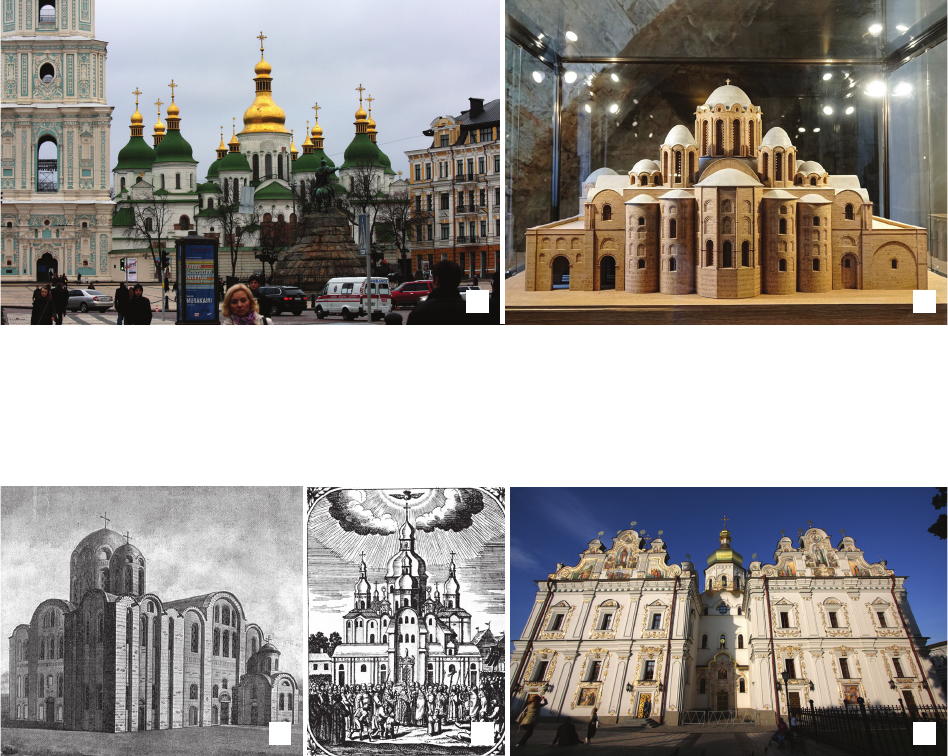
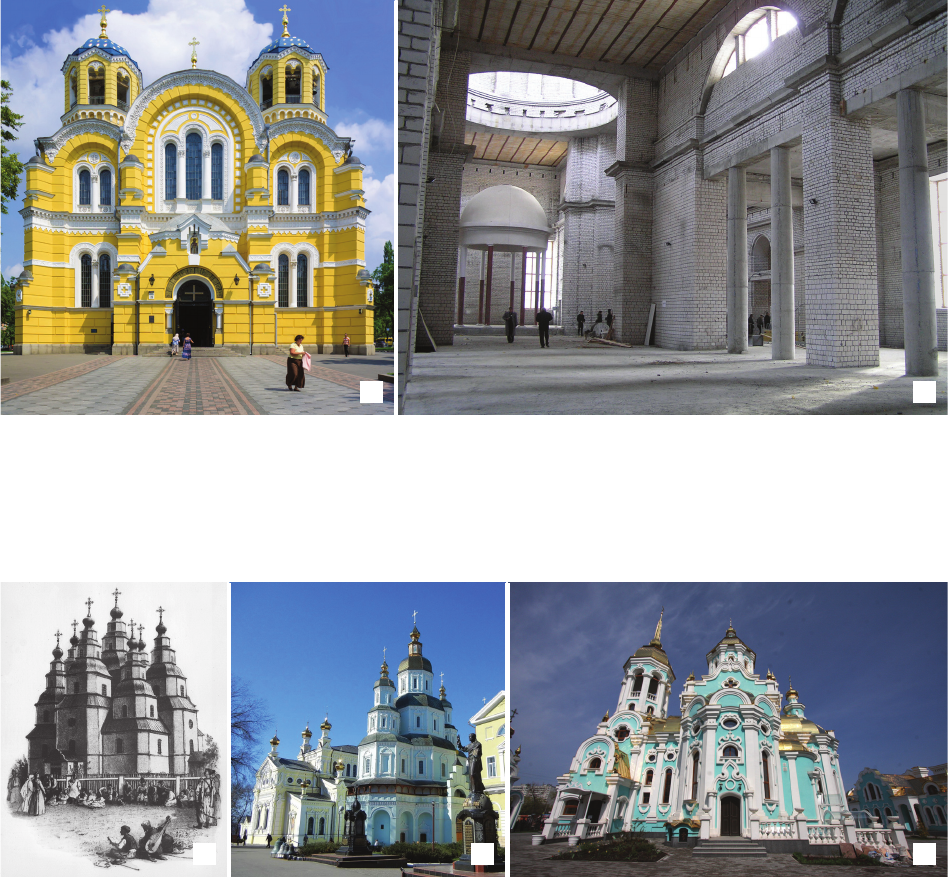
th
c.) fostered
the formation of several original architectural schools: Kyiv,
Chernihiv, Volhynia (Volodymyr), Halych, and Pereia-
slav (Figs. 1–3).
The Mongol-Tatar invasions abruptly interrupted this
trajectory, destroying thousands of wooden and masonry
churches, and bringing an end to the great architectural ep-
och of Kyivan Rus. For several centuries, the ourishing
architectural tradition of the 9
th
–14
th
centuries lay dormant.
With the rise of municipal self-governance, commerce,
and communication, the Renaissance reached Ukrainian
lands from the 16
th
century onward – primarily through ar-
chitects arriving from Italy, Germany, Switzerland, and other
regions. This epoch coincided with renewed state-building
Fig. 1. Saint Sophia Cathedral in Kyiv (11
th
c.): a) present condition (photo by Y. Kryvoruchko),
b) reconstruction by Y. Asieiev as of the 11
th
century (source: Asieiev 1969, photo by Y. Dyba)
Il. 1. Sobór Mądrości Bożej (Sobór św. Sofii) w Kijowie (XI w.): a) stan obecny (fot. Y. Kryvoruchko),
b) rekonstrukcja autorstwa J. Asiejewa przedstawiająca wygląd świątyni w XI w. (źródło: Asieiev 1969, fot. J. Dyba)
a b
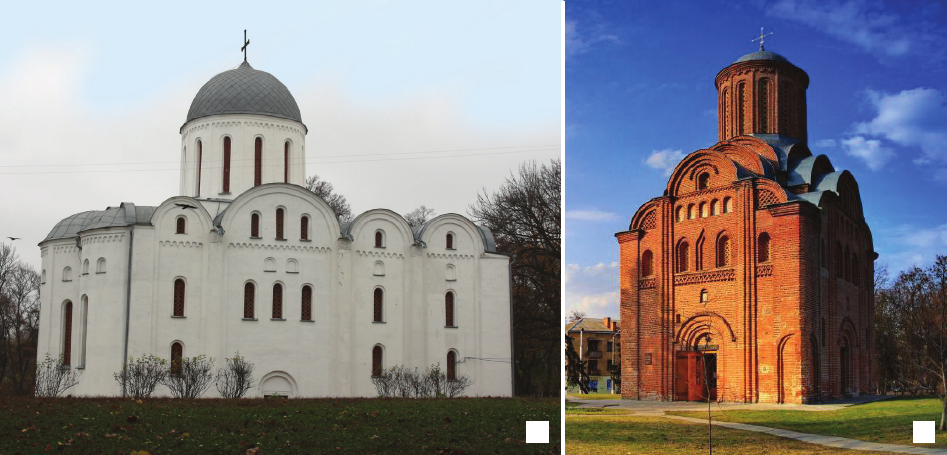
Fig. 2. Dormition Cathedral of the Kyiv-Pechersk Lavra (11
th
century): a) original appearance – reconstruction by Y. Asieiev (source: Asieiev 1969, 27),
b) view of the cathedral in an engraving by L. Tarasevych, 1702) (source: Vecherskyi 2021, 120),
c) present condition after reconstruction in 1997 (photo by Y. Kryvoruchko)
Il. 2. Sobór Zaśnięcia Najświętszej Maryi Panny Ławry Kijowsko-Peczerskiej (XI w.): a) pierwotny wygląd – rekonstrukcja autorstwa J. Asiejewa
(źródło: Asiejew 1969, 27), b) widok soboru na rycinie Ł. Tarasewycza z 1702 r. (źródło: Vecherskyi 2021, 120),
c) stan obecny po odbudowie przeprowadzonej w 1997 r. (fot. Y. Kryvoruchko)
a b c
54 Yuriy Kryvoruchko
aspirations during the Hetmanate, the Zaporozhian Sich,
and the ongoing struggles with neighbouring powers. The
rise of the Cossack elite facilitated church construction as
an expression of spiritual strength and national identity. The
turbulent 17
th
–18
th
centuries, marked by alternating gains
and losses of independence, nonetheless witnessed a cul-
tural and artistic ourishing, epitomized by the emergence
of the Ukrainian Baroque. Social movements, urban expan-
sion, the quest for national and religious self-identication
between Catholicism and Orthodoxy (especially following
the Union of Brest, 1596), and the rise of a military aristoc-
racy all stimulated the development of fortications, palaces,
and sacral architecture. Hetman Ivan Mazepa and the Cossack
elite patronized the construction of over 55 churches,
leav-
ing a profound architectural legacy (Fig. 2b).
The failure of Mazepa’s state-building project at Polta-
va in 1709, however, led to the denitive subjugation of
Uk raine to the Russian Empire and marked the end of
the
uniq uely Ukrainian (Cossack) Baroque. Following the abo -
lition
of autonomy in 1801, imperial authorities issued
a decree forbidding the construction of churches in the
Ukrainian style. From that moment until the 1990s, the
so-called “synodal style” – a standardized architectural
model derived from the Byzantine type – was ocially
imposed as the normative template across the empire. In
addition, the Russian Orthodox Church disseminated the
tent-roofed church type, characteristic of Russia but for-
eign to Ukrainian traditions, with distinct stylistic and spa-
tial connotations. This religious and cultural totalitarianism
arrested the development of Ukrainian sacral architecture
as an indigenous and identity-bearing phenomenon for
nearly two centuries, stiing processes of national self-de-
termination. The long-lasting cultural expansion of Russia
entrenched a historically distorted and spiritually super-
cial archetype of church architecture, falsely presented as
autochthonous in Left-Bank Ukraine, Polissia, and Podillia.
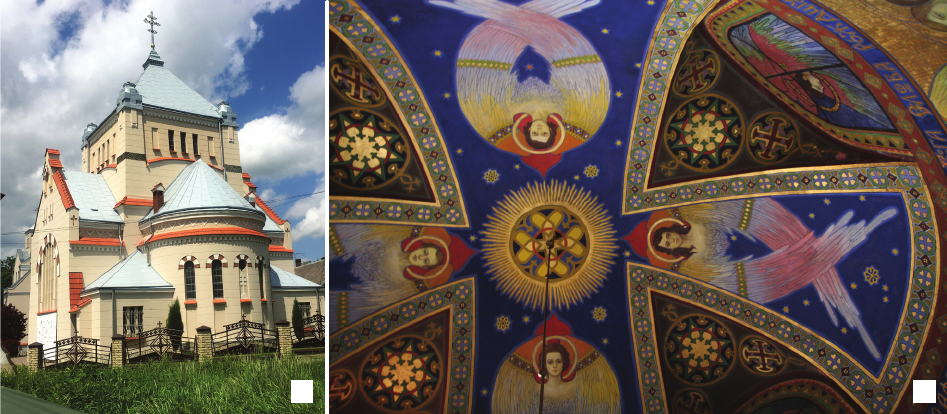
The architectural languages of Classicism and Historicism
in the 18
th
–19
th
centuries, with their rigidly codied orders
and manipulable semantics, further reinforced this imposed
paradigm (Fig. 4).
As a result, the living traditions of the princely and
Baroque epochs nearly vanished from monumental ec-
clesiastical architecture. Creative impulses shifted pri-
marily to rural contexts, where local craftsmen preserved
vernacular traditions in wooden churches. This continuity
sustained the vitality of folk architecture, culminating in
masterpieces such as the wooden Zaporozhian Cathedral in
Novoselytsia (now Novomoskovsk) on the Samara River.
Built between 1773 and 1775 by Yakym Pohrebniak, this
nine-bay, nine-domed cathedral represents the pinnacle of
Ukrainian wooden architecture (Fig. 5). Wooden places of
worship belonging to other confessional groups – Roman
Catholic, Protestant, and Jewish synagogues – were also
widespread, and some of which have survived to this day.
The Renaissance, and later the Baroque, proved par-
ticularly resonant with the worldview and sensibility of
the Ukrainian peasantry and artisan class, reecting their
joy ful and optimistic perception of nature, its dynamism,
the inevitability of renewal, ourishing, and fertility. This
cha racteristic of the national spirit, rst articulated in the
Re naissance and matured during the Baroque era, eventual-
ly attained its full spiritual resonance – a resonance which,
though repeatedly suppressed and brutally destroyed, ulti-
mately determined the vitality and eectiveness of the
Ukrainian people in history, culture, and art well into the 20
th
century. At the beginning of the 20
th
century, with the rise
of the national movement across all Ukrainian lands, the
style of Ukrainian modernism gained prominence. Its most
distinguished representatives included Vasyl Krychevskyі,
Dmytro Diachenko, Mykhailo Kravchuk, Volodymyr Si-
Fig. 3. The Cathedrals of Chernihiv:
а) Borys and Hlib Cathedral (1123), b) Church of Paraskeva Pyatnytsia (12
th
century) (photo by Y. Kryvoruchko)
Il. 3. Sobory Czernihowa: a) Sobór Świętych Borysa i Gleba (1123), b) Cerkiew św. Paraskewy Piątnicy (XII w.) (fot. Y. Kryvoruchko)
a b
Architecture of new cathedrals in Ukraine 55
the anni hilation of the majority of its sacred buildings but
also the near-total eradication of the clergy as a vital insti-
tution of spiritual life. The cultural landscape and the hi-
sto rical character of cities, towns, and villages, shaped or -
ga nically since the princely era, were violently distorted.
Se veral generations of Soviet citizens grew up deprived
of even the most fundamental freedoms. In Ukraine alone,
pri marily during the 1920s and 1930s, approximately ten
thousand churches were demolished. The four decades of
church architecture in Ukraine since 1991 represent an en ti-
re ly new stage, marked above all by the granting of auto ce-
phaly to the Orthodox Church of Ukraine by the Ecu meni-
cal Patriarchate on 6 January 2019. The emergence of this
new autocephalous Orthodox Church opens new realities
chyn skyі, Volodymyr Rykov, Oleksandr Verbytsky, Ivan
Mor hi levsky, Serhii Tymoshenko, Volodymyr Obremskyі,
Ivan Levynskyi, Yevhen and Vasyl Nahіrny, Oleksa Lush-
pyn skyі, and Petro Hrytsai (Fig. 6).
The outbreak of the First World War, the collapse of em-
pires, and the Bolshevik coup in Russia in 1917 abruptly
terminated the evolutionary development of architecture
in Eastern Europe; in the case of sacred architecture, the
process was halted altogether. What followed were long
de cades of militant atheism and systematic destruction of
churches, not only in the Union of Soviet Socialist Re pub-
lics (USSR) but also in other communist states. Under the
ag gressive anti-religious and anti-Christian ideology of
Bol she vism and communism, Ukraine witnessed not only
Fig. 4. Cathedrals of the 18
th
–19
th
centuries: a) Patriarchal Cathedral of St. Volodymyr in Kyiv (1882),
b) Transfiguration Cathedral in Odesa, interior (1795, destroyed in 1936, rebuilt 1999–2011) (photo by Y. Kryvoruchko)
Il. 4. Katedry z XVIII–XIX w.: a) Patriarchalny Sobór św. Włodzimierza w Kijowie (1882),
b) wnętrze Soboru Przemienienia Pańskiego w Odessie (1795; zniszczony w 1936 r., odbudowany w latach 1999–2011) (fot. Y. Kryvoruchko)
a b
Fig. 5. Traditions of wooden churches translated into stone architecture:
a) Wooden Trinity Cathedral, Novomoskovsk (master Y. Pohrebniak, 1778, drawing by O. Slastion, 1887) (source: Vecherskyi 2007),
b) Protection of the Holy Virgin Cathedral, Kharkiv, 1689, с) Cathedral, Kharkiv, architect P. Chechelnytskyi, beginning of the 21
st
century
(photo by Y. Kryvoruchko)
Il. 5. Tradycje drewnianych świątyń w architekturze murowanej:
а) drewniany Sobór Trójcy Świętej w Nowomoskowsku (mistrz J. Pohrebniak, 1778; rys. O. Słastiona, 1887) (źródło: Vecherskyi 2007),
b) Sobór Opieki Matki Bożej w Charkowie, 1689, с) sobór w Charkowie, architekt P. Czeczelnycki, początek XXI w. (fot. Y. Kryvoruchko)
a b c
56 Yuriy Kryvoruchko
and new possibilities for the development of Orthodoxy in
Ukraine and, alongside it, of church architecture.
In conclusion, it is important to stress that the three his-
torical epochs of Ukrainian sovereignty and state-building
struggles – the era of Kyivan Rus’, the Cossack Hetmanate,
and the nation- and state-building processes of the early
20
th
century – generated three distinct impulses in the deve-
lopment of authentic Ukrainian sacred architecture. These
gave rise to three architectural archetypes: the princely
style, the Ukrainian (Mazepine, Cossack) Baroque, and the
national style of the late 19
th
and early 20
th
centuries.
Contemporary tendencies in Ukrainian church architec-
ture draw explicitly upon these three native sources: the
princely, the Cossack, and the national. Each was violently
interrupted – by the Mongol-Tatar invasions, the Russian
Empire, and the Soviet period, respectively. The reverence
towards these past styles is rooted not only in their inherent
artistic and spiritual value but also in the fact that they were
forbidden and systematically destroyed in earlier centuries.
This sense of historical discontinuity and unnishedness,
coupled with their indisputable spiritual and aesthetic sig-
nicance, their authenticity and originality, and their role
in shaping not only architectural identity but also national
self-determination, continues to inspire the three principal
currents of traditional Ukrainian sacred architecture today:
the princely style, the Cossack Baroque, and the search for
a national style. These currents will long remain sources
of creative exploration for ecclesiastical architects. The
princely era, the Cossack legacy, and the formative periods
of national identity are being reinterpreted anew, lling his-
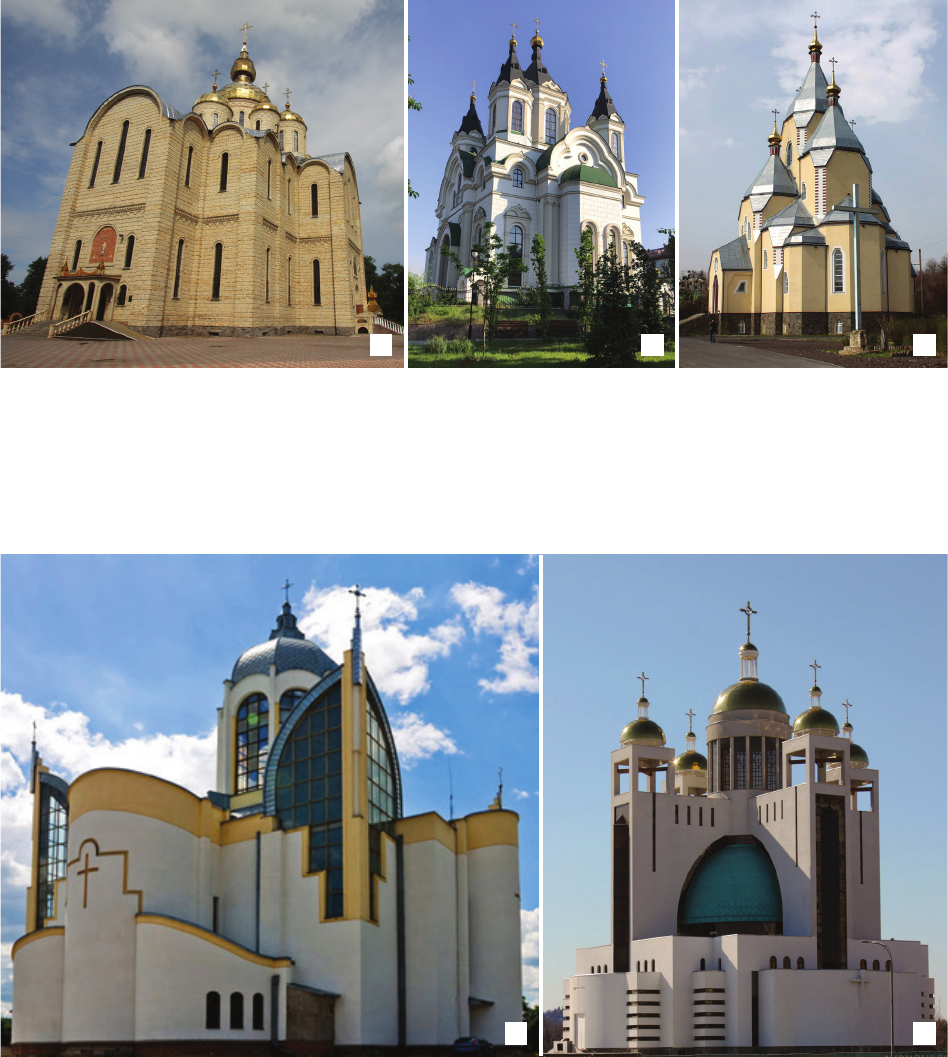
torical lacunae within Ukrainian culture (Fig. 7).
It must be emphasized that the issue at stake is not limit-
ed to the stylistic features of Ukrainian sacred architecture.
Rather, it concerns the broader image of the sacred place:
the conceptualization of liturgical space, its semantics,
structure, and form; the interpretation of archetypes and
traditions; the sense of harmony and beauty inherent in the
temple; and, ultimately, the theological meaning with which
Ukrainians have imbued it over the centuries.
Alongside the three currents of contemporary Ukrainian
church architecture – drawing on princely, Cossack, and
national legacies – there is also a path of searching for uni-
versal and absolute forms: primal archetypes of the sacred,
interreligious meanings, and an abstract language of spatial
expression. This approach rests on the intuitive explora-
tions of contemporary ecclesiastical architects. At its core
lies the philosophy of simple gures, volumes, and geomet-
ric forms – shapes that, across many religions, have been
endowed with sacral meaning since antiquity. These spatial
structures are readily grasped, endowed with strong visual
suggestiveness, and minimal in architectural detailing, or-
namentation, and decorative stylization. They are charac-
terised by ascetic form, absence of quotations, borrowings,
eclectic juxtapositions, kitsch, spatial verbosity, or ill-con-
sidered solutions. This direction resonates strongly with the
broader currents of contemporary Western sacred architec-
ture, informed by the principles articulated by the Second
Vatican Council (Fig. 8).
Conclusions
For contemporary directions in church architecture, what
proves to be characteristic and signicant is not so much
adherence to traditional historical styles – which, as with
any form of stylization, inevitably remain supercial – but
rather a profound sensibility towards Tradition itself, its
deep sources, and the primordial autochthonous character
of Ukrainian ecclesiastical architecture. At the same time,
it must be observed that the attempt to combine the ideas
of modern architecture with theological inquiry has not yet
yielded clear or tangible creative results. Contemporary life
demands an adequate architectural expression for sacred
Fig. 6. Churches in the National Style of the early 20
th
century: а) St. Demetrius Cathedral in Obroshyne, Lviv Region (1907),
b) Church of the Sacred Heart of Jesus in Zhovkva, mural by J. Butsmaniuk (1931–1939) (photo by Y. Kryvoruchko)
Il. 6. Świątynie w stylu narodowym początku XX w.: a) Sobór św. Dymitra w Obroszynie koło Lwowa (1907),
b) Сerkiew Najświętszego Serca Jezusowego w Żółkwi, polichromia autorstwa J. Bucmaniuka (1931–1939) (fot. Y. Kryvoruchko)
a b
Architecture of new cathedrals in Ukraine 57
buildings, particularly in newly developed urban districts,
where the appearance of new churches often stands at odds
with the language of modern spatial design.
It may be stated that there is, as yet, no fully developed
architectural doctrine for the Christian church in contem-
porary Ukraine. This absence has resulted in a delay in the
cultivation of professional thought and in the rarity of suc-
cessful, modern examples of Ukrainian church architecture.
The dierences between Western and Eastern Christianity
place upon Ukrainian ecclesiastical building and architec-
ture a particular responsibility: to preserve the phenomenon
of tradition while at the same time creating an authentic,
modern, and distinctly Ukrainian type of church.
Within this very eld, Ukrainian architecture has a broad
scope for action. Above all, it must distinguish its own in-
digenous tradition from external inuences, nurturing the
native Ukrainian church heritage and its spatial expression
in forms, locations, and environments. The architecture of
Fig. 7. Cathedrals of the 1990s:
a) Cathedral in Cherkasy (1990s), b) Cathedral in Zaporizhzhia (1990s),
с) Cathedral in Vyshhorod, architect Y. Losytskyi (1990s) (photo by Y. Kryvoruchko)
Il. 7. Katedry lat 90. XX w.: a) sobór w Czerkasach (lata 90. XX w.), b) sobór w Zaporożu (lata 90. XX w.),
с) sobór w Wyszogrodzie, architekt J. Łosycki (lata 90. XX w.) (fot. Y. Kryvoruchko)
a b c
Fig. 8. The Newest Cathedrals in Ukraine: a) Cathedral of Saints Peter and Paul in Chortkiv, architect S. Hora (2020),
b) Patriarchal Cathedral in Kyiv, architect Y. Levchuk (2011) (photo by Y. Kryvoruchko)
Il. 8. Najnowsze katedry na Ukrainie: a) Sobór Świętych Apostołów Piotra i Pawła w Czortkowie, architekt S. Hora (2020),
b) Sobór Patriarszy w Kijowie, architekt J. Lewczuk (2011) (fot. Y. Kryvoruchko)
a b
58 Yuriy Kryvoruchko
References
Asieiev, Yuriy. Mystetstvo starodavnіoho Kyieva. Mystectwo, 1969.
Cherkes, Bohdan, Oksana Diachok, and Józef Hernik. “Theoretical
Studies of Identity in the Sacral Architecture of Ukraine.” Architectu -
ral Studies 10, no. 1 (2024): 58–68. https://doi.org/10.56318/as/
1.2024.58.
Diachok, Oksana. Formuvannia arkhitektury sakralnykh komplek-
siv u konteksti suspilno-politychnykh protsesiv (na prykladi Ter-
nopilshchyny). Hab. diss., Natsionalnyi universytet “Lvivska po-
litekhnika”, 2020.
Dunayevskyi, Yevhen. Evoliutsiia arkhitektury pravoslavnykh khramiv
i kompleksiv v period nezalezhnosti Ukrainy. PhD diss., Odeska der-
zhavna akademiya budivnytstva ta arkhitektury, 2023.
Gorbyk, Olena, Galyna Shevtsova, Tetyana Kashchenko, Volodymyr
Star chuk, Oleksandra Yezhova, and Yaroslav Starchuk. “Kyiv St. Ni-
cho las Roman Catholic Church: Problems of Restoration and Post-
War Renovation of a Unique Monument of the Neo-Gothic Style.”
In ter national Journal of Conservation Science 15, Special iss. no. 1
(2024): 305–20. https://doi.org/10.36868/IJCS.2024.SI.23.
Ivashko, Yulia, Andrii Dmytrenko, Aneta Pawłowska, et al. “Destruction
of the Architectural Heritage as a Result of War: The Experience of
Re con struction (Conservation and Logistical Aspects).” International
Jour nal of Conservation Science 15, Special Iss. 1 (2024): 17–30.
https://doi.org/10.36868/IJCS.2024.SI.02.
Kozłowski, Tomasz, Yulia Ivashko, Serhii Belinskyi, Andrii Dmytrenko,
and Oleksandr Ivashko. “Theoretical and legal rules for the re con-
struc tion of architectural monuments in Ukraine that suered dur-
ing the Russian military aggression.” Teka Komisji Urbanistyki
i Architektury PAN w Krakowie 50 (2022): 391–408. https://doi.
org/10.24425/tkuia.2022.144859.
Kryvoruchko, Yuriy. Fenomen sakralnoho u rozvytku mist i terytorii (na
dosvidi Ukrainy). Hab. diss., Natsionalnyi universytet budivnytstva
i arkhitektury, 2018.
Kryvoruchko, Yuriy. “Yakii buty arkhitekturi Ukrainskoi Tserkvy pis-
lia Tomosu?” Religious Information Service of Ukraine. Published
January 11, 2019. Accessed February 18, 2026, at https://risu.ua/ya-
kiy-buti-arhitekturi-ukrajinskoji-cerkvi-pislya-tomosu_n95752.
Kryvoruchko, Yuriy. “Romanticism in the Religious Architecture of the
20
th
and 21
st
Century.” Sztuka Europy Wschodniej 8 (2020): 309–24.
Kryvoruchko, Yuriy. “Sakralna arkhitektura.” In Entsyklopediia sucha snoi
Ukrainy. Vol. 1, edited by Ivan Dziuba. Natsionalna akademiia nauk
Ukrainy, Naukove tovarystvo imeni Shevchenka, 2001.
Kryvoruchko, Yuriy, and Bogusław Podhalański. “The Need for a Myth
in Contemporary Sacred Architecture.” In Dening the Archi tec
tu ral Space – The Myths of Architecture. Vol. 1, edited by Tomasz
Kozłowski and Anna Mielnik. Ocyna Wydawnicza ATUT – Wro-
cław skie Wydawnictwo Oświatowe, 2021.
Kubiiovych, Volodymyr, Zenon Kuzelia, and Arkadii Zhukovskyi, eds.
En tsy klopediia ukrainoznavstva. Vol. 3. Naukove tovarystvo imeni
Shev chen ka, 1995.
Molochko, Vitaliy, and Joanna Borowczyk. “Preserving Ukraine’s Cul-
tural Heritage: Restoration and Inclusivity.” International Journal of
Conservation Science 16 (Special Issue) (2025): 555–66. https://doi.
org/10.36868/IJCS.2025.SI.14.
Rybakov, Boris. Yazychestvo Drevnei Rusi. Nauka, 1988.
Shevchenko, Igor. Byzantiia i Kyivska Rus u 6–9 stolittiakh. Вizantiiski
studii. Lybid, 1995.
Shevtsova, Halyna. Pochodzhennia ukrainskoi derevianoi tserkvy. Kon
tekst Svitu i oryginalnist. Oleksandr Savchuk, 2017.
Slobodian, Volodymyr. Kataloh isnuiuchykh derevianykh tserkov v Ukrai
ni i ukrainskykh etnichnykh zemliakh. Bulletin of Ukrzakhid pro ektre -
sta vratsiya 4 (1996): 74–159.
Taras, Yaroslav. Arkhitektura derevianykh tserkov v Ukrainskykh Kar pa
takh. Kulturni i tradytsiini aspekty. Folio, 2018.
Urakina, Anastasiia. “Transformation of Church Architectural Com po si-
tion in Ukraine between the Tenth and Eighteenth Centuries as a Theo -
retical Basis of Restoration. Wiadomości Konserwatorskie 69 (2022):
15–25. https://doi.org/10.48234/WK69UKRAINE.
Vecherskyi, Viktor. “Baroko ukrainske, kozatske i mazepynske: termi no-
lohichni denitsii i sutnist yavyshcha.” Sivershchyna v istorii Ukrai-
ny: Zbirnyk naukovykh prats, no. 14 (2021): 7–11.
Vecherskyi, Viktor. Ukrainski dereviani tserkvy. Nash Chas, 2007.
Voitovych, Valerii. Ukrainska mifolohiia. Lybid, 2002.
contemporary cathedrals may thus serve not only as a labo-
ratory of practice, but also as a eld of reection on a new
sacred architecture capable of addressing contemporary
challenges, for its role ultimately lies in pointing the way
towards God.
In the personal revelation of the temple’s creator, faith
itself is manifested and the sacred is revealed. Such indi-
vidual revelation demonstrates that in the authentic crea-
tivity of the artist, the sharp distinctions between Western
and Eastern modes of expressing Christian faith begin to
dissolve. For at its core, the categorical and gurative or-
der of sacred works in both branches of Christianity draws
upon the same Tradition of Revelation, the Tradition of the
Gospel, and the lived experience of the Eucharist. The art of
the icon and of architecture – by elevating the image to the
level of eschatological reality – transcends discursive dif-
ferences among the theological positions of Christianity’s
various branches, and can act as a unifying foundation for
mutual understanding. It attests that creativity and the sa-
cred share the same spiritual nature.
The disclosure of the essence of the image and of the
modes in which the sacred is manifested within the struc-
ture of the Christian temple, together with the personal
revelation of its creator, makes possible the unveiling of
the sacred dimension of architectural objects beyond the
doctrinal boundaries of individual Christian traditions.
A deeper comprehension among the branches not only of
Orthodoxy but of Christianity as a whole is possible only
through the recognition of the inherent syncretism of the
Image. Such comprehension will come to fruition when be-
lievers grasp the spiritual signicance of this unity.
Translation verication
Yaryna Voronych
Architecture of new cathedrals in Ukraine 59
Streszczenie
Architektura nowych katedr w Ukrainiе
Tematem artykułu są współczesne katedry Ukrainy jako wyraz ciągłości autochtonicznej tradycji architektury sakralnej, przestrzeń ujawniania
archetypów ukraińskiej świątyni chrześcijańskiej oraz najbardziej reprezentatywne zjawisko najnowszej ukraińskiej architektury sakralnej. Katedry roz-
patrywane są jako przestrzeń dialogu między tradycją a współczesnością, w której dokonuje się reinterpretacja dziedzictwa historycznego, kształtowanie
nowych obrazów architektonicznych oraz aktualizacja duchowych i kulturowych archetypów narodu ukraińskiego.
Celem autora było określenie głównych archetypów ukraińskiej architektury cerkiewnej oraz zbadanie sposobów ich współczesnej interpretacji
i realizacji w architekturze nowych katedr Ukrainy. Szczególną uwagę poświęcono problematyce historycznej ciągłości tradycji sakralnej, relacjom po-
między przedchrześcijańskimi i chrześcijańskimi wyobrażeniami światopoglądowymi, a także poszukiwaniu współczesnego języka architektonicznego
zdolnego do wyrażenia duchowej treści świątyni w warunkach współczesności.
W pracy wykorzystano metodę historyczno-genetyczną, hermeneutyczną, analizę porównawczo-typologiczną, metodę architektoniczno-kompozy-
cyjną oraz interpretację kulturową i fenomenologiczną przestrzeni sakralnej.
Analizą objęto główne etapy kształtowania się ukraińskiej architektury sakralnej – od przedchrześcijańskich warstw kulturowych i epoki Rusi
Kijowskiej po ukraiński barok oraz styl narodowy przełomu XIX i XX w. Na tej podstawie wyodrębniono trzy podstawowe archetypy ukraińskiej archi-
tektury cerkiewnej: tradycję książęcą, ukraiński (kozacki, mazepiński) barok oraz narodowy styl epoki nowoczesnej.
Wykazano, że współczesna architektura katedr Ukrainy rozwija się w kilku kierunkach: poprzez twórczą reinterpretację archetypów historycznych,
poszukiwanie nowych form ekspresji sacrum oraz odwołanie do uniwersalnych, międzyreligijnych obrazów i praform sacrum. Ustalono, że zasadni-
czym wyzwaniem współczesnego budownictwa sakralnego nie jest odtwarzanie historycznych stylów, lecz pogłębione rozumienie tradycji oraz two-
rzenie auten tycznego, współczesnego typu ukraińskiej świątyni, odpowiadającego duchowym i kulturowym potrzebom współczesnego społeczeństwa.
Architektura nowych katedr postrzegana jest jako swoiste laboratorium poszukiwania nowej ukraińskiej architektury sakralnej zdolnej połączyć
tradycję teologiczną, tożsamość narodową i współczesną kulturę architektoniczną. Wykazano, że poprzez architektoniczny obraz świątyni oraz osobiste
twórcze objawienie architekta ujawnia się sakralny wymiar architektury, który może przekraczać granice konfesyjne i sprzyjać głębszemu zrozumieniu
jedności tradycji chrześcijańskiej.
Słowa kluczowe: architektura, Ukraina, innowacje, archetyp, tradycja