2021
1(65)
DOI: 10.37190/arc210107
Bartosz Kaźmierczak*
Assistance of an expert in the participatory planning model
in the area included in the revitalisation programme in view
of the desired changes.
Based on the example of the district of Śródka in Poznań
*
ORCID: 0000-0001-8436-6963. Faculty of Architecture, Poznan
University of Technology, e-mail: bartosz.kazmierczak@put.poznan.pl
Introduction
There are no participatory methods developed in the
Polish urban planning process that might engage the in-
habitants into joint cooperation at all the stages of a plan-
ning process. This statement does not apply only to man-
datory procedures that under Polish legislation require
social participation at the stage of drawing up the planning
documentation or documentation pertaining to revitalisa-
tion works. However, the above mentioned participatory
planning should above all apply to factual inclusion of the
voices of local communities in the legislative and decision
making processes. The most frequent practice is to present
the already worked up planning and design solutions that
are subsequently consulted with the social groups. Such
a practice is most often supported with the time pressure
argument in reference to the EU funds application proce-
dures. As a result, the term “participatory” planning be-
comes an empty phrase used to conrm that the consensus
was reached in social negotiations [1]. Thus, the voice of
local communities is rarely fully accounted for and it rare-
ly has any major impact on the decision making process, in
particular at the level of a given revitalisation programme
implementation. The blame, however, should not be put
on the self-governments only. As Mielczarek-Żej mo [2]
states, involvement of a variety of entities into the decision
making process should be based on eective management
of complexity and diversity of conicts and crises that may
arise in reference to one area as well as on eective mana-
gement of diversity of opinions regarding social needs and
development opportunities of a given zone.
The purpose of this article is to carry out a case study
on Śródka district in Poznań to nd answers to the ques-
tion about the role of experts in participatory planning.
Participatory method in the process
of revitalisation
Social participation in urban development facilitates
proper diagnosis of problems and chances as well as the
process of education, the exchange of know-how and good
professional practices. Moreover, inclusion of a wide range
of stakeholders into the stage of identication, planning,
implementation and monitoring of the revitalisation or de-
velopment works will elevate them to the rank of factual
co-designers of the changes in their surroundings. Polish
urban planning process has so far failed to work up par-
ticipatory methods that might engage the inhabitants into
joint cooperation at all the stages thereof.
Socialisation of the planning process at a number of
stages shall be based on appropriate education of the local
communities to ensure that they are prepared and ready
to properly participate in the process. In particular, they
should be ready to conduct substantive and responsible
dialogue [3]. Four main categories may be distinguished
from among good practices ensuring the factual sociali-
sation of the urban development or revitalisation that will
facilitate due education of the local communities to eec-
tively participate in the planning process [4]. These are the
techniques that develop:
1) understanding the complexity of the assessment per-
spectives, in particular the dierence between the subjec-
60 Bartosz Kaźmierczak
tive (your own) and objective (collective) perception of
problems, needs and solutions;
2) abilities to recognise and compare places based on
a wide perception of the local environment in view of its
potential opportunities, not just problems and deciencies;
3) ability to use the municipal information database:
reading plans and referring them to a factual space; structur-
ing the information coming from dierent sources, under-
standing how the municipal administration functions, etc.;
4) a collaborative approach to the planning process and
proposing the desired, reasonable and feasible solutions.
Engaging diversied entities into the decision making
process shall be founded on the searches for ecient man-
agement of complexity and diversity of the conicts and
crises that might arise in one place as well as the ecient
management of diversity of opinions on social needs and
development opportunities of a given area [2]. A social
network is one of those theoretical perspecti ves that al-
low for dening rules applicable to combining forces in
the process of urban development or revitalisation. Such
networks assume a specic form of governance networks,
which can be dened as a manner of creating and imple-
menting public policies through the creation of the rela-
tions network between the authorities, entrepreneurs and
key players in the civic society [5]. The operation of such
cooperation network in the context of the activities in-
tended for the purpose of conversion and development of
the town is predetermined with the role of local leaders.
Their role shall focus on the initiation of the said activities,
regulation of their functioning and verication of their ob-
servance. The main idea of such networks is to engage
into cooperation the right key players that have proper re-
sources and know-how in order to meet dened targets. It
is also important to dene the framework of the cooper-
ation network, in particular in the context of identifying
the desired target activities, scope of competences and the
manner of making decisions. Here, the experts can play
an important role as the approval body, but more than just
that, they can educate, integrate and coordinate the stake-
holders in the process.
Case study – Śródka
Śródka is a small housing estate on the borderlines of
Poznań downtown area, which has been the subject matter
of many research works for many years now. The social,
economic and spatial changes undergoing in the area are
of interest to all the stakeholders that view revitalisation
as an important regeneration process of degraded urban
structures and fabric [6]. Since 2006, when the Munici-
pal Revitalisation Program was adopted for the district of
Śródka, this small housing area has become the core of re-
search and a case study in respect of the implementation of
revitalisation activities prescribed in the aforementioned
revitalisation programme adopted by the authorities of
Poznań. Opinions concerning the assessment of the eects
of Śródka revitalisation have varied. Many researchers are
critical of the eects of the activities undertaken within
the framework of the programme in 2006, pointing out
that they resulted in increased rents and pushed out the
nancially fragile inhabitants from the area [7], [8]. Nev-
ertheless, we cannot overlook the positive spatial changes
that have improved the aesthetics of development and
pub lic space or increased the functional attractiveness of
the district owing to the opening of the Interactive Centre
for the History of Ostrów Tumski (ICHOT). The process,
furthermore, increased the awareness of the inhabitants
and the entrepreneurs living and operating in Śródka in
respect of the district contribution into the creation of the
image of Poznań.
Problems of local entrepreneurs
Activities undertaken to revitalise degraded areas – in
particularly those located in the central part of the city
– must account for certain adverse phenomena inherent
in increased attractiveness of an area under revitalisation.
Increased public interest in a venue where cultural events
take place, improvement of visual quality of urban space
or creating certain social popularity trends may result in
social conicts or increase the abuse of particular interests
[9]. In case of the district of Śródka, the stakeholders have
many times successfully managed to balance the interests
of respective groups, thus preventing any conict escala-
tion and loosening of the social bonds established with so
much eort and involvement [10].
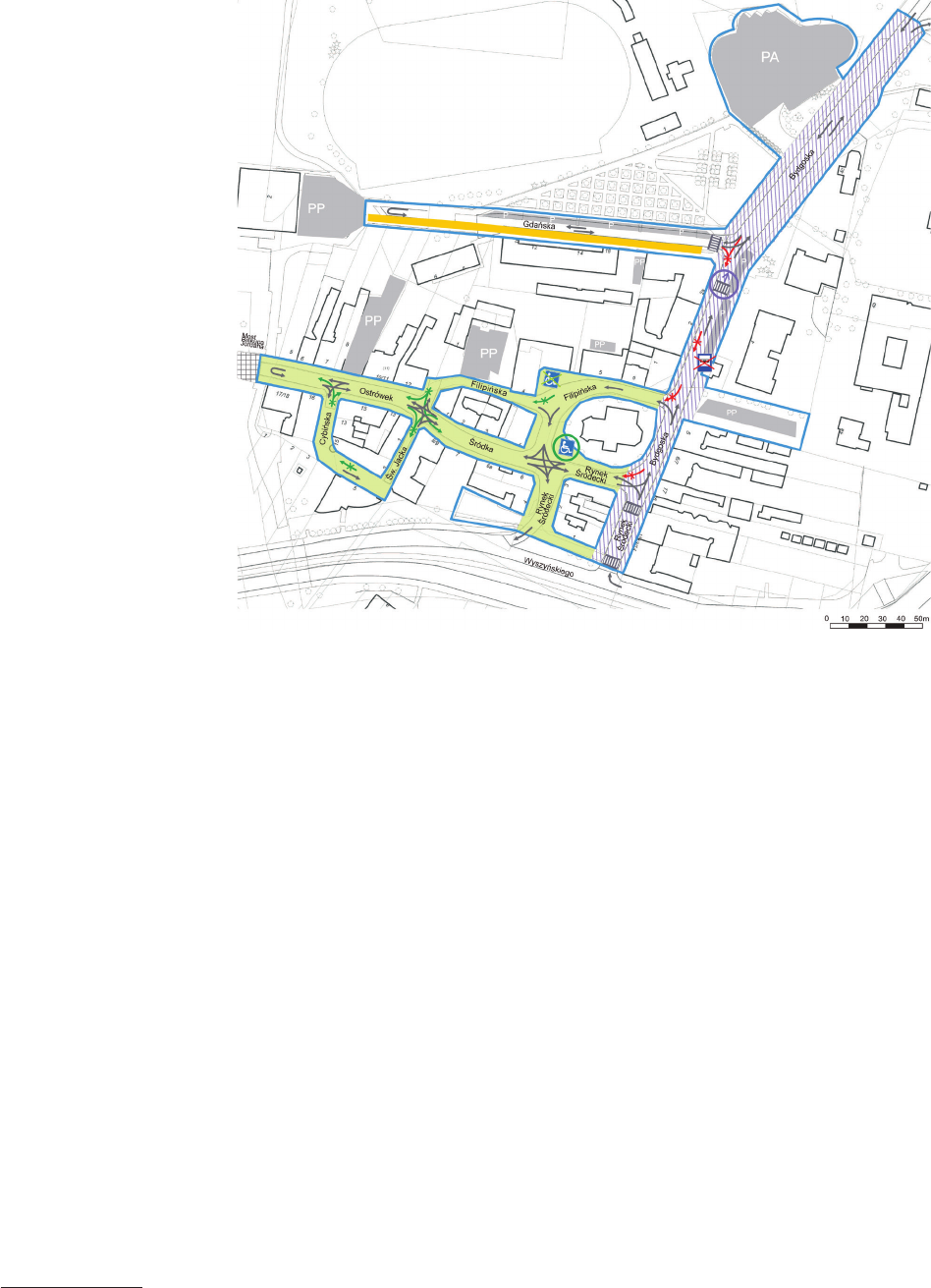
It has turned out that a conict arose from a problem-
atic issue that failed to be resolved at the very beginning
of revitalisation and from a new situation that occurred
due to unpredicted circumstances. Both situations under-
lay the escalating dissatisfaction of the entrepreneurs op-
erating in the district of Śródka. The rst one concerned
the so far unsolved problem of transit through the housing
estate and improper organisation of parking options. The
second conict developed unexpectedly when the own-
ers, after the renovation of the façades of their tenement
houses, demanded that the trac lights operator that had
used the elevations of the houses for the purpose of the
installation of the lighting xtures should reimburse the
owners a part of the renovation costs. The operator did not
have any proper agreements concluded in this respect and
for this reason, refused to pay any compensation to the
tenement house owners. They, in turn, refused to have the
light xtures installed on the elevations of their buildings.
Due to the conict, spatial attractiveness of Śródka de-
clined and, as per the claims of local entrepreneurs, trans-
lated into the decreased revenue generated from business
operations, mainly in the catering sector. Some of the lo-
cal restaurant owners decided to undertake their own initi-
ative to rescue their businesses. Unfortunately, their ideas
to support respective businesses failed to account for the
interests of other local entrepreneurs, and even the inhab-
itants of Śródka, the main users of the district space. Two
extreme approaches could be observed among members
of the local community:
1. The approach taken by the entrepreneurs: “I am strong
and I have the initiative, thus, I convert the actual sur-
roundings as I deem t”.
2. The approach taken by the local activists: “I am an
im portant part of the urban fabric, where I operate, and
Assistance of an expert in the participatory planning model 61
Fig. 1. A map showing the
approved in 2017 by the Town
Hall in Poznań “Social concept
of changes in the organisation of
traffic in the district of Śródka”,
where transit through the district
centre is no longer admissible
(source: https://www.poznan.pl/
mim/s8a/projekt-srodka,
p,1025,5634.html;
accessed: 14.03.2021)
Il. 1. Mapa przedstawiająca
zatwierdzoną w 2017 r.
przez Urząd Miejski w Poznaniu
„Społeczną koncepcję zmian
w organizacji ruchu na Śródce”,
w której nie dopuszcza się już
tranzytu przez centrum dzielnicy
(źródło: https://www.poznan.pl/
mim/s8a/projekt-srodka,
p,1025,5634.html;
data dostępu: 14.03.2021)
because I am the beneciary of this place, I am partially
responsible for it”.
Thus, the question arises on the conditions to be met
for the two groups of stakeholders taking the two extreme
approaches but declaring to have the same needs to get
together and discuss the issue amicably.
Activation of local entities and social leaders translates
into increased civic awareness and creates the need for
a dialogue. In the district of Śródka, in order to resolve
the conict and to agree on the right solution in the best
interest of the inhabitants, it was necessary to get the mu-
nicipal authorities involved. A dedicated workshop was
organised and the invited experts
1
were expected to re-
solve the dispute that had arisen in the local community,
in a manner facilitating the strengthening of social bonds
and mutual trust.
Workshop meeting.
Assumptions, course of development, conclusions
The Revitalisation Branch of the Poznań Town Hall
2
,
the Board of the Housing Estate “Ostrów Tumski Śródka
– Zawady – Komandoria” and the Society of the Friends
of Śródka and the neighbouring areas called “Śródeja”
1
The invited experts: Bartosz Kaźmierczak and Sławomir Palicki
were members of the group of experts, actively engaged in the activities
aimed to implement the Śródka district Revitalisation Programme in the
years 2008–2019.
2
The Head of the Branch Oce was at the time Lech Podbrez, an
architect.
came up with the idea of the workshop meeting and then
organised it. The workshop attracted property owners and
administrators as well entrepreneurs operating in the dis-
trict of Śródka (hotel owners, restaurant owners and retail
store owners), as well as local activists. The purpose of
the workshop was to agree on the most crucial threats and
opportunities for the businesses in Śródka, options of cre-
ating the image of entrepreneurial spirit of the district of
Śródka and a possible scope of cooperation.
To optimally use the time individual participants could
devote to participate in the workshop, its preliminary pri-
ority assumptions had been worked up in advance. Be-
fore commencing work with any group of participants,
the organisers approved of a postulate of a wide range of
cooperation at the stage of conceptions and of the princi-
ple that joint interest shall prevail over particular interests
in the selection of solutions to be implemented. It was
agreed that the main task of the meeting was to make the
participants aware that every one shall contribute to the
discussion on the desired changes because the solutions
worked out jointly shall serve the common welfare. Thus,
if every participant declared that s/he needed to maximise
the prots generated from business activity run in Śródka,
then, s/he should make a relevant nancial investment or
put an eort in the organisation of joint initiatives, ade-
quately to his/her declaration. The meeting was scheduled
for three hours; the planned workshop was divided into
two thematic groups: diagnosis – listing the problems; and
directions of changes – during this part of the workshop
the participants searched for possible solutions to the prior
listed problems.
62 Bartosz Kaźmierczak
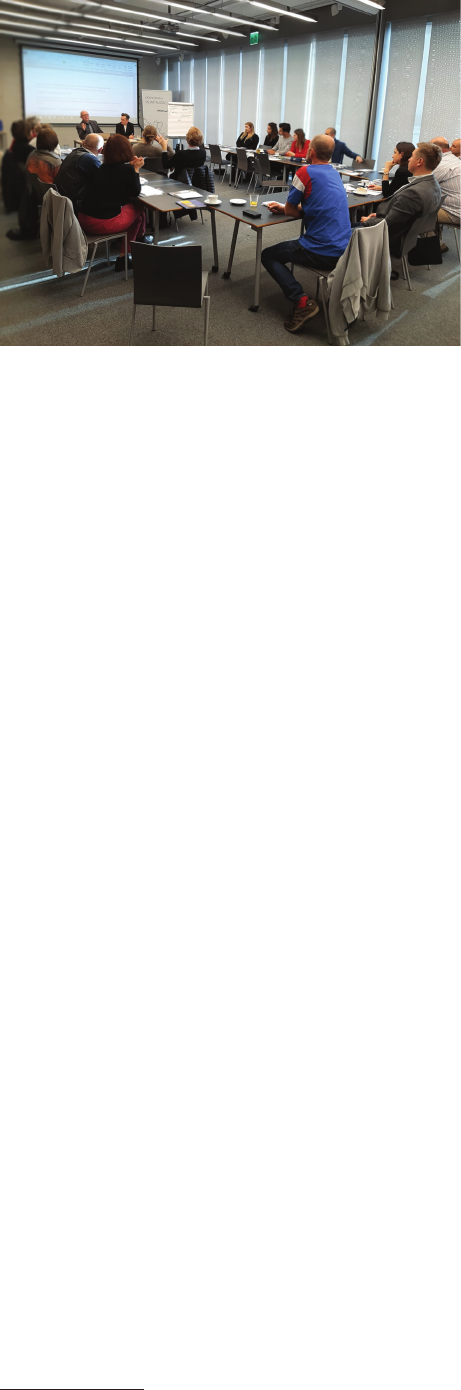
Fig. 2. Participants of the workshop – representatives of local
entrepreneurs, housing estate board and local activists
(photo by L. Podbrez)
Il. 2. Uczestnicy warsztatów – przedstawiciele lokalnych
przedsiębiorców, rady osiedla i lokalnych aktywistów
(fot. L. Podbrez)
The rst part of the workshop started with two short
presentations by the experts
3
who chaired the event. The
rst presentation recalled the leading role of the district of
Śródka and its neighbouring area of Ostrów Tumski (the
cradle of the Polish state) in the development of Poznań.
The second part focused on the methodology of running
discussions and reaching consensus. After the introduc-
tory part the participants were asked to report problems
that for them directly translated into the reduced income
generated from the business activities they ran in Śródka
and to list the assets of the location. Spontaneously voiced
opinions by individual participants in the course of the
discussion were recorded. The workshop chairmen re-
frained from moderating the voices raised, but only noted
down the drawbacks in red and the benets in green.
The concerns raised included voices on several prob-
lematic issues. The most important one, being the direct
reason why the workshop meeting was organised, was
the street lighting. The organisers hoped the participants
would be able to arrive at a consensus. After dusk, it was
pitch dark in Śródka. Lack of lights at the section from the
Cathedral to Śródka Roundabout discouraged any visitors
from entering the area. The lighting arrangement should
invite the visitors, whereas there was no such incentive,
the space lacked coherence and emitted no express signals
that might “invite” visitors to Śródka. Poor recognisabil-
ity of the place aects the perception of what the district
has to oer (as a hidden/unknown oer), whereas the ex-
isting spatial arrangement only underlines the separation
of Śródka with the urban planning borderlines between
this district and Ostrów Tumski and next the Old Market
Square. Tourist information and promotion services seem
to insuciently propagate what Śródka has to oer (thus,
3
The rst to take oor was B. Kaźmierczak, a PhD, engineer
architect, to be followed by Sławomir Palicki, PhD, specialist in economy.
it remains hidden/unknown). The recognisability of the
place is poor, its identity symbols fail to be widely rec-
ognised, e.g., the 3D mural, which fails to be described
in guide books and the tourists often do not know where
to look for it. As far as historical sites are concerned – the
Church of St. Margaret is inaccessible to the public. The
entrance to its chapel and to the yard is usually closed.
What is more, the Polish-Catholic Saint Casimir church is
equally inaccessible and unknown, similarly to the school
for the deaf children and the Cathedral School, which of-
ten hold a variety of cultural events. The exchange of in-
formation on the events organised in Śródka and Ostrów
Tumski was also poorly rated. In this scope consensus
had failed to be reached by the two administrative areas,
which, despite their close vicinity, seemed to operate sep-
arately. From the perspective of servicing the tourist traf-
c, Śródka was noted to clearly lack the tourist infrastruc-
ture in the basic form of small architecture, i.e., benches,
rubbish bins or cash dispensing machines.
Another issue raised and highlighted, in particular
by the representatives of the housing estate board and
“Śró de ja” Society, was the leading residential function
of Śród ka. Thus, the two bodies maintained that the late
opening hours of restaurants and bars, similarly to those
in the Old Market Square in Poznań, were improper
because it was in the best interest of the residents that
Śródka should attract the visitors during the day and not
at night. The inhabitants were the hosts in their district,
therefore peaceful resolution of conicts between them
and the visitors should be viewed as a necessity. The res-
taurant owners agreed with the statement and acknowl-
edged the fact. They, how ever, stressed that at weekends
their businesses located in Śródka generated the highest
turnover. They also named the events that adversely af-
fected their business operations. The marathon was listed
as an event generating great losses for the entrepreneurs
(on average there are approx. ve such events annually).
During such events, transport to Śródka is blocked and
social media especially contribute to the atmosphere of
panic, predicting total trac paralysis, and recommend
that the visitors should avoid going to Śródka on such
occasions. It often happens that the circulation of the in-
formation about such events is inecient, the public is
not informed about them with due notice and there is no
reliable information about bypasses or alternative access
roads leading to Śródka. The information on available
transport options to Śródka is similarly poorly dissemi-
nated, this includes no information on bus or passenger
car park options or on the car park at the back of the
Cathedral in Ostrów Tumski. Car park space as such was
assessed as sucient because at weekends the car park
near the school for the deaf can be used if needed. The
participants, however, acknowledged the fact that car
park places need to be clearly delimited as the cars tend
to be parked “wherever possible” – even on the pave-
ments; this renders the impression of chaos, disorder,
lack of aesthetics, which, in view of the perception of the
quality of space, translates into its negative image and,
moreover, results in the obstruction of vehicle and pe-
destrian trac. The transit trac rush hours in Śródka

Assistance of an expert in the participatory planning model 63
4) use slogans including the district name, i.e. Śródka,
“Śródka – the smallest town in Poland”, “Śródka – this is
where Poland began”,
5) make the historical sites in Śródka available to the
visitors – including the sacral facilities,
6) create new signs in the city space (new direction
signs, following the example of the mermaid in Copen-
hagen),
7) stress the uniqueness of Śródka district niche of-
fer, intended for individuals but not for the masses (quiet
nights, busy days),
8) attract pedestrians, yet leave and clearly delimit the
car park places,
9) remove the transit trac,
10) create a formal “incentive” that will invite cyclists
and pedestrians from the “Wartostrada” side,
11) enhance what Środka has to oer by its “unica-
tion” with Ostrów Tumski and by coordination of joint
activities,
12) strengthen the social impact of Saint Peter and Paul
Day, the holy patrons of Poznań (as an alternative or sup-
plementary event to St. Martin’s day),
13) coordinate – to an extent larger than before – the
organisation of events and celebrations in respect of re-
ligious, culinary and cultural events which take place in
Śródka,
14) organise street stall sales (fairs, weekend sales, ea
markets or antique fairs [china, clocks], militaria fairs),
15) open a car park near the school for the deaf chil-
dren,
are the morning and the afternoon hours. This is a major
problem of the district and requires changes in the trac
organisation. Śródka is accessible by car only from two
directions, but the cyclists using Wartostrada (the cycle-
way along the Varta river) fail to be directed to Śródka,
in the opinion of the restaurant owners, this reduces the
earning opportunities of the restaurants.
Later on, the experts and the participants moved to
classify the comments and observations using the standard
marketing evaluation method, i.e., the SWOT (strengths,
weaknesses, opportunities, threats) analysis. After rele-
vant table columns were appropriately lled up, all the
participants were asked to assign weight (in the scale 1–5)
to individual comments in order to prioritise the advantag-
es and drawbacks.
The second part of the workshop was dedicated to
the search for solutions, which, in view of the reported
problems could positively aect business operations of
Śródka entrepreneurs. The participants were free to voice
their ideas, which were not moderated by the chairmen.
The following ideas were proposed (according to their se-
quence):
1) ensure continuous lighting arrangement that would
link the entire Royal-Imperial Route (the Old Market
Square, Chwaliszewo, Ostrów Tumski, Śródka),
2) compile a guide book about Śródka that would be
continuously available at any tourist information oce in
Poznań,
3) use the mural in promotional and informative mate-
rials/leaets,
ASSETS DRAWBACKS
5 historical area 5 lack of information about the place and its attractions
5 integration of business entities/fair competition 5 darkness in the evening/lack of proper street lights
4 catering zone (“clustering” of the offer – note by the author) 5 inaccessibility of attractive sacral and educational facilities
3 cosiness 5
poor legibility of the urban layout/architectural composition/
separation, interrupted transport route/
lack of integration with Ostrów Tumski
3 Location
OPPORTUNITIES THREATS
5 combination of the offer of Śródka and Ostrów Tumski 5 incoherent investment policy
5
opportunity of working up a common strategy of develop-
ment, instead of a separate tourist and cultural offer
5
no cohesive thinking about Śródka shared by a variety
of stakeholders (inhabitants, entrepreneurs, local politicians,
the municipal authorities, the Church),
including lack of coherent spatial planning policy
5 local media publicity 5
traffic jams/transit traffic every day in Śródka district
(in the morning and at about 4 pm) – including many
collisions and accidents at Śródka Roundabout
3
organisation of municipal events that prevent access
to Śródka
3
competition – other districts of the city
(e.g., Jeżyce or Wilda)
Table 1. Summary of the comments reported in the form of SWOT analysis (elaborated by S. Palicki, B. Kaźmierczak)
Tabela 1. Podsumowanie uwag zgłoszonych w formie analizy SWOT (oprac. S. Palicki, B. Kaźmierczak)
64 Bartosz Kaźmierczak
16) bring more life to the district thanks to restaurant
outdoor patios,
17) create tourist-friendly infrastructure in the form of
small architecture such as benches, rubbish bins as well as
information boards (maps/information boards/road signs/
tourist information about given facilities) with the support
of the Poznań Local Tourist Organization (PLOT),
18) encourage new investors – open up to new ideas,
19) create an attractive image of the district though
so cial media – “Talking about Śródka” – a quasi-ocial
forum for the exchange of opinions and a form of support-
ing the business interests of the entrepreneurs operating
in Śródka in cooperation with the Board of the Housing
Estate and the Society of the Friends of Śródka – “Śróde-
ja”, etc.
The results of the workshop
– an expert’s attempt to classify the ideas voiced
In accordance with the denition [11] of the types of
activities undertaken in revitalisation projects:
– “Hard” activities are related to the improvement of
the condition of infrastructure and development, e.g., tan-
gible structures,
– “Soft” activities are connected with the improvement
of the condition of the local community and its growth
opportunities, including recovery from a crisis (in the con-
text of social and economic situation).
Nineteen of the submitted ideas were, thus, divided
into “hard” and “soft” activities (in 8 to 11 proportion).
The following ideas were classied into the rst group
(“hard activities”): 1, 6, 8, 9, 10, 15, 16, 17, whereas the
second group (“soft activities”) contained: 2, 3, 4, 5, 7, 11,
12, 13, 14, 18, 19.
The ideas could also be grouped with the use of another
criterion, i.e. the types of problems to be solved by the
ideas proposed. Moreover, the strengths and weaknesses,
identied within the SWOT analysis, can become further
criteria for the division of the proposed ideas. As a conse-
quence, the ideas can be divided into four strategies:
– spatial accentuation of a place and its assets (1, 6,
16, 17),
– using the tourist potential of the area (2, 3, 4, 5, 7),
– minimising the negative impact of motor vehicle
transport (8, 9, 14, 15),
– integration of undertakings made by the entities oper-
ating in the district (11, 12, 13, 18, 19).
To facilitate the verication of respective ideas, the de-
gree of their complexity, their potential and limitations,
the experts dened 5 assessment criteria:
– continuity, potential of maintaining eects – the crite-
rion, which helps us answer the question whether a given
idea entails a one-time, irregular activity or a regular one.
The assumption was that regular, periodic activities shall
contribute more to the maintenance of the results in time,
– potential conicts/concessions/consensuses – the cri-
terion based on the search for solutions that raise no res-
ervations. Any activities that might be a source of any po-
tential conicts shall be dismissed and the entrepreneurs
shall focus mainly on those ideas that stand a chance of
reaching a consensus. Implementation of solutions that
have a potential for concessions could also be considered,
however, then it shall be assumed that their results might
turn out unsatisfactory,
– costs to be incurred and the sources of their nancing
are an important criterion of the assessment of the ideas in
view of their feasibility. Solutions that involve high level
of costs and depend on the investor’s outlay will have lit-
tle chances of implementation if the investor does not gain
any direct benets from the investments. The ideas that
take precedence are those that do not require excessive
costs to be incurred or those that might attract a group of
investors willing to partially cover the costs of the invest-
ment,
– the criterion of division of tasks and their contractors
describes the complexity degree of scheduling the factual
activities necessary for the attainment of goals proposed
within the framework of given ideas. The more complex
the undertaking – i.e., requiring the completion of many
tasks and engaging a great number of contractors – the
more dicult the desired goal is to attain. The best ideas
are those that can be entrusted to contractors already per-
forming similar works, and the planned tasks will only
extend the scope of works that have been started already,
– the last assessment criterion denes the tasks of key
importance for the attainment of the desired goal. Based
on Pareto principle (80 to 20 principle), 20% of the ideas
are assumed to be selected as being capable of rendering
80% of the pursued goals.
The fact that experts were appointed to engage into the
urban planning issues of the district of Śródka as early as
in 2008 has contributed to the strengthening of the social
network of the stakeholders, including the executive body
of the self-government, local activists, leaders and entre-
preneurs, who have successfully exchanged their know-
how on the changes undergoing in the revitalised areas
from their own perspectives. Owing to this collaborative
approach, the stakeholders have succeeded in creating the
atmosphere of mutual trust and actively and creatively
cooperated in the process of identifying the problematic
issues and proposing solutions thereto. The role of an ex-
pert, in this case, was not limited to designing the frames
of the participatory planning. The invited experts also as-
sisted the stakeholders in dening the assessment criteria,
which allowed them to make objective decisions on pos-
sible strategies to be undertaken in order to meet the goals
(Table 2).
Conclusions
The ideas proposed during the workshop are of double
value. On the one hand, they are precise guidelines for
future activities in reference to the organisation of space,
and, on the other hand, they are the evidence that it is pos-
sible to work up joint strategies accounting for the needs
of all the stakeholders. Participation of experts (neutral in
respect to the problems) in the pursuit of joint solutions
underlies the successful cooperation between the groups
characterised with dierent standing as regards the space
use. Such experts can work up relevant concessions for

Assistance of an expert in the participatory planning model 65
the postulates of the entrepreneurs to meet the conditions
set forth by the local community and the formal require-
ments posed by the authorities.
Another important aspect of the research is its educa-
tional value. The entrepreneurs acknowledged the fact that
cooperation with public institutions and the area inhabit-
ants was not only necessary to reach the set goals – par-
ticularly in the area of the so-called “hard” activities con-
nected with the development of the required infrastructure
– but was also a pre-requisite for creating the atmosphere
of mutual trust which underlies the streamlining of Śród-
ka community initiatives. The example described in the
article is intended to emphasise the role of an expert in in-
creasing the social awareness of the need to integrate tasks
and synchronise activities undertaken within the frame-
work of adopted strategies. Active engagement of experts
has a potential of a synergy eect, strengthening the de-
velopment opportunities of the entire district. To reach
SOFT ACTIVITIES
New investors – opening up to new original ideas
The “vital few”
– Patero principle
Continuity potential
of maintaining the effects
Potential conflicts/
concessions/ consensus
Costs and sources
of financing
Division into tasks
and their contractors
Ideas to standardise events/festivities – sacral, cultural, catering
“Talking about Śródka [Śródka na językach]” – social media in the form
of a quasi-official forum for the exchange of opinions; an association, forum,
society, board as a form supporting the business interests of the entrepreneurs
operating in Śródka in cooperation with the Board of the Housing Estate
and the Society of the Friends of Śródka – “Śródeja”, etc.
Street stall sales (fairs, weekend sales, flea markets or niche events e.g. antique fairs:
china, clocks, militaria fairs, etc.)
ENHANCEMENT OF THE DISTRICT OFFER BY ITS UNIFICATION
AND CONNECTION WITH OSTRÓW TUMSKI
Organising/Increasing the attractiveness of the festivities of Saint Peter and Paul Day,
the holy patrons of Poznań (as an alternative or supplementary event
to the celebrations of St. Martin’s Day)
A GUIDE BOOK ABOUT ŚRÓDKA/TOURIST INFORMATION
– HISTORICAL SITES OF ŚRÓDKA
“Śródka – the smallest town in Poland” (or rather: Śródka – the historical location
of Ostrówek – the smallest town in Poland, author’s comment),
the place closely connected with the origins of the Polish state
“Opening the historical sites” – including sacral buildings
Using the mural for the promotion purposes
HARD ACTIVITIES
Tourist-friendly infrastructure. Small architecture such as benches, rubbish bins as
well as information boards (maps/information boards/road signs) with the support of
the Poznań Local Tourist Organization (PLOT)
NEW SIGNS IN CITY SPACE
Continuous lighting arrangement that would link the entire Royal-Imperial Route
Formal “invitation” from Wartostrada side
ATTRACTING PEDESTRIANS, LEAVING AND CLEARLY DELIMITING
THE CAR PARK PLACES
reviving the street life thanks to restaurant outdoor patios
Banning the transit traffic in Środka district
Opening a car park near the school for the deaf children
Table 2. Ideas assessment diagram (elaborated by B. Kaźmierczak, S. Palicki, L. Podbrez)
Tabela 2. Schemat oceny pomysłów (oprac. B. Kaźmierczak, S. Palicki, L. Podbrez)
66 Bartosz Kaźmierczak
Abstract
Assistance of an expert in the participatory planning model in the area included in the revitalisation programme in view of the desired changes.
Based on the example of the district of Śródka in Poznań
This article presents the method of resolving conicts arising around projects implemented in the area included in the revitalisation programme.
The author presents the subject of social participation in the Central European context, in which the low level of social trust and the diculty in making
joint decisions in the spirit of consensus are characteristic. The aim of this article is to try to dene the role of experts in the participatory planning
model. The described case study allows for the assumption that in the search for the desired changes in the area covered by the revitalization program,
the participation of not only stakeholders but also experts should be taken into account. Thanks to this approach, it becomes possible to articulate
– often contradictory needs, which in turn increases the chances for the implementation of postulates submitted by stakeholders. Real social partici-
pation in the decision-making process regarding changes related to revitalization is possible thanks to the involvement of experts who are, in a way,
“shop stewards” who guarantee not only an appropriate level of debate but also help to objectify the developed postulates.
Key words: participatory planning, expert assessment, revitalization, post-communist countries, Central Europe
Streszczenie
Pomoc ekspercka w partycypacyjnym modelu planowania pożądanych zmian w obszarze objętym programem rewitalizacji.
Przykład poznańskiej Śródki
W artykule omówiono sposób rozwiązywania koniktów pojawiających się wokół projektów realizowanych na obszarze objętym programem
rewitalizacji. Autor przedstawia w nim problematykę partycypacji społecznej w kontekście środkowoeuropejskim, dla którego charakterystycznym
elementem jest niski poziom zaufania społecznego oraz trudność w podejmowaniu wspólnych decyzji w duchu konsensusu. Celem artykułu jest
próba określenia roli ekspertów w partycypacyjnym modelu planowania. Opisane studium przypadku pozwala przyjąć założenie, że w poszukiwaniu
pożądanych zmian w obszarze objętym programem rewitalizacji należy uwzględnić udział nie tylko interesariuszy, ale także ekspertów. Dzięki takie-
mu podejściu możliwe staje się wyartykułowanie – często sprzecznych ze sobą – potrzeb, co w konsekwencji zwiększa szanse na urzeczywistnianie
i realizację zgłoszonych przez interesariuszy postulatów. Realny udział społeczny w procesie decyzyjnym dotyczącym przemian związanych z rewi-
talizacją jest możliwy dzięki zaangażowaniu ekspertów, którzy są niejako „mężami zaufania”, gwarantującymi nie tylko odpowiedni poziom debaty,
ale również pomoc w obiektywizacji wypracowanych postulatów.
Słowa kluczowe: planowanie partycypacyjne, ocena ekspercka, rewitalizacja, kraje postkomunistyczne, Europa Środkowa
References
[1] Miessen M., The Nightmare of Participation, MIT Press, Cambridge
2010.
[2] Mielczarek-Żejmo A., Sieci współrządzenia w procesach rewitaliza-
cji, “Rocznik Lubuski” 2019, t. 45, z. 2, 105–117.
[3] Przywojska J., Współzarządzanie i partycypacja społeczna w rewi-
talizacji, “Rocznik Lubuski” 2019, t. 45, z. 2, 21–34.
[4] Martyniuk-Pęczek J., Rembarz G., Urban mentoring jako nowa
technika współpracy w procesie planowania partycypacyjnego,
“Biuletyn KPZK” 2016, nr 264, 119–146.
[5] Klijn E.H., Skelcher Ch., Democracy and governance networks:
compatible or not?, “Public Administration” 2007, Vol. 85, Iss. 3,
587–608.
[6] Kaźmierczak B., Nowak M., Palicki S., Pazder D., Oceny rewitali-
zacji. Studium zmian na poznańskiej Śródce, Wydawnictwo Wydzia-
łu Nauk Społecznych UAM, Poznań 2011.
[7] Nowak M., Niezrealizowana rewitalizacja jako niedoskonała gentry-
kacja. Analiza procesu ożywiania poznańskiej Śródki, “Ruch Praw-
niczy, Ekonomiczny i Socjologiczny” 2013, R. 75, z. 3, 229–249.
[8] Nowak M., Śródka po siedmiu latach rewitalizacji. Metateore-
tyczny wtręt i interpretacja socjologii procesu ożywiania miasta,
[in:] K. Derejski, J. Kubera, S. Lisiecki, R. Macyra (red.), Nowe
życie w mieście? Dylematy rewitalizacji, Wydawnictwo Naukowe
Wydziału Nauk Społecznych UAM, Poznań 2014, 49–70.
[9] Billert A., Problemy rewitalizacji Śródmieścia Poznania, “Kwar-
talnik Architektury i Urbanistyki” 2007, t. 52, z. 1–4, 72–80.
[10] Donderowicz M., Główczyński M., Wronkowski A., Partycypacja
społeczna w rewitalizacji – rola stowarzyszeń lokalnych na przy-
kładzie Poznania, Problemy Rozwoju Miast, “Kwartalnik Nauko-
wy Instytutu Rozwoju Miast” 2016, R. 13, z. 4, 41–51.
[11] Lorens P., Lokalny Program Rewitalizacji Miasta Płocka, [presen-
tation], http://rozwojmiasta.plock.eu/wp-content/uploads/2015/10/
Borowiczki-6_10_2015.pdf [accessed: 6.07.2020].
[12] Przywojska J., Revitalisation Committee – a Form of the Coman-
agement of the Revitalisation Process on the Example of the City
of Łódź, “Przedsiębiorczość i Zarządzanie” 2018, t. 19, z. 3, cz. 3,
15–26.
the set goals, it is important to stress that the community
should participate in the process to the largest extent pos-
sible. A neutral and objective approach of the experts in
the assessment of the proposed ideas, often perceived in-
dividually and selectively, makes a huge dierence.
The participatory model in the planning of desired
changes that includes the assessment of experts contrib-
utes to the right diagnosis of problematic issues and op-
portunities; it, furthermore, facilitates education, popular-
isation of know-how and exchange of good professional
practices. Moreover, inclusion of a wide group of stake-
holders at the stage of identication, planning, implemen-
tation and monitoring of revitalisation or development
activities makes the group members viable change pro-
moters [12].
Translated by
Barbara Wesołowska-Marszałek