
2010
Nr 2(28)
Vision
They try to achieve that by creating a unique atmosphere,
characteristic of not only one specic building but each
visit, the season of the year or the time of the day or sim-
ply individual mood of the user. In order to maximize the
experience architectural objects should affect several sens-
es simultaneously. The advance of that phenomenon can
be seen in the Blur Building designed by Diller/Scodio
(Expo 2002) which is permanently shrouded in a cloud
of fog or in wood smelling Peter Zumthor Swiss Pavilion
(Expo 2000). The degree of complexity of the solutions
can obviously greatly vary in respect of applied effects and
technology from quite simple to very complicated ones. It
is worth noting that for instance providing interiors with
LCD monitors displaying any landscape, which only a few
years ago was considered advanced technology, nowadays
is considered the basic level of complexity. The phenom-
enon of multisensual architecture increasingly relates to
cultural sites (museums, exhibitions, theaters or concert
halls), recreation spaces (SPA facilities), commercial areas
(retail and services) as well as private homes.
Barbara Widera*
At the senses’ edge. Multisensual architecture
Designing buildings at the beginning of the 21st century
became a eld in which the development of technology and
design support software resulted in a clearly visible trend
to move the barriers which until recently were considered
ultimate architectural limits. This is in line with the expecta-
tions of both investors and end users who are accustomed to
the swift exchange of information and to the performance
in virtual reality. Contemporary society which is oriented to
consumption driven by the media and accustomed to quick-
ly satisfy their needs, naturally impose similar requirements
on architecture. At the same time this is only the rst level of
expectations. Advanced users of modern architecture, apart
from a high level of complexity and functionality, want to
use it to experience the contact with art in its broad sense
and recently more and more often also with nature.
Designers do not hesitate to introduce some elements
of surprise. They try to encourage the end user to join the
process of creating architecture, arranging interactive so-
lutions. Many authors seek to enable the visitor to experi-
ence the contact with architecture as deeply as possible.
Body and movement
Designed by Asymptote in 2003, Carlos Miele Flag-
ship Store in New York was inspired by the beauty of hu-
man body. The space in uid forms was created on the
basis of observation and analysis of movements of pro-
fessional dancers. The silver gleaming dancer’s dress and
the scarf owing around her gure became a permanent
symbol of a woman’s rich and lively nature. The arches
outlined by the edges of owing fabrics mark the irregular
curves of the structure, limiting specic sections of the
interior, whereas the expressive movements of the na-
ked dancer symbolized the purity of form and natural el-
egance of body. The elements of interior decoration were
designed on the basis of averaged graphs of the man’s
movements. The combination of fragments generated in
this way resulted in a retail space as well as exhibition
and theater sections. Despite the palpability the dancers’
movements frozen in architectural forms, the spectators
and customers visiting the store, moving around unusual
structures, assume the role of actors. The clothes from the
latest collection, just like the elements of the theatrical set
*
Wrocław University of Technology, Faculty of Architecture, Insti-
tute of History of Architecture, Art, and Technology.
216 Barbara Widera
design, are suspended on thin strings xed to the ceiling.
Dresses, levitating in a mystical glow generated by light
rings in the oor, are perceived as unusual exhibits, stimu-
lating curiosity and becoming objects of desire.
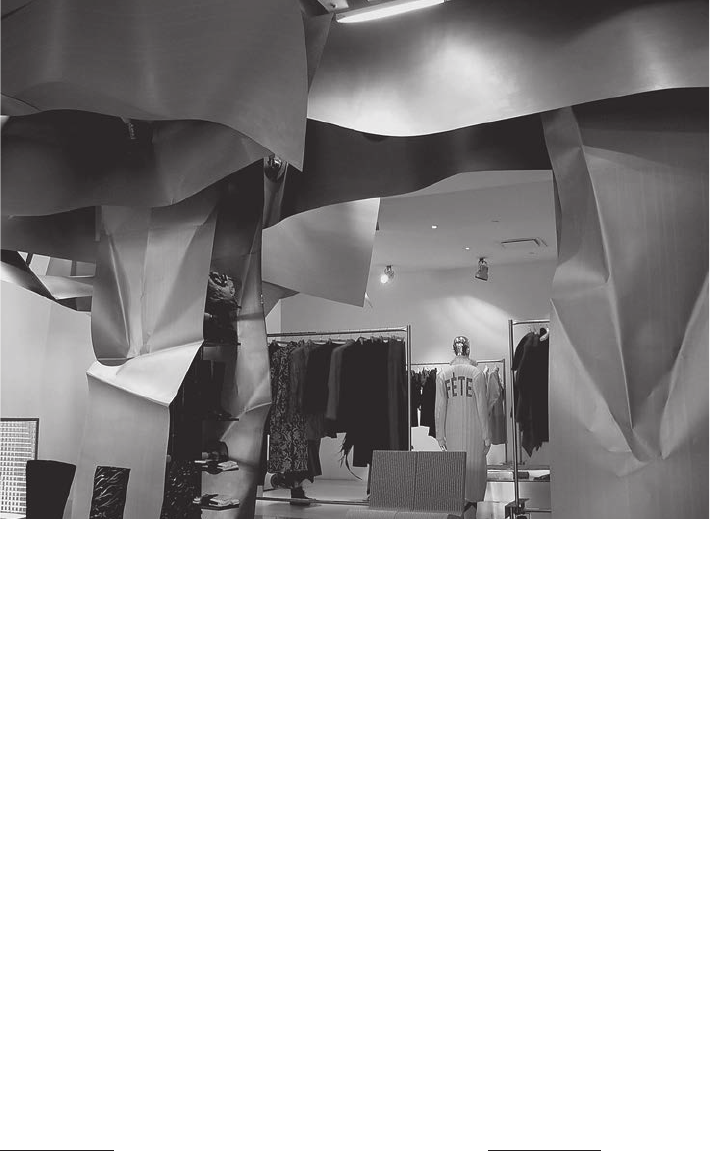
Fig. 1. Interior of Tribeca Issey
Miyake Store in New York (2001),
design by Frank O. Gehry.
Photo by Barbara Widera
Tornado
Tribeca Issey Miyake Store (2001) is another New York
clothes boutique designed by Frank O. Gehry for Issey Mi-
yak whose interior design was inspired by a tornado whip-
ping through space. The space of the store was divided
into smaller sections, however, the intention of the author
was to maintain a sense of a large, single-space interior.
In order to do that a glass shaft was installed at the low-
er oor to provide eye contact between two levels of the
store
1
[1]. Especially spectacular effects were achieved on
the ground oor which has access directly from the street
and which is the upper, more representative part of the
boutique. This is where Gehry decided to affect simultane-
ously several senses of the visitors of the parlor. He used
steel bands, suspending them in space like metal curtains
undulated by strong wind and frozen in that state (Fig. 1).
1
Hubertus Adam, New York Architecture and Design, teNeues Düs-
seldorf 2003, p. 155.
Just like in nature, each element is unique in this amazing
landscape. In the opinion of the author these differences
and diversity determines their beauty
2
[2]. As a result the
character of the interior became more contemporary and
surprising, but not technological. It corresponds well to
both the style of clothes designed by Issey Miyake and to
the dangerous, heavy and cold yet still fascinating nature
during a hurricane. In order to more closely experience the
effect created by Gehry one should hold two furthermost
steel sheets xed to the pillar in the middle and gently
shake them a few times. As a result of spreading vibra-
tions the store interior is lled with a distant and gradu-
ally growing sound of thunder. The impression is strong
enough to cause a change in the spectator’s perception of
space through eyesight, touch and hearing.
2
Compare also: Frank O. Gehry, [in:] Gehry Talks, Mildred Fridman
(ed.), Thames and Hudson, London 2003, p. 210.
Water and air
Next group of objects includes the ones which use
architectural means and scenery to engage all possible
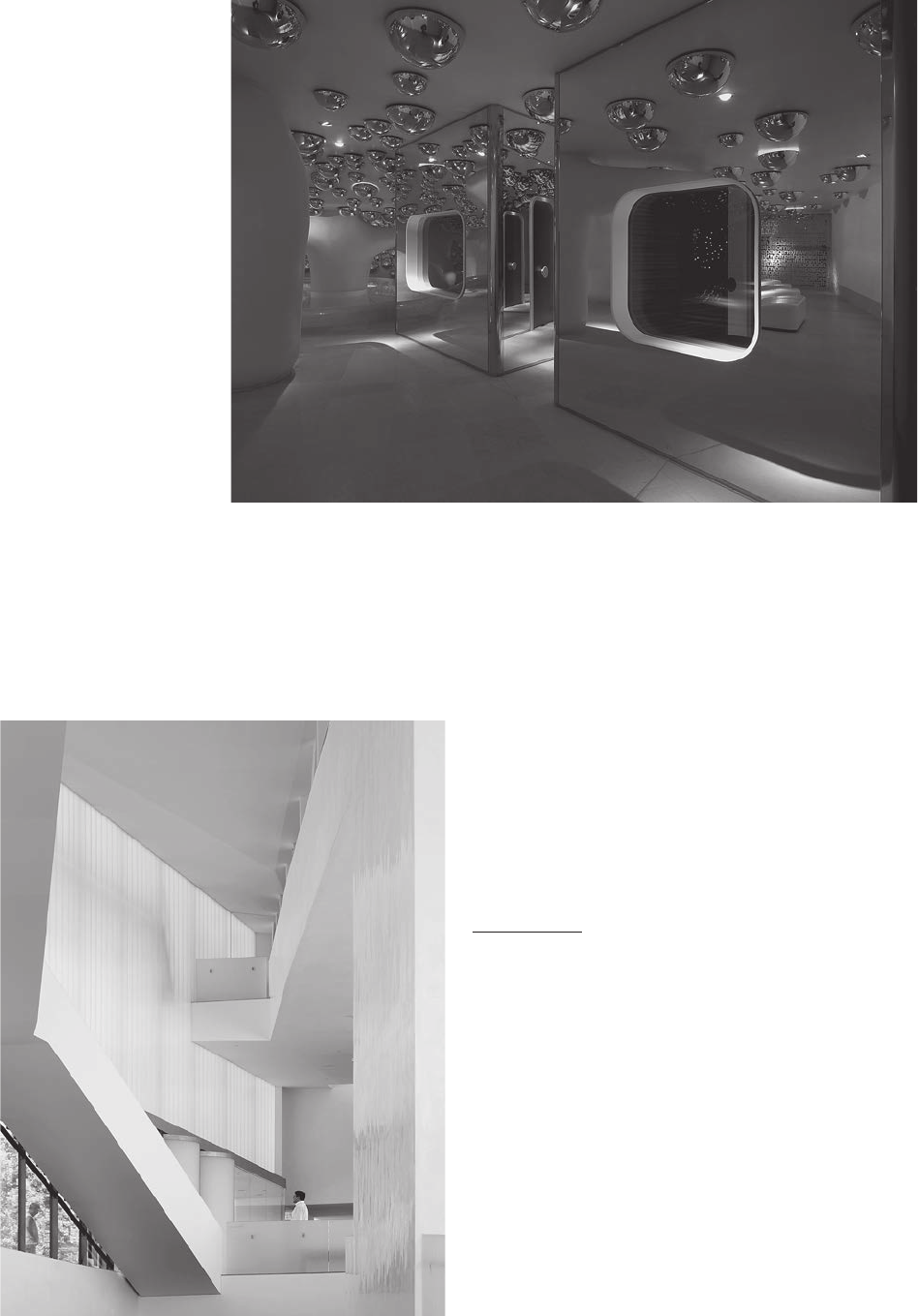
senses. A good example of that is Atomic Spa Suisse at
the Exedra Hotel in Milan, designed by Italian architect
Simone Micheli in 2009. The spectacular effects created
in that facility provide the visitors with relief and deep
relaxation, which is in line with the idea of wellness. The
combination of colors and LEDs creates a mystic atmos-
phere and discretely marks the boundaries between spe-
cic spaces. The soft, uid shapes of white furniture and
At the senses’ edge. Multisensual architecture 217
biomorphic, tree-like supporting structures match the soft
music owing from loudspeakers which are invisible to
the users. Mind and body are stimulated in such a way as
to facilitate full relaxation. As this is a Spa facility, wa-
ter is present there in different forms and seems virtually
ubiquitous. The theatrical attempt at creating architecture
within architecture is supposed to take the recipient to
a three-dimensional, multisensual space – totally palpa-
ble and perceived with the use of senses yet still unreal
due to its unusual character
3
[4]. Its exceptional quality
is achieved by mirror macroscopic half-spheres made of
plastic, coated in shining chrome (Fig. 2). Fixed above
water, on the walls and under the ceiling, they resemble
air bubbles. The visitors of the Spa can feel they are un-
der water, where they can see, hear and feel their breath
which, in the opinion of psychologists, greatly aids com-
plete relaxation. Additionally, the silver bubbles can, in
the opinion of the author of the project, evoke associations
with bubbling champagne, resulting in a sense of euphoria
and joyous relaxation
4
[4].
3
Simone Micheli, Atomic SPA Swiss, Press Release 2009, http://
www.simonemicheli.com, 03.05.2010.
4
Ibidem.
Fig. 2. Atomic Spa Suisse
in Milan, Italy (2009),
design by Simone Micheli.
Photo by Jürgen Eheim
Journey
The designers of museums and exhibition spaces
make use of a lot of methods engaging different senses
of the viewers. In some cases the most sophisticated so-
lutions are applied in a quite simple form. This princi-
ple was applied in the new addition of the Nelson-Atkins
Museum of Art (NAMA) in Kansas City (1999–2007)
designed by Steven Holl and Chris Mc Voya. According
to the author: As visitors move through the new addition,
they will experience a ow between light, art, architecture
and landscape, with views of from one level to another,
from inside to outside. The threaded movement between
the light-gathering lenses of the new addition weaves
Fig. 3. Interior of the main building of the new addition
of the Nelson-Atkins Museum of Art, Kansas City (1999–2007),
design by Steven Holl Architects, copyright by Andy Ryan

218 Barbara Widera
the new building with the landscape in a uid dynamism
based on a sensitive relationship to its context created by
the architect
5
[3].
Both the process of creation and the ultimate charac-
ter of architecture perceived by its users are dedicated to
a specic journey undertaken by the visitors of the mu-
seum. Each time their experiences can be totally differ-
5
Steven Holl, [in:] Francesco Garofalo, Steven Holl, Universe
Publishing, New York 2003, p. 196.
ent as open circulation enables the multiplication of paths
going through various exhibitions. The system is based
on chaos theory. Similarly to other museums designed by
him such as Cranbrook Institute of Science in Bloomeld
Hills (1992–1999), Steven Holl uses the strong potential
of the Lorenz attractor
6
[6] (Fig. 3).
6
Detailed description of the conception of the expansion of NAMA,
[in:] Widera B., Bloch Building – Muzeum nowej generacji. Rozbudowa
Nelson-Atkins Museum of Arts, Kansas City, Steven Holl, Chris McVoy
1999–2007, Archivolta, 1/2008, p. 8.
Limits of architecture
Modern systems, including construction solutions as
well as multimedia technologies, offer designers an ex-
ceptionally broad selection of possibilities, enabling them
to execute virtually every vision. Consequently, imagina-
tion is the ultimate limit of architecture. Regardless of
sources of inspiration, architects evidently strive as much
as possible to engage the user in the man–architecture re-
lations. The trend promoting the multi-level perception
of architecture and including various types of perception
in that process helps the development of multisensual ar-
chitecture, and ultimately, so called virtual architecture
breaks the barrier of senses [5, 7].
References
[1] Adam H., New York Architecture and Design, teNeues Düsseldorf
2003.
[2] Fridman M., Gehry Talks, Thames and Hudson, London 2003.
[3] Garofalo F., Steven Holl, Universe Publishing, New York 2003.
[4] Micheli S., Atomic SPA Swiss, Press Release 2009, http://www.
simonemicheli.com, 03.05.2010.
[5] Threat C., Sensory Architecture_Beyond Appearances. The relation-
ship between Senses and Space. http://upetd.up.ac.za/thesis/available/
etd-07162010–002128/unrestricted/00front.pdf, 19.08.2010.
[6] Widera B., Bloch Building – Muzeum nowej generacji. Rozbudowa
Nelson-Atkins Museum of Arts, Kansas City, Steven Holl, Chris McVoy
1999–2007, Archivolta, 1/2008, pp. 8–13.
[7] Winkler T., Reimann D., Herczeg M., Höpel I., Creating digital
augmented multisensual learning spaces – Transdisciplinary school
education between aesthetic creating and building concepts in com-
puter science. http://mc.informatik.uni-hamburg.de/konferenzbaende/
mc2003/konferenzband/muc2003–30-winkler.pdf, 19.08.2010.
Na granicy zmysłów. Architektura multisensualna
W dobie błyskawicznego rozwoju technologii granice możliwości
architektonicznych stają się coraz bardziej umowne. Odbiorcy, przyzwy-
czajeni do szybkiej wymiany informacji oraz funkcjonowania w wirtualnej
rzeczywistości, oczekują od obiektów architektury wysokiego poziomu
funkcjonalności i złożoności, pozwalającego zaspokoić ich potrzeby. Pro-
jektanci nie wahają się również wprowadzać elementy zaskoczenia. Stara-
ją się włączyć końcowego użytkownika w proces kreowania architektury,
tworząc rozwiązania interaktywne. Wielu twórców dąży do umożliwienia
odbiorcy jak najpełniejszego przeżywania kontaktu z architekturą. W tym
celu obiekty architektoniczne mają oddziaływać na kilka zmysłów jedno-
cześnie. Zjawisko architektury multisensualnej dotyczy w coraz większym
zakresie obiektów kultury (muzea, powierzchnie wystawowe, teatry czy
sale koncertowe), przestrzeni rekreacyjnych (obiekty SPA), komercyjnych
(strefy handlowo-usługowe), a także prywatnych domów.
Key words: multisensual architecture, senses Słowa kluczowe: architektura multisensualna, zmysł