2021
4(68)
DOI: 10.37190/arc210412
Rafał Śledzik-Kamiński*
Bastion fortifications in Wiązów and Żórawina
as an example of less known Silesian implementations
by Hans Schneider von Lindau
Introduction
Hans Schneider von Lindau was a fortication builder
in the 16
th
and 17
th
centuries. Today, he is noted for his
works in large cities such as Gdańsk, Wrocław, Brzeg,
and Nysa. However, he also conducted works in smaller
centers. The aim of the article is to present the gure of
this fortica tion builder and his bastion works in two
smaller towns, namely Wiązów and Żórawina in Lower
Silesia. The author also intends to answer the question
whether they were modern defensive layouts in line with
the latest fortication trends and bastions built by him in
larger cities. This is especially important in the case of the
fortications in Żórawina, which in source literature to
date have been linked with the construction activities of
Valentin von Säbisch the younger (1577–1657) or Alb recht
von Säbisch (1610–1688).
The gure of Hans Schneider von Lindau was not un-
known to researchers of defensive architecture, but most
often they focused on typological assigning of a specic
work to him and determining the chronology of its con-
struction. A study by Alwin Schultz on the city architects
of Wrocław is important for the topic under consideration.
This author in his work described the life and professional
activities of, inter alia, Hans Schneider von Lindau [1, pp.
115–137]. Also Maria Ludwika Lewicka-Cempa in her
text outlined his professional path and his career as a for-
tication builder [2, pp. 29–53].
When it comes to the fortications of Wiązów, Kurt
Engelbert [3, pp. 72–85] and Kurt Bimler [4, pp. 117–123]
described the development and appearance of the town’s
fortications and on the basis of archival sources they also
found that the author of the early modern bastion fortica-
tions of the town was Hans Schneider von Lindau.
The rst scientist to undertake research on Żórawi-
na was Alfred Gellhorn – he reconstructed the island’s
buildings, marking the church, the manor house and the
preserved bastion fortications [5, pp. 39, 73, Fig. 26].
Bimler dened the chronology of the fortications for the
17
th
century, suggesting that the reason for their erection
was a desire to be secured during the Thirty Years’ War
[6, pp. 61–63]. Jerzy Rozpędowski recognized Valentin
von Säbisch the younger as the author of the fortications
in Żórawina. Moreover, he assigned them to the Dutch
bastion fortication school [7, pp. 43–46], [8, pp. 62,
95]. According to Józef Pilch, the author of the fortica-
tions was Albrecht von Säbisch and the time of erecting
the fortications fell in the 1
st
half of the 17
th
century [9,
pp. 478, 479]. On the basis of the research carried out,
Lewicka-Cempa recognized Hans Schneider von Lindau
as the author of the bastion fortications in Żórawina and
claimed that the renovation of the church, the construction
of the manor, as well as the construction of the forti-
cations were carried out at the same time as part of the
transformation of the building into a fortied manor with
bastion fortications [2, p. 38]. In the source material,
Piotr Oszczanowski found a poem by Balthasar Exner
from 1606, which described the then existing earth forti-
cations along with a church, a manor house and an arsenal
[10, pp. 79–87].
Hans Schneider von Lindau
Hans Schneider von Lindau, also known as Jan Schnei-
der of Lindau or Hans of Lindau, was born to a middle-
* ORCID: 0000-0001-5474-0248. Doctoral School of Wrocław
Uni versity of Science and Technology, e-mail: rafal.sledzik-kaminski@
pwr.edu.pl
122 Rafał Śledzik-Kamiński
The north-eastern section of the Wrocław River Odra
bank was devoid of fortications. Hans Schneider von
Lindau stayed in Gdańsk and supervised the fortication
works there, whereas the implementation of his projects in
Wrocław was undertaken by Friedrich Gross who was the
city architect. In 1588, the buildings near the Holy Spirit
Church were pulled down and in this place Sand Bastion
was built, in the old Italian type with a high buttress and an
earth parapet of the embankment. Behind the orillons of
the bastion, casemated three-level anking gun emplace-
ment were located. The earthen parapet of Sand Bastion
was connected with the parapet of Ceglarski Bastion [14,
p. 126]. Also in 1588, the works on Bernardyński Bastion
began and they were completed in 1590, to the south of
Ceglarski Bastion. The bastion had a high buttress with
casemated anks protected by rectangular orillons [13,
p. 211].
On March 27, 1591, Schneider von Lindau signed
a contract with the Wrocław City Council. It oered him
a salary higher than the one he received in Gdańsk and the
council did not oppose his scientic trips around Europe
[2, p. 35], [12, p. 541]. The high salary and the urgent
need to extend the Wrocław city fortications prompted
the city council to limit the activities of Hans Schneider
von Lindau to investments made for the city only. Still in
1590, residential buildings were demolished for the con-
struction of a new rampart gate, i.e., Piaskowa. In 1592,
the works on its construction started and in 1593 the works
on the casemate part were completed. In 1594 a wood-
en bridge (the so-called Sand Bridge) was built over the
river, whereas in 1595 a stone façade was embedded in the
outer face of the gate.
Also in 1593, the works on Sakwowy Bastion were
started, an earthen and masonry work with highly devel-
oped and casemated ank gun emplacements which were
protected by long orillons. This bastion was a twin struc-
ture of Ceglarski Bastion. The relics of two bastions, i.e.,
Ceglarski and Sakwowy have survived to the present day.
In the place of Job’s Roundel Bastion, the construction
of a semi-bastion started in 1594. The constructing and
proling of the embankments were nished at Piaskowy
Bastion, where even The Holy Spirit Church was demol-
ished because it prevented the work from being carried
out. The ramparts of Sakwowy Bastion were completed in
1598 and the rampart Sakwowa gate was also built, which
was secured in terms of artillery by the right orillon of the
bastion. The northern and eastern sections of the town’s
defensive perimeter were nally secured in around 1600
[2, p. 36], [14, pp. 126, 127].
Hans Schneider von Lindau prolonged his contracts
with the city council of Wrocław. Initially, he focused on
the extension of Wrocław’s fortications, however, other
nobles in Silesia were also interested in his services. As
early as in 1584, General Starost of Silesia, bishop An-
dreas von Jerin addressed him, but then the fortication
builder had to refuse him. He remained in the service of
Gdańsk, whereas for Wrocław he consulted the projects
of fortications only. When he signed the contract with
Wrocław, he initially had to focus on urban projects. How-
ever, as the construction of the Wrocław fortications pro-
class family in the free town of Lindau situated on Lake
Constance in southern Bavaria on October 9, 1544 [11,
p. 33]. His rst documented work was the construction
of the English House in Gdańsk in the years 1568–1570,
where, as a construction manager, he collaborated with
Hans Kramer (died 1577), the then building master of
the Gdańsk city council. Their close professional rela-
tionships were sealed with the marriage of Schneider and
Kramer’s daughter [12, pp. 534, 535].
Hans Schneider von Lindau worked both in Pomera-
nia and in Silesia. In his Pomeranian period of activity,
in the years 1570–1580, he worked as a master builder of
the town council in Elbląg. In 1580, he was employed as
a city architect in Gdańsk and reconstructed the city for-
tications after the damage caused during the siege of the
city by Stefan Batory. It was him who in 1582 designed
new fortications of Wisłoujście Fortress in the type of
the carré fort (four-sided) after the war of 1577. The for-
tications were built on a rectangular plan because the
previously existing fortications (a lighthouse with de-
fensive objects) were included in the defensive perimeter.
The curtain acquired an angular form in this section. Four
bastions were built on the corners of the fort. The south-
ern bastion was the rst to be constructed (1586), then in
1587 the eastern bastion under which warehouses were
built under the curtain of the embankment. The northern
and western bastions received more massive faces. In the
northern bastion, cross vaults on pillars were built inside
it, which was more advantageous for its fortress and stor-
age purposes. Originally, the entrance opening to the fort
(situated on the land side) was to be protected by the bas-
tion’s orillon. Changes in the design, however, deprived
it of this protection, but it was still within the range of its
anking batteries [2, pp. 39–41].
On March 18, 1584, the Wrocław City Council asked
Hans Schneider von Lindau, who was in the service of
Gdańsk, to take the position of the city architect. Being
bound by the contract, he could not agree to this proposal,
nevertheless, he accepted the commission to design spe-
cic defense objects.
The rst work in Wrocław, whose nal stages of con-
struction might have been consulted with Hans Schneider
von Lindau, was the Imperial Bastion (next to the impe-
rial castle), which was built in the years 1577–1584 [13,
pp. 211, 212]. Ceglarski Roundel Bastion, which was situ-
ated within the fortications of Wrocław, was demolished
on February 12, 1585, and in its place Ceglarski Bastion
designed by Hans Schneider von Lindau was built. On
May 9, 1586, the cornerstone for the construction of Ce-
glarski Bastion was laid. Already in 1587, the bastion was
completed. It was a corner earthwork layout with a stone
pre-rampart and two-level casemates. Behind the orillons
of the bastion there were gun emplacements [2, p. 33, 34].
The conrmed presence of Hans Schneider von Lindau
in Wrocław dates back to 1587, when General Starost of
Silesia, bishop Andreas von Jerin in his letter of July 22,
1587, asked Wrocław councilor Simon von Hanniwaldt
to contact him as regards the possibility of temporary em-
ployment of the fortication builder who erected new The
River Oder bastion fortications on [14, p. 125].
BastionfortificationsinWiązówandŻórawina 123
gressed and the city’s security level increased, he was able
to start working for other principals.
In 1587, the owner of Żórawina, Simon von Hanni-
waldt, on the recommendation of bishop Andreas von Jer-
in, contacted Hans Schneider von Lindau. His task was to
obtain the services of a fortication builder for the bish-
op during building the fortication of his two cities, i.e.
Nysa and Otmuchów. Finally, in 1594, he undertook the
modernization of the fortications of two bishop’s towns,
i.e., Nysa and Wiązów [3, p. 81], [4, p. 120]. The death of
bishop Andreas von Jerin in 1596 interrupted the works at
the bastions in Nysa. At the same time, his death resulted in
the employment of Hans Schneider von Lindau by Simon
von Hanniwaldt during the reconstruction of the Żórawina
com plex in the years 1597–1602 [2, p. 38], [10, pp. 74–76].
In Brzeg, where he stayed twice in the years 1596 and
1598 at the invitation of Joachim Fryderyk, Duke of Leg-
nica and Brzeg (29/09/1550–25/09/1602), Hans Schnei der
von Lindau modernized the Castle Bastion on the River
Oder. He gave it a new plan – as a result of the remodeling,
the object gained a form similar to Ceglarski Bastion in
Wrocław [14, pp. 131, 132].
In Oleśnica, in the years 1602–1603, he supervised the
construction of a rampart gate in the form of a barbican
and the earthen fortications of the castle from the fore-
ground, where two bastions and a curtain were built [15,
p. 69].
In 1605, he visited the castle in Chrzelice twice and de -
signed bastion fortications. They were not implemented,
perhaps because Hans Schneider von Lindau died on No-
vember 22, 1606 in Wrocław and their execution would
have been deprived of his professional supervision [16,
p. 212].
Wiązów
– example of a carré type fort
Wiązów is situated halfway between (about 40 km from
both centers) Nysa and Wrocław, by the River Oława and
smaller watercourses – Babica, Łękawka and Mły nów -
ka. From the Middle Ages it was the bishop’s property,
being a safe stopping place on the communication route
between the bishop’s Nysa and Wrocław, the capital of
the region [17, p. 623]. Bimler dened the original lay-
outs protecting Wiązów with the term “maceria” (which
means ruins) – they had the form of a fence additionally
reinforced with a moat. In 1580, their condition was unsat-
isfactory and they did not fulll their defensive functions.
In 1590, Bishop Andreas von Jerin (1541–1596) initiated
their general reconstruction. He entrusted the work of re-
construction to Schneider von Lindau. On April 25, 1594,
the bishop received the message that the outline of the for-
tications had been marked out and the work was done
by Melchior Festenberger who worked according to the
guidelines of Schneider von Lindau. The early modern
earthen curtains partially repeated the medieval course of
the fortications (elliptical), whereas four bastions were
located in the corners and were open from the city side.
The ramparts and bastions were equipped with parapets.
In the place of the old moat and the medieval embank-
ment, similar to the shape of an ellipse, a layout with four
bastions at the corners was established on a rectangular
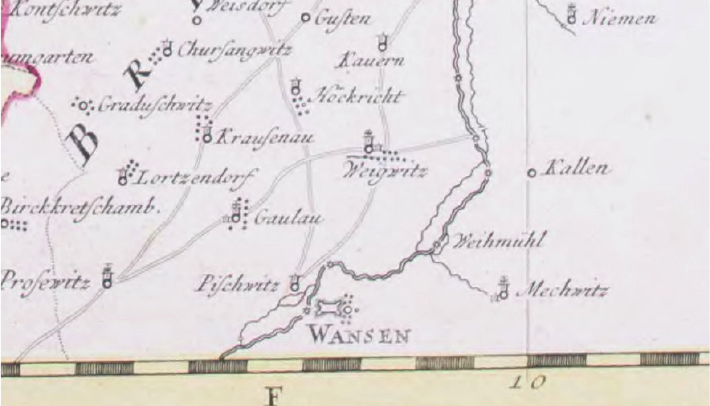
plan (Fig. 1). Longer curtains of the embankment were
about 300 m long, whereas the shorter ones were about
150 m. The whole complex was additionally surrounded
by a wet moat. New city gates were built at the city exits
leading to Wrocław, Brzeg, and Nysa. Wooden platforms
led to them and the gates themselves were equipped with
bascule bridges. The rst to be completed was Nyska
Gate which was presented in the drawing by Friedrich
Bernhard Werner. It was made of stone, embedded in the
embankment, and covered with red roof tiles. Already
Bimler noticed that it was enlarged (possibly signicantly
over-scaled) by the author of the drawing and protruded
signicantly beyond the parapet line. The drawing does
not show the remaining towers, hence his assumption that
the two remaining gates had a less extensive architectural
program, perhaps only the gate passage itself, which was
covered with a ceiling or a vault with a room for guards on
the gates [3, p. 81], [4, pp. 119–121].
In Wiązów, in the areas by the River Młynówka and
Spacerowa Street (south-western part of the town), there
Fig. 1. Fortifications in Wiązów
(German: Wansen)
in the map section from 1750
(source: BUWr, Oddział Zbiorów
Kartograficznych, 59-IV.B)
Il. 1. Fortyfikacje Wiązowa
(niem. Wansen)
na wycinku mapy z 1750 r.
(źródło: BUWr, Oddział Zbiorów
Kartograficznych, 59-IV.B)
124 Rafał Śledzik-Kamiński
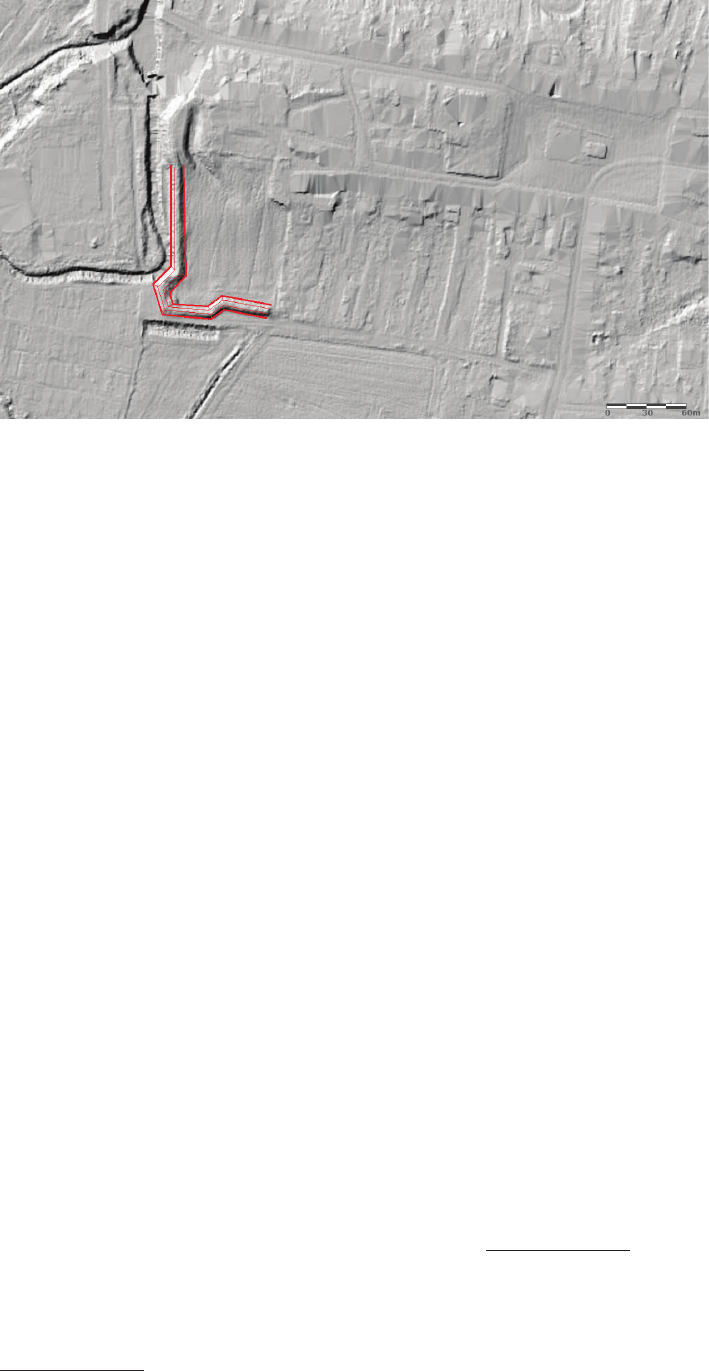
are relics of earthen town fortications, i.e., a bastion with
curtains and the remains of a moat. The preserved em-
bankment curtains in a trapezoidal cross-section, 9–10 m
wide at the base, were about 84 m long (by Młynówka)
and 35 m (in Spacerowa Street). The height in relation to
the ground level was about 1 to 1.5 m and about 2.5 m,
counting from the preserved relics of the moat. The pre-
served bastion’s left face was about 44 m long and the
right face was about 26 m long. The left ank which
connected the curtain with the face was about 8 m long,
whereas the right ank was about 18 m long (Fig. 2).
Żórawina
– an example of a fortified residential complex
with bastion fortifications
Żórawina is situated about 15 km from Wrocław on
Wrocław Plain in the conuence of Żórawka and Żalina.
The village has a medieval origin
1
and in the early modern
period it was owned by the von Prockendorf family. The
death of Matthias von Prockendorf in 1579 allowed the
Bishop of Wrocław to take over the town [10, pp. 32, 33].
Bishop Martin von Gerstmann (1527–1585) hand-
ed over Żórawina to Simon Hanniwaldt von Eckers-
dor (1529–1599) in 1584. During the reign of Bishop
Kaspar von Logau (1524–1574), Simon von Hanniwaldt
worked for the Silesian Chamber as its secretary and
later as a chancellor. For his service to the church, he
was awarded a lifetime award to the village of Czerni-
ca near Wrocław (in 1572). The death of Bishop Kasper
von Logau (in 1574) did not interrupt his career in the
church administration. Martin von Gerstmann, who was
elected bishop in 1574, entrusted him with the oce of
chancellor. In 1575 Simon Hanniwaldt von Eckersdor
received another church ef – Pilczyce. From 1576, he
1
A history of Żórawina, ownership changes in the village, as well
as the architectural layout of the Holy Trinity Church were described in
detail in the monograph [10].
was also an advisor to princes as well as states of Low-
er and Upper Silesia. Andreas von Jerin, a new bishop
of Wrocław from 1586, also entrusted him with the of-
ce of counselor. On the bishop’s recommendation who
wanted to modernize the fortications of Nysa and Ot-
muchów (in 1587), Simon von Hanniwaldt got familiar
with the new Wrocław fortications and with their author
Hans Schneider von Lindau [10, pp. 56–58]. Already Si-
mon von Hanniwaldt saw Żórawina as the center of the
family estates, but it was his successor Adam von Han-
niwaldt (1567–1621) who took decisive steps to achieve
this goal. From 1591, he was an advisor to bishop Andreas
von Jerin and from
1597, a counselor to Duke of Oleśnica
and Ziębice, Charles II of Podbiera dowicz (15/04/1545–
28/01/1617). He also held an elder land oce and a lay
judge of the vassal court in Weichbild and Wrocław Princi-
pality. He was also a diplomat for the services of Maximi-
lian II Habsburg
2
(31.01.1527–12.101576) and Maciej
Habs burg
3
(24.02.1557–20.03.1619). He also carried out
diplo matic missions for Emperor Rudolf II Habsburg
(18/07/1552–20/01/1612) who made him an advisor to the
Silesian Chamber. On September 22, 1608, he obtained
a patent from Rudolf II in Prague, which changed the ex-
isting church ef of Żórawina into a free castle ef and the
village received town privileges [5, pp. 64, 65].
The rst investments which were connected with the
change in the status of the village were made in the years
1600–1602, when the renovation of the church began.
The works on furnishing the temple were carried out until
1604. It was also then that the fortications surrounding
2
King of Bohemia from September 20, 1562 to October 12, 1576,
King of Germany from November 28, 1562 to October 12, 1576, King of
Hungary and Croatia from September 8, 1563 to October 12, 1576, Holy
Roman Emperor from June 13, 1564 to October 12, 1576, Archduke of
Austria from July 25, 1564 to October 12, 1576.
3
King of Hungary and Croatia from 1608 to March 20, 1619,
Archduke of Austria from 1608 to March 20, 1619, King of Bohemia
from 1611 to March 20, 1619, Holy Roman Emperor from June 13, 1612
to March 20, 1619.
Fig. 2. Wiązów, reconstruction
of the preserved bastion
with curtains (elaborated by
R. Śledzik-Kamiński)
Il. 2. Wiązów, rekonstrukcja
zachowanego bastionu
z kurtynami
(oprac. R. Śledzik-Kamiński)
BastionfortificationsinWiązówandŻórawina 125
this complex were extended in the years 1597–1602 [2,
p. 38]. Nowadays in Żórawina, earth fortications in the
form of embankments with three semi-bastions (the fourth
one was pulled down in the 19
th
century) and a moat have
been preserved around the Holy Trinity Church which
was rebuilt into a mannerist one (Fig. 3).
The rst researcher to recognize internal buildings
within the embankments was Gellhorn. He made an at-
tempt at reconstructing the island’s development, where,
apart from the church, he marked the relics of the manor
and the preserved fortications [5, pp. 39, 73, Fig. 26].
Bimler dened the initial chronology of the preserved
fortications for the 17
th
century, which suggests that the
reason for their formation was the desire to be secured
during the Thirty Years’ War that was going on at that time
[6, p. 62]. Rozpędowski described the layout in Żórawina
as a structure with a regular rectangular plan which was
surrounded by a trapezoidal earth embankment and rein-
forced with bastions in the corners as well as surrounded
by a deep watered moat [7, pp. 44–46]. The ramp, which
was located at the southern curtain, next to the brick ram-
part gate with a drawbridge, led to the embankment. The
corner bastions were given the form of semi-bastions
(they had one bastion face and one bastion ank which
connected the ank with the curtain, whereas the line of
the bastion’s head was also the curtain’s wing). On the
south-eastern semi-bastion, relics of the parapet have been
preserved, which suggests that it existed along the entire
length of the defensive perimeter.
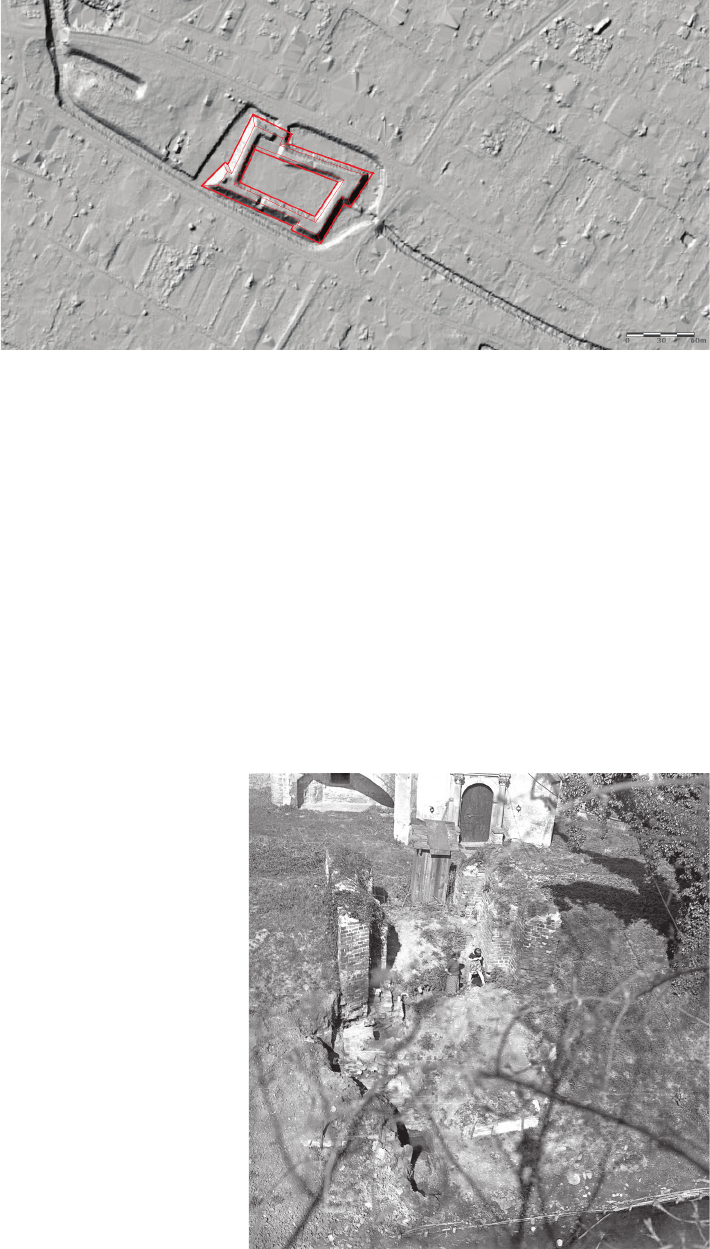
Under the earthen embankments, there are relics of the
southern gate with a clearance of 2.8 × 2.5 m, limited by
counterfort and buttresses, which might have been cov-
ered with a ceiling or vault (Fig. 4). A wooden bridge,
partly a drawbridge, led to it.
The length of the curtains was 37 and 86 m, the face of
the bastion was 30 m long, the ank of the bastion was 4 m,
the width of the curtain at the ank (at the narrowest point)
was 6 m, the angle of the bastion was 60°, respectively. The
height of the embankments was 1.7 m (from the ground
level) and 5.5 m from the bottom of the moat [8, p. 95].
As already mentioned, by noticing analogical forti-
cation designs in Żmigród and Uraz, where the use of semi-
bastions was also planned, Rozpędowski considered Va-
lentin von Säbisch the younger to be the author of the
Żóra wina fortications in the Dutch type. At the same
time, he criticized the ndings of Gellhorn who had de-
ned the origin of the manor house on the island, demol-
ished in 1880, at the turn of the 17
th
century, in this way
leaving the ndings and more detailed determination of
the chronology to future researchers [7, pp. 43–46], [8,
p. 62]. The authorship of Valentin von Säbisch the young-
er was accepted by most specialists as certain, or almost
certain, and the date of their construction was also estab-
lished for year 1630 [18, p. 59], [19, p. 1110].
Józef Pilch recognized the son of Valentin Albrecht von
Säbisch as the author of the fortications, specifying the
Fig. 3. Żórawina, reconstruction
of bastion fortifications
(elaborated by R. Śledzik-
Kamiński)
Il. 3. Żórawina, rekonstrukcja
fortyfikacji bastionowych
(oprac. R. Śledzik-Kamiński)
Fig. 4. Manor house in Żórawina. Southern fortress gate.
Relics of the building and the outer bank of the moat
(photo by Z. Nowakowski, 1981,
source: Dolnośląska Biblioteka Cyfrowa, DUN1/15999)
Il. 4. Dwór w Żórawinie. Południowa brama forteczna.
Relikty budynku i zewnętrznego brzegu fosy
(fot. Z. Nowakowski, 1981,
źródło: Dolnośląska Biblioteka Cyfrowa, DUN1/15999)

126 Rafał Śledzik-Kamiński
time of formation of the fortications, i.e., the 1
st
half of
the 17
th
century [9, pp. 478, 479].
Oszczanowski in his monograph on The Holy Trinity
Church cited two verse descriptions of the temple and its
immediate surroundings. In the rst, from 1606, the au-
thor of which was Balthasar Exner, we nd the following
verses [translated from the Polish translation]: […] that
thethroneofthetemplewouldnotberobbed, / Andeither
[not to be robbed] the Heroines of the temple, / Wonderful
images of heroines, [Adam von Hanniwaldt] surrounded
thebuildingswitharampart. / Theembankmentwaslled
withditches,andtheditcheswerelledwithwater. / From
thefaceyoucanseethenewbulwark [arsenal] armedwith
thehandofMars. / Thankstothis,beingfreeofanyene-
my,youcanattendtosacredthings. / Who,however,can
entirelycounttheweaponsofthatMars? / Walkerorrider,
go on foot, / Youhavebulletsagainstenemymissilesat
hand […] [10, p. 75]. In the second one, from 1610, Georg
Reutter included his description of the island’s buildings
with earth embankments surrounding the newly remod-
eled church as well as a manor house known as a castle
and an arsenal [10, p. 75].
Thanks to these two poems, it was possible to clarify the
chronology and spatial development of the island, where
already in the 1
st
decade of the 17
th
century, apart from
the renovated church, there were earth fortications with
a moat, a manor house (called a castle) and an arsenal.
Both Lewicka-Cempa and Oszczanowski, on the basis
of their research, recognized Hans Schneider von Lindau
as the author of the bastion fortications in Żórawina. Not
only was he responsible for the design of the mannerist re-
modeling of the church, but also for putting up the bastion
fortications that surrounded it [2, p. 38], [10, pp. 79–87].
At the time when the fortications in Żórawina were
built, Hans Schneider von Lindau was an active fortica-
tion builder in Silesia. He must have known Simon and
Adam von Hanniwaldt personally because of the clerical
functions they performed. Bimler claimed that due to the
high remuneration which the city decided to pay him, his
services were reserved only for Wrocław [14, pp. 126,
127]. While this could have been the case at the beginning
of his work in Silesia, at the end of the 16
th
century most
of the Wrocław fortications had already been designed
and their construction was underway. Anyway, the pos-
sibility of using the services of the Wrocław fortication
builder by General Starost of Silesia – Bishop Andreas
von Jerin – was by all means benecial to the interests of
Wrocław. A line of communication opened up between the
city and the most important royal ocial in Silesia. The
possibility of using Schneider’s services by members of
the von Hanniwaldt family, who occupied high positions
in the clerical hierarchy, was no longer unusual if we take
into account their interrelationships and contacts.
Summary
Reconstructing the list of countries and places where
Hans Schneider von Lindau gained his professional expe-
rience is dicult today. However, the measures of length
which were used by him when designing fortications
give some clues as to the places of his studies. The Vien-
nese foot
4
, which he used, was most likely an adjustment
to the measures used in Silesia, which were known and
applied by his local co-workers. However, the cubit which
he also used and in metric values equaled 53 cm, was
characteristic of the city of Reggio in northern Italy [11,
p. 96]. It can therefore be assumed that he was educated
in Reggio or its immediate vicinity, or possibly in Hunga-
ry, where the fortications of the New-Italian school were
constructed by northern Italian fortication builders [11,
p. 120].
In the fortications he erected, he used three forms of
bastions. Bernardyński Bastion from Wrocław and the
bastion which was situated to the south of Mikołajska
Gate in Nysa are bastions of the New Italian type with
old Italian elements. They had rectangular orillons and
the parapet of the upper embankment which surrounded
the faces. It was also possible to establish additional re
positions behind the orillons.
Ceglarski Bastion and Sakwowy Bastion in Wrocław
were earthen layouts with a stone parapet of the pre-ram-
part. Additionally, in order to increase the repower, they
might have been equipped with a cavalier. They were
modeled on the assumptions of the treaty, the author of
which was Daniel Specklin (Speckle).
The third type of bastion was connected with Wisło-
ujście Fortress and the Nysa fortications, a bastion with
stone and brick face and with earthen parapet, with long
lowered orillons which were used by Hans Schneider von
Lindau for smaller architectural objects. Its origins should
be sought in Szatmár Fortress in Transylvania [11, p. 68].
On the basis of the material from which the forti-
cations in Wiązów and Żórawina were built – soil, turf,
fascine – they could be classied as the Dutch type. How-
ever, knowing their author, the period in which he lived
and worked, as well as his professional experience and
the time of their construction, it would be necessary to
change their typological aliation to the mixed Old and
New Italian type. In Hungary, already from the beginning
of the 16
th
century, there were many Italian engineers and
fortication builders who constructed bastion fortica-
tions which were supposed to survive and stop attacks of
the Ottoman Empire. Due to the lack of time necessary to
erect stone fortications and a necessary material (stone,
brick), the Italian-type bastion fortications began to be
built of wood and earth. Builders erected log grates which
were lled with wet earth and then compacted, where-
as the external walls were reinforced with fascine [20,
pp. 23–29].
The bastion fortications which were constructed around
Wiązów and Żórawina constitute an example of the Ital-
ian-type bastion fortication and in Silesia they were built
with the use of Hungarian techniques. Hans Schneider
von Lindau used fort carré (four-sided) as the basis for his
projects. He had already successfully used this solution
in Wisłoujście Fortress. He adapted it to local conditions
4
The Viennese foot – 31.61023 cm, was used in Silesia and in
Hun gary in parallel with the Silesian foot – 28.8 cm.
BastionfortificationsinWiązówandŻórawina 127
and needs, thanks to which it was possible to build mod-
ern bastion fortications around Wiązów in a short time.
As a result, they increased its defensive values. While re-
modeling the church in Żórawina, he also planned new
bastion fortications, which, supplemented with a court
and an arsenal, transformed this complex into a renais-
sance noble residence, fully fortied. The bastion forti-
cations which were designed by Hans Schneider von Lin-
dau did not dier from the European models at the turn
of the 17
th
century [21, p. 21 et seq.]. The outbreak of
the Thirty Years’ War in the 17
th
century subjected them
to a re test. Wrocław Fortress was not threatened by
a
direct attack thanks to its extensive bastion fortications
which were managed by over 2,000 city soldiers, where-
as in 1642 Brzeg successfully repelled the Swedish siege,
which lasted four weeks. Of course, one can argue that
both Wiązów [3, p. 282] and Żórawina [10, p. 36] were
con quered during this conict, which may indicate that
the strengthening of these two centers was inadequate. It
should be emphasized, however, that this was not due to
the weakness of the fortications, but due to an insu-
cient number of soldiers. In order for the fortications to
eectively fulll their military function, there should be
200 soldiers and 3–4 cannons per one bastion (taking into
account the rotation, where some of the re team fought,
some rested, and some were on standby to support their
ghting colleagues) [22, pp. 87–95]. An insucient num-
ber of soldiers necessary to man the fortications and to
ght in the eld was, however, a constant problem of the
imperial army [23, pp. 173–177].
The bastion fortications around Wiązów and Żórawi-
na also served non-utilitarian purposes. Winning a famous
fortication builder, i.e. Hans Schneider von Lindau, -
nancing the construction of fortications, their preserva-
tion and maintenance, was a demonstration of the social
position, prestige, wealth, as well as political aspirations
of the founder.
Translatedby
BogusławSetkowicz
References
[1] Schulz A., DieBreslauerStadtbaumeisterinsechzehntenJahrhun-
dert.FriedrichGross–HansSchneidervonLindau, “Schlesiens
Vorzeit in Bild und Schrift” 1870, Bd. 1, 115–137.
[2] Lewicka-Cempa M., JanSchneiderzLindauatwierdzawWisło
ujściu, [in:] P. Molski (red.), ZespółfortecznyGdańskWisłoujście.
Problemyochronyzespołówpofortecznych, Towarzystwo Przyja-
ciół Fortykacji, Gdańsk 1998, 29–53.
[3] Engelbert K., GeschichtederStadtWansenunddasWansenerHal-
tes, Verlag Dr Hermann Eschenhagen, Ohlau i. Schl. 1927.
[4] Bimler K., DieschlesischenmassivenWehrbauten, Bd. 2, Fürsten-
tumBrieg, Komission Heydebrand-Verlag, Breslau 1941.
[5] Gellhorn A., Die Friedhofanlagen Schlessiens unter besonderer
Berücksichtigungihrer SituierungundGestaltung, Heitz, Strass-
burg 1918.
[6] Bimler K., DieschlesischenmassivenWehrbauten, Bd. 1, Fürsten-
tumBreslau, Komission Heydebrand-Verlag, Breslau 1940.
[7] Rozpędowski J., WarownekościoływJaszkotlach,LutyniiŻórawi
nie, “Zeszyty Naukowe Politechniki Wrocławskiej. Architektura”
1957, nr 20, 31–48.
[8] Rozpędowski J., Kościoły warownena Śląsku, “Roczniki Sztuki
Śląskiej” 1968, t. 6, 54–97.
[9] Pilch J., LeksykonzabytkówarchitekturyDolnegoŚląska, Arkady,
Warszawa 2005.
[10] Oszczanowski P., CasusŻórawiny.KościółTrójcyŚwiętejwŻóra
winieokoło1600roku, Piotr Oszczanowski & Starostwo Powia-
towe we Wrocławiu, Wrocław 2007.
[11]
Lewicka-Cempa M., Szesnastowieczny projekt fortykacji bastiono
wychNysyJanaSchneiderazLindau, PhD thesis, Instytut Historii Ar-
chitektury Sztuki i Techniki Politechniki Wrocławskiej, Wrocław 1980.
[12] Hauke K., HansSchneidervonLindaueinBaumeisterdes16.Jahr
hundertsimdeutscheOsten, “Zeitschrift für Ostforschung” 1959,
Bd. 4, 533–549.
[13] Rozpędowski J., Fortykacje bastionowe z lat 1544–1693, [in:]
Z. Świechowski (red.), Wrocław. Jego dzieje i kultura, Arkady,
Warszawa 1978, 210–215.
[14] Bimler K., Hans Schneider von Lindau ein Breslauer Stadtbau
meister, “Zeitschrift des Vereins für Geschichte Schlesiens” 1934,
Bd. 68, 118–132.
[15] Starzewska M., Oleśnica, Zakład Narodowy im. Ossolińskich,
Wrocław 1963.
[16] Bimler K., DiePiastenburginSchelitz, “Der Oberschlesier” 1935,
Nr 17, 212–214.
[17] Eysymontt R., Kodgenetycznymiasta.Średniowiecznemiastalo
kacyjneDolnegoŚląskanatleurbanistykieuropejskiej, Via Nova,
Wrocław 2009.
[18] Przyłęcki M., BudowleizespołyobronnenaŚląsku.Geneza,mo
dernizacjaiewolucjadoXVIIw., Towarzystwo Opieki nad Zabyt-
kami, Warszawa 1998.
[19] ZabytkisztukiwPolsce.Śląsk, S. Brzezicki, Ch. Nielsen, G. Gra-
jewski, D. Popp (red.), Krajowy Ośrodek Badań i Dokumentacji
Zabytków, Warszawa 2006.
[20] Gerö L., WłoskiefortykacjebastionowenaWęgrzech, “Kwartal-
nik Architektury i Urbanistyki” 1959, t. 4, nr 1–2, 23–42.
[21] Specklin D., ArchitecturavonVestungen,wiediezuunsernZeiten,
anStätten, SchlössernundClaussen,zuWasser,Land, Bergund
Thal mit ihren Bollwercken, Cavaliren, Streichen, Gräben und
Läuenmögenerbawet,auchwiesolchezurGegenwehrwiderden
Feindt,samptdemhiezugehörigenGeschütz,ordentlichundnütz
lichsollengebrauchtwerden:Jetztaberausnewubersehen,mit
Fleissverbessert,auchvielenanderenVisierungenvermehret, La-
zari Zetzners, Strassburg 1599, https://www.e-rara.ch/zut/content/
structure/2160661 [accessed: 20.03.2020].
[22] Maroń J., WojnatrzydziestoletnianaŚląsku.Aspektymilitarne, Wy -
dawnictwo i Agencja Informacyjna WAW Grzegorz Wawrocz ny,
Wrocław–Racibórz 2008.
[23]
Pruski Sztab Generalny, Pierwszawojnaśląska1740–1742.CzęśćI:
zajęcieŚląskaibitwapodMałujowicami, Napoleon V, Oświęcim
2019.
128 Rafał Śledzik-Kamiński
Abstract
Bastion fortications in Wiązów and Żórawina
as an example of less known Silesian implementations by Hans Schneider von Lindau
The article is devoted to early modern fortication builder Hans Schneider von Lindau. The aim of the work was to present a professional career
of this fortication builder and his bastion fortications thanks to the studies of source literature as well as archival iconographic and cartographic
materials. The fortications in two smaller centers, i.e., Wiązów and Żórawina, were researched. In Żórawina, it was possible to determine the
hitherto uncertain authorship and to pinpoint the construction time of fortications, namely for the years 1597–1602. In general, the author of the
article claims that the fortications designed by Hans Schneider von Lindau in smaller centers were as modern as the bastion fortications he erected
in larger towns.
Key words: bastion, bastion fortications, early modern period, Hans Schneider von Lindau, Wiązów, Żórawina
Streszczenie
Fortykacje bastionowe w Wiązowie i Żórawinie
jako przykład mniej znanych śląskich realizacji Hansa Schneidera von Lindau
Artykuł jest poświęcony nowożytnemu fortykatorowi Hansowi Schneiderowi von Lindau. Celem pracy było przybliżenie – dzięki studiom nad
literaturą przedmiotu, archiwalnymi materiałami ikonogracznymi i kartogracznymi – zawodowej kariery tego budowniczego oraz wykonanych
przez niego umocnień bastionowych. Badaniom poddano umocnienia w dwóch mniejszych ośrodkach: Wiązowie i Żórawinie. W Żórawinie możliwe
było ustalenie niepewnego dotychczas autorstwa i uściślenie czasu budowy fortykacji na lata 1597–1602. Uogólniając, autor artykułu pokusił się
o stwierdzenie, że projektowane przez Hansa Schneidera von Lindau fortykacje w mniejszych ośrodkach były równie nowoczesne jak umocnienia
bastionowe wznoszone przez niego w większych miastach.
Słowa kluczowe: bastion, fortykacje bastionowe, okres nowożytny, Hans Schneider von Lindau, Wiązów, Żórawina