2020
4(64)
DOI: 10.37190/arc200411
Wprowadzenie
Dla większości nauczycieli akademickich prawdopo-
dobnie oczywista jest konieczność zmian w nauczaniu
dyscyplin artystycznych na uczelniach architektonicz-
nych. Przyczyny znane są doskonale, najogólniej ujmu-
jąc, to wejście technik cyfrowych w szeroki obszar pre-
zentacji architektury i zapisu projektowego oraz zmiany
ustawowe dotyczące udziału poszczególnych zagadnień
w programie studiów. Jest jeszcze jedna przyczyna, bar-
dziej subiektywna i zarazem mniej oczywista, jeszcze
niezdeniowana – zmiany mentalne w kolejnych pokole-
niach studentów. Poszukując odpowiedzi na pytanie, jak
zmieniać nauczanie dyscyplin artystycznych, aby odpo-
wiadało ono potrzebom i wymaganiom współczesności
i kroczącej ku nam błyskawicznie przyszłości, być może
warto zwrócić się ku przeszłości? Może odnaleźć trzeba
istotę, niezmienny korzeń artyzmu, który będzie odporny
na dynamiczną zmienność współczesności?
Próbując odpowiedzieć na te pytania, trzeba przypo-
mnieć Bauhaus, jego twórców i wykładowców. Był to
ruch o wyjątkowo silnym oddziaływaniu, który zaważył
na kolejnym wieku kształtowania architektury. Warto
może sięgnąć do jego idei i zaszczepić je dzisiaj, trochę
zapomniane, zakurzone i przysłonięte upływem czasu, od
nowa odkryć punkt, linię i płaszczyznę. Odnosząc się do
Mirosław Orzechowski*
Między punktem, kreską i plamą.
Kilka uwag do edukacji architektonicznej opartej na dyscyplinach sztuki
Between a dot, a line and a stain – a few remarks on
architectural education based on the disciplines of art
Introduction
For the majority of academic teachers, it is probably
obvious that there is a need to change the teaching of
artistic disciplines at architectural universities. The rea-
sons are well known. Generally speaking, it refers to the
implementation of digital techniques in a wide area of
presentation of architecture and design record, as well as
statutory changes regarding the participation of individ-
ual issues in the study program. There is one more rea-
son, more subjective and at the same time less obvious,
as yet undened – mental changes in successive genera-
tions of students. Looking for an answer to the question
of how to change the teaching of artistic disciplines so
that it would correspond to the needs and requirements of
the present time and the future that is rapidly approaching
us, perhaps it is worth to turn to the past? Perhaps we
need to nd the essence, the unchanging root of artistry,
which will be resistant to the dynamic changeability of
modern times.
When trying to answer these questions, it is neces-
sary to recall Bauhaus, its creators and lecturers. It was
a movement with an exceptionally strong inuence that
aected the next century of shaping architecture. Perhaps
it is worth coming back to its ideas, which are a bit for-
gotten, dusty, and obscured by the passage of time, and
instill them today, in order to rediscover the point, line and
plane. Referring to the Bauhaus on its 100
th
anniversary,
it can be discovered that the activities which are carried
out at the Faculty of Architecture of the Warsaw Univer-
sity of Technology (FA WUT), somehow resulting from
* ORCID: 0000-0002-1704-8946. Wydział Architektury Politech-
niki Warszawskiej / Faculty of Architecture, Warsaw University of Tech-
nology, e-mail: miroslaw.orzechowski@pw.edu.pl

128 Mirosław Orzechowski
Bauhausu w 100-lecie jego powstania, daje się odkryć,
że działania prowadzone na Wydziale Architektury Po-
litechniki Warszawskiej (WA PW), wynikające ponie-
kąd z tradycji wydziału, mają wiele wspólnego z ideami
głoszonymi przez starszych kolegów wiek temu. Celem
tej wypowiedzi jest zatem ukazanie znaczenia włączania
dyscyplin artystycznych do projektowania architekto-
nicznego na przykładzie wybranych zajęć projektowych
prowadzonych od kilku lat na WA PW. Należy oprzeć się
przy tym właśnie na wskazanych wspólnych założeniach
Bauhausu i warszawskiej uczelni.
Materiały
Prowadzony przez autora tej pracy od kilku lat na
pierwszym semestrze studiów magisterskich projekt
na etapie poszukiwania idei jest oparty na studiach ar-
tystycznych. Pomysł takiej formuły zajęć kiełkował od
dłuższego czasu, a zaczął być werbalizowany już kilka-
naście lat temu, podczas dorocznego pleneru w Kazimie-
rzu Dolnym. W 2015 r. w jednej z grup studenckich roz-
poczęto zajęcia zatytułowane „Projekt miejsca pamięci”.
W pierwszej ich odsłonie studenci mieli swobodę wyboru
metody pracy, a zespół prowadzący skupił się na tema-
cie miejsca pamięci i osobie upamiętnianej, którą był
książę Ksawery Drucki-Lubecki. Skoncentrowano się na
placu Bankowym w Warszawie. W efekcie doświadczeń
z tego pilotażowego semestru powstał program obejmu-
jący istotny udział dyscyplin artystycznych w procesie
powstawania projektu. Zaczął on funkcjonować w peł-
ni ukształtowany od 2016 r., od tego czasu zbierane są
kolejne doświadczenia i jest stale modykowana metoda
pracy ze studentami. Zespół prowadzący zajęcia opiera
się przy tym na doświadczeniach dydaktycznych, któ-
re ukształtowały się w Pracowni Rysunku, Malarstwa
i Rzeźby w Zakładzie Dziedzictwa Architektonicznego
i Sztuki WA PW. Tradycją jednostki było od początku jej
powstania w 1915 r. uniwersalne traktowanie wszystkich
dyscyplin artystycznych w tworzeniu dzieła architekto-
nicznego.
Sięgając do spuścizny warszawskiego Wydziału Ar-
chitektury, warto odwołać się do słów prof. Zygmun-
ta Kamińskiego: Gorąco pragnąłem współuczestniczyć
w dziele kształcenia młodych pokoleń architektów, aby
na moim odcinku współdziałać w formowaniu typu ar-
chitekta do ceniającego wartość zagadnień plastycznych,
znawcy ich i miłośnika, zdolnego do inicjatywy i mecenatu
w zakresie właściwego stosowania malarstwa, rzeźby, wi-
trażu, mozaiki, tkaniny artystycznej, ceramiki itp. w pro-
jektach architektonicznych. A więc takiego architekta,
który przyszedłszy do głosu, umiałby dobrać właściwe ze-
społy artystów plastyków o różnorodnych klasykacjach
zawodowych, aby w ten sposób otworzyć im szerokie pole
artystycznej pracy twórczej dla dobra rozwoju i postępu
sztuki w naszej Ojczyźnie [1, s. 504]
1
.
1
Kamiński wielokrotnie odwoływał się do współudziału przedsta-
wicieli różnych dyscyplin sztuk w procesie edukacji i tworzenia archi-
tektonicznego. W zgodzie z tym zbudował w 1915 r. program nauczania
rysunku dla studentów architektury na WA PW. Por. [2].
the tradition of the faculty, have a lot in common with
the ideas promoted by older colleagues a century ago. The
aim of this statement is, therefore, to show the importance
of incorporating artistic disciplines into architectural de-
sign on the example of selected design classes which have
been conducted at the Warsaw University of Technology
for several years. At the same time, we should take advan-
tage of the indicated assumptions which are common for
Bauhaus and the Warsaw university.
Materials
The project, which has been conducted for several
years in the rst semester of MA studies by the author
of this paper, at the stage of searching for ideas, is based
on artistic studies. The idea of such a formula of classes
had been sprouting for a long time and it began to be ver-
balized over a dozen years ago during the annual open-
air event in Kazimierz Dolny. In 2015, one of the student
groups started a class entitled “Project of a memorial
site”. In the rst edition, the students had the freedom to
choose the method of work and the leading team focused
on the subject of the memorial site and the commemo-
rated person, i.e., Prince Ksawery Drucki-Lubecki. The
focus was on Bankowy Square in Warsaw. As a result
of the experiences from this pilot semester, a program,
which included a signicant participation of artistic dis-
ciplines in the process of creating a project, was created.
It started to function fully developed in 2016. Since then
new experiences have been gathered and the method of
working with students has been constantly modied. The
team conducting the classes uses the didactic experience
which was developed in the Studio of Drawing, Painting
and Sculpture at the Department of Architectural and Art
Heritage of the Warsaw University of Technology. The
tradition of the unit, since its establishment in 1915, was
the universal treatment of all art disciplines in creating an
architectural work.
When referring to the legacy of the FA WUT, it is worth
quoting the words of Professor Zygmunt Kamiński: I was
eager to participate in the education of young generations
of architects to help me shape the type of an architect ap-
preciating the value of art, an expert and an enthusiast,
capable of initiative and patronage in the proper use of
painting, sculpture, stained glass, mosaic, artistic fabric,
ceramics etc. in architectural projects. This is an architect
who, having come to the fore, would be able to choose
the right groups of visual artists with various profession-
al classications, in order to open a wide eld of artistic
creative work to them for the good of development and
progress of art in our homeland [1, p. 504]
1
.
After all, this is a shared voice with Walter Gropius,
who wrote: The Bauhaus aimed at the training of peo-
ple possessing artistic talents as designers in industry
and handicrafts, as sculptors, painters and architects.
1
Kamiński made many references to the participation of repre-
sentatives of various disciplines of arts in the process of education and
architectural creation. In line with this, in 1915 he built a curriculum of
drawing classes for students of architecture at the WUT. Cf. [2].

Między punktem, kreską i plamą / Between a dot, a line and a stain 129
Czyż nie jest to wspólny głos z Walterem Gropiusem,
który pisał: Założeniem Bauhausu było przygotowanie osób
utalentowanych artystycznie do roli projektantów w prze-
myśle i rzemiośle, a także rzeźbiarzy, malarzy oraz architek-
tów. Podstawę stanowiło obszerne, uporządkowane szkole-
nie obejmujące wszystkie postaci rękodzieła […] [3, s. 30]
2
.
Taki był też kierunek tworzenia architektury [5] po-
czątków i 1. połowy XX w.
3
Coś wydarzyło się na przestrzeni wieku, co doprowa-
dziło do oderwania współczesnych twórców od tych – jak-
że pięknych – idei, które przecież nie były jedynie ideami,
a uzyskały liczną reprezentację w postaci wybitnych dzieł
architektonicznych, również w międzywojennej Polsce,
jak choćby przykłady modernistycznej architektury z Po-
wszechnej Wystawy Krajowej w Poznaniu w 1929 r.: Pawi-
lon Nawozów Sztucznych Szymona Syrkusa, Pawilon Cen-
trocementu Bohdana Lacherta i Józefa Szanajcy, Pawilon
Domu Mody Bogusława Herse autorstwa Bohdana Pniew-
skiego czy Pawilon Ministerstwa Skarbu grupy Praesens
czy wiele późniejszych dzieł tych i innych autorów [6].
Nie do końca trafnie Bauhaus utożsamiany jest przez
odbiorców architektury, w tym również osoby o odpo-
wiednim przygotowaniu zawodowym, przede wszystkim
jedynie z prostopadłościennymi budynkami-pudełkami
reprezentującymi tzw. styl międzynarodowy. Zasadna
wydaje się głębsza reeksja nad tym, co pisali o twór-
czości projektowej i artystycznej założyciel szkoły i je-
den z zaproszonych do jej prowadzenia artystów. Warto
zatem przytoczyć dwa, jakże znaczące cytaty. Trzeba też
pozwolić sobie na komfort głębszej analizy zawartych
w nich treści. Przede wszystkim wniknąć w myśl Waltera
Gropiusa zawartą w słowach: Jeśli zaś chodzi o moje do-
świadczenie, to gdy budowałem w Stanach Zjednoczonych
pierwszy dom – mój własny – postanowiłem włączyć do
planu te cechy architektonicznej tradycji Nowej Anglii,
które wydawały mi się wciąż żywe i odpowiednie. Połą-
czenie lokalnego ducha ze współczesnym podejściem do
projektowania doprowadziło do powstania domu, którego
nigdy nie skonstruowałbym w Europie, w całkowicie od-
miennym klimacie oraz kontekście technicznym i psycho-
logicznym. Starałem się podejść do tego zadania tak, jak
czynili to pierwsi budowniczowie na tych terenach, gdy,
robiąc najlepszy użytek z dostępnych im środków, projek-
towali proste budynki o wyrazistych cechach, zdolne spro-
stać warunkom klimatycznym, a równocześnie wyrażające
nastawienie społeczne mieszkańców [3, s. 13]
4
.
2
Dostrzeżenie specjalnej roli dyscyplin sztuki w nowej archi-
tekturze, w pewnym sensie wyzwolonych, było charakterystyczne dla
Bauhausu, szczególnie w początkowym okresie funkcjonowania. Anali-
zując Bauhaus, nie wolno pomijać zmian dyrektorów i charakteru samej
szkoły. Por. [4].
3
U Le Corbusiera znajdujemy słowa: Panowie malarze i rzeźbia-
rze, mistrzowie współczesnej sztuki, którzy znosicie tyle drwin i spotyka-
cie się z taką obojętnością, oczyśćcie domy, połączcie wasze wysiłki, by
odbudować miasta. Wasze dzieła pojawią się wówczas w ramach epoki
i będziecie powszechnie rozumiani i podziwiani. Architektura potrzebuje
waszej uwagi. Zmierzcie się z problemem architektury [5, s. 74]. Oparcie
nowej architektury na nowych kierunkach sztuki wydawało się współ-
czesnym najlepszym, jedynym kierunkiem rozwoju.
4
Czyż nie jest to kontekstualizm?
A complete co-ordinated training of all handicrafts […]
[3, p. 30]
2
.
This was also the direction in creating the architecture
[5] of the 1
st
half of the 20
th
century
3
.
In the past, there was something which led to the sepa-
ration of contemporary artists from these – how beautiful
– ideas, which were not only ideas, but were widely repre-
sented in the form of outstanding architectural works, also
in interwar Poland, such as examples of modernist archi-
tecture from the Universal National Exhibition in Poznań
in 1929: Fertilizer Pavilion by Szymon Syrkus, Centro-
cement Pavilion by Bohdan Lachert and Józef Szanaj-
ca, Bogusław Herse Fashion House Pavilion by Bohdan
Pniewski or the Pavilion of the Ministry of Treasury by
the Praesens group or many later works by these and other
authors [6].
The Bauhaus, not quite accurately, is identied by the
recipients of architecture, including people with proper
professional preparation, mainly only with cuboidal build-
ings-boxes representing the so-called international style.
A deeper reection on what the founder of the school and
one of the artists invited to run the school wrote about the
design and artistic creativity, seems justied. Therefore, it
is worth recalling two very signicant quotes. One should
allow oneself the comfort of a deeper analysis of their con-
tent. First of all, one should penetrate the mind of Walter
Gropius contained in these words: As to my practice, when
I built my rst house in the U.S.A. – which was my own
– I made it a point to absorb into my own conception those
features of the New England architectural tradition that
found still alive and adequate. This fusion of the regional
spirit with a contemporary approach to design produced
a house that I would never have built in Europe with its
entirely dierent climatic, technical and psychological
background. I tried to face the problem in much the same
way as the early builders of the region had faced it when,
with the best technical means at their disposal, they built
unostentatious, clearly dened buildings that were able to
withstand the rigors of the climate and that expressed the
social attitude of their inhabitants [3, p. 13]
4
.
In the context of the contemporary, rather supercial
understanding of Bauhaus, the sense derived from the
above words may be surprising, supporting designing on
heritage, local traditions and the context in areas beyond
visual or stylistic issues. The views of Wassily Kandinski
are similar in their deepest sense:
2
The perception of the special role of the disciplines of art, liberated
in a sense, in new architecture was characteristic of the Bauhaus, espe-
cially in its initial period. When analyzing the Bauhaus, one cannot ignore
the changes in the directors and the nature of the school itself. Cf. [4].
3
The following words of Le Corbusier can be found: Painters and
sculptors, champions of the art of to-day, you who have to bear much
mockery and who suer so much indierence, let us purge our houses,
give your help that we may reconstruct our towns. Your works will then be
able to take their place in the framework of the period and you will every-
where be admitted and understood. Tell yourselves that architecture has
indeed need of your attention. Do not forget the problem of architecture
[5, p. 74]. Basing the new architecture on new directions of art seemed to
contemporary authors to be the best and the only direction of development.
4
Isn’t that contextualism?

130 Mirosław Orzechowski
W kontekście współczesnego, dość powierzchownego
pojmowania Bauhausu może zadziwić sens płynący z po-
wyższych słów, oparcie w projektowaniu na dziedzictwie,
tradycjach lokalnych i kontekście w obszarach wykracza-
jących poza zagadnienia wizualne czy stylistyczne. Po-
dobne w najgłębszym swoim sensie są poglądy Wassilego
Kandinskiego:
W niniejszej publikacji rozpatrywane będą dwa ele-
menty podstawowe stanowiące najmniejszy zalążek każ-
dego dzieła sztuki malarskiej, niezbędny początek jego
istnienia. Stanowią one zarazem podstawę odrębnego
gatunku artystycznego – graki. Tak więc wypada zacząć
od praelementu malarstwa – od punktu. Ideałem każdego
badania jest:
1. staranne analizowanie poszczególnych zjawisk – izo-
lowanie,
2. badanie wzajemnego oddziaływania zjawisk na sie-
bie – konfrontowanie,
3. wyciąganie wniosków ogólnych z obydwu wymienio-
nych sposobów postępowania [7, s. 20]
5
.
Porównując założenia dla „zalążku dzieła sztuki ma-
larskiej” z etapem wstępnym procesu projektowego w ob-
szarze architektury, dostaje się pełną spójność obydwu
metod. Architekci również zaczynają od analizy poszcze-
gólnych zjawisk – zagadnień programu funkcjonalne-
go, uwarunkowań lokalizacji, wymagań planistycznych
i urbanistycznych, kontekstów, w tym szeroko pojmo-
wanego dziedzictwa i tradycji budowlanej. Co ciekawe,
w procesie analiz projektowych też następuje „izolowa-
nie” zagadnień, a następnie ich „konfrontowanie”, spraw-
dzanie wzajemnych oddziaływań. Procesy te prowadzą do
wniosków, wytycznych dla dalszych działań w projekto-
waniu architektonicznym.
Metoda
Wprowadzenie dyscyplin sztuki na WA PW zostało
zaszczepione na końcowym etapie studiów w ramach
projektu architektonicznego w kontekście śródmiejskim,
odbywającego się na pierwszym semestrze studiów magi-
sterskich na studiach dwustopniowych, odpowiadającym
dziewiątemu semestrowi studiów jednolitych. Tytuł zajęć
brzmi: „Miejsce Pamięci księcia Ksawerego Druckiego-
-Lubeckiego, Plac Bankowy w Warszawie”. Temat jest
poświęcony studium formy architektonicznej upamięt-
niającej wybitną osobę życia polityczno-ekonomicznego
Królestwa Kongresowego. Studium projektowe przepro-
wadzane jest w oparciu o koncepcje przestrzenne stwo-
rzone na podstawie studiów z dyscyplin artystycznych,
rysunku, graki, malarstwa i rzeźby
6
.
5
Podwaliny analizy sztuki zawarte w dziele Kandinskiego miały
głęboki wpływ na późniejszy rozwój sztuk, wydają się stale aktualne,
ponadczasowe.
6
Projekt prowadzi zespół pod kierunkiem dr. hab. inż. arch. Mi-
rosława Orzechowskiego, prof. PW, w składzie: dr inż. arch. Grzegorz
Rytel – odpowiedzialny za zagadnienia miejsca pamięci; mgr sztuki,
artysta rzeźbiarz Marcin Nowicki – odpowiedzialny za zagadnienia
rzeźbiarskie; dr sztuki, artysta malarz Radosław Jan Balcerzak – odpo-
wiedzialny za zagadnienia malarskie i graczne. Prace są recenzowane
przez mgr. inż. arch. Krzysztofa Mycielskiego.
This book will deal with two basic elements which are
the very beginning of every work of painting, and with-
out which this beginning is not possible. At the same time,
they constitute the conclusive material for an independent
kind of painting – graphic. We must, therefore, start here
with the proto-element of painting – the Point. The ideal
of all research is:
1. precise investigation of each individual phenomenon
– in isolation,
2. the reciprocal eect of phenomena upon each other
– in combinations,
3. general conclusions which are to be drawn from the
above two divisions [7, p. 20]
5
.
Comparing the assumptions for the “seed of the painting
art” with the initial stage of the design process in the eld
of architecture, we get full consistency of both methods.
Architects also start with the analysis of individual phe-
nomena – issues of the functional program, location con-
ditions, planning and urban requirements, contexts, includ-
ing the broadly understood heritage and building tradition.
Interestingly, in the process of design analyses, issues are
also “isolated” and then “confronted” and their mutual in-
teractions are checked. These processes lead to conclusions
and guidelines for further actions in architectural design.
Method
The introduction of art disciplines at FA WUT was in-
stilled at the nal stage of studies as part of an architec-
tural design in the downtown context, taking place dur-
ing the rst semester of two-cycle studies, corresponding
to the ninth semester of uniform studies. The title of the
class is: “Prince Ksawery Drucki-Lubecki Memorial Site,
Bankowy Square in Warsaw”. The topic is devoted to the
study of an architectural form commemorating an out-
standing person of political and economic life in Congress
Poland. The design study is carried out on the basis of
spatial concepts created on the basis of studies in artistic
disciplines, drawing, graphics, painting and sculpture
6
.
The process may be divided into three stages. It is
preceded by a fairly extensive introduction to the method,
to which separate classes are devoted. They include a lec-
ture describing the manner of its implementation and the
essence of individual study steps as well as formal condi-
tions, corrections, consultations, and rules for assessing
the eects of the work. The rst stage consists of studies
and analyses devoted to the collection of input materials
for designing, which ends with the formulation of con-
clusions. The second stage consists of artistic studies on
the recording of the conclusions formulated during the
5
The foundations of the art analysis contained in Kandinski’s work
had a profound inuence on the subsequent development of arts, hence,
they seem to be all the time relevant and timeless.
6
The project is being conducted by a team led by Mirosław
Orzechowski, D.Sc. Eng. of Architecture, professor at WUT composed
of: Grzegorz Rytel, PhD Eng. of Architecture – responsible for the me-
morial sites issues; sculptor artist Marcin Nowicki, M.A. in Arts – re-
sponsible for sculpting issues; painter Radosław Jan Balcerzak, PhD in
Art – responsible for the issues of painting and graphics. Papers are re-
viewed by Krzysztof Mycielski, M. Eng. of Architecture.

Między punktem, kreską i plamą / Between a dot, a line and a stain 131
rst stage. The third stage consists of interpretation of the
artistic records in such a way as to transfer their content
into the language of architecture, leading to the creation
of specic design solutions. A separate part of the course,
immediately before the end of the project and the nal ex-
hibition, includes presentation of the results of the studies
performed, a retrospection of the subsequent stages and
indication of the main structure of the design process. Fo-
cusing on understanding the idea of the method, and not
only on its implementation, is the most important compo-
nent of the task for the teaching team.
The teaching method under discussion – as it has al-
ready been mentioned – consists of three stages of study
work and a strictly formulated rules for the presentation of
projects and the rules for their evaluation. To illustrate the
subsequent stages of work with students, illustrations of
exemplary student works made during the exercises
7
have
been enclosed herein.
After presenting the methods and principles of their
conduct during the rst classes, students receive a ge-
odetic base of the project location area and take a eld
vision. The inspection is divided into three parts. First,
the group gets to know the spaces leading to Bankowy
Square from all directions, paying special attention to the
rst urban and architectural premises announcing enter-
ing into the area of the project location. Focusing on re-
lations on a city scale is of the greatest importance. The
next step is to walk around the entire area, paying special
attention to the scale of the urban interior, the scale of
individual objects and visual connections with second-
ary plan objects from outside of the site. For this stage
it is important to spend more time returning to the same
places, analyzing them again, etc. The group spends some
time discussing the main ndings on issues of scale, style,
function, movement, and atmosphere of the place. Stu-
dents indicate what caught their attention, both in terms
of detail and the entire space of the square. At the end of
the eld vision, students are recommended to carry out
independent analyses at dierent times of the day, also
at night with articial lighting. During the inspection,
sketches of nature, photographs and notes devoted to the
features of the existing space, are created. Then, on the
basis of the received geodetic background of Bankowy
Square (SURE), they analyze the technical conditions,
media and communication. They get acquainted with the
commemorated person and perform a biographical and
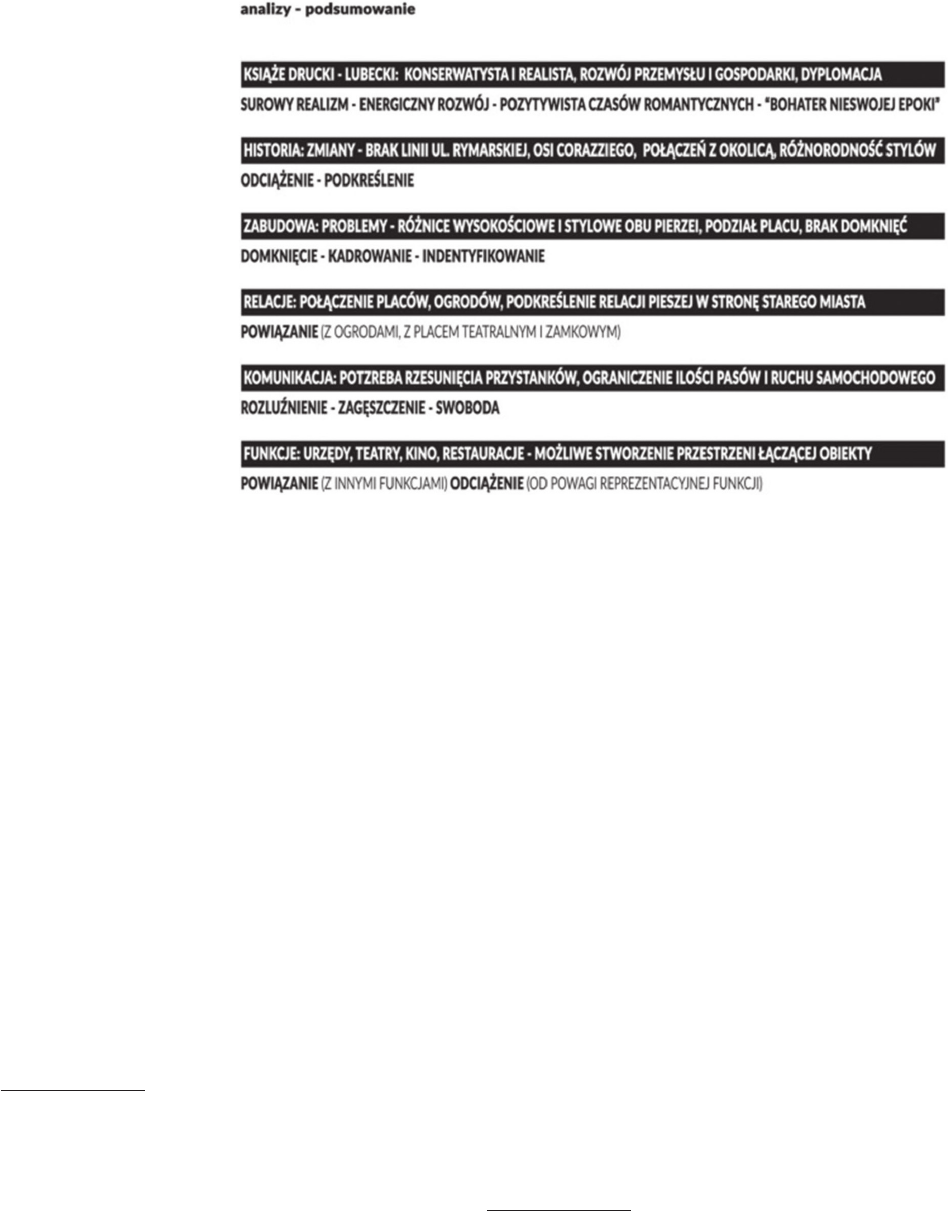
historical analysis of the character (Fig. 1). On the basis
of own studies and searches of available archival materi-
als they carry out a historical and architectural analysis
of development of Bankowy Square and the surrounding
area (Fig. 2). At the same time, on the basis of a eld vi-
sion, they also analyze spatial connections on a city scale
(Fig. 3) and a stylistic study of building development
of the square and the neighboring buildings. All studies
lead to the indication of conclusions to make a decision
on the form of commemoration. At the same time, each
7
Due to the fact that it is not possible to present all the projects in
this text, we decided to include a selection of dierent works without
any evaluation.
Praca nad projektem podzielona jest na trzy etapy. Po-
przedza je dość obszerne wprowadzenie do metody, cze-
mu poświęcone są odrębne zajęcia przeznaczone na wy-
kład opisujący sposób jej realizacji, istotę poszczególnych
kroków studialnych oraz uwarunkowań formalnych, ko-
rekt, konsultacji i zasad oceniania efektów pracy. Pierw-
szy etap stanowią studia i analizy poświęcone zbieraniu
materiałów wejściowych do projektowania zakończone
sformułowaniem wniosków. Etap drugi to studia arty-
styczne nad zapisem wniosków sformułowanych podczas
pierwszego etapu. Trzeci etap polega na interpretacji zapi-
sów artystycznych w taki sposób, aby ich treści przenieść
na język architektury, doprowadzając do powstania kon-
kretnych rozwiązań projektowych. Odrębną część zajęć,
bezpośrednio przed zakończeniem projektu i wystawą
końcową, stanowi omówienie sposobu prezentacji wyni-
ków wykonanych studiów, retrospekcja kolejnych etapów
i wskazanie głównej struktury procesu projektowego.
Skupienie uwagi na zrozumieniu idei metody, a nie wy-
łącznie na jej realizacji, stanowi dla zespołu dydaktyczne-
go najistotniejszy składnik zadania.
Omawiana metoda dydaktyczna składa się – jak wspo-
mniano – z trzech etapów prac studialnych oraz ściśle
sformułowanych zasad prezentacji projektów i zasad ich
oceny. Dla zilustrowania kolejnych etapów pracy ze stu-
dentami zamieszczono ilustracje przykładowych prac stu-
denckich wykonanych podczas ćwiczeń
7
.
Po przedstawieniu na pierwszych zajęciach metody
i zasad ich prowadzenia studenci otrzymują podkład
geo dezyjny terenu lokalizacji projektu i odbywają wizję
w terenie. Obchód podzielony jest na trzy części. Naj-
pierw grupa poznaje przestrzenie wiodące ze wszystkich
kierunków na plac Bankowy, szczególną uwagę zwraca
się przy tym na dostrzeganie pierwszych urbanistycznych
i architektonicznych przesłanek anonsujących wcho-
dzenie w obszar lokalizacji projektu. Skupienie uwagi
na relacjach w skali miasta ma przy tym najistotniejsze
znaczenie. Kolejny etap to obejście całego terenu ze
szczególnym zwróceniem uwagi na skalę wnętrza urbani-
stycznego, skalę poszczególnych obiektów i powiązania
widokowe z obiektami drugiego planu spoza terenu lo-
kalizacji. Ważne dla tego etapu jest poświęcenie większej
ilości czasu na powracanie w te same miejsca, ponowne
ich analizowanie etc. Grupa spędza nieco czasu na dys-
kusji poświęconej głównym spostrzeżeniom dotyczącym
zagadnień skali, stylu, funkcji, ruchu, atmosfery miej-
sca. Studenci wskazują, co przykuło ich uwagę zarówno
w skali detalu, jak i całości przestrzeni placu. Kończąc
wizję w terenie, studenci otrzymują zalecenie wykona-
nia samodzielnych analiz o różnych porach doby, rów-
nież nocą przy sztucznym oświetleniu. Podczas obchodu
powstają szkice z natury, fotograe i notatki poświęco-
ne cechom zastanej przestrzeni. Następnie na podstawie
otrzymanego podkładu geodezyjnego placu Bankowego
(SURE) dokonują analizy uwarunkowań technicznych,
mediów, komunikacji. Zapoznają się z osobą upamiętnia-
7
Ze względu na brak możliwości prezentacji w niniejszym tekście
wszystkich wykonanych projektów zdecydowano się zamieścić wybór
zróżnicowanych prac bez ich wartościowania.
132 Mirosław Orzechowski
analysis is summed up with a short record in the form of
a slogan
8
dening the features that should be included in
the designed shape of the Bankowy Square. The results of
this stage are recorded in the form of a digital presentation
and presented to the group by subsequent students in the
form of a 10-minute commented visual presentation. Each
statement is discussed by the group and the tutor. This
form of a series of micro-lectures constitutes an important
8
Verbalizing conclusions in the form of a short slogan, consisting
even of two or one word, in the form of an adjective is of particular im-
portance for the synthesis of the obtained information. Bringing the pro-
cess of information processing for individual issues to be written in one
or two words triggers the necessity to specify, carry out full analysis and
a synthesis of data, forcing to consider and make an in-depth reection.
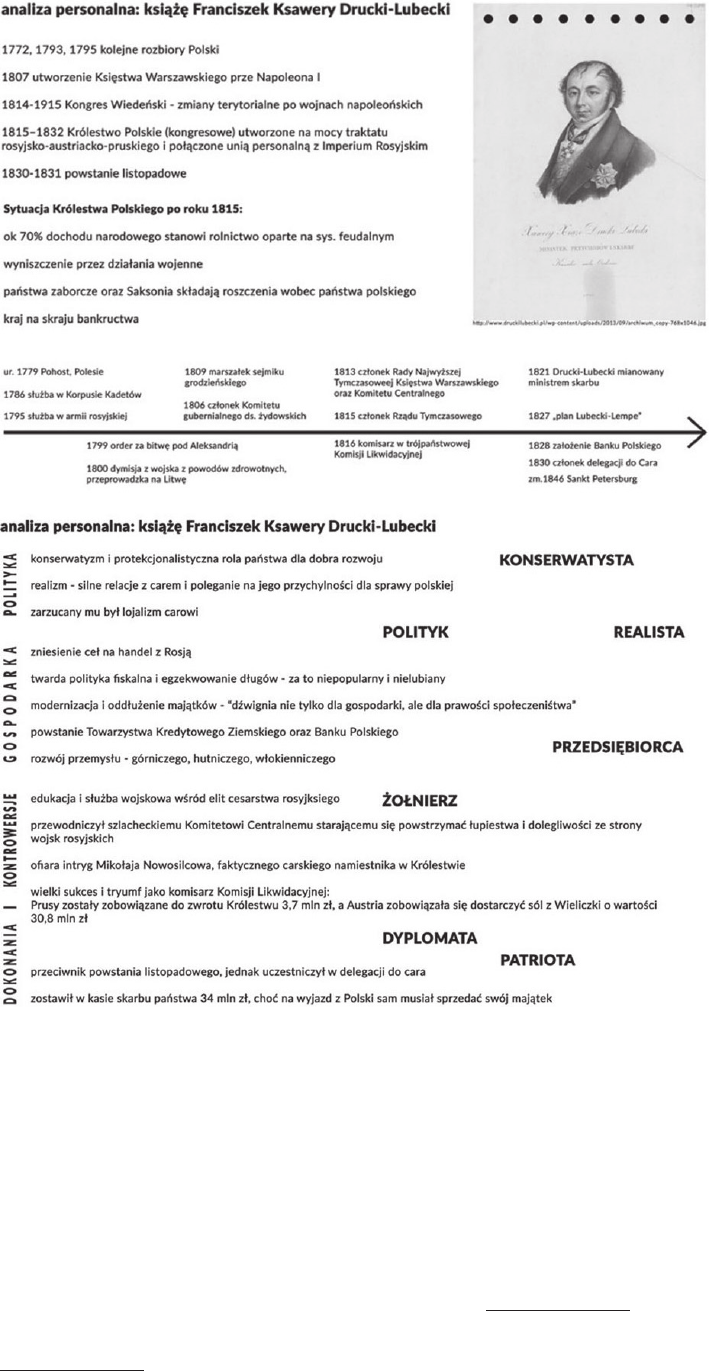
ną i wykonują analizę biograczno-historyczną postaci
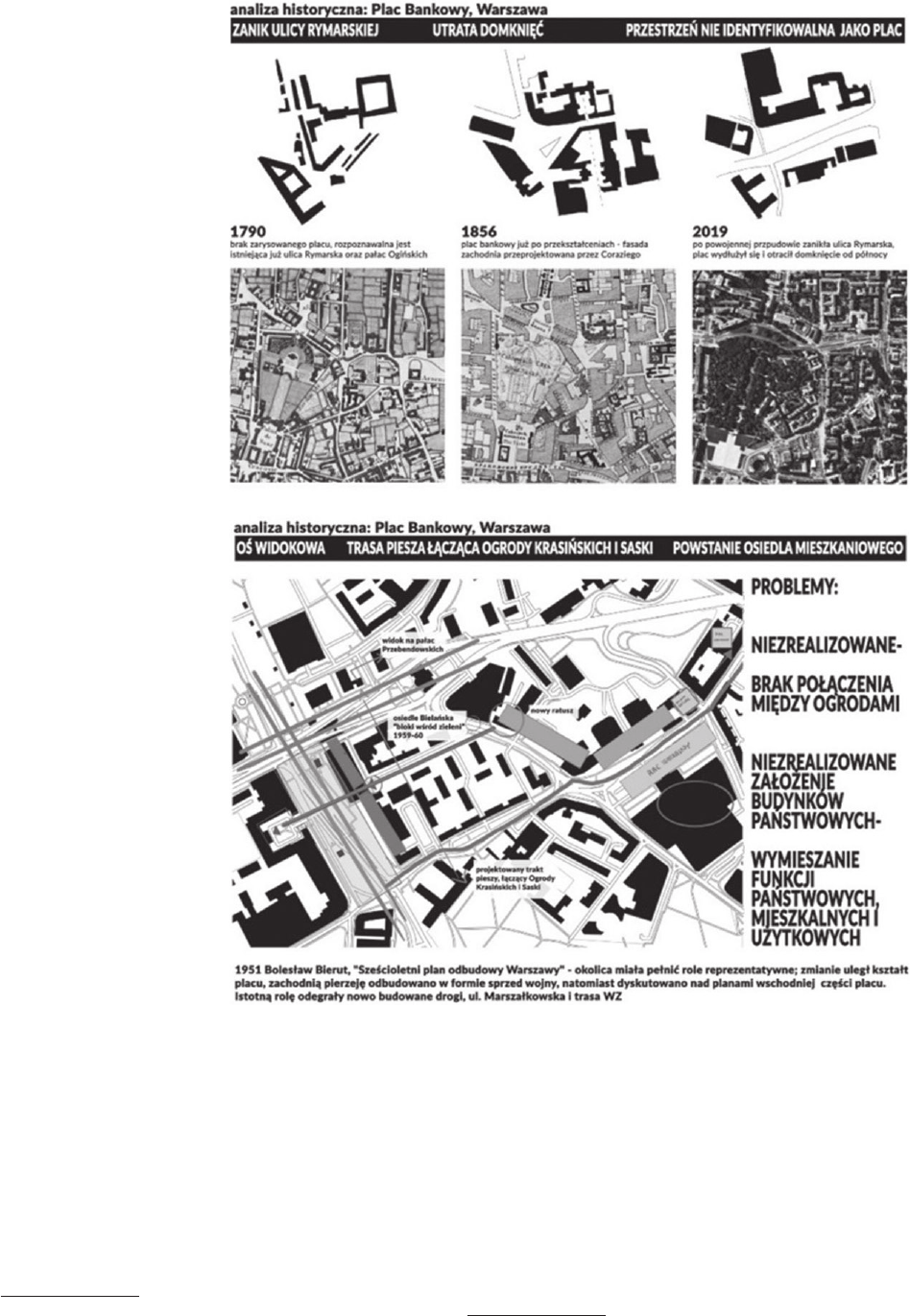
(il. 1). Na podstawie studiów własnych, kwerendy dostęp-
nych materiałów archiwalnych przeprowadzają analizę
historyczno-architektoniczną rozwoju placu Bankowego
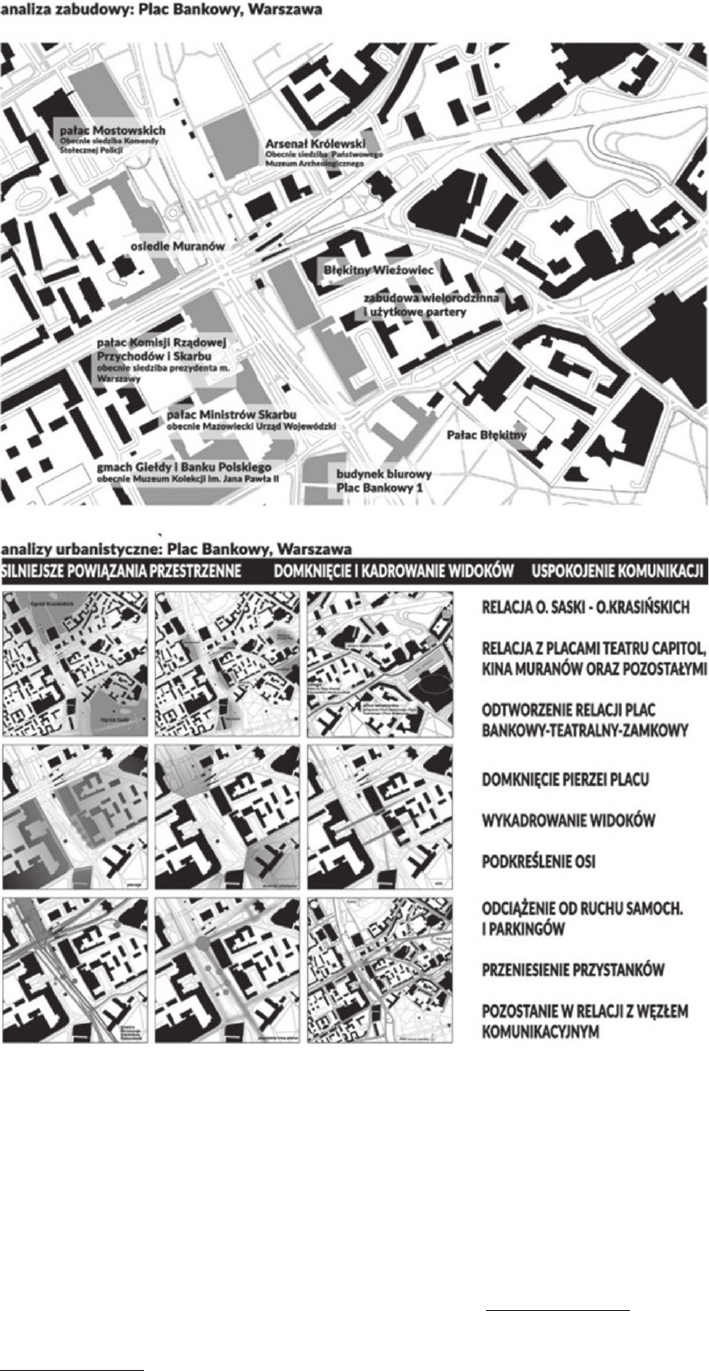
i okolic (il. 2). Równocześnie m.in. na podstawie wizji
w terenie wykonują też analizy powiązań przestrzennych
w skali miasta (il. 3) oraz badanie stylistyczne zabudo-
wy placu i obiektów sąsiadujących. Wszystkie studia
prowadzą do wskazania wniosków do podjęcia decyzji
o formie upamiętnienia. Jednocześnie każda analiza zo-
staje podsumowana krótkim zapisem o charakterze hasła
8
8
Zwerbalizowanie wniosków w formie krótkiego hasła, wręcz
dwu- lub jednowyrazowego, o charakterze przymiotnikowym ma szcze-
gólne znaczenie dla syntetyzowania zdobytych informacji. Doprowa-
Il. 1. Karty z analizy
osoby księcia.
Synteza hasłowa zapisana
w prezentacji przedstawianej
przez studenta i w zeszycie A3
(oprac. A. Rusinowska,
źródło: archiwum WA PW)
Fig. 1. Cards with the analysis
of the prince’s persona.
A keyword synthesis included
in the presentation prepared by
a student and in A3 notebook
(elaborated by A. Rusinowska,
source: archive of FA WUT)
Między punktem, kreską i plamą / Between a dot, a line and a stain 133
Il. 2. Karty z analizy historycznej.
Synteza hasłowa zapisana
w prezentacji przedstawianej
przez studenta i w zeszycie A3
(oprac. A. Rusinowska,
źródło: archiwum WA PW)
Fig. 2. Historical analysis cards.
A keyword synthesis included
in the presentation prepared by
a student and in A3 notebook
(elaborated by A. Rusinowska,
source: archive of FA WUT)
summary and is an opportunity to confront the interests
and the clearing up predispositions of individual partici-
pants of the classes. Exchange of views on dened prob-
lems can be fruitful and may have an impact on further
own analyses. This usually conrms students’ records of
the main ideas, features, design indications, and sometimes
allows students to formulate them more precisely. It is also
an opportunity to check in practice the completeness of
the input analyses carried out by indivi dual people
9
.
9
On this occasion, the technical side and methods of conducting
this type of presentation are also discussed, paying attention to their
strengths and weaknesses, also in the linguistic area.
określającego cechy, które powinny zostać zawarte w pro-
jektowanym kształcie placu Bankowego. Wyniki tego eta-
pu zapisywane są w formie prezentacji cyfrowej i przedsta-
wiane grupie przez kolejne osoby w postaci 10-minutowej
komentowanej prezentacji wizualnej. Każda wypowiedź
jest omawiana przez grupę i prowadzącego. Taka for-
ma serii mikroreferatów stanowi ważne podsumowanie
i jest okazją do konfrontacji zainteresowań i klarujących
dzenie procesu przetworzenia informacji dla poszczególnych zagadnień
do zapisu w jednym lub dwóch słowach wyzwala konieczność konkre-
tyzowania, pełnej analizy i syntezy danych, zmusza do zastanowienia
i pogłębionej reeksji.
134 Mirosław Orzechowski
The second stage of work consists in illustrating ver-
bal, slogan
10
conclusions from individual analyses in the
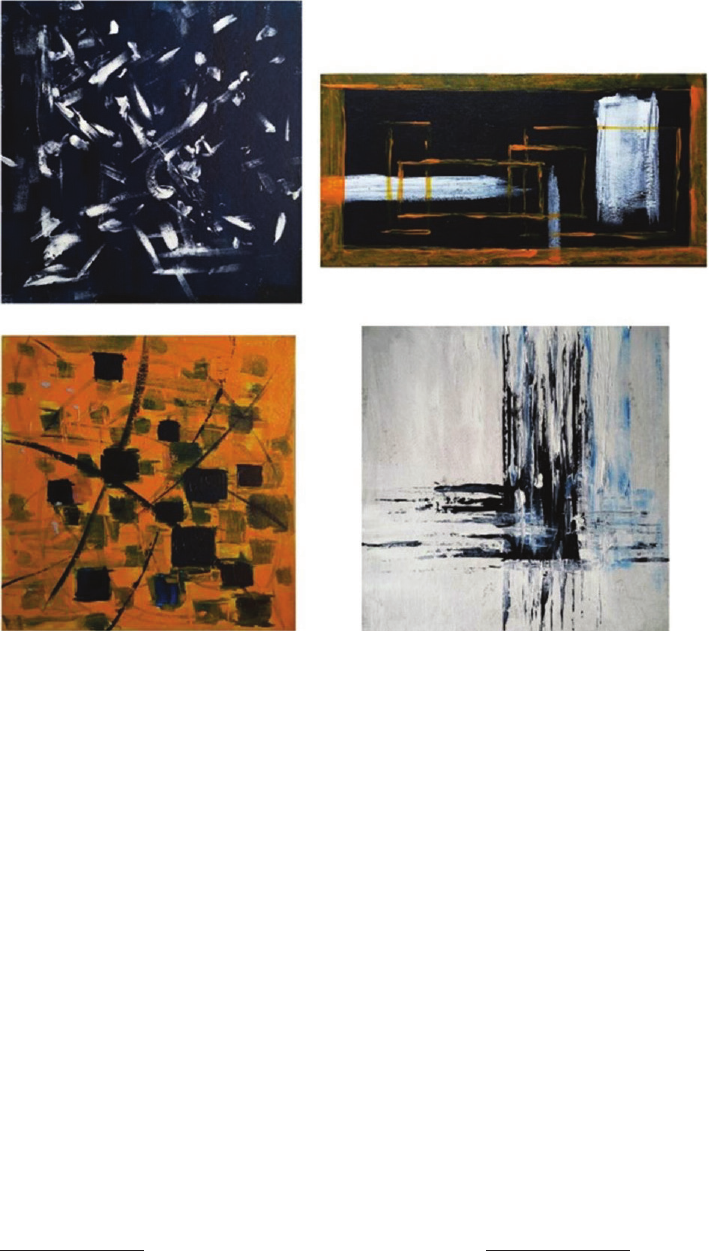
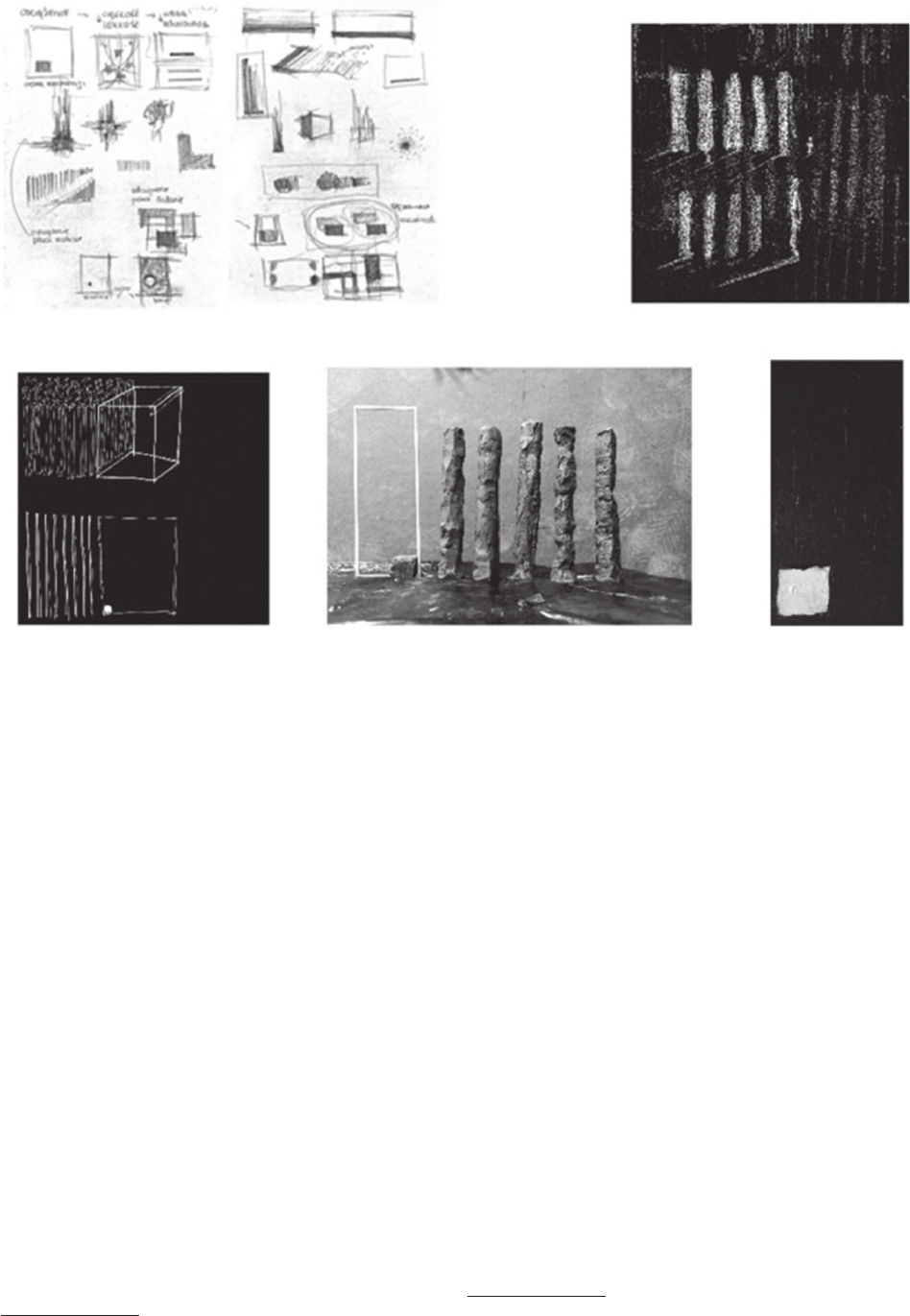
form of graphic, painting and sculptural works (Fig. 4)
11
.
It is important to realize that this is not an easy stage and
it is certainly dierent from the previous academic design
experience. The form of artistic works does not have to
10
Slogans are treated as artwork titles.
11
It is recommended to rst make sketches looking for graphic,
painting and sculptural compositions in various techniques, which are
rather not familiar to students and it is advisable to experiment with new
tools. After completing the sketch diagnosis, students may (but do not
have to) choose one technique to continue further art studies.
się predyspozycji poszczególnych uczestników zajęć.
Wymiana poglądów na zdeniowane problemy bywa
owocna i może mieć wpływ na dalsze analizy własne,
zazwyczaj utwierdza studentów w dokonanych zapi-
sach głównych idei, cech, wskazań projektowych, nieraz
też pozwala je dokładniej sformułować. Jest to również
okazja do praktycznego sprawdzenia kompletności ana-
liz wejściowych przeprowadzanych przez poszczególne
osoby
9
.
9
Przy tej okazji omawia się również techniczną stronę i metody
prowadzenia tego typu prezentacji, zwracając uwagę na ich mocne i sła-
be strony, również w obszarze językowym.
Il. 3. Karty z analizy
urbanistycznej. Synteza hasłowa
zapisana w prezentacji
przedstawianej przez studenta
i w zeszycie A3
(oprac. A. Rusinowska,
źródło: archiwum WA PW)
Fig. 3. Cards from the urban
analysis. A keyword synthesis
included in the presentation
prepared by a student
and in A3 notebook
(elaborated by A. Rusinowska,
source: archive of FA WUT)
Między punktem, kreską i plamą / Between a dot, a line and a stain 135
refer directly to spatial issues, although it is often based
on them, it is even recommended to abstract artistic com-
positions from the direct determinants of the square’s
space. The works of art illustrate only the slogans which
are the conclusions from these analyses
12
. A far-reach-
ing individualization of artistic studies is allowed at this
stage. The role of the lecturer – tutor is very important
here. The distinctness of the method may cause and some-
times causes diculties, for some there may be a crea-
tive emptiness – it is not known what to draw. Accompa-
niment and support is advisable. Animating the activity
despite the barrier of the workshop, lack of courage, etc.
belongs to the tutor and consultants from individual ar-
tistic disciplines. This is their main task at this stage of
work. During this stage, more or less after the completion
of the rst sketches, a review of the works takes place
with the participation of a commentator, i.e., a practicing
architect who has not participated in the classes so far.
During the review individual students present their works,
explain their way of thinking, the concept, and the inten-
tions of further artistic attempts. Everyone is invited to
present their opinion. Important for the creative process
are the comments of a commentator who knows the sub-
ject and views the resulting works in a completely fresh
and new way. As a result of overcoming the initial di-
culties, many works are created, which, in the course of
12
It is very important to focus on the depiction of the slogan with-
out referring to the topic directly. Such an assumption allows students to
release their creative expression, to detach from the school, often quite
clumsy representation of existing spatial systems. The link with the proj-
ect topic has already been recorded in the slogan as a result of its creation
on the basis of previous analyses. All the knowledge of the preliminary
studies conducted so far, already works in the student’s imagination.
Focusing only on reection of the meaning of the slogan allows stu-
dents to comprehensively and fully use the information obtained and
processed. Without the threat of the dominance of a single, periodically
dominant trait.
Drugi etap pracy polega na zobrazowaniu słownych,
hasłowych
10
wniosków z poszczególnych analiz w for-
mie prac gracznych, malarskich i rzeźbiarskich (il. 4)
11
.
Trzeba zdać sobie sprawę, że nie jest to łatwy etap, jest
z pewnością odmienny od dotychczasowych doświadczeń
akademickich dotyczących projektowania. Forma prac
plastycznych nie musi odnosić się wprost do zagadnień
przestrzennych, choć często się na nich opiera, zaleca
się wręcz wyabstrahowanie kompozycji plastycznych od
bezpośrednich uwarunkowań przestrzenią placu. Prace
artystyczne ilustrują wyłącznie hasła będące wnioskami
z analiz
12
. Dopuszcza się na tym etapie daleko idącą in-
dywidualizację studiów artystycznych. Bardzo ważna
jest w tym miejscu rola prowadzącego zajęcia – tutora.
Odmienność metody może sprawiać i sprawia niekiedy
trudności, u niektórych może pojawiać się pustka twór-
cza – nie wiadomo co rysować. Towarzyszenie i wsparcie
jest wskazane, animowanie aktywności pomimo bariery
warsztatu, braku odwagi etc. należy do tutora i konsul-
tantów z poszczególnych dyscyplin artystycznych, to jest
ich podstawowe zadanie na tym etapie pracy. W trakcie
10
Hasła są traktowane jak tytuły prac plastycznych.
11
Zaleca się wykonanie najpierw szkiców poszukujących kompo-
zycje graczne, malarskie i rzeźbiarskie w różnych technikach, raczej
niekoniecznie znanych studentom, wskazane jest eksperymentowanie
z nowymi narzędziami. Po wykonaniu rozpoznania szkicowego studenci
mogą (ale nie muszą) wybrać jedną technikę do kontynuowania dalszych
studiów plastycznych.
12
Bardzo istotne jest skupienie uwagi na obrazowaniu hasła, bez
bezpośredniego odnoszenia się do tematu. Takie założenie pozwala na
uwolnienie ekspresji twórczej studentów, oderwanie od szkolnego, często
dość nieporadnego odwzorowywania zastanych układów przestrzennych.
Powiązanie z tematem projektu zostało już zapisane w haśle w wyni-
ku jego wykreowania w oparciu o wcześniejsze analizy. Całość wiedzy,
dotychczasowych studiów wstępnych pracuje już w wyobraźni studenta.
Skupienie uwagi wyłącznie na oddaniu sensu hasła pozwala całościowo
i w sposób pełny wykorzystać zdobyte i przetworzone informacje. Bez
zagrożenia dominacją pojedynczej, narzucającej się okresowo cechy.
Il. 4. Karta z podsumowania
analiz. Synteza hasłowa
stanowiąca materiał wejściowy
do studiów artystycznych,
zapisana w prezentacji
przedstawianej przez studenta
i w zeszycie A3
(oprac. A. Rusinowska,
źródło: archiwum WA PW)
Fig. 4. A card with a summary of
analyses. A keyword synthesis
constituting an input material
for artistic studies, recorded
in the presentation by the student
and in A3 notebook
(elaborated by A. Rusinowska,
source: archive of FA WUT)
136 Mirosław Orzechowski
corrections and discussions, will constitute a preliminary
material for the nal stage of the project (Figs. 6, 7).
The third and nal stage consists of nding an appro-
priate formula for transferring the artistic form – obtained
in the course of artistic studies on the basis of entries
from input analyses – to the architectural concept of the
commemorative object, the design of development of the
Bankowy Square area. Students are asked to select a work
or a series of works, which will be the preliminary plastic
material for the project
13
. Students are expected to eas-
ily discover the ideological connections of the
resulting
works with the commemoration of the prince. In most
cases, it turns out that students make a more or less un-
expected discovery of the spatial relations of their art-
works with the idea of commemorating Prince Ksawery
Drucki-Lubecki and the site. This leads to a fairly ecient
record of these connections and assigning them to specic
architectural solutions and the development of Bankowy
Square. The form of commemoration is then recorded in
the form of projections, sections, or possibly a facade. It
can be presented in a painting formula related to architec-
13
At this point, it is important to learn how to make a choice. It
may take place in the course of conversations with the tutor, weighing
of features, self-analysis, in-depth reection, noticing of self-developing
spatial aspects. At the same time, it is worth remembering that during
the performance of artistic works, students’ attention was focused on
the essence of the features indicated as a result of preliminary design
analyzes, so the task of returning to the design form consists in skillful
interpretation of the resulting paintings or sculptures, leading to the no-
ticing of architectural shapes in them.
trwania tego etapu, mniej więcej po zakończeniu pierw-
szych szkiców odbywa się przegląd prac z udziałem ko-
mentatora, architekta praktyka, który nie uczestniczył do
tej pory w zajęciach. Podczas przeglądania poszczególne
osoby przedstawiają swoje prace, wyjaśniają sposób my-
ślenia, koncept, zamierzenia dalszych prób plastycznych.
Wszyscy są zaproszeni do zaprezentowania swojej opinii.
Istotne dla procesu twórczego są uwagi komentatora zna-
jącego temat, a patrzącego na powstałe prace w całkowicie
świeży, nowy sposób. W wyniku przełamania początko-
wych trudności powstaje wiele prac, które w toku korekt
i dyskusji będą stanowić materiał wstępny do ostatniego
etapu projektu (il. 6 i 7).
Etap trzeci, końcowy, polega na odnalezieniu odpo-
wiedniej formuły dla przeniesienia formy plastycznej
– uzyskanej w toku studiów artystycznych na podstawie
haseł z analiz wejściowych – na koncepcję architektonicz-
ną obiektu upamiętniającego, projektu zagospodarowania
terenu placu Bankowego. Studenci proszeni są o autorskie
wskazanie wybranej pracy lub ich serii, które stanowić
będą plastyczny materiał wstępny do projektu
13
. Oczeku-
13
Znaczenie w tym momencie ma zdobycie umiejętności dokony-
wania wyboru. Może odbywać się to w toku rozmów z tutorem, ważenia
cech, autoanalizy, pogłębionej reeksji, dostrzegania samokreujących
się aspektów przestrzennych. Warto przy tej okazji pamiętać, że pod-
czas wykonywania prac plastycznych uwaga studentów skupiona była
na istocie cech wskazanych w wyniku wstępnych analiz projektowych,
zatem zadanie powrotu do formy projektowej polega na umiejętnym in-
terpretowaniu powstałych obrazów czy rzeźb, prowadzącym do dostrze-
żenia w nich kształtów architektonicznych.
Il. 5. Prace malarskie
odpowiadające wnioskom
zapisanym na podstawie analiz
(por. il. 4). Kopie prac zawarte
w pracy studenckiej w zeszycie A3
(autor: A. Rusinowska,
źródło: archiwum WA PW)
Fig. 5. Painting works
corresponding to the conclusions
drawn on the basis of
the analyses (cf. Fig. 4).
Copies of works included in
the student’s work in A3 notebook
(elaborated by A. Rusinowska,
source: archive of FA WUT)
Między punktem, kreską i plamą / Between a dot, a line and a stain 137
Il. 6. Prace rysunkowe, graficzne, rzeźbiarskie, stanowiące ciąg myślowy, odpowiadające wnioskom zapisanym na podstawie analiz.
Kopie prac zawarte w pracy studenckiej w zeszycie A3 (autor: A. Rusinowska, źródło: archiwum WA PW)
Fig. 6. Drawing, graphic and sculptural works, constituting a string of thought, corresponding to the conclusions drawn on the basis of analyses.
Copies of works included in
the student’s work in A3 notebook
(elaborated by A. Rusinowska, source: archive of FA WUT)
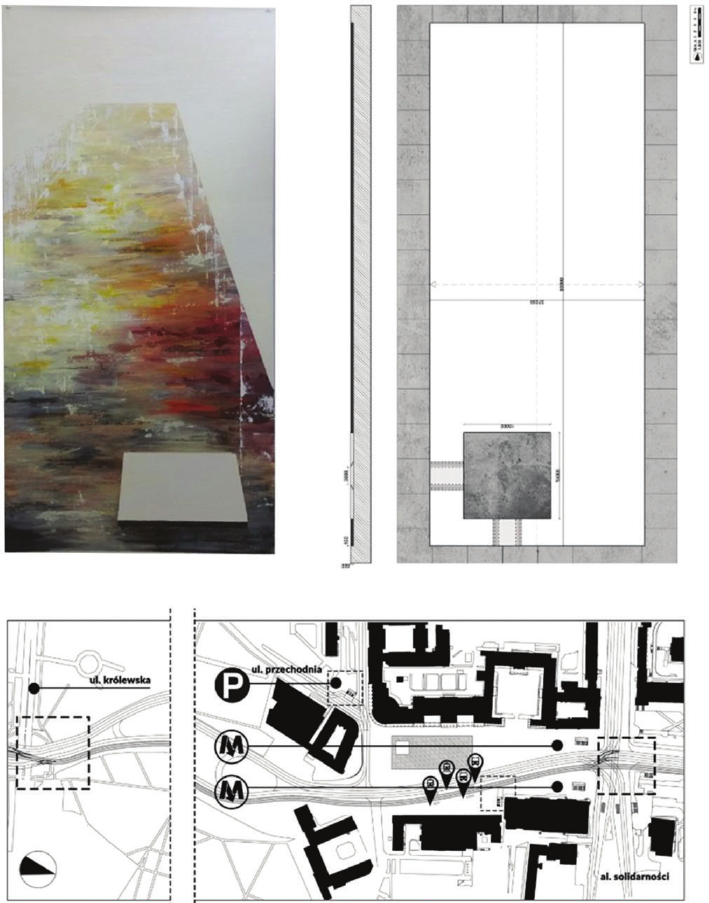
tural projections (Fig. 7). Full freedom is assumed in this
respect, only the format and scope frames are indicated
every semester. The techniques of implementation are left
to students and they usually go to the end in line with the
art works made in the second stage of the work.
The project of the concept of the memorial site is cur-
rently
14
presented in the form of a board 1 m wide and
up to 2 m high showing the idea of commemoration and
a notebook in A3 format containing all the analyses and
conclusions, copies or originals of artistic studies, sketch-
es and design drawings as well as projections, sections,
façades, land development plan. A model of the square is
also a mandatory component of the concept presentation.
Results
For the design process based on artistic studies, two
components connecting the subsequent stages of work
are important. The rst one takes place when the key-
words summarizing the analysis are indicated. There is
14
In previous years, the scope of presentations has changed, from
three 70 × 100 cm boards in a horizontal layout and models, through
three boards, a model and a separate idea board in any format, to the
current scope.
je się, że studenci w prosty sposób odkryją powiązania
ideowe powstałych prac z upamiętnieniem osoby księ-
cia. W większości przypadków okazuje się, że studenci
dokonują mniej lub bardziej niespodziewanego odkrycia
związków przestrzennych swojej pracy plastycznej z ideą
upamiętnienia księcia Ksawerego Druckiego-Lubeckiego
i terenem lokalizacji. Prowadzi to do dość sprawnego zapi-
su tych powiązań i przypisania ich konkretnym rozwiąza-
niom architektonicznym i zagospodarowaniu placu Ban-
kowego. Forma upamiętnienia zostaje następnie zapisana
w postaci rzutów, przekrojów, ewentualnie elewacji. Może
być przedstawiona w formule malarskiej powiązanej z rzu-
tami architektonicznymi (il. 7). Zakłada się pełną dowol-
ność w tej mierze, wskazane są co semestr wyłącznie ramy
formatowe i zakresowe, techniki realizacji pozostawia się
studentom, zazwyczaj idą one do końca w parze z pracami
plastycznymi wykonanymi w drugim etapie pracy.
Projekt koncepcji miejsca pamięci jest obecnie
14
pre-
zentowany w formie planszy o szerokości 1 m i wysokości
do 2 m ukazującej ideę upamiętnienia oraz zeszytu w for-
macie A3 zawierającego wszystkie wykonane analizy wraz
14
W poprzednich latach zmieniały się zakresy prezentacji, od trzech
plansz 70
×
100 cm w układzie poziomym i makiety, przez trzy plansze,
makietę i osobną planszę idei w dowolnym formacie po obecny zakres.
138 Mirosław Orzechowski
no room for compiling conclusions and deriving a sin-
gle or summary set of design guidelines. This task is to
be fullled by artistic studies. After conducting in-depth
input analyses, the formulated slogans contain all rele-
vant data from the point of view of the importance of de-
sign decisions.
The basis for artistic studies is therefore a set of slogans
constituting a pretext for creative activities, during which
the content of the created slogans is transferred into the
area of art. In this way, through the activity of the con-
ducted synthesis, essential content is naturally selected,
the most important part gains an advantage in creative ac-
tivities and receives the nal form of artistic works that
contain important premises concerning the main topic of
the design and the localization context (Figs. 8, 9).
The second important moment in the design process
is noticing the potential in the created artistic work that
could be the theme of the object (Fig. 6) or even the struc-
ture of the entire establishment, development of Bankowy
Square, while maintaining the idea of commemorating
z wnioskami, kopie lub oryginały studiów artystycznych,
szkice i rysunki projektowe oraz rzuty, przekroje, elewacje,
projekt zagospodarowania terenu. Obowiązkowym skład-
nikiem prezentacji koncepcji jest również makieta placu.
Rezultaty
Dla procesu projektowego opartego na studiach ar-
tystycznych istotne znaczenie mają dwa składniki spa-
jające kolejne etapy pracy. Pierwszy z nich następuje
w momencie wskazania haseł podsumowujących analizy.
Nie ma przy tym miejsca na zestawianie wniosków i wy-
prowadzanie pojedynczego czy sumarycznego zespołu
wytycznych projektowych. To zadanie mają spełnić stu-
dia artystyczne. Po przeprowadzeniu wnikliwych analiz
wejściowych w sformułowanych hasłach zawierają się
wszystkie istotne dane, z punktu widzenia wagi decyzji
projektowych.
Podstawą dla studiów artystycznych jest zatem zbiór
haseł stanowiących pretekst do działań twórczych, pod-
Il. 7. Praca malarska prezentująca
ideę projektu upamiętnienia,
rzut z projektu i schemat
przestrzenny z projektu
(por. il. 5 i 6). Kopie prac
zawarte w pracy studenckiej
w zeszycie A3
(autor: A. Rusinowska,
akryl, 100 × 200 cm,
źródło: archiwum WA PW)
Fig. 7. A painting work presenting
the idea of the commemoration
project, projection of the design
and a spatial diagram of
the design (cf. Figs. 5 and 6).
Copies of works included in
the student’s work in A3 notebook
(elaborated by A. Rusinowska,
acrylic, 100 × 200 cm,
source: archive of FA WUT)
Między punktem, kreską i plamą / Between a dot, a line and a stain 139
the prince. As a result of artistic studies, students receive
“ready” spatial solutions, and the process of dening them
and associating them with a specic architectural form be-
gins simultaneously with work on them.
The last stage of studies on the project concerns only
the skillful presentation of the idea of commemoration
developed in this way. The projects stop at the concep-
tual stage, primarily shaping the form. The advancement
of detailed solutions regarding functions and details de-
pends to a large extent on the student’s predisposition and
is highly individualized and varied (Fig. 10).
The classes methodically, step by step, lead the partic-
ipants through consecutive predened stages. Summing
up, it should be noted that the interest of students in this
form and method of work has been growing year by year.
The projects are distinguished by their slightly “compet-
itive” nature. From year to year, this process is assessed
by subsequent participants, and on its basis, it is modied
every year in various scopes. Despite the fourth semes-
ter of teaching according to the formula described above,
none of the students’ projects (42 works) was repeated in
czas których następuje przeniesienie w obszar sztuki
treści zawartych w utworzonych hasłach. W ten sposób
przez aktywność prowadzonej syntezy następuje natu-
ralne selekcjonowanie istotnych treści, te najważniejsze
uzyskują przewagę w działaniach twórczych i otrzymują
nalną formę dzieł artystycznych, które zawierają istot-
ne przesłanki dotyczące głównego tematu projektowego
i kontekstu lokalizacyjnego (il. 8 i 9).
Drugim ważnym momentem w procesie projektowym
jest dostrzeżenie w powstałej pracy artystycznej potencja-
łu mogącego stanowić motyw obiektu (il. 6) czy wręcz
strukturę całości założenia, zagospodarowania placu Ban-
kowego przy jednoczesnym zachowaniu idei poświęconej
upamiętnieniu osoby księcia. Praktycznie studenci dosta-
ją w wyniku studiów artystycznych „gotowe” rozwiąza-
nia przestrzenne, a proces ich deniowania i kojarzenia
z konkretną formą architektoniczną zaczyna się równole-
gle z pracą nad nimi.
Ostatni etap studiów nad projektem dotyczy de fac-
to jedynie umiejętnego zaprezentowania wypracowanej
w ten sposób idei upamiętnienia. Projekty zatrzymują się
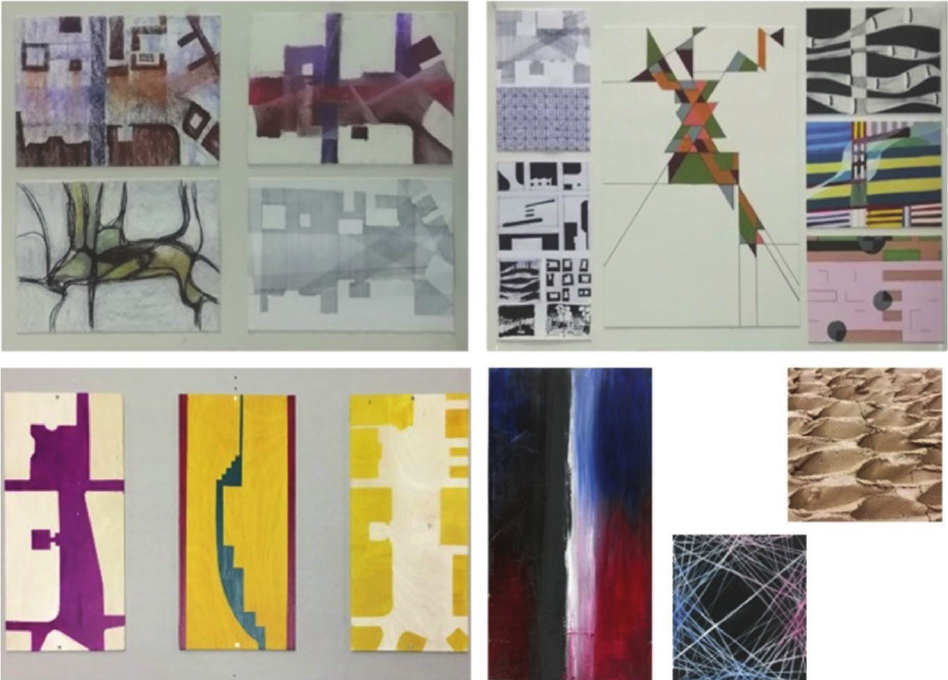
Il. 8. Prace malarskie, graficzne i rzeźbiarska, odpowiadające wnioskom zapisanym na podstawie analiz, przykłady autorstwa różnych studentów.
Prace zawarte w pracy studenckiej w zeszycie A3
(autorzy: plansze graficzne u góry – A. Parzyszek,
trzy prace u dołu po lewej – A. Bartczak, po prawej – E. Zientała,
źródło: archiwum WA PW)
Fig. 8. Painting, graphic and sculptural works, corresponding to the conclusions drawn on the basis of analyses,
examples of works by various students. Works included in the student’s work in A3 notebook
(authors: graphic boards at the top – A. Parzyszek, three works at the bottom to the left – A. Bartczak, on the right – E. Zientała,
source: archive of FA WUT)
140 Mirosław Orzechowski
na etapie koncepcyjnym, kształtując przede wszystkim
formę. Zaawansowanie rozwiązań szczegółowych, doty-
czących funkcji i detalu, zależy w dużej mierze od predys-
pozycji studenta i jest dalece zindywidualizowane i zróż-
nicowane (il. 10).
Zajęcia, metodycznie, krok po kroku, prowadzą uczest-
ników przez kolejne zdeniowane etapy. Podsumowując,
należy zauważyć, że z roku na rok rośnie zainteresowanie
studentów tą formą i metodą pracy. Projekty wyróżniają
się swoim nieco „konkursowym” charakterem. Z roku na
rok proces ten jest poddawany ocenie kolejnych uczest-
ników, na jej podstawie corocznie modykowany w róż-
nych zakresach. Pomimo czwartego semestru prowadze-
nia zajęć według opisanej formuły żaden z powstałych
projektów studenckich (42 prace) nie powtórzył się za-
równo w sferze plastycznej, jak i w formie architektonicz-
nej i zagospodarowania placu.
Jednym ze składników procesu dydaktycznego jest za-
wsze ocena pracy. W przypadku omawianej metody nie
stosuje się żadnych form ocen przejściowych. Nacisk pod-
czas trwania projektowania położony jest na animowanie
dyskursu pomiędzy ich uczestnikami oraz wydobywanie
pozytywów w przedstawianych pracach. Ocena efektów
jest oceną aktywnego uczestniczenia w kolejnych etapach
pracy, czyli odbycia pełnego procesu dydaktycznego.
the visual sphere, or in the architectural form and arrange-
ment of the square.
One of the components of the teaching process is al-
ways job evaluation. This method does not use any form
of interim assessment. During the design phase, the em-
phasis is on animating the discourse between the par-
ticipants and bringing out the positives in the presented
works. The assessment of the results is an assessment of
active participation in the subsequent stages of work, i.e.,
completing the full didactic process.
Discussion
According to the method described above, so far 42
works have been performed, which from the point of view
of the author’s experience is a considerable number, but
objectively it is not a large number. Behind each project
work there is a specic student who has individually
addressed the proposed method. A vast majority of stu-
dents fully applied it. Starting the work according to the
described method requires overcoming various objective
opposites, such as the routine consisting in getting used
to a certain design method, such as internal pressure to
achieve a good eect, or such as compliance with the
formal requirements of the project presentation method,
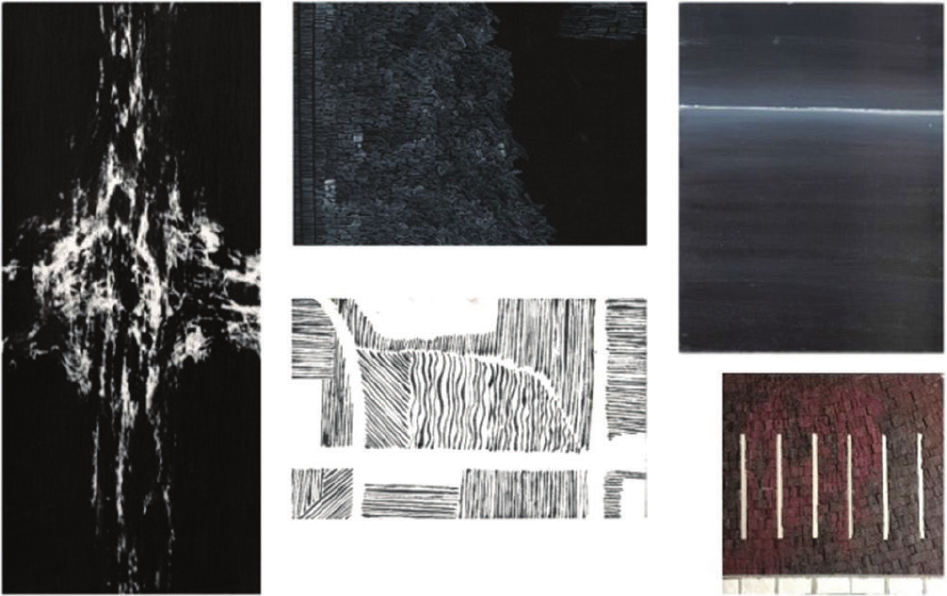
Il. 9. Prace graficzne odpowiadające wnioskom zapisanym na podstawie analiz, przykłady autorstwa różnych studentów.
Prace zawarte
w pracy studenckiej w zeszycie A3
(autorzy: praca u góry po lewej i w środku – M. Mikos,
w środku poniżej i u góry po
prawej – K. Wojtczyk-Eluszkiewicz,
po prawej – A. Gadomski, źródło: archiwum WA PW)
Fig. 9. Graphic works, corresponding to the conclusions drawn on the basis of analyses, examples of works by various students.
Works included in the student’s work in A3 notebook (authors: work at the top to the left and in the center – M. Mikos,
in the middle below and at the top to the right – K. Wojtczyk-Eluszkiewicz, on the right – A. Gadomski,
source: archive of FA WUT)
Między punktem, kreską i plamą / Between a dot, a line and a stain 141
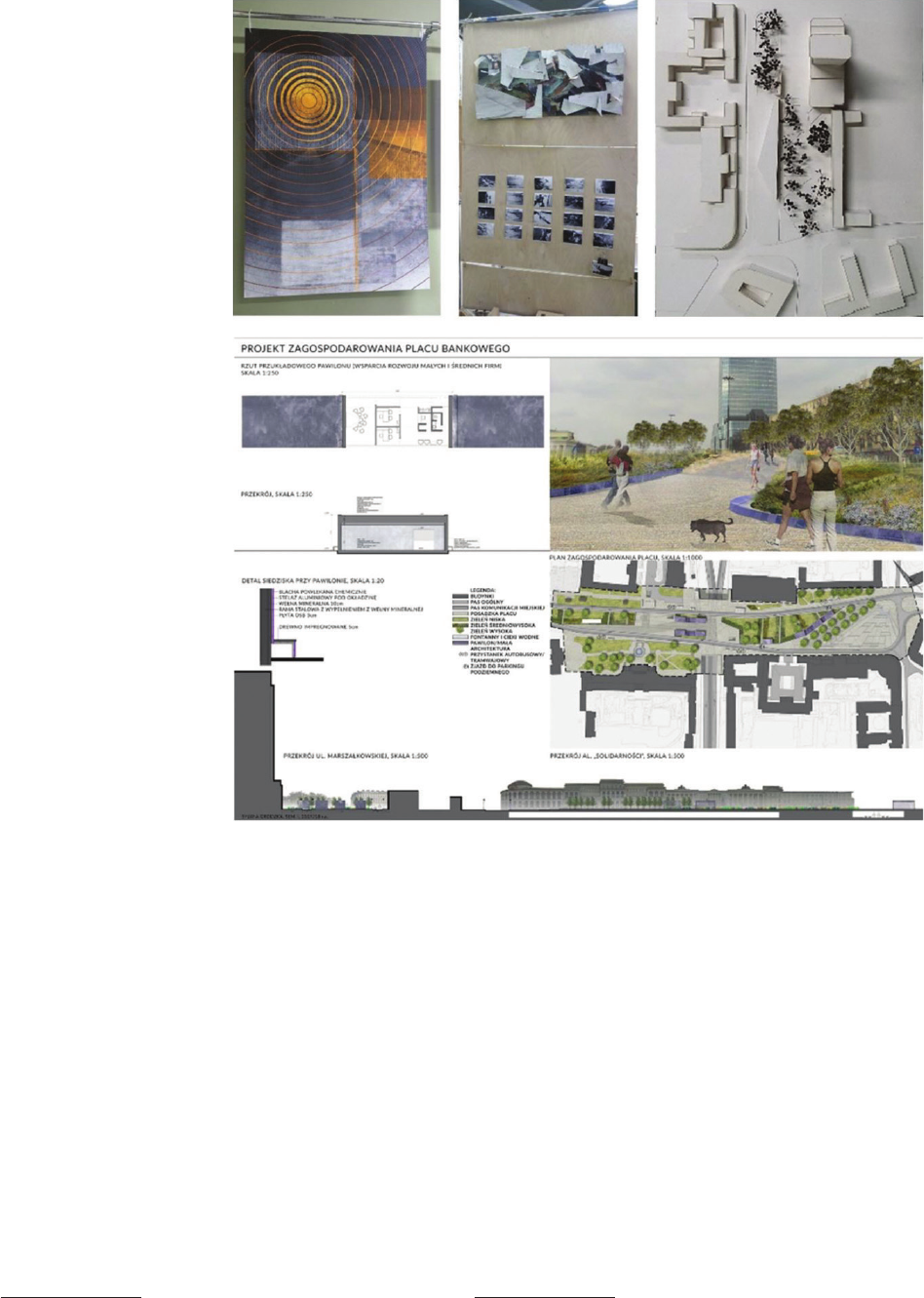
Il. 10. Prace finalne różnych
autorów, u góry zdjęcia
z wystawy z pracami
prezentującymi ideę projektu
(autorzy: od lewej
K. Matuszewski, obraz,
akryl, 100 × 140 cm,
collage – N. Słomczyński,
makieta po prawej – E. Zientała,
u dołu plansza projektowa
– S. Grodzka,
źródło: archiwum WA PW)
Fig. 10. Final works by various
authors, at the top photos from
the exhibition with works
presenting the idea of the project
(authors: from the left:
K. Matuszewski, painting,
acrylic, 100 × 140 cm,
collage – N. Słomczyński,
model on the right – E. Zientała,
at the bottom a board design
– S. Grodzka,
source: archive of FA WUT)
Dyskusja
Według opisanej metody wykonano dotychczas 42 pra-
ce, co z punktu widzenia doświadczeń autora jest liczbą
znaczną, jednak obiektywnie nie jest ona duża. Za każdą
pracą projektową stoi konkretny student, który odniósł się
indywidualnie do zaproponowanej metody. Zdecydowa-
na większość studentów zastosowała ją w pełni. Wejście
w pracę według opisanej metody wymaga pokonywania
różnych obiektywnych przeciwieństw, takich jak rutyna
polegająca na przyzwyczajeniu do określonego sposobu
projektowania, jak wewnętrzna presja osiągnięcia dobrego
efektu, jak przestrzeganie wymogów formalnych sposobu
prezentacji projektu etc.
15
W efekcie powstają prace o zróż-
nicowanej wartości architektonicznej. Jednak to nie osta-
teczny efekt projektowy decyduje o wartości ćwiczenia dla
15
Co roku, pomimo przekazywania sobie informacji przez stu-
dentów kolejnych roczników, pojawia się niedowierzanie, że nie będzie
ocen cząstkowych, że będzie prowadzenie przez proces projektowy krok
po kroku, a na koniec nie będzie oceniany efekt tylko całość pracy pod-
czas semestru.
etc.
15
As a result, works of various architectural value are
created. However, it is not the nal design outcome that
determines the value of the exercise for an individual stu-
dent. What is decisive is the path taken, the work, the new
experience, change of mindset, broadening the knowl-
edge, openness to joint activity. This, too, is probably the
greatest value of this method. The examples presented
are only a general background for the presented didactic
method and one should not go into their details, evaluate
or classify them. That should never be the goal.
The same applies to the issue of authorship. The team-
work in the profession of an architect is now an obvious
thing veryone who works in a design team probably per-
fectly knows how the ideas of others often make us form
innovative associations which are transformed into the
nal architectural form not only by us but also by others
15
Every year, in spite of sharing information by students of sub-
sequent years, there is disbelief that there will be no partial grades, that
there will be a step-by-step guiding through the design process, and at
the end of the semester the eect will not be assessed but the overall
work throughout the semester.
142 Mirosław Orzechowski
and to the improvement of which we also contribute.
Who is the author in this case? This is also worth teach-
ing in the context of the discussed design method. This
exchange of ideas with friends often helps to see one’s
own idea appearing vaguely in our imagination. This also
translates into further stages of professional work, and es-
pecially research work, when instead of jealously guard-
ing our own discoveries, plans and ideas, we should, or
even we are called to make them public for the good of the
research community, so that others, maybe more talented
ones, could develop them or avoid our mistakes. We instill
this attitude towards creativity in our students as part of
our method.
It is worth paying attention not so much to the content
of the method, but rather to the conducting of classes in
accordance with any method. One of the information ob-
tained from students is their surprise that designing can be
a sequence of successive dened steps, and not a search in
the dark, by feeling, or according to imaginary formal as-
sumptions detached from real conditions. There is a belief
that one of the academic duties is to present specic meth-
ods of work to students, allowing them to nd over time,
through subsequent, specic searches, perhaps their own
method. But for this to work, one should show a certain
amount of tolerance and nd in younger colleagues those
good qualities that should be nurtured, and at the same
time try to understand the dierence of their point of view,
reasons, needs related to a dierent perspective from ours,
and also always leave them an appropriate measure of in-
dependence and full freedom in making a choice.
Perhaps then it will be possible to develop the ability
to perceive the relationship between a point, a line and
a stain concerning not only the recording of an architec-
tural idea, teaching of architecture understood as art, but
also the subjective perception of man in all aspects of his
activity. Perceiving man not on the basis of vague ideas
often burdened with our ego, but on the honest listening
and observing man as a separate person, with an attitude
of searching for the values presented by that person. In
this way, by building a subjective relationship between
people, we will contribute to educating architects who are
sensitive to the real needs of future users of the architec-
ture they design.
As a result of applying the presented method of teach-
ing design on the basis of artistic disciplines, the way of
perceiving the design function is changing. Transforma-
tion of attitudes represented by students is revolutionary,
it takes the form of discovering one’s own path, opening
up to new creative forces, often dormant so far between
occasional design attempts. Finally, the reference to art in
the design process makes it possible to establish a thread
of relations with the often forgotten original ideas of the
founders of the Bauhaus, as well as the FA WUT. Human-
istic ideas, blurred throughout the century, can be success-
fully reborn in the projects of the young generation who
discover that architecture is art after all.
Students who condently started designing on the ba-
sis of art disciplines deserve special thanks from the au-
thor of this article. Thanks to their eorts, art has a chance
to practically return to the architect’s design workshop.
pojedynczego studenta. Decyduje droga, którą odbył, praca,
nowe doświadczenie, zmiana sposobu myślenia, poszerze-
nie wiedzy, otwarcie na wspólne działanie. To też stanowi
prawdopodobnie największą wartość metody. Zaprezen-
towane przykłady to tylko ogólne tło dla przedstawionej
metody dydaktycznej i nie należy wnikać w ich szczegó-
ły, oceniać, klasykować. To nie powinno być nigdy celem.
Podobnie rzecz ma się z kwestią autorską. Zespoło-
wość w zawodzie architekta jest obecnie oczywistością,
każdy, kto pracuje w zespole projektowym, wie prawdo-
podobnie doskonale, sam z pewnością tego doświadczył,
jak pomysły innych rodzą w nas kolejne, często odkryw-
cze skojarzenia, które niekoniecznie my sami, ale jeszcze
inni zamieniają w ostateczną formę architektoniczną, do
której uszlachetnienia z kolei również my przykładamy
dłoń. Kto w takim przypadku jest autorem? Tego też war-
to nauczać przy okazji omawianej metody projektowania.
Owa wymiana myśli z koleżankami i kolegami pomaga
często dostrzec własny pomysł niejasno zarysowujący się
w wyobraźni. Ma to również przełożenie na dalsze eta-
py pracy zawodowej, a szczególnie również badawczej,
kiedy zamiast zazdrośnie strzec własnych odkryć, planów,
pomysłów, powinniśmy, a wręcz jesteśmy powołani do
ich upubliczniania dla dobra wspólnoty badawczej, aby
inni, może zdolniejsi, mogli je rozwijać albo nie popeł-
niać naszych błędów. Takie nastawienie do twórczości
wpajamy studentom w ramach naszej metody.
Warto zwrócić uwagę nie tyle na treść metody, ile ra-
czej na prowadzenie zajęć w zgodzie z jakąkolwiek me-
todą. Jedną z informacji pozyskanych od studentów jest
właśnie ich zaskoczenie tym, że projektowanie może być
sekwencją kolejnych zdeniowanych kroków, a nie po-
szukiwaniem po omacku, na wyczucie albo według wy-
imaginowanych i oderwanych od realnych uwarunko-
wań założeń formalnych. Istnieje przekonanie, że jedną
z akademickich powinności jest właśnie przedstawianie
studentom konkretnych metod pracy, pozwalających na
odnalezienie z czasem, w drodze kolejnych, konkretnych
poszukiwań, być może ich własnej metody. Ale aby to za-
funkcjonowało, winno się okazać pewną dozę tolerancji
i odnajdywać w młodszych koleżankach i kolegach te do-
bre cechy, które należy pielęgnować, a jednocześnie pró-
bować zrozumieć odmienność ich punktu widzenia, racji,
potrzeb związanych z inną perspektywą od naszej, zawsze
też pozostawiać im stosowną miarę samodzielności i peł-
nię wolności w dokonywaniu wyboru.
Może uda się wówczas wytworzyć umiejętność do-
strzegania relacji między punktem, kreską i plamą doty-
czących nie tylko zapisu idei architektonicznej, naucza-
nia architektury rozumianej jako sztuka, ale jednocześnie
podmiotowego postrzegania człowieka we wszystkich
aspektach jego aktywności. Postrzegania człowieka nie
na podstawie niejasnych, często obarczonych naszym ego
wyobrażeń, ale rzetelnego przysłuchiwania i przyglądania
się człowiekowi jako odrębnej osobie, z nastawieniem na
poszukiwanie wartości przez nią prezentowanych. W ten
sposób przez budowanie relacji podmiotowej pomiędzy
ludźmi będziemy przyczyniać się do kształcenia architek-
tów wrażliwych na realne potrzeby przyszłych użytkow-
ników projektowanej przez nich architektury.
Między punktem, kreską i plamą / Between a dot, a line and a stain 143
W wyniku stosowania przedstawionej metody naucza-
nia projektowania w oparciu o dyscypliny artystyczne
następuje przemiana sposobu postrzegania funkcji pro-
jektowania. Przemiana postaw reprezentowanych przez
studentów ma charakter rewolucyjny, przybiera formę
odkrycia własnej ścieżki, otwarcia na nowe siły twórcze
drzemiące często do tej pory pomiędzy dorywczymi pró-
bami projektowymi. Wreszcie odwołanie do sztuki w pro-
cesie projektowym pozwala nawiązać nić relacji z za-
pomnianymi już często pierwotnymi ideami założycieli
Bauhausu, a również WA PW. Rozmyte na przestrzeni ca-
łego wieku humanistyczne idee mogą się z powodzeniem
odradzać w projektach młodego pokolenia odkrywające-
go, że architektura jest jednak sztuką.
Studenci, którzy z zaufaniem przystąpili do projekto-
wania w oparciu o dyscypliny sztuki, zasługują na szcze-
gólne podziękowania ze strony autora tego artykułu. Dzię-
ki ich wysiłkowi sztuka ma szansę praktycznie powrócić
do warsztatu projektowego architekta. Podobnie należy
dziękować wymienionym wcześniej kolegom architek-
tom i artystom, którzy zdecydowali się wesprzeć autora
w prowadzeniu omawianych ćwiczeń.
Dzieląc się w ten sposób pomysłem formuły zajęć pro-
jektowych, autor wyraża nadzieję na otwarcie szerszej
dyskusji w architektonicznym środowisku akademickim
na temat włączania dyscyplin sztuki do procesów projek-
towych. Przywrócenie ich prymatu w twórczych proce-
sach projektowych wydaje się konieczne. Również liczy
na opinie koleżanek i kolegów, być może prowadzących
podobne ćwiczenia.
Similarly, thanks should be given to the aforementioned
fellow architects and artists who decided to support the
author in conducting the exercises described above.
By sharing the idea of the formula for design classes in
this way, the author hopes to open a wider discussion in
the architectural academia on the topic of incorporating
art disciplines into design processes. It seems necessary to
restore their primacy in creative design processes. Also,
the author counts on the opinions of his colleagues, who
perhaps have been conducting similar exercises.
Translated by
Jadwiga Andrejczuk-Panasiuk
Bibliografia /References
[1] Warszawska Szkoła Architektury 1915–1965. 50-lecie Wydziału Ar-
chitektury Politechniki Warszawskiej, J. Zachwatowicz (red.), WA
PW, Warszawa 1967.
[2] Kamiński Z., Dzieje życia w pogoni za sztuką, PAX, Warszawa 1975.
[3] Gropius W., Pełnia architektury, Karakter, Kraków 2014.
[4] Mies in Berlin, T. Riley, B. Bergdoll (eds.), The Museum of Modern
Art, Monachium–Berlin–London–New York 2002.
[5] Le Corbusier, W stronę architektury, CA, Warszawa 2012.
[6] Szczerski A., Cztery nowoczesności, DodoEditor, Kraków 2015.
[7] Kandyński W., Punkt i linia a płaszczyzna, Ocyna, Łódź 2019.
Streszczenie
Artykuł jest poświęcony propozycji wdrożenia w projektowanie architektoniczne dyscyplin artystycznych na etapie studiów magisterskich. Celem
przywołania aktywnego udziału sztuki w tworzeniu architektury jest poszukiwanie jej stale odnawialnego wyrazu, sensu głównych idei kształtują-
cych architekturę. Dla pokazania tła wskazane są odniesienia do przeszłości, do czasu Bauhausu, który jako ruch twórczy wskazywał sztukę jako
istotną część kreacji architektonicznej. Kreując i przyglądając się nauczaniu dyscyplin artystycznych na WA PW, należy dostrzec wyraźne zmiany.
Podaje się do dyskusji pomysł ściśle zdeniowanej metody projektowania w oparciu o dyscypliny sztuki. Przedstawiając zastosowaną metodę i pły-
nące z niej doświadczenia liczy się na jej upowszechnienie. Istotną część stanowią wnioski z przeprowadzonych studiów. W edukacji artystycznej
prowadzonej we wskazany sposób tracą na znaczeniu zagadnienia czysto warsztatowe, przewagę zyskuje umiejętność syntetycznego zapisu myśli
jako zapisu i przekazu informacji w formach artystycznych, malarstwie, grace, rzeźbie, kolażu. Jednocześnie obserwuje się, w jaki sposób wpro-
wadzone działania artystyczne pomagają w otwieraniu nowych obszarów twórczych w dydaktyce w obszarze projektowania architektonicznego
i urbanistycznego.
Słowa kluczowe: architektura, sztuka, dydaktyka, projekt
Abstract
This article discusses the proposals for implementing artistic disciplines into architectural design at the stage of master’s studies. The aim of referring
to the active participation of art in the creation of architecture is to search for its constantly renewable expression, the sense of the main ideas shaping
architecture. In order to show the background, references to the past are made, to the time of the Bauhaus which as a creative movement pointed
to art as an essential part of architectural creation. When creating and observing the teaching of artistic disciplines at the Faculty of Architecture
of Warsaw University of Technology, signicant changes can be noticed. The idea of a strictly dened designing method based on the disciplines of
144 Mirosław Orzechowski
art is discussed. Presenting the method used and the experience derived from it, we hope for its dissemination. The conclusions from the research
constitute a signicant part. In artistic education conducted in the indicated way, purely workshop issues lose their signicance, while more emphasis
is placed on the ability to synthesize thoughts as a record and transmission of information in artistic forms, painting, graphics, sculpture, collage.
At the same time, we observe how the introduced artistic activities help in opening new creative areas in education in the eld of architectural and
urban design.
Key words: architecture, art, education, architectural design