
2015
3(43)
DOI: 10.5277/arc150303
Mariusz Caban*
Kapitele pilastrów kaplicy Hathor ze świątyni Dżeser achet
Totmesa III w Deir el-Bahari
Capitals of pilasters from the Hathor shrine in the temple Djeser-akhet
of Tuthmosis III at Deir el-Bahari
Niniejszy artykuł poświęcony jest fragmentom kapi teli
hathoryckich, pochodzącym z sali hypostylowej kapli-
cy Hathor przy świątyni Totmesa III w Deir el-Bahari
w Egip cie. Studia nad architekturą kaplicy zostały mi po -
wierzone w ramach realizacji grantu i udziału w Misji
Totmesa III pod kierownictwem Pani dr Moniki Do -
lińskiej
1
.
Kaplica Hathor została odkryta w trakcie wykopalisk
prowadzonych przez Edouarda Naville’a oraz
Henry’ego
R. Halla w ob rębie świątyni Mentuhotepa II w latach
1903–1907 w ra mach ekspedycji Egypt Exploration
Fund. Na relikty ka plicy Hathor natrafiono po raz pierw-
szy pod koniec drugiego sezonu prac wykopaliskowych
[1], kiedy zbliżono się do styku świątyni Mentuhotepa II
ze skałą. W miejs cu, w którym północna część tarasu
świątyni są siaduje ze skalistym zboczem od zachodu,
odkryto wę gary wejścia prowadzące poza obrys tarasu
świątyni na wysokości 1,1 m. Badacze nie mieli wątpli-
wości, iż mają do czynienia ze znacznie młodszymi relik-
tami. W kolejnym sezonie prac wykopaliskowych konty-
nuowano eksplorację tego obszaru. Odsłonięto wszystkie
* Wydział Architektury Politechniki Wrocławskiej/Faculty of
Architecture, Wrocław University of Technology.
1
Podziękowania dla Pani dr Moniki Dolińskiej, za umożliwienie
publikacji materiału. Grant pod kierownictwem dr Dolińskiej pt.: „Od -
tworzenie programu ikonograficznego i kształtu architektonicznego
świątyni Totmesa III w Deir el-Bahari” finansowany jest z funduszy
Na ro dowego Centrum Nauki (nr N N109 244439). Realizacja projektu
jest możliwa dzięki współpracy z Centrum Archeologii Śródziem no-
morskiej Uniwersytetu Warszawskiego oraz Najwyższą Radą Staro żyt-
ności Egiptu.
This paper regards the fragments of the Hathoric capi-
tals from the hypostyle hall at the Hathor Shrine by the
temple of Tuthmosis III at Deir el-Bahari in Egypt. I was
commissioned to conduct studies on the architecture of
the shrine, which was part of the grant and participation
in the Mission of Tuthmosis III under the direction of Mo -
nika Dolińska, Ph.D.
1
The Hathor Shrine was discovered during the excava-
tion works conducted by Edouard Naville and
Henry R.
Hall in the temple of Mentuhotep II in 1903–1907 during
the expedition supported by the Egypt Exploration Fund.
The original remains of the Hathor Shrine were found
first at the end of the second season of excavation works
when they came nearer to the contact of the Mentuho-
tep II temple with the rock [1]. In the place where the
north part of the temple terrace touches the rocky slope
from the west jambs of an entry were discovered leading
beyond the outline of the shrine’s terrace at the height
of 1.1 m. The explorers were sure that they had found
a much younger structure. The exploration of this area
continued in the following season. All preserved remains
of the shrine were unearthed, including floor slabs with
1
Special thanks to Monika Dolińska, Ph.D. for her consent to
publish the material. The grant under the directorship of Dolińska titled
“The Restoration of the Iconographical Program and the Architectural
Form of the Temple of Tuthmosis III at Deir el-Bahari” is financed by
the National Science Center (no. N N109 244439). The project can be
carried out due to the cooperation with the Polish Center of Mediterranean
Archeology of the University of Warsaw and the Supreme Council of
Antiquities in Egypt.
28 Mariusz Caban
pozostałości kaplicy, na które składały się bloki posadz-
kowe z narysami pomieszczeń i węgarów drzwi, będące
jednocześnie fundamentem ścian. W trakcie odgruzowy-
wania dalszej części zachodniej badacze natrafili na pia-
skowcową, pozorną kolebę, która okazała się stropem
sanktuarium, najważniejszego pomieszczenia w kaplicy
Hathor [2]. W przeciwieństwie do stanu zachowania
pozostałej częś ci, odkryte w trakcie wykopalisk sanktu-
arium zachowało się niemal w całości w idealnym stanie.
Zniszczeniu uległa jedynie ściana wschodnia tego po -
miesz czenia z otworem wejściowym, zachowanym w przy-
ziemiu
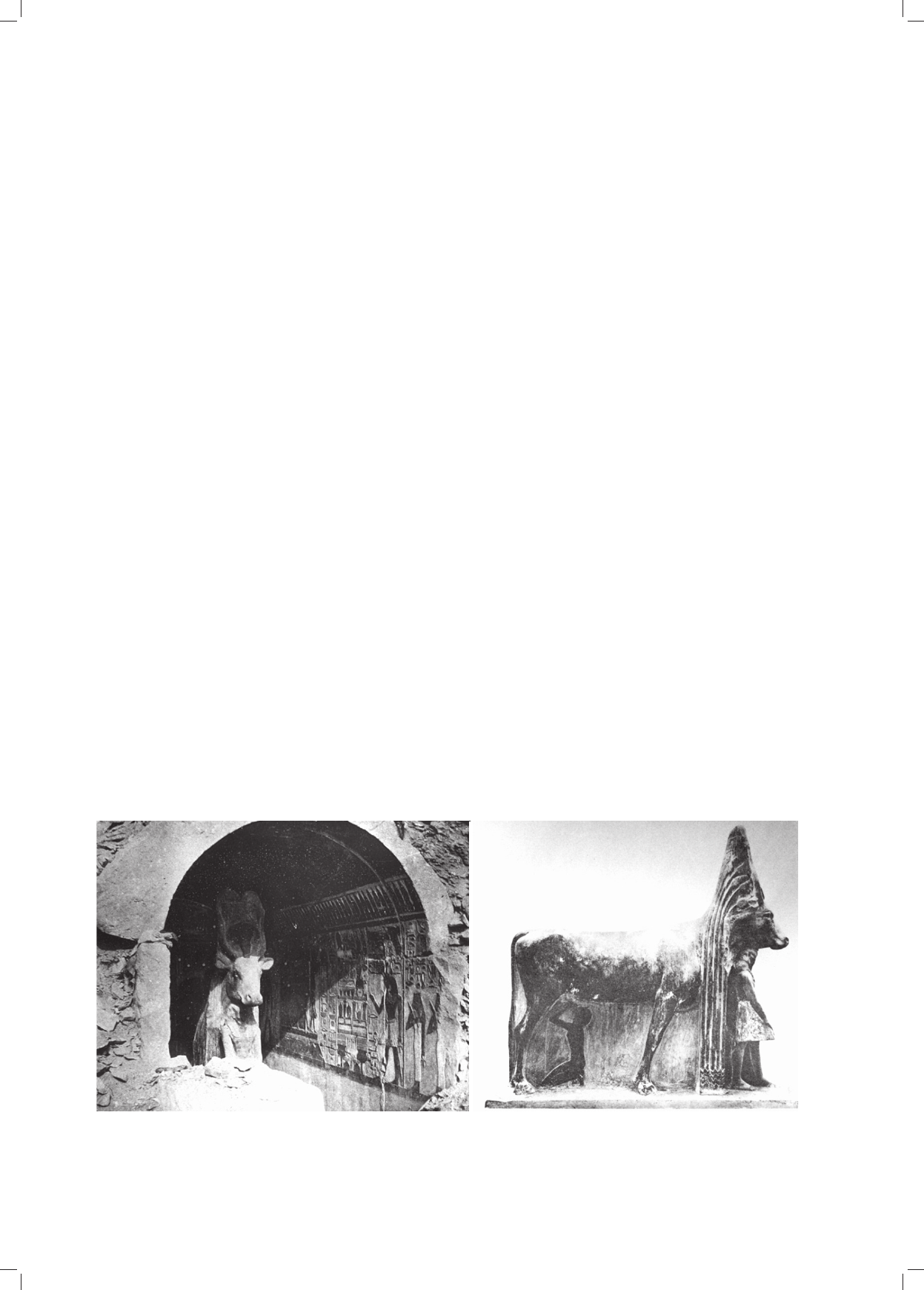
(il. 1). Po mieszczenie to przetrwało zawalenie się
świątyni Totme sa III najprawdopodobniej dlatego, że jako
jedyne zostało wykute w skale. Cała reszta kaplicy znaj -
dowała się w ma sywie fundamentu pod górny taras świą-
tyni Totme sa III i najpewniej dlatego w momencie kata-
strofy uległa niemal całkowitemu zniszczeniu. Wąskie
i skryte w skale pomieszczenie sanktuarium przetrwało
la wi nę zawalającej się świątyni, a gruba warstwa skał i gru-
zu
skutecznie skryła ocalałe w ten sposób wnętrze. Po -
nieważ łupkowa skała, w której wykuto sanktuarium, nie
była dobrym pod łożem pod wykonanie dekoracji, jego
ściany wyłożono dodatkowo płytami piaskowcowymi, na
których do pie ro wykonano relief. Dekoracje ścian tego
po miesz cze nia przedstawiają Totmesa III adorujące -
go Amo na oraz Hathor, co jednoznacznie determinuje
oso bę fundatora ka plicy oraz jej przeznaczenie. Oprócz
zachowanego ory gi nalnego wyposażenia sanktuarium
skry wa ło posąg bo gi ni Hathor pod postacią krowy na tu-
ral nych rozmia rów wraz z faraonem w wieku chłopię cym
[2]. Po nieważ przy wize runku króla znaleziono kar tu-
sze z imie niem Amen hotepa II, syna Totmesa III, istnie -
je przypuszczenie, że prace wykończeniowe w kaplicy,
w tym wstawienie posągu bogini, mógł wykonać właśnie
Amenhotep II. Po dokonanym odkryciu, ze względu na
jego wyjątkową war tość i na wysoki stopień zachowania
tej części kaplicy, zdecydowano się na przeniesienie całe-
contours of the rooms and door jambs, which at the same
time were the foundation of the walls. When clearing the
further west part, the explorers found a sandstone, appar-
ent barrel vault which proved to be the vault of the sanctu-
ary, the most important room in the Hathor Shrine [2].
Unlike the rest of the structure, the sanctuary, which was
discovered during the excavation works, was practically
intact. The only element which suffered some damage
was the east wall of that room with the entrance opening
on the ground floor (Fig. 1). That room survived the col-
lapse of the temple of Tuthmosis III most probably
because it is the only room carved in the rock. The rest of
the shrine was within the foundation under the upper ter-
race of the temple of Tuthmosis III and most probably this
is why at the moment of the disaster it was almost totally
destroyed. The narrow sanctuary hidden in the rock sur-
vived the avalanche of the crushed temple and the thick
layer of rock and debris effectively secured the space of
the room. As the sanctuary was carved in shale rock, it did
not provide a good substrate for decorations and its walls
were additionally cladded with sandstone slabs with
reliefs on them. The decorations of the walls in this room
depict Tuthmosis III adoring Amun and Hathor, which
unequivo cally determines the founder of the shrine and its
dedication. Apart from the preserved, original equipment,
the sanctuary housed a statute of the goddess Hathor in
the form of a life-size cow with the pharaoh as a boy [2].
As cartouches with the name of Amenhotep II, son of
Tuth mosis III, were found by the depiction of the king, it
can be assumed that the finishing works in the shrine,
including the placement of the statue of the goddess,
could have been indeed conducted by Amenhotep II.
After the discovery, due to the exceptional value and high
degree of preservation of that part of the shrine, a decision
was made to move the whole sanctuary to the Museum of
Cairo. At that time the area of Deir el-Bahari and Western
Thebes was frequently looted and devastated because it
Il. 1. Sanktuarium kaplicy Hathor Totmesa III oraz posąg bogini z królem, po lewej: in situ, fotografia z czasów odkrycia w Deir el-Bahari,
po prawej: posąg po wydobyciu z sanktuarium (fot. H.E. Naville [3])
Fig. 1. Sanctuary of the Hathor shrine of Tuthmosis III and statue of goddess with the king: left: sanctuary in situ, photo dating from the time
of the discovery in Deir-el-Bahari, right: statue after having been taking out from sanctuary (photo by H.E. Naville [3])

Kapitele hathoryckie świątyni Dżeser achet Totmesa III /Hathor capitals in the Djeser-akhet temple of Tuthmosis III 29
go sanktuarium do Muzeum Kairskiego. Niestrzeżony
wówczas obszar Deir el-Bahari i całych Teb Zachodnich
był miejscem licz nych rabunków i dewastacji. Tak cenne
znalezisko nie mog ło pozostać in situ na czas nieobecnoś-
ci eks pe dycji. Piaskowcowy, polichromowany i częścio-
wo kry ty złotem posąg bogini Hathor z królem został
wy eks po nowany w oryginalnym kontekście ścian okła-
dzinowych z reliefem. Całość można podziwiać dziś jako
stałą ekspozycję Muzeum Egipskiego w Kairze.
Do czasu, kiedy świątynia Dżeser achet pozostawała
nie odkryta, kaplicę Hathor traktowano jako aneks Tot me-
sa III do świątyni Mentuhotepa II [3]. W trakcie wy -
kopalisk Egypt Exploration Fund w obrębie świątyni
Men tuhotepa II, oprócz elementów pochodzących z tej
świątyni, znaleziono również bloki ze świątyni Totme -
sa III. Odkryto szesnastoboczne cylindry kolumn oraz
spo rych rozmiarów architrawy z kartuszami Totmesa III.
Zna lezione bloki pochodziły z sali hypostylowej na gór-
nym tarasie świątyni Dżeser achet, jednak zostały zin ter-
pre towane jako pozostałości kaplicy Hathor [2]. Od kryw cy
musieli zdawać sobie sprawę ze złożoności pro blematyki,
z jaką się zetknęli, odkrywając również za byt ki z czasów
ramessydzkich, dlatego cały materiał nie będą cy przed-
miotem badań nad świątynią Mentuhotepa II za bezpie-
czono do późniejszego opracowania. Wśród zde pono wa-
nych fragmentów znajdowały się również te po chodzące
z kapiteli hathoryckich.
Dla interpretacji i dalszych badań nad kaplicą Hathor
przełomowe znaczenie miało odkrycie świątyni Totme -
sa III przez prof. Kazimierza Michałowskiego w 1962 r.
W tamtym czasie prof. Michałowski był dyrektorem
Polskiej Stacji Archeologii Śródziemnomorskiej w Kairze
oraz nadzorował wiele prac wykopaliskowych, w tym
w Deir el-Bahari. W latach 1962–1967 przeprowadzone
(częś ciowo pod kierownictwem prof. Jadwigi Lipińskiej)
wy ko paliska odsłoniły pozostałe części świątyni. Wów-
czas stało się jasne, iż kaplica Hathor nie jest jedynie
aneksem Totmesa III do świątyni Mentuhotepa II, lecz
stanowi część programu funkcjonalnego nowo odkrytej,
osobnej świątyni. Cały zabezpieczony blisko 50 lat wcześ-
niej materiał został wreszcie zanalizowany i zinterpre-
towany w trakcie badań nad ikonografią i architekturą
świą tyni. Przewodniczyła im prof. Jadwiga Lipińs ka [4].
Ka pitele hathoryckie, z których pochodziły zachowane
frag menty, musiały znajdować się w sali hypostylowej,
zlo kalizowanej przez prof. Lipińską w przestrzeni pomię-
dzy końcem kolumnady świątyni Mentuhotepa II oraz
zachowanym wejściem do kaplicy Hathor. W miejscu
tym, po północnej stronie od wejścia do kaplicy, widocz-
ne jest mniej więcej metrowej szerokości wysunięcie
przed lico ściany, które prof. Lipińska odczytała jako
podstawę bazy pilastra. Wcześniejsze plany tego obszaru,
skupiające się głównie na przedstawieniu architektury
świątyni Mentuhotepa II, pomijają istnienie wielu śladów
związanych z architekturą młodszej kaplicy Hathor [5].
Dotyczy to również dwóch bloków fundamentowych
przy zakończeniu północnej kolumnady świątyni Men-
tuhotepa II od strony zachodniej. Bloki te leżą na liniach
narysów z czasów XVIII dynastii i zostały określone
przez prof. Lipińską jako fundamenty wschodniej ściany
was not protected. Such a valuable find could not be left
in situ when the expedition was not there. The sandstone
statue of the goddess Hathor with the king covered with
polychrome and partly with gold was exhibited in the
original context of walls covered with reliefs. Today, it
can be admired at the permanent exhibition at the Egy-
ptian Museum in Cairo.
Before Djeser-akhet temple was discovered the Hathor
Shrine had been considered to be an annex of Tuthmo-
sis III to the temple of Mentuhotep II [3]. During the
excavations by the Egypt Exploration Fund in the temple
of Men tuhotep II, apart from the elements from that
temple, the blocks from the temple of Tuthmosis III were
also found, including column drums with sixteen sides
and quite large architraves with cartouches of Tuthmo -
sis III. The blocks came from the hypostyle hall on the
upper terrace of Djeser-akhet temple, however, they were
identified as the remains from of the Hathor Shrine [2].
The excavators must have been aware of the complexity
of their discovery when they also found some monuments
from the Ramesside times and that is why all material
which was not subject of their study of the temple of
Mentuhotep II was secured for further research. The frag-
ments which were secured in cluded also those from the
Hathoric capitals.
The discovery of the temple of Tuthmosis III by Pro-
fessor Kazimierz Michałowski in 1962 was a real break-
through for the interpretation and further research on the
Hathor Shrine. At that time, Professor Michałowski was
director of the Polish Center of Mediterranean Archeology
in Cairo and he supervised many of excavation works,
including those conducted at Deir el-Bahari. The excava-
tions which were conducted in 1962–1967 (partly under
the direction of Professor Jadwiga Lipińska) uncovered
the remaining parts of the temple. It became clear then
that the Hathor Shrine is not just an annex of Tuthmosis III
to the temple of Mentuhotep II but it is part of the func-
tional program of the newly discovered, separate temple.
All material secured almost 50 years earlier was finally
analyzed and interpreted during the studies on iconogra-
phy and architecture of the temple which were directed by
Professor Jadwiga Lipińska [4]. The Hathoric capitals,
from which the original fragments came, must have been
in the hypostyle hall located by Professor Lipińska in the
space between the end of the colonnade of the temple of
Mentuhotep II and the original entrance to the Hathor
Shrine. In that place, on the north side of the entrance to
the shrine, there is a projection, about one meter wide,
beyond the face of the wall which Professor Lipińska
interpreted as a pilaster base. The earlier plans of that
area, focusing mainly on the architecture of the temple of
Mentuhotep II, ignore the existence of many elements
connected with the architecture of the younger Hathor
Shrine [5]. This also regards two foundation blocks at the
end of the north colonnade of the temple of Mentuho tep II
from the west side. Those blocks lie on the contour lines
from the times of the Eighteenth Dynasty and they were
considered by Professor Lipińska to be the foundation of
the east wall of the hypostyle hall of the Hathor Shrine.
The differences in the interpretation of the architecture
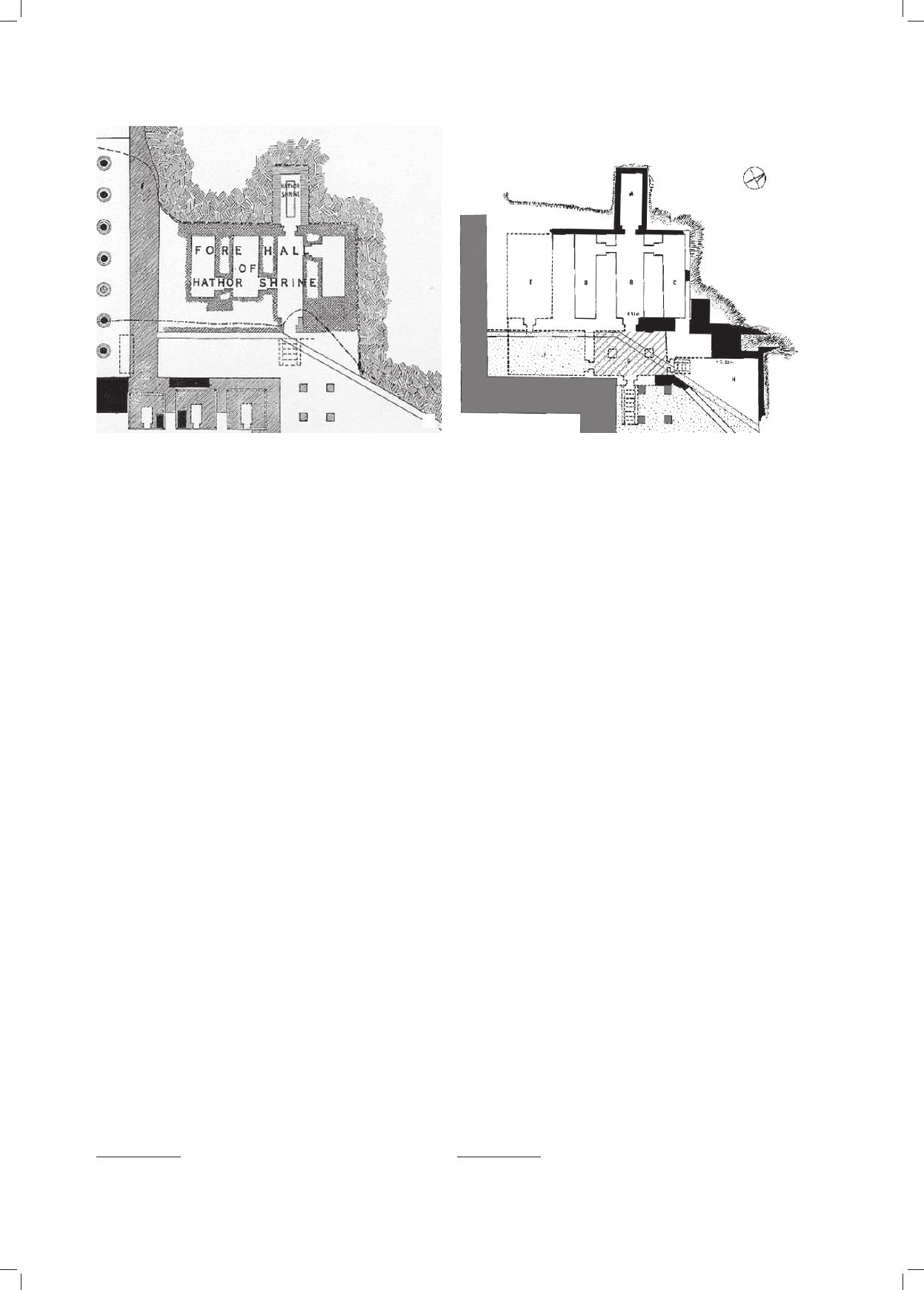
30 Mariusz Caban
sali hypostylowej kaplicy Hathor. Różnice w interpretacji
architektury tej części założenia przedstawiono na ilustra-
cji (il. 2). Od tamtej pory kaplica Hathor przestała być
postrzegana jako ostatnia faza przemian architektonicz-
nych świątyni Mentuhotepa II [6].
Zachowane części kapiteli hathoryckich z sali hyposty-
lowej kaplicy nigdy nie zostały zinwentaryzowane, a je -
dynie w części sfotografowane i opisane w publikacji
prof. Lipińskiej na temat świątyni [4]. W rozdziale po -
świę conym kaplicy prof. Lipińska przedstawiła swoje wnio-
ski z badań nad wyglądem kapiteli hathoryckich. Z usta leń
tych wynika, iż relacja proporcji kapiteli ze świątyni Tot-
mesa III do tych ze świątyni Hatszepsut [7] wynosi 1:1,4.
Zależność ta została wyznaczona na podstawie mierzal-
nych i możliwych do porównania ze sobą zachowanych
części kapitelu z obydwu kaplic. W trakcie działań obec-
nej Misji Totmesa III, które obejmują badania egiptolo-
giczne i architektoniczne oraz prace konserwatorskie,
pod jęto decyzję o dokładnym zadokumentowaniu wszyst-
kich fragmentów kapiteli i poddaniu ich wnikliwej ana-
lizie przy wykorzystaniu dzisiejszych technik multime-
dialnych. Do wykonania szczegółowej dokumentacji
wykorzystałem technikę fotoskanowania
2
, która umożli-
wia tworzenie wirtualnych, trójwymiarowych kopii obiek-
tów w oparciu o serię odpowiednio wykonanych foto -
grafii (il. 3). Po sporządzeniu dokumentacji mo żliwe było
ze stawienie wszystkich zeskanowanych w ten sposób frag -
men tów
we wspólnej skali i przestrzeni programu kom pu-
terowego. Aby dokonać rekonstrukcji kapitelu na podsta-
wie zgromadzonych kawałków, potrzebny był linearny
schemat podstawowych proporcji kapitelu. W tym celu
po służyłem się analogią do proporcji kapiteli hathoryc-
2
Przy dokumentacji fragmentów kapiteli wykorzystano program
PhotoScan firmy Agisoft.
of that part of the whole structure are presented in Fi -
gure 2. The Hathor Shrine was no longer considered to be
the last stage of architectural changes of the temple of
Men tuhotep II [6].
The original parts of the Hathoric capitals from the
hypostyle hall of the shrine were never surveyed – they
were only photographed and described in the publica-
tion by Professor Lipińska on the temple [4]. In the chap-
ter on the shrine, Professor Lipińska presented her con-
clusions from the studies of the appearance of the Ha -
thoric capitals. They demonstrate that the relation between
the proportion of the capitals from the temple of Tuthmo-
sis III and those from the temple of Hatshepsut [7] is
1:1.4. That relation was calculated on the basis of the
original fragments of the capitals in both shrines which
can be measured and compared with one another. During
the operations of the current Mission of Tuthmosis III
which include Egyptological and architectural studies as
well as conservation works, it was decided to thoroughly
document all fragments of the capitals and carefully ana-
lyze them with the use of modern multimedia techniques.
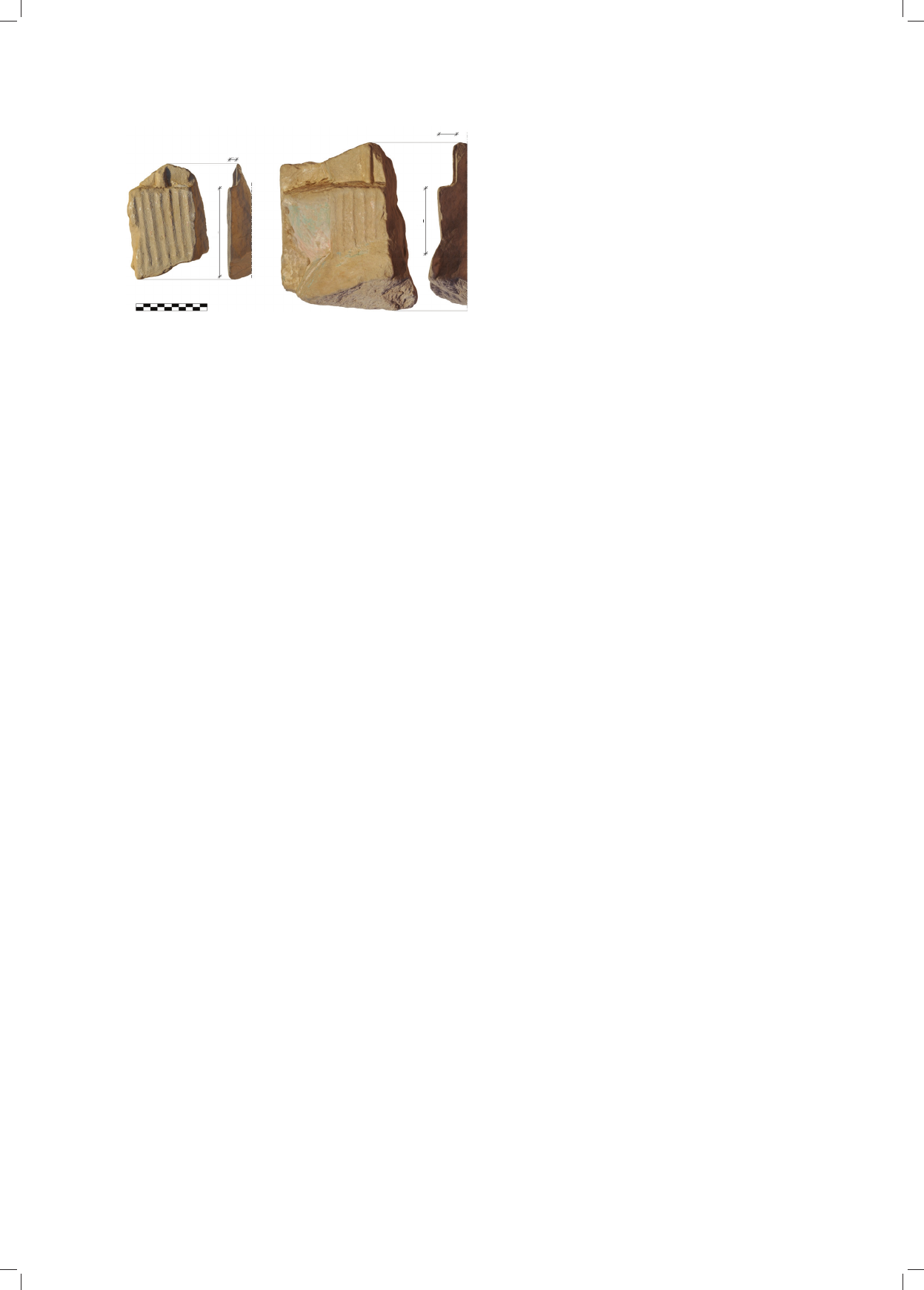
I developed detailed documentation with the use of tech-
nique of photoscanning
2
which enabled me to make vir-
tual, three-dimensional copies of the structures on the
ba sis of a series of special photographs (Fig. 3). After the
documentation was made, it was possible to put together
all scanned fragments in the same scale and space with
the use of special software. A linear setup of the basic
proportions of the capital was needed to reconstruct the
capital on the basis of collected pieces. For this purpose
I applied the analogy to the proportions of the Hathoric
capitals from the temple of Hatshepsut. The width of the
2
PhotoScan by Agisoft was used to develop the documentation of
the fragments of the capitals.
Il. 2. Plan kaplicy Hathor według: a) E. Naville’a oraz H.R. Halla z planu świątyni Mentuhotepa II. Kaplica bez sali hipostylowej [5];
b) prof. Jadwigi Lipińskiej [4]. Zakreskowano salę hypostylową z pilastrami i kolumnami (podrys autora)
Fig. 2. Plan of the Hathor shrine by: a) E. Naville and H.R. Hall from their plan of Mentuhotep II temple. Shrine without hypostyle hall [5];
b) Prof. Jadwiga Lipińska [4]. Crosshatched hypostyle hall with pilasters and columns (highlighted by author)
a
b
Kapitele hathoryckie świątyni Dżeser achet Totmesa III /Hathor capitals in the Djeser-akhet temple of Tuthmosis III 31
kich ze świątyni Hatszepsut. Za szerokość rekonstruo wa-
nego pilastra przyjąłem 60 cm, według ustaleń prof. Li -
pińskiej. Następnym krokiem w rekonstrukcji była mo -
dyfikacja stworzonego w ten sposób schematu, po przez
umiesz czanie w nim zachowanych fragmentów. Do pro-
wadziło to do powstania swoistej, wirtualnej anastylo zy.
Dla jak najlepszego uchwycenia proporcji kapitelu nie które
elementy umieściłem w odbiciu lustrzanym (il. 4).
Prof.
Lipińska uważała, że ze względu na skromność za chowa-
nego materiału zrekonstruowanie kapitelu jest nie moż-
liwe, jednak dzięki dzisiejszym możliwoś ciom mul time-
dialnym udało się odtworzyć jego bardzo prawdopodobne
proporcje. Wbrew przypuszczeniom prof. Li pińskiej o ist-
nieniu podwójnego ureusza (analo gicz nie do sąsiedniej
świątyni Hatszepsut) dzięki rekonstrukcji udało się udo-
wodnić, iż naos kapitelu zawierał pojedynczy ureusz. Wy -
nika to z wymiarów zachowanych części kapliczki nao su
i z dobrze zachowanego samego ureusza. Jeśli chodzi
o długość peruki bogini, nie udało się definitywnie ok -
reślić miejsca jej zakończenia, gdyż nie zachował się
żaden fragment, który jednoznacznie określałby to miejs-
ce. Starając się jednak połączyć zachowane części peruki
jedną krzywą, ustalono prawdopodobne miejsce zakoń-
czenia formy kapitelu. Niższe części porządku sali hypo-
stylowej jawią się wyłącznie w jedynym zachowanym
fragmencie trzonu pilastra oraz w narysach i pozostało-
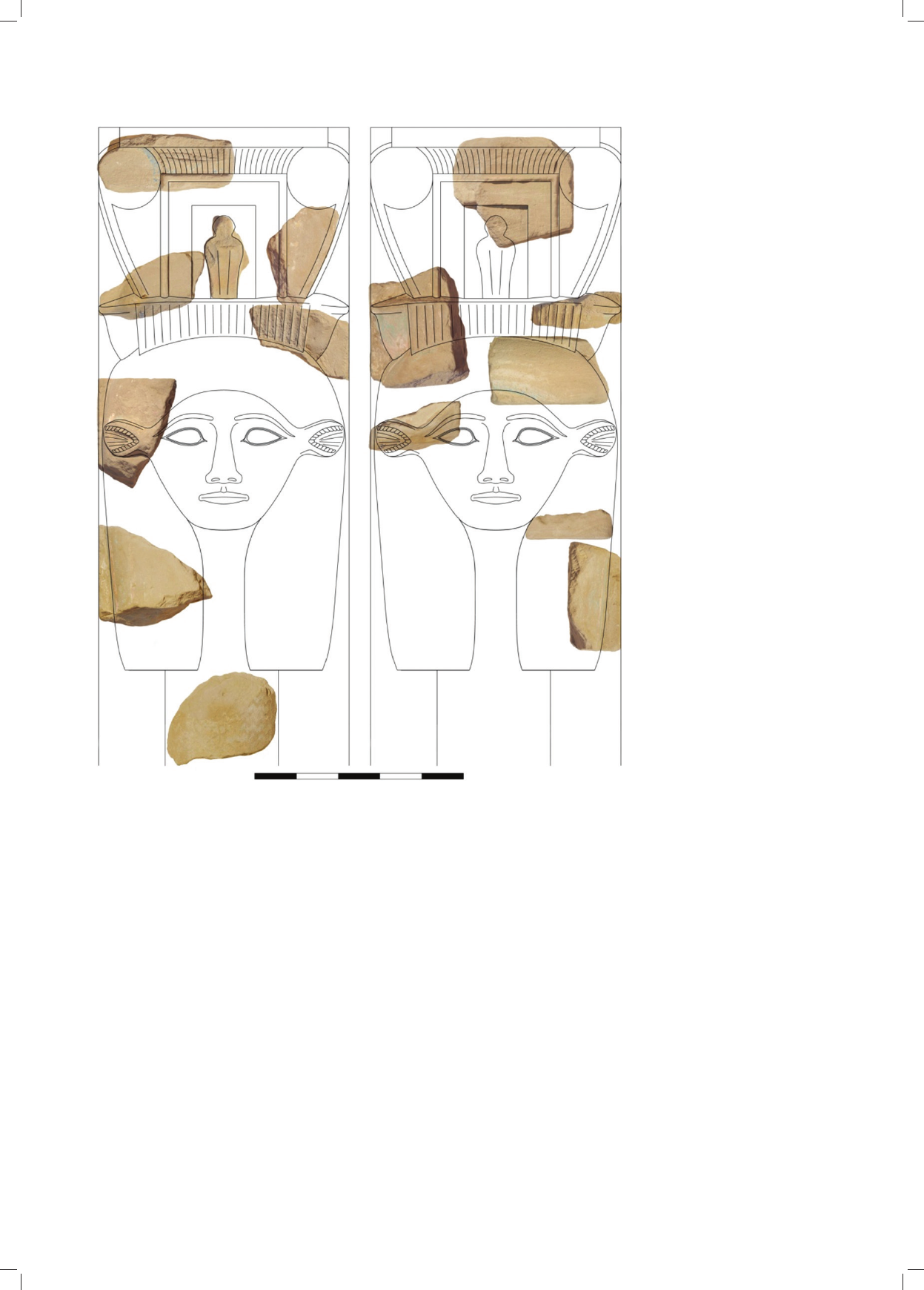
ściach bazy. Potwierdził się natomiast fakt istnienia co
najmniej dwóch pilastrów (il. 5). Na ilustracji 5 można
zauważyć, że niemal wszystkie elementy mają swoje
miejsce i mogą występować tylko w sąsiedztwie innych,
konkretnych fragmentów. W trakcie badań prof. Lipiń -
r
econstructed pilaster was assumed to be 60 cm which
was calculated by Professor Lipińska. In the next stage
of the reconstruction, I modified the setup developed in
this way by placing the preserved fragments in it. This
re sulted in a special, virtual anastylosis. I placed some
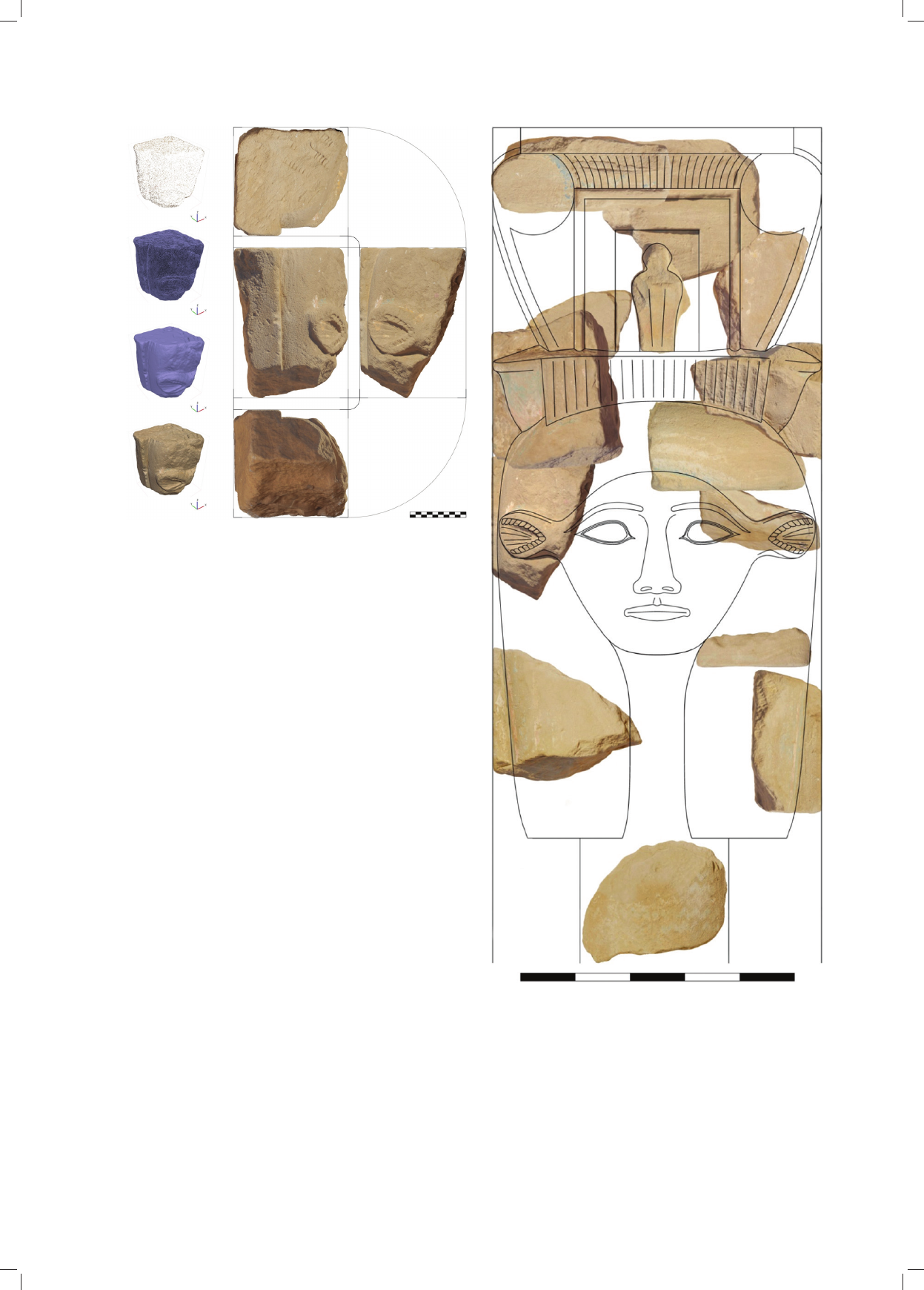
Il. 3. Dokumentacja fragmentu nr H1/13
w technice fotoskanowania
Fig. 3. Documentation of fragment No. H1/13
in photoscaning technique
Il. 4. Rekonstrukcja kapitelu hathoryckiego pilastra
na podstawie wszystkich zachowanych fragmentów
Fig. 4. Reconstruction of the Hathor capital from the pilaster
based on all preserved pieces
32 Mariusz Caban
skiej wyodrębniono trzy fragmenty interpretowane jako
lewostronne krawędzie podstawy naosu [5], co także za -
ob serwowano w trakcie inwentaryzacji. Potwierdzono
rów nież, iż jeden z tych fragmentów istotnie różni się
w proporcjach w stosunku do pozostałych dwóch. Różni-
ce te dotyczą konkretnie wysokości i kąta nachylenia
podstawy naosu, spoczywającej bezpośrednio na peruce
bogini, co przedstawiono na rysunku (il. 6). Na ilustracji
łatwo zauważyć, że znajdujący się po lewej stronie frag-
ment nie pasuje do tego z prawej, ma znacznie wyższą
i spłaszczoną podstawę naosu. Wyniki przeprowadzonej
analizy róż niących się fragmentów pokrywają się z wnio-
skami prof. Lipińskiej na ten temat. Występowanie przed-
stawionych różnic można wytłumaczyć na dwa sposoby.
W sali hypostylowej mogła znajdować się jeszcze jedna
para pilastrów, po przeciwnej stronie, na ścianie wschod-
niej lub dodatkowo na ścianach: północnej i południowej.
Różniący się fragment byłby wówczas przykładem na
nieregularność wykonania tego samego elementu w obrę-
bie jednego pomieszczenia. Ostatecznie fragment ten
of the elements as if reflected in the mirror to get the
best possible proportions of the capital (Fig. 4). In the
opinion of Professor Lipińska it was impossible to recon-
struct the capital because of too few original pieces, how-
ever, with the use of modern multimedia techniques it was
possible to reconstruct its most probable proportions.
Contrary to the assumptions made by Professor Lipińska
that the naos of the capital had a double ureaus (just like
in the nearby temple of Hatshepsut), it was possible to
prove with the use of the reconstruction that it had a sin-
gle ureaus. This results from the dimensions of the origi-
nal parts of the shrine, the naos and the well preserved
ureaus itself. As regards the length of the goddess wig, it
was not possible to definitively determine the place where
it ended as there is no one original fragment which would
unequivocally indicate that place. However, with an effort
to connect the preserved pieces of the wig with one line,
the probable place where the form of the capital ended
was determined. The lower parts of the order in the hypo-
style hall are visible only in the only original fragment
Il. 5. Zestawienie wszystkich
elementów, wykazujące istnienie
co najmniej dwóch pilastrów
Fig. 5. Setup of all preserved
fragments showing the possibility
of existence of at least
two pilasters
Kapitele hathoryckie świątyni Dżeser achet Totmesa III /Hathor capitals in the Djeser-akhet temple of Tuthmosis III 33
może pochodzić z kapitelu kolumny, a nie pilastra, co
czyniłoby go jedynym dowodem na istnienie kolumn
w sali hypostylowej. W przeciwieństwie do kaplicy Ha -
thor świątyni Hatszepsut [8], gdzie nie brakowało miejsca
na wiele rzędów kolumn, w kaplicy Hathor Totmesa III
mogły stać co najwyżej dwie kolumny. Według prof.
Lipińskiej to właśnie niewielkie rozmiary sali hypostylo-
wej mogły być powodem pojawienia się większej liczby
pilastrów, które imitowałyby dodatkowe rzędy kolumn.
Ze względu jednak na niewielką ilość zachowanego
materiału, kwestia ta pozostanie bez jednoznacznej odpo-
wiedzi.
Il. 6. Porównanie dwóch fragmentów z podstawy naosu
o znacznych różnicach w proporcji.
Po stronie lewej element niepasujący do reszty tego typu,
reprezentowanych przez element po prawej
Fig. 6. Comparison of two fragments from the base of naos
with significant disproportion.
The piece on the left does not fit the rest of this type
represented by the element on the right
of the shaft of the pilaster and in the contour lines as well
as in the remains of the base. The existence of at least two
pilasters was confirmed (Fig. 5). Figure 5 shows that
almost all elements have their specific places and they
fit only other specific fragments. During the studies con-
ducted by Professor Lipińska, three fragments were inter-
preted as the left-side edges of the naos base [5], which
was also observed during the survey. It was also con-
firmed that one of those fragments materially differs
in proportions from the other two. These differences re -
gard specific heights and the angle of inclination of the
naos base placed directly on the goddess wig, which is
presented in Figure 6. It is clearly seen that the fragment
on the left does not fit the one on the right; it has a much
taller and flatter naos base. The results of the conducted
analysis of different fragments are consis tent with Pro-
fessor Lipińska’s conclusions in that respect. Those dif-
ferences can be explained in two ways. In the hypostyle
hall there might have been one more pair of pilasters on
the opposite side, on the east wall or additionally on the
north and south walls. T he fragment which is different is
then an example of the irregularity of the same element in
one room. This fragment might also come from the capital
of a column and not a pilaster, which would make it the
only evidence of the existence of columns in the hypo-
style hall.
Unlike the Hathor Shrine at the temple of
Hatshepsut [8], where there is enough room for many
rows of columns, the Hathor Shrine at the temple of Tuth-
mosis III could have two columns at the most. Accor ding
to Professor Lipińska it is because of the small size of the
hypostyle hall that there might have been more pilasters
which would imitate additional rows of columns.
However, due to the small amount of preserved mate rial,
there is still no definitive explanation to this question.
Translated by
Tadeusz Szałamacha
Bibliografia /References
[1] Naville E., Hall H.R., Archaeological report 1904–1905, Egypt
Exploration Fund, London 1905.
[2] Naville E., Hall H.R., Archaeological report 1905–1906, Egypt
Exploration Fund, London 1906.
[3] Naville E., The XI
th
Dynasty Temple Deir el-Bahari, part 1, chap. 6:
The Hathor shrine, Egypt Exploration Fund, London 1907.
[4] Lipińska J., Deir el-Bahari, t. 2: The Temple of Tuthmosis III. Archi-
tecture, PWN, Warszawa 1977.
[5] Naville E., Hall H.R., Archaeological report 1906–1907, Egypt
Exploration Fund, London 1907.
[6] Arnold D., The Temple of Mentuhotep at Deir el- Bahari, The Met-
ropolitan Museum of Art, New York 1979.
[7] Naville E., The shrine of Hathor and the southern hall of offerings,
Egypt Exploration Fund, London 1901.
[8] Karkowski J., Polish archaeology in the mediterranean IV Reports
1992, The Hatshepsut temple at Deir El-Bahari, season 1992, Cen-
trum Archeologii Śródziemnomorskiej, Warszawa 1993.
Streszczenie
Artykuł poświęcony jest kapitelom hathoryckim pochodzącym z kaplicy Hathor świątyni Dżeser achet wzniesionej przez Totmesa III w Deir
el-Bahari. Fragmenty kapiteli hathoryckich zostały odkryte przez E. Naville’a oraz H.R. Halla w obrębie świątyni Mentuhotepa II w latach
1903–1907 w trakcie amerykańskiej ekspedycji Egypt Exploration Fund. Właściwa interpretacja odnalezionych fragmentów kapiteli była możliwa
dopiero po odkryciu świątyni Totmesa III przez prof. Kazimierza Michałowskiego w 1962 r. oraz po wykopaliskach w latach 1962–1967 pod
częściowym kierownictwem prof. Jadwigi Lipińskiej. Trwająca obecnie misja Totmesa III pod kierownictwem dr Moniki Dolińskiej swoim
zakresem obejmuje badania egiptologiczne, architektoniczne oraz prace konserwatorskie. Ponieważ zachowane fragmenty kapiteli hathoryc -
kich nigdy nie zostały zinwentaryzowane, w trakcie prac podjęto decyzję o przeprowadzeniu ich szczegółowej dokumentacji. Do tego celu
a
a
b
b

34 Mariusz Caban
wykorzystano technikę fotoskanowania, która pozwala na tworzenie wirtualnych, trójwymiarowych kopii obiektów w oparciu o serię odpowiednio
wykonanych fotografii. Pozwoliło to na stworzenie swoistej, wirtualnej anastylozy. W rekonstrukcji wykorzystano dotychczasowe ustalenia
prof. Lipińskiej na temat proporcji kapitelu. Stworzona rekonstrukcja przedstawia bardzo prawdopodobne proporcje kapiteli hathoryckich z kaplicy.
W trakcie przeprowadzonej dokumentacji potwierdzono i w niniejszym artykule zobrazowano pewne fakty na temat architektury kaplicy, które przez
prof. Lipińską są jedynie opisane w publikacji na temat świątyni Totmesa III.
Słowa kluczowe: kapitel hathorycki, architektura Nowego Państwa starożytnego Egiptu, Deir el-Bahari, Totmes III
Abstract
The article is about Hathor capitals from the Hathor shrine in the temple Djeser-akhet of Tuthmosis III at Deir el-Bahari. Fragments of Hathor
capitals were discovered by E. Naville and H.R. Hall during excavations at the temple of Mentuhotep II in the years 1903 to 1907 by the American
expedition Egypt Exploration Fund. The correct interpretation of the found fragments of capitals was possible only after the discovery of the temple
of Tuthmosis III by professor Kazimierz Michałowski in 1962 and after later excavations in 1962–1967 under the partial supervision of professor
Jadwiga Lipińska. Scope of the present mission of Tuthmosis III, under the direction of Monika Dolińska, Ph.D., covers Egyptological and archi-
tectural studies with conservation work. Preserved fragments of Hathor capitals have never been inventoried, during work it was decided to create
detailed documentation of the preserved fragments of Hathor capitals by using photoscaning technique. It allows creating virtual, three-dimensional
copies of objects based on a series of photos. Thanks to that, a kind of virtual anastylosis was created. In the reconstruction findings of professor
Lipińska about the proportion of the capitol were used. The developed reconstruction shows very probable proportions of Hathor capitals from the
chapel. Results of created documentation confirmed some facts about the architecture of the shrine, which prof. Lipińska mentioned in her publica-
tions about the temple of Tuthmosis III. This article has illustrated some facts examplified by the prepared documentation.
Key words: Hathor capital, New Kingdom architecture in Ancient Egypt, Deir el-Bahari, Tuthmosis III