2015
2(42)
DOI: 10.5277/arc150202
Agnieszka Tomaszewicz*
Carl Lüdecke i wrocławskie budownictwo mieszkaniowe
Carl Lüdecke and dwelling-houses in Wrocław
Carl Lüdecke
1
należał do grona najważniejszych archi-
tektów XIX-wiecznego Wrocławia, uważano nawet, że
[...] stworzył we Wrocławiu budowle takiej klasy i w takiej
liczbie, że jego imię ma na zawsze zapewnione jedno z naj-
bardziej honorowych miejsc w historii architektury mia-
sta
2
[2, s. 7]. Wśród najbardziej znanych wrocławskich
dzieł artysty wymienia się zwykle: gmach Nowej Giełdy
[3], frontową część Dworca Świebodzkiego [4], budynki
w ogrodzie zoologicznym [5], a także koncepcję odbudo-
wy Teatru Miejskiego po pożarze z 1865 r. [6] oraz projek-
ty rewaloryzacji staromiejskiego ratusza i kated ry św. Jana
Chrzciciela. Tymczasem Lüdecke zaprojekto wał też kilka
miejskich domów mieszkalnych, wzniesionych zarówno w za -
b
udowie zwartej, jak i otwartej. Projekty wspomnia nych
domów powstały głównie w latach 50. i 60. XIX w., a więc
w pierwszym okresie wrocławskiej twórczości artysty.
Najwcześniejszą koncepcję kamienicy Lüdecke opra-
cował w 1858 r. na zlecenie kupca Nathana Arona. Dom
* Wydział Architektury Politechniki Wrocławskiej/Faculty of
Architecture, Wrocław University of Technology.
1
W 1976 r. Profesor Janusz Dobesz obronił pracę doktorską zaty-
tułowaną: Nurty architektury 2. połowy XIX wieku w twórczości Karola
Lü deckego [1], która zawierała eseje dotyczące życia architekta i wybra-
nych aspektów jego działalności zawodowej. Szczegółowo zostały wów-
czas omówione budowle sakralne, użyteczności publicznej, wiejskie
rezydencje oraz pomniki zaprojektowane przez Lüdeckego. Niniejszy
artykuł stanowi próbę przedstawienia niewielkiej grupy w większości
nieopisanych dotąd wrocławskich dzieł architekta, a mianowicie domów
mieszkalnych. Dodatkowy impuls do napisania tego tekstu stano wiło
od nalezienie przedruków wykładów Lüdeckego, w których ar tys ta przed-
stawił
swoje stanowisko m.in. w kwestii stylów w architekturze.
2
Er hat hier in Breslau Bauwerke solcher Art und in solcher Zahl
geschaffen, dass seinem Namen für alle Zeit einer der ehrenvollsten
Plätze in der Baugeschichte der Stadt gesichert ist [2, s. 7].
Carl Lüdecke
1
was one of the most important archi-
tects of the 19
th
-century Wrocław, he was even consi-
dered to [...] have created in Wrocław structures of
such a class and in such a number that his name would
always be remembered as one of the most remarkable
names in the architectural history of the city
2
[2, p. 7].
The most renowned Wrocław works of the artist are the
following: Nowa Giełda (New Stock Exchange) Edi fi ce
[3], the front part of Świebodzki Railway Station [4],
buildings in the zoological garden [5], a concept of the
City Theatre restoration after the 1865 fi re [6] as well
as restoration projects of the Old Town Hall and John
the Baptist Cathedral. Meanwhile Lüdecke also designed
several urban residential houses which were built both in
compact and open developments. Designs of the above
mentioned houses were mainly carried out in the 50
s
and
60
s
of the 19
th
century, i.e. in the fi rst period of the ar-
tist’s Wrocław artistic creativity.
1
In 1976 Professor Janusz Dobesz defended his doctoral thesis
entitled:
Nurty architektury 2. połowy XIX wieku w twórczości Karola
Lüdeckego (Trends in architecture of the second half of the 19
th
century
in Carl Lüdecke’s works) [1], which contained essays on the life of the
architect and certain chosen aspects of his professional activity. Sacral
structures, public buildings, country residences and monuments designed
by Lüdecke were discussed there in a detailed way. This article is an
attempt at presenting a small group of mostly previously non-discussed
Wrocław works of the architect, namely residential houses. An addi-
tional stimulus to write this text was a retrieval of Lüdecke’s lecture
reprints, in which the artist presented his attitude, inter alia, towards
styles in architecture.
2
Er hat hier in Breslau Bauwerke solcher Art und in solcher Zahl
geschaffen, dass seinem Namen für alle Zeit einer der ehrenvollsten
Plätze in der Baugeschichte der Stadt gesichert ist [2, p. 7].
8 Agnieszka Tomaszewicz
miał zostać wzniesiony przy ul. Kazimierza Wielkiego 31
(Carlstr. 31) na miejscu wcześniejszej budowli zajmującej
wąską działkę w zwartym ciągu zabudowy. Lüdecke za-
projektował trzyosiową, czterokondygnacyjną kamienicę
wypełniającą niemal całą niewielką posesję; jednak nie
tylko kształt działki, ale również potrzeby inwestora zde-
terminowały sposób rozwiązania rzutu budynku – w piwni-
cach architekt umieścił magazyny towarów sprzedawanych
w sklepie urządzonym na parterze domu, trzy wyższe kon-
dygnacje zajmowały mieszkania do wynajęcia. Koncepcja
domu nie została zatwierdzona przez urzędników Poli cji
Budowlanej, Lüdecke musiał obniżyć budynek o jedną
kondygnację
3
, w nowym projekcie architekt utrzymał jed-
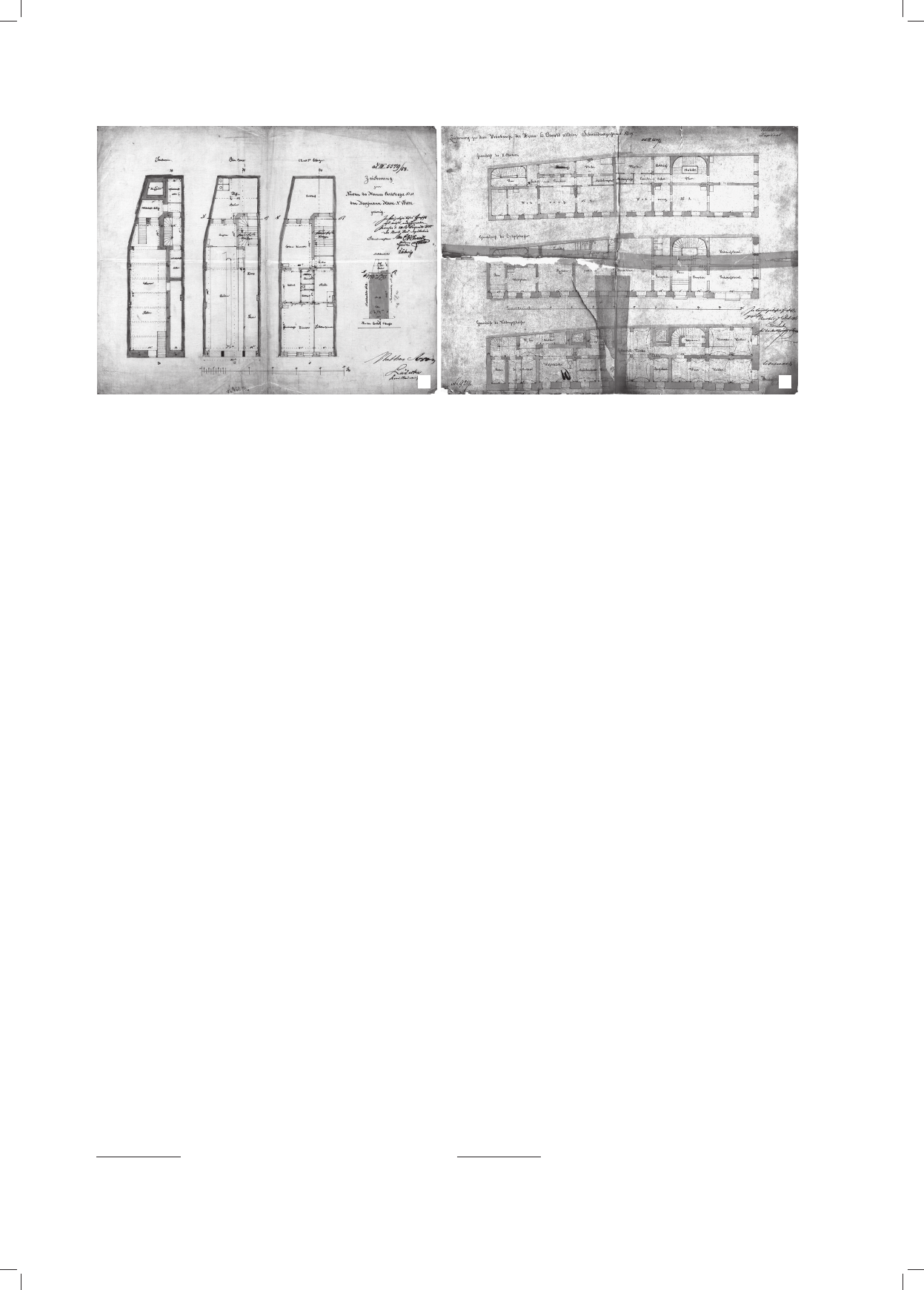
nak zaplanowaną wcześniej dyspozycję wnętrz (il. 1a).
Dwa lata później, w 1861 r. Eduard Ostwald powierzył
Lüdeckemu przygotowanie koncepcji zabudowy trud-
nej, bardzo wąskiej i głębokiej działki położonej u zbie-
gu ul. Świdnickiej (Schweidnitzerstr.) i Franciszkańskiej
(An der Dorotheenkirche), tuż przy kościele św. Doroty.
Ostwald – kupiec handlujący winem – planował urządzić
w kamienicy restaurację, sklepy, mieszkanie własne i lo-
kale do wynajęcia. Lüdecke zaproponował podział budyn-
ku na dwie części obsługiwane dwiema klatkami schodo-
wymi, które zostały umieszczone w ciemnym trakcie przy
ścianie szczytowej sąsiedniej kamienicy (il. 1b). Na parte-
rze, w głębi działki, wzdłuż ul. Franciszkańskiej architekt
urządził pomieszczenia restauracyjne, oddzielone biurami
od lokali handlowych usytuowanych od strony ul. Świd-
nickiej. W piwnicy zaprojektowano kuchnię i inne po-
mieszczenia pomocnicze restauracji, a także pralnię, służ-
bówki i niewielkie składy należące do sklepu i mieszkań
dochodowych usytuowanych na drugim i trzecim piętrze
budynku. Każde mieszkanie składało się z amfi lady czte-
rech lub pięciu pokoi poprowadzonych wzdłuż ulic oraz
3
W okresie powojennym kamienicę rozbudowano w partii dachu,
w 2014 r. przeszła gruntowny remont.
The earliest tenement house concept was developed
by Lüdecke in 1858 commissioned by Nathan Aron who
was a merchant. The house was to be constructed at 31
Ka zimierza Wielkiego Street (Carlstr. 31) on the site of
the previous building occupying a narrow plot of land in
the form of a compact deve lopment. Lüdecke designed
a three-axis, four-storey te nement house which occupied
almost the entire small property; however, not only did the
shape of the plot determine the way of solving the build-
ing plan but also the needs of the investor – in the base-
ment the architect placed warehouses of goods sold in the
shop which was arranged on the ground fl oor of the house,
whereas three upper fl oors were occupied by fl ats for rent.
The house concept was not accepted by the offi cials of the
Construction Police and Lüdecke had to lower the build-
ing by one storey
3
, however, in the new design the archi-
tect kept a pre-planned interior disposition (Fig. 1a).
Two years later in 1861 Eduard Ostwald entrusted Lü-
decke with the task of preparing a concept of developing
a diffi cult, very narrow and deep plot of land located at
the junction of Świdnicka Street (Schweidnitzerstr.) and
Franciszkańska Street (An der Dorotheenkirche) just next
to the St. Dorothy Church. Ostwald – a merchant selling
wine – planned to arrange a restaurant, shops, his own
apartment and fl ats for rent in this tenement house. Lü-
decke proposed the division of the building into two parts
supported by two staircases which were placed in the
dark part near the gable wall of the neighbouring tene-
ment house (Fig. 1b). On the ground fl oor, in the deep
part of the plot along Franciszkańska Street the architect
arranged restaurant rooms separated from commercial
rooms located on the side of Świdnicka Street by means
of offi ces. The kitchen and other restaurant facilities were
designed in the basement as well as a laundry, a maid’s
3
In the postwar period the tenement house was extended in the
roof part and in 2014 it underwent thorough restoration.
Il. 1. Carl Lüdecke, rysunki rzutów kamienic wzniesionych przy:
a) ul. Kazimierza Wielkiego 31 (MA/ABmW., t. 2167), b) ul. Świdnickiej (d. Schweidnitzerstr. 19, MA/ABmW., t. 4031)
Fig. 1. Carl Lüdecke, projection drawings of tenement houses built at:
a) 31 Kazimierza Wielkiego Street (MA/ABmW., t. 2167), b) Świdnicka Street (Schweidnitzerstr. 19, MA/ABmW., t. 4031)
a
b

Carl Lüdecke i wrocławskie budownictwo mieszkaniowe /Carl Lüdecke and dwelling-houses in Wrocław 9
kuchni i służbówki wyodrębnionej z szerokości korytarza.
Zarówno korytarze, jak i kuchnie umieszczone w trakcie
tylnym budynku zostały oświetlone niewielkimi dziedziń-
cami doświetlającymi. Pierwsze piętro kamienicy zajmo-
wało mieszkanie właściciela, jedynie dwa pomieszczenia
wzdłuż ul. Świdnickiej, połączone z pokojem od strony
ul. Franciszkańskiej, przeznaczono na cele handlowe
4
.
W 1870 r. po przeciwnej stronie ul. Świdnickiej Lü-
de cke zaprojektował dla Juliusa Neugebauera budynek
han dlowo-mieszkaniowy, w którym zastosował schemat
rzu tu poziomego najczęściej spotykany w kamienicach
sy tuowa nych na wąskich i głębokich działkach Starego
Mia sta. W ciemnym trakcie środkowym budynku archi-
tekt usy tuo wał oświetloną od góry klatkę schodową oraz
„gabinet” i ze spół pomieszczeń pomocniczych – dzięki
temu jas ne trakty zewnętrzne mogły zająć pokoje miesz-
kalne (od strony ulicy) i sypialnie (od strony podwórza).
Do dat ko we po ko je sypialne oraz kuchnię umieszczono
w głębi, w skrzyd łach otaczających wewnętrzne podwór-
ko. Tak jak w więk
szoś ci kamienic o funkcji mieszanej
(handlowo-mieszkanio wej) parter i trakt frontowy pierw-
szego piętra zajęły lokale han dlowe i biurowe, a pozo-
stałą powierzchnię pierwszego piętra oraz dwie kolejne
kondyg nacje – mieszkania
5
.
W większości projektów budynków mieszkalnych Lü -
decke próbował dostosować układ wnętrz do ksztatu dział -
ki i potrzeb inwestora, tymczasem w kamienicy op ra co -
wa nej w 1863 r. dla Heinricha Karutha architekt za sto so wał
typowy, „berliński” szablon rzutu, który pozwa lał
maksy-
malnie wykorzystać powierzchnię posesji. Nieistniejący
dziś dom wzniesiony przy ul. Legnickiej (Berlinerstr. 5)
został złożony z budynku frontowego połączonego z dwo-
ma skrzydłami bocznymi, które architekt zamknął skrzy-
dłem poprzecznym poprowadzonym wzdłuż tylnej grani-
cy działki. Pomieszczenia w ofi cynie oświetlono jedynie
od strony wewnętrznego dziedzińca.
Warto wspomnieć, że Lüdecke projektował również licz -
ne przebudowy miejskich domów mieszkalnych, w któ rych
najczęściej usprawniał komunikację pionową, zmie niał uk -
ład wnętrz lub aranżował lokale użytkowe. Nie zależnie jed-
nak od ukształtowania przestrzennego budynku elewacje
do mów projektowanych przez Lüdeckego miały zbliżoną
kom pozycję i jednorodne stylistycznie formy dekoracji.
Poglądy architekta dotyczące wyboru form stylowych
są znane dzięki przedrukowi wykładu zatytułowanego
W kwestii stylu współczesnych budowli i rzemiosła arty-
stycznego (Zur Stylfrage bei Bauten und Kunstwerken der
Jetztzeit), który Lüdecke wygłosił w 1859 r. na forum Sek-
cji Technicznej Śląskiego Towarzystwa Kultury Ojczystej
[7]. Poruszając temat stylu w architekturze, artysta wziął
udział w ogólnoniemieckiej debacie, którą zapoczątko-
wał w 1828 r. Heinrich Hübsch tekstem zatytułowanym
W jakim stylu powinniśmy budować? (Im welchem Style
sollen wir bauen?). Z wystąpienia Lüdeckego wynika, że
4
Budynek został zniszczony w czasie działań wojennych, dziś na
jego miejscu znajduje się dom handlowy Solpol I.
5
W 1915 r. kamienicę wyburzono, a na jej miejscu wzniesiono
zachowaną do dziś siedzibę firmy odzieżowej M. Königsberger u. Ernst
Engel, którą zaprojektowali Richard i Paul Ehrlichowie.
room, small warehouses belonging to the shop and profi t-
yielding apartments located on the second and third fl oor
of the building. Each apartment consisted of an enfi lade
consisting of four or fi ve rooms aligned with each other
along the streets as well as a kitchen and a maid’s room
separated from the width of the corridor. Both the hall-
ways and kitchens situated in the rear part of the building
were illuminated by means of small courtyards providing
additional light. The fi rst fl oor of the tenement house was
occupied by the owner’s apartment and only two rooms
along Świdnicka Street which were connected with the
room on the side of Franciszkańska Street were allocated
for commercial purposes
4
.
In 1870 on the opposite side of Świdnicka Street,
Lüdecke designed a commercial and residential building
for Julius Neugebauer, in which he used a horizontal pro-
jection scheme that was most commonly seen in tenement
houses situated on narrow and deep plots of the Old Town.
In the central dark part of the building the architect si-
tuated a staircase illuminated from the top as well as an
“offi ce room” and a complex of facility rooms due to
which lighter external parts could be occupied by living
rooms (from the street side) and bedrooms (from the yard
side). Additional bedrooms and a kitchen were located
deep in the wings surrounding the internal courtyard. As
in most tenement houses with mixed functions (commer-
cial and residential), the ground fl oor and the front part of
the fi rst fl oor were occupied by offi ces and commercial
rooms, whereas the remaining area of the fi rst fl oor and
the two successive fl oors were occupied by apartments
5
.
In most of the residential building designs Lüdecke
tried to adapt the arrangement of the interiors to the shape
of the plot and the investor’s needs, whereas in the tene-
ment house designed for Heinrich Karuth in 1863, the ar-
chitect applied a typical “Berlin” projection template that
allowed the maximum use of the property’s area. A house
non-existing today which was built at 5 Legnicka Street
(Berlinerstr. 5) consisted of the front building connected
with two side wings, which the architect closed by means
of a transverse wing running along the rear border of the
plot. The rooms in the annex were illuminated only from
the internal courtyard.
It is worth mentioning that Lüdecke also designed
numerous reconstructions of urban residential houses in
which he improved the vertical communication, changed
the interior layout or arranged commercial rooms. How-
ever, regardless of the spatial shape of the building, fa-
cades of buildings designed by Lüdecke had a similar com -
position and stylistically homogenous forms of decoration.
The architect’s views regarding the selection of style
forms are well known due to the lecture reprint entitled
On the contemporary building style and applied arts
(Zur Stylfrage bei Bauten und Kunstwerken der Jetztzeit),
which was delivered by Lüdecke at the forum of the Tech-
4
The building was destroyed during the war and now there is
a department store Solpol I in this place.
5
In 1915 the tenement house was demolished and in its place
M. Königsberger u. Ernst Engel clothing company seat was built, which
survived till today; it was designed by Richard and Paul Ehrlich.

10 Agnieszka Tomaszewicz
artysta nie dawał pierwszeństwa żadnemu z obowiązują-
cych w historyzmie stylów. Przedstawiał ich wady i zalety
z punktu widzenia projektującego architekta, który dobie-
rał styl do konkretnego zadania projektowego. Postawę
tę
inspirowało zapewne stanowisko Gottfrieda Sempera, który
analizując w swoich publikacjach style historyczne, wyod-
rębnił jednostkowe „typy budowli” – ich formę określały:
materiał, konstrukcja i cel, jakiemu obiekt służył. Wydaje
się, że Lüdecke oceniał styl przede wszystkim ze względu
na jego przydatność konstrukcyjną. W gotyku, wzorując się
zapewne na pismach Wilhelma Lübkego, Lüdecke zwra-
cał uwagę na [...] zadziwiającą i wspaniałą konsekwencję
[kształtowania] organizmu budowli
6
[7, s. 214]. Architekt
na drugim planie pozostawiał kwestie ideowe. W przeci-
wieństwie do romantyków, upatrujących w gotyku – stylu
„germańskim” – symbolu chrześcijaństwa i niemieckiej
historii [8, s. 208 i n.], Lüdecke dowodził, że określenie
to może wydawać się uzasadnione [...] jeśli będzie się [je]
pojmować w tym znaczeniu, że Niemcy wprowadzili styl
łuku ostrego w dużych dziełach najbardziej konsekwentnie
i w naj bardziej logicznym, całościowym systemie, wobec
częs to słabych form francuskich czy angielskich
7
[7, s. 214].
Architekt ganił stosowanie jednej tylko wybranej sty-
listyki do wszystkich zadań projektowych. O ile gotyk
spraw dzał się, jego zdaniem, w obiektach o dużej skali,
o tyle nie powinno się go stosować w budowlach o niewiel-
kich
rozmiarach, a szczególnie w rzemiośle artystycznym,
dla którego najwłaściwszy wydawał mu się „tektonicz-
ny” klasycyzm oparty na antyku. Moim zda niem – pisał
Lüdecke – są ściśle określone obszary [sto sowania] dwóch
głównych rodzajów stylu w różnych gru pach zadań. Ko-
ścioły, budynki parlamentów i ratuszy, w ogóle większość
budowli publicznych i większych pałaców będzie się bu-
dować w stylu gotyckim, w stylu, który umożliwia two-
rzenie dużych pomieszczeń, a szczególnie sklepionych
sal najpewniej, najwspanialej i najozdobniej. Do innych
bu dowli cywilnych, a zwłaszcza domów mie szkalnych,
za leca się renesans
8
[7, s. 317]. Przytoczona wypowiedź
wska zuje podstawę, na której architekt wybudował swój
system wartości estetycznych – była nią zapewne doktry-
na artystyczna Wilhelma Stiera.
Wilhelm Stier kształtował swoje poglądy estetyczne
podczas studiów w Paryżu (1820–1821) i kilkuletniego
pobytu we Włoszech (1822–1827), gdzie prowadził bada-
nia nad antycznym budownictwem mieszkaniowym. Stier
6
[...] wunderbare und großartige Konsequenz in dem Organismus
der Bauten [7, s. 214].
7
Wenn man die Bezeichnung „germanisch” aber in dem Sinne
auffassen will, das die Deutschen den Styl des Spitzbogens in großen
Werken am konsequentesten und in dem vollständigsten folgerichtigsten
Systeme durchgeführt haben, den oft flauen Formen Frankreichs und
Englands gegenüber, so mag die Bezeichnung gerechtfertigt erscheinen
[7, s. 214].
8
Meiner Meinung nach gibt es [...] ganz bestimmte Ressorts der 2
Hauptstylarten für die verschiedenen Gruppen von Aufgaben. Kirchen,
Parlaments- und Rathhäuser, überhaupt die Mehrzahl der öffentlichen
Gebäude und größeren Paläste wird man am besten im gotischen Style
bauen, dem Style, der große Räume und Säle, besonders mit Wölbdecken
am sichersten, großartigsten und zierlichsten zugleich herzustellen ver-
mag. Für andere profane Bauen und für das private Wohnhaus nament-
lich empfiehlt sich die Renaissance [7, s. 317].
nical Section of the Silesian Association of Native Culture
in 1859 [7]. While dealing with the issue of style in archi-
tecture, the artist took part in the German nationwide de-
bate that was begun in 1828 by Heinrich Hübsch with the
text entitled In what style should we build? (Im welchem
Style sollen wir bauen?). Analysing Lüdecke’s speech,
it can be concluded that the artist did not give a priority
to any of the styles existing in historicism. He presented
their advantages and disadvantages from the point of view
of a designing architect who chose a style for a specifi c
design task. This attitude was certainly inspired by Got-
tfried Semper’s approach who, by analyzing historical
styles in his publications, distinguished individual “types
of buildings” – their forms were determined by the materi-
al, structure and purpose of a given structure. It seems that
Lüdecke evaluated a given style fi rst of all due to its struc-
tural usefulness. In Gothic, following undoubtedly Wil-
helm Lübke’s writings, Lüdecke paid attention to [...] the
amazing and excellent consequence [of shaping] a build-
ing’s body
6
[7, p. 214]. The architect left ideological issues
in the background. Unlike the romantics who saw in the
Gothic – a “German” style – a symbol of Christianity and
the German history [8, p. 208 and next], Lüdecke proved
that this term may have seemed reasonable [...] if [they
are] understood in the sense that the Germans introduced
an acute arch style in large works most consequently and
in the most logical, comprehensive system in comparison
to often weak French or English forms
7
[7, p. 214].
The architect dispraised the usage of only one stylistics
for all design tasks. Providing Gothic, in his view, perfor-
med well in large scale buildings, however, it should not be
applied in small-size buildings, particularly in applied art
for which “tectonic” classicism based on antiquity seemed
to be the most appropriate. In my opinion – wrote Lüdecke
– there are strictly defi ned areas of [applying] two main
kinds of style in different groups of tasks. Churches, build-
ings of parliaments and town halls, in general, most of
the public buildings and bigger palaces will be built in
the Gothic style, in a style that allows creation of large
rooms, in particular vaulted halls in the most excellent,
decorative and surest way. Renaissance is recommended
for other civil buildings, especially residential houses
8
[7,
p. 317]. The quoted statement indicates the basis on which
the architect built his system of aesthetic values – it was
undoubtedly a William Stier’s artistic doctrine.
6
[...] wunderbare und großartige Konsequenz in dem Organismus
der Bauten [7, p. 214].
7
Wenn man die Bezeichnung “germanisch” aber in dem Sinne
auffassen will, das die Deutschen den Styl des Spitzbogens in großen
Werken am konsequentesten und in dem vollständigsten folgerichtigsten
Systeme durchgeführt haben, den oft flauen Formen Frankreichs und
Englands gegenüber, so mag die Bezeichnung gerechtfertigt erscheinen
[7, p. 214].
8
Meiner Meinung nach gibt es [...] ganz bestimmte Ressorts der 2
Hauptstylarten für die verschiedenen Gruppen von Aufgaben. Kirchen,
Parlaments- und Rathhäuser, überhaupt die Mehrzahl der öffentlichen
Gebäude und größeren Paläste wird man am besten im gotischen Style
bauen, dem Style, der große Räume und Säle, besonders mit Wölbdecken
am sichersten, großartigsten und zierlichsten zugleich herzustellen ver-
mag. Für andere profane Bauen und für das private Wohnhaus nament-
lich empfiehlt sich die Renaissance [7, p. 317].

Carl Lüdecke i wrocławskie budownictwo mieszkaniowe /Carl Lüdecke and dwelling-houses in Wrocław 11
uważał, że antyk i renesans, rozumiany jako jego kontynu-
acja, powinny stanowić podstawę współczesnej mu sztuki
budowlanej, czytelną zwłaszcza, jak mówił, w kształto-
waniu [...] pałaców, miejskich domów mieszkalnych i sie-
dzib wiejskich [cyt. za: 9, s. 333]. Domy miejskie służące
zarówno celom merkantylnym, jak i mie szkaniowym, dla
których nie można znaleźć wzorców w an tycznej archi-
tekturze greckiej, powinny być, zdaniem Stiera, [...] pod-
porządkowane starorzymskiemu stylowi budowla nemu
albo też bezpośrednio stylowemu piętnu włoskiej szkoły
budowlanej
9
[cyt. za: 9, s. 333]. Elewacje frontowe do-
mów miejskich wznoszonych w zabudowie zwartej wy-
magały, według Stiera, [...] jaśniejszego wyrazu estetyki
detalu [...] niż daje to grecka sztuka budowlana
10
[cyt. za:
9, s. 333]. Architekt zachęcał do projektowania domów
z [...] pewnym kosmopolitycznym brakiem charakteru,
jako towaru dla wszystkich, wychodzącego spod fabrycz-
nego stempla
11
[cyt. za: 9, s. 333].
Swoje przemyślenia Stier przekazywał studentom Aka-
demii Budownictwa w Berlinie, gdzie od roku 1828 pro-
wadził „Projektowanie i rysowanie budowli” oraz wykłady
z historii architektury, a od roku 1829 – ćwiczenia „Form
architektury antycznej” [10, s. 19]. Był przy tym uważa-
ny za wykładowcę nowoczesnego, ponie waż w swo ich
wystąpieniach przedstawiał nie tylko zabytki sztuki an-
tycznej, ale również dokonania mistrzów śred nio wiecza
[11, s. 343]. Z pluralizmem stylowym głoszonym przez
Stiera Lüdecke zapoznał się w czasie studiów, któ re odbył
w berlińskiej szkole architektury w latach 1846–1849
12
[12, s. 3]. Akademia Budownictwa ukształtowała poglądy
estetyczne Lüdeckego, architekt dostrzegał jednak man-
kamenty obowiązującego tam systemu nau czania. Uwa-
żał, że za mało czasu poświęcano ćwicze niom rysowania
elementów konstrukcyjnych i ornamentów sztuki średnio-
wiecza, czego negatywne skutki odczuł, jak twierdził,
rów nież we własnej praktyce [7, s. 216].
Jako jeden z nielicznych twórców Lüdecke zwracał
uwagę na ograniczenia w wyborze stylu budowli, będące
kon sek wencją obowiązujących ustaw budowlanych [7,
s. 215]. Architekt zapewne zgadzał się z wizją ulicy miej-
skiej przedstawioną przez Ungewittera na stronie tytułowej
zbioru Projektów domów miejskich i wiejskich, na której
po ka zano budowle mieszkalne o malarsko rozluźnionej
bry le, urozmaiconej charakterystycznymi dla średniowie-
cza motywami – szczytami, wieżami i wykuszami [14].
Uwa żał jednak, że prawo budowlane nie pozwala projek-
tować budynków mieszkalnych na wzór gotyckich domów
wrocławskich patrycjuszy. Określenie maksymalnej liczby
kondygnacji i wysokości domu miejskiego uniemożliwia -
ło projektowanie szczytów, a do roku 1864 nie wolno było
stosować w budynkach mieszkalnych wykuszy i wież. Wy-
9
[...] des altrömischen Baustyles unterzuordnen oder auch gerade
den Stylgepräge der italienischen Bauschulen [cyt. za: 9, s. 333].
10
[...] einen grelleren Ausdruck (des) ästhetischen Details [...] als
die griechische Baukunst gewährt [cyt. za: 9, s. 333].
11
[...] ein gewissen kosmopolitischen Characterlosigkeit: als Ware
für alle unter einem Fabrikstempel geprägt [cyt. za: 9, s. 333].
12
Lüdecke należał też do Związku Studentów „Motiv” (Studenten-
verein „Motiv”), założonego przez Stiera w 1847 r. [13, s. 2, 3].
William Stier shaped his aesthetic views during his
studies in Paris (1820–1821) and a several-year stay in
Ita ly (1822–1827), where he carried out research on an-
cient residential development. Stier believed that anti-
quity and the Renaissance, understood as its continuation,
should constitute the basis of contemporary construction
art, particularly clear, as he said, in shaping [...] pala ces,
town residential houses and rural residences [quoted
in: 9, p. 333]. According to Stier, town houses for both
mercantile and housing purposes, for which patterns in
the ancient Greek architecture cannot be found, should
be [...] subordinated to the ancient Roman construction
style or directly to the stylish mark of the Italian construc-
tion school
9
[quoted in: 9, p. 333]. Front facades of ur-
ban houses built in the compact development required,
acco r ding to Stier, [...] a clearer expression of the aes-
thetic detail [...] than it is in the case of Greek construc-
tion art
10
[quoted in: 9, p. 333]. The architect encouraged
designing houses with [...] a certain cosmopolitan lack of
character as a product for everyone marked with a factory
stamp
11
[quoted in: 9, p. 333].
Stier shared his thoughts with the students of the Aca-
demy of Construction in Berlin where he conducted
“Design ing and drawing constructions” classes and gave
lectures on the history of architecture since 1828, whereas
since 1829 he conducted “Ancient architecture forms”
classes [10, p. 19]. At the same time he was considered to
be a modern teacher because in his speeches he presented
not only monuments of ancient art but also achievements
of masters of the Middle Ages [11, p. 343]. Lüdecke be-
came acquainted with stylish pluralism proclaimed by
Stier during his studies in the Berlin school of architec-
ture in the years 1846–1849
12
[12, p. 3]. The Academy of
Construction shaped Lüdecke’s aesthetic views, however,
the architect saw some shortcomings of the existing edu-
cational system there. He believed that not enough time
was devoted to classes in drawing structural elements and
ornaments of art of the Middle Ages, the negative effects
of which he felt, as he claimed, even in his own practice
[7, p. 216].
As one of a few artists Lüdecke drew attention to the
limitations in choosing a building style, which resulted
from construction laws in force at that time [7, p. 215].
The architect undoubtedly agreed with a vision of the ur-
ban street presented by Ungewitter on the title page of the
collection of Projects of urban and rural houses, where
residential buildings with artistically relaxed shapes di-
versifi ed with motifs characteristic of the Middle Ages –
gables, turrets and bay windows were shown [14]. He be-
lieved, however, that the construction law did not permit
designing residential buildings based on Gothic Wrocław
9
[...] des altrömischen Baustyles unterzuordnen oder auch gerade
den Stylgepräge der italienischen Bauschulen [quoted in: 9, p. 333].
10
[...] einen grelleren Ausdruck (des) ästhetischen Details [...] als
die griechische Baukunst gewährt [quoted in: 9, p. 333].
11
[...] ein gewissen kosmopolitischen Characterlosigkeit: als Ware
für alle unter einem Fabrikstempel geprägt [quoted in: 9, p. 333].
12
Lüdecke also belonged to “Motiv” Student Association (Studen-
tenverein “Motiv”) established by Stier in 1847 [13, pp. 2, 3].

12 Agnieszka Tomaszewicz
bór klasycyzmu i form renesansowych do projektowania za-
budowy mieszkaniowej Lüdecke uzasadniał zatem nie tylko
kwestiami ideowymi, ale również prozaiczną koniecznoś-
cią dostosowania projektu do wymogów prawnych.
Środowisko akademików berlińskich miało decydują-
cy wpływ na poglądy Lüdeckego dotyczące sztuki deko-
rowania budowli i rękodzieła, które architekt przedstawił
w cyklu wykładów wygłoszonych w 1860 r. na forum Wro -
cławskiego Związku Rzemiosła [15]. W swoich roz wa ża -
niach artysta odwoływał się do podstawowych pryn cy piów
sztuki klasycznej – eurytmii i symetrii, przedsta wia jąc
właś ciwie witruwiańską koncepcję piękna. Wy cho dząc
od
Wi truwiusza, Lüdecke naszkicował etapy roz wo ju pod sta-
wowych
ornamentów stosowanych w antycz nej ar chi tek-
turze sakralnej – zilustrował przy tym swo ją wypo wiedź
rysunkami zaczerpniętymi z Tektoniki Helle nów (Die Tek-
tonik der Hellenen) Carla Böttichera.
Bötticher, który od 1839 r. uczył w berlińskiej Akademii
Budownictwa rysunku odręcznego i ornamentyki, przyjął
w swoim głównym dziele teoretycznym, że forma podzia-
łów architektonicznych greckich budowli odzwierciedla
przejrzystość kompozycji i logikę ich konstrukcji. Ele-
menty dekoracyjne były dla Böttichera [...] jedynie sym-
bolicznym wyrazem funkcji konstrukcyjnych [16, s. XV],
miały za zadanie pokazywać powiązania między częścia-
mi budynku. Mimo że Lüdecke nie zgadzał się z surowym
i dogmatycznym klasycyzmem Böttichera i zarzucał mu
niemożność zrozumienia celowości konstrukcji budowli
średniowiecznych ze względu na brak praktyki projek-
towej [7, s. 215], to jednak elewacje miejskich domów
mieszkalnych komponował w sposób „tektoniczny”, choć
wzbogacony elementami o renesansowej proweniencji.
Lüdecke projektował trzy- lub czteropiętrowe domy
miejskie, a ich elewacjom frontowym nadawał trójdziel-
ną kompozycję. Parter kamienic architekt rozwiązywał
w formie cokołów dźwigających szerokie belkowanie, na
którym „ustawiał” wyższe kondygnacje. Cokół budynku
„wzmacniało” boniowanie, w węższych kamienicach ko-
lejne piętra „podpierały” pilastry, między nimi projekto-
wano zaś otwory okienne i drzwiowe. Parter i piano nobile
rozdzielało belkowanie, którego gzyms stanowił zazwy-
czaj podokiennik okien pierwszego piętra. Piano nobile
wyróżniała bogatsza forma klasycznie obramionych okien,
w budynkach czterokondygnacyjnych było ono zdobione
tak jak kolejna, wyższa kondygnacja, co równoważyło
wartość obu środkowych pięter. Ostatnia kondygnacja,
oddzielona od pozostałych gzymsem, miała najczęściej
mocno uproszczone formy dekoracji – wyżej biegł mocny,
„antyczny” gzyms zamykający całą kompozycję. Lüde cke
kształtował fasady domów miejskich zgodnie z zasadą ho-
ryzontalnego trójpodziału, który jednak kontrował elemen-
tami pionowymi. Architekt uważał bowiem, że [...] kontrast
dodaje życia każdemu dziełu sztuki
13
[15, No 9, s. 66].
W kamienicy Ostwalda poziome belkowania
wspierały
pi las try, które dodatkowo wzmacniały optycznie krańce
fasady, a od strony ul. Franciszkańskiej markowały po-
13
Der Kontrast verleiht jedem Kunstwerke rechtes Leben [15,
No 9, s. 66].
patrician house models. Specifying the maximum number
of fl oors and the height of the urban house made it impos-
sible to design gables and till 1864 it was forbidden to
use bay windows and towers in residential buildings. The
choice of classicism and Renaissance forms to design res-
idential developments was justifi ed by Lüdecke not only
in terms of ideological issues but also in terms of a prosaic
need to adapt a design to legal requirements.
The Berlin academic environment had a decisive in-
fl uence on Lüdecke’s views as regards art of decorating
buildings and handicrafts, which the architect presented
in a series of lectures delivered at the forum of Wrocław
Handicraft Association in 1860 [15]. In his refl ections the
artist referred to the basic principles of classical art – eur-
hythmics and symmetry, showing properly a Vitruvian
concept of beauty. Starting from Vitruvius, Lüdecke sket-
ched the stages of development of the basic ornaments
applied in ancient sacral architecture – he also illustrated
his statement with drawings taken from Die Tektonik der
Hellenen by Carl Bötticher.
Bötticher, who since 1839 taught freehand drawing and
ornamentation at the Berlin Academy of Construction, in
his main theoretical work assumed that the form of ar-
chitectural divisions in Greek buildings refl ects the clar-
ity and logic of their structures. Decorative elements were
for Bötticher [...] only a symbolic expression of structural
functions [16, p. XV] and they were supposed to show re-
lationships between parts of a building. Although Lüdecke
disagreed with the severe and dogmatic Bötticher’s classi-
cism and accused him of being unable to understand the
purposefulness of medieval building structures due to the
lack of design practice [7, p. 215], he designed facades
of urban residential houses in a “tectonic” way, however,
enriched with elements of Renaissance provenance.
Lüdecke designed three- or four-storey town houses
having front facades with a tripartite composition. The
architect solved the ground fl oor of tenement houses in
the form of plinths carrying broad entablature on which
he “placed” higher fl oors. The plinth of the building was
“strengthened” by rustication; in the narrower houses the
subsequent fl oors were “supported” by pilasters, whereas
window and door openings were designed between them.
The ground fl oor and piano nobile were separated by en-
tablature whose cornice usually constituted a windowsill
of the fi rst fl oor windows. The piano nobile was distin-
guished by a richer form of classically framed windows
and in four-storey buildings it was decorated like another
higher fl oor, which balanced the value of the two middle
fl oors. The last storey, separated from other fl oors by
means of a cornice, most often had highly simplifi ed forms
of decoration – above there was a strong “ancient” cornice
closing the entire composition. Lüdecke shaped facades
of urban houses according to the principle of the horizon-
tal tripartite division, which, however, he countered with
vertical elements. The architect believed that [...] con-
trast adds life to every work of art
13
[15, No 9, p. 66].
13
Der Kontrast verleiht jedem Kunstwerke rechtes Leben [15,
No 9, p. 66].
Carl Lüdecke i wrocławskie budownictwo mieszkaniowe /Carl Lüdecke and dwelling-houses in Wrocław 13
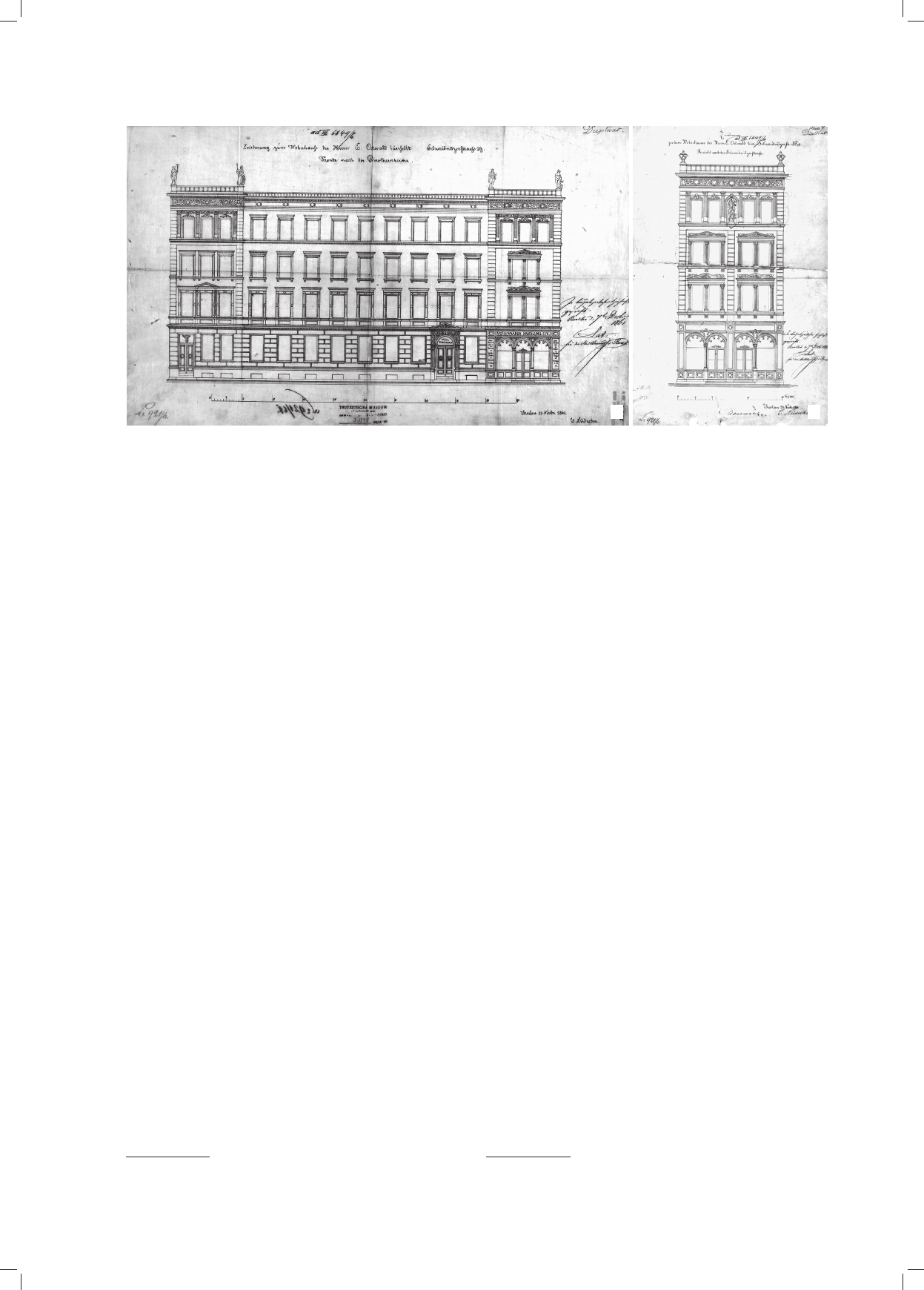
dział wieloosiowej elewacji na część centralną i fl anku-
jące ją skrzydła (il. 2a). Środkowy pilaster podkreślał oś
symetrii elewacji od strony ul. Świdnickiej (il. 2b), dzie -
lił ją na dwa przęsła, a dodatkowo stanowił podporę dla
„re ne san sowej” niszy, w której umieszczono posąg Dionizo-
sa (?). Odmiennie zaprojektowano też ostatnią kon
dygnację
budowli – w bocznych ryzalitach od strony ul. Fran
cisz-
kańskiej i od strony ul. Świdnickiej okna ujęto
pi lastra mi,
któ re dźwigały mocno rozbudowane belkowanie zwień-
czone balustradą. Zdecydowane podkreślenie kie run ków
pionowych miało zapewne na celu osiągnięcie efektu op-
tycz nego podwyższenia pseudoskrzydeł budowli.
W kompozycji elewacji późniejszej kamienicy zbudo-
wanej dla Juliusa Neugebauera, Lüdecke dał pierwszeń-
stwo liniom pionowym – oś symetrii fasady wyznaczał
pseudoryzalit prowadzony przez trzy kondygnacje bu-
dynku, a wspólne obramienia wiążące okna pierwszego
i drugiego piętra pogłębiały wrażenie ich równoważności.
Zasadą kontrastu architekt kierował się również przy do-
borze ornamentów, którymi dekorował fasady miejskich
domów mieszkalnych. Powołując się na XVIII-wieczną
rozprawę o pięknie Williama Hogartha, Lüdecke dowo-
dził, że [...] linie o kontrastowych kierunkach mają szcze-
gólny wdzięk
14
[15, No 9, s. 66]. Architekt z upodobaniem
stosował fryzy meandrowe, palmetowe i groteskowe –
opracował nawet zestawy elementów kompozycyjnych
i dekoracyjnych, które następnie powtarzał w swoich pro-
jektach. Lüdecke nie stronił również od wykorzystywania
do dekorowania elewacji budynków mieszkalnych goto-
wych schematów zdobień, które publikowano w licznie
wydawanych w XIX w. wzornikach ornamentów.
Jako zwolennik pluralizmu stylowego Lüdecke pod-
chodził dość swobodnie do kwestii łączenia w obrębie
jednej fasady motywów pochodzących z różnych okresów
14
Die Linien von kontrastierender Bewegung sind von besonde-
rem Reize [15, No 9, s. 66].
In Ostwald’s tenement house horizontal entablature was
supported by pilasters which additionally reinforced opti-
cally the facade edges, whereas from Franciszkańska Street
side they marked a multi-axis facade division into a cen-
tral part and fl anking wings (Fig. 2a). The central pilaster
emphasized the facade axis of symmetry from Świdnicka
Street (Fig. 2b) and divided it into two bays as well as it ad-
ditionally constituted some support for the “Renaissance”
niche where a statue of Dionysus was placed (?). The last
fl oor of the building was also designed differently – in
side avants-corps, windows on the sides of Franciszkań-
ska Street and Świdnicka Street were equipped with pi-
la sters which carried heavily developed entablature sur-
mounted by a ba lustrade. A strong emphasis on vertical
directions was surely aimed at reaching an effect of the
optical elevation of the building’s pseudo-wings.
In the facade composition of the later tenement house
built for Julius Neugebauer, Lüdecke gave priority to the
vertical lines – the axis of symmetry of the facade was
ma rked by a pseudo-avant-corps along three fl oors of the
building and common frames connecting windows of the
fi rst and second fl oors deepened the impression of equi-
valence. The architect used a contrast principle when
choosing ornaments for decorating facades of urban re-
sidential houses. Referring to the 19
th
-century treatise
on beauty by William Hogarth, Lüdecke argued that [...]
lines of contrasting directions have special charm
14
[15,
No 9, p. 66]. The architect used winding, palmette and
grotesque friezes with pleasure – he even developed a set
of compositional and decorative elements which he then
repeated in his designs. Lüdecke also did not abstain from
using ready schemes of ornamentation to decorate facades
of residential buildings, which were published in the 19
th
century ornament templates in great amounts.
14
Die Linien von kontrastierender Bewegung sind von besonde-
rem Reize [15, No 9, p. 66].
Il. 2. Carl Lüdecke, kamienica Ostwalda, rysunki elewacji od strony: a) ul. Franciszkańskiej, b) ul. Świdnickiej (MA/ABmW., TP)
Fig. 2. Carl Lüdecke, Ostwald’s tenement house, drawings of the facade from: a) Franciszkańska Street, b) Świdnicka Street (MA/ABmW., TP)
a
b
14 Agnieszka Tomaszewicz
historycznych. W szkicu do projektu kamienicy Ostwalda
architekt nadał parterowi budynku wyraźnie „fl orenckie”
piętno, w projekcie realizacyjnym „renesansowe” okna
parteru zostały ozdobione „gotyckimi” noskami. Wydaje
się jednak, że „tektoniczna” spójność kompozycji elewa-
cji była dla artysty celem nadrzędnym, nie w pełni uze-
wnętrzniał on bowiem dwoistość funkcji projektowanych
przez siebie kamienic – konsekwentnie wyróżniał jedynie
partery nawet wtedy, gdy celom handlowym służyło rów-
nież kolejne piętro budynku.
Lüdecke, podobnie jak duża część współczesnych mu
architektów, traktował projektowanie elewacji jako zada-
nie niezależne od rozplanowania rzutu budowli. W 1871 r.
architekt przygotował projekt dekoracji fasady budynku,
który został zaplanowany i wzniesiony przy ul. Lelewe-
la 13 (Zimmerstr. 13) przez budowniczego Maxa Ike go.
Lüdecke zastosował, znany ze swoich wcześniejszych
reali zacji, schemat kompozycyjny ściany artykułowany
kla sycyzującymi elementami architektonicznymi (il. 3).
Do mi nującym w elewacji kierunkom poziomym architekt
przeciwstawił pion wspólnie obramionych, zbliżonych do
siebie środkowych osi okiennych, które uzewnętrzniały
miejsce usytuowania pomieszczenia reprezentacyjnego
w mieszkaniach pierwszego i drugiego piętra.
W „tektoniczny” nurt twórczości Lüdeckego można
wpi sać również projekt willi, który architekt przygotował
As a supporter of stylish pluralism, Lüdecke quite free-
ly approached the issue of combining motifs originating
from different historical periods within a single facade. In
the sketch to the design of Ostwald’s tenement house the
ground fl oor of the building was given a clearly “Floren-
tine” hallmark by the architect and in the realisation de-
sign the “Renaissance” windows of the ground fl oor were
ornamented with “Gothic” peaks. However, it seems that
“tectonic” coherence of the facade composition was of the
primary goal for the artist because he did not fully mani-
fest a duality of functions of tenement houses designed by
him – he consequently distinguished only ground fl oors,
even when another fl oor of the building was to serve com-
mercial purposes.
Lüdecke, similarly to a vast majority of contemporary
architects, treated designing of facades as a task which
was independent of the layout of the building projection.
In 1871 the architect prepared a design of the building
facade decoration, which was planned and built at 13 Le-
lewela Street (Zimmerstr. 13) by builder Max Ike. Lü-
decke applied, as it was known from his earlier realisa-
tions, a compositional scheme of the wall articulated with
classicizing architectural elements (Fig. 3). The architect
contrasted dominating horizontal directions in the facade
with the vertical of commonly framed and close to each
other window axes which manifested a location of the rep-
resentative room in the apartments of the fi rst and second
fl oors.
A villa design, which the architect prepared for Robert
Staats in 1863, an entrepreneur and municipal councilor,
can be also included in the “tectonic” trend of Lüdecke’s
artistic creativity. The house was designed on an almost
square projection – its compositional core constituted
a cross of central rooms which were supplemented with
four corner rooms (Fig. 4a). Three of them served residen-
tial purposes, while the kitchen with facility rooms were
arranged in the space of the fourth chamber. The width of
central chambers was determined by the size of the stair-
case situated in one of the arms of the cross. The compo-
sition of the projection was manifested on the facades of
the building, which connected this design with a Durand’s
design method; similarly to the applied here close align-
ment and symmetry as well as repeatability of main ele-
ments of the interior layout. However, the motifs Lüdecke
used to articulate the building’s facade were taken from
the Schinkel’s School of Architecture. The architect di-
versifi ed a simple cubist body of the building by means
of small avants-corps and loggias, which emphasized the
axis of symmetry of each facade and broke their horizon-
tal and tripartite composition (Fig. 4b). In the avant-corps
of the staircase there was an entrance to the building as
well as a monumental two-storey window that illumi-
nated stairs and also indirectly the central hall which was
situated at the intersection of the axes of symmetry of the
building’s projection. The central axis of the front of the
buildings was highlighted by a group of three window
and door openings giving them the form of an arcade on
the fi rst fl oor. The composition was equipped with pilas-
ters carrying a triangular pediment and in front of it there
was a loggia closed with a balcony at the top. This motif,
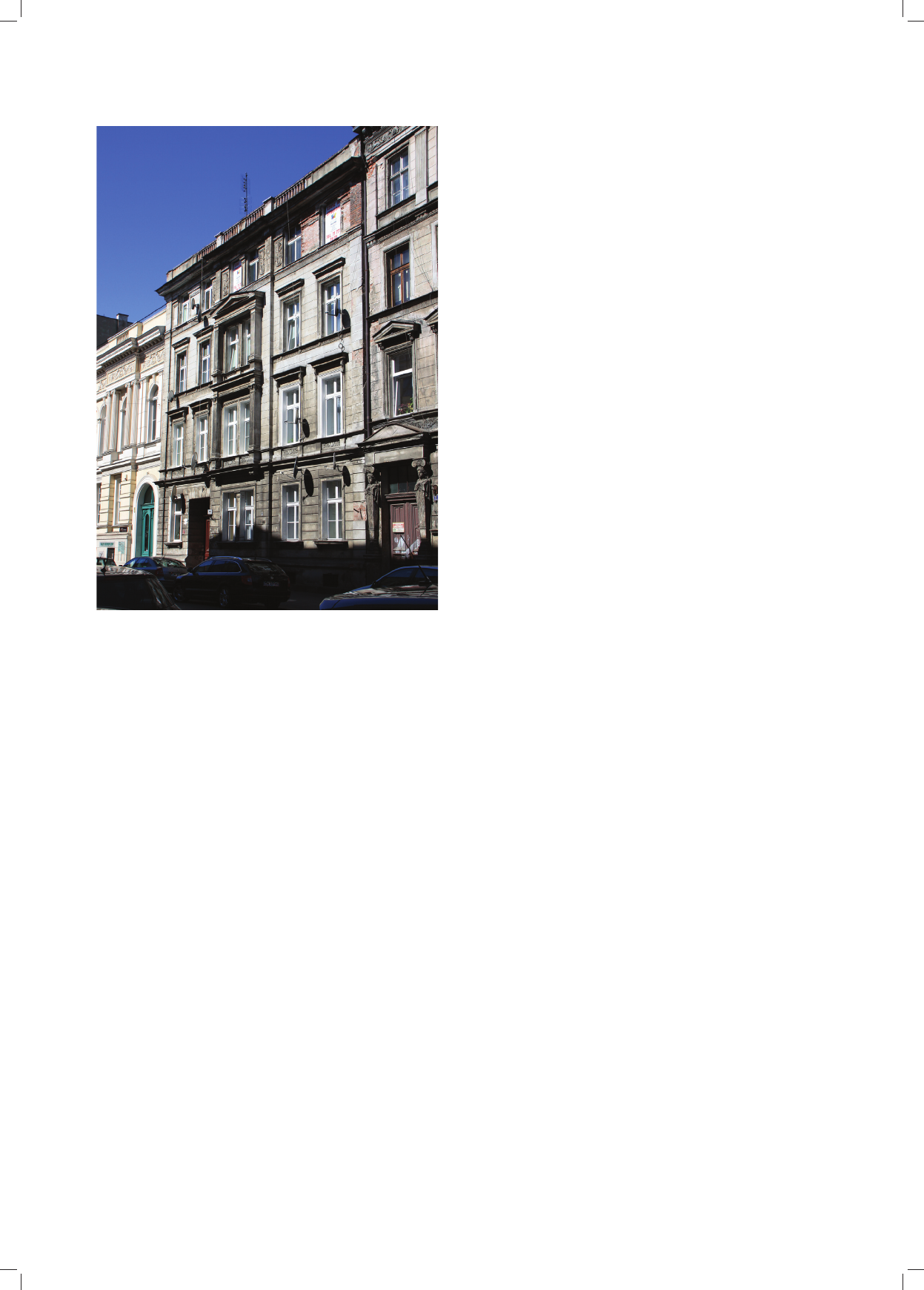
Il. 3. Wrocław, kamienica przy ul. Lelewela 13, elewacja frontowa
(fot. A. Tomaszewicz, 2014)
Fig. 3. Wrocław, tenement house, 13 Lelewela Street, front facade
(photo by A. Tomaszewicz, 2014)
Carl Lüdecke i wrocławskie budownictwo mieszkaniowe /Carl Lüdecke and dwelling-houses in Wrocław 15
brought back by Schinkel, was willingly used as decora-
tion of residential buildings designed by architects from
Berlin around the middle of the 19
th
century [17, p. 161].
The Staats’ villa was built near the suburban road which
connected the city with the village of Borek (Kleinburg)
15
and with time it was transformed into one of the most ele-
gant streets in Wrocław (Kleinburgerstr., since 1877 Kai -
ser-Wilhelm-Str., at present Powstańców Śląskich Street).
In 1876 Lüdecke built here one more villa which was
designed for the owner of an iron foundry Julius Kem-
ny. This time the architect rejected strict symmetry and
alignment that characterized the villa of Staats – the non-
existing today Kemny’s house consisted of two uneven
height bodies displaced towards each other. An enfi lade of
three representative chambers was situated on the ground
fl oor in the higher part of the building and a spa cious ves-
tibule with an open staircase was designed in the lower
part (Fig. 5a). On each of both sides of the vestibule there
were two rooms, three of which fulfi lled a residential
function and in the fourth a kitchen was arranged. Private
rooms, dressing rooms and toilet facilities were arranged
on the fi rst fl oor. A departure from strict symmetry in
planning the projection allowed Lüdecke to increase the
functionality of room deployment as well as preferably
loosen the body of the building, which was additionally
diversi fi ed by numerous outbuildings. Each facade was
given a different character. From the street side the house
was shaped in the form of a “villa with a tower” – the
15
In 1884 the Staats’ villa was extended by its new owner Max
Grund. The cubic body of the building was diversified with a tower and
numerous outbuildings. By the end of the 19
th
century the villa was
rebuilt several times and in 1940 it was planned to be demolished. How-
ever, this plan was not put into practice – until 2014 the building housed
the National Higher Theatre School; at present the villa is offered for
sale (22 Powstańców Śląskich Street, archival design records are kept in
the Museum of Architecture in Wrocław – Department of Construction
Archives of the City of Wrocław, vol. 4244, also cf. [18]).
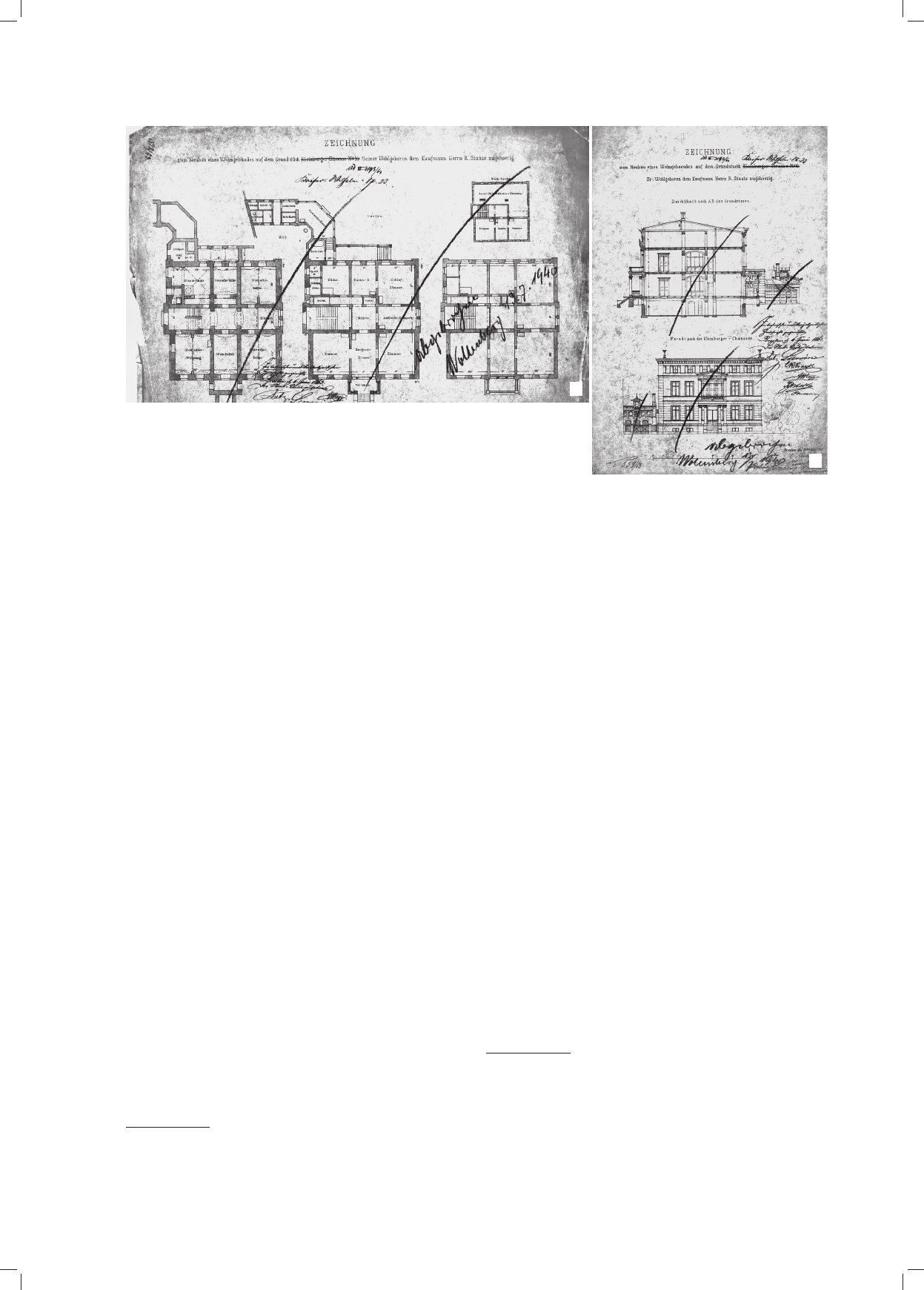
w 1863 r. dla Roberta Staatsa, przedsiębiorcy i radnego
miejskiego. Dom został zaprojektowany na prawie kwa-
dratowym rzucie – jego trzon kompozycyj ny stanowił
krzyż środkowych pomieszczeń, które uzu pełniono czte-
rema narożnymi pokojami (il. 4a). Trzy z nich słu żyły ce -
lom mieszkaniowym, w przestrzeń czwartego wpisano
kuch
n i ę z pomieszczeniami pomocniczymi. Szerokość izb
środkowych wyznaczał wymiar klatki schodowej usytuo-
wanej
w jed nym z ramion krzyża. Kompozycja rzutu zo-
stała uzew nętrzniona
na elewacjach budowli, co łączyło
ten pro jekt z durandowską metodą projektowania, podob-
nie jak zastosowana tu ścisła osiowość i symetria, a tak -
że powtarzalność głównych elementów rozplanowania
wnętrz. Jednak motywy, których Lüde cke użył do artyku-
lacji elewacji budowli, zostały zaczerpnięte z schinklow-
skiej szkoły architektury. Prostą, kubiczną bryłę budynku
architekt urozmaicił niewielkimi ryzalitami i loggiami,
które podkreślały oś symetrii każdej elewacji i rozbijały
ich horyzontalną, trójdzielną kompozycję (il. 4b). W ryza-
licie klatki schodowej zaprojektowano wejście do budyn-
ku i monumentalne dwukondygnacyjne okno oświetlające
schody, a pośrednio także centralny hol, który umiesz-
czono na przecięciu osi symetrii rzutu budynku. Środko-
wą oś frontu budowli podkreślono grupą trzech otworów
okiennych i drzwiowych, na pierwszym piętrze nadając im
formę arkady. Kompozycję
ujętą pilastrami dźwigającymi
trójkątny naczółek poprzedzała loggia zamknięta od góry
balkonem. Motyw ten, przypomniany przez Schinkla, był
chętnie stosowany w de koracji budynków mieszkalnych
projektowanych około połowy XIX w. przez architektów
berlińskich [17, s. 161].
Willa Staatsa została wzniesiona przy podmiejskiej
dro dze łączącej miasto z wsią Borek (Kleinburg)
15
, któ ra
15
W 1884 r. willa Staatsa została rozbudowana przez jej nowego
właściciela, Maxa Grunda. Kubiczną bryłę budynku urozmaicono wów-
czas wieżą i licznymi przybudówkami. Do końca XIX w. willę przebu-
dowywano jeszcze kilkakrotnie, a w 1940 r. planowano ją wyburzyć.
b
Il. 4. Carl Lüdecke, projekt willi Staatsa, ul. Powstańców Śląskich 22,
a) rzuty, b) przekrój i elewacja frontowa (MA/ABmW., t. 4244)
Fig. 4. Carl Lüdecke, Staats’ villa project, 22 Powstańców Śląskich Street,
a) projections, b) cross-section and front facade (MA/ABmW., t. 4244)
a
b
16 Agnieszka Tomaszewicz
function of the “tower” was fulfi lled by the higher part of
the building, which was optically “smoothed” by a ver-
tical composition of windows (Fig. 5b). In accordance
with the principle of contrast, the facades of the lower
part of the building were designed in a horizontal system.
The consistency of the facade composition was broken
by the side avant-corps which due to the nature of the
rooms contained in it was provided with only one small
window and in order to maintain balance – diaphragms
imitating holes. A garden facade was most effectively de-
veloped and its main compositional axis was highlighted
by means of a shallow avant-corps closed with a triangle
pediment. A bay window, which expanded the space of
the living room, was built on the ground fl oor just in front
of the avant-corps face and it was covered with a bal-
cony. The exit door along with windows, which led to
the balcony, was closed with a Palladian motif. On the
fi rst fl oor, on either sides of the central axis, there were
aedi cule-framed niches with statues. On the ground fl oor
a green house was added to the building – a winter garden
accessible from the living room bay window and the sym-
metry of the facade composition was supplemented with
a ve randa designed on the other side of the central bay win-
dow. A triple, vertical facade system, the use of fi ve axes,
three of which were grouped in the central part of the wall
make this project similar to the realisation of the Dresden
School of Architecture, however, in a version processed
by architects from Berlin [19, p. 222, Figures 515, 519].
Most of the Wrocław urban houses Lüdecke designed
in the classicizing style, however, in the Kemna’s villa the
ar chitect expanded a repertoire of forms with motifs of
the Italian Renaissance. The design of a residential house
connected with an apartment and entertainment garden,
which the architect prepared for the brewer C.H. Hilde-
brandt in 1871, confi rms Lüdecke’s tendency to apply va-
rious neo-Renaissance trends. The building was built at
33 Ko mandorska Street (Neudorfstr. 33) at the site of an
older residential house which was located in a compact
deve lopment. The new tenement house did not occupy
z czasem została przekształcona w jedną z najelegant szych
ulic Wrocławia (Kleinburgerstr., od roku 1877 Kai ser-Wil-
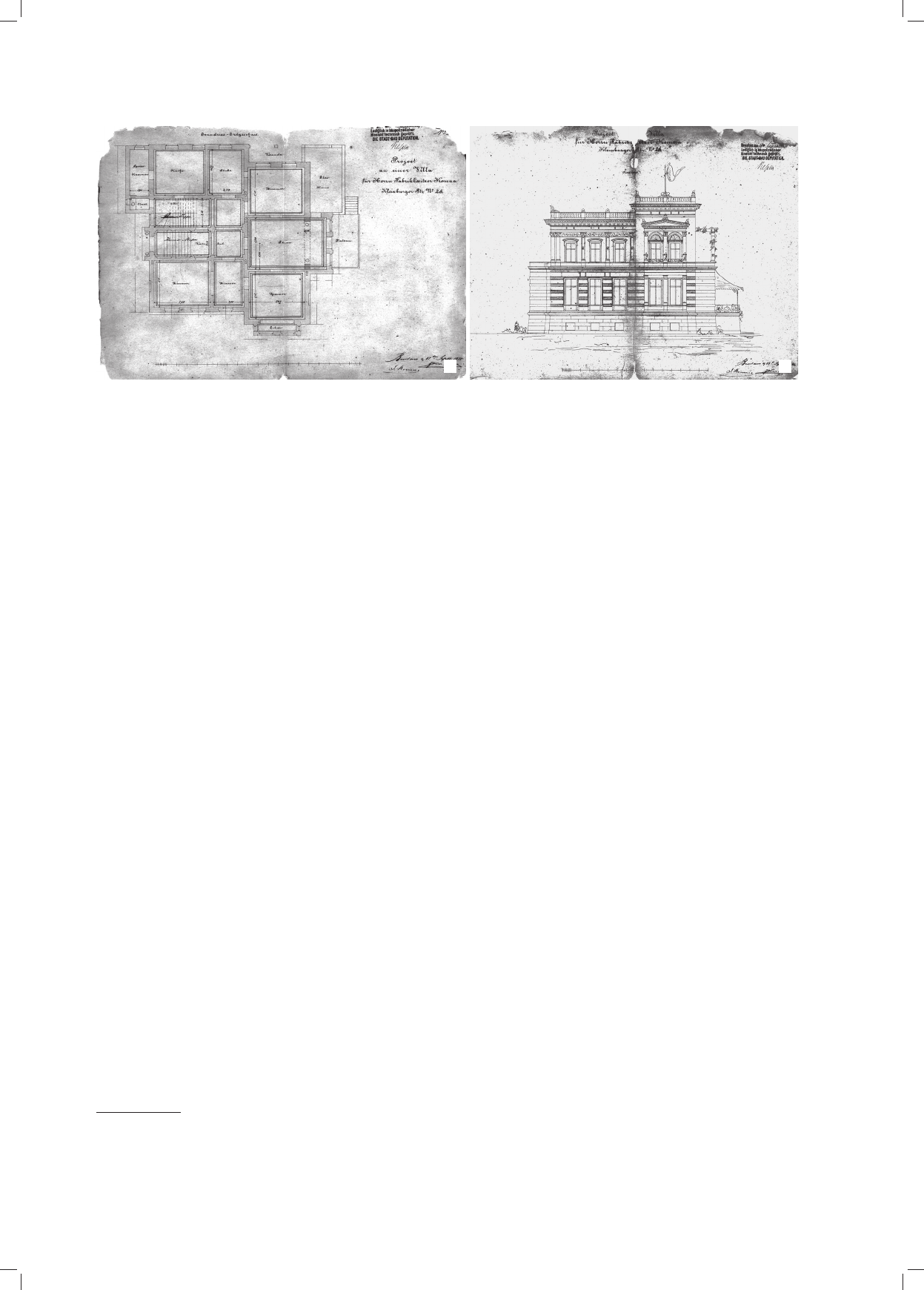
helm-Str., obecnie ul. Powstańców Śląskich). W 1876 r.
Lü decke wzniósł tu jeszcze jedną willę, za pro jek to waną
dla właściciela odlewni żelaza Juliusa Kemny. Architekt
odrzucił tym razem ścisłą symetrię i osiowość, która ce-
chowała willę Staatsa – nieistniejący dziś dom Kemny zo-
stał złożony z dwóch przesuniętych względem siebie brył
nierównej wysokości. Na parterze wyższej części budyn-
ku umieszczono amfi ladę trzech pomieszczeń reprezenta-
cyjnych, w niższej części zaprojektowano obszerny we-
stybul z ot wartą klatką schodową (il. 5a). Po obu stronach
westy bulu usytuowano po dwa po mieszczenia, z których
trzy pełniły funkcje mieszkalne, a w jednym urządzono
kuch nię. Na piętrze zaprojek towano pokoje prywatne, gar-
deroby i pomieszczenia toale towe. Odejście od ścisłej sy-
metrii w planowaniu rzutu pozwoliło Lüdeckemu
zwięk-
szyć funkcjonalność rozmieszczenia pomieszczeń, a także
korzystnie rozluźnić bryłę budynku, która dodatkowo zo-
stała urozmaicona licznymi przybudówkami. Każdej ele-
wacji nadano odmienny charakter. Od strony ulicy dom
został ukształtowany w formie „willi z wieżą” – funkcję
„wieży” pełniła wyższa część budynku, którą optycznie
„wysmuklała” wertykalna kompozycja okien (il. 5b). Zgod -
nie z zasadą kontrastu elewacje niższej częś ci budynku za-
projektowano w układzie horyzontalnym. Spójność kom -
pozycji elewacji wejściowej rozbijał boczny ryzalit, któ ry
ze względu na specyfi kę umieszczonych w nim pomiesz -
czeń został zaopatrzony jedynie w jedno niewielkie okien-
ko i w celu zachowania równowagi – blendy imitujące
otwory. Najefektowniej opracowano elewację ogrodową,
której główną oś kompozycyjną podkreślono płytkim ry-
zalitem zamkniętym trójkątnym naczółkiem. Na parterze
Zamiaru jednak nie zrealizowano – w budynku do 2014 r. mieściła się
siedziba Państwowej Wyższej Szkoły Teatralnej, obecnie willa jest wysta-
wiona na sprzedaż (ul. Powstańców Śląskich 22, archiwalna dokumenta-
cja projektowa znajduje się w Muzeum Architektury we Wrocławiu –
Oddział Archiwum Budowlane Miasta Wrocławia, t. 4244, por. też: [18]).
Il. 5. Carl Lüdecke, projekt willi Kemny, ul. Powstańców Śląskich (Kaiser Wilhelm Str. 64),
a) rzut parteru, b) elewacja frontowa (MA/ABmW., t. 4266)
Fig. 5. Carl Lüdecke, Kemna’s villa project, Powstańców Śląskich Street (Kaiser Wilhelm Str. 64),
a) ground floor projection, b) front facade (MA/ABmW., t. 4266)
a
b

Carl Lüdecke i wrocławskie budownictwo mieszkaniowe /Carl Lüdecke and dwelling-houses in Wrocław 17
the entire width of the plot – along one of the borders
there was a crossing to the garden situated in the back-
yard of the property. On the ground fl oor a beer house
was arranged and on the next three fl oors – apartments for
rent. The functional differentiation of interiors was pre-
sented on the facades of the building, which were solved
in two stylistic versions by the architect, i.e. the fi rst con-
cept referred to the French Renaissance and the second
one to the early Italian Renaissance. In both versions of
the design the windows of the ground fl oor of the build-
ing were vaulted with full arches, whereas the wall was
“loaded” with rustication. In the “Florentine” concept the
facade was covered with rustication on the entire height of
the building and the facade composition had a remarkably
horizontal character. In the “French” version the slightly
bossage ground fl oor was accompanied by a smooth wall
of upper fl oors, a horizontal facade composition was
countered by avants-corps, lesenes highlighting corners
of the building as well as the bay window emphasizing
the location of a “good chamber” in the apartments of the
fi rst and second fl oor. The last fl oor of the building was
hidden in a steep mansard roof illuminated by high and
slender dormers. The design was carried out in the “Flo-
rentine” version
16
, however, it is worth noting that both
the stylistics of the Italian Quattrocento and the French
Re naissance had already been applied previously in Wroc -
ław residential development. The fi rst “Florentine” urban
houses were built in Wrocław in the 1840
s
, whereas mo-
tifs referring to the French Renaissance were introduced
into residential architecture nearly twenty years later.
In the fi eld of urban residential housing Carl Lüde cke
was not an original designer – he was under a great in-
fl uence of the Berlin School of Architecture. Tenement
houses erected according to his designs had a correct and
functional interior layout sometimes designed in a way to
make it possible to change freely the purpose of rooms.
When designing projections of tenement houses for rent,
the architect usually avoided the use of schematic solu-
tions and adapted interior arrangements to specifi c condi-
tions of the building’s location. Lüdecke designed urban
building facades in a “tectonic” way using antique-like
de corative elements which he combined, particularly in
fun ctionally heterogeneous tenement houses, with motifs
taken from different forms of the Renaissance. Lüdecke
rea lized private investors’ orders and he did not try, follo-
wing patterns of his masters Stier and Stüler, to develop
model concepts of multi-family residential buildings. Inte-
restingly enough, despite enormous design achie vements,
the architect never built his own house
17
, which could
have constituted a full illustration of his artistic creed.
Translated by
Bogusław Setkowicz
16
The tenement house with Hildebrandt’s entertainment room was
destroyed during World War II.
17
Until his death Lüdecke lived in Heinrich Kuveke’s tenement
house – a carpenter who ran a construction company which carried out
designs of many Wrocław architects, including Lüdecke.
przed lico ryzalitu wysunięto wykusz powiększający
przestrzeń salonu, który przykryto balkonem. Drzwi wyj-
ścia na balkon i zespolone z nimi okna zamknięto moty-
wem serliany. Na piętrze, po obu stronach centralnej osi,
zaprojektowano edykułowo obramione nisze z posągami.
Na parterze do budynku dostawiono szklarnię – ogród zi-
mowy dostępny z wykusza salonu, a symetrię kompozycji
elewacji uzupełniono werandą zaprojektowaną po drugiej
stronie środkowego wykusza. Trójdzielny, wertykalny uk-
ład elewacji, zastosowanie pięciu osi, z których trzy zo sta-
ły zgrupowane w środkowej części ściany, zbliża ten pro-
jekt do realizacji drezdeńskiej szkoły architektury, jednak
w wersji przetworzonej przez architektów berlińskich [19,
s. 222, rys. 515, 519].
Większość wrocławskich domów miejskich Lüdecke za -
pro jektował w stylu klasycyzującym, w willi Kemny ar chi-
tekt poszerzył jednak repertuar form o motywy zaczer pnięte
z renesansu włoskiego. Skłonność Lüdeckego do stosowa-
nia różnych nurtów neorenesansu potwierdza projekt domu
mieszkalnego połączonego z lokalem i ogrodem rozrywko-
wym, który architekt przygotował w 1871 r. dla browarnika
C.H. Hildebrandta. Budynek stanął przy ul. Komandorskiej
(Neudorfstr. 33) na miejscu starszego domu mieszkalnego,
usytuowanego w zabudowie zwartej. No wa kamienica nie
zajęła całej szerokości działki – wzdłuż jednej z granic za-
projektowano przejście do ogrodu, który zajmował tył po-
sesji. Na parterze urządzono piwiarnię, na kolejnych trzech
piętrach – mieszkania dochodowe. Zróżnicowanie funkcjo-
nalne wnętrz zostało ukazane na elewacjach budynku, któ-
re architekt rozwiązał w dwóch wersjach stylistycznych:
w pierwszej koncepcji nawiązał do francuskiego renesan-
su, w drugiej – do wczesnego renesansu włoskiego. W obu
wersjach projektu okna parteru budynku przesklepiono łu-
kami pełnymi, a ścianę „obciążono” rustyką. W koncepcji
„fl orenckiej” rustyk
ą pokryto elewację na całej wysokości
budynku, a kompozycja elewacji miała wybitnie horyzon-
talny charakter. W wer sji „francuskiej” lekko boniowane-
mu parterowi towarzyszyła gładka ściana wyższych kon-
dygnacji, horyzontalną kompozycję elewacji kontrowały
ryzality, lizeny podkreślające narożniki budowli, a także
wy kusz akcentujący położenie „dobrej izby” w mieszka-
niach pierwszego i drugiego piętra. Ostatnia kondygnacja
bu dynku została ukryta w stromym mansardowym dachu,
oświetlonym wysokimi, smukłymi lukarnami. Projekt zre-
alizowano w wersji „fl orenckiej”
16
, warto jednak zazna-
czyć, że zarówno stylistyka włoskiego Quattrocenta, jak
i re nesansu francuskiego była już wcześniej stosowana we
wro c ławskim budownictwie mieszka nio wym. Pierwsze
„fl o renckie” domy mieszczańskie wznie siono we Wrocławiu
w latach 40. XIX w., motywy nawiązujące do renesansu
francuskiego wprowadzono do ar chitektury mieszkaniowej
blisko dwadzieścia lat później.
W dziedzinie miejskiego budownictwa mieszkaniowe-
go Carl Lüdecke nie był twórcą oryginalnym – pozostawał
pod dużym wpływem berlińskiej szkoły architektury. Ka-
mienice wznoszone według jego projektów miały popraw-
16
Kamienica wraz z lokalem rozrywkowym Hildebrandta została
zniszczona w czasie II wojny światowej.

18 Agnieszka Tomaszewicz
ny, funkcjonalny układ wnętrz, zaprojektowany niekiedy
w sposób umożliwiający swobodną zmianę przeznaczenia
pomieszczeń. Projektując rzuty kamienic dochodowych,
architekt unikał zazwyczaj stosowania rozwiązań sche-
matycznych i dostosowywał układy wnętrz do specyfi cz-
nych warunków lokalizacji budynku. Elewacje domów
miejskich Lüdecke komponował w sposób „tektoniczny”,
używając antykizujących elementów dekoracyjnych, któ-
re łączył, szczególnie w kamienicach niejednorodnych
funkcjonalnie, z motywami zaczerpniętymi z różnych od -
mian
renesansu. Lüdecke realizował zamówienia prywat-
nych inwestorów, nie próbował, wzorem swoich mistrzów
Stiera i Stülera, opracować koncepcji wzorcowych wielo-
rodzinnych budynków mieszkalnych. Co ciekawe, mimo
ogromnego dorobku projektowego, architekt nigdy nie
wybudował własnego domu
17
, który mógłby stanowić
pełną ilustrację jego artystycznego kredo.
17
Do końca życia Lüdecke mieszkał w kamienicy Heinricha Kuve-
kego – cieśli prowadzącego firmę budowlaną, która realizowała projekty
wielu wrocławskich architektów, w tym także samego Lüdeckego.
Bibliografia /References
[1] Dobesz J., Nurty architektury 2. połowy XIX wieku w twórczości
Karola Lüdeckego, praca doktorska, Wydział Architektury PWr,
Wrocław 1976.
[2] Becker R., Carl Luedecke, Gedächtnissrede, Verein für Geschichte
der Bildenden Künste zu Breslau, Breslau 1896.
[3] Dobesz J., Gmach Nowej Giełdy we Wrocławiu. Projekty konkur-
sowe, [w:] H. Lisińska (red.), Sztuka XIX wieku w Polsce. Naród–
miasto. Materiały sesji Stowarzyszenia Historyków Sztuki. Poznań,
grudzień 1977, PWN, Warszawa 1979, 209–232.
[4] Dobesz J.L., Wrocławskie dworce kolejowe, Studio Sense II, Wro-
cław 2000.
[5]
Klamecki H., Ogród zoologiczny, ul. Zygmunta Wróblewskiego 1–5,
[w:] R. Eysymontt, J. Ilkosz, A. Tomaszewicz, J. Urbanik (red.), Lek-
sykon architektury Wrocławia, Via Nova, Wrocław 2011, 907–908.
[6] Grzegorczyk B., Architektura i budownictwo teatralne we Wrocła-
wiu od około 1770 do schyłku XIX wieku, UWr, Wrocław 2000.
[7] Lüdecke C., Zur Stylfrage bei Bauten und Kunstwerken der Jetzt-
zeit, „Jahres-Bericht der Schlesischen Gesellschaft für Vaterländi-
sche Kultur” 1859, Jb. 37, 213–217.
[8] Zabłocka-Kos A., Sztuka. Wiara. Uczucie. Alexis Langer – śląski
architekt neogotyku, UWr, Wrocław 1996.
[9] Bothe R., Berliner Architekten zwischen 1790–1870, [w:] W. Aren-
hövel (red.), Berlin und die Antike, Berlin 1979 [katalog wystawy].
[10]
Börsch-Supan E., Berliner Baukunst nach Schinkel 1840–1870,
„Stu dien zur Kunst der neunzehnten Jahrhunderts”, 1977, Bd. 25.
[11] Hoepfner W., Schwandner E.-L., Archäologische Bauforschung,
[w:] W. Arenhövel (red.), Berlin und die Antike, Berlin 1979 [ka-
talog wystawy].
[12] Becker R., Der Verein für Geschichte der bildenden Künste zu
Breslau 1862–1912, Korn, Breslau 1912.
[13] Festschrift „Unser Motiv”, [b.m.w.] 1897.
[14] Ungewitter G.G., Entwürfe zu Stadt- und Landhäusern, Verlag von
Carl Fleming, Glogau 1856–1864.
[15] Lüdecke C., Vorträge über Ornamentik, „Breslauer Gewerbe-
Blatt” 1860, No 8 (21. April), 58, 59; No 9 (5. Mai), 66–68; No 10
(19. Mai), 73, 74; No 11 (2. Juni), 83–86.
[16] Bötticher K., Die Tektonik der Hellenen, t. 1: Einleitung und Dori-
ka, Verlag von Ferdinand Riegel, Potsdam 1852.
[17] Hammer-Schenk H., Neurenaissance in Berlin. Architekten nach
Schinkel: Friedrich Hitzig, Eduard Knoblauch, Eduard Titz, [w:]
W. Krause (red.), Neorenaissance. Ansprüche an einen Stil, „Mus-
kauer Schriften”, Bd. 4, Bad Muskau 2001.
[18] Eysymontt R., Państwowa Wyższa Szkoła Teatralna im. Ludwika
Solskiego, d. willa, ul. Powstańców Śląskich 22, [w:] R. Eysymontt,
J. Ilkosz, A. Tomaszewicz, J. Urbanik (red.), Leksykon architektury
Wrocławia, Via Nova, Wrocław 2011, 615–616.
[19] Brönner W., Die bürgerliche Villa in Deutschland 1830–1890,
Wernersche Verlagsgesellschaft, Worms 1994.
Streszczenie
Carl Lüdecke był jednym z najbardziej wszechstronnych architektów XIX-wiecznego Wrocławia, projektował budynki użyteczności publicznej,
wiejskie siedziby arystokracji, prowadził także prace konserwatorskie najważniejszych zabytków stolicy Śląska. Niniejszy artykuł jest próbą uzu-
pełnienia luki w dotychczasowych opracowaniach na temat twórczości artysty i pokazuje nieopisaną dotąd grupę projektów Lüdeckego – miejskie
domy mieszkalne. We Wrocławiu architekt zaprojektował kilka kamienic najczęściej o funkcji usługowo-mieszkalnej, dwie wille, prowadził także
przebudowy domów istniejących, tworzył projekty dekoracji elewacji. W propozycjach miejskich budynków mieszkalnych Lüdecke stosował zasadę
pluralizmu stylowego – elewacjom domów nadawał formy klasycyzujące wzbogacone motywami zaczerpniętymi z różnych okresów włoskiego
renesansu. Swoje stanowisko dotyczące stylów w architekturze artysta zaprezentował w czasie wykładów, które wygłosił na forum Śląskiego Towa-
rzystwa Kultury Ojczystej. Architekt realizował wyłącznie zamówienia prywatnych inwestorów, każdy projekt był zatem wypadkową uwarunkowań
lokalizacyjnych, potrzeb zleceniodawcy, wymogów prawnych oraz przekonań artystycznych projektanta, które pozostawały pod dużym wpływem
berlińskiej szkoły architektury.
Słowa kluczowe: budownictwo mieszkaniowe, historyzm, Wrocław
Abstract
Carl Lüdecke was one of the most versatile architects of the 19
th
century Wrocław. He designed buildings of public services, country seats of
aristocracy, he also carried out preservation works of the most important monuments in the Silesian capital. This article is an attempt at replenishing
the gap in hitherto existing works related to the creation of the artist and shows the so far not described group of Lüdecke’s projects – the urban
residential houses. The architect designed several tenament houses, most often of the service-tenament function, two villas, he also carried out
reconstructions of existing houses, and created plans of facade decorations. In propositions of urban tenament houses Lüdecke employed the
principle of style pluralism – to house elevations he gave classic form enriched with motives derived from various periods of Italian Renaissance.
His standpoint related to styles in architecture the artist presented during his lectures which he gave in the Silesian Association of Native Culture.
The architect realized only commissions of private investors, so that each design was the result of conditions of localization, the needs of the
customer, legal requirements and artistic beliefs of the designer which were under a high influence of the Berlin school of architecture.
Key words: tenament housing, historicism, Wrocław