2010
Nr 2(28)
The rst thing is an idea which is disturbing enough
to prevent a peaceful sleep. It needs to be worked out and
broken into its component parts and all pros and cons
need to be thought through. Then it is slowly transferred
to paper to develop a project which is often subjected to
evaluation and changed nally to meet all possible re-
quirements and recommendations. Construction: trans-
formation of a vision into reality, erection of walls and
unbearable expectation of the nal result.
However, this is not the moment when the last brick is
laid that the work is complete. The real test and the only
true verication is time. The evaluation of the quality of
buildings includes a lot of factors, the most important of
which seems to be the durability of architectural solutions
and their correct application.
Not all of them can stand the test of time. More im-
portantly, some of them which at rst seem to be world
scale events and the keys opening new doors cannot bear
the burden of the load placed on them. Constructed with
the spotlights directed at star-architects, the buildings’
foundations are supported only on their fame. Often the
renown is not coupled with construction quality or dili-
gence.
Fortunately, some real gems can be found in the star
architecture rmament. Works that not only defend them-
selves but also combine nesse, artistry and functionality
as well [2].
Simplicity, work at the grass roots, quality, and trans-
parency are only some of the distinctive features of the
designs by Peter Zumthor. The number of structures de-
signed by him is not too high. However, that too works
to his advantage. Rejecting the model of run-of-the-mill
designs and a model of a factory worker, Zumthor relies
on work quality, attention to detail, and uniqueness. Just
like a real carpenter, he cuts each structure in a unique
way. His work, which can be easily called a masterpiece
of a good craftsman, focuses on details, keeping in mind
one of the most fundamental features of any building:
functionality. Although buildings are rightly predestined
to be called works of art, it should not be ignored that they
are constructed primarily to be functional. In the case of
architecture, the category of aesthetics is as important as
meeting the usability requirements in everyday life.
Zumthor perfectly combines care for beauty with care
for functionality.
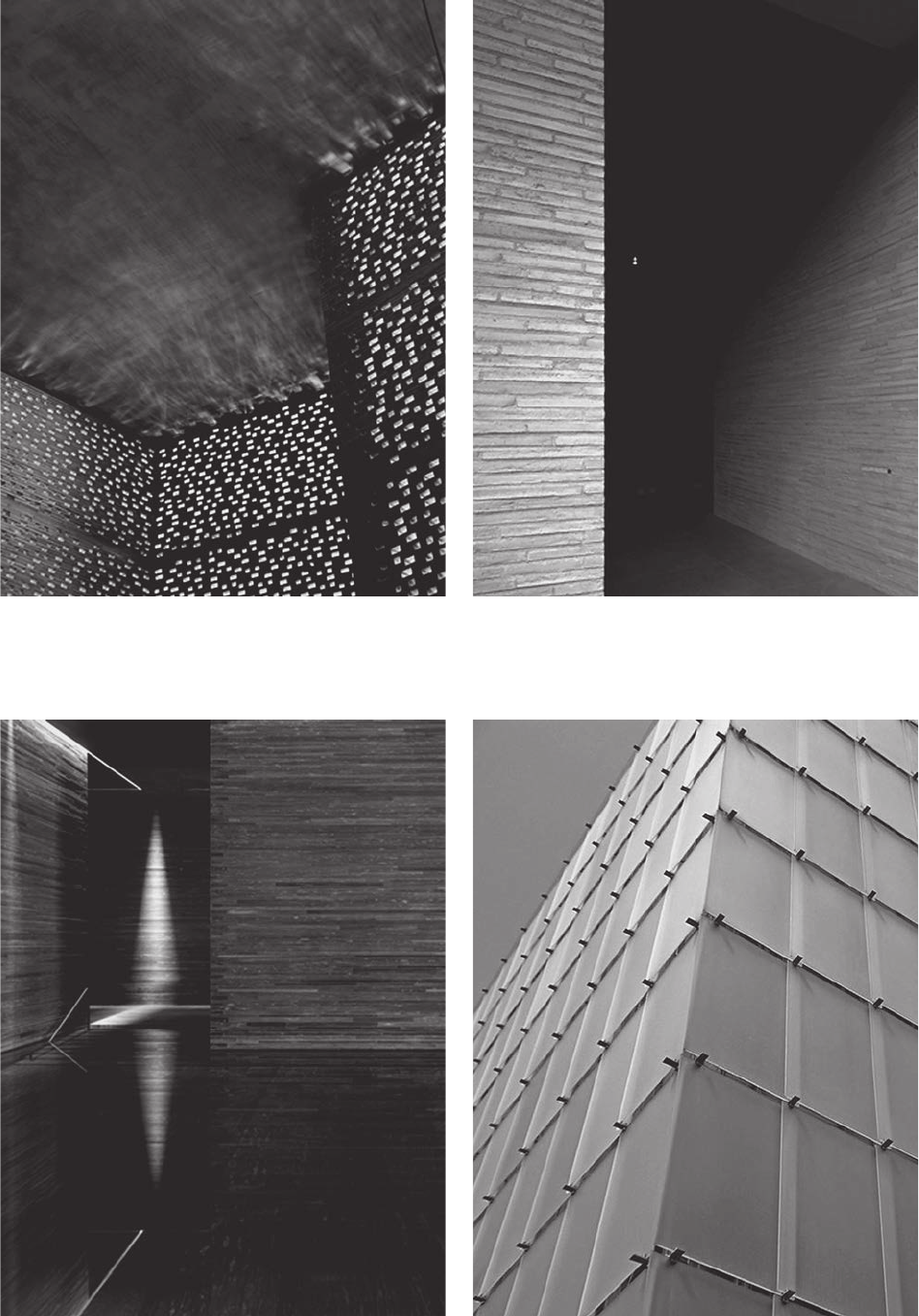
This can be easily exemplied by for instance the Ko-
lumba Diocesan Museum in Cologne. First of all the space
which had already existed was used: the new building was
erected in the place of a cathedral or more specically on
its remains. Building an addition, Zumthor incorporated it
into the city and did not invade the character of that space.
Special bricks which were used are simply laid with gaps
in between them, thus rendering an extraordinary effect.
Light which is allowed into the interior delicately pen-
etrates through the cracks, bends in specic places and the
visitors can admire its exceptional display. It slowly trick-
les inside, creating a unique atmosphere of the place.
Another example of his works is his design of the ho-
tel/spa facility in Vals. In this case he applied narrow rub-
ble stones and ultimately created an impression of excep-
tional mass and weight. Thick, seemingly too thick, walls
themselves would appear huge, overwhelming, heavy
and providing little interior space. However, combining
them with water, its delicate structure, subtlety and peace
tames the walls. This combination provided balance be-
tween two opposites. Placing them on one scale pan was
a good idea because they in fact do not repel each other in
a vulgar way; on the contrary, they harmonize and create
a space which perfectly serves the designed purposes [3].
Another example of Zumthor’s artistry is the museum
of modern art in Bregence which perfectly demonstrates
the frail nature of glass. He achieved it by emphasizing
and presenting its edges. Presented in this way, glass dis-
plays its truly delicate structure additionally contrasted by
application of bare concrete inside. The elements com-
bined in this way create an intricate structure which dis-
plays cold, austere, and neutral features. This is important
Maciej Kowaluk*
Construction quality of architecture
*
Wrocław University of Technology, Faculty of Architecture.
256 Maciej Kowaluk
Fig. 1. Kolumba Diocesan Museum in Cologne,
designed by Peter Zumthor, photo by Helen Binet.
Source: http://www.wallpaper.com/gallery/art/helene-binet
Fig. 2. Kolumba Diocesan Museum in Cologne,
designed by Peter Zumthor, photo by Helen Binet.
Source: http://www.wallpaper.com/gallery/art/helene-binet
Fig. 3. Therme Vals in Vals,
designed by Peter Zumthor, photo by Helen Binet.
Source: http://www.wallpaper.com/gallery/art/helene-binet
Fig. 4. Art Museum in Bregenz, designed by Peter Zumthor,
photo by Hans Peter Schaefer.
Source: http://www.reserv-a-rt.de
Construction quality of architecture 257
for the function of that facility as it is not supposed to be
a work of art – it is indeed ‘only’ its aesthetic packaging –
its true objective is to make people anxious to see what’s
inside.
Passing time terries everybody, including architects
who frequently look at the struggle of the buildings they
designed with its passage. Not everybody wins that ght.
Some buildings, maybe as a result of the lack of precision
or their excessive form, deteriorate in time and fade into
oblivion. Others prove triumphant and go down in history
as designs which are one of the kind and unique.
The example of Peter Zumthor demonstrates that it is
not only about aesthetics and care for external beauty but
also about a job well done, taking into account all aspects
and nuances, including those connected with the usability
of the structures, that provide the result which is praise-
worthy and timeless [1].
Quality is not about how quickly a structure can be
built or about the use of most innovative solutions but
about the ability to combine this with its usability and
sound workmanship.
This is what every architect should remember.
References
[1] Pontopulos K., Peter Zumthor, Ofce designer, 2009, 3, pp. 28–81.
[2] Stec B., Droga. Kaplica brata Klausa., Architektura & Biznes, 2007,
7/8, pp. 38–43.
[3] Stec B., Trzy rozmowy z Peterem Zumthorem, Architektura & Biznes,
2003, 2, pp. 20–39.
[4] www.archdaily.com
[5] www.mimoa.eu
[6] www.wallpaper.com
Budowlana jakość architektury
Podstawą pracy architekta jest akt kreacji. Proces projektowania
wieńczy budowa. Jest ona nalnym efektem naszej pracy, a zarazem jej
werykacją. Wyznacznikiem dobrej architektury może być funkcjonal-
ność, estetyka, wpisanie w tkankę miejską, kompozycja przestrzenno-
-bryłowa.
Jednak prawdziwym sprawdzianem dla obiektu budowlanego jest
czas. O jakości budynków decyduje trwałość rozwiązań architektonicz-
nych i ich poprawność budowlana.
Niektóre budynki są ogromnymi wydarzeniami medialnymi za sprawą
star-architekta. Jednak w przypadku, gdy za rozgłosem nie poszła jakość
budowlana, obiekty te nie wytrzymują próby czasu. Na uwagę zasługują
prace Petera Zumthora. Tworzy on projekty niepowtarzalne, bardzo me-
dialne, ale zarazem oparte o doskonały detal architektoniczny.
Należy podkreślić, że poprawność rozwiązań budowlanych jest
podstawowym elementem zawodu architekta. A w oparciu o solidny detal
można stworzyć niezwykłe obiekty i przestrzenie.
Key words: constructions, quality, architecture Słowa kluczowe: budownictwo, jakość, architektura