2010
Nr 2(28)
Educational issues
Builders used drawings from the earliest times. The
statue of the Sumerian ruler of Gudea (circa 2500 BC)
– kept in the collections of the Louvre Museum – who is
sitting on the throne and keeping a drawing of the temple
plan on his lap can be considered to be the oldest drawing
representation of the structure. Ancient civilizations con-
tributed to the development of mathematics and geometry
as well as the studies on proportions and in this way they
set the trends of architectural thought development for the
next centuries. The Roman creators of architecture com-
monly used drawings of projections and facades. In order
to make the communication with clients easier, some of
them tried to present a project by means of perspective
drawings. Such a method of presenting the space devel-
oped and was popularized only in the period of the Ren-
aissance.
Anetta Kępczyńska-Walczak*, Bartosz M. Walczak*
Contemporary architectural practice – a challenge for educational process
*
Technical University of Łódź, Institute of Architecture and Urban
Planning.
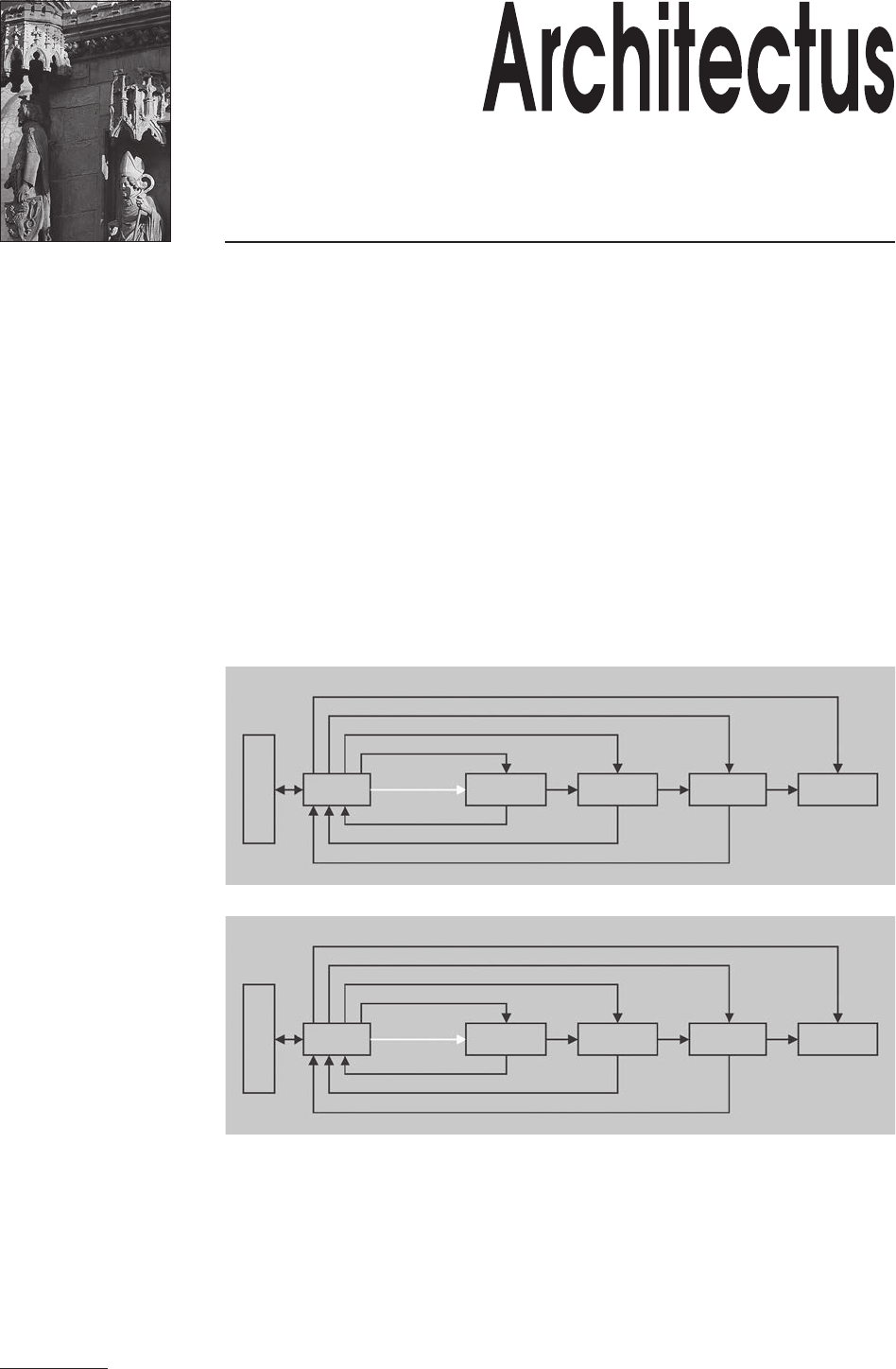
Fig. 1. The process of the project
creation on the basis of traditional
architect’s practice – freehand
or computer drawing (by authors)
concept
mind
result 1
result 2...
...result n
effect
concept
mind
result 1
result 2...
...result n
effect
anticipation
caad drawing
caad drawing
caad drawing
acceptance
evaluation
evaluation
evaluation
anticipation
manual drawing
manual drawing
manual drawing
acceptance
evaluation
evaluation
evaluation
272 Anetta Kępczyńska-Walczak, Bartosz M. Walczak
The architect was responsible not only for the project
but also for its realization. He lived and created in the direct
contact with constructions, materials and the process of ac-
tual building. Architects, who not only designed buildings
but also used their profound knowledge and numerous skills
in painting, sculpture and widely-understood engineering,
performed a particular role in the period of the Renaissance.
Dissonance between aesthetics and technology appeared
only in the 19
th
century. S. Giedion conrms that a particular
feature of the architecture of that period was isolation from
technological development, in which he observes the mani-
festation of a division into architects and constructors
1
[1,
3]. From that time, architects were concerned with design-
ing and construction engineers dealt with the realization of
projects. Thus, no wonder architects were associated rst of
all with a drawing board, T-square and pencil until recently.
1
Giedion S., Space, time and architecture, Harvard University Press,
Cambridge 1959, pp. 209–216 (chapter „The schism between architecture
and technology”).
The process of creating a design can be regarded as
invariable through centuries. It consisted in presenting
the concept, which was rst commenced in the architect’s
thoughts, in form of at drawings. The eye and hand were
responsible for the most precise imitating of the expected ef-
fect. Basically, this method has not been changed even after
the introduction of programs which aid designing (Fig. 1).
It should be explained that initially CAD abbreviation stood
for Computer Aided Drafting or drawing. In other words,
architects started using electronic drawing boards. The mo-
ment the systems were developed to the level of spatial
modelling, the letter D was extended to designing.
Apparent simplicity of operating the programs, which
dealt with composing simple objects with ready-made
elements and with the possibility of seeing them in 3D
(without the necessity to have the knowledge of descrip-
tive geometry as it used to be) gave the impression that at
the beginning of the 21
st
century it was possible for every-
one – at least in theory – to become a creator and designer
(‘design your garden!’). Fascination with spatial model-
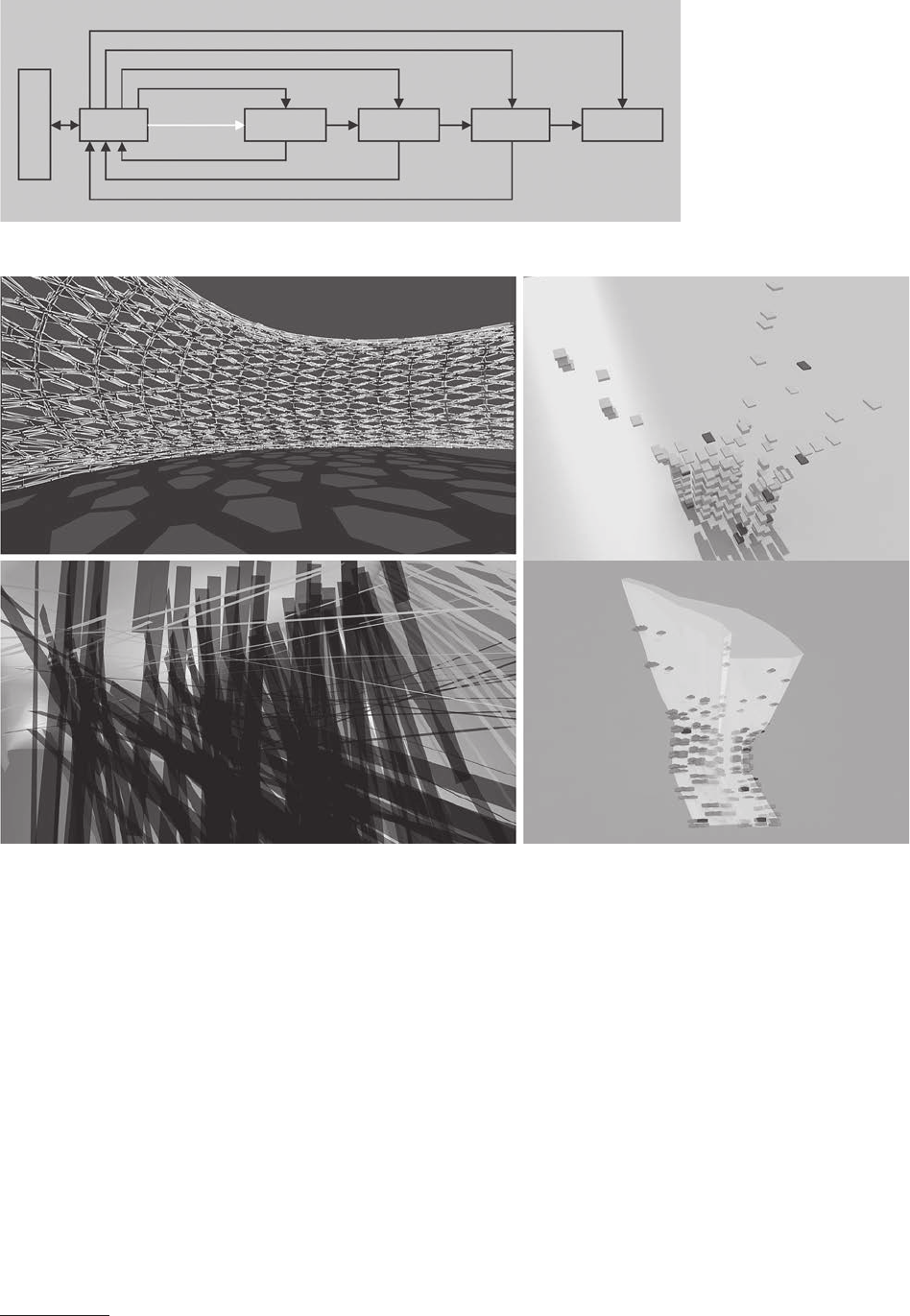
Fig. 2. The process
of the project creation
on the basis of parametric
and generative methods
(by authors)
concept
mind
expectations
curiosity
result 1
result 2...
...result n
effect
scripting
scripting
scripting
acceptance
evaluation
evaluation
evaluation
Fig. 3. Designs of IAiU students created during the rst workshops (by authors on the basis of students’ designs)
Contemporary architectural practice – a challenge for educational process 273
ling, visualisation and creation of technical documenta-
tion programs even made some people draw conclusions
that ‘thanks to new technologies architecture shall not be
the faculty of university of technology any longer but it
will come back to the academy of ne arts’
2
[4, 7].
During the recent years, numerous studies have been
written about new possibilities which are provided for
architects who use computer aided architectural design
3
[14]. Advanced tools and CAAD software, which in fact
2
Knap J., Wirtualny architekt, Wprost No. 28/2001 (972).
3
Inter alia: Świt-Jankowska B., Współczesne narzędzia pracy
architekta, a jakość nowo projektowanej przestrzeni mieszkalnej, AR-
CHITECTURAE et ARTIBUS, No. 2/2010, pp. 79–85; Krzaczek M.,
Inteligentny Modeler Graczny w komputerowych systemach wspoma-
gania projektowania budowlanego, typescript, Politechnika Gdańska,
2004; Górska A., Integrating CAD and Manual Design Methods for Visual
Science, „Materiały Seminarium Geometrii i Graki Inżynierskiej”, Script
8, Gliwice 2000, pp. 14–19.
is within each contemporary designer’s reach, allow creat-
ing and describing complicated forms and constructions
4
[8]. Thanks to new technologies, which made 3D design-
ing possible, architects who solve complex spatial prob-
lems do not have to use complicated models as Antoni
Gaudi used to do who constructed vault inverse systems
by means of cords and plummets
5
[11]. Modern architects
have at their disposal a wide range of programs which sup-
port designing, management, realisation and exploitation
of the structure. BIM programs (Building Information
Modelling) support not only the creation and transforma-
4
Kocaturk T., Veltkamp M., Interdisciplinary Knowledge Model-
ling of Free-Form Design – An Educational Experiment, [in:] Martens
B. Brown A. (eds.) Computer Aided Architectural Design Futures 2005,
Springer, Dordrecht 2005, pp. 465–474.
5
Moravanszky, A., Antoni Gaudi, Arkady, Warszawa 1983, pp.
26–29.
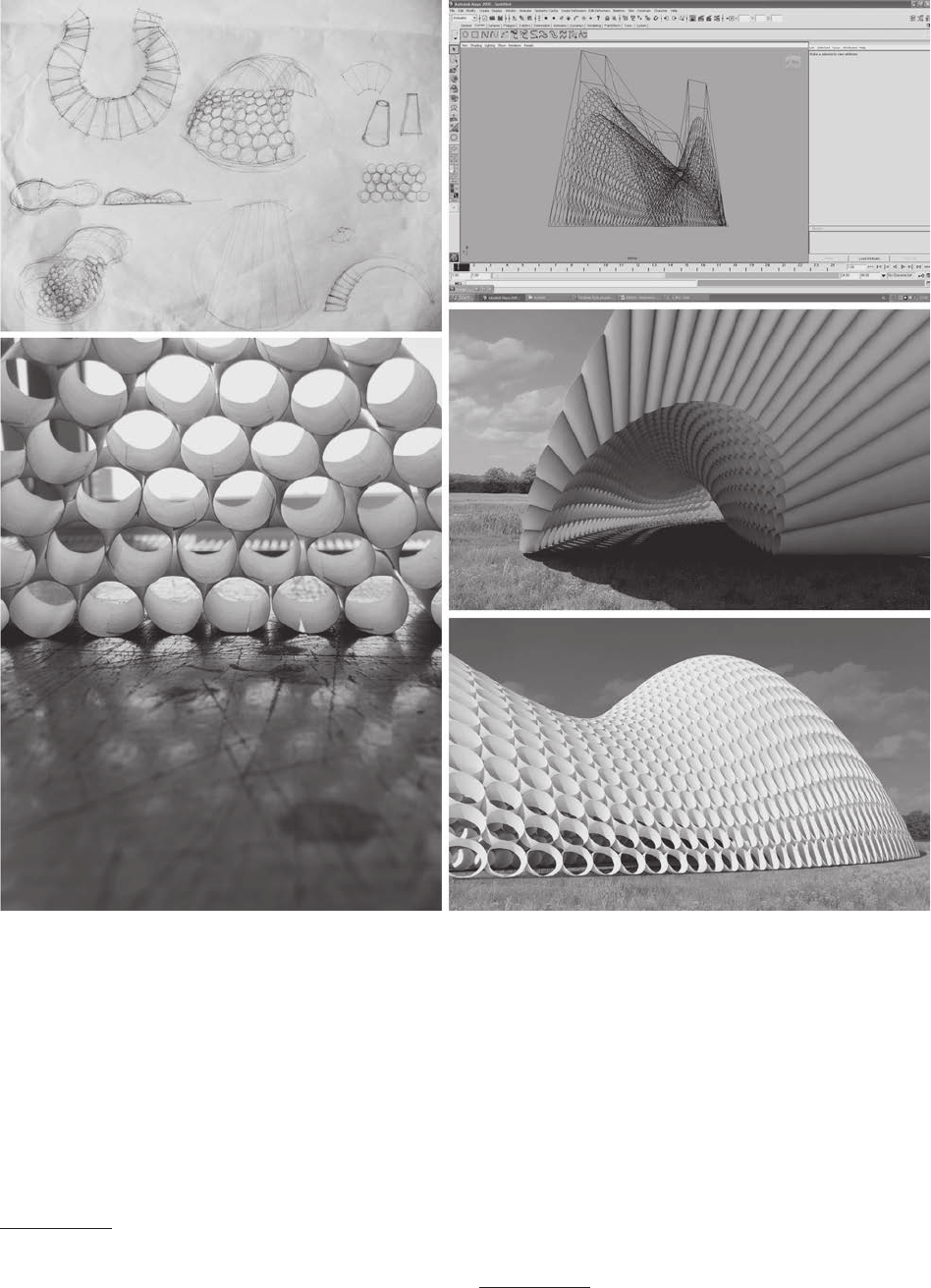
Fig. 4. Designs of IAiU students created during the second workshops (by authors on the basis of students’ designs)
274 Anetta Kępczyńska-Walczak, Bartosz M. Walczak
tion of geometry in the computer environment but they
also control the construction of the structure, quantitative,
materials, areas and cubage statements. Architects can also
operate new methods of communication and information
transmission, which are different from the old ones.
This breakthrough that we have been witnessing
nowadays consists in another transformation of the archi-
tect’s work. It is connected with a uent transition from
the design phase to its realisation, which is carried out
totally on the basis of the digital platform. It is possible
thanks to scripts (i.e. a kind of the computer program-
ming language), which has been a domain of computer
technologists and programmers. In this way, architects
are faced with new challenges. ‘In generative methods the
architect does not directly model the form (…). In spite
of this, the form is generated by the computer, while the
architect controls it by means of a code or script. The de-
signer’s work starts resembling the work of the computer
programmer very much (…). It consists in writing a com-
puter program’
6
[12]. Moreover, designing of this type
requires a high level of mathematical knowledge which
in most cases the graduates from architecture schools do
not have
7
[13].
For the rst time in the history of architectural design-
ing the process of creation is changing so diametrically.
A different cognitive model appeared – digital continuum
– smooth transition between architectural designing, en-
gineering and realization. This introduces new conditions
and dependencies between interdisciplinary domains
which are connected with the designing process. With the
6
Piasecki, M., Architektura generatywna, http://www.sztuka-archi-
tektury.pl/ (access: 13.10.2010).
7
Pottman H., Asperl, A., Hofer M., Kilian A., Architectural Geom-
etry, Bentley Institute Press, Exton 2007, pp.i–iv.
usage of generative methods, designing does not consist
in imitating a vision which was intended by the archi-
tect. It rather constitutes a quest for computer generated
forms and their transformations until a satisfying effect
is achieved. At the same time, the forms, which were not
possible to be achieved, became feasible thanks to the us-
age of generative methods of designing (Fig. 2).
Faculties of Architecture of Warsaw and Wrocław Uni-
versities of Technology are proud to have introduced the
newest solutions to the didactic process. Also in the Insti-
tute of Architecture and Urban Planning of Łódź Techni-
cal University some actions were taken up in this matter.
Already in 2007 computer work-rooms were equipped
with Autodesk Maya Complete 8.5 software. In the same
year, similarly to the next years, several-day workshops of
generative programming were organized in which invited
foreign lecturers as well as designers from well-known
architectural studios such as SOM – Skidmore Owings
and Merrill oraz Zaha Hadid Architects took part.
At that time these precursory actions were carried out
additionally to the obligatory schedule of classes. They
aroused a lot of interest and a wide response from stu-
dents. Unfortunately, so far this aspect has not been taken
into account as regards the program of education.
During the rst workshops, students were familiarised
with the possibilities of Maya program and MEL script
language (Maya Embedded Language). They experi-
mented with simple software and checking effects in the
virtual space. Later, they tried to write a script in order to
achieve a spatial form in a control way – assumed a priori
(Fig. 3). During the second edition, the participants had an
opportunity to experience a real designing process a bit –
from the idea, through its development, to the realization
of the designed structure. It should be emphasized that
thanks to such workshops, students are able to understand
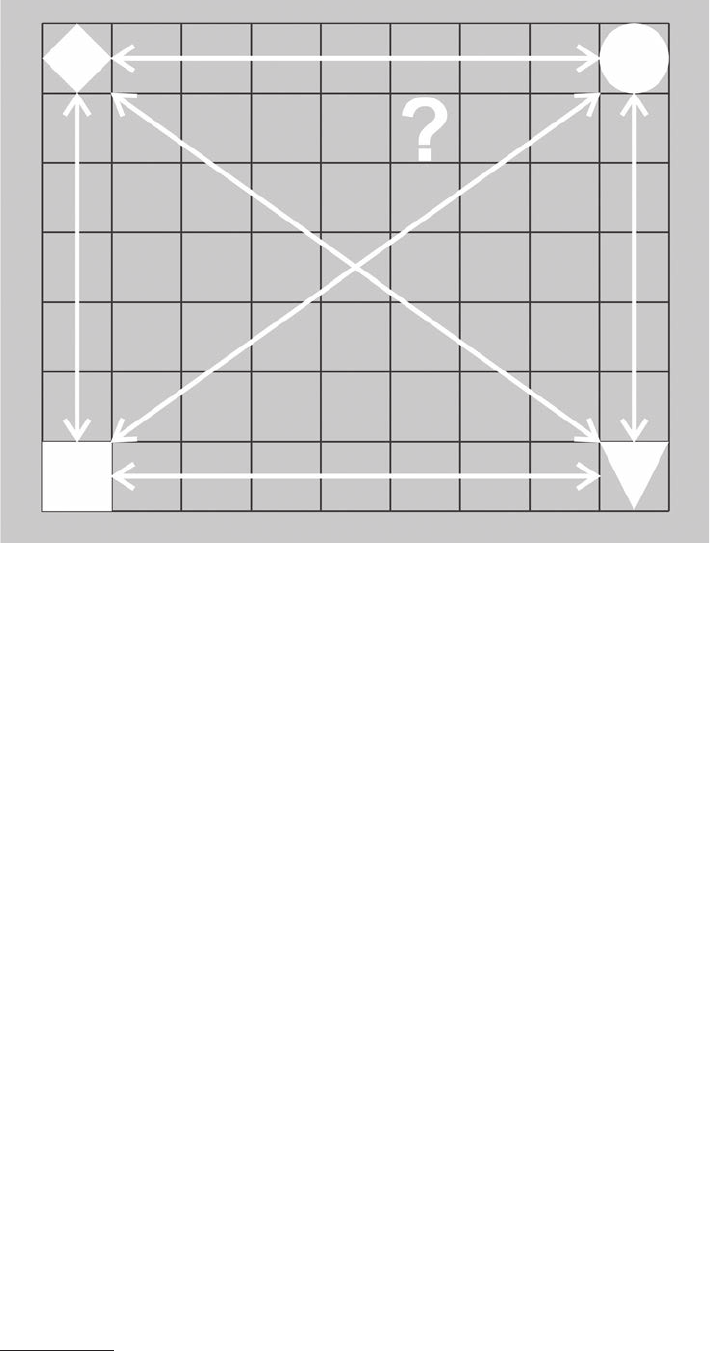
Fig. 5. Matrix illustrating
the problem of designer’s
imagination limits. The arrows
indicate transformations of gures.
With appropriate software,
we are able to obtain the shape
which ought to be in the square
with the question mark.
But are we able to imagine it
before we see the result
on the screen? (by authors)

Contemporary architectural practice – a challenge for educational process 275
the concept of generative designing but it requires a lot of
time and exercises to acquire skills allowing them to op-
erate the software uently. The results of the workshops
depended on the skills in using a new tool which aided
designing and to a lesser extent on spatial imagination as
well as a designer’s concept (Fig. 4). It is not the case
with CAAD ‘traditional’ software in which limited pos-
sibilities of the program along with the lack of skills in
operating it did not allow visualization of the idea and
imagination
8
[6, 15].
In consideration of the above, an appropriate introduc-
tion of programs which support designing in the educa-
tion of future architects acquires particular signicance.
Unfortunately, it often happens that the so called ‘CAD
education’ is identied with learning about a chosen com-
puter program and this makes the students passive and
unaware users of tools which they are not able to use in
a complete way. In order to realise how challenging gen-
erative methods of designing are, it is enough to point out
that a popular CAD application has about several thou-
sand commands which an average user uses in 10 per cent
only
9
[5, 9].
A digital revolution in architectural designing as well
as CAD implementation in the construction industry are
considered to be the most radical technological leaps in the
history of architectural designing. This revolution requires
from a designer algorithmic and procedural thinking as
well as the skill of programming. The software is more and
more complex and more difcult in operating. It also re-
8
Kępczyńska-Walczak A., Contemporary Renaissance Architect
– Yet Architect?, [in:] Muylle M. (ed.), eCAADe 2008: Architecture ‘in
computero’ Integrating methods and techniques, eCAADe/Artesis Uni-
versity College, Antwerp 2008, pp. 445–450.
9
Kacprzyk Z., Wirtualne modelowanie w projektowaniu, II Krajowa
Konferencja Naukowo-Dydaktyczna „Kształcenie na kierunku Budownic-
two – problemy studiów wielostopniowych”, Politechnika Świętokrzyska,
Kielce 2005.
quires a specialist and computer science knowledge from
the user. In the nearest future, education of the architect
will be based on computer studies to a much larger extent,
similarly to a situation in other engineering domains
10
[5].
In other words, the requirements and skills, which mod-
ern designers need, result in the fact that architecture must
again be connected with engineering more strictly, but this
time with the domains of computer studies and automatics.
Therefore, can we say that – as it used to be in the past,
when no difference between an architect and engineer-
constructor was to be found – it is possible that the dif-
ference between an architect and a computer scientist will
gradually be blurred now? Where are the boundaries of
architecture and designing? Are we able to predict the nal
shape that is expressed by means of mathematical param-
eters before we see its visualization on the screen (Fig. 5)?
Who is the real author – a human being or a machine?
In the past, buildings used to be materialized draw-
ings. At present, they are rather materialized digital in-
formation – designed and documented by means of
techniques of computer aided designing. Buildings are
also constructed thanks to the machines which are com-
puter controlled (MAD – Machine Aided Design)
11
[10].
Thus, we should appreciate great masters like Gaudi
who were able to imagine complicated spatial forms
and carry out their projects without having at their dis-
posal computer techniques, in this way creating works
of art which permanently entered the history of architec-
ture
12
[2].
10
Kacprzyk Z., op. cit.
11
Mitchell W.J., Constructing Complexity, [in:] Martens B., Brown
A. (eds.), Computer Aided Architectural Design Futures 2005, Springer,
Dordrecht 2005, pp. 41–50.
12
Cf.: Burry, M., Digitally Sponsored Convergence of Design Educa-
tion, Research and Practice, [in:] Martens B., Brown A. (eds.), Computer
Aided Architectural Design Futures 2005, Springer, Dordrecht 2005, pp.
3–40.
References
[1] Architectural Theory from the Renaissance to the Present, Taschen,
Koln 2006.
[2] Burry M., Digitally Sponsored Convergence of Design Education,
Research and Practice, [in:] Martens B., Brown A. (eds.), Computer
Aided Architectural Design Futures 2005, Springer, Dordrecht 2005,
pp. 3–40.
[3] Giedion S., Space, time and architecture, Harvard University Press,
Cambridge 1959.
[4] Górska A., Integrating CAD and Manual Design Methods for Visual
Sience, „Materiały Seminarium Geometrii i Graki Inżynierskiej”,
Zeszyt 8, Gliwice 2000, pp. 4–19.
[5] Kacprzyk Z., Wirtualne modelowanie w projektowaniu, II Krajowa
Konferencja Naukowo-Dydaktyczna „Kształcenie na kierunku Bu-
downictwo – problemy studiów wielostopniowych”, Politechnika
Świętokrzyska, Kielce 2005.
[6] Kępczyńska-Walczak A., Contemporary Renaissance Architect – Yet
Architect?, [in:] Muylle M. (ed.), eCAADe 2008: Architecture ‘in
computero’ Integrating methods and techniques, eCAADe/Artesis
University College, Antwerp 2008, pp. 445–450.
[7] Knap J., Wirtualny architekt, Wprost, 2001, No. 28.
[8] Kocaturk T., Veltkamp M., Interdisciplinary Knowledge Modelling
of Free-Form Design – An Educational Experiment, [in:] Martens
B., Brown A. (eds.), Computer Aided Architectural Design Futures
2005, Springer, Dordrecht 2005, pp. 465–474.
[9] Krzaczek M., Inteligentny Modeler Graczny w komputerowych
systemach wspomagania projektowania budowlanego, typescript,
Politechnika Gdańska, 2004.
[10] Mitchell W.J., Constructing Complexity, [in:] Martens B., Brown A.
(eds.), Computer Aided Architectural Design Futures 2005, Springer,
Dordrecht 2005, pp. 41–50.
[11] Moravanszky A., Antoni Gaudi, Arkady, Warszawa1983.
[12] Piasecki M., Architektura generatywna, http://www.sztuka-architek-
tury.pl/ (access: 13.10.2010).
[13] Pottman H., Asperl A., Hofer M., Kilian A., Architectural Geometry,
Bentley Institute Press, Exton 2007.
[14] Świt-Jankowska B., Współczesne narzędzia pracy architekta,
a jakość nowo projektowanej przestrzeni mieszkalnej, ARCHITEC-
TURAE et ARTIBUS No. 2/2010, pp. 79–85.
[15] Yüce Gün O., Anti UV: Progressive Component Design in Cross
Platforms, [in:] Muylle M. (ed.), eCAADe 2008: Architecture ‘in
computero’ Integrating methods and techniques, eCAADe/Artesis
University College, Antwerp 2008, pp. 69–75.
276 Anetta Kępczyńska-Walczak, Bartosz M. Walczak
Współczesny warsztat architekta – wyzwanie dla procesu dydaktycznego
Czy rzeczywiście istnieje architektura bez granic? Zależy jak
zdeniujemy to pojęcie. Czy granicę stanowi wyobraźnia?, zdolności
rysunkowe?, wykonalność projektu?, umiejętność obsługi programów
komputerowych wspomagających projektowanie?, ograniczenia opro-
gramowania CAAD?, a może jeszcze coś innego?
Współczesne pokolenia architektów dla rozwoju zawodowego
i osiągnięcia sukcesów potrzebują wiedzy i umiejętności wykraczających
poza zakres tradycyjnego warsztatu projektowego. W czasach renesansu
architekci nie tylko projektowali budynki. Swoją głęboką wiedzę i licz-
ne umiejętności wykorzystywali w malarstwie, rzeźbiarstwie, szeroko
pojętej inżynierii.
Obecnie projektanci, podobnie jak wówczas, penetrują niezbadane
rejony architektury i sztuki, stając przed wyzwaniami, jakie stawiają przed
nimi nowe rozwiązania technologiczne.
Dzieła największych współczesnych architektów nie mogłyby
powstać bez zaawansowanych technologii komputerowych. Należałoby
postawić pytanie: Czy technologie CAAD nie wyprzedzają wyobraźni
kreatora, podsuwając/dając gotowe rozwiązania? Jakie w związku z tym
są potrzeby i oczekiwania w stosunku do procesu dydaktycznego?
Dla pełniejszego zobrazowania problematyki przedstawiono wyniki
warsztatów zorganizowanych w Instytucie Architektury i Urbanistyki
Politechniki Łódzkiej.
Key words: architecture, education Słowa kluczowe: architektura, edukacja