2010
Nr 2(28)
One could consider the question: Culture
2
or Tact
3
in
Architecture? to be groundless. However, the meaning
of these two terms – culture and tact – should be distin-
guished. Architecture comprises both of them. Culture –
as a broadly explained semantic expression – is embed-
ded in the history of philosophy and aesthetics. Tact is
rather parvenu in this comparison but it provides a less
restrained, less historical and philosophical, approach to
culture. Culture is our common good connected with his-
torical heritage and architecture, as one of the most per-
manent arts, is its special expression.
In 2009, on the initiative of the Minister of Culture and
National Heritage Mr. Bogdan Zdrojewski, the Congress
of Polish Culture was held in Cracow. A document which
presents in its more detailed part an approach to immovable
historic monuments but understood in their broader sense
as cultural heritage was developed for the meeting
4
. Nu-
merous questions were also asked; for instance: “Is there
*
Kielce University of Technology and Włodarczyk+Włodarczyk
Architekci Studio Autorskie.
1
Kysiak M., Miasto kultur, religii narodów – wielki bazar archi-
tektury, conference materials from the Congress of Polish Architects:
„Architektura miasta w dialogu kultur, narodów, religii”, Białystok,
May 20–22, 2005, passim. The deliberations regard Poland but
they include issues regarding activities between cultures. Both the “meet-
ings” and “knowledge” which provides a broader context for communica-
tion and differentiation: what subjectively is culture and what is tact [6].
2
Culture has here two meanings. On the one hand, it is spiritual
and material legacy and on the other hand, it is an expression of high
development or skill, education, knowledge.
3
Tact (Lat. taktus=touch) should be understood here especially as
maintenance of moderation and principles of decency in architecture of
“yesterday, today and future, some gentleness.
4
Publication edited by Jacek Purchla, Raport o systemie ochrony
dziedzictwa kulturowego w Polsce po roku 1989, National Culture Center,
Warszawa, 2009 [7].
no alternative to Polish ‘today’ than: epigonic historicistic
thinking of heritage or another ‘hint of modernism (...)
5
. In
the nal notes, it was stressed e.g. that so far the experienc-
es after 1989 have demonstrated an urgent need to change
approach and treat the cultural legacy not as a burden but
as an opportunity as well as a need to look at culture as an
element of economy not as an unproductive thing
6
, espe-
cially in the context where the current legal system does not
include all elements allowing for adapting objects of archi-
tecture to changing conditions. There is no “social debate”
on the role of historic monuments and the latest cultural
assets in valuation of that heritage
7
. This is the origin of
the need to approach architecture also from the position of
“tact” and not only from the position of “culture”.
Architecture is closely connected with the art of
knowledge. For knowledge to be possible what is needed,
as Roman Ingarden proved, is discovery of cognitive val-
ues
8
. In this case it could be architecture, both historical
and modern, in culture. We learn architecture through its
5
Op. cit., p. 10.
6
It is evident that architecture is important e.g. in tourism, which in
the theory of culture is called cultural tourism. The term “cultural-tourism”
which appeared in the theory of culture is not connected only with historic
sites but also with modern ones as well with those which are connected
with “addition and subtraction”, which is closely connected with culture
or tact/culture and tact. Cognition can be in this case multicultural.
7
This also regards modern designs (20
th
and 21
st
centuries) which
“consume” the existing environment: both cultural and natural.
8
Ingarden R., Studia z teorii poznania, PWN, Warsaw 1995, passim.
He also writes this about values: (...) a value is never something that exists
for itself, but it is always the value of something. Regardless of their kind
[usefulness, moral, artworks – abbreviated by MW]. (...) There is no value
which whatsoever which exists which would exist without that something
of which it is a value, [in:] Przeżycie – dzieło – wartość, Kraków 1966, pp.
92–93; [after:] W. Juszczak, Fragmenty, Zamek Królewski w Warszawie
1995, p. 65 [4].
Małgorzata Włodarczyk*
Culture or tact in architecture?
Poland lies on the outskirts of the West and on the outskirts of the East
– at the meeting point of many cultures. This location was the founda-
tion of the phenomenon of many Polish cities combining in architec-
ture the traditions of (...) nations, denominations and cultures
1
.
224 Małgorzata Włodarczyk
impact and message – communication of ideas, functional
or sentimental and historical message. This knowledge al-
lows for placing a given object or architectural and urban
complex in culture of a given community
9
. The character
of this knowledge is “open”: it is in fact not limited by any
denition. Consequently, depending on context we can
perceive architectural activities as connected with “cul-
ture” or we will consider them “tact”. A lot of theories
10
have been developed for the events which cannot be de-
ned as knowledge and only as listing
11
. They regard e.g.
styles and rules of analysis and perception of events and
buildings as well as in the scope of continuity in architec-
ture and continuity connected with culture or tact. This
enables us to look at architecture in a broader historical
context also at present in the times of pop-culture
12
. In
this context it becomes evident that it is possible nowa-
days to look for differentiation of meanings. Mass culture,
however, should require tact from what is historical and
9
It should not be forgotten that culture and tact will be understood and
differentiated in a different way by recipients from one social culture and
those from other cultures because what will be needed then is understand-
ing between cultures – cultural communication based on aesthetics.
10
A. D’Alleva claims, however, that the borderline between theory
and methodology is uid. Com.: Anne D’Alleva, Metody i teorie historii
sztuki, Universitas, Kraków 2005, passim [1].
11
Listing also regards judgments and aesthetic convictions which
exist in a given culture, in this case in Western culture. When deliberating
the need to list and place, U. Eco notes that (...) it is difcult to say how
a given image can present things and still suggest some ‘and so on (...).
Innity in aesthetics is a subjective feeling of something that surpasses
us (...) it is a feeling that comes from a nite and perfect wholeness of
admired thing (...). This presentation modality will be called a list, index
or a catalog.”, [in:] Szaleństwo katalogowania, Rebis, Poznań 2009, pp.
9–17, passim [3].
12
In the opinion of W. Burszta pop-culture of the 21
st
century is the
domain of simultaneity. Com.: Wojciech J. Burszta, Świat jako więzienie
kultury, PIW, Warszawa 2008, passim [2].
culture in creating for the future, depending on adequacy
in capturing quality of a given architectural structure and
with subjective assessment of modication possibilities.
Of course, as the precursor of pop-culture Andy Warhol
put it, “everybody will be world-famous for fteen min-
utes” but it is the activities taken now that, despite their
subjectivity, should be cognitive and not only informative
or presentative. They should also serve cultural commu-
nication, especially in respect of such permanent artwork
as architecture.
Due to its concrete character and relative permanence,
architecture is a rm “physical foundation” of other arts
such as painting, sculpture, mosaic and as such it ranks
high in cultural heritage. This harmonization is evident
in both historic buildings and complexes and in some
modern buildings – but it is also less and less frequent
mainly for economical reasons. This is where culture and
tact in continuity is missing: addition or subtraction in
a new space development as well as creative space. Due
to its special time spread architecture is vulnerable to
change and transformation but new activities do not al-
ways demonstrate creative properties
13
. This results from
the changing weight of semiotic and ontological values,
which translates into experience and perception of activi-
ties perceived as cultural in the case of meaning resulting
from education or tactful in the case of experience.
In perception of activities connected with architecture,
what is important is architectural education which is an
indicator of culture of a given society. In Scandinavian
13
W. Tatarkiewicz indicates a contemporary denition of creation
where the notion of novelty is general as Every creation implies novelty
but not every novelty implies creativity. Furthermore, he claims that
(...) creating a new work can have different results – theoretical and
practical. W. Tatarkiewicz, Dzieje sześciu pojęć, PWN, Warszawa 2005,
pp. 309–310 [8].
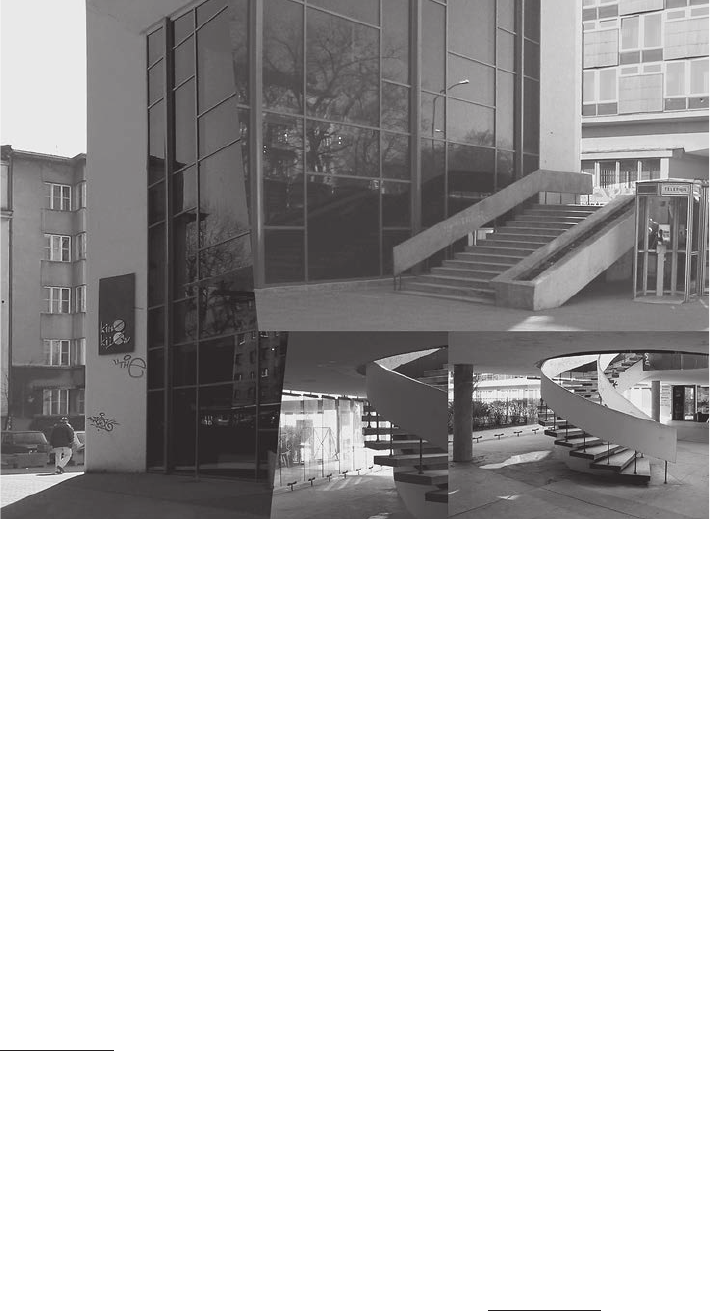
Fig. 1. Cinema “Kijów”
in Cracow, 2004
Culture or tact in architecture? 225
countries, e.g. in Finland
14
, great emphasis is placed on
this kind of social education, just like on cultural educa-
tion in general. As Jacek Woźniakowski put it: there are
countries where children are exposed to culture which
is a “living value of tradition and necessary progress”
15
.
And since architecture is the common root of all arts, its
signicance is synthesizing, both for the recipients and
authors of architectural works in which and with which
other arts harmonize, constituting a culture-forming ele-
14
M. Włodarczyk, Architektura Finlandii a edukacja architektoniczna
społeczeństwa, Doctoral dissertation, Faculty of Architecture, Cracow
University of Technology 2009. In chapter II – 8.4, p. 46 on the role of
education he states that special attention needs to be paid to the fact that
the signicance of the inuence of architecture on the general cultural and
social sensitivity is universal [in Finland – note by MW], which results
in both architectural culture in designing and tact for the context of the
place and time. The author writes that Finland decided that education
through art, including architecture, is important element of policy of the
state and by extension educational system. In the sixties, [1960s – note
by MW] an educational campaign began (...). It was decided to educate
conscious consumers. He also quotes Dariusz Śmiechowski [in:] Budow-
anie systemu edukacji architektonicznej w Polsce: Respect for our own
environment testies to the level of our national culture. The development
of the sensitivity to the quality of surroundings at young age (understood
as both built and natural environment) determines future behaviors con-
nected with the use of space in our country. Investing in education and
knowledge, including architectural education of children and youth (...)
belongs to the most effective policy [11].
15
J. Woźniakowski, Czy kultura jest do zbawienia koniecznie potrzeb-
na?, SIW Znak, Kraków 1988, p.176. The text regards also other aspects
connected with culture which demonstrate that the European culture is
“alive” and its properties include pluralism as well as a large scale of is-
sued connected with different time and different places. The author notes
that masterpieces are not created every day but they set the direction of
efforts and possibilities, and only by creating culture they can be preserved.
He stresses that (...) in a sense man is the greatest masterpiece of culture.
In that context it is especially important to pay attention to the signicance
of education in architecture as developing man’s experiences and thus
himself [12].
ment. However, in order to understand and experience
architecture the “eye and mind” should be developed as
well as the whole “apparatus” receiving graphic stimuli to
which people with their psycho-physicality are exposed
16
.
This is exactly the purpose which architectural education
serves because the very term culture, without architectural
education, easily escapes purely theoretical denition, and
more intuitive, closer to tact, denitions seem more appli-
cable. Culture subjects itself to certain rules, whereas tact
uses some implied freedom of activities, complementing
or excluding each other in art and architecture. However,
they are both connected with creating and with Vitruvian
“propriety”
17
.
The term “sustainable development”
18
, which is cur-
rently quite popular, is used in reference to more and more
aspects of our life. What does it really mean? It is my
experience that so called sustainable development has al-
ways been present in culture as an element of continuity
and heritage and “sustainable design” is the answer to the
necessary adaptation of design in architecture to the con-
ditions resulting from more and more complex activities
connected with the environmental protection in its broad
16
Ibidem, p. 197.
17
In his treatise The Ten Books on Architecture, Vitruvius lists the
component elements of architecture which include for instance beauty
(eurythmy) – the proper arrangement of members and propriety (decor)
– perfection in appearance composed of individual members which are
considered good. Currently that approach could be denote new mean-
ings and contemporary connotations with good continuity or sustainable
development in architecture design [10].
18
Sustainability (e.g. renewability, durability, balance). Often used
without translation in the eld literature, including architecture. Apart from
infrastructural and technical activities in the scope of designing buildings,
this term can also regard aesthetic and cultural aspects. This means that
in architectural activities there may appear a need to look at prospective
behavior of future recipients in respect of the connection between cultural
and natural environments.
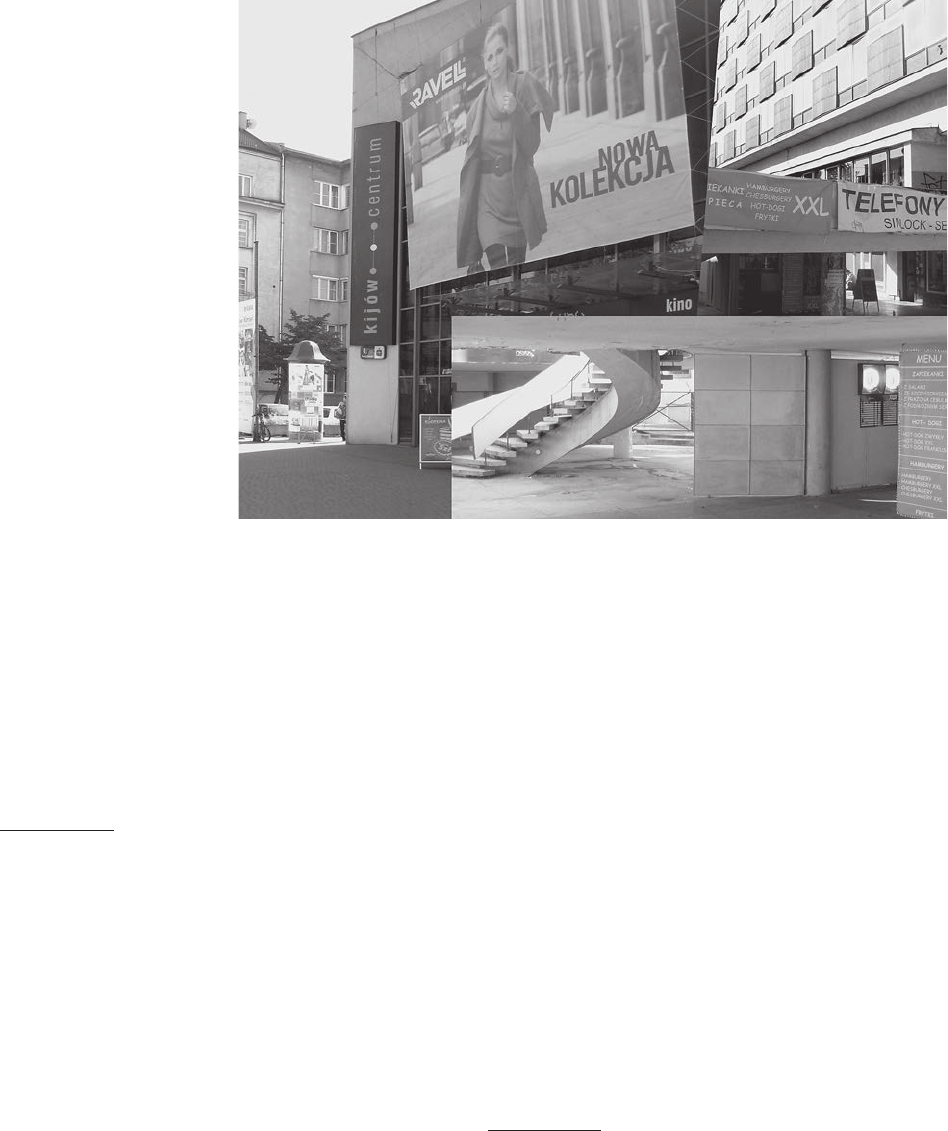
Fig. 2. Cinema “Kijów”
in Cracow, 2010
226 Małgorzata Włodarczyk
sense, including urban and natural landscape. The con-
text of the place and time as indicators of culture in archi-
tecture is here a “supplementary” element. At present, in
a sense, the word culture is replaced with the term sustain-
able development. A similar thing can be observed also in
activities connected with architectural heritage where for
a long time now conservation more and more often has
been replaced with a broader term revitalization.
Let us focus on some examples. Is covering a build-
ing with advertising banners cultural? It is not. The per-
son who was commissioned to design a building did not
design a holder for banners. The plague of advertising
banners destroys not only historic buildings but modern
ones too: without any culture and without any tact. Un-
fortunately, this also regards objects of so called high cul-
ture such as museums, theaters or cinemas (Figs. 1–2).
People who take such decisions evidently violate copy-
right unless the author has given a permission but I have
never noticed in my career that efforts at obtaining such
permits are made. The building and conservation au-
thorities say they have no legal capacity to do anything
about that. It is not exactly true because “anything that is
not prohibited by law is legal”, so these institutions are
allowed to inform potential law breakers about applicable
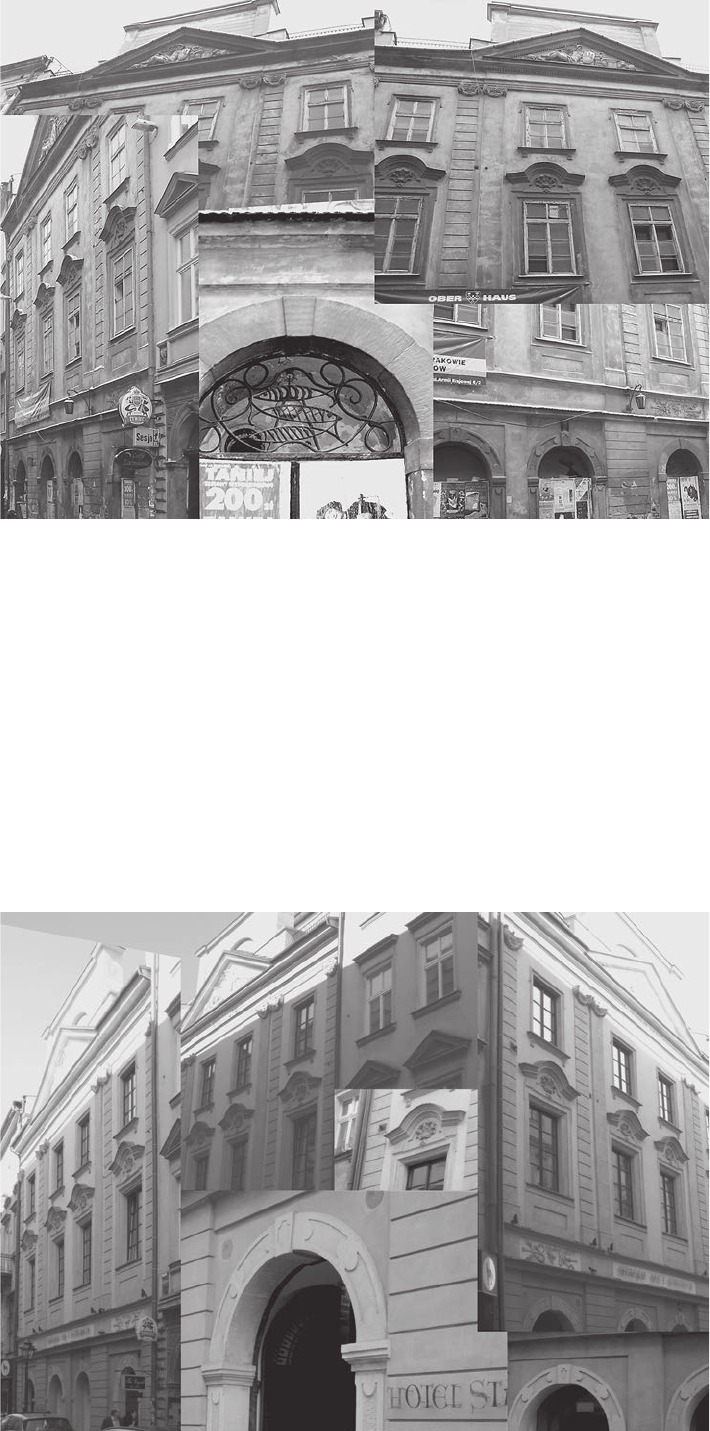
Fig. 3. House at Szczepańska
Street 5, Cracow – before
remodeling; former Restaurant
“Pod Trzema Rybkami”
Fig. 4. House at Szczepańska
Street 5, Cracow – after
remodeling; at present
“Hotel Stary”

Culture or tact in architecture? 227
regulations and consequences of their violation. Simi-
lar problems regard thermal modernization of buildings.
Where is then culture in architecture? It is rather rare (Figs.
3–4). So called “right continuity” principle is vanishing
19
.
It is not supported by “sustainable development”. How-
ever, tact could be useful in this situation but this seems to
be rare as well.
The deliberations presented above provoke reection
on the problem in general. However, maybe the ques-
tion asked at the beginning was asked in the wrong way.
Maybe not culture or tact but culture and tact. This could
be a logical conclusion. Without harmonization of those
apparently synonymous terms and sensitivity in approach
to what is culture and what is tact in architecture, there
19
J. Żórawski, O budowie formy architektonicznej, Arkady 1973,
passim [13]. In his book J. Żórawski notes the psychological aspect of
experiencing architecture. He stresses the juxtaposition of subjective and
objective experience in the theory of architecture and adds that develop-
ment evolves towards subjectivity. So the more in architecture, “good
continuity”, which is an element of culture in designing and activities
regarding architecture, is important to experience it. He continues simi-
lar deliberations and writes that It will be a mistake if we do not nd the
input form in the derivative form but we will see other formal values.
(...) architecture operates only through adding or subtracting parts. (...)
architecture is exclusively about constant and permanent continuity of
existing systems. (...) Most probably we will achieve that by experiences
and not by reasonable inquiries, [in:] Wybór pism estetycznych, Univer-
sitas, Kraków 2008, pp. 148–152 [14].
will never be any culture or any tact. The same way a cul-
tured man should be tactful and a tactful man should be
cultured (although it is not always so). One can be cul-
tured in general that is “educated” but at the same time
with no tact at all. And the other way around – one can
be extremely tactful that is “considerate” and know noth-
ing about culture and in this sense not be cultured. I think
that it is similar with architecture in which we are dealing
with both culture and tact and we keep searching for the
answer to the question: “culture or tact”. Everybody will
look for the answer in their own way. One thing, however,
seems to be certain – right continuity and reection over
the past, presence and future encompass both meanings
of seemingly the same notion. Paraphrasing a philosophi-
cal thought: we satisfy the soul not when we know much
about culture, but when we understand and feel
20
. In cul-
ture, like in nature, development takes place gradually
and slowly and (...) intellect enjoys, in a sense, sensual
pleasures although coming not directly from senses, in-
tellect enjoys aesthetic pleasures
21
. Ultimately then it is
culture and tact in architecture, and not culture or tact.
20
Ignatius of Loyola: What lls and satises the soul consists, not
in knowing much, but in our understanding the realities profoundly and
in savoring them interiorly, [in:] W.E. Lynch SJ, The integrating mind,
Sheed and Ward 1962, p. 82; [after:] J. Woźniakowski, op. cit., p. 292.
21
I. Kant, Antropologia w ujęciu pragmatycznym, Warsaw 2005,
pp.175–176.
References
[1] Burszta W.J., Świat jako więzienie kultury. Pomyślenia, PIW, War-
szawa 2008.
[2] D’Alleva A., Metody i teorie historii sztuki, Universitas, Kraków
2005.
[3] Eco U., Szaleństwo katalogowania, Rebis, Poznań, 2009.
[4] Ingarden R., Studia z teorii poznania, PWN, Warszawa, 1995.
[5] Juszczak W., Fragmenty, Zamek Królewski w Warszawie, 1995.
[6] Kysiak M., Miasto kultur, religii narodów – wielki bazar architek-
tury, conference materials from the Congress of Polish Architects:
„Architektura miasta w dialogu kultur, narodów, religii”, Białystok,
May 20–22, 2005.
[7] Purchla J. (ed.), Raport o systemie ochrony dziedzictwa kultur-
owego w Polsce po roku 1989, National Culture Center, Warszawa,
2009.
[8] Tatarkiewicz W., Dzieje sześciu pojęć, PWN, Warszawa, 2005, pp.
309–310.
[9] Wilkoszewska K. (ed.), Czas przestrzeni. Anna Wolińska, Doświad-
cze nie nieskończoności – rozległość czy skupienie?, Universitas,
Kraków 2008.
[10] Vitruvius, O architekturze ksiąg dziesięć, Prószyński i S-ka, War-
szawa 1999.
[11] Włodarczyk M., Architektura Finlandii a edukacja architektonic-
zna społeczeństwa, Doctoral dissertation, Faculty of Architecture,
Cracow University of Technology, 2009.
[12] Woźniakowski J., Czy kultura jest do zbawienia koniecznie potrzeb-
na?, SIW Znak, Kraków 1988.
[13] Żórawski J., O budowie formy architektonicznej, Arkady, 1973.
[14] Żórawski J., Wybór pism estetycznych, Universitas, Kraków 2008.
Kultura czy takt w architekturze
Wydawać by się mogło, że postawione pytanie: kultura czy takt w ar-
chitekturze jest bezzasadne. Niemniej jednak należy rozróżnić wyrazy:
kultura i takt. Jedno i drugie w architekturze występuje. Kultura jako
szerzej pojmowane semantycznie wyrażenie jest umocowane w historii
lozoi. Takt jest bardziej „parweniuszem”, ale jednocześnie pozwala
na swobodniejsze podejście do wyrazu „kultura”. Poruszając się wśród
przykładów: Czy kulturalnym jest obwieszanie budynków reklamami?
Nie jest. Ktoś kto projektował na czyjeś zlecenie, nie projektował „wie-
szaka dla reklam”. Osoby decydujące o takim działaniu naruszają prawo
autorskie. Chyba, że autor wyraził zgodę, ale z moje dotychczasowej
praktyki nie wynika, aby takie starania o zgodę były czynione. Władze
architektoniczne i konserwatorskie zasłaniają się niemożnością działania.
Nie jest prawdziwe, bo w świetle obowiązującego prawa to, co nie jest
zabronione, jest dozwolone. I nic nie stoi na przeszkodzie informowaniu
potencjalnych entuzjastów naruszania tego prawa o wynikających z tego
konsekwencjach. Podobnie jest z występującą obecnie powszechnie tzw.
termoizolacją. Gdzie jest zatem kultura w architekturze? Jest niestety
wyjątkiem. Zanikła tzw. dobra kontynuacja. Nie wspomaga jej też obecnie
modny „zrównoważony rozwój”. Mógł by być tu pomocny „takt”, ale jego
też najczęściej nie ma. W końcowej reeksji: jednak kultura i takt.
Key words: culture, tact, architecture Słowa kluczowe: kultura, takt, architektura