2026
1(85)
Joanna Jadwiga Białkiewicz*
Defining biomimetic residential architecture:
indicators and selected projects
DOI: 10.37190/arc260104
© by the Author/Authors. Licensee WUST.
Published in open access. CC BY-NC license.
Abstract
This article examines contemporary biomimetic strategies in collective housing, showing how the implementation of criteria that dene bio-
mimetic architecture aects the form, functioning, and underlying concepts of such projects. The selected case studies are characterized by the
dominance of megastructures and vertical constructions, mixeduse programs, spatial exibility, and a drive towards energy self-suciency. Biomi-
metics manifests itself in advanced technological systems, biologically inspired processes and materials, and architectural forms referencing natural
structures. The analysis highlights the potential of biomimetic solutions to improve residents’ quality of life, foster social relations, increase climate
resilience, and reduce environmental impact. At the same time, it underscores that biomimetic collective housing remains largely conceptual, reect-
ing both growing interest in the idea and signicant challenges to its realization.
Key words: biomimicry, biomimetics, bioinspiration, biophilia, residential architecture
Introduction
The term biomimetics emerged in the midtwentieth cen-
tury and initially referred to medical engineering solutions
inspired by the structure and functioning of living organisms.
In the 1970s, Werner Nachtigall and Göran Pohl, in Bau-
Bionik: Natur – Analogien – Technik, formulated the con-
cept of biomimetic design as a scientic discipline and
ex tended it to other elds of human activity, including ar-
chitectural design (2013). From that point on, biomimetics
began to be referenced in relation to architecture, along-
side the term biomimicry introduced in 1997. In her book
Biomimicry: Innovation Inspired by Nature (1997), Janine
Benyus dened biomimicry as the imitation (mimesis) of
life (bio) in order to seek solutions in nature to problems
arising in dierent elds of human activity. Drawing from
nature can occur at dierent levels – from the micro scale,
where sources of inspiration are individual elements or
functionalities of living organisms, to the most synthetic
macro scale, that is, modeling based on the overall func-
tioning of ecosystems
1
.
In the human–nature relationship, architecture is a eld
with a profound impact – both on the natural environment
and on human beings themselves – by shaping the space
of human functioning. The dichotomy between the built
and natural environments is deeply rooted in human con-
sciousness. The concept of biomimicry challenges this by
advocating for abandoning an anthropocentric perspective
and returning to nature as a model, measure, and mentor.
Benyus wrote about achieving true sustainability by mak-
ing cities more like forests, i.e., grounding the functioning
of civilization in strategies that are the only legitimate ones
because they have been developed over millions of years
by nature. The idea of applying biomimicry in architecture
has gained signicant popularity over the past decade and
a half, tting squarely within both contemporary needs
1
The literature most often distinguishes three levels of mimicry in
biomimetics: emulation of the form and/or function of an organism or
its elements (Organism Level); emulation of organism behaviour and its
interaction with the environment (Behaviour Level); and emulation of
natural ecosystems (Ecosystem Level).
* ORCID:
0000-0002-8827-9397. Faculty of Architecture, Cracow
University of Technology, Poland, e-mail: joanna.bialkiewicz@pk.edu.pl
42 Joanna Jadwiga Białkiewicz
(ecology and sustainable development) and technological
capabilities (scientic and technological progress). How-
ever, despite the interest among architects, built works
are primarily individual buildings, most often public-use
structures or experimental pavilions and installations that
demonstrate biomimetic structures or building materials. If
biomimetic architecture is to have a real impact on the en -
vironment of human life, it must create the places closest to
people and their dwellings. The aim of this paper is to pres-
ent examples of biomimetic residential architecture and to
identify the dominant tendencies and dening characteris-
tics of this type of project.
State of research
Among the available publications on biomimetics, there
is a lack of studies devoted specically to residential ar-
chitecture; however, reference should be made to literature
addressing the general issues of biomimetics in architec-
ture. Michael Pawlyn (2011) indicated both the features of
architectural objects and the principles of the design pro-
cess itself, in accordance with the idea of biomimicry. The
fundamental concept is a shift away from linear systems
typical of the industrial economy (from cradle to grave)
towards circular systems, in which every waste product si-
multaneously serves as a resource (from cradle to cradle).
Guidance for architects includes reliance on renewable en-
ergy sources, use of local resources, and form optimization.
As with living organisms, buildings should have their own
metabolism and adapt to change. Siobhan Barry and Greg
Keee (2010) described the concept of Bio-City – a biomi-
metic highrise operating in a closed metabolic cycle, using
green algae that produce biomass subsequently burned in
bioreactors. Maibritt Pedersen Zari has addressed biomim-
icry in urban design in several works. According to Pe der-
sen Zari, the human-built environment must function as
a living system composed of cooperating organisms, rather
than a set of buildings lacking interconnections (Pedersen
Zari 2018). At the core of Pedersen Zari’s theory, further
developed with Katharina Hecht (Pedersen Zari, Hecht
2020), is the denition of ecosystem services – what the
ecosystem provides and produces – and how this can be
mimicked in technology and design strategies for urban-
ism. At the same time, Pedersen Zari noted that there is no
clear denition of biomimetics specically for architects,
and that only an analysis of dierent interpretations of the
concept can help determine which approaches yield the
most eective results. In Poland, Jakub Onyszkiewicz, in
his doctoral dissertation Elementy biomimetyki w projek-
towaniu architektury w środowisku zrównoważonym [Ele-
ments of biomimetics in designing architecture in sustain-
able environment] (2019), dened features of a biomimetic
architectural object – largely consistent with Pawlyn’s cri-
teria – and evaluated around 200 projects accordingly. In
numerous publications after 2020, biomimicry is posi-
tioned as a tool for sustainable design (Ilieva et al. 2022;
Borham, Croxford and Wilson 2024; Ali Hussein, Abbas
Abbood 2024). An attempt to relate biomimetics directly
to residential architecture was made by Mohamed Reza
Akbarian and Mahdis Kolivand Salooki (2025, 50, 51),
who listed key indexes of biomimetic architecture grouped
into categories: mimicking form and structure, mimicking
processes, mimicking ecological systems, sustainability
and energy eciency, harmony with the environment. In
-
dependently of biomimetic concepts, studies of contempo-
rary residential architecture address the aordable housing
crisis (Fishman 2018), sustainable building (Mazur 2021),
and issues such as the individualization of multi-family
housing (Stoiljković, Petković-Grozdanović and Jovanović
2015), resilience (Paulichen, Leite and Pina 2019), modu-
lar, non-predetermined solutions (Djukanovic, Alegre and
Bastos 2025), architectural recycling of existing structures
(Hernández Falagán 2021), and other proposals to adapt
housing to the needs of a postindustrial and postpandemic
society (Seruga 2014; Klochko 2022). It should be noted
that many of these proposals can fall within the criteria of
biomimetic architecture.
For the purposes of this paper, information on particular
projects and built works was drawn mainly from websites:
architectural studios, competitions (e.g., eVolo Skyscraper),
and individual portfolios.
Methods
The adopted research method is a comparative multi-
ple case study. The set comprises projects with the same
function – collective housing – albeit in most cases it is not
their only function. Due to the relatively small number of
completed buildings, the principal object of analysis is the
design itself, as the material manifestation of an architec-
tural concept. The selected projects, apart from the func-
tional criterion, share the realization of certain criteria that
dene their biomimetic character. The criteria described
below were identied based on an analysis of selected liter-
ature that addresses, in theoretical terms, the application of
biomimetics and biomimicry in architecture. The way each
project meets the adopted criteria is presented descriptively
in a table. Based on this comparison, conclusions are drawn
as an attempt to synthesize the issue in the form of answers
to the following questions:
1. What objectives of residential architecture are served
by the application of biomimetic elements?
2. Which characteristics of contemporary collective
housing projects result from the implementation of criteria
dening their biomimetic nature?
Criteria defining the biomimetic character
of residential architecture
A fundamental issue in establishing criteria that dene
a biomimetic character is the need to clarify the terms “bio-
mimetics” and “biomimicry” in relation to architecture.
Pohl and Nachtigall (2015) refer to the “classical” deni-
tion of biomimetics, according to which it is a scientic dis-
cipline concerned with the adaptation and implementation
of biological structures, processes, and principles of devel-
opment in technology. This corresponds to the denition
formulated in the international standard ISO 18458:2015
(Verbrugghe, Rubinacci and Khan 2023), which states that
biomimetics focuses on functional analysis of biological
Dening biomimetic residential architecture: indicators and selected projects 43
systems, their abstraction into models, and their transfer
and application in technology. In the light of these deni-
tions, biomimetic products are primarily technological in-
novations reproducing biological systems at the structural
level (e.g., biomimetic materials) or process level (e.g.,
a ventilation system modeled on termite mounds). Eec-
tive classication of bio-inspired technological solutions
requires a system that reects their developmental history
and the transfer of knowledge from biology to technology
(Speck et al. 2017). The fundamental indicator of wheth-
er we are dealing with a biomimetic product/object is thus
the transfer of a selected biological principle. Some authors
treat “biomimetics” and “biomimicry” as synonyms; others
distinguish between biomimetics–oriented towards techno-
logical innovation, imitating natural forms and structures
in a de-contextualized way (Mitxelena, Genua 2017) – and
biomimicry, which sees in nature primarily normative prin-
ciples of ecological sustainability. In this view, nature is not
only a source of biological models for technical elds, but
a source of standards that dene the ecological “correct-
ness” of human technological outputs. The aim of biomim-
icry is therefore to emulate natural systems and strategies
in order to create solutions that meet human needs while
simultaneously minimising the environmental impact of
civilisation. In architecture, this means creating a built
environment that is sustainable and potentially regenera-
tive towards natural ecosystems. As Henry Dicks (2016)
emphasized, biomimicry cannot be reduced to copying
nature’s systems without integrating the resulting technol-
ogies into the circular systems characteristic of the biologi-
cal world. Table 1 presents selected denitions of the terms
biomimetics, biomimicry, bioinspiration, and biophilia that
have appeared in the literature over the last ve years. For
the purposes of this study, a synthetic denition is adopted:
biomimetics is an interdisciplinary design process based
on understanding and abstracting biological principles and
transferring them to technology. The concept of biomimic-
ry, according to which nature is not only a model but also
a measure and a mentor (Dicks 2016), adds to biomimet-
ics goals aligned with sustainability and focuses on linking
technological solutions to environmental challenges. The
ideological premise of biomimicry is to renew the human–
nature bond by addressing civilisational problems in ways
that emulate the functioning of ecosystems.
From these denitions of biomimetics and biomimicry,
the following determinants of biomimetic architecture can
be identied (Fig. 1):
1. Transfer of solutions from nature to technology
through an interdisciplinary design process (collaboration
among architects, biologists, engineers, chemists, etc.);
technological innovation creating synthetic counterparts of
biological structures and functionalities.
2. Inspiration derived from a specic biological model.
Structural and functional biomimetics. This includes the
imitation of the form, structure, or functionality of a living
organism (animal or plant).
3. Biomimetic materials (synthetic materials that mimic
the structure and functions of natural ones); biomaterials.
4. The purpose of technological innovation – ecological
functioning of buildings and their complexes:
– minimizing environmental impact;
– designing material cycles and building life cycles
within circular systems, recycling;
– harvesting energy from renewable sources, energy ef
-
ciency;
– reducing CO
2
emissions;
– retention and recovery of rainwater;
– natural ventilation.
5. Structures exhibiting biological qualities such as op-
timality, resilience, and adaptability. Autopoietic and kinet-
ic systems enabling buildings to respond and adapt autono-
mously to changing environmental conditions.
In the context of concepts related to architecture, it is
also worth noting the term biophilia, dened primarily as
the creation of built environments that foster and deepen
the human–nature relationship. This is crucial because, un-
like biomimetics and biomimicry, it directly concerns the
user of architecture, aiming at their psycho-physical well-
being. Including biophilic aspects thus seems necessary,
especially in residential architecture, which constitutes the
built environment closest to every person. Accordingly,
the set of indicators is supplemented by biophilic elements
(Uchiyama, Blanco and Kohsaka 2020), such as:
– enabling direct contact with nature;
– introducing plant elements;
– using natural materials;
– the presence of water;
– biomorphic shapes and patterns;
– ensuring optimal temperature and air quality, access
to daylight or its simulation.
Contemporary residential projects can be broadly di-
vided into those that respond to current needs and those
anticipating future needs. Housing – especially collective
housing – struggles with numerous problems arising from
urban phenomena such as urban sprawl, dispersion of de-
velopment, and deepening social and spatial segregation.
Historic centres are emptying, while gated luxury estates
form enclaves accessible only to the wealthiest. Biomimet-
ic architecture – through its innovative, interdisciplinary,
and technologically advanced dimension – requires high
nancial outlays for research, materials, and experimental
implementations etc. Consequently, the few realized resi-
dential buildings that aspire to be biomimetic are typically
high-end and located in the wealthiest urban centres of the
world. Dominant, instead, are futuristic conceptual proj-
ects. The underlying idea is to emulate biological systems
that evolve, adapt, and survive by developing qualities such
as resilience and regeneration. Hence, biomimetic design
features numerous visions of habitats for extreme environ-
ments or able to ensure human survival in the face of vari-
ous catastrophes.
Selected biomimetic
residential projects
The examples of biomimetic residential projects cited in
this paper are divided into two typological groups: urban
high-rises and specialpurpose residential habitats. For se-
lected architectural objects, the implementation of individ-
ual indicators is described in Table 2.

44 Joanna Jadwiga Białkiewicz
Ilieva et al. 2022
Gerola, Robaey
and Blok 2023
Sanglier Contreras et al.
2023
Chayaamor-Heil 2023 Sedira et al. 2024
Bijari, Aflaki and
Esfandiari 2025
Akbarian, Kolivand
Salooki 2025
Biomimicry
An interdisciplinary
method for studying
and transferring principles
and mechanisms from
nature to solve design
challenges. Biomimicry
serves both innovation
and sustainability;
its guiding ideas are
biosynergy (renewing
the human–nature bond)
and ecosystem
regeneration.
Focuses on the ecological
sustainability effect.
Nature is a source
not only of biological
models for technology
but also of normative
principles. Three
typologies are listed,
with medium, strong
or very strong
sustainability effects:
normative inspiration,
normative imitation,
normative integration.
Imitating natural forms,
processes, and functions
to solve human (technical)
problems. In architecture,
the goal is to design
buildings and structures
with the qualities
of biological organisms,
such as efficiency,
resilience, and
adaptability.
Biomimicry and
biomimetics are based
on the same methodology
of an interdisciplinary
approach to design
through understanding
and relying on biological
models. Biomimicry adds
to biomimetics the goals
of sustainable
development and focuses
on linking design
and technological
solutions to environmental
challenges.
Learning and emulating
nature’s strategies to solve
human problems; reliance
on “life’s principles”
to achieve resilience and
adaptability characteristic
of living organisms.
The pursuit of
innovative and
sustainable solutions
to human problems
by imitating biological
patterns and strategies
developed by nature.
An innovative design
approach that emulates
time tested natural
solutions to human
problems and challenges;
by studying and emulating
nature’s strategies,
effective and sustainable
solutions for humanity
can be developed.
Biomimetics
Biomimetic design
identified with
the practice of
biomimicry.
Focuses on the
reproduction of innovative
biological functions.
Three typologies are listed
with very weak, weak,
and medium sustainability
effects: technical
inspiration, technical
imitation, technical
integration.
Identified with
biomimicry
An interdisciplinary
design process based on
understanding and
abstracting biological
functions and principles
and transferring them
to technology.
Biology-based
technology. The study
of the formation,
structure, and function
of substances and
materials of biological
origin, as well
as biological processes
and mechanisms, with
the aim of synthesizing
similar products using
technology.
Nature inspired forms
adapted/applied in
architecture in two
ways: as replicas of
natural forms or
by reproducing
a biological process.
Biomimetic architecture
– an innovative
and sustainable design
approach that imitates
structures, processes,
and systems from
the natural world.
Bio-inspiration
A creative design
approach based on
observing biological
principles (unlike
biomimicry, the goal may
be purely aesthetic
or symbolic).
Identified with
biomimetics
– biologically inspired
design.
Using nature as
inspiration in design
without direct copying;
nature provides ideas
and patterns for creative
solutions, often relying
on advanced technology.
Biophilia
Creating buildings and
environments that foster
deep human–nature
relationships.
Architecture focused on
creating a close bond
between building users
and nature.
Table 1. Definitions of biomimetics, biomimicry and related terms (biophilia, bio-inspiration) in the literature after 2020 (elaborated by J. Białkiewicz)
Tabela 1. Definicje biomimetyki, biomimikry i pojęć pokrewnych (biofilia, bioinspiracja) w literaturze po 2020 (oprac. J. Białkiewicz)

Dening biomimetic residential architecture: indicators and selected projects 45
Bioscrapers – Citytrees
– biomimetic residential high-rises
Population growth and its concentration in urban cen-
tres necessitate the intensication of urban fabric, which
can essentially be pursued in two ways: by erecting mixe-
duse highrises or mixeduse horizontal structures. While
garden-city concepts of low-rise development still attract
supporters and promoters today, high-rises are likely to
dominate in the future
2
. As early as 1964, Warren Chalk
presented the concept of Capsule Homes, i.e., a multi-res-
idential tower grouping modular housing units (capsules)
around a circulation core. Most biomimetic residential
high-rise projects remain conceptual today; however, a few
completed examples can be identied. These include “Ver-
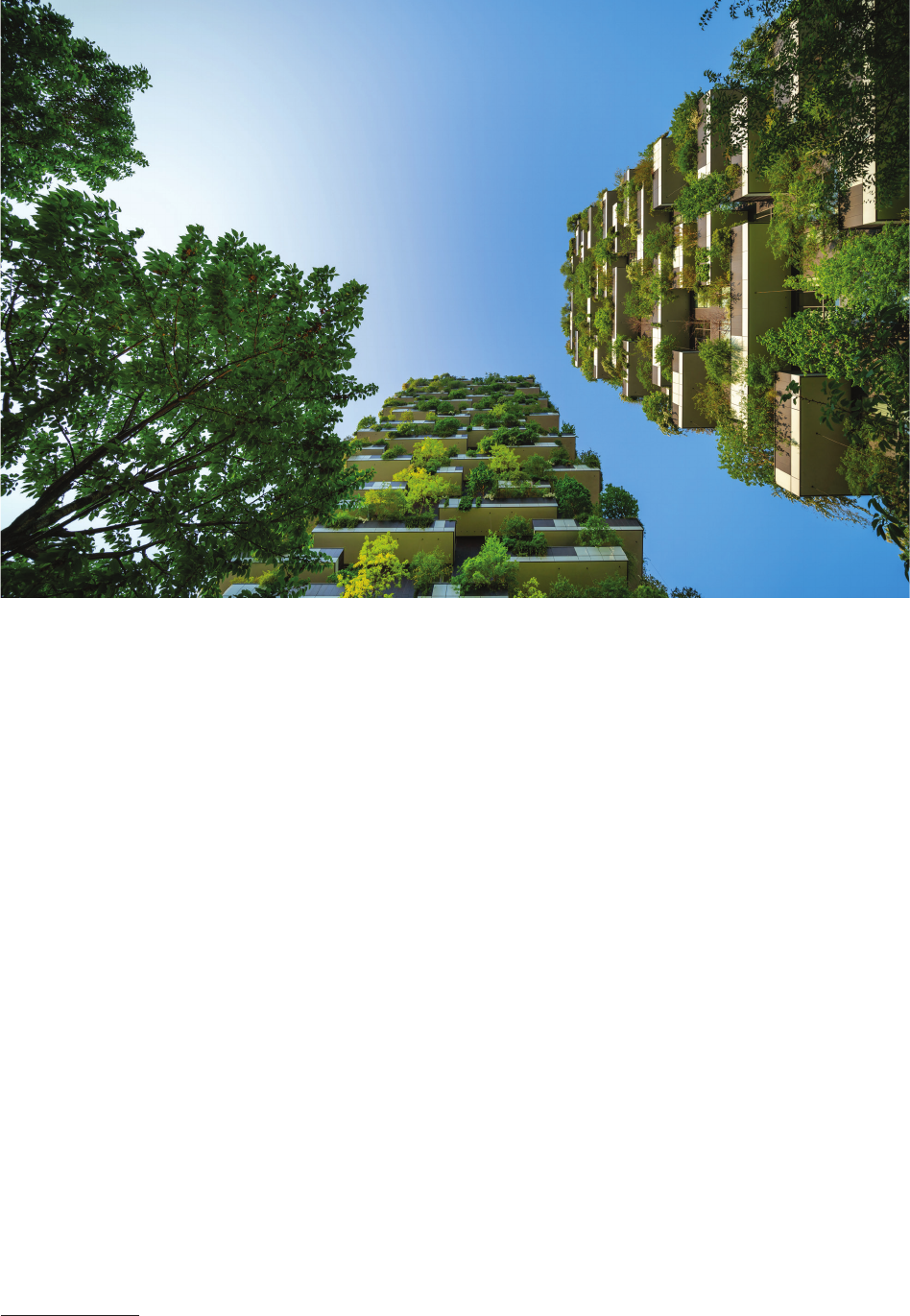
tical Forests” (Bosco Verticale, Fig. 2) designed by Stefa-
no Boeri, which the architect himself describes as “home
for trees and birds, that also houses humans”. The concept
behind the Bosco Verticale denes not only the urban and
technological features of the project but also its architec-
2
The expansion of linear structures (low-rise development amid
greenery) leads to longer circulation routes, and consequently, higher
operating costs.
tural design and expressive qualities (www.stefanoboeri-
architetti.net). The rst pair of such towers was complet-
ed in Milan in 2014 (Liu 2023). Subsequent towers were
designed for Chinese cities Huanggang (2017–2021) and
Nanjing (2016), Dubai (2022), Lausanne in Switzerland
(The Tower of Cedars, 2015), and Tirana in Albania (2017).
The concept of a residential high-rise with trees and other
vegetation integrated into the façade – undeniably striking
visually – has become popular among designers. Examples
include Tree Tower Toronto (Penda Design, 2017), Tour
Végétale in Nantes (Edouard François, 2011), and Riviera
Tower in Athens (Foster + Partners, 2021–2025). Urban
“tower – forests”, although they meet some biophilic crite-
ria, beyond the general idea of imitating trees, lack a con-
crete, identiable biological model.
More biomimetic are the projects of Vincent Callebaut,
who describes himself as an Archibiotect, pointing to the
characteristic fusion of architecture, biology, and technolo-
gy in his work. Alongside botanical inspirations (e.g., The
Rainbow Tree in Cebu, the Philippines), Callebaut has de-
signed structures that mimic a variety of biological struc-
tures – for example, a DNA-chain-inspired construction
(Agora Garden in Taipei, Taiwan, 2010–2018; Citytrees,
2014) and honeycomb structures (Honeycomb Towers in
Paris Smart City 2050, 2014–2015). Notably, Agora Gar-
NATURE
ARCHITECTURE HUMAN
Technical mimesis
Reproducing
biological structures, processes,
and systems in technology.
GOAL:
Creating innovative solutions
for design challenges
BIOMIMETICS
►Interdisciplinary design process
based on understanding biological
systems
►Technological innovation
►Inspiration from a specific
biological model
►Biomimetic materials
and biomaterials
►Ecological and sustainable
operation of buildings based on
mimicking natural processes:
energy generation from natural
sources, water cycling, recycling,
and designing the building's life
cycle in accordance with natural
circular cycles
►Imbuing buildings with
characteristics of living organisms:
autopoietics, responsiveness,
resilience, kinetic and adaptive
systems
Normative Mimesis
Imitating strategies developed
by nature to create
a sustainable built environment.
GOAL:
A good relationship
between the built environment
and the ecosystem
BIOMIMICRY
►Presence of bioactive greenery
and natural elements in the living
environment
►Natural materials
►Presence of water
►Biomorphic shapes
►Caring for the quality of the
building's internal environment
(air, temperature, natural light),
striving to achieve optimal
conditions for people
Creating a relationship between
humans and nature within
architecture.
GOAL:
Human well-being
and deepening
their connection with nature
BIOPHILIA
Fig. 1. Determinants of
biomimetic residential
architecture based on the features
of biomimetics, biomimicry
and biophilia – diagram
(elaborated by J. Białkiewicz)
Il. 1. Wyznaczniki
biomimetycznej architektury
mieszkalnej na podstawie cech
biomimetyki, biomimikry
i biofilii – schemat
(oprac. J. Białkiewicz)

46 Joanna Jadwiga Białkiewicz
Innovation/Technology Biological inspiration
Biomimetic materials
and biomaterials
Ecological functioning
(designed)
Autopoiesis, adaptation,
resilience
Biophilia
The Bionic Tower
(project, Shanghai)
1997–2001
Eloy Celaya, Maria
Rosa Cervera, Javier
Gómez
An innovative structural
system enabling
the construction of a 1228 m
high residential tower
– a technological imitation
of a tree.
The form and structure of
the building are inspired by
the cypress tree – its green part
consists of scale-like membranes
through which wind of any
strength can pass without moving
the tree. The method of anchoring
the building is modeled on
the cypress root system–shallow
but highly branched.
Synthetic materials
modeled on
the structure of bone
and spider webs, with
a thin plastic exterior
imitating the properties
of skin.
A biologically inspired structure
enabling natural ventilation;
energy generated from wind
and sunlight through a turbine
at the top of the tower and solar
panels. Rainwater and seawater
retention.
Tall structure resistant
to wind, vibration, fire,
flood and earthquakes;
ventilation and
air-conditioning systems
self regulate temperature
in response to external
conditions.
The design includes 12 floors
covered with vegetation,
the presence of water,
and internal gardens.
Condo Tower
(New Sky Condos)
(project, Lima)
2013
B+U Architects
Technologically advanced
material solutions. Replacing
load-bearing walls with
a modified concrete shell
that effectively transfers
weight.
The building’s façade is inspired
by the structure of skin, with
pores and hair that open and close
automatically depending on
external conditions. The form
and color scheme of the building
evoke associations with
a biological organism.
A silicone composite
capable of movement
(lengthening,
shortening
and rotation) under
the influence of
external conditions.
Openings in the building
structure surrounded by
composite “hairs” regulate
temperature and sunlight
and absorb air pollutants.
The building adapts
automatically to external
conditions, its form
is dynamic.
Plant elements and gardens on
balconies; biomorphic shapes;
opening glass walls blurring
the line between interior
and exterior; control over
temperature and sunlight
inside.
Paris – Smart City
2050
(project, Paris)
2014–2015
Vincent Callebaut
Innovative technologies for
the construction, acquisition,
storage and processing
of energy by buildings.
The tower structure is modeled
after a honeycomb (Honeycomb
Towers) and mangrove trees
(Mangrove Towers). The solar
shield structure is modeled after
dragonfly wings.
Biomaterial: algae.
The buildings are designed to
generate more energy than they
consume, including through solar
panels and wind turbines.
Rainwater retention and
greywater recycling. Green algae
on the facades produce biofuel
that is processed in bioreactors.
Mechanical ventilation systems,
CO₂ and pollutant absorption.
Buildings adapt their
metabolism to changing
external conditions.
Trees and vegetation on
building façades; interaction
with nature – cultivated
gardens for residents;
biomorphic shapes.
A Living Resilience
(project)
2017
Jack Francis,
Rebecca Beer,
Elina Savvas,
Andrew Waller
Façade “scales”; geometry
based on the Fibonacci
sequence; chitin scales
3D printed.
Inspired by the structure
and function of a pine cone
(morphological inspiration).
Chitin façade
scales–fully recyclable
biopolymer.
A façade system of “scales” that
open and close in response to
the time of day, protecting
against the cold while
maximizing solar energy gain.
A responsive façade
enhances the building’s
resilience to extreme
temperature fluctuations;
an adaptive, dynamic
structure.
Plant elements integrated
within the “scales”; designed
to ensure thermal comfort and
access to sunlight; a space
dedicated to agriculture.
Table 2. Examples of biomimetic residential architecture projects according to selected criteria (elaborated by J. Białkiewicz)
Tabela 2. Przykłady biomimetycznych projektów z zakresu architektury mieszkaniowej, według wybranych kryteriów (oprac. J. Białkiewicz)

Dening biomimetic residential architecture: indicators and selected projects 47
Innovation/Technology Biological inspiration
Biomimetic naterials
and biomaterials
Ecological functioning
(designed)
Autopoiesis, adaptation,
resilience
Biophilia
Wertykalna Oaza
(project)
2019–2021 FAAB
The ECO-DNA system
and the “green skin” system
are managed by residents via
a mobile app. The “green skin”
is an AI-assisted system
– a designed combination of
selected plants and microorganisms.
Developed in collaboration
with specialists in dendrology,
climatology, zoology, and
microbiology.
Mimicking metabolic functions,
the façade is designed to resemble
living skin.
Composition of plants
and microorganisms
on VOS WCC panels.
The ECO-DNA system enables
the conversion of solar energy
into electricity. The “green skin”
regulates temperature, absorbs
CO
2
and pollutants, produces
oxygen, and also supports
rainwater retention. Natural
transpiration processes help cool
and humidify the air.
Depending on the selection
of “green skin” system
components, the building
can withstand both
extremely low and high
temperatures.
The building’s appearance
evolves with changes to
its biological components.
A vertical garden system
within the façades, designed
to maintain air quality,
regulate temperature,
and reduce indoor noise levels.
Mitosis (project)
2020
GG-loop
The project utilizes parametric
modeling software.
The building volume and
residential cluster layouts are
derived from simulations
of parameters related to
specific site conditions
and user needs.
Inspired by the biological process
of mitosis (cell division)
– the entire concept is based on
modules that can be combined
in various configurations.
Biomaterials;
prefabricated timber
panels.
The selected materials and plants
absorb CO
2
. The ecosystem
is capable of generating more
energy than it consumes.
The system’s modularity
allows for extensive
adaptability. The entire
complex is designed to
evolve with its
surroundings.
The concept envisions
an ecosystem where residents
live surrounded by plants and
animals. Vertical gardens and
entire forested sections are
integral to the design. Natural
materials (wood), large glazing,
and the feeling of being immersed
in nature from every perspective.
Lilypad (project)
2008–2017
Vincent Callebaut
Prototype technologies for
an amphibious city; innovative
materials.
Inspired by the giant water lily
Victoria Regia amazonica.
Polyester fiber skin
coated with titanium
dioxide–absorbs
pollutants like a plant;
use of biomass.
The building is designed to be
completely self-sufficient
– achieving a positive energy
balance with zero CO
2
emissions.
It produces oxygen, utilizes
waste, and purifies water.
The structure enables
human habitation in
the middle of the ocean
and can move in accordance
with ocean currents.
The entire structure is covered
with hanging gardens;
the presence of water
(a central lagoon); biomorphic
shapes; spaces designated
for agriculture.
Coral Reef
(project, Haiti)
2011
Vincent Callebaut
A composition of prefabricated
residential modules placed on
an artificial pier constructed on
seismic piles, incorporating
technology for harvesting
energy from water movement.
Inspired by coral reef structure. Local timber
The complex is energy
self-sufficient, composed
of passive residential units.
Hydroelectric turbines beneath
the pier convert the kinetic
energy of the tides into electricity.
The structure is
earthquake-resistant.
The complex can expand
and develop without limit.
The roof of each residential
module is also a garden;
natural material – wood;
glazing, access to sunlight.
Puffer Village
(project, Benin)
2021
Sajjad Navidi
An innovative system for inflating
or filling the substructure
and superstructure of residentia
l
units with water,
triggered by water level data
from specialized sensors.
The biological model is the
pufferfish – a fish characterized
by its ability to inflate its body
with water or air.
No information
available.
Each residential unit
independently generates energy
from tidal kinetic energy as well
as through photovoltaic panels.
The structure responds to
changes in water levels
during tides and heavy
rainfall.
Each residential unit is
surrounded by a wooden fence
covered with plants cultivated
through aquaponics.

48 Joanna Jadwiga Białkiewicz
Table 2 cont. Examples of biomimetic residential architecture projects according to selected criteria (elaborated by J. Białkiewicz)
Tabela 2 cd. Przykłady biomimetycznych projektów z zakresu architektury mieszkaniowej, według wybranych kryteriów (oprac. J. Białkiewicz)
Innovation/Technology Biological inspiration
Biomimetic naterials
and biomaterials
Ecological functioning
(designed)
Autopoiesis, adaptation,
resilience
Biophilia
In Absentia (project)
2021
DADA – Deo
Alrashid Alam
Design Architecture
Innovative energy generator
technologies and “cells” that
convert ocean waste into 3D
printing material.
The designers focused on
the process of creating
an independent ecosystem that
grows organically, starting with
energy production. A biomorphic
element can be noted – the energy
generators are called Energy
Elephants.
The material for
printing residential
units is sourced from
recycled ocean waste.
Energy is generated in power
units from the kinetic energy of
waves and wind. The units,
called “cells” (Nexus), collect
plastic waste and print additional
modules. Each residential capsule
is equipped with a wind turbine,
photovoltaic façade, and a full
waste recycling system.
The essence of the project
is the organic growth of the
development, which
produces its own
components solely using
energy from renewable
sources.
The project envisions the
presence of trees and green
spaces between the residential
capsules.
Home Alive
(project)
2021
Terreform ONE
EML (Engineered Living
Materials) technology. Plants
and microorganisms grow on
parametrically designed
polymeric matrices to form
the structure. The system is
complemented by 3D-printed
clay inserts. Developed in
collaboration with biologists
and microbiologists.
There is no specific biological
model; the project does not so
much mimic biological functions
as it harnesses them through
technology. The concept is based
on “synthetic biology”.
Biomaterials
– plants and animal
microorganisms,
engineering materials
composed of living
cells.
Regenerative bioactive materials
are designed to provide all
“ecosystem services”, actively
filtering air, water, and soil.
A residential structure built
from self-replicating, self-
regulating, and self-healing
materials, responsive to
changing environmental
conditions.
Biomaterials – vegetation
serves as the building material;
biomorphic forms; blurring
the boundary between the
residential unit and nature.
Adaptive Cell
(project) 2022
Karolina
Kosmowska,
Beniamin Walecki,
Anna Wojtynia
Advanced technological
materials and structural
solutions enable the capsules
to move under any conditions.
The shape and structure are
modeled on plant cell anatomy;
the capsule shells feature nodules
inspired by the armor of desert
beetles of the genus Onymacris.
Biomaterial – algae;
a construction material
modeled on
spiderwebs.
The algae harvest solar energy
and produce pulp that serves as
biofuel. The bionic coating
allows for water absorption
and regulates light access.
Thanks to its variable
structure and color, the
capsule adapts to
environmental conditions
(desert, forest, mountain).
The capsule also moves on
water. Thanks to its shell, it
can obtain water in desert
conditions. Single-person
capsules can be combined
into teams.
The mobile residential capsule
allows humans to experience
direct contact with nature in
any chosen biome.
The Corallite
(project) 2023
Chris Soria,
Sharon Mathew,
Steffany Brady,
Stefania Ingaramo,
Aimee Platt,
Chun-Tien Kuo,
Brandon Geiger
Material innovation
– the tower’s exterior cladding
consists of ETFE
and a nanotechnology-based
material with anti-corrosion
properties and energy-loss
prevention.
Inspired by corals (morphological
and functional).
Synthetic materials
with biological
properties.
A skyscraper powered entirely by
a closed-loop system converting
ocean waste into energy.
Seawater is filtered
and desalinated.
Adaptive structure – each
building module can be
detached. The purpose of
the structure is to provide
shelter and sustain
the ecosystem. It features
an extendable external
“shell” designed to
withstand hurricane-force
winds.
Vertical gardens integrated
into the building structure;
biomorphic, rounded forms;
interior gardens; access to
sunlight.
Dening biomimetic residential architecture: indicators and selected projects 49
Fig. 2. Bosco Verticale, Milan, Boeri Studio, 2014 (source: courtesy of Stefano Boeri Architetti, photo by Dimitar Harizanov)
Il. 2. Bosco Verticale, Mediolan, Boeri Studio, 2014 (źródło: dzięki uprzejmości Stefano Boeri Architetti, fot. Dimitar Harizanov)
den is among the few such projects realized
3
. Callebaut
has proposed entire ensembles of biomimetic towers as
solutions for future cities, including the world’s largest
metropolises such as Paris (Paris Smart City 2050, 2014–
2015) and New York (Treescrapers, 2023). While New
York’s Treescrapers are primarily based on the concept of
high-rises with vegetation-covered façades, the Paris proj-
ect shifts away from the primacy of the biophilic factor to-
wards a more technological biomimicry approach, drawing
inspiration from the structure and functionality of natural
forms. Among the eight proposed tower prototypes are, for
example, Photosynthesis Towers with biofaçades covered
with algae. A similar idea of high-rises using algae to pro-
duce energy appears in the Bioscrapers project for Chicago
(project by Walter R. Hughes, 2020). Close in character to
Treescrapers is Mitosis, designed for Amsterdam by GG-
loop. The Cross-Laminated Timber (CLT) panels used by
the architects appear to be among the most popular mate-
rials (alongside synthetic polymers and nanomaterials) for
shaping biomimetic residential buildings.
The vast majority of biomimetic projects are futuristic
visions. Conversely, one may note that a signicant propor -
tion
of visions of future cities are based precisely on bio-
mime tic architecture. An example is “AI × Future Cities”
– a series of images created by architect and designer
3
The building’s environmental qualities are conrmed by LEED
Gold and Low Carbon Building Alliance certication at the diamond
level.
Manas Bhatia using the AI tool Midjourney. These visions
are dominated by towers with façades covered in algae or
trees. Fascinated by how insects and animals build their
habitats, Bhatia also creates visions of “symbiotic archi-
tecture”, according to which in the future humans might
inhabit growing, metabolizing structures that look and
function like trees. In 2013, the U.S. studio B+U Architects
presented a biomimetic residential tower for Lima (Peru).
In this project, a reduced presence of biophilic elements
can be observed alongside a strong biomimetic component,
namely the concept of replicating natural functionalities in
a synthetic manner. Among the futuristic visions of biomi-
metic residential architecture, there are also works by Pol-
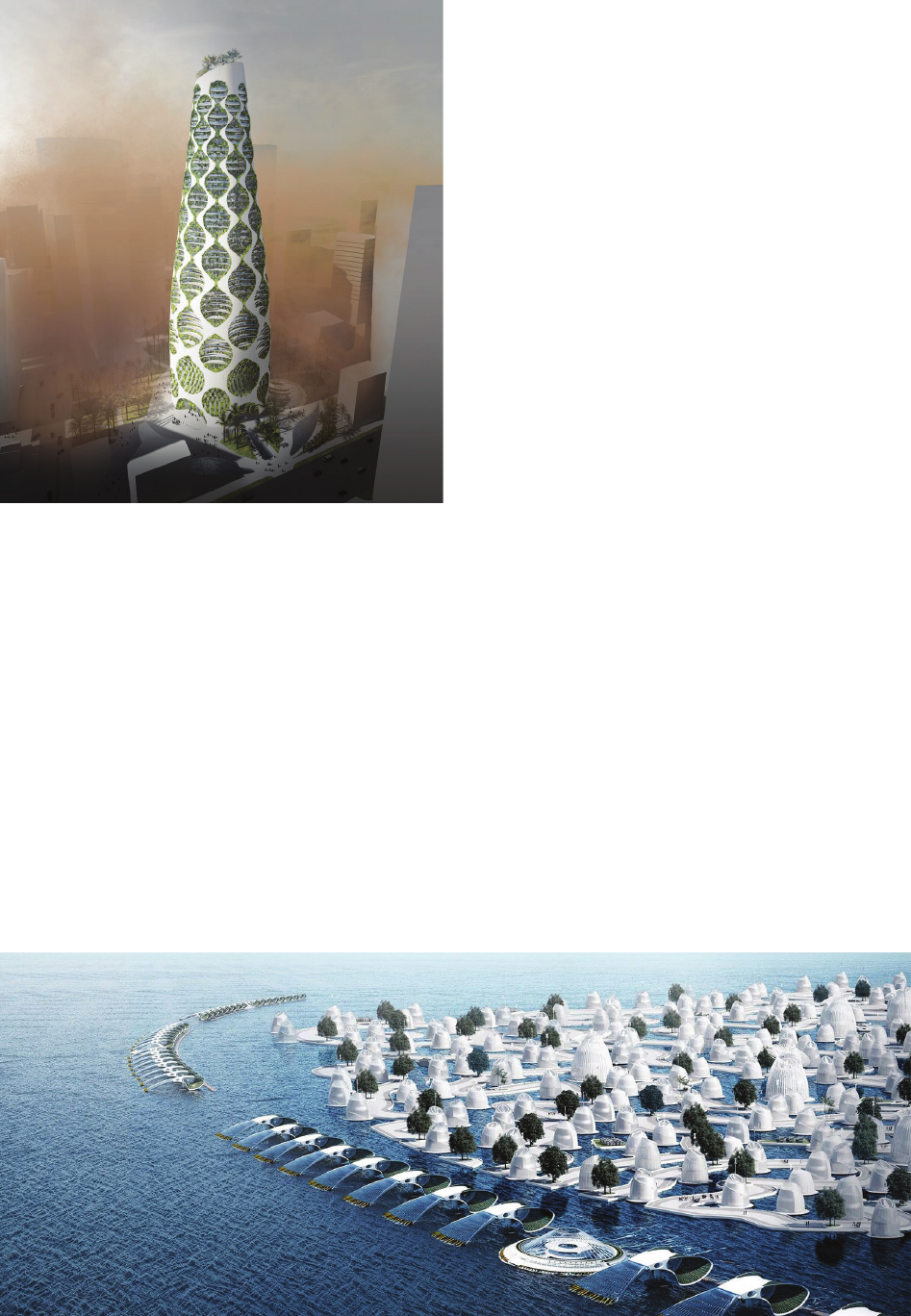
ish architects, such as the Vertical Oasis project by FAAB
Studio (Fig. 3). It is a design of an advanced, technolog-
ically driven biomimetic building combining residential,
oce, and commercial functions, whose metabolic func-
tionality is dened by a “green skin” – a designed compo-
sition of plants and microorganisms. Interesting examples
of futuristic residential architecture concepts are provided
by projects showcased in thematic competitions, such as
24H – organized by the portal if – ideas forward. From the
2017 edition devoted to biomimetic housing comes, for ex-
ample, the commended project A Living Resilience (proj-
ect by J. Francis, R. Beer, E. Savvas, A. Waller) – a tower
that mimics the structure and function of a pine cone. In
futuristic visions, residential towers sometimes reach enor-
mous sizes; an early, pioneering example is Bionic Tower
(project by M.R. Cervera, J. Pioz, E. Celaya, 1997–2001),
50 Joanna Jadwiga Białkiewicz
which could accommodate up to 100,000 residents across
300 oors (project by Cervera, Carreras-Solanas). A com-
mon feature of biomimetic high-rises is the integration of
multiple functions, oering residents proximity and easy
access to oces, shops, and service points. Architects also
tend to incorporate publicly accessible communal spaces
that promote social interaction.
Biomimetic special-purpose habitats
In addition to residential architecture whose main goal
is to provide comfortable and healthy living environments
and social functioning, another thread relevant to biomi
-
metic solutions is special-purpose housing. These are resi-
dential projects that also respond to challenges and threats
such as natural or climate-related disasters or global armed
conict. The guiding idea is resilient and regenerative ar-
chitecture capable of ensuring human survival. Another
desirable natural quality in the built environment is adapt-
ability–the ability to adjust to any, even extreme, living con -
ditions. Hence numerous projects of habitats in “hostile”
ecosystems, e.g., in hot arid climates.
Among futuristic visions of future human settlements,
a recurring concept is oating or on-water housing units.
This responds to threats from climate warming and the risk
of signicant sea-level rise. These visions may take the
form of vertical ecosystems, such as The Corallite (proj-
ect by CannonDesign, 2023), whose structure is modeled
on coral. More frequently, however, we see onwater settle-
ments composed of modular housing units. Examples in-
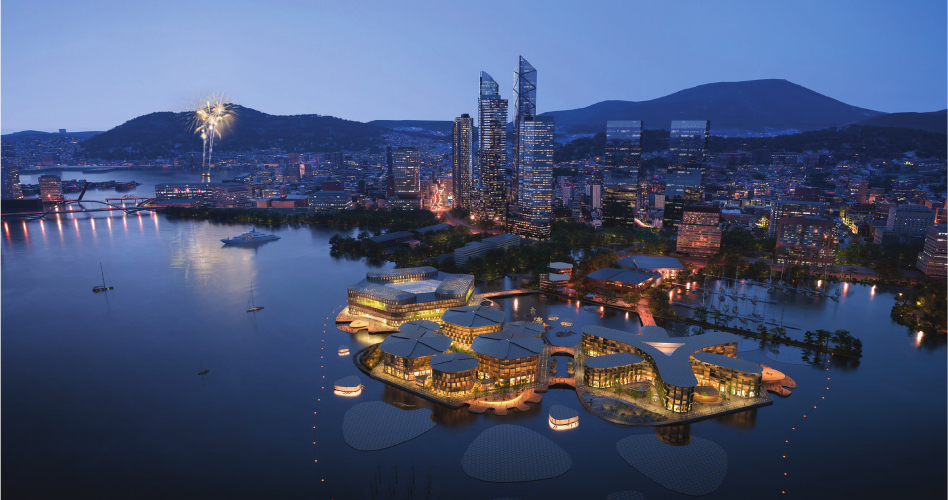
clude Lilypad by Vincent Callebaut (2008–2017) and In
Absentia by DADA – Deo Alrashid Alam Design Architec-
ture (Fig. 4). A prototype on-water settlement already in-
tended for implementation is the Oceanix for the South Ko-
rean port city of Busan (2022, BIG – Bjarke Ingels Group,
SAMOO) (Fig. 5).
The eVolo Skyscrapers competition entries demonstrate
a striking variety of specialpurpose habitats. They include
residential buildings for war refugees, e.g., Honeycomb Re-
fugee Skyscraper (project by N. Badr, N. Maestro, H. Elah -
mar, 2017); desert-region habitats, e.g., Skyscrapers Forest
for Desert Regions (project by Daonchio & Associates
Architects, 2019); and earthquakeresistant buildings in
seis mic zones – Mega-Bio-Cell (project by M. Fazel,
S. Ad nan Almousa, M. Safari, 2018) and Coral Reef (proj-
ect by V. Callebaut, 2011). As nature adapts to any con-
ditions through evolution, resilient residential buildings of
the future are conceived as evolving–responsive to change,
easy to recongure (which modular construction enables)
or relocate – for example, Xerophyte Tower (project by
A. Lilly stone, S. Mills, 2015). Also relevant are the con-
Fig. 4. In Absentia, concept rendering, DADA (2021) (source: courtesy of DADA – Deo Alrashid Alam Design Architecture)
Il. 4. In Absentia, wizualizacja koncepcji, DADA (2021) (źródło: dzięki uprzejmości DADA – Deo Alrashid Alam Design Architecture)
Fig. 3. Vertical Oasis, project: FAAB (source: courtesy of ©FAAB)
Il. 3. Wertykalna Oaza, projekt FAAB (źródło: dzięki uprzejmości ©FAAB)
Dening biomimetic residential architecture: indicators and selected projects 51
cepts of capsules and various mobile modular units. These
are portable homes designed for the scenario in which so-
ciety, due to catastrophe, reverts to a nomadic lifestyle. An
example of such a concept is the Adaptive Cell project by
Ka rolina Kosmowska, Beniamin Walecki, and Anna Woj-
tynia (2022), developed under the supervision of Roman
Czajka. It presents a capsule inspired by the structure of
a plant cell, designed to serve simultaneously as a shelter
and a means of transport for humans. As the authors ob-
served, the pandemic experience, along with the rise of
remote work, has prompted reection that one’s dwelling
could be mobile. An interesting concept for oodprone Af-
rican areas is Puer Village (project by S. Navidi, 2021)
– a set of houses that inate as water levels rise. Among
bio mimetic dwelling units one should also mention the work
of Terreform ONE, e.g., Home Alive and Fab Tree House,
described by their creators as “multispecies living struc-
tures”. The essence of Terreform ONE’s projects lies in en-
gineer-designed “living” materials – built from living cells,
self-sustaining, and capable of growth and self-regulation.
Conclusions
The presented compilation of selected projects that meet
the criteria dened in the study for biomimetic architecture
allows for drawing synthetic conclusions regarding this
type of residential architecture.
What purposes in residential architecture
are served by the use of biomimetic elements?
The following goals of residential architecture can be
achieved through the application of biomimetic forms and
ideas:
1.
Creating a comfortable and healthy living environ-
ment for humans. These qualities are achieved by providing
residents with thermal comfort, clean air, access to sunlight,
a space that can be arranged and adapted according to indi-
vidual needs, as well as direct contact with nature through
the presence of plants and trees within the building’s space.
2.
Building community and creating spaces for interper-
sonal relationships. This is achieved through the arrangement
of shared spaces that foster neighbourhood interactions.
3. Positive impact of human habitation on the natural
environment. A shift away from buildings that drain natural
resources and produce waste towards habitats that gener-
ate energy from renewable sources, operate in closed loops
based on recycling, and are capable of independently puri-
fying the air and adapting to external conditions.
4. Protecting people from the consequences of natural
and anthropogenic disasters; ensuring survival in extreme
situations.
5. Adapting residential environments to unfavourable
and extreme climatic and geographical conditions.
6. Enabling the development of society by ensuring de-
cent living conditions for all social groups.
What characteristic features
of contemporary collective housing projects result
from the implementation of biomimetic criteria?
The presented biomimetic residential architecture proj-
ects exhibit the following characteristic features:
1. In collective housing, a dominance of megastructures
and vertical constructions that occupy limited ground area
yet can accommodate very large populations.
2. Multifunctional buildings, combining residential, of-
ce, and commercial functions, often with cultivated gar-
Fig. 5. OCEANIX Busan, concept rendering, BIG & SAMOO (2022) (source: courtesy of BIG-Bjarke Ingels Group)
Il. 5. OCEANIX Busan, wizualizacja koncepcji, BIG & SAMOO (2022) (źródło: dzięki uprzejmości BIG-Bjarke Ingels Group)
52 Joanna Jadwiga Białkiewicz
dens. This reects the changing lifestyle in a post-industrial
society, where the boundaries between residence and work-
place are blurring.
3. Flexible solutions enabling customization to indi-
vidual needs and arrangements of personalized spaces.
4. Designing residential buildings as autonomous, en-
ergy-self-sucient structures, capable of producing energy,
using mechanical ventilation, water recovery and waste re-
cycling systems, with the model assumption being a build-
ing functioning analogously to a living organism – metab-
olising, reacting to changing environmental conditions and
adapting to them.
5. The use of technologically advanced solutions sup-
porting or controlling the functioning of a building, enabling
the transformation of its structure and adaptation of param-
eters to external conditions, including the development of
parametric design and modern methods of fabricating build-
ing elements (e.g., 3D printing), as well as the search for ex-
perimental, innovative solutions, often going beyond current
technical possibilities.
6. Use of synthetic materials exhibiting properties of
living organisms; integration of biological structures and
forms in the building process (growing trees, algae); popu-
larity of wood in the form of CLT panels.
7. Inspiration from nature, most often expressed by
imitating specic biological functionalities, primarily in
structural and façade systems; morphological imitation is
less common.
8. Morphology shaped by two dominant tendencies:
on the one hand curvilinear, irregular, non-geometric forms
(since right angles and straight lines scarcely occur in na-
ture) and structures imitating organic growth; on the other
hand regularity based on repetitive patterns (modules), ref-
erencing the cellular and atomic structure of the uni verse.
9. Adapting the functionality of the building to envi-
ronmental conditions, with an emphasis on resilience to
climate and natural hazards (e.g., oods, earthquakes).
10. Emphasis on biodiversity. The presence of bioactive
greenery serves a dual purpose: plants incorporated into the
building’s structure regulate interior temperature, absorb
CO
2
and pollutants, and, by enabling people to directly
interact with nature in their living environment, positively
impact their mental well-being and health.
11. Designing biomimetic residential buildings as a re-
sponse to the specic needs of wealthy metropolises in high-
ly developed countries, cities with high population density
or for particularly neglected areas (e.g., in Africa), with the
simultaneous dominance of conceptual designs often creat-
ed by students and novice young architects, which demon-
strates the simultaneous interest in the idea of biomimetic
architecture and the real diculties in its implementation.
The presented conclusions can be further dissected and
formulated separately for urban architecture and architecture
designed outside urban areas. The analysis of biomimetic
housing can be further deepened by studying a larger number
of cases, enriched by considering the concept of local context
and its impact on biomimetic designs. In the eld of urban
construction, an interesting issue is the re lationship between
contemporary biomimetic architecture (including futuristic
urban concepts) and the existing architectural fabric of cities,
including historic buildings. Another crucial issue, open to
further research and analysis, concerns the problems of con-
temporary collective housing in a social context and how to
address them through the use of biomimetic elements.
Summary
The rst observation that comes to mind after analyzing
the presented material is the clearly visible discrepancy be-
tween the scope of the concept and the impossibility of its
implementation. The presented designs are visionary and fu-
turistic in nature. The architects propose techno logical and
material innovations that require advanced interdisciplinary
research. Even if these technologies were developed, the cost
would likely be so high that their implementation on a larger
scale would be impossible. The ecological functioning of the
designed structures also remains in the realm of plans and
assumptions. We lack any specic gures that would allow
us to properly assess the actual energy and water consump-
tion, carbon footprint, or life-cycle costs of these buildings.
It seems, therefore, that biomimetics remains a concept that
is denitely capturing the imagination of architects, which is
a positive development, but we are still a long way from the
actual implementation of biomimetic residential architecture.
The fundamental challenge facing contemporary archi-
tects is making comfortable and healthy living spaces acces-
sible to everyone. Therefore, housing, especially multi-fam-
ily housing, should be treated as the most important tissue
of the urban organism. Architectural solutions for aordable
housing are urgently needed. In this search, we can certain-
ly draw on some of the ideas emerging from biomimetic
designs, such as modular, prefabricated housing units man-
ufactured using 3D printing. For economic
reasons, it is
crucial to implement sustainable solutions in multi-family
housing, including energy eciency, water management,
and material recycling, while for the health and well-being
of residents, it is crucial to incorporate the elements that
comprise the concept of biophilia. Architects should also
focus on urban recycling, i.e., the revitalization of existing
architecture and the regeneration of damaged areas, such
as post-industrial areas. This is a broad topic that requires
further in-depth analytical and comparative research.
References
Akbarian, Mohamed Reza, and Mahdis Kolivand Salooki. “Explaining the
Model of Biomimetic Architectural Indexes in Sustainable Building
Design in Residential Buildings.” Journal of Urban Manage
ment and
Energy Sustainability 6, no. 1 (2025): 47–57. https://doi.org/10.22034/
ijumes.2025.2048790.1282.
Ali Hussein, Ebtihal, and Oday Abbas Abbood. “Biomimicry as a Sustainable
Solution in Architecture: Analytical study.” BIO Web of Conferences 97,
no. 00015 (2024): 1–13. https://doi.org/10.1051/bioconf/20249700015.
Barry, Siobhan, and Greg Keee. “Biomimetic Architecture: Ecotonic
Transmutations across the Urban Membrane.” In SB10 Finland Sus-
Dening biomimetic residential architecture: indicators and selected projects 53
tainable Community – buildingSMART Conference, 22 September
2010–24 September 2010, Espoo, Finland. Finnish Association of
Civil Engineers RIL, 2010. https://e-space.mmu.ac.uk/622247/.
Benyus, Janine M. Biomimicry. Innovation Inspired by Nature. William
Morrow, 1997.
Bijari, Maryam, Ardalan Aaki, and Masoud Esfandiari. “Plants Inspired
Biomimetics Architecture in Modern Buildings: A Review of Form,
Function and Energy.” Biomimetics 10, no. 2 (2025): 1–26. https://
doi.org/10.3390/biomimetics10020124.
Borham, Omar, Ben Croxford, and Duncan Wilson. “Biomimetic Strate-
gies for Sustainable Resilient Cities: Review across Scales and City
Systems.” Biomimetics 9, no. 9 (2024): 1–30. https://doi.org/10.3390/
biomimetics9090514.
Chayaamor-Heil, Natasha. “From Bioinspiration to Biomimicry in Archi-
tecture: Opportunities and Challenges. Encyclopedia 3, no. 1 (2023):
202–23. https://doi.org/10.3390/encyclopedia3010014.
Dicks, Henry. “The Philosophy of Biomimicry.” Philosophy and Techno-
logy 29 (2016): 223–43. https://doi.org/10.1007/s13347-015-0210-2.
Djukanovic, Mina, Alexandra Alegre, and Francisco Teixeira Bastos.
“Prefabricated Solutions for Housing: Modular Architecture and
Flexible Living Spaces.” Buildings 15, no. 6 (2025): 1–22. https://doi.
org/10.3390/buildings15060862.
Fishman, Robert. “The Global Crisis of Aordable Housing: Architecture
Versus Neoliberalism.” Architectural Design 88, no. 4 (2018): 22–9.
https://doi.org/10.1002/ad.2317.
Gerola, Alessio, Zoë Robaey, and Vincent Blok. “What Does it Mean to
Mimic Nature? A Typology for Biomimetic Design”. Philosophy and
Technology 36 (2023): 1–20. https://doi.org/10.1007/s13347-023-
00665-0.
Hernández Falagán, David. “Review of Design of Collective Housing in the
21
st
Century.” Buildings 11, no. 4 (2021): 1–22. https://doi.org/10.3390/
buildings11040157.
Ilieva, Lazaara, Isabella Ursano, Lamiita Traista, Birgitte Homann,
and Hanaa Dahy. “Biomimicry as a Sustainable Design Methodo-
logy – Introducing the ‘Biomimicry for Sustainability’ Framework.”
Biomimetics 7, no. 2 (2022): 1–13. https://doi.org/10.3390/biomimet-
ics7020037.
Klochko, Asmik Rubenovna. “Visions of the Future of Post-Industrial
and Post-Pandemic Housing Architecture”. In IOP Conference Se-
ries: Earth and Environmental Science, no. 988 (2022). https://doi.
org/10.1088/1755-1315/988/4/042077.
Liu, Yiqi. “Analysis of the Vertical Forest of Milan in Terms of High-Rise
Architecture and Biodiversity.” Highlights in Art and Design 3, no. 2
(2023): 47–52. https://doi.org/10.54097/hiaad.v3i2.10043.
Mazur, Łukasz K. “Circular Economy in Housing Architecture: Methods
of Implementation.” Acta Scientiarum Polonorum: Architectura 20,
no. 2 (2021): 65–74. https://doi.org/10.22630/ASPA.2021.20.2.15.
Mitxelena Etxeberria, Alex, and Enkarni Gómez Genua. “From Ecological
Architecture to Biomimicry.” Journal of Sustainable Architecture and
Civil Engineering 20, no. 3 (2017): 68–74. https://doi.org/10.5755/
j01.sace.20.3.19295.
Nachtigall, Werner, and Göran Pohl. Bau-Bionik: Natur – Analogien
– Tech nik. Springer, 2013.
Onyszkiewicz, Jakub. Elementy biomimetyki w projektowaniu architektu
-
ry w środowisku zrównoważonym. Ewolucja i interpretacja bioniki na
przykładzie polskich i zagranicznych konkursów architektonicz nych.
PhD diss., Politechnika Wrocławska, 2019.
Paulichen Luana, Raquel M. Leite, and Silvia A. Mikami G. Pina. “Re-
silience in Architecture: Housing as a Process.” Strategic Design
Research Journal 12, no. 2 (2019): 383–401. https://doi.org/10.4013/
sdrj.2019.123.06.
Pawlyn, Michael. Biomimicry in Architecture. RIBA Publishing, 2011.
Pedersen Zari, Maibritt. Regenerative Urban Design and Ecosystem Bio-
mimicry. Routledge, 2018.
Pedersen Zari, Maibritt, and Katharina Hecht. “Biomimicry for Regener-
ative Built Environments: Mapping Design Strategies for Producing
Ecosystem Service.” Biomimetics 5, no. 2 (2020): 1–17. https://doi.
org/10.3390/biomimetics5020018.
Pohl, Göran, and Werner Nachtigall. Biomimetics for Architecture and De-
sign: Nature – Analogies – Technology. Springer, 2015.
Sanglier Contreras, Gastón, Roberto Alonso González Lezcano, Eduardo
Jose López Fernández, and María Concepción Pérez Gutiérrez. “Ar-
chitecture Learns from Nature. The Inuence of Biomimicry and Bio-
philic Design in Building.” Modern Applied Science 17, no. 1 (2023):
58–70. https://doi.org/10.5539/mas.v17n1p58.
Sedira, Naim, Jorge Pinto, Isabel Bentes, and Sandra Pereira. “Bibliomet-
ric Analysis of Global Research Trends on Biomimetics, Biomimicry,
Bionics, and Bio-inspired Concepts in Civil Engineering Using the
Scopus Database.” Bioinspiration and Biomimetics 19, no. 4 (2024).
https://doi.org/10.1088/1748-3190/ad36.
Seruga, Wacław. “Architektura mieszkaniowa XXI wieku. Prognozy roz-
woju.” Czasopismo Techniczne. Architektura, 1-A (1) (2014): 209–
39. https://doi.org/10.4467/2353737XCT.14.013.2463.
Speck, Olga, David Speck, Rafael Horn, Johannes Gantner, and Klaus Pe-
ter Sedlbauer. “Biomimetic Bio-inspired Biomorph Sustainable? An
Attempt to Classify and Clarify Biology-derivered Technical Devel-
opments.” Bioinspiration and Biomimetics 12, no. 1 (2017). https://
doi.org/10.1088/1748-3190/12/1/011004.
Stefano Boeri Architetti. Accessed January 3, 2025, at https://www.stefa-
noboeriarchitetti.net/en/project/vertical-forest/.
Stoiljković, Branislava, Nataša Petković-Grozdanović, and Goran Jova-
nović. “Individualization Concept in Housing Architecture.” Facta
Universitatis: Architecture and Civil Engineering 13, no. 3 (2015):
207–18. https://doi.org/10.2298/FUACE1503207S.
Uchiyama, Yuta, Eduardo Blanco, and Ryo Kohsaka. “Application
of Biomimetics to Architectural and Urban Design: A Review
across Scales.” Sustainability 12, no. 23 (2020): 1–16. https://doi.
org/10.3390/su12239813.
Verbrugghe, Nathalie, Eleonora Rubinacci, and Ahmed Z. Khan. “Bio-
mimicry in Architecture: A Review of Denitions, Case Studies,
and Design Methods. Biomimetics 8, no. 1 (2023): 1–29. https://doi.
org/10.3390/biomimetics8010107.
Streszczenie
Deniowanie biomimetycznej architektury mieszkaniowej: wyznaczniki i wybrane projekty
W artykule podjęto temat współczesnych projektów wykorzystujących elementy biomimetyczne w architekturze mieszkalnictwa zbiorowego. Au-
torka ukazała, w jaki sposób realizacja kryteriów deniujących architekturę biomimetyczną wpływa na kształt, funkcjonowanie i ideę tych obiektów.
Przedstawione przez nią koncepcje charakteryzują się dominacją megastruktur i konstrukcji wertykalnej, wielofunkcyjnością, elastycznością przestrzeni
oraz dążeniem do energetycznej samowystarczalności. Biomimetyka przejawia się w nich zarówno w zaawansowanych systemach technologicznych,
inspiracjach biologicznymi procesami i materiałami, jak i w formach architektonicznych nawiązujących do struktur naturalnych. Na podstawie przepro-
wadzonej analizy autorka wskazała na potencjał biomimetycznych rozwiązań w poprawie komfortu życia mieszkańców, budowaniu relacji społecznych,
zwiększaniu odporności budynków na zmiany klimatyczne oraz w ograniczaniu negatywnego wpływu na środowisko. Jednocześnie podkreśliła, że bio-
mimetyczne mieszkalnictwo zbiorowe pozostaje w dużej mierze w sferze projektów koncepcyjnych, co odzwierciedla zarówno rosnące zainteresowanie
tą ideą, jak i istotne wyzwania związane z jej realizacją.
Słowa kluczowe: biomimikra, biomimetyka, bioinspiracja, biolia, architektura mieszkaniowa