
2025
2(82)
Tomasz Broma**
Design strategies for achieving mono-material structures
DOI: 10.37190/arc250211
Published in open access. CC BY NC ND license
Abstract
Increasing demands for the multi-aspect eciency of buildings lead to the growing complexity of their partitions. This results in the subdivision
of these partitions into increasingly specialized layers and, consequently, in the creation of complex multi-material systems – challenging to execute,
requiring advanced expertise, signicant nancial input and resources, and often marked by higher failure rates and faster degradation. An alterna-
tive lies in mono-material systems – architectural assemblies homogeneous in terms of the material used in construction. Their implementation may
contribute to increased sustainability and technological inclusiveness, as well as foster the development of new aesthetics, aligning with the values
promoted by the New European Bauhaus initiative.
The study aimed to develop design strategies for creating mono-material partitions and, consequently, mono-material structures. The subject of
the study focused on mono-material partitions identied in recently constructed European buildings, selected through a critical literature review. In an
analysis based on case studies, desk research, and document examination, the base material of each partition was determined rst. Then, the internal
partition structures were identied by dening layer numbers, their types and functional roles within the partitions. Methods of using the base material
that led to obtaining mono-materiality were also indicated. Finally, strategies for achieving mono-material structures were identied, systematized,
and described using comparison and synthesis.
The article demonstrates that these strategies are dened through functional operations on partition layers, encompassing three main actions: layer
unication, layer bonding, and layer multiplication. Implementing strategies requires a shift in the approach to material use, either appropriate usage,
strengthening or inducting new properties of this material. Each strategy includes three approaches: one relates to modifying the internal structure of
the base material, the second to shaping the base material and the third to accumulating unmodied base material. These strategies and approaches
are universally applicable, not limited to specic materials.
Key words: mono-material structures, design strategies, layer unication, layer bonding, layer multiplication
Introduction
Increasing demands for building performance are lead-
ing to a growing complexity in building partitions. As
a result, their internal composition becomes a system of
successive, highly specialized layers (Moe 2014, 254).
This process leads to developing complex and costly con-
struction technologies that consume more resources and
require advanced expertise (Binder, Riegler-Floors 2019,
102). Consequently, the risk of failure and the rate of deg-
radation of the entire building increase (Brand 1995, 13).
As an alternative to these technologies, the article dis-
cusses mono-material systems – structures in which all
building partitions and their layers are made from a com-
mon base material (Binder, Riegler-Floors 2019, 102),
leading to a simplication and unication of their internal
composition. This approach enables easier renovation and
reuse of the entire building. Moreover, the reduced number
of building elements allows for simpler disassembly and
reuse of individual components. In the case of demolition,
the recovered material is relatively homogeneous, which
facilitates its reuse or disposal (Addis 2006, 13). The low-
er complexity of mono-material systems also reduces con-
struction costs and simplies the building process. This, in
turn, may contribute to increased technological inclusive-
ness. Mono-material systems are therefore more accessible
to less-qualied builders and lower-income users, while
also promoting sustainability through a closed material
cycle. These two features also give rise to a new archi-
tectural aesthetic. Altogether, they align with the values
* ORCID: 0000-0002-0413-8192. Faculty of Architecture, Wro-
cław University of Science and Technology, Poland, e-mail: tomasz.
broma@pwr.edu.pl

114 Tomasz Broma
promoted by the New European Bauhaus (NEB) initiative,
which addresses, among other issues, the role of materials
in achieving its stated objectives (European Commission
2022, 8).
The assumption that building partitions originate from
a single base material requires that this material exhibit
structural, insulating, protective, and aesthetic properties.
This necessitates exploring appropriate methods of using,
enhancing, and modifying material properties, as well as
inducing entirely new ones. Paola Antonelli described this
process as the transmutation of materials – adapting a ma-
terial to exhibit atypical, often mutually exclusive charac-
teristics (Antonelli 1995, 15).
Based on the above, the research problem was formulat-
ed around two key questions:
1. Are there identiable patterns of working with mate-
rials (strategies) within building partitions, the application
of which may lead to the development of mono-material
systems?
2. Are these patterns (strategies) directly related to spe-
cic materials, or are they independent and thus universal-
ly applicable to various materials?
The scope of the study covered building partitions with
mono-material characteristics, identied in contemporary
buildings constructed after the year 2000 across Europe.
The objective was to analyze the internal composition of
mono-material partitions and, based on this analysis, to
develop patterns that enabled their realization. It was as-
sumed that the study would conrm the hypothesis that it
is possible to formulate strategies which, through appro-
priate approaches to the use of any given material, would
allow for the creation of such partitions and, consequently,
entire mono-material systems.
The article presents the analysis and results of the study,
which led to the identication and systematization of these
strategies. The analysis also conrmed their universal na-
ture and the potential for application regardless of the type
of base material.
State of research
In the available body of literature, most works focus
on the potential of specic materials for the implementa-
tion of mono-material systems. Through the comparison
of structural, thermal, diusion, and acoustic properties
of selected materials, Markus Binder and Petra Riegler-
Floors developed system diagrams indicating the degree
to which these can be realized in a mono-material manner.
In their work Mono-Material Construction, they discussed
monolithic single-layer systems and layered mono-mate-
rial assemblies (Binder, Riegler-Floors 2019). In turn, Till
Boettger and Ulrike Knauer equated mono-material sys-
tems with monolithic, single-layer partitions. They iden-
tied their low level of complexity as oering potential
for reducing a building’s environmental impact. They also
emphasized their aesthetic value, referencing the mod-
ernist idea of “material honesty”. These authors classied
buildings with mono-material system characteristics ac-
cording to the materials used in their construction (Boett-
ger, Knauer 2023). A similar classication was adopted
by Elina Koivisto, who, however, linked mono-material
systems to the context of traditional building practices.
Koivisto observed that promising new material solutions,
introduced without adequate research, often degrade in-
door conditions. As an alternative, she proposed traditional
single-layer mono-material technologies (Koivisto 2021).
Furthermore, the literature includes studies focused
on specic technologies with a mono-material character,
such as the use of digital fabrication for shaping timber
partitions (Bucklin et al. 2021), gradient modication of
concrete properties within a partition (Torelli, Giménez
Fernández and Lees 2020), rammed raw earth
1
construc-
tion (Kapnger, Sauer 2015), the application of myceli-
um-based materials
2
as building components (Bitting et al.
2022), or the use of traditional log construction techniques
(Lakkala, Luusua and Pihlajaniemi 2020).
A literature review reveals that it predominantly con-
sists of isolated investigations into individual materials
and technologies. The few cross-sectional publications
aggregate examples of mono-material systems, organizing
them by material type and comparing partition parame-
ters. However, there is a noticeable absence of a system-
ic approach that would characterize universal patterns of
working and general strategies applicable to mono-mate-
rial systems. This gap in the current body of knowledge
constitutes the primary rationale for this article and serves
as the starting point for the research undertaken.
Analysis of selected mono-material systems
– research description
Step 1. Selection of mono-material building objects
Fourteen building objects were selected for the study,
each either entirely or partially constructed using tech-
nologies exhibiting mono-material characteristics. This
group was supplemented by an additional technology of
functionally graded concrete, currently in an experimental
phase (Table 1, no. 1.3). This exception was made due to
the unique internal structure of the hypothetical partition
– its omission could have aected the study’s outcome.
Furthermore, the selection was guided by the criterion of
recency – the year 2000 was adopted as the lower time
boundary for implementation. A territorial criterion was
also applied, limiting the selection to buildings construct-
ed in Europe (in reference to the thematic connection with
the NEB programme). One exception was made (Table 1,
no. 6.1) – a prototype building made of mycelium bricks.
Similar, smaller-scale structures have been built in Europe
(Bitting et al. 2022, 13, 14), but it was deemed appropri-
1
The term “raw earth” refers to the use of unred earth for con-
struction (Kelm 1996, 5) that is, a suitable mixture of mineral-origin par-
ticles of varying grain sizes extracted directly from the ground (Kelm,
Długosz-Nowicka 2011, 66). Raw earth can be processed using various
techniques, such as ramming, casting of liquid mixtures, or pressing
(Kelm 1996, 20).
2
Mycelium is the vegetative part of fungi, consisting of a dense
network of hyphae capable of binding organic substrates and transform-
ing them into composite materials with potentially broad applications,
including in the construction industry (Bitting et al. 2022).

Design strategies for achieving mono-material structures 115
A
– B C D E F
Base
material
no.
Analyzed building structure
author(s) location; completion date
Technology
Partition
thickness
[mm]
Number
of
layers
Layers from the outside – thickness [mm]
(layer functions: a – aesthetic, p – protective,
i – insulating, s – structural)
Concrete
1.1
Single-family house
design: Patrick Gartmann
Chur, Germany; 2003
monolithic
concrete
450 1 1. Insulating concrete– 450 (a / p / i / s)
1.2
Single-family house
design: Adamiczka.Broma
Wrocław, Poland; 2004
aerated
concrete
395 3
1. Lime plaster – 15 (a / p)
2. Aerated concrete block – 365 (s / i)
3. Cement–lime plaster – 15 (p / a )
1.3
not applicable
(experimental technology)
functionally
graded
concrete
– 1 1. Gradient concrete – (–) (a / p / i / s)
Ceramics
2.1
2226 Office Building
design: Baumschlager Eberle
Lustenau, Austria; 2013
porous
ceramic
blocks
760 4
1. Cement–lime plaster and lime skim coat – 20 (e / p)
2. Insulating block – 365 (i / s) (vertical joint – 20)
3. Structural block – 365 (i / s)
4. Cement–lime plaster and lime skim coat – 20 (e / p)
2.2
Helsingin Muurarimestari
Apartment Building
design: AVARRUS
Helsinki, Finland; 2024
solid brick 720 4
1. Hollow solid brick – 135 (a / p)
(vertical joint – 45)
2. Hollow solid brick (3 layers) – 585 (a / p / i / s)
Timber
3.1
Bürohaus Küng Office Building
design: Seiler Linhart
Alpnach, Switzerland; 2024
cross-
laminated
timber (CLT)
420 14 (2×7)
1. 7-layer CLT panel – 210 (a / p / i / s)
2. 7-layer CLT panel – 210 (a / p / i / s)
3.2
School Campus
design: Lukkaroinen
Pudasjärvi, Finland; 2016
log
construction
timber
275 1 1. Timber log – 275 (a / p / i / s)
3.3
IBA Timber Prototype House
design: ICD University of Stuttgart
Stuttgart, Germany; 2019
milled solid
timber
445 3
1. Timber boards 20 (a / p) (ventilation gap – 45)
2. Waterproof membrane (p)
3. Timber profile with a variable cross-section
– 400 (a / p / i / s)
3.4
Private Recreation Building
design: Adamiczka.Broma
Jeziorna, Poland; 2023
timber
frame
350 6
1. Timber boards – 20 (a / p)
(ventilation gap / battens and counter-battens – 90)
2. Tongue-and-groove wood wool board – 60 (i)
3. Timber studs and wood fiber insulation – 160 (i / s)
4. OSB-3 board – 15 (p)
5. Timber boards – 15 (a)
Stone
4.1
1413 Single-Family House
design: HARQUITECTES
Ullastret, Spain; 2017
jointed
stone
650 1
1. Stone blocks bonded with glass-exposed mortar
– 650 (a / p / i / s)
Raw earth
5.1
Rauch House
design: Roger Boltshauser and
Martin Rauch
Schlins, Austria; 2008
rammed
earth
590 3
1. Raw earth – 450 (a / p / i / s)
2. Reed mat – 100 (i)
3. Clay base coat and plaster – 40 (a / p)
5.2
Le Cap Business Incubator
design: Hors les Murs and Reach
& Scharff
Saint-Clair-de-Tour, France; 2018
poured
earth
520 3
1. Poured earth – 300 (a / p / i / s)
2. Wood wool – 200 (i)
3. Clay plaster – 20 (a / p)
5.3
Casa de Tapia
design: Edra arquitectura km0
Ayerbe, Spain; 2014
light clay 450 3
1. Lime plaster – unevenness filler (a / p)
2. Light clay – 450 (a / p / i / s)
3. Lime plaster – unevenness filler (a / p)
Alternative materials
6.1
Hy-Fi Pavilion (prototype)
design: The Living
New York, USA; 2014
mycelium
bricks
225 1 1. Mycelium brick – 225 (a / p / i / s)
6.2
Cork House
design: Dido Milne, Matthew B.
Howland, Oliver Wilton
Berkshire, United Kingdom; 2019
cork blocks 500 1 1. Cork block – 500 (a / p / i / s)
Table 1. Analysis of selected mono-material partitions: step 1 and step 2 (elabrorated by T. Broma based on: Schittich 2005;
Binder, Riegler-Floors 2019; Torelli, Giménez Fernández and Lees 2020;
Hugentobler
et al.
2016; Avarrus Arkkitehdit 2024; Stieglmeier 2021;
Lakkala, Luusua and Pihlajaniemi 2020; Bucklin et al. 2021; Boettger, Knauer 2023; Kapfinger, Sauer 2015; Bitting et al. 2022)
Tabela 1. Analiza wybranych przegród monomateriałowych: krok 1, krok 2 (oprac. T. Broma na podstawie: Schittich 2005;
Binder, Riegler-Floors 2019; Torelli, Giménez Fernández i Lees 2020;
Hugentobler
et al. 2016; Avarrus Arkkitehdit 2024; Stieglmeier 2021;
Lakkala, Luusua i Pihlajaniemi 2020; Bucklin et al. 2021; Boettger, Knauer 2023; Kapfinger, Sauer 2015; Bitting et al. 2022)

116 Tomasz Broma
ate to include this alternative material in the analysis due
to its potential for realising full-scale structures. The nal
selection criterion was material diversity, which allows
verication of the hypothesis that the strategies leading to
mono-material systems are not tied to any specic materi-
al. The selected buildings are listed in Table 1, col. B.
Prior to conducting the core analysis, it was assumed
that the study would focus on segments of mono-material
structural systems – specically, external vertical building
partitions. This simplication served to standardize the
elements being compared, enabling direct juxtaposition.
Notably, the research aims to abstract recurring patterns in
achieving mono-material systems rather than to prove the
feasibility of constructing such systems using a particular
material. Consequently, excluding other types of partitions
does not aect the outcome of the analysis.
Step 2. Characteristics of the selected
mono-material partitions
The selected group of partitions exhibiting mono-ma-
terial characteristics was analysed using case study meth-
odology, desk research, and document analysis. The study
was based on architectural documentation, authors’ de-
scriptions, and publications concerning the selected build-
ings. The collected information was presented in a stan-
dardized format in Table 1. The partitions were categorized
by base material
3
, distinguishing concrete, ceramics, wood,
stone, raw earth, and a group of alternative materials (Ta-
ble 1, col. A).
Subsequently, the technologies used to con-
struct the individual mono-material partitions were identi-
ed (Table 1, col. C). The table also includes data on the
thickness of the partitions, the number and types of layers
they consist of, and the thickness of each layer (Table 1,
cols. D, E, and F).
Step 3. Functional analysis of the selected
mono-material partitions
The collected data regarding the layers of the building
partitions were examined from a functional perspective.
The following division of layer functions was adopted:
1) structural (s) – the ability to bear and transfer loads
(Pyrak, Włodarczyk and Woliński 2008, 173),
2) insulating (i) – regulating the conditions on one side
of the partition by reducing the impact of those present on
the other side (Moe 2014, 13),
3) protective (p) – shielding the partition from degrad-
ing chemical, physical, and biological factors (Ściślewski
2018, 830, 831),
4) aesthetic (a) – the perception of the partition by users
(Böhme 2017, 59–62).
3
The term base material should be understood as encompassing
both: (1) a raw material, that is, an unprocessed substance obtained
through agriculture, forestry, mining, or waste processing industries and
transformed into goods through manufacturing processes (Black, Kosher
2011, 10) (e.g., wood); and (2) a starting material, meaning a substance
already processed from a raw material and prepared for further transfor-
mation (e.g., ceramics, concrete).
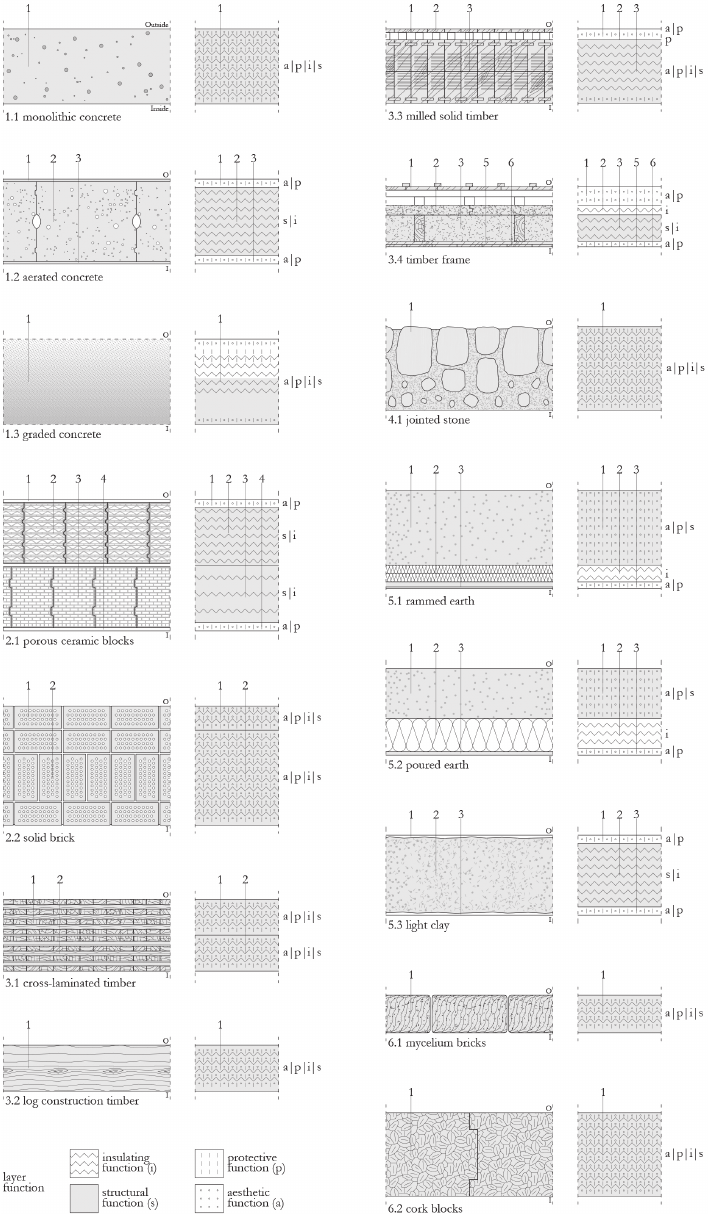
Each layer was assigned one to four of the listed func-
tions, depending on its role within the partition. Diagrams
were also developed to visually represent the distribution
of these functions across the layers, as shown in Figure 1.
This functional approach to mono-material partitions aimed
to uncover relationships between functions – revealing
their overlaps, partial intersections, duplications, or com-
plete separations. The standardized diagrams further en-
abled comparative analysis between the partitions and the
identication of patterns that lead to the formation of mo-
no-material systems.
Step 4. Identification of strategies
and approaches in the pursuit
of mono-materiality in selected partitions
Using synthesis and comparison, the functional opera-
tions performed on the layers of each partition that led to
the realization of mono-material partitions were identied
(Table 2, col. G). These operations were then linked to spe-
cic actions that modied the base material’s properties
(Table 2, col. H). The actions were classied into three ap-
proaches: modifying the internal conguration of the base
material, shaping the base material, and accumulating the
base material. Subsequently, through synthesis, these data
were used to derive, systematize, and describe the strate-
gies aimed at achieving mono-material building systems.
Results
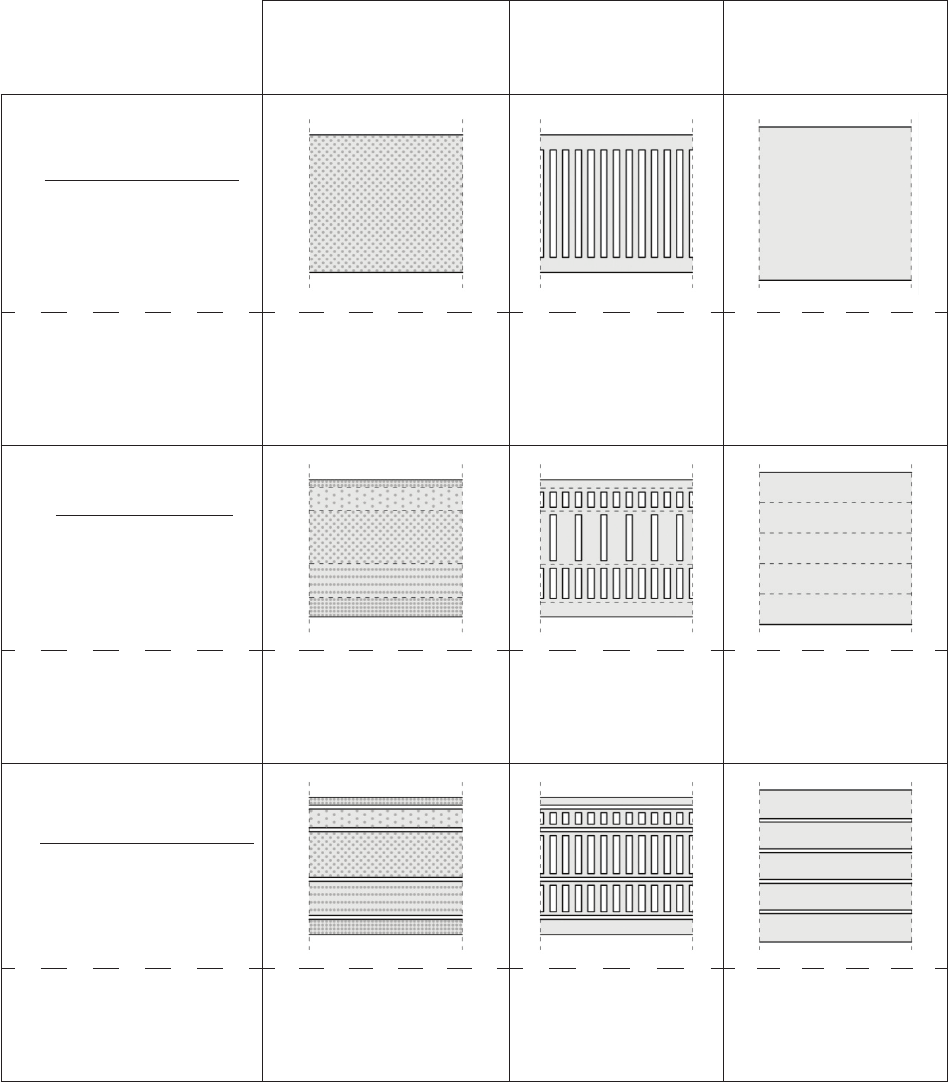
The results of the analysis are presented in Table 3,
which provides a complete summary of the strategies
aimed at achieving mono-material systems and the meth-
ods of implementing these strategies. The table also out-
lines the objectives of each strategy and the means of their
realization. The strategies were derived based on opera-
tions performed on the layers, which lead to a redistribu-
tion of functions within the building partition. The follow-
ing three strategies were identied:
I. Unication of layers.
II. Merging of layers.
III. Multiplication of layers.
The strategies are implemented through a shift in the
approach to the base material, allowing for the use of its
original properties, as well as their enhancement or the in-
duction of new ones. These approaches are not determined
by the strategies – they function independently. Three such
approaches can be distinguished:
1. Modifying the internal conguration of the base ma-
terial as a result of changes in its extraction or processing
methods, or through the use of additives.
2. Shaping the base material appropriately within the
components of individual layers or entire layers.
3. Accumulating the unmodied base material as
a means of increasing the thickness of the layers.
It was also observed that analogous strategies and ap-
proaches to their implementation were applied to dierent
materials. Therefore, it can be concluded that the base ma-
terial does not directly determine both the strategies and the
approaches – they possess a universal character in the con-
Design strategies for achieving mono-material structures 117
text of the mono-material system concept. Moreover, as con-
rmed in the analysed partitions, in pursuing a mono-ma-
terial system, the strategies and approaches may be applied
individually and singularly, or repeatedly and in combina-
tion. The following sections describe each strategy in great-
er detail, along with the three accompanying approaches.
For each, an example of a relevant partition is provided.
I. The unification
of layers strategy
The layer unication strategy entails the homogeniza-
tion of layers, ultimately aiming to reduce the total number
of layers within the partition. The nal objective of imple-
menting this strategy is to achieve a partition composed of
Fig. 1. Analysis of selected
mono-material partitions:
step 3 – horizontal sections of
analysed mono-material
partitions and their
functional diagrams
(elaborated by T. Broma based
on: Schittich 2005; Binder,
Riegler-Floors 2019; Torelli,
Giménez Fernández and Lees
2020; Hugentobler et al. 2016;
Arkkitehdit 2024; Stieglmeier
2021; Lakkala, Luusua and
Pihlajaniemi 2020;
Bucklin et al. 2021; Boettger,
Knauer 2023; Kapfinger,
Sauer 2015; Bitting et al. 2022)
Il. 1. Analiza wybranych
przegród monomateriałowych:
krok 3 – przekroje poziome
analizowanych przegród
monomateriałowych i ich
diagramy funkcjonalne
(oprac. T. Broma na podstawie:
Schittich 2005; Binder,
Riegler-Floors 2019; Torelli,
Giménez Fernández i Lees 2020;
Hugentobler et al. 2016;
Arkkitehdit 2024; Stieglmeier
2021; Lakkala, Luusua
i Pihlajaniemi 2020; Bucklin
et al. 2021; Boettger, Knauer
2023; Kapfinger, Sauer 2015;
Bitting et al. 2022)

118 Tomasz Broma
G H
No. Applied strategy Approach to implementing the strategy
1.1
(I) Unication of Layers:
structural, insulating, protective, and aesthetic
functions fullled by a single homogeneous layer
Approach 1
Modifying the internal conguration of the base material within the layer:
use of an additive in the base material (expanded clay and expanded glass)
1.2
(I) Unication of Layers:
structural and insulating functions fullled
by a single homogeneous layer
Approach 1
Modifying the internal conguration of the base material within the layer:
adding porosity to the base material (foaming agent)
1.3
(II) Merging of Layers:
structural, insulating, protective, and aesthetic
functions fullled by inseparable segments
of a single heterogeneous layer
Approach 1
Local modication of the internal conguration of the base material within the layer:
creating a gradient internal conguration of the base material
2.1
(I) Unication of Layers and (III) Multiplication
of Layers:
structural and insulating functions jointly fullled
by two heterogeneous layers
Approach 1
Modifying the internal conguration of the base material within the layer:
altering the internal structure of the base material (adding porosity)
Approach 2
Shaping the base material within the layer:
introducing air voids into the form of the base material
Approach 2
Variable shaping of the base material for dierent layers:
use of two dierently formed layers made from the base material
2.2
(III) Multiplication of Layers:
structural, insulating, protective, and aesthetic
functions fullled by two homogeneous layers
Approach 3
Accumulating the base material by duplicating repeatable layers:
use of four layers made from the base material
3.1
(II) Merging of Layers and (III) Multiplication
of Layers:
structural, insulating, protective, and aesthetic
functions fullled by fourteen homogeneous
layers
Approach 3
Accumulating the base material by duplicating repeatable zones within the layer:
use of layers made from cross-laminated base material
Approach 2
Accumulating the base material by duplicating repeatable layers:
duplication of two layers made from the base material
3.2
(I) Unication of Layers:
structural, insulating, protective, and aesthetic
functions fullled by a single homogeneous layer
Approach 3
Accumulating the base material within the layer (increased thickness):
applying increased thickness of the base material
3.3
(II) Merging of Layers:
structural, insulating, and aesthetic functions
fullled by distinguishable segments
of a single heterogeneous layer
Approach 2
Local variable shaping of the base material within the layer:
introducing zones with dierent shapes into the base material
3.4
(III) Multiplication of Layers:
structural, insulating, protective, and aesthetic
functions fullled by separate layers
Approach 2
Modifying the internal conguration of the base material dierently for each layer:
use of dierently processed base material to perform specialized functions within
individual layers
4.1
(I) Unication of Layers:
structural, insulating, protective, and aesthetic
functions fullled by a single heterogeneous layer
Approach 3
Accumulating the base material within the layer (increased thickness):
applying increased thickness of the base material bonded with mortar containing
expanded glass
5.1
(I) Unication of Layers:
structural, insulating, protective, and aesthetic
functions fullled by a single homogeneous layer
Approach 3
Accumulating the base material within the layer (increased thickness):
applying increased thickness of the base material
5.2
(I) Unication of Layers:
structural, insulating, protective, and aesthetic
functions fullled by a single homogeneous layer
Approach 3
Accumulating the base material within the layer (increased thickness):
applying increased thickness of the base material
5.3
(I) Unication of Layers:
structural, insulating, protective, and aesthetic
functions fullled by a single homogeneous layer
Approach 1
Modifying the internal conguration of the base material within the layer:
use of an additive in the base material (straw)
6.1
(I) Unication of Layers:
structural, insulating, protective, and aesthetic
functions fullled by a single homogeneous layer
Approach 1
Modifying the internal conguration of the base material within the layer:
use of a specic harvesting process of the base material (form-lling through growth
to desired density)
6.2
(I) Unication of Layers:
structural, insulating, protective, and aesthetic
functions fullled by a single homogeneous layer
Approach 1
Modifying the internal conguration of the base material within the layer:
use of a specic processing method for the base material (expansion)
Table 2. Analysis of selected mono-material partitions: step 4 (elaborated by T. Broma)
Tabela 2. Analiza wybranych przegród monomateriałowych: krok 4 (oprac. T. Broma)
Design strategies for achieving mono-material structures 119
Table 3. Design strategies and approaches for achieving mono-material structures (elaborated by T. Broma)
Tabela 3. Strategie i sposoby podejścia w dążeniu do osiągnięcia monomateriałowych ustrojów (oprac. T. Broma)
1. Approach to implementing
the strategy modifying
the internal conguration
of the base material
2. Approach to implementing
the strategy shaping
the base material
3. Approach to implementing
the strategy accumulating
the unmodied base material
(I) Unication of Layers Strategy
unifying the structure
of the mono-material partition
by reducing the number of layers
strategy objective:
a single multifunctional
mono-material layer
with a homogeneous structure,
simultaneously fullling all partition
functions
method of achieving
the objective in approach 1:
modifying the internal
conguration of the base material
within the layer
method of achieving
the objective in approach 2:
shaping the base material
within the layer
method of achieving
the objective in approach 3:
accumulating the base material
within the layer
(increasing thickness)
(II) Merging of Layers Strategy
dierentiating distinguishable
but inseparable zones within
the mono-material partition through
the permanent merging of layers
strategy objective:
a single multifunctional
mono-material layer with
specialized zones, collectively
fullling all partition functions
method of achieving
the objective in approach 1:
locally modifying the internal
conguration of the base material
within the layer
method of achieving
the objective in approach 2:
locally varying the shaping
of the base material
within the layer
method of achieving
the objective in approach 3:
accumulating the base material
by replicating repetitive zones
within the layer
(III) Multiplication of Layers Strategy
applying a sequence of separable
layers that together form
a mono-material partition
strategy objective:
a mono-material sequence
of single- or multifunctional layers,
collectively fullling all partition
functions
method of achieving
the objective in approach 1:
modifying the internal
conguration of the base material
dierently for individual layers
method of achieving
the objective in approach 2:
dierentiated shaping
of the base material
for individual layers
method of achieving
the objective in approach 3:
accumulating the base material
by replicating
repetitive layers
a single layer that fullls all required functions. A dening
feature of such a layer is its homogeneous internal structure
– its entire cross-section is uniform, with no distinguish-
able zones. As previously stated, this strategy may be im-
plemented through one of three approaches:
1. Modication of the internal conguration of the
base material in the context of unication occurs uni-
formly within a single layer, allowing it to perform all the
necessary functions of the partition. Modern building ma-
terials are often complex, multi-component systems (Ste-
fańczyk, Lipczyńska 2005, 12). Therefore, an example of
this approach involves altering the proportion of materi-
al components, substituting them with other substances,
or incorporating additives that permanently change their
properties. A representative example is the house in Chur
(Switzerland) by Patrick Gartmann (Table 1, no. 1.1).
There, a reduction in the number of layers was achieved
by modifying the concrete mix – gravel was replaced with
expanded clay, and sand with expanded glass. This en-
abled a monolithic, single-layer concrete shell to fulll all

120 Tomasz Broma
partition functions without additional insulation
4
(Schit-
tich 2005, 146–151).
2. An example of the second approach – shaping the base
material within a layer to expand its functional properties
– can be found in ceramic blocks
5
. These blocks are
formed as a series of thin-walled surfaces enclosing cham-
bers lled with air voids (Małasiewicz 2005, 181–183).
This design signicantly improves thermal insulation, and
together with the material’s inherent properties, enables
the unication of structural and insulating functions within
a single layer (Table 1, no. 2.1).
3. In the context of unication, accumulating the base
material within a single layer increases its thickness. In this
way, the material’s original properties – enhanced through
the expanded cross-section – become sucient to fulll
all required functions. The school campus in Pudasjärvi
(Finland), completed in 2016 by Lukkaroinen Architects,
exemplies this approach (Table 1, no. 3.2).
Traditional
log construction was used, with a single wooden layer
of appropriate thickness fullling structural, insulating,
and aesthetic roles (Lakkala, Luusua and Pihlajaniemi
2020).
II. The merging
of layers strategy
The merging of layers involves the creation of distin-
guishable but inseparable zones within a mono-material
partition, resulting from the permanent joining of layers.
Ultimately, this strategy leads to a single mono-material
multifunctional layer composed of specialized zones that
collectively fulll all required functions. In contrast to the
unication strategy, the resulting layer is characterized by
a heterogeneous internal structure. The merging strategy
can be implemented in three ways:
1. The rst involves locally modifying the internal con-
guration of the base material within the layer. An exam-
ple is a gradient-based layer (Table 1, no. 1.3), in which
zones with varying material properties full dierent
functions. This variability occurs continuously across the
cross-section – no clearly homogeneous segments exist.
An experimental technology that allows for such internal
composition is functionally graded concrete. The variation
in properties is achieved by dynamically adjusting mixture
proportions during spraying with nozzles or by layered ap-
plication with printheads. Alternatively, a gradient prole
can be obtained through controlled segregation of compo-
nents under gravity or centrifugal force
6
(Torelli, Giménez
Fernández and Lees 2020, 10, 11).
2. The second method involves locally dierentiated
shaping of the base material within the layer. This ap-
4
An exception is the roof, which is covered with a permanently
exible cementitious mortar.
5
Porous ceramic blocks are also an example of the rst approach.
During ring, combustible additives mixed with the clay oxidize, leav-
ing behind pores. The altered internal structure of the base material im-
proves its thermal performance.
6
This technology is currently being developed as an attempt to im-
prove the strength and performance of concrete elements; however, it also
holds signicant potential for achieving mono-material structural systems.
proach was applied in constructing the IBA Timber Pro-
totype House (Table 1, no. 3.3), developed by ICD at the
University of Stuttgart. The partitions of the pavilion were
made from solid, notched spruce beams joined with wood-
en dowels and interlocks. The horizontal cross-section of
the beams is divided into three functional zones: a dense-
ly notched insulating zone, an uncut structural zone, and
a closing/sealing zone with assembly notches
7
(Bucklin
et al. 2021, 7, 8). This system incorporates inseparable yet
clearly distinguishable and functionally specialized zones
within a single layer.
3. The third approach involves the accumulation of base
material through the repetition of inseparable zones with
specialized functions. This approach is exemplied by
cross-laminated timber (CLT) panels used, for instance, in
the construction of the oce building in Alpnach, Swit-
zerland, designed by Seiler Linhart Architekten (Table 1,
no. 3.1). The visible outer layers of the panels were made
from high-quality timber serving an aesthetic function.
In contrast, inner layers were composed of waste wood
whose irregularities created thin internal air pockets, en-
hancing the thermal insulation of the partition. At the same
time, all layers collectively perform the structural function
(Stieglmeier 2021, 34–38).
III. The multiplication
of layers strategy
The layer multiplication strategy involves using a se-
quence of separable layers that together form a mono-ma-
terial partition. These layers can be individually distin-
guished, and each may serve a specialized function or be
multifunctional. The goal is to achieve mono-materiality
by ensuring all layers originate from the same base mate-
rial. This strategy can be implemented through three ap-
proaches:
1. The rst approach involves modifying the internal
conguration of the base material dierently for each lay-
er. This allows them to serve specialized functions within
the partition. An example is the technology of prefabricated
timber frame panels used in the summer house in Jeziorna,
designed by Adamiczka.Broma Studio (Poland) (Table 1,
no. 3.4). Its structure comprises a wooden frame reinforced
internally with OSB-3 boards that also function as a va-
pour barrier. Wood bre insulation was placed between the
frame elements, while external wood wool panels reduce
thermal bridging and ensure windproong. The assembly is
covered with boards mounted on a wooden batten system.
2. The second approach relies on shaping the base ma-
terial dierently across layers. This was applied in the con-
struction of the 2226 oce building in Lustenau (Austria)
by Baumschlager Eberle Architekten (Table 1, no. 2.1).
The external walls consist of two layers of perforated ce-
ramic blocks, each with distinct shaping. The outer layer
is formed to enhance thermal insulation at the expense of
structural capacity, while the inner layer comprises blocks
7
The structure was additionally complemented with external mem -
branes providing waterproong.

Design strategies for achieving mono-material structures 121
with increased load-bearing capacity. These two dier-
ently shaped layers from the same base material result in
a mono-material partition with low thermal transmittance,
high thermal mass, and appropriate strength parameters
8
(Hugentobler et al. 2016). This partition also exemplies
the simultaneous use of two dierent strategies (unica-
tion and multiplication) and three distinct approaches,
demonstrating that their combined application is possible
and that achieving a mono-material partition may require
complex combinations of strategies and approaches.
3. The third approach involves the accumulation of the
base material through the repetition of separable layers. An
example is the previously discussed oce building in Alp-
nach (Table 1, no. 3.1). To achieve complete mono-materi-
ality, the previously described CLT wood panels were du-
plicated and joined with wooden dowels. The repetition of
separable layers made from the base material enabled the
fullment of all functions, thus resulting in a mono-mate-
rial partition.
Conclusions
Based on the conducted analysis and its ndings, the
following conclusions were drawn:
1. It is possible to identify strategies whose implemen-
tation enables the discovery of the potential of a given base
material for the realization of mono-material structural
systems. These strategies refer to the operations of unica-
tion, merging, and multiplication performed – functionally
– on the layers of a partition.
2. Implementing these strategies involves a shift in the
approach to the base material, resulting in the use of its
original properties, as well as their enhancement or the in-
duction of new ones. Within each strategy, three approaches
were distinguished: the rst involves modifying the inter-
nal conguration of the base material; the second involves
shaping the base material; and the third – accumulating the
unchanged base material.
3. The strategies and corresponding approaches are uni -
versal and do not directly depend on specic materials. The
recurrence of similar strategies and approaches in relation
to various base materials conrms this.
4. To achieve mono-material partitions and, consequent-
ly, complete mono-material structural systems, the strate-
gies and approaches may be applied individually and once,
but also repeatedly and in combination.
8
The construction of the external partitions, combined with grav-
ity ventilation, enables the maintenance of interior temperatures within
the range of 22–26°C without the use of heating, air conditioning, or
mechanical ventilation. This is also the origin of the building’s name.
Summary
This article presents a new perspective on the topic of
mono-material structural systems. Based on case analysis,
it identies three universal strategies that potentially lead to
the realization of mono-material systems: the unication of
partition layers, the merging of layers, and the multiplica-
tion of layers. The eectiveness of these strategies depends
on the appropriate use, enhancement, or induction of new
properties in the base material, which may result from mod-
ifying its internal conguration, shaping it, or accumulating
it in an unchanged form. These strategies are universal (in-
dependent of the material or partition type), oering a com-
prehensive and structured framework previously lacking in
the literature. They simultaneously constitute a typology of
mono-material partition technologies based on operations
performed on layers. Moreover, the strategies and related
approaches serve as tools for exploring the potential of re-
alizing mono-material systems with a given base material.
They can, therefore, be applied in the design process, add-
ing practical value.
At the same time, a practical limitation in implement-
ing the strategies was observed. Not all analyzed partitions
– or the structural systems they belong to – were entirely
mono-material. This suggests that achieving complete mo-
no-materiality may be either unfeasible or unjustied due
to cost or technological challenges. Notably, mono-mate-
rial partitions pose specic challenges in harsher climatic
zones, where temperature uctuations, humidity variation,
and overall environmental exposure make it dicult for
a single layer to perform all necessary functions (especially
within the unication strategy)
9
.
Nevertheless, the inability to achieve full mono-materi-
ality does not undermine the value of striving towards the
highest possible degree of it. This underscores the need for
further research to rene the denition of mono-material
structural systems, including a clear indication of the mini-
mum level and scope of base material usage. Future studies
should also establish conditions under which supplemen-
tary materials may be used, as well as guidelines on their
types. Addressing these research goals will improve the
feasibility of mono-material structural systems and support
the practical application of the proposed strategies.
9
The implementation of mono-material structural systems in harsh-
er climatic zones is not, however, impossible. This is evidenced by the
deliberately selected examples from regions with such conditions. Most
of them originate from Austria, Switzerland, Germany, Finland, the Unit-
ed Kingdom, and Poland.
References
Addis, Bill. Building with Reclaimed Components and Materials: A De-
sign Handbook for Reuse and Recycling. Routledge, 2006.
Antonelli, Paola. Mutant Materials in Contemporary Design. Museum of
Modern Art, 1995.
Avarrus Arkkitehdit. “Helsingin Muurarimestari.” Accessed October 25,
2024, at https://www.avarrus./helsinginmuurarimestari.
Binder, Markus, and Petra Riegler-Floors. “Mono-Material Construc-
tion.” In Manual of Recycling: Buildings as sources of materials,
122 Tomasz Broma
edited by Annette Hillebrandt, Petra Riegler-Floors, Anja Rosen, and
Johanna-Katharina Seggewies. Detail, 2019.
Bitting, Selina, Tiziano Derme, Juney Lee, Tom Van Mele, Benhamin
Dillenburger, and Phelippe Block. “Challenges and Opportunities in
Scaling up Architectural Applications of Mycelium-Based Materials
with Digital Fabrication.” Biomimetics 7, no. 2 (2022): 44. https://
doi.org/10.3390/biomimetics7020044.
Black, James Temple, and Ronald A. Kohser. DeGarmo’s Materials and
Processes in Manufacturing. Wiley, 2011.
Boettger, Till, and Ulrike Knauer. Mono-Material: Monolithic, Homoge-
neous and Circular Construction. Birkhäuser, 2023.
Böhme, Gernot. Atmospheric Architectures: The Aesthetics of Felt Spac-
es, edited and translated by Anna-Christina Engels-Schwarzpaul.
Bloomsbury Publishing, 2017.
Brand, Stewart. How Buildings Learn: What Happens After They’re Built.
Penguin Books, 1995.
Bucklin, Oliver, Achim Menges, Oliver Krieg, Hand Drexler, Angela
Rohr, and Felix Amtsberg. “Mono-Material Wood Wall: Digital Fab-
rication of Performative Wood Envelopes.” Journal of Facade De-
sign and Engineering 9, no. 1 (2021): 1–16. https://doi.org/10.7480/
jfde.2021.1.5398.
European Commission: Directorate-General for Research and Innova-
tion, Hans Joachim Schellnhuber, Barbara Widera, Andreja Kutnar,
et al. “Horizon Europe – New European Bauhaus Nexus Report.”
Publications Oce of the European Union, 2022. Accessed Decem-
ber 15, 2024, at https://data.europa.eu/doi/10.2777/49925.
Hugentobler, Walter, Peter Widerin, Lars Junghans, and Willem Bruijn.
“Do
Healthy Buildings Need Technology?” Paper presented at Healthy
Buildings 2016, Ghent, July 31, 2016. Accessed December 17,
2024, at https://www.researchgate.net/publication/330011167_DO_
HEALTHY_BUILDINGS_NEED_TECHNOLOGY
Kapnger, Otto, and Marko Sauer, eds. Martin Rauch. Rened Earth
Construction & Design with Rammed Earth. Detail, 2015.
Kelm, Teresa. Architektura ziemi. Tradycja i współczesność. Murator,
1996.
Kelm, Teresa, and Dorota Długosz-Nowicka. Budownictwo z surowej zie-
mi: idea i realizacja. Ocyna Wydawnicza PW, 2011.
Koivisto, Elina. “Updating Monomaterial Construction.” Arkkitehti. Finn-
ish
Architectural Review, no. 2 (2021): 8–19.
Lakkala, Matti, Aale Luusua, and Janne Pihlajaniemi. “Finnish Percep-
tions of Log and Log Architecture.” Scandinavian Journal of Forest
Research 35, no. 5–6 (2020): 296–307. https://doi.org/10.1080/0282
7581.2020.1774642
Małasiewicz, Andrzej. “Ceramika budowlana.” In Budownictwo ogólne.
Tom 1: Materiały i wyroby budowlane, edited by Bogusław Stefań-
czyk. Arkady, 2005.
Moe, Kiel. Insulating Modernism: Isolated and Non-Isolated Thermody-
namics in Architecture. Birkhäuser, 2014.
Pyrak, Stefan, Wojciech Włodarczyk, and Szczepan Woliński. “Zagad-
nienia konstrukcyjne w budownictwie.” In Budownictwo ogólne.
Tom 3: Elementy budynków. Podstawy projektowania, edited by
Lech Lichołaj. Arkady, 2008.
Schittich, Christian, ed. In Detail: Building Simply. Birkhäuser, 2005.
Stefańczyk, Bogusław and Iwona Lipczyńska. “Podstawowe właści wości
techniczne materiałów budowlanych.” In Budownictwo ogólne.
Tom 1: Materiały i wyroby budowlane, edited by Bogusław Stefań-
czyk. Arkady, 2005.
Stieglmeier, Manfred. “Oce Block in Alpnach.” Detail, no. 12 (2021):
34–41.
Ściślewski, Zbigniew. “Trwałość i ochrona przed korozją.” In Budownictwo
ogólne. Tom 2: Fizyka budowli, edited by Piotr Klemm. Arkady, 2018.
Torelli, Giacomo, Mar Giménez Fernández, and Janet M. Lees. “Func-
tionally Graded Concrete: Design Objectives, Production Techniques
and Analysis Methods for Layered and Continuously Graded Ele-
ments.” Construction and Building Materials 242 (2020): 118040.
https://doi.org/10.1016/j.conbuildmat.2020.118040.
Streszczenie
Strategie projektowe służące osiągnięciu monomateriałowych ustrojów
Rosnące wymagania wobec wieloaspektowej efektywności budynków skutkują wzrostem poziomu skomplikowania ich przegród. Prowadzi to do
rozszczepiania się tych przegród na kolejne wyspecjalizowane warstwy, a w konsekwencji do powstawania złożonych ustrojów wielomateriałowych
– skomplikowanych wykonawczo, wymagających zaawansowanej wiedzy oraz dużych nakładów nansowych i zasobów, ale także cechujących się
wzrostem poziomu awaryjności i szybszą degradacją. Alternatywą są ustroje monomateriałowe – heterogeniczne pod względem materiału wykorzy-
stanego do wzniesienia budynku. Ich stosowanie może przyczynić się do wzrostu poziomu zrównoważenia i inkluzywności technologicznej, a także
do wypracowania nowej estetyki, co wpisuje się w wartości promowane w projekcie Nowego Europejskiego Bauhausu.
Celem autora było wyprowadzenie strategii projektowych, których zastosowanie pozwala osiągnąć przegrody, a w rezultacie także ustroje mo-
nomateriałowe. Badaniem objęto przegrody o cechach monomateriałowych, które zidentykowano we współcześnie zrealizowanych budynkach na
obszarze Europy. Ich wyboru dokonano na podstawie przeglądu literatury przedmiotu. Następnie w analizie opartej na studium przypadku, desk rese-
arch i badaniu dokumentów określono zastosowane materiały bazowe i zidentykowano wewnętrzną budowę przegród poprzez wyznaczenie liczby
warstw i wskazanie pełnionych przez warstwy funkcji. Wskazano także sposoby wykorzystania materiału bazowego, które doprowadziły do uzyskania
przegród o cechach monomateriałowych. Następnie przez porównanie i syntezę, zidentykowano, usystematyzowano i opisano strategie w dążeniu do
osiągnięcia ustrojów o charakterze monomateriałowym.
W artykule wykazano, że strategie te deniowane są poprzez operacje dokonywane w ujęciu funkcjonalnym na warstwach przegrody. Obejmują
one trzy typy działań: unikację warstw, spajanie warstw i zwielokrotnianie warstw. Wiąże się to bezpośrednio ze zmianą sposobu podejścia do ma-
teriału, czego efektem jest odpowiednie jego wykorzystanie, wzmocnienie lub wzbudzenie nowych właściwości tego materiału. W ramach każdej ze
strategii wyróżniono trzy takie sposoby podejścia. Pierwszy związany jest z modykowaniem wewnętrznej konguracji materiału bazowego, drugi
– z kształtowaniem materiału bazowego, a trzeci – z nagromadzeniem niezmienionego materiału bazowego.
Słowa kluczowe: ustroje monomateriałowe, strategie projektowe, unikacja warstw, spajanie warstw, zwielokrotnianie warstw