2010
Nr 2(28)
According to the assumptions of Agenda 21, human-
itarian education became a part of the canon of actions
which have the purpose of propagating the principles of
sustainable development directed not only at the desire of
satisfying people’s needs, but also connected with their
life and domesticated environment.
In our times, sustainable development is becoming
a form of shaping mutual relations of man and animal,
which makes it possible to create particular patterns of so-
cial behaviours in the society where the animal becomes an
equal partner of man. Owing to the civilisation progress,
there is no need to objectify domesticated animals any
longer and consequently man discovers in animals a differ-
ent and lively creature whose needs should be respected.
Of course, the subject of animal in architecture con-
stitutes a very wide notion. It includes any presentations
of animals which perform a decorative role as well as the
role of a carrier of ideological and symbolic meaning.
This is also a problem of legislation connected with the
development of buildings used by man for farming and
raising domesticated animals. Moreover, this is a prob-
lem of the development and usage of zoological gardens
which serve the purpose of recreation for human beings or
nally the structures in which unwanted animals or those
which need professional care as a result of ‘meeting’ man
nd appropriate man’s protection there. We must mention
here not only stables, paddocks, pigsties, cow sheds and
henhouses, aviaries for birds or zoological gardens but
also shelters and emergency service for animals. These
are the topics which have been known and shaped for cen-
turies on the basis of man’s comfort and spatial require-
ments of different genres.
However, the problem of designing for animals also in-
cludes a number of newly created issues and forms which
have appeared recently in connection with the interest in
animal as a conscious recipient of the space. It happens
so because of the growing awareness of the fact that an
animal is not only ‘a lively object’ but also a creature that
feels and thinks. The animal is a friend and member of
a family for people living in cities. At the present pace of
life, man often becomes ‘a lonely island’, an individual
who is unable to establish good interpersonal relations.
Therefore, man transfers emotions to an animal using
a kind of auto-therapy completely unconsciously and at
the same time he/she learns to function with respect for all
patterns of social behaviours. Paradoxically, it is the man
who starts to socialise through the contact with an animal.
Establishment of the humanitarian education programme,
which assumes respect for all living organisms, also has
an inuence on this situation.
However, such behaviours result not only from man’s
nobleness – a humanist and human being – ecologist, as
everybody happens to consider himself/herself as such
in secret. There is one more aspect of taking up actions
of this type. This aspect is more down-to-earth, i.e. the
western civilisations developed an attitude of blind con-
sumerism beyond all limits. Along with a gradual process
of the society getting rich, ‘hunger’ for novelties increas-
es. If there is nothing new and surprisingly luxurious to
come up with, people start to look for a luxury in mak-
ing their pets’ lives more attractive. An extreme example
of this phenomenon can be the products for the clients’
pets, which are already introduced as a standard offer of
the biggest fashion houses or jeweller’s stores. A jacket
from Chanel or a diamond collar for a dog do not surprise
any longer in some environments. We can only ask what
next?
A trend of pattern-designing or a trend of art which
uses the signicance of wild animals living in a city envi-
ronment should be discussed in the rst place. Recently,
there appeared many architectural and sculptural forms
implemented in urban spaces as a form of a happening
Justyna Kleszcz*
Designing not only for human. Animal in architecture
as a determinant of the humanitarian education standard
*
Wrocław University of Technology, Faculty of Architecture, Insti-
tute of Housing Estate Designing.
102 Justyna Kleszcz
or a permanent structure for ‘wild’ inhabitants of the city.
They all aim at the attempt of humanisation – ‘animalisa-
tion’ of the unfriendly environment in such a way so as
not only people would feel free in the city. The subject
which has recently been brought up more frequently re-
fers to the creation of proper conditions for animals in
order to make them come back to the human settlements
from which they once escaped to avoid the dangers of our
mechanical world. On the other hand, some artists try to
compare natural forms of settlements made by animals to
unied residential estates which look as if they ‘just left’
a production line of a big residential houses panelák fac-
tory, giving the lie to the Le Corbusier vision of a machine
for living. Is that really so? Don’t the appearance and rules
of functioning of beehives or bird nests constitute a natu-
ral conrmation of human behaviours and tendencies of
standardisation within one group?
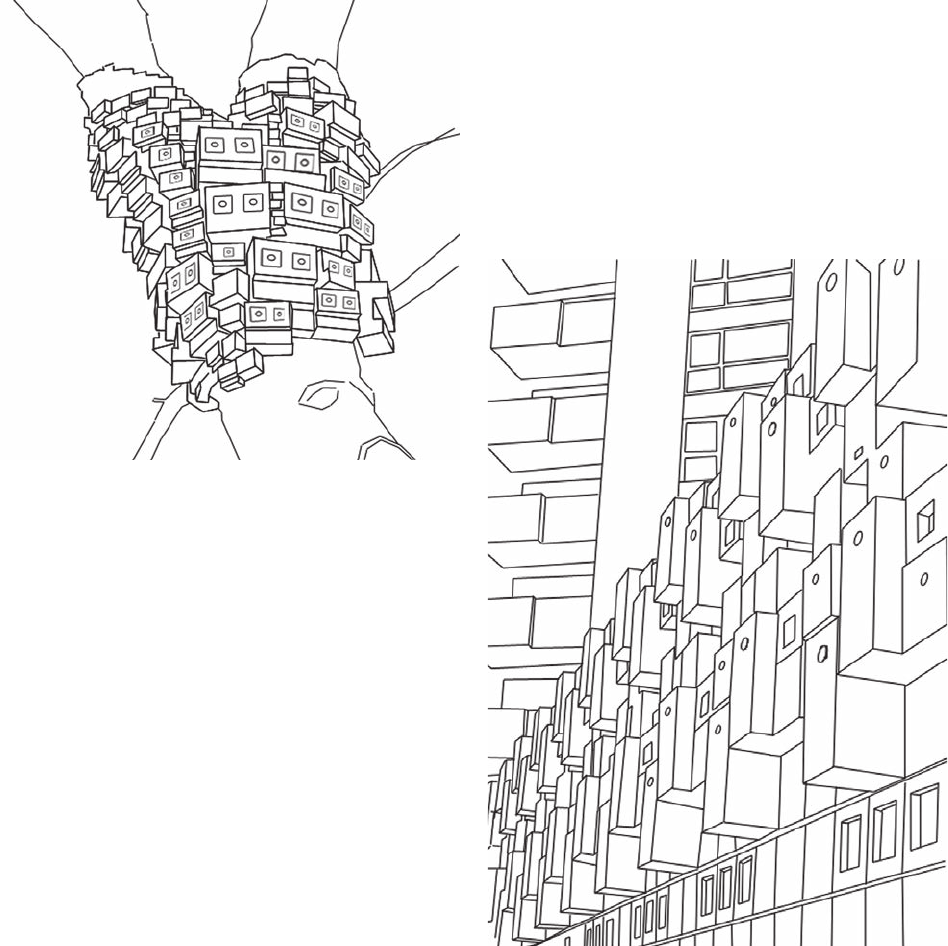
This year’s gallery called ‘Up Projects’ took place
during the Secret Gardens Projects Exhibition. Among
the sculptures placed by different artists in some small,
little-known or completely unknown gardens of London,
there was also a design entitled ‘Spontaneous City In
the Tree of Heaven’ by London Fieldworks group [1]. In
fact, it comprised two spatial forms nested in two points
– Cremone Gardens in Kingston and Duncan Terrace Gar-
dens in Islington. Module living ‘cells’ for birds or bees
were simply stuck onto trees creating in this way a mini-
ature version of housing estates which surrounded both
parks.
A similar initiative turned out to be this year’s design
by Ben Faga [2] who decided to persuade bees to come
back to the area of London after they had left the city
many years ago because of too heavy pollution of the en-
vironment. The design, which is still under development,
consists in xing a man-made box with a scent decoy in-
side within the distance of ve kilometers from an exist-
ing beehive in order to encourage lured bees to settle in
this new ‘breeding box’. In this way, the artist decided to
give the bees their territory back.
In both of the described examples, animal became the
motif of the designer’s work because the animal’s fate
reected the level of the conscious creation of the city
space. However, it is not always so. Some designers treat
animals in a subjective way or as a form of expressing
certain social ideas and do not pay particular attention to
their fate in the articially created scenery.
The example of this kind of activities is the design
‘Animal Wall’ by Gitty Gschwendtner [3]. In the territory
of Cardiff Bay she created a monumental 50-meter-high
wall which consisted of four types of breeding boxes for
various genres of birds. This wall separated a new big
housing estate called Century Harf with over one thou-
sand ats from the wharf. Although the artist explains that
by creating her work of art she wanted to give bird gen-
res their original settlements on the wharf areas back, this
curtain wall has little to do with conscious shaping of the
place of living for birds and it only constitutes a form, in
accordance with the idea that animals will simply start to
defend their natural environment.
An extreme example of an ideological attitude in de-
signing for animals is the auction organised by a pro-eco-
logical organisation called Adventure Ecology and Phil-
lips de Pury & Company
[4]. This organization aims at
Fig. 1. London Fieldworks „Spontaneous City in the Tree of Heaven”
Fig. 2. “Animal Wall”, by Gitta Gschwendtner
Designing not only for human. Animal in architecture as a determinant of the humanitarian education standard 103
leveraging funds for endangered species protection in
Great Britain. Each of the invited reputable designers
(who were many) was supposed to design a habitat for
one of such species from the recycling materials. A long
list of the participants included, among other persons, Rolf
Sachs, Michael Young or Peter Marigold. However, these
designs – although designed for animals – will never serve
their recipients. These designs reect very simplied im-
ages of the designers only, for example, the appearance of
a bird nest which is built by animals from elements that
can be found in the natural environment.
In this way, the designers deal with the problem of
wild animals’ presence in the urban environment. Some
small architectural forms are designed and they quickly
become popular. Their authors attempt to harmonize na-
ture and an articial structure which is the city. This trend
is continued, however, in form of permanent architectural
structures which serve both animals and a local society. It
is true that people who have been brought up in cities live
in a state of permanent separation from nature without any
awareness of the life outside the urban areas. The only
source of knowledge referring to the animals’ life and
habits are the mass media or zoological gardens. Howev-
er, the fact that a child brought up in this way shall know
more about the life of wild African animals than about the
native or even domesticated animals sounds paradoxical.
In order to cope with this problem, some miniature
farms were created in the city parks where animals are
raised for educational purposes and where a real physi-
cal contact with them is possible. ‘Petting Farm’ building,
created by 70F study, is an example of such a structure. It
was built in Almere (Holland). The building is not big and
it fulls the role of a shelter as well as a place for interac-
tion for different genres of animals.
Along with the increase of social awareness regard-
ing the role of animals in man’s life and the signicance
of empathy in man – animal relations, people started to
treat education and domesticated animals breeding in
a more responsible way. The cases of non-humanitarian
treatment of animals are condemned in public more and
more often. Along with the problem, a social answer to
it appears. When the mass media publicised the fact that
in many houses dogs are kept on chains in horrible con-
ditions, many companies which specialised in producing
comfortable kennels appeared on the market. The ex-
ample of this kind of designing actions is the activity of
the German brand ‘Best Friend’s Home’ in the European
market, which refers to the humanitarian traditions of
Bauhaus even in its ideological sphere. Although some of
their works constitute an example of a skilful operation on
the border of stylization and kitsch, their products – apart
from the appearance – provide the maximum of comfort
as well [5].
Similar actions were taken up when the mass media
started to criticize a wave phenomenon of throwing out
pets before holidays. At present, there are more and more
hotels for animals, which – apart from the basic care dur-
ing the period of stay – provide pets with additional attrac-
tions. On the whole, if a dog or cat is a family member, it
also has the right to have a rest on holidays.
The environment of man’s life, which is more and
more degraded, causes numerous civilization diseases.
They also trouble animals which live together with hu-
man beings in the same environment. Similarly to man,
dogs and cats also face problems such as obesity, asthma
or allergies more often. Therefore, these problems are
remedied by creating health or rehabilitation centres, bio-
logical regeneration or even tness centres for pets. Such
institutions combine also the hotel function and in this
way the pets’ owners can plan the whole holiday for their
animals [6].
In the standard of this hotel we can nd separate rooms
with a comfortable bed for each dog, a nursing room for
animals, play room. Pets go on regular walks and have in-
dividual diets. Many hotels, like for example the Elmtree
in London, provide places for pets whose owners work
and the transport of those pets to their owners’ houses.
At rst glance, it all may seem a bit bizarre, but if we
compare the way of functioning of such an institution
with similar institutions in the United States of America
we can drive at the conclusion that Europe has still a lot
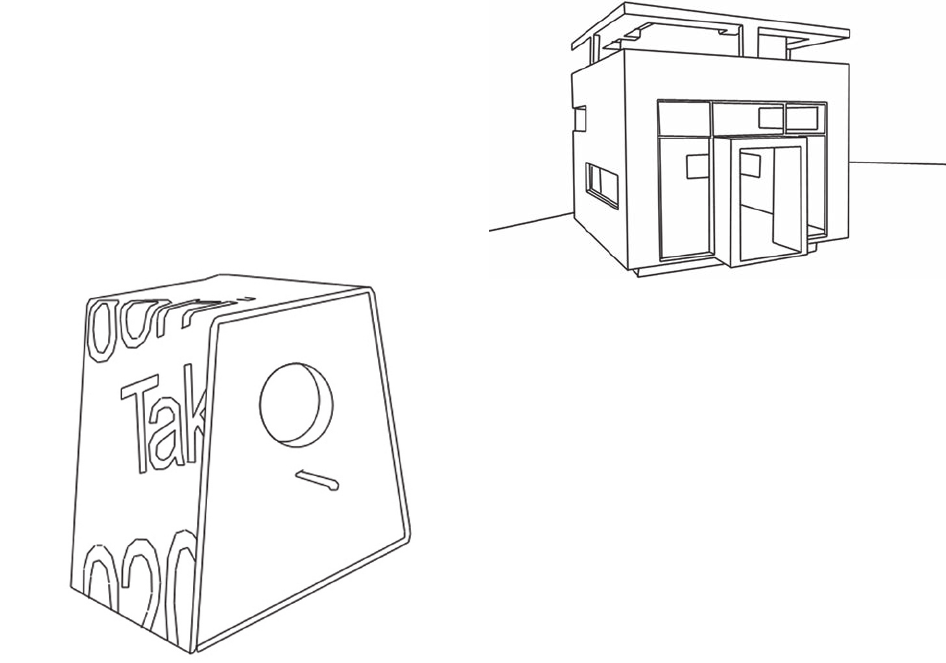
Fig. 3. The Birds, Bats and Bees habitat, by Peter Marigold
Fig. 4. Residence for a dog Cubix, by Best Friends’ Home
104 Justyna Kleszcz
to do. Chateau Poochie in Pompano Beach in Florida is
an example of one of the most luxurious centres where
– apart from normal care – the best dog and cat stylists
look after pets. On the owners’ request animals can use
a botanic spa or have a peat bath. Visiting a pet manicure
salon or a senior’s corner every day is a standard. The
tness centre is furnished and equipped with sport equip-
ment which makes the animals keep t at the same level
as their owners do. In this situation, we are forced to ask
a question about possible limits of luxury that a human
being can reach [7, 8].
The presented issues constitute only a small part of
the problem with regard to designing for animals. Along
with the analysis of the presented examples, we must ask
a question about the rightness of these directions duality
in which this sphere remains. On the one hand, animal be-
came a determinant of luxury – an easy form of manifest-
ing a social status, on the other hand, the role of animal in
man’s life and functioning, not only as a beast of burden
and a source of food, was noticed at last. In this situation,
humanitarian education performed a signicant role by
teaching humans a humane approach towards animals.
References
[1] http://www.dezeen.com/2010/09/08/spontaneous-city-in-the-tree-of-
heavenby-london-eldworks/
[2] http://www.dezeen.com/2010/07/21/if-you-build-it-they-will-come-
by-ben-faga/
[3] http://www.dezeen.com/2009/08/28/animal-wall-by-gitta-gschwendt-
ner/
[4] http://www.dezeen.com/2008/06/20/the-birds-bats-and-bees-by-
various-designers/
[5] http://www.elmtreekennels.co.uk
[6] http://www.bestfriendshome.com
[7] http://www.luxlux.pl
[8] http://www.70f.com/projects/al0504/al0504.htm
Projektowanie nie tylko dla człowieka. Zwierzę w architekturze
jako wyznacznik poziomu edukacji humanitarnej
Równocześnie z pojawieniem się idei rozwoju zrównoważonego
narodziła się konieczność wprowadzenia tej myśli w życie poprzez
edukację społeczną. Jedną z form jej przejawu stała się postawa wobec
zwierząt. W świadomości projektantów pojawił się inny od człowieka
użytkownik architektury. Związane to jest również ze zmianą pozycji
zwierzęcia w krajach zachodnich. Wraz z systematycznym odchodze-
niem od przedmiotowego – czysto użytkowego podejścia, możliwego
dzięki znacznemu postępowi technicznemu, zwierzęta stały się częściej
towarzyszami-przyjaciółmi człowieka. A skoro wprowadzamy je do sil-
nie przetworzonych przestrzeni dostosowanych do potrzeb konkretnego
gatunku, to automatycznie rodzi się problem konieczności dostosowania
ich do odmiennego typu użytkownika. Czy jednak mamy problem ten
traktować jako fanaberię, czy wynika on z realnej potrzeby ciągłego
udoskonalania otaczającego nas świata?
Key words: animal in architecture, humanitarian education Słowa kluczowa: zwierzę w architekturze, edukacja humanitarna