2021
1(65)
DOI: 10.37190/arc210109
Marcin Brzezicki*
Disturbance of transparency in the architecture
of contemporary glass façades. Part 1
* ORCID: 0000-0002-3901-144X. Faculty of Architecture, Wrocław
University of Science and Technology, e-mail: marcin.brzezicki@pwr.
edu.pl
Introduction
Architecture communicates with the viewer through the
façade. Façades, apart from their function of the cover and
illumination, are the hallmark of the building – they com-
municate its meaning and prestige. However, the complex-
ity of the relationship between the dierent architectural
“forms” and the “messages” makes contemporary archi-
tecture not easy to understand or value. Already 150 years
ago, Gottfried Semper claimed that buildings “should be
cloaked by a façade” [1], just like the gentleman is dressed
in a frock. Some 50 years later, the modernists postulated
“honesty” in design, which resulted in radical formal op-
erations involving the removal of all classical ornamen-
tation. The widespread introduction of skeletal structur-
al systems allowed for the use of the then-revolutionary
glass curtain walls, which were completely independent
of the building’s supporting structure. Smooth glass panes
representing the “new architecture”, apart from illuminat-
ing the interiors of buildings, also created mirror reec-
tions. This is because the use of glass makes it transparent
in certain lighting conditions, while – with the dierent
balance of internal and external illumination – the glass
surface becomes the mirror. Therefore the rst phase of
the formal development of the so-called “glass architec-
ture” was focused on studying the basic laws of optics. In
his garden, Mies van der Rohe […] photographed a model
of the famous glass skyscraper to assess the optical eects
that inuenced the appearance of the building [2, p. 82].
This basic optical eect of transforming the transparent
into the mirrored surface (with the increasing use of re-
ective coatings) has become the source of many critical
opinions concerning entirely glazed buildings. Those crit-
ical opinions are also currently formulated by renowned
authors, critics, and publicists. L. Alter, a journalist for the
inuential TreeHugger portal, writes that […] all-glass
buildings are an aesthetic, as well as a thermal crime [3].
In some buildings transparent façades have turned into
a large-scale version of the one-way-mirror, in others, the
reective coating makes the façade disappear and thus the
façade becomes a trap for people and animals.
The division of the building into “the structure” and
“the envelope”, was originally motivated by strictly en-
gineering reasons. Over time this division also gained
an important narrative function. In historical epochs, the
façade – apart from its load-bearing and covering func-
tions – played an important role in communicating the
meaning, the prestige of the client, and even the purpose
of the building. However, especially in the era of “inter-
national style” the spread of identical-looking glass cur-
tain walls caused this important narrative function of the
façade to be signicantly reduced, and in some cases, it
ceased to be performed at all. As a counteraction, new
buildings began to emerge for which the façade is much
more than just a simple physical climate barrier between
the internal and external environment. This new façade
gained an additional meaning: informational, communica-
tive, and also political [4]. In a sense, it returned to its
historical roots when the façade informed about the status
of the building and the client.
Modern glass façades – and especially the latest frame-
less systems – are characterized by high transparency (nota
bene it is even possible to buy panes without a greenish
tint, caused by the content of iron ions in the glass mass
– the product called clear glass). The most recent glass
surface modication makes the application of coatings on
glass cheap, easy, and available on a large scale. Many of
the coating technologies are created to meet the growing
78 Marcin Brzezicki
environmental requirements, i.e., to protect buildings
from overheating or to reduce the escape of heat. These
important technologies are developing dynamically, but
remain outside the scope of interest of the author of the
presen ted paper.
However, the designers of “transparent” architecture do
not always push the glass/façade to be more and more
transparent. Recent trends may be found, in which – along
with signicant formal transformations – the pane of glass
is losing its basic optical feature of light transmission. In
those façades, the transparency is deliberately disturbed,
and glass is no longer chosen solely because of its basic
function of light transmission, but also because of its other
optical properties. E. Diller and R. Scodio emphasize
this very aptly, writing that: […] glass is now understood
as a surface to look at, not only through. Transparent
glass is no longer invisible, rather, it is a display surface
[5, p. 355]. The clients and building users […] also show
a particular interest in surface design, in tactile proper-
ties, colour and texture [6, p. 7], at least as much as in the
real needs of users.
State of the art
The issues of the disturbance of transparency have
been the subject of many publications and scientic ar-
ticles. Due to the limited space, it is worth mentioning
those which – in the author’s opinion – are the most im-
portant for the subject of this article. In 1995, after the
exhibition organized in the MoMA in New York entitled
“Light Construction”, the exhibition catalogue was pub-
lished, followed by a joint publication including papers of
the authors that studied the issues of transparency in ar-
chitecture [7]. In 2004, in the series Detail Praxis, a book
entitled Translucent Materials was published, which cov-
ers the subject of light-diusing materials and perforated
metals [6]. It is mainly a technical review including the
presentation of details important for the development of
design practice. This study was published in a popular,
widely-readable series and – according to the author – has
signicantly increased the use of translucent materials in
architecture. The book titled In Detail: Japan – Architects,
Constructions, Ambiance [8] gives a special insight into
the use of translucent glass and other translucent materi-
als in Japan. Not only details are shown in the book but
also comments on trends in architectural transparency,
especially in the chapter titled “Toyo Ito, Blurring Archi-
tecture”. E. Blau’s books and papers are particularly im-
portant for the development of the theoretical foundation
and make a signicant critical contribution to the issue,
with an essay titled Tensions in Transparency… written
in 2008 [9] which particularly stands out. An important
summary of the issue is included in the book titled Trans-
lucent Building Skins: Material Innovations in Modern
and Contemporary Architecture from the year 2012 [10]
written by S. Murray. In 7 chapters the author presents
case-studies in which various light-transmitting materi-
als are used: diusing, ornamental, perforated. The nar-
ration focuses more on the reasons for their use than on
visual eects. This is – so far – the most comprehensive
monograph on the issues of the use of translucent glass/
façades in architecture.
Many books and papers were also written in the Polish
language. The general issue of the transparency of glass
façade was presented by W. Celadyn in his book entitled
Przegrody przeszklone w architekturze energooszczędnej
[Glazed envelopes in energy-ecient architecture] [11].
In chapter no. 7.3 titled “Glass vs. Aesthetics and Percep-
tion of Buildings” the author addresses the optical aspects
of perception of glass envelopes and forms the basis of
nomenclature in the Polish language. This book consti-
tutes a local reference for all subsequent scientic publi-
cations on the issue. Celadyn’s book has become a direct
inspiration for the presented research undertaken by the
author. In 2012, a book entitled Szkło we współczesnej
architekturze. Monograa [Glass in Modern Architecture.
Monograph] [12] was published by E. Wala in which the
author in the chapter titled “Transparency, Semi-transpa-
rency, Translucency” discusses the issues of the glass en-
vel opes that diuse or interfere with the light transmission
in various ways. The issues of translucent glass in archi-
tecture are also addressed by M. Zielonko-Jung [13] and
J. Marchwiński [14].
The novelty of the presented approach
According to the author’s knowledge, issues of the dis-
turbance of transparency presented in this article have not
been addressed in this way yet. In the previous refer ences,
typological distinctions were made, but this was done
either according to the type of material (glass, lux, plastic,
perforated metal) – see F. Kaltenbach [6], or according to
the function of the element in the building – see Murray
[10]. The typology presented here is based on the visual
eects – regardless of the material type that is used. The
visual eect is dened as a characteristic conguration of
the images received by the observer, created as a result of
the interaction of the light-transmitting pane and the light
itself [15]. Additionally, due to the dierent degrees of in-
tensity of visual eects, a relational matrix was created to
systematize the case-studies, allowing to organize them
according to two criteria (features): haze intensity (simply
speaking the degree of light scattering) and intensity of
the pattern which is applied to the glazing. In this method,
the position of the case-study in the presen ted matrix is
determined in a “fuzzy” way [16], according to the degree
of the optical phenomena (haze and pattern) marked on
the X and Y-axis. Therefore, it is possible to determine
the hazing intensity in the range between zero (clear) and
100% (fully scattered), and pattern intensity between zero
(clear) and 100% (opaque).
Aim and the scope of the paper
The article aims to systematize the issues of the distur-
bance of transparency in contemporary architecture and to
present the typology of light-transmitting façades in which
this optical phenomenon takes place. The author distin-
guishes the two most distinctive sub-trends of the main
trend and illustrates them with case studies of light-trans-
Disturbance of transparency in the architecture of contemporary glass façades. Part 1 79
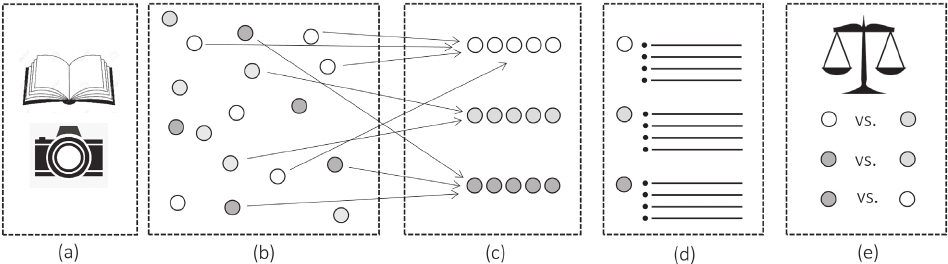
Fig. 1. The diagram of research techniques used: a) desk study, field research; b) building data collection; c) formulation of trend models;
d) description of distinctive features; e) comparative analysis (elaborated by M. Brzezicki)
Il. 1. Schemat pokazujący wykorzystane techniki badawcze: a) badania literaturowe, wizje lokalne; b) zbieranie danych o budynkach;
c) formułowanie modeli nurtów; d) opis cech wyróżniających; e) analiza porównawcza (oprac. M. Brzezicki)
mitting façades. All presented case studies are assigned
to the sub-trends based on the characteristic features of
façades, which allows for the trend’s model denition (see
chapter titled “Matrix approach” in the second part of the
paper). The author also uses the matrix approach to sys-
tematize case studies (for a detailed description see the
paragraph above).
Method
The research methods adopted in the presented paper
are typical for architectural research conducted ex-post
on the built environment, the aim of which is to broaden
the knowledge about architecture [17]. The author started
research with the desk study (scientic publications and
internet portals). Then a database containing case-studies
was created. Next, GPS location data of all case-studies
were collected. This stage was followed by the eld re-
search and study trips to photograph, measure, and record
the case studies included in the paper. As emphasized by
J. Sławińska and B. Widera it is important to establish the
knowledge about architecture not only based on the lite-
rature and references but also “on in situ visits and re-
search” [18]. The analytical part of the presented paper is
based on the photographic material that was collected by
the author. This way of gathering/acquiring the research
data has advantages and disadvantages. The disadvantage
is a limited territorial range resulting from physical possi-
bilities of relocation and budgetary limits. The advantage
is the experience that results from the personal, direct con-
tact of the researcher with the analysed case-study [15].
The author used the research method of logical argu-
mentation [17], analysed the collected case-studies of
façades, distinguished the characteristic features of the
trends, and then undertook the eort to describe them
briey in a model. The inductive method reasoning was
used – experiences and observations were synthesized to
come up with a general truth – in which detailed analy-
sis of individual case studies resulted in the process of
the trends classication and the establishment of their
models [17]. The collected photographic data were sub-
jected to comparative analysis, on the basis of which the
author drew the conclusions and created a simplied ty-
pology proposed in chapter titled “Simplied typology”.
The research method adopted consisted of the following
techniques: desk study (literature review and internet por-
tals) case study trips, eld study, documentation using the
photographic equipment. The individual stages of the re-
search procedure are shown in the diagram – see Figure 1.
Definition of the trend and criteria
The article aims to classify and characterize trends in
contemporary architecture to the extent specied above
by the author. Based on the analysis of the available ref-
erences on the subject it has been assumed that […] the
trend in architecture is a group/collection of buildings,
while its model is a set of characteristic features of the
trend [19, p. 55]. Case-studies with similar characteristics
have been grouped, and their distinctive features are used
to dene the trend model in the chapter titled “Matrix ap-
proach” in the second part of the paper.
In the comparative analysis carried out below the ba-
sic criteria were: (i) degree of the distortion of an image
that is visible for the observer after the light is transmitted
through the façade; (ii) the density of the pattern visible
on the pane of glass. Research techniques previously de-
veloped by the author were used to carry out the analysis of
the digitally recorded image of the façade and specication
of the regions that have been blurred or/and blocked [15].
Based on this, it was possible to estimate the type of trans-
lucent or patterned material, its optical parameters, and
the case-study location in the proposed relational matrix.
Case-study selection principle
While working on the database, the author observed
many trends in contemporary architectural transparency
and determined their change in time and space; some of
them were described in other publications by the author
[20], [21]. For the presentation in this paper, only those
case-studies were selected that manifested the formal fea-
tures of the disturbance of transparency in the most ex-
pressive way. Those case-studies became later the basis
80 Marcin Brzezicki
for the description of the trend’s model. As a consequence,
the paper includes case-studies that are widely known
(e.g., Kuursaal in San Sebastian) but also little-known
ones, that are signicant for the research (e.g., Hopital
Mermoz in Lyon). The paper includes case-studies build
not later than 25 years ago, in which the transparency of
the façade was deliberately modied as a formal proce-
dure used by the architect/designer. Featured case-studies
are located in Europe, the USA, and Japan and present
a possible large spectrum of techniques used in trans-
parency disturbance. The presented case studies were se-
lected from 382 case studies, that were visited within the
research project titled “New trends in the architecture of
transparent façades – formal experiments, technological
innovations” in the years 2015–2018, funded by National
Science Center, Poland.
Definitions
To clarify the terms used in the article, it is necessary to
briey characterize the issues at the interface of architec-
ture and optics. A standard pane of glass is described in the
paper by the term “transparent” and should be understood
as a at pane that allows the light to pass through without
any distortion, meaning that it is possible to observe the
objects located on the other side of the pane without any
blur. In optics, this type of optical device is described as
an “optical at”. The “atness” of its geometry is essential
here, as this type of device allows a parallel passage of
the rays of light, without any concentration or dispersion
(it does not act as a lens).
The term “translucent” has been used to describe panes
that scatter the rays of light. The term originates from the
Latin words “trans” and “lucere”, meaning “through” and
“light”. Scattering is the phenomenon of the interaction
of light with matter, that results in the random change of
the direction of the ray of light. In the case of translu-
cent panes, an observer can see the blurred contours of the
source of light and all objects located behind the pane.
In material science, two parameters of light scattering are
measured: narrow- and wide-angle scattering. Wide-angle
scattering [15] is called haze. Haze determines the num-
ber/percentage of rays of light that have deviated by more
than 2.5° from the original direction. In contrast, the pa-
rameter called clarity determines the number/percentage
of the rays that have deviated by less than 2.5° in a pro-
cess called narrow-angle scattering. Due to the scale of
optical phenomena observed in the presented case-studies
linguistic simplications are used. The terms: translucent,
milky, foggy, misty are used in the text interchangeably.
In optics, translucent light scattering materials allow
light to penetrate but prevent the formation of sharp im-
ages (in focus) [15]. Thus, translucent pane works like
a screen – when backlit, it reveals its light-permeable/
ornamental structure, when it is illuminated […] its opa-
city increases as the space behind the glass grows darker
[22, p. 151]. As the result, the pane seems indierent from
a solid wall. The use of such translucent glazing makes the
interior of the building either invisible or visible depend-
ing on lighting conditions, e.g., with strong direct sunlight.
Ornamental panes (called also obscure glass, gured
glass) from an optical perspective act as an assembly of
adjacent optical elements: ats, prisms, concave or con-
vex lenses that form the surface of the pane. The surface
of the ornamental glass can be compared to the rippled
water surface, which is “not at, but smooth
”
[15]. In the
typology proposed by the author ornamental panes are an
intermediate phase between smooth transparent panes and
translucent panes. The reason for this is because on a build-
ing scale ornamental panes with a very ne pattern are
perceived by observers as translucent – individual small
compound lenses are beyond the perception of an observer.
In the paper, the author also refers to panes decorated
with various types of patterns. It should be understood as
such optical systems, where transparent areas are adjacent
to areas that are not transparent because they have been
covered with various prints that do not let light through at
all or do it only partially.
In the paper, two terms are used: “façade” and “enve-
lope”, which need to be explained. By the “façade” the
author understands a climate barrier separating two envi-
ronments internal and external (e.g. glass curtain wall). The
term “envelope” is also used in the paper in the meaning of
“shell, casing, and cover”, usually meaning an additional,
external layer, mounted outside the actual façade, fre quent-
ly as an optical device to achieve additional visual eects.
Disturbance of transparency
Transparency as an optical property of material has
been questioned in architecture many times. As early as in
the 1950s in order to limit the overheating of extensively
glazed oce buildings glass coated with metal oxides was
used. This type of glass is often called reective. Reec-
tive panes were also used in the famous works of modern-
ist architecture and in high-tech (e.g., Willis-Faber oce
building, arch. N. Foster, 1978). Thus, from an optical per-
spective, reective glass was considered as a tool of quan-
titative modication – part of the incoming daylight was
reected, part transmitted, but – in general – the direction
of the penetrating ray of light did not change. Disturbance
of optical transparency – if visible at all – usually resulted
from assembly errors or from imperfections of the mate-
rial itself (defects of products or used material, e.g., glass
mass). Since the 1990s, however, a new trend has been
developing in which optical transparency is deliberately
questioned by architects using new types of glass. Those
new types of glass change the direction of the penetrating
ray of light by refraction in a dierent scale (on macro or
micro level). In contrary to quantitative modication, this
new trend could be distinguished as a qualitative modi-
cation – the amount of light transmitted does not change
fundamentally, but its quality changes – it is scattered or
refracted in dierent directions when penetrating through
a translucent or ornamental pane.
The new trend in contemporary architecture is associ-
ated with a deliberate departure from the most desirable
feature of glass, i.e. optical transparency – transmission of
both light and image. It seems that it stems from a depar-
ture from pure modernist ideals, when a transparent façade
Disturbance of transparency in the architecture of contemporary glass façades. Part 1 81
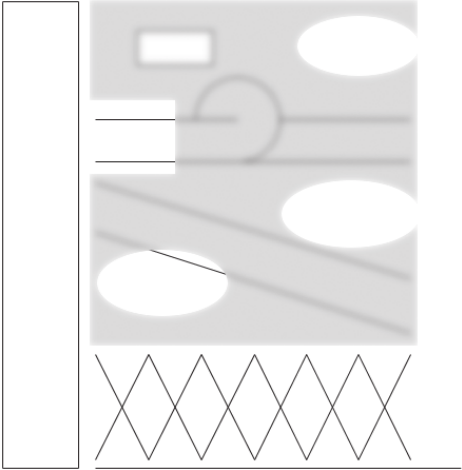
Fig. 2. OMA’s competition proposal
for the French National Library (1989)
(drawing M. Brzezicki based on R. Koolhaas’ own sketch; source: [26])
Il. 2. Koncepcja konkursowa pracowni OMA’s
na projekt Francuskiej Biblioteki Narodowej (1989)
(rys. M. Brzezicki na podstawie szkicu R. Koolhaasa; źródło: [26])
disturbance of transparency can also occur at the level of
the envelope, an additional element applied or laid over
the actual façade. This additional envelope usually has
optical parameters other than transparent pane. It is there-
fore possible that the transparent façade is covered with
a translucent envelope. However, the disturbance of the
transparency may also result from the fact that the path of
the ray of light becomes so complicated – and there are so
many obstacles on this path – that guessing what is hidden
on the other side of the pane is almost impossible. This
phenomenon occurs when the pane is covered with a dense
ornament, which entangles the observer’s gaze in its com-
plexity, not allowing for deeper penetration. This “voile”
can also take the physical form of a screen or a blind,
which is located in front of or behind the actual pane. In
this case, the “voile” eect might not be permanent – the
blinds can be retracted, the cover can be removed. More
and more often it happens automatically, without human
intervention, e.g., in the so-called adaptive façades [29].
The optical phenomena taking place in the translucent
façades have already been described. The author of the ar-
ticle proposes his original simplied typology, according
to which – depending on what optical phenomena occur
in the façade or the envelope – the disturbance of trans-
parency can be classied as homo- and heterogeneous
disturbance:
Homogenous disturbance
The rst group is homogeneous disturbance in which
the whole surface of the pane is the source of the same
optical distortion. A good example of this phenomenon is
allowed not only for illumination the interior, but also al-
lowed users to “be seen” and “become visible” [23, p. 36].
The use of coatings that interfere with light is strongly
connected with a signicant transformation taking place
in the dialectic of the building, with the transformation of
the modernist curtain wall – a mullion and transom skele-
tal system lled with transparent glass – into an envelope,
more metaphorical membrane. This new envelope allows
for the perception of the distorted image of the building
by the observers located outside and the distorted image
of the surrounding environment by those located inside.
While the façade – in the sense of the modernist curtain
wall – is something very literal and specic but never-
theless closely related to the building, the new envelope
gains its independence. In the literal, technical sense, as
an element forming an additional layer of façade, in for-
mal sense, as an element introducing additional quality
into the façade space.
As early as in 1966, R. Venturi observed the division of
the building into the volume and facade/envelope [24]. In
2011 in the text titled Building Envelope as Surface S. Lee
and S. Holzheu write: […] here the medium is the actual,
physical and material presence of the façades themselves,
while the content consists of visual eects, messages, signs
and other elements that are supercial to the façades [25,
p. 125]. From their perspective – in the Venturian view
– the façade is […] a communicative device that is ex-
pected to signify, symbolize and convey certain narratives,
messages and information [25, p. 125]. After the book
Complexity and Contradiction was published, the trend of
the envelope independence went even further than Venturi
himself had expected. However, gradual erosion of trans-
parency has been observed in architecture progressing only
after 1989, from the time the R. Koolhaas proposal of the
French National Library was revealed – see Figure 2 [26].
In the proposed design one cuboidal block made of trans-
lucent glass enveloped small functional elements that were
contained inside. Only a few oval-shaped, clear openings
allowed for illumination and an unobstructed view into and
out of the interior; the remaining envelope served more as
a “cover than a fenestration” [15]. This specic relation of
“closeness and inaccessibility” was noted by French phi-
losopher J. Starobinsky as early as 1961 [27] and in 1995
T. Riley described a very similar mechanism of […] shift-
ing the objects meaning from its form [meaning the spatial
form – M.B. note] to its surface [7, p. 29], thus strength-
ening the role of the façade itself, regardless of the volume
to which it was attached. H. Muschamp concludes well:
building skin is used not to reveal but to veil [28, p. 1].
Simplified typology
The disturbance of transparency can be manifested in
many dierent ways. It can take place within the space
of the façade when the transparent pane is replaced by
a translucent pane and the light penetrating through the
façade is scattered to a degree that depends on the opti-
cal parameters of the pane (e.g., the shoji eect – a matte
screen made of rice paper mounted in bamboo frames
which is present in the Japanese building tradition). The
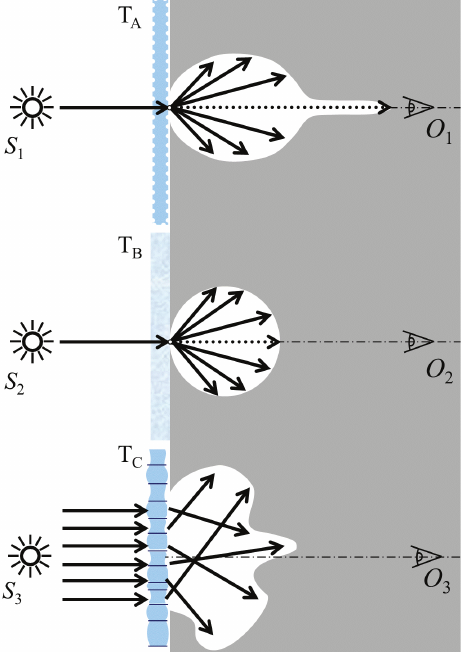
82 Marcin Brzezicki
face scattering the central group of scattered rays is vis i-
bly stronger and the contours of objects on the other side
of the pane are visible. What is more, the closer they are
to the surface of the pane, the more recognizable the out-
line will be. In contrast, the scattering in the mass of the
material results in an image devoid of contours of objects
that are located on the other side of the pane and the pane
itself radiates/illuminates an even brightness. What may
seem an insignicant dierence at rst glance, has signi-
cant consequences for the perception of the entire build-
ing. Etched panes can transmit the colour, while in the
case of mass-scattering this transmission is either equal to
zero or is strongly limited. Surface-scattering allows for
the better integration of the object with the environment
as the blurred boundary of the building body “melts” with
the colour “taken” from the surrounding.
Glass pane optically composed of smaller or larger
groups of convex and concave lenses constitutes the so-
called compound lens. From the optical perspective, this
type of pane does not scatter the light at all, only the di-
rection of the ray of light is changed by refraction. Light
transmission is less homogeneous and the specic pattern
is superimposed on the image visible through the pane,
which reects the arrangement of smaller convex and
concave lenses in the pane. The inuence of such a pane
on the visible image depends on the size of lenses vs. the
size of the building and the building-observer distance.
In large-size glass elements, optical refraction will visi-
bly distort the image of the building behind the glazing
and this distortion will be visible to the observer. On the
contrary, ornamental glass the surface of which consists
of many small lenses will produce similar optical results
as an evenly light-scattering pane. Although the optical
mechanism is dierent, typologically, compound lenses
(ornamental glass) can be classied as belonging to the
homogenous disturbance group.
Heterogeneous disturbance
The second group is a heterogeneous disturbance in
which some areas of the pane change the path of the ray
of light, while others do not. This type of disturbance is
therefore not uniformly distributed over the whole sur-
face of the pane but is present only in selected regions.
It is usually observed in the case of screen-printed panes
with the pattern or when selective acid etching is applied
to the regions of the pane. A heterogeneous disturbance
is very sensitive on the scale in the sense that the scale
of the pattern determines the nal optical eect visible
to the observer. The distance from which the building
is observed is decisive. Small patterns (e.g., small dots,
squares, dashes) that are too small to be recognized by the
observer from a distance are perceived as a homogeneous
disturbance, while large, easily recognizable patterns are
perceived literally – as patterns. The large, easily distin-
guishable ornament on transparent glass usually entan-
gles an observer’s eye with its complexity, not allowing
for deeper penetration. In this way, the pattern – print of
frit – gains independence, becomes more important than
the light-transmitting surface on which it is placed. These
Fig. 3. Diagrams showing three main types of light scattering:
scattering on the surface of the material (T
A
),
scattering in the mass of the material (T
B
),
and refraction when passing through complex lenses,
e.g. an ornamental pane (T
C
), which, due to the scale of the pattern,
is perceived as passing through a translucent sheet of glass.
The light sources S
1
, S
2
and S
3
are identical
(elaborated by M. Brzezicki)
Il. 3. Schematy przedstawiające trzy główne rodzaje rozpraszania światła:
rozpraszanie na powierzchni materiału (T
A
),
rozpraszanie w masie materiału (T
B
)
oraz załamanie przy przejściu przez złożone soczewki,
np. szybę ornamentową (T
C
), która ze względu na skalę wzoru
odbierana jest jako przejście przez przeświecalną taflę.
Źródła światła S
1
, S
2
i S
3
są identyczne (oprac. M. Brzezicki)
a light-scattering pane that makes objects located behind
optically blurred. Homogeneous distortion usually occurs
when translucent, etched, or sandblasted glass (or acrylic)
panes are used. The mechanism of the optical phenome-
non is simple and well known: one ray of light falling on
the surface of a pane is “scattered” into many randomly
oriented rays. This change of the ray’s direction results
from the microstructure of the pane’s surface. Similar
optical eects can be achieved with materials that scat-
ter light not only on the surface (as in the case of etched
glass), but in its entire mass of the material like in the milk
glass, polycarbonate, or even solid stone (e.g., alabaster).
Detailed optical experiments prove that there is a signif-
icant dierence: light is more evenly scattered in the mass
of the material (mass-scattering) vs. when the scattering
process takes place only on the surface (surface-scatter-
ing). Figure 3 shows the dierence. In the case of the sur-
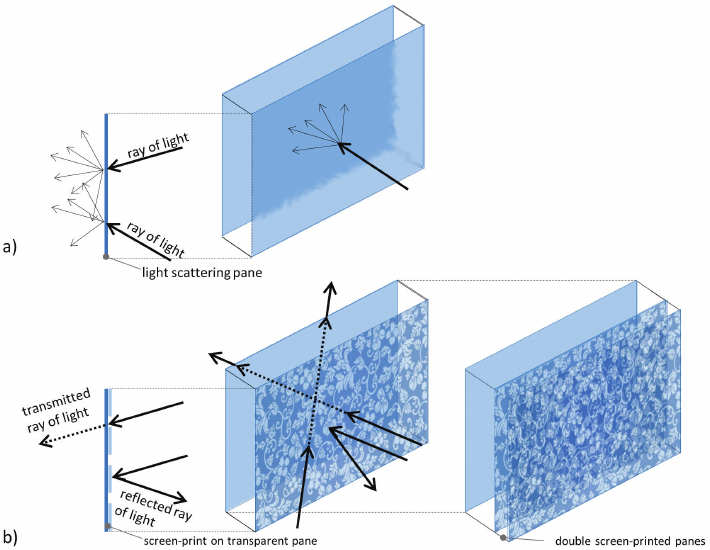
Disturbance of transparency in the architecture of contemporary glass façades. Part 1 83
patterns are often applied to an additional envelope laid
over the proper glass façade of the building. In optical
terms, they resemble classic decorative jacquard curtains
and behave similarly. Observed from the outside, they
form a barrier, viewed from the inside, usually with the
pattern backlit, allow for a limited view of what is happen-
ing outside like a one-way mirror.
Summary of part 1
An envelope “rich in ornamentation” and a “tempting
veil” are two dierent design strategies in the disturbance
of transparency, leading to dierent visual phenomena.
The rst part of the paper addresses the issues of methodo-
logy, denitions and proposed the simplied typology of
light-disturbing envelopes in contemporary architecture.
Matrix approach, case studies and the characteristics of
sub-trends based on conducted analyses are presented by
the author in the next part of the presented paper in the
next issue of an journal. The following part will also in-
clude the discussion and conclusions.
Translated by
Marcin Brzezicki
Fig. 4. A diagram illustrating
optical phenomena in sub-trends
defined by simplified typology:
a) homogenous disturbance;
b) heterogeneous disturbance
(elaborated by M. Brzezicki)
Il. 4. Schemat ilustrujący
zjawiska optyczne występujące
w pod-nurtach:
a) zniekształcenie jednorodne;
b) zniekształcenie niejednorodne
(oprac. M. Brzezicki)
References
[1]
Wartzeck S., Herrmann E.M., Krammer M., Sturm J., Enclose build:
Walls, façade, roof, Birkhäuser Architecture, Basel–Boston 2015.
[2] Colomina B., Unclear Vision: Architectures of Surveillance, [in:]
M. Bell, J. Kim (eds.), Engineering Transparency: The Technical,
Visual, and Spatial Eects of Glass, Princeton Architectural Press,
New York 2008, 78–87.
[3] Alter L., All-glass buildings are an aesthetic, as well as a thermal
crime, https://www.treehugger.com/green-architecture/all-glass-buildings-
are-aesthetic-well-thermal-crime.html [accessed: 30.05.2020].
[4] Brzezicki M., Optical transparency vs. institutional transparency:
the discussion on the origins of architectural honesty in glass ap-
plication, [in:] J. Belis, F. Bos, Ch. Louter (eds.), Proceedings of
the Challenging Glass 5 Conference, Ghent, Belgium, June 16–17,
2016, Ghent University, Bos and Louter, Ghent 2016, 25–30.
[5] Diller E., Scodio R., Post-paranoid Surveillance, [in:] T.Y. Levin,
U. Frohne, P. Weibel (eds.), CTRL [Space], MIT Press, Cambridge,
Mass. 2002, 354–360.
[6] Kaltenbach F., Translucent materials. Glass, Plastics, Metal, Birk-
häuser, Basel–Boston 2004.
[7]
Riley T., Light Construction, The Museum of Modern Art, New York 1995.
[8] Schittich Ch., In Detail: Japan – Architects, Constructions, Am-
biance, Birkhäuser, Basel–Boston 2002.
[9] Blau E., Tensions in Transparency. Between Information and Expe-
rience: The Dialectical Logic of SANAA’s Architecture, “Harvard
Design Magazine” 2008, No. 29, 29–37.
[10] Murray S., Translucent Building Skins: Material Innovations in
Modern and Contemporary Architecture, Routledge, Milton Park,
Abingdon 2012.
Acknowledgements
This paper was funded by the National Science Centre, Poland grant
entitled: “New trends in architecture of transparent façades – formal
experiments, technological innovations”, ref. no. 2014/15/B/ST8/00191.
Various elements of simplied typology have already appeared in the
author’s previous publications [20], [21], [30] but were not described
in such detail. The case studies shown there have not been systematized
in the form of a matrix system before.
84 Marcin Brzezicki
[11] Celadyn W., Przegrody przeszklone w architekturze energooszczęd-
nej, Wydawnictwo Politechniki Krakowskiej, Kraków 2004.
[12] Wala E., Szkło we współczesnej architekturze. Monograa, Wydaw-
nictwo Politechniki Śląskiej, Gliwice 2012.
[13] Zielonko-Jung K., Fasady przeszklone, “Architektura-murator”
2018, nr 2(286), 36–38.
[14] Marchwiński J., Funkcja estetyczna atriów przeszklonych w archi-
tekturze – cz. 1, “Świat Szkła” 2005, nr 4, 14–21.
[15] Brzezicki M., Spostrzeganie przezroczystości w architekturze współ-
czesnej: aspekty wizualne i kognitywne, Ocyna Wydawnicza PWr,
Wrocław 2014.
[16] Piegat A., Modelowanie i sterowanie rozmyte, Akademicka Ocy-
na Wydawnicza EXIT, Warszawa 1999.
[17] Niezabitowska E., Metody i techniki badawcze w architekturze,
Wydawnictwo Politechniki Śląskiej, Gliwice 2014.
[18] Sławińska J., Widera B., Nurty w architekturze współczesnej – kło-
poty z wyodrębnieniem, “Architectus” 2001, nr 1–2, 89–95.
[19] Sławińska J., Architektura high tech – próba charakterystyki, “Ar-
chitectus” 1998, nr 1–2(3–4), 54–67.
[20] Brzezicki M., Recent trends in architectural design of light-perme-
able façades, [in:] GPD2017: All eyes on glass. Glass Performance
Days 2017, June 28–30, 2017, Tampere, Finland. Conference pro-
ceedings, Glass Performance Days, Tampere 2017, 222–227.
[21] Brzezicki M., The architectural design of light-permeable façades
– a summary of recent trends and observations, “Technical Transac-
tions” 2019, Vol. 12, 5–30, doi: 10.4467/2353737XCT.19.120.11445.
[22] Elsener Ch., Glass, the opaque building material, [in:] A. Deplazes
(ed.), Constructing Architecture: Materials, Processes, Structures.
A Handbook, Birkhäuser, Basel 2008, 151–158.
[23] Shimmel D.P., Transparency in theory, discourse, and practice of
Landscape Architecture, PhD Thesis, The Ohio State University,
Ohio 2013.
[24] Venturi R., Scully V., Museum of Modern Art, Complexity and con-
tradiction in architecture, Museum of Modern Art, New York 2002.
[25] Lee S., Holzheu S., Building Envelope as Surface, [in:] Sang Lee
(ed.), Aesthetics of Sustainable Architecture, 010 Publishers, Delft
2011.
[26] OMA, Très Grande Bibliothèque, France, Paris, 1989, https://oma.
eu/projects/tres-grande-bibliotheque [accessed: 1.05.2020].
[27] Starobinski J., Le voile de Poppée, [in:] J. Starobinski, L’oeil
vivant: Essai, Gallimard, Paris 1961, 9–27.
[28] Muschamp H., Buildings that hide and reveal, “The New York Times”
1995, 22 Sept., Sect. C, p. 1, https://www.nytimes.com/1995/09/22/
arts/architecture-review-buildings-that-hide-and-reveal.html [ac-
cessed: 7.03.2021].
[29]
Loonen R.C.G.M., Trčka M., Cóstola D., Hensen J.L.M., Climate
adaptive building shells: State-of-the-art and future challenges, “Re-
newable and Sustainable Energy Reviews” 2013, Vol. 25, 483–493,
doi: 10.1016/j.rser.2013.04.016.
[30] Brzezicki M., Redundant Transparency: The Building’s Light-Per-
meable Disguise, “Journal of Architectural and Planning Research”
2014, Vol. 31, No. 4, 299–321.
Abstract
Disturbance of transparency in the architecture of contemporary glass façades. Part 1
Over the last two decades, new trends have emerged in the design of translucent façades. Those trends result from the dynamic technological pro-
gress and achievements in material engineering. The trends that are associated with the use of envelopes that interfere with the transmission of light
through the façade are particularly interesting. This is strongly related to the signicant transformation that took place in the dialectic of the building,
the transformation of the “façade” into an “envelope”. The paper presents the author’s original distinction between the two most characteristic main
sub-trends, distinguished based on optical phenomena occurring within the façade. The proposed division includes two main groups of disturbances:
homogenous and heterogeneous. The former is present where panes of glass are used to disperse/diuse light evenly, while the latter in façades with
strong – usually printed – ornamentation. The article systematizes the issues of transparency disturbance in contemporary architecture and presents
the typology of light-transmitting façades, in which this phenomenon takes place. The author also presents a matrix of relations that systematizes the
presented case studies. Only this type of matrix makes it possible to illustrate an issue in which more than one variable is present. An assignment of
the case studies to the trends and the determination of trend models are also included in the paper. The rst part of the paper presents the introduction,
methodology and simplied typology, the second one presents case studies, discussion and conclusions.
Key words: transparency, theory of architecture, façade glazing, printing on glass, coatings on glass
Streszczenie
Zakłócenie przezroczystości w architekturze współczesnych szklanych fasad. Część 1
W ciągu ostatnich dwóch dekad pojawiły się nowe nurty w projektowaniu przezroczystych fasad. Są one wynikiem dynamicznego postępu tech-
nologicznego i osiągnięć w dziedzinie materiałoznawstwa. Szczególnie manifestują się te nurty, które związane są z zastosowaniem powłok zakłó-
cających przenikanie światła przez fasadę. Wiąże się to silnie z istotną przemianą, która dokonuje się w dialektyce budynku, z przemianą fasady
(ang. façade) w obudowę/powłokę (ang. envelope). W artykule przedstawiono dokonane przez autora rozróżnienie zjawisk optycznych, które zacho-
dzą w obrębie fasady. Proponowany podział obejmuje dwie główne grupy: jednorodne i niejednorodne zniekształcenia przezroczystości. Te pierwsze
występują tam, gdzie zastosowano tae równomiernie rozpraszające światło, te drugie natomiast w fasadach o silnej – zazwyczaj nadrukowanej
– ornamentacji. Artykuł systematyzuje zagadnienia zniekształcenia przezroczystości w architekturze współczesnej i przedstawia typologię tych fasad
przepuszczających światło, w których występuje to zjawisko. W artykule przedstawiono też macierz relacyjną, która systematyzuje opisywane studia
przypadków. Jedynie ten typ macierzy pozwala na pokazanie zagadnienia, w którym obecna jest więcej niż jedna zmienna. W tekście dokonano
również przypisania studiów przypadków do nurtów, a także charakterystyki samych nurtów – stworzenia ich modeli. Pierwsza część tekstu zawiera
wstęp, opis metodologii oraz uproszczoną typologię, a w drugiej znajdą się studia przypadków, dyskusja oraz wnioski.
Słowa kluczowe: przezroczystość, teoria architektury, szklana fasada, nadruk na szkle, powłoki na szkle