2010
Nr 2(28)
Climate change at the turn of the 20
th
and 21
st
cen-
turies is indisputable. In 1988, two Organizations of the
United Nations – the World Meteorological Organiza-
tion (WMO)
1
and the United Nations Environment Pro-
gramme (UNEP)
2
created the Intergovernmental Panel on
Climate Change (IPCC)
3
. IPCC is a permanent forum of
cooperation of hundreds of scientists from many coun-
tries, publishing every few years the reports which greatly
affect the development of national and international cli-
mate programs and the policy of nancing research on
climate change. The rst report of IPCC was published
in 1990, next ones in 1995 and 2001 and the last one in
2007. The last report was developed by over 600 authors
from 40 countries, reviewed by over 620 experts and rep-
*
West Pomeranian University of Technology, Szczecin, Faculty of
Civil Engineering and Architecture, Division of Contemporary Architec-
ture, Theory and Methodology of Design.
1
The World Meteorological Organization (WMO) – international
organization with 188 member states which originated from the Interna-
tional Meteorological Organization (IMO), which was founded in 1873.
Established 1951, WMO became a specialized agency of the UNO whose
task is to unify, improve and exchange of publications on meteorology as
well as support studies of climate, geography, and hydrology.
Source: http://pl.wikipedia.org/wiki/Światowa_Organizacja_Me-
teorologiczna.
2
The United Nations Environment Programme (UNEP) – agency
of the UNO established by the resolution of the General Assembly of the
UNO no. 2997 from Dec. 1972 to coordinate UN environmental activities,
constantly monitoring the global environment. UNEP is based in Nairobi,
capital of Kenya. Achim Steiner from Germany is the Executive Director
of UNEP.
Source:http://pl.wikipedia.org/wiki/Program_Środowiskowy_Or-
ganizacji_Narodów _Zjednoczonych.
3
Intergovernmental Panel on Climate Change (IPCC) – organization
established in 1988 by two organizations of the United Nations – World
Meteorological Organization (WMO) and The United Nations Environ-
ment Programme (UNEP) to assess the risk of climate change caused by
human activity.
Source: http://pl.wikipedia.org/wiki/Intergovernmental_Panel_on_
Climate_Change.
resentatives of governments. The summary of the report
was accepted by representatives of 113 countries. The key
conclusions of the Fourth Assessment Report of the IPCC
(AR4) are as follows:
– Warming of the climate system is unequivocal,
– The probability that this is caused by natural climatic
processes alone is less than 5%,
– The probability that this is caused by anthropogenic
(human) greenhouse gas concentration is >90%,
– During the 21
st
century world temperature could
rise by between 1.8 and 4 °C. However, the possible rise
ranges from 1.1 to 6.4 °C,
– Sea levels will probably rise by 28 to 42 cm,
– There is a condence level >90% that there will be
an increase in heat waves and heavy rainfall.
In architecture the rst ideas to save energy and con-
struct environmentally friendly buildings appeared during
the fuel crisis of the 1970s. A growing interest in new,
non-conventional sources and technologies of energy
generation has resulted in the development of philosophy
of architecture which is friendly both to people and en-
vironment where it is located as well as the doctrines of
sustainable development of architecture. Currently sus-
tainable development is development that meets the needs
of the present without compromising the ability of future
generations to meet their own needs, is possible – this fa-
mous sentence from the 1987 WCED report – “Our Com-
mon Future” (Brundtland Report – after the last name of
Gro Harlem Brundtland – the Chair of the commission)
set a new direction in the development of architecture
at the end of the 20
th
century. The beginning of the 21
st
century strongly conrmed the ecological and energy ef-
cient architecture as a canon and indicator of culture in
creating human life space. Taking into account the pre-
cisely assigned objective of the European Commission
to shift to an energy efcient and low carbon economy
already in 2020 (reduction of the demand for energy by
20% and reduction of emission of CO
2
by 20% as well as
Robert Mazur*
Ecological and energy efcient architecture
as a new trend in the architectural culture
128 Robert Mazur
an increase in use of renewable energy by 20%), the fol-
lowing question arises: Is ecological and energy efcient
architecture only a fashion or temporary trend caused by
the problems with global natural resources or architec-
tural culture growing from the receptivity to the ideas of
eco-philosophy and care for future generations as a vi-
sion of the future? The analysis of the conception as well
as of the execution of architectural designs from the turn
of the 20
th
and 21
st
centuries in Europe and globally can
provide the answer to that question.
Since the 1970s, the works by Emilio Ambasz have
been permanently in the center discourses about ecologi-
cal architecture
4
due to their incorporation into surround-
ing landscape and vegetation. His works are a perfect ex-
ample of the integration with nature – the key postulate of
ecological architecture. The theories developed by Emilio
Ambasz include the basic criteria of ecological architec-
ture – relation to context, creative approach to landscape,
symbols, ecological technologies and visionary imagina-
tion. In his designs Ambasz treats landscape as integral
part of an object and, just like other architects, incorpo-
rating a human dwelling place into the context of nature,
he makes references to the achievements of Frank Lloyd
Wright. Schlumberger Research Laboratories in Austin,
Texas, is a center of technology whose interiors, accord-
ing to the assumptions of its investors, were to adapt to the
changing number of its employees [3]. The location of the
buildings was to be associated with data owing through
the computer and that is why the whole compound was
designed as integrated with the landscape with its indi-
vidual buildings buttressed with earth berms. Ambasz
achieved two goals: integration with the surroundings and
a better thermal insulation of the buildings regardless of
the season by covering the buildings with masses of earth.
4
Ecological architecture – although the idea of energy efcient
and environmentally friendly architecture has always been embraced by
utopian architects, it became especially popular and important in the early
1970s, and particularly after the fuel crisis in 1973. London’s Ecologi-
cal House by Graham Caine is the agship building of this type. Some
of the most spectacular examples of ecological architecture, although
never executed, include the arboreal designs by Magdalena Abakanowicz
from 1991.
Source: http://www.artinfo.pl.
Furthermore, the design displays cosmological relations
with ancient Celtic buildings and at the same time indi-
cates the connection between the computer age communi-
cation techniques and art of earth as well as ancient ritu-
als. Another example of work by Emilio Ambasz where
earth berms are used to incorporate the building into the
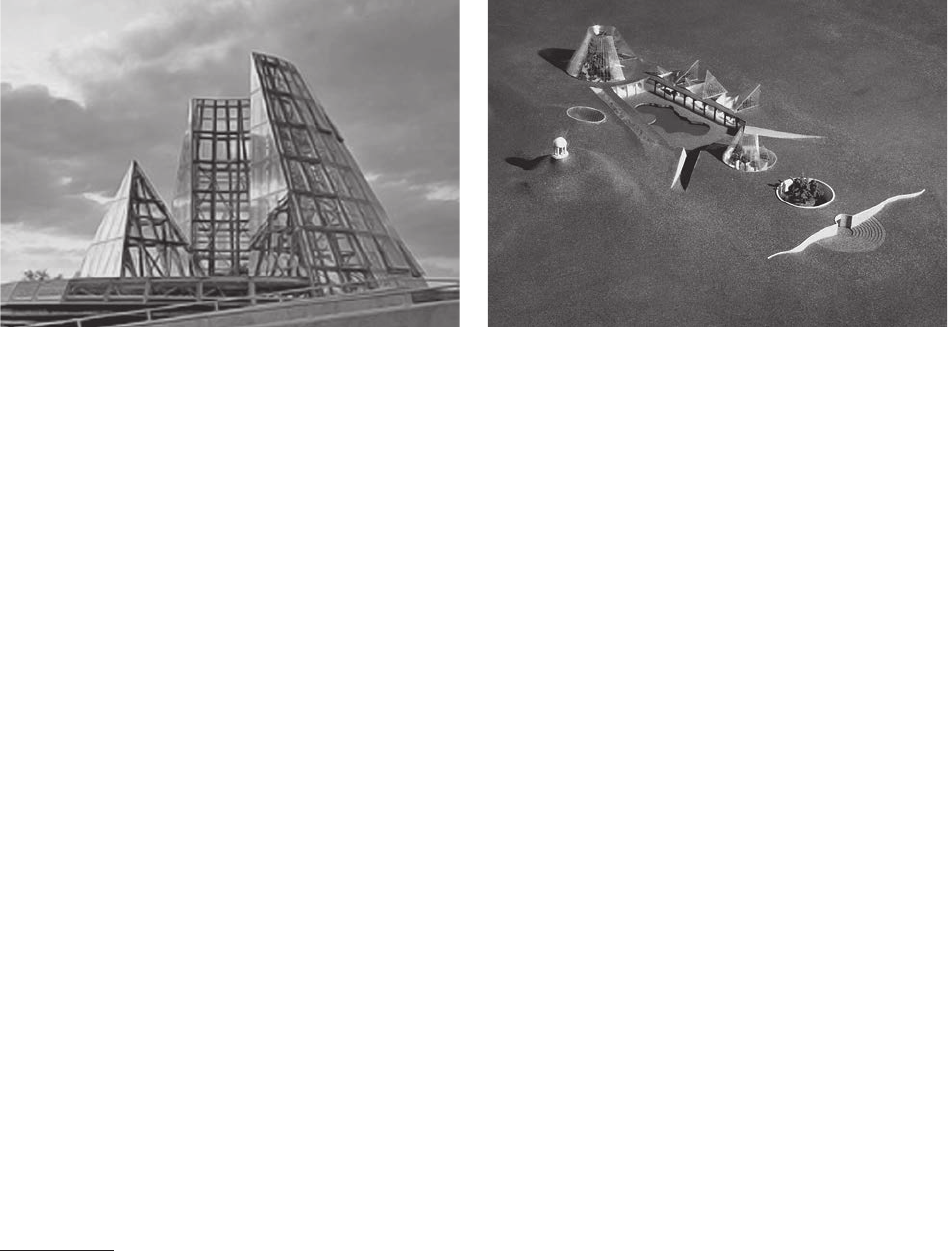
landscape is Lucille Halsell Conservatory in San Antonio,
Texas (see Figs. 1 and 2).
The buildings with specimens of plants resemble the
Hanging Gardens of Babilon. The design is crowned with
forms resembling glass pyramids surrounded by furrows
in the ground and moulds. This makes it look like a living
monument in honor of plants, earth, and sky. The whole
design provides for proper sun exposure, microclimate
and exchange of air for the plants kept inside. The big-
gest design by Emilio Ambasz is ACROS Building in
Fukuoka, Japan completed in April 1995. This is one of
the most signicant examples of architecture – the gar-
den design is in opposition to garden architecture inter-
preted as “return to nature” associated with a house built
in the natural environment. ACROS Building expresses
the ecological desire to give back to nature the space
taken by people and to rebuild the natural environment
destroyed in the 20
th
century. The use of the green fa-
cade of the center of culture as an extension of the nearby
parkland is no longer a visual object and it becomes an
icon of architecture absorbing and stimulating senses.
This design refers to the important issue for architecture
ecological namely the man-made nature as opposed to
original nature. This is also an answer to the question:
What is green architecture at the turn of the 20
th
and 21
st
centuries?
The Pit by Peter Noever can be a European example
of pro-ecological architecture, expressing the vision of ar-
chitecture regarded as an extension of landscape [3]. The
architect remodeled an old wine cellar abandoned for over
two hundred years and a nearby quarry located in Breiten-
brunn, Austria. This is a special combination of integrated
environment, public space and landscape architecture,
creating green architecture provoking further work on
ecological apartments of the future. Another example of
architecture integrated with the natural environment is
EFA – a radio satellite station by Gustav Peichl in Aenz,
Figs. 1, 2. Lucille Halsell Conservatory, San Antonio, Texas, Emilio Ambasz – source: http://www.ickr.com
Ecological and energy efcient architecture as a new trend in the architectural culture 129
Austria [3]. The design integrating the broadcasting sta-
tion technical facilities with residential buildings into an
earth slope refers to the works by Emilio Ambasz and his
green architecture designs.
These examples of ecological architecture at the end
of the 20
th
century are set in the context of the idea of
integration of a man-made space with the natural space.
They provide the answer to the question asked earlier:
What is ecological architecture? The sensitivity of archi-
tects expressed in those examples and the consequence of
the idea of integration of architecture with its surround-
ings is the best conrmation of the high culture in creating
a man-made environment. The respect for green natural
resources by giving back the space taken by man is an
expression of a deep concern for the environment of the
future generation and realization of the vision of contem-
porary architecture. It is worth noting that the examples
do not apply modern energy efcient solutions or use re-
newable sources of energy. Their focus is more on design
solutions and implementation of the idea of earth-oriented
ecological architecture.
Ecological architecture of the 21
st
century is totally
different. Its characteristic features include a rapid devel-
opment of information technologies and technological
achievements in the scope of use of renewable sources of
energy. In order to meet the current needs of the society
ecological architecture sets a new direction in creating hu-
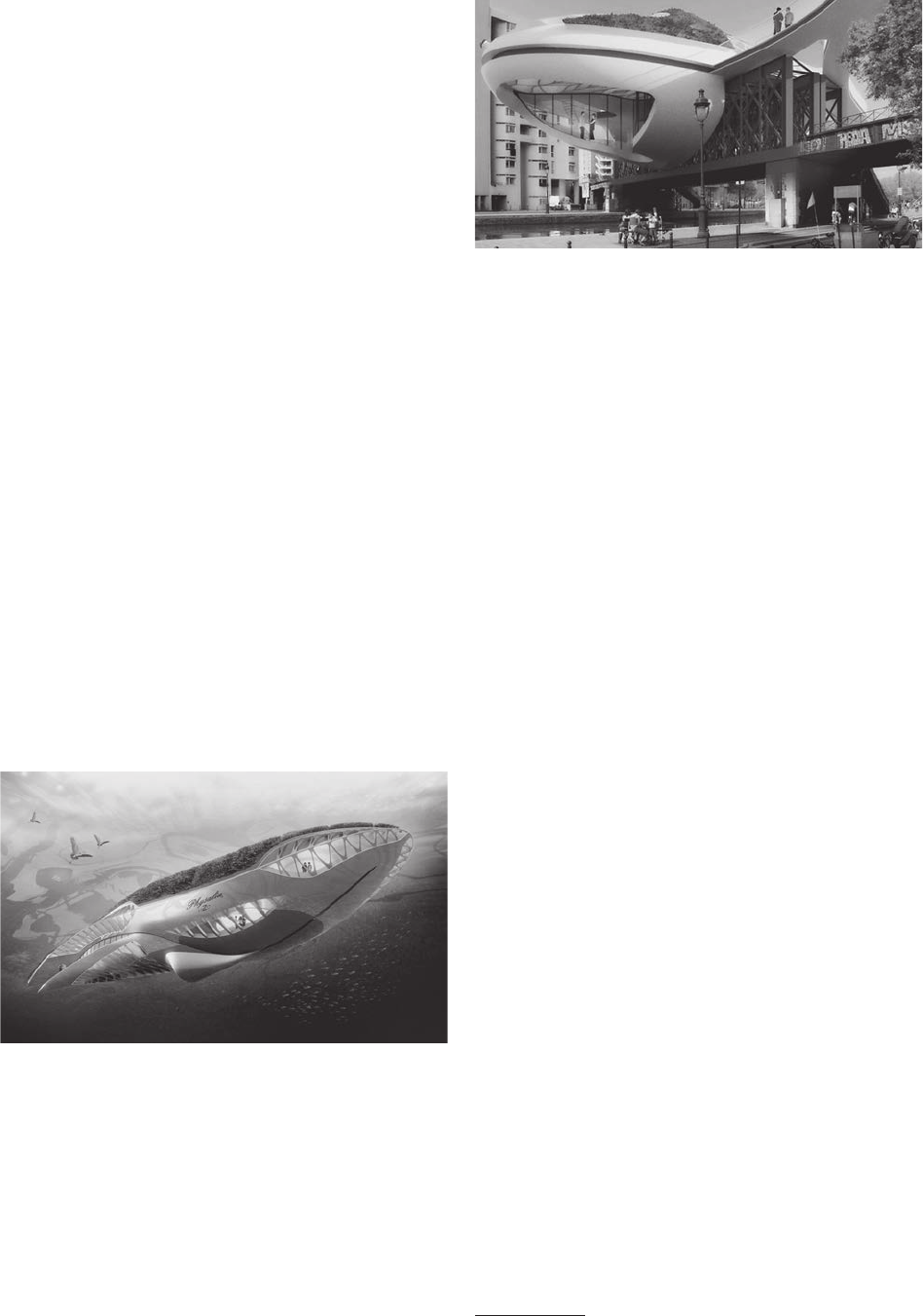
man life space. Physalia – which in Latin means jellysh
– is a giant cnidarian driven by hydro-turbines designed
by Vincent Callebaut covered with plants and solar panels
(see Fig. 3) [1].
Physalia is meant to navigate through the rivers and
clean water. Furthermore, inside there will be lecture halls
and gardens where the visitors will live pro-ecologically.
Another design by Vincent Callebaut called Dragony
is a vertical farm providing healthy and ecological food.
The program includes the production of high quality veg-
etables and fruits. The futuristic ecological farm without
pesticides will be located in the heart of New York. Anti-
Smog is a project for one of industrial districts in Paris
(see Fig. 4) [1]. A structure whose surface is coated in
titanium dioxide will efciently reduce the amount of
smog in the air. Modern architecture is supposed to be
not only energetically self sufcient but also contribute
to removing toxic pollutants from the air, cleaning water
in nearby reservoirs or using rainwater for technical pur-
poses.
The architect calls his work an “organic parasite”
placed in a post-industrial environment full of both still
operating and already abandoned factories. It will con-
sist of two main parts. The “Solar Drop” perched over an
unused railroad tracks on de l’Ourcq canal – an ellipti-
cal structure resembling rugby ball which, in compliance
with the requirements of ecological architecture, will
have hundreds of photovoltaic panels supplying neces-
sary energy and systems to collect rainwater which can
be used e.g. to ush toilets or clean photocells. What is,
however, truly distinctive about the project by the Belgian
designer is its exterior coated in titanium dioxide which,
according to the author, will reduce the level of airborne
pollutants and contaminants. In its reaction with smog it
will break down organics and consequently clean the at-
mosphere. Inside the “drop” there will be public spaces
and a huge exhibition hall – everything designed around
a central garden full of vegetation. The other building in
the ecological compound is a 45 m tall “Wind Tower”
with an art gallery and a skytop garden with a spiral path
leading to it. The name of the building derives from the
name of special vertical axis wind turbines used in its con-
struction that operate like the Darrieus wind turbine
5
. The
Tower will be coverd with LED screens to display news.
Inspired by the shape of a water lily, Vincent Callebaut
designed the Lilypad – a completely self-sufcient oat-
ing eco-city. This visionary urban agglomeration will be
adapted to meet the need of contemporary civilization. It
will have apartments, gardens, shopping centers, places
for recreation and entertainment. The project is a vision of
an ecological city of the future. Born in 1977 in Belgium,
Vincent Callebaut expresses in his projects the ideas of
ecological human life spaces needed by the 21
st
century
information society. This is also expressed by the Per-
fumed Jungle as a reminiscence of jungle located in the
5
The Derrieus turbine – sometime called an eggbeater is one of two
main types of vertical axis wind turbines (VAWT). Patented by Georges
Darrieus in 1931.
Source: http://pl.wikipedia.org/wiki/Turbina_Darrieusa
Fig. 3. Physalia, Vincent Callebaut
– source: http://portal.architekturakrajobrazu.info
Fig. 4. Anti-Smog, Paris, Vincent Callebaut
– source: http://portal.architectkrakrajobrazu.info
130 Robert Mazur
harbor. The project implements the assumption of green
areas provided to the residents of Hong Kong for recrea-
tion, relax and entertainment. It may also house ofces
and other facilities.
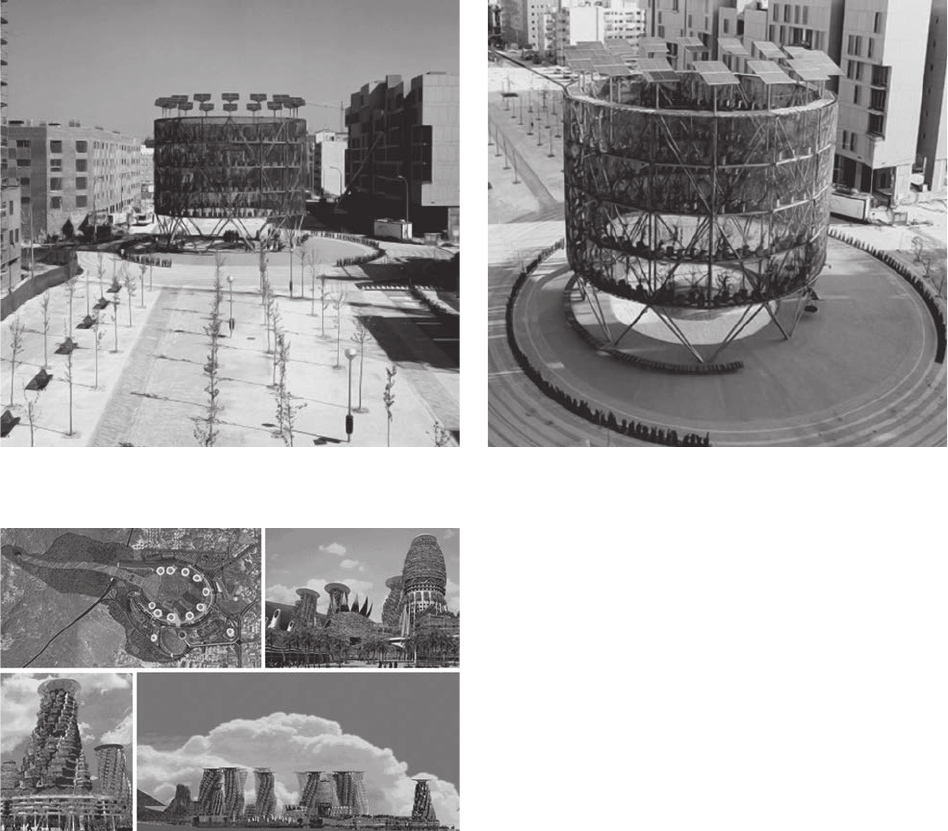
Architects from Ecosistema Urbano created a project
of an ecological urban space. The designers of Eco Boul-
evard, in Vallecas, a suburb of Madrid, assumed that it
would serve two purposes: an ecological lter and a place
to stimulate social activity. They deliberately chose the
form of an open pavilion that can be freely used by the
residents of Vallecas (see Fig. 5) [1]. It also serves as a
city amphitheater to hold concerts and performances as
well as a meeting place for the residents of the district.
Eco Boulevard is a self-sufcient structure tted with
photovoltaic fuel cells. On individual oors there are pot-
ted plants to lter the air in the district. The most interest-
ing effect was created inside the pavilion where the air
temperature is lower than outside by 8 to 10°C.
Architecture of the 21
st
century evidently evolves in
the direction of ecological ideas, maintaining modern ap-
pearance and application of the latest technologies. This
is conrmed by Rafesia Zero Energy House from Kuala
Lumpur in Malaysia, Zoki Zoli or Elm Park in Dublin,
Ireland designed by Bucholz McEvoy Architects and
California Academy of Sciences in San Francisco. Global
solutions for cities such as Penang Peaks in Malaysia by
Michael Sorkin Studio (see Fig. 6) or Shenzhen Logistic
City in China, by JDS-Julien de Smedt architects are more
and more popular [2].
It is impossible to describe all examples which would
provide the answer to the question asked earlier: Is eco-
logical and energy efcient architecture only a fashion
or temporary trend caused by the problems with global
natural resources or architectural culture growing from
the receptivity to the ideas of eco-philosophy and care
for future generations as a vision of the future? One can
conclude that although contemporary architecture is a de-
liberate direction inspired by the ideas of eco-philosophy,
however, it still applies the latest information technolo-
gies and technical solutions. The examples of projects
presented above as well as architectural concepts dene
the vision of the future, respecting the context of the place
and the natural environment as well as show deep ecologi-
cal concern for future generations.
Fig. 5. Eco Boulevard, Ecosistema Urbano – source: http://www.plataformaarquitectura.cl
Fig. 6. Penang Peaks, Michael Sorkin,
Makoto Okazaki, B. Degn, Y. Koda
– source: http://sorkinstudio.net/PenangPeaks.htm
References
[1] Jodidio P., Green Architecture Now!, Tashen GMBH, Cologne
2009.
[2] Van Uffeln C., Ecological Architecture, Braun Publishing AG, Berlin
2009.
[3] Wines J., Zielona Architectura, Taschen/TMC Art., Cologne 2008.
Ecological and energy efcient architecture as a new trend in the architectural culture 131
Architektura ekologiczna i energooszczędna
nowym kierunkiem kultury architektonicznej
Przedmiotem artykułu jest architektura ekologiczna i energoosz-
czędna jako odpowiedź na wzrastające zapotrzebowanie i tendencje
w nowoczesnej wizji architektury. Kreowanie architektury przy użyciu
odpowiednich materiałów oraz stosowanie zintegrowanych systemów
energooszczędnych z wykorzystaniem odnawialnych źródeł energii staje
się nowym zjawiskiem kulturowym. Artykuł podaje przykłady ekokultury
architektonicznej i odpowiada na pytanie czy jest to moda obecnych
czasów, czy powszechny kierunek kultury architektonicznej.
Keywords: ecological and energy efcient architecture Słowa kluczowe: architektura ekologiczna i energooszczędna