2020
2(62)
DOI: 10.37190/arc200201
Prezentowany numer czasopisma „Architectus” doty-
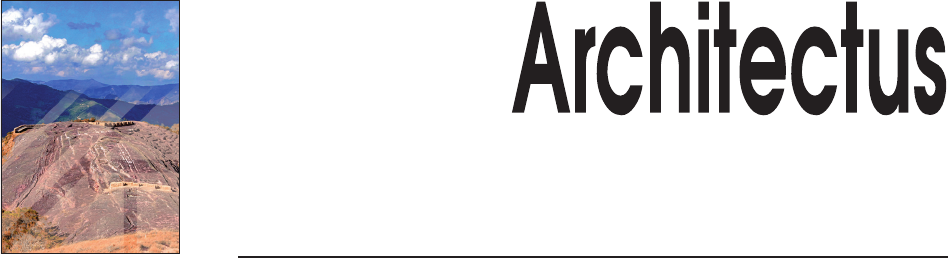
czy miejsca wyjątkowego, jakim jest El Fuerte de Samai
pata. To jeden z najważniejszych na terenie współczesnej
Boliwii zespół osadniczy o ponad 1000letniej historii,
odzwierciedlający wpływy kolejnych prekolumbijskich
kultur – nie tylko tych wywodzących się z kręgu cywi-
lizacji andyjskich, ale także mających swoje źródła na
amazońskich nizinach. Unikalność tego miejsca (czasa-
mi nazywanego Małym Machu Picchu) legła u podstawy
wpisania El Fuerte de Samaipata na Listę Światowego
Dziedzictwa UNESCO.
El Fuerte de Samaipata było już w przeszłości tema-
tem wielu opracowań naukowych, od połowy XX stule-
cia realizowanych przede wszystkim przez badaczy nie-
mieckich. Szczególne miejsce w tych badaniach zajmuje
Proyecto Arqueológico en Samaipata (PIAS) – wielolet-
nie, kompleksowe prace archeologicznodokumentacyj-
ne kierowane przez Alberta Meyersa. Zawdzięczamy im
nie tylko ustalenie sekwencji wpływu kolejnych kultur
na obecny kształt Samaipata, ale i pierwszy tak dokładny
plan całego stanowiska sporządzony za pomocą najbar-
dziej wówczas (lata 90. XX w.) zaawansowanych metod
pomiarowych. Wyniki przeprowadzonych prac zwróciły
uwagę specjalistów na szybko postępującą erozję skały
Samaipata. Wprawdzie destrukcja o podłożu antropoge-
nicznym została radykalnie ograniczona już w latach 90.
XX w., ale miękka osadowa skała nadal jest wystawiona
na erozyjny wpływ panującego tu ostrego klimatu cha-
rakteryzującego się gwałtownymi zmianami temperatury,
dużą ilością opadów i silnymi wiatrami.
To właśnie szybko postępująca erozja skały i z roku
na rok zacierające się liczne ryty naskalne sprawiły, że
w 2014 r. polscy badacze z Centrum Studiów Andyjskich
Uniwersytetu Warszawskiego w Cuzco kierowanego przez
Profesora Mariusza Ziółkowskiego i Laboratorium Ska-
nowania i Modelowania 3D Politechniki Wrocławskiej
kierowanego przez Profesora Jacka Kościuka zaintereso-
wali się El Fuerte de Samaipata. W wyniku ich współpra-
cy w latach 2016–2019 powstała prezentowana w tym ze-
szycie „Architectusa” szczegółowa dokumentacja zespołu
From the Editors/Od Redakcji
The presented issue of the “Architectus” magazine is
about the unique place of El Fuerte de Samaipata. It is
one of the most important settlements in modern Bolivia,
with over 1000 years of history, reecting the inuence of
subsequent preColumbian cultures – not only those orig-
inating from the circle of Andean civilizations, but also
having their origins in the Amazon lowlands. The unique-
ness of this place (sometimes called Little Machu Picchu)
was the reason why El Fuerte de Samaipata was entered in
the UNESCO World Heritage List.
El Fuerte de Samaipata, starting from the midtwenti-
eth century, has already been the subject of many scien-
tic studies, which were carried out mainly by German
researchers. A special place in this research is occupied
by Proyecto Arqueológico en Samaipata (PIAS) – many
years of comprehensive archaeological and documentary
work led by Albert Meyers. We owe him not only the de-
termination of the sequence of the inuence of successive
cultures on the present shape of Samaipata, but also the
rst so detailed plan of the entire site, prepared using the
most advanced measurement methods at that time (the
1990s). The results of the conducted work drew the spe-
cialists’ attention to the rapidly progressing erosion of the
Samaipata rock. Although anthropogenic destruction was
radically reduced in the 1990s, soft sedimentary rock is
still exposed to the erosive inuence of the harsh climate
here characterized by rapid temperature changes, heavy
rainfall and strong winds.
It was the rapidly progressing erosion of the rock and
the numerous rock carvings that are blurred every year
that made Polish researchers from the Center for An-
dean Studies of the University of Warsaw in Cusco led
by Professor Mariusz Ziółkowski and the Laboratory of
Scanning and 3D Modeling of the Wrocław University of
Science and Technology led by Professor Jacek Kościuk
interested in El Fuerte de Samaipata in 2014. As a result
of their cooperation in the years 2016–2019, the detailed
documentation of the site presented in this issue of “Ar-
chitectus” was created, made with modern surveying
techniques (3D laser scanning, structured light scanning,
4 From the Editors / Od Redakcji
wykonana współczesnymi technikami inwentaryzacyj-
nymi (laserowe skanowanie 3D, skanowanie światłem
strukturalnym, fotogrametria cyfrowa w świetle widzial-
nym i w podczerwieni) oraz analiza zasięgu i prędkości
procesu degradacji (erozji) stanowiska. To stało się pod-
stawą analizy ikonogracznej zachowanych petroglifów
i ustalenia względnej chronologii poszczególnych rytów
naskalnych. Było także punktem wyjścia opracowania
mapy zniszczeń pozwalającej na typowanie obszarów do
natychmiastowej interwencji.
Przedstawiony w tym numerze obiekt badań – El Fuer
te de Samaipata – stanowi przedmiot zainteresowania czy-
telników z bardzo wielu stron świata. Zeszyt ten jest ad-
resowany do międzynarodowej społeczności specjalistów
zajmujących się zarówno szeroko rozumianymi studiami
nad kulturami prekolumbijskimi, jak i wąską tematyką
prekolumbijskiej sztuki naskalnej. Mając na względzie
wyjątkowość obiektu, jego specykę, a także rangę pre-
zentowanych materiałów i analiz, redakcja zdecydowała
się na szczególne potraktowanie strony edytorskiej tego
numeru pisma i wprowadzenie kilku odstępstw od obo-
wiązujących zasad redakcyjnych.
digital photogrammetry in visible and infrared range) as
well as an analysis of the extent and speed of the degrada-
tion process (erosion) of this site. This became the basis
for the iconographic analysis of preserved petroglyphs
and the relative chronology of individual rock carvings.
It was also the starting point for the development of the
risk maps allowing for the selection of areas for imme
diate intervention.
The subject of research presented in this issue – El
Fuerte de Samaipata – is of interest to readers from many
parts of the world. This edition is addressed to the inter-
national community of researchers dealing with both the
broadly understood studies of preColumbian cultures and
the narrow subject of preColumbian rock art. Taking into
account the uniqueness of the site, its specicity, as well
as the importance of the presented materials and analyzes,
the editors decided to treat the editorial side of this issue
in a dierent way and introduce a few exceptions to the
binding editorial rules.