2010
Nr 2(28)
Architecture in culture has existed for ages and it is
needless to propagate it in a special way because it has
always been perceived as prominent among other arts. It
has often been described in literature as well. Interesting
literary texts can easily be confronted with descriptions of
various buildings, sometimes also paintings, sculptures,
monuments and this provides a unique possibility of per-
ception of architecture as a eld of art which is distant
from constructional or functional issues. On the one hand
the poetic opinion inspires us to enrich our knowledge as
regards architecture, while on the other hand it can make
us search for wise and good literature.
Literary descriptions of architectural structures are
created by non-architects and are addressed to non-spe-
cialists. They describe impressions of a spectator as well
as feelings and experiences caused by the direct contact
with an architectural structure which is outstanding and
signicant. There are also architectural structures which
are quite common and only their different perception
through a unique personality allows us to see ‘their hid-
den beauty’.
Out of the ancient seven wonders of architecture, only
the Pyramid of Cheops survived until the present times.
The rest was lost throughout the ages. We are informed
about their size, beauty and existence mainly by literature,
which in some fragments is now conrmed by archeol-
ogy. Therefore, we put our trust in the ancient descriptions
which extol their unique beauty. Callimachus of Cyrene is
considered to be the greatest poet of the so called Alexan-
drian period and the author of the rst history of literature
– a productive writer indeed. In 220 BC he made one of
the lists of seven wonders of the world, probably the old-
est one. For the ancient Greeks, this was a peculiar guide
which constituted an afrmation of the architecture that
was signicant and remarkable and which is particularly
valuable for us today as most of it is now lost.
Zbigniew Herbert sensed the beauty emanating from
architecture in a very profound way. In a peculiar manner
he perceived Italy with the colours of the particular towns
…Assisi is pink, as long as this banal word can express the
tone of reddish sandstone; Rome is xed in your memory
as terracotta against the green background [3, pp. 66–
67]. He analysed in detail the constructions of Gothic ca-
thedrals, dealt with their architects by dispelling the myth
that their builders were anonymous. He analysed histori-
cal materials about …workers-bricklayers, stone-masons
and architects and not about what happened in their souls
when they were building the cathedral but what materi-
als, tools and methods they used and also how much they
earned [3, p. 125]. He was especially interested in the ca-
thedral in Orvieto, the town which is gold and brown with
a façade in the painterly and sculptural convention. The
cathedral is standing (as long as this motionless verb is
adequate to describe something that tears the space apart
and makes you dizzy) on a large square and the surround-
ing several storey buildings fade away after a moment
and you no longer see them. The rst impression does not
differ from the last one and there is a prevailing feeling
that it is impossible to get accustomed to this architecture.
(…) You can wander around the town for a long time but
you never lose this feeling that the cathedral is behind
you and its overwhelming presence supersedes all the
other impressions [3, pp. 63–67]. A literary work and an
architectural image are similar visualizations. They both
create a ctitious reality for the spectator and this reality
in both of the spheres is contaminated with subjective im-
pressions. The Z. Herbert’s description is an afrmation
of architecture in ideal conditions, the architecture which
Maria J. Żychowska*
‘High’ architecture
*
Tadeusz Kościuszko Cracow University of Technology, Faculty
of Architecture.
A given object belongs to culture if it has existed longer than any
function which it fullled at the moment of its creation
Z. Bauman [2, p. 249]
240 Maria J. Żychowska
is abstracted from climatic weather changes, similarly
to a perfect photograph whose author must have spent
many hours waiting for proper light. However, for each
type of architecture its perception or subjective feelings
are of key importance. Therefore, one’s own reection on
architecture which is experienced and seen is extremely
signicant. At this point, a certain comment seems neces-
sary. The notion of experienced architecture is of utmost
importance here. It is not enough merely to read about
a building, its creator, see the plans, designs, perhaps
a photograph in order to start writing about it. An image
created in this way is a hoax. It may give an impression of
truth, but it is only half-truth. Each object must be expe-
rienced. You must feel its atmosphere, climate, smell, see
the people who are there, recognise the surroundings, its
elements and structure. Architecture is more than a cos-
tume or a shell in which some interiors are closed. It is an
integral entirety of the urban context which is one of the
most signicant reasons why it was created as well as the
composition of masses, its form, function, light, inherent
idea and rst of all subjective perception of the work of
art. Only after we have had a taste of such architecture,
can we attempt to write about it, try to be objective or rely
upon our own feelings and emotions. Zbigniew Herbert’s
poetic language is very adequate here, while the emotions
depicted in the poem Architecture constitute the synthesis
of truly individual perception.
Above a light arch –
eyebrow of stone
on the wall’s
undisturbed front
in windows joyful and open
where faces instead of geraniums
where rectangles very compact
next to a dreaming perspective
where woken by an ornament
stream on a quiet eld of planes
where movement with stillness, line with scream
uncertainty trembling, straight brightness
you are there
architecture
art made of fantasy and stone
you are there, beauty residing
above a light arch
like sighing
on the wall
pale with height
and in the window
tearful with a window pane
an exile of obvious shapes
I promulgate your motionless dance [4]
In the contemporary world, there are many opinions
that due to the globalisation processes, towns are trans-
formed from places which protect their inhabitants into
the areas …which are characterised by rules of terror
and ubiquitous fear [1, p. 115]. Remaining in the sphere
of reections upon dangers connected with the analy-
sis of the modern urban tendencies, Zygmunt Bauman
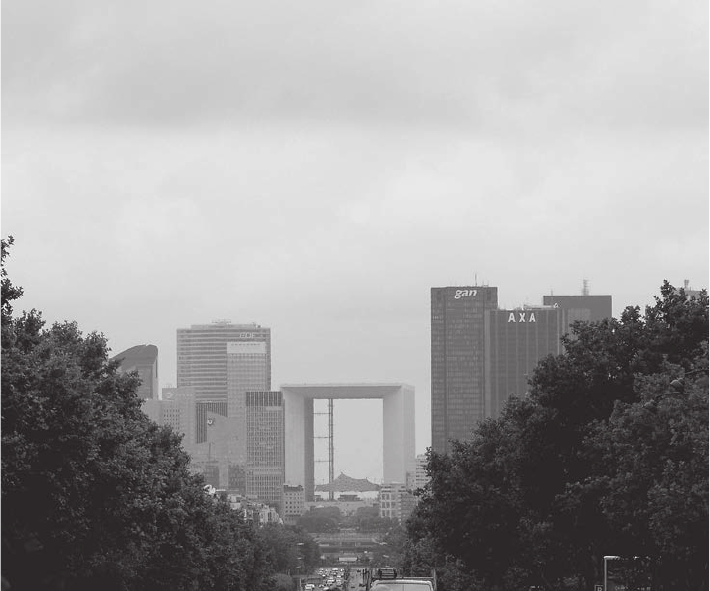
wrote: The place called La Defense, a great square on
the right bank of the River Seine which was designed and
executed as a permanent monument to François Mitter-
rand’s presidency – in which the greatness and dignity
of the ofce was carefully separated from the personal
weaknesses and faults of the person who held it – it con-
tains all the features (…) of the category of public but
inhospitable town space. (…) a visitor is struck by the
fact how repulsive this place is: all the things around here
gain the visitor’s respect at the same time discouraging
everybody from staying. The fantastically shaped build-
ings surrounding the big and empty square seem to be
erected in order to be admired and not in order to be used.
Completely glassed mirror like façade sheets seem to be
windowless and not to have entrance doors which gives
the impression that they turn their backs on the square on
which they are standing. They are imperious and indiffer-
ent – imperious because indifferent – and both of these
features complement and reinforce each other [1, pp.
149–150]. It comes as no surprise that the perfect asceti-
cism of the place and lack of the attributes of traditionally
understood space made Z. Bauman comment as follows:
…it exists only to be traversed quickly and left behind
[1, p. 158].
Throughout the decades, assessment criteria of ar-
chitecture do change and the permanent works which
were once perceived as kitsch can grow innitely valu-
able. Globally admired, they will last until their last days
or until another reevaluation. Such changes, dened by
Zygmunt Bauman as ‘liquid modernity’ [1, p. 158], are
nothing unusual although when confronted with a radical
change in valuation they can surprise.
In 1973 Jan Zakrzewski a postwar journalist, writer
and translator wrote: …many have a grudge against
Catalans (…) for not destroying, at a moment of anar-
chist excitement, the structure created by Gaudi under the
name ‘Sagrada Familia’. It is hard to encounter some-
thing equally hideous. This is an example of employing
secession for building a cormorant’s nest, next hybridiz-
ing the whole thing with a coral reef, a dirty sponge after
washing a car and pouring the whole thing with a mixture
of clay and water. The Gaudi’s structure is gigantic, its
ghastly gure makes your hair stand on end, faith evapo-
rates from even the most faithful ones. It just stands there
and, surprisingly, the Catalans still do not lose their sense
of humour… [6, p. 242].
Already then J. Zakrzewski stated that crowds visit and
after forty years it is even difcult to draw near towards the
Gaudi’s work. The church faces the destruction by ‘tram-
pling’. The church architecture has existed in culture for
a long time and it is needless to promulgate it in a spe-
cial way, similarly to hundreds of other places around the
world. We can ask the following question: is it real admira-
tion for a work of art, place, its creator that make people
admire it? Perhaps it is just a part of a designated tourist
track and the splendour of good holidays, and maybe they
really think that …Gaudi is a priest of architecture who
‘High’ architecture 241
respects the laws given by God and turns our attention to
His great work – nature. Turning streams, bird’s nests, an-
thills, stalactites, mountains and plants into towers, vaults,
domes, columns and pilasters. Gaudi would say that origi-
nality is nothing but a return to sources and that beauty is
a light of truth [5, p. 187].
The denition of ‘culture’ itself was shaped in the
second part of the 19
th
century as ...a shortened term de-
scribing the process of managing human thinking and
behaviour [2, p. 239] and according to the denition, it
referred to learning and accumulating information. On
the whole, we can say that this phenomenon is depend-
ent upon external determinants within the framework of
division into those who are managed and those who man-
age. The former ones, those who are managed are crea-
tors of art the immanent feature of which is freedom. It is
…the most developed part of culture – ghts reconnais-
sance battles in order to discover the roads to follow and
lay out new routes for (…) human culture… [2, p. 243].
On the other hand, those who manage are the people who
form standards and administer cultural processes. They
create a normative order which evolves in time and in
accordance with needs for searching or experimenting.
However, all avant-garde actions always caused social
fears and were treated with reserve.
Between these two antagonistic parts, we do not see
symbiotic cooperation because their interests seem to be
different as well. Nevertheless, culture, independently of
its shape is a phenomenon which dominates our existence.
Architecture as one of the most permanent elements of art
is an object belonging to culture because it has existed
longer than any other objet d’art.
References
[1] Bauman Z., Płynna nowoczesność, Kraków 2006.
[2] Bauman Z., Szanse estetyki w zglobalizowanym świecie, Kraków
2007.
[3] Herbert Z., Barbarzyńca w ogrodzie, Wrocław 1997.
[4] Herbert Z., Struna światła, 1956, http://www.poema.art.pl/site/
itm_70513_/architektura.html
[5] Martin E., Carranza A., Tajemnica Gaudiego, Warszawa 2009.
[6] Zakrzewski J., Iberyjskie wędrówki, Warszawa 1973.
Architektura „wysoka”
Architektura w kulturze istniała od zawsze i jej specjalne propago-
wanie jest zbędne, bo zajmowała poczesne miejsce wśród innych sztuk.
Często też była opisywana w literaturze. Ciekawie teksty można z łatwo-
ścią zestawiać z opisami różnych budowli, czasami także obrazów, rzeźb,
pomników, co tworzy unikatową możliwość percepcji architektury jako
dziedziny sztuki odległej od zagadnień konstrukcyjnych czy funkcjonal-
nych. Z jednej strony poetycka opinia inspiruje do pogłębiania wiedzy
z zakresu architektury, ale też skłaniać może do poszukiwań literatury
mądrej i dobrej.
Key words: “high” architecture Słowa kluczowe: architektura „wysoka”
Fig. 1. La Défense.
Photo by M.J. Żychowska