
2010
Nr 2(28)
Culture and holism; place of culture in the holistic world system
The phenomenon of culture formation takes place as
a result of sociological reaction of ‘double feedback’:
natural environment impinges on Man, Man – in the proc-
ess of civilization building – processes and creates the
environment, while the environment, in turn, as cultural
reality, surrounds and forms Man by improving Man’s
personality.
Originally, the notion of cultura was connected with
land cultivation and it referred to transforming the natural
state of the environment through human work into a state
that was more useful for man. In the ancient times, the
meaning of culture changed to refer more to man, his men-
tality and environmental interdependence
1
. In the Middle
Ages, culture had a more universal character, however,
because of the signicance of religion (i.e. Christianity) in
human life, its particularistic aspect was emphasized. The
meaning of culture as a motivator of all conscious efforts
aimed at developing and assessing the quality of a given
object, talking about for instance ‘culture of wheat’ or
‘culture of trades’ was in use at the beginning of the 16
th
century.
Some symptoms of connecting culture with the intel-
lectual sphere of human development referring to ancient
philosophies appear in history in the 17
th
century when
Voltaire uses the word culture in the context of process
of human mind formation and improvement by enlarging
the scope of acquired skills with various domains of sci-
ence, art and knowledge of conventions and manners. In
*
Cracow University of Technology, Faculty of Architecture, Institute
of Urban Planning, Department of Residential Environment Formation.
1
Cicero ( 106–43 BC ) used the word cultura , to dene philosophy
and emphasized moral and intellectual education of an individual which
elevates a human being to a higher level (quoted from: Hartman, Słownik
lozoi). The following types were distinguished: Cultura animi – culture
of farming; cultura mentis – culture of mind, because: cultura animi
philosophia est – philosophy is farming, formation of spirit (quoted from:
Landowski, Woś, Słownik cytatów łacińskich).
Małgorzata Solska*
Holism as a determinant of culture in architecture
the subsequent periods of history in the 18
th
and 19
th
cen-
turies, culture is associated with improvement of an indi-
vidual as ‘a whole’, with qualications and skills, includ-
ing both technology and the intellectual side of life as part
of these achievements. A new domain of science appears,
‘Anthropology of culture’, which slowly aims to separate
civilization achievements from culture by humanizing the
latter through a range of research on human life environ-
ment, in particular with regard to customs, beliefs, art,
family and social life, talents and habits, laws and even
morality of a given community.
Division of the notions of civilization and culture, as
well as an analysis of cultural phenomena are dealt with
contemporarily by many scientic domains; the most sig-
nicant ones are research in the scope of sociology and
cultural anthropology as well as social ethnology.
During the last 100 years of human history, the no-
tions of ‘culture’ and ‘cultural studies’ underwent signi-
cant evolution or even ‘paraphrasing’ – because of many
important and profound social changes, transformations
in the way of valuating phenomena and behaviours, as
a result and simultaneous effect of political, economical,
social and civilization globalizing universalizing process-
es. In the contemporary reality there is a visible cultural
dissonance brought about by a universal trend of uni-
cation of principles and phenomena, their ephemerality
caused by the creation of ‘hybrid cultural structures’ – and
the need to accept distinctness and uniqueness of cultural
community.
The notion of culture presents a dichotomy as regards
expressions and meanings:
– culture, with regard to symbols of meanings or be-
haviours; collection of elements and synthesis of phenom-
ena, signs, skills adapted or created anew by perception
and its reference to conscious actions directed at creating
new ideological and model values in the social human en-
vironment; and

198 Małgorzata Solska
– culture as a social phenomenon, but basically refer-
ring to an individual or a social group; it is a collection
of formulas of the so called ‘cultural lifestyle and being
human’ – resulting from ethnical conditions marked by
history that determines the course of political and social
changes [7]
2
.
2
There are numerous denitions of the idea, notion, phenomenon
and entry of ‘culture’, depending on the accepted criteria resulting from
their authors’ range of interests, time of their formulation and purpose
By a ‘statistical’ person, culture is usually understood as
follows: lifestyle of an individual within a social group, de-
termined by history and ethnical conditions and apart from
that, synthesis of phenomena, signs, skills adapted or cre-
ated through perception and its reection in form of creating
new esthetical values in the existing social environment.
of usage. In the present work, the author introduces her own laconic,
popularized and somewhat paraphrased interpretation of the notion of
‘culture’ for the purpose of this essay.
Culture and architecture
Culture is de facto a notion/phenomenon which is ab-
stract as such and does not refer to any particular being or
thing, yet, it actually effects the concepts of development
of phenomena and interpersonal relations. When dening
culture from the philosophical viewpoint, in the most la-
conic way, it is best to perceive it as …a mobile signi-
cant element which allows discussing human activity in
various manners
3
. Many factors inuence the process of
culture formation, of which nowadays the most expres-
sive and signicant ones appear to be ethnical, political
and social factors [1].
However, human history undergoes evolution and it is
determined by system, economic and social transforma-
tions and each era brings new values into social culture,
its form and content. Fascination with ‘the new’, discov-
ering new spheres of spiritual development and material
civilization goods have always been – as a psychological
and sociological phenomenon – logical consequences of
man’s permanent search and aspirations to improve living
conditions, to perfect the form of the surrounding space
and to subjugate the forces of nature.
Architecture is understood as the things which are
built, shaped by talent and knowledge, things which serve
man and possess esthetic features. Lack of these features
excludes ‘thing / work’ from being part of architecture.
According to the Vitruvian canon, architecture is charac-
terized by: being solid, useful and beautiful
4
. We can ask
whether this canon also marks the limits of architecture.
Variety of denitions of architecture as a work which is
3
Quoted from: Barker Ch., Studia kulturowe, p. 516.
4
Vitruvius (Marcus Vitruvius Pollio), 1
st
century BC; Treaty De
architectura. Vitruvian triad: rmitas, utilitas and venustas, i.e. – being
solid, useful/usable and beautiful.
real and completed, presented by ne and humanistic arts
authors allows us to formulate the most adequate and con-
cise denition which says that Architecture is an organi-
zation and art of space formation
5
. In theory, things from
beyond the denition scope do not belong to architecture
(for instance, engineering constructions), however, they
do complement it as regards ideas, structures, landscape.
Is architecture art? The answer seems to be simple
as throughout the centuries, especially during the Renais-
sance and Baroque periods, architecture was regarded as
the queen of ne arts and although historically their mu-
tual connotations were perceived variably, we must admit
that art and architecture originate from the same ‘cultural
root’. It is logic that ne arts are an indispensible part or
even the basis of each type of culture (culture of being, so-
cial culture, symbolic culture) and they determine culture.
Therefore, we can draw the conclusion that architec-
ture is a signicant part of culture as it is social, universal
and it ‘touches’ almost every being, every gure.
Nowadays, however, the abovementioned rule is un-
derstood in a broader sense – the importance of the space
which surrounds, complements and so to speak promotes
the architectural work is emphasized
6
.
Therefore, from the axiological point of view, in order
to maintain or upgrade the cultural value of places and
space, at the time of permanent uniformity, it becomes
signicant to combine the architectural structure with its
natural and cultural context as regards ideas, functions
and even forms.
5
This is also the main assumption of the idea of habitat (author’s
footnote).
6
Quoted from: Krakowski P., O sztuce nowej i najnowszej, PWN,
Warszawa 1984.
Symbiosis or partnership;
Holistic relationship of architecture with art and environment
The notions of value and assessment have always ex-
isted in architecture. Man, while transforming Nature for
the needs of his own existence, interfered in the surround-
ing environment in consent and harmony with it – or not,
protecting nature and cultural goods – or not, anyway, he
always introduced new content, forms and structures into
the environment, he introduced a new quality which was
not always positive. These new forms brought in civiliza-
tion values and by forming places of worship, work and
social contacts, man created the cultural value of a place
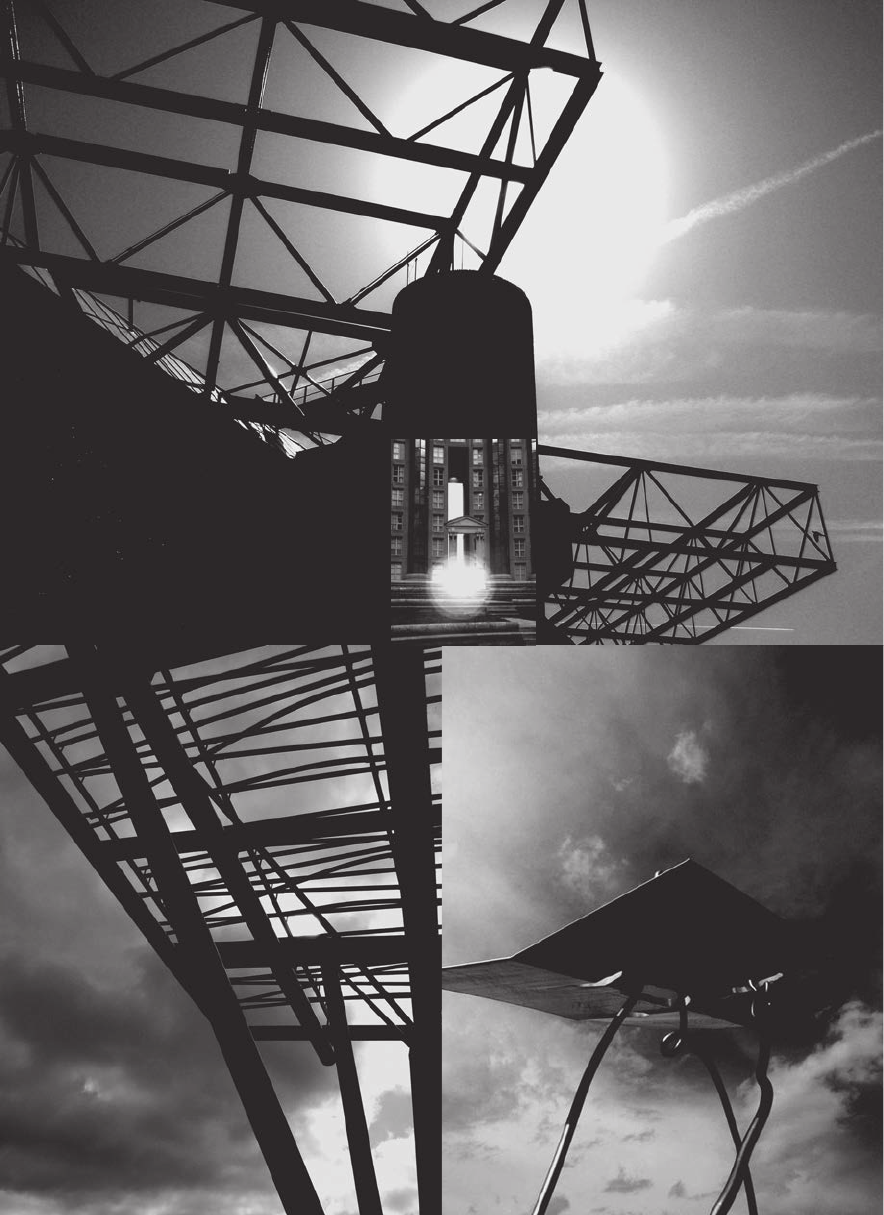
Holism as a determinant of culture in architecture 199
α
ω
Fig. 1. The problem which is discussed in the essay with regard to connections of culture and architecture, their ideological, mental, historical,
social, architectonic, spatial and esthetical connotations is multi-dimensional, broad and inter-disciplinary. It was merely outlined here
by presenting for discussion (non-verbal) its signicant aspects. The illustration is a type of author’s graphic recapitulation, synthesis
– referring to symbols of the alphabetical Greek letters: α–ω from the Greek alphabet, between which ‘a diverse reality’ is contained,
not only graphic, linguistic, cultural – referring to one culture. α–ω this is the symbol of beginning and end, but rst of all of stages.
Culture also has its beginning, perhaps its end, but it certainly has the stage of philosophical, social and esthetic reections. And similarly
– architecture, too. While Vitruvius dened the canon, Plato – principles of beauty, Corbusier – the topic of economical exploitation,
Wright – organicity, Zaha Hadid – extravagance and expression, etc., so we can conclude that in architecture almost everything has been said.
Well, but architecture in itself can be nothing more but ‘…a collection of stones’ (quote)…

200 Małgorzata Solska
with an appropriate dimension – local, regional or na-
tional.
As architecture is created for a community, it is only the
architecture accepted by the community that can become
assimilated with the natural, or cultural environment, thus
forming a symbiotic work. This mainly refers to architec-
ture of residence, which should have ‘certicate of social
acceptance’ as a whole.
Uniform, unied and modern technical and technological
solutions, which are used in the scope of improvement of the
human environment quality (pro-ecological system solutions
as regards usage of natural sources of energy or recycling),
have a civilization character. By combining technological
achievements with architecture as a domain of art, we can
achieve two goals for civilization and culture. This opera-
tion humanizes architecture, it is accepted by its recipients,
provides framework for unique architecture in places and
spaces which are culturally transparent and ideologically
and esthetically readable. More and more frequently, we can
observe the employment of spatial solutions in urban plan-
ning and architecture which combine totally different and
characteristic trends of building the contemporary esthetics:
modernistic elements/motifs combined with organic ones;
bound by ideas and structures and expressing connection
with the context by means of form and content/function.
In the modern world, culture is subject to econo-
mization and becomes a product, the source of ubiq-
uitous commerce
7
. This phenomenon generates social
and cultural transformations which are based on the ne-
cessity to improve the daily life organization, to make
forms of consumption and relaxation more attractive,
including entertainment, which can particularly be seen
in cities and their public, social, sports and relaxation
spheres.
Similarly to the unique architecture that ‘celebrates’
the cultural environment determining the place and space
– we can perceive the universalism propelled by the mar-
ket situation and inclusion of green areas as a dangerous
symptom, perhaps an equally dangerous phenomenon is
– although apparently socially ‘pro-educational’ – inclu-
sion of name/entry dening the idea of architecture for
commercial products and services.
Let us have a look at the following examples: archi-
tecture – meaning organization of place (symposium,
meeting, social event), architecture – ‘of the subject mat-
ter’ (concept of arranging a matter), architecture – of light
(shop with lamps), architecture – of space (ordinary, util-
ity space, e.g. backyard, store area), architecture – of g-
ure (physiognomic appearance), architecture – as a name
adapted for cosmetics of a popular company: ‘Skin Archi-
tect’ (facial cream and other products)
8
. Linguists could
certainly provide us with some more of such ‘pompous’
phrases.
7
Pierre Bourdieu (1930–2002, French sociologist of culture, anthro-
pologist and philosopher) names the modern process of commercializa-
tion of culture as ‘symbolic goods market’ in which we can observe
a synergy effect between market, technology and afuence of the society.
en.wikipedia.org/wiki/Pierre_Bourdieu
8
These are only some of the examples that the author could spot.
According to this essay’s author – apparently, when
we familiarize the society with a notion, we deprive it of
its ideological superstructure which is reserved for one
culturally important domain of science and art and which
forms the space and society’s sense of esthetics. Culture
has a time dimension, it has its own history, it undergoes
development, i.e. it ourishes or it declines depending on
political and economical conditions of the society
9
.
Architecture as an integral part of culture is a mate-
rial result of many generations’ work, structural trans-
formations of societies, evolution and diffusion of forms
‘shaped’ by ideas, fashions and civilization innovative-
ness [8]. Architecture, similarly to culture, refers to or-
ganization of places and space, but, since it is not a place
itself, it can only create a system
10
.
This elaboration is not aimed at conducting an analy-
sis of criteria used when comparing elements and charac-
teristic features of the phenomena of culture and architec-
ture; we only wish to signal the existence of a connection,
a symbolic one, between Culture – Architecture and hu-
man Environment as regards ideological and psychologi-
cal spheres as well as behavioural and material ones.
Knowledge is built on facts, like a house is built of
stone; however, a collection of facts is not knowledge,
like a pile of stones is not a house – Jules Henri Poincare
(1854–1912, mathematician, physicist, philosopher).
Holism is dened as a philosophical, pragmatic and
pro-ecologic idea of symbiosis. This superior ecumenical
idea and mechanism combine all the complexes of the
sustainable development system. It acts in the natural ec-
osystem space and in creating urban premises of cultural
space: historical, ethnical, multi-cultural, public, social;
mental or verbal.
Architecture as a plane/bridge/element of an agree-
ment between a widely understood environment and man
is contained in this holistic cultural ecosystem and it ecu-
menically cooperates with it in the following scopes:
– locating/residing,
– formation of social space connected with profes-
sional and educational activity,
– formation of public and recreation space (sports and
relaxation).
These various types of space and places are marked by
codes, symbols, utility architecture and narration, which
distinguish residential architecture and utility architecture
from ‘the big one’ of theatres, concert halls, ofce blocks
etc. – creating a specic climate of places, zones, pub-
lic and social space, in which architecture occurs as the
area and image of civilization and cultural transforma-
tions.
The connection of architecture with culture is indis-
putable, similarly to the connection of architecture with
art
11
. We can observe cultural feedback between these
9
Quoted from: A. Kłoskowska, Socjologia kultury.
10
Ibidem; referring to characteristic qualities of culture as a philo-
sophical and social phenomenon / complex of phenomena.
11
For more about connections of ne arts with architecture in modern
culture, see: Piotr Krakowski in: O sztuce nowej i najnowszej, PWN,
Warszawa 1984.

Holism as a determinant of culture in architecture 201
three domains: culture – architecture – art. Art, of which
architecture is an integral part – because as a whole it is
an expression, testimony and motivation of culture.
Nowadays, culture is discussed in the context of the
two particularly expressive social phenomena: informa-
tion and mutual interpersonal communication [6]. How-
ever, it seems that the theory of creating culture accord-
ing to individualism and full voluntariness, which is ex-
tremely promoted in our times, is controversial from the
viewpoint of the social order. ‘Individualized voluntari-
ness’ gives rise to ephemerality of actions and relativism
of assessments. As a consequence, there is no place for the
modern universalism of culture which is supposed to form
the basis for the modern character of architecture in order
to accomplish its idea and mission at the same time and
outline a perspective of development.
In relation to the problem which is the topic of the
conference, namely, mutual connotations of architec-
ture and culture, we ought to focus our attention on
time and space of the modern (end of the rst decade
of the 21
st
century) environment of Man’s life and out-
line a sphere of recipient’s needs (an individual being or
a community) by dividing it into two groups as follows.
One is a demand for utility architecture which takes into
account basic functions connected with the environment
of living and recreation, while the other deals with access
to the so called higher social and cultural values, con-
nected with great architecture, but also with small one
of public and social spaces as well as green landscape
architecture.
All the types of architecture are de facto extremely sig-
nicant for symbiosis of Nature and Culture through Man
who, by his creative activity, complements and executes
holistic system of environmental and cultural ecumene.
An attempt to ‘answer’ the second part the question
which is formulated in the topic of the conference is not
simple and the problem itself is ambiguous. We can only
venture to say that the level dening the content of (con-
temporary) ‘culture in architecture’ is directly proportion-
al to the intellectual level of the society, nancial possi-
bilities, creative predispositions, knowledge, respect for
the existing, laboured by generations values – connecting
humbleness towards Nature and distancing oneself from
periodic fashions, with transforming the creative design-
er’s ego into a creative – pro-ecologically and esthetically
– organization of space.
We can ask the following question: where is the place
and intellectual space for innovativeness – experiment,
formal expression of a newly created work of art, or even
a formal test awaiting social acceptance? The choice of
place and formula, innovative in content, form and mean-
ing of the architectural work, must result from versatile
studies in the domains of urban planning, architecture
and environment, employment of timeless canon of order
and harmony in space, which is formulated in the Vitru-
vius principles
12
as well as the contemporary principles
of sustainable and permanent environment development,
contained in the entire idea of ‘New Green Deal’
13
– with
the principal holistic statement
14
.
The traditional view on culture was expressed in the
holistic permanent moral and axiological order referring
to the cultural and natural environment; according to the
contemporary one, this spatial order and harmony ought
to be ‘enriched’ by an economy which gives possibilities
of realization of modern architecture as innovative, mod-
ern, unconventional, however, with a ‘note’ of organic
stylistics which provides conditions for the formation of
environmental empathy.
12
Vitruvian triad: rmitas, utilitas and venustas, i.e. – being solid,
useful and beautiful contains an ideological creed for architecture and
it is reected in the modern principles of sustainable development, par-
ticularly with regard to: dispositio (appropriate arrangement of elements
of a building), symmetry (harmonious conformity between elements and
the entire work) or distributio (appropriate attitude towards economy of
the building process)
13
Initiator of building and employment of the new formula is the UN
Secretary-General Ban Ki-Moon; this policy allows stimulating economi-
cal growth and concurrently restrains the climate changes.
14
In the documents on establishing ‘Principles of sustainable develop-
ment’ there is no explicit reference to the role of culture in the creation of
a new architectural structure or its revitalization; lack of a doctrine gives
rise to liberty, freedom of interpretation; excess of liberty – gives rise to
chaos. Only the principle of holism can determine the direction of culture
and of cultural activity (author’s footnote).
References
[1] Barker Ch., Studia kulturowe. Teoria i praktyka, Wydawnictwo Uni-
wersytetu Jagiellońskiego, seria Cultura, Kraków 2005.
[2] Hartman J. (ed.), Słownik lozoi, Wydawnictwo Zielona Sowa,
Kraków 2004.
[3] Kłoskowska A., Socjologia kultury, PWN, Warszawa 2007.
[4] Krakowski P., O sztuce nowej i najnowszej, PWN, Warszawa 1984.
[5] Landowski Z., Woś K., Słownik cytatów łacińskich; wyrażenia,
sentencje, przysłowia, Wyd. Literackie, Kraków 2002.
[6] Mikułowski-Pomorski J., Kultura wobec społecznej transformacji,
Wydawnictwo Akademii Ekonomicznej w Krakowie, Kraków
2005.
[7] Solska M., Urok i uroda miasta – rozważania dialektyczne, Wy da-
wnic two Teka KU i A O/PAN, Kraków 2004/5.
[8] Zamiara K. (ed.), Kultura. Komunikacja. Podmiotowość; Szkice
epistemologiczno-kulturoznawcze, Wydawnictwo Naukowe UAM,
Poznań 2005.
Holizm jako wyznacznik kultury w architekturze
Idea holizmu w kategorii lozoczno-estetycznej i proekologicznej
jest kierunkiem realizacji wszelkich zadań i działań na rzecz KULTU-
RY.
Architektura i kultura, to dwie damy kroczące w równym rytmie
dziejowego korowodu przez szlak życia, góry, doliny, salony i rozstaje
społeczeństw w kolejnych okresach epok dziejów ludzkości.
202 Małgorzata Solska
Keywords: sustainable development – holism, culture – architecture,
universalism and symbiosis
Słowa kluczowe: zrównoważony rozwój – holizm, kultura – architektura,
uniwersalizm a symbioza
Architektura jest bowiem rzeczywistym i trwałym obrazem kultury
duchowej oraz dorobku cywilizacyjnego i materialnego społeczeństwa
i epoki.
Czy jednak we współczesnym multikulturowym świecie architektura
nadal zachowuje pozycję ‘mentora’ i świadka dziejów? Czy jest w stanie
podtrzymać, bądź wskrzesić unikatowość miejsc i przestrzeni?
Czy współczesna architektura, którą cechuje uniwersalizm formal-
ny, a nowoczesne rozwiązania techniczne i technologiczne stają się jej
domeną, nadal utrzymuje status królowej sztuk?
Sama nazwa ARCHITEKTURA – symbol kreatywności – uległa
pauperyzacji i zawłaszczeniu przez najprzeróżniejsze dziedziny wy-
twórczości i logistyki.
Czy owa wulgaryzacja nazwy służy właściwemu odbiorowi
architektury, jej idei, celebry w przestrzeni kulturowej i jej związku
ze środowiskiem życia Człowieka?