
Introduction
The idea of sustainable development has become
a mantra in many dimensions of life of modern Europeans.
It functions in legal regulations of the particular Member
States and in European Union law. The European Union
(EU) officially accepted the Sustainable Development
Strategy at the summit in Goteborg in 2001 [2]. The idea
echoes in the media and constitutes an important element
of popular culture in highly developed countries. It is
manifested first of all in famous slogans such as 4R or 3P
[3, p. 14] and replaced by 4P. In English it means “reduse,
reuse, recycle, renewable”, whereas the other one means
“people, planet, profit” and “project”
1
. These words-keys
appear in many spheres of life ranging from marketing
campaigns of well known food or clothing companies to
1
These words evolve which is exemplified by changing profit to
prosperity, or replacing “profits” by a wider notion of “well-being”.
These changes took place after the summit in Johannesburg in 2005.
2014
2(38)
DOI: 10.5277/arc140201
Anna Bać*
Idea zrównoważenia i jej wybrane przejawy
Idea of sustainability and its chosen manifestations
Wprowadzenie
Idea zrównoważonego rozwoju stała się mantrą w wielu
wymiarach życia współczesnego Europejczyka. Funkcjonuje
w europejskich i państwowych regulacjach prawnych. Unia
Europejska (UE) ofi cjalnie przyjęła Stra tegię Zrównoważo-
nego Rozwoju w 2001 r. [2] na szczycie w Goeteborgu. Idea
rozbrzmiewa w mediach oraz stanowi ważny element kultu-
ry masowej w krajach wysokorozwiniętych. Przejawia się
przede wszystkim w znanych hasłach jak 4R czy 3P [3, s. 14],
zastąpione przez 4P. Z języka angielskiego pierwsze z nich
oznacza „redukcja, ponowne użycie, recykling, odnawianie”
(re duse, reuse, recycle, renewable), zaś drugie „ludzie, pla-
neta, korzyś ci” (people, planet, profi t) i „projekt” (project)
1
.
* Wydział Architektury Politechniki Wrocławskiej/Faculty of Ar -
chitecture, Wrocław University of Technology.
1
Hasła te ewoluują, czego przykładem jest zamiana profit na pro-
sperity, czyli zastąpienie „korzyści” szerszym pojęciem „dobrobytu”.
Mia ło to miejsce po szczycie w Johannesburgu w 2005 r.
Koncepcja zrównoważonego projektowania architektonicznego nie jest alternatywą dla trady-
cyjnego modelu projektowania; jest ona w swej istocie wskazaniem kierunku ewolucji teorii i meto-
dologii projektowania architektonicznego w obliczu przełomu cywilizacyjnego. Powołaniem archi-
tekta jest być uczestnikiem, a nie jedynie świadkiem tego przełomu.
Andrzej Baranowski, Projektowanie zrównoważone w architekturze [1, s. 156].
The concept of sustainable architectural design is not an alternative for the traditional model
of design; in its essence it indicates the direction of the evolution of a theory and methodology of
architectural design in the face of a civilisation breakthrough. An architect’s vocation is to be
a participant and not only a witness to this breakthrough.
Andrzej Baranowski, Projektowanie zrównoważone w architekturze [1, p. 156].

4 Anna Bać
the so called missions and visions of organisations, in-
cluding universities, big corporations or design studios as
well as executive companies
2
. On the one hand, they are
a common fashion, buy they are also a necessity to pre-
serve life on earth. Not without reason, in a colloquial
language in the West instead of “sustainable develop-
ment”, the word “sustainability” is used as an expression
of a basic paradigm of contemporaneity.
Social awareness is a key issue in achieving sustain-
ability, since without understanding the idea and putting it
into practice, it is not possible to improve the present
situa tion of our civilisation. According to many sources,
our environment is in a much worse state than it was in
the 1960
s
and 1970
s
when the idea of sustainability was
born. An example here can be the second version of the
first report of the Club of Rome entitled The Limits to
Growth from 1972 [4] where the authors after 30 years
(2004) indicate more real threats to the Earth than in the
1970
s
[5]. The postulates and slogans proclaimed then still
have had no desired results.
Educational units perform (may perform) an invalu-
able role in increasing social awareness as regards threats
to the development of civilisation, in particular higher
schools, mainly technical ones and departments connec-
ted with architecture and construction. A widely under-
stood construction sector is one of the most invasive ele-
ments of the development of civilisation. This is due to an
expansion and development of cities, industrial areas and
development of infrastructure as well as environmental
and economic costs of exploitation on the scale of a build-
ing or a city. In the EU the construction sector consumes
42% of energy and is responsible for 35% of greenhouse
gas emission [6]. Hence, it seems extremely important to
2
An example of sustainability in the practice of global range com-
panies are such firms as SKANSKA, ISOVER, or IKEA. SKANSKA
worked out the so called Skanska Color Palette. This program assumes
three performance standards. The first one, i.e. vanilla is addressed to
investors who aim at the correct and good quality of an investment, in
accordance with the existing legal regulations. The second one, i.e.
green is addressed to investors who are interested in executing buildings
which are characterised by better environmental parameters, comprised
by multi-criteria certification such as LEED or BREEAM. The third
one, i.e. the so called deep green is addressed to recipients who are
interested in more advanced solutions. This standard contains require-
ments for structures such as a zero primary energy balance, an almost
zero emission of CO
2
, a zero waste level, a zero harmful materials level,
zero of “unsustainable” materials, a zero demand for water in a building
and zero consumption of potable water during construction. For more
information see: http://www.group.skanska.com/Global/About%20
Skanska/Sustainability/Reporting/Final%20Skanska_Annual%20
Report%202010_sustian%20110314.pdf [accessed: 12.06.2011].
ISOVER has been pursuing a policy of popularising the issues of sus-
tainability. With this in mind, ISOVER organises student competitions
devoted to designing sustainable objects all over the world. For more
information see: http://www.isover-students.com/. IKEA since it started
functioning consequently pays attention to pro-environmental solutions
for its products and a green approach to its objects. In 2013 the biggest
IKEA store in Central Europe was opened in Wrocław where sustainable
solutions are used such as exclusively renewable energy sources or
usage of rainwater for sanitary and economic purposes. More informa-
tion on http://www.ikea.com/ms/pl_PL/about-the-ikea-group/people-
and-planet/ [accessed: 12.06.2011].
T
e słowa-klucze pojawiają się w wielu płaszczyznach ży-
cia, od kampanii marketingowych znanych fi rm spożyw-
czych czy odzieżowych, po tzw. misje i wizje organiza-
cji, w tym także wyższych uczelni, wielkich korporacji
czy biur projektowych i fi rm wykonawczych
2
. Z jednej
strony są powszechną modą, z drugiej – koniecznością
dla zachowania życia na ziemi. Nie bez powodu w języku
potocznym na Zacho dzie, zamiast „zrównoważony roz-
wój”, używa się po prostu „zrównoważenie” jako określe-
nie podstawowego paradygmatu współczesności.
Świadomość społeczna jest dla osiągnięcia zrównowa-
żenia kwestią podstawową, albowiem bez zrozumienia idei
i wcielania jej w życie nie jest możliwa poprawa obecnej
sytuacji naszej cywilizacji. Wiele źródeł donosi wręcz o po-
gorszeniu stanu środowiska naturalnego w porównaniu ze
stanem, w jakim powstawał ruch zrównoważenia w latach
60.–70. XX w. Przykładem na to może być chociażby dru-
ga edycja pierwszego raportu Klubu Rzymskiego Granice
wzrostu z 1972 r. [4], w której autorzy po 30 latach (2004)
wskazują na bardziej realne zagrożenia dla Ziemi niż w la-
tach 70. [5]. Postulaty i hasła głoszone wówczas nie odnio-
sły i wciąż jeszcze nie odnoszą pożądanych skutków.
Nieocenioną rolę w zakresie poszerzania świadomoś-
ci społecznej na temat zagrożeń rozwoju cywilizacyj-
nego odgrywają (mogą odgrywać) jednostki edukacyj-
ne, a zwłaszcza wyższe uczelnie, głównie techniczne
i kierun ki związane z architekturą oraz budownictwem.
Szero ko pojęty sektor budownictwa jest jednym z najbar-
dziej inwazyjnych elementów rozwoju cywilizacji. Dzie-
je się tak zarówno przez ekspansję i rozrost miast, tere-
nów przemysłowych i rozwój infrastruktury, jak i przez
środowiskowe oraz ekonomiczne koszty eksploatacji,
czy to w skali budynku, czy w skali miasta. W UE sektor
2
Przykładem na zrównoważenie w praktyce firm o zasięgu global-
nym są SKANSKA, ISOVER czy IKEA. SKANSKA opracowała tzw.
Skan ska Color Palette. Program ten zakłada trzy standardy wykonaw-
cze. Pierwszy, tzw. waniliowy, skierowany jest do inwestorów celu ją-
cych w poprawną i dobrą jakość inwestycji, zgodną z obowiązującymi
przepisami prawa. Drugi, tzw. zielony, skierowany jest do inwestorów
zainteresowanych realizacją obiektów o lepszych parametrach środowis-
kowych, objętych certyfikacją wielokryterialną, jak LEED lub
BREEAM. Zaś trzeci standard, tzw. głęboki zielony, jest adresowany do
odbiorców zwróconych na rozwiązania bardziej zaawansowane. Stan-
dard ten zawiera takie wymagania dla obiektów jak: zerowy bilans ener-
gii pierwotnej, blisko zerową emisję CO
2
, zero odpadów, zero szkod li-
wych materiałów, zero materiałów „niezrównoważonych” oraz zerowe
zapotrzebowanie na wodę dla budynku i zero zużycia wody pitnej w cza-
sie budowy. Więcej informacji na: http://www.group.skanska.com/
Global/About%20Skanska/Sustainability/Reporting/Final%20Skanska_
Annual%20Report%202010_sustian%20110314.pdf [data dostępu:
12.06.2011]. Z kolei ISOVER od lat prowadzi politykę popularyzowa-
nia problematyki zrównoważenia. Z takim założeniem ISOVER organi-
zuje konkursy studenckie poświęcone projektowaniu zrównoważonych
obiektów na całym świecie. Więcej informacji na: http://www.isover-
students.com/. Zaś IKEA konsekwentnie od początków funkcjonowania
dba o prośrodowiskowe rozwiązania dla swoich produktów, a także
o zielone podejście do swoich obiektów. We Wrocławiu w 2013 r. do
użytku oddano największy w Europie Centralnej sklep IKEA, w którym
stosuje się rozwiązania zrównoważone, takie jak wyłącznie odnawialne
źródła energii czy wykorzystanie wody deszczowej do celów sanitar-
nych i gospodarczych. Więcej informacji na http://www.ikea.com/ms/pl_
PL/about-the-ikea-group/people-and-planet/ [data dostępu: 12.06.2011].

Idea zrównoważenia i jej wybrane przejawy /Idea of sustainability and its chosen manifestations 5
devote a few words to the issue of sustainability, espe-
cially in the architectural environment. Therefore, this is
a focus of this issue of “Architectus”.
Occurrence and significance
of the notion of sustainability
The issues of uncontrolled civilisation development
started to appear under various forms, either research re-
sults, reports on threats to the environment or activities of
organisations and institutions as early as at the beginning
of the 1960
s
. A decade later broader connections between
economic and social development and the environment
and natural resources were noticed and defined, which
found an expression in the so called UN Stockholm Con-
ference Declaration (UN) in 1972 [7]. However, it was
not until 1987 that another report, i.e. the UN Brundtland
Report
3
entitled Our Common Future [8] brought the
attention of the public to the existing difficult situation
resulting from the rapid development of civilisation. The
report contained problematic social, economic, cultural
and environmental issues and, moreover, a potential for
tackling these issues was also indicated. Hence, the con-
cept of the so called three pillars of sustainability which
constitute a regular and permanent social, economic (fi-
nancial) and ecological (environmental) develop ment or
other notions derived from English called tripple bottom
line (TBL) which makes it possible to verify almost all
aspects of development, i.e. it allows for determining
whether a product, device, object etc. contributes to an
economic profit, social justice and satisfaction as well as
protection of the environment. This definition seems to be
the simplest explanation of sustainability on condition
that it is understood in the so called entire cycle of life (of
a product, device, object etc.).
The most popular definition of sustainable develop-
ment appeared in the Brundtland Report, i.e. Sustainable
development means development that meets the needs of
the present without compromising the ability of future
generations to meet their own needs [8, p. 37]. Thousands
of definitions of sustainability function in the world
which are created by scientists and researchers as well as
by towns and organisations, which may be demonstrated
by one million articles appearing in Google Scholar scien-
tific search engine after entering the notion of sustain-
ability definition.
The Brundtland Report resulted in convening by the
UN the Earth Summit in Rio de Janeiro in 1992 where
Agenda 21 was adopted. It includes a set of methods and
conditions with regard to sustainable development which
was called Strategy of protecting our planet [9]. This
document, which is believed to be groundbreaking, points
to the new era of sustainable development in accordance
with the environment protection requirements. Every five
years the UN summits and conferences are held in order
to set the directions of sustainable development of the
3
The name comes from the surname of the chairperson of the com-
mission – Norwegian Prime Minister Gro Harlem Brundtland.
budownictwa zużywa 42% energii i odpowiada za 35%
emisji gazów cie plarnianych [6]. Stąd przybliżenie pro-
blematyki zrów noważenia wydaje się niezwykle istotne,
zwłaszcza w śro dowisku architektonicznym. Niniejsze
wydanie „Architectusa” jest temu właśnie poświęcone.
Występowanie i znaczenie pojęcia zrównoważenia
Problematyka niekontrolowanego rozwoju cywili-
zacyjnego zaczęła pojawiać się pod różnymi postacia-
mi, czy to badań naukowych, raportów o zagrożeniach
środowiska naturalnego, czy działalności organizacji
i in stytucji już we wczesnych latach 60. XX w. Dekadę
później dostrzeżono i zdefi niowano szersze związki po-
między rozwojem gospodarczym, ekonomicznym i spo-
łecznym a śro dowiskiem i zasobami naturalnymi, czego
wyrazem była tzw. Deklaracja Sztokholmska Organizacji
Narodów Zjednoczonych (ONZ) z 1972 r. [7]. Lecz do-
piero w 1987 r. tzw. Raport Brundtland
3
ONZ pt. Nasza
wspólna przyszłość [8] zwrócił uwagę szerokiej opinii pu-
blicznej na zaistniałą trudną sytuację wynikającą z gwał-
townego rozwoju cywilizacyjnego. W raporcie zawar-
to problematyczne zagadnienia społeczne, ekonomiczne,
kulturalne i środowiskowe, a także wskazano potencjał
ich rozwią zania. Stąd pojęcie tzw. 3 fi larów zrównoważe-
nia, jaki mi jest równomierny i trwały rozwój społeczny,
ekonomiczny (gospodarczy) i ekologiczny (środowisko-
wy), czy inne pojęcie z angielska zwane tripple bottom
line (TBL), które pozwala na weryfi kację niemal wszyst-
kich aspektów rozwoju, tj. pozwala określić, czy produkt,
urządzenie, obiekt itp. przyczynia się do ekonomicznej
korzyś ci, społecznej sprawiedliwoś ci i satysfakcji oraz
ochrony środowiska. Okreś lenie to wydaje się najprost-
szym wyjaśnieniem zrów noważenia, pod warunkiem że
będzie rozumiane w tzw. całym cyklu życia (produktu,
urzą dzenia, obiektu itp.).
W raporcie Brundtland pojawiła się najpopularniejsza
defi nicja rozwoju zrównoważonego: Zrównoważony roz-
wój to rozwój, który zaspokaja potrzeby współczesnych
bez naruszania możliwości zaspokojenia potrzeb przy-
szłych pokoleń [8, s. 37]. Na świecie funkcjonują tysią-
ce defi nicji zrównoważenia, tworzone przez naukowców
i badaczy, a także miasta i organizacje, o czym świadczyć
może 1 mln artykułów pojawiających się w naukowej wy-
szukiwarce Google Scholar po wpisaniu hasła sustainabi-
lity defi nition.
Następstwem raportu Brundtland było powołanie przez
ONZ tzw. Szczytu Ziemi (ang. Earth Summit) w Rio de
Janeiro w 1992 r., na którym przyjęto Agendę 21. Zawie -
ra ona zbiór sposobów i warunków realizacji zrównowa-
żonego rozwoju, nazwany Strategią dla ochrony naszej
planety [9]. Uważa się, że jest to przełomowy dokument
wyznaczający nową erę trwałego rozwoju zgodnego
z wymaganiami ochrony środowiska. Co 5 lat odbywają
się kolejne szczyty i konferencje ONZ wyznaczające kie-
runki zrównoważonego rozwoju krajów członkowskich
3
Nazwa pochodzi od nazwiska przewodniczącej komisji – norwe-
skiej premier Gro Harlem Brundtland.

6 Anna Bać
member states and to sum up the realisation of the par-
ticular objectives. And this process has turned out to be
quite complicated (and still is) in practice. It is assumed
that one of the reasons for this is connected with objec-
tives which are in this case quite unclear and immeasur-
able. Hence in the current European strategy
4
“Europe
2020” from 2012 [10] some quantifiable effects of the
recommended actions are determined. A good example
here is the so called climate package “20/20/20”. It
assumes that till 2020 in the EU member states emissions
of greenhouse gasses shall be reduced by 20% when com-
pared with the level of the year 1990, the efficiency of
energy use shall increase by 20% and energy use from
renewable sources shall grow by 20% [10, p. 35].
Summing up, the basic problems of the contemporary
civilisation on a global scale (still) comprise first of all an
unrestrained and uncontrolled growth of industrialisation,
further development of highly developed countries with
simultaneous underdevelopment of poor countries and
a population growth. Among the most significant aspects
we ought to mention excessive consumption, irrational
lifestyles and wasteful models of life in rich countries in
comparison with poverty and hunger in the Third World
countries
5
. An additional problem is connected with an
aspiration to achieve the consumption standards which
are characteristic of North America. This situation results
in, e.g. depletion and wasting of natural resources, de-
struction of the environment, extinction of species, grow-
ing pollution of atmosphere, water and soil erosion as
well as diminishing of agricultural areas. Therefore, we
can observe a growing necessity to protect earth’s natural
resources and natural systems combined with protection
of biodiversity and biosphere. There are attempts to pre-
vent global warming and reduce greenhouse gasses, par-
ticularly carbon dioxide. Special emphasis is placed on
“green revolution” in industry and power engineering, i.e.
giving up high emissions of coal for the good of renew-
able sources of energy and energy efficiency.
Sustainability in Poland
Sustainability in Poland was entered in the Constitution
of the Republic of Poland in 1997 [11] and in 2006 the
Sustainable Development Strategy was accepted until
2025 [12]. Its implementation is visible especially in the
4
That document was worked out at the next UN conference, i.e.
Rio+20 (United Nations Conference on Sustainable Development in
2012). The full name: Europe 2020 – strategy for intelligent and sus-
tainable development facilitating social inclusion. It replaces the Lisbon
Strategy which was realised in the years 2000–2010.
5
One of the most important, and often neglected, messages conta-
ined in the Brundtland Report was an issue of preventing poverty in the
world. It was indicated that poverty is one of the biggest threats to the
earth. Nowadays, 27 years after the report was published, 1.2 billion
people live on less than 1 dollar a day and almost half of the world popu-
lation live on less than 2 dollars a day. Due to absence of funds, they are
sentenced to hunger, illiteracy, diseases, unemployment and a lack of
future perspectives. Often they have no access to clean potable water,
sanitary appliances, education, health care and energy. More information
on http://www.unic.un.org.pl/johannesburg/ [accessed: 14.01.2014].
oraz podsumowujące realizację wyznaczonych celów. Ta
zaś okazywała się (i wciąż okazuje) niełatwa w prakty-
ce. Za jeden z powodów takiego stanu przyjmuje się zbyt
mało konkretne i niemierzalne cele. Stąd np. w aktualnej
strategii europejskiej
4
„Europa 2020” z 2012 r. [10] okre-
śla się wymierne efekty zalecanych działań. Przykładem
może być tzw. pakiet klimatyczny „20/20/20”. Zakłada
on, że do roku 2020 w krajach UE nastąpi redukcja emi-
sji gazów cieplarnianych o 20% w stosunku do poziomu
z 1990 r., zwiększenie efektywności wykorzystania ener-
gii o 20% oraz zwiększenie wykorzystania energii ze źró-
deł odnawialnych do 20% [10, s. 35].
Reasumując, do podstawowych problemów współ-
czesnej cywilizacji w skali globalnej zalicza się (nadal)
przede wszystkim niepohamowany i niekontrolowany
wzrost uprzemysłowienia, dalszy rozwój państw wyso-
korozwiniętych i równoczesne zacofanie krajów ubogich
oraz przyrost zaludnienia. Do szczególnie istotnych za-
gadnień należy nadmierna konsumpcja, nieracjonalny styl
życia oraz marnotrawiące wzorce życia w krajach boga-
tych, w porównaniu z ubóstwem i głodem w państwach
Trzeciego Świata
5
. Dodatkowy problem stanowi dążenie
do osiągnięcia standardów konsumpcji cechujących Ame-
rykę Północną. Stan ten powoduje m.in. wyczerpywanie
się, a jednocześnie marnowanie zasobów naturalnych,
niszczenie środowiska, ginięcie gatunków, rosnące zanie-
czyszczenie atmosfery, wody i erozję gleby oraz zmniej-
szanie się obszarów rolniczych. Stąd nasila się koniecz-
ność ochrony ziemskich zasobów natu ralnych, systemów
przyrodniczych, ochrona bioróżnorodności i bio sfery.
Dąży się do przeciwdziałania globalnemu ociep leniu
i redukcji gazów cieplarnianych, zwłaszcza dwutlen-
ku węg la. Szczególny nacisk kładziony jest na „zie loną
rewo lucję” w przemyśle i energetyce: odejś cie od wyso-
kiej emisji węgla na rzecz odnawialnych źródeł energii
oraz efektywności energetycznej.
Zrównoważenie w Polsce
W Polsce zrównoważenie zapisano w Konstytucji RP
w 1997 r. [11], w 2006 r. przyjęliśmy Strategię Zrówno-
ważonego Rozwoju do 2025 r. [12]. Jej realizacja najbar-
dziej widoczna jest w krajowej polityce energetycznej
i w od niedawna obowiązującej tzw. ustawie śmieciowej
[13]. Przejawia się także poprzez fi nansowanie projektów
4
Dokument ten powstał na kolejnej konferencji ONZ, tzw. Rio+20
(United Nations Conference on Sustainable Development z 2012). Pełna
nazwa: Europa 2020 – strategia na rzecz inteligentnego i zrównoważo-
nego rozwoju sprzyjającego włączeniu społecznemu. Zastępuje realizo-
waną w latach 2000–2010 Strategię Lizbońską.
5
Często pomijanym, a jednym z najważniejszych przesłań Raportu
Brundtland była kwestia zapobiegania ubóstwu na świecie. Wskazano,
że bieda jest jednym z największych zagrożeń dla ziemi. Obecnie,
w 27 lat po opublikowaniu raportu, 1,2 miliarda ludzi żyje za mniej niż
1 dolara dziennie, a prawie połowa ludności świata żyje za mniej niż
2 dolary dziennie. Z braku środków skazani są na głód, analfabetyzm,
choroby, bezrobocie i na brak perspektyw na przyszłość. Często nie
mają dostępu do czystej wody pitnej, urządzeń sanitarnych, edukacji,
opieki zdrowotnej i energii. Więcej informacji na http://www.unic.un.
org.pl/johannesburg/ [data dostępu: 14.01.2014].

Idea zrównoważenia i jej wybrane przejawy /Idea of sustainability and its chosen manifestations 7
national energy policy and since recently in the so called
junk act [13]. It is also manifested in the financing of
projects from the EU funds, namely developmental, so-
cial or innovative ones. The idea of sustainability is often
present in research studies in various domains of science
of the Polish academic centres.
However, as we can see in practice, few Poles know
what sustainable development means. In October 2013 out
of 250 second year students of the Faculty of Ar chitecture
of Wrocław University of Technology only a dozen or so
persons heard such an expression at all. No one could say
what this notion really meant, and even more, what are the
architectural criteria of sustainability
6
. After four years of
studying, some slight improvement can be observed, but
the situation is still far from satisfacto ry
7
. Things gradu-
ally get better in this regard, for example, thanks to the so
called Educational path of sustainable architecture and
other actions implemented at our fa culty
8
.
In Poland sustainable development was formally de-
fined in the Act dated 31 January 1980 on environment
protection and formation. According to this document, it
is [...] social and economic development in which for the
purpose of balancing opportunities to have access to the
environment for the particular societies and their indi-
viduals – both in our times as well as for future genera-
tions – a process of integrating political, economic and
social actions takes place with maintaining natural ba-
lance and permanence of the basic natural processes [14,
art. 3.3a].
Practical reflection of sustainability in architecture
Sustainability is reflected (or it ought to be reflected)
in the whole model of our modern civilisation, accord-
ing to Andrzej Baranowski – in all domains of develop-
6
A. Bać conducted her own research among second year students
of the Faculty of Architecture of Wrocław University of Technology
during the academic year 2012/2013. By comparison, students who had
their practices of ERASMUS in Denmark in the city of Horsens at the
VIA University College recognised determinants of sustainable archi-
tecture as basic criteria of architectural designing in general, not as some-
thing special.
7
Own research carried out by K. Cebrat in years 2007–2013 on the
basis of a survey among fourth year students of the Faculty of Architec-
ture of Wrocław University of Technology shows the knowledge of
sus tainability issues on an average level of 21%.
8
For many years at the Faculty of Architecture of Wrocław Uni-
ver sity of Technology sustainability activities have been carried out by
Professor Alina Drapella-Hermansdorfer; for example in 2005 and 2009
two conferences were held under the name of Faces of Sustainability. In
2012 thanks to the Professor’s efforts Educational Module of Sustainable
Architecture started being addressed to MSc students. It comprises
a four-semester long course on design from an urban scale to a build-
ing’s scale. More information: http://www.krajobraz.wroc.pl/. Moreover,
since 2009 there is an optional author’s subject taught by A. Bać and
K. Cebrat entitled: “Ecological buildings – design problems” that
focuses on issues of sustainable designing on the scale of small build-
ings. Since 2011 the same persons have been teaching another subject
entitled “Designing of sustainable residential development” which
focuses on sustainability on an urban scale. Since 2013 a contest of
diploma theses has been organised at the faculty entitled Energy-
efficient architecture organised and supervised by A. Bać.
z funduszy unijnych, tzw. rozwojowych, społecznych czy
innowacyjnych. Idea zrównoważenia często wys tępuje
w pracach naukowych z różnych dziedzin polskiego śro-
dowiska akademickiego.
Jednak – jak pokazuje praktyka – niewielu Polaków
wie, co oznacza ów zrównoważony rozwój. W paździer-
niku 2013 r. na 250 studentów drugiego roku na Wydziale
Architektury Politechniki Wrocławskiej jedynie kilka osób
słyszało takie pojęcie. Żadna z nich nie potra fi ła powie-
dzieć, co ono tak naprawdę oznacza, a tym bardziej, ja-
kie są architektoniczne kryteria zrównoważenia
6
. Po czte-
rech latach studiów sytuacja ta wygląda nieco lepiej, ale
dalej nie jest zadowalająca
7
. Stopniowej poprawie tego sta-
nu rzeczy służy choćby tzw. Ścieżka edu kacyjna zrówno-
ważonej architektury i inne działania na naszym wydziale
8
.
W Polsce formalnie zrównoważony rozwój zdefi nio-
wano w Ustawie z dnia 31 stycznia 1980 r. o ochronie
i kształtowaniu środowiska. W jej myśl jest to […] taki
rozwój społeczno-gospodarczy, w którym w celu równo-
ważenia szans dostępu do środowiska poszczególnych
społeczeństw lub ich obywateli – zarówno współczesne-
go, jak i przyszłych pokoleń – następuje proces integro-
wania działań politycznych, gospodarczych i społecznych
z zachowaniem równowagi przyrodniczej oraz trwałości
podstawowych procesów przyrodniczych [14, art. 3.3a].
Praktyczne odzwierciedlenie zrównoważenia
w architekturze
Zrównoważenie przekłada się (powinno się przekła-
dać) na cały model współczesnej cywilizacji, jak pisze
An drzej Baranowski – na wszystkie dziedziny rozwoju, na
tworzenie nowych wartości i wzorców zachowań, sposo-
bów postępowania i myślenia [1, s. 155]. Dzięki temu pro-
cesowi powstaje wiele nowych pojęć i związanych z nimi
fi lozofi i, które obrazują szeroki zasięg oddziaływania idei.
Warto zaznaczyć, że w znacznej mierze nie są to nowe po-
6
Badania własne A. Bać przeprowadzone na WA PWr wśród stu-
dentów drugiego roku w roku akademickim 2012/2013. Dla porównania
studenci, którzy odbywali praktyki ERASMUS w Danii w mieście
Horsens na VIA University College, uznawali wyznaczniki zrównowa-
żonej architektury za podstawowe kryteria projektowania architekto-
nicznego w ogóle, nie za coś szczególnego.
7
Badania własne K. Cebrata, przeprowadzone w latach 2007–2013
na podstawie ankiet wśród studentów czwartego roku WA PWr, wykazu-
ją znajomość problematyki zrównoważenia średnio na poziomie 21%.
8
Od lat na WA PWr działalność na rzecz zrównoważenia prowadzi
prof. Alina Drapella-Hermansdorfer; m.in. w latach 2005 i 2009 odbyły
się dwie konferencje pt. Oblicza równowagi. W 2012 r. dzięki staraniom
Pani Profesor ruszył Moduł edukacyjny Architektury Zrównoważonej,
skierowany do uczestników studiów magisterskich. Obejmuje on czte-
rosemestralny blok projektowania od skali urbanistycznej do skali
budynku. Więcej informacji na http://www.krajobraz.wroc.pl/. Ponadto
od 2009 r. prowadzony jest autorski przedmiot wybieralny A. Bać
i K. Ce brata „Budynki ekologiczne – problemy projektowe” poruszają-
cy problematykę projektowania zrównoważonego w skali małych
obiektów. Od 2011 r. przez te same osoby prowadzony jest przedmiot
„Projektowanie zrównoważonego środowiska mieszkaniowego” doty-
czący zrównoważenia w skali urbanistycznej. Od 2013 r. na wydziale
odbywa się konkurs prac dyplomowych pt. Architektura energooszczęd-
na, którego organizatorem i kuratorem jest A. Bać.

8 Anna Bać
ment, in creating new values and models of behaviour,
ways of acting and thinking [1, p. 155]. Thanks to this
process, many new notions and associated philosophies
are created which illustrate a broad range of impinge-
ment of the idea. It is worth mentioning that to a large
extent these concepts are not new in the strict sense.
They occurred often (or usually) as phenomena or pro-
cesses in nature or were manifested in human activities
throughout the centuries or even millennia. Their no-
velty consists mainly in naming these processes, show-
ing them to the public and restoring them to social
awareness once again.
Ideas and philosophies
Among the most interesting ideas and philosophies,
which are worth mentioning in the context of architecture
and which were established on the grounds of sustainabil-
ity are the following [15]:
– ecocentrism – a paradigm of changing attitudes to the
world from an egocentric focus on human needs to the
a focus on needs of Nature that man is a part of;
– biophilia – a science of relationship of man with
Nature, which relation is often unconscious but it is in-
born and genetically determined, thus a tendency to im-
prove the quality of objects, especially the office ones, by
introducing greenery
9
;
– biomimicry – a science of imitating Nature [16], e.g.
introducing analogies to formations of nature in designs
– the most frequent inspiration for designers is a ter mite
mound where these insects build their habitats equipped
with perfect systems of heating, cooling and ven ti la-
tion
10
;
– ‘cradle to cradle’ [18] – a philosophy of perceiving
construction materials (buildings) through the prism of
a closed production process wheel, the so called cycle
of life in which utilisation products become materials for
ma nufacturing a new product
11
;
– post carbon society, zero waste – a philosophy of
a society whose priorities are in accordance with assump-
tions of sustainability; for example, habitats the residents
of which decide not to have their own cars relying only on
public transport means (powered by renewable sour -
ces of energy) or habitats where there is an assumption to
minimise amounts of wastes subjected to utilisation in
the environment with an emphasis on their use for lo-
cal needs.
9
The philosophy was created by biologist E.O. Wilson (1984).
10
An example of a structure designed on the model of a termite
mound is a trade centre in Harare (Zimbabwe) where there is no air
con ditioning while a natural ventilation system is used. From: [17,
p. 62].
11
This is another step in following the philosophy ‘from the cradle
to the grave’ which is a basis for an assessment of materials (buildings)
in the perspective of their life cycle, i.e. Life Cycle Assessment: from the
moment of extraction of natural assets, transport, processing, produc-
tion, distribution, application, use, demolition and finally utilisation.
More information, see: http://greenbuildingelements.com/2014/04/16/
life-cycle-assessment/
jęcia sensu stricto. Często (zazwyczaj) występo wały już
jako zjawiska lub procesy w przyrodzie czy prze jawiały
się w działalności człowieka na przestrzeni wieków, a na-
wet tysiącleci. Ich novum polega głównie na nazwaniu,
na unaocznieniu opinii publicznej i na (często ponow-
nym) przywróceniu do świadomości społecznej.
Idee i filozofie
Do najciekawszych idei i fi lozofi i, które powstały na
gruncie zrównoważenia, wartych wymienienia w kon-
tekś cie architektury, należą [15]:
– ekocentryzm – paradygmat mówiący o zmianie po-
dejścia do świata, z egocentrycznego, koncentrującego
się na potrzebach człowieka, na skoncentrowany na po-
trzebach Natury, której człowiek jest częścią;
– biofi lia (biophilia) – dotycząca często nieuświado-
mionego, acz wrodzonego i genetycznie zdetermino-
wanego powinowactwa człowieka z Naturą, stąd m.in.
tendencja do podnoszenia jakości obiektów, zwłaszcza
biurowych, przez ich zazielenianie
9
;
– biomimetyka (biomimicry) – nauka mówiąca o na-
śladownictwie Natury [16], np. w projektowaniu wpro-
wadzanie analogii do tworów natury – najczęstszą inspi-
racją dla projektantów jest kopiec termitów, gdzie owady
te budują swoje habitaty wyposażone w doskonałe syste-
my grzewczo-chłodniczo-wentylacyjne
10
;
– ‘od kołyski do kołyski’ (cradle to cradle) [18] – fi lo-
zofi a postrzegania materiałów budowlanych (budynków)
poprzez pryzmat zamkniętego koła procesu produkcji,
tzw. cyklu życia, w którym produkty utylizacji stają się
materiałem do wytworzenia nowego produktu
11
;
– społeczność postwęglowa (post carbon society), zero-
odpadowa (zero waste) – fi lozofi a społeczności o prio-
rytetach zgodnych z założeniami zrównoważenia, przy-
kładem są habitaty, w których mieszkańcy decydują się
na nieposiadanie własnych samochodów, zdając się na
transport środkami komunikacji publicznej (zasilanymi
przez odnawialne źródła energii), czy habitaty, w których
zakłada się minimalizację odpadów poddanych utyli za -
cji w środowisku na rzecz ich lokalnego wykorzystania.
Zrównoważona architektura
W ujęciu architektonicznym mówi się o ‘zrównowa-
żo nej’ architekturze, ‘zrównoważonym’ projektowaniu,
a tak że o ‘zrównoważonych’ budynkach, zespołach za-
budowy, miastach itp. Bazując na wspomnianej TBL, za
zrównoważoną architekturę uznaje się taką, która przy-
9
Twórcą filozofii jest biolog E.O. Wilson (1984).
10
Przykładem obiektu zaprojektowanego na wzór kopca termitów
jest obiekt handlowy w Harare w Zimbabwe, gdzie nie zastosowano kli-
matyzacji, a wykorzystano system naturalnej wentylacji. Za: [17, s. 62].
11
Jest to kolejny krok za filozofią ‘od kołyski do grobu’, która jest
podstawą oceny materiałów (budynków) w perspektywie ich cyklu
życia, tzw. Life Cycle Assessment: od momentu wydobycia dóbr natural-
nych, transportu, przetworzenia, produkcji właściwej, dystrybucji, zasto-
sowania, użytkowania, rozbiórki i wreszcie utylizacji. Więcej informacji
na http://greenbuildingelements.com/2014/04/16/life-cycle-assessment/

Idea zrównoważenia i jej wybrane przejawy /Idea of sustainability and its chosen manifestations 9
czynia się do ekonomicznej korzyści, społecznej sprawie-
dliwości i satysfakcji oraz ochrony środowiska.
Taka architektura nie jest nowością. Wystarczy spoj-
rzeć na indiańskie tipi czy eskimoskie igloo, które od se-
tek lat tworzyły zrównoważone habitaty, doskonale reali-
zujące dzisiejsze idee. Problem polega na tym, że przez
dokonujący się rozwój, uprzemysłowienie czy mody ar-
chitektoniczne współczesne społeczeństwo odwraca się
od prostych i korzystnych rozwiązań.
Warto wspomnieć, że architektoniczny wyraz rodzącej
się idei zrównoważenia powstał już w 1926 i w 1967 r.
pod postacią Dynamaxion House i późniejszego Goede-
sic House. Oba zaprojektowane przez architekta Buck-
minstera Fullera prototypy domów stanowią kwintesen-
cję dzisiejszego rozumienia architektury zrównoważonej.
Stały się one inspiracją dla wielu współczesnych projek-
tantów, takich jak Richard Rogers [19].
Współczesnych defi nicji zrównoważonej architektu-
ry jest wiele, powstało tysiące opracowań naukowych
i praktycznych przewodników projektowania. Wyszuki-
warka Google Scholar pokazuje 187 tysięcy rezultatów
dla hasła sustainable architecture criteria.
W tym miejscu warto zacytować dwa skrajnie różne
podejścia. Jedno mówiące o tym, że zrównoważony bu-
dynek to taki, który […] zużywa podstawowe zasoby, ta-
kie jak energia, woda, materiały i teren, bardziej efek-
tywnie niż budynki projektowane tylko zgodnie z prawem
[20, s. V]. Brakuje w nim aspektu dobrobytu i satysfakcji
społecznej. Występują one natomiast wyraźnie w podejś-
ciu autorstwa Sarah Sayce z Uniwersytetu w Kingston.
Okreś la ona zrównoważone budynki modnym skrótem
6L, zawierającym takie kryteria, jak:
– trwałość (longevity): w celu np. zredukowania ener-
gii wbudowanej;
– elastyczność (loose-fi t): m.in. łatwa możliwość wpro-
wadzania zmian;
– niewielkie zużycie energii lub niska emisja CO
2
(low
energy or carbon low);
– właściwa lokalizacja (locationally-appropriate):
włącznie z dostępnością;
– lubiany przez użytkowników (liked by occupiers):
w znaczeniu – sprawnie działający i funkcjonalny;
– miły (loveable) w znaczeniu estetyczny i dający
użytkownikom satysfakcję [21, s. 4].
Jak widać, zrównoważenie w architekturze wymaga od-
niesienia do szeregu złożonych aspektów i może być róż-
norodnie interpretowane, dlatego na świecie powstało du-
żo narzędzi służących ocenie i etykietowaniu obiektów. Są
to wielokryterialne systemy ocen budynków [22]. Pozwa-
lają one na określenie, czy i w jakim stopniu dany obiekt
spełnia warunek TBL i jest zrównoważony. Na podstawie
analizy wymogów jednego z najbardziej popularnych syste-
mów certyfi kacji – BREEAM
12
– wyodrębniono następują-
ce ogólne kryteria i wyróżniki zrównoważonych obiektów:
– zarządzanie – przemyślana polityka zarządzania
działką i inwestycją, partycypacja użytkowników, Zinte-
12
Pełna nazwa brzmi „The Building Research Establishment’s
Environmental Assessment Scheme”. Więcej informacji na www.breeam.org
Sustainable architecture
In the aspect of architecture, we can talk about ‘sus-
tainable’ architecture, ‘sustainable’ designing as well as
‘sustainable’ buildings, complexes of development, cities,
etc. Based on the aforementioned TBL, sustainable archi-
tecture is considered to be the one which contributes to an
economic profit, social justice and satisfaction as well as
protection of the environment.
This type of architecture is nothing new. It is enough to
have a look at a Native American tipi or an Eskimo igloo
which have formed sustainable habitats for centuries pursu-
ing today’s ideas in a perfect way. The problem is that due
to development, industrialisation or architectural fashions
the modern society rejects simple and profitable solutions.
We should bear in mind that the architectural expression
of a newly born idea of sustainability came into being as
early as in 1926 and in 1967 under the form of Dynamaxion
House and later in Goedesic House. Both of these house
prototypes designed by architect Buckminster Fuller con-
stitute the quintessence of today’s understanding of sus-
tainable architecture. They have become an inspiration for
many contemporary designers, e.g. Richard Rogers [19].
Nowadays there are numerous definitions of sustain-
able architecture as well as thousands of scientific publi-
cations and practical designing guides. Google Scholar
search engine shows 187 thousand results for the entry
sustainable architecture criteria.
It is worth quoting here two extremely different appro-
aches. The first approach presents the idea that a sustainable
building is the one which [...] use key resour ces like ener gy,
water, materials and land much more efficiently than build-
ings that are simply built to code [20, p. V]. What it lacks
is an aspect of well-being and social satisfaction. On the
other hand, these aspects can be clearly seen in the approach
presented by Sarah Sayce from the University in King ston.
She defines sustainable buildings with the use of mo dern
abbre viation 6L which includes the following criteria:
– longevity: in order to, e.g. reduce embodied energy,
– loose-fi t: inter alia an easy possibility of introducing
changes,
– low energy or carbon low,
– locationally-appropriate: including accessibility,
– liked by occupiers: meaning – operating effi ciently
and functional,
– loveable, which means aesthetic and giving satisfac-
tion to occupiers [21, p. 4].
As it can be seen, sustainability in architecture requires
references to many complex aspects and can be interpreted
in many ways, therefore, many tools have been created in the
world, which are used for assessing and labelling of struc-
tures. These are multi-criteria building assessment systems
[22]. They allow for determining whether and to what extent
a given structure meets the TBL requirement and if it is sus-
tainable. On the basis of the analysis of requirements of one
of the most popular certifi cation systems, i.e. BREEAM
12
–
12
The full name is “The Building Research Establishment’s En vi-
ron mental Assessment Scheme”. More information on www.breeam.org

10 Anna Bać
growany Proces Projektowy, zaangażowanie wszystkich
akcjonariuszy inwestycji;
– zdrowie i dobrobyt – rozwiązania wewnątrz i na ze-
wnątrz obiektu pozytywnie wpływające na zdrowie i sa-
mopoczucie użytkowników;
– zużycie energii – poziom energii operacyjnej i emi-
sji CO
2
;
– transport – kwestie emisji CO
2
związane z lokaliza-
cją, infrastruktura rowerowa;
– woda – zużycie i oszczędność wody;
– materiały – środowiskowe oddziaływanie materia-
łów budowlanych, włącznie z ich cyklem życia;
– odpady – zarządzanie odpadami z budowy i zapew-
nienie sortowania w trakcie funkcjonowania;
– wykorzystanie gruntu i ekologia – rewitalizacja tere-
nów, podniesienie wartości ekologicznej działki;
– zanieczyszczenie – toksyny w powietrzu we wnętrzu
bu dynku oraz kwestie zanieczyszczenia światłem.
Wszystkie wyżej przytoczone kryteria obrazują, jak
szeroka jest dzisiejsza perspektywa postrzegania archi-
tektury. Odbiega ona znacznie od tradycyjnego podejścia
poprzez pryzmat formy, funkcji i konstrukcji.
Systemy certyfi kacji są pomocnym narzędziem w pro-
jektowaniu. Zawierają rodzaj listy kontrolnej, która po-
zwala od wczesnego etapu projektowania, a nawet pla-
nowania inwestycji, ukierunkować proces jej realizacji
w stronę zrównoważenia.
Blaski i cienie
Andrzej Baranowski w swojej już cytowanej prze ło-
mo wej pracy, w 1998 r., pisał o zrównoważonym pro jek -
to waniu architektonicznym. Jednak koncepcja, o ja kiej
pisał, nie doczekała się w Polsce praktycznej realizacji.
Przejawem tego jest ogólna sytuacja głównego nurtu
współ czesnej polskiej architektury, która zdaje się wciąż
przed kładać formę nad jakość i efektywność energetycz-
ną, a także ekologiczną, ekonomiczną czy społeczną. Ist-
nieje co prawda w Polsce kilkanaście obiektów mających
prestiżowe etykiety obiektów zrównoważonych, lecz ro-
dzi się pytanie: „Czy i na ile zachodnie certyfi katy są
adek watne do polskich realiów?”. I kolejne: „Czy w Pols-
ce uda się zapobiec niepokojącym zjawiskom, jakie obser-
wuje się w związku z funkcjonowaniem certyfi katów za
Zachodzie?”. Pierwsze z nich dotyczy faktu certyfi kacji
na podstawie projektu, a nie już funkcjonującego budyn-
ku. Co oznacza, że realizacja obiektu nie musi być równie
zrównoważona jak jego projekt. Drugie zjawisko nazwa-
no mianem green-wash i point-hunter. Pojęcia te odnoszą
się do sytuacji, w której dany obiekt w rzeczywis tości
nie spełnia kryteriów TBL. Zdobycie wysokiej pozycji
w systemie certyfi kacji bywa bowiem (niestety) możli we
dzięki „łapaniu punktów” za rozwiązania, które nie pod-
noszą rzeczywistej efektywności obiektu
13
. Najczęś ciej
13
Znaczącym przykładem podejścia niektórych polskich projek-
tantów jest wypowiedź znanego wrocławskiego architekta, autora jedne-
go z polskich obiektów certyfikowanych LEED. Na warsztatach archi-
tektonicznych poświęconych zrównoważonemu projektowaniu osiedla
the following general criteria and characteristics of sustain-
able structures were established:
– management – a clear site and investment manage-
ment policy, participation of occupiers, Integrated Design
Process, involvement of all investment shareholders;
– health and prosperity – solutions inside and outside
a building which positively infl uence health and comfort
of occupiers;
– energy consumption – a level of operational energy
and emission of CO
2
;
– transport – issues of CO
2
emission connected with
location, bicycle infrastructure;
– water – water consumption and saving;
– materials – environmental infl uence of construction
materials, including their cycle of life;
– wastes – construction waste management and sorting
during functioning;
– land use and ecology – redevelopment of terrains, in-
creasing the ecological value of the site;
– pollution – issues of toxins in the air, inside a build-
ing, light pollution.
All of the above mentioned criteria show a broad per-
spective of perceiving architecture. It signifi cantly differs
from a traditional approach through the prism of the form,
function and construction.
Certification systems are a helpful tool in designing.
They include a kind of a control list which allows for
orientating the process of an investment realisation –
since the early stage of designing or even investment
planning – towards sustainability.
Lights and shadows
Andrzej Baranowski in his already cited groundbreaking
study from 1998 wrote about sustainable architectural de-
sign. However, the concept he discussed has not been im-
plemented in Poland in practice. It is manifested in a gen-
eral situation of the main trend in Polish modern architecture
which still seems to value form above quality and energetic
as well as ecological, economic and social efficiency. In
fact, there are several structures in Poland which have pres-
tigious labels of sustainable buildings but a question arises:
“Whether and to what extent are western certificates ade-
quate for the Polish reality?”. And another question: “Can
one prevent Poland from uneasy phenomena which are
observed in the west in connection with functioning of
certificates?”. The former refers to the fact of certification
on the basis of the design and not on the basis of the already
functioning building. This means that construction of
a building does not have to be as sustainable as its design.
The latter phenomenon is called green-wash and point-
hunter. These notions refer to the situation where a given
building does not meet the TBL criteria in reality. Achieving
high ranking in the certification system is (unfortunately)
possible due to “catching points” for solutions which do not
increase actual efficiency of a building
13
. The most com-
13
A significant example of the attitude presented by some Polish
designers is a statement made by a well-known Wrocław architect who

Idea zrównoważenia i jej wybrane przejawy /Idea of sustainability and its chosen manifestations 11
stosowanym „chwytem”, np. przy projektowaniu dewe-
loperskich budynków mieszkalnych, usługowych czy
biurowych, jest zdobywanie punktów dzięki umiesz-
czaniu parkingów rowerowych przy bu dynkach oraz
szatni i pryszniców dla rowerzystów w piwnicy. Za-
bieg ten zastępuje podniesienie faktycznej efektywno-
ści energetycznej obiektu, np. przez wyższą izolacyjność
przegród zewnętrznych. Koszty inwestycyjne, a potem
środowiskowe i użytkowe obu rozwiązań są zdecydo-
wanie odmien ne. Jako zamiennik efektywności, w ce-
lach marketingowych podkreślany jest prospołeczny
i pro środowiskowy (modny) element zielonego transpor-
tu (rowerzystów). W rzeczywistości koszty zainwesto -
wane w lepsze ściany czy okna lub ich osłony przeciw -
słoneczne zwróciłyby się w postaci mniejszego zużycia
energii i mniejszej emisji CO
2
(aspekt środowiskowy)
oraz mniejszych kosztów eksploatacji ponoszonych po-
tem przez użytkowników (aspekt ekonomiczny i społecz-
ny). Opisane zjawisko jest wynikiem dążenia do minima -
lizacji kosztów budowy i krótkowzrocznego rozumienia
nakładów inwes tycyjnych w stosunku do cyklu życia bu-
dynku i kosztów operacyjnych. Jednocześnie jest ono wy-
razem niedoskonałości systemów certyfi kacji. Należy jed-
nak zaznaczyć, że takie systemy jak LEED czy BREEAM
podlegają ciągłej modyfi kacji, aby zapobiegać sytuacjom
opisanym powyżej i osiągać lepszą skuteczność
14
.
Obecnie w Polsce wielu architektów myli dzisiejszą
zrównoważoną architekturę, z tzw. zieloną czy (pro)eko-
logiczną architekturą sprzed lat 40
15
. Znacząca różnica
między ówczesnym a obecnym podejściem (rok 2014) do
projektowania polega przede wszystkim na odróżnieniu
wczes nego ruchu ekologicznego od zrównoważenia, roz-
wiązań alternatywnych od technologii odnawialnych, po-
szukiwa
nia intuicyjnego od zaawansowanych symulacji
czy wreszcie subiektywnej oceny od wielokryterialnych
metod certyfi kacji. Być może fakt ten tłumaczy małą popu-
larność rodzimej współczesnej zrównoważonej architektu-
ry, która może równać się ze światowymi osiągnięciami.
Ponadto podejmowane przez państwo działania legi-
slacyjne wynikające z podążania za polityką unijną, które
powinny wspierać szeroko pojęte zrównoważone budow-
WUWA 2 (14.02.2013) architekt ten certyfikację nazwał „ściemą”, nagi-
naniem rzeczywistości w celu uzyskania punktacji.
14
Obok wspomnianego BREEAM-a innym światowym, amery-
kańskim systemem certyfikacji jest LEED. Pełna nazwa brzmi „Leader-
ship in Energy and Environmental Design”. W styczniu 2014 r. USGBC
zapowiedziało opublikowanie nowej i ulepszonej czwartej już edycji
LEED-a. Wydanie pierwszej wersji nastąpiło w 1993 r. Więcej informa-
cji na http://www.usgbc.org/articles/usgbc-membership-says-yes-
leed-v4 [data dostępu: 25.11.2013].
15
Obecnie w Polsce obserwować można zjawiska zbliżone do
sytuacji z 1997 r. w Vancouver w Kanadzie. Kiedy ówczesny szef depar-
ta mentu planowania miasta orędował za wprowadzeniem zrównoważe-
nia w strategie planistyczne miasta, odnotowywał dwie reakcje: albo
ludzie nie wiedzieli, o czym on w ogóle mówi, albo uważali, że postradał
zmysły. Więcej informacji na http://www.thechallengeseries.ca/wp/wp-
content/uploads/2010/01/tcs07_booklet.pdf [data dostępu: 11.03.2013].
Obecnie, po 17 latach, Vancouver plasuje się w kategorii najbardziej
zrównoważonego miasta w Kanadzie w swojej kategorii wielkości.
Miasto prowadzi także przygotowania do zdobycia tytułu „Najbardziej
zielonego miasta na świecie w 2020”.
monly used “trick”, for instance, when designing developer
residential buildings as well as service or office buildings,
is to score points by building bicycle parking areas near
buildings as well as changing rooms and showers for cy-
clists in the basement. This procedure replaces the increase
of actual energy efficiency of a building, e.g. by means of
higher insulation of external partitions. The investment and
later environmental and utility costs of both solutions are
defi ni tely different. For marketing purposes a pro-social
and pro-environmental (fashionable) element of green
transport (cyclists) is emphasised as a substitute for effi-
ciency. In practice, a return on the money invested in better
walls, windows or their anti-solar covers would be in the
form of lower energy consumption and a lower emission of
CO
2
(environmental aspect) as well as lower operating
costs borne by future occupiers (economic and social as-
pects). The presented phenomenon results from minimising
construction costs and a short-sighted understanding of in-
vestment costs in relation to a building’s cycle of life and
operating costs. At the same time, it reflects imperfection of
certification systems. It must be stressed, however, that
systems such as LEED or BREEAM are subject to constant
modification in order to prevent the aforementioned situa-
tions and to achieve better efficiency
14
.
Nowadays in Poland many architects confuse today’s
sus tainable architecture with the so called green or (pro)eco-
logical architecture of forty years ago
15
. A significant diffe -
rence between the old and present (2014) approach to de-
signing consists mainly in differentiating an early ecolo gi cal
movement from sustainability, alternative solutions from
renewable technologies, intuitive searching from advanced
simulations or finally a subjective assessment from multi-
criteria certification methods. Perhaps this fact explains the
small popularity of our native contemporary sustainable ar-
chitecture which can compare to the world’s achievements.
Moreover, legislative actions taken by the state au-
thorities resulting from following the EU policy, which
should support widely understood sustainable construc-
tion industry in Poland, do not bring any desired results.
Implementation of the Act on energy efficiency of build-
ings not without reason is considered to be only on pa-
is the author of one of Polish LEED certified structures. During an ar -
chitectural workshop on sustainable design of WUWA 2 housing estate
(14.02.2013) that architect referred to certification as “fake” and called
it bending the reality in order to catch points.
14
Apart from BREEAM, another American system of certification
used worldwide is LEED. Its full name is “Leadership in Energy and
Environmental Design”. In January 2014 USGBC announced the publi-
cation of a new improved fourth version of LEED. The first version was
published in 1993. More information on http://www.usgbc.org/articles/
usgbc-membership-says-yes-leed-v4 [accessed: 25.11.2013].
15
Nowadays in Poland we can observe phenomena similar to the
situation from 1997 in Vancouver, Canada. When the then head of the
city development department advocated introducing sustainability into
the city planning strategies, he noticed two kinds of reactions, i.e. either
the people did not know what he was talking about or they thought that
he was out of his mind. More information on http://www.thechallenge-
series.ca/wp/wp-content/uploads/2010/01/tcs07_booklet.pdf [accessed:
11.03.2013]. Now after 17 years Vancouver achieved the rank of the
most sustainable city in Canada in its category size. The city is also
preparing to win the title of “The greenest city in the world in 2020”.

12 Anna Bać
nictwo w Polsce, nie przynoszą oczekiwanych rezulta-
tów. Realizacja Ustawy o efektywności energetycznej bu-
dynków nie bez powodu uznana jest za papierową
16
. Zaś
ustawa o odpadach, zamiast spotkać się ze zrozumieniem
i aprobatą społeczną, spotyka się z krytyką i niechęcią,
przede wszystkim z powodów organizacyjnych.
Wnioski
Zasadność konieczności zrównoważenia we współcze-
snym świecie nie budzi wątpliwości. Jest ono potrzebne
zarówno w skali globalnej, jak i w skali lokalnej.
Zrównoważone działania, w tym architektoniczne, to
takie, które przyczyniają się do ekonomicznej korzyści,
społecznej sprawiedliwości i satysfakcji oraz ochrony śro -
dowiska. Ich realizacja jest możliwa, kiedy architekturę
i cały proces inwestycyjny postrzega się poprzez kryte-
ria i ich wyznaczniki, które daleko wybiegają poza trady -
cyjne postrzeganie formy, funkcji i konstrukcji. Kryteria
te wywodzą się z takich obszarów, jak efektywna go-
spodarka energią, wodą, materiałami, odpadami, zanie-
czyszczeniem i zielenią w cyklu życia obiektu. Równo-
cześnie ważna jest poprawa zastanego stanu środowiska
przyrodniczego (oraz społecznego i zbudowanego) dział-
ki, a także zadowolenie, zdrowie i komfort użytkowni-
ków oraz satysfakcja wszystkich akcjonariuszy procesu
inwestycyjnego. Kryteria te muszą być spełniane na zasa-
dach efektywności ekonomicznej widzianej z perspekty-
wy kosztów operacyjnych (a nie tylko inwestycyjnych).
Stopień urzeczywistnienia idei zrównoważenia w Pols-
ce i polskiej architekturze nie jest zadowalający. Podsta-
wowym warunkiem realizacji zrównoważenia jest wy-
soki poziom świadomości społecznej. Dlatego w Polsce
konieczne są działania zmierzające do jego podniesie-
nia. Muszą one obejmować edukację zarówno w systemie
kształcenia, jak i poprzez media czy programy prowa-
dzone przez instytucje i organizacje, tak aby stały się po-
wszechną modą. Dodatkowo, szczególną funkcję spełniać
powinna edukacja profesjonalistów związanych z sekto-
rem budownictwa jako kluczową branżą rozwoju. Odno-
si się to zwłaszcza do architektów i innych specjalności
inżynierskich.
Szkoły wyższe powinny realizować strategie, misje
i wizje oraz programy nauczania zwrócone na zagadnie-
nia TBL. Niezbędnym warunkiem realizacji zrównowa-
żenia jest także spójna legislacja oraz skuteczne metody
jej egzekwowania, którym towarzyszy kampania społecz-
na oparta na trzech fi larach zrównoważenia. Pożądanym
elementem są polskie narzędzia projektowe, systemy cer-
tyfi kacji i procedury, które ułatwią i przyspieszą obecne
tempo zmian towarzyszących zrównoważeniu w polskiej
architekturze.
16
Na podstawie wykładu Jerzego Żurawskiego na konferencji pt.
„Dni Oszczędzania Energii”, zorganizowanej przez Dolnośląską
Agencję Poszanowania Energii, listopad 2011.
per
16
. Also the Act on wastes instead of social understand-
ing and approval meets with criticism and reluctance,
mainly for organisational reasons.
Conclusions
There is no doubt that the necessity for sustainability is
justifiable in the modern world. It is needed on a global
scale as well as on a local scale.
Sustainable actions, including architectural, are those
which contribute to an economic profit, social justice and
satisfaction as well as protection of the environment. It is
possible to implement these actions when we perceive
architecture and the whole investment process through
criteria and their determinants which go far beyond tradi-
tional perception of the form, function and construction.
These criteria originate from such areas as efficient man-
agement of energy, water, materials, wastes, pollution and
plants in a particular structure’s life cycle. At the same
time, it is important to improve the existing condition of
the natural environment (social and built as well) of a site
and also satisfaction, health and comfort of users as well
as satisfaction of all shareholders of an investment pro-
cess. These criteria must be met on the basis of economic
efficiency approached from the perspective of operational
costs (and not only the investment ones).
The level of realisation of the idea of sustainability in
Poland and Polish architecture is not satisfactory. The ba-
sic condition that is necessary to implement sustainability
is a high level of social awareness. Therefore, in Poland
we need actions aimed at increasing that level. They must
comprise education as part of the school system as well as
through the media or programs conducted by institutions
and organisations so that they could become a common
fashion. Additionally, a special function is to be fulfilled
by education of professionals connected with the construc-
tion industry as a key sector of development. This particu-
larly refers to architects and other engineering specialists.
Higher schools should implement strategies, missions
and visions as well as curricula directed towards the TBL
issues. An indispensible condition of implementing sus-
tainability is also coherent legislation and efficient en-
forcement methods thereof accompanied by a social
campaign based on three pillars of sustainability. Other
desirable elements involve Polish design tools, certifica-
tion systems and procedures that shall facilitate and ac-
celerate the existing pace of changes that accompany
sustainability in Polish architecture.
Translated by
Bogusław Setkowicz
16
Based on Jerzy Żurawski’s lecture at the conference “Days of
Energy Saving”, which was organised by Dolnośląska Agencja
Poszanowania Energii (Lower Silesian Agency for Energy Respect),
November 2011.

Idea zrównoważenia i jej wybrane przejawy /Idea of sustainability and its chosen manifestations 13
Bibliografia /References
[1] Baranowski A., Projektowanie zrównoważone w architekturze,
Wydawnictwo PG, Gdańsk 1998.
[2] European Commission, A Sustainable Europe for a Better World:
A European Union Strategy for Sustainable Development, 2001,
http://europa.eu/legislation_summaries/agriculture/environment/
l28117_en.htm [accessed: 11.12.2013].
[3] Schneider-Skalska G., Zrównoważone środowisko mieszkanio-
we. Społeczne – Oszczędne – Piękne, Wydawnictwo PK, Kraków
2012.
[4] Meadows D., Meadows D., Randers J., Granice wzrostu, PWE,
Warszawa 1993.
[5] Meadows D., Meadows D., Randers J., Limits to Growth: the 30-
year update, Chelsea Green, [b.m.w.], 2004.
[6] Kukian J., Ekoinnowacje w budownictwie, Portal Innowacji,
2010, http://www.pi.gov.pl/parp/chapter_86196.asp?soid=4DB-
1871C4E5B4D73847777B5C97816F7 [accessed: 15.12.2013].
[7] Deklaracja Sztokholmska Organizacji Narodów Zjednoczonych,
1972, http://www.wolfpunk.most.org.pl/deksztok.htm [accessed:
19.12.2013].
[8] Report of the World Commission on Environment and Develop-
ment: Our Common Future, 1987, http://www.un-documents.net/
our-common-future.pdf [accessed: 11.12.2013].
[9] Agenda 21: The Earth Summit Strategy to Save Our Planet,
1992, http://sustainabledevelopment.un.org/content/documents/
Agenda21.pdf [accessed: 15.12.2013].
[10] Europa 2020. Komisja Europejska, Bruksela 2010, http://ec.europa.
eu/eu2020/pdf/1_PL_ACT_part1_v1.pdf [accessed: 15.10.2012].
[11] Konstytucja Rzeczpospolitej Polskiej, Rozdział I, art. 5, http://www.
sejm.gov.pl/prawo/konst/polski/kon1.htm [accessed: 15.12.2013].
[12] Ministerstwo Środowiska, Strategia Zrównoważonego Rozwoju
Polski do 2025 roku, Warszawa 1999, http://www.access.zgwrp.
org.pl/materialy/dokumenty/StrategiaZrownowazonegoRozwoju-
Polski/ [accessed: 11.12.2013].
[13] Ustawa z dnia 14 grudnia 2012 r. o odpadach, Dz.U. 2013, poz. 21.
[14] Ustawa z dnia 31 stycznia 1980 roku o ochronie i kształtowaniu
środowiska, Dz.U. 94.49.196, z późn. zm., art. 3.3a.
[15] McLennan J., The Philosophy of Sustainable Design, Ecotone,
Kansas City 2004.
[16] Benyus J., Biomimicry, Quill William Morrow, New York 1997.
[17] Project Eastgate, [w:] D. Giessen (ed.), Big&Green. Toward
Sustainable Architecture in the 21
st
Century, Princeton Architectural
Press, New York 2003, 62–63.
[18] McDonough W., Braungart M., Cradle to cradle. Remaking the
Way We Make Things, North Point Press, New York 2002.
[19] Rappaport N., Richard Rogers: On Sustainability and How
It’s Changing the Face of Modernism, [w:] D. Giessen (ed.),
Big&Green. Toward Sustainable Architecture in the 21
st
Century,
Princeton Architectural Press, New York 2003, 170–173.
[20] Kats G., Green Building Costs and Financial Benefi ts, Massa chu-
setts Technology Collaborative, Massport 2003.
[21] Sayce S., Ellison L., Parnell P., Investment Drivers for Sustainable
Property: Have we got the balance right? Questions from the UK,
2012, http://www.cce.ufl .edu/wp-content/uploads/2012/08/Sayce.
pdf [accessed: 11.12.2013].
[22] Niezabitowska E., Masły D. (red.), Oceny jakości środowiska zbu-
dowanego i ich znaczenie dla rozwoju koncepcji budynku zrówno-
ważonego, Wydawnictwo PŚl, Gliwice 2007.
Streszczenie
Problematyka zrównoważenia jest obecnie jednym z najważniejszych tematów o zasięgu międzynarodowym. Z jednej strony stanowi modę,
z drugiej zaś jest niezbędnym czynnikiem stabilnego rozwoju cywilizacji. Warunkiem realizacji idei zrównoważenia jest wysoki poziom świadomoś-
ci spo łecznej oraz wola zmiany. Efekty zrównoważenia przejawiają się na trzech podstawowych płaszczyznach: korzyści ekonomicznych,
społecznej sprawiedliwości i satysfakcji oraz ochrony środowiska. Powinny one przekładać się na wszystkie dziedziny życia oraz proces kreowania
środowiska zbudowanego. W zakresie architektury zrównoważenie wymusza nowe szersze spojrzenie na proces inwestycyjny. Objawia się kryteria-
mi i wyznacznikami, które starano się przedstawić w telegrafi cznym skrócie. Wskazano polską specyfi kę zrównoważenia. Pokazano także zagroże-
nia, jakie niesie za sobą bezkrytyczne podążanie za modą, bez głębokiego zrozumienia i zastosowania idei.
Słowa kluczowe: zrównoważony rozwój, zrównoważona architektura, zrównoważone projektowanie architektoniczne
Abstract
The issue of sustainability is at present one of the leading subjects in an international scope. On the one hand, it is fashionable, while on the other
hand it is an essential factor of the stable development of civilization. Both a high level of social awareness and the willingness to change are condi-
tions of implementing the idea of sustainability. Effects of sustainability are manifested on three basic planes, i.e. economic benefits, social justice
and satisfaction as well as environmental protection. They should influence all spheres of life and the process of creating a built environment.
In architecture, sustainability develops a new, wider approach to an investment process. It is manifested by criteria and indicators which were
briefly outlined here. Polish specificity of sustainability was pointed out. Threats resulting from the process of uncritical following of the fashion,
without a deeper understanding and application of the idea, were also shown.
Key words: sustainable development, sustainable architecture, sustainable architectural design
Praca naukowa finansowana ze środków na naukę w latach 2010–2012
jako projekt badawczy nr N N 527 159638.
This scientific study was financed from the means allocated for science
in the years 2010–2012 as research project No N N 527 159638.
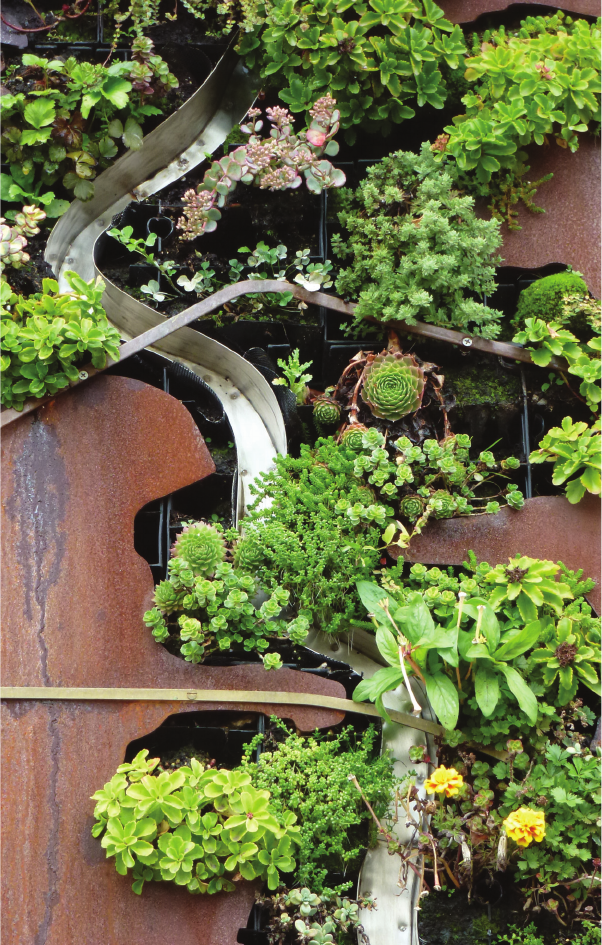
Fragment rury spustowej tworzącej kompozycję
kanalików nawadniających zieloną ścianę.
Obraz odzwierciedla zrównoważony system
parków oraz rzek i kanałów spływających
do oceanu w Toronto w Kanadzie
(fot. A. Bać, 2011)
Fragment of a downpipe creating a system of
canals irrigating the green wall. Design reflects
the sustainable system of parks and rivers
and channels flowing into the ocean in Toronto
in Canada (photo by A. Bać, 2011)