2010
Nr 2(28)
What is associated with a city? Cities and places are
associated with their culture. That culture is often associ-
ated with unique architecture but not always.
Valencia is associated with the Old Town which
evokes the spatial culture of the past centuries. All his-
torical buildings must be restored but the approach to that
is different in different countries. The architectural space
restoration culture in Spain is dened by local develop-
ment plans. They specify which buildings must be re-
stored completely, namely both their interior and exterior
shall remain as they were. However, a large part of his-
torical architecture is restored by restoring only the his-
torical front facade while the remaining of the building is
demolished and built again, taking into account the mod-
ern functional and material requirements. It is character-
istic of the protection of the cultural heritage of the whole
Spain. Usually a few levels of protection of architectural
spaces are determined. The rst level is the preservation
of all elements of a building (shape, exterior and interior
decorative elements). The second level protects the build-
ings which are important for the urban landscape and not
necessarily of high architectural value. These buildings
should preserve the body of the building and construction
system, whereas the change of internal walls is allowed.
The third level protects only some important elements of
the building such as facades characteristic of specic ep-
och and style in which a building was designed or remod-
Elżbieta Czekiel-Świtalska*
Identity of place and culture of urban development
Fig. 1. The City of Arts
and Sciences. Valencia
*
West Pomeranian University of Technology in Szczecin, Depart-
ment of Building and Architecture, Institute of Architecture and Spatial
Planning, Division of Urban Development, Regional Planning and Man-
agement.
90 Elżbieta Czekiel-Świtalska
eled. The front of the building is xed to a special scaffold
and the rest is demolished. A new, functional system is
created in line with the latest technology and the facade
is nally restored. At this level the buildings which sig-
nicantly affect the urban landscape, however, not due to
their shape, which can be changed to some extent, are also
protected
1
[3]. Culture of places with historical buildings
is connected also with the way in which that urban fab-
ric is replenished. In Valencia most of the new buildings
which are built to restore the missing urban fabric of the
old town are designed with their dimensions to t the his-
torical buildings. What is more and more appreciated and
applied is the culture of presentation of buildings which
are nicely lit so their beauty can be admired also at night.
The contemporary urban space of Turia pedestrian
walkway has become a competition for the Old Town
which was associated with the culture of Valencia. Every-
body can nd something interesting here, for instance the
City of Arts and Sciences, active and passive recreation
or the Nature Park. It is the area whose culture of devel-
opment and numerous, interesting functions – especially
those connected with art and education – attracts crowds
of visitors. The modern “City of Arts and Sciences” in
Valencia is one of the biggest centers of culture in Europe.
It has theaters, opera, science museum, halls for different
kinds of artistic events. Is the architecture of these build-
ings associated with their function? I don’t think so but it
does not change the great qualities of the whole design.
The whole space of the City of Arts and Sciences con-
nected with culture and science is located along the pedes-
trian walkway. All events are held in individual buildings
as well as in the open air. This interesting design does
1
Prepared on the basis of E. Czekiel-Świtalska, Zatrzymanie
przemijania starówek, Technical Magazine 1-A/2009, Publication by
Cracow University of Technology, Cracow 2009.
not need to be advertised today; it promotes Valencia and
attracts tourists from all over the world. This new space
culture has been enthusiastically embraced by both the
city dwellers and the visitors. People who are asked what
they associate with the culture in Valencia answer: the Old
Town, Turia and some with paella (traditional dish).
Szczecin became world famous when the tall ships
visited the city in 2007. The event was televised all around
the world. Then what is Szczecin associated with? It is as-
sociated with the Chrobry Embankments where all major,
open air events are held and with the water by which the
city is located. A lot of people connect Szczecin with the
shipyard and the sea although the Baltic Sea is 100 kil-
ometers away, but what is positive is that they identify it
with water. The lack of regular international events is the
reason why the knowledge of Szczecin is poor. The devel-
opment of the most important places of that city does not
attract people to spend time there. The architecture alone
is not enough. The creation of interesting places for pedes-
trians with numerous attractions and especially with regu-
lar events held there would provide a possibility for these
spaces to be always full of people. The other place which
should play the role of a hallmark is the old-new town.
Just like in Gdańsk, only many years later, an attempt was
made in Szczecin to revive the old town. At the turn of
the centuries, new buildings were erected on the histori-
cal urban layout whose design was stylized to resemble
the historical design. However, the buildings alone will
not attract crowds. No walkways or squares were built
and instead there is one huge parking lot. The culture of
a place is not only its urban development but also its char-
acter and the people who are supposed to spend their time
there, so they need to be provided with a possibility to
move around freely without any cars. The development
around the buildings is not less signicant and sometimes
more important than the buildings themselves.
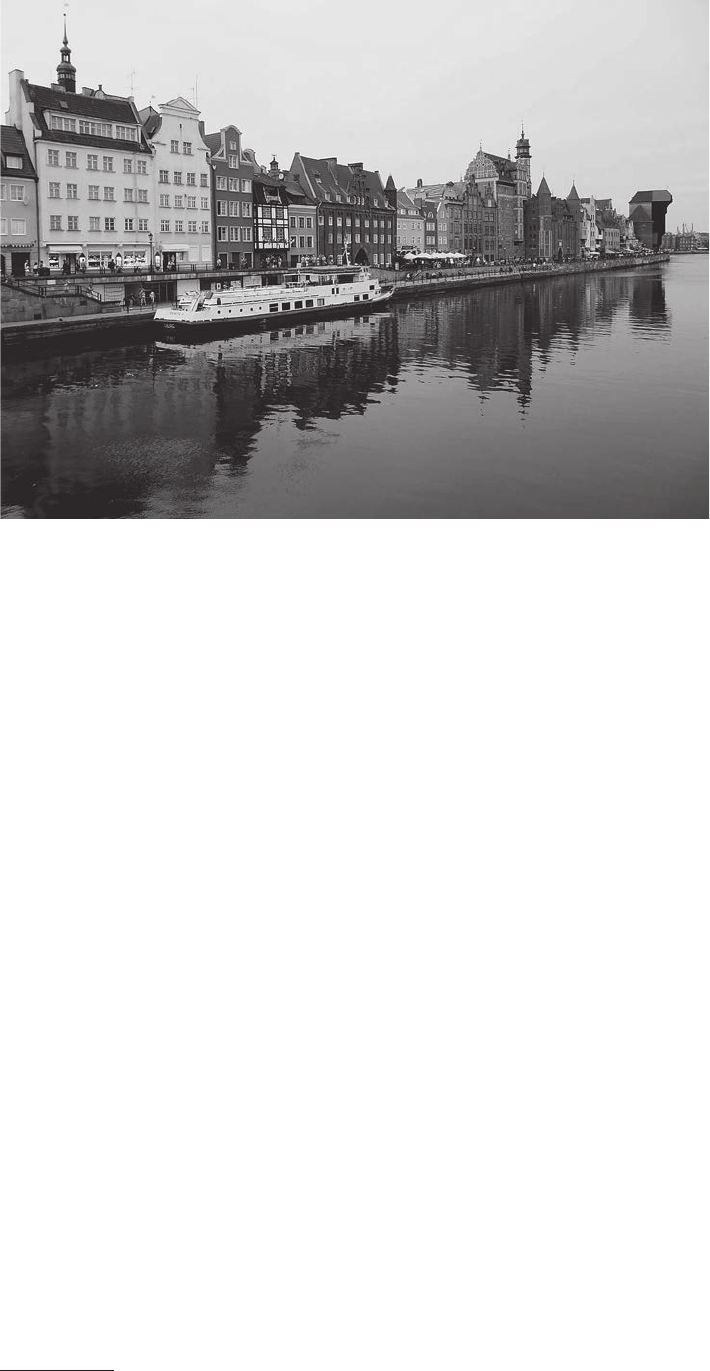
Fig. 2. Gdańsk. Old Town
Identity of place and culture of urban development 91
The hallmark of Gdańsk is undoubtedly its Old Town
with its events and the Great Crane; these are the most im-
mediate associations with its culture and recognizability.
Although today’s old town is a original reconstruction of
the old town, it was the buildings, their function, the de-
velopment of the area as well as advertising of all events
that made it the symbol of Gdańsk. A friendly atmosphere
of the historical and architectural space, numerous places
for meetings and recreation, outdoor and indoor events,
care for provision of attractions are the things that make
people want to come and spend their time in that charm-
ing place. As a result of changes in social and economic
changes as well as changes of needs and habits, people
more often than before spend their free time meeting so-
cially in public places such as cafes, pubs and restaurants.
These places are most often connected with city centers
and old towns. All cities look for ways to attract people to
their centers to prevent the old towns from dying. It should
not be forgotten that a totally new model of spending free
time, especially among the youth, emerged – shopping
idea that the historical layout of that space should be re-
stored. Fortunately the latter idea prevailed. The restora-
tion of the old town combined two ideas: in general the
historic layout of the streets and facades was preserved
but the interiors of the buildings were restored and some
elements were developed in compliance with then modern
technology. (…) The more specic guidelines for the plan
of space development of the historical districts of Gdańsk
(…) provide instructions which constitute a kind of syn-
thesis of historical and modernization postulates – for
instance it was claimed that despite their historical exter-
nal forms the tenement houses to be restored should have
a “modern layout with modern amenities” (Borowski J.)
Especially evident modernistic principles were demon-
strated in the recommendation that despite preservation
of the historical layout of the streets the urban develop-
ment of the space between buildings should be signi-
cantly open, providing huge open spaces for backyards
and green areas. That way of thinking shall soon result
in creating an extremely interesting hybrid of history and
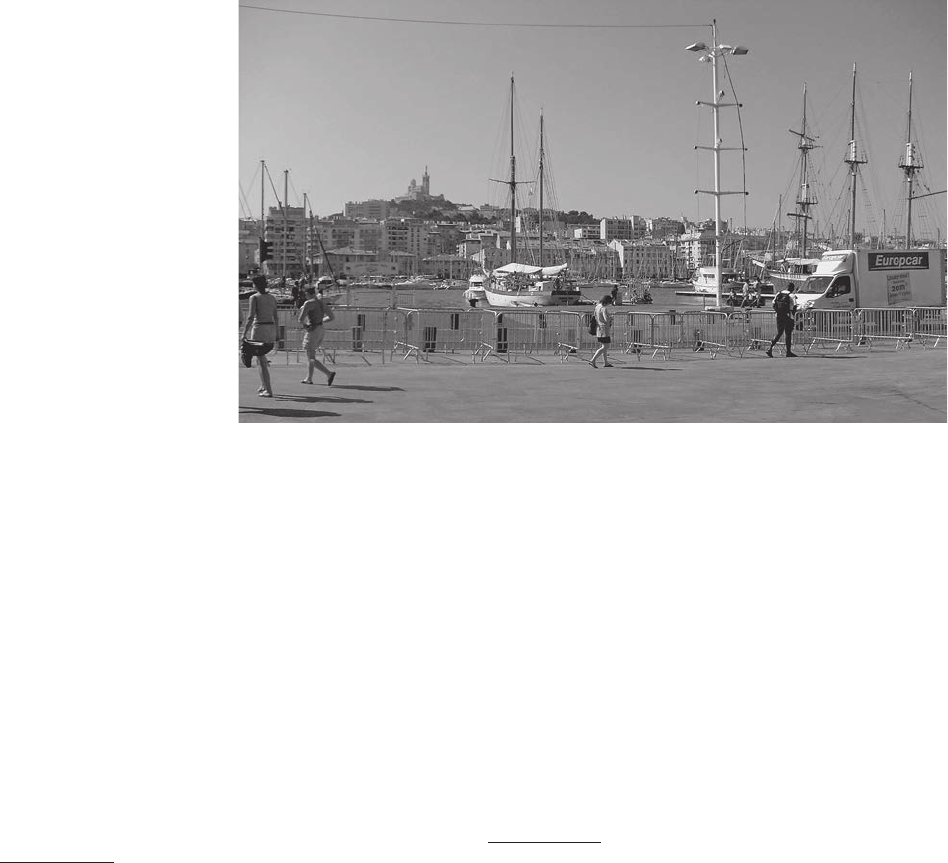
Fig. 3. Marina in the center
of Marseille with the view
of Notre-Dame
de la Garde Basilica
malls are ghting with city centers for visitors. As a re-
sult their interiors are kind of “new marketplaces” where
one can buy something but rst of all be in the public eye
and meet with friends. The spiritual growth of the visitors
was also taken care of in those spaces by opening multi-
plexes and presenting some art by organizing temporary
exhibitions there
2
[5].
The culture of urban development of the old town in
Gdańsk is the post-war idea of rebuilding the destroyed
old town as an original reconstruction of the historical
space. The post-war discussions on the city old town
space development were very different and often extreme.
Some perceived the culture of that place as a modern and
modernistic architecture, whereas others advocated the
2
Hołda K., Przesmycka E., Uwalnianie przestrzeni, kulturaenter.pl
monthly magazine of exchange of ideas, No. 15, 2009.
modernity which the restored Main City in Gdańsk shall
become
3
[2]. It is because of the culture of urban space de-
velopment of the old town in Gdańsk that today both the
citizens of Gdańsk and tourists from all over the world are
happy to visit it. All the time the residents of the city and
its authorities care for the culture of that place, including
both the maintenance of the space and provision of such
attractions as for instance the annual Dominican Fair [1].
It may be surprising to realize what Marseille is asso-
ciated with. A lot of people say it is associated with white
taxis which they know from the lm titled “Taxi” and
with crime. The idea of the culture of that city developed
to a large extent on the basis of lms. Only after people
visit that place do they notice a yacht marina in the center
3
Jacek Friedrich, Problem nowoczesności w kulturze architekto-
nicznej powojennego Gdańska, http://www.buero-kopernikus.org/_/pl/
article/31/7.
92 Elżbieta Czekiel-Świtalska
and beautiful buildings, including the Notre-Dame de la
Garde Basilica overlooking the city. It can be said that the
culture of that city is created by its monumental buildings
and water which is connected with a lot of sailboats in the
very heart of the city. Every day in the morning the places
where you can eat something are lled with the locals and
tourists who want to drink coffee and eat breakfast. In the
evening nding a free table in the cafes, pubs or restau-
rants located in the center by the marina is sometimes al-
most impossible. The friendly character of the streets that
open to the waterfront with dozens of boats makes people
like to walk there and enjoy that specic culture of archi-
tecture and landscape of that place.
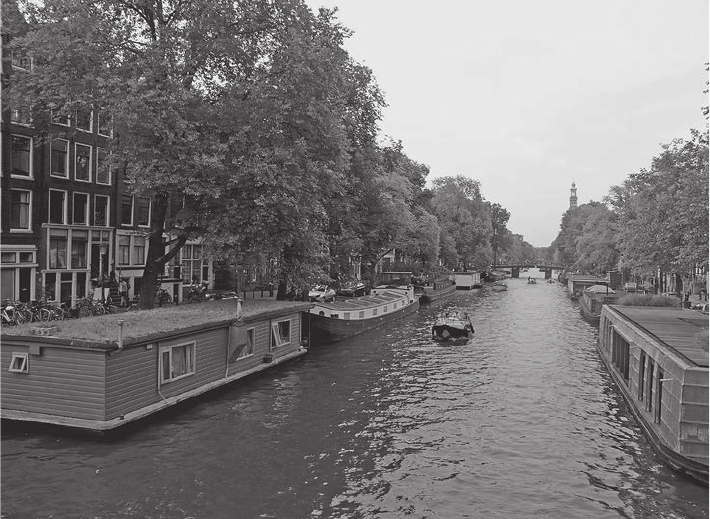
Holland is associated with wind mills, tulips and bicy-
cles as well as narcotics. The perception of Dutch cities,
however, is different. The combination of historic archi-
tecture and water canals next to it forms the culture of
Amsterdam space. The specic, full of live character of
the streets running along the waterfront attracts a lot of
tourists who visit the city again and again. The specic
character is created by the architecture surrounding the
numerous canals surrounded by green areas. Between the
buildings there is pedestrian and road trafc with numer-
ous speed bumps. Pedestrians and bicyclists use those are-
as freely and there is a speed limit for cars. The number of
parking places for cars is very limited but there is enough
room for bicycles. In spite of the diversity of modern and
older architecture, the culture of Amsterdam is associated
primarily with the architecture around the canals. A lot
of buildings feature great historical details and appealing
beauty and there are numerous meeting places on their
ground oors. The opposite banks of the canals are con-
nected by a lot of bridges which makes the division of the
space by water insignicant. The water is here not only
an interesting landscape feature providing the place with
a specic charm but it also serves as a communication
route used by water trams and taxis, connecting different
parts of the city with the ocean or places of residence. It
is a specic approach to the culture of residing and living
because it is rare that people live on water on such a large
scale in cities located by water.
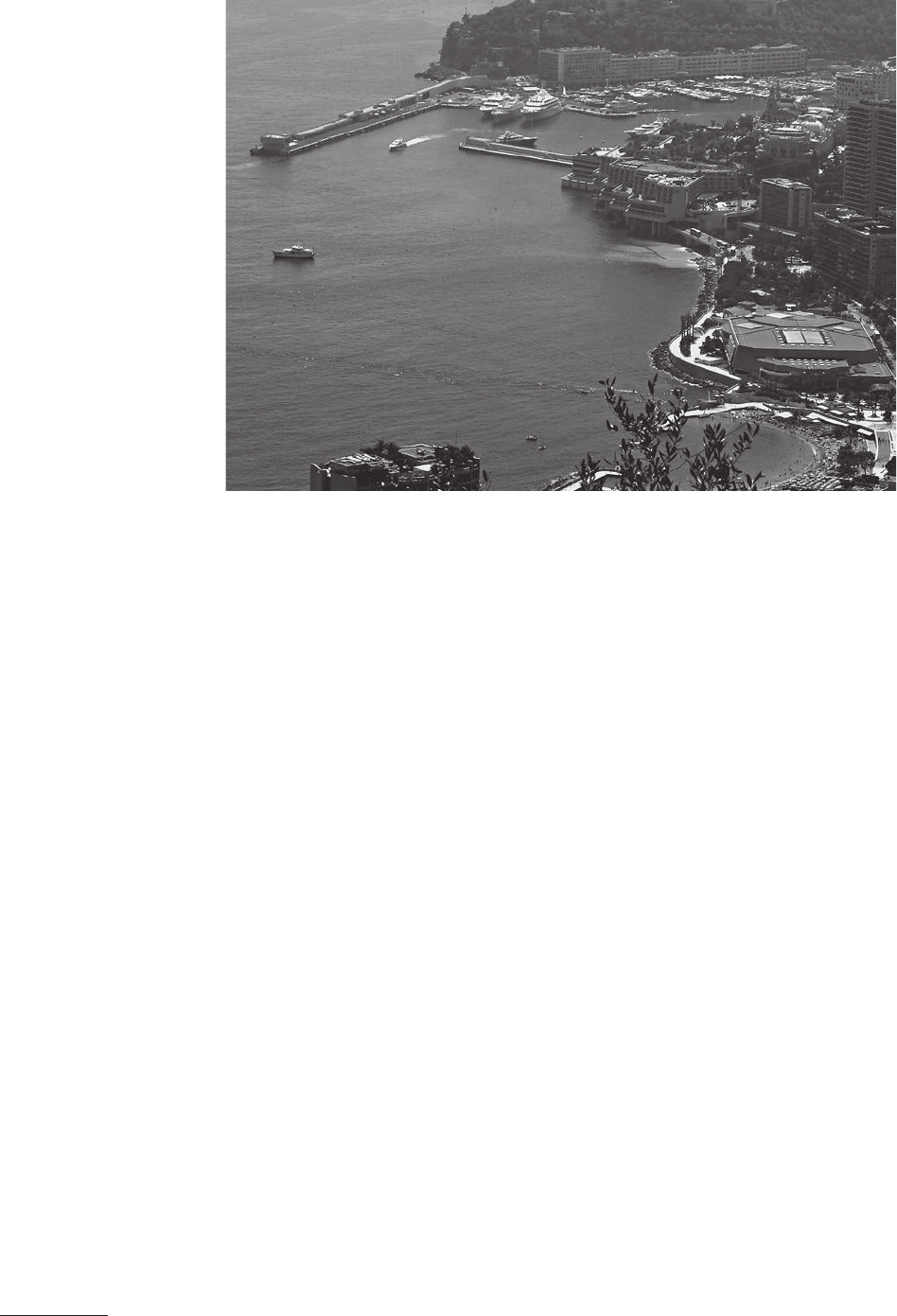
The association of a place with culture can develop
through events which were or are held in a given city or
their form of power. This is the case with Monaco which,
perceived as a principality with monarchs, is full of cul-
ture connected with water as well as with yachts. Monte
Carlo is often associated not with its being a district of
Monaco but with its Formula 1, casinos and rich people.
The culture of that place is not at all associated with the
development of its architectural spaces. The picturesque
architecture located among rocks climbing higher and
higher as well as marinas with vessels which cannot be
seen anywhere else is the culture of space appreciated
only by few people, usually those who visited the city.
Photo No. 5 shows the picturesque location of Monte Car-
lo whose landscape has everything: mountains, warm sea,
beautiful green areas.
Who makes the decisions on spatial development and
consequently infuse a given place with a specic culture
of architecture and local development? In practice the
planning decisions are made by politicians but it is the
owners of real property that implement the assumptions
of the plan. Designers make spatial development plans
and they advocate their ideas but the nal decisions are
made ultimately by local authorities, as is the case in most
European countries. In Poland until 2003, almost all plan-
ning decisions were made by local authorities; after that
year politicians make only those decisions which are con-
nected with the local development plans, whereas the de-
cisions on building conditions are made without the con-
sent of local authorities. Wherever there are no valid local
development plans, it is the owners of land who decide
Fig. 4. Amsterdam
Identity of place and culture of urban development 93
on property development and they apply on their own for
the decisions provided specic statutory requirements are
satised. It is possible to assure a harmonious, friendly
culture of space only through local development plans.
To a large extent the decisions on building conditions re-
sult in spatial disharmony and chaos. However, the cul-
ture of a specic place is not only its harmonious spatial
development but also its acceptance by the society and
that is why the society is consulted at the stage of prepar-
ing the local development plans, which is not practiced
when the decisions on building conditions are granted. In
many countries the presentation of the planning ideas to
local communities is a very important factor and they con-
sider it very seriously. This is not just a mere satisfaction
of a statutory obligation but this is the way of getting as
many people as possible interested in that matter [4].
The assumption … of the systems – English and Ger-
man ones – is the conviction that providing local authori-
ties with a signicant decision-making freedom is nec-
essary to effectively balance the interests. However, the
scope of discretion is limited by the obligation to respect
the spatial solutions reached at higher levels of local au-
thorities, by necessary consulting with other public insti-
tutions and by the obligation to provide the society with
a possibility to participate in the planning process
4
[6].
Widely conducted consulting with the community
provides the answer to the question whether intended de-
velopment is received positively or negatively. Often it
is the local community, including property owners, that
determines the success of the execution of the plan. For
instance in Germany and England they are trying to get
as big an interest of the community in the planning ideas
4
Izdebski H., Felicki A., Zachariasz I., Zagospodarowanie prze-
strzenne, Sprawne Państwo, Warszawa 2007. Online edition. p. 31.
as possible. They keep looking for new ways of getting
to the citizens. In Poland the practice shows that social
consulting is only fullling the statutory obligation. Most
local administrative districts (gminas) do not try to get
the people who live there interested in the intentions of
local authorities regarding space planning. From the very
beginning, that is from the collection of applications and
then at the stage of making the plan, widely conducted
consulting greatly increases the possibility of execution
of the plan.
In order to become famous the cities must nd their
gems of culture which can become known and attract peo-
ple as well as make them willing to come back to a given
place. It happens very seldom for such an object alone
to become a hallmark which would be often visited. For
example for a lot of people Paris is associated rst of all
with the Eiffel Tower but the city is visited in connection
with its general culture and not for this famous structure
itself. It is important that the culture of the whole space
which apart from interesting architecture would offer in-
teresting functions and friendly development, conducive
to recreation and rest.
The architecture and space development is a signi-
cant factor in strengthening the culture of a place, a city
or a country. That culture creates a character of a place,
offers interesting functions as well as ambiance provided
by the buildings and known elements of the culture of be-
ing in that space.
It is important how a given place is perceived by aver-
age people and not by architects. People create the culture
of a given space, whereas architects and urban planners
only design it. City authorities do everything to make the
created culture popular and consequently draw visitors and
investors who would help to encourage the growth. Un-
doubtedly especially in today’s reality every place needs to
be advertised. Even the most beautiful architecture without
Fig. 5. Monaco
94 Elżbieta Czekiel-Świtalska
publicity will not be famous and that is why cities promote
themselves more and more strongly, presenting their most
beautiful places and offering popular attractions.
The image of the culture of a given place is connected
with its recognizability and it is highly important that as
many people as possible know it. The popularity of dif-
ferent places is created in different ways. The image of
the culture of a place which is created indirectly varies
greatly from knowing the place rst hand. The persons
who have visited specic places usually have associations
with the architecture which impressed them, whereas the
knowledge of the places which they have not visited is
usually associated with the knowledge gained from the
media, especially from television and the Internet. The as-
sociations are often connected with lms, songs, sports
and other events. This is the basis on which an image of
the culture of a given place is created.
The associations connected with the culture of the
places described above have been prepared on the basis of
a survey conducted among the persons from different age
groups with secondary and university education in Spain
and Poland. From among the cities described above Va-
lencia and San Sebastian were least known to Poles and
Szczecin was least known to Spaniards.
References
[1] Borowski J., Zabytkowy Gdańsk w odbudowie, Technika Morza
i Wybrzeża, R. III: 1948, No. 11/12, p. 32.
[2] Friedrich J., Problem nowoczesności w kulturze architektonicznej
po wo jennego Gdańska, http://www.buero-kopernikus.org/_/pl/article/
31/7.
[3] Czekiel-Świtalska E., Zatrzymanie przemijania starówek, Technical
Magazine 1-A/2009, Publication by Cracow University of Technology,
Kraków 2009.
[4] http://www.buero-kopernikus.org/_/pl/article/31/7.
[5] Hołda K., Przesmycka E., Uwalnianie przestrzeni, culturaenter.pl
monthly magazine of exchange of ideas, No. 15, 2009.
[6] Izdebski H., Felicki A., Zachariasz I., Zagospodarowanie przestrzenne.
Sprawne Państwo, Report for Ernst & Young Program, Warszawa
2007, Online edition, p. 31.
Tożsamość miejsca a kultura zagospodarowania
Z czym kojarzy się miasto? Miasta i miejsca kojarzą się z ich
kulturą.
Walencja kojarzy się ze Starym Miastem, które prezentuje kulturę
przestrzenną przeszłych wieków. Konkurencją dla Starego Miasta stała
się współczesna przestrzeń urbanistyczna, jaką jest ciąg pieszy Turii.
Znajduje się tu Miasto Nauki i Sztuki, miejsca rekreacji biernej i czynnej
oraz Park Natury.
Szczecin kojarzony jest z kulturą miasta nadwodnego, którego wizy-
tówką są Wały Chrobrego. Symbol ten ugruntował się podczas transmisji
telewizyjnych ze zlotu żaglowców w 2007 roku.
Gdańsk to Żuraw Gdański i Stare Miasto. Kultura jego zabudowy, czy
mocno reklamowane liczne imprezy sprawiają, że jest on znany.
Holandia kojarzy się z wiatrakami i tulipanami. Połączenie zabyt-
kowej zabudowy z kanałami, przy których się znajduje, to niewątpliwie
kultura przestrzeni Amsterdamu. Specyczny klimat uliczek przyle-
głych do wody, tętniących życiem, przyciąga turystów, którzy chętnie
tu wracają.
Architektura i zagospodarowanie przestrzeni jest istotnym czynnikiem
w umocnieniu kultury miejsca, miasta, państwa. To właśnie ona tworzy
klimat miejsca, oferuje ciekawe funkcje, które przyciągają ludzi.
Key words: identity of place, urban development Słowa kluczowe: tożsamośc miejsca, rozwój urbanistyczny