2010
Nr 2(28)
The Sudetes Region is one of many European border-
line mountain areas with specic and different culture which
has been developed through centuries. This specic culture
resulted from the fact that this region belonged to different
countries during the previous centuries (Poland, Czechs,
Austria and Germany) and the important European trade
routes, which connected Lower Silesia with the countries of
Western and Eastern Europe, crossed this region. The variety
of culture was reected, among other things, in the whole
sphere of folk art, including native and wooden architecture.
Native regional culture also appeared in Lower Si-
lesian traditions and legends, which in turn, inuenced
painting, sculpture and architecture of this region enrich-
ing them with new concepts often lled with the spirit of
mysticism and symbolism.
Beautiful landscape of the Sudetes with the highest
range of the Karkonosze Mountains inspired with its beauty
and danger the people living there for ages and the tourists
of the 19
th
century who visited this place more often.
The magic of the Karkonosze Mountains also signi-
cantly inuenced the life and creative activity of the artists
who more willingly settled there and at the end of the 19
th
century they founded a colony assembled around the writ-
ers Carl and Gerhart Hauptmann.
The main personality, who lived in Szklarska Poręba
among the members of the artistic colony, was the writer and
Nobel Prize winner Gerhart Hauptmann and similarly, the
structures built in 1903 were the main buildings in the Seven
Houses Valley; the house of the painter Hermann von Hen-
drich (Hendrich-Haus) and rst of all “Hala Baśni” – “Fairy-
Tales Valley” (“Sagenhalle”) situated nearby became the ob-
jects associated with the Karkonosze Mountains symbolism.
Their interior decoration was lled with the atmosphere
of Karkonosze-like traditions and legends, which was ad-
ditionally enriched with paintings and sculptures created by
the artists who lived in colonies [6, 16].
Woodcarving, which was quite common in the Su-
detes and gave a specic character to the new buildings,
developed already in the second half of the 18
th
century.
Woodcarving reached its culmination before the outbreak
of World War I and mainly thanks to Woodcarving School
in Cieplice Zdrój which was founded in 1902. Native folk-
lore was cultivated in different forms, for example, wood-
en signposts were used in the mountain tourism, which be-
came a characteristic part of the Sudetes landscape [16].
The interiors of shelters, inns and taverns were decorat-
ed with the local artists” woodcarving, who graduated from
Cieplice Zdrój School. Unfortunately, after 1945 many of
those interiors were devastated or totally destroyed and
Cieplice Zdrój School was closed. The new School of Ar-
tistic Craftsmanship does not continue artistic creativity of
its predecessor.
Jacek Suchodolski*
Inspirations with regional architecture form in the Sudetes landscape
Introduction
“Hala Baśni” and the Sudetes villas
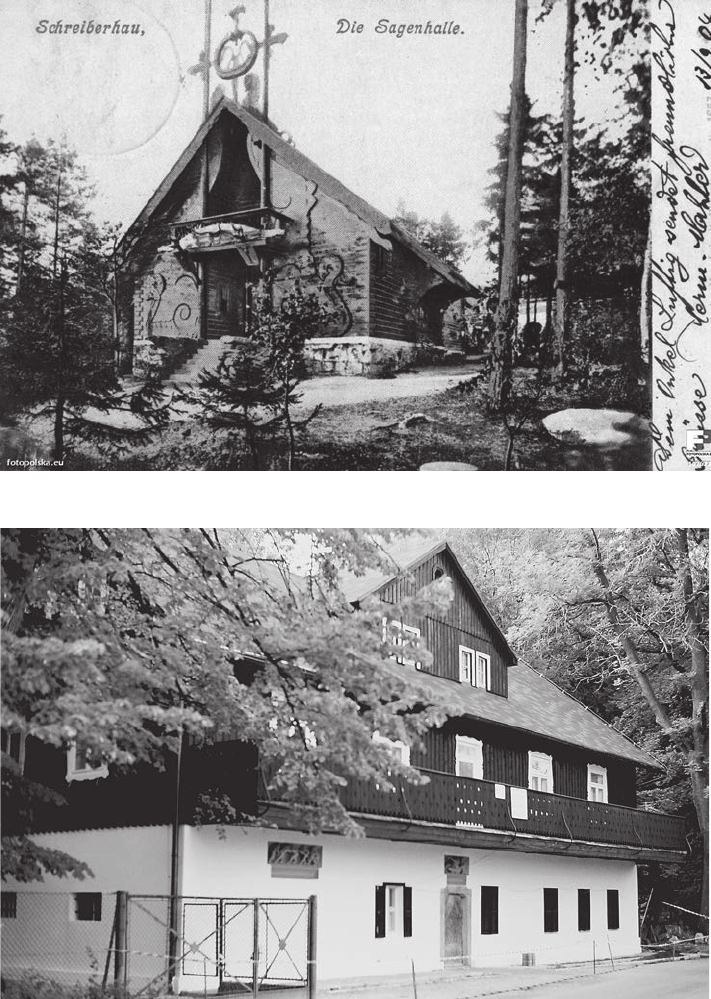
“Hala Baśni” was built in 1903 and the author of its
design was the Berliner architect Paul Engler. Its con-
struction aroused heated discussions but nally, “Liczy-
rzepa Castle” was built and it became a place of particu-
lar worship of Liczyrzepa – Woltan. “Hala Baśni” often
called “Nordic framework temple” was a building simple
in form with a framework construction and covered with
a steep gable roof. The main entrance, which was situ-
ated on the side of the gable wall, was anked with two
*
Wrocław University of Technology, Faculty of Architecture.
68 Jacek Suchodolski
high columns on the model of old German clasped spears
“Eidring” and decorated with god Thor hammer hanging
on chains. Above the entrance, there were dragons and
horses” heads stylized in wood [16].
On the outside of “Karkonosze Legends Temple”
there were old German external sculptural decorations
(“Sagenhalle des Riesengebirges”), whereas the interior
was decorated with the symbols based on the legends and
fairy-tales connected with the Karkonosze mountain spirit
called Liczyrzepa. The themes of the interior paintings by
Hermann Hendrich who initiated the building of the “Hala
Baśni” were magnicent Karkonosze landscapes and the
gure of the spirit of these mountains. The paintings pre-
sented in the fairy-tale convention, with specic colours,
in specially designed frames, were full of mystery and
poetry, thus creating a unique climate which permeated
the interior [6]. Shaped in this way, the Fairy-Tales Valley
was complemented by the Karkonosze landscape which
spread from its entrance – powerfully inuencing the im-
agination by being the source of all inspirations and cre-
ated by nature itself.
Peculiar magic of these mountains became a ‘strong
magnet” attracting many artists who often came from dif-
ferent parts of Germany and settled at that place under the
inuence of the mountains” charm and beauty, which was
expressed in their creative activity [16].
The inuence of the native type of wooden buildings,
which had been shaped in the Sudetes for centuries, on
the creative activity of architects who worked in the circle
of the artistic colony was emphasized by means of par-
ticular villas and pensions. A characteristic escape – made
by many members of the artistic colony – from big and
Fig. 1. “Hala Baśni” in the period
before World War I.
Source: http://fotopolska.eu
Fig. 2. House of Gerhard
and Carl Hauptmann
in Szklarska Poręba Średnia.
Photo by author, 2001
Inspirations with regional architecture form in the Sudetes landscape 69
overpopulated cities to this mountainous region and the
return to nature, communion with nature, had an inuence
on the character of new buildings as well as on the choice
of old village huts as the place for living. The member-
ship of Wilhelm Bölsch and Brunon Will (the artists who
belonged to the artistic colony in Szklarska Poręba) in
German Association of Cities-Gardens (Deutsche Gar-
tenstadtgesellschaft – the aim of this association was the
popularization of living in detached houses surrounded by
gardens and using the models of the local and regional
architecture – contributed to strengthening the movement
of Heimatschutz Bewegung (Protection of Regional Cul-
ture Movement), which existed since 1880 in the Sudetes
where many important persons from cultural and artistic
circles decided to live in old regional buildings.
Most of them were adapted by new owners according
to their needs through changes of the construction and the
roof shape, creation of new rooms and other more or less
signicant alterations [16].
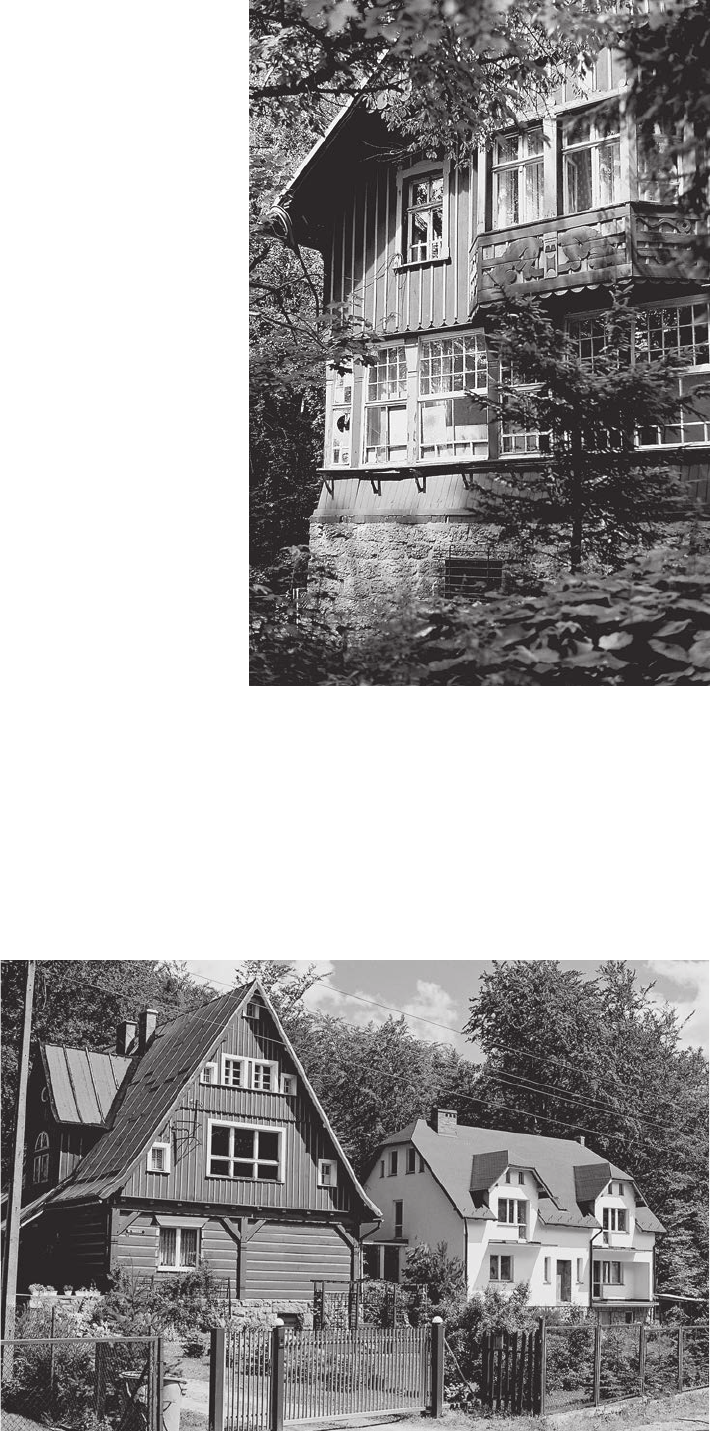
We should also mention, among other things, the
houses which belonged to Gerhart and Carl Hauptmann
who were rst to become the owners of a wooden house
in Szklarska Poręba Średnia in 1880, a village house of
John Henry Mackay (Siebenhausern), houses belonging
to Wilhelm Bölsche and Brunon Wille situated near “Hala
Baśni” in Szklarska Poręba Średnia, a house of Hans
Fechner also in Szklarska Poręba Średnia or a village
house of Alfred Wilm in Zachełmie.
In the group of buildings, which were designed from
scratch, the most distinctive are the following ones: the
house of the painter Georg Wichmann from the years
1908–1909 in Michałowice, the house with a framework
construction of the mayor of Berlin Reicke in Szklarska
Poręba Średnia from 1907, the house of the painter Her-
mann Hendrich from 1905 designed by Paul Engler situ-
ated near “Hala Baśni” in Szklarska Poręba Średnia and
nally, the house of the historian of art Alfred Koepen
built opposite to the Hendrich villa in 1905 and designed
by a well-known Berliner architect Bruno Möhring. The
“Lukas Mill” (“Lukasmühle”), which was designed by
Franz Egbert Scumann and opened to public in the years
1922–1923 in the centre of Szklarska Poręba, certainly
deserves our attention as well. The building was the seat
Fig. 3. Hermann Hendrich House (Hendrich-Haus)
in Szklarska Poręba Średnia. Photo by author, 2001
Fig. 4. Georg Wichmann House
in Michałowice.
Photo by author, 2001.
70 Jacek Suchodolski
of St. Lukas Artistic Society (Künstlergemeinschaft St.
Lukas) with a hotel and restaurant [10, 12, 16].
The architecture of this building was explicitly in-
spired by the Sudetes regional elements of architecture
and it mainly referred in its essence to the principles of St.
Lukas Artistic Society, i. e. protecting and propagating the
native architecture.
It should be mentioned here that the above mentioned
villas – as a result of the native building tradition – were
not only more or less successful copies of the Sudetes
regional architecture but they also constitute its creative
development. Each of these designs had some individu-
al formal solutions which enriched the architecture and
made it more charming and sophisticated.
Tourist buildings
The inuence of regional elements was particularly
emphasized in the architecture of objects which were con-
nected with tourism.
The objects which are directly connected with recrea-
tion and active leisure time certainly come to the fore here.
These are rst of all shelters, mountain hotels, inns (tav-
erns), pensions of different sizes and agro-tourism build-
ings which were arranged for this purpose in the adapted
Sudetes houses.
Most often, their forms were inspired by regional ar-
chitectural elements both in construction and building
details.
The biggest concentration of the buildings of this type
is in the highest part of the Sudetes, i.e. the Karkonosze,
where tourism developed at the earliest in comparison to
other parts of these mountains [12, 13, 14].
In these mountains, the most known shelters in the
Sudetes were built from shepherd or chimneyless huts.
In their form they often referred to the native heritage
of the region (“Pod Łabskim Szczytem” – “Alte Schle-
sische Baude”, “Strzecha Akademicka” – “Hampelbau-
de”, “Bronek Czech” – “Schlingelbaude”, “Samotnia”
– “Kleine Teichbaude” or relatively the newest “Na Hali
Szrenickiej” – “Neue Schlesische Baude”).
Important elements, which also inuenced the shape of
the wholeness in the case of shelters or inns, were practi-
cal aspects, i.e. higher resistance of the building construc-
tion to the impingement of weather changes which are
particularly destructive in higher parts of the mountains.
In high mountains shelters, the elements which are so
frequently used in the construction of buildings situated in
lower parts and serve the purpose of tourism, such as bal-
conies, loggias, terraces, dormers and others, are reduced
to the minimum. Peculiar asceticism and monumentalism,
which serve the purpose of practical goals, are dominant
in the shape of the buildings. The only characteristic ele-
ments in the shape of shelters and inns are verandas where
there are dining rooms and which constitute an excellent
place for admiring this magnicent mountainous land-
scape.
The examples of shelters which have compact and
crude forms are: “Na Szrenicy” (“Reifträgerbaude”) at
the top of Szrenica Mountain at the height of 1365 m
above sea level built in the years 1921–1922; “Strzecha
Akademicka” (“Hampelbaude”) built on the slope of
Złotówka meadow at the height of 1258 m above sea
level– the present building was designed after the re in
1906; and nally, the old shelter “Nad Śnieżnymi Kotłami”
(“Schneegrubenbaude”) at the height of 1490 m above
sea level from the years 1895–1897. Also the third shel-
ter “Na Śnieżce” (“Schneekoppe Baude”) built on top of
Śnieżka Mountain at the height of 1603 m above sea level
in 1862 survived for 104 years and it had a compact con-
struction with visible features of the regional architecture.
And the shelters with a stepped and pyramid-shaped form
of the roof, for example “Dom Śląski” (“Schlesierhaus
im Riesengebirge”) from the years 1921–1922 at the
height of 1394 m above sea level as well as “Odrodzenie”
(“Jugendkammhaus Rübezahl”) on Karkonoska Pass –
1236 m above sea level from 1928 are characterized by
a simple form [14].
The interiors of the Sudetes shelters and inns were in
many cases arranged in a very interesting way. The inte-
rior decorations were based on regional elements which
were enriched with motives from fairy-tales and legends
connected with mountains and their unique atmosphere as
well as a majestic landscape.
After 1945 many of these interiors were deprived of
their most precious elements and equipment and some of
them somehow disappeared along with the buildings like,
for instance, Altschlesische Bauernstube in Kowalowa –
Fuchswinkel colony (Lisi Zakątek) near Mieroszów in
the Suche Mountains in Wałbrzych district. There were
many interesting exhibits in form of furniture, dinner
sets, ceramics and fabrics with a regional origin, which
were collected in this building by director Bertram from
Sokołowsko. The interiors of such shelters, among other
things, as “Strzecha Akademicka” in the Karkonosze
Mountains, “Dom Śląski” at the foot of Śnieżka Moun-
tain or the present pension “Irena” (the old “Kaffebaude”)
in Karpacz are also worth paying attention to. The shel-
ters situated in Kłodzko district such as already non-ex-
isting “Hindenburgbaude” in Zieleniec or “Puhu Baude”
on Puchaczówka Pass in the massive of Śnieżnik, which
have stylistically designed interiors with the Sudetes re-
gional character.
Now we would like to present some interiors in the
tourist industry structures which survived the war destruc-
tion and due to their redecorations we can now see their
old beauty and style.
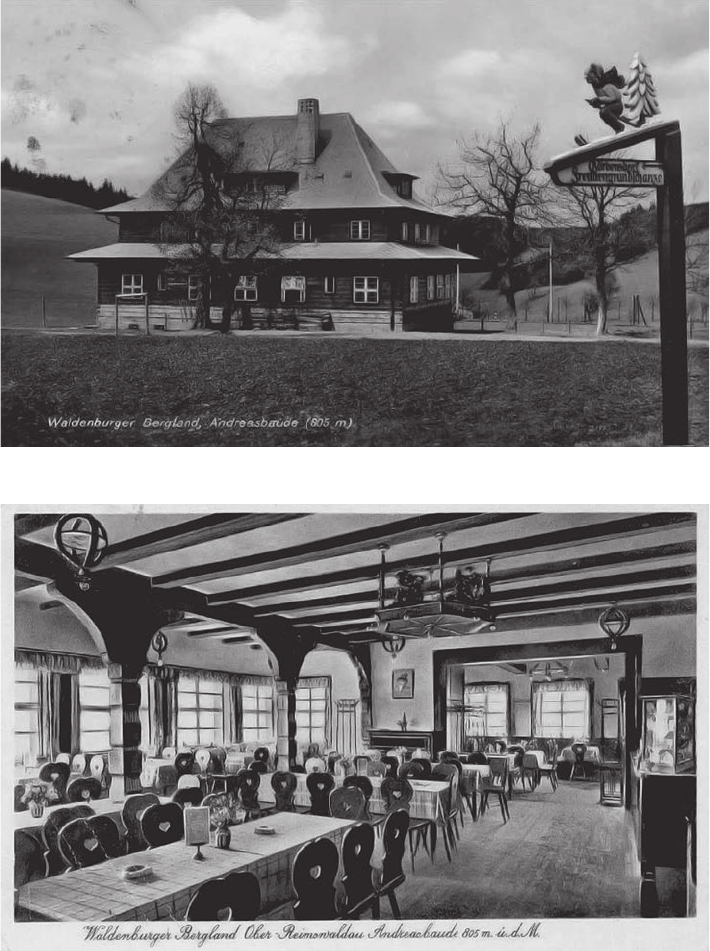
The interior decorations of “Andrzejówka” shelter
(“Andreasbaude”) in the Suche Mountains in Wałbrzych
district in Rybnica Leśna town (Ober-Reimswaldau) come
to the fore here for sure [14].
This shelter was built in the years 1932–1933 as a re-
sult of an architectural competition in 1928 announced
Inspirations with regional architecture form in the Sudetes landscape 71
by GVW (Waldenburger Gebirgsverein) – Wałbrzych
Mountains Society which was the part of Wałbrzych
Mountains Federation. The initiator of this development
was the chairman of GVW Andreas Bock and the shelter
was given his name. Thanks to Bock’s determination, the
process of building the shelter was accomplished despite
a very unfavourable nancial situation resulting from the
world economic crisis. The winner of this competition
was the Wałbrzych architect Friedrich W. Kronke, the
member of BDA who also managed the whole building
place. The building was supposed to be a structure with
the architecture referring in its form and construction to
the regional traditions and full contemporary functional
requirements.
The cornerstone for the building of “Andrzejówka”
was put on 20
th
June 1933 and the ofcial opening of the
building located at the height of 805 m above sea level
took place already on 22
nd
October in the same year.
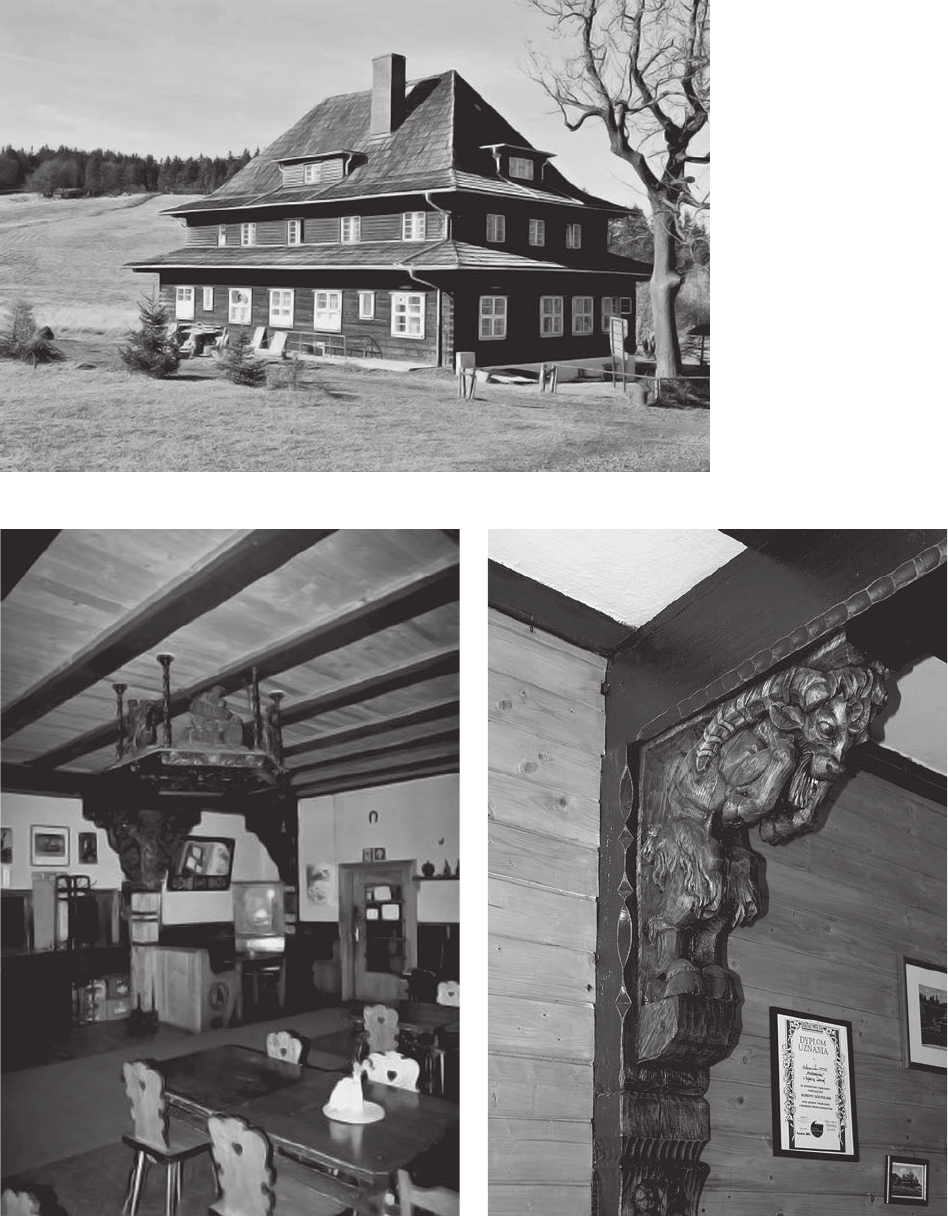
The shelter is a one-storey building with a basement
and utility attic. The whole structure is covered with a hip
and stepped roof. Grey stone walls of the basement, brown
beams of the ground and rst oor walls along with white
joint of carcasses of the building and nally a silver shade
of the roof eternity cover created a particular artistic effect
of the shelter.
The carpenter’s works during the framework construc-
tion of the shelter walls were performed by the master
Petrick, while bricklayer’s work were performed by the
Wałbrzych company called Becker and Bergmann.
We should focus our particular attention on all deco-
rations and woodcarving made by the artist and sculptor
Hans Brochenberger from Janowice Wielkie. By sculptur-
ing forest animals, local highlanders, dancing couples or
skiers Brochenberger presented the regional topics which
were strongly connected with the Wałbrzyskie Mountains.
The climate of the building’s interior with the open-access
Fig. 5. Shelter “Andrzejówka”
with a sculptured signpost,
photograph from the 1930s.
From the collections
in the Wałbrzych Museum
Fig. 6. Interior of “Andrzejówka”
shelter. Inter-war period.
From the collections
in the Wałbrzych Museum
72 Jacek Suchodolski
part for guests as well as lodging part was dominated by
woodcarving of the native character which was strongly
inspired by the Sudetes and lled with local legends and
fairy-tales, which was the wish of the investor – Wałbrzych
Mountains Society.
The rst leaseholder of the shelter was a famous tourist
activist Otto Rübartsch who along with his wife Marga-
retta ran the shelter for several years and popularized the
ideas of active recreation among tourists from Wałbrzych
who visited this place in large numbers. He tted the shel-
Fig. 7. “Andrzejówka” shelter,
view from south.
Photo by author, 2004
Fig. 8. “Andrzejówka” shelter, southern side Shelter interior fragment.
Banquet room. Photo by author, 2004
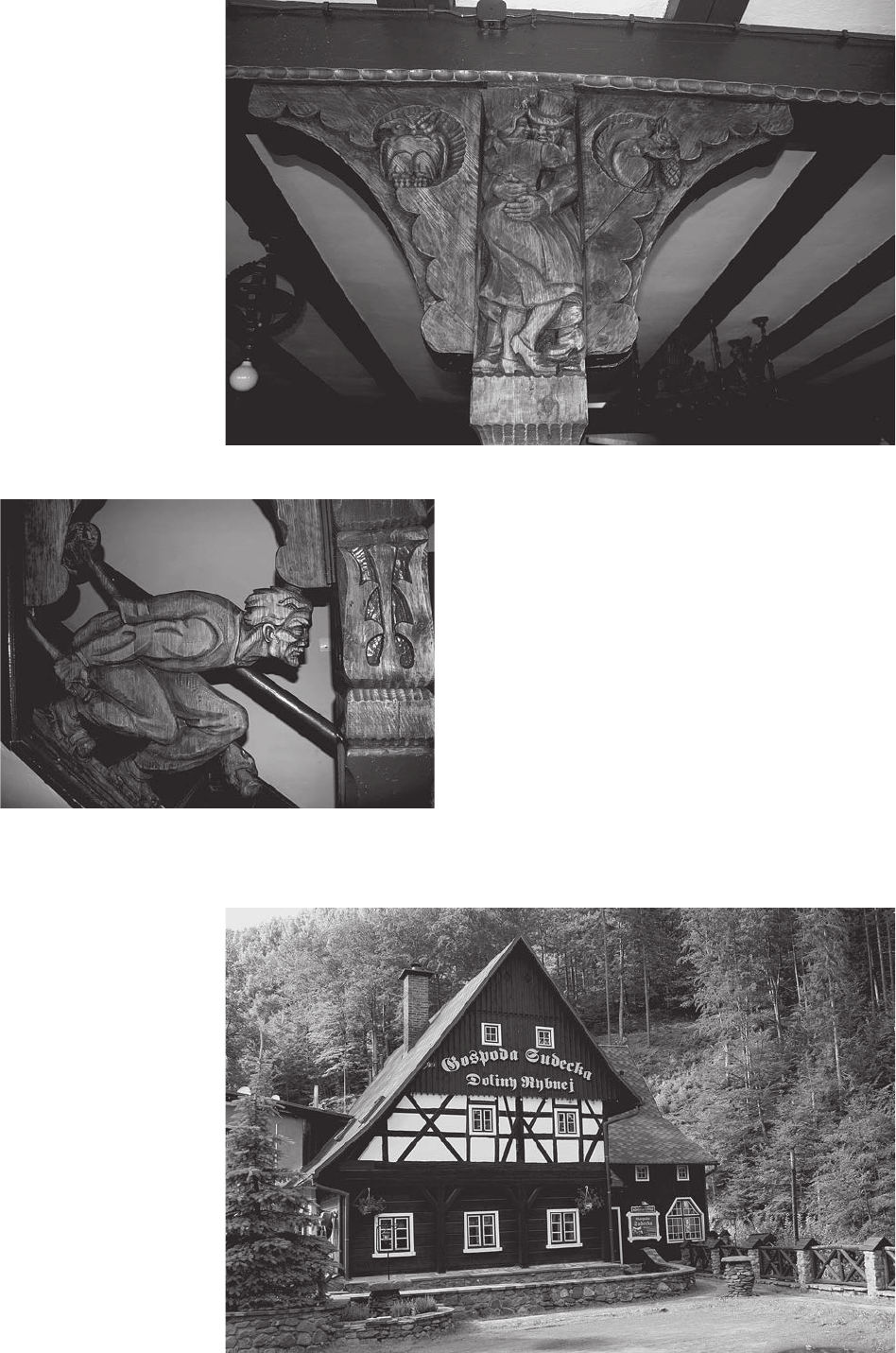
Fig. 9. “Andrzejówka” shelter. Stylized sculpture of a goat supporting.
Photo by author, 2006
Inspirations with regional architecture form in the Sudetes landscape 73
ter interior with furniture at his own expense and several
years later he connected the building to the water main.
In 1944 Hitlerjugend took over the shelter and one year
later Wehrmacht came there. After the war ended the
German leaseholder came back to “Andrzejówka” but in
1946 he left it for good. After the war in 1947 the
Wałbrzych PTT took over the shelter and together with
the Lower Silesian Coal Industry Association it belonged
to the PTTK till 1992 when the company ZG PTT “The
Sudetes PTTK hotels and shelters” in Jelenia Góra was
established.
Most of the shelter woodcarving made by the artist
was preserved until today and now we can admire the
artistry and symbolism of human and animal gures as
well as mountain spirit allegories enchanted in wood
[14].
Fig. 10. “Andrzejówka” shelter.
Cap of the column with
the motif of a dancing couple.
Photo by author, 2008
Fig. 12. Rybnica Mała.
Gospoda Sudecka Doliny Rybnej.
Entrance façade.
Photo by author, 2009
Fig. 11. “Andrzejówka” shelter, staircase to the rst oor. Skier.
Photo by author, 2009
74 Jacek Suchodolski
“Gospoda Sudecka Doliny Rybnej” (The Sudetes Inn
of Fish Valley) is another well preserved structure situated
not far from the “Andrzejówka” shelter, namely in Ryb-
nica Mała. This building was erected in 1713 as a mill and
later it was converted into an inn. It performed this role
until World War II, however,after the war ended it became
a residential house.
After the general overhaul at the beginning of 2002,
which restored the beauty and style of the inn building,
this structure again became a place that was willingly vis-
ited by tourists.
The interior part, in particular the banquet room on the
ground oor, which is kept in the austere interiors style
of the old Sudetes inns, is really worth noticing. Simple
wooden furniture, small windows giving very little light
and the beam construction of the structural ceiling on
which there were simple decorative motives created the
atmosphere of the interior.
The relatively low interior of the banquet room along
with a marked rhythm of the structural ceiling beams addi-
tionally create the atmosphere of familiarity and warmth,
which is so typical of the Sudetes wooden houses.
Summary
In the Sudetes region, a type of wooden building with
characteristic constructional and formal features was cre-
ated as a result of different cultural inuences through
centuries. It became a creative inspiration for many gener-
ations of architects and builders who designed residential
houses, public utility buildings and in particular pensions,
inns and shelters in this mountainous region.
The additional signicant factor, which had an inu-
ence on the shape of creative activity of the representa-
tives of art and culture who lived in the Sudetes, was the
magnicent mountainous landscape, especially the high-
est part of the mountains, i.e. the Karkonosze. The local
folklore, which was strongly embellished with mysticism
and fairy-tales, in particular the mountain spirit gure –
Liczyrzepa, became the force which inspired and stimu-
lated artists” imagination.
“Hala Baśni” (Fairy-Tales Valley, also called Moun-
tain Spirit Castle), which combined the features of the
old German and Sudetes regional buildings, constituted
in a way a symbol that united various domains of creative
activity of the artists who lived in the artistic colony in
Szklarska Poręba.
Another signicant element, which shaped the charac-
ter and climate of houses in the Sudetes, was also – apart
from their wooden construction and proportions of the
particular parts – the interior decoration which often re-
ferred to the local symbolism through the style of wood-
carving.
Unfortunately, after the end of World War II, the cul-
tural continuity in the Sudetes was broken; the artistic col-
ony in Szklarska Poręba stopped existing, “Hala Baśni”
was demolished, Cieplice Zdrój School of Woodcarving
does not exist any longer and the newly built houses in
the Sudetes do not refer in their form and detail to the
local regional models which were crystallised throughout
the centuries.
However, especially during the recent years after
1989, among the inhabitants of the Sudetes region we can
observe the rebirth of interest in its rich cultural heritage
and among architectonic projects we can notice more or
less successful attempts to refer to the regional character
of the buildings, although this is by no means a permanent
change in the building style. The process of crystallisation
of cultural inuences, which takes place in the changing
social and economic conditions after the year 1945 in the
Sudetes, is still in its early stage and we must wait till we
see its mature form.
References
[1] Album vom Riesengebirge mit 31 Bidern, Graph. Kunstanstalt Globus,
Kotzschenbroda, Dresden.
[2] Baedeker K., Schlesien – Riesengebirge, Grafschaft Glatz, Edition 2,
Karl Baedeker Verlag, Leipzig, 1938.
[3] Birke E., Das Riesengebirge und Isergebirge in 144 Bildern, Gerhard
Rautenberg Verlag, Leer–Ostfriesland, 1983.
[4] Birke E., Das Waldenburger und Glatzerbergland in 144 Bildern,
Gerhard Rautenberg Verlag, Leer–Ostfriesland, 1983.
[5] Dehlitz F., Umgebinde im Überblick, Graphische Werkstätten Zittau,
Gmbh,1987.
[6] Die Sagenhalle des Riesengebirges (Schreiberhau),von Hermann
Hendrich, Hugo Schuchard, Paul Engler, Bruno Wille, J.J. Weber in
Leipzig, 1903.
[7] Franke H., Ostgermanische Holzbaukultur und ihre Bedeutung für das
deutsche Siedlungswerk, Wilh.Gottl.Korn Verlag/Breslau, 1936.
[8] Härtel H., Ländliche Baukultur am Rande der MittelSudetes, Schles-
ien-Verlag, Breslau 2, 1941.
[9] Kłodnicki Z. (ed.), Dziedzictwo kulturowe Dolnego Śląska, Polskie
Towarzystwo Ludoznawcze, Wrocław, 1996.
[10] Kurverwaltung Schreiberhau, Schreiberhau im Riesengebirge, Som-
mer, 1929.
[11] Löwe L., Schlesische Holzbauten, Werner Verlag, Düsseldorf,
1969.
[12] Słownik geograi turystycznej Sudetów, Vol. 3, Karkonosze, M. Staf-
fa (ed.), Wydawnictwo PTTK „Kraj”, Warszawa–Kraków, 1993.
[13] Suchodolski J., Regionalizm w kształtowaniu formy architektury
współczesnej na obszarze Sudetów, Ocyna Wydawnicza PWr,
Wrocław, 1996.
[14] Suchodolski J., Architektura schronisk górskich w Sudetach, Ocyna
Wydawnicza PWr., Wrocław, 2005.
[15] Trocka-Leszczyńska E., Wiejska zabudowa mieszkaniowa w regionie
sudeckim, Ocyna Wydawnicza PWr., Wrocław 1995.
[16] Wspaniały krajobraz – artyści i kolonie artystycz ne w Karkonoszach
w XX wieku, praca zbiorowa, Gesellschaft für Internationalen Kultur-
austausch e.V Berlin, Muzeum Okręgowe w Jeleniej Górze, 1999.
Inspirations with regional architecture form in the Sudetes landscape 75
Inspiracje regionalną formą architektury w krajobrazie sudeckim
Region sudecki jest jednym z wielu europejskich pogranicznych
obszarów górskich o ukształtowanej w ciągu minionych stuleci specyce
i odrębności kulturowej. Złożyły się na to: przynależność do różnych
organizmów państwowych w poprzednich wiekach (Polski, Czech, Austrii
i Niemiec) oraz przebieg ważnych europejskich szlaków handlowych,
łączących Dolny Śląsk z krajami Europy Zachodniej i Wschodniej.
Wielowątkowość kulturowa uwidoczniła się tu także między inny-
mi w całej sferze ludowej sztuki, w tym w rodzimej formie drewnianej
architektury.
Rodzima kultura regionalna zaznaczyła się także w podaniach i le-
gendach dolnośląskich, co z kolei wywarło wpływ na malarstwo, rzeźbę
i architekturę tego regionu, wzbogacając je o nowe wątki przesycone
często duchem mistycyzmu i symboliki.
Wspaniały krajobraz Sudetów z najwyższą ich partią Karkonoszami
inspirował swym pięknem i grozą ludność zamieszkującą te tereny od
pokoleń oraz turystów przybywających tu coraz liczniej od XIX wieku.
Magia Karkonoszy wywarła także głęboki wpływ na życie i twór-
czość coraz chętniej osiedlających się tutaj artystów, którzy z końcem
XIX stulecia założyli kolonię skupioną wokół pisarzy Carla i Gerharta
Hauptmannów.
Key words: Sudetes Region, regional architecture Słowa kluczowe: Sudety, architektura regionalna