2026
2(86)
Ewa Angoneze-Grela*, Diogo Tadeu Vargas Horvath**
Jorge Zalszupin:
between Brazilian Modernism and its alternative interpretations
DOI: 10.37190/arc260204
© by the Author/Authors. Licensee WUST.
Published in open access. CC BY-NC license.
Abstract
This article examines the work of Jorge Zalszupin, a Polish-Brazilian architect, in the context of architectural movements prevalent in Europe and
Brazil during the Modernist period.
The aim of this study is to examine the connection between Zalszupin’s architecture – with particular emphasis on the architect’s residence in Gua-
rujá (São Paulo) – and his biography, as well as the architectural realities that characterized the various stages of his professional career. The research
is based on a case study, supported by contextual and biographical analysis that includes previously unpublished materials, such as an original sheet of
architectural drawings and trade journals from the period.
The analysis demonstrated the hybrid nature of his work, which combines Brazilian modernism (the carioca and paulista schools) with references
Key words: Jorge Zalszupin, Brazilian modernism, sculptural architecture, Mediterranean architecture
Introduction
-
ure whose body of work is typically situated within the con-
text of Brazilian Modernism. Although he was amongst the
works, furniture designs, and industrial designs are recog-
Zalszupin designed furniture for government buildings in
Oscar Niemeyer. In this context, it can be argued that his
body of work deserves greater attention and international
recognition.
There are still few scholarly studies devoted to his work,
industrial design. In Poland, interest in him has recently
grown thanks to the exhibition “Jerzy Zalszupin’s Brazil
-
ian Modernism: Warsaw – São Paulo – Warsaw”, organized
by the Visteria Foundation and ETEL, a Brazilian publisher
specializing in design. The event took place in the fall of
that would present his architectural body of work, which
constituted the main focus of his professional career.
This research gap served as the starting point for this ar-
-
idence in Guarujá (São Paulo), analyzed within the context
of Brazilian Modernism. This article also examines selected
structure clearly diverges from Zalszupin’s earlier works,
and intriguing use of materials. It is reasonable to ask what
creative direction, and in what context this change took place.
As noted, Jerzy Zalszupin’s work is most often inter-
preted through the lens of modernism, which gained wide -
-
ewa.grela@put.poznan.pl
**
ment, Casa Zal szu pin, Brasil.

spread popularity during his professional career both in
Europe and in Brazil. While skillfully employing its lan-
guage, Zalszupin was also an attentive observer of changes
and current design trends in Europe, with which he main-
tained a constant intellectual dialogue. In the authors’ view,
it is precisely the design of the house in Guarujá that holds
the key to interpreting his architectural work, serving as
a testament to Zal szupin’s openness to concepts that co-
existed with Modernism, while also demonstrating his dis-
tinctiveness and his consistent search for his own architec-
tural language.
Methods
The starting point for the research was the acquisition of
original source materials related to the architect’s house de-
sign, courtesy of Casa Zalszupin
. They include architectural
drawings – a set of plans, elevations, sections, and building
descriptions – as well as photographic documentation from
This study uses a qualitative analysis method focused on
interpreting the building under study, as well as a contextu-
al – historical and architectural – analysis that addresses the
broader idea and cultural background. A biographical-con-
textual approach was also employed, linking the architect’s
work to the course of his life and the contexts in which he op-
erated. The research was based on a bibliographic review that
included both academic studies and press materials, includ-
ing publications in the Brazilian journal Manchete and the
French architectural periodical L’Architecture d’Aujourd’hui.
Direct contact with the architect’s daughter, Verônica
Zalszupin, as well as an on-site observation of his home
in São Paulo – which currently serves as Casa Zalszupin
– proved to be an important addition to the research.
Results
The results are presented in three sections focusing on
the architect’s biography and the architectural trends with-
in which he worked during various periods of his life. This
structure allows us to trace the evolution of his work. These
sections cover, in turn, his European experiences, followed by
2
, includ-
ing sculptural works that draw on the “Mediterranean style”.
Within the context of European architectural ideas
-
on the streets of prewar Warsaw, particularly in the area
The space, designed by Lissa Carmona Tozzi and managed by
ETEL, is dedicated to research, conservation, and the promotion of
his home in São Paulo.
2
In this article, the term “tropical Modernism” refers to an inter-
pretation of Brazilian Modernist architecture as a response to climatic
conditions, the landscape, and the local way of life. Architecture under-
stood in this way is present in the writings of Lúcia Costa and was pop-
-
home was located. As a teenager, he came across a book of
Le Corbusier’s sketches and – as he recalls in his autobiog-
raphy – decided at that moment to devote his life to archi-
-
-
slovakia to France, where he found work helping to rebuild
Dunkirk which had been damaged by the war. During that
time, he settled in the nearby town of Saint-Pol-sur-Mer
and gained professional experience for a year. Then, driven
by ambition and the need to seek out more ambitious de-
about this decision in his autobiography
:
I’ll go far away from the anticipated wars – preferably to
Brazil – because my monthly architecture journal (“L’Ar-
chitecture d’Aujourd’hui”) featured names and projects
that made me dream and fantasize about these new worlds
At that time, France, devastated by the war, was entering
a phase of intensive reconstruction, in which Modernism
was used as a key design tool. Le Corbusier was develop-
ing the concept of the machine à habiter and working on
same time, the idea of the synthesis of the arts became wide-
the founder of the magazine L’Architecture d’Aujourd’hui.
and the Architecture-Sculpture Debate” emphasizes that,
arts was intensively developed in the pages of his maga-
South America. The magazine L’Architecture d’Aujourd’hui
was distributed across several continents, including Brazil,
which made it possible to stay in touch with the European
In Europe, in response to orthodox Modernism, alterna-
tive approaches to architecture gradually emerged. The idea
pioneered by the founder of L’Architecture d’Aujourd’hui
was taken up in subsequent decades by other designers, in-
cluding Jacques Couëlle, a sculptor and self-taught archi-
tect who is sometimes regarded as one of the initiators of
as the housing complex in Castellaras-Le-Neuf and the
Cala di Volpe hotel, served as a sort of laboratory for sculp-
Zalszupin’s autobiography was also published in Polish, trans-
lated by Joanna Kuhn (J. Zalszupin, Z d*** na księżyc, Wydawnictwo
Zalszupin and Brazilian Modernism
tural forms scaled up to the level of architecture. The design
process often relied on working with scale models, and the
architect himself actively participated in the construction,
Couëlle’s design practice spanned both the French Riviera
the context of postwar development in elite tourist archi-
stark contrast to the geometric orthogonality of Modern-
ism. The buildings he created helped shape the identity of
these spaces, consciously referencing notions of the Medi-
terranean lifestyle.
Couëlle’s bold, sculptural forms may have provided
-
onal geometry and the rigidity of the right angle had be-
come too restrictive. In one interview, Zalszupin admitted:
The right angle […] is something I admire, but that I am
unable to apply. What I create takes on a certain lyricism,
a certain ornamental character – in short, there is always
an element in it that does not stem from purity or formal
clarity
-
azine Aujourd’hui Art et Architecture published a special
Aujourd’hui
Art et Architecture
the houses in Castellaras-Le-Neuf, it may also have found
its way into Zalszupin’s hands. The context of Mediterra-
nean resort architecture, designed with European elites in
architecture may have inspired him to seek an alternative
architectural language that went beyond the dominant prin-
ciples of the paulista and carioca schools, within which he
developed his creative work.
Tropical Modernism
– between the paulista school and the carioca school
While living in France, Zalszupin viewed Brazil as
a place open to experimentation with enormous architectur-
At that point, I decided to leave France and look for
a young country where I could develop my career. And
don’t ask me why Brazil. Perhaps because I had come
across some information about the country in the magazine
“L’Architecture d’Aujourd’hui”, which featured articles on
the Fábrica Nacional de Motores, the Ministry of Educa-
tion, and Pampulha. I believed that Brazil was a country
particularly well-suited to the creative pursuit of architec-
ture
de Janeiro, but soon found employment at the practice of
Lucjan Korngold, a Polish architect who had already fol-
professional position and invited him to join his practice in
the magazine L’Architecture d’Aujourd’hui and met his
future wife, the Frenchwoman Annette Kahn (Zalszupin
channel of communication for Zalszupin with French cul-
ture and language.
emerged in Brazil. It found fertile ground, becoming a ve-
hicle for a new national identity that clearly distanced itself
from the country’s colonial past. A generation of architects,
including Lúcio Costa, Oscar Niemeyer, and Roberto Burle
Marx, emerged from Le Corbusier’s vision.
-
er noted the exceptional qualities of the natural landscape,
stating that it was “one of the most beautiful landscapes the
-
phasized the close relationship between nature and urban-
ization: “the landscape penetrates the city from all sides”.
This foreshadowed one of the aspects that would become
characteristic of modern Brazilian architecture. Le Corbus-
collaborate on the design of the Ministry of Education and
and Oscar Niemeyer, proved decisive for the development
-
location of the federal capital from Rio de Janeiro to the
new city built in the country’s interior, a debate over the
directions of architectural Modernism in Brazil quickly
carioca school, asso-
ciated with Rio de Janeiro – characterized by monumental
and formal Modernism – the paulista school developed in
São Paulo and was associated with João Batista Vilanova
Artigas, distinguished by its austere, structural, and socially
This was the context in which Zalszupin worked. After
several years of working for Korngold, he decided to open
-
the new architecture, which led him to develop his own de-
signs as an extension of his architectural practice. Although
architecture occupied a central place in his work, it was fur-
niture design that brought him recognition, leading to the
inclusion of his designs in government buildings in Brazil’s
projects, such as the Conjunto Nacional in São Paulo.
From that point on, his architectural projects expand-
complexes, and began to appear not only in São Paulo’s
most important districts but also in cities in the interior and
along the coast. At the same time, his furniture designs be-
gan to be used in public buildings and major commercial
spaces, such as bank branches and airports.
-
dim Europa neighborhood of São Paulo (Fig. 2). Although
the building displays characteristics of Modernism – such
façade – it already revealed the architect’s interest in ex-
ploring ornamentation, as well as in integrating architecture
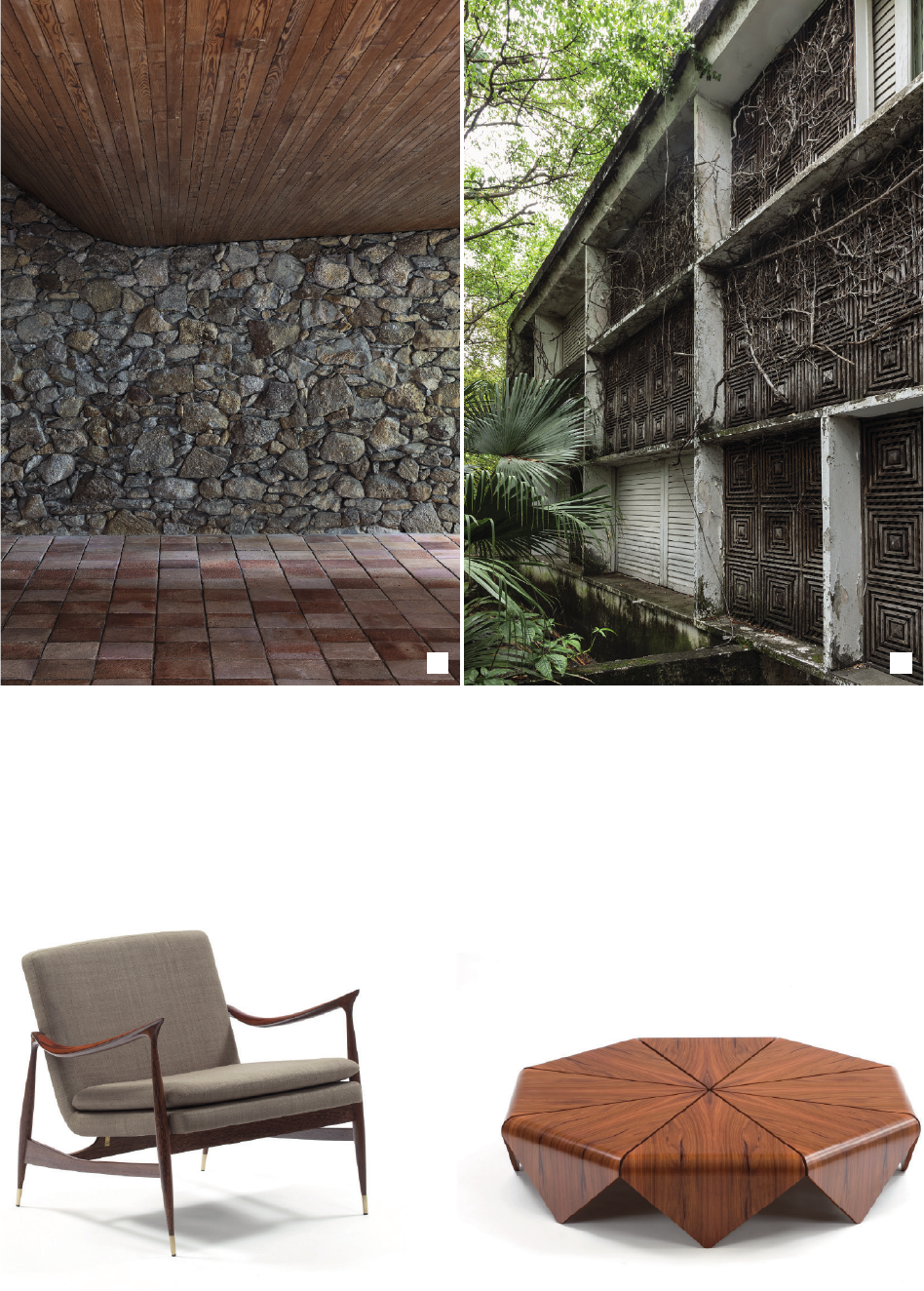
with nature. In the façade design, he employed geometric
ornamentation made of jacarandá wood, while the interiors
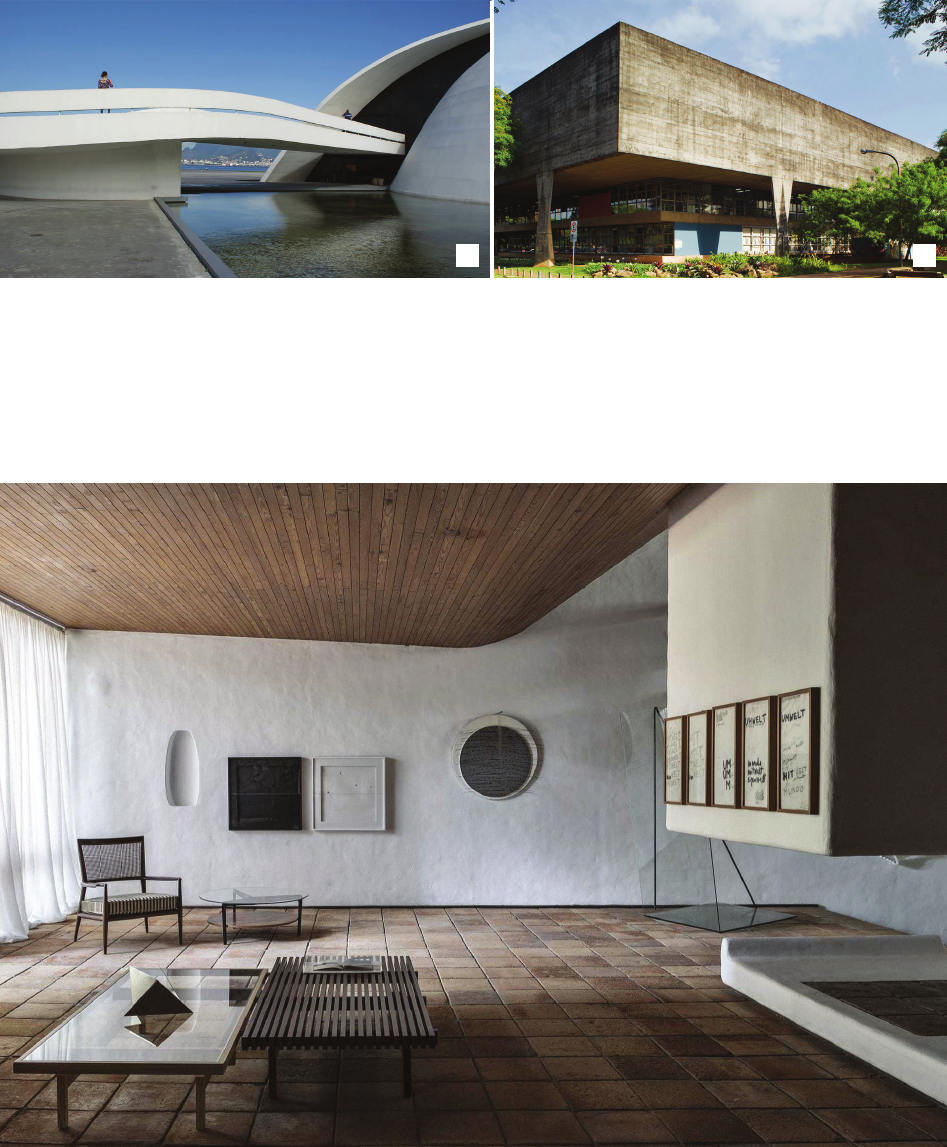
come to the conclusion that morphological forms are the
most authentic and closest to my heart, rather than those
– a distinctive feature of his work – had already been ev-
featured textured plaster with an irregular, sculptural form,
a rounded, soft line that rises smoothly toward the mezza-
-
place. The dialogue between architecture and nature was
carioca and paulista
a b
Fig. 2. The interior of Zalszupin’s
residence in São Paulo (source: © Ruy Teixeira)
Zalszupin and Brazilian Modernism
b) geometric panels made of jacarandá wood and vegetation on the garden-facing façade (source: © Ruy Teixeira)
a b
(source: © Fernando Laszlo)
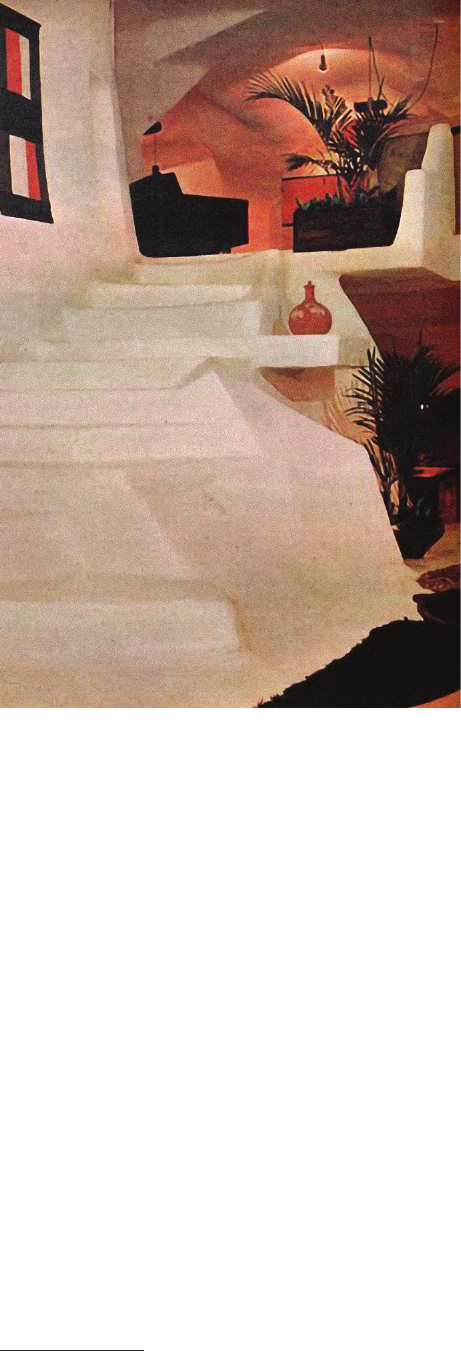
Danish armchair
– but in architecture, its development has faced greater
limitations. This is because Zalszupin operated within the
the two major schools.
Zalszupin’s independence from current trends and his
tendency to experiment with form – perhaps inspired by
the idea of a synthesis of architecture and sculpture – be-
incorporate the language of sculpture into architecture can
be seen in the interior design of the L’Atelier store in Rio
-
designer of the project, whose authorship is attributed to
Roberto Bastos Cruz, an architect and employee of L’Ate-
magazine of the time, Revista Casa & Jardim, Bastos Cruz
Zalszupin drew much of his inspiration from Scandinavian archi-
tecture and design, as he mentioned, among other things, in an interview
for Murator-
arate study to this topic.
himself stated that the concept of the space was developed
entirely by Zalszupin, who provided him with guidelines
was shaped using a variety of materials, such as “canvas,
eternit, concrete, Vimatex, gypsum, lime, paint, and even
to model the walls into organic, sculptural forms. These
An architectural experiment in a Mediterranean spirit
This house marked a complete shift in architectural style,
one that would determine all subsequent designs. I could
only attempt this experiment for myself, because no one
could have predicted the outcome. But it turned out to be
immensely satisfying both for me and for my future clients,
who immediately began to appear, seeking something in the
same architectural language. And so it was these circum-
stances that helped bring about the miracle of discovering
a true desire to create a kind of architecture that lay hidden
within me, waiting to be unleashed
This is how Zalszupin described the design of his own
southeast of São Paulo. It is worth noting that the city,
th
century as a vacation resort for the
ambitious tourism project.
At the time, the famous hotel with a casino, the beaches,
and other attractions drew wealthy tourists, making Gua-
rujá a popular seaside resort and a meeting place for the
at the time for his successful projects in Brasília – prepared
a study on the tourist development of Guarujá (Fundação
Oscar Niemeyer n.d.). This project was never carried out.
It survives only in the form of hand-drawn sketches with
extensive plan included, among other things, a small set-
tlement consisting of “alternating houses”. Noteworthy is
the brief description Niemeyer added to one of the draw-
ings: “white and picturesque like Mediterranean houses”.
The term “Mediterranean” in the context of Guarujá
Brazilian magazine Manchete published an article titled
“The Mediterranean Style – The Old Art of Good Living”,
which explained the emergence of a new style that had
quickly gained popularity in this resort town. The author
traces its origins, explaining that:
A group of architects led by Le Corbusier – one of the main
leaders of the modern architectural revolution – turned to the
study and analysis of the forms and ways of life of past so-
cieties, primarily those that inhabited the Mediterranean
coast […]. The result of this research was the incorpora-
tion, in numerous contemporary projects, of vernacular
Mediterranean-style architecture
In reality, interest in the vernacular architecture of the
Mediterranean region accompanied Modernism from its
“Vanguarda: cenário do futuro”, article from the magazine
Jóia: Revista Feminina Quinzenal
Jóia: Revista Feminina Quinzenal
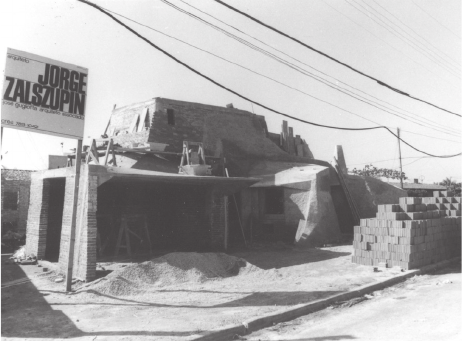
Zalszupin and Brazilian Modernism
formed in formwork – whose imprint creates the distinctive
pattern known as forro paulista – and a ribbed ceiling with
tijolos baianos). The walls were built of sol-
id brick and then sculpted into artistic shapes using mortar
aggregate. Furthermore, the architect incorporated authentic
sails into the design, mounted on the garden side in the form
of an awning. The use of these elements may indicate a de-
liberate connection between the architecture and the coastal
character of Guarujá, as well as references to Zalszupin’s
European career, particularly from the period of his stay and
connected by a meandering circulation route. The cen-
tral part consists of a tall, open living space connected to
-
tural winding stairs leading to the upper level, and a dining
area. This zone opens onto the garden, bringing light and
kitchen along with an outdoor utility area, while the oppo-
site section features a private zone comprising three bed-
rooms with en-suite bathrooms and a garage. Despite its
functional organization. The upper level features additional
bedrooms with en-suite bathrooms and two terraces.
ceilings. Against this backdrop, bold color accents emerge,
particularly in the bathrooms, which are decorated in in-
tense shades of orange and yellow. Their form brings to
mind molded plastic elements and references Zalszupin’s
work in industrial design. This was a period during which
Zalszupin developed the production of plastic furniture and
furnishings, introducing this material to the Brazilian mar-
space exploration and the space-age aesthetic, may have
early stages. Experiences related to the development of
th
here. It was in this context that Ibiza was “rediscovered”,
and its rural architecture – resembling white, geometric
forms – was interpreted as a model example of modernity
García Vergara and Antonio Pizza, who point out that the
term “Mediterranean style” does not refer to a coherent ar-
chitectural language, but rather to a mythical image of a life-
style created and disseminated by the architectural media
a way that aimed to create an almost scenographic vision
of a lifestyle:
The fusion of modern decorative elements and timeless
furniture and artisanal objects in the interiors formed an
evocative image of the Mediterranean environment, adopt-
ed to the metropolitan inhabitant’s need for summer con-
sumption
As a result, the concept of “Mediterranean style” under-
went a transformation and was transmitted in this form to
South America, among other places.
The author of an article published in Manchete outlined
the path by which this style is said to have reached Guarujá:
Initially, its inuence was concentrated in the Mediter-
ranean region, where it had previously ourished. It then
spread to other parts of Europe, establishing itself as a new
style and a new concept of modern life. Later, crossing the
ocean, it took root on the American continent. A few years
ago, it arrived triumphantly in Brazil – specically in São
Paulo, where it was introduced by architects such as Jorge
Zalzupin [sic!], Eduardo Longo, Elsa de Wit, and William
Ferreira, who applied it to residential architecture (Ferreira
The rest of the text also highlights the characteristics of
this architectural style, which include: massive, white-paint-
-
rujá’s real estate market. Jorge da Silva Prado, the owner of
extensive properties near Praia de Pernambuco, commis-
sioned Gregori Warchavchik – a renowned architect and
a small pavilion. This marked the beginning of ambitious
projects and the presence of renowned architects in the
area, who in the years that followed left a distinct mark on
Zalszupin’s experiment was carried out at the intersection
of Rua dos Flamboyants and Rua dos Jambolões, in Praia
2
, and the residence is accompanied by a separate
2
. The building’s form
brings to mind a white, sculptural structure gently rising from
the ground, resembling a hill, a cluster of boulders, or a tent.
The building’s mass is polygonal and faceted, with a dis-
tinctive chimney that tapers toward the top. The structural
system combines masonry with a monolithic concrete slab
(source: © Acervo Casa Zalszupin)
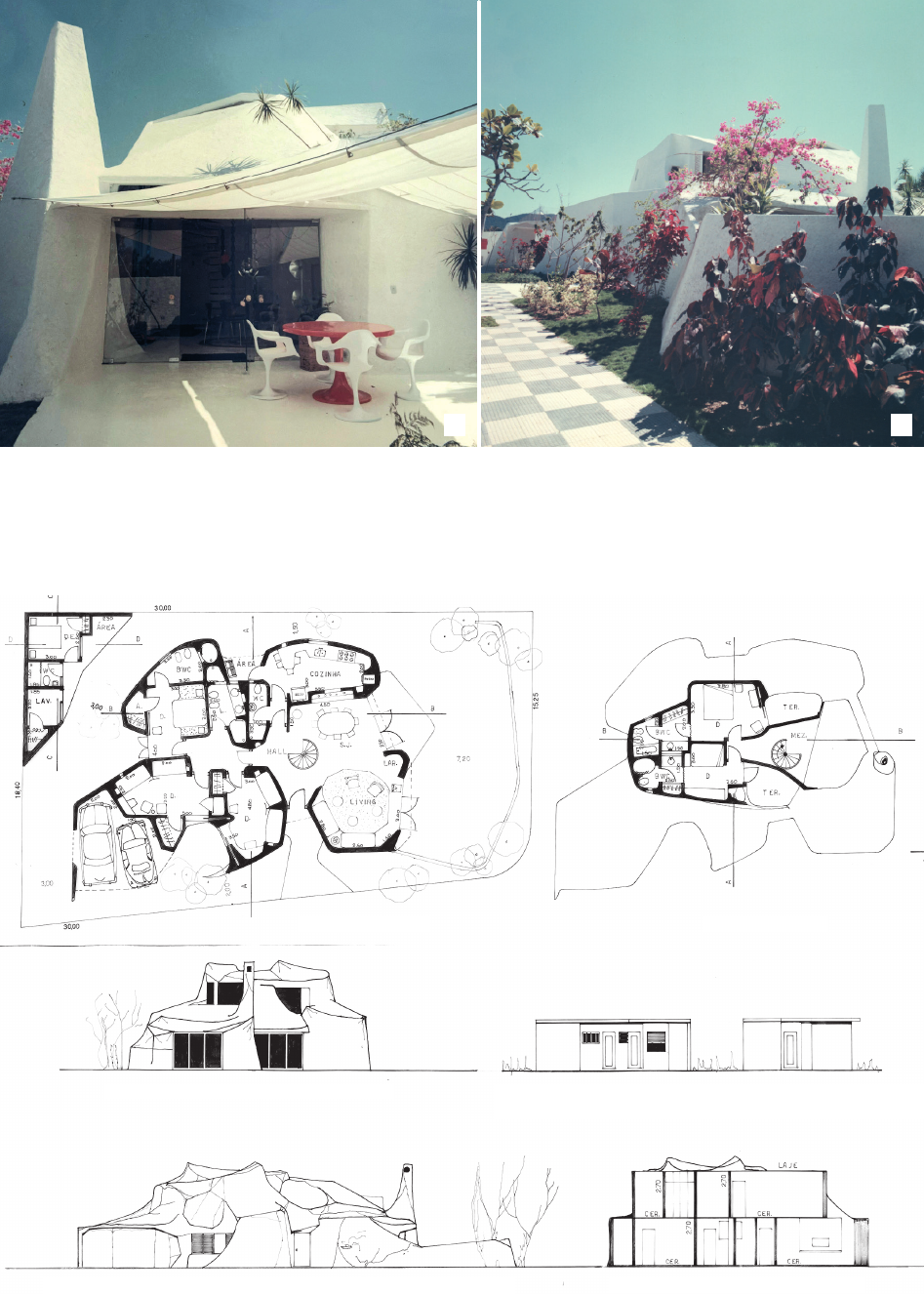
(source: © Jorge Zalszupin, Acervo Casa Zalszupin)
a b
PLANTA BAIXA
CORTE BB
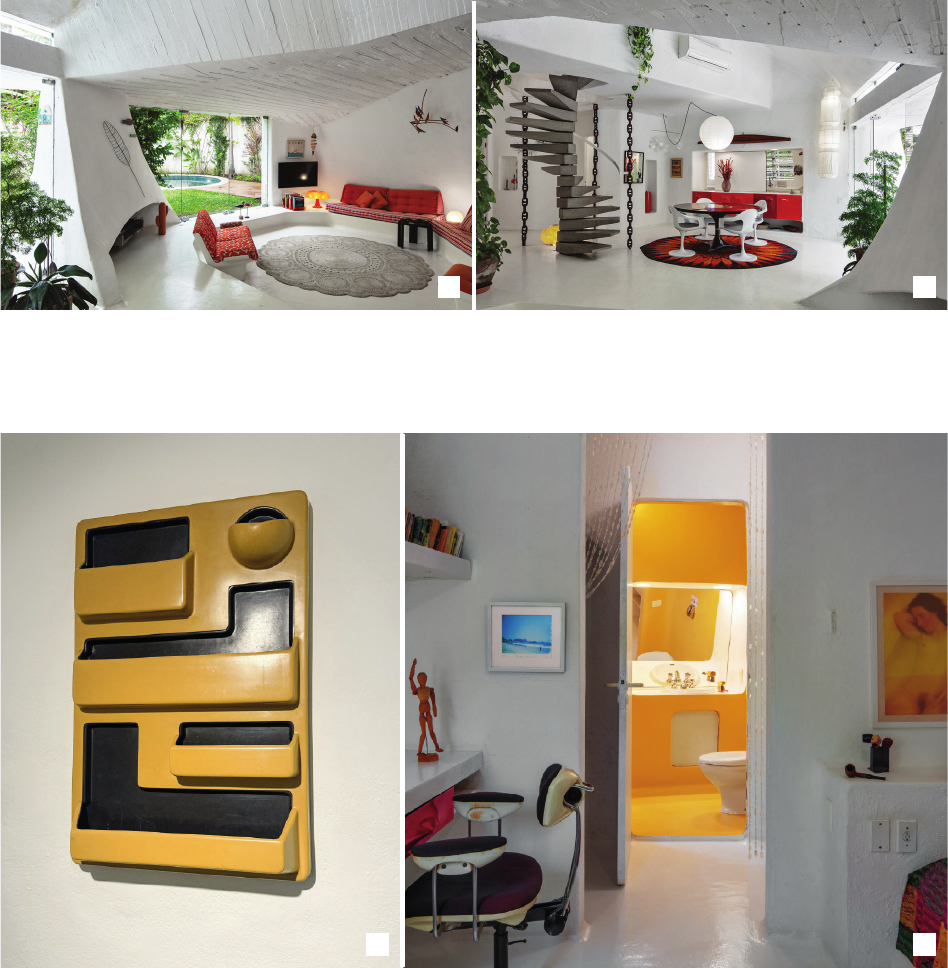
Zalszupin and Brazilian Modernism
inspired the design of futuristic interior spaces. In turn, ref-
erences to the Mediterranean style are evident in elements
such as the white façades, massive walls, small rounded
-
ing staircases. At the same time, the overall design brings
to mind a vision of a house of the future or a space station
rather than the vernacular architecture of the Mediterra-
nean region. This project demonstrates Zalszupin’s clear
exploration of sculptural architecture, inspired by Couëlle’s
works, though in his interpretation these forms remain less
soft – balancing between polygonal geometry and curved
lines with rounded edges. Like Couëlle, Zalszupin used
scale models as a design tool, treating them as experimental
studies of form. According to family members, he also per-
sonally participated in the construction process, collaborat-
-
pervised its progress on site, which allowed him to achieve
a result consistent with his own vision.
This project contributed to the evolution of his architec-
tural language. As demonstrated in this article, however, this
was not an abrupt change, but rather a process that had al-
ready been foreshadowed in his earlier designs. It led to a se-
a b
a b
ries of subsequent projects in a similar style, which were cre-
ated in the years that followed during his professional career.
Discussion and conclusions
In light of the aforementioned remarks, it is possible to
identify the factors that shaped Zalszupin’s unique archi-
tectural language, as well as the context of the transforma-
tion he mentioned in his autobiography.
Zalszupin’s work falls within a period of intense devel-
opment of Modernism, both in Europe and in Brazil, and is
often unequivocally associated with this movement. From
which of the two schools – carioca or paulista – he was
but rather constitutes a reinterpretation of both, a sort of hy-
brid. On the one hand, there is a sculptural quality and visual
expression
of form, as well as a strong connection between
architecture and nature – characteristic of the ca rio ca school.
On the other hand, it is distinguished by the rationality of its
solutions and the emphasis on the raw quality of the material,
forro paulista.
Zalszupin did not apply the principles of Modernism
Corbusier’s thinking. As he himself admitted, he valued
“the purity of line and the rationality of this architecture”
-
der and a desire to transcend rigid rules through the free
shaping of form. In this context, it is also worth noting his
references to the home as a form of shelter, as well as com-
stem from his personal experiences, including those during
the war and his time in exile.
mainstream Modernism. These can be linked to the concept
of a synthesis of architecture and sculpture, popularized by
L’Architecture d’Aujourd’hui,
as well as to the works of Jacques Couëlle. In this sense,
Zalszupin’s architecture is part of a broader search for al-
ternative directions in Modernism. Despite his strong ties
to the European context, maintained through intellectual
dialogue, Zalszupin adapted well to the Brazilian reality,
which was conducive to experimentation, and thus became
part of the local architectural language.
References to the so-called Mediterranean style also play
copied but rather reinterpreted and combined with other in-
spirations, including the space age aesthetic, as well as his
own design work involving the use of plastic, a material that
was new at the time. In this way, an architectural language
-
dernity.
This article discusses only a selected portion of Zal szu -
pin’s work and does not fully capture the complexity of his
architectural legacy. Previous research has focused prima-
rily on industrial design, while Zalszupin’s architecture – de-
spite its originality and exceptional formal sophistication
– remains largely underrecognized and unexplored. It seems
essential to conduct further analyses covering both his archi-
tectural projects and his work in industrial design, as well as
the interrelationships between them. The authors intend to
continue their research in this direction, treating this study
as a starting point for further analyses of the work of this
Polish-Brazilian architect.
Translated by
Krzysztof Barnaś
Acknowledgements
The authors would like to express their special thanks to Acervo Casa
Zalszupin, ETEL, and Verônica Zalszupin for providing source materials.
They would also like to thank the photographers for granting permission
to use their illustrative materials: Fernando Laszlo, Nelson Kon, Rogério
Angoneze Jr., and Ruy Teixeira.
References
cidade de Guarujá.” Revista Don Domênico
Andrade, Mariana Vieira de. “Jorge Zalszupin: contribuições para o de-
-
.
Aujourd’hui Art et Architecture. Sculptured Space – Architectural Space.
Azenha Dias, Maurício. “Arquitetura moderna na praia: residências na
praia de Pernambuco, Guarujá.” Cadernos de Pós-Graduação em Ar-
quitetura e Urbanismo
-
bate.” Studi e ricerche di storia dell’architettura
.
Cartum, Marcos, and Maria Lydia Fiamminghi. Mobília Brasileira Con-
temporânea, edited by Claudia de Brito Lameirinha Bianchi, Centro
Costa Cabral, Cláudia. “Niemeyer no Guarujá.” In Arquiteturas do pat-
rimônio moderno paulista. Reconhecimento, intervenção, gestão,
edited by Audrey Migliani Anticoli, Fernanda Critelli, Silvia Raquel
Falbel, Anat. Lucjan Korngold: a trajetória de um arquiteto imigrante.
Ferreira, Durval. “Estilo Mediterrâneo. A velha arte de bem viver.” Man-
chete
Figueiredo, Vera de. “Vanguarda: cenário do futuro.” Jóia: Revista Fe-
minina Quinzenal
.
Fundação Oscar Niemeyer. Obra / Arquitetura – Pro “412.” Urbanização
no Guarujá
.
Zalszupin and Brazilian Modernism
García Vergara, Marisa, and Antonio Pizza. “The Mediterranean and Mod-
ern Architecture: the Dissemination of a Myth in Architectural Me-
dia.” The Journal of Architecture
.
Goodwin, Philip Lippincott. Brazil Builds: Architecture New and Old,
1652–1942.
-
wybitny-architekt-i-designer-jerzy-zalszupin-nie-zyje-bylem.html.
Le Corbusier. Précisions sur un état présent de l’architecture et de l’ur-
banisme.
Modern Architecture in Brazil. Reinhold Pub-
-
crete Allows for Creativity and Individualism.” Concrete Quarterly
Paris. Ficha Consular de Qualicação no. 91544, Zalszupin Jerzy.
Santos, Maria Cecília Loschiavo dos. Jorge Zalszupin: design moderno no
Brasil
Zalszupin, Jorge. De * para a lua
Jorge Zalszupin: brazylijski design ze słowiańską duszą.
Rozmowa z Jerzym Zalszupinem -
jorge-zalszupin-brazylijski-design-ze-slowianska-dusza-rozmowa-z-
Streszczenie
Jerzy Zalszupin – między modernizmem brazylijskim a jego alternatywnymi interpretacjami
-
nych w Europie i Brazylii w okresie modernizmu.
carioca i pau-
lista
-
Słowa kluczowe: